Climate-conscious fashion
FREE Take a copy
Mary Beard on Nolan’s Odyssey
p.10
p.26-27
No.947 Friday 2nd October 2026 varsity.co.uk The Independent Student Newspaper since 1947
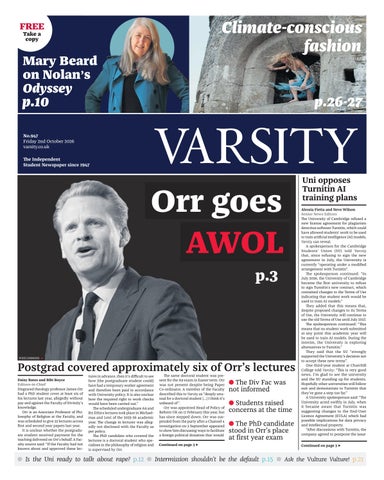
Orr goes AWOL p.3
WIKICOMMONS ▲
Postgrad covered approximately six of Orr’s lectures Daisy Bates and Bibi Boyce Editors-in-Chief Disgraced theology professor James Orr had a PhD student cover at least six of his lectures last year, allegedly without pay and against the Faculty of Divinity’s knowledge. Orr is an Associate Professor of Philosophy of Religion at the Faculty, and was scheduled to give 32 lectures across first and second year papers last year. It is unclear whether the postgraduate student received payment for the teaching delivered on Orr’s behalf. A Faculty source said: “If the Faculty had not known about and approved these lec-
tures in advance, then it’s difficult to see how [the postgraduate student could] have had a temporary worker agreement and therefore been paid in accordance with University policy. It is also unclear how the required right to work checks would have been carried out.” The scheduled undergraduate A9 and B11 Ethics lectures took place in Michaelmas and Lent of the 2025-26 academic year. The change in lecturer was allegedly not disclosed with the Faculty as per policy. The PhD candidate who covered the lectures is a doctoral student who specialises in the philosophy of religion and is supervised by Orr.
The same doctoral student was present for the A9 exam in Easter term. Orr was not present despite being Paper Co-ordinator. A member of the Faculty described this to Varsity as “deeply unusual for a doctoral student […] I think it’s unheard of ”. Orr was appointed Head of Policy of Reform UK on 17 February this year, but has since stepped down. Orr was suspended from the party after a Channel 4 investigation on 3 September appeared to show him discussing ways to facilitate a foreign political donation that would Continued on page 3 ▶
● The Div Fac was not informed ● Students raised concerns at the time ● The PhD candidate stood in Orr’s place at first year exam
Uni opposes Turnitin AI training plans Alessia Fietta and Neve Wilson Senior News Editors The University of Cambridge refused a new license agreement for plagiarism detection software Turnitin, which could have allowed students’ work to be used to train artificial intelligence (AI) models, Varsity can reveal. A spokesperson for the Cambridge Students’ Union (SU) told Varsity that, since refusing to sign the new agreement in July, the University is currently “operating under a modified arrangement with Turnitin”. The spokesperson continued: “In July 2026, the University of Cambridge became the first university to refuse to sign Turnitin’s new contract, which contained changes to the Terms of Use indicating that student work would be used to train AI models.” They added that this means that, despite proposed changes to its Terms of Use, the University will continue to use the old Terms of Use until July 2027. The spokesperson continued: “This means that no student work submitted at any point this academic year will be used to train AI models. During the interim, the University is exploring alternatives to Turnitin.” They said that the SU “strongly supported the University’s decision not to accept these new terms”. One third-year student at Churchill College told Varsity: “This is very good news. I’m glad to see the university and the SU standing up for students. Hopefully other universities will follow suit and demonstrate to Turnitin that they’ve gone a step too far.” A University spokesperson said: “The University acted swiftly in July, when it became aware that Turnitin was suggesting changes to the End-User Licence Agreement (EULA) which had possible implications for data privacy and intellectual property. “After discussions with Turnitin, the company agreed to postpone the issue Continued on page 3 ▶
● Is the Uni ready to talk about rape? p.12 ● Intermission shouldn’t be the default p.15 ● Ask the Vulture Vulture! p.21
Friday 2nd October 2026
2
Easter, Week 0
Editors’ Note This week, we unpacked the last of our boxes in our new office on Trumpington Street. It’s a strange sort of feeling. After 20 years at Mill Lane, the next generation of student journalists will call this place home. As Editors, this puts us under some pressure: what if, amid all this change, things go awry? We needn’t have worried: this edition is full of stories that teach us to embrace the messiness of student life, whether that’s a game of duel (p.8) or a culinary disaster (p.20). Across the Newspaper, our reporters remind us of the importance – and the complexity – of making our voices heard. In News, we hear from several student societies who have raised concerns about the recently launched review intended to outline the support offered to Jason Arday (p.6). His death this summer sent shockwaves through the University community. Our thoughts remain with his family.
In Features, Varsity hears from rape survivors (p.12) about the ramifications of sexual violence on their student experience, and the ways they hope to see the University step up. On the next page, Daniella Adetoye discusses what it means to find community as a Black student in Cambridge (p.13), and asks why marginalised students are made to do the heavy lifting. Academic pressure can encourage students to let their problems fall by the wayside, but these stories are testament to the power of speaking out. From running recs (p.31) to watchlists (p.24), this year shows no sign of slowing down. Unless you’d rather stand still like Girton or Homerton in the Tompkins Table (p.4)… how’s the view from down there? We’re kidding. We go to Robinson and Medwards. Our Vulture Vulture, new for this print edition, reminds us to not take things too seriously. Join that society, or don’t. Ask out your lecture crush, or spend the
whole year pining. It doesn’t matter – we’re here to make mistakes, to muck up and try again, to make bird pun after bird pun… or maybe that’s just some of us. SQUAWK! Rounding out our first print week as Editors, we’re filled with a sense of accomplishment that won’t end even if this edition finds its way into your bin. These pages may be fleeting, but their stories hold real impact, and something similar could be said about our student years. Whether this is your first Michaelmas or your last, we welcome you back to everchanging Cambridge. Here’s to a new year of experiences: enjoy it, it goes fast.
Daisy Bates & Bibi Boyce Editors-in-Chief MICHAELMAS 2026
editors Daisy Bates & Bibi Boyce editor@ varsity.co.uk deputy editors Olivia Goodman & Emma Tenzler deputyeditor@varsity.co.uk vulture editors Emma Gower & Daniel Kamaluddin magazine@varsity.co.uk news Alessia Fietta & Neve Wilson (Senior); Maebh Carey, Jacob Smith, Hayley Butler, & Benjamin Pine (Deputy) news@ varsity.co.uk; Skyler Roberts (Investigations) comment Jasper Burnside, Lily O’Sullivan, & Dexter Twycross opinion@varsity.co.uk features Bryony Clarke & Phoebe Leung features@varsity.co.uk interviews Faron Smith & Sam Elgar interviews@varsity.co.uk science Sophie Patel & Yu Tong science@ varsity.co.uk sport Daisy Kaye & Sophe Hardman sport@varsity.co.uk lifestyle Cherie Wong & Ruby Randall lifestyle@varsity.co.uk arts Juliette Berry & Ben Bailey arts@ varsity.co.uk fashion Rachel Jones & Scarlett Prunty fashion@varsity.co.uk fashion shoot co-ordinator Emer Naylor Afram film & tv Daniella Adetoye & Amanda Ljunberg filmandtv@varsity.co.uk music Lauren Quinn & Dylan Ingram music@varsity.co.uk theatre Lucy Farmer & Barney Sayburn theatre@varsity.co.uk photography editors Clio Sze & Gabriella Douglas-Kitsis illustrations editor Rosie Beyfus sub-editors Ell Heeps, Joss HeddleBacon, Sophie Giles, Natasha Simm, Ariela Ohrenstein & Lucia Taylor subeditor@ varsity.co.uk associate editors Charlie Rowan, Ell Heeps, Sophie Ennis, Leo Kang Beevers, Joss Heddle-Bacon, & Ben Lubitsh associate@ varsity.co.uk business manager Mark Curtis business@ varsity.co.uk varsoc president Bibi Boyce president@ varsity.co.uk varsity board Dr Michael Franklin (Chairman), Dr Tim Harris, Michael Derringer, Mark Curtis (Company Secretary), Hugo Gye, Ell Heeps, Daisy Bates, Bibi Boyce (Directors), Lotte Brundle (Guest), & Zoah Hedges-Stocks (Guest) © VARSITY PUBLICATIONS LTD, 2026. All rights reserved. No part of this publication may be reproduced, stored in a retrieval system or transmitted in any form or by any means electronic, mechanical photocopying, recording or otherwise without prior permission of the publisher. Varsity, 1 Trumpington Street, Cambridge CB2 1QA. Telephone 01223 337575. Varsity is published by Varsity Publications Ltd. Varsity Publications also publishes The Mays. Printed at Iliffe Print Cambridge – Winship Road, Milton, Cambridge CB24 6PP on 42.5gsm newsprint. Registered as a newspaper at the Post Office. ISSN 1758-4442
Friday 2nd October 2026
3
News
Orr absent at undergrad Ethics lectures The fellow reportedly missed lectures in both Michaelmas and Lent Continued from front page have been illegal. Reform deny all allegations against them. Following the reporting, the Metropolitan Police launched a formal criminal investigation into Reform over potential breaches of electoral law. The University of Cambridge said it was “looking into” Orr’s conduct after the Channel 4 investigation. The University has not, however, acknowledged publicly the allegations of internal misconduct made by the FT. Varsity understands the PhD scholar covered at least six lectures. Both the A9 and B11 lecture series ran through Michaelmas and Lent, with the lectures timetabled back-to-back on Fridays. Students confirmed to Varsity that at least two B11 lectures and between four and five A9 lectures were not delivered by Orr, with the missed lectures occur-
ring across both Michaelmas and Lent. Varsity has heard that several students raised concerns with their Directors of Studies at the time. Senior members of the Divinity Faculty were allegedly only notified that these lectures had been covered by the PhD student after the lectures had taken place. In emails between senior members of the Faculty, a fellow confirmed that Richard Rex, the Faculty Chair, had “promised to investigate” the matter. In response to separate allegations made by the Financial Times, the University stated that it had “no reason to believe
that Dr Orr’s external roles have adversely affected his performance of his contractual duties”. One faculty member told Varsity that the University’s statement “just cannot stand up”. The FT also reported that Orr arrived late to the online exam board meeting for a final marking review in June of this year. That week, Orr was attending the Alliance for Responsible Citizenship (ARC) conference, an annual gathering of mainly Christian British, European and American conservatives. He maintained to the FT that he “chaired the examination process thoroughly and properly”. Speaking to Varsity, one student described Orr’s lectures as “vague and rambling” and that without College support they would “not have done
▲ HOLLY HARDMAN
well in that module”. Commenting on Orr’s position as direct supervisor to the PhD candidate, one member of the Divinity Faculty told Varsity: “The doctoral supervisor-student relationship seems to me to have been significantly complicated by this arrangement”.
32
Number of lectures Orr was scheduled to deliver
Orr has previously described his family home in the north of Cambridge as a “compound”. At least two other flats that Orr and his family own on the same road house a group of postgraduate students who pay rent and do chores. Joshua Heath, a Cambridge research fellow in Christian theology and philosophy, suggested to the FT that Orr could be using his financial and intellectual capital to attract “ideologically pliable” students, and said he worries that these arrangements prey on the vulnerabilities of graduate students. In response to a request for comment, a spokesperson for the University of Cambridge said: “We have clear policies and processes in place to protect our students and staff. We cannot comment on individual cases because our students and staff have a right to confidentiality”. James Orr and the Faculty of Divinity were contacted for comment.
Uni anti Turnitin AI training plans Alternatives to the plagiarism detection service are now being explored Continued from front page of a new EULA until September 2027. Turnitin has confirmed that no student or staff data has been used to develop any generative Artificial Intelligence models or Large Language Models, and that it has no plans to use student essays in this way. “Discussions will now continue with Turnitin, but we are clear that we will not accept any changes to the EULA that impact on data privacy or intellectual property.” Cambridge first began trialling Turnitin in the academic year 2007-2008, with an increasing number of faculties and departments subsequently adopting the software. Some faculties and departments at the University of Cambridge use Turnitin for blanket checks of all assessed work submitted online by students, including the Department of Computer Science and Technology, and the Faculty of History. However, other departments use Turnitin selectively, either conducting checks at random or submitting work to Turnitin when there are existing grounds for concern. For instance, the Department of Psychology only submits work to Turnitin that is deemed “suspicious,” while the Department of Engineering claims that submitted work “will be subjected to spot checks from time to time, or in cases where there is cause for concern”. Students across the country have
raised concerns over the use of Turnitin at UK universities, in light of the proposed changes to the software’s licence agreement. SUs at universities such as York, St Andrew’s, Lancaster, Reading, and East Anglia have either planned or already undertaken discussions with their universities about concerns surrounding the use of Turnitin. Sam Dickinson, union affairs officer at York Students’ Union, commented: “The key issue here is that students’ intellectual property is something that should belong to them.” Dickinson added: “If your university is using Turnitin and it’s using studentsubmitted work to train AI services, you can’t meaningfully consent to that because you have to submit your work to get marked.” While the University of York has said it will review changes to Turnitin’s terms and conditions, the University of Southampton has announced it will begin “phasing out” its use of Turnitin “immediately,” and will not renew its contract with the platform after the 2026-27 academic year. “While we understand Turnitin has postponed changes to the end-user licence agreement that would have allowed it to use student submissions to train AI services, it has not fully clarified what future changes may be imposed,” a spokesperson for the University of Southampton said. Turnitin uses machine learning to
help identify plagiarism, comparing students’ work to previous submissions and existing academic articles. The company previously proposed updating its End User Licence Agreement (EULA) to allow it to use student work in the development and improvement of AI tools. Institutions would have had to accept the new agreement to continue using the service. A Turnitin spokesperson said: “We recognise the great responsibility that comes with our customers’ trust to protect their data, which we have prioritised for nearly
30 years. We acknowledge that the introduction of AI in education raised new questions and concerns about data use and privacy. We are committed to being transparent around AI product design and data use and do not train a generative AI ▴ABDULLAH NADEEM model. We have recently released the Turnitin Trust Centre, which covers Turnitin’s AI principles, AI definitions, how AI is used in Turnitin products, what customers can control, and the full privacy policy.”
Benjamin Pine delivers news from around Cambridge Corn Exchange concert to celebrate Pink Floyd founder Pink Floyd co-founder and frontman Syd Barrett will be celebrated in a tribute concert at Cambridge Corn Exchange on 10 October. The concert falls on what would have been the singer’s 80th birthday, which is also World Mental Health Day. Barrett was born in Cambridge in 1946, and, after meeting his bandmates in London, went on to write much of Pink Floyd’s early material. Barrett’s sister told Cambridge Independent he “would have laughed” at the concert, adding: “he never ever could get his head round the point of celebrity. He was just having fun – as simple as that”.
Community café opens in Arbury A community café has opened at the Meadows Community Centre in Arbury, in northern Cambridge, last Thursday (24/09) to raise money for projects distributing food to the local area. The Arbury Social, which will operate from Monday to Friday, will serve food made from locally sourced and surplus ingredients, and host cookery sessions and shared meals. Founded in collaboration with Cambridge City Council, the café will put its profits towards schemes which provide food to people in the area, including holiday lunch programmes and “community food events”. Alongside the café’s opening, the Council announced a range of locally sourced, sustainable ready meals “to increase access to good food”.
Bus routes set to be tweaked
▲ AMIKA PIPLAPURE
Bus routes across the region will be updated under plans put forward by the Cambridgeshire and Peterborough Combined Authority, the body responsible for transport. According to the plans, several routes into Cambridge will be tweaked, and a new service will pass through west and north Cambridge to “better match local travel needs”. The plans follow a consultation on the public’s priorities for buses, and are expected to gradually come into effect in 2027. The Authority also plans to introduce bus franchising, under which it would have more control over services, using powers given to mayors by Westminster.
Friday 2nd October 2026
4
News
▲ MADE WITH FLOURISH
Tompkins Table 2026
Neve Wilson and Alessia Fietta Senior News Editors Trinity College has retained its spot at the top of the Tompkins Table for the third year in a row. The table, shared exclusively with Varsity, was established in 1981 by then third-year Trinity mathematics student Peter Tompkins, and ranks colleges according to their undergraduates’ exam performance. Tompkins uses exam results from across all years of undergraduate study, and employs a points-based system where each First receives five points,
each 2:i receives three points, each 2:ii receives two points, and each Third receives one point. While the Tompkins Table is not officially affiliated with the University of Cambridge, the University uses a similar, internal inter-college academic league table called the Baxter Table, which is not usually available to the public. However, unlike the Baxter Table, the Tompkins Table uses a weighting system to account for differences in the subjects taken by students at each college, noting that certain subjects may have different proportions of high-scoring students.
Trinity beat Christ’s by 1.26 percentage points this year, compared to 1.62 percentage points in 2025. This represents a slight relative gain by Christ’s on Trinity. Selwyn comes in third on the 2026 table, just 0.08 points behind Christ’s, with Queens’ and Gonville and Caius rounding off the top five. Trinity has come first in the Tompkins Table every year since 2024. Before that, Christ’s had a period of dominance between 2018 and 2024, and Trinity was at the top of the table between 2011 and 2017.
Reacting to the College’s retained dominance, one Trinity student emphasised the “nuanced” conversation surrounding academic pressure at the College, telling Varsity: “None of my supervisors have ever suggested that I would be less valuable in their eyes if I didn’t get a First […] I think Trinity, essentially, has the financial power to attract a lot of really intelligent academics, and the academics do their best to help you get as high a mark as you can”. Trinity has the highest endowment of any Oxbridge college. They added: “I think a lot of the pressure comes paradoxically from the students themselves, or rather from their peers. Students at Trinity tend to be fiercely competitive with one another, and very eager to get a better result than their friends.” On Christ’s placing second, the College’s JCR Welfare Officer said that “the College provides a great variety of welfare support,” and that “the students themselves also support each other,” which “creates a really supportive and friendly community”. Pembroke rose nine places in the table, moving from sixteenth to seventh, while Downing and Peterhouse both fell nine places to fifteenth and nineteenth respectively. A Peterhouse student reacted: “Peterhouse is a small college so we will be more statistically volatile year on year than most. I’m very happy with the teaching provided by the college [...] [and] I don’t think we make a compromise between results and team spirit. I heard we did pretty good in Bumps this year so I think you can cut us some slack on this one.”
A student at Downing also told Varsity: “The worth of a student or the feeling of belonging at a college isn’t measured by how many Firsts it gets. Academic achievement is obviously important, but what the Tompkins Table leaves out is whether there is a feeling of community and opportunities to develop outside your degree.” The colleges at the bottom of the Tompkins Table for 2026 were Murray Edwards, Girton, and Homerton. One Homerton student noted: “The margins between colleges are small, and I think they reflect different outlooks on balance. Homerton demands academic excellence like any Cambridge college, but it doesn’t ask students to sacrifice their wellbeing for a few extra marks, whether that means taking part in extracurriculars or taking time when they need it.” They added: “I wouldn’t want prospective students to be put off by the ranking. Nothing about the College hinders you from getting a First, and I’d hate to see a self-fulfilling prophecy where people won’t take a chance on a newer, less central college.” The Tompkins Table has met controversy over the years regarding the use of academic performance as the single indicator marking a college’s success. The University of Oxford officially scrapped its equivalent – the Norrington Table – in 2024, although this was an official metric used by the University.
Sum Fun Place the digits 1–5 once each in every row and column. All coloured boxes' sums are multiples of one another (e.g., the sums could include 2, 6, 1, 12, 2, 24...). The grey square does not have the smallest sum.
Your career at d-fine We are a European consultancy firm focussed on analytical and quantitative topics and the development of sustainable solutions to bring about positive change for our clients. What does d-fine offer you? - Diversity: Work with clients on topics ranging from financial engineering and machine learning through to climate risk and healthcare - International: Collaborate in project teams staffed across Europe - Education: Acquire new skillsets to broaden your technical and professional repertoire Who do we look for? Master’s or PhD-level graduates in STEM fields
www.d-fine.com
Berlin, Dusseldorf, Frankfurt, Hamburg, London, Milan, Munich, Stockholm, Utrecht, Vienna, Zurich
Friday 2nd October 2026
5
News Neve Wilson Senior News Editor Former Cambridge Students’ Union (SU) Disabled Students’ Officer (DSO) Chalo Waya has had his employment tribunal claim against the SU and four individuals struck out. Waya brought a number of claims against the SU, including unfair dismissal, age, race, and disability discrimination, victimisation, whistleblowing detriment, and unlawful deduction of wages, as well as allegations of blackmail and intimidation which were outside of the tribunal’s jurisdiction. Waya told Varsity that his concerns related “not only to my personal circumstances but also to issues which I believed affected the students I was elected to represent, particularly disabled students”. SON DER
H AN
RA ▼ SA
Waya is a PhD student in English and Comparative Literature, and was elected in March 2024 to the position of Disabled Students’ Officer (DSO) for 2024-2025. The tribunal heard that, although he was meant to begin his role as DSO on 7 July 2024, he did not start until 3 September. As an international PhD student, Waya required permission to intermit from his college and the University, as well as his PhD funders and the Home Office, before he could officially start the role. Waya did not undertake any duties in July or August, and the SU initially withheld his pay for these months before voluntarily offering 50% of the disputed pay. Among his other claims, Waya alleged that the SU’s failure to pay him his full salary for July and August constituted an “unlawful deduction of wages”. He lodged his claim form on 21 May last year against the SU and four other named individuals after the parties failed to reach a settlement agreement in an early conciliation process that took place between 1 and 7 May. The SU subsequently argued that the unlawful deduction claim should be struck out because it was out of time, and that Waya’s discrimination, victimisation, and whistleblowing allegations were too vague. At a case management preliminary hearing held on 6 May, employment judge Laidler asked Waya to provide further information about his
claims. The information requested included an impact statement and medical evidence in relation to his disability, further information about the whistleblowing and victimisation complaints, and names of alleged white colleagues who he said could be used as comparators in his race discrimination claim. Waya was also told to provide further information about his allegation that the SU had briefed against him to third parties, alongside evidence of his means and ability to pay a potential deposit order. A deadline of 18 June to provide additional information was given, and a public preliminary hearing was then listed for 23 July 2026 to determine whether some or all claims could be struck out, or whether Waya would be required to pay a deposit before proceeding with allegations. Waya subsequently requested 28 additional days to provide additional information and for the 23 July hearing to be adjourned for at least 28 days. He cited having an opportunity to write a journal article and participation in a summer school. The tribunal granted a seven-day extension for Waya to provide additional information, but refused his request to postpone the hearing. On 25 June, Waya said he could not meet the extended deadline, as he had been “in great pain and laid up for weeks”. On 26 June, the SU applied to have the claim struck out on several grounds, including unreasonable conduct, non-
compliance with a tribunal order, lack of reasonable prospects of success, and that a fair hearing was no longer possible. On the afternoon of 22 July 2026, Waya sent an email to the tribunal and the SU claiming he would attend the hearing despite being “unwell” and “weak”. While the email made a number of allegations about the SU’s behaviour, it did not provide the information previously ordered by the employment judge Laidler. Waya, who brought his claim without legal representation, told the hearing that he was not prepared and had not read the SU’s strike-out application because he had been unwell, which had left him bedridden and unable to do anything. When asked for medical evidence to support this, Waya said he had been too unwell to go to the GP and had been unable to arrange an online consultation but had arranged an appointment for the following day. Waya stated that he could not comply with the orders until the SU provided data in response to the access request he had submitted in April. He also said that he would not be able to comply with employment judge Laidler’s orders until he had submitted at least three chapters of his PhD thesis by January 2027. During the adjournment of the hearing, Waya submitted a 14-page written document for the judge to read, which he prepared.
Employment judge Moore ultimately concluded that Waya had not complied with the tribunal’s orders by the original deadline of 18 June, extended deadline of 25 June, or by the hearing on 23 July. Waya also never provided evidence of his means in relation to a potential deposit order. Judge Moore said that Waya had provided no medical evidence that he was unable to comply with the tribunal’s orders. The claim was ultimately struck out due to unreasonable conduct and failure to comply with a tribunal order. In the notes recording the tribunal case, Waya stated that he intends to appeal the tribunal’s decision. Waya told Varsity that he has now initiated the appeal process. The SU told the tribunal that it intended to make an application for costs against Waya. While a costs hearing was scheduled for 17 November, the SU has since told Varsity that it will not be pursuing costs. A spokesperson for the SU also told Varsity: “We are grateful for the judge’s ruling. We have been insistent from the start that there was no case to answer, but it has nonetheless taken time away from the SU.” The SU added: “We take all allegations, particularly those of discrimination seriously, however it was clear in this case that these allegations were unfounded.” The strike-out was a procedural decision and the tribunal did not determine the merits of Waya’s allegations.
Could a PhD in Management be your next step? Develop the ideas that shape business and society. The INSEAD PhD prepares the next generation of management scholars through a fully funded, five-year doctoral programme*. Whether your background is in economics, engineering, computer science, psychology, or the social sciences, we welcome applicants with the foundations for rigorous research and the curiosity to ask meaningful questions.
INSEAD PhD in Management Five-year scholarships*, regardless of background Highly diverse academic community: 82 students from 26 nationalities Study in France and Singapore; PhD Exchange in the US with Wharton** Close collaboration with world-leading faculty Graduates placed at leading business schools worldwide Strategic alliances with Wharton and Sorbonne (dual-degree**; behavioural lab) Now accepting applications for the mid-August 2027 intake inse.ad/why-insead-phd | inse.ad/phd-apply | inse.ad/phd
Scan to contact us or click https://inse.ad/phd-inquiry-cambridge *more info at https://inse.ad/phd-financing; **optional
6
Friday 2nd October 2026
News
Student concern over Arday review Alessia Fietta and Neve Wilson Senior News Editors Members of the University of Cambridge have raised concerns relating to the scope of the University’s independent review which was launched last month, following the death of professor Jason Arday. On 4 September, the University of Cambridge announced that it was launching an independent review to examine both the welfare protections available to the professor before his death and wider institutional practices. The review will consist of two parts. Part one, led by Nazir Afzal – former Chief Crown Prosecutor for North West England and chancellor of the University of Manchester – will examine the support, interventions, and protections made available by the University to Professor Arday in the period before his death. Part two will more broadly investigate institutional processes and practice related to Arday’s appointment and time at the University, but will not review the inquest process. This part of the review will consider aspects such as the University’s recruitment of senior academic staff and the support available to academics at Cambridge who experience “extraordinary” public and media scrutiny. It is expected to conclude within six months of the panel being established.
However, following the University’s initial launch of the review, the Cambridge Students’ Union (SU) released a statement, alleging that “the University has swiftly and quietly set up the ‘independent’ review themselves”. The SU continued: “To be clear, this announcement came as a surprise to us. We wish to emphasise, and severely condemn, the fact that this decision has been made without any substantial student involvement.” It added: “The terms laid out for the review are also notably narrow, responding to what they have attempted to delineate as two neatly contained issues. But this is inadequate: the treatment and experiences of Professor Arday are the product of far more wide reaching structures of institutional racism.” After the review was launched, a meeting took place between two SU sabbatical officers, the presidents of several black student-led societies, and the University’s pro-vice chancellors, Bhaskar Vira and Kamal Munir. At the meeting, students demanded that protocols be introduced on how to support students and academics who experienced racialised attacks. In a second meeting, the SU sabbatical officers, pro-vice-chancellors, and vice-chancellor Deborah Prentice discussed the SU’s concerns with the independent review. In a social media post, the SU said it
had been agreed that, in future, the SU would be kept updated on the investigation through fortnightly meetings between the SU presidents and senior University leadership. Regarding the review, the Cambridge University Amnesty International Society told Varsity: “We welcome the investigation and call on the University to ensure it is as transparent as possible”. However, professor Oliver Linton, chair of the University’s Faculty of Economics, told Varsity: “Rather than undertaking a genuinely searching review of the wider institutional decisions and processes involved in that case, the University has now narrowed its review substantially so that it is essentially only concerned with whether sufficient support was provided to Professor Arday”. When announcing the review, Prentice said: “We worked very hard to support Professor Arday during an appalling period of external criticism and focus, but given the devastating outcome, we are all asking ourselves whether we could have and should have done more. This review will answer that question.” Afzal officially launched Part One of the review on 14 September. The review does not directly involve Jesus College, but the College has agreed to be part of the process. The University is able to withhold documents if it explains its reasoning. However, the University has suggested that it has no intention of withholding
documents subject to applicable requirements. In reference to Arday, Afzal said: “Professor Arday was autistic, he was Black, and he was under a sustained public attack that included ridicule of his personal history. Any competent review [...] has to engage with all three of those facts”. Cambridge for Palestine (C4P) said: “The appointment of Nazir Afzal does not provide much comfort. Despite his credentials, the fact of him being an internal appointment is a great cause of concern.” The University has highlighted that the University Council, which appointed Afzal to serve as the independent lead, includes three student members. A summary of the review’s findings and resultH ing actions is TE ▼
set to be shared with the public. The University of Cambridge was contacted for comment.
AN RY
Get in touch
We’re excited to connect with ambitious and fresh talent ready to make an impact on our team. davincitrading.com
THE HIGH-TECH RECRUITMENT EXPERTS
CAMBRIDGE UK Software • Electronics • Mechanical • Maths & Physics Applied Sciences • Consultancy • Graduate / PhD
Let us do the detective work. From knowing what jobs are out there to advice and guidance through the hiring process, we work with you. Da Vinci is a propietary trading house made up of some of the sharpest minds and most passionate players in the industry.
01223 81 33 99 register@ecmselection.co.uk ecmselection.co.uk/university
Friday 2nd October 2026
7
News
Uni staff criticise senior restructuring Alessia Fietta Senior News Editor The University Council’s proposals to restructure the University of Cambridge’s senior administrative offices and create the new senior administrative role of Chief Operations Officer (COO) have been met with concerns. Staff state that the University is overcomplicating an already “large and increasingly complex senior administrative structure”. Criticism of the plans comes amid concerns surrounding the recent events relating to the Professor Wyn Evans whistleblowing case and the death of Professor Jason Arday, which have been linked by some staff members to the University a d -
ministration’s “bureaucratic” structure. Earlier this year, the Council consulted University members on proposals to reorganise the senior administrative offices. The original proposal involved dividing the Registrary’s responsibilities between the existing Registrary and a new COO, in an effort to make the roles more manageable and to improve coordination across the University’s professional services. In light of the feedback that they received, the Council revised their proposal into a three-pillar structure, consisting of the Registrary, in charge of governance and legal affairs; the COO, responsible for operations; and the Academic Secretary, responsible for academic planning, education; and research operations. On 30 June, the Council formally proposed its plans. However, in a discussion ▼ LO
UIS
ASH
WO RTH
with members of the Regent House in July, concerns were raised over issues such as whether senior responsibilities should be delegated to staff who are not University officers, and whether the restructuring would help alleviate the University’s financial pressures. Ronald Haynes, senior computer officer at the University, said: “at a time when austerity is bweing broadly enforced, it does not look like these options help reduce the overall budget concerns”. Dr Michael Rutter, another computer officer at the University, argued: “the proposed change to Statutes and Ordinances would enable the Council and General Board to allocate any duty of the Registrary, the Academic Secretary, or the Chief Operating Officer to a postholder”. Rutter added: “It is difficult to see why the duties, and presumably responsibilities, of some of the most senior roles in the University should be assigned to non-officers.” Although the Council responded to the Regent House’s discussion by acknowledging concerns surrounding the delegation of senior officers’ duties to non-officers and removed this change from their proposal, it also emphasised that the main purpose of the restructuring was not to save money, but to improve the coherence and efficiency of senior roles. The Council submitted two ‘Graces’, or petitions, on 29 July, asking the Regent House to approve its proposed changes to the senior administration’s structure. In
August, 35 members of the Regent House requested a vote on each of the Graces, both of which had been set to go to a ballot in October. However, a group of 25 Regent House members later proposed an amendment to ‘Grace 2’, which would remove the COO position and instead establish a two-pillar structure consisting of the Registrary and the Academic Secretary. This amendment was rejected by the Council on 21 September, on the grounds that it was fundamentally incompatible with the Council’s proposal given the recommendation that the COO position be removed. The vice-chancellor consequently ruled that the amendment could not be considered, and that the original Grace would go ahead to a vote in October. On the Council’s plans, Professor Oliver Linton, Chair of the Faculty of Economics and Trinity fellow, told Varsity: “I signed the amendment because I do not believe the University has made a convincing case for creating an additional Chief Operating Officer role. “[…] That concern is particularly acute given the events of the last few months. The Wyn Evans whistleblowing case exposed very serious shortcomings in the way the University administration handled concerns raised by one of its own staff. We have also had the deeply damaging Jason Arday affair.” Linton added: “The central problem at Cambridge is not an absence of senior administrators. It is that responsibil-
ity can too easily become dispersed through a complicated bureaucracy, while academics and the Regent House find it increasingly difficult to establish who actually made a decision and who is accountable when things go badly wrong. Adding another layer at the top risks making that problem worse rather than better.” Professor Matthew Kramer, Director of the Cambridge Forum for Legal and Political Philosophy and fellow at Churchill, commented: “On this issue, my main concern has been with the proliferation of administrative positions within the University at a time when academic positions are increasing far more slowly.” Senior computer officer Ronald Haynes also said that the proposals were “substantial yet controversial,” raising questions whether the reorganisation had received sufficient consideration and discussion to go to a vote. A University spokesperson said: “The proposals do not increase the number of senior staff as the position of Chief Financial Officer is being retired at the same time. The new Chief Operating Officer will be instrumental in delivering greater efficiency and effectiveness from our professional services.”
8
Friday 2nd October 2026
News in brief Railway repairs
Tripos-friendly sport
Railway maintenance works are scheduled between Cambridge North and Ely for some weekends this October to ensure services can function efficiently. The repairs include signal improvements, timber replacements, and general inspections of equipment. Cambridge trains are affected on the 10th, 11th, 17th, 18th, 25th, and 31st of October, with rail replacement buses running instead. The repairs will affect trains going to locations such as London King’s Cross and Stansted Airport. Martin Beable, COO for GBR Greater Anglia, justified the month-long repairs as “vital work to keep services operating safely and reliably for our customers”.
Two sisters from Cambridge have designed a new, accessible racquet sport, inspired by the hectic nature of student life. Avallon and Honour Constable heard cantabs complain about not having enough time to exercise, and created a sport called ‘duel’. The aim of the game is to hit a shuttlecock towards your partner’s torso, for about 15 minutes, with a portable racquet. The racquet was on display at the 2026 London Design festival, and an exhibition of the game is planned for 15 October. Discussing the frantic Cambridge timetable, the sisters said “students were saying not taking part in sport might have been having an effect on their grades,” and are seeking to introduce healthy habits during a busy academic timetable.
Pollinator protection The University, alongside the Bumblebee Conservation Trust, is launching a £907,000 scheme to grow the population of Moss carder bumblebees. The organisations intend to work with landowners, primarily in Cornwall, Kent, and the North Pennines, to trial different habitat changes for the species. The Moss carder bumblebee is one of the most endangered types of bee due to its habit of foraging close to where it lives. Habitat loss and fragmentation of colonies, due to changes in the British countryside, has threatened this habit in recent years. Those involved say the plans “demonstrate how targeted investment can support practical conservation on the ground”.
UNIQLO opens in Cambridge The popular Japanese clothing brand UNIQLO, famous for its quality and construction, opened its store in Cambridge on 24 September, partnering with the University to produce a line of merchandise. The collection includes t-shirts featuring the University and Cambridge sport logos, lion, and images of student life, and is exclusively available in the St Andrews’ Street store. The shop also contains a mural by local artist Lele Saa, designed to look like a map, highlighting famous parts of the city along the banks of the river Cam. Alessandro Dudech, COO of Uniqlo UK, said the company was excited to “become part of such a vibrant and internationally renowned city,” while working with local people and organisations.
20% OFF ALL BOOKS FOR HOLDERS OF CAMBRIDGE UNIVERSITY AND CAMCARDS SIMPLY PRESENT YOUR CARD IN STORE WE ALSO STOCK A WIDE RANGE OF CAMBRIDGE RELATED GIFTS AND SOUVENIRS
Maebh Carey rounds up student news from across the country
Illustration by Richard Briggs
Oxford X Open AI
1 Trinity Street, Cambridge CB2 1SZ 01223 333333
bookshop@cambridge.org
Offer can’t be combined with other promotions
The University of Oxford has allowed OpenAI to train its AI models using digitised historical texts in the Bodleian Library, the largest university library in the UK. Oxford said it aimed to use OpenAI software to digitise texts from the Bodleian Library and make them more accessible for students and researchers, but did not state that that this data would be used to train future generations of large language models (LLMs). Meeting minutes obtained following a Freedom of Information request show concerns from various Oxford staff, including members of the Bodleian Library’s own governance committee. These concerns included the impact the partnership could have on Oxford’s reputation, and its potential contradictions with the University’s climate commitments. Although similar agreements have been struck with prestigious US universities, Oxford is the only UK university known to have done so.
Oil heir made Newcastle professor of sustainability Newcastle University has faced criticism after announcing it had appointed Anant Ambani, the son of an oil baron who owns the largest oil refinery in the world, as its new professor of sustainability. Ambani’s father is the wealthiest person in India, making much of his fortune from
Friday 2nd October 2026
9
News
Evans tribunal finds Uni failure Varsity News Professor Wyn Evans’ employment tribunal has raised questions about the University of Cambridge’s process for insurance claims, a Varsity investigation has found. 11 of 14 of Evans’ complaints to the tribunal were ultimately upheld in August this year. This includes a complaint about the University’s lack of investigation into its funding of former Institute of Astronomy head Richard McMahon’s legal costs in a defamation case. The University provided insurance funding to McMahon despite later claiming that the defamation case was a private dispute. However, the tribunal also rejected a complaint about the University’s investigation into its insurance protocols. Evans filed a defamation case against McMahon in July 2022 in response to an internal investigation into complaints raised by McMahon about Evans and other individuals in 2021. McMahon notified the University of the defamation case in August 2022, and was later granted cover under one of the Libel and Slander policies that the University maintains with its insurer. The policy continued to support McMahon until approximately November 2023, the same month the defamation case was
oil and gas via his conglomerate, Reliance Group. The new professor focuses on renewable energy in his role on Reliance Group’s executive board, and owns a vast private zoo near his family’s oil refining facilities. Ramachandra Guha, who has written on Indian environmentalism, described it as a “mystifying choice,” adding that many other Indian individuals have contributed more to environmentalism and questioning whether the university did its due diligence. Professor Matt Perry, chair of the University and College Union at Newcastle, also said that staff had cited concerns over the decision.
St Andrews’ snobbery debate sparked News that a Scottish student has left St Andrews’ due to experiences of classism has raised significant questions about the institution’s culture, despite scoring first in the Times University Guide 2027. Sophie Rose Jenkins, a former undergraduate at the University, said: “Arriving at a university ranked first in the UK at the time from a background like mine, I thought I was doing everything right”. However, Jenkins said she faced judgement on campus during her time there, with other students criticising the influx of wealthy American students at St Andrew’s. Jenkins’ decision comes two years after Edinburgh University published guidance on students respecting one another after rising complaints of classism and mockery of Scottish students’ accents. St Andrews’ Vice-Principle Niall Scott said that “this isn’t a St Andrews issue – it’s a societal issue”.
settled out of court. The internal review into McMahon’s complaints had ended in July 2023. According to a witness statement from a former insurance assistant at Cambridge, the University has the discretion to deny coverage in cases it believes to be “bad faith”. However, the tribunal found that the process to hand claims to the insurer in these circumstances was automatic, and was not provided with evidence “as to what discussions, if any, there were as to whether Professor McMahon’s grievance was brought in bad faith”. According to Emma Rampton, the former Registrary of the University, McMahon was provided cover due to his status as an employee, which was considered an appropriate use of the policy. The insurance assistant s t a t e d that Evans
would have been able to claim similar support had he been in the same circumstances as McMahon. The tribunal did not make “a finding of fact that there was any improper use,” and therefore rejected Evans’ claim that the University wilfully let McMahon inappropriately use its insurance policies. Employment Judge Graham did so on the basis that it was credible that the University’s explanation of the policy was standard protocol, and was not influenced by Evans making protected disclosures. In addition to the complaint about the use of the insurance policy, the tribunal also investigated how the
▲ AMIKA PIPLAPURE
University dealt with complaints Evans made in December 2023 about the insurance coverage. Both Rampton and vice-chancellor Professor Deborah Prentice had rejected the grievance in 2024, claiming that the defamation case was a private dispute between McMahon and Evans. The tribunal report states that this was the “crux” of Evans’ complaint, and that “there was no attempt to get to grips with what the grievance was about - and the decision to dismiss it for that reason”. Employment Judge Graham also rejected Prentice’s evidence that she and Rampton had both contributed to the rejection of Evans’ grievance, stating: “We find the response was not drafted with the assistance of Ms Rampton, rather we find that it was written solely by Ms Rampton and then presented to the ViceChancellor as a fait accompli.” The tribunal found that Prentice had little to do with the rejection “save for putting her name to it”. Prentice also could not explain to the tribunal “who it was she says had investigated the use of the insurance policy”. The tribunal concluded this was “because nobody had done so”. The tribunal therefore upheld Evans’ complaint that the University had failed to sufficiently investigate its use of its insurance policy in the case.
However, it concluded that the lack of thorough investigation into the case was evidence that the dismissal of Evans’ complaint around insurance was because of his protected disclosure. This separate complaint about the nature of the investigation was upheld. The University has committed to reviewing the tribunal’s findings. In a public statement on 13 August, vice-chancellor Prentice said that “the University needs to look very hard at the judgment, its findings, and what went wrong”. She added: “I have therefore taken the step of asking the Deputy Chair of the University Council and the Council’s Audit Committee to establish the terms of an independent review of all relevant University processes, with the outcome to be reported directly to the Council. This will operate independently of, but alongside, the investigation into the circumstances around Jason Arday’s appointment and time at Cambridge.” The investigation will run alongside, but independently of, the ongoing sixmonth review into the University’s hiring practices and response to allegations of academic misconduct, as well as the circumstances surrounding the death of Professor Jason Arday on 14 August. The University of Cambridge was contacted for comment.
Busway raises questions over use of council money Alessia Fietta Senior News Editor The Conservators of the River Cam (CamCon) have proposed a 200% increase in registration fees for all rowing clubs and University boat clubs, effectively tripling the current fee. According to the Cam Conservators, this hike reflects “the significant cost burden created by the more intensive and frequent weed-clearance programme required to support rowing, which far exceeds the level of vegetation management undertaken for powered and non-rowing vessels”. In 2026/27, the annual registration fee was £167 for an eight (a rowing boat for a crew of eight), £127 for a four, £94 for a pair, and £80 for a scull. The proposed 200% increase would see the fee for an eight rocket to £381. This fee increase could pose a particular threat to smaller college boat clubs. In 2024, a Varsity investigation revealed the stark disparity of spending between the University’s college boat clubs, with St John’s College spending almost 90 times more on their boat club than less wealthy colleges. While St John’s Lady Margaret Boat Club received £172,412 in college funding that year, Lucy Cavendish gave just £1,951 to their boat club, and Newnham contributed £9,000. As of 2022, Lucy Cavendish Boat Club had six boats. At the new rate, registering all six boats would cost the club £2,286 – more than £300 above the sum it received from the College in 2024. CamCon began a six-week-long public consultation on the proposed fee changes on 21 September, in order to give members of the public and river users the opportunity to raise concerns
through written responses. In justification of the fee hike, CamCon noted that additional bank and vegetation management is needed in order to accommodate rowing on the Cam. They added that, since 2021, factors such as inflation, rising operational costs, greater compliance requirements, and increased maintenance needs due to ageing infrastructure and higher river usage have necessitated an increase in registration fees. To hire an operated weed-cutting ves-
£167 vs. £381 Price increase for an eight sel, it costs approximately £1,600 per day, while bank management and vegetation works can cost around £80,000 per 100 metres of riverbank work. The Conservators alleged that these costs, although these costs are currently absorbed into general navigation budgets funded by all river, a revised fee structure would ensure proportionate cost recovery. CamCon have also proposed a 200% increase in registration fees in 2027/28 for “commercial” vessels, as well as for punts and tour boats. In 2026/27, the Conservators implemented a 3.2% inflationlinked increase in registration fees. Boat clubs are legally required to pay registration fees to CamCon in order for their boats to be allowed on the river. CamCon, whose income relies largely on licence fees paid by boat owners and commercial punting firms, receive no financial support from the City Council, the University, or its colleges. If approved, these changes are set to be implemented on 1 April 2027.
Neve Wilson Senior News Editor The £158,000 Cambridgeshire Council paid to cover Clare Hall’s costs after the College withdrew its objection to the Cambridge to Cambourne (C2C) busway is not the limit of the Council’s obligations to the College, Varsity understands. Cambridgeshire County Council will also reimburse Clare Hall for lost rental revenue where it is unable to rent accommodation at the Property or collect agreed rent due to “noise and vibration impacts” during the construction of the busway, provided that the College can demonstrate “that it has minimised its losses as far possible”. The Council will also pay for soft landscaping tools, such as plants, if Clare Hall wishes to block the view of the busway project from buildings located on its property. In addition, the Council agreed to pay for replacement trees should any of Clare Hall’s trees need to be felled for the project to take place, and to take action at their expense to protect Bin Brook if found that building a new bridge causes the water to flow faster and erode the riverbed. Cambridgeshire County Council also agreed to pay for the legal paperwork required if it needs to build a pedestrian walkway outside the official boundaries of the busway project which is part of Clare Hall’s land. In response, Clare Hall has agreed not to charge Cambridgeshire County Council to use this space when construction is taking place. Clare Hall previously spent £537,000 opposing the proposed busway route down Rifle Range Road, and lobbied for the busway to go down Adams Road instead. Adams Road is now England’s first cycle street.
The College formally withdrew its objection to the C2C busway in October 2025. It was later revealed that the council paid Clare Hall £158,000 to cover some of its costs, including services provided by law firm Dentons and the College’s property advisors, Newsteer. The Greater Cambridge Partnership and Cambridgeshire Council also paid the National Trust £46,184.16 on top of what it paid Clare Hall, according to an FOI request submitted by Anna Gazeley. These constituted the legal fees that public law firm Sharpe Pritchard incurred when advising the National Trust, and were paid from the City Deal allocated funds for Greater Cambridge by the end of September last year. The £46,000 paid to cover Sharpe Pritchard’s costs is a similar figure to the £48,000 the Council paid to Clare Hall to cover legal costs incurred by hiring legal firm Dentons. A spokesperson for Clare Hall stated: “The terms of the agreement which Clare Hall made with the County Council have been in the public realm for some time as a result of an FOI request to the County Council. The College agreed that the specific content of the agreement be confidential to all signatories and that provision remains in force.” They added: “The Busway application has been approved by the Secretary of State and the agreement will be very important in ensuring that this graduate research college will be protected from the inevitable disturbance arising from this new piece of public infrastructure.” A spokesperson for the Greater Cambridge Partnership said: “It is common practice with major infrastructure projects for the promoter to enter into legal agreements with objectors and for payments towards costs incurred, for example land agent and legal costs.”
Friday 2nd October 2026
10
Interviews Her focus, however, remains on the classics, which have had a major mo▼ CATERINA TURRONI ment this summer with the release of Christopher Nolan’s much-anticipated cinematic adaptation of the Odyssey. “It’s been absolutely wonderful for the classics,” Beard says: “I hope the classical profession can capitalise on the fact that the Odyssey has been on the bestsellers list for the irst time in about two thousand years!” She admits that she was initially conlicted about the ilm itself: “I came out with a curmudgeonly view about it. I regretted some of the changes.” Nolan’s focus on the Bronze Age collapse was “a bit naf,” she thought, and the adaptation missed some of the original’s comedic aspects. “he Odyssey is actually a work of literature that’s wryly ironic, and witty. […] Nolan isn’t a director well-known for his humour.” But Beard came to appreciate the ilm more and more: “I saw I was being a stupidly pedantic academic classicist and I was missing the point. An adaptation is an adaptation. You cannot faithfully put the Odyssey on the screen.” What ultimately matters in an adaptation, she says, is whether “you’ve gained more than you’ve lost”. In this respect, he Odyssey was a success. Beard especially lauded Nolan’s take on Circe, the animal-loving, island-dwelling witch. In the text, “Circe is a seductive temptress who keeps Odysseus as a sex toy, but [in Nolan’s ilm] she’s been turned into a top feminist! Now that’s a signiicant change, but it was worth its weight.” Considering the recent resurgence of classics, does Beard think it is worth drawing comparisons between the ancient world and today? “What I think you have to be careful about is looking for absolutely direct analogues," she say. “I think there’s a danger in thinking that the ancient world provides oven-ready solutions to modern problems, and, if only we understood the whole of the Roman Empire, then we would be able to understand the standof between America and China, or whatever […] I can’t imagine a world worse than one which was always going back to antiquity to ind the answer to things.” ing learning experience, although very he classics do something diferent: hard work.” “What I think it does is, it wakes you up. Given the sheer quantity of reading she’s completed, does Beard have any tips for Cambridge students, who may be intimidated by muchneglected summer reading lists? Not really, she says, confessing that she’s “quite a slow reader”. Her strategy is to spend every free moment reading a novel. “you just manage,” she says, “you don't have to want to do it […] I didn’t plan it, I didn’t have a timetable where I wrote, you know, read this book now and this book then.” So far, good advice for students. One of her tactics, however, may be slightly harder to replicate: “In February I saw this awful spectre of me getting behind. I could see that I wasn’t catching up. I thought, what do I do? It gives you a diferent perspective. It says, look, there are problems that people have I’ve just got to go away. So I went to thought about before. It’s extremely interGreece; I had four days in a hotel with a nice view. I took ten or 11 books to esting to see how previous people on the planet dealt with some of the problems catch up, and I sat there from six a.m. that we’re still dealing with.” till I went to bed, reading novels.” One such problem, close to Beard’s Beard recalls meeting a woman at heart, is free speech. She describes a rethe hotel bar, who, on the inal night, gave her a gift: “She bent down be- cent visit to a secondary school, where neath the bar, and she gave me a an ancient free speech controversy arose. book.” She told Beard: “I see you read- “Let’s go back to 399 BCE, and look at Socrates: there is, efectively, a free speech ing all the time […] I thought I should trial.” Although the children said they give you my favourite book.” Beard tells us: “I thought that is didn’t know who Socrates was, “the kind of discussion that they had was much betsuch a nice gesture; but blimey, it’s ter than when they were having a rather the last thing I wanted!”
‘You cannot faithfully put the Odyssey on screen’
W
hen she retired from the University of Cambridge in 2022, Mary Beard had no intention of slowing down. Four years later, she has just brought out a new book, Talking Classics, and she is about to embark on a tour encompassing more than a dozen cities across the UK and Ireland. Alongside this, she is balancing her duties as head of the judging panel for the Booker Prize. With all the buzz, we’re interested to ask if, when she retired, she felt she still had something to contribute to the University. Her answer is clear: “I think I needed to get out of the road and not be a job-blocker. here’s something good about a ixed retirement age; it gives young people the chance to get in at the bottom.” he same applies for matters of University governance. With the exception of last year’s Chancellor election, for which she recorded a “little video” to encourage alumni to turn out to vote, she wants to avoid wielding “power without responsibility”. “I groan,” she continues, “when I see some retired fellow of some college meddling – get back in your place!” hat being said, Beard says that she didn’t want to turn “67 or 69 and then say: ‘Right, I’m going to garden for the rest of my life’. I think nobody has thought very carefully about what, in any walk of life, the last part of your active career means.” Beard says that
she’s been lucky in this regard: “I’m a beneiciary of a good pension scheme; I’ve got a cushion. I was able to plan for what I was going to do.” She has certainly kept busy. Since becoming Head Judge for the Booker Prize, Beard has read 163 books in just six months. “It’s been very interesting,” she says: “here are all these anecdotes about the Booker Prize, of [judges] storming of or saying ‘Over my dead body!’. We’ve had all kinds of disagreements; not everybody likes the same thing.” Beyond diferent opinions, she also
❝ When I see some retired fellow meddling – get back in your place! highlights how interpretations of the novels themselves vary from one judge to another: “Listening to other people, […] you see that they were reading a diferent book from you. It might be a slim book, but their reactions to it have been entirely diferent. It’s been the most amaz-
❝
She thought Nolan’s focus on the Bronze age collapse was a ‘bit naff ’
anxious discussion about free speech in the 21st century”. his, for Beard, is the power of classics: it provides an arena where we can “engage with those problems without feeling that we’re implicated with them”. As for how Cambridge fares on the free speech issue, Beard says that it’s hard to know: “If you accept that free
❝ I can’t imagine a world worse than one which was always going back to antiquity to find the answer to things speech has been a diiculty at the heart of speaking forever, you don’t start out thinking that there’s going to be a neat solution here. he idea that at a certain point we’d say, ‘Right, we’ve got free speech sorted, everybody. We’ve solved the problem.’ hat’s never going to be the case.” But she has no time for people who say that academic freedom has been completely compromised: “When people now talk about Cambridge being onceupon-a-time a meritocracy, I just say: ‘one in ten undergraduates were women. Where’s the meritocracy?’” When Beard irst came to Cambridge as an undergraduate, “it was a completely diferent world […] I would walk into my faculty library, and I was walking into a monoculture. It was largely elite white males.” She’s keen to add that her student experience wasn’t blighted by this (“I became great friends with some of those elite white males”). Nevertheless, Cambridge’s development has been monumental: “It’s been a revolution.” “he change has been a great increase in fairness, but it’s also delivered more interesting ideas,” she says. Students from more diverse backgrounds don’t “dumb down the University; they reinvigorate it”. Beard accepts that there’s still work to be done, and that not all change has been beneicial. Overall, though, “the change has been for the better […] hat nostalgic view we have, the Inspector Morse-style dreaming spires, it’s gone! And, I’m pleased.” he changes at Cambridge that Beard lived through may have been monumental, but, ever with an eye on history, she says that it probably doesn’t compare to the University’s development in the 19th century: “It must have been pretty exciting living through periods when fellows could get married for the irst time, or when you didn’t have to be a paid-up member of the Church of England.” Retrospect makes us forget how different things used to be: “We live with a strange version of nostalgia, thinking that Cambridge was always the same in the past […] We see these fusty old blokes hanging on the wall in college halls, and we think that they were boring, all the same. Actually, they were young men in a hurry, once.”
INTERVIEWS EDITORS
2 St Mary’s Passage, Cambridge cambridgesatchel.com © University of Cambridge
Friday 2nd October 2026
12
Features
Is the Uni ready to talk about rape? Bibi Boyce speaks with rape survivors about their experience at Cambridge
“T
here is no real justice, because there is no punishment. And because there is no punishment, it just allows these things to keep happening. There’s no deterrent angle.” This is what a University of Cambridge student who was raped in her first year said to me. “I’m just hoping that what happened to me doesn’t have to repeat itself.” ‘Doesn’t have to’. When we find ourselves at a stage where rape survivors have to rely on hope for prevention, rather than on the system, it’s time to take a look at the system. Most rape happens under the age of 24, with the biggest risk during secondary school. The second biggest risk is at university. “It’s promised to you when you go as the best years of your life. And if something like this happens, that threatens that,” says Katie White, co-founder of Enough, a non-profit dedicated to deterring rapists and supporting survivors on university campuses. Rape culture manifests itself uniquely in university culture. “Acknowledging that you have been raped is a very heavy and very profound thing. So, if it does happen, there can be a real tendency to deny it to yourself and say that it was just a bad experience. And with that comes a certain level of self-blame and shame, even if you don’t realise it at that moment.” Between a heavy drinking culture, difficulty confiding in brand-new friends, and societal expectations of ‘banter’, the environment fostered is particularly complicated for a survivor. Cultural barriers aside, the administrative tangle a survivor may navigate is paramount. Katie continues: “Even if you do know what has happened, deciding what to do about it is impossibly hard. If you want to collect evidence, you have to leave home and be examined by a stranger.” Another rape survivor explained that after a friend was raped, they were directed to a Sexual Assault Referral Centre (SARC). The most convenient SARC was in Peterborough, which necessitated a hefty Uber fee: “highly inaccessible doesn’t even cover it”. Here, ‘most convenient’ translates to “the one which would enable her to go get tested and still be able to attend her supervision as if nothing had ever happened” due to its opening hours. The intense academic pressure at a university like Cambridge is yet another hurdle rape survivors have to overcome.
“It’s an institution where students don’t feel comfortable enough to raise issues, basic academic issues. […] When you’re in the Cambridge bubble, you’re so focused on your degree, you have to be, that any other element of your life that goes wrong is a distraction.” Apolline,a second year HSPS student, is an ambassador for Enough. “Going through a process of reporting, let alone just how the system is very much built against you at Cambridge for reporting, is so mentally exhausting.” Is the system built against survivors?
❝ I realised that the uni I’d worked my entire life to get to didn’t give a shit “It’s just this constant sense of anger, I’ve had to rewrite my entire life plan and focus on healing from something while he’s just still at uni,” one student told me. She reported the rape to the University’s Office of Student Conduct, Complaints and Appeals (OSCCA). “My caseworker was a wonderful, kind, gentle, and supportive man. […] but he was working within a broken system. He told me I had different options, but he was frank with me: there was no chance of getting my attacker any real penalty that felt justified.” Nearly a year on from the rape, she made the decision to intermit. “It’s done wonders for me and my well-being,” but throughout has felt weighed down by the sense that “this is so unjust that I’ve had to put my life on hold. […] I’m going to have to redo second year […] for something that I never asked for, […] [something that] occurred
when I was 18 years old in a place that I was meant to be safe.” Ahead of her intermission, she “realised that the uni that I’d worked my entire life to get to didn’t give a shit”. Inextricable from intense academic pressure is, of course, heavier drinking, in turn pointing to Cambridge’s ‘secret’ drinking societies. The infamous ‘swaps’ between one college’s male drinking society and another’s female drinking society perpetuate patriarchal expectations of both parties in the context of excessive alcohol consumption. When these societies are presented as integral to the fabric of university life in Cambridge, it’s easier to accept these entirely outdated ‘traditions’ as the norm. “These hush societies […] lend to an environment where things are known about but not addressed,” commented one student, with Apolline describing an “old boys network”. In addition to its open ‘secrets’, one of Cambridge’s most well known attributes is its collegiate network and intimate size. However, this can pose a significant challenge to survivors: “everyone knows everyone […] there’s no real privacy and there’s no real way to escape it. I was forced to run into him in Sainsbury’s all the time.” Apolline was keen to emphasise the role college politics play in reporting: “You have to disclose it to your college for it to be then brought to the central University, where it then becomes a University disciplinary matter. […] So, if you don’t have good relations with your college, it’s going to [create a] dire situation.” The small size of the city also plays a major role in the infrastructure available to survivors. Sexual health clinics are an essential resource in establishing a safe and healthy sex culture, but demand exceeds supply: “Because I lived in London, it was very easy to get [an STI] home test and get it sorted really quick, […] [in Cambridge] I kind of expected to have a
similar system” but found it “incredibly difficult to get tested”. The sexual health clinic that serves Cambridge is the Lime Tree Clinic on Mill Road, but they are only able to send out a limited number of STI test kits a day: “If you’re not staying up until midnight to be the first one to get it […] I’ve never been able to get one from that centre.” The student went on to emphasise the importance of self testing kits: “[A survivor] may be really scared and confused […] One of the great things about an at-home test is you can do it without really needing to confront anything. You can just get it done, post it off and not think.”
❝ She had to travel to Peterborough to get tested and then attend her supervision as if nothing ever happened When I spoke with Katie, I asked if anything had surprised her during Enough’s campaigns. “From what I am hearing on campus [the statistics] seem to be massively underestimating what’s actually going on […] I have students come up to me quite frequently and say things like ‘we’re a house of five girls and three of us have been raped’ or ‘all of us have been raped’.” About a third of the UK’s 100 largest universities do not record rape as a separate category and instead group it within a broader ‘sexual misconduct’ figure, including
Cambridge. “That’s like saying murder falls within aggression. It’s […] obscuring the severity of what’s really going on and the only person that that protects is a perpetrator,” Katie comments. “Many people are terrified of even saying the word rape […] I don’t think until we can learn to comfortably talk about it, that we’re going to be able to collectively do anything about solving it.” These conversations need to start before university. One student described how he struggled after being assaulted by a close friend prior to university: “Now, I am more aware that [assault] is most likely to come from friends and family, members and partners. But at the time I didn’t know that, […] that lack of education definitely barred me from coming to terms with things.” He also mentioned how the sex education curriculum, especially coming from a boys’ school, lacked inclusivity: “The heteronormative approach to it really didn’t do the queer students justice […] I don’t think it prepared any boy for a scenario where they’re not the perpetrator.” Moving on from school, however, doesn’t lead to sex education. Another student, although keen to emphasise that her college has been very supportive in her personal circumstances, said that “the only thing that I can remember from Freshers’ Week was having a consent workshop that wasn’t any different to what I’d experienced when I was 16.” At the beginning of Enough’s 2026 survey report, they state that their aim is to “learn what [students] think about sexual violence on campus and how they want their universities to act”. In each conversation, I asked students how they want Cambridge to act. “I want them to acknowledge that this is an issue,” one said. Referencing the aforementioned Freshers’ Week workshops, she continues: “They never told us what we should do if this happened to us. I had to find all of the information myself and go hunting for it completely alone.” Another said “I’m very aware that if I was put into a bad situation at this University, if, God forbid, I underwent an assault again, I don’t really know where I would go.” “Having very strong, clear, abundant communication about the services that are available,” another commented, before succinctly finishing with “knowledge is power”. Anyone who has experienced rape or sexual assault, or who would like advice or support, can contact the SU’s independent Advice Service. Students can also access support through the University’s Harassment, Violence and Support Service (HVSS), which provides support and guidance to students who have experienced harassment, sexual violence or other forms of abuse.
Friday 2nd October 2026
13
Features
ture because of the way issues affecting Black communities are discussed in it. For them, debates on colonialism and racism feel more performative than substantive. “When an institution does not seem to take the
NG NI
BR
entirely unreasonable – but they did make me reflect on my place in the Cambridge creative scene. They made me consider the extra work I was suggested to take on to make a space more inclusive. I was asked to become an organiser, a teacher, and an inclusion officer, when I just wanted to be a director. Black-led creative spaces have the vibrant community that mainstream spaces often lack. In the African and Caribbean Society (ACS) and other Black student communities, many students keenly participate in creative projects. A recent Pembroke Players production, One Brazy Night by Rebekah Moyo, which prominently featured Black students on- and offstage, was sold out on its last night. Examples like this question the idea that Black students’ lack of participation in mainstream theatre is about a lack of interest, rather than whether students can see themselves in these spaces. This issue affects Black participation in nearly all Cambridge spaces. As an HSPS student, I’ve met Black students who care deeply about politics, enjoy debating, and have plenty to say – but who aren’t found in the Cambridge Union on a Thursday night. One student who asked to remain anonymous feels uncomfortable with Cambridge’s mainstream political cul-
W O
▼L YR A
W
hen I came here last year, I threw myself into Cambridge’s creative scene, watching shows, stalking Camdram pages to work out who was working on what, and taking part wherever I could. I soon noticed an unspoken understanding. At comedy sets, POC comedians would frequently joke about being the only Black person in a cast, in a society, or audience, or being asked if they attend ARU. The jokes are funny because they are recognisable. They are recognisable to everyone who is also used to being the only Black or POC student in the room. Every time I put on one of those tiny ADC Theatre hard hats that don’t quite fit over braids, it is a small reminder that I am entering a space that was not designed with people like me in mind. Cambridge is full of institutions that are technically open to everyone. But accessibility on paper does not necessarily translate into feeling like you belong. This became particularly clear to me when I developed a BME-led show last Easter. The show did not go ahead, and it was suggested that I could lead workshops for BME students to prove that we would be able to sustain BME participation before pitching the project again. The concerns may not have been
issues you care about seriously, it becomes harder to feel invested in participating in it.” This is where many are torn. While some students pull away from an institution where they don’t feel particularly comfortable, others find it more difficult to spend their whole degree at Cambridge without taking part in the
very ‘Cambridge’ things. Elijah, who participated extensively in the Union last year through its Speakers and Social Events subcommittees, felt that the Cambridge Union represents “one of the central pillars of Cambridge student life”. As a politics student, he “values seeing political ideas come to life through its debates and speaker events,” but at the same admits that spaces such as the Labour Club are “a lot more accessible” since he is more often surrounded by “like-minded peers.” Tosin, the ACS’s LGBTQ+ Officer, is working to create spaces for the Black queer community because she wants to ensure people can “exist in rooms without having to explain themselves”. In such communities, Tosin feels like she doesn’t need to expend additional energy to prove herself or change the way she speaks and presents herself. She wants to be able to “come as I am and present my craft without it constantly being linked to my blackness. I am a black woman, but I don’t want that to always be the defining factor about me.” So, should Black students just make their own spaces? Maybe. Some of the best things I’ve done at Cambridge have happened in spaces created by Black students. But I
also came to Cambridge because I wanted to participate in all of it. I wanted to work in the ADC Theatre. I wanted to make theatre and films with new people. I wanted to argue about politics and write for student newspapers. I don’t want to choose between the two, and the other Black students I spoke to don’t want to either. People want different things at different times; sometimes that’s being surrounded by people who understand your experience, sometimes that’s being thrown into a room full of people you’ve never met. But it seems to be Black students who often end up doing the work of making either option happen. If you want a Black-led project, it is on you to find participants, organise, build the audience, and convince everyone else that there will be enough people interested in it. If you want to be part of an existing institution, you may become the person responsible for making it more inclusive. I don’t have a grand solution to the problem. I don’t think every Cambridge institution needs to look the same, or that Black students should abandon the communities we’ve built in the name of integration. I just think it would be nice if you could turn up without first having to work out how to make the place a little more like you.
Friday 2nd October 2026
14
Comment
A
DHD has become big busithere has been a fivefold increase in ness, and it’s for this reason ADHD prescriptions for the wealthiest that we should be concerned. patients, compared to a threefold rise for Over the past half-decade, Britain as a whole. NHS reports describe Britain has developed an entire indusa ‘two-tiered system’, whereby affluent try around selling ADHD assessments. families can pay for private assessments Between 2023 and 2025, NHS spending before gaining an NHS prescription. Put on private ADHD assessors rose from these two strands together and you have £36m to £128m. This largely resulted a postcode lottery, where richer patients from the NHS’s own assessment waitcan afford private assessments with list exploding to over 550,000 patients. lower standards, receiving diagnoses at Under the Right to Choose policy, Brita far higher rate than the general public. ain’s health service is legally obliged to I suspect Cambridge follows a simifund private ADHD treatment, creating lar trend. Long the most unequal city fertile ground for a ‘high volume, low in the UK, Cambridge’s waitlists are risk’ market, with excessive profit marthe fifth worst in Britain. Yet the afflugins. One private equity-backed ADHD ence of the city’s university population assessor reported profit margins of 33% means that many patients can skip the between 2023 and 2025. queue. I throw down the gauntlet to My concern is that, motivated by anyone willing to defend this system profit, the credibility of private assessas it stands, where the credibility of asments has slipped. The NHS itself resessment is eroded, and the affluent are ports that there is now ‘enormous over-serviced. variation’ in the clinical rigour of ADHD diagnoses, given under-regulation in the market. It was recently found that 14 private assessors were operating without a licence from the Care Quality Commission, despite receiving £3.5m in NHS funding. Even if ADHD as a whole is still under-diagnosed, there ER is clear reason to be sceptical END of malpractice from BritEK E SM ish assessors. In the gold ▼E rush of ADHD diagnostics, we have to acknowledge numerous bad actors, each motivated to lower standards. But is the evidence sufficient to claim over-diagnosis in some areas? For my money, I say yes, when we look at who is being served. While the boom in private ADHD assessors has eased public waitlists, it has also enabled affluent families to skip the queue entirely. Over the past ten years,
Harry Cammish
I
t shows itself in little things at first. A remark overheard in hall, a friend disclosing their view of ‘a woman’s place’, the strange way conversations change when they are only among men. Bit by bit I notice that the ‘manosphere’ has come to Cambridge. Scant consideration has been given to the most important feature of this revolt: it is often carried out by the well-educated, the rich, and the privileged. Discussions of the ‘manosphere’ frequently treat it as a problem of the white working class. This dislocates the problem: it reduces it to an issue of distribution which can be solved by changes to spending and investment. The extension of the manosphere to Cambridge teaches us that the present backlash to feminism is not a transitional issue among the disadvantaged, but a fundamental challenge to the forces that have begun to liberate women. Only by taking it on these terms can we defeat this challenge. Much unites today’s young men with the original ‘angry young men’ of the 1950s, and much separates them. That too was a revolt of the upper echelons: although its films and literature depicted discontented men from workingclass backgrounds, its proponents (such as Kingsley Amis) were often drawn from the respectable middle class. Each stands on a historical threshold. The post war angry young men inherited the pessimism induced by the Second World War, the failure of modernism, and the lows of empire. To-
❝ The antifeminist revolt is carried out by the welleducated, the rich, and the privileged
❝ A diagnosis is not an act of teenage rebellion
Maia Barrett
Dexter Twycross
Is ADHD over-diagnosed in Cambridge?
A
DHD diagnosis is on the rise, both nationally and in Cambridge. But ADHD disclosure rates in Cambridge remain below the national average, and a student’s disclosure does not necessarily mean the University has diagnosed them. Cambridge is far less receptive to screening applications than sceptics suggest. In 2024, Cambridge tightened access to the Crane Fund, making it more difficult to access ADHD assessments. There seems to be a blanket antagonism towards neurodivergent Cambridge students, directed from and inflamed by the media. The suggestion is that students are seeking ADHD diagnoses as a shortcut for extra exam time. On GB News, broadcaster Clare Muldoon argued that extra time for ADHD is unnecessary, as a Cambridge student is “a jolly clever fellow”. Muldoon’s comments are symptomatic of a dangerous conflation of ADHD with a shortcut. In the controversial documentary The Great ADHD Myth?, psychiatrist Max Pemberton speculated: “If I have a diagnosis, then I don’t have to make a change.” Similarly, Alistair Morley argued for The Spectator Australia that ADHD and autism diagnoses alike are “frivolous” and are “likely leading to young people developing an identity based on being sick,” and “reduced expectations for the young people concerned”. The argument that diagnoses are pursued to achieve a pass from society for unproductive, anti-social behaviours is rooted in contemptuous ableism. While I find the comprehensiveness of private services questionable, people largely seek private diagnoses because of the NHS’s lack of capacity. A diagnosis is not an act of teenage rebellion, but rather an understanding of one’s needs. When it’s considered that around 20% of people
with ADHD attempt suicide – compared with 7.8% of the general population – the callousness of the ‘frivolity’ argument makes itself known. Arguments against institutional efforts in aid of neurodivergent students (based on ‘over-diagnosis’) reveal the generalised expectations of how ADHD presents itself; that Cambridge students are simply ‘too intelligent’ to be neurodivergent. What is ignored is that Cambridge students are largely from financially flexible families. While disclosure to the University does not necessarily mean a diagnosis has been made, the request for support remains the same. But understanding a student’s needs requires an upbringing that instils that knowledge. In The Great ADHD Myth?, the benefits of an outdoorsy, screen-free, creative childhood were advocated as a supportive upbringing for an ADHD child. But this childhood isn’t available to everyone. To The Independent, Dr Mukesh Kripalani asserted that “Wealthier people can get help, whereas for working-class people it is harder.” Money can’t buy everything. But it can buy the support, the time, and the energy required to allow an ADHD child to thrive. When our perception of ADHD is centred around an image of challenging behaviour, it’s no wonder that Cambridge students with ADHD are accused of unnecessarily exhausting resources. The assumption that Cambridge is ‘over-diagnosing’ ADHD ignores the reality of neurodiversity and socio-economic disparities. If anything, Cambridge is doing its ADHD students a disservice. Surely, when a university has wealth, it also has a duty to make its best efforts towards equitable practices that support student welfare.
Angry young men day’s young men live in a moment where society has woken up from its dream of progress. They’ve realised that the future does not mean prosperity for all. Though the media gives more attention to the attitudes of the working class, the extension of the crisis of masculinity to Cambridge is more worrying. The most dangerous moment for an illusion is not when it is disproved, but when the ruling class stops believing in it. Today it is the illusion of progress which many privileged young men have ceased to believe in. Even the generation of the 1950s did not go that far: the project of the angry young men was also positive, imbued with a belief in overcoming old customs and siding with the future. Now things are different. The present manosphere revolves around a sequence of images from the past. Each is taken to represent a time when a widely accepted ideal of masculinity existed; say the 1980s, the 1950s, the Victorian era. It matters little whether these times actually match their descriptions: their potency lies in their power as images and symbols. To many young men, these imagined pasts offer sites of
certainty. They supply the one quality which they lack: even though it is the poor who suffer the most physically in moments of historical crisis, it is frequently the aspiring elites who suffer the most psychologically. Whereas the truly rich know that change seldom hurts those at the very top, those at thresholds are most insecure and the most promising recruits for rebellion. The Cambridge man is the epitome of such a creature: through his membership of this University, he has a foot in the door of the establishment but lacks secure status or a clear future.
In the eyes of these young men, certain basic identities used to be reliable in such transitional periods. One of these identities, however mangled and stereotyped, was that of a man. Now, even this is lost, and no amount of money can compensate for the poverty of the soul. I do not condone this revolt for a second. But “man shall not live by bread alone”: economic crisis makes present anger more intense and widespread, but it has not created it. Individuals cannot live simply as individuals. Only through standards, roles, and morals can the person find their place in society. Only in the unique constellation of different social roles and duties, rather than atomism or subsumption to the whole, is the individual made. The last few decades in the West have been spent destroying these roles – challenging, among other things, what it means to be a man. This process is welcome insofar as it has undermined toxic identities, but it has left nothing in their wake. It is not enough to leave an absence where once there was evil: progressives must find another idea of masculinity to replace the one they have removed, or else surrender that territory to their enemies.
Friday 2nd October 2026
15
Comment covered, more complex than the feeling of loss. I wasn’t so much sad as slow; I struggled to sleep, eat, think – and as I avoided doing the latter wherever possible, writing essays became a slog. I half-listened to lectures while planning a funeral on my laptop. I tried to block out the Tragedy paper’s emphasis on matricide. Though I continued to submit good work, I couldn’t keep up with deadlines, It became clear that sitting my exams in this condition wouldn’t be feasible. When I raised the dreaded topic of intermission, my DOS was firm: “Intermission is for people who will receive proper support at home. Intermission is not for you”. We decided instead that College would support my application for double time, which would allow me to split my part II papers over two years. The difficulty is, double time is intended for students with physical disabilities. To persuade the ADRC that receiving these accommodations would not offer me an unfair advantage, I had to provide extensive evidence. After weeks of gruelling preparation, and despite a doctor’s note that likened my symptoms to chronic fatigue, I was deemed unfit and advised not to apply. I assumed there would be another way, but there was never even the suggestion of a fight. Ultimately, I was told it would be intermission or nothing. I am far from the only one. So few students fit into the boxes of University support – they are simply too rigid, and our needs so varied. Those with uncon-
❝ I take fault with the University and its aversion to nuance
ventional needs are implicitly advised that Cambridge is not the right place for them. But you cannot expect that, over three years, every student will require the same level of support they applied with. To declare, quite openly, that your only options are to stay and ‘tough it out’ or leave the city entirely – even if leaving will put you in a more vulnerable position – is an act of failure on the University’s part. I was horrified to learn that intermitting students are rescinded access to the University Counselling Service, the very group the University should be supporting most. To receive a measly six sessions over my eight-month intermission, my counsellor had to apply for a grant on my behalf, which I received due to the extremity of my situation. What of the other intermitting students whose needs aren’t deemed significant enough? It was late January the day my DOS confirmed my intermission; the sky bruised a pinkish purple. I walked back towards the University Library, Addison Rae’s ‘Headphones On’ blasting in my ears, and I cried. I couldn’t believe my relief; that, after months of anxiety, intermission finally felt right. I surrendered to the moment. I made the only choice available to me, and I left. The months I spent on intermission were not good for me. I could go days without talking to anyone, could lie in bed for hours with nobody and nothing to encourage me to get up. Intermission might have been preferable to weekly deadlines; it was still the wrong call.
The crux of my outrage is this: the options we are given are not enough. Very few students intermit because they cannot bear to be in Cambridge – if that were true, nobody would return. But they do. In the 2023/24 cycle, 268 students chose to intermit, significantly more than the 38 who withdrew from their studies altogether. I’m left to consider how many of those 268 truly benefitted from intermission, and how many could have completed the year with sufficient support. I take fault with the University and its aversion to nuance. For some students, intermission will undoubtedly be the right fit. For others, it will not. In my case, I feel strongly that intermission stood in the way of the ‘hard support’ I really needed. Grief was not something I could overcome with eight months at home, nor were the pressures that came with being thrust into adulthood at 20. I needed real help, a better-paced workload, and the ability to stay in Cambridge. Accommodations should be provided on a case-by-case basis, working with – not against – the students, and the staff who know them best. I wish I had been given another option. I wish, for so many of us, that the University cared enough to try. My positive experiences in Cambridge have led me to conclude that it is not unsympathetic individuals but an uncompromising system to blame – and all systems, as entrenched as they might be, are open to change. So I will continue to expect a lot from my University. I hope they listen.
TURN YOUR PASSION INTO A PROFESSION MA/MFA CREATIVE PRACTICE A unique opportunity to study Directing, Dramatic Writing or Producing within a uniied Creative Practice ecosystem. Designed for artistic practitioners who are inspired by collaboration and ambitious about meeting the demands of the modern creative industries.
Dramatic Writing - Producing - Directing
APPLY NOW FOR SEPTEMBER 2027 mountview.org.uk
Photo by Steve Gregson Photography
Daisy Bates
T
he first time a college official raised the idea of intermission, I hadn’t yet matriculated. I was a student on my College’s summer bridging course, a programme aimed at incoming freshers from underrepresented backgrounds. I also had the additional stress of caring for a terminally ill single mum. For this reason and others, I arranged a meeting with a College wellbeing representative. She handed me an ice lolly and a pamphlet on intermission. Despite my rocky start, the University eventually stepped up for me in several ways, offering talking therapy and an ADRC-appointed mentor. Still, the greatest support was the life I built for myself in Cambridge. As the terms progressed and I became more enveloped in student life, I grew to forget that there was ever a time I’d wanted to leave. Being at home now meant looking after an increasingly sick parent. My breaks were spent driving her to and from hospital, acting as a full-time carer while editing my dissertation by her bedside. When mum died last summer, staying in Cambridge became my priority. I could think of nothing worse than living in my empty home, and I was set to move back to college in a week. “Absolutely no one is going to force you to intermit,” my senior tutor assured me. Six days after my mum died, I moved into my third-year flat. Dealing with bereavement is, I dis-
16
Friday 2nd October 2026
Science
verse. The park spans industries from life sciences to software and engineering. While it’s obvious how companies benefit from being located near others in the same sector, Hutchins noted that there are advantages to mixing different fields. Research has found that life sciences companies actively seek proximity to technology businesses, and as healthcare technology advances, the boundaries between these disciplines continue to blur. One industry stood out to me in particular: video games. What was a company like Jagex, best known for the video game RuneScape, doing in a science park? “I get asked this so often. Gaming is an amazing sector!” Hutchins exclaimed. Many technologies now used in cybersecurity and banking, she argued, were developed or refined in the gaming industry.
❝
m
s ie er ov
The diversity of the park extends to the companies’ stages of growth as well. Tenants range from fledgling startups to the research centres of Microsoft and Huawei. This mix is one of the park’s greatest strengths, encouraging peer-topeer learning between business leaders. The park also takes special care of its startups in other ways. “At the very early stages, a startup is not looking for fancy offices. What they need is an address that adds credibility.” The Bradfield Centre was designed with this in mind, offering a highly flexible workspace. Another issue that small companies face is the staggering costs of setting up R&D facilities; to support them, the park maintains two laboratory buildings. Throughout our conversation, Hutchins kept returning to one word: community. The park is very much a community, and joining this is one of the most cited reasons
s the latest scie e s nti us fic sc i d di n sc le
o fr
They have this common desire to change the world. That’s what I love about science parks
for businesses landing here. These are firms that recruit highly qualified people; they want to surround themselves with peers who are similarly skilled and ambitious. “It sounds so cheesy!” Hutchins laughed. “But they have this common desire to change the world. And that’s what I love about science parks.” But building a thriving innovation community is not a one-off achievement – the team is currently preparing a masterplan for significant refurbishment. Many of its buildings date back decades, and the contrast was striking: alongside gleaming modern offices stood small, visibly older single-storey buildings. The park has to keep up with changing expectations as well. In an era of hybrid and remote work, “it has to be worthwhile coming in. It has to be better than home.” As a result, the park is investing heavily in its built environment. Plans include improved landscaping, additional outdoor seating, and upgrades to green spaces. Hutchins highlighted that sustainability has been a major consideration throughout this process. Rather than demolishing older buildings outright, the team assessed each property to determine the most environmentally responsible approach. Perhaps the most ambitious goal for this refurbishment, however, is cultural. In the past, the park has felt somewhat closed off from the wider Cambridge community; Hutchins hopes that perception will change. This entails redeveloping the entrances and adding science-themed play equipment for children. She was particularly enthusiastic about the arrival of the Cambridge Science Centre, which has been “an absolute game changer” in bringing families onto the site. “We’ve got these amazing spaces here,” is the message she wants to send. “This is an inspirational estate. Come in, be welcome!” Upon asking Hutchins what her hopes were for the next chapter of the science park, her first answer was immediate: “Success, obviously!” But after a moment, she added, speaking to her tenants, “On a flippant level, come to our summer party. Come out and mingle.” But it was a fitting message from someone whose job centres on building community. Over 50 years after its founding, the work of the Cambridge Science Park remains similar to its original purpose: bringing innovative people together and seeing what happens next.
NI ▲ LY RA BROW
insight into a later time in the animal family tree, around 518 million years ago. The fossilised organism Yujingia glutentunica originated from the Cambrian explosion, a period of rapid diversification of life forms on earth, when many organisms first appeared in the fossil record. Researchers believe it may be the last common ancestor of the ambulacrarians (a group including starfish and their relatives) and the chordates (organisms with a notochord, including humans). Previous hypotheses suggested their ancestor would be similar to a modernday acorn worm, lacking tentacles and filtering food through its pharynx. However, new evidence is challenging this hypothesis; Dr Giovanni Mussini, the co-author of the study from the University of Cambridge, says that instead “the common ancestor of the ambulacrarians might have actually fed with tentacles, and may have been more like starfish and their relatives”. From fern-like animals to ancient organisms with tentacles, these new discoveries are rewriting the earliest chapters of animal evolution.
Ca mb
ridge an
The data behind sleep As public awareness of the importance of sleep in ageing and health grows, so too has our interest in tracking what happens when we sleep. From smartwatches to sleep trackers, millions of people are generating a wealth of data about their nights, creating a vast new resource for scientists. For example, the app Sleep Cycle records sounds, such as coughing and
such thing as a safe threshold for exposure to air pollution.”
d
W
hen you think of Cambridge, you probably think of cobbled streets and centuries-old traditions. But a long walk this summer took me far out of the city centre, to a place where college courts give way to glass offices and modern laboratories. Here, some of the most cutting-edge scientific work in the world is taking place. This is the Cambridge Science Park, the oldest science park in Europe. In a cafe inside the sleek Bradfield Centre, I met director Jane Hutchins to find out how the park became one of the UK’s most established centres of innovation. When Trinity College founded the park in 1970, its aim was to support the commercialisation of research from the University. But before the park formally existed, the movement of research into industry was already happening on its own. “Classic science park theory,” Hutchins explained, “is that you need a source of intellectual property, talent who know what to do with it, an environment that companies can make home, good quality advice, and access to finance – all of which you find in Cambridge.” She pointed out that worldwide, science and technology clusters tend to spontaneously emerge near hotspots of innovation, like universities. But how does formalising these clusters benefit companies? That’s the work of a management team.“If you just build buildings and fill them with companies, in theory, serendipity will happen. People will bump into each other and share ideas and frustrations. In reality, you have to curate that.” Much of Hutchins and her team’s work revolves around creating opportunities for these interactions. One of their key initiatives are 'special interest groups' – networking events that bring together people facing similar challenges. Other events are more casual, like nature walks and sundowners. But their work goes beyond being event organisers. “We’re physically present,” she said, gesturing to a glass office behind us, “and we maintain personal relationships with all our companies.” This was evident: as we walked around the site, Hutchins pointed towards different buildings and describe at length the companies inside them, their histories, and what they were working on. The mix was remarkably di-
snoring, before analysing the recordings using AI. Scientists at the University of Cambridge and Tsignhua University used this data to investigate the effect of air pollution on sleep. The research team analysed coughing sounds, over 500 days, of users from 32 cities across the world. Professor Cecilia Mascolo, from Cambridge’s Department of Computer Science and Technology, says “most public health studies only have data from one country, so having a dataset of this size gives it much more power”. Results showed a strong association between the daily pollution levels and increased coughing at night, which in turn was associated with lower sleep quality. Perhaps more surprisingly, the relationship was observed even at pollution levels below the World Health Organisation’s recommended safe exposure limit. But if pollution can disrupt our sleep, what effect does sleep quality have on our wider health? In one study, scientists analysed 10,000 clinical sleep recordings linked with the participants’ medical records. They found strong associations between sleep quality and cardiovascular events and epilepsy. Together, these studies highlight the growing potential of sleep data as a window into our health. Mascolo emphasised the potential significance of their findings on air pollution, commenting: “there may be n o
NG
Yu Tong Lim speaks to Jane Hutchins about the UK’s thriving centre of scientific innovation
Recently, international research teams, including from the University of Cambridge, have unearthed new fossils which are helping to piece together the mysterious early history of animal life. In a sheep field in the Norwegian Arctic, rare 3D fossils of early animals were found in the Indreelva Member, a rock layer dating from the late Ediacaran period around 560 million years ago. One of the fossils uncovered, Charnia, looks remarkably like a modern-day fern. But under its frond-like appearance, the organism resembles a sedentary jellyfish, lacking the appendages, organs or means of movement that characterises an animal today. Furthermore, these new fossils revealed a previously unseen feature of ridges, or “keels,” along its body. This observation was only possible due to the high-resolution, 3D nature of these fossils; fossils of soft-bodied organisms are rarely this detailed. Dr Yorick Veenma, lead author from Cambridge’s Department of Earth Sciences, commented “when you see the same species preserved in a different way, you start noticing properties you hadn’t seen before”. In other research, fossils discovered thousands of miles from the Arctic in southwestern China have provided Cambridge scientists with
Flo ra Al
How to build a science park
Rewriting the animal family tree
on y e db
Humanising the mouse brain Stanford researchers have taken stem cell research a step further by adapting mice brains to be partially human. To achieve this, the team first genetically engineered the mice to deplete the mouse glutamatergic neurons in the cortex, causing loss of up to half their brain volume during development. The mice were then surgically implanted with human brain organoids (small pieces of brain tissue grown from human skin cells). Imaging revealed that the human neurons effectively integrated into the mouse brain, eventually forming the outer cortex layer, despite being slightly ‘messier’ than the typical brain organisation. The experiment raises an intriguing question: could incorporating human neurons into a mouse brain also make the animal more human in its behaviour? Overall, behavioural tests showed mice remained largely the same to typical mice, with no major changes in locomotion or reflexes. Rather than making more humanlike mice, researchers hope to create more realistic models to study various psychiatric and neurodevelopmental diseases with notoriously low success rates in clinical trials. These modified mice would provide insight into how human brain cells respond to disease and potential treatments, and allow testing of drugs in a living system before progressing to human clinical trials.
Find your pathway Who we are Optiver is a leading technology- and researchdriven trading irm where engineers build the systems that power trading across global inancial markets. We’re a team of problem solvers, from mathematicians and physicists to computer scientists and researchers, working together to solve one of the world’s greatest quantitative challenges: global inancial markets.If you think in numbers, spot patterns in data and want to see your ideas shape real-time strategy, this is where theory meets impact.
+
+
2,000
10M
Total full-time employees
Trades executed every day
Nanosecond latency optimisation
+
20
Terabytes
Global colocation sites
of market data processed daily
Find your track Research Our quantitative researchers turn complex data into real-world impact, using maths, markets and machine learning to help us make better trading decisions, fast. From statistical modelling to predictive modelling and strategy design, they identify patterns, test hypotheses and optimise our edge in real time.
Opportunities at every stage Earlier years Five-day programmes offering hands-on challenges and tailored learning.
Technology Technology powers everything we do at Optiver, from low-latency infrastructure and trader tools to algorithms built at scale. Whether improving reliability, solving microsecond-level challenges or contributing to production systems, interns and graduates work on technology with real-world impact
Penultimate years Paid internships combining structured training with real-world experience.
Trading Optiver trades thousands of inancial instruments on exchanges worldwide, using our own capital and at our own risk. As markets constantly change, our traders reine strategies, optimise algorithms and make fast, precise decisions under pressure.
Final years Career programmes and full-time roles combining deep training, early ownership and impact.
18
Friday 2nd October 2026
The Smoking Area Sudoku
Word Wheel
Combine the following letters to make as many words as you can. Letters can be used more than once, but the central letter must be used in each word. There are 116 answers.
Cryptic Crossword
By Jafar ACROSS 1 Fortune of woman, Spooner says, is being outgoing politician (4,4) 5 MI6 involved when bank account bounces in Italian city (6) 10 Measuring luminosity may uncover melancholy (4) 11 Obscure feud with antics getting ridiculous (10) 12 Say big blind man ate, neglecting to open (4) 13 To lose a rally without scoring is a wonderful thing to do, quoth Berlin (4,2,4) 15 Customs officer, busy man, entertains you and an international (8) 16 Ethan Lim initially following dude in college building (6) 18 Forming capital, if not top (6) 19 Most of floater returns after Henry succeeds, opening to three cheers! (5,3) 23 Bit of humour backfired in pretrial, costing a right before marriage (10) 25 I jump before them with reservation (4) 26 Priest gone; hope gone? (10) 27 Skipping intro and outro, play Frozen Love? (4) 29 Gives in to produce section, initially (6) 30 Without registered nurse, nurseryman treated for swelling (8) DOWN 1 Slowcoach in gulag garden (7) 2 Get on with independent judge, university fellow coming up to Japanese site (5,4) 3 Act on demand? The contrary! (2) 4 Inward conspiracy to destroy Left (7) 6 Used facial feature? (6,4) 7 Start of trending slop doing the rounds (5) 8 Occupy writing accessory, reducing thousand by half (7) 9 Queen Elizabeth shall subdue (5) 14 Greek character rises up in defiant revolts, filled with passion (10) 17 Quiet millennial gets suspiciously holy as adaptation (9) 18 Contend to take on decline, nearly, in Northwest town (7) 20 Uncivilised warm layer (7) 21 U on the phone? (7) 22 Compass and hard map-makers (5) 24 Relegate timeless fabric (5) 28 Letter of hesitation repealed (2)
Inside ● The acoustics of Cambridge architecture p.22 ● Varsity’s Michaelmas watchlist p.24 ● Inside the 2026 Greek Play p.28
▲ ROSIE BEYFUS
Vulture.
20 Vulture
friday 2nd october 2026
Lifestyle
Our house, in the middle of our street Lara Glennie reflects on good times as she tries to let her second year house go ❝ Traditions formed slowly and organically our friends knocking on the door with various dishes as we dragged in extra chairs and ambient lamps from our bedrooms. One evening in Michaelmas, four of us made a routine visit to the Pickerel, and in an effort to appear mature and resist a fresher-filled Wevs, folded origami stars which were then blue-tacked to the ceiling. That house saw parties, shared wardrobes, 26 exams, two May Balls, and a ‘best house’ Halfway Hall trophy. Traditions formed slowly and organically; six o’clock dinners became a ritual upheld most nights, where chopping, slicing, and stirring acted as the backing track to the stories we’d tell, muffling those details which required the window to be fully shut. Post-dinner cocktail evenings were hosted on the nights we went ‘out out’, and
debriefs the morning after became mandatory. It was only when staring at my emptied room that rushed Saturday morning, somehow in a moment that once felt impossibly far away, I finally realised that I did not own this house any more than I did my first-year bedroom. Out of all the peculiar things I have seen and done while attending this university, the one that felt most unnatural was the mundane act of packing up my bags, and moving out of that house. Another group of second years will soon move in, and probably feel the same sense of ownership and security that we did. The house will be theirs. The peripheral feeling that haunted the end of my second year now comes to full force as my third and final year begins in a matter of
days. The pressure of making the most of all the opportunities Cambridge has to offer, of completing the pile of work set for me over the summer, of having to again manage that workload, trying to maintain some semblance of a social life, and, of course, figuring out what exactly I will do after I graduate, is becoming slightly too large to see over. My hope is that this Michaelmas will feel like the two just passed, perhaps even better. I’m not sure if I have entirely convinced myself of that yet. Who knows how I’ll feel in Easter, after I’ve packed my bags for a final time – I’ll just have to trust that I can find somewhere new to make a home.
▲ SCOTT COBBOLD
A
brupt knocking on my window is what signalled the end of my second year house. In my sleep-addled state, it took a few seconds for me to realise that the sound from my dream was indeed coming from the real world – coming from, in fact, my dad knocking on the ground floor window. My phone told me the time was 10:31am, half an hour past the time I’d planned to leave. Evidently, I had not set the 8am alarm I’d planned, so I launched out of bed, throwing my belongings into bags and frantically apologising to my dad. A slightly unceremonious ending to my penultimate year, yet ironically fitting. May Week was tinged with the sense that something permanent was changing very soon: an awareness that after those seven days had passed, I’d only have one year left. The Jesus College ballot system had graced five friends and I with a building entirely to ourselves – a six-room house we did not have to move in or out of at each term break, ours from September until June. Each day the pleasure of having our own front door, a garden with our own bike racks, our own washing machine, tumble dryer, oven, and freezer, was not lost on me. ‘Happy Birthday’ bunting (stolen from my own house) adorned the window as each of us turned twenty. Dinner parties were hosted: all of
A recipe for disaster Ruby Randall cooks up her latest kitchen accidental
L
ike most well-adjusted people, I’d like to think of myself as someone with many good qualities. I’m a bright student, decent friend, acceptable employee, and excellent splinter-picker-outer. Being a good cook, however, is not included in that list. I bring a level of The Bear-esque anger with a generous dose of recklessness when I get in the kitchen. Across my halls cooking career, I’ve been known to steal, cause fires, get portered, and lacerate my fingers upon undertaking a meal. But it wasn’t always this way. When I was a first year at Catz, our college gyps became plagued by a villain known only
▲
RO S
IE
BE Y
FU S
as ‘The Gyp Thief ’, whose hit area was localised right around my staircase. I lost a whole punnet of freshly-purchased raspberries to this evil-doer – who, to make matters worse, chucked the packaging in the general waste bin instead of recycling it. As a victim of their crimes, I should have been in the clear. However, one cooking misadventure placed me in the line of fire. Having forgotten balsamic vinegar to complete a meal, I ventured upstairs to borrow a drop from another gyp. They’d hardly miss it. Just as I started rifling through their cupboards for the ingredient, I was stopped dead in my tracks by one of the scariest third years in college, holding a plate of liver that I can only assume she planned to eat raw, perhaps with a nice glass of chianti. After she caught me, my name began to gather traction as the mastermind behind the whole operation – the stolen air fryers and disappearances of entire weekly shops were attributed to my hand. I felt ostracised by the gyp which I had once called home, and this began my cooking downfall. If Jekyll had previously ruled my hotplate, now Mr Hyde was set loose. Horrors followed. In our second year flat, we made the cute plan to handle meals like a family – we’d share the shopping, and cook for each other across the week. Whenever it was my turn, I’d take to drinking – ‘cooking juice’ – as so many of us call it. My chopping would get sloppy, my stirring lopsided, and my timings grew later
and later. One night we didn’t eat until 11pm. By the end of second year, I had to change my ways, so I dedicated my summer to becoming an angel in the kitchen. A real Martha Stewart, preindictment. My trial dish was relatively simple, just your average pan of paella. After hearing stellar reviews from my flatmates, I decided to take the recipe home and wow everyone with my newfound understanding of tomatoes, saffron, and the fact that the crust at the bottom of the pan is actually desirable.
❝ With the wise guidance of Michel Roux, I knew I had to go big or go home It should’ve been easy since my only competition was a Schwartz spice mix. After slaving away for an hour or two, I produced the paella in a big pasta bowl. Encouraging praise, I loudly enjoyed my dish, looking around the table to assess everyone else’s reactions. My mum took two bites and stayed quiet, so I asked her, “Well, what do you think?”
She looked heartbroken as she stared down at the dish, like it was her new Christmas puppy, squashed flat in front of her. “Hmm.” “What’s wrong? Everyone loved it back in college.” “Oh Ruby,” she said, meeting my gaze with disappointment. “You didn’t make this with love, did you?” This episode by no means discouraged me. With the wise guidance of Michel Roux, I knew I had to go big or go home. Over the summer, I cooked monkfish with cumin and sumac, lemon fried kale and Syrian-style potatoes. I seasoned chicken for the first time, marinating it in cajun spices and orange. During our holiday in France, I used regional heirloom tomatoes and anchovies, experimented with greengages. These were my salad days. I decided to tackle my most difficult meal yet: scallops with a whipped wine sauce and fried potatoes dauphinoise, courtesy of my new mate Michel. By midnight, my frozen scallops were still refusing to defrost, and I whipped wine and eggs for thirty minutes just to make a gross frothy slop. My potatoes went cold after meticulously squeezing them through a sieve, and when I tried to fry them, the pan exploded twice. Here’s a tip, by the way – if you mix chip oil with water, and put it over the highest heat setting, you get oil burns on your arms. We ended up with three measly, slightly worrying scallops, washed up in seafoam, and some cold, eggy potato. Bon Appetit.
Vulture
friday 2nd october 2026
21
Lifestyle
The Vulture Vulture’s survival kit Scared to fly the nest? The Vulture Vulture’s got your beak. SQUAWK!
H
ey chicks. It’s me, the Vulture Vulture, your agony-turned-avianaunt. Delighted to make your acquaintance. I’ll be here to answer all of your burning questions, provide you with well-needed advice, and just generally be your port of call when you’re in the sh*t… sorry for the fowl language! I’ll try not to ruffle too many feathers. Since Freshers’ Week is upon us, I thought it only right to start you off with some recommendations and ideas. We all know that Freshers’ Week is a curious kind of fever-dream filled with the potential for both euphoria and agony (which is where I come in). However, in most cases, it’s actually filled with the rather humbling realisation that you may have got full marks on your further maths paper, but you can’t for the life of you remember the name of the girl that just told you all about her parasocial relationship with a random Internet celebrity. Squawkward. But, I get it, you’re nervous. What if nobody likes me? What is a plodge and a bop and a pidge (spoiler alert, it’s sadly not a baby pigeon)? And what on earth happened at Trinity Hall for the college to gain such a nickname? So, with a sprinkling of hindsight and a dash of lived-experience, here are my top-tips that will secure you the best start possible.
❝ I'll try not to ruffle too many feathers First and foremost: If you’re ever unsure or need advice, ask people. I used to think independence was cool and aspirational – don’t be a part of the flock, I thought, fly on your own path. While that’s a great philosophy sometimes, the real idiot is the person that takes this too far and spends the first five minutes of their lecture in Easter connecting to their personal hotspot, because they didn’t just ask somebody to fix their Eduroam seven months earlier. So yeah, be yourself. I know, I know, I KNOW, everyone says this, but if you just try to make people like you, you may as well be making them forget you. One guy once had an Excel sheet in Freshers’ Week with names and origins that he would whip out when he met someone new. Although it sounds highly offensive, it actually got him a lot of laughs (with him or at him we may never know), but to this day people approach him for intel. In my first supervision, I was so nervous I laid an egg! And I’ve turned out just fine.
which can wait for Lent or even Easter. (Or even until your finals… unless you’re at Churchill. I’ll still love you if you get a 2:ii!)) Should I get involved with sport? Sign up for at least one sporting activity! Whether you go all out and try to become a University Blue (tiddly winks?), or just commit to the college gym, this will be very important. Don’t try to sweat your hangover off in the first week or you may get yourself a premature trip to Addenbrookes, but for the sake of your sanity be sure to attend as term goes by. Don’t get me started on hawks and ospreys though…
But how can I actually make friends? Buy that fresher’s wristband! Even if social media tells you it’s a scam (and it definitely is) you must buy it! At other universities, there’s lots of different clubs to choose from, and often that pesky wristband will have you on a deserted dance floor while ‘Cotton Eye Joe’ plays. However, at Cambridge, everyone else will have bought one, so you can all listen to ‘Cotton Eye Joe’ together! You don’t have to get black-out drunk (although of course many of you will), the important thing is that you have an unflattering collection of photo booth pictures to decorate your gyp. Also, go to the Hall. I know that the flavourless heap of mushy vegetables and dry rice is somewhat of a letdown to the culinary delights of home, and it’s certainly got nothing on my favourite meal of mice carcass and grub, but you need to make an effort to eat there, particularly in your first week. Absolutely everyone you sit with will want to chat and get to know one another. Plus, you’ll save yourself the headache of trying to poach salmon in your microwave. Is there room for romance? Always. Follow in the footsteps of that famous princess and kiss a few frogs. No deadlines, no society-commitments, no crippling fears of unemployment – and no one will remember anything once you leave the club anyway. This is your chance! You know what they say about the birds and the bees… although I’ll admit I’ve canoodled with a few wasps. How can I stop worrying about academic commitments? Know where the college library is. That’s literally it. Everything else at Cambridge will be spoon-fed to you by your DOSes and countless welcome meetings! Ignore that little voice in your head – locking in and getting a first is very firmly a pastime
How will I know which societies to join? Follow your beak! Get yourself to Parker’s Piece for the Freshers’ Fair.
I recommend a little pre-research of the things that you are actually interested in, so you can walk into the maze of tents with direction. From bell-ringing to bee-keeping, there’s a society for you out there. If you sign up to a mailing list just because they’re offering free sweets, I can’t judge you for that. Don’t pressure yourself into joining every society, or you’ll soon be stretched thinner than the marquee. Just wing it, chicks! What about doing activities to further my career? If you’re a medic, then please, skip ahead. Anyone else, particularly humanities students: listen up! Join at least one serious society, be that law, finance, politics, consultancy or even dare I say … Varsity? Squawk squawk. Aim to be proactive and apply for a committee role, and you will put yourself miles ahead. I’d like you to treat my advice as a pick-n-mix. Use that brain that got you here to choose what to take on. Remember that new starts are not one-size-fits-all, and never beak yourself up for stumbling a little along the way. Chicks always fall before they first start to fly. Soon enough you’ll be taking to Cambridge like a duck to water.
● Large selection of good quality used cycles ● Bike accessories and parts ● Quote VARSITY10 for a 10% discount on bikes and accessories ● Repairs and Servicing ● Competitive prices and friendly service Come and see us at: 72 King Street, Cambridge, CB1 1LN Tel: 01223 661435
ADVERTISE WITH US. To advertise in any of our print publications or online, please contact our Business Manager: S FU
IE OS ▲R
Y BE
tel : 01223 33 75 75 email: business@varsity.co.uk web: varsitypublications.co.uk
22 Vulture
friday 2nd october 2026
Arts
W
hen I speak to Malik Al Nasir, he is in the middle of his next reXsearch road trip, sparing me an hour of his time along his journey to Glasgow to meet his Scottish ancestors. Despite the recent paperback publication of his deeply personal memoir, Searching for My Slave Roots, it is evident that his investigative work is far from finished: “the book’s obviously done … the research is not”. The book itself follows Al Nasir’s lineage from modern-day Liverpool through to the transatlantic slave trade and to Guyana, revealing how major modern-day institutions are still profit on the back of plantation economics. His book itself is phenomenal and insightful, but as an avid fiction reader, I didn’t anticipate how reliant his storytelling would be on research, and more specifically: the archives. Al Nasir explains that the search for his lineage was a remarkably different process for his Black relatives due to the inherently flawed recording of archives during the enslavement period. Enslaved people were stripped from their African names, their birth records were ill-recorded, and any trace of their tribal or religious practices were removed. Malik utilised this structural difference within the archives to explain the colonial effort to prevent enslaved people and their descendants from finding each other: “it wasn’t that they didn’t know how to record things, they were doing it. It was that there was a deliberate attempt to stop you from being able to have the ability to trace”. Al Nasir thus had to rely heavily on the ‘unreliable’ methods of oral histories and genealogy to uncover his ancestry. M a l i k
Papers (a collection of Sandbach Tinne & Co’s makes clear that without analysing the records through genealogy, his revelation of the firm Sandfounding partner, Charles Stuart Parker’s family bach Tinne’s trafficking of enslaved Africans folpapers). Among the collection was a concealed lowing the abolition of slavery would have been photograph that would later reveal an entirely new impossible to find. “When you look at any of these inperspective on the American War of Independence. dividuals in isolation, you would see a very He would confront such discoveries again in the ▼ ZAK GRANT different story. And that’s why I Scottish Business Archives as he looked think Sandbach Tinne went at the records of a nineteenth-cenunder the radar for so tury engineering firm, Mirrlees long,” Malik reflects. In Watson and Co. This collecorder to decolonise tion was previously only the arts, we must perused by engineers shine a differor business-enthuent light on the siasts, but Malik archives that uncovered that already exist, designers and For Al architects were Nasir, debeing sent to the colonising Caribbean to dethe archives velop machinery begins with that was later simply inused in Britain. dexing and “So much of the cataloguing Industrial Revocollections. He lution, which was encountered this powered by steam … first-hand when was actually develgaining acoped for the Carcess to the ibbean, and Parker then the dual use w a s found
When so
A
und m
eets su r
churches have long reverberation periods, given the reflective properties of hard, smooth surfaces, like stone. Soft furnishings on wooden pews, screens, and choir stalls provide some degree of sound absorption to prevent the environs becoming raucous. I like to think that the building itself becomes an instrument during Evensong; it is not a neutral party but rather the intermediary between the music and our ears, interpreting and regurgitating sounds with added echoes and ambience.
❝ I like to think that the building itself becomes an instrument The designs for lecture theatres, at least the more modern ones, have quite different aims. Harder, reflective materials tend to be strategically placed near the front of lecture theatres to strengthen the hushed, learned tone of meek professors. Excess reverberation is reduced by acoustic panels and other soft furnishings towards the rear, so that soft-spoken lecturers don’t become overwhelmed by the sound of their own voice, preventing their otherwise inevitable cowering behind a lectern in acoustic-based terror. The absorption also means eager students can cling onto every word, rebounded with clarity around the
face Ben Bailey ex p o
l itectu ores the aco u re in C ambri stics dge
f arch
room. Though I find this clarity also creates a certain level of unwanted familiarity with the involuntary, wet sounds your lecturer’s mouth makes while they are speaking. Cambridge’s libraries with their densely packed bookshelves and upsettingly cheap carpets, feature layouts conducive to sound dampening. Study areas are often in alcoves and semi-enclosed spaces to both encourage individual study and reduce reverberations from the aforementioned loud whisperers. Importantly, these buildings also rely on users to self-enforce their own quietness, otherwise the Reading Room in the University Library, with its open space and high ceilings, would certainly break into a scene of bacchanalian cacophony, usually reserved for debates at the Union. My overhearing of the college chapel’s music can in part be explained by the brick surfaces of the building and its surroundings, reverberating the (mostly) sweet harmonies emanating from the modern, hard-surfaced building. Yet I sense that the main culprit for the acoustic overspill may be the large stained glass window, stretching across a significant portion of the chapel's length. As I strongly suspect this admittedly attractive feature is single glazed, leaking even the quietest choral whispers.
▲TATTY TATTY ANTON-SMITH
s I emerge from my staircase on a chilly Cambridge evening, I quickly register the eerie whisper of choral music echoing quietly around the large, brick-paved courtyard. This is something I have grown used to, given its twice weekly frequency; it now helps to shape the mood of walking from my room towards the Porters’ lodge, before being subjected to the suburban thrills of Grange Road. The music can be powerful and uplifting or, as it is tonight, strange and foreboding. It is an experience unique to Cambridge, and possibly the other place, for the first moments of a night out to be influenced by my proximity to the college chapel and it’s one which I appreciate. It’s led me to consider how different spaces in Cambridge are designed to treat sound. The chapels and lecture theatres are open and airy, heightening the sounds produced by choirs and organ recitals, or amplifying a mild-mannered professor. Though there are key differences in the desired clarity of sound for the occupants of these two building types, which I will go on to explore. The University’s many libraries are enclosed and often stuffy, in terms of both atmosphere and spirit, in an effort to promote individual, private study and dampen noise produced by Cambridge’s many loud whisperers. The historic college chapels, with their towering stone walls and vaulted ceilings, intensify sound via reverberation. The resonant melodies produced by choirs and organists are reflected by smooth, hard-surfaced, parallel walls and high ceilings to create a rich, atmospheric sound, full of reverberation and consequently reduced clarity. The reverberation time is the standard measure for the degree to which sound is absorbed or reflected by a building’s interior. Chapels and
for them here.” So much of art relies on historical facts and knowledge as the foundation for storylines or paintings, yet Malik’s work destabilises these certainties and calls on artists and historians alike to truly investigate the history we have taken for granted. “The information is all there,” he says, “but sometimes it’s hiding in plain sight.” Museums also play a critical role in the progress of decolonisation. Al Nasir notes that “one of the things that I discovered when I was doing the research, was that there was an absence of Black archivists, there was an absence of Black librarians, there was an absence of Black professors, there was an absence of Black academics.” Malik found that many white archivists viewed the violence of the empire as too unsettling to confront; while exhibitions would display Aboriginal skulls, they would neglect the fact they were slaughtered as trophy prizes by European settlers. Malik argues that we must “give Black academics the opportunities, give Black academics the funding to do this. Open up your archives - as much as the history is grotesque.” Turning to Cambridge, I wondered how Malik felt about the University’s confrontation with its own colonial history and whether representation was adequately reflected within its academia. Discovering upon joining the university as a PhD student in 2020 that there was no one in the Faculty of History studying slavery, it is evident that Cambridge has a long way to go in terms of its own decolonisation. For Malik, he believes that Cambridge needs to ”apply the same academic rigour to their colonial corpus, as they expect from their students.” If academics have relied on sources based on pseudosciences that propagate white supremacy, he argues that it is the university’s role to unpick it. He recognises that Cambridge “is really at the beginning of that journey”; launching its first slavery enquiry and supporting exhibitions by Black academics. For Al Nasir, the work of decolonisation is consequently not about rewriting history, but about revealing the truth behind the histories presented to us; whether that be through exhibitions or books. In the same way that Malik’s book is completed, but his research is not, the process of decolonising the arts is truly only at its beginning.
Vulture
friday 2nd october 2026
A
ent social and creative events as well as opportunities to have your poems published. CUPPS (Cambridge Poetry & Prose Society) CUPPS accommodates not only fans of poetry, but also prose, holding talks and workshops in both disciplines throughout the year! Here, you can meet other creative writers and learn to hone your prose talents! CUDAS (Cambridge University Digital Arts Society)
Perhaps one of the most laid-back and welcoming of Cambridge’s art societies, CUDAS provides a weekly chill drawing session where you can work on your projects with new friends or play artsy Life drawing These group illustration sessions are offered throughout the year by a number of different venues and societies, typically advertised via the poste r s
around town or via Instagram. If you’re interested in honing your traditional drawing skills this year, look out for news from Pembroke, Arcsoc, and beyond. Galleries and exhibitions You will never be at a loss for artsy things to see in Cambridge – if anything, you’ll be wishing you had time to see more. Some permanent galleries like the Fitzwilliam Museum and The Women’s Art Collection need to be seen during your time here, but you can also find a plethora of temporary exhibitions from college venues, Kettle’s Yard, The Museum of Cambridge, and more! Photography Cambridge’s many student run projects are always looking for willing photographers so don’t be afraid to ask around. Some good starting points are the visual team at Varsity or submitting pieces to student magazines. Hopefully you’ve figured out where you could fit in! Now it’s time to be confident and put yourself out there in our arts scene to see which skills (and friendships) you can cultivate this Michaelmas! ▼ AMALIE BROWN
rriving in Cambridge, you will find yourself swarmed with stalls at the Freshers’ Fair. For anyone looking to get involved with the vivid arts scene here in Cambridge, this guide attempts to make things a little easier! Cambridge Bibliophiles I’m guessing you love to read books: to admire them, feel them, smell them, maybe even taste them … either way, it sounds like you could be a bibliophile! If you can’t walk out of a second-hand bookshop empty handed then this could be the society for you! Varsity Considering that you’re reading us; you might already have an idea of what writing for Varsity could look like, but being Cambridge’s oldest and biggest student newspaper, Varsity offers opportunities to develop your non-fiction writing skills by publishing news stories, theatre reviews, fashion shoots, and much more! College literary societies If you’re looking for a small, local way to enter the literary scene, then college literary societies are perfect! These societies offer differ-
23
24 Vulture
friday 2nd october 2026
Film & TV
Your autumn watchlist W
ith Michaelmas deadlines fast approaching, students are prepping to lock in and knuckle down. When a day’s essay drafting is done, though, is there any better way to unwind than by ticking off a film from your autumn watchlist? Whether it’s a mindlessly optimistic feel-good flick or a character study reflective of the dreaded Week Five Blues, here are some picks that will go down perfectly after a cosy study session. When Harry Met Sally An obvious choice, and for good reason. Rob Reiner’s masterwork of bigcity romance is the first film I think of when the leaves start to fall. In their titular roles, Billy Crystal and Meg Ryan bring Nora Ephron’s razor-sharp dialogue to life, breathing a spontaneous chemistry into the screenwriter’s genre-conscious, perfectly poignant exchanges. Though the plot spans years of Harry and Sally’s intertwining early adulthood, the vista of Central Park adorned with golden-brown foliage cements it as an autumnal staple on streaming services. Beneath the wry one-liners lies the simple but central focus of the film: the passage of time, and the understanding that some emotional fates can only unfold with the rolling of the seasons. This mirror of autumnal shifts is cloaked in themes of the minutiae of dating and marriage – Billy Crystal’s ‘wagon wheel coffee table’ rant being a favourite example – but the focus on love outlasting the changes of an autumn breeze makes it a classic of the season. The Royal Tenenbaums Wes Anderson’s 2001 comedy-drama explores
❝ These rewatches will carry you through to Bridgemas the relationships between three prodigious children and their distant father, centring on their reunion in adulthood sparked by an apparent terminal illness. The plot alone might not sound like the cheeriest of stories, but Anderson’s ultimate concern is with redemption and forgiveness. Gene Hackman’s turn as Royal Tenenbaum – a highlight of his late-career credits – typifies the film’s balance between bleak familial fractures, and Anderson’s uplifting, quirky comic voice. Generational divides through passing years form the dramatic tension of Tenenbaums, and that thematic focus is married with a supremely autumnal aesthetic. Fine-tuned colour palettes are always key for Anderson; cinematographer Robert Yeoman and art director Carl Sprague rise to the challenge, practically painting the lens with pastel reds and browns. The film is also an exemplar of Anderson’s celebrated soundtracks. The Nico classic ‘Fairest of the Seasons’ is the epitome of autumnal rumination, and needle-drops like Paul
Simon’s ‘Me and Julio Down by the Schoolyard’ will chameleonic embodiment of my favourite American inject you with joy. The music is dotted among the songwriter, in a study of the mental health battles film’s darker moments like a glimpse of sunlight and creative disillusionment that led to Springsthrough November clouds. teen’s stripped-down masterpiece ‘Nebraska’ RunSchool of Rock ning in parallel with a motif of father-son reconciliThe top candidate for back-to-school nostalgia, ation is an admirable dedication of runtime to the for a back-to-uni dopamine hit. Before Mike White nerdy details of analogue production, tracing the created the zeitgeisty HBO hit The White Lotus, he painstaking transfer of four-track bedroom recordpenned this comedic ode to the timelessness of ings to vinyl masters. Before we see Jeremy Strong rock music. Jack Black plays amateur axe-wielder don the mask of Mark Zuckerberg in the upcoming Dewey Finn, who poses as a substitute teacher The Social Reckoning, his heartwarming portrayal of after being fired from his band. The brilliance of Springsteen’s manager proves an acting range that White’s premise could easily have been fumbled stretches beyond villainy. Deliver Me from Nowhere by a jobbing family comedy director, but Richard is symbolically reflective of the season, capturing Linklater ensured the credibility of this student- a time of creative shifts, and emotional death and teacher dynamic was a cut above other offerings of rebirth in a rock legend’s career. However, the blusthe genre. Drawing out flawless performances from tery New Jersey forests that form the backdrop of child actors feels an obvious string to Linklater’s Springsteen’s songwriting seclusion make the fall bow following Boyhood (2014), and School of Rock t h e m e s pop out just as much visually as in the flaunted this skill over a decade before that cincharacterisation of its eponyematic experiment concluded. Dewey Finn mous musician. I’ll certainly is definitely not the perfect template be dedicating a rainy evenfor a Michaelmas supervisor, but ing to a rewatch. Jack Black is perfect in the role The connecting thread behe was born to play. Convinctween all these modern classics ▲ROSIE BEYFUS ing Led Zeppelin to permit is a power to immerse the viewer in a the inclusion of ‘Immigrant Song’ brilliantly realised autumnal world. When you’ve in one of the film’s most memorable scenes is testa- caught up with all the October releases, these rement to the performer’s power. watches will carry you through to Bridgemas. Springsteen: Deliver Me from Nowhere Released last October, this era-specific biopic was one of my top cinema experiences during my first Michaelmas. Jeremy Allen White displays a
Don’t let cinema pass you by T
he most unexpected side effect of being a Cambridge student who likes film is that there are always so many films and never enough time. There is always something you are supposed to have seen. A new indie sleeper hit that is circling social media discourse, the latest from a big-name director, or a classic your coursemate cannot believe you have somehow missed. You either nod along, hoping nobody asks what you thought of the ending, or face the slightly embarrassing reality that, despite spending a disproportionate amount of your time talking, writing about, and helping make films, you have only watched 38 so far this year. After a busy day in the library, committing to a twoand-a-half-hour film can feel like an extension of the reading list. The trick is to stop mak-
ing watching films an entirely individual activity. My most successful film-watching habit last year was a loosely established Monday night tradition with friends. We would gather in someone’s kitchen, put something on, and collectively agree not to work for two hours. This is probably the easiest way to watch more at Cambridge because it makes a wider social obligation responsible for the decision. A weekly film night, cinema trip, or a society screen-
ing turns watching films into something you can build friendships and a community around. Fortunately, Cambridge does quite a lot of the organising for you. The Cambridge University Film Association and World Cinema Society regularly put on screenings, and college societies and academic departments often host their own. MML screenings offer an excuse to see amazing international films you might otherwise never have encountered. There are also countless student films, festivals, and screenings happening throughout the year, often within walking distance of your college. The Arts Picturehouse is perhaps the most obvi-
❝ Keeping up with film does not have to mean keeping up with everything
LA
L BE
▲
E EV
LA CO
ous solution to the problem of not knowing what to watch. Its vast programme does the work for you, covering new releases, independent films, retrospectives, and films you have been meaning to see since 2019. It also has a good student ticket deal,
and sometimes even shows films free for students. It helps that the Picturehouse is suspiciously close to Wetherspoons, making the post-film ‘analysis’ an integral part of the experience. The most important thing I have learned, though, is that keeping up with film does not have to mean keeping up with everything. There is a particular pressure, especially in Cambridge, to have an opinion on every new release, to know what is coming out and what everyone is watching. I think I have spent far too much time treating this as a productivity problem. It is very easy, in an academically competitive student environment, to turn film into another body of knowledge to accumulate. This can accumulate into an enormous mental watchlist, as though Cambridge might one day spontaneously produce a spare fortnight. It never will. 38 films is not actually a useful measurement of how much I like films. Nor will 50, or 100, or whatever absurd number people post from their Letterboxd Wrapped. Stop thinking about watching films as something you need to be good at. Embrace the community around film. Take advantage of Cambridge’s cinemas and watch things without feeling guilty for missing something else. You will miss some screenings. You will spend an evening scrolling through FilmTok instead of actually opening Netflix. You will occasionally have to say, “I haven’t seen that yet.” There will always be another film. And, at Cambridge at least, there will usually be another screening.
Vulture
friday 2nd october 2026
25
Dear hearing world:
Music
S
itting down with the poet Raymond Antrobus following the launch of his new memoir The Quiet Ear, I didn't know what to expect. Antrobus’ poetry, rooted in his experience of deafness, often explores how sound reigns over a society that is always “drowning out the quiet” (as written in his poem ‘Dear Hearing World’). This interview not only reshaped my understanding of the poetic voice, but also how the sonic shapes our world. Antrobus begins by explaining how “sound,” and its lack, is essential to his practice: “Every book, every project I write would belong on a shelf called ‘An Investigation of Missing Sound’.” He says the word “sound” is “a more generous way to talk about deafness” in a social dictionary often formatted on “the false assumption that there’s a binary of deaf people, hard of hearing people, and hearing people.” I was introduced to Antrobus’ work through his video adaptation of ‘Dear Hearing World’, one of his most prominent works. The video conjures an overwhelming ebb and flow of noise that alludes to the deaf experience. Addressing the “Hearing World”, Antrobus’ voice declares “I have left earth in search of sounder orbits,” proceeding to explain how an “audible God” is inaccessible as “though his songs are beautiful, they are not loud enough” (a line that perhaps leaves a thought-provoking rift in the musical ethos of Cambridge’s chapel choirs). Antrobus’ message in that “deaf voices go missing like sound in space” is matched by the
disorientating but increasingly intense music that overwhelms the listener. Asking Antrobus about the video project, he explains that
❝ We were sitting in the studio with our hands on the speaker and decided, yeah, we’ve got this although at first “unsure” about the use of “incorporated sound” in case it ended up “drowning out the words or making them secondary,” he found that the music had the opposite effect. The use of sound was instead “impactful, present, and intentional enough for it to work. It vibrates. We were sitting in the studio with our hands on the speaker and decided, yeah, we’ve got this.” It is poignant that this musical element is exchanged with illustrations of sign language in the printed book. Where music accompanies the emotion in the video, in the book, deaf communication take centre stage. Antrobus describes how sound is merely “one idea
in [the] synaesthesia of sight,” explaining that “I am interested in people and voices, and what the voice conveys that goes beyond what the voice can do, and how it is extended into sign.” Repositioning the aural as only one of many “sounds,” Antrobus presents how deaf interaction with sound can differ: “I have dreams where I am talking with a person that in real life can’t sign … it’s interesting that, in those dreams, the way that they sign echoes how they speak.” Antrobus tells me how poetry “grounds” all his experiences, stretching beyond its limits and possibilities to portray personal experience. “Poems rely on each sentence disrupting something or pro-
pelling forward, playing with language, but with a strange surrender to the limit of language embedded in it – we are trying to express the unsayable of the [cycle] of this life, living and dying, which we can never render perfectly.” In his poetic intricacy of language, form, and structure, Antrobus investigates not only sound but the largest unknowns that unite all of humanity. Antrobus argues that the aural orientation of the ‘Hearing World’ does not have to dominate the “sound” of 21st century society. In a world (including this newspaper’s own music section) so reliant on the interaction with typical “music” that does not feature in the sonic experience of at least 5% of the human population, Antrobus’ poetry reminds us that we are all at risk of “eras[ing] what could have always been poetry.” The Quiet Ear was released in paperback on 3rd September 2026.
▲ MARCO GIUGLIARELLI
J. S. Wilson & Son Bookbinders Ltd Cambridge Established 1830
Thesis Binding Conservation Leather Binding Journal Binding
Tel (01223) 212420 www.jswilsonandson.co.uk
26 Vulture
friday 2nd october 2026
Fashion
Oh, to be by the seaside...
T
he coast has long been associated with industry, repose, and inspiration alike. Through time, it has been home to various Bloomsbury artists, ailing invalids, and intrepid seamen. This introduces an eclectic mix of styles which line the foundations of coastal fashion: whiskered fishermen in woollen rollnecks, deteriorating Victorians swaddled in cotton bed jackets, and the striped marinière of sailors. The differing relationships of these garments’ fibres to the sea – a protective layer against its harsh spray, a light insulator against its healing breeze, a visible pattern against its murky waters – remind us of the sea’s turbulent character, one that can go from gentle waves to shipwrecking swell in a matter of hours. It’s a mild day at Falmouth’s Pendennis Point, the chosen shoot location, warm for September but with a characteristically coastal biting wind. The weather-beaten cliffs provide a dramatic backdrop for the accordingly muddled range of styles on show: the athleisure of dog walkers, mis-matched outfits of tourists confused on what to pack, and the floaty contours of students taking on a new academic year. Coming from Cambridge, the students’ outfits aren’t dissimilar to our own, with a boho, classic feel which wouldn’t be out of place if spotted on Sidge or around col-
leges. Waxy outer layers accompany heavy denims or chunky cardigans, and are mixed in with delicate silk or satin pieces. These outfits differ from those spotted around Market Square in their level of preparation. Here, the environment more visibly dictates one’s outfit as it evolves across hours, days, and seasons. Greater change is on the horizon, as a future shaped by global heating looms, begging the question of how seaside fashion will respond. Along the UK’s coast, new weather patterns will certainly influence clothing choices, with more versatile, layered outfits becoming necessary for unpredictable shoulder seasons, sturdier outerwear for longer winters, and UV-protective clothing for hotter summers. Yet the fashion industry equally has to take responsibility for driving the climate crisis, with fast fashion producing over 10% of all global emissions. Student designers are part of a response calling for slower, more conscious fashion, which at once takes inspiration from the tumultuous seas and brings attention to the destructiveness of mass production. Against a background of spontaneous outfits which bear the mark of relentless consumerism, a piece created by Grace Gilfillan, a fashion student at Falmouth University,
pushes against the quickening tides. The dress stands out for its replication of the landscape, almost a study in still-life, with its mixed mate-
rials and micro-details that arise with every new glance. Angry and roaring, yet at once placid and tranquil, the essence of the sea is captured on the model’s body. The impact of coastal erosion on properties, businesses, and tourism on the Cornish coast (is and will) continue to be devastating: the dress, jagged, as if on the point of disintegration, reminds us of this. Even in its reproduction of the sea, the piece appears
nearly swallowed by it. Grace’s creative process reminds us to look to a more sustainable future in fashion, both in manufacture and wear. Discussing the dressmaking process, she highlights the range of upcycled and materials used, with components taken from disused necklaces and second hand items. These sections are pieced together by hand, including with crocheted segments, a technique which can’t be replicated using machinery. Grace reiterates the danger of overconsumption, and hopes that her designs will inspire further change within the fashion industry. Her work illustrates how fashion and art belong at the heart of tackling the climate crisis. So, how to emulate Grace’s ethos for your next visit to the coast; what to pack for your New Year’s dip this Michaelmas break? First, look at what you already have before purchasing more. If you come up empty handed, raid your parent’s wardrobes. Failing this, try investing in pieces from brands committed to sustainability who share their manufacturing process. Look for natural fibres such as cashmere or merino wools to trap in warmth, or go for recycled polyester (displayed on labels as rPET). Second-hand platforms and charity shops are also ideal for finding good quality items which won’t exacerbate the environmental threat to the coastline, with many gems to be found around Cambridge’s own Mill Road area. In this uncharted era of climate crisis, we must consider how our outfit choices are impacting our environment.
Vulture
Friday 2nd OctOber 2026
27
Fashion Fashion Shoot Co-Ordinator: Emer Naylor Afram Photographer: Jules Dean Models: Skyla Cannon, Alice Silvey, Grace Gilillan
❝ People yearn to see the grey concrete of Sidgwick illuminated with bright and warm colours
Student Discount Only accepted with a valid student card
Monday to Friday
from
Skin Fade
from
Follow us
£16
£23 ni Dow
t Stree Silver
Tel: 01223 566663 Online: luisbarbershop.co.uk
k
m
Mill
Lane
et re St ton
Contact us
Pe
g pin um Tr
5a Pembroke Street Cambridge CB2 3QY
e
et
Find us
an lph L Boto
o br
et tre eS
oad ourt R nis C Ten
luisbarbershop2001
re gton St Trumpin
@luisbarbershop1
28 Vulture
friday 2nd october 2026
Theatre Olive Fawcett in conversation with the team behind this year’s Greek Play
S
ince 1882, the triennial Cambridge Greek Play has brought together classicists and non-classicists alike to perform ancient drama much as it would originally have been intended: in its original Ancient Greek, with choral unity and movement at its centre. This year’s production follows the highly-acclaimed Persians and Cyclops double bill in 2022, and turns now to Euripides’ Ion, staged by a new creative team under director Rosalind Parker.
❝ Greek tragedies have this sense of cosmic impact
This instinct, it seems, is what injects modern energy into this ancient play. “I think the physicality of it is what makes [this production] so exciting,” Izzy remarks. “It is not constrained by a classical academic lens.” This focus on physical expression, she continues, has driven rehearsals from the very beginning: “Rosalind is such a physically focused director. At the start of every rehearsal, she has us doing physical warm-ups in choruses: physical movement in unison, thinking about breath and collective impulse.” This embodied approach shaped the cast’s work on perhaps the most challenging and unique aspect of this production: performing the play in its original Ancient Greek. For Tally, the physically focused direction was especially valuable: “Physical movement helped me understand what each word is
▼ GEORG LOVR IC
Ion opens with Creusa (Iris Tadie), an Athenian princess, who, having been raped by the god Apollo, abandoned the child she bore him. Apollo, however, has the boy raised, ignorant of his parentage, as a temple attendant at Delphi: the boy who will grow up to be Ion (Dylan Hughes). Years later, Creusa and her husband Xuthus (Jacob Coughlan) travel to Delphi to ask the oracle why they remain childless: and so ensues a chain of mistaken identities, divine deception, and a reckoning with the complicated and often painful bonds that make up a family. “Ion is not one of the big tragedies compared to the ones people are familiar with,” Izzy Megilley acknowledges. Yet its smaller scale, she argues, is part of what makes it worth staging: “As much as Greek tragedies have this sense of cosmic impact, they are also talking about things like family.” It is this focus on such universal human themes and experiences that Izzy deems the play’s defining quality: “It has a feeling of not being resolved at the end, which has been really interesting to play with. I’m interested to see how that feeling of unresolvedness plays out with audiences.” This sense of humanity in the play, Tally Arundell remarks, is something that has been awoken through
the rehearsal process. Echoing a phrase used by Rosalind Parker in rehearsals, Tally credits this to what she calls the actors’ ability to “colour in” each role. “Ion, the titular character … is in many ways quite a relatable character to many of our age demographic, and that’s not necessarily something I felt was fully pronounced from initially reading the play. Dylan colours that in really well.” Indeed, for both Tally and Izzy, the singularity of this production lies less in the text itself than in Rosalind’s approach. Tally says: “I really love how instinctual [Rosalind] lets her cast be. When I was doing other projects within amateur theatre, it was a lot more overintellectualised; she really lets the sense of self and the sense of body take the lead, as opposed to approaching a text from so long ago as solely something to read, discuss, and research intensely.”
lending itself to, which is really lovely, because the audience is approaching the play through the physical.” The cast worked on the play’s language with Anthony Bowen and James Diggle from the Clas-
❝ The physical language of the play speaks for itself sics faculty, some working from the Ancient Greek itself and others with the transliteration. “It was interesting working with the language as a sound before looking at the meaning and the translation,” Izzy says, reflecting on the ability of sound, presence, and emotion to carry meaning beyond the words alone. The English surtitles that will accompany this production follow the same logic: “They are not a direct translation,” Izzy notes. “They gesture towards the play rather than the other way round.” Tally shares a similar sentiment: “The physical language of the play speaks for itself, and that language is very universal.” This production of Euripides’ Ion reminds us of theatre’s oldest magic: an actor, standing before an audience, can make a story written thousands of years ago feel immediate and alive. “For people who have never seen Greek tragedy staged before and have only ever read it,” Izzy says, “I think this will definitely change their view of it.” Euripides’ Ion runs from 14th-17th October 2026 at the Arts Theatre, Cambridge, featuring a 1 PM preshow talk for every performance, and a post-show talk at 7.30 PM on Thursday, 15th October.
There’s something for everyone Fresh on the theatre scene this Michaelmas? Ella Hardy is your guide T consider theatre as valuable precisely because there is something to say, an opinion to draw out after the curtain closes. If you feel similarly, Varsity is for you! However, the opportunities to engage with student theatre are not limited to performance and reviews. There is also writing and directing, a feat which Rebekah Moyo took on last year. I asked her to tell me a little more about what it was like: “I started writing One Brazy Night at 3 am in my room thinking ‘How hard could it be?’ Little did I know that this tiny comedy scene would turn into the most intense project I’ve ever done.” “I’m not a theatre kid, I had never acted or been in a play other than my Year 6 production. Everything I used to help write this I learned from movies and TV. After the Pembroke Players submitted my
▼ DAISY COOPER
his time last year, as an enthusiastic soon-to-be fresher, I was planning exactly what I wanted to get involved in besides my degree. Not being a part of the Cambridge theatre scene was out of the question. Its prestige sparkled in my mind. How could I avoid something that was once enjoyed by Britain’s most iconic actors today? Metaphorically and literally, I wanted a front row seat. A year on, I feel grateful to say that many times I got one! If you ever see a girl sitting in A2 of the ADC, squinting in the dark in an attempt to make notes, it is probably me. I did do some acting; I had the privilege of playing Evelyn in Raindrops on a White Pear Blossom by Leo Lu. Though mainly, my first year was marked by the joyful experience of interviewing astoundingly creative directors and sharing my opinions on ground-breaking student theatre. This would probably surprise my pre-fresher self, who had no idea that Varsity even existed! Interviewing and reviewing has taught me to see the value of theatre in new ways. It has challenged me to see the people behind the performance. My conversations with directors, cast members, and professional actors all guided me to the notion that performances are manifestations of human passion, and that it is limiting to define a piece of theatre through opinion alone (was it ‘good’ or ‘bad’). I now
pitch, I spent the next three weeks of Lent scrambling for cast and crew. I asked almost every one of my friends. Everyone involved had never done anything like this before. It was cute; we were all doing it together!” “I put so much effort into marketing and it all paid off ! Telling a “friend of a friend of a friend” went a long way, and resulted in a sold-out closing night! Hearing people laugh at my jokes was so rewarding.” Rebekah was honest: “It was easily my most stressful experience in Cambridge beyond exams, but it was also the thing I’m most proud of.” I hope this shows that Cambridge theatre wants students to try new creative feats. Maybe this year is the year to produce that play you’ve had hidden in your notebook … Another of the most
valuable ways that I see Cambridge theatre being used is as a means of addressing our social and political climate. As young, intellectual people we can use theatre’s power to articulate the change we want to see in this world. A striking example of this was Scenes from The Climate Era, a pastichestyle work which jumped across past, present, and future to explore the catastrophic potential of the climate crisis. I asked Leni Klöcker, who performed in this piece, why she thought theatre was an effective means of expressing these issues: “The ways
❝ Theatre is not just for people who love to act in which activists are allowed to express distress, anger, and grief over the climate crisis often feel limited to me. Acting in this play was the direct opposite: we were allowed to rant and cry on stage and people had chosen to engage with it.” Whether you’re an upcoming fresher or a curious current student, theatre is not just for people who love to act. It is for anyone with a voice and an opinion to share.
STUDENT DISCOUNT
25% OFF TOTAL BILL CALL 01223 941 993 TO BOOK OR USE THE ONLINE CODE: CAMBRIDGE25 SHOW VALID STUDENT ID AT APPOINTMENT | T&Cs APPLY
30 Vulture
friday 2nd october 2026
Vulture
WHAT’S ON? Film & TV
Arts
Music
Theatre
6 October
2 October
October
6-10 October
Heat of the Night (1967) Arts Picturehouse, 1pm
The Calling (Tim Curry night) The Blue Moon, 7:30pm
6-7 October
6 October
Sunil Gupta: Life with a Camera, 1970now Kettle’s Yard
CAST 2026: King Lear ADC Theatre, 7:45pm (2:30pm matinee)
October
7-10 October
Film societies at the Fresher’s fair Parker's Piece
Lime Garden Junction, 7pm
8 October
7 October
Frank Bowling: Seeking the Sublime The Fitzwilliam Museum
The Footlights Tour Show 2026: Prize Cow (for my best son) ADC Theatre, 11pm
Cambridge University Film Association (CUFA) freshers' pub social Location TBC, 7:30pm
Cambridge University Jazz Society gig Hidden Rooms, 8-11pm
8 October
11 October Jesus Film Club Back Through Time Screening: Emma & Don’t Look Up
Kettle's Yard Concert Kettle's Yard, 8-10pm
10 October
13 October CUFA screening: Some Like It Hot
Trinity College Music Society Orchestra Trinity College Chapel, 8-9pm
GYM OFFER 3 MONTHS STUDENT MEMBERSHIP Ofer valid unil 31st October 2026
GYM MEMBERSHIP
ONLY £63
GYM MEMBERSHIP TO INCLUDE ALL CLASSES
ONLY £80
• NO joining fee or contract
• Pay as you go opions also available
October
9 October Other than Words: A Sense of Release in the Presence of Art Clare Hall, 9am-4pm
Freshers’ Friday ADC Theatre, 1-6pm
Until 11 October
11 October
Ten good years Heong Gallery, Downing College, 12pm5pm Wednesday-Sunday
Impronauts Quickfire ADC Theatre Bar, 8pm
12 October Sylvia Plath, Witchcraft & Radical poetry, Cambridge Junction, 7:30pm
14 October Footlights Smoker ADC Theatre Bar, 9pm
Friday 2nd October 2026
31
Sport
The Cambridge runner’s handbook
▼ JE
SSI CA
LE ER
Daisy Kaye has the need-to-know routes, rules, and reminders
F
rom beautiful libraries to formal dinners, Cambridge has many qualities which make it a great place to be a student. If you’re a runner, that’s only amplified by the plethora of races, running clubs, and scenic, flat routes around the city – all a stone’s throw away from a top-tier cafe for a mandatory post-run treat. But if you’re new to Cambridge, or to running, it can be difficult to know where to start. To help you find your footing, this guide discusses everything an incoming student needs to know about running in Cambridge. Where should I run? Start with the obvious: the Backs. This 5km loop gives you a whistle-stop tour of central Cambridge, making it convenient for runners from a range of different colleges and allowing you to tick off some iconic sights and catch your bearings if you’re an incoming fresher. Starting on Parker’s Piece, you’ll run past Downing College and then Peterhouse, crossing the river at Queens’ and catching a glimpse of the Mathematical Bridge. You can then take a right, running along the back of King’s, St John’s, Trinity and Trinity Hall, taking in some of the most iconic views in Cambridge. You’ll then head towards Magdalene and across Jesus Green, returning to Parker’s Piece via Christ’s Pieces. If you’re looking for something a little longer, Grantchester Meadows is the way to go. Starting from Lammas Land, you can follow the trail across the meadows to Grantchester, where you can swing by one of its lovely cafes or pubs for a coffee or pint, to fuel your run back home along the river. For something shorter, Jesus Green and Midsummer Common make a roughly 2.6km loop, which can easily be extended by following the river
further along to Fen Ditton or the lock. For a change of scenery, you could continue west from the University Sports Centre towards Coton Countryside Reserve, where you may even find one of Cambridge’s elusive hills. For maps of these routes and a plethora more to choose from, the University sports website has a walking and running route library, which is definitely worth checking out. While these routes provide a good starting point, the best way to find your footing in Cambridge while also getting a good session in is to just set off with no plan, and see where you end up. Who should I run with? Cambridge University Hare and Hounds (CUH&H) are the official University cross-country club. Don’t be put off by this description, however – they cater to people of all abilities, interested in all aspects of running. A typical week includes easy runs, intervals, faster sessions, and longer runs, of which you can choose to attend any that appeal. You don’t need to arrive fit, fast, or raceready, and you can attend taster sessions to see if the club works for you before paying the £30 annual membership fee. If you are interested in competing in Varsity/BUCS races, ranging from middle distance on the track to 5k road runs and longer XC meets, CUH&H is the place to be, though there is by no means pressure to compete. If you wish to compete in the sprints, Cambridge University Athletics Club is the one for you, and they similarly run taster sessions at the Wilberforce Road track. If this all sounds a little serious, don’t forget your college run club. Ranging from serious training squads to casual groups whose main objective is a free college
breakfast – make sure to check out what your college has on offer at the college freshers' fair, or by speaking to your JCR sports rep. Outside the University, Cambridge has a growing social running scene too. Groups such as Croissant Run Club combine running with coffee and pastries, or the Mill Road Run Club, who meet outside Hot Numbers and hit up the pub afterwards – what’s not to like? What should I enter? The big one is the Cambridge Half Marathon, a popular, fast, and infamously flat – route which takes over Cambridge on 14 March next year. Standard entries opened on 30 September and last year they sold out fast, so at the time of print you may struggle to find a place. Don’t let this put you off – many charities, often working with individual colleges, receive places which runners can access in exchange for fundraising. I’d recommend that everybody interested in running the Cambridge Half checks out what charity places are available through their college, official half marathon charity programmes, or the Cambridge Sports Service. Beyond this, the Cambridge Town & Gown 10k takes place on 4 October – though entries for this year’s race are full, it could be a great thing to go along and support at the start of term. CUH&H operate a ‘Boundary Run’, featuring a marathon and half-marathon around the city boundary, which is around 30% off-road and even features a few hills which may be few and far between on your Cambridge training routes. CUH&H also runs a freshers' 5k early in Michaelmas to kickstart their College League, before a longer Cuppers race which
takes place later in term. There is also, of course, Parkrun. Coldham’s Common is probably the closest route to the city centre, with Milton Country Park, Brook Leys, and Fulbourn Hospital all easily accessible by bike or bus. Simply register for free online – or, bring your barcode from your home Parkrun – and run at whatever pace suits you. The important stuff: shoes, injury, and cake If your trainers have seen better days, Up & Running on Trinity Street offers free gait analysis and lets you try different shoes in store. Runners Need on Bridge Street is another good shout, and from Lululemon to Sports Direct, Cambridge isn’t short of shops to top up on gear. For injuries, don’t wait until you can no longer walk to ask for help. University Sports Services offer physiotherapy and other performance support. CUH&H membership includes access to subsidised physio, while a CUAC membership gets you this for free. Some colleges also have their own physiotherapists who you can access for free or a subsidised rate – check your college intranet or ask the JCR if you’re unsure. And finally, the most important part of any run: the sweet treat at the end. Fitzbillies on Trumpington Street is perfectly positioned for a Grantchester outing, with The Locker Cafe being a personal favourite of mine near Christ’s Pieces. There’s always a foodie precedent for running in Cambridge, like Franco Manca’s 2026 ‘Map My Pizza Run’ campaign, and it’s worth keeping an eye on what incentives restaurants have on offer. So lace up, By the end of term, you could have explored half the city with a great new group of people – and know exactly where to get cake afterwards.
Continued from back page ▶ Where does netball fit in the landscape of women’s sport? I think netball is extremely important in the landscape of women’s sport, especially in England where it’s the biggest women’s team sport, while the men’s side of netball is extremely small. Having to stand alone without a male equivalent really shows how hard it is for women’s sport to succeed and grow in popularity without men backing it. Netball has done a great job in growing its base, and because it’s so ingrained in women’s sport, netball’s growth helps all women’s sport. What’s the worst thing about being captain? The only ‘negative’ is the fact that training is a lot more important now. I like the fact that I can contribute more in training and be a role model to other people, but I do sometimes miss being able to switch off and just think about the game. Do you have any pre-match rituals? First of all, eat well. The night before a match, I try to have a steak if it’s really important. Headspacewise, especially before Varsity, I need some alone time. So I put my headphones in, walk around, and do some random stretches. I try to be really vocal throughout warmups, especially in defence, because if I’m really nervous, I can go into a nonverbal mood, so I need to get myself talking and shouting all the time. If my legs are feeling sleepy, I try and do some jumps to warm up my fast-twitch muscles. I try and do anything that makes me feel strong before a match, both physically and mentally. What’s the best thing about being captain? Being able to make a difference in a club that has so greatly supported me throughout uni. Being able to see what I want to do with the club and run it on a day-to-day basis, like being able to film away matches, because I experienced how difficult it was as a team captain to play and report back on matches. Also, being able to communicate with the coaches and suggest what we should do in training or what the teams need to focus on, and being able to have such an amazing committee behind me helping out with everything.
Friday 2nd October 2026
32
Sport
▼ RUYING YANG
VARSITY
Are all Blues created equal? Sophie Hardman investigates gender differences in the awarding of Blues
L
ast Easter term, I gave a presentation on Blues statuses, which, admittedly, I was more nervous about than most of my finals. The purpose of this presentation was to lobby the Joint Blues Committee (JBC) to change the Blues criteria for Netball. The JBC are a committee of student sport captains who oversee the processes and status of Blues across the University. They are made up of fifteen members, representing a wide variety of sports across Cambridge, who meet twice a term, and award Blues, review Blues criteria, and debate core issues of student sport at Cambridge. It was to these people that we were appealing to change our criteria. Netball’s Blues criteria stated that in order for our First Blues team to receive their award, they had to play in the Varsity match as an individual, while the team must remain in tier one of the BUCS netball league. While making this presentation, I had the privilege of being able to flick through other sports’ Blues criteria – for men’s, women’s and mixed teams. What struck me was how different Blues requirements are. Across sports and across genders, there seemed to be very little that tied these markers of sporting
excelence together. A Blue is meant to represent an athlete who excels in their chosen sport. When you think about it, the task of trying to standardise what ‘elite’ sport means becomes a gargantuan task. Differing rules, standards, popularity, competitiveness, among many other things, all change between sports –
❝ There is no doubt that gender equality in Cambridge sport is a priority sometimes even within sports. To take a recently changed example, the rugby Blues criteria used to read that the men’s team had to simply play in the Varsity match, whereas it required the women to play a minimum
Captain’s Corner ▲MARCELL HUNYADI
Sophie Hardman speaks to Netball Captain Nat McEvoy
of five minutes during the Varsity match, while the team maintained a certain BUCS league standing. Once this inequality was brought to the attention of the JBC, there “was quite a big discussion that went on, with the implication that something was to be done about the discrepancy,” last year’s president Luke told me. Luke made the JBC’s attitude towards gender equality uncompromisingly clear: “All of us around this table agree that [Blues] should be equal. That’s never in doubt. We’re now trying to work out what’s the best way forward.” It is easy to assume that when discussing gender inequality in sport, this consists of one change – bringing women’s sport in line with men’s. However, the JBC has to navigate all kinds of landscapes, including mixed and men’s teams wanting to align with their female counterparts. One notable example is mixed lacrosse, which recently requested that their Blues criteria mirror their women’s team. Luke points out this example to me, demonstrating that the Blues criteria revisions “did go both ways at points”. In those situations, it was important to the committee to ensure that “the same process was taken” as with female sports. There is no doubt that gender equality in Cambridge sport is a priority. Differences
in Blues statuses “were something that came up in almost every meeting” this year, says Luke, with football, rugby, and netball all altering their criteria since the creation of the JBC. “We all believe that it should be equal,” Luke told me. The
What makes netball so great? It’s such a team sport. You can’t have one person on the court doing everything. You have to pass to basically everybody on the team, and everybody has to pull their weight. That means that when the team does well, it’s one of the most rewarding feelings because you have complete trust in everyone on your team – you’re only as good as your weakest player. It’s also just one of the most fun sports to play. It’s a great way to exercise and a great way to bond with other people, and it really
develops how you work in a team. How do you think netball has changed nationally & globally in the last ten years? I think netball has become a lot more popular. I remember when I started playing, I just had no idea what it was; I think especially now it has a really concrete fan base. This is especially true in Australia, where they’re trying to change how netball is played and make it a sport which can make more money and get more viewers by introducing rules like fast-fives and multiple points per shot.
❝ The air has changed [...] if not now, when? question remains, however, how can we all “continue to make it so?” The answer seems to be to look backwards in order to look forwards. Until recently, there was a Men’s and Women’s Blues Committee, which was independent of each other. They demanded very different criteria for what athletes needed to achieve in order to earn a Blue, even within sports that had both men’s and women’s teams. These committees were merged in 2024. This aimed to enable all sports in Cambridge to be judged by the same
committee, meaning more consistency in Blues criteria, awards, and meeting processes. But of course, it is difficult to outrun the past in a few short years. When I asked about the gender differences in Blues statuses, Luke nodded knowingly: “You can see the lasting effects of the division [of the two previous committees] in the different criteria.” The defunct Men’s and Women’s Committees still haunt the meetings of the new Joint Committee. But in the JBC’s fledgling years, they are dispelling their predecessors’ ghosts by paying close attention to equality, fairness, and sporting performance. Why are there gender differences in Blues criteria? The answer is, as it so often is, history. Separate Men’s and Women’s committees set different lines for Blues awards, and their legacy is only beginning to change. In each revision and alteration, the JBC blur these boundaries, encouraging debate and change. Sport can be a unique catalyst in driving equality. Any Cambridge club that feels its Blues criteria are unequal, for any reason, can apply to the Joint Blues’ Committee for a revision. The old committees have died; their new heirs are eager. The air has changed, and if not now, when? Season’s predictions for CULNC? I honestly think this will be a really strong season for CULNC. Off the back of two regulations last year, we’re in a great position to do really well. We’re looking forward to being able to dominate games and get our confidence back. It’s still very early days in preseason, but a lot of the freshers coming through look extremely promising and I think they’ll make a huge difference. With Varsity, I think we can be very confident this year. ◀ Continued on page 31