VOLUME XCIX / NO. 2 · SEPTEMBER 15, 2026 · THE OFFICIAL STUDENT PUBLICATION OF THE UNIVERSITY OF SANTO TOMAS · Manila, Philippines
ON SOCIAL MEDIA
facebook/varsitarian
twitter@varsitarianust
youtube/TheVarsitarianUST
instagram varsitarian.ust
BREAKING NEWS & REAL-TIME UPDATES AT www.varsitarian.net
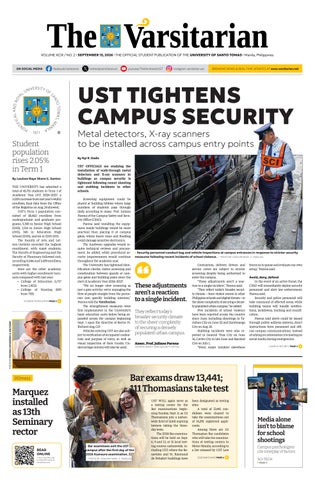
UST TIGHTENS CAMPUS SECURITY
Metal detectors, X-ray scanners to be installed across campus entry points
Student population rises 2.05% in Term 1
By Nyl R. Dadiz
By Louisse Raye Shara C. Santos
THE UNIVERSITY has admitted a total of 45,731 students in Term 1 of Academic Year (AY) 2026-2027, a 2.05% increase from last year’s 44,812 enrollees, final data from the Office of the Registrar on Aug. 24 showed. UST’s Term 1 population consisted of 38,463 enrollees from undergraduate and graduate programs, 5,343 in Senior High School (SHS), 1,514 in Junior High School (JHS), 345 in Education High School (EHS), and 66 in EHS-SHS. The Faculty of Arts and Letters (Artlets) recorded the highest enrollment, with 4,664 students. The Faculty of Engineering and the Faculty of Pharmacy followed suit, recording 4,046 and 3,439 enrollees, respectively. Here are the other academic units with higher enrollment turnouts compared with last year: • College of Education (1,717 from 1,402) • College of Nursing (839 from 753)
PHOTO BY ROGINA CASSANDRA G. BALTAZAR
STUDENT POPULATION PAGE 2
►
UST OFFICIALS are studying the installation of walk-through metal detectors and X-ray scanners in buildings as campus security is tightened following recent shooting and stabbing incidents in other schools. Screening equipment could be placed at building lobbies where large numbers of students pass through daily, according to Assoc. Prof. Juliano Parena of the Campus Safety and Security Office (CSSO). Parena said installing the equipment inside buildings would be more practical than placing it at campus gates, where heavy rains and flooding could damage sensitive electronics. The hardware upgrades would require technical reviews and procurement, he added, while procedural security improvements would continue throughout the academic year. The University has tightened identification checks, visitor screening and coordination between guards at campus gates and building posts since the start of Academic Year 2026-2027. “We no longer view screening as just a gate activity; we’re managing the flow of people straight from the perimeter into specific building interiors,” Parena told the Varsitarian. The strengthened measures were first implemented in the University’s basic education units before being expanded across the campus beginning Sept. 1 upon the directive of Rector Fr. Richard Ang, O.P. Vehicles entering UST are also subject to verification of occupants’ credentials and purpose of entry, as well as visual inspection of their trunks. Undercarriage mirrors will also be used.
Marquez installed as 13th Seminary rector ► Scan the QR code
to read this story at varsitarian.net
measures following recent incidents of school violence. — PHOTO BY JOACHIM NIGEL Z. TANGLAO
‘‘
These adjustments aren’t a reaction to a single incident. They reflect today’s broader security climate to the sheer complexity of securing a densely populated urban campus. Assoc. Prof. Juliano Parena
CAMPUS SAFETY AND SECURITY OFFICE
Contractors, delivery drivers and service crews are subject to stricter screening despite being authorized to enter the campus. “These adjustments aren’t a reaction to a single incident,” Parena said. “They reflect today’s broader security climate – from violent events in other Philippine schools and digital threats – to the sheer complexity of securing a densely populated urban campus,” he added. Five incidents of school violence have been reported across the country since June, including shootings in Tacloban City on June 22 and Zamboanga City on Aug. 18. Stabbing incidents were also reported in General Trias City on June 16, Cavite City in late June and Bacolod City on July 1. “Every major incident elsewhere
forces us to pause and evaluate our own setup,” Parena said. Avoid, deny, defend
In the event of an active threat, the CSSO will immediately deploy security personnel and alert law enforcement, Parena said. Security and police personnel will take command of affected areas, while building teams will handle notifications, lockdowns, tracking and reunification. Parena said alerts could be issued through public-address systems, direct instructions from personnel and official campus communications, instead of relying on information circulating on social media during emergencies. CAMPUS SECURITY PAGE 2
Bar exams draw 13,441; 111 Thomasians take test
Witness
READ ONLINE
► Security personnel conduct bag and vehicle inspections at campus entrances in response to stricter security
► Bar examinees exit the UST
campus after the first day of the 2026 licensure examination. — PHOTO BY JOACHIM NIGEL Z. TANGLAO
UST WILL again serve as a testing center for the Bar examinations beginning Sunday, Sept. 6, as 111 Thomasians join a nationwide field of 13,441 aspiring lawyers taking the threeday tests. The 2026 Bar examinations will be held on Sept. 6, 9 and 13, at 15 local testing centers nationwide, including UST, where the Benavides and St. Raymund de Peñafort buildings have
been designated as testing sites. A total of 13,441 candidates were cleared to take the examinations out of 14,291 registered applicants. Among them are 111 Thomasian Bar candidates who will take the examinations at testing centers in Metro Manila, according to a list released by UST Law 2026 BAR EXAMS PAGE 4
►
Media alone isn’t to blame for school shootings Campus psychologists cite interplay of factors SCI-TECH ► PAGE 5
►
2
THE VARSITARIAN • SEPTEMBER 15, 2026
NEWS
EDITOR: CARLO JOSE H. RUGA
Fewer orgs get OSA approval Students warned vs. unrecognized groups UST ACCREDITED 145 student organizations for academic year 2026–2027, 19 fewer than the 164 recognized last year, according to the Office for Student Affairs (OSA). Of the total, 30 are University-wide organizations, down from 36 during the same period in the previous academic year, while 115 are college-based groups across 16 academic units, down from 128. Among the University-wide organizations accredited this year are
Thomasian Nihon Kyouhai, Thomasian Film Society, TomasinoWeb, UST Hiraya, UST International Students Association and Fotomasino. The six groups were not in the preliminary list of accredited organizations released by OSA on Aug. 11. The office emphasized that organizations not included in its official list are not recognized, authorized or endorsed by the University. “Recognized organizations provide safe spaces for students to explore shared interests and develop
skills while embodying Thomasian values of competence, commitment, and compassion,” OSA said in its Facebook announcement. “Students should only join officially recognized groups and verify their legitimacy with this official list before engaging in any activities,” it added. The number of accredited student organizations may still increase as groups complete the recognition process. To gain accreditation, organiza-
tions must hold general and year-end assemblies, conduct two major activities and render community service. Student groups must also submit proof of participation during recruitment and remain engaged in OSA and University-wide activities. Accredited organizations are required to submit liquidation reports, a summary of receipts and disbursements, and a monitoring form for organizational activities to maintain their status. PAOLO EMMANUEL D.C. BLANCO
Travel to conflict zones, countries with security advisories ‘paused’ UST WILL continue barring students and faculty from traveling to conflict zones in the Middle East, North Africa and Eastern Europe through December as it monitors security risks, fuel costs and changes to flight routes. The University has also “paused” travel to destinations under heightened security advisories, including the United States and neighboring countries, as well as mainland China. Travel to lower-risk destinations in Southeast Asia, East Asia, Australia and New Zealand remains allowed, according to the Office of International Relations and Programs (OIRP). Trips to areas classified as medium-risk, including Japan, South Korea and Guam, may also proceed subject to safety assessments and available resources. The restrictions, first imposed amid conflicts in the Middle East, were extended on Sept. 2 as UST continued to assess security, aviation and diplomatic developments affecting international travel. A Sept. 2 OIRP memo said authorized travelers would undergo safety briefings and be required to secure travel and medical insurance and register with Philippine embassies abroad. Student mobility would also require clearance from the Commission on Higher Education. The University is reviewing global conditions every two weeks and has encouraged academic units to TRAVEL PAGE 4
READ ONLINE
► Scan the QR code
to read this story at varsitarian.net
Student population ► FROM PAGE 1
► Peeva Restaurant — PHOTO BY ASHLEY VALKYRIE E. BUENO
Food concessionaire vows full phaseout of single-use plastics this September By Carlo Jose H. Ruga and Louisse Raye Shara C. Santos
PEEVA RESTAURANT, a major UST food concessionaire and caterer, expects to completely phase out single-use plastics by the end of September in compliance with the University’s newly implemented ban. A Peeva representative said all of food outlets inside UST had stopped using single-use plastics, with remaining stocks of plastic food containers being used only for delivery orders. “Regarding this, yes, Peeva is already complying. All of our stores inside the University have stopped using single-use plastics, except for existing purchase orders for deliveries to various departments,” the Peeva representative told the Varsitarian in Filipino. “Inuubos lang po namin
‘yung natitira na plastic food container pero pag naubos po ito, totally no single-use plastic na po ang Peeva. Possible before end of September ubos na po ito.” (We are just using up our remaining plastic food containers, but once these are exhausted, Peeva will no longer use any single-use plastics. We expect to use them up before the end of September.) UST began phasing in its ban on the use and distribution of single-use plastics across the campus in September. The policy prohibits plastic cups, straws, stirrers, utensils, plates, food containers, sachets, bags, packaging and similar disposable plastic products. Pilot implementation covers campus concessionaires, along with select academic units and colleges that had adopted similar restrictions.
The Alfredo M. Velayo College of Accountancy has implemented a single-use plastic ban since 2024, while the Junior High School has had one since 2019. The University-wide policy covers UST operations, special events and activities organized by academic and administrative units, student organizations, suppliers and service providers. The ban was recommended by the Sustainability Program Overseeing Committee, led by Vice Rector for Research and Innovation Fr. Jannel Abogado, O.P. and Accountancy Dean Fermin Yabut. UST improved to the 401600 bracket in the 2026 Times Higher Education University Sustainability Impact Ratings after placing in the 601-800 bracket in the previous five years.
►
Campus security ► FROM PAGE 1
Students are being trained to make three situational choices during an active threat: • Avoid — Move away from danger through a safe escape route. • Deny — Secure oneself inside a classroom or office when evacuation would expose occupants to greater danger. • Defend — Act only as an absolute last resort when confronted with imminent, life-threatening danger and escape is impossible. The framework does not expect students to confront attackers, Parena stressed.
UST priest, motorists slam NLEX flood response
“Always take the safest logical choice and follow live instructions from safety officers,” he said. Buildings will also not automatically be evacuated simply because a threat has moved to another location, Parena said, as exit routes must first be cleared before a controlled evacuation can proceed. The UST Open Field, for instance, may be used as an assembly area only after it has been cleared and secured by incident commanders. Preparedness drills
UST plans to conduct 26 sector-level drills after the first term preliminary examinations. Four quadrant-level exercises and a
University-wide simulation will follow during the second semester. The exercises will be supported by training on incident command, bombthreat response, first aid, rescue operations, emergency communications and post-incident accountability. Unlike traditional fire and earthquake drills, the active-threat exercises will focus on decision-making, including recognizing warning signs, determining whether to evacuate or secure a room, controlling unauthorized entry and managing accountability after an incident. “Active threat planning isn’t a new reaction from us, but recent events push us to stress-test our assumptions,” Parena said.
The University has ruled out hyper-realistic drills involving mock shooters, blank gunfire, simulated injuries and surprise scenarios. A 2025 study by the National Academies of Sciences, Engineering, and Medicine titled “School Active Shooter Drills: Mitigating Risks to Mental, Emotional, and Behavioral Health” found that such simulations carry a high potential for psychological harm and should not be used in school preparedness exercises. “Our goal is to build calm, clear-headed confidence—not panic,” Parena said. “Students cannot truly focus on learning unless they first feel safe and secure,” he added.
• Graduate School of Law (173 from 156) • College of Rehabilitation Sciences (1,339 from 1,245) • College of Commerce and Business Administration (3,008 from 2,826) • Faculty of Philosophy (98 from 93) • College of Science (3,008 from 2,860) • Alfredo M. Velayo-College of Accountancy (2,064 from 1,970) • Conservatory of Music (464 from 447) • College of Tourism and Hospitality Management (2,125 from 2,048) • Faculty of Medicine and Surgery (2,178 from 2,114) • Review classes and short courses (64 from 51) The Faculty of Sacred Theology experienced the steepest decline in enrollment turnout at 15.14%, admitting 157 students this year, down from last year’s 185. The Faculty of Canon Law (77 from 84) followed suit with a 8.33% drop, the College of Information and Computing Sciences (2,176 from 2,354) with a 7.56% decline, and the Faculty of Civil Law (831 from 890) with a 6.63% dip. Lower freshmen turnout
A total of 14,104 freshmen across all units were admitted this year, down from last year’s 14,463, or a 2.48% decrease. The freshman population consisted of 11,009 students in undergraduate and graduate programs: 2,632 in SHS; 344 in JHS; 89 in EHS; and 30 in EHS-SHS. The academic units with the highest total turnout also logged the most freshmen enrollees, with Artlets recording the biggest number at 1,277, followed by Engineering at 1,170 and Pharmacy at 974. The enrollment period ended on Aug. 22, while the Office of the Secretary General will still accept late enrollment requests until August 28, 5 p.m., provided they submit the required endorsement form and catch-up plan. Classes in the University started on Aug. 7. WITH REPORTS FROM AMADOR DENZEL M. TESTON
THE VARSITARIAN • SEPTEMBER 15, 2026
3
EDITORIAL Fusion Alley has to go Interlude LUIS ANGELO N. PALMA
A YEAR after its opening, Fusion Alley has become less a livelihood project and more a burden imposed on the community around it. The food park, which operates from 4 p.m. to midnight along I. Delos Reyes Street, corner P. Noval Street, in Sampaloc, Manila, was established by the Manila City Government as part of a livelihood program. It was meant to create a food destination in what Manila Mayor Francisco “Isko Moreno” Domagoso calls the “Heart of U-Belt.” Instead, it has created a growing list of complaints over sanitation, noise, congestion, blocked pedestrian access, and the quality of life of nearby residents. The Varsitarian first reported on these concerns a month after Fusion Alley opened. Yet more than a year later, the same problems persist. The city government even formally closed I. Delos Reyes Street for the food park through Resolution No. 297, Series of 2025, allowing the road to be closed from 5 p.m. to midnight. A public road was effectively repurposed to accommodate a government-backed commercial venture. That decision alone should have prompted greater scrutiny: a space maintained for public use was being taken away from the public to sustain a livelihood project. Instead, the problems multiplied. Foul odors, litter, oil-stained pavement, improper
“A university that prides itself on being a center of excellence and knowledge should not settle for these superficial fixes to systemic problems.”
INTERLUDE PAGE 5
EDITORIAL
Keeping UST open amid disruption THE ALMOST daily cancellation of on-site classes and office work due to flooding from heavy monsoon rains since August has so reduced actual transactions and operations on campus that there may be a need to modify the institutional continuity arrangements put in place since March in response to the energy crisis triggered by the US-Iran conflict. The arrangements, announced in March and reaffirmed and broadened in April, designated Mondays as a “common work-fromhome (WFH) day for all administrative offices, covering both officials and support staff, provided that the specific job functions may be rendered remotely.” Administrative offices affected by the order include the offices of the registrar, accounting, and alumni relations. Because of the nearly daily cancellation of on-site classes and operations due to the monsoon rains, alumni and other stakeholders who are unaware of the emergency work arrangements have been coming to the UST Main Building, usually on a Monday, to transact alumni business, such as applying for their transcripts of records and diplomas and paying for them. Many come from the provinces and dedicate the whole of Monday to transact and finish their business with their alma mater. But to no avail. Perhaps the institutional continuity arrangements can be modified so that a skeletal force is present in both offices every Monday to accommodate alumni business and other concerns. This will go a long way
toward ensuring that the needs of alumni and other stakeholders are accommodated during the emergency period. Thankfully, the administration has ordered the Library to remain open Monday to Saturday to accommodate researchers, especially those deep at work on their undergraduate and graduate theses. Moreover, guidance counselors have been instructed to provide continuing on-site and online counseling and career services. The latter directive is especially critical for students experiencing anxiety because of the academic disruptions caused by the inclement weather. In this connection, perhaps the administration should also remind the UST Health Service to provide continuing services, onsite or online, especially during this season marked by water-borne diseases. Some students and faculty members affected by the Indonesian haze or who have contracted flu in recent weeks have found the online ThOMedSS inoperative. The institutional continuity measures are expected to remain in place even beyond the monsoon season. World crude oil prices remain elevated and are currently surging
toward $100 a barrel because of a major escalation in the U.S.–Iran conflict. The war has caused historic supply bottlenecks in the Middle East. Following a brief dip over the summer (their summer, not the Philippines’), prices are experiencing a massive sixweek high after a series of heavy weekend military exchanges. These are unusual times that call for flexibility in the implementation of emergency arrangements. Measures adopted in response to one crisis may have to be recalibrated when another crisis changes the circumstances on the ground. The objective, after all, should not simply be to keep offices running on paper but to ensure that essential services remain accessible to those who need them. The University has shown that continuity is possible even amid disruption. Keeping the Library open, maintaining counseling services, and ensuring access to health services are examples of how essential functions can be preserved despite difficult conditions. The same principle should apply to offices that serve alumni and other stakeholders whose needs cannot always be addressed remotely. In times of prolonged disruption, institutional continuity must ultimately mean continuity of service. A skeletal Monday workforce in critical offices may be a small adjustment, but it would send an important message: even when the rains keep the campus from functioning normally, the university remains responsive to the community it serves.
Marcos Jr., Sara Duterte show wages of dynastic politics Covey LILAH MIKAELA S. PAREDES
BY ITSELF, political dynasties are already disruptive of democracy in the Philippines. Its concentration of power does not equate to stability, as the same problems persist in its local governments. Take the National Capital Region (NCR), for example. All cities in the region elect candidates from political families– the Gatchalians of Valenzuela, Malapitans of Caloocan, and Cayetanos of Taguig– yet, they’re still figuring out how to solve flooding in the NCR. Yet political dynasties’ democratic disruption goes beyond their territories. Their influence on people goes so broad and deep that uniting two dynasties could wield enough power. The alliance between President Ferdinand Marcos Jr. and Vice President Sara Duterte united political families in the north and south of the Philippines, resulting in the biggest election win in recent history. What was once a tandem that campaigned for “unity” resulted in one of the biggest fallouts in politics. Their split was so intense that Duterte ended up publicly issuing a death threat to Marcos, his wife, and his cousin, leading to her impeachment. The extent to which a political family can influence public institutions was evident in Duterte’s COVEY PAGE 5
FOUNDED JANUARY 16, 1928 Amanda Luella A. Rivera Editor in Chief Frenchshield Shayne G. Delovieres Managing Editor Billy Andrei P. Ramos Associate Editor Carlo Jose H. Ruga News Editor Amador Denzel M. Teston Assistant News Editor Lilah Mikaela S. Paredes Sports Editor Luis Angelo N. Palma Special Reports Editor Yuvshenka Andrea R. Osea Witness Coordinator Justin Jacob S. Urag Acting Features Editor Marielle F. Pesa Science and Technology Editor Kirsten Therese C. Barrameda Circle Editor Ashley Valkyrie E. Bueno Acting Literary Editor Aidan Raphael F. Caluyo Art Editor Mhyzell Dayne J. Oblepias Assistant Art Editor Djenhard Yreneo Raphael Y. Sapanhila Photo Editor Jed William V. Gocatek Layout Editor
News Jed L. Ampongan, Paolo Emmanuel D.C. Blanco, Czeantal Naomi P. Delos Santos, Alexandra S. Demaisip, Yuahn Zachary B. Guilas, Tatyana Sabeerah R. Marananan, Louisse Raye Shara C. Santos Sports Charles Martin A. Manalang, Kurt Russel Vincent I. Miranda, Jay-Z V. Perez, Clyde Leanne M. Salamatin, Allanee Raye C. Valeriano Special Reports Nyl R. Dadiz, Ashley Madeleine D. Lampa, Mikaela Angela C. Villacorta Features Elihoenai Hazael B. Cortez, Alejandro Mari C. Eusebio, Phoebe Elaine B. Pua Witness Bruce L. Buenaventura, Alexandra Gabrielle C. Mansineros, Enzo Miguel D. Mejia Filipino Dan Cedric V. Latasa, James Maverick R. Talavera Science and Technology Bernadette E. Alpas, Marigela Isabel R. Cirio, Regis Avalo Jophiel L. Lim Circle Lianne Therese G. Espiritu, Inah Denise A. Manansala, Rhamiel Mae T. Vicente Literary Elizabeth Joy C. Castro, Charlize Ann D. Lavastida, Psalmuel D. Reyes, Prince Cassel O. Trono
►
Art Kathryn Grace S. Enriquez, Allana Elaine J. Libunao, Rich Harry A. Marbella, Arlene F. Turla, Natasha Aizhen B. Zaño Photography Danielle D. Atienza, Rogina Cassandra G. Baltazar, Jerick Marc Laurence C. Grimaldo, Ethan Joshua Nikholai F. Guisama, Divina Eloisa P. Meguines, Mickaela Jamylle C. Sison, Joachim Nigel Z. Tanglao, Vio Neiro M. Villaescusa Editorial Assistant Joshua Emmanuel E. Camacho
Felipe F. Salvosa II Assistant Publications Adviser
Joselito B. Zulueta Publications Adviser
►
4
THE VARSITARIAN • SEPTEMBER 15, 2026
FEATURES
ACTING EDITOR: JUSTIN JACOB S. URAG
Meet the Thomasian behind ‘The Nostalgic Thomasian’ FOR MORE than a decade, the Facebook page “The Nostalgic Thomasian” has brought old photographs, forgotten campus lore and memories of generations of Thomasians back to life. Behind it is UST Department of History instructor John “Rancho” Arcilla, who created the page as an 18-year-old student in 2013. What began as a personal project on University history has since grown into a community-driven archive, with alumni sending Arcilla photographs and stories documenting Thomasian life across generations. Arcilla was an Asian studies junior when he started “Nostalgic Thomasian,” at a time when personal blogging was popular. Combining his interest in history with his skills in photo restoration, he initially filled the page with formal, academic posts about UST’s colonial history, including popes, Spanish kings and royal decrees, using materials available in University archives and libraries. “Noong una, katuwaan lang talaga siya, pero I never realized that it would become so serious over time,” Arcilla told the Varsitarian.
‘‘
► John ‘Rancho’ Arcilla:
The Nostalgic Thomasian — ART BY NATASHA AIZHEN B. ZAÑO
It’s very important that you were actually there, hanging out at Dapitan, experiencing Asturias Street and P. Noval Street, for you to have a proper appreciation of the content and to be able to verify it. John ‘Rancho’ Arcilla THE NOSTALGIC THOMASIAN
(At first, it was really just for fun, but I never realized that it would become so serious over time.) Over the next 13 years, alumni began sending Arcilla personal photographs and recollections, gradually transformNOSTALGIC PAGE 7
►
THE GREAT FLOOD OF 2026: Thomasians recall ‘bayanihan’ THOMASIANS STRANDED during the Aug. 17 campus flooding recalled how students, employees and University officials stepped in to provide food, shelter and assistance as floodwaters forced thousands to remain inside UST for hours. The emergency put the University’s disaster preparedness to the test while drawing acts of bayanihan, or communal cooperation, from members of the Thomasian community. Assoc. Prof. Juliano Parena, director of Campus Safety and Security, said thousands of Thomasians were
Travel ► FROM PAGE 2 consider virtual and hybrid alternatives when travel is not feasible. UST also cited fluctuating fuel costs and changes to international transit routes in urging academic units to limit unnecessary travel and make more efficient use of resources. The latest restrictions extend measures adopted by the University in March amid the conflict in the Middle East and concerns over its effects on energy costs and the Thomasian community. At the time, UST advised academic and administrative units to limit local and international travel to safe and essential trips. The University also introduced measures covering academic continuity, energy conservation and psychosocial support amid the conflict. JED L. AMPONGAN
stranded on campus at the height of the flooding. “The headcount was more or less 5,000,” he told the Varsitarian. As Thomasians sought refuge in University buildings, student volunteers, employees and officials organized evacuation areas, distributed food and supplies, and assisted those unable to leave the campus. The 3Cs in action
Christopher Erasquin, a junior at the Faculty of Medicine and Surgery and president of the Medical Missions
2026 bar exams ► FROM PAGE 1
Bar Operations. The Tan Yan Kee Student Center will serve as headquarters for Supreme Court officials assigned to UST, while San Beda College Alabang in Muntinlupa City will serve as the national headquarters of this year’s examinations. San Beda Alabang took over from UST as the national headquarters, a decision announced by the Supreme Court in July. The examinations will cover six core subjects over three days under the Bar chair, Associate Justice Samuel Gaerlan. UST was traditionally the sole venue of the Philippine Bar examinations before the Supreme Court decentralized the tests. The regionalized system was first implemented in February 2022, when
Incorporated Student Group, set aside his own unease and worked with other student leaders and staff at the Tan Yan Kee Student Center. “Kaysa magreklamo ako na hindi pa suspended, as a student leader, [I thought], what can I do now, knowing the situation and applying what I’ve learned from med school,” Erasquin told the Varsitarian. (Instead of complaining that classes had not yet been suspended, as a student leader, I thought, what can I do now, knowing the situation and applying what I’ve learned from med school?) Erasquin was later joined by Senior Teacher Caesar Yoma, assistant director of the UST Purchasing Office, who oversaw operations at the student center. By noon, the building had become a makeshift evacuation center, an emergency response base of the Red Cross Youth Council (RCYC) and a food distribution hub. When volunteers encountered
difficulties distributing food, they improvised by using excess meals from the “ROARientation” for freshies as an initial food supply before additional provisions could be sent out. Among the Thomasians stranded at the student center was psychology junior Ayenna Rogayan, who stayed there for nine hours. Despite experiencing a spike in body temperature and a drop in blood pressure, Rogayan said she thought about helping students who had become distressed by the situation. “I saw students na sobrang overwhelmed na, some of them were crying, and nasa isip ko na lang sana [ay] maka-help din ako kasi psychology student ako. And I feel like I could’ve helped them, but at that time, I was trying to help myself not feel overwhelmed,” Rogayan said. (I saw students who were very overwhelmed. Some of them were crying, and all I could think about was that I wished
the pandemic-delayed 2020/21 Bar examinations became the first digitalized and regionalized Bar in Philippine history and were administered at 29 testing sites across 22 local government units nationwide. The Supreme Court has since retained the regionalized and digitalized format and formally adopted electronic and regionalized Bar examinations as the standard mode of admission to the legal profession in 2025. Ahead of Sunday’s opening examinations, the Supreme Court reminded candidates to bring a transparent bag, a laptop with the prescribed version of Examplify testing application installed, printed copies of their notice of admission and other required documents, and a government-issued ID. Examinees were also advised to arrive before their scheduled time, wear appropriate attire, account for traffic
I could help because I am a psychology student. I feel like I could’ve helped them, but at that time, I was trying to help myself not feel overwhelmed.) Despite the difficult conditions, Rogayan recalled seeing students willing to assist those stranded elsewhere on campus. As the student center became a food distribution hub, volunteers waded through floodwaters to bring supplies to other buildings.
and weather conditions, and bring necessary food, drinks and medications. Several roads surrounding UST will be closed during the three examination days. Dapitan Street, Lacson Avenue and P. Noval Street will be closed on Sept. 6, 9 and 13 from 2 a.m. to 7 p.m. On Sept. 6 and 9, assisted traffic management will be implemented on the two westbound lanes of España Boulevard from Gate 2 to P. Noval Street from 2 a.m. to 8 a.m. and from 3 p.m. to 7 p.m. The same traffic scheme will be implemented on España Boulevard on Sept. 13 from 2 a.m. to 8 a.m., while all westbound lanes from Lacson Avenue to P. Noval Street will be closed from 3 p.m. to 7 p.m. Manila Mayor Francisco “Isko Moreno” Domagoso imposed a liquor ban within a 500-meter radius of UST and San Beda University and prohib-
RECALL ‘BAYANIHAN’ PAGE 6 ►
RELATED
UST MOVES TO REVISE CRISIS PROTOCOLS AFTER FLOODING
ited ambulant vendors and disruptive activities in the areas during the examination days. Several UST academic units, particularly those housed in buildings designated as testing centers, were advised to shift to enhanced virtual mode of instruction (EVM) during the Bar examinations schedule, including the days for ingress, egress, sealing and restoration. The entire University will shift to EVM on Sept. 9. Only the UST Hospital, Carpark, Institute of Physical Education and Athletics, Santísimo Rosario Parish, Hotel 1611 and Domus Mariae residence will be allowed to operate during the examination days. UST posted an 87.16% overall passing rate in the 2025 Bar examinations, with four Thomasians placing in the Top 10. TATYANA SABEERAH R. MARANAN
THE VARSITARIAN • SEPTEMBER 15, 2026
5
CIRCLE
EDITOR: KIRSTEN THERESE C. BARRAMEDA
PHOTOS BY DIVINA ELOISA P. MEGUINES
LITERARY
Inaccurate documentation can erase regional culinary traditions – food historians
Conservatory marks 80th year with heritage exhibit THE UST Conservatory of Music opened an exhibit tracing its eightdecade history on Aug. 26 at the UST Museum. Titled “Legacy in Harmony,” the heritage exhibit features materials documenting the Conservatory’s history and an image of St. Cecilia, its patron saint. Student performances accompanied the exhibit opening. Conservatory Dean Prof. Maria Alexandra Chua described the anniversary as a milestone, noting that the Conservatory was unable to hold a full celebration for its 75th anniversary during the Covid-19 pandemic. “This is really the first opportunity for us to properly celebrate such a milestone,” Chua said. The Conservatory has lined up a series of activities for its 80th anniversary, including the restaging of the Rodgers and Hammerstein musical “South Pacific” in September, first presented in February. Chua said the exhibit was mounted to acquaint students and faculty members with the history of the Conservatory, which she said had been
Interlude ► FROM PAGE 3 waste disposal, and piles of garbage became familiar sights. Students living in nearby dormitories and area residents have had to deal with the consequences, while local businesses have struggled amid the disruption. When the Varsitarian raised the issue with Domagoso during the Kapihan sa Manila forum on July 30, he defended Fusion Alley but promised that the city would “do better.” Cleaning operations were subsequently doubled. But when monsoon rains flooded Manila, garbage, cockroaches, and rats were seen floating along P. Noval Street as floodwaters reached ankle- to waist-deep levels in some areas. If doubling the cleaning operations still leaves the community dealing with this, then the problem is clearly bigger than how often the streets are swept.
the subject of few published historical studies. “When you think about it, it is actually difficult to find information about the Conservatory because there are not yet many published historical studies
specifically about it,” she said. “I felt that through an exhibit, we would be able to communicate our story and our history.” Chua and Assoc. Prof. Mary Ann Bulanadi, a research fellow at the UST Research Center for Culture, Arts, and Humanities, began pursuing the project
A livelihood program cannot justify taking over public space while imposing persistent sanitation, traffic, noise, and environmental problems on the community. But this also raises a more fundamental question: If Fusion Alley was created to provide better livelihood opportunities for
The city should not be forced to choose between supporting vendors and protecting residents. There must be a better solution — one that allows street hawkers to earn without unduly displacing public space.
ahead of the Conservatory’s 80th year. Students were tapped to join the research team that gathered materials for the exhibit. During the research, the team uncovered what is believed to be a playbill from “Suor Angelica,” an opera that Chua described as the Conservatory’s first musical production. The production was staged in partnership with the old College of Architecture and Fine Arts, revealing an early link between the disciplines that Chua said continues in present-day collaborations. “After 80 years, we are once again collaborating with Fine Arts and Music. That connection and continuity are also very meaningful,” Chua said. Beyond the anniversary, Chua said the Conservatory would seek to further establish itself as a world-class music institution, pointing to its orchestra, award-winning choirs and other programs. “Even though these are school or university productions, the quality can truly be compared with professional productions,” she said. “It is world-class.” JOSHUA EMMANUEL CAMACHO
some, what about the people who were already living, working and studying in the area before it existed? Their right to a safe, accessible, and livable community should not become the price of another group’s livelihood. The city should not be forced to choose between supporting vendors and protecting residents. There must be a better solution — one that allows street hawkers to earn without unduly displacing public space, or regular shops that pay rent and taxes without disrupting surrounding communities or compromising the welfare of those who have called the area home long before Fusion Alley arrived. The concerns have been raised. The problems have been documented. The promise to “do better” has been made. What remains is for the city government to decide whether doing better means simply cleaning up the consequences — or reconsidering the arrangement that created them in the first place.
INACCURATE DOCUMENTATION of heritage dishes can distort culinary history and erase regional distinctions, food historians and cultural advocates warned, calling for rigorous research and verification in publications on Filipino food. Guillermo “Ige” Ramos, a Thomasian food scholar and founder of the Ugnayan Center for Filipino Gastronomy, said relying on “generic recipes” without proper research may contribute to cultural erasure. “Inaccurate data becomes ‘fact’ once printed in a book, misleading future researchers and the public,” Ramos told the Varsitarian. He said documenting food heritage goes beyond recording ingredients and cooking methods and should also examine geography, community-specific technologies and oral histories surrounding a dish. Fernando Zialcita, professor emeritus at the Department of Sociology and Anthropology of Ateneo de Manila University, warned that inaccurate documentation could homogenize regional flavors. He cited differences between Ilocano pakbet and the Tagalog version of pinakbet, particularly in their cooking methods, ingredients and flavor profiles. Zialcita said traditional Ilocano pakbet uses a water-based cooking method and a distinctly bitter variety of ampalaya, while the Tagalog version uses fat or oil. For cultural journalist and documentarian Roberto Villarcabral, documenting regional variations in recipes is itself a form of cultural preservation. “Food writing is, at its core, investigative journalism. It requires the same discipline as any other beat (a topic a reporter covers in journalism),” he said. Villarcabral said understanding why a particular ingredient is used in one province but not another, or why a dish has different names
Covey ► FROM PAGE 3 impeachment trial. The trial court consisted of senator-judges tasked with examining evidence while maintaining neutrality despite their political affiliations. Yet Presiding Officer Francis Escudero had to remind the senator-judges to exercise “cold neutrality.” Atty. Howard Calleja had questioned Senator Imee Marcos’ line of questioning, saying she was acting as a defense senator-judge. He also said that she, along with siblings Senators Alan and Pia Cayetano and Senator Robin Padilla, had asked the witness “out of this world” questions. Had these senator-judges’ judgment and sworn duty been clouded by partisan loyalty rath-
‘‘
Food writing is, at its core, investigative journalism.
It requires the same discipline as any other beat. Roberto Villarcabral CULTURAL JOURNALIST AND DOCUMENTARIAN
across locations, helps preserve the cultural identity of communities. “If we flatten these distinctions, we erase the reasons behind a dish and reduce a living piece of history to a generic souvenir,” he said. He added that misrepresenting food in literature could amount to historical erasure and marginalize the practitioners who sustain culinary traditions. Toronto-based travel and food writer Natasha Alli stressed the importance of obtaining information from primary sources, particularly families that have preserved heritage dishes across generations, as part of fact-checking and verification. She described traveling to communities where culinary traditions originated as “irreplaceable.” “In the Philippine context, this means finding the right connections, building relationships with the people [or] communities who can connect you with the [information] you need,” Alli told the Varsitarian. Harold Bernardo Bueno, presCULINARY TRADITIONS PAGE 7
►
er than the truth? They were placed there to serve the public. Their allegiance belonged to the law and the people—not to a political family. If Padilla could advocate for a biased prosecution, the public had every right to demand an impartial senator-judge. Impartiality was not merely an expectation; it was a duty. Beyond corruption and centralized power, political dynasties erode the system by undermining due process itself. No political family should exert such influence that officials favor private interests over their constitutional duty. Public servants owe their allegiance solely to the people they swore to serve. For if there is one thing that should have the most power, it is the law.
6
THE VARSITARIAN • SEPTEMBER 15, 2026
FILIPINO Komisyoner ng KWF, nanindigan sa pagtanggap ng ‘Kampeon ng Wika’
► Marites Barrios-Taran — RETRATO NI MICKAELA JAMYLLE C. SISON
KWF: Pax Silica maaaring magpahina sa mga wika, pamayanang katutubo Ni Frenchshield Shayne G. Delovieres
HINDI tutol ang Komisyon sa Wikang Filipino (KWF) sa napipintong Pax Silica initiative sa Filipinas, ngunit nagbabala ang tagapangulong si Marites BarriosTaran na maaaring maapektuhan nito ang mga katutubong pamayanan at wika sa bansa. “‘Yong wika natin, nakasalalay ‘yan sa mga pamayanan. Kapag nagkaroon ng dispersion, pag-alis ng mga katutubo, pati ‘yung wika ay hihina,” wika ni Taran, komisyoner para sa wikang Tagalog, sa panayam ng Varsitarian. Inihayag ni Taran na dapat paghandaan ng pamahalaan ang posibleng epekto ng proyekto, partikular sa pagtatayo ng mga artificial intelligence (AI) data center na maaaring magkaroon ng epekto sa kalikasan at sa malaking bahagi ng katutubong komunidad. “At sino ang binibigyan ng obligasyon o pananagutan para mapabuti ang isang napipintong masama? Ang pamahalaan,” wika niya. Para kay Taran, hindi pa ganap na handa ang Filipinas sa mabilis na pag-usbong ng AI, lalo na sa usapin ng wika at kultura. Binigyang-diin niyang hindi pa nakapaghahanda ang KWF ng ortograpiya para sa lahat ng wika sa
Recall ‘bayanihan’ ► FROM PAGE 4
Among them were blockmates of medical technology junior Alessandra Inguillo. “My blockmates mainly [brought] food from Tan Yan Kee to the Buenaventura Garcia Paredes, O.P. Building (BGPOP), and then since we were stuck in Fr. Lorenzo Rodriguez Laboratory, they were the ones who were transporting food to us and then to another place,” Inguillo said. The Santísimo Rosario Parish Church also served as a shelter, including for College of Tourism and Hospitality Management (CTHM) freshman Junold Antoy, who spent hours inside the church after the heavy downpour. Antoy said the experience left a strong impression on him as a freshman because it showed the solidarity of his newfound Thomasian community. “Sobrang nakita doon ‘yong ‘family’ that we’re calling sa CTHM na nagtutulungan. Even though everyone was stranded inside the parish church, nakita
Filipinas nang magsimulang lumaganap ang paggamit ng AI. Bagaman sinisikap ng komisyon na tuklasin ang malawak na paggamit ng AI sa iba pang proyekto bilang kasangkapan, inamin ni Taran na hindi pa ito ginagamit ng KWF sa pagsasalin. Kinilala ng KWF ang potensiyal ng AI bilang kasangkapan sa pananaliksik at iba pang larangan, tulad ng kanilang tema ngayong taon na “Wikang Filipino at AI: Kasangkapan sa Pananaliksik at Tulay sa Yaman ng Impormasyon.” Ipinaliwanag ni Taran na maituturing na natural phenomenon ang pag-usbong teknolohiya at hindi na ito paipigilan pa. Aniya, makatutulong ang teknolohiya kung gagamitin ito nang etikal at responsable kung kaya’t mahalaga na magkaroon ng malinaw na pamantayan sa paggamit nito, lalo sa wika at panitikan. Sa usapin ng pagdiriwang ng Buwan ng Wikang Pambansa sa mga susunod na taon, sinabi ni Taran na nais niyang dumating ang panahong hindi na kailangang hikayatin ang kabataan na makilahok upang mapanatili at mapreserba ang wikang Filipino. “Sana hindi na magkaroon ng selebrasyon ng Wikang Pambansa para manghikayat ng mga kabataan para sumali. Sana ay para na lang magdiwang dahil malakas ang wika,” aniya.
NANINDIGAN ANG tagapangasiwa ng programa at proyekto ng Komisyon sa Wikang Filipino (KWF) sa pagtanggap ng parangal bilang “Kampeon ng Wika” 2026 sa kabila ng mga komentong “buhat-bangko” at “walang delicadeza” ang ahensya na gawaran ang mga sarili nitong opisyal. Ipinaliwanag ni Carmelita Abdurahman, kinatawan para sa wikang Samar-Leyte, na ang pagkilala ng Kampeon ng Wika ay dumaan sa resolusyon ng KWF at kabilang sa mga batayan nito ang naging karanasan at kontribusyon ng mga komisyoner sa larangan ng wika at edukasyon. “Kung nabigyan man ako ng ganyan (Kampeon ng Wika), itinuturing ko na ako’y karapat-dapat,” ani Abdurahman sa panayam ng Varsitarian. Ibinahagi niyang hindi niya ikinakahiya ang pagtanggap sa parangal dahil nagsilbi siyang komisyoner sa loob ng dalawang termino bukod sa kanyang 25 taong karanasan bilang guro. Dating dekano ng Sacred Heart College at dating tagapangulo ng Pambansang Samahan ng mga Tagapagtaguyod sa Filipino si Abdurahman. Dagdag pa niya, ibinibigay ang Kampeon ng Wika sa mga komisyoner ng ahensya na malapit nang magtapos ang termino at dumaan sa aniya’y search committee ng Malacañang bago pirmahan ng pangulo. “Hindi rin ako uhaw sa dangal. Hindi ako for promotion. Wala na, retiro na ako. Naka-dalawang termino ako sa pagiging commissioner,” ani Abdurahman. Opisyal na inanunsyo ng KWF ang anim na tatanggap ng parangal noong ika-18 ng Agosto. Matapos makatanggap ng batikos, dalawa na lamang ang nakapaskil sa
► Carmelita Abdurahman — RETRATO NI MICKAELA JAMYLLE C. SISON
Facebook page ng ahensya noong ika24 ng Agosto. Kinumpirma ni Abdurahman sa Varsitarian na hindi tinanggap nina Alain Russ Dimzon, komisyoner para sa wikang Hiligaynon; Christian Aguado, komisyoner para sa mga wika ng katimugang pamayanang kultural; Reggie Cruz, komisyoner para sa wikang Kapampangan; at Evelyn Oliquino, komisyoner para sa wikang Bikol, ang pagkilala. “Kung pinanghinaan sila ng loob dahil hindi nila tinanggap ang hamon, kami [ay] hindi, lalaban at lalaban talaga kami,” wika ni Abdurahman. Dagdag pa ni Abdurahman, itinuturing niyang pagkilala sa kanilang wika ang naturang parangal. “Basta tungkol sa wikang Waray hindi ako magpapatalo sa kanila. Kung ako man [ay] nagawaran, dala-dala ko ang aking wika, dala-dala ko ang wikang Pilipino at ‘yon ay iingatan ko,” wika niya. Hinamon ni Abdurahman ang mga kritiko na ipakita ang kanilang mga kakayahan at ambag sa larangan
Youth violence ► FROM PAGE 7
emotional self-regulation. “Instead of the child holding those negative emotions inside of himself or herself, he has a safe space inside the family where he could actually vent out those emotions,” he said.
Schools likewise have a role in identifying behavioral warning signs before they escalate into violence, the psychologists said. “The government can strengthen policy enforcement [on firearms and substance use] and [push] for hiring more mental health professionals for basic education settings,” Kliatchko said. Canlas added that men-
ng wika at edukasyon sa halip na patuloy na mamuna. Hinimok niya ang mga kabataan na pangalagaan at payabungin ang wikang Filipino sa kabila ng malawak na impluwensya ng social media. “Huwag kailanman ibalewala, huwag ikahiya [ang wika]. Dahil ‘pag nawala ang wika, mawawala rin ang kultura,” saad niya. Iginagawad ang Kampeon ng Wika sa mga indibidwal, institusyon, at samahan na nakapag-ambag sa pagtataguyod, pagpapaunlad at preserbasyon ng wikang Filipino at mga katutubong wika sa Filipinas sa iba’t ibang disiplina at larangan. Ilan sa mga indibidwal na nakatanggap ng naturang parangal ang Pambansang Alagad ng Sining para sa Film at Broadcast Arts na si Nora Aunor noong 2021 at ang premyadong makata na si Michael Coroza noong 2019. Hindi isinama ang paggawad ng Kampeon ng Wika sa daloy ng programa ng KWF Gabi ng Parangal na idinaos noong ika-27 ng Agosto sa Hotel Lucky Chinatown. Pinarangalan bilang Mananaysay ng Taon ang propesor at manunulat mula Kalinga na si Rexon Hora Gaston. Nagkamit ng ikalawang gantimpala si Emersan Baldemor, kumukuha ng masterado sa malikhaing pagsulat, ng UP Diliman, at ikatlong gantimpala naman kay Mark Anthony Angeles, guro sa malikhaing pagsulat sa UST. Kinilala rin ang mga nagwagi sa mga pangunahing parangal na iginagawad ng KWF, kabilang na ang Gawad Dangal ng Wika, Gawad Carlos Padilla at Talaang Ginto: Makata ng Taon. DAN CEDRIC V. LATASA
tal health professionals should strengthen their empathy and digital literacy to better understand the environments in which children and adolescents now interact. The Psychological Association of the Philippines issued a statement on July 6 outlining academic frameworks and policy guidelines for addressing youth aggression.
MAY ULAT NI DAN CEDRIC V. LATASA
ko pa rin ‘yong bayanihan sa mga student leaders,” he said. (I really saw there the “family” that we talk about in CTHM, where everyone helps one another. Even though everyone was stranded inside the parish church, I still saw bayanihan among the student leaders.) Political science senior and RCYC Arts and Letters Unit President Ellyza Crisostomo was among the students who spent the night in UST to assist those who remained stranded. Crisostomo said the volunteers were themselves afraid and exhausted. She and her fellow volunteers went home at 8 a.m. the next day, Aug. 18. “We were just students who stepped up,” Crisostomo said. “Pero promise, takot din kami. Kasi at that time, we were just joking to each other, lalo na noong humupa na [‘yong baha]. Kasi ramdam na namin ‘yong pagod.” (But I promise, we were afraid, too. At that time, we were just joking with one another, especially when the flood had already subsided, because we were already feeling the exhaustion.)
UST officials, staff leave no one behind
University employees and emergency personnel likewise worked throughout the flooding to assist stranded Thomasians. Jeramil Gabaon, a member of the eight-man UST Quick Response Team (QRT), said he expected to work beyond his regular shift as the team evacuated students and delivered food and supplies. “My original duty was supposed to be until 6 p.m. only, but as a QRT member, when we started operations at around 11 a.m., I knew that we would need to get the job done before we could go home,” Gabaon told the Varsitarian. “There was no backup, it was just us as QRT. Kaya po hindi ko maisip na iwan ang mga kasama ko,” he said. (There was no backup. It was just us as QRT. That was why I could not think of leaving my colleagues behind.) Despite the suspension of senior high school (SHS) classes announced the night before, UST SHS Principal Erika Bolaños, along with faculty and staff, prepared meals for Thomasians stranded at the
Saint Pier Giorgio Frassati Building. “As school administrators and educators, our responsibility does not end when classes end or when office hours are over. If there are students who need assistance, then we stay,” Bolaños said. By late afternoon, SHS faculty members had fed more than 200 students from different colleges, preparing chicken nuggets, corned beef, luncheon meat and other food. “What was particularly meaningful to me was that many of the students we assisted were not even from Senior High School,” Bolaños said. “But during a crisis, we do not distinguish whether a student belongs to SHS, to a particular college, or to another unit. They are Thomasians, and at that moment, they needed help.” Call for better mitigation measures
Despite the volunteer response, Parena said the flooding also showed areas where the University could strengthen its disaster preparedness. He proposed requiring every Thomasian to carry a go bag, implementing an incident command system, and training
more University employees to respond to emergencies such as floods. “It would also be of great help if there were willing support staff and faculty members who would undergo training to be able to provide much-needed help during these incidents,” Parena said. “I believe that if there were more trained responders, we would be able to secure our stakeholders, move logistics, and help the injured in a faster and safer manner,” he added. For the Thomasians who endured the Aug. 17 flooding, the emergency became not only a test of the University’s disaster response but also an occasion when students, employees, and officials relied on one another to get through the hours-long ordeal. ELIHOENAI HAZAEL B. CORTEZ, ALEJANDRO MARI C. EUSEBIO, PHOEBE ELAINE
B. PUA, AND JUSTIN JACOB S. URAG, WITH REPORTS FROM FRENCHSHIELD SHAYNE G.
DELOVIERES, KATHRYN GRACE S. ENRIQUEZ, JED WILLIAM V. GOCATEK, MARIELLE F. PESA,
LOUISSE RAYE SHARA C. SANTOS, AND AMADOR DENZEL M. TESTON
THE VARSITARIAN • SEPTEMBER 15, 2026
7
SCI-TECH
EDITOR: MARIELLE F. PESA
Media alone isn’t to blame for school shootings Campus psychologists cite interplay of factors
By Marigela Isabel R. Cirio and Regis Avalo Jophiel L. Lim
RECENT incidents of school violence in the country have renewed debate over whether violent videos and video games contribute to youth aggression, but UST psychologists said such behavior cannot be traced to media consumption alone. Associate Professors John Manuel Kliatchko and Rodel Canlas said youth violence is shaped by a complex interplay of personal, environmental, and social factors. Concern intensified after a June 22 shooting at San Jose National High School in Tacloban City left three students dead and 20 injured. Investigators linked the minor suspects to the gaming app GoreBox. On July 31, a Grade 9 student was stabbed to death by a fellow student in Las Piñas City. Another gun-related incident occurred at Ateneo de Zamboanga University on Aug. 18, where a shooting left two students dead and several others injured. Kliatchko said discussions blaming violent media often rely on an overly narrow reading of psychologist Albert Bandura’s Social Learning Theory, which is sometimes interpreted to mean that children simply imitate aggressive behavior they observe. “Bandura’s theory is often interpreted too narrowly. It does not claim that children automatically imitate everything they see,” said Kliatchko, president of the Psychological Association of the Philippines (PAP). He said Bandura’s concept of “reciprocal determinism” holds that behavior results from the continuing interaction of personal charac-
Nostalgic Thomasian ► FROM PAGE 4
ing “Nostalgic Thomasian” from a historical blog into an archive of everyday Thomasian culture. The submissions expanded the page beyond official University history to memories of student life, including the streets, establishments and experiences familiar to generations of Thomasians. It now has 62,000 followers. Viral pieces include a photo of the old Art Deco-style gymnasium demolished in 2011 to give way to the Buenaventura Garcia Paredes, O.P. Alumni Center Building, a 1978 Education High School yearbook photo of actor Albert Martinez, and long-haired architecture and fine arts students from the 1970s originally posted by another page, “UST Valiant Legions.” For Arcilla, who had worked as an archivist for the Intramuros Administration, documenting that history requires more than consulting archival sources. Familiarity with Thomasian student life also helps him assess the sto-
teristics, the environment, and an individual’s actions. “The difference lies not only in what they consume, but also in who they are, the environments in which they are growing up, and the protective factors that surround them,” Kliatchko said. Canlas, former chair of the Department of Psychology, said children may also misinterpret ordinary behavior as hostility, prompting aggressive responses. “Mga normal behavior ng mga tao nakapaligid sa kanila, they might misinterpret it as a form of hostile aggressive behavior towards them. And when they misinterpret it that way, somehow their tendency is to act aggressively [as well],” he said. (They might misinterpret the normal behavior of people around them as a form of hostile or aggressive behavior toward them. When they interpret it that way, their tendency may also be to act aggressively.)
‘‘
According to decades of research, there is no link between violent media and violent behavior.
Violent media may play a role in some cases, Multifaceted causes Kliatchko said a child’s temperament, emotional regulation, family but it is neither relationships, school environment, peer influences, and community all the sole nor affect how media experiences are the primary. interpreted. Canlas said violent behavior explanation may also emerge from stressors faced by children, including undi- for these tragic agnosed mental health problems, bullying, and severe social rejection. events. “When these individuals would do hostile or violent behavior towards others, it’s their way of retaliation against those individuals who have bullied them or caused them to feel social rejection,” he said.
Rodel Canlas
FORMER CHAIR OF THE DEPARTMENT OF PSYCHOLOGY
Violent media
Children who already have aggressive tendencies may also respond differently to violent media, Canlas said, underscoring the importance of parental supervision and guidance in how children in-
ries and material submitted to the page. “Very important na you were actually there, tatambay ka sa Dapitan, na-experience mo ang Asturias [Street], na-experience mo ’yong P. Noval [Street] for you to have a proper appreciation of the content, and for you to be able to verify,” he said. (It’s very important that you were actually there, hanging out at Dapitan, experiencing Asturias Street and P. Noval Street, for you to have a proper appreciation of the content and to be able to verify it.) As the page evolved, so did Arcilla’s writing. Even as he earned his master’s and began pursuing a doctorate in the University of the Philippines, he deliberately moved away from the academic tone of his early posts and adopted the humor and familiarity that he believed better reflected how Thomasians interacted with one another. “Over time, ‘yong tone ng pagsulat ko [ay] naging very informal, parang nang-aasar na. Because that’s what we are. Thomasians
in real life are not serious. Thomasians in real life have humor, we are very familiar with each other, we are friendly, and we’re outgoing,” Arcilla said. (Over time, the tone of my writing became very informal, almost teasing.) More than a decade after Arcilla started the page as a student project, “Nostalgic Thomasian” now draws much of its material from the community whose history it seeks to preserve. For Arcilla, the photographs and recollections shared by alumni allow personal memories to become part of a larger record of Thomasian life. “UST is really bigger than all of us, and it’s such an honor that I’m able to contribute, even if this is just a small contribution, towards the nourishment of a community dedicated to the sharing of memories,” he said. “The memory will live on. It promotes the sharing of memories, the continuity of oral traditions, and the continuity of stories,” Arcilla added. ALEJANDRO MARI E. EUSEBIO
terpret what they watch and experience. “According to decades of research, particularly conducted by the American Psychological Association, there is really no link between violent media and violent behavior,” Canlas said. Kliatchko likewise said treating violent media as the primary cause of youth violence overlooks the broader factors involved in child behavior and psychological development. “Violent media may play a role in some cases, but it is neither the sole nor the primary explanation for these tragic events,” he said. Canlas said aggressive behavior following exposure to violent media may also be connected to other circumstances in a child’s life. “Kadalasan, the reason why children and adolescents nowadays exhibit violent behavior kasi marami silang stressors sa buhay. They could also be traumatized and probably have access to weapons,” he said. (Often, children and adolescents exhibit violent behavior because they face many stressors in life. They could also be traumatized and probably have access to weapons.) Effects of prolonged exposure
Canlas said prolonged exposure to violent media may contribute to “negative attribution bias,” in which a person increasingly interprets harmless actions by others as threatening or malicious. “Because of the changes in their cognition, na-que-question nila ‘yong motive ng mga tao sa kanila. Na ‘yong mga taong ‘to, pag lumalapit, pag nakangiti sa akin, genuine ba ‘yong intention nila? Or mayroon silang hidden agenda or malicious intention?” he said. (Because of changes in their thinking, they begin to question other people’s motives toward them. When someone approaches or smiles at them, they may wonder whether the intention is genuine or
Culinary traditions ► FROM PAGE 5
ident and spokesperson of Slow Food Manila, urged food writers to conduct extensive interviews with practitioners and communities to identify recurring culinary practices and trace how they evolve over time. “You can interview several artisanal makers who [are] doing that specific ingredient or that specific dish,” he said. Bueno cautioned against declaring a single version of a dish as definitively authentic, particularly in the Philippines where recipes vary across regions. Role of academic institutions
Ramos described academic institutions as “primary gatekeepers” of quality cultural publications. He urged universities to require peer review and rigorous research methods, particularly for government-funded cultural publications. “Documentation is a form of power; when it is done poorly, it does more harm than having no documentation at all,” Ramos said. Alli, who served as research and engagement coordinator for the Culinary Tourism
whether the person has a hidden agenda or malicious intent.) Canlas also cited sublimation, a psychological defense mechanism in which socially unacceptable impulses are redirected into more acceptable forms of behavior. “Every one of us has aggressive tendencies. It’s just a matter of how you channel it,” he said. “Theoretically, through playing video games and even watching videos depicting violence, in a way, na-channel ‘yong mga hostile, aggressive, and even violent urges or tendencies.” (Every one of us has aggressive tendencies. It is a matter of how they are channeled. Theoretically, playing video games and watching violent videos can, in a way, channel hostile, aggressive and even violent urges or tendencies.) Kliatchko said excessive digital consumption may contribute to emotional desensitization or diminished emotional responses, but stressed that escalation into criminal violence would involve much deeper and more systemic factors. Risk mitigation
The psychologists said sweeping bans on violent media would not address the underlying causes of youth violence. “Banning violent media will never be enough to prevent youth violence. [We] fail to address the root cause [and] may also create greater interest among children to secretly access the restricted media,” Kliatchko said. He said prevention should begin within the family through active parental involvement, open communication, and positive discipline rather than purely restrictive measures. Canlas recommended an authoritative parenting style that involves children in household decision-making and encourages healthy dialogue to build trust and YOUTH VIOLENCE PAGE 6
►
Alliance, said academic institutions are the first line of defense in producing quality food reporting and research. “Works produced [or] supported by the academe carry their weight and will always be regarded as a trusted source,” she said. Bueno also emphasized the role of food education in preserving heirloom ingredients. He recalled seeing edible wild plants growing in urban areas of Sampaloc and reflected on how some indigenous food sources can thrive with minimal intervention. Bueno said Slow Food Manila is working to document indigenous ingredients found in Metro Manila and preserve them through an online archive called “Slow Food Archive Taste.” Among the ingredients identified by the group is palapat, an indigenous souring agent used in Valenzuela, Bueno said. Slow Food Manila is the local chapter of the global Slow Food Movement, which promotes Philippine culinary heritage, urban gardening and sustainable local ingredients. Villarcabral, founder of the Histolinarya Collective, said universities can help move food studies beyond lifestyle content and into history, sociology and anthropology. CHARLIZE ANN D. LAVASTIDA
ART BY ALLANA ELAINE J. LIBUNAO
TRIGGER WARNING: This story contains mentions of death, shooting, and violence.
Sports
ONLINE
FOR REAL-TIME SPORTS UPDATES, FOLLOW:
@VSportsUST
Golden Tigresses win over Foxies at UST kickoff party
READ ONLINE
► Scan the QR code
to read this story at varsitarian.net
The Varsitarian SEPTEMBER 15, 2026
TIGERS CAPTURE PINOYLIGA CROWN Gain momentum in quest to end 20-year UAAP title drought The UST Growling Tigers boosted their confidence ahead of UAAP Season 89 after overpowering the CEU Scorpions, 80-61, to win the Pinoyliga – The Big Dance championship on Thursday, Sept. 3, at the FilOil Arena. The Tigers went unbeaten throughout the tournament, securing their second offseason title in three finals appearances. “Stepping stone ito sa kumpyansa ng mga players and coaches natin, deserve nila ito dahil sa pinakita nila tonight,” UST assistant coach Peter Martin told the Varsitarian. UST carried a 37-34 advantage into halftime before pulling away in the second half with a 44-26 scoring surge to secure the championship. The Tigers’ defense forced CEU into 21 turnovers, while the Scorpions managed just 15 assists compared with UST’s 12 turnovers and 22 assists. Collins Akowe, who was named Most Outstanding Player, paced UST with 17 points, six rebounds and four blocks. Amiel Acido added 15 points, while Mark Llemit finished with 13. The two teams traded baskets early, resulting in 14 lead changes throughout the game. Landyn Jumawan’s 3-pointer put the
Growling Tigers ahead, 20-18, at the end of the opening quarter. CEU seized control with 3:17 left in the second quarter as Stanley Gicoso converted back-to-back layups to give the Scorpions a 30-26 lead. UST responded with a 6-0 closing run to regain the advantage, 37-34, at halftime. Precious Momowei opened the third quarter with a layup to pull CEU within one at 37-36, but four straight jumpers from Llemit and Kirk Canete sparked a 13-2 UST run that stretched the lead to 53-43. The Tigers dominated the period, outscoring CEU, 23-12, to take a 60-46 cushion into the final frame. UST carried its momentum into the fourth quarter with a 15-9 run, capped by Akowe’s breakaway slam that pushed the lead to 75-55. Kris Porter then knocked down back-to-back 3-pointers as the Tigers pulled further away for the 80-61 victory. Jumawan and Llemit were also named to the Mythical Team. Gicoso led CEU with 13 points. The Tigers will open their Season 89 campaign against the University of the Philippines Fighting Maroons on Sept. 13, followed by a matchup with the De La Salle University Green Archers on Sept. 16 and the Adamson University Soaring Falcons on Sept. 30. CHARLES MARTIN A. MANALANG
► Growling Tiger Collins Akowe soars for a dunk. — PHOTOS BY ETHAN JOSHUA NIKHOLAI F. GUISAMA
END OF AN ERA
Tigers secure commitment of Gilas guard Andrew Chio
Detdet Pepito bids UST goodbye after 11 years FORMER GOLDEN Tigresses captain Detdet Pepito has closed an 11-year chapter with UST, bidding farewell to the University she entered as a Grade 7 player and eventually represented as a six-time UAAP Best Libero. Pepito, who has since turned professional, looked back on her years with UST in an emotional Instagram post on Friday, ahead of UAAP Season 89, the first season the Tigresses will play without her since she joined the University’s volleyball program. “Ang hirap pala talagang magpaalam sa lugar na matagal mo nang naging tahanan,” Pepito wrote. (It really is difficult to say goodbye to a place that has long been your home.) “Eleven years of memories, lessons, friendships, victories, heartbreaks, and dreams. Sa lahat ng pagkakataong pinili kitang ipaglaban, salamat dahil pinili mo rin akong mahalin at pagkatiwalaan,” she added. (Eleven years of memories, lessons, friendships, victories, heartbreaks, and dreams. For all the times I chose to fight for you, thank you for choosing to love and trust me, too.) A product of coach-turned-program director Kung Fu Reyes’s development program, Pepito won four straight Best Libero
awards in the juniors division from Seasons 79 to 82. She helped the UST juniors squad finish as runner-up for three straight seasons from Seasons 78 to 80 before securing bronze medals in Seasons 81 and 82. Pepito moved up to the seniors division in 2021 and made her Golden Tigresses debut in Season 84, when UST settled for fourth place following a semifinal loss to the Ateneo Lady Eagles. She won consecutive Best Libero honors in Seasons 85 and 86 before securing her first UAAP podium finish with the Tigresses in Season 87, when UST claimed bronze. After graduating from the College of Education, Pepito enrolled in the Graduate School to extend her stay and play another season with UST. The Tigresses again finished with a bronze medal in Season 88. “UST, palagi kitang ipaglalaban at ipagsisigawan! Hindi ito pagpapaalam kundi pasasalamat na walang hanggan,” she said. (UST, I will always fight for you and proudly proclaim you! This is not a goodbye but an everlasting expression of gratitude.) Pepito began her professional career in July after being selected second overall by the Capital1 Solar Spikers in the 2026 Premier Volleyball League Draft. ALLANEE RAYE C. VALERIANO
By Lilah Mikaela S. Paredes
‘‘
Ang hirap pala talagang magpaalam sa lugar na matagal mo nang naging tahanan. Detdet Pepito
FORMER GOLDEN TIGRESSES CAPTAIN
► SWAN SONG. Detdet Pepito bids her final goodbye for the
Growling Tigresses. — FILE PHOTO
THE UST Growling Tigers secured the commitment of Gilas Youth guard Andrew Chio just days before the start of their UAAP Season 89 campaign. Chio will have five years of eligibility. He adds to UST’s backcourt rotation that was depleted with the departures of Forthsky Padrigao and Kyle Paranada. He made his debut for the Tigers in their Pinoyliga – Collegiate Cup match against the Jose Rizal University Heavy Bombers in July, where he finished with five points, one rebound and one assist. The 6-foot-1 guard posted averages of 8.4 points, 4.0 rebounds and 1.8 assists for Gilas Youth in the 2026 SEABA U-18 Championship. During the offseason, UST brought in one-and-done recruits Lorenzo Abellar, Landyn Jumawan and Donovan Sevilla, along with former Tiger Cubs Kirk Canete and Charles Esteban. The Tigers begin their Season 89 campaign against the University of the Philippines Fighting Maroons on Sept. 13, before facing the De La Salle University Green Archers on Sept. 16 and the Adamson University Soaring Falcons on Sept. 30.