


By Alexandra S. Demaisip
THE COMMISSION on Higher Education (CHEd) has decided to postpone the “reframed” general education (GE) curriculum following widespread criticism.
CHEd Chairperson Shirley Agrupis said the decision to defer implementation, originally set for Academic Year 2026-2027, was reached in an interagency meeting consisting of the Depart-
ment of Education, Teacher Education Council, and the Second Congressional Commission on Education (EDCOM 2).
“This is to give us time to analyze and study well the different manifestations because we understand where they are coming from,” Agrupis said in a press conference on May 13.
Agrupis said the target date for pilot testing would be moved to 2028.
Under the reframed curriculum, the number of GE units will be reduced to a minimum of 18 units with six courses
namely Professional Communication, Global Trends and Emerging Technologies, Data, Evidence, and Ethics in a Knowledge-Driven Society, Rizal and Philippine Studies, Labor Education, and an institutional course.
The overhaul was meant to “eliminate redundancies between the senior high school and college GE courses,” and to focus on an “outcomes-based” curriculum, which shifts from a “teacher-centric” to a “student-centric” design.
CHEd earlier said in a statement
that all position papers and feedback from stakeholders would be reviewed by the technical panel for GE.
‘Teachers should be consulted’ UST Arts and Letters Faculty Association President Rene Tadle welcomed the CHEd’s move, stressing that teachers should be consulted in policy decisions.
“CHEd’s deferment shows that teachers can no longer be treated as an
By Alexandra S. Demaisip
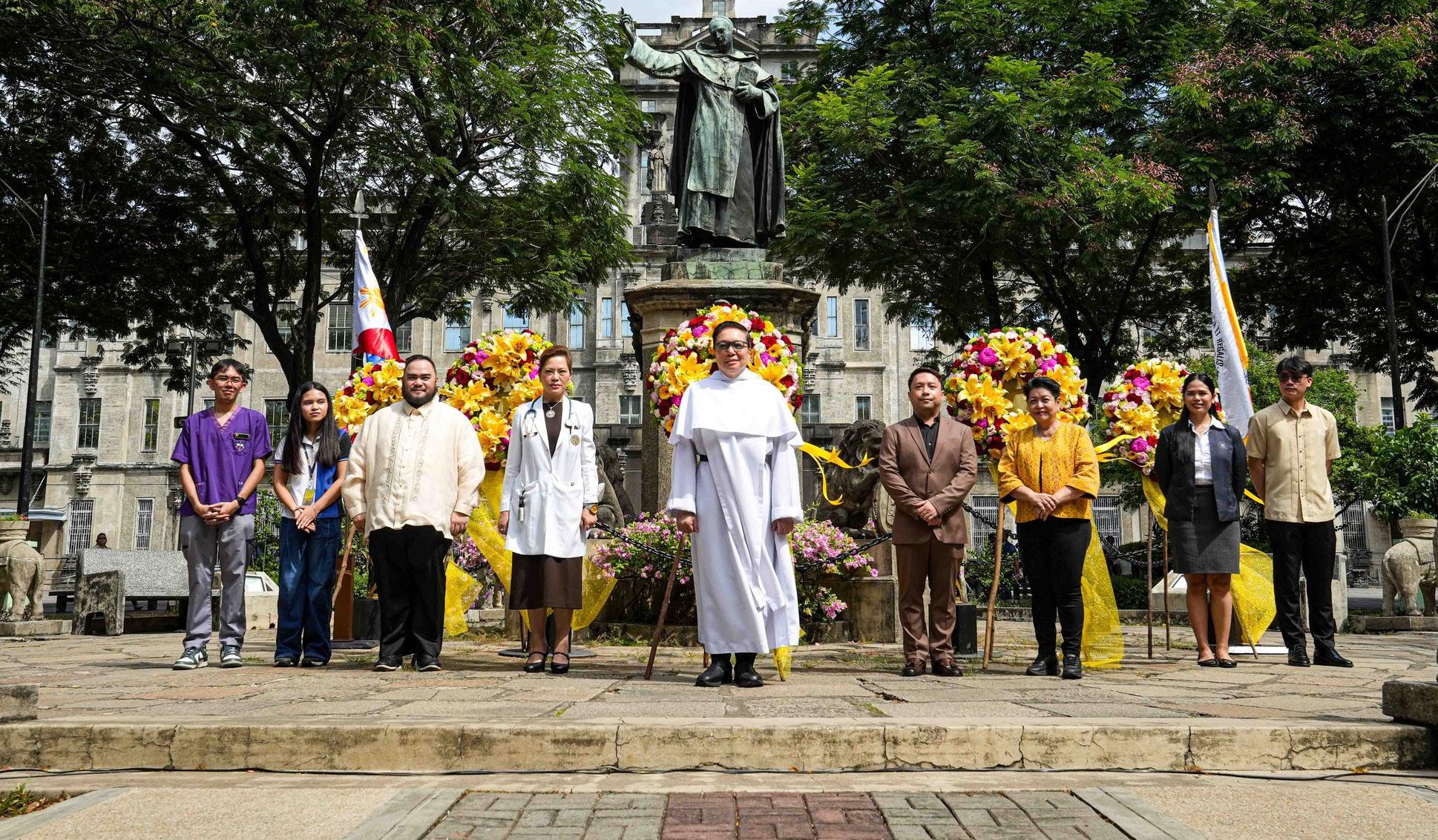
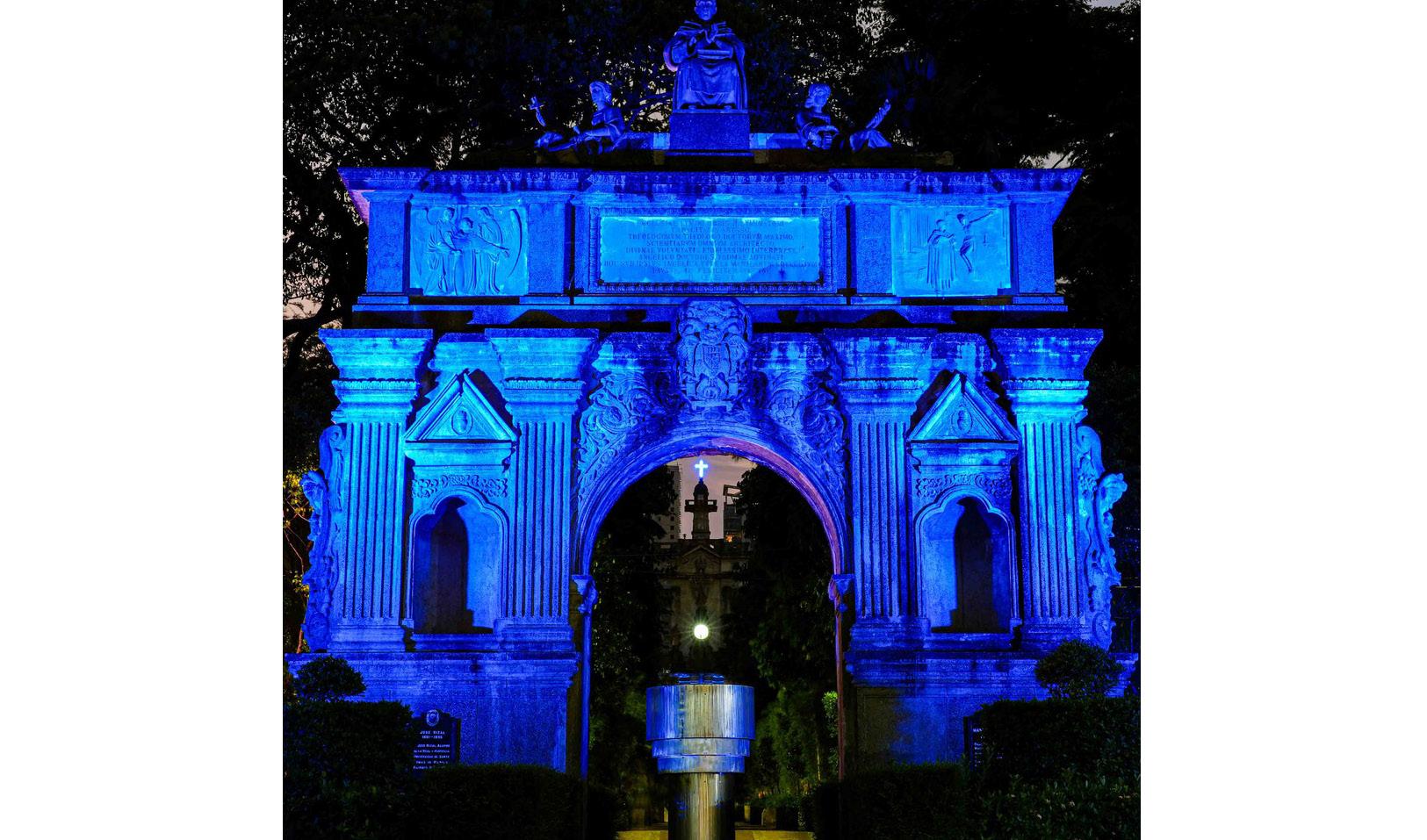
THE UNIVERSITY honored its founder, Msgr. Miguel De Benavides, O.P., with solemn wreath-laying rites and a Eucharistic celebration at the Benavides Garden for its 415th founding anniversary on April 28.
During his homily, Fr. Angel Aparicio, O.P., prefect of the Miguel Benavides Library, said Benavides’ monument serves as a “silent figure” that encourages Thomasians to continue persevering towards a “higher reality.”
“As I contemplate the monument…I ponder at a silent figure pointing upwards with his finger as a continuous and invincible reminder of a higher reality, of which what we
see is only a mere announcement or image,” Aparicio said.
Benavides’ monument on the UST Sampaloc campus, a bronze statue atop a pedestal flanked by four seated lion figures, is located in Plaza Benavides in front of the Main Building.
Aparicio said Benavides was a “poor man,” but was a “real missionary and evangelizer.”
“[He] had embraced Jesus’ instruction to his disciples almost literally. And [he] trusted Jesus’ words in the parable of the seed that no matter its apparent insignificance, when properly taken care of, it may grow into a mighty tree,” he stated.
The library prefect said the “secret” to sustaining operations for over

four centuries lies not only in financial investment but also in a strong “spiritual” foundation.
“Miguel de Benavides and his Dominican brothers, following the footsteps of Saint Dominic, the founder of the Dominican Order, were men of faith and had a profound commitment to the work of evangelization through education,” he said.
Benavides, the third archbishop of Manila, laid the groundwork for the University’s foundation in 1605 by donating his books and the sum of P1,500.
UST Vice Rector Fr. Isaias Tiongco, O.P., presided over the Mass. Rector Fr. Richard Ang, O.P., Secretary General Fr. Louie Coronel, O.P. and Benavides Cancer Institute Direc-
tor Teresa Sy Ortin, along with other University officials, were present at the ceremony.
In her speech, Ortin said Benavides’ teachings “carry a very profound meaning” to the Benavides Cancer Institute, which bears his name, as they guide the institute’s “healing mission.”
“The Benavides Cancer Institute has been guided by a single vision that is to deliver integrated, compassionate care to every cancer patient who enters its door,” Ortin said.
The Benavides Cancer Institute was inaugurated in 2006 and is the country’s first one-stop cancer center.
The 2026 anniversary rites bear the theme, “UST@415: Keep Us in Truth.”


UST calls on CHEd to respect inst’l autonomy in gen ed reform
By Amanda Luella A. Rivera
THE UNIVERSITY has called on the Commission on Higher Education (CHEd) to respect institutional autonomy and ensure that reforms to the general education (GE) curriculum “deepen the formative, humanistic, civic, ethical, and intellectual purpose of higher education.”
In a statement, UST outlined its suggestions following the CHEd proposal for a “reframed” GE curriculum, which seeks to offer six streamlined courses, of 18 to 36 units.
“The University trusts that CHED will reconsider the implemen-
‘‘
The University trusts that CHED will reconsider the implementation, ensuring that any revision to the General Education Curriculum genuinely strengthens the quality, depth, and transformative character of Philippine higher education.
tation… ensuring that any revision to the General Education Curriculum genuinely strengthens – rather than diminishes – the quality, depth, and transformative character of Philippine higher education,” the statement read.
The proposal seeks to revise
CHED postpones
afterthought in education policy,” Tadle, also the president of teachers’ coalition Cotescup and newly elected executive vice president of the UST Faculty Union (USTFU), told the Varsitarian
“If EDCOM 2 will help shape the future of Philippine education, then organized teachers—especially private school teachers—must have actual seats at the table, not mere invitations after decisions have already been made,” he added.
He was referring to the congressional commission tasked to reform education, which had been criticized for backing the GE overhaul.
Tadle said education policymakers should also include the working realities of private school teachers into the national education reform agenda.
On May 12, various faculty and advocacy groups, including the USTFU and Cotescup, submitted a position paper to CHEd to junk the proposed GE curriculum.
In a 13-item position paper, the groups asked CHEd to delay any pilot testing until a full review of the existing curriculum is completed.
It also asked for a nationwide, bottom-up consultation process to assess the curriculum’s effectiveness and guide its revisions, evaluate existing core courses, and restore removed subjects such as Filipino, Panitikan, and Philippine Government and Constitution.
They also demanded protection for faculty workers from potential job displacement that could be caused by the curriculum revision.
John Vincent Ignacio, the USTFU external vice president, warned that faculty members could lose their jobs because of the reframed GE curriculum.
“The union is very much vested in this issue because there’s a lot of labor implications if this proposal of CHEd is implemented,” Ignacio told the Varsitarian
By Amanda Luella A. Rivera
UNIVERSITY FACULTY and other academic personnel may soon be exempted from the city’s mandatory annual health certificate requirement after a city council panel approved a draft amendment narrowing the policy to high-risk occupations.
The proposed amendments to Ordinance No. 8793 introduce a riskbased classification that limits mandatory health certification to workers whose duties “directly and substantially affect public health,” including food handlers, sanitation personnel, and healthcare workers.
Under the draft amendments, teaching, administrative, and other office-based employees are classified as “low risk” and may be exempted from obtaining individual health permits, provided they are covered by institutional health programs or employer-administered medical examinations.
The draft also indicated that testing requirements shall not be done exclusively through a single government facility “when equivalent examinations from duly licensed or accredited facilities adequately satisfy

public health objectives.”
The measure has cleared the committee level and is set to be taken up for plenary approval by the Manila City Council.
The proposed amendments fol-
low sustained appeals from academic groups, including the Organisasyon ng Nagkakaisang Empleyado ng UST (ONE-UST), a coalition of labor unions in the University, and the Council of Teachers and Staff of Colleges and
Universities of the Philippines, which had questioned the blanket application of the 2021 ordinance to faculty.
In a joint statement read be-
The union is very much vested in this issue because there’s a lot of labor implications if this proposal of CHEd is implemented
John Vincent Ignacio USTFU EXTERNAL VICE PRESIDENT
“In our rough estimate in the university, at least 20% of our faculty members are teaching in the [GE] courses,” he said.
In an interview with the Varsitarian, former CHEd chairperson Prospero “Popoy” de Vera III said major reforms in the curriculum should be based on data and studied thoroughly.
“Because that is what we are in higher education, we are guided by studies, we are guided by research, we are guided by data when we make decisions,” he said.
De Vera said that before leaving CHEd in May 2025, he asked the technical panel to create an inventory of faculty members who could potentially be affected by the curriculum reform.
“It must be consultative, you need to talk to the students, you need to talk to their parents, you need to talk to the faculty members, you need to talk to the schools,” he said. WITH


By Luis Angelo N. Palma
STUDENT ACTIVIST Raven Racelis clapped back at Defense Secretary Gilberto “Gibo” Teodoro Jr., saying it was “hypocritical” of the Cabinet official to label her “bastos” (disrespectful) amid what she described as continuing human rights violations by state forces.
“Napaka-hypocrite na manggaling sa defense secretary ‘yung salitang ‘bastos,’” Racelis told the Varsitarian on April 28.
Racelis accused the Armed Forces of the Philippines and the Philippine National Police of being “numero unong nangbabastos sa karapatang pantao ng mamamayang Pilipino.”
Racelis hits back at Teodoro, slams military for rights violations Eng’g clinches 4-peat crown in 46th Pautakan, Nursing wins individual
By Luis Angelo N. Palma
THE FACULTY of Engineering secured its fourth consecutive championship in the 46th Pautakan, the Varsitarian’s intercollegiate quiz competition, outlasting 15 other teams at the St. Pier Giorgio Frassati Auditorium on April 8.
The Engineering team overcame a tight field in the finals, with the Faculty of Medicine and Surgery finishing second with 175 points and the Faculty of Pharmacy placing third with 145.
In the group eliminations, the Alfredo M. Velayo College of Accountancy led all 16 teams with 205 points, followed by the Faculty of Medicine and Surgery
(200), the Faculty of Pharmacy (185), the Faculty of Engineering (165), and the College of Commerce and Business Administration (155).
Engineering team captain Sophia Gabrielle Suarez said the team’s improved chemistry and support system fueled their title run.
“For this year, mas masaya, mas malawak, and mas memorized ‘yung alam namin,” she told the Varsitarian. “Mas masarap makipag-interact sa teammates, and mas naging participative ‘yung team namin sa practice at training, with stronger support.”
Suarez, who is set to gradu-
ate, said the win was especially meaningful as it capped her final year with the team.
Individual category College of Nursing junior Joachim Benedict del Rosario captured the individual title after edging out Paul Topacio of Medicine in a sudden-death round, 153.5–153, following a tie in the clincher round. Topacio, last year’s champion, settled for second place, while Engineering’s James Abris finished third with 135 points. Del Rosario said the victory was more meaningful as a mile-
Racelis said her exchange with Air Force personnel inside the University stemmed from questions about military operations in Mindoro and Negros Island, including bombings and strafing incidents linked by activists to civilian deaths.
“Ano ba ‘yung ginawa ko, no? All throughout the conversations I’ve had with this AFP personnel inside our University, tinatanong ko lang naman kung anong kinalaman nila sa pagbobomba nila sa Mindoro,” she said.
Racelis said she also asked whether the Air Force equipment exhibited on campus on April 21 had been used against civilians, activists, and peasant organizers.
“Ano ang sinabi sakin, isa daw akong bastos, isa raw akong komunista, parte lang daw ako ng ma-



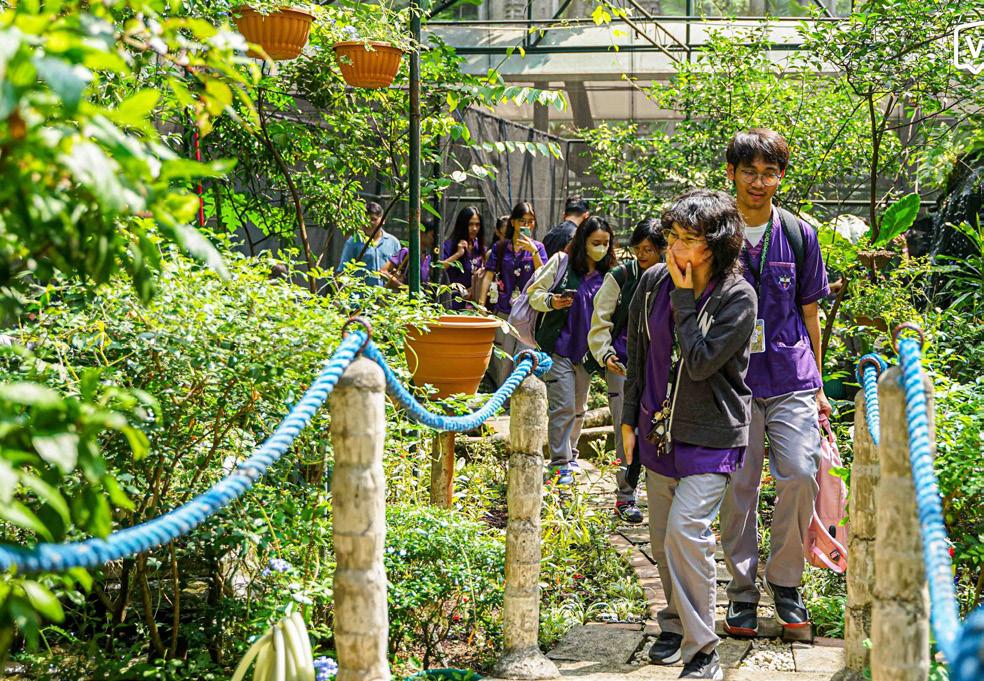
► The UST Facilities Management Office, in collaboration with the Faculty of Pharmacy and the College of Science, opens a butterfly sanctuary at the UST Botanical Garden on April 24. — PHOTOS BY CHLOE
By Alexandra S. Demaisip
UST HAS upgraded the Botanical Garden with a new butterfly sanctuary, improved water features and new identification tags for trees, officials from the Facilities Management Office (FMO) said on April 24.
FMO Director Fr. Dexter Austria, O.P. said the butterfly sanctuary would serve as an indicator of sorts of the level of pollution within the campus.
“If our air is so polluted, the butterflies will not thrive,” Austria said.
“These are also sanctuaries for people who wanted to have a more relaxed environment…they could go here and find some relaxation,” he added.
Austria said the revival of the butterfly sanctuary, which has three
existing offerings to align with “global standards,” flexibility, and employability-driven skills.
In a statement dated May 9, UST urged CHEd to “balance regulatory oversight with respect for institutional autonomy,” noting that flexibility should not be limited to autonomous higher educational institutions, but also to institutions with curricular capacity and faculty expertise.
“Rather than prescribing specific courses, we propose that CHED spells out minimum expected outcomes, allowing HEls to innovate and design their own courses,” it said.
UST said curriculum reform should not only aim for “labor-market pressures,” but must also create “well-rounded graduates.”
“Excessive consolidation of foundational GE courses into interdisciplinary courses may not fully achieve the depth of learning outcomes traditionally associated with disciplinal formation, unless accompanied by robust curricular safeguards and sufficient instructional prepa-
kinds of butterflies—Lime, Appias paulina, and Psyche—was the “first chapter” toward transforming UST into a “green and sustainable campus within the city.”
Jared Gunting, environmental, health, safety, and crisis engineer of FMO, said more butterfly species would be added in the future.
“While this is a good starting point, our goal is to gradually introduce and support more local butterfly species, further strengthening biodiversity and promoting native ecosystem,” he said.
Gunting said the new identification tree tags include QR codes that lead to a website containing more information about the plant species.
“We are slowly improving, slowly enhancing the botanical garden by making sure that all of the plants inside the campus are well accounted
ration,” UST said.
UST also urged the CHEd to conduct an evidence-based assessment of students nationwide to determine whether they have achieved the required competency before implementing changes to the GE curriculum.
UST added that CHEd must “consider the labor implications of any curricular change,” which it said entails not only employment issues but also quality assurance.
“Abrupt curricular reduction risks the loss of experienced disciplinal experts whose formation, scholarship, and teaching experience are essential to meaningful interdisciplinary education,” it said.
The Philippines should draw lessons from globally competitive universities as they show that “professional readiness and liberal education are not mutually exclusive,” it said.
“For the University of Santo Tomas, general education is not a curricular excess,” it said.
UST depts speak out on gen ed overhaul
Academic departments earlier opposed the reframed GE curriculum
We have introduced these features that not only improve the aesthetic quality of the space, but also help create more conducive microclimate for plants and animals inside the botanical [garden].
Jared Gunting FMO CRISIS ENGINEER
for,” he said.
Water features inside the botanical garden, like ponds and fountains, are now functional, and an overhead sprinkler system was recently installed, he said.
“We have introduced these features that not only improve the aesthetic quality of the space, but also help create more conducive microclimate for plants and animals inside the botanical [garden],” Gunting said.
The Botanical Garden was established in 1932 as a pharmacy garden. It was later transformed into a botanical garden by the Faculty of Pharmacy, the College of Science, and the Research Center for the Natural Sciences.
By Sydney Venice V. Verba
CLASSES FOR Academic Year (AY) 2026-2027 in the Manila and General Santos (Gensan) campuses will begin on Aug. 7, according to the collegiate calendar released by the Office of the Secretary General on Friday.
Both UST Manila and GenSan campuses will hold freshmen onboarding activities starting Aug. 3 with the UST Cloud Campus orientation, followed by the virtual “ROARientation” on Aug. 4.
The Misa y Discurso de Apertura or the Mass of the Holy Spirit and the inaugural lecture is scheduled for Aug. 5.
The in-person ROARientation and welcome concert will take place on Aug. 6.
As in the previous academic year, classes will open on Aug. 7, but will be suspended the following day in observance of the feast of St. Dominic de Guzman, founder of the Order of Preachers.
The Manila and GenSan campuses will hold Term 1 preliminary examinations on Oct. 9 to 10 and Oct. 12 to 13, while final examinations are set on Dec. 14 to 17.
The Undas break for Thomasians has been shortened to Oct. 30 to Nov. 3, compared with last academic year, when it was extended until Nov. 4.
The Paskuhan festivities are slated on Dec. 18, a day earlier than last year’s schedule.
The Butterfly Sanctuary is open to the public from Monday to Friday, 9 to 11 a.m. and 2 to 4 p m. It will be closed on weekends and holidays.
proposal, warning that the move could reduce the role of humanities in higher education.
The UST Department of Creative Writing said the humanities are central to education, warning that removing them erases “possibilities of humanhood” and limits students’ capacity for reflection.
“Hindi lamang mga kurso ang tinatanggal kundi mga tinig at alaala,” the department said in a May 7 Facebook post.
“Hindi lamang tayo mga tagapagbayad ng buwis at kasangkapan para manatili sa kapangyarihan ang iilan. Tayo ay mga nilalang na may gunita, may paninindigan; may kakayahang magsalaysay, magsuri, at magpasiya,” it added.
The Department of Literature likewise urged CHEd to “restore the rightful place of Literature and the Humanities as mandated general education courses.”
“The study of Literature, Art, and the Humanities… fosters critical thinking, nourishes creativity and imagination, and deepens empathy,” it said in a May 8 Facebook post.
The department stressed that while technological skills were necessary, they should not come at the expense of disciplines that shape human values and crit-
ical thought.
The College of Science, meanwhile, called on CHEd to expand its consultations and to pursue reforms that aim to create a holistic and interdisciplinary higher education.
“Naniniwala kami na hindi sapat na natutugunan ng mga panukalang interdisciplinary GE courses ang mga pangunahing kasanayang kasalukuyang nalilinang sa umiiral na science-oriented GE courses,” the academic unit said in a May 9 statement.
The Catholic Educational Association of the Philippines (CEAP) and the Catholic Bishops’ Conference of the Philippines – Episcopal Commission on Catholic Education (CBCP-ECCE) supported the calls by educational institutions in a May 7 statement, noting the role of GE as the “formative core of the university experience.”
The Catholic groups said that CHEd must pursue “a more grounded and evidence-based” review of the reframed GE curriculum.
“In this context, treating ethics as merely diffuse or incidental across the General Education curriculum risks producing only a “thin crust” of moral aware-
Registration for Term 2 will begin on Jan. 11, 2027, while regu-
ness,” it said.
CEAP and CBCP-ECCE also recommended CHEd to pursue a “broad national consultation” rather than piloting in select institutions, noting that “pilots may prematurely normalize contested frameworks.”
Reframed GE curriculum ‘not yet final’
In a May 7 statement, CHEd backtracked on the proposed GE curriculum, stating it was“not yet final” and remained open to refinement following consultations with stakeholders.
The commission said inputs from higher education institutions, faculty, students, and professional organizations would be reviewed by the technical panel for GE, stressing that the process would “ remain deliberate and evidence-based.”
It added that the proposal formed part of ongoing efforts to align senior high school and GE curricula, with further consultations expected before the issuance of a final policy.
“CHEd will continue to engage stakeholders through additional consultation mechanisms,” it said.

WHEN THE Senate convenes as an impeachment court, the proceeding will inevitably turn on a single, troubling question: What happened to the ₱612.5 million in confidential and intelligence funds entrusted to the Office of the Vice President and the Department of Education under Vice President Sara Duterte?
More than a dispute between political rivals, the case strikes at the heart of public accountability. Confidential funds may be shielded from public view, but they are not beyond public scrutiny. In a democracy, secrecy cannot become a substitute for explanation.
The ₱612.5 million in confidential and intelligence funds at the center of the impeachment case consists of allocations made to both the Office of the Vice President (OVP) and the Department of Education (DepEd).
Of the total amount, ₱500 million was released to the OVP. This included the controversial ₱125 million transferred from the Office of the President’s contingency fund in late 2022. House investigations and Commission on Audit findings showed that the entire amount was reportedly disbursed within just 11 days in December 2022, despite the OVP having no confidential-funds item in its approved budget that year. The remaining ₱375 million came from confidential-fund allocations released to the OVP in quarterly tranches during 2023.
Another ₱112.5 million involved funds released to DepEd while Duterte was Education Secretary from 2022 till 2024. This amount rep-
resented three quarterly releases of ₱37.5 million each in 2023 from DepEd’s ₱150-million confidential-funds allocation. Congressional inquiries later questioned the liquidation of these funds, citing allegedly defective receipts, questionable documentation, and the use of fictitious names—including the now notorious “Mary Grace Piattos”—in acknowledgment records submitted to support expenditures.
These alleged irregularities now form a cen-
versy are allegations regarding Duterte’s wealth and financial transactions. Before the House committee on justice, Anti-Money Laundering Council Executive Director Ronel Buenaventura disclosed billions of pesos in covered and suspicious transactions linked to Duterte and her husband, lawyer Manases Carpio.
These reports are not proof of guilt. Covered transactions simply meet reporting thresholds under law, while suspicious transactions
For too long, public accountability in the Philippines has been reduced to a contest of political survival. Scandals are treated as storms to be weathered rather than allegations to be answered. Yet surviving public outrage does not erase questions about the use of public funds.
tral pillar of the impeachment case and related complaints alleging misuse of public funds.
This is not merely a paperwork dispute. Government offices entrusted with confidential funds are not exempt from audit. The public is not demanding disclosure of intelligence operations or sensitive information. What taxpayers deserve is assurance that public money was used lawfully and supported by legitimate documentation.
Separate from the confidential funds contro-
are flagged for further examination. Likewise, discrepancies raised regarding Duterte’s Statements of Assets, Liabilities and Net Worth (SALNs) have yet to be conclusively established as violations.
Still, such questions cannot simply be dismissed. Public officials are expected to account for their assets and financial activities with transparency, especially when concerns are raised by official institutions performing their

legal duties.
What must be avoided, however, is the temptation to conflate distinct issues. COA’s findings concern the spending and liquidation of confidential funds. The Anti-Money Laundering Council’s reports concern financial transactions. SALN questions concern the accuracy and completeness of asset declarations. Each issue must be examined according to the evidence available and the legal standards that apply.
The Senate’s responsibility is to determine whether Duterte committed impeachable offenses and whether she remains fit to hold public office. But accountability cannot end there.
If evidence of criminal wrongdoing emerges, the appropriate investigative bodies and courts must be allowed to perform their duties independently and without political interference. Impeachment may remove an official from office and disqualify her from holding future public positions, but criminal liability can only be established through due process.
For too long, public accountability in the Philippines has been reduced to a contest of political survival. Scandals are treated as storms to be weathered rather than allegations to be answered. Yet surviving public outrage does not erase questions about the use of public funds.
The ₱612.5 million at the center of the impeachment case demands clear answers. The public has a right to know whether taxpayer money was spent lawfully, responsibly, and honestly. Whatever the Senate ultimately decides, that question must not disappear with the verdict.
Newsdesk notes
CARLO JOSE H. RUGA

EARLIER THIS year, social media once again fell into a familiar cycle of nostalgia. Filipinos revisited 2016 through old Vine clips, Pokémon Go screenshots, and fading internet trends that now feel strangely distant. For many, it was harmless reminiscing — a return to a simpler digital age before algorithms fully consumed public discourse.
But 2016 was not only the year of viral dances and fleeting memes. It was also a turning point in Philippine politics; one whose consequences continue to shape the nation nearly a decade later.
That year, longtime Davao City mayor Rodrigo Duterte rose to power and became president.
He had promised change: swift government action, public safety and order, and clean government in a country exhausted by corruption, crime, and inequality. Millions embraced his message.
What followed was a presidency defined by fear, violence, and deep political division.
The so-called “war on drugs” became the centerpiece of Duterte’s administration. Official narratives framed it as a campaign against criminality, yet many of those killed by police came from poor communities. Human rights groups, Church leaders, and international observers repeatedly questioned the killings and the culture of impunity and state terrorism they fostered.
At the same time, another battle was unfolding online.
Duterte’s rise coincided with the rapid expansion of coordinated disinformation networks and algorithm-driven propaganda. Social media became more than a platform for discussion; it became a weapon for information distortion, harassment, and political manipulation. Facts were buried beneath noise. Critics were branded enemies. Lies traveled faster than accountability.
[Remember]
that democracy is not sustained by nostalgia, charisma, or trending slogans.
It
survives through discernment, accountability, and the
courage
to confront uncomfortable truths.
And perhaps the most dangerous effect of disinformation was not that it convinced everyone — but that it exhausted people into confusion.
Nearly 10 years later, the country still lives with the consequences.
Today, Duterte sits in detention in The Hague where he will be tried by the International Criminal Court for crime against humanity in connection with
THE IDEA of San Beda University joining the UAAP is not new. The matter has been a topic of UAAP conversations for more than a decade.
From a UST perspective, the discussion is less about novelty and more about standards. San Beda represents a sports program built on sustained dominance across multiple sports.
In the NCAA Philippines, the grand old league now two years past its centennial mark, San Beda’s basketball program alone has amassed 24 titles.
Its swimming teams have produced extended championship runs, while its presence across other disciplines continues to yield consistent podium finishes.
Its backers and alumni, too, are as committed and well-resourced as those of the UAAP’s top schools, if not more.
The UAAP itself has shown that expansion is not a foreign concept.
In recent seasons, it has opened its doors to guest schools in select events. In boys’ football, schools such as the Claret School of Quezon City and PAREF Southridge School were invited to compete, a move aimed at deepening the field and strengthening grassroots development.
Let the Lions in
That openness extended further when Southridge captured a UAAP high school baseball title, becoming the first guest team to win a championship and proving that inclusion can immediately elevate competition.
So what keeps the Red Lions from entering the fold?
Leagues, like the athletes within them, are not meant to remain static. Growth becomes a necessity rather than a risk. The UAAP has already embraced this
Leagues, like the athletes within them, are not meant to remain static. Growth becomes a necessity rather than a risk.
If evolution is accepted in sport, it should not be dismissed in structure.
idea by adding new disciplines such as e-sports and adding events like golf, signaling that adaptation is part of its identity.
If evolution is accepted in sport, it should not be dismissed in structure. Adding a program like San Beda would raise the competitive standard of the UAAP.
FROM
fore the council, the groups said the amendment would align requirements with “actual public health exposure” and prevent duplication of medical clearances already conducted within universities.
“This avoids duplication, reduces administrative burden, and recognizes the occupational health systems already in place in our schools,” the joint statement read.
The draft has also recognized institutional compliance mechanisms,
allowing consolidated certifications in place of individual permits for lowrisk sectors.
A legal opinion from the Manila City Legal Office supporting the amendment stated that while the city could issue regulations for public health, such measures must be “reasonable and proportionate” to the nature of the work.
Earlier, the Manila Health Department said faculty members were still covered under the existing ordinance, the city’s Sanitation and Disinfection Code signed by Manila Mayor Francisco “Isko Moreno” Domagoso
the thousands killed during his anti-drug campaign.
For families of victims of extrajudicial killings, the development represents something long denied to them: the possibility that power may finally answer to justice.
Duterte’s camp continues to challenge the ICC’s jurisdiction and proceedings, while the court prepares for the next stages of trial. Yet regardless of the outcome, the moment carries historic weight. For years, many believed accountability for the drug war would never arrive.
Now, the world is watching.
But legal proceedings alone will not heal a nation that continues to struggle with historical amnesia.
As the 2028 presidential elections slowly approach, familiar political machinery is already beginning to move again. Narratives are being rewritten in real time. Online propaganda remains alive and profitable. Politicians continue to test how easily public memory can be softened, redirected, or erased.
The responsibility, then, falls heavily on voters — especially those who were still minors in 2016 and are now old enough to participate in shaping the country’s future.
May they remember that democracy is not sustained by nostalgia, charisma, or trending slogans. It survives through discernment, accountability, and the courage to confront uncomfortable truths.
And may we remember that forgetting is never neutral.
When a nation forgets too easily, history does not disappear. It returns — often louder, crueler, and more dangerous than before.
The plea remains the same: May we never forget.
A deeper field demands sharper competition, while a broader landscape invites new narratives that keep the league relevant and reinforce its standing as the country’s premier collegiate association.
Beyond spectacle, expansion carries long-term value. With the UAAP’s centennial season still more than a decade away, integrating a program like San Beda now positions the league for sustained growth.
It strengthens the UAAP’s identity as the premier collegiate league in the country, widens its reach, and ensures that by the time the milestone arrives, the league stands larger and more competitive than ever.
I acknowledge the concerns. The UAAP’s identity extends beyond competition into shared academic and cultural alignment. Integrating a new member would require careful adjustments in scheduling, governance, and athlete support.
Expansion inevitably reshapes balance, forcing them to adapt. But not every change is guaranteed immediate success, and not every stakeholder will welcome it.
Yet leagues are not defined by what they preserve, but by what they are willing to become.
The question is no longer whether San Beda can compete—because they certainly are—but whether the UAAP is ready to evolve and is welcome to take another step to growth.
If the UAAP is to remain the home of the best, then standing still is no longer an option.
As the league approaches nine decades of excellence, perhaps it is time to finally let the Lions in.
in April 2022.
The Varsitarian has learned that non-tenured faculty were required to submit their health certificates before receiving their teaching appointments for next academic year.
ONE-UST earlier urged Manila officials to limit the requirement to newly hired personnel, citing the burden imposed on faculty members already subject to regular medical screening.
In a Jan. 29 letter to Mayor Francisco “Isko Moreno” Domagoso, coursed through Manila Health Department director Dr. Grace Padilla,
the group said “inconsistent implementation” of the policy had caused “confusion” among workers.
The coalition said it had learned that the city government had introduced changes to the policy, in which the health permit requirement would be “applied only to new applicants and not to teachers or employees who are already currently employed.”
“We appreciate this adjustment,” ONE-UST said, adding that it “avoids imposing unnecessary burdens on teachers and employees who are already compliant with institutional health protocols.”
ka-kaliwang grupo na nanggugulo kaya umalis na lang daw ako,” she recalled.
Teodoro later reacted to Racelis’s confrontation with the Air Force personnel, which went viral.
“So ako, walang justification ‘yan. Talagang kabastusan lang ’yon,” Teodoro told reporters covering the opening of a military exercise with the US on April 24.
Racelis also disputed Teodoro’s claim about her supposed eightyear academic stay in UST, clarifying that she had been in the University for six years, including senior high school.
She also criticized the University’s silence on alleged red-tagging and threats against her.
“Ni minsan ba nagsalita ang UST hinggil sa mga death threats, red-tagging against sakin? Wala,” she said.
Her remarks came during the “Araw ng Paniningil,” a protest led by students from universities across the U-Belt, denouncing what they described as a worsening economic crisis, widespread corruption, intensified military operations, and rising attacks under the Marcos administration, while calling for justice for the “Toboso 19” killed in a recent Negros Occidental military operation.
46th Pautakan FROM PAGE 2 ►
FROM PAGE 2 ► stone for his college.
“It’s mostly for the college because we haven’t won since 2010, and it’s good to bring it back,” he said. “Of course, I’m happy for myself, but it’s really for the College of Nursing.”
He also topped the individual eliminations with 130 points, followed by Topacio (120). Sean Queja of Accountancy and Abris tied at 90 points, while Jose Dema-ala of the Faculty of Arts and Letters placed next with 75.
Competition proper
In his opening remarks, Secretary General Fr. Louie Coronel, O.P., urged contestants to value truth, discipline, and wisdom over recognition.
“To our dear contestants: yes, compete. Enjoy the thrill. Trust your preparation. Answer boldly,” he said. “But do not forget that the real victory [is] a mind trained to love truth, a character formed by discipline, and a heart humble enough to know that wisdom is always greater than mere information.”
Participants answered questions across six categories: UST history, history, general information and current events, humanities, science and technology, and mathematics, divided into easy, average, and difficult rounds, with 12 questions per difficulty level.
Resource persons were Jose Victor Torres (UST history), Emmanuel Jeric Albela (history), Jose Ramon Lorenzo (general information and current events), Ralph Semino Galan (humanities), Carl Rogel Inocentes (science and technology), and Mark Dexter de Lara (mathematics).
Serving as quizmasters were former Varsitarian Circle writer Alyanna Tamaray and Tiger TV host Kody Huang for the eliminations, and events host Jessica Asprer and Education alumnus Claude Despabiladeras for the finals.
By Alexandra S. Demaisip
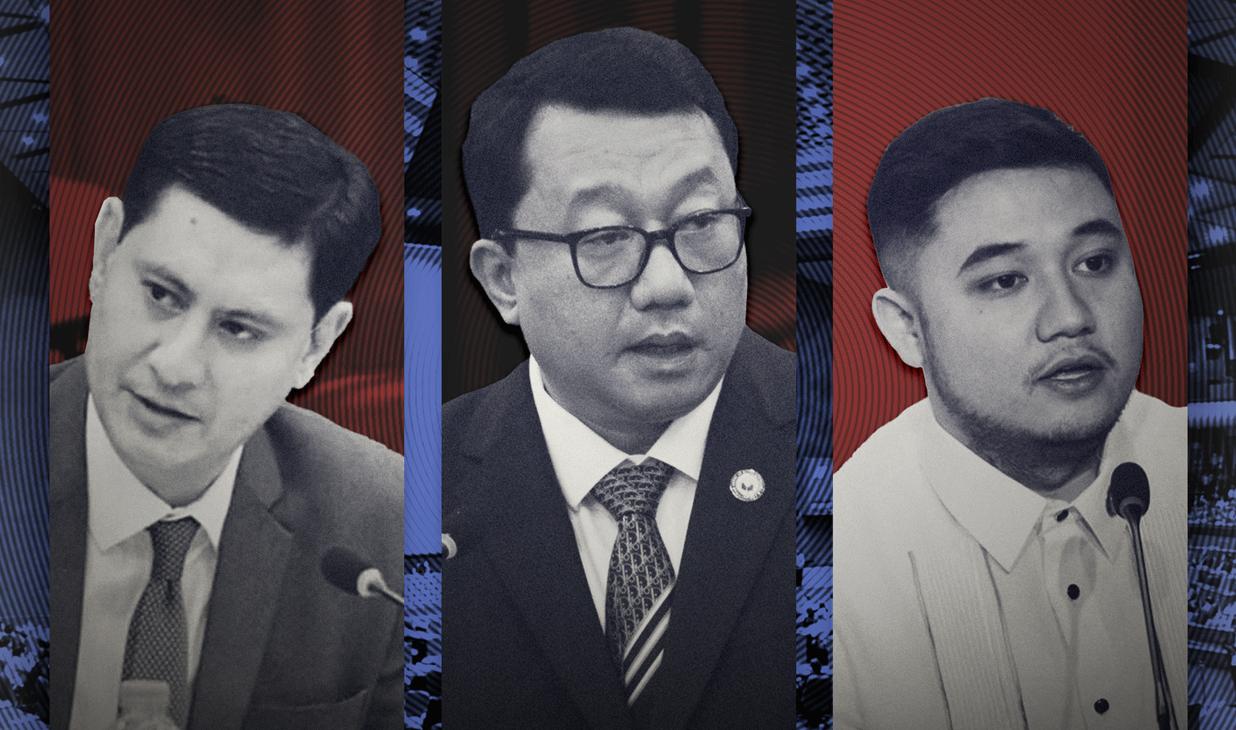
TWO THOMASIANS retained their spots in the 11-person prosecution team for the impeachment proceedings against Vice President Sara Duterte.
Representatives Joel Chua and Lorenz Defensor were initially among those chosen as prosecutors in the impeachment trial of Duterte in February 2025, but no trial materialized after the Supreme Court nullified the proceedings.
Added to the list was Rep. Ramon Rodrigo “Rodge” Gutierrez, a graduate of UST Legazpi, who was among the names listed by House Justice Committee chairperson Rep. Gerville Luistro on May 12.
This selection came after the House’s decisive 257-25 vote to impeach the vice president on Monday.
In accordance with the House Rules on impeachment, the chamber is required to select its delegates to manage the investigation as it proceeds to the Senate for a trial.
The House’s vote came more than a year after the Supreme Court nullified the attempt to impeach Duterte in February 2025, due to violations of the one-year bar rule, which prevents more than one impeachment process for an impeachable official.
Duterte’s impeachment will also be the first time an incumbent vice president will be tried.
Joel Chua
Chua graduated with a bachelor’s degree in accountancy from the College of Commerce and Accountancy (now Alfredo Velayo College of Accountancy). He was elected as Manila’s third
district representative in 2022. He is the secretary general of the local party Asenso Manileño.
Chua chairs the House Committee on Good Government and Public Accountability, which led inquiries into the alleged mismanagement of confidential and intelligence funds (CIF) by Duterte within the Office of the Vice President and the Department of Education
The issue of Duterte’s management of the confidential funds was one of the four articles or grounds of her impeachment.
Chua, who has held the position since 2022, won against Aksyon Demokratiko bet Honey Nieto-Rodriguez, the sister of former Manila vice mayor Yul Servo.
Lorenz Defensor
Defensor was elected as Iloilo’s third district representative under the PDP-Laban (Partido Demokratiko ng Pilipinas-Laban ng Bayan) party in 2019. He switched to the National Unity Party in 2021.
His father, Arthur Defensor Sr., was the governor of Iloilo from 2010 until 2019, having represented the third district in Congress from 2001 until 2010. His brother, Arthur Defensor Jr., holds office as the governor of Iloilo.
Defensor graduated from the Faculty of Civil Law in 2004 and worked as a managing partner of the Salazar Enrile Defensor & De Mata Law Firm, which specializes in energy law and project financing.
He serves as senior deputy majority leader and vice-chairman of the House Committee on Constitutional Amendments.
Ramon Rodrigo “Rodge” Gutierrez
A representative under the 1-Rider party-list group, Gutierrez attained his secondary education at UST Legazpi.
He later obtained his Juris Doctor degree from the Ateneo de Manila University and passed the Philippine Bar Examination in 2019.
Gutierrez was elected to Congress in 2022.
He was reelected in the 2025 midterm election as the first representative
PROSECUTORS PAGE 9 ►

By Chalssea Kate C. Echegoyen
FORMER PRESIDENT Rodrigo Duterte will stand trial for crimes against humanity after judges of the International Criminal Court (ICC) confirmed all charges linked to thousands of killings under his administration.
In a decision dated April 23, the ICC’s Pre-Trial Chamber I ruled that there were “substantial grounds to believe” Duterte was responsible for murder and attempted murder under Article 7(1)(a) of the Rome Statute, citing a “widespread and systematic attack” against civilians from November 2011 to March 2019.
The decision was based on evidence presented in hearings held from February 23 to 27, 2026, as well as submissions and documents submitted by the parties, participants, including participating victims.
The ruling covers Duterte’s time as Davao City mayor and later as president, and follows a confirmation of charges hearing held in February, where prosecutors presented evidence on alleged extrajudicial killings during his “war on drugs.”
In a 50-page decision that came after ICC junked all appeals made by Duterte, the Chamber identified the charges against the former president:
Count 1: Murder as a crime against humanity in Davao City during the mayoral period of at least the 19 victims in identified incidents between 2013 and around June 2016;
Count 2: Murder as a crime against humanity of “high-value targets” in locations across the Philippines during the presidential period of at least the 14 victims of identified incidents, some time between July 2016 and July 2017; and
Count 3: Murder and attempted murder as crimes against humanity in barangay clearance operations in locations across the country during the presidential period of at least 45 victims (43 murders and two attempted murders) of identified incidents, some time between July 2016 and September 2018.
Fusion Alley will operate ‘as long as the people like it’ – Isko
By Carlo Jose H. Ruga
MANILA
Moreno” Domagoso said on Thursday the popular Manila food destination Fusion Alley would remain operational “as long as the people like it.”
Domagoso said in a video interview by The Flame on April 30 that the food park located on Delos Reyes Street near UST’s P. Noval gate would continue operations indefinitely.
“So, pagdating ng araw na they need to go, they will go. But for now,
I am happy for the students and the community around accessing good, but affordable, food,” he said.
Domagaso said the city was trying to maintain the cleanliness and orderliness of the food park, and the safety of people passing by.
“We try to manage it every day in such a way to make it publicly available during daytime, to try to make an opportunity for your individuals, family, entrepreneur to make a living,” he said.
In an earlier report by the Varsi-
tarian, nearby dormitories, residents and commuters raised concerns over safety, sanitation, and street congestion brought by Fusion Alley.
In the November 2025 report, a staff member of the Fusion Alley told the Varsitarian street sweepers were employed to clean daily.
The noise at the crowded street was unavoidable, however, the staff member said.
The “Zero Vendor Policy” was implemented in some parts of Manila in August 2025, following a 2024
memorandum of the Department of the Interior and Local Government on the nationwide implementation of barangay road clearing operations.
Vendors at the four streets aroundUST were allowed to operate as long as they moved their carts to clear pedestrian access.
Domagoso allowed street food vendors to set up stalls on Delos Reyes Street in September 2025 at the request of vendors.
Fusion Alley operates from late afternoon to midnight.
The 81-year-old former leader, who has repeatedly denied the charges, has been detained at the ICC facility in The Hague in Netherlands since March 2025.
Trial proceedings to begin
With the confirmation of charges, the case now proceeds to trial.
The ICC Presidency will constitute a new Trial Chamber composed of three judges who were not part of the pre-trial panel. They will set the schedule and procedure including evidence disclosure and other preliminary matters. Both the prosecution and defense may appeal the decision but should first obtain permission from the other chamber.
Under ICC rules, Duterte is expected to be present during the trial proceedings, subject to judicial deter-


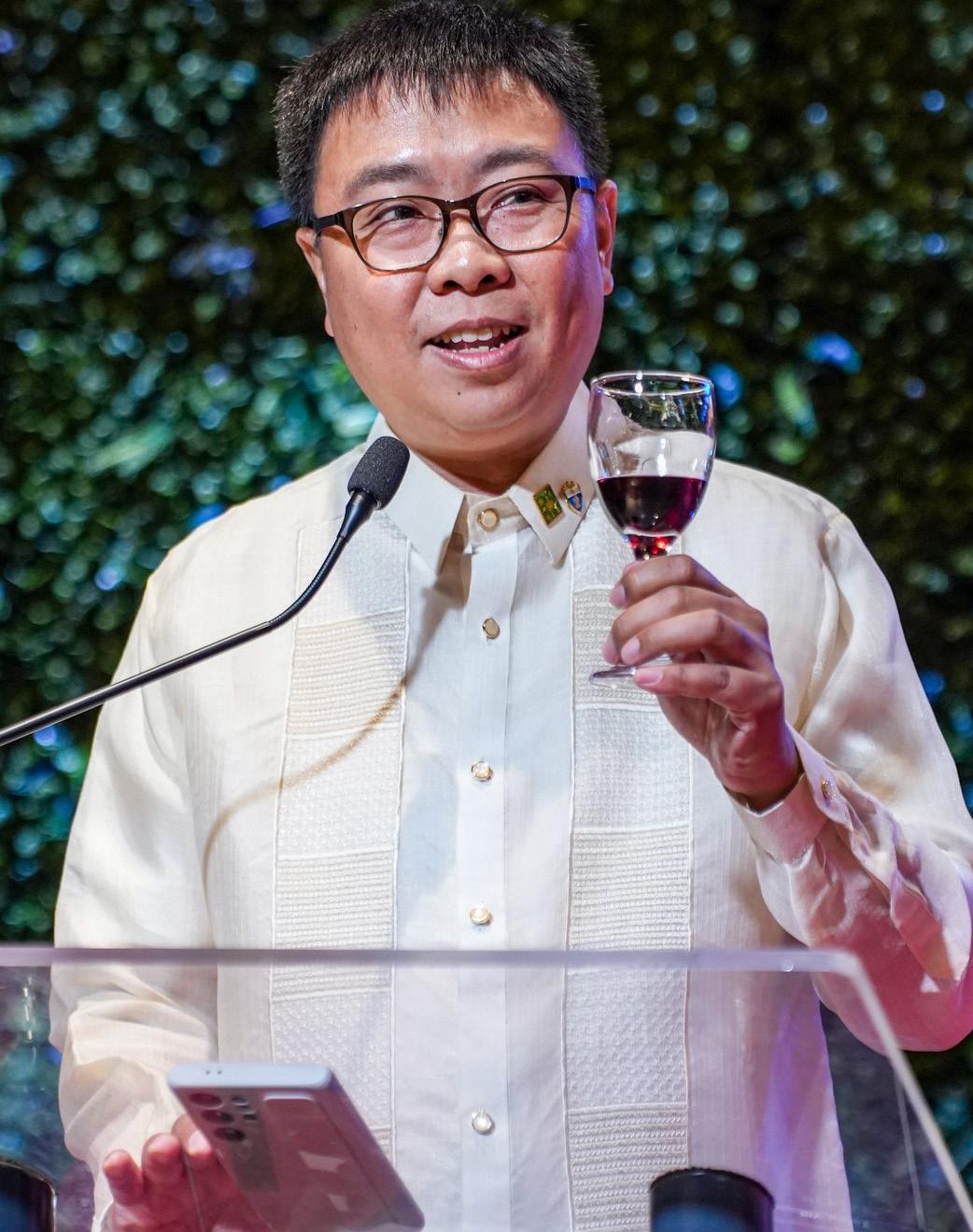
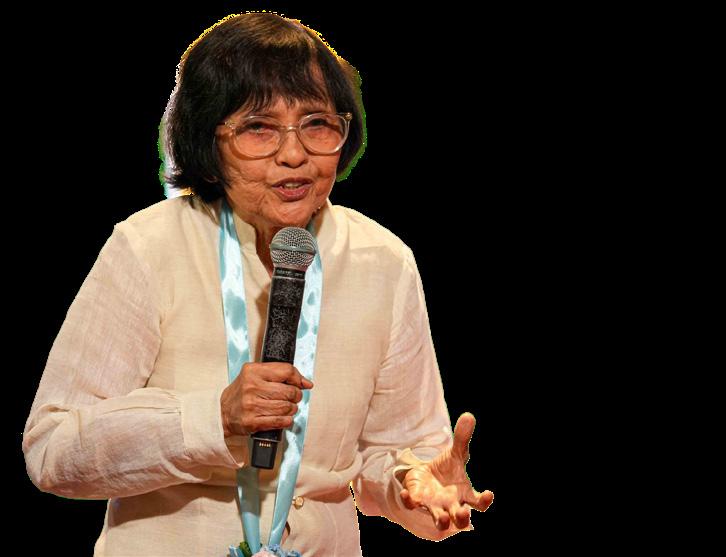
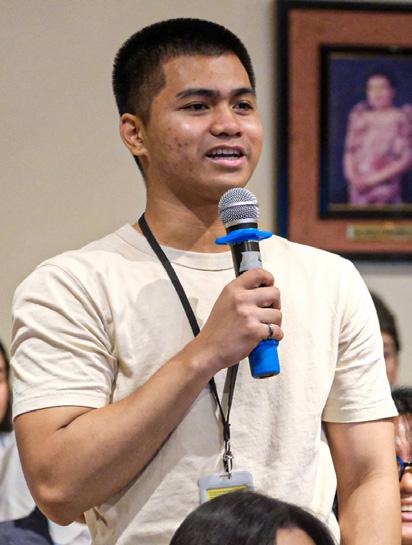
AT 100, the UST College of Science is looking back not only at a century of scientific instruction, but also at the steady leadership that helped turn it into one of the country’s leading centers for pure and applied sciences.
As the college closes its centennial year, former deans Fortunato Sevilla III (2002 to 2008), Maribel Nonato (2008 to 2012), and John Donnie Ramos (2012 to 2019), along with current dean, Rey Donne Papa, reflected on the programs, policies, and crises that shaped the college’s growth.
Established in 1926 as part of the now-defunct College of Liberal Arts, the College of Science has sustained its momentum through continuity, with each administration building on the work of its predecessors.
What helps keep the college on track and forward-facing is continuity from one dean to another.
“Established na ng mga previous deans ‘yung direction na gusto nila for the College of Science, kaya it was not hard to make plans. Na-set na nila ‘yung foundation sa gusto mong mangyari,” Nonato said.
Papa said this continuity kept the college from “resetting” with every change in leadership.
“One good thing with the College of Science is that the current dean always makes sure that he adds to the [progress], hindi nag-rereset. We build on what the past deans have done,” Papa said.
Faculty profile and research
During Sevilla’s term, the college

strengthened its faculty profile by encouraging professors to pursue graduate studies.
“It was a target during my time to increase the number of master’s and doctorate degree holders, and articulated na ‘yung objective na ‘yung goal was zero bachelor degree holders among the faculty,” Sevilla said.
He also encouraged faculty members to become more active in research, including through the University’s research centers.
Nonato and Ramos continued the
push for graduate education, with faculty members pursuing advanced degrees in the Philippines and abroad.
During Ramos’ deanship, the college expanded its internationalization programs, allowing students and faculty members to train and collaborate with universities in Taiwan, Australia, and Japan.
The implementation of the K-to-12 curriculum, however, reduced freshman and sophomore enrollment and affected faculty tenure opportunities.
To respond to the decline, Ramos

said some faculty members were sent to teach in senior high school, while others were encouraged to apply for scholarships abroad and complete their doctorate degrees.
When the transition period ended, the college saw more faculty members return with graduate degrees and become more involved in research and teaching, strengthening the college’s reputation as a research-oriented institution.
“We have always had excellent teachers, excellent professors within our

ranks, and excellent students who have been recognized after they graduated from the University,” Papa said.
“Our faculty members and students are actively doing research that is considered to be of good quality and merit publication in quality international and national peer-reviewed journals,” he said.
Accreditation and curriculum
Papa said the college had consistently led efforts to improve academic programs in the University.
“We’ve always been trailblazers in the University in terms of the quality of academic programs that we have,” he said.
To adapt to the K-to-12 curriculum, the college revamped its biology program into three majors: medical biology, industrial biology (now molecular biology and biotechnology), and environmental biology.
“Turning point ‘yun, because from that time, we started really to get a very good competition with the other premed programs,” Ramos said.
During Nonato’s term, the college received its first Level IV accreditation from the Philippine Association of Colleges and Universities’ Commission on Accreditation, or Pacucoa, the highest recognition given by the accrediting body.
“We became the first college to be awarded the Level IV accreditation by the Pacucoa. The only college at that
Akda tungkol sa sakripisyo ng kababaihan, nagwagi ng Rector’s Literary Award
NAKAMIT NG mag-aaral sa ika-apat na taon ng creative writing na si Angela Maria Tabios ang Rector’s Literary Award (RLA) para sa kanyang akdang tumatalakay sa sakripisyong nararanasan ng kababaihan sa isang relasyon. Pinili ng Rektor ng Unibersidad, P. Richard Ang, O.P., ang nagwagi ng RLA mula sa mga nagkamit ng unang gantimpala sa iba’t ibang kategorya ng Gawad Ustetika, ang taunang patimpalak pampanitikan ng Varsitarian Galing din sa Rektor ang gantimpala. Nasungkit ni Tabios ang unang gantimpala sa kategoryang Fiction para sa kaniyang akdang “A Thousand Sweet Deaths.”
“‘Yong central metaphor na ginamit ko dito is honey, and at the same time ‘yon nga, ‘yong pagkamatay. Kumbaga, kahit na may mga matatamis na bagay or kahit na akala mo na mabuti iyon, hindi natin alam na nakakasakit na pala tayo ng iba,” wika ni Tabios sa isang panayam ng Varsitarian
“I wanted to say na love has to have autonomy, kumbaga kahit na gaano ka ka-devoted sa isang tao, kapag nasasakal mo na siya, you have to know na the other person is still a person at the end of the day,” aniya.
Ayon kay Tabios, eksperimental ang naging proseso niya sa pagsulat ng akda, kabilang ang paggamit ng “kill your darlings,” o ang pagtanggal
Ni Billy Andrei P. Ramos
IGINAWAD ANG prestihiyosong
Parangal Hagbong sa mamamahayag
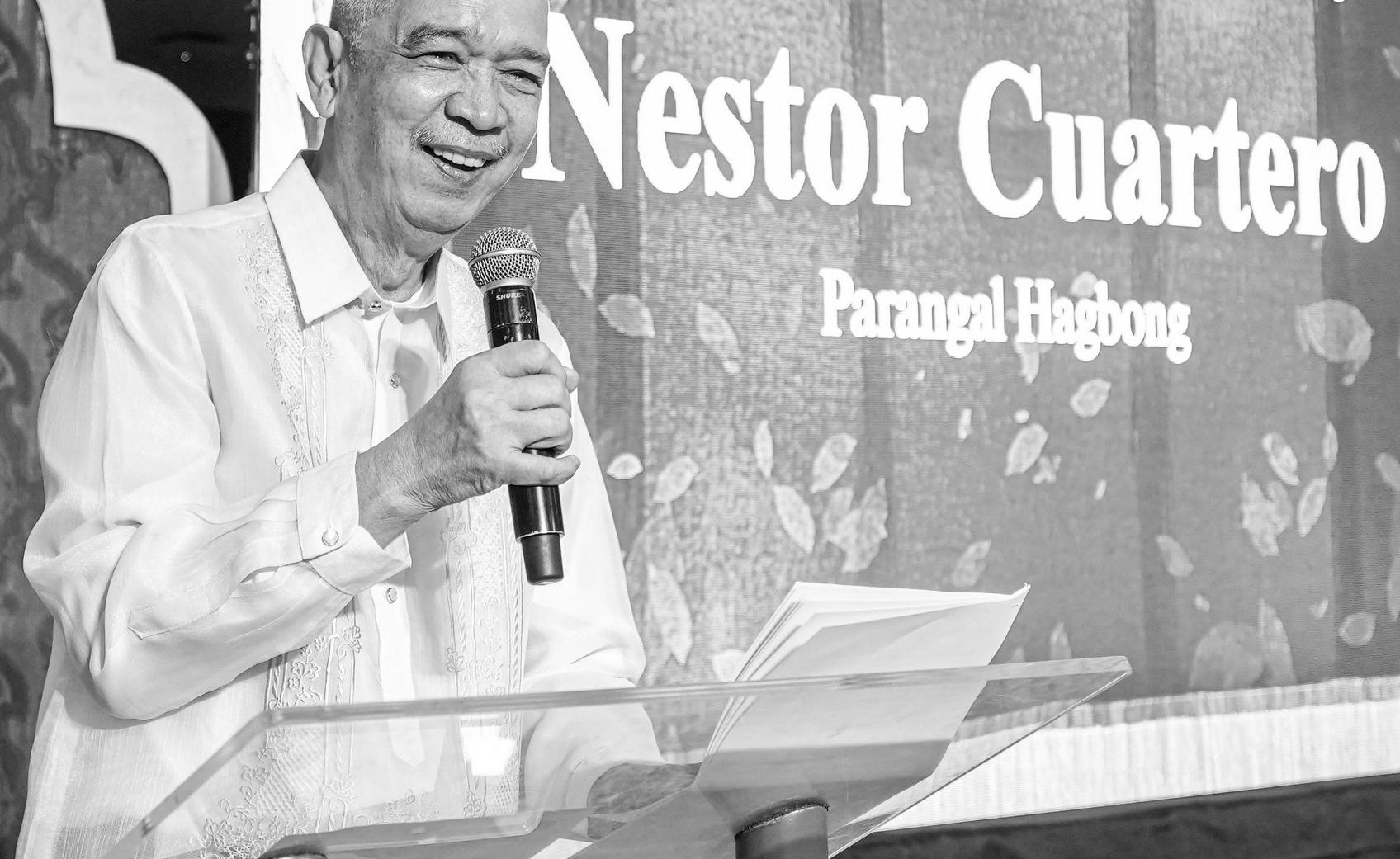
na si Nestor Cuartero sa Gabi ng Parangal ng ika-41 Gawad Ustetika noong Biyernes, Marso 27.
Iginawad ng Varsitarian ang Parangal Hagbong mula pa noong 1997 bilang lifetime achievement award sa isang Tomasinong may natatanging ambag sa sining at panitikan.
Sa taong ito, kinilala si Cuartero para sa “kanyang natatanging kontribusyon sa larangan ng peryodismo, dedikasyon sa pagsasabi ng katotohanan bilang manunulat at patnugot, at mahalagang papel sa paghubog sa susunod na henerasyon ng mga mamamahayag.”
Sa kanyang talumpati, binalikan ni Cuartero ang kanyang mga karanasan bilang mag-aaral sa Unibersidad at manunulat ng Varsitarian noong panahon ng batas militar.
“For these and so much more, I thank the Faculty of Arts and Letters, our good old Varsitarian—the one great love of my youth… for having planted, nourished and nurtured me on the right track all along,” aniya.
Nagsilbi si Cuartero bilang patnugot ng seksiyong Mulinyo (Circle) at katuwang na patnugot ng Varsitarian noong kaniyang huling taon sa kolehiyo sa ilalim ng kursong journalism.
Aniya, ang kanyang karanasan bilang patnugot ang humubog sa kanyang landas sa entertainment journalism.
Si Cuartero ay isang premyadong mamamahayag na nakapaglimbag ng mga librong “At Large, At Leisure” (2008), “PH Movie Confidential” (2022), at “Easy Listening” (2023). Kasalukuyan siyang miyembro ng lupon ng Movie and Television Review and Classification Board at kolumnista sa Manila Bulletin at The Business Monitor.
Nagturo rin siya sa Unibersidad sa ilalim ng Department of Communication and Media Studies sa loob ng dalawang dekada, mula 1998 hanggang 2018. Noong 2024, ginawaran siya ng The Outstanding Thomasian Alumni (TOTAL) Award for Media and Entertainment.

Pamamahayag sa ilalim ng Martial Law
Sa ilalim ng diktadurang Marcos, tinutulan ng mga magulang ni Cuartero ang kanyang pagkuha ng kursong journalism dahil sa panganib na kaakibat nito.
Dahil sa kanyang hilig sa media, pinili niyang magsulat tungkol sa sining at entertainment, na mas ligtas kaysa sa pagtalakay sa pulitika noong panahong iyon.
“I went for the arts, specifically, the movies, where my writing felt safe, cocooned, less controversial. This way, I thought my parents would feel secure with their peace of mind in the countryside,” aniya sa kaniyang talumpati.
Nagpasalamat din siya sa mga gurong humubog sa kanya, kabilang sina Felix Bautista, Ophelia Alcantara-Dimalanta, Celso Al Carunungan, at Eugenia Apostol.
Binigyang-diin niya ang papel ng Unibersidad sa paghubog ng kanyang pananaw bilang manunulat.
“Side by side, the Varsitarian, my Arts and Letters education, laid the foundation for a firm, holistic view of
[We should have] a sense of responsibility that can be achieved without robbing the stories of their natural grasp, look and feel of the beautiful, the intriguing, the vibrant, and the entertaining.
Nestor Cuartero 41ST GAWAD USTETIKA PARANGAL HAGBONG AWARDEE

PINUNA NG ilang eksperto ang mga kakulangan sa bagong mobile dictionary app ng Komisyon sa Wikang Filipino (KWF), bagaman kinilala nilang mahalaga itong hakbang sa digital na dokumentasyon ng mga salitang Filipino. Ang mobile app na “KWF Diksi” ay online na diksyunaryo ng Komisyon sa Wikang Filipino (KWF) na inilunsad upang palawakin ang digital na dokumentasyon ng mga salita mula sa iba’t ibang wika sa Pilipinas.
Ayon kay Asst. Prof. Alvin Ringgo Reyes, kalihim ng UST Kolehiyo ng Edukasyon, bagaman mahalagang inisyatibo ang paglulunsad ng KWF Diksi upang mapreserba ang mga katutubong salita sa gitna ng banta ng pagkawala ng ilang wika, marami pa itong dapat pagbutihin.
“Saklaw rin ng corpora nito ang mga salitang katutubo, gaya ng “payyó” na siya namang talagang tawag ng mga Ifugao sa sinasabi nating hagdan-hagdang palayan, “rabaw” na salitang Ilocano para sa surface, “palanggà” ng mga Hiligaynon, at iba pa,” ani Reyes sa panayam ng Varsitarian Bukod sa mga katutubong termino, kabilang din sa app ang mga salitang balbal tulad ng “epal,” “chipipay,” at “KKB,” na nangangahulugang “kaniya-kanyang bayad.”
Nakapaloob din ang ilang banyagang salita na naging bahagi na ng pang-araw-araw na komunikasyon ng mga Pilipino, gaya ng “laptop,” “chicken sandwich,” “Christmas tree,” “Facebook,” at “yearbook.”
Isa aniya sa mga dapat pagtuunan ng pansin ang kakulangan ng
kahulugan ng ilang salita, kabilang ang “alimunmon,” “Dekalogo,” “cellphone,” “balihanda,” “abstrak,” at “Chinese.”
Binanggit din niya ang ilang di-tugmang kahulugan sa diksyunaryo, tulad ng balbal na salitang “chipipay,” na sa KWF Diksi ay tinukoy bilang “tagaampon,” samantalang karaniwang ginagamit ito upang ilarawan ang mumurahin o cheap na bagay.
Para kay Prop. Roberto Ampil, na nagtuturo ng Filipino sa Kolehiyo ng Edukasyon, ipinapakita ng paglulunsad ng app ang patuloy na pag-unlad ng wikang Filipino at ang kakayahan nitong umayon sa digital na panahon.
“Maganda ito kasi dito pinapakita ‘yong modernisasyon ng leksikograpiya sa Filipinas, [at] bukod pa, pasok [ito] doon sa adbokasiya tal-
aga ng KWF na ilapit ‘yong wikang Filipino sa mga mamamayan sa digital na panahon,” sabi ni Ampil sa isang panayam sa Varsitarian Sinabi ni Ampil na tila minadali ang paglulunsad ng offline dictionary at nangangailangan pa ito ng masusing pagpapakinis.
Ipinunto rin ni Ampil ang mga salitang hindi tugma ang kategorya gaya ng:
• “matter,” na nasa kategoryang batas sa halip na agham; “eskuwela,” na nasa kategoryang pisika; at “palpitasyon,” na nasa kategoryang arachnology o pagaaral ng mga gagamba, sa halip na agham o medisina. Dagdag pa ni Ampil, mahalagang maisama sa talasalitaan mag-
the world and of myself, putting me on solid ground in a Christian, humanistic perspective, one steeped in prayer and thanksgiving.”
Sa pagtatapos ng kanyang talumpati, iginiit ni Cuartero ang halaga ng entertainment journalism bilang seryosong larangan ng pamamahayag.
“Journalists pounding the beat are encouraged to develop seriousness of purpose, imbued with a historical perspective, a sense of responsibility that can be achieved without robbing the stories of their natural grasp, look and feel of the beautiful, the intriguing, the vibrant, and of course, the entertaining,” dagdag niya.
Kabilang sa mga naunang ginawaran ng Parangal Hagbong ang mga Pambansang Alagad ng Sining tulad nina Nick Joaquin, Daisy Hontiveros Avellana, Rolando Tinio, J. Elizalde Navarro, F. Sionil José, Cirilo Bautista, at Bienvenido Lumbera.
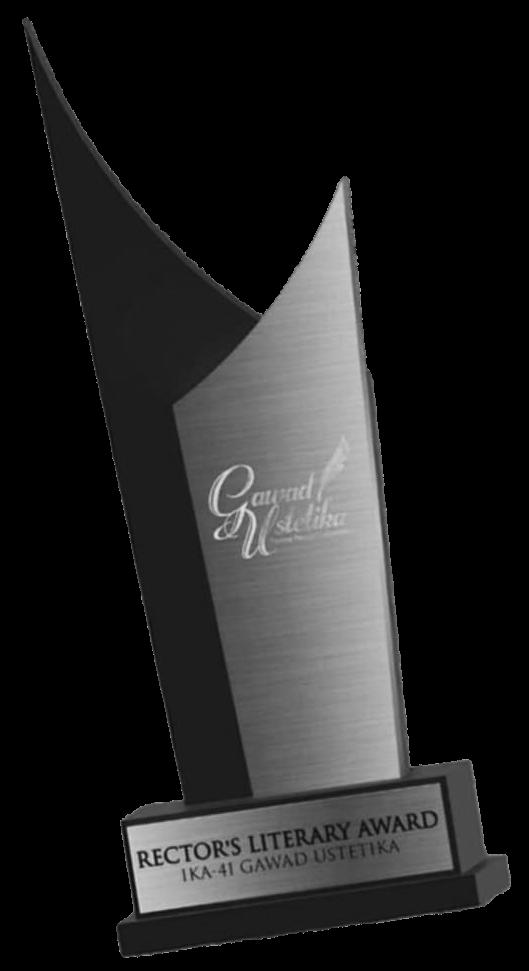
Iginawad ang parangal kay Cuartero sa lobby ng Blessed Buenaventura Garcia Paredes, O.P. Building, kalakip ang inukit na tropeyong likha ni Romeo Forbes na sumisimbolo sa balanse.
UST opens FROM PAGE 3 ►
lar classes will resume on Jan. 13, 2027, earlier than last year’s Jan. 16 reopening.
UST Manila will hold its Term 2 preliminary examinations on March 18 to 20, while final examinations start on May 10 for graduating students, and May 26 to 29 for undergraduate students.
For UST GenSan, Term 2 preliminary examinations will be on March 17 to 20, while final examinations are set on May 24 to 28. The Holy Week break will be observed from March 22 until March 27, 2027.
The 2027 Student Awards Day will be on May 21, and the graduating Class of 2027 will attend the Baccalaureate Mass on May 28. Solemn investitures or graduation rites will begin on June 1, 2026. Registration for the 2027 special term will be from June 7 to 8, with classes beginning June 9, 2027. Similar to the current academic year, AY 2026-2027 will have a total of 208 school days.
EDITOR: BILLY ANDREI P. RAMOS

By Ashley Valkyrie E. Bueno
UST
MEDICINE student Sofia
Julianne Bautista had her academic journey turned upside down when, just one semester into medical school, she began experiencing low-grade fevers, fatigue, bruising, paleness and a near-fainting episode she initially dismissed as routine exhaustion.
She later recognized warning signs she had previously overlooked, such as persistent pain in her nape, severe breathlessness after climbing a single flight of stairs in the San Martin de Porres building, and a pallor she tried to conceal with repeated applications of lip tint.
Her growing struggle to climb stairs without extreme fatigue eventually pushed her to seek medical evaluation. What started as a request for elevator access quickly escalated into a medical emergency.
Upon admission, Bautista underwent blood transfusions and a bone marrow biopsy, which confirmed she had acute myeloid leukemia, an aggressive cancer affecting the blood and bone marrow.
The diagnosis abruptly interrupted what she believed was the beginning of her medical career.
“Gumuho ‘yong mundo ko,” she told the Varsitarian. “I was already in a place
FROM PAGE 6 ►
minations on specific arrangements. Victims’ participation, legal safeguards
The court has authorized 539 victims to participate in the case, represented by a common legal team. Additional victims may still apply as proceedings continue.
The ICC stressed, however, that Duterte–like all accused persons–is presumed innocent until proven guilty beyond reasonable doubt and is entitled to full defense rights, including counsel, presentation of evidence, and protection against self-incrimination.
The ICC began its investigation in 2021, focusing on alleged crimes committed between 2011 and 2019.
where I was reaching my dreams, … and then it was taken away abruptly by a disease I was studying during my undergraduate days.”
Bautista earned her undergraduate degree in medical technology from UST in June 2023 and enrolled at the Faculty of Medicine and Surgery the following year to pursue her long-held ambition of becoming a physician.
‘‘
It’s a privilege to be able to get up in the morning, go to school, and worry about the more mundane things.
Don’t take anything for granted no matter how little you think something is, appreciate it while it’s there.
She filed a leave of absence in February 2025 to focus on treatment. During her initial chemotherapy sessions, she attempted to continue studying, but the cognitive effects — what she described as “chemo brain” — forced her to stop.
Unable to continue her studies, she turned to puzzles, games, coloring books and rewatching familiar shows to keep her mind active. She said she did not want to feel stagnant while her body slowed down.
Her treatment was marked by severe complications, including sepsis, a life-threatening response to infection. At one point, she feared she was nearing multiple organ failure and believed she might not survive.
Her recovery also required prolonged isolation due to her weakened immune system. For several months, she remained largely confined to her room, with her mother as her primary companion. Messages from loved ones encouraged her to persevere, though the absence of physical presence weighed heavily on her.
Still, the thought that others were waiting for her became one of the strongest sources of motivation she held onto.
In September 2025, she underwent a bone marrow transplant and
FROM PAGE 7 ►
time. It was not an easy road to go to,” Nonato said.
The chemistry and biology programs were named Centers of Excellence by the Commission on Higher Education during Nonato’s deanship. The psychology program received the same recognition during Ramos’ term.
UST underwent the Asean University Network Quality Assurance assessment for the first time during Ramos’ deanship.
The college began offering the data science and analytics program in August 2022.
Papa said the college helped develop science programs for UST General Santos, particularly the BS Biology major in Medical Biology curriculum.
“There are also other science programs that are in the pipeline [in] GenSan na malaki rin ang naitulong ng College of Science through our different departments,” he said.
Policies and projects
One of Sevilla’s most prominent initiatives was the use of Filipino in teaching pure and applied sciences.
“Bago ako mag-dean, nagtuturo ako in Filipino, chemistry sa Filipino. Natutuwa naman ako na hindi ako kinontrahan ng dean at the time,” he said.
Papa encouraged faculty members to teach technical courses using the national language, a policy officially implemented in 2025.
During Sevilla’s term, the college continued the practice of holding commencement exercises in Filipino.
“Graduation natin in Filipino language, tapos ang estudyante, Filipiniana ang suot. Lahat ng speech ng estudyante, ng faculty, ng guests, Filipino. Parang matataguyod ng college ‘yung paggamit ng national language,” Sevilla said.
Resiliency in crisis
Papa was dean when the Covid-19 pandemic forced the shift to online learning, bringing new challenges for students, faculty members, and administrators.
“We had to listen to what our students were telling us, the challenges that they were facing. We had to make sure we listened to our faculty, because a lot of problems were raised related to the shift to online learning,” he said.
FROM PAGE 6 ►
of the 1-Rider party-list, which represents the interests of motorcycle riders, including pushing for reforms in traffic policy and road safety.
Rep. Jill Bongalon, another Thomasian who was supposed to serve as prosecutor in 2025, lost to Rep. Kristel Lagman in the first district of Albay during the 2025 midterm elections.
Joining Chua and Defensor in the 11-person prosecution team are the following:
Rep. Leila de Lima (Mamamayang Liberal Partylist)
• Rep. Chel Diokno (Akbayan Partylist)
Rep. Keith Flores (Second District of Bukidnon)
Rep. Jinky Luistro (Second District of Batangas)
Rep. Terry Ridon (Bicol Saro Partylist)
• Rep. Lordan Suan (First District of Cagayan de Oro)
• Rep. Ysabel Zamora (Lone District of San Juan)
Rep. Kaka Bag-ao (Lone District of Dinagat Islands)
Senators will sit in the trial as judges, with the Senate president acting as presiding officer.
A two-thirds vote, or at least 16 out of 24 senators, is necessary for Duterte’s conviction and subsequent removal from power. However, only nine votes can overturn the impeachment and acquit the vice president.
The Senate has yet to convene as an impeachment court following the transmittal of the grounds of impeachment from the House and a recent leadership shake-up that seated Sen. Alan Peter Cayetano in place of Sen. Vicente Sotto III as Senate president.
The college moved activities online and had to adapt its teaching, research, and extension work to remote platforms.
Ramos said earlier efforts to introduce the Blackboard learning management system (LMS) helped the college adjust during the pandemic.
“We’ve been pushing already for the use of that time LMS Blackboard pa. So, we’ve been pushing faculty members to use online systems also as an alternative to face-to-face teaching,” Ramos said.
Papa said the college was able to continue its operations despite the disruption.
“Fortunately, we survived. There was no major disruption. Hindi natigil ‘yung teaching, learning, research, and even extension work, the community service activities,” he said.
Shaping Thomasian scientists
Sevilla hopes Thomasian scientists will remember how the college helped form them.
“Many will say ganito ako ngayon dahil sa tinuro ng UST sa kanila. Binibilin ko nga, huwag niyo kalimutan na bumalik, at i-share ‘yung natutuhan niyo,” he said.
Nonato said graduates should look back on their Thomasian scientific formation.
“And for the future students, they can look back. Para malaman nila, this will be who I am after I leave the College of Science,” she said.
For Ramos, science students should remain curious while keeping their faith intact.
“They should continue always being curious about their environment, that they always start to question everything that is happening around them. Because this is a characteristic of a scientist, a questioning mind,” Ramos said.
Papa said Thomasian scientists should practice science with moral responsibility.
“I hope that the members of the science community will feel a sense of pride that they belong to a college with a very rich history, and that has contributed to the growth and development, not just of science inside the University, but also science in the Philippines,” Papa added.
Whether the research that we’re doing is basic or in the applied sphere, dapat maensure ng college na ganong level na ‘yung ginagawa niya, talagang may impact, regardless of what program you are in
Bracing for the next century
As the college moves beyond its centennial year, Papa said it must continue building on its past achievements.Papa said the college was looking into micro-credentials, interdisciplinary programs, upskilling and reskilling programs, and lifelong learning opportunities.
“Whether the research that we’re doing is basic or in the applied sphere, dapat ma-ensure ng college na ganong level na ‘yung ginagawa niya, talagang may impact, regardless of what program you are in,” he said. The UST College of Science marked its 100th anniversary with a month-long celebration from March 24 to April 21. The centennial carried the theme “Expressing Our Faith through Excellence in Science,” underscoring the college’s view that scientific excellence is inseparable from its Catholic identity.
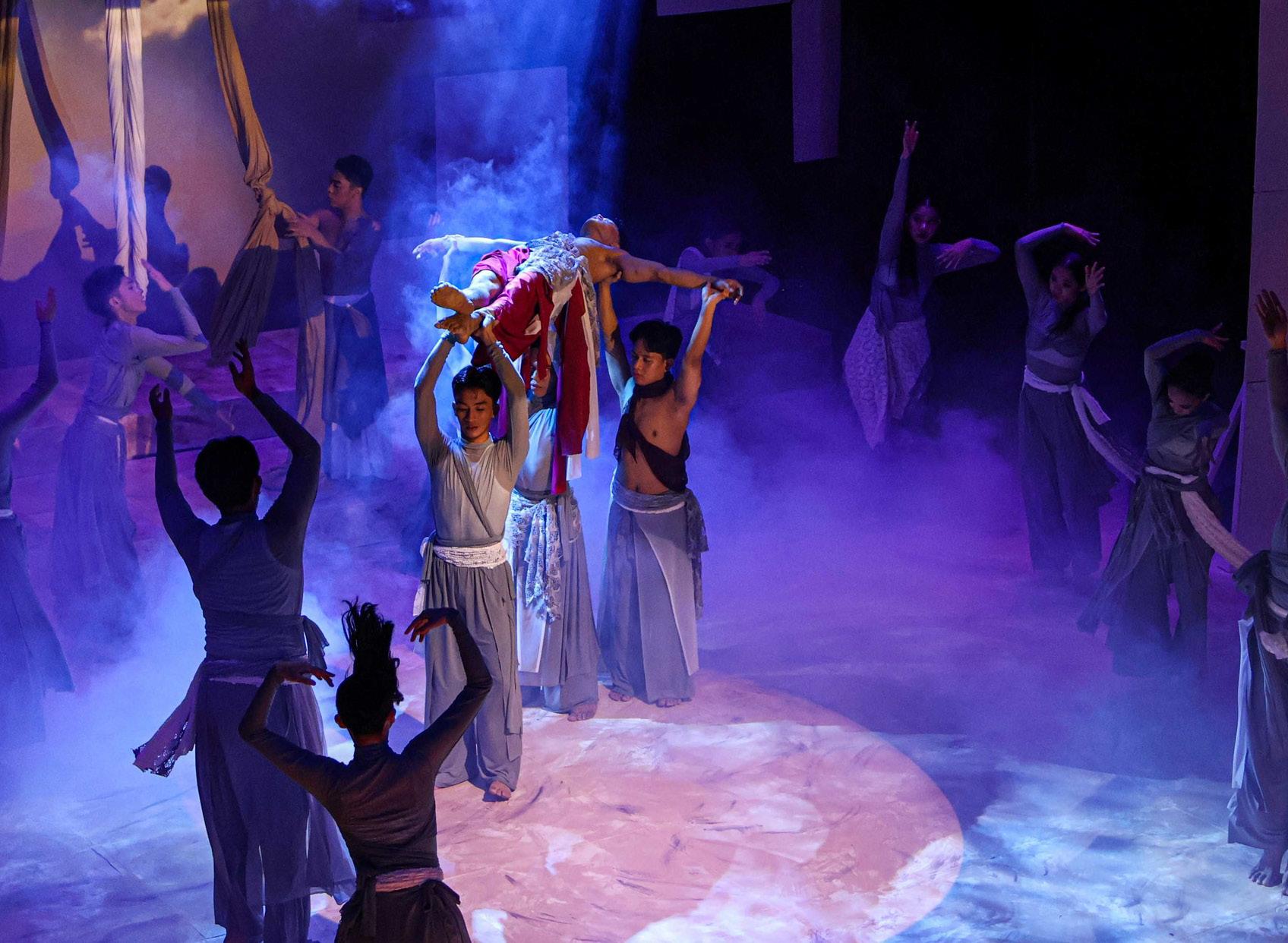
► The UST Salinggawi Dance Troupe, in collaboration with UST Coro Tomasino, stages its 54th annual dance concert, ‘Jubilate: Sayaw ng Pasasalamat, Dalit ng Pananampalataya,’ at the UST Education Auditorium, Albertus Magnus Building, on Friday, April 10.
By Kirsten Therese C. Barrameda
THE UST Salinggawi Dance Troupe, in collaboration with UST Coro Tomasino, staged its 54th dance concert titled “JUBILATE: Sayaw ng Pasasalamat, Dalit ng Pananampalataya,” at the Albertus Magnus Auditorium on April 10 and 11.
The performance was inspired by Filipino Catholic culture and practices, primarily during Lent, infused with a modern take on devotion.
The concert opened with a procession-like modern dance routine that showcased Filipinos’ long-standing, deeply rooted Holy Week traditions.
In an interview with the Varsitar-
ian, Salinggawi president Jesela Agas said the creative vision for the show was to merge different forms of dance the organization had executed over the years, rather than focusing on one.
Several routines and choreographies performed by Salinggawi were accompanied by UST Coro Tomasino as a vocal ensemble.
“Actually, ‘yong collaboration na ‘to, once in a lifetime milestone namin. Kasi hindi usually nakikita magkasama ‘yong dance tsaka ‘yong chorale,” Agas added.
The production also featured a vocal performance from the inaugural champion of Kumu’s “Sing For The Stars” and former “Tawag ng Tanghalan” contestant Shane Gulle, accompanied by Salinggawi’s routine.
500 UST musicians pay tribute to Filipino musical heritage in ‘Sampung Mga Daliri’ concert
THE UST Conservatory of Music staged the 35th edition of its annual concert, “Sampung Mga Daliri,” at the Newport World Resorts Performing Arts Theater on May 3.
Over 500 homegrown talents, alumni, and faculty across several generations came together to perform in honor of the conservatory’s 80th anniversary.
In an interview with the Varsitarian, Music Dean Maria Alexandra Chua said the concert, which spotlighted 10 grand pianos onstage, sought to expose audiences to the breadth and history of Filipino music.
“We want people to enjoy the show, to be able to support musical arts, especially in the country, because it’s so difficult despite the talents that we have in music. There’s
ng ilang bahagi ng kuwento upang mapaiksi at mapatingkad ito.
“So kill your ‘darlings’ pero at the same time, magtiwala ka. Kahit kaunting tiwala lang sa piece mo, and eventually kaya niya ng ipaglaban ‘yong sarili niya,” dagdag niya.
Hinimok niya ang mga Tomasinong manunulat na nais lumahok sa susunod na edisyon ng patimpalak na huwag sumali para lamang sa karangalan.
“Mas nagiging sweet ‘yong pagkapanalo kasi hindi mo talaga ini-expect kasi diba may saying nga, ‘yong mga bagay na unexpected, ‘yon pa ‘yong mas nakakakilig,” aniya.
Noong ika-40 Gawad Ustetika, nakamit ni Tabios ang ikatlong gantimpala sa kategoryang One-Act Play para sa akdang “Choke,” ang kanyang unang pagsali sa patimpalak.
Umabot sa 272 ang bilang ng mga lahok sa ika-41 edisyon ng Gawad Ustetika, ang pinakamataas sa kasaysayan nito.
Pinarangalan si Tabios sa Gabi ng Parangal ng ika-41 Gawad Ustetika sa Gusaling Buenaventura Garcia Paredes, O.P. noong Marso 27. MAY ULAT
NINA AMADAR DENZEL M. TESTON AT CHLOE ELYSSE B. IBAÑEZ
very little support we get from the government as well as from the private sector,” she said.
Kicking off the event was a rendition of “Philippine Portraits” by the late composer Redentor Romero, which blends Eastern and Western orchestrations to illustrate the country’s ethnic and regional musical diversity.
The piece was performed by 10 alumni pianists and the UST Symphony Orchestra under the baton of Assoc. Prof. Herminigildo Ranera.
It was followed by the UST String Orchestra’s interpretation of “Sa Dating Sinehan” by acclaimed composers George Canseco and Restie Umali. It was led by Arnold Josue of the Manila Symphony Orchestra.
The event also featured a med-
ley of traditional Filipino folk songs by the UST Rondalla and UST Guitar Ensemble under the leadership of Asst. Prof. Daniel Bartolome.
Bartolome also led the UST Symphony Orchestra in a suite composed of songs by acclaimed composer Ryan Cayabyab.
Renditions of songs from Filipino pop groups SB19, BINI, and Cup of Joe were also performed at the event.
Under Ranera’s baton, the concert was capped by a compilation of famed musician Ernani Cuenco’s most popular songs alongside several patriotic compositions.
Other Thomasian performers were the UST Jazz Band, Coro Tomasino, the UST Symphony Orchestra, the Liturgikon Vocal Ensemble, and the UST Wind Orchestra. JOHN KOBE S. BALOD

Ex-‘V’ reporter, veteran entertainment scribe, Danilo Vibas writes 30
By Czeantal Naomi P. Delos Santos
DANILO VIBAS, a veteran entertainment columnist and a former reporter for the Varsitarian, passed away on April 29. He was 71.
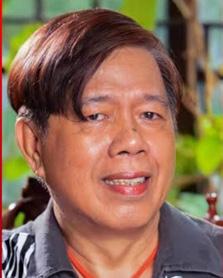
He died due to pancreatic cancer, his nephew Vincent Vibas confirmed to the Varsitarian Vibas earned his journalism degree, cum laude, from UST in 1975.
During his stay at the University, he served as a reporter for the Varsitarian from 1974 to 1975.
Vincent remembered Danilo as a “pillar” of the family who used his success to uplift his kin.
“His quiet selflessness was the bridge to our futures, as his financial support paved the way for many of our cousins to graduate and pursue their dreams,” Vincent said.
“His legacy lives on in the degrees we hold and the values he instilled, a testament to a man who invested his life’s work into the success and growth of the next generation,” he added. Vibas was known among his peers for his “pointed” questioning during press conferences and his support for Thomasian visual artists.
He spent decades covering the entertainment industry, serving as an assistant entertainment editor at The Manila Times and a columnist at the Daily Tribune in 2022.
Vibas also served as a public relations officer of The Entertainment Arts & Media, an organization of entertainment editors, columnists, photographers, publicists, and talent managers. Vibas was also an educator who taught English at Far Eastern University. His wake was held at La Funeraria Paz on G. Araneta Avenue in Quezon City until May 5.
A funeral Mass and interment took place on May 6 at the Sarmiento San Jose Del Monte Bulacan Cemetery.
ing ang mga maseselang bahagi ng katawan at mga salitang itinuturing na taboo, sapagkat bahagi rin ang mga ito ng aktuwal na paggamit ng wika.
Aniya, ang isang diksyunaryo ay dapat mapagkakatiwalaan at hindi lamang limitado sa pagbibigay ng payak na kahulugan.
“Kapag naghanap ka [ng salita at] hindi natugunan, para saan pa ‘yong diksyunaryo? Nawawala ‘yong purpose ng diksyunaryo,” wika niya.
eventually entered remission. When her doctor asked if she was ready to return to medical school by January, Bautista did not hesitate.
An arrangement with Medicine officials, including the faculty secretary, Assoc. Prof. Citadel de Castro, allowed her to gradually reintegrate into academic
Iminungkahi ni Reyes na paunlarin pa ang app sa pamamagitan ng pagdaragdag ng mga materyal na makatutulong sa mas malinaw na pagtukoy sa mga salita.
“Mainam din kung may suportang audio-visual na magtuturo ng bigkas sa salita o makakapaghanap ng entry sa pagsasalita sa halip na pagta-type lang o pagpapakita ng larawan,” wika ni Reyes.
Ibinahagi ni Sheilee De Vega, chief language researcher ng KWF, ang pagdaragdag ng audio pronunciation, phonetic spelling at mga salin o katumbas ng salita sa iba
pang mga wika sa Pilipinas sa mga susunod na taon.
“Bilang namamayagpag ang technological innovation sa iba’t ibang larangan ng pag-aaral, nakapagbibigay ang mobile app ng mga feature, [gaya ng] visual at audio media, multimedia, at searching tools, [upang] makaangkop sa kasalukuyang estado sa lipunan ng partikular na wika at ang pagtanggap at pagkilala rito ng mga tao,” wika ni De Vega sa panayam sa Varsitarian Sinimulan ng ahensya ang pagbuo sa proyektong noong 2024, batay sa koleksyon ng mga salitang
nailabas na sa kwfdiksiyonaryo.ph na pinasinayaan noong 2022, at sa pinakaunang edisyon ng diksyunaryo na inilathala noong 1989.
Ayon kay De Vega, na-validate ang mga salitang isinama sa app sa pamamagitan ng Korpus ng Wikang Filipino, na binubuo ng humigit-kumulang walong milyong salita at nagsisilbing batayan hindi lamang ng diksyunaryo kundi ng iba pang pananaliksik sa Filipino. Sa kasalukukan, humigit-kulang 1,000 download na ang naitala ng KWF Diksi app sa Google Play Store.
life while prioritizing her recovery. After months of strict isolation, adjusting to crowded hallways and classrooms proved challenging.
As she resumed her studies, Bautista also began rebuilding her physical strength through regular exercise, proper nutrition and adequate rest.
Despite the interruption, her resolve to pursue a career in medicine has only strengthened.
“Medicine has always been a passion of mine, but it was also such a driving force during cancer. I really wanted to be a doctor,” she said. She added that her experience has reshaped her perspective on both her education and her future practice. Having gone through illness herself, she said she now reflects more deeply on the kind of physician she hopes to become and the empathy she aims to extend to her patients.
Now gradually returning to student life, Bautista hopes her story serves as a reminder not to take everyday moments for granted.
“It’s a privilege to be able to get up in the morning, go to school, and worry about the more mundane things. Don’t take anything for granted no matter how little you think something is, appreciate it while it’s there,” she said.
Pastrana delivers final masterpiece, ends UST career with 3×3 crown
By Miguel Angelo B. Marco
A GOLDEN ending for a golden career.
Kent Pastrana closed her UAAP journey with the UAAP Season 88 women’s 3×3 title as the UST Growling Tigresses routed the Far Eastern University Lady Tamaraws, 21-10, on Sunday, May 3, at Ayala Malls Manila Bay.
The Growling Tigresses capped a dominant run with a perfect 9-0 record, avenging last year’s bronze-medal finish that denied them a possible three-peat in the 3×3 tournament.
Pastrana contributed five points, three rebounds, and three assists, closing out her UAAP career with another championship — her second in 3×3 on top of two titles in the 5-on-5 game.
Coi Danganan led the way with nine points and 11 rebounds, while Brigette Santos added five points.
“Mixed emotions talaga ako. Masaya pero at the same time nakakaiyak kasi iiwanan ko na ‘yong UST,” Pastrana said.
The Tigresses built a commanding 15-6 lead behind a Pastrana layup before Victoria Pasilang sparked a quick 4-0 run to pull FEU within striking distance, 15-10.
UST, however, stayed composed down the stretch, with baskets from Erinn McAlary and free throws from Danganan sealing the title.
Earlier in the day, the Tigresses dispatched Adamson University, 2110, in the semifinals.
In the girls’ division, the UST Junior Growling Tigresses fell short of a title defense after bowing to the National University–Nazareth School Lady Bullpups, 20-13.
After a tightly contested start marked by multiple deadlocks and lead changes, a two-pointer from Janine Oczon tied the game at 13-all.
NUNS then unleashed a decisive 7-0 run to secure the championship.
Oczon and Lea Pinuela scored four points each for UST. WITH REPORTS FROM LILAH MIKAELA S. PAREDES
Dacanay emerging as the MVP.
Dacanay and Jose Llarena won gold in the mixed-pair event, while Dacanay teamed up with Audrey Arnaiz and Naima Tumang to rule the girls’ team category.
Llarena, Richanth Navasquez and Ashton Losaria earned silver in the boys’ team event, while Dacanay added another silver in the individual girls’ division.
Freestyle poomsae was introduced in both divisions as a demonstration event, with medals not counted in the official tally.
In the collegiate division, UST dominated, collecting three of the four gold medals at stake.
Jesus Yape ruled the men’s individual event and also teamed up with Stella Yape to win the mixed-pair gold.
Paul Rodriguez, Eljay Vista, Liam Jimenez, Stella Yape and Aliyah Baquial secured gold in the mixedteam event.
In the high school division, UST added one gold and two bronze medals. Zoie Croox won gold in the individual girls’ event and also claimed bronze in the mixed-pair event with Navasquez.
Ashton Losaria contributed another bronze in the mixed-pair category.
By Miguel Angelo B. Marco
THE BLACK and gold journey comes to an end for Detdet Pepito and Jonna Perdido.
The UST Golden Tigresses fell to the National University (NU) Lady Bulldogs, 20-25, 26-24, 26-24, 25-21, ending their UAAP Season 88 women’s volleyball campaign with a bronze medal on Saturday, May 2, at the Araneta Coliseum. It is UST’s second straight bronze-medal finish. The match served as the swan song for team captain Pepito and Perdido, both of whom have exhausted their UAAP eligibility.
Reg Jurado finished with 19 points on 17 attacks, while Angge Poyos added 16. Perdido contributed 15 points on 11 attacks, one block and three service aces, while Pepito tallied 23 digs and eight excellent receptions.
After a back-and-forth 7-all deadlock, the Tigresses surged to an 11-5 run highlighted by Perdido’s attack to build a five-point cushion, 18-13. UST then held off NU to claim the opening set, 25-20.


Trailing 10-6 in the second set, the Tigresses mounted a 14-7 run punctuated by Lianne Penuliar’s attack to take a 20-17 lead.
NU, however, regained control late with a 9-6 counter run, as Arah Panique’s down-the-line kill and UST’s costly fourtouch error handed the Lady Bulldogs the extended set, 26-24.
Down 7-4 in the third frame, the Tigresses unleashed a 12-7 run capped by Xyza Gula’s back-to-back kills to take a 16-14 lead heading into the second technical timeout.
Salamat talaga sa UST. Halos half ng buhay ko, doon ako lumaki since Grade 7. Dahil sa kanila, talagang nag-grow ako — from pasaway na tao, tapos naging leader pa.
Pepito
UST moved within a point of taking the set after going up 24-23, but attacks from Chamy Maaya and Vange Alinsug, along with a Perdido error, allowed the Lady Bulldogs to steal the third set, 26-24. The Tigresses opened strong in the fourth set, building an 18-14 lead as Perdido broke through NU’s defense. However, the Lady Bulldogs answered with an 11-3 run to close the match, 25-21, advancing to the finals and eliminating UST. Panique led NU with 23 points on 21 attacks, while Alinsug added 18.
By Joaquin Edgardo A. Cortez
UST PRIME and UST Galvanize brought home silver medals in the UAAP Season 88 street dance competition on Sunday, May 3, at the Blue Eagle Gym.
Prime fell short of reclaiming the crown, settling for a second straight silver-medal finish.
After placing first runner-up last season, Prime again ended in second place with 92.17 points, this time behind a Lunar Festival-inspired routine.
Prime also placed second in both the artistic and execution categories, recording 46.30 and
46.70 points, respectively.
“It is their best run, although of course we were expecting something more. Gusto sana namin mag-champion like everyone else,” UST head coach Chips Beltran told the Varsitarian. “Pero gano’n talaga ang competition. May times na nasa taas ka, may times na nasa baba ka, but what’s important is consistency.
“For the past years, nando’n naman tayo sa podium. Bawi na lang next year.”
The University of the Philippines Streetdance Club secured its second straight title with 93.33 points, delivering a performance inspired by icon-
ic Filipino superheroes. La Salle Dance Company–Street finished third with a wedding-themed routine inspired by Ben&Ben’s “Araw-Araw,” scoring 90.33 points.
Ateneo and Adamson both scored 89.83 points, but Ateneo placed fourth after Adamson incurred a 0.50-point deduction, dropping to fifth.
National University Dance Company finished sixth with 89.00 points, followed by Far Eastern University Street Alliance in seventh with 87.83.
The UE East Force Dance Com-
pany rounded out the seniors’ division in eighth place with 79.67 points. In the juniors’ division, Galvanize climbed to first runner-up with 86.83 points, improving from its fourthplace finish in Season 87.
Galvanize also recorded the second-highest scores in both artistic (43.20) and execution (43.70).
Adamson University Dance Company captured its first-ever title with 88.17 points behind a Mexican-themed routine, while FEU’s T.A.M. Streetz secured bronze with 85.50 points after a performance centered on the demands and struggles of student life.
Judokas
doka Aeon Kim the silver.
Justine Bagallon finished with silver after falling to the University of the Philippines’ (UP) Hye Jun Lee in the -55 kg final.
Ralph Suarez picked up bronze in the same division after defeating Jason Palmes of De La Salle University.
Last season’s MVP Troy Estrella fell to UP’s Michael Zuniga in the -66 kg bronze-medal match.
Kyan Ballecer, who won the -90 kg category on Day 1, took home the MVP award, while Kim bagged Rookie of the Year honors.
“Sobrang sarap sa pakiramdam, iba pa rin talaga pag champion ka. Lahat ng paghihirap namin, worth the wait. Ang tagal naming hinintay ‘tong championship, kaya sobrang thankful,” UST head coach Gerard Arce told the Varsitarian
In the women’s division, Margaret Fajardo clinched gold in the
-78 kg final after defeating Leah Ladia of UP.
Mariah Albert Lua also struck gold in the -70 kg final, prevailing over Myles Casanas of Adamson.
Iahna Jaboneta delivered another gold in the +78 kg division after defeating Rovy Ujano of UP.
In the -63 kg division, Sherilyn Tagra secured bronze against Adamson’s Drew Soriano.
Sophie Madamba also finished with bronze in the +78 kg category after overcoming Carina Bornea of UP.
Christine Quiniones was hailed as the season MVP after ruling the -44 kg division on Day 1.
In boys’ play, Zeus Babanto topped the -90 kg division after outlasting Datu Mamaril of Adamson.
Ethan Dalmacio also bagged gold in the +100 kg division, while Shankarangel Tabar added a bronze medal.
Mundhir Gonzales earned bronze in the -81 kg division after defeating Juanito Luciano of
Ateneo. Jillian Albeza settled for bronze in the -100 kg division.
Jeormil Caguicla took silver in the -81 kg division after falling to Alphonso Academia of Ateneo.
Zachary Cabrera bagged the MVP award after ruling the -66 kg division on the first day.
“Overwhelming nang sobra. Team effort talaga ‘to, sabi namin it’s either we make it or we break it so nagawa naman namin. Super sulit lahat ng pagod namin,” UST head coach Mike De Vera told the Varsitarian In the girls’ division, Season MVP Zkeana Valdez claimed gold in the -57 kg category, while Aquisha Yongco secured bronze.
Steffany Talob emerged victorious with the gold medal in the -44 kg category, while Mikeighla De Vera settled for silver in the same division.
“Masaya lang talaga nang sobra. Last season, isang medal lang, ngayon, nakabawi kami, nakuha namin lahat, kaya sobrang saya,” De Vera said.
FROM PAGE 12 ►
The 23-year-old standout from General Santos finished with 90.192 statistical points, built on a season total of 278 points from 244 attacks, 16 blocks and 18 aces.
He ranked fourth in attacking with a 45.19% success rate and second in aces with 0.35 per set. Ybañez reclaimed the award he lost in last year’s injury-plagued campaign. He previously earned MVP honors in Season 86, marking back-to-back wins after capturing both Rookie of the Year and MVP in Season 85.
He also claimed his third consecutive Best Outside Spiker award alongside National University’s Michaelo Buddin, his teammate in Alas Pilipinas. Ybañez tallied 329 ranking points, ahead of Buddin’s 269.
Despite primarily playing as a spiker, Ybañez showcased his allaround game, recording the second-most excellent receptions in the league with 185. He was the only outside hitter in the top four, with the rest composed of liberos.
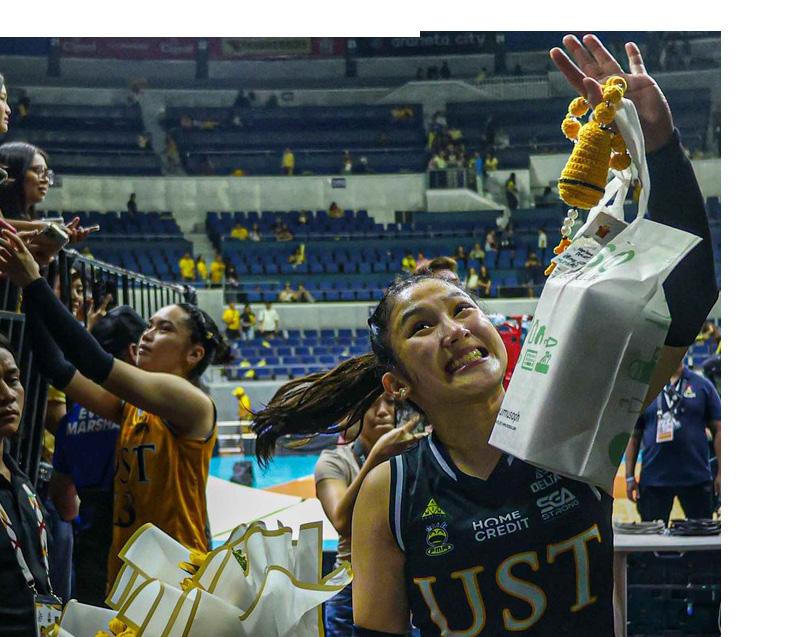



By Lilah Mikaela S. Paredes
THE UST Poomsae Jins fell short of a third straight title as National University (NU) captured the UAAP Season 88 throne on Tuesday, April 21, at Rizal Memorial Sports Coliseum.
UST finished with one gold and four silver medals in the collegiate division, while NU had three gold and two bronze medals.
“Super happy ako sa result ng team kahit hindi namin nakuha ang overall championship,” UST poomsae coach Rodolfo Reyes Jr. told the Varsitarian “Kung tutuusin, UST pa rin ang may pinakamaraming gold medals sa lahat ng divisions. Panalo pa rin
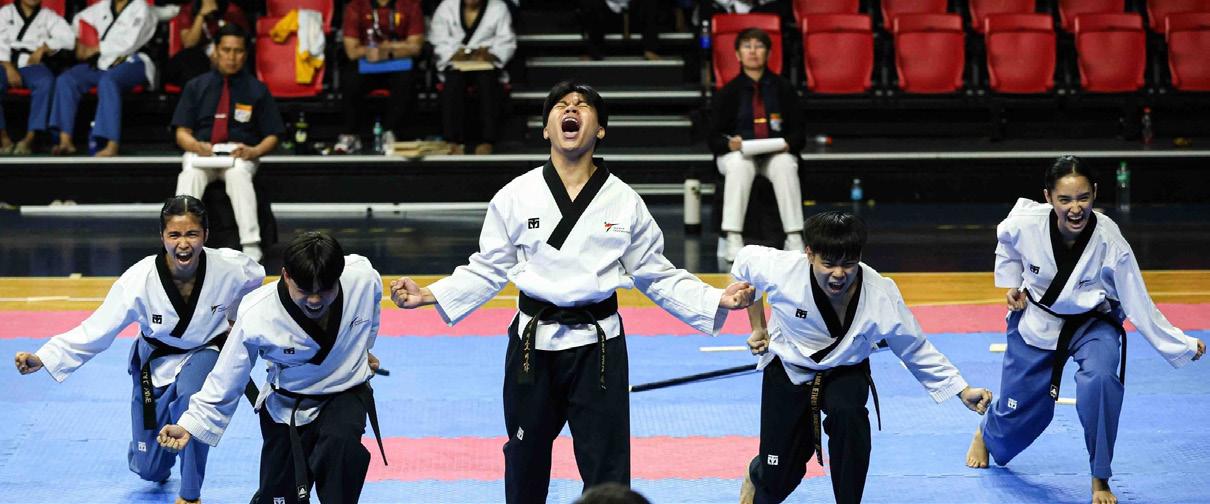
Reyes also pointed to last-minute changes regarding the freestyle category, which was ultimately classified as a demonstration event.
he added. The duo of King Alcairo and Maria
Labayne delivered UST’s lone gold in the recognized poomsae mixed-pair event.
Aidaine Laxa and Leno Subaste secured silver medals in the recognized poomsae individual women’s and men’s events, respectively.
Laxa, Labayne and Heza Serapio added another silver in the women’s team event, while Alcairo, Subaste and Dane Subaste finished second in the men’s team category.
The UAAP also introduced poomsae in the high school division this season, where the Junior Tiger Jins captured the inaugural title.
UST collected two gold and two silver medals in the division, with Angel

Josh Ybañez makes history as UST’s first 3-time UAAP men’s volleyball MVP
By Rob Andrew L. Dongiapon
JOSH YBAÑEZ became the first three-time UAAP men’s volleyball Most Valuable Player (MVP) in UST history after topping the statistical race in Season 88.