
► Civil society and clergy raise their fists at the foot of the People Power Monument to mark the 40th anniversary of the 1986 EDSA People Power Revolution.
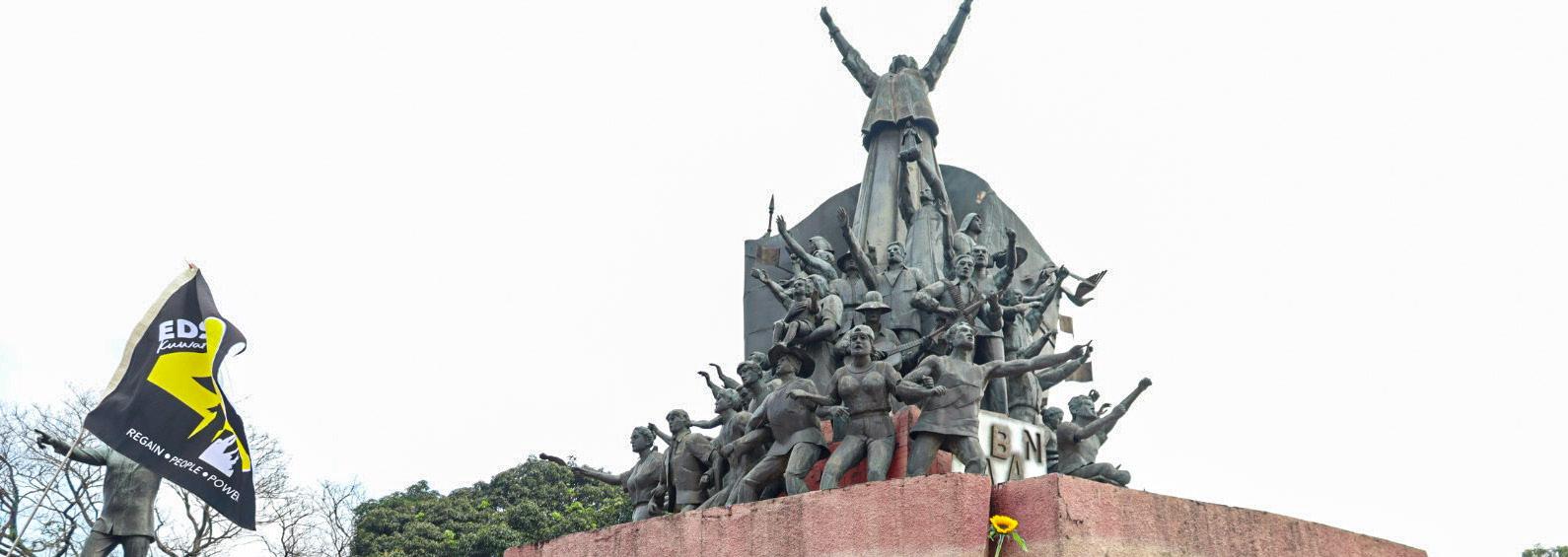
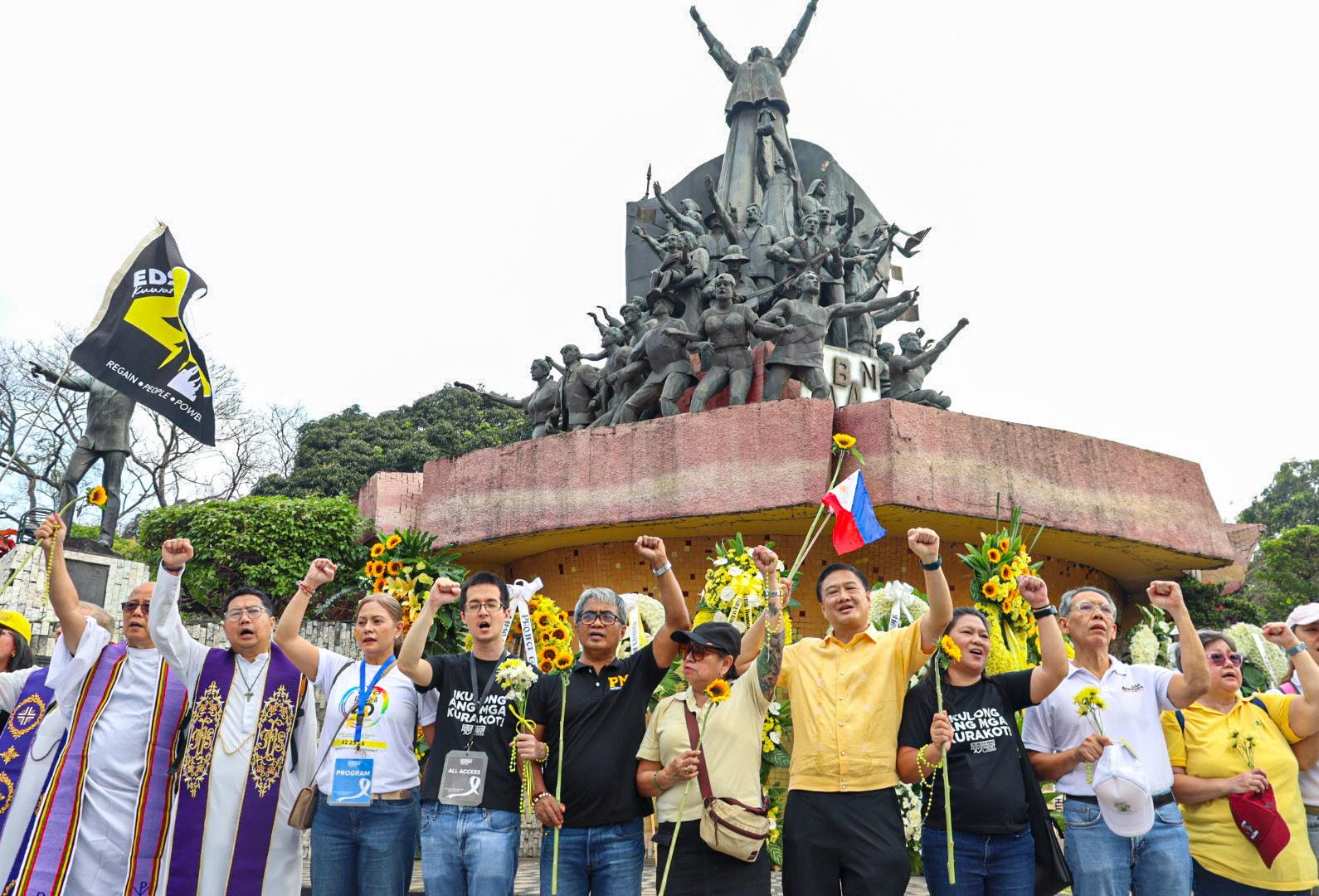

► Civil society and clergy raise their fists at the foot of the People Power Monument to mark the 40th anniversary of the 1986 EDSA People Power Revolution.
ON ITS 40th anniversary, the People Power Revolution was commemorated at its historic site EDSA, but in different locations, reflecting subtle differences among opposition blocs.
Two distinct movements took place this year. One, organized by Bagong Alyansang Makabayan (Bayan) together with the Kilusang Bayan Kontra Korapsyon, was held near the EDSA Shrine.
The Caritas Philippines and the Trillion Peso March Movement staged the third iteration of the movement at the EDSA People Power Monument, highlighting government corruption and the trillion-peso flood control controversy.
Central to the third Trillion Peso March
BY LUIS
Independent Commission for Infrastructure.
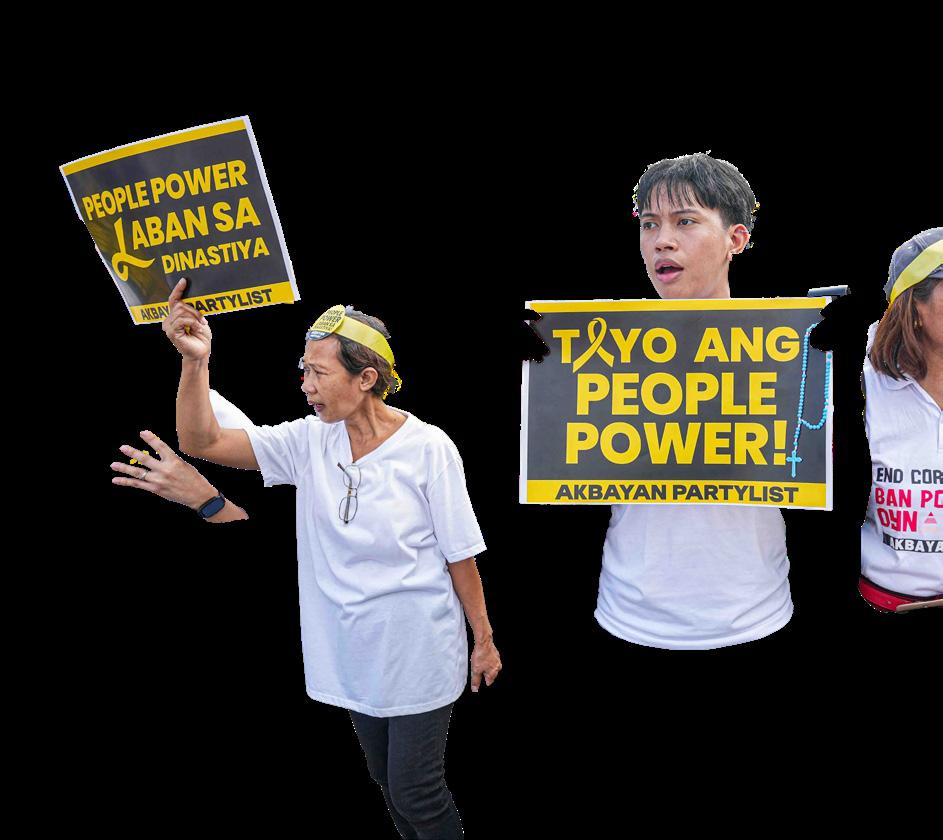
In both houses of Congress, initiatives to ban political dynasties are in the works, with the Senate Committee on Electoral Reforms and People’s Participation signing a committee report to bring the anti-dynasty bill to the plenary.
The 1987 Constitution, drafted in the aftermath of the People Power Revolution, prohibits political dynasties but requires an enabling law to implement this provision.
“The aim for this commemoration hasn't been regime change. The aim has been to push for reforms that we need, to push for accountability,” Tindig Pilipinas co-convenor Francis “Kiko” Dee told the Varsitarian
“The calls that we're making now are backed up by the 1987 Constitution,” Dee said.
“Kasi dito ina-allow ang iba't ibang mga sektor, ang kabataan, na i-express ‘yong sarili nila nang walang threat na i-censor o i-pababa ‘yong kanilang mga panawagan,” Co, who attended the protest staged by Bayan, said.
Tensions between the two blocs were evident even before the anniversary. Days prior, Dee outlined specific topics that were off-limits during the Trillion Peso March—guidelines not agreed upon by Bayan participants.
In recent years, accountability efforts have led to the detention of two contractors, 14 Department of Public Works and Highways (DPWH) officials, and former Sen. Ramon Bong Revilla, all of whom are facing trial. Dee expressed hope that protests would continue until higher-ranking officials are also held accountable.

Dee remained hopeful that the protests
DIVIDED OPPOSITION PAGE 3 ►
‘‘
The aim for this commemoration hasn’t been regime change. The aim has been to push for reforms that we need, to push for accountability.
Francis “Kiko” Dee TINDIG PILIPINAS CO-CONVENOR
WITH THE UAAP Season 88 volleyball tournaments tipping off and both the UST Golden Spikers and Golden Tigresses eyeing championship runs, The Varsitarian premiered its second-semester UAAP primer video, “Now or Never,” on social media—framing the rest of the season as a decisive moment for Thomasian athletes.
The video, released at the start of the volleyball season, features UST athletes competing in second-semester sports and underscores the urgency of the campaign, stressing that Season 88 “won’t repeat itself.” Now or Never was produced by The Varsitarian’s award-winning videography team, continuing the publication’s tradition of cinematic UAAP primers that blend sports storytelling with school spirit.
The video closes with the line “Ibalik ang Korona sa España” (“Bring Back the Crown to España”), a pointed nod to UST’s championship aspirations—particularly in volleyball, where both the men’s and women’s teams are seen as title contenders.
The primer follows a string of high-impact UAAP videos by the 98-year-old student publication. Last year’s second-semester primer, “Superstar,” won first place in the sports feature (audio/visual) category of the College Media Association (CMA) Pinnacle Awards, besting entries from U.S. college publications and premiering at the CMA Audio and Video Festival in Washington.
Earlier this season, The Varsitarian released the
first-semester Season 88 primer, “Welcome to Our House,” which served as a curtain raiser for UST’s hosting of the UAAP opening rites.
The video went viral, amassing more than 1.2 million views across social media platforms and significantly expanding the publication’s digital reach. It helped push the Varsitarian to more than 300,000 followers on Facebook to date, the largest among campus publications.
Set to Kendrick Lamar’s “Now or Never” featuring Mary J. Blige, the V’s second-semester UAAP primer leans on a pulsating soundtrack and tightly edited visuals to portray the pressure and promise of the second semester—when medals are decided and seasons are defined.
The release was accompanied by the rallying call: “SEASON 88 IS OUR TIME,” reinforcing the message that the window for a championship run is narrow—and that the moment belongs to the present.
The video was edited by James Michael Magboo, with Rob Andrew Dongiapon and Karis Tsang serving as producers.
Animation was handled by Aidan Raphael Caluyo and Regina Louise Sanota, while cinematography was led by a team of student videographers covering multiple sports and venues.
As UAAP Season 88 enters its most competitive stretch, Now or Never positions the campaign not just as another semester of games, but as a defining chapter—one that, as the video insists, will not come around again.


By Micah G. Pascua
AFTER an 11-year battle, almost a hundred members of the Talents Association of GMA (TAG), including UST alumni, won a legal victory when the Supreme Court (SC) declared them regular employees of media giant GMA Network Inc.
The TAG members, led by communication arts alumnus Christian Cabaluna, had sought better pay, benefits, and work conditions through regularization and lodged a complaint before labor arbiters. Fifty TAG members were dismissed by GMA Network in 2014.
The group wanted to end the “talent system” prevalent in the broadcast industry, where production staff were treated as “independent contractors” who issue their own receipts and are subject to a different tax scheme.
The high court’s third division de-
nied GMA Network’s appeal against the earlier decision of the Court of Appeals (CA), which ruled in favor of the talents’ group.
“Plain as day, there exists an employer-employee relationship between GMA and respondents,” the high tribunal said.
The resolution dated July 16, 2025, which was made public on Jan. 24, also ruled that the talents’ contracts were illegally terminated or ended as the case was being heard.
The 50 illegally dismissed employees are entitled to reinstatement or separation pay according to the ruling. However, if reinstatement is no longer an option, they “may be awarded separation pay equivalent to one month’s salary for every year of service.”
The court said the termination of 15 talents was “too harsh” because they had no prior offenses. The other 35 employees received no renewal notices from GMA when their contracts
expired, after they sought regularization.
The 94 talents who claimed legal victory were among 142 workers who originally filed a complaint with the National Labor Relations Commission, arguing that they must be regular employees of GMA Network rather than be classified as talents. Some employees were eventually regularized by GMA Network.
Cabaluna told the Varsitarian that the high court’s decision proved “that no company, no matter how powerful, is above labor law. It tells media workers that contracts cannot erase the reality of control, supervision, and years of service.”
Cabaluna, an alumnus of the Faculty of Arts and Letters, finished his undergraduate degree in communication arts in 2002. He worked as an associate producer at GMA Network when the case began.
online and onsite.
By Alexandra S. Demaisip
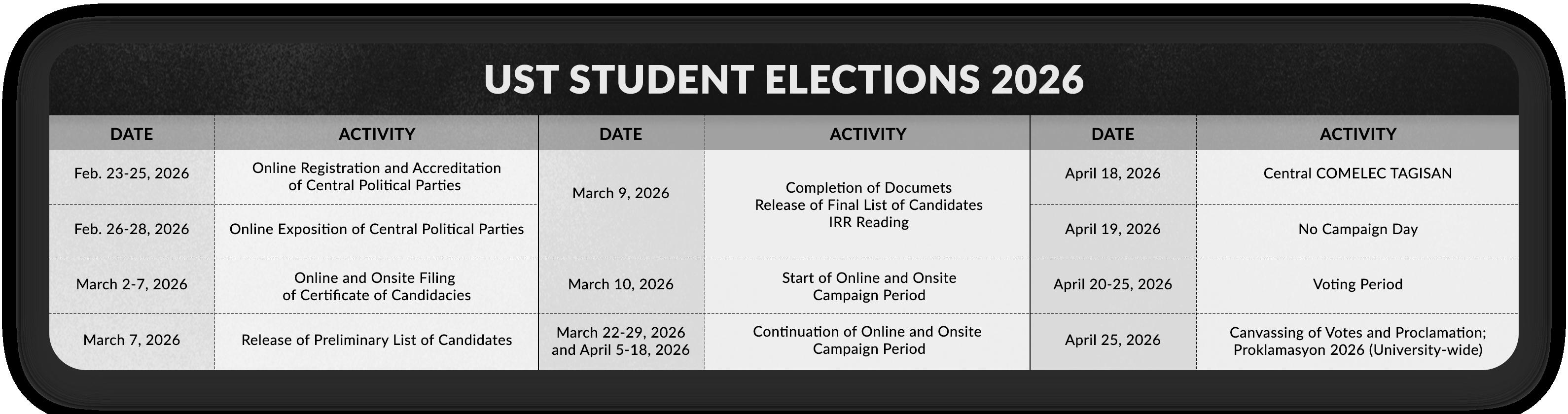
THE UST Central Commission on Elections (Comelec) announced on Feb. 22 the calendar of activities in preparation for the Central Student Council (CSC) elections in April.
Central political parties must accomplish online registration and accreditation until Feb. 25.
An online exhibition was held on Feb. 26 to 28, where registered and accredited political parties discussed platforms and principles.
The online registration and accreditation of central political parties on Feb. 23 marked the start of all election-related activities.
The last time a political party was accredited was in 2019, when Lakas ng Diwang Tomasino and Lakas Tomasino Coalition fielded CSC candidates. Since 2020, all CSC bets have run as independents.
Filing of certificates of candidacy of CSC aspirants for Academic Year 2026 to 2027 ran from March 2 to 7,
The preliminary list of candidates was released on March 7. Candidates are given until March 9 to complete documents.
Onsite and online campaigning started on March 10. Campaigning will continue on March 22 to 29 and April 5 to 18.
Tagisan, the mandatory debate for CSC bets, will be April 18, also the final campaign day.
The University-wide voting period is set on April 20 to 25.
Proklamasyon, or the canvassing of votes and proclamation of winning candidates, will be on April 25.
EDITOR: RALENT M. PENILLA

By Justin Jacob S. Urag
SIGNIFICANT cultural structures across the University could be at risk if flood-control projects are implemented on campus, heritage conservation experts said.
In August 2025, the idea of digging underground rainwater catch basins across the campus was revived by the Metropolitan Manila Development Authority (MMDA) and Manila Mayor Francisco “Isko Moreno” Domagoso.
The University houses five National Cultural Treasures, four of which are structures: the Main Building, Arch of the Centuries, Central Seminary, and the Grandstand and Open Spaces.
would eventually lead to holding higher government officials accountable.
“I know that some big fish have been arrested, but as long as the ones who are really close to the president are not facing justice, I think the protests will continue,” Dee said.
However, at the EDSA Shrine, contingents called for a more radical approach against widespread corruption, mainly the removal of President Ferdinand Marcos Jr. and Vice President Sara Duterte.
Political tensions between the president and vice president have fueled debates over potential impeachment moves.
Marcos has been accused by former Ako Bicol Rep. Zaldy Co of inserting P100 billion into the national budget through flood control and other projects, while Duterte, who recently announced her 2028 presidential
Constructing flood control infrastructure in these areas could affect not only their physical integrity but also their cultural significance, however.
In 2010, the four UST sites were declared National Cultural Treasures in time for the University’s Quadricentennial celebration. The designation grants them protection under the National Cultural Heritage Act of 2009.
According to National Commission for Culture and the Arts (NCCA) Chairman and Executive Director Eric Zerrudo, repurposing these heritage sites would be a lengthy and complex process.
“You cannot touch basta-basta
bid, faces allegations involving over P612.5 million in confidential funds.
Youth groups such as Anakbayan, Kabataan, Panday Sining, and League of Filipino Students joined the protest near the EDSA Shrine.
Among them was UST Central Student Council President Annie Agon, who said that the ongoing protests reflected the gradual exposure of corruption and disinformation.
“Little by little, the lies and acts of corruption they committed are being exposed, which is why the Filipino people continue to protest until now,” Agon told the Varsitarian Thomasians joined the Dominican Family for Justice, Peace and Care for Creation, and the Dominican Province of the Philippines in the Trillion Peso March at the EDSA People Power Monument.
Philosophy freshman Paul Pineda attended to gain a different perspective, stressing the importance of uniting reform calls.
“People must understand that
ang isang national treasure and suddenly i-repurpose mo siya,” Zerrudo said.
“The University would have to write the NCCA to petition for the lifting of the declaration,” Zerrudo, the cultural heritage program lead of the UST Graduate School, added.
Heritage conservation expert Mary Ann Bulanadi said thorough research was needed to weigh the project’s benefits against potential damage to cultural sites.
“Dapat talaga pag-aralan mabuti. Hindi lang puwede basta-basta na lang ito gagalawin and operate the cistern,” Bulanadi told the Varsitarian The proposed cistern or catch basin beneath UST’s 21-hectare campus
activist youth are not agitated for no reason, nor are they a threat to anyone who has nothing to fear,” Pineda said. “Justice and reform cannot be delayed. We can only achieve this as one opposition, indivisible and resilient against the interests of the few.”
In his homily at the EDSA Shrine, Fr. Jerome Secillano lamented the increasing complexity of the country's social issues 40 years after the revolution.
“We only had one enemy in 1986. Forty years later, we have plenty of enemies,” Secillano said.
Last year, Marcos Jr., during his State of the Nation Address, acknowledged the slow progress of flood-control projects, prompting investigations that revealed trillions of pesos lost to corruption and implicated key government officials.
“If it took millions of Filipinos to oust a single enemy, perhaps it would take trillions to oust even more enemies,” Secillano added.
will have a capacity of up to 72,000 cubic meters, enough, as proponents said, to store stormwater and ease flooding on España Boulevard and nearby areas.
According to discussion materials obtained by the Varsitarian, two possible sites were identified: Plaza de Benavides and the UST Open Field.
The Open Field has hosted major religious gatherings, including the 1995 World Youth Day, and Masses led by Blessed Paul VI, Saint John Paul II, and Pope Francis.
Commenting on the proposal’s structural implications, Asst. Prof. Rino Fernandez said grass would be difficult to sustain above underground concrete structures.
“Hindi na magagamit ‘yong grass sa ibabaw ng field dahil mahirap na itong mabuhay if planted above a concrete slab,” Fernandez said.
Bulanadi echoed the concern, noting that areas tied to historical events risked losing cultural integrity if construction plans pushed through.
“Even with assurances to restore the field to its original state, construction will inevitably alter the site,” she said.
“The realization of the project would mean years of construction, resulting in significant noise, traffic within the University, and disruption to daily campus life,” Bulanadi added.
CATCHBASIN PAGE 11 ►
The case was initially filed by TAG members in 2014, after media workers had served as talents for years without receiving full benefits or security of tenure.
“When the case started, I was an associate producer earning well, providing for my family, and building a future. When I was terminated, I slowly lost everything. The work disappeared. No media company wanted to hire a labor leader,” Cabaluna said.
The SC noted that a key element in GMA’s talent agreement was “freedom from control from the principal over the means and method of their work,” contradicting the network’s own system, which bound talents by the company’s rules. The talents used network equipment and facilities, an arrangement akin to those of regular workers.
The TAG members included pro-
ducers, writers, researchers, production assistants, artists, coordinators, and cameramen behind various programs under GMA News and Public Affairs.
“I can now look back at the past 15 years and call this my best achievement. I stood up for the right cause, helped amplify the voice of the anti-contractualization movement, and left a lasting legacy to all future media workers,” said Lian Buan, a TAG member and now a Rappler investigative journalist, in a Facebook post.
Buan obtained her undergraduate degree in journalism from UST in 2010.
Cabaluna said: “I hope this empowers workers to speak up and reminds employers that calling someone a talent or a project employee, as they now call it, does not remove their right to security of tenure.”
“This win is not just for us. It is for those who were afraid to fight and for the new generations of media workers,” he said.
THE PRESIDENCY is not a sanctuary. Vice President Sara Duterte should know that.
The highest office in the land cannot be pursued while serious questions about public accountability remain unresolved.
Yet, despite the elections being two years away and with ongoing impeachment complaints, Sara Duterte has declared her candidacy for presidency in the 2028 elections.
Historically, the Dutertes have long had a stable approval rating from Filipinos; they specifically enjoy solid grassroots support in the Visayas and Mindanao.
The Vice President’s short stint as Education secretary has been marred by multiple impeachment complaints, many of them centered on her controversial use of confidential and intelligence funds.
In 2022 and 2023, her offices were granted hundreds of millions of pesos in confidential allocations; P125 million for the Office of the Vice President in 2022 alone was reportedly spent within just 11 days. The Department of Education under her leadership was also allocated P150 million in confidential funds in 2023, despite not being a security or intelligence agency.
Lawmakers and civil society groups raised alarm not over the speed of fund releases, but over their dubious liquidation. Hundreds of millions of pesos, drawn from taxpayers, were reportedly funneled to questionable recipients bearing names such as “Mary Grace Piattos,” “Chippy MacDonald,” and “Fernando Tempu-
ra”—widely seen as “ghost beneficiaries” tied to non-existent programs, echoing past controversies over ghost flood-control projects.
Meanwhile, the Department of Education (DepEd), already grappling with learning losses, classroom shortages, and underpaid teachers, faces a deepening crisis of public trust. At a time when transparency and meaningful reforms are urgently needed, the public edu-
Congress, their existence matters. They reflect a serious doubt of public confidence that cannot be brushed aside by campaign slogans or popularity surveys.
And now, the possibility of a 2028 presidential run raises the stakes dramatically.
As Vice President Sara Duterte edges closer to a 2028 presidential bid, the country must confront a question that is heavier than cam-
To be clear : Sara Duterte is not her father. But she cannot run from the political brand that carried her to national office.
Nor can the nation pretend that 2028 exists in isolation from the unresolved trauma of the past decade.
cation system is increasingly overshadowed by concerns over opaque expenditures and outright graft and corruption.
Impeachment complaints are not political ornaments. They are constitutional mechanisms designed precisely when accountability at the highest levels of government is called into question. Even if political arithmetic prevents these complaints from prospering in
paign machinery and louder than political rallies: Have we truly reckoned with what the Duterte era has cost us? Because 2028 is not just another election year. It is a crossroads.
Sara Duterte carries with her the shadowy legacy of the administration of her father, former president Rodrigo Duterte – a period defined by a brutal war on drugs that left thousands dead.
Mothers buried sons without trials. Children grew up without fathers. Entire communities learned to fear the knock on the door at night by Duterte’s extra-judicial executioners.
Beyond the bloodshed, there was the coarsening of public discourse: attacks on media institutions, open hostility toward critics, and a political climate where dissent was often branded as communist destabilization. Institutions meant to serve as checks and balances were tested. Some bent. Some broke.
This is the legacy that inevitably shadows any Duterte candidacy.
To be clear: Sara Duterte is not her father. But she cannot run from the political brand that carried her to national office. Nor can the nation pretend that 2028 exists in isolation from the unresolved trauma of the past decade.
This is what makes the stakes in 2028 dangerously high.
Can the country afford another presidency under the same political banner that once defined an era of bloodshed and division?
If we reduce 2028 to personality, machinery, and nostalgia, we risk forgetting the mothers who mourned, the communities that trembled in fear, and the democratic norms that were stretched to their limits, if not totally discarded and waylaid. We risk signaling that state violence can be politically survivable. That institutional strain can be electorally rewarded.
The Palace is not merely a seat of power. It


EDITOR: FRENCHSHIELD SHAYNE G. DELOVIERES
Ni Amador Denzel M. Teston
MAHIGIT 400 akda ang naisumite ng mga Tomasinong manunulat sa nakalipas na limang edisyon ng Gawad Ustetika, ang pinakamatagal nang patimpalak pampanitikan sa mga pamantasan sa Pilipinas.
Ika-36 na Gawad Ustetika (2021)
Idinaos sa pamamagitan ng Zoom ang unang Gabi ng Parangal sa panahon ng pandemya, kung saan nakapagtala ang patimpalak ng 69 lahok.
Si Hailord Lavarias mula sa Faculty of Arts and Letters ang tumanggap ng Rector’s Literary Award (RLA), ang pinakamataas na pagkilala ng Gawad Ustetika, para sa kaniyang koleksiyong “Umiiral: Mga Tula.”
Rektor ng Unibersidad ang pumipili ng mag-uuwi ng RLA mula sa mga nagwagi ng unang gantimpala sa pitong kategorya: tula, poetry, katha, fiction, essay, sanaysay at one-act play o dulang may isang yugto.
Sa taong 2021, walang nagkamit ng una at ikalawang gantimpala sa kategoryang one-act play o dulang may isang yugto.
Bitbit ang temang “Ipamalas ang Laya at Haraya ng Panitikang Tomasino,” ang Ustetika ay pinangunahan ng mga lahok mula sa Faculty of Arts and Letters, na sinundan ng Graduate School at Faculty of Engineering.
Naritoangmganagwagisaika-36
GawadUstetika:
Faculty of Arts and Letters
Unang Gantimpala - 4 (Essay, Fiction, Poetry, Katha)
Ikalawang Gantimpala - 3 (Fiction, Sanaysay, Tula)
• Ikatlong Gantimpala - 2 (Poetry, Tula)
• Karangalang Banggit- 2 (Essay, Sanaysay) Graduate School
Unang Gantimpala - 1 (Sanaysay)
• Ikalawang Gantimpala - 2 (Essay, Katha)
Ikatlong Gantimpala - 4 (Essay, Fiction, Dulang May Yugto, Katha)
Karangalang Banggit - 1 (One-Act Play)
Faculty of Engineering
• Ikatlong Gantimpala - 1 (Sanaysay)
Ika-37 na Gawad Ustetika (2022)
Nagpatuloy ang online na paggagawad ng parangal noong 2022.
Dala ang temang “Panitikang Tomasino, Sandigan ng Malayang Tinig at Haraya,” muling nanguna ang mga kalahok mula sa Faculty of Arts and Letters, na sinundan ng Faculty of Civil Law, Graduate School at Faculty of Engineering.
Si Justin Andrew Cruzana mula sa Faculty of Arts and Letters ang tumanggap ng RLA para sa kaniyang sanaysay na “City Heartbeats: A Harrison Plaza Obituary.”
Nakamit naman ni Lavarias, na magaaral ng Faculty of Civil Law sa taong iyon, ang ikalawang gantimpala sa tula at poetry para sa “Gambala: Mga Tula” at “Laws and Loss: Poems.”
Nakatanggap ng 106 na lahok na akda ang Varsitarian sa taong ito.
Naritoangnaitalangresultangika-37
GawadUstetika:
Faculty of Arts and Letters
• Unang Gantimpala - 6 (Tula, Poetry, Katha, Fiction, Essay, One-Act Play)
• Ikalawang Gantimpala - 5 (Katha, Fiction, Sanaysay, Essay, One-Act Play)
• Ikatlong Gantimpala - 7 (Tula, Poetry, Katha, dalawang Fiction, Essay, One-Act Play)
Karangalang Banggit - 5 (Poetry, tatlong Sanaysay, One-Act Play)
Faculty of Civil Law
Ikalawang Gantimpala - 2 (Tula, Poetry)
Faculty of Engineering
• Karangalang Banggit - 1 (Sanaysay)
Graduate School
• Karangalang Banggit - 1 (Essay)
Ika-38 na Gawad Ustetika (2023)
Ito ang ikatlong birtwal na edisyon ng Gawad Ustetika, kung saan inanunsiyo ang mga nagwagi sa programang ipinalabas sa Facebook page ng Varsitarian Nakapagtala ang patimpalak ng 73 lahok.
“Ipagbunyi ang Muling Pagsilang ng Panitikang Tomasino” ang naging tema para sa taong ito.
Nakapagtala ng pinakamaraming gantimpala ang Faculty of Arts and Let-

ters, habang nag-uwi rin ng mga parangal ang mga kalahok mula sa Graduate School, Faculty of Civil Law at Faculty of Engineering.
Namayagpag si Cruzana, na nagkamit ng unang gantimpala sa poetry at ikalawang gantimpala sa fiction at essay. Nakatanggap din si Lavarias ng ikalawang gantimpala sa katha at ikatlong gantimpala sa tula at poetry.
Walang naitalang RLA sa edisyong ito.
Naritoangresultangika-38Gawad
Ustetika:
Faculty of Arts and Letters
Unang Gantimpala - 5 (Poetry, Fiction, Essay, Tula, Sanaysay)
• Ikalawang Gantimpala - 4 (Poetry, Fiction, Essay, Tula)
• Ikatlong Gantimpala - 4 (Fiction, Essay, Tula, Katha)
• Karangalang Banggit - 4 (Katha, Sanaysay, dalawang Dulang May Isang Yugto)
Faculty of Civil Law
Ikalawang Gantimpala - 1 (Katha)
• Ikatlong Gantimpala - 2 (Poetry, Tula)
Graduate School
• Unang Gantimpala - 1 (Katha)
Faculty of Engineering
• Karangalang Banggit - 1 (Tula)
Ika-39 na Gawad Ustetika (2024)
Ibinalik ang taunang parangal sa tradisyunal nitong pormat matapos ang tatlong taong birtwal na pagdiriwang.
Bitbit ang temang “Ipagpatuloy ang Pagsulong ng Panitikang Tomasino,” mahigit 160 akda ang nakalap ng Varsitarian, doble ng bilang na naitala noong nakaraang edisyon.
Si Ma. Claire Lagrisola mula sa Faculty of Arts and Letters ang nag-uwi ng RLA para sa kaniyang sanaysay na “Isang Liham ng Isang Dating Atleta.”
Naritoangresultangika-39Gawad Ustetika:
Faculty of Arts and Letters: Unang Gantimpala - 6 (Poetry, Essay, Katha, Sanaysay, Fiction, Dulang May Isang Yugto)
• Ikalawang Gantimpala - 5 (Poetry, Essay, Tula, Sanaysay, One-Act Play)
• Ikatlong Gantimpala - 6 (Poetry, Fiction, Tula, Katha, Sanaysay, OneAct Play)
Karangalang Banggit - 4 (Essay, dalawang Sanaysay, Dulang May Isang Yugto)
Graduate School
• Ikalawang Gantimpala - 2 (Fiction, Katha)
• Ikatlong Gantimpala - 1 (Essay)
Karangalang Banggit - 1 (Sanaysay)
Faculty of Civil Law
• Unang Gantimpala - 1 (Tula)
Ika-40 na Gawad Ustetika (2025)
Sa ika-40 taon ng Gawad Ustetika noong 2025, napili ang temang “Pag-al-
Ni Sofia Gabrielle G. Rosario
HINDI SAPAT ang mga letra upang katawanin ang tunog at kahulugan ng mga salita, ayon sa isang akademiko at guro ng wikang Filipino sa UST.
Ayon kay Mark Anthony Angeles, mahalaga ang tuldik o accent marks bilang gabay sa tamang bigkas at malinaw na kahulugan ng mga salita, lalo na sa akademya at midya.
“May mga salita na mahaba ang pagkakabigkas, [at mayroon ding] maikli, na hindi [naipapahiwatig] ng mga letra lang, [kaya] kailangan ng mga tuldik para makita kung saan ‘yong maikli, at kung aling [pantig] ang pinapahaba,” wika niya sa isang panayam ng Varsitarian Paliwanag ni Angeles, bahagi ng mahabang tradisyon ng pagsulat sa Pil-
ipinas ang paggamit ng tuldik, mula sa Baybayin hanggang sa mga diksyunaryo noong panahon ng mga Kastila. Tinukoy niya ang Vocabulario de la lengua Tagala nina Padre Juan de Noceda at Padre Pedro de Sanlucar, kung saan lumitaw ang sistematikong paggamit ng tuldik sa mga sumunod na edisyon noong panahon ng kolonyalismo. Halimbawa nito ang letrang /ba/ sa Baybayin: kapag nilagyan ng tuldik sa itaas, nawawala ang tunog na /a/ upang maging /i/ o /e/; kapag tuldik naman sa ibaba, nagiging /o/ o /u/. Ayon kay Angeles, patunay ito na matagal nang bahagi ng lokal na sistema ng pagsulat ang pagmamarka sa tunog at kahulugan. Bukod sa mga karaniwang tuldik gaya ng pahilis, paiwa at pakupya, binanggit din ni Angeles ang patuldok o di-
aeresis (ë) para sa schwa sound na umiiral sa ilang wika tulad ng Pangasinan, Ilokano at Maranaw, na aniya’y nagpapakitang hindi iisang tuntunin ang akma sa lahat ng komunidad lingguwistiko sa bansa.
Ani Angeles, hindi kailangang “tadtarin” ng tuldik ang bawat teksto, ngunit dapat itong gamitin kapag may panganib ng kalituhan.
Nagbigay rin siya ng mga halimbawa kung paanong nagiging mapanlinlang ang kawalan o maling paggamit ng tuldik sa pang-araw-araw na espasyo, mula sa pamagat ng pelikulang “Kita Kita” at ang kaso ng “paa” sa Mang Inasal na maaaring mabasa bilang paa o “chicken feet,” kahit ang tinutukoy sa ilang wika gaya ng Hiligaynon ay “páa” o hita.
Para kay Angeles, hindi lamang gab-
ay sa pagbabasa ang tuldik kundi maaari ring anyo ng paggigiit ng identidad at sariling pagpapasya ng mga lingguwistikong komunidad. Kaugnay nito, ibinahagi niya ang panukalang pagpapatupad ng UST Department of Creative Writing ng kursong tumatalakay sa advanced grammar, na tutuon sa wastong gramatika, bantas, baybay at paggamit ng diacritical marks sa parehong wikang Ingles at Filipino. Bagaman hindi pa ito pormal na inaprubahan, nasa proseso na ang departamento para sa preparasyon at implementasyon ng bagong kurso para sa taong akademiko 2026 hanggang 2027, ayon sa tagapangulong Joselito delos Reyes.
abin ang Hiraya at Likha ng Panitikang Tomasino.”
Umabot sa 222 ang naisumiteng akda — ang pinakamataas sa loob ng limang taon — at nakapagtala ng 33 kalahok na nagwagi.
Unang pagkakataon sa nakalipas na limang taon na nagkamit ng gantimpala ang isang manunulat mula sa College of Science, nang masungkit ni Faye Rafael ang unang gantimpala para sa tulang “Laro,” na nagwagi rin ng RLA. Ito rin ang unang pagkakataon na nabigyan ng pagkilala ang isang magaaral mula sa Conservatory of Music, matapos igawad kay Juan Cortes ang karangalang banggit para sa tulang “Magtanim ay Isang Biro.”
Naritoangresultangika-40Gawad
Ustetika:
Faculty of Arts and Letters
• Unang Gantimpala - 5 (Poetry, Fiction, Essay, One-Act Play, Dulang May Isang Yugto)
• Ikalawang Gantimpala - 6 (Poetry, Fiction, Tula, Katha, Sanaysay, Dulang May Isang Yugto) Ikatlong Gantimpala 6 (Fiction, Essay, One-Act Play, Katha, Sanaysay, Dulang May Isang Yugto Karangalang Banggit - 4 (Fiction, Essay, dalawang Katha)
Graduate School
• Unang Gantimpala - 2 (Katha, Sanaysay)
• Ikalawang Gantimpala - 1 (Essay
• Ikatlong Gantimpala 2 (Poetry, Tula)
• Karangalang Banggit - 4 (Fiction, dalawang Poetry, Tula) College of Science Unang Gantimpala - 1 (Tula) Conservatory of Music
• Karangalang Banggit - 1 (Tula) Layunin ng patimpalak na palakasin ang pagpapahalaga sa panitikan at linawin ang papel ng mga mag-aaral bilang mga tinig ng malikhaing pag-iisip sa gitna ng patuloy na pagbabago ng anyo at porma ng sining. MAY ULAT NINA MA. IRISH F. FERY, CHARLIZE ANN D. LAVASTIDA, LILAH MIKAELA S. PAREDES, NYL R. DADIZ, SYDNEY VENICE V. BERBA AT INAH DENISE A. MANANSALA

“Maaaring hindi [nagagamit ang tuldik] sa karaniwang pagsulat ng mga teksto dahil hindi naman ito naipatutupad at pormal na napag-aaralan,” aniya. Dagdag pa ni Carandang, isang alumnus at dating patnugot sa Varsitarian ang kakulangan ng pag-aaral nito sa pormal na edukasyon ay isang sanhi kung bakit “optional” ang paggamit ng tuldik.
Ang kawalan ng sistematikong pagtuturo hinggil sa tuldik sa mga paaralan at institusyon ay lalong nagpapabigat sa pag-asa sa konteksto para malaman ang kahulugan ng salita. Aniya, ang pagtuturo ng tuldik “ay isang uri ng pagbibigay ng halaga at pagpapayaman ng ating wika.”
Ayon naman kay Prop. Ernesto Carandang II ng De La Salle University, bagama’t mahalaga ang tuldik sa teorya, nananatiling hamon ang malawakang pagpapatupad nito sa pagsusulat.

► Priests place ashen crosses on the foreheads of Thomasians at the Ash Wednesday Mass at the UST Plaza Mayor on February 18.
By Reya Vincent P. Misa
FAILING TO recognize God’s blessings and graces leads to ingratitude, and eventually greed and corruption, Santísimo Rosario Parish Priest Fr. Glen Mar Gamboa, O.P. stressed during Ash Wednesday Mass at Plaza Mayor on Feb. 18.
For Gamboa, ingratitude distorts one’s sense of contentment and can lead a person to desire more than what is just, even at the expense of others.
“Kapag tayo ay punong-puno ng pagbibilang ng mga kulang sa
atin, mas lalo tayong mang-aangkin ng hindi sa atin. Magiging ganid ka pa para kumuha sa kaban ng iba, sa pinaghirapan nila. Hindi ka kasi nagpapasalamat,” Gamboa said in his homily.
“Meron ka na ngang sapat na pera, hindi ka pa nakuntento, hindi ka pa rin nagpapasalamat,” Gamboa added.
Reflecting on the practice of imposition of ashes on the forehead, Gamboa said the cross should not only remind Catholics of death, but also of the grace that God has already given them in life.
“Tayo’y mula sa alikabok at
Detaching from gadgets, social media a new form of penance, Church says
TURNING AWAY from digital gadgets, social media, online entertainment and gaming is also a form of penance that Catholics can do for Lent, the Catholic Bishops’ Conference of the Philippines (CBCP) said in a pastoral letter on Feb. 13.
Lipa Archbishop Gilbert Garcera, president of the CBCP, stressed that fasting, one of the pillars of Lent, must adapt to the “new realities” humans live in.
“Today, constant engagement with phones, social media, streaming, gaming, and online entertainment often absorbs our attention and weakens our interior life,” Garcera said.
Garcera said gadgets should not dominate human life, as it can leave little room for silence and reflection.
“Many struggle to be present to God
tayo’y babalik din sa alikabok. Waring sinasabing, mamamatay ka rin… Pero sana bago po tayo mamamatay, makita po natin kung anong pinapaalala sa atin: ‘yung grasya at biyaya ng Diyos habang tayo’y nabubuhay,” he added.
The Dominican priest clarified that practicing the three pillars of Lent: prayer, fasting and almsgiving, must come from gratitude, not mere obligation or self-denial.
“It is not about what you have given up, pero kung ano ‘yung iyong binigay, dahil ikaw ay punong-puno ng biyaya,” he said.
and others because screens constantly demand attention. Digital media fasting helps restore balance,” he said.
Excessive use causes fatigue, loss of focus, weakened relationships and diminished spiritual awareness, he added.
For Garcera, screen time can be replaced by prayer, service, reading scripture and even conversion.
“In stepping back from digital excess, we reclaim interior silence, deepen relationships, and rediscover God’s presence in daily life,” Garcera concluded.
He urged Catholics to avoid using phones before sleeping and upon waking, put away devices during meals and gatherings, and delete distracting apps from devices.
Catholics observe Ash Wednesday
He also warned Thomasians against measuring holiness by external practices alone, saying fasting, going to church, or completing devotions do not automatically make a person holy.
“Magsasakripisyo ka dahil natuto kang magpasalamat. At ‘yun po ang magpapabanal sa atin,” he said.
Ash Wednesday marks the beginning of the 40-day season of Lent, a period of preparation before the Paschal Triduum, the central point in the Catholic faith, commemorating the passion, death and resurrection of Jesus Christ.
AS CATHOLICS welcomed the liturgical season of Lent on Ash Wednesday, Feb. 18., the faithful began acts of penance, such as fasting and abstaining from meat.
In a message for Lent, Pope Leo XIV advised Catholics to “refrain from words that offend and hurt our neighbor,” which is also a form of abstinence.
“Let us begin by disarming our language, avoiding harsh words and rash judgement, refraining from slander and speaking ill of those who are not present and cannot defend themselves,” Pope Leo said in his message on Feb. 5.
‘‘
Let us begin by disarming our language, avoiding harsh words and rash judgement, refraining from slander and speaking ill of those who are not present and cannot defend themselves.
Pope Leo said Catholics should instead speak with kindness and foster respect in their families, friends, work, social media and Christian communities.
The pope stressed that the practice of fasting should prepare the people to receive the word of God.
“Listening to the word in the liturgy teaches us to listen to the truth of reality. In the midst of the many voices present in our personal lives and in society, Sacred Scripture helps us to recognize and respond to the cry of those who are anguished and suffering,” Pope Leo said.
The pope also urged parishes, families and religious communities to journey together during Lent by listening to the cry of the poor and the earth, and fasting for repentance.

on Feb. 18, marking the beginning of the liturgical season of Lent, focused on conversion, renewal of faith and penance.
Fasting requires the faithful to eat
EDITOR: BILLY ANDREI P. RAMOS
By Rev E. Dela Cruz
SUCCESS IS earned in a multitude of ways, it may come swiftly for some, it can be through years of consistency, but for others, it arrives only after years of setbacks, sacrifices, and second chances.
Two Thomasians claimed second and third place in the 2025 Bar examinations, as the University produced 104 new lawyers. While their paths to success were different, both reached the end-goal as a Thomasian lawyer–finally having the right to cross the physical railing or “bar” inside a courtroom.
Spinel Albert Declaro
Placing no. 2 with a score of 92.46% was not in Spinel Declaro’s plan, nor was it a result of a straight, predictable path. It was a culmination of a 13-year journey marked by hard work, self-doubt, faith, and the decision to try again.
“I feel ecstatic and grateful. But at the same time overwhelmed because I didn’t expect that I would land no. 2 [in] this year’s Bar examinations because I was not a brilliant student back in law school,” Declaro told the Varsitarian
Declaro how he did not originally plan to take up law. As a 2006 Legal Management graduate, he was only influenced by his batch mates who were applying for law schools, saying he just “joined the bandwagon” and “tested the waters.”
He also shared that he was an average law student who failed subjects and did not graduate with Latin honors– making his feat more surprising and meaningful for him.
Declaro graduated from the Faculty of Civil Law in 2012. He took the Bar examination after, but was not included in the list of successful examinees.

After his first Bar attempt, he continued to apply for the examination in the years that followed, but repeatedly chose not to sit for it, believing he was not yet ready.
“I [didn’t] want to waste my chances and just see to it that when I take it again, I will be able to finish it and pass it,” he added.
In those 12 years, he ventured into businesses and trading. In 2012, he coowned and established Sessions Bar and Resto located in Commonwealth, Quezon City, which showcased OPM talents, but it closed during the pandemic.
“God closed one of my ventures, a bar and restaurant, to give me the time to finish an unfinished business — the bar examinations,” he said.
Now, Declaro is affiliated with the
National Amnesty Commission under the Office of the President. For him, his line of work and previous business ventures helped shape him as a future lawyer.
“During my business stint, I was engaged in legal compliance. So, I was able to apply my technical know-how in business compliance, legal compliance, and tax concerns,” he said.
Declaro decided to take a refresher course in 2020 at the height of the pandemic to reacquaint himself with recent laws, jurisprudence, and amendments. However, he did not immediately sit for the examinations as his formal review began only in the last quarter of 2024.
For two years, Declaro dropped his professional responsibilities and focused solely on his Bar preparations.
Aside from a strict study schedule, he also held on to his faith.
“The most difficult moment is losing my confidence, I think, and gathering myself, picking [myself up] again to have that courage to take the Bar exams,” Declaro said.
A chance meeting with 2025 Bar Chairperson Associate Justice Amy Lazaro-Javier, his former law school professor, prompted him to finally retake the Bar exams.
“She urged me to take it because she promised that it would be a just bar and that the questions would be reasonable and the rubrics and checking would be reasonable as well,” he said.
For him, this achievement lifted a long-standing burden he had carried for 13 years after failing on his first at-
Failure gives you a chance to do better. It paves the way for you to rewrite your story.
your story with God.
tempt.
He added that being part of the Thomasian community contributed significantly to his personal and professional growth.
“I think as a Thomasian, we were taught to have a deep sense of faith. So, I think that helped me a lot to go through all the struggles and challenges along the way,” he said.”
Declaro also underscored the crucial role of his support system, such as the unwavering support of his wife, his two sons, and his parents.
“Failure gives you a chance to do better. It paves the way for you to rewrite your story. Rewrite your story with God,” he said.
“And most importantly, do your
Pharmacy-trained Thomasian makes mark in pageantry, sports media
By Elihoenai Hazael B. Cortez
IN 2018, Maria Andrea Endicio entered the UST Faculty of Pharmacy with a firm purpose: to begin her journey toward becoming the first doctor in her family.
The road was far from easy, defined by grueling class schedules and a demanding academic workload that often ran from early morning until night. Amid the pressure, she managed to balance pageantry and her love for sports. In her sophomore year, she was crowned Miss Galaxy Philippines 2019, and by her senior year, she served as UST’s courtside correspondent for the UAAP Season 84 volleyball tournament.
Endicio passed the pharmacist licensure examinations in 2022, and as her journey unfolded across different paths, she credited her pharmacy education for pushing her into unfamiliar and exhausting territory.
“I realized that no matter how hard and heavy things are, if you surround yourself with the right people and you know what you want, nothing can really stop you,” she told the Varsitarian
“That’s one thing about the Faculty of Pharmacy that shaped me. … I was surrounded by great people. I was in the right environment.”

Although she initially planned to practice pharmacy and eventually pursue medicine, Endicio placed those ambitions on hold after receiving opportunities from TV5, where she was tapped for sports journalism projects following her UAAP courtside work.
What started on collegiate side-
lines soon extended to the professional stage, as Endicio went on to cover the Philippine Football League and the Maharlika Pilipinas Basketball League.
Alongside her work in sports media, Endicio returned to pageantry, a passion that traced back to childhood. She recalled watching her older sister
‘‘ No matter how hard and heavy things are, if you surround yourself with the right people and you know what you want, nothing can really stop you.
rehearse her pasarela at home and quietly copying the walk long before she understood where it would lead.
Her national pageant journey saw her compete in both Miss World Philippines and Binibining Pilipinas, where she finished as a finalist in each.
Representing Quezon Province,
Endicio joined Mutya ng Pilipinas 2025, winning the Darlings of the Press and People’s Choice awards during the preliminaries. She capped her campaign by securing the Mutya ng Pilipinas–Tourism International title on Nov. 17.
Reflecting on where her career has taken her, Endicio said it was driven by a mindset she developed at UST — never being content with where she stood.
“Just because, say, you’ve achieved becoming a courtside reporter, or you’ve achieved becoming a beauty queen, don’t ever put a stop to your improvement,” she said. “Because anyone can be limitless — don’t let anybody tell you that you’re only up to there.”
“You will only stop improving once you believe that it’s your peak. If sasabihin mo sa sarili mo na, ‘This is not yet my peak, I can’t see my peak yet,’ then you will keep on improving. And I feel like that’s the best mindset you could ever have, kahit anong edad mo.”
Even with a pageant crown to her name, Endicio pointed not to victory but to failure as the most defining moments of her journey.
“A lot of people think the crowning moment is the most transformational,” she said. “Pero for me, it was the times that I failed. Those moments pushed me to strive harder.”

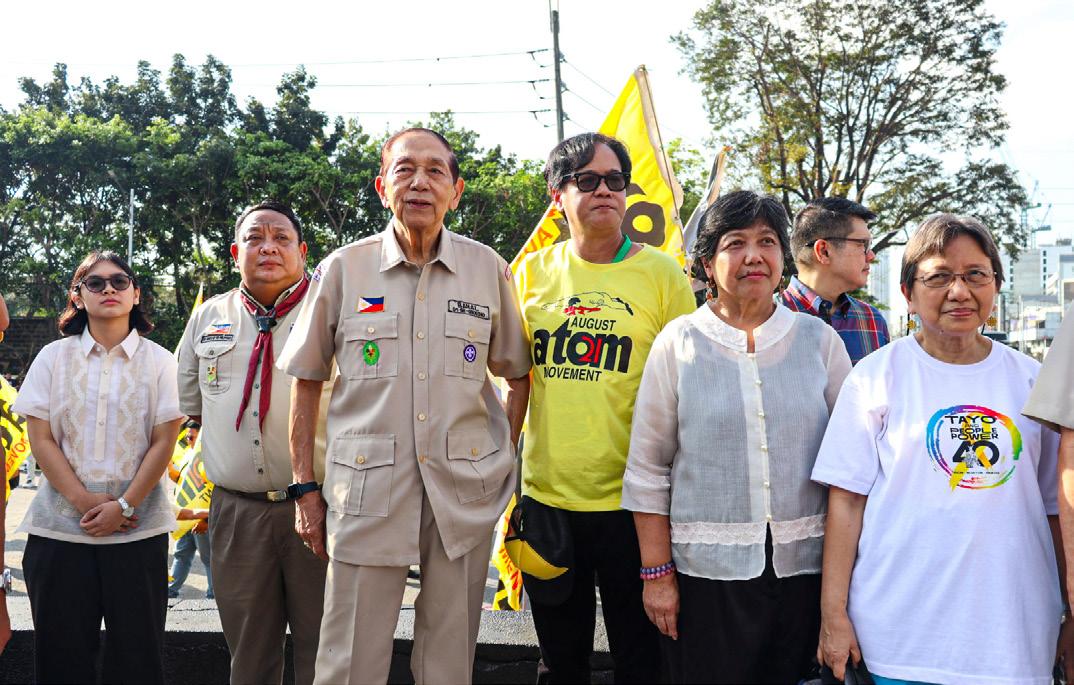
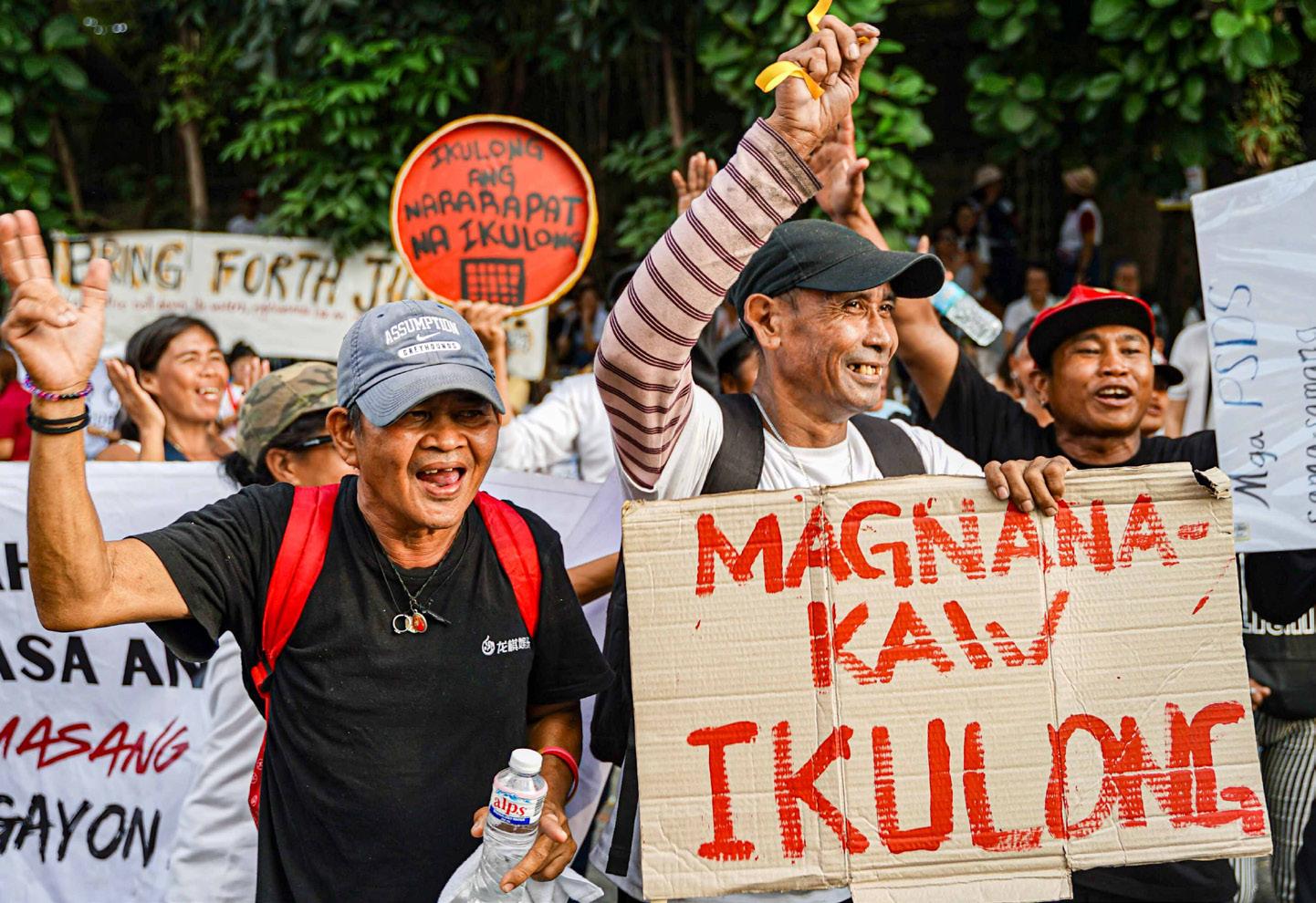



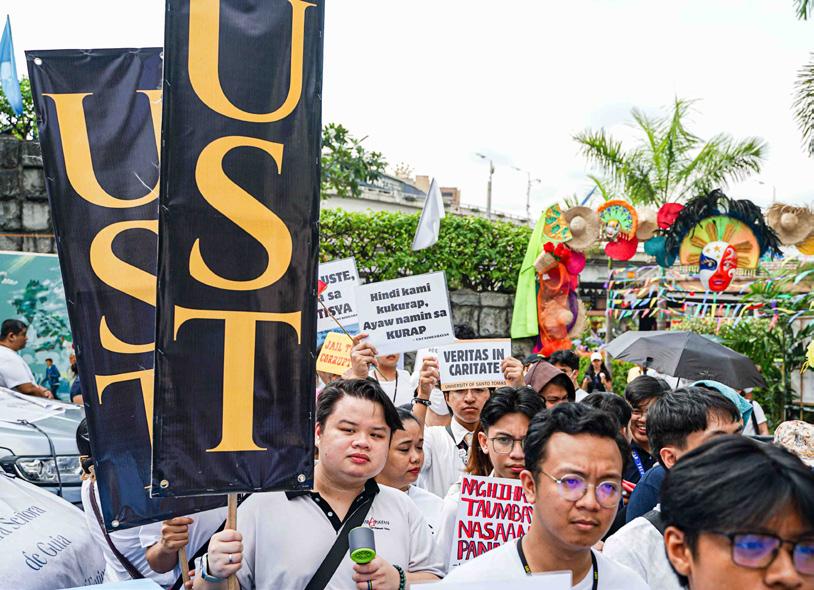
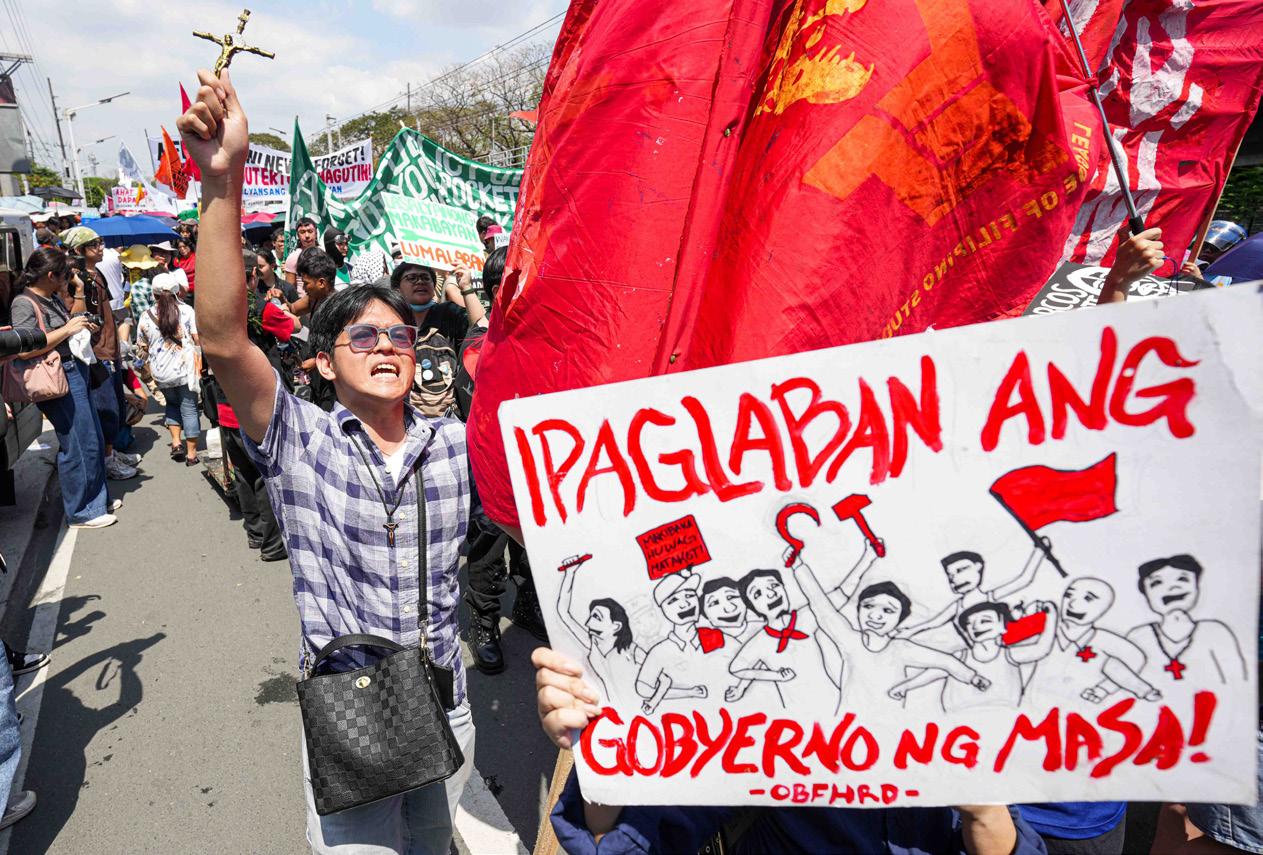
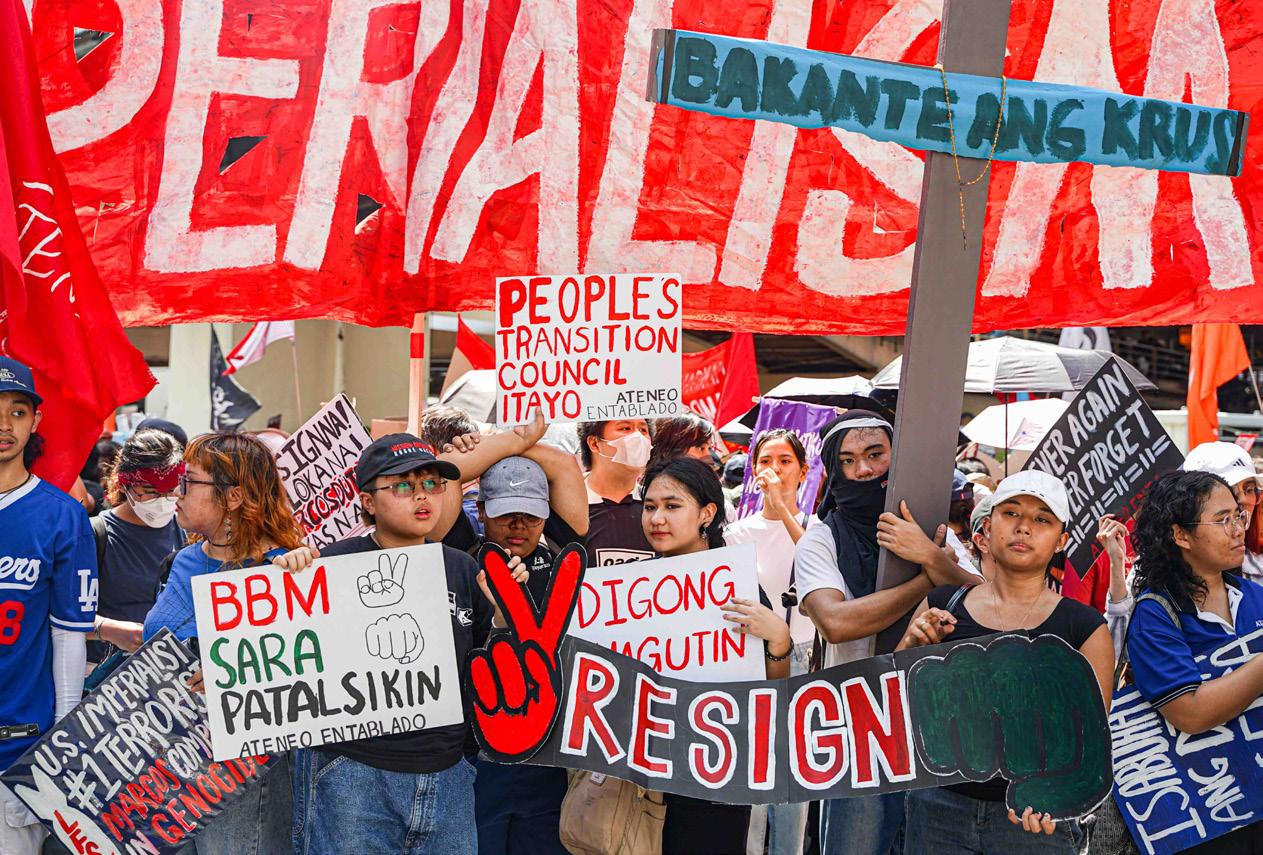
Protesters and civil society groups gather at the the 40th anniversary of the






the EDSA Shrine on Feb. 25 to commemorate the People Power Revolution.












5 Thomasians named fellows in first Philippines Graphic literary workshop
FIVE THOMASIANS are among the fellows of the first literary workshop of Philippines Graphic, the country’s oldest magazine founded in 1927.
Three fellows come from the Faculty of Arts and Letters, namely fourth-year creative writing students Angela Tabios and Andrea Margaret Guevara, and second-year literature student Bettina Reyes.
Also accepted as fellows are two students from the College of Science, psychology freshman Gillian Santos and psychology junior Dominique Abareta.
Acclaimed fictionist and Palanca-winning author Susan Lara served as lecturer in the workshop proper.
Lara chairs the panel of judges of the Nick Joaquin Literary Awards. She has served as a panelist in creative writing workshops organized by the Varsitarian
The event is part of the Philippines Graphic centennial celebration.
The application was open to undergraduate students, who were each required to submit a flash fiction piece ranging from 100 to 250 words.
CHARLIZE ANN D. LAVASTIDA
AHEAD OF the expected national artist conferment this year, writers and critics are demanding clearer standards for the literature category, citing concerns over opaque lobbying, gender imbalance, and biases toward region and language.
The National Artist title, conferred every three years, is the highest recognition for Filipino artists, honoring their contributions to the development of Philippine arts.
Katrina Stuart Santiago, a writer and critic, said the lobbying process becomes a form of election campaign, where candidates with popularity, financial resources, and strong public relations or social media support gain an advantage in the selections.
“I think to begin with, lobbying is a questionable exercise,” Santiago told the Varsitarian Santiago cited the circulation of promotional materials on social media, including printed commendations, film reviews, and compiled creative works.
“How do we make the lobbying process [fairer] if we cannot abolish the lobbying process? To me, it’s to be clearer what the criteria are,” Santiago said. She added that the criteria for selecting a National Artist should set what “national” means and how it is defined in relation to literature.
In an interview with the Varsitarian, writer Jerry Gracio pointed to the lack of national awareness in establishing a consistent standard for Philippine literature.

“To be declared a national artist, an artist should be able to imagine and reimagine the nation through his or her work, inspire the people to deeply reflect not just on the past but on our current dilemma as people,” the multi-awarded author and recipient of the Southeast Asian writer’s award said.
Gracio said a narrowed-down lin-
guistic focus often results in recognition of works written in English and Filipino, despite the country having over 100 languages.
He suggested addressing these issues by acknowledging writers working in different dialects, funding translation programs, and increasing publication opportunities.
“Ganito rin ang isyu sa gender,
ayokong sabihin na dahil lalaki ang karamihan ng namimili para sa [National Artist], pero hindi pa rin pumapasok sa utak ng judges ang idea ng representation kaya ang konti ng babaeng [National Artist],” Gracio said. In a Facebook post dated Feb. 18, 2024, he criticized the gender imbal-
EDITORS MUST adapt to the growing role of artificial intelligence (AI) while adhering to ethical standards, a freelance journalist said during a literary workshop at Pasinaya 2026, the multi-arts festival organized by the Cultural Center of the Philippines (CCP).
“Al is here to stay—whether we like it or not. For something this transformative, the best approach is to accept [or] embrace it, understand it well, and strategize our moves accordingly,” Aimee Morales, founder of the Freelance Writers’ Guild of the Philippines, told the Varsitarian
While AI has created opportunities for editing work, human editors remain irreplaceable due to their crucial responsibility of providing ethical judgment and context that AI cannot replicate, Morales said.
AI-generated content, which can be formulaic and robotic, can become vague, repetitive or simply incorrect, and human intervention is needed to catch mistakes and ensure the published work is accurate, she said.
Morales also highlighted the need for government regulation on AI use in the Philippines.

Architecture alumnus and graphic artist Roland Amago, who conducted a comic writing and illustration workshop, said AI should only be used as a tool and not as a replacement for human creativity.
“It’s important that we keep on working. We keep on producing our own works. If you want to experiment with AI, experiment using it as a tool, not as a way of producing

By Kirsten Therese C. Barrameda
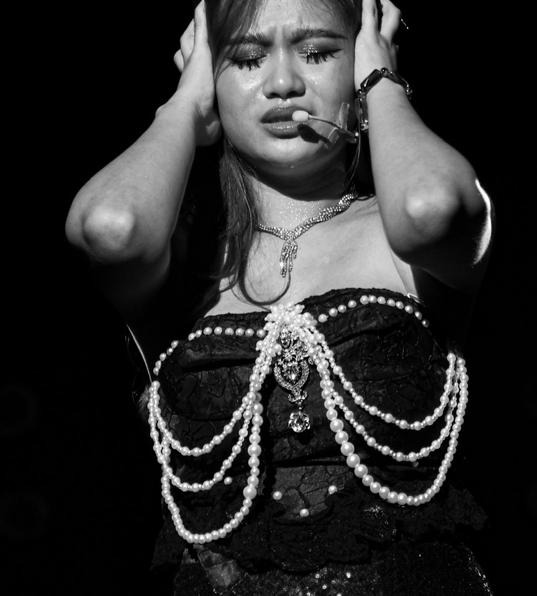
A PREVIEW of UST alumnus Jun Robles Lana’s stage adaptation of his film, “About Us But Not About Us,” was presented at the Power Mac Center Spotlight Blackbox Theatre in Makati on Jan. 16.
The story traces the mentor-mentee relationship of literature student Lance (Elijah Canlas) and his professor, Eric (Romnick Sarmenta), as they unravel wounds, secrets, and unsettling truths.
Throughout Lance and Eric’s conversation, they untangle themes of
mental health and abuse, identity, and corruption, all while discovering lies that surround their shared trauma.
The stage adaptation gives justice to the lingering narratives in the film, providing a more expansive and open space for flashbacks, perspectives, and deeper narratives, and allowing the audience to immerse themselves in the character’s intensity.
“It was inspired by the theatricality because it’s so exposed. I didn’t want it to be as ambiguous as the film,” Lana said.
What seems most distinctive about the stage adaptation, however, is the personification of Marcus (Epy
Quizon), Eric’s partner and Lance’s former professor—a character who is echoed only in the conversation of the two characters in the film.
“The only evidence [of Marcus] that we have were pieces from the conversations between Eric and Lance—a lot of that character building were the makings of Epy and Andoy (his alternate),” Rutaquio said.
While the adaptation succeeds in using lights and sounds to bring different angles to life, the balanced portrayal of the three characters falls short, as the emphasis on Marcus’s scenes makes the story feel as if it revolves around him, overshadowing Lance





and, most notably, Eric’s narrative. Nonetheless, Rutaquio’s theatrical vision seamlessly aligns with Lana’s, with the production amplifying the cast’s dynamics and underscoring the interplay of trauma and society, all while navigating the realities of educational changes during the pandemic.
In addition to the stage adaptation, Lana revealed the release of “Teorya ng Mga Tanong,” the book introduced in the play, available on the production’s opening night on Feb. 14.
The stage adaptation of Lana’s “About Us But Not About Us” ran from Feb. 14 to March 8.
FROM PAGE 3 ►
‘Logical alternatives’
More than a decade has passed since the University rejected a government proposal to build a cistern beneath the UST field.
UST’s refusal prompted President Benigno Aquino III to indirectly reference the issue in his 2015 State of the Nation Address.
Architect Felicismo Tejuco Jr., an urban planner and faculty member at the Polytechnic University of the Philippines Manila, said floodwater storage alone would not solve Metro Manila’s flooding problem.
“Other planners and engineers have already pointed out that a holistic and comprehensive water and land-use management plan is needed for Metro Manila,” Tejuco said.
Zerrudo said such structures could serve dual purposes, depending on their design.
“Hindi lang siya catch basin throughout the year. Kapag hindi ginagamit, puwede itong magsilbing massive parking area,” he said.
On Jan. 7, the Quezon City government opened a basketball court designed to double as a catch basin, which officials said would reduce flooding in low-lying areas.
However, Zerrudo said other sites could be more appropriate for large-scale flood infrastructure, such as the Intramuros Golf Course, which historically functioned as a moat for the walled city.
“The golf course was previously a moat, and its significance was tied to the historical setting of the walls,” Zerrudo said.
In 2024, the Facilities and Management Office completed upgrades to the University’s stormwater drainage system, now covering nearly all campus roads. WITH REPORTS FROM RALENT M. PENILLA
By Kirsten Therese C. Barrameda
MEDIARTRIX-UST, a universitywide multimedia organization, staged its debut production for the academic year, “Ayoko kay Helena,” at the Albertus Magnus Auditorium on Feb. 4.
The musical production, directed by Nerlin Ann Cometa, is a retelling of the story of Helen of Troy, centering on a pop girl group consisting of Helena (Riccy Belmonte), Hera (Faith Humirang) and Athena (Darlene Rivera).
As these women ascend to the peak of their careers, they also confront the music industry’s glass ceiling— an invisible barrier that is shaped by patriarchy, stigma and stereotypes that limit their potential.
The relatability of the production is central to Cometa’s artistic vision, mirroring her personal experience of “losing her voice” due to misogyny, citing what she described as “oppression and lack of freedom in Filipino society.”
Gusto ko ipakita ‘yung
Nerlin Ann Cometa DIRECTOR
“Gusto ko ipakita ‘yung (misogyny) sa madla kasi in the Philippine context, super normalized ng ganitong issue, na hindi pa nabibigyan ng action,” Cometa said.
While tackling weighty issues, the production maintains its sense of playfulness, offering the audience an enjoyable yet socially conscious story.
The production, however, prioritizes an unambiguous storyline over thematic complexity, leaving the audience little room to interpret and analyze the story in depth. A few lackluster scenes occasionally slow the show’s momentum.
The story’s ending felt abrupt and lacked a significant payoff, leaving the audience unsatisfied.
Nonetheless, the cast and live band’s performance presented a dynamic soundtrack that stands as the true powerhouse of the production. Ultimately, the production is grounded in recognizing the female voice, contributing to the resurgent feminist discourse.
► Faculty members test a mobile earthquake simulator at the Quadricentennial Park on Jan. 19.
—
BY DANIELLE D. ATIENZA



THE THOMASIAN community experienced what an Intensity 8 earthquake feels like — minus the danger — after the Philippine Institute of Volcanology and Seismology (Phivolcs) brought its mobile earthquake simulator and hazard-mapping technology to the University.
The hands-on simulation, held at the Quadricentennial Park, aims to move students beyond routine drills by letting them feel severe ground shaking and assess campus risks in real time.
Facilities Management Office (FMO) director Fr. Dexter Austria, O.P., said inviting Phivolcs to bring the simulator to campus had been under consideration for months to address the limitations of conventional earthquake preparedness, which often relies on drills rather than sensory experience.
“We practice [drills], but we do not know and are not aware of what an earthquake is really all about,” Austria told the Varsitarian. “Here, you experience the intensity, from Intensity 4 up to 8.”
Austria recalled a powerful earthquake during his childhood in the 1990s, something many students today have never experienced, making it difficult for them to grasp the need for preparedness measures.
Experiential learning allows students and personnel to go beyond “duck, cover, and hold” during drills, he said.
“We want this university to be ready for earthquakes [because they] are inevitable, but if we are ready to face them, we will be more prepared,” he said.
Phivolcs science research specialist Ian Luzon said the simulator should discourage students from trivializing earthquakes, and reframes drills as preparation for real disasters.
“Malalaman ng [students] na hindi biro ‘yung earthquake kasi nakita mo naman na ‘yung Intensity 8, malakas talaga,” Luzon told the Varsitarian. “So kapag nangyari talaga ‘yung event, hindi dapat siya gawing katatawanan.”
Campus readiness
UST houses several historic structures, including the Main Building, which Austria described as among the country’s earliest earthquake-resistant designs due to its segmented structure rather than deep foundations.
He said newer facilities, such as the Saint Pier Giorgio Frassati Building and the Buenaventura Garcia Paredes, O.P. (BGPOP) Building, have deeper foundations that can withstand earthquakes of up to Intensity 8.
“Itong mga newer buildings natin, mas malalim na ‘yung foundation kaya alam natin na it can withstand an earth-
quake. We are looking at the structural integrity of our buildings, and as much as possible, we take action kapag may nakita tayo agad.”
The FMO plans to intensify earthquake drills in the coming weeks to better reflect the realities of a major seismic event.
UST is also considering developing its own earthquake simulator.
Future simulations could incorporate additional earthquake-related hazards, such as liquefaction and falling debris, which are not represented by the existing simulator, Austria said.
Disaster information
Phivolcs also introduced publicly accessible digital platforms to help citizens understand hazard exposure and disaster risk.
Luzon demonstrated HazardHunterPH, an internet-based application that
generates official hazard assessment reports for any location in the country.
Pinning the UST Manila shows the distance of the campus to the Valley Fault System and identifies it as susceptible to hazards such as liquefaction and flooding. Ground rupture risk remains low due to buffer zones around active faults.
“It is an official document. Kahit normal citizen lang po kayo, magagamit niyo siya para malaman kung prone ba ang property ninyo sa isang hazard,” Luzon said.
The platform features real-time earthquake monitoring, volcano alerts, 10-day weather forecasts, and official hazard maps from Phivolcs and partner agencies.
Phivolcs will deploy its mobile earthquake simulator at the Quadricentennial Park until Jan. 23, allowing more Thomasians to experience earthquake intensities firsthand. NYL R. DADIZ
By Marigela Isabel R. Cirio
WITH CANCER still the country’s second leading cause of death, the UST Benavides Cancer Institute is urging Thomasians and the public to move past one-size-fits-all ideas of treatment, pushing earlier screening and care plans tailored to each patient’s disease and lived experience.
“Even though they have the same type of cancer, or even if they have the same stage of cancer, each patient might have a different treatment approach or management,” said Dr. Rafael Jeric Bautista, a medical oncology fellow at the institute, in an interview with the Varsitarian Bautista said the institute commonly treats breast, lung, colorectal, and prostate cancers, patterns he said were “almost the same” as global data, with no inherent risk factors unique to Filipinos.
He reiterated that message during a forum on cancer awareness held Feb. 5, where he explained how cancer de-

velops and what increases risk.
Bautista grouped risk factors into physical, biological, and chemical causes: ionizing radiation and ultraviolet rays; infections from bacteria, viruses, and parasites; and exposure to tobacco, alcohol, and other chemicals such as arsenic.
“In general, for you to prevent developing these types of cancers, you have to avoid being exposed to the causes that I have discussed,” he said.
He linked prevention to screening, citing mammograms for breast cancer and Pap smears for cervical cancer, along with imaging for highrisk patients for lung cancer and endoscopic procedures to detect suspicious polyps or tumors in colorectal cancer.
Bautista said vaccination could also reduce cancer risk by preventing infections linked to certain cancers, citing the hepatitis B vaccine, which lowers the risk of liver disease that can progress to liver cancer, and the HPV vaccine, which helps prevent
cervical cancer.
“The best way to [deal] with the disease is for you to detect it early and for you to do the management earlier in the stage of the disease,” he said, adding that late or terminal stages often shifted goals toward palliative care rather than cure.
He identified barriers that keep Filipinos from timely screening and diagnosis: lack of knowledge on when to screen, stigma and fear of consulting a doctor, and the cost of procedures and diagnostic tests.
“Healthcare access might seem difficult here in the Philippines, but it’s still accessible,” he said. “It’s still better for you to consult a doctor than to consult the internet.”
According to Bautista, the institute’s care model emphasizes coordination and employs a multidisciplinary team to deliver personalized treatment, which he characterized as molecular and targeted oncology.
“We not only manage certain patients by ourselves; we refer them
to other services such as radiation oncology [and] surgical oncology,” he said, adding that palliative care services were also available for patients with metastatic or stage 4 cancers.
To align plans across specialties, the institute holds regular tumor board meetings, including weekly boards for breast cancer cases, head and neck tumors, and gastrointestinal tumors, with radiologists and pathologists included in discussions.
“For us to provide the patient with the best possible management and care, we discuss it in this tumor board so that we have a consensus on the management of this patient,” Bautista said.
Bautista said public education remained central to the cancer institute’s work beyond World Cancer Day, citing regular forums and cancer awareness months for specific cancer types, often amplified through social media to reach more people.
UST marked World Cancer Day on Feb. 4 by lighting campus land-
marks—including the Main Building, Arch of the Centuries, UST Hospital Benavides Cancer Institute, and the Santisimo Rosario Parish—in orange and blue.
In a circular issued by the Office of the Secretary General, the University outlined World Cancer Day activities running from Feb. 4 to 28 in coordination with UST Hospital and the cancer institute. The schedule includes forums on early consultation, screening, and detection on Feb. 5 and 19, and an art exhibit at the St. John Paul II Building’s upper ground floor. Looking ahead, Bautista said research and academic collaboration would be crucial to improving patient care and informing future hospital and University policies.
He said the institute’s priorities aligned with UST Hospital’s goal of “the highest quality of patient-centered services,” aiming at delivering “customized and personalized management with the latest technologies and treatment.”



Finals or bust
is a symbol of the nation’s moral direction. Before any campaign slogan echoes, we, Filipinos, must ask: What does another Duterte presidency say about what we are willing to tolerate? About what we are willing to forget?
The Philippines in 2028 will not be the Philippines of campaign theatrics. It will be a nation confronting mounting debt, intensifying climate disasters, and escalating geopolitical tensions in the West Philippine Sea—tensions exacerbated by past policies that shamelessly
kowtowed to Beijing at the expense of national sovereignty. It will also face a fragile education system still struggling to recover. Leadership in that context cannot afford ethical ambiguity.
A presidential bid under the cloud of unresolved constitutional complaints risks sending a dangerous message: that political ambition can outpace accountability; that public office can be escalated even when public trust is strained.
If we normalize the idea that allegations involving confidential public funds can simply be politically weathered until the next election cycle, we erode
the very safeguards meant to protect democratic governance. The presidency must not become a refuge from public scrutiny and accountability.
The presidency demands a leader whose record invites confidence rather than suspicion, whose stewardship of public funds is beyond question, and whose ascent to power does not hinge on institutional amnesia.
Malacañang is not an escape route from controversy. It is a seat of public trust. And trust, once fractured, must be restored—not bypassed.
Before the Palace, there must be reckoning.
part. Eventually, a new chapter will unfold. Your pen will inscribe victory and your story will become an answered prayer — a testament of God’s faithfulness and unending grace.”
Alaiza Adviento
Meanwhile, consistency and discipline defined 2025 Civil Law valedictorian Alaiza Adviento who landed third nationwide with a 91.91% rating.
Multiple postponements of the Certified Public Accountant Licensure Examination (CPALE) in 2020 due to the pandemic is what prompted her to enter law school.
“I felt like my preparation for CPALE was more relaxed compared to how I reviewed for the bar because
I took the exam when I was already in law school,” Adviento said. “So, for me, not much was at stake at that time. If ever I don’t pass, at least I’m already in law school. This is the field that I will be in.”
Adviento believes being a CPA is an advantage in law school. Attributing much of her discipline and study habits to her years in accountancy, she stressed the program instilled structure, consistency, and familiarity with law subjects such as taxation and business law.
“As I coursed through law, I’ve met several professors who inspired me to continue with my law journey and I felt like I also wanted to be like them,” Adviento told the Varsitarian Throughout law school as a UST Law Alumni Foundation Inc. scholar, and during her bar preparations, she relied on thorough, repeated reading of
of judges to include more women to ensure gender diversity in the conferment.
assigned materials. She began with full coverage readings before narrowing her focus to highlighted key concepts.
Rather than following a rigid daily schedule during review, she adopted a flexible system that allowed her to adjust tasks while ensuring that daily goals remained realistic and achievable.
Adviento describes her bar journey as “ordinary” — a quiet contrast to the usual stories of sleepless nights, emotional turmoil, and grueling sacrifices that often define the path of many lawyers.
“For a long time, I wondered if that made my journey less meaningful. I questioned whether a path that is really gentle could still be profound,” she said. “But somewhere along the way, I realized not all victories are born from suffering. Some are born from [constant support].”
After the Bar exams, Adviento officially reported for work at the
unsure if it played a part.
ance among National Artists for Literature, noting that Edith Tiempo is the only Filipino woman on a roster of 13 male awardees.
“Nakakaligtaan lang natin dahil hanggang ngayon, hindi natin kinukuwestiyon ang napakalaking ‘di pantay na bilang ng mga lalaki at babae sa talaan ng national artists. Mali ito. At kailangan nating itama ang mali,” Gracio stated in his post.
He called for expanding the panel
A former female nominee from the Visayas told the Varsitarian her regional affiliation had disadvantaged her.
“It might be said that a local nomination for national artist is always accompanied by a sense of despair, the awareness that despite one’s accomplishments, the most tremendous handicap of all is being an ”outsider” in the geopolitical sphere and its so-called “national” priorities,” she said.
When asked about the role of gender in her nomination, she said she was
“As of now, I am not aware that my being a woman has something to do with my losing, but it is possible that being male has something to do with someone else’s winning,” she added.
She called for transparency in the selection of the National Artists for Literature and encouraged greater public engagement.
This year’s edition of the National Artist selection involves a stricter process, a member of the selection panel told the Varsitarian Panel members were required to
Spikers faced collegiate powerhouses, including top-ranked Waseda University.
“For the players, highlight sa kanila ‘yong we won two sets over Waseda,” Mamon said. “Marami silang natutuhan that we can utilize.”
The Golden Spikers also tinkered with their rotations, with setter Dux Yambao emerging as a more assertive scoring threat.
At the same time, UST continues to wait for Al-Bukharie Sali’s return from surgery, with the middle blocker expected to miss at least a month, while Sherwin Umandal has returned and rookie Jancriz Ayco provides added depth.
After finishing third in Season 87, the clock is ticking. With stars like Josh Ybañez, GBoy de Vega, Yambao, Joshua Avila, and Umandal nearing graduation,
DivinaLaw in November 2025 as an associate under the corporate law department, following an earlier stint as an underbar associate during the review season.
Adviento described the Thomasian community as inherently warm and welcoming, a trait she carried with her while also gracing the university with her recent triumph. She emphasized this sense of warmth is crucial in the field of law.
“[Warmth] is important in the field of law [because] you will really interact with other people. So, it’s important that the people you interact with will feel that you are warm, inviting, and that you are a person that they can trust and talk to easily,” Adviento said.
“I’ve always believed that family is a place you return to with good news. Not to prove anything, not to seek validation, but simply because you care,”
this season appears to be now or never for the Golden Spikers.
Mamon is counting on that urgency to push the team to greater heights.
“I hope pressure fuels them to perform better,” Mamon said. “Without pressure, there cannot be movement.”
“What we reinforced is patience sa laro. Pagdating sa atake, there should be less errors. There are a lot of eye-openers,” he said.
Even with established firepower on the wings, Mamon stressed that the Golden Spikers’ attack will not hinge solely on their outside hitters.
“Actually, we’re not reliant on the wings but more on the setter,” he said. “Whether he chooses the middle or activates the wings — any of them can score.”
The Golden Spikers opened their season against the National University Bulldogs on Feb. 15, at the SM Mall of Asia Arena.
she said. “UST has always been that kind of family to me. Hence, placing in the top three is my way of coming back home with good news. It is my way of saying thank you.”
While she currently sees herself continuing in corporate law, she also envisions a future in the academe, inspired by professors who once motivated her in law school.
As she looks back on her journey, Adviento believes success in law is built by showing up, especially on the hardest days, when self-doubts are loudest and the path feels uncertain.
A total of 104 Thomasians passed the 2025 Bar examinations, where UST recorded an overall passing rate of 87.16%, and a 96.3% passing rate for first-time takers, ranking third among law schools with more than 100 examinees. WITH REPORTS FROM LOUISSE RAYE SHARRA C. SANTOS
sign a nondisclosure agreement to keep the list of nominees confidential.
Each nominee undergoes three levels of screening by an undisclosed panel, with a resource person assigned at each level to present and defend their accomplishments.
The panel member also mentioned that while anyone could nominate a candidate previously, the last two to three editions had limited the nominations to those from qualified cultural organizations and educational institutions.
Under the Order of National Artists Guidelines, nominees must be Filipino
citizens whose body of work has significantly contributed to the development of a Filipino sense of nationhood, pioneered creative expression, and enriched artistic practice across generations. They are categorized into seven classical Western arts, namely, literary arts, dramatic arts, visual arts, cinema, music, architecture, and allied arts. Critics opined that the selection process fails to take public opinion into account, with institutions such as the University of the Philippines able to nominate the same candidates rather than spotlight emerging artists.
by Joaquin Edgardo A. Cortez
THE UST Golf Team is entering a new chapter as it gears up for its UAAP debut, rising from a studentformed organization to a universityrecognized varsity squad in just two years.
After gaining recognition from the Office for Student Affairs in 2024, the team obtained approval from the Institute of Physical Education and Athletics (IPEA) last month, paving the way for its participation in the UAAP this season, where golf will be staged as a demonstration tournament.
Before receiving IPEA recognition, the team operated independently, with players shouldering their own green fees — the charge required to play on a golf course — along with coaching and training expenses while representing UST in competitions.
Still, the vision remained firm: to become an official team club and claim a spot in the UAAP.
“Hopefully, this will have continuity and that each and every member who has been part of the UST Golf Team will leave a legacy,” JM Tapia, a Faculty of Arts and Letters alumnus and the UST Golf Team founder, told the Varsitarian
“Continuity is vital to keeping the fire burning within the UST Golf Team,” he said.
Team captain Marc Velasco, a Civil Engineering student who has competed in the ICTSI Philippine Golf Tour, said the IPEA recognition gave institutional backing.
“Since now we’re under IPEA, they can provide support,” Velasco told the Varsitarian. “They can give us a sports

psychologist, tapos ‘yong access sa gym and all.”
“We’re happy, kasi now we’re official na talaga.”
Even as an established member, Velasco will still go through the team’s formal screening process and tryouts.
Each UAAP golf team must have a roster of seven players — four starters and three reserves — in both the men’s and women’s divisions.
The team is searching for recruits who offer not only talent but also the mindset and long-term vision needed to grow the program, Velasco said.
The program remains a work in
Hopefully, this will have continuity and that each and every member who has been part of the UST Golf Team will leave a legacy
JM Tapia UST GOLF TEAM FOUNDER
progress, as the team has yet to settle on a moniker, appoint a head coach and secure a permanent training base.
The team held a player screening on Feb. 22, at the Swing Golf & Lounge in Diliman, Quezon City, with a fairway tryout scheduled for March 1.
For now, preparation remains mostly individualized, with players continuing to work with their personal swing coaches while the team’s structure is finalized.
Typically, a golf coach supervises technique, refines course management and reinforces control.
The last time the UAAP introduced

Shaq not afraid to turn to younger Tigresses
By Kurt Russel Vincent I. Miranda

IN THE UST Golden Tigresses’ four-set defeat to the NU Lady Bulldogs in their UAAP Season 88 opener on Feb. 15, one thing stood out: head coach Shaq Delos Santos did not hesitate to tap his bench.
After fourth-year standouts Cassie Carballo and Reg Jurado struggled early, Delos Santos made the call, fielding rookie Julia Balingit and setter Arlene Waje into the starting lineup for the third and fourth sets.
Though the Tigresses ultimately fell in four sets, they displayed greater grit in those stretches compared with the opening two frames.
“Iyong [naging] diskarte kasi namin, hindi lang kami nag-base doon sa game kanina, kung hindi pati na rin prepara-
tion pa mismo,” Delos Santos told the Varsitarian
“Medyo shaky [rin] pa [kasi] ‘yong nagiging performance nila Cassie before and Reg, and alam naman nila ‘yon,” he added.
The move sparked a third-set rally, with Balingit unloading 10 points and Waje tallying 12 excellent sets — a bright spot despite the loss.
“Nung nag-rotate kami ng tao, mas naging okay din ‘yong performance,” Delos Santos said.
“Lagi ko sinasabi sa kanila, once na ginamit kayo, ‘yong quality na magiging performance. Kahit hindi kayo ‘yong matagal sa court, ‘yong opportunity na nandyan kayo, ‘yon ‘yong kailangan ko.”
UST also leaned on backup libero Pau Escober after captain Detdet Pe-
pito exited the third set due to cramps, as she chipped in four digs and seven receptions.
Delos Santos attributed the lift from the bench to steady work in practice, citing Waje and Balingit’s preparedness.
“Doon sa training pa lang, ‘yon na talaga ‘yon eh, performing talaga [sila] even sa training,” he said.
The opener underscored the Tigresses’ improving depth entering the season. Beyond the reserves, Delos Santos likewise started juniors standout Avril Bron alongside middle blocker Marga Altea.
“‘Yon ‘yong isang good thing na meron kami — ‘yong sa rotation, even rookies kapag ginamit mo, alam
ing [kayang] mag-perform,” Delos
tos said.
a demonstration sport was in Season 87 in 2025, when rapid and blitz chess were added to the second-semester calendar. Both collegiate and high school divisions were formed, with all schools except UE competing.
Before that, the league introduced an esports tournament in 2024 that featured Mobile Legends: Bang Bang, Valorant, and NBA 2K.
UST was represented in that competition by the Teletigers, a wellknown gaming organization within the University before it was elevated to official varsity status.
“That’s the goal really of the UAAP, to expand its platform, and to follow the lead of basketball, volleyball, and cheerdance, to have its own press conference one day and the same popularity that volleyball now enjoys,” UAAP executive director Rebo Saguisag said during the Season 88 volleyball press conference at the Mall of Asia Arena on Feb. 11.
The league is considering Luisita Golf and Country Club in Tarlac as the tournament venue, with the event tentatively slated for May.
Scholarships are not yet available since golf remains a demonstration sport, though the team anticipates such benefits once it establishes itself in the UAAP.
Tapia said the sport’s demonstration status came with added responsibility for the players.
“We hope that this will be the stepping stone for the UST Golf Team to finally go out there and be recognized,” Tapia said.
“I do think that it is important for them as well to realize that they are carrying the name of UST with them once they’re on the golf course,” he said.
They also traveled to compete against provincial squads months before the season opened.
UST’s dominance at the collegiate level was clear, as the men’s team surrendered just one set in the entire tournament, while the women’s team completed a clean sweep of their matches.
The boys’ team — led by Karl Escobal and James Apdian, with Mark Ian Bihag as substitute — lost only one game in the tournament, while the girls’ team — composed of Grithney Dadang, Angelica Del Mar and Jheliane Auxtero — dropped just two sets and finished unbeaten.
The girls avenged their Season 87 defeat to NUNS. The boys, for their part, replicated last season’s breakthrough when they claimed their first-ever title.
“May motivation silang lahat manalo. Feeling nila kailangan talaga nila manalo para sa isa’t isa,” Doloiras said. “Sa girls, katulad ng mga ate nila, gusto nilang bumawi. Sa boys, gusto nilang may mapatunayan din sila tulad ng mga kuya nila.”
“Pinaghirapan nila lahat ng mga ito. Nakita ko kung paano sila nag-trabaho matapos gumising ng umaga. Lahat nag-tulungan,” he added.
Earlier in the season, Doloiras said the collegiate and high school tandems trained against one another more often in preparation for Season 88.
At UST, they practiced twice daily — in the early morning and late afternoon — mirroring the UAAP setup, where teams sometimes play twice in a day. Doloiras said that tireless commitment throughout the program powered UST’s historic Season 88 run.
“Lahat ng tao sa team tumulong. … ‘Yong mga taong hindi nakikita sa court na kahit hindi naglalaro, malaki ang tulong sa amin,” he said. For the program, the sand courts represent more than a venue — they symbolize UST’s stature as the nation’s beach volleyball powerhouse.
“Kaya gumanda ang skills nila kasi nandoon ‘yong enjoyment sa paglalaro, lalo na sa araw araw na pag-training. Naging masaya lang ‘yong lugar namin sa UST,” he said.
“Lalo pang naging masaya kasi na-coconvert sa panalo kaya ginaganahan silang mag-laro.” Doloiras vowed to keep the momentum going and possibly elevate the team to even greater achievements.
“Tuloy tuloy lang kami. Naka-experience na kami ng panalo at talo. Marami pa rin na nakasupport sa amin. Ginagawa namin ito para sa kanila.” WITH REPORTS FROM MIGUEL ANGELO A. MARCO
Tuloy tuloy lang kami. Naka-experience na kami ng panalo at talo. Marami pa rin na nakasupport sa amin.
Ginagawa namin ito para sa kanila.




By Rob Andrew L. Dongiapon
THE UST Tiger Sands made history in UAAP Season 88, becoming the first beach volleyball program to sweep the men’s, women’s, boys’, and girls’ championships in one season.
On Feb. 22, the Junior Tiger Sands secured the boys’ and girls’ beach volleyball crowns, cementing the program’s place in UAAP lore three months after the collegiate
teams ruled the men’s and women’s divisions.
“Walang katumbas ‘yong panalong ‘to,” Paul Doloiras, head coach of all UST beach volleyball teams, told the Varsitarian. “‘Yong hugot sa laro, binitbit nila ‘yon. Noong natapos, nakita ko na binuhos talaga nila lahat. Nilaban talaga nila.”
Doloiras said there were late-season setbacks, including the Junior Tiger Sands’ loss in their final elimination game in the boys’ division against the NU-Nazareth School
(NUNS) Bullpups.
Even though the game had no bearing since UST had already clinched a Final Four berth, Doloiras said it ignited the team’s push toward the high school championships.
“Nasubok ako. Hindi ako pinatulog ng pagkatalo namin sa last elimination game namin so nagising ang mga players at talagang blessed kami,” he said.
“More than the game preparation, hinugot namin sa pagiging ready mentally…‘Yong utak nila talagang papatay ng bola.”
In November, Doloiras steered the Tiger Sands to collegiate glory behind Alche Gupiteo, Dominique Gabito and Smael Salon on the men’s side, and Sofiah Pagara, Khylem Progella and Lorien Gamboa on the women’s side.
The men’s team stretched its championship run to seven straight titles, while the women wrested the crown back from the National University Lady Bulldogs after their six-year reign ended in Season 87.
It’s finals or bust for Golden Spikers in UAAP Season 88, says coach
By Kurt Russel Vincent I. Miranda
THE UST Golden Spikers will not be satisfied with simply reaching the Final Four in UAAP Season 88. For head coach Odjie Mamon, the minimum goal this year is a finals berth.
Following consecutive silver finishes, Mamon in Season 87 described his squad as the “best lineup” yet, but injuries and a failure to build momentum led to a bronze-medal result.
Mamon said the team used the preseason to sharpen execution and clarify roles within a system already nearing its best form as they chase a return to the finals.
We checked lots of boxes sa to-do list namin. So I’m very hopeful for this season. Goal namin, finals. That’s it.

“We checked lots of boxes sa to-do list namin,” Mamon told the Varsitarian. “So I’m very hopeful for this season. Goal namin, finals. That’s
By Clyde Leanne M. Salamatin

Eka Soriano
FORMER UST Growling Tigresses Eka Soriano, Chille Serrano, and Nikki Villasin were selected in the inaugural Women’s Maharlika Pilipinas Basketball League (WMPBL) Draft on Feb. 15, at Xentro Mall in Montalban, Rizal. The Biñan Angels took Soriano with the No. 2 pick, while Serrano went No. 4 to the Caloocan Lady Kankaloo. Villasin was then selected 24th overall by the Akari Sparks Rizal.

Soriano, who debuted for UST in 2019, won the UAAP Season 85 MVP after averaging 14.36 points, 6.29 rebounds, 7.14 assists, and 3.71 steals per game.
A two-time champion with the Tigresses, she averaged 7.17 points, 3.17 rebounds, 4.92 assists and 1.92 steals per game in her final season, helping UST capture the Season 88 title.
Serrano, meanwhile, completed a four-year stint with the Tigresses, winning two championships in Seasons 86 and 88 as a backup big.
Villasin joined UST in 2021 and played a key role in the Tigresses’ title run in Season 86. She then served as an assistant under head coach Haydee Ong in Season 87 and also played for Discovery Perlas in the 2025 WMPBL Inaugural Season Invitationals.
Meanwhile, former Growling Tigresses standout Tantoy Ferrer was traded from the Akari Sparks to RK Hoops Quezon City on draft day. Ferrer was named UAAP Season 81 Rookie of the Year and Season 86 Finals MVP after averaging 15.7 points, 11.3 rebounds, 3.0 assists, and 1.3 steals per game.