P R O T E C T I N G
A R M E N I A ' S
E N V I R O N M E N T
JULY 2009
Distributed in cooperation with
Armenian newspapers
I r a v u n k , N o y a n Ta p a n , Va g h r s h a p a t , K a m q + , Va y o t s A s h k h a r h , Vo r o t a n , Va n a d z o r y a n K h c h a n k a r , H i n g s h a b t i , S e v a n , T u f a s h k h a r h i A r o r y a , L u s a r d z a k , Ta l i n A s h k h a r h , N o v o y e Vr e m y a , A z g
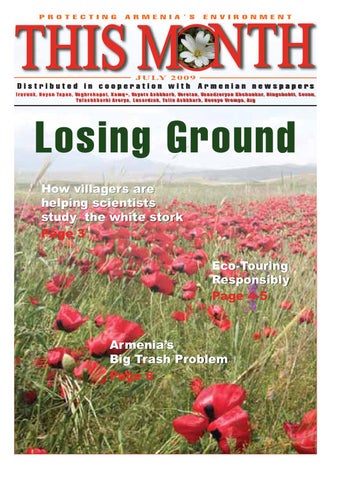
Losing Ground How villagers are helping scientists study the white stork Page 3 Eco-Touring Responsibly Page 4-5
PHOTOS BY AVARAYR TOURS
Armenia’s Big Trash Problem Page 6
Page 2
PROTECTING ARMENIA'S ENVIRONMENT
July 2009
Commentary
In Defense of People and Nature Reserves By Dr. Jennifer Lyman Director emeritus, Acopian Environmental Center, American University of Armenia
nderstanding the human relationship to nature is not an abstract concept for Armenians. They learned the immense value of forests during the energy crisis of the early 1990s, when thousands of families survived harsh winters by using trees to heat their homes. Today, these same Armenians also benefit from the Armenian Tree Project’s efforts to replace and restore trees. Trees planted by ATP after the energy crisis are now bearing fruit, providing food for the table and for the market. The trees that resulted from careful soil preparation, regular watering and careful nurturing 20 years ago are gifts and blessings to new generations of Armenians. Preserving Armenia’s environment is, to many of my friends and colleagues, an activity far down on the country’s list of priorities. What about poverty and pensions, employment and education, health care for women and children? What about traffic deaths, emigration of intellectuals and capable working people? What about having enough to eat? What about the banking system and economic development, and finally, what about corruption? Environmental concerns,
U
they say, are far less important than any of these other problems. But I argue that the list is upsidedown. If humans learn to truly respect and protect nature, many of our social and economic problems will disappear. Nowhere is this more important than creating Nature Reserves that are truly protected and respected. Armenia’s Nature Reserves set aside as much as 50 years ago, most notably the Khosrov Nature Reserve located east of Garni village to Vedi continue to offer benefits and services to Armenia. What does Khosrov offer to us today? Not only is it the habitat of rare and unusual species, it is a place where Armenians can relax, observe and photograph animals and flowers, and simply connect to nature. The new visitor center at Garni is a wonderful place to learn about Khosrov’s natural areas, to arrange hikes, and to picnic. Forward-thinking Armenians worked with iInternational development groups such as the World Wildlife Fund (WWF) and the Norwegian government to design and build a modern and beautiful visitor center for today and for the future. They understand that the large undisturbed habitats of Khosrov provide ecosystem services that ecologists have only recently described. Healthy forests, in fact, aren’t just something beautiful to be admired. They reduce the intensity and frequency of floods, they hold soil in place, help to clean the air and water, provide food for wildlife, protect rivers from erosion, and contain
plants that have medicinal uses. In fact they are a “natural capital”, a warehouse of goods, an insurance policy, and they provide all these essentially free of charge. Lake Sevan National Park is another important reserve, containing the largest strategic fresh water storage in Armenia. Its Hrazdan River drains to the Araks River which supplies water to Turkey, Nakichivan, and Iran. Certainly Lake Sevan ranks as one of the most beautiful in the Caucasus. If these waters become severely polluted then Armenia is truly lost. With 28 rivers flowing into the lake and only one flowing out, the protection of the lake basin is vital to the whole country. Fortunately, Article 10 of the Law of Sevan protects the lake by prohibiting activities that would have negative direct or indirect impact on the lake’s ecosystem. This includes any pollution that might be brought to the lake by rivers or heavy industrial air pollution. This law is the first line of defense in the protection of the waters of Sevan for today and for Armenia’s future. Those who created this law and those who passed it were thinking not of today, not of themselves, not of short-term profit for a few, but of their children and their children’s children. Yet the government is often not the watchdog that it should be when it comes to respecting those reserves. For example, Parliament recently changed well-established laws protecting Khosrov Reserve to allow lands to be taken out of the reserve system and rented indefinitely
to private groups as elite hunting grounds of the bezoar goat and the mouflon sheep that are listed internationally as threatened species. Protection of these spaces must be taken seriously. In the early days of America’s famous Yellowstone National Park, then US President Theodore Roosevelt assigned the Army to guard the animals and the natural environment and to teach tourists how to conduct themselves properly in the natural wild. Now, thriving ecotourism businesses have developed along the park boundaries. In the case of Lake Sevan, it is the government’s responsibility to retain Article 10 of the Law of Sevan, whose authors had the foresight to protect its lifve-giving and valuable fresh water supply and the ecosystems that sustain it. Activities such as cyanide processing of gold ore are activities prohibited by Article 10 and for very clear reasons. In this case clean fresh water is more valuable and more sacred than gold that would result from a proposed gold processing plant in Sotq village. A second argument for protecting and caring for Nature Reserves is that there is an alternate conservation option for almost every human activity. The choice is not simply jobs and economic security vs. protection of the natural environment. This is always a false choice used to scare citizens into agreeing to minor short-term gains without thinking beyond the present. Old technologies and development schemes of the 19th and 20th
centuries are just that – old! All countries are racing to find new and effective methods of production that minimize energy use and waste and minimize our impact on natural resources. These will be job-producing activities, not job reducing ones. Why not look for solutions that produce jobs and reduce public poaching by working with villagers to find alternative livelihoods that will reduce the need to poach for food or profit? Poverty reduction and healthy and well-educated Armenians, along with rigorous protection of the natural environment, should be the goal of any post-Soviet society. Regular visits to nature centers where children and adults can learn about nature and how it makes human life possible and beautiful should become an inherent part of Armenian life. Armenians can lead the south Caucasus region in implementing eco-solutions for the 21st century rather than stagnating in an economic model that never worked sustainably for any society.
Proposed Hrazdan metal processing plant poses environmental hazards By Ani Matevosyan This Month he hill wrapped around the town of Hrazdan like a crescent moon is now covered with green grass and wildflowers. But there are plans to build a metal-processing mine on the hill, close to three schools and residential houses in a settlement less than two kilometers from the town. The proposed plant has raised environmental concerns that heavy metal processing will release dust into the air that can, at worst, cause cancer and serious respiratory problems as well as clog up the air and water supply. The chemical elements can remain in the soil and human body for many years. “The problem is that this mine is open where these heavy metals can be spread by the wind,” said Edgar Yengibaryan, coordinator of the Aarhus Environmental Information Center in Hrazdan. “Besides that, under this mine there are wells that provide drinking water for Hrazdan, Abovian, Gagarin, which can be poisoned.” Nobody knows when exactly the Nagin Ltd. Company will build the metal processing plant, said Yengibaryan. When he directly asked this question to Ministry of Environment Minister Ara Haratyunyan in June, he said the minister would say only that “when we know the answer, we will tell you.” Much of the planning has been done in secret. The ministry has posted a report on its website, claiming it offers an environmental impact study. Yet only the first 48 pages of
T
The hill in the background, looming above this Hrazdan city park, is the proposed location for a metal-processing plant. PHOTO BY ANI MATEVOSYAN
the 90-page report are available, and the pages available show only the environment description and Hrazdan, but not the impact of the mine on the environment. The ministry has ignored repeated requests from a This Month reporter to provide the entire document. Despite the Ministry of Environment’s claims of having organized public hearings in Hrazdan in February on the draft proposal, Yengibaryan contends the hearings weren’t publicized at all. They weren’t advertised on the local television station or newspaper, nor were they posted in any city building. Yengibaryan said he can find no evidence of anyone who attended the public hearing. “The law provides that hearings are announced a few days before they
begin. We opened the ministry’s site only after we learned about the hearings and saw that the information on the hearings planned for February 13 was posted on Feb. 11,” he said. The Nagin Company has been equally difficult to track down. The address and telephone number for the Armenian company listed with the Ministry of Economy led to a private mining metallurgy institute that often performs environmental impact studies for such proposals. But no one there knew anything about Nagin. Anonymous sources say the company is owned by the former Minister of Environment, Vartan Ayvazyan, a charge he repeatedly refused to comment on. In the meantime, researchers of the Acopian Center for the Environment at American University of Arme-
nia say exploitation of a mine located close to the town would seriously damage the environment. The report by the center says: “Iron ores also usually contain reserves of other metals, including copper, chrome, selenium, arsenic metal and others. So, if the company starts extracting the ore, it will endanger the environment causing contamination threatening the town.” The report also underlined a particular concern over the possible contamination of the air. “The dust produced by any metal ore industry may cause serious respiratory diseases with the citizens, because of its toxicity. Dust particles are particularly dangerous for people suffering asthma and lung diseases,” reads the report. Karo Tumoyan, head of the nature protection department at the agency for agriculture and nature protection of Kotayk province administration stated in an interview with This Month, that the regional administration was completely bypassed in this particular project. “The rules have changed: the consent of the province administration was a must for exploitation of mines before, and we used to require survey results from the head of the community, where the mine site was located,” said Tumoyan. “But in recent years licenses have been granted without asking the opinion of the province administration. We now have no leverage over the process.” The environmental problems in the town with a population of 60,000 are huge, even before the metal ore plant gets put in place. Hrazdan resident Anush Vardanyan is an organizer at Aarhus and
a graduate student whose doctoral dissertation is devoted to the influence of industrial emissions on environment and humans. She explains the major part of the population in the neighborhood of Hrazdan has been suffering respiratory problems and diseases beginning with the 1970s, when a cement plant was built there. “If the iron ore is mined, the number of people suffering from cancer will add to those already having various diseases, because the dust of metals is more stable and once getting into the body causes transformations on the cellular level, which can cause cancer,” said Vardanyan. Thomas Lyman, a senior researcher at the Acopian center AUA and one of the authors of the report, says he knows from his own experience what iron ore mining can do to a town. “I am from the state of Montana in the U.S. The town of Butte, once known as ‘the richest hill in the world’ and the territory with the largest mining of copper, is contaminated today so much that it is considered as the largest and the most dangerous and toxic area currently being cleaned up in the U.S.,” Lyman said. “The rivers, the brooks, the soil and the woods in the neighborhood of Butte are polluted so much that fishing is dangerous in some areas. The territory now has to be fenced to prohibit people’s entrance there. “I wouldn’t like to see Hrazdan in the same condition. “I am concerned with the projected mining enterprise and the potential damage it may cause to the environment and the people.”
PROTECTING ARMENIA'S ENVIRONMENT
July 2009
Page 3
Village “researchers” help monitor storks and environment in Armenia Storks live in Yerevan
Shirak
Lori
Ararat
Aragatsotn
Armavir
Vayots Dzor In 2008, there were 993 stork nests, including 640 occupied with stork couples. The stork is a large bird; it is 100-125 centimeters tall and weighs 2.3 – 4.5 kilos. It eats frogs and big insects as well as rodents, small birds, and lizards. Little known fact: Storks throw their weak nestlings and non-impregnated eggs out of the nest, killing them. The stork does not have any natural enemies (other animals do not eat them), which is why they must weed out the weak links to ensure a strong genetic line. But this kind of behavior of storks can be conditioned also by the amount of available food. They lay more eggs than they can feed and later they make the number of the nestlings and the amount of food match.
By Siranuysh Gevorgyan ArmeniaNow.com rom Novoseltsovo and Hovtashat to Areni locals call Lusine Stepanyan and Maro Kochinyan “stork girls.” Each year since 2005, the young scientists visit virtually every area where storks nest in Armenia and distribute special calendars among the residents living near the nests. These so-called “nest neighbors” fill in crucial data regarding stork movements in the calendars. That information includes the return date of the storks, the starting date of breeding, the first day they see the nestlings, the first day of nestlings’ flight, the date of the storks’ departure, as well as the number of the nestlings and whether they threw eggs or nestlings out of the nest. The unique research-public education project is run through American University of Armenia’s Acopian Environmental Research Center. Researchers use the information to study the patterns of migratory birds. “We decided to study a widelyspread species rather than a rare bird or a species on the verge of extinction. It would enable us to see how
F
the changes in the environment affect the number of birds and their nestlings,” said Karen Aghababyan, senior avian researcher at the research center. Armenia is well-suited for such research because it has a large stork population evenly spread throughout the country, allowing researchers to examine the bird in a large and diverse area, he continued. “The stork lives as a bird of prey. That is why we can see how they are affected by stable chemical pestkillers or heavy metals because the latter are accumulated in the birds in the food chain.” Aghababyan said that recent data shows some interesting trends, including that in the last four years there is an increase in the number of storks. “Besides, not only the number of couples, but also the number of nestlings has gone up,” Aghababyan said. There are a few reasons for this change. He says that the increase in the number of storks is firstly conditioned by the increase in available food, which, Aghababyan believes, is influenced by global warming. “That is to say there are more insects that cause an increase in the
Stork scientist Maro Kochinyan (top photo) meets with a village “researcher.” Below, students celebrate “White Stork's Day” in Hovtashat village last September. The village is one of three AUA awarded with the party for being good “nest neighbors.” ALL PHOTOS ON THIS PAGE PROVIDED BY AUA ACOPIAN CENTER FOR THE ENVIRONMENT
number of frogs that are food for storks. In some places the increase in the number of storks may also be conditioned by the existence of poultry and fish farms that are surrounded by large quantities of food wastes.” Aghababyan mentioned that some storks in Armenia living next to poultry farms are so well-fed, they don’t migrate to Africa at all, even for the winter. Breaks in the pattern can offer important scientific information not just about the species, but also about the environment. For example, AUA researchers have noticed that there are storks in the Ararat Valley and Vayots Gorge that hatch out few or no nestlings whatsoever, which can indicate the use of illegal pesticides such as DDT, or other heavy metals that are harmful to the environment. “The polluted area can be 20 kilometers away, but these substances come to the storks by water flow. Or
else the stable organic chemical weed- and pest-killers that remain in the earth for a rather long period of time may come out and harm the storks because of a change in the use of land ,” Aghababyan said. However, Stepanyan (one of the aforementioned “stork girl” researchers) cautions that four years is a very short period of time to draw serious conclusions on the influence of environmental changes on storks. “In order to have a comprehensive picture we must study the storks for at least 20-25 years,” Stepanyan said. The center is also able to provide aid for storks that are sometimes injured hitting high voltage cables near where they build their nests. However, the people who care for storks mostly inform the staff of the Center who treat the injured birds with the assistance of the Biodiversity Center functioning at the RA Botanical Institute.
“Last year we rehabilitated eight storks and successfully released them where we had caught them,” Aghababyan said. Back in the villages, researchers Kochinyan and Stepanyan have made friends with all the “nest neighbors.” The young women said that it was difficult at the beginning; when they were distributing calendars, villagers demanded payment. The girls are proud that they have managed to convince all nest neighbors to become volunteers, and haven’t paid anyone to do the work. “Now it is much easier, we already know how to speak to the people. We talk cordially to one, we explain things scientifically to another,” Stepanyan said. The majority of the population treats the storks very well, say the researchers, for traditionally the stork has been the symbol of luck and success. For example, in the village of Apaga, in Armavir province, storks often build their nests on the roofs of farmers’ houses, sometimes blocking the gutters. Even though the houses of the villagers get wet, they never remove stork nests. “When the stork does not come back, many people relate all their failures to it. However, there are people whom storks disturb. For example, the birds break the glasses of someone’s greenhouse. They strike against them with force or carry heavy objects and drop them on the glass,” Stepanyan said. In some villages in the Ararat Valley, AUA researchers have actually documented villagers eating the bird. But the majority of the Armenian rural population admire storks and consider them “beautiful birds,” such as Gohar Hayrapetyan, 41, a villager of Hovtashat, Ararat province. Hayrapteyan said that she worked and at the same time enjoyed the view of the storks that had nested on the post in her vegetable garden. “I draw parallels with our life. I watch them building their nests bringing in twigs, hatching out their young, and then the young ones leave. Just like people,” Gohar said.
PROTECTING ARMENIA'S ENVIRONMENT
July 2009
PROTECTING ARMENIA'S ENVIRONMENT
July 2009
ThisisArmeniA
LEGEND M ountain tour Hiking and bicycling tours are offered in the Semyonovka Mountain Pass northwest of Sevan in the Tavush region. Also in the area the Dilijan Reserve offers flora and fauna representative of all the Transcaucasia region. PHOTOS BY AVARAYR TOURS
ALAVERDI
LAKE ARPI
Lake Arpi is situated in the north-west of Armenia, in Amasia region. Shirak tours offers a flower and bird-watching tour guided by a local hunter, where tourists can spot the water lily, and other flowers and Dalmatian Pelican, Armenian Gull, and the Black Stork which is unique to that region. Trchkan waterfall, situated in the Getik reservoir near the border of Shirak and Lori regions, is only 33 km from Gyumri. Here there are also many different unique plants and birds . The place to start is Trchkan, and the road up to the falls passes through the Kakavasar village, famous for its remains of a chapel and Karmravor church dating to the 7th century. Shirak Tours offers a day tour to the area, including lunch and an exploration of the cave behind the waterfall. PHOTOS BY SHIRAK TOURS
ZUYGAGHBYUR TUMANYAN IJEVAN TRCHKAN GYULAQARAK KAQAVASAR
GYUMRI
ARAGATS MOUNT SUMMIT
LCHAP MOUNT ARA
BYURAKAN
SHORJA
TSAGHKAVANK AYRUDZI HORSE CAMP
AJDAHAK LITTLE SPITAKASAR
TEGHER ASHTARAK
NORADUS GAVAR
It is also interesting to visit Lake Gili which is now a drained marsh and a resting station for migrating birds. The Geghama and Vardenis mountain ranges can truly be called a volcanic world with their more than 600 large and small craters that are located in this expansive highland. There are extraordinarily beautiful lakes in many craters.Contact the AUA Acopian Center for the Environment (51.25.18) to arrange tours with an ornithologist. PHOTO BY AVARAYR TOURS
MOUNT KAKAVABERD
GARNI CANYON
LAKE GILI MARTUNI
Mount Aragats is a dormant volcano, one of the largest craters in the world formed as a result of an eruption caused by a great explosion 12 million years ago. Four summits surround the crater like mighty guards - the highest is the Northern Summit (4,095 meters). The crater, as well as the whole volcanic highland of Mount Aragats, are of great interest to geologists. The frozen lava layers, the preserved ice-age formations in the crater, and the composition of emissions have created a a geological open-air museum. The abundance of water contributed to the emergence of rich vegetation with a great number of endemic species. The vividly expressed irregular landscape, the wide range of relative altitudes and the mountainous climate zone enable tourists to see nature a-bloom in early spring, and summer on Mount Aragats in the same day. Over 200 species of birds can be seen here and bird-watching is good from March until the mountain is covered with a thick layer of snow in October. Contact the AUA Acopian Center for the Environment (51.25.18) for specialized bird-watching tours with ornithologists. The other tour companies listed (right) can also organize a tour to the crater. PHOTOS BY AVARAYR TOURS
VARDENIS
The spot where the Vardenis and Geghama mountain ranges meet overlooks a unique diversity of alpine vegetation and flowers. Here, plant lovers can find a variety of flora and fauna. Spring here comes in June, when it is already hot summer in the lowlands. A hike in the cool and fresh mountainous zones are a relief from the lowland heat. All companies (right) offer hiking, biking or camping tours. PHOTOS BY AVARAYR TOURS
MARGARA SELIM
ARARAT SEVAKAVAN
The Armash fish farm is in the Ararat Valley, at the foot of Mount Ararat, and is a system of ponds, walled by reeds. It’s also an excellent place to watch migrating birds. The abundance of food, the many places suitable for laying eggs, the open reservoirs and the marshy segments attract a great number of water and other birds that prefer to settle next to ponds. During seasonal migration many species of birds pass by here.
VEDI
SEV LAKE
Provide positive experiences for both visitors and hosts? Provide direct financial benefits for conservation? Offer financial investment into the local economy: e.g. Does the company employ locals in their business? Do locals benefit from the tour? How much money goes into the local economy where the tours are being conducted? Raise sensitivity to the host country's political, environmental, and social climate? Standards from the International Ecotourism Society, at www.ecotourism.org
S
Some Eco-Tour Company suggestions The following companies offer a range of activity tours to all regions
Av a r a y r To u r s Street address: Byuzandi 1, Yerevan, 0070, Armenia Tel: (374.10.52.40.42) e-mail: avarayr@arminco.com Contact person: Arkadi Sahakyan www.avarayr.am
E r k i r N a i r i Tr a v e l C o m p a n y Street address: 1 Tamanyan, 0009, Yerevan, Armenia Tel: (+374 10) 58.23.39 Fax: (+374 10) 58.61.18 e-mail:info@erkirnairi.am; www.erkirnairi.am Contact person: Ashot Levonyan
S e t To u r i s m A g e n c y
S h i r a k To u r s ISHKHANASAR MOUNT
GORIS TATEV MONASTERY
TIPS ON FINDING A LEGITIMATE ECO-TOUR COMPANY The list of eco-tour operators on Page 5 is not exhaustive - there are many other eco-tour companies in Armenia. But buyer beware: Not all companies offer eco-tours that are sensitive both to local culture and the environment. Use the following criteria to evaluate whether your chosen company is doing more good, or more harm. Does your tour:
E
This company specializes in Shirak region tours
KARAHUNJ
SISIAN
Build environmental and cultural awareness and respect?
N
Street address: 5 Aygestan Street, Fizkulturnikneri 48 Tel: (+374 10) 55.21.81 e-mail: info@set.am; www.set.am Contact person: Satenik Sargsyan
VAYK
Bird watchers can spot the flamingo, the black stork, the pelican, the cormorant, the grey albatross, and the crane, among others. Contact the AUA Acopian Center for the Environment (51.25.18) for a guided tour with an ornithologist. PHOTOS BY AUA AKOPIAN CENTER
Minimize impact of visitors to an environmentally sensitive location?
L ake Sevan Yacht tour Communities Start/End of tours
OSHAKAN YEREVAN
A nimal watching tour
B icycle tour
A beautiful view opens to the gem of the Armenian Highland – Lake Sevan – from Selim mountain pass. Being of unique volcanic origin, Lake Sevan is fed from 28 mountain rivers, flowing on the slopes of the surrounding mountain ranges. Lake Sevan is one of the key factors affecting the Armenian highland climate, contributing to many unique species of flora and fauna here. Particularly, the lake is home for the trout and the brook trout, the Baltic whitefish from the salmon family, the minnow, the carp, and the crucian carp from the minnow family. An endemic species of gull– the Armenian Gull that cannot be seen anywhere else in the world also lives in Lake Sevan. It is of special interest to visit the Gull Island which is the spot where the Armenian Gull lays eggs. Contact the AUA Acopian Center for the Environment (51.25.18) to arrange tours with an ornithologist. Biking, hiking, and overnight camping tours are offered by the tour companies listed at right.
SEVAN
AMBERD CASTLE
F ish farming tour
B otanical tour
W
VANADZOR
KASAKH RIVER CANYON
W alking tour
B ird watching tour
H orse riding tour
DILIJAN
KARI LAKE
Thanks to the Armenian Monuments Awareness Project, a preservation and education iniative sponsored by USAID, Vivacell, and the Honorary Consulate of Italy, hikers can enjoy spectacular views of Ararat and rare endemic flowers on a self-guided 3.3 km hike through this wildflower reserve, starting at Amberd castle and winding down a trail that follows the ancient passage into the Ararat Valley (to the edge of Byurakan). A sign on the way to the castle and one on the castle grounds identify rare flowers, history and other points of interest in five languages. PHOTO BY AMAP
Page 5
Street address: 25 Haghtanaki Blvd., 3104 Gyumri, Armenia Tel: (374 312) 5.76.59 Fax: (374 312) 5.03.86 e-mail: terminasyan@berlinhotel-gyumri.am Contact person: Alexan Ter-Minasyan
This organization offers bird-watching tours guided by professional ornithologists
American University Of Armenia Acopian Center For The Environment Metaphorically, Syunik could be considered the lungs of Armenia, as it contains the largest forests producing oxygen. Forest hikes, accompanied by the songs of birds and the flutter of butterflies, overnight stays in tents and hiking tours make this region one of the most attractive areas for ecotourism in the country. All companies (right) offer hiking, biking or camping tours. PHOTOS BY AVARAYR TOURS
KAPAN
Street address: AUA, 40 Baghramian Ave, Yerevan, 0019, Armenia Tel: (374 10) 51.25.18 e-mail: karen@aua.am; www.aua.am/ace Contact person: Karen Aghababyan
KAJARAN SHIKAHOGH
MEGHRI
Ma p c Po rea gh te os d b & Va Lil rzh y i t IR ap Be EX ety CM gany an an SP / A
Page 4
PROTECTING ARMENIA'S ENVIRONMENT
Page 6
July 2009
Waste and want create unsightly and unhealthy environment By Edgar Amirkhanyan Ankakh Weekly hen Arkadzi Sahakyan, head of the Avariray Eco-Tour Company, leads tourists to visit Armenia’s natural wonders, steering his group away from trashed-out hillsides, rivers and even protected reserves has become a regular occupational hazard. “All of Armenia is a trash can,” he said. “We are used to this, but we don’t like it. If you had guests in your house and there was litter all over the floor, wouldn’t you feel embarrassed?” The beauty of Armenia is becoming harder to find, under a mounting pile of garbage. Armenians throw out more than one million tons of trash each year into unlined, untreated garbage dumps or the nearest ravine. That’s 350 kilograms of trash per person, according to Armenian Women for Health and Healthy Environment NGO. It’s not only unsightly, but also dangerous: 70 different hazardous substances, causing everything from cancer to asthma, are emitted into the air when trash - particularly plastics - are burned. Burying hazardous wastes such as the illegal pesticide DDT actually mean the product gets into the water supply, livestock, and eventually into humans (see “Toxic pesticide . . .”, Page 7). None of the country’s primary dumping grounds – in Yerevan’s Nubarashen and Ajapnyak neighborhoods – have any mechanism to process the waste or prevent it from seeping into the ground. “None of the waste dumps meets the minimal requirements for sanitation. Here they just dump the waste, and think it’s done,” said Lilik Simonyan, a medical doctor working at the Armenian Women for Health and Healthy Environment NGO, which has conducted a number of surveys examining the health effects of Armenia’s trash disposal methods. Simonyan said that as a rule, the waste dumps are poorly equipped in Armenia and lack regular records on the dumped rubbish, conditions to wash refuse trucks, and even means to properly dump the waste. Separation of paper and plastic rubbish is done only informally by people who later sell it to companies accepting such materials, to earn extra money. “Waste dumps must have concrete walls or be located on areas that can be cleaned and washed, to avoid contaminating the environment,” said Simonyan. “Refuse chutes have to be made of metal in the high-storied buildings, and have to have the proper capacity of accommodation.”
W
The mountains of garbage piled at Yerevan’s Nubarashen dump have an apocolyptic feel, while a sign there (right) saying “Don’t Litter, Penalty 50,000 AMD” is hardly taken seriously. Who will be responsible for building an environmentally sound landfill in the country? PHOTOS BY ROBYN WISHNA
Getting the government to invest and build a proper waste processing plant or landfill has proved nearly impossible. Tech-
www.icis.com
www.sxc.hu
BAN THE (PLASTIC) BAG The best thing Armenians as individuals can do to help their environment is simple: bring a cloth bag to the market to carry your food, and stop using plastic bags. Around the world, there is a growing movement to ban or discourage the use of the plastic shopping bag. Though they are light and don’t take up as much landfill space as other waste products, they aren’t biodegradable, so they stay there forever. They also can damage fragile eco-systems, killing numerous plants and animals each year and burning them releases toxic chemicals that cause diseases. That’s caused some countries to take radical action: From South Africa and Kenya to India and New York, for example, the use of the ubiquitous plastic shopping bag has been made illegal – and business owners who pass them out get a hefty fine. When Ireland introduced the “Plastax” in 2002, requiring that shoppers pay 33 cents for each bag, within weeks the use of plastic bags dropped by 94 percent, and today, the streets of Ireland cities are virtually plastic-bag free, according to a recent New York Times article. Ditto in Taiwan, where restaurants were required to charge citizens for plastic knives, forks and bags: that reduced the usage by nearly 70 percent immediately. So why not return to cloth bags: your grandmother does it, why can’t you?
nically, both collecting and disposing of waste is a municipal responsibility. Yet the
cost of building an environmentally sound landfill is prohibitively expensive, and most cities – even Yerevan – can’t afford to build one on their own. “We don’t have so much money to have an international standard landfill,” said Gagik Khachatryan, head of the Yerevan city municipality services department. “Our best option was to privatize (the service) and require a company to rebuild this landfill.” Yet Yerevan hasn’t been moving quickly on that score. For eight years, the city negotiated with the Japanese company Shimidzu, which wanted to build a plant converting some of Nubarashen’s methane gas into electricity, which would be resold to Armenians. That permit was finally granted in March, but Shimidzu won’t rebuild a new landfill, but will only cover the existing one, said Hayk Mirzoyan, head of the industrial department of the Ministry of Economics. “We are still trying to find a new operator, which may happen in September or October,” he said. “This new operator will be required to rebuild and manage the whole landfill.” Part of the problem might be that some Armenian businessmen actually profit from keeping things the way they are, said Karine Danielyan, director of the Sustainable Development NGO. “We’ve heard there is a businessman who collects the empty plastic bottles and uses them for some business,” she said. If the landfill is privatized, she said, people such as that man would have to pay for access to the dump. Still, there are a few efforts being made to recycle plastics, mostly in the private sector. Yuri Sahakyan, director and founder of the PoliServ Company, suggests a new approach in the sphere. He uses plastic parts of old refrigerators, washing machines, telephone sets, and heels of shoes to produce construction materials. Sahakyan says the enterprise he started in the town of Abovian 10 years ago offers more than 100 various types of products. The plant uses 5-10 tons of material a month to produce the stock and half of it is recycled from old plastic parts. The businessman also plans to introduce technologies to recycle plastic bottles and packages when he can find capital for the project. “I get the materials from the people who collect it at the waste dumps and in the streets. I buy for a dollar per kilo. Recycling helps me save money, as a kilogram of raw material costs about two dollars,” he said.
Three more good ideas for reducing the trash we throw out Turn your kitchen scraps into fertilizer: Old coffee grounds, banana peels, apple cores, egg shells, and vegetable scraps can be combined and turned into a great fertilizer for gardens and potted flowers alike. Just keep them in a bin in the kitchen, and mix them outside with a mix of grass and shrub clippings, leaves and even newspaper. Lay soil over your compost pile, then keep adding more layers of kitchen scraps, and soil. Avoid buying plastic: Plastic is made from gas and oil. Don’t use styrofoam. It is non-recyclable and non-biodegradable. Drink water from a tap, not from a plastic bottle. Freecycle.org: Six years ago, a group of Americans who wanted to give away free what they no longer needed created an e-mail group to allow members to both give and get. Since then, freecycle.org has e-mail lists in 85 countries and serves thousands of groups and millions of members. Site managers say they save 500 tons of trash per day from going into landfills. There is no Armenian version, maybe it’s time to start one?
July 2009
PROTECTING ARMENIA'S ENVIRONMENT
Page 7
Toxic pesticide has unhealthy legacy in Ararat Valley then, the area has experienced several landslides. “There are no destruction mechanisms, and complicated technology is needed. At this point no one is able to find solutions, and the state does not have so much money. The situation is in a state of neglect,” warned Karine Yesayan, Head of the Horticulture Development Department under the Plant Cultivation, Forestry and Plant Protection Agency of the Ministry of Agriculture. Environmental experts are concerned that the problems at the pesticide dumping ground are getting worse. Simonyan’s organization conducted an investigation into the surrounding soil. They discovered that the concentration of chemical pesticides, particularly that of DDT and hexachlorocyclohexane (another pesticide) exceeds the marThis dilapidated grave of chemical weed killer is a time bomb, buried in a territory known for landslide. One day this dangerous chemical will seep into the irrigation or drinking water. PHOTO BY ARMENIAN WOMEN FOR HEALTH AND HEALTHY ENVIRONMENT NGO
By Hasmik Hambardzumyan Panorama.am ilik Simonyan, a medical doctor and scientist working with the Armenian Women for Health and Healthy Environment NGO was disturbed, but not surprised that traces of DDT was found in the breast milk of all 70 women the NGO tested in the Ararat Valley. The highly toxic and illegal chemical was also found in women tested in an Abovian maternity ward. The results are alarming, but unfortunately also predictable. The richly fertile valley is Armenia’s major food basin from which most of the republic’s produce is harvested. The valley is also “rich” in traces of DDT. The chemical pesticide was banned in Armenia in the 1970s, but is believed to still be in use today. A highly stable compound, it is currently seeping into Armenia’s water, land, livestock and even people. “The problem with DDT is that it lasts forever,” said Simonyan. “Even if people stopped using the pesticide in the 1970s, it would still be in their systems 40 years later. And we believe people are still using it today.” First developed as a lice killer and insecticide during World War II, DDT was widely used in Armenia and many other countries in Europe and in the U.S. throughout the 1950s and 1960s. A ban on the pesticide was instituted in the U.S. in 1972 after researchers noted that spraying it was a contributing factor in the near extinction of bald eagles and peregrine falcons, by weakening the bird’s eggshells and causing them to crack. Laboratory tests in animals have shown that DDT can cause cancer and other health problems, and DDT exposure has been shown to be associated with premature births and lower birth weight in babies. There is debate in the international scientific community about whether the ban on DDT in many countries is more helpful than harmful. Many scientific groups have argued that DDT was responsible for eliminating the malarial mosquito.
L
Opponents of the ban contend that discontinuing use of DDT has led to an increase in malarial deaths across the globe. In 2006, the World Health Organization actually reversed its policy on the ban, and now advises it for use in fighting malaria in Africa and other mosquito-ridden areas of the world. What is agreed upon is that DDT stays in the ground, animal populations and humans for years – even decades – after the pesticide is out of use. Specialists do not know the real situation with regard to expired chemical pesticides in Armenia, nor do they know how many farmers are using DDT. The Ministry of Agriculture says it is necessary, and yet impossible, to conduct a final inventory of expired chemical pest-killers imported into Armenia since 1997. The ministry is considering an announcement, asking the population to hand over expired chemicals and receive quality chemicals in exchange. But this entails some other, more difficult work: how to preserve or with what means to destroy the collected expired chemical pesticides. Simonyan said she’s personally seen the largest amount of DDT in the Ararat Valley and the Ararat province in particular. The chemical there has been found in both soil and products made of animal tissues. She said people widely used DDT in the region, which is why it predominates over other revealed chemicals. The organization she heads found DDT in one of the chemical production outlets several years ago, with no such cases being reported later. In Ararat villages such as Margara, Apaga, Aknashen and Sev Jur village in Armavir Province, DDT is showing up in the bird population. Researchers have noticed that reproduction of storks (read “Storks”, Page 3) is low, and one hypothesis is that DDT is the culprit. Another potential danger spot is Yerevan’s Erebuni, site of a burial ground of expired DDT and other pesticides, put there by the Agriculture Chemistry of Armenia state-run enterprise in 1982. Since
ginal permissible amount by several hundred times, and has increased in recent years. Currently, the Global Environmental Foundation through the United Nation’s Food and Agricultural Organization (FAO) has allocated 2.5 million Euros to liquidate the burial ground of toxic chemicals. The program will be launched after an assessment of the situation. Yesayan said the chemicals must first be exhumed from the burial ground, packaged and only later destroyed. “The residential districts are now closer to the burial site, hence any time the toxic substances may penetrate into the drinking water or reach the population through the soil. In a word, this is dangerous, this is a bomb, immediately next to Yerevan,” said Yesayan.
Green Lane the road to organic produce in Armenia By Armine Gevorgyan Radio Hay rganic in Armenia? That’s the goal of Nune Sarukhanyan, chairman of Green Lane, which delivers fresh produce each week in Yerevan grown by farmers in the Tavush region. Tavush boasts the smallest amount of legal and illegal pesticides, says Sarukhanyan: “It is the safest region to grow organic products.” Green Lane, an NGO existing since 2004, has been training farmers, sending experts out to help farmers use organic methods, and more importantly, distributing and selling their produce to larger local markets. Recently, they’ve been pushing the use of reusable cloth bags to their customers to cut down on plastic bag use (see “Waste and want . . .”, Page 6).
O
“For example, cultivated plants are injected with specially prepared substances, say garlic solution, rather than toxic chemicals,” Sarukhanyan said. Sarukhanyan’s larger goal is to get Armenian products to meet European organic standards. “We’ve got many herbs and berries, particularly medicinal ones, that could be sold abroad,” she said. “There are greens unknown to us but there are many Diaspora living in Armenia familiar with those species, who are the main consumers of these products,” Sarukhanyan said. WANT TO SUPPORT LOCAL FARMERS AND BUY ORGANIC PRODUCE? Greenlane will deliver directly to your home or office each week. To get on the mailing list and order weekly products, e-mail: market@greenlane.am For more information on Green Lane projects, go to www.greenlane.am
The Women Farmer Group of Gargar village of Lori province cultivate herbs and other agricultural goods without chemical weed killer, providing unique organic food for consumers in Armenia. PHOTO BY “GREEN LANE” AGRICULTURAL ASSISTANCE NGO
Page 8
PROTECTING ARMENIA'S ENVIRONMENT
July 2009
Trashed Out: Garbage mountain grows while Armenia lacks recycling plant
This Nubarashen dump of Yerevan is a seven-ton mountain of garbage. The only solution to this problem is building a new recycling factory. After eight years of negotiations the Government of Armenia finally signed a contract with a Japanese company, which will recycle the garbage, although this is not a complete solution yet. Armenia still needs one more company which will build a dump with international norms. PHOTO BY ROBYN WISHNA
Whatever is good for our planet is also good for our business
Bezoar goat © WWF Armenia/A. Malkhasyan
´ÝáõÃÛ³Ý Ñ»ï Ý»ñ¹³ßÝ³Ï In harmony with nature
ä³Ñå³Ý»ÉÝ ³í»ÉÇ Ñ»ßï ¿, ù³Ý í»ñ³Ï³Ý·Ý»ÉÁ Easier to protect, harder to restore
гٳ·áñͳÏóáõÃÛ³Ý Ñ³Ù³ñ ¹ÇÙ»’ù ´ÐРѳ۳ëï³ÝÛ³Ý Ù³ëݳ×ÛáõÕÇ Ù³ñù»ÃÇÝ·Ç μ³ÅÇÝ. Ñ»é. (+37410) 524712, 546156 (Ýñù. 16) ¿É.÷ëáï. akhoyetsyan@wwfcaucasus.am This publication is made possible through the generous support of the American people through the United States Agency for International Development (USAID). The content does not necessarily reflect the views of IREX, USAID, or the US government. ²Ûë ÃáÕ³ñÏáõÙÁ Ñݳñ³íáñ ¿ ¹³ñÓ»É ²ØÜ ÅáÕáíñ¹Ç` ²ØÜ ÙÇç³½·³ÛÇÝ ½³ñ·³óÙ³Ý ·áñͳϳÉáõÃÛ³Ý ÙÇçÝáñ¹áõÃÛ³Ý ßÝáñÑÇí: ä³ñï³¹Çñ ã¿, áñ ÃáÕ³ñÏÙ³Ý μáí³Ý¹³ÏáõÃÛáõÝÁ ³ñï³óáÉÇ §²Úèºøê¦-Ç, ²ØÜ Ø¼¶-Ç Ï³Ù ²ØÜ Ï³é³í³ñáõÃÛ³Ý ï»ë³Ï»ïÝ»ñÁ:
Managing Editor, Content: Leah Kohlenberg Copy Editor: John Hughes; Armenian Editor: GayaneAbrahamyan Contributing Reporters: Ani Matevosyan, Hasmik Hambartsumyan, Edgar Amirkhanyan, Siranuysh Gevorgyan, Armine Gevorgyan Layout Design: Poghos Varzhapetyan; Proofreader: Taguhi Susliyan Published in “Tigran Mets” print house.