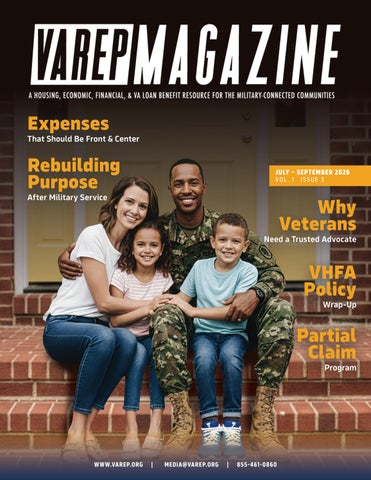
Expenses
That Should Be Front & Center
Rebuilding Purpose
JULY – SEPTEMBER 2026 VOL. 1
After Military Service
ISSUE 3
Why Veterans
Need a Trusted Advocate
VHFA Policy
Wrap-Up
Partial Claim
Program
WWW.VAREP.ORG
|
MEDIA@VAREP.ORG
|
855-461-0860
DONATE A CAR GIVE VETERANS A HAND UP
Donate your car, truck, motorcycle, RV, or other recreational vehicle to VETCares by simply scanning the QR code. We will contact you to arrange a vehicle pickup at no cost to you. You may qualify for a tax deduction while supporting a cause near and dear to your heart!
SCAN TO DONATE VETCARES.CAREASY.ORG/HOME Fo r A d d i t i o na l Q u es tio n s P l eas e Emai l Car l a L emon at cl emon @ve tc a re s. o rg VETCares Inc. is a 501(c)(3) charitable organization. Your generous donation may be eligible for a tax deduction in accordance with applicable law for U.S. residents. Our legal name is VETCares, Inc. Tax ID #87-1693050
TABLE OF CONTENTS MAINSTAYS Message From National President .......................................
PAGE 5
FEATURED
VAREP Wire - The VA Loan Partial Claim ..........................
PAGE 11
Who Am I Without the Uniform?
VAREP Wire - The Hidden Cost of Homeownership .........
PAGE 18
The Member Advantage .........................................................
PAGE 24
The Missing Link - VAREPNation Advocacy ......................
PAGE 26
PAGE 7 VHFA 2026 Policy Conference Wrap Up PAGE 21
NEC Corner - VAREP Education .............................................
PAGE 29
Counceling Stability Hub ........................................................
PAGE 33
ALC Chapter Advice - The Chapter Leader Toolbox ..........
PAGE 37
Back to the Outdoors - TrackChair Donation PAGE 40
EDITORIAL
CREATIVE
CONTACT VAREP
PUBLISHER
SENIOR DESIGNER
HEADQUARTERS
USA Homeownership Foundation, Inc. DBA Veterans Association of Real Estate Professionals
Remy (Sierra) Broadwell Juan Lopez
951·444·7363 info@VAREP.org 495 E. Rincon St., Suite 110 Corona, CA 92879
SENIOR WEB DEVELOPER
WWW.VAREP.ORG
EDITOR Dana Ahern
GRAPHIC DESIGNER
Francisco Labias
VAREP MAGAZINE - 3
I N T R O D U C T I O N : VA R E P ’ S V S O A D V O C A C Y A R M
The Veterans Housing & Financial Alliance (VHFA) By: VAREP Editorial Staff As VAREP’s national impact has grown, so has the need for a stronger voice.
The VAREP Ecosystem
What began as a mission focused on housing education and homeownership has evolved into something more, ensuring servicemembers and veterans are not only served, but represented in the policies that shape their future.
• VHFA, 501c.19 – Veteran Service Organization (VSO) advocacy and policy leadership
That evolution led to the creation of the Veterans Housing & Financial Alliance (VHFA), the official VSO 501.c19 advocacy arm of VAREP.
• USA Homeownership Foundation, Inc. dba VAREP, 501c.3 – Housing & Financial counseling, education, and direct services
• VETCares, 501c.3 – Philanthropy and direct support
Why It Matters • Clear separation of roles • Strong accountability • Greater impact across the veteran lifecycle
A Natural Evolution For over a decade, VAREP has delivered housing counseling, financial education, and community-based services nationwide. One Thing Became Clear:
The Bottom Line • VHFA is not a shift in mission, it’s an expansion of it. • By aligning service, support, and advocacy, VAREP ensures those who served are not only supported, but heard and represented.
• Programs alone are not enough—policy must be part of the solution.
LEADERSHIP PROFILE Son Nguyen, a U.S. Navy veteran, founded the Veterans Association of Real Estate Professionals (VAREP) to address long-standing gaps in financial literacy, economic opportunity, housing industry training, and access to the VA home loan benefit. Guided by a commitment to service beyond the uniform, Nguyen has dedicated his career to strengthening financial readiness, housing stability, and homeownership access for servicemembers, veterans, surviving spouses, and military families. Under Nguyen’s leadership, VAREP has grown into a nationally recognized ecosystem of three nonprofit organizations working side by side to deliver HUD-approved financial and housing counseling, affordable housing initiatives, professional education, military-focused learning pathways, wellness programs, and policy advocacy. Together, these efforts are designed to meet the real-world needs of the military-connected community and the institutions that serve them. A seasoned real estate practitioner, educator, and curriculum developer, Nguyen operates the VAREP Training Institute (VTI), a multi-state continuing education (CE) school. He is frequently called upon as a subject matter expert by government agencies, financial institutions, and industry organizations, and regularly speaks at national conferences and policy forums, helping advance veteran-centered housing practices, accountability, and cultural competency across the housing and financial services sectors.
4 - VAREP MAGAZINE
MESSAGE FROM THE NATIONAL PRESIDENT Building the Future Through Education, Training, and Inclusion As we enter the third quarter of 2026, I am excited about the direction of VAREP and the opportunities ahead for our members, chapters, and the military-connected community. Over the past 15 years, VAREP has grown from a simple idea into a national organization dedicated to empowering servicemembers, veterans, surviving spouses, military families, and the professionals who serve them. That success has been made possible by the commitment of our members, volunteers, chapter leaders, partners, and supporters across the country.
In June, we reached an important milestone with the launch of VAREP 2.0 and the migration of our membership platform from varep.net to varep.org. While many will notice a new website and enhanced technology, VAREP 2.0 represents something much greater—an investment in the future of our organization and our ability to connect people with education, training, advocacy, housing counseling, professional development, and community engagement opportunities. Our vision is clear: Expand membership and continue positioning VAREP as the nation’s premier hub for financial literacy, homeownership, VA housing benefits, foreclosure prevention, and veteran homelessness prevention resources. Education and training remain central to that mission. Through the VAREP Training Institute, MVPro™, BOOTS2™, and other emerging initiatives, we are creating new opportunities for personal growth, professional development, and leadership. Our goal is simple: equip military families and the professionals who serve them with the knowledge, skills, and resources needed to succeed.
Our local chapters remain the backbone of VAREP. As we move forward, we are broadening chapter membership beyond the housing and financial services industries to create a more inclusive network of veterans, military families, and patriotic supporters united by a commitment to service. This evolution will strengthen our chapters, expand volunteerism, and increase our collective impact. We also remain committed to advancing policies that improve housing opportunities, financial readiness, consumer protections, and access to earned VA housing benefits. Working alongside government agencies, Veteran Service Organizations, nonprofit partners, housing counselors, and industry leaders, we will continue advocating for meaningful solutions that support military families. The future of VAREP is not being built from a national office, it is being built every day in communities across America by chapter leaders who volunteer their time, members who step forward to serve, partners who believe in our mission, and veterans who inspire us to do more. Thank you for being part of VAREP Nation and helping us write the next chapter of this organization
In Service, Son Nguyen National President & CEO USA Homeownership Foundation Inc. DBA Veterans Association of Real Estate Professionals (VAREP) VAREP MAGAZINE - 5
Real stories from VAREP members who turn compassion into action. These are veterans, families, and community heroes making a difference where they live—building homes, changing lives, and proving that service doesn’t end when the uniform comes off. It continues through purpose, leadership, and heart.
Learn more! Join us at VAREP.ORG 6 - VAREP MAGAZINE
F E AT U R E D
Who Am I Without the Uniform? Rebuilding Purpose After Military Service By: VAREP Editorial Staff
For nearly a decade, Staff Sergeant James Ramirez knew exactly who he was. Military service provided structure, responsibility, and a sense of purpose that shaped nearly every aspect of his life. He led Soldiers, mentored younger servicemembers, and contributed to missions larger than himself. His days had direction, his role was clearly defined, and he belonged to a team united by a common mission. When it came time to leave the military, James did everything he was supposed to do. He attended transition classes, updated his resume, explored career opportunities, and secured a civilian job shortly after separation. By most measures, his transition appeared successful. Yet several months later, during his morning commute to work, he found himself wrestling with a question he never expected to ask: Who am I now? He had a job. He had a paycheck. He had goals. What he missed was harder to describe. He missed the sense of purpose that came from serving something larger than himself. He missed the camaraderie of being surrounded by people who shared a common mission. He missed the feeling that his work was directly connected to a greater cause. James’s story is not unique. Whether a veteran served four years or twenty-four, whether they were an infantryman, pilot, mechanic, medic, administrator, or intelligence analyst, many experience a similar challenge after military service. The transition to civilian life often requires more than finding a new job or a new place to live. It requires redefining identity and discovering a renewed sense of purpose.
For women veterans, this transition can be even more complex. Many leave military service balancing multiple identities as veterans, mothers, spouses, caregivers, professionals, and community leaders. While every transition journey is different, the question remains remarkably similar: What does my next chapter look like?
More Than a Career Change When people talk about military transition, the conversation often focuses on employment, education, healthcare, benefits, and finances. These are important topics and critical components of a successful transition. However, research has consistently shown that many veterans struggle with something less visible: the loss of identity, belonging, and purpose that can accompany the end of military service. Military service is more than a profession. It is a culture, a
VAREP MAGAZINE - 7
“The transition to civilian life often requires more than finding a new job or a new place to live. It requires redefining identity and discovering a renewed sense of purpose.” community, and a way of life. It influences how people lead, communicate, solve problems, and define success. Over time, military experiences become woven into a person’s sense of self. That is why transition can feel so disorienting. For years, many servicemembers have operated within a structure that provides clear expectations, shared values, and a mission-driven environment. When that structure changes, it is natural to feel uncertain about what comes next. The good news is that uncertainty is not failure. It is often the beginning of growth.
What the Research Shows Researchers studying military transition have identified several common themes among veterans adjusting to civilian life. Many report missing the sense of purpose, belonging, and connection that military service provided. Others describe difficulty translating their military identity into a civilian environment where fewer people understand their experiences. At the same time, studies have found that veterans who maintain strong social connections, engage in meaningful activities, and continue serving others often experience healthier transitions and higher levels of overall well-being. The lesson is simple but powerful: Successful transition is not only about what veterans leave behind. It is also about what they build moving forward.
Your Purpose Didn’t Leave With the Uniform One of the most important things veterans can remember is that military service may have shaped who they are, but it does not define everything they can become. The leadership, resilience, adaptability, discipline, integrity, 8 - VAREP MAGAZINE
and commitment developed through military service do not disappear when a veteran leaves active duty. Those qualities remain valuable in every stage of life. The question is no longer, “What was my mission?” The question becomes, “Where can I apply my strengths next?” For some veterans, the next mission is centered on family. Years of deployments, training exercises, relocations, and long hours may have required personal sacrifices. Transition can create opportunities to become more present as a spouse, parent, caregiver, or family leader. Others find purpose through entrepreneurship, education, coaching, mentoring, public service, volunteerism, faith communities, advocacy, or professional leadership. Many discover that the desire to contribute remains just as strong as it was during military service—it simply takes a different form. Purpose is rarely found overnight. More often, it is built through meaningful relationships, service to others, personal growth, and a willingness to embrace new opportunities.
Rebuilding Connection When veterans are asked what they miss most about military service, the answer is often surprisingly simple: the people. Military life creates bonds built on trust, shared experiences, accountability, and mutual support. Those relationships can be difficult to replace after separation from service. That is why rebuilding community is such an important part of the transition process. Connection can be found through Veteran Service Organizations, community service projects, professional associations, educational programs, faith communities, volunteer opportunities, recreational groups, and local events. Strong relationships provide encouragement during difficult times, accountability when pursuing goals, and a reminder that no one has to navigate life’s challenges alone. Just as military service was never intended to be a solo effort, neither is the transition that follows.
Reflection: Where Are You Today? Take a few moments to reflect on the following questions: • What part of military service do I miss most? • Where do I currently find purpose and fulfillment? • Who are the people I rely on for support and encouragement? • How am I continuing to serve others? • What strengths developed during military service continue to benefit me today? • What does success look like in this next chapter of my life? There are no right or wrong answers. The goal is simply to become intentional about the life you are building moving forward.
Resources for Your Next Mission If you are working to redefine purpose, strengthen your support network, or navigate life after military service, consider exploring: • Veteran Service Organizations (VSOs) • Professional networking groups • Mentorship and coaching opportunities • Volunteer and community service programs • Continuing education and certification pathways • Faith-based organizations • Housing and financial counseling services • Veteran entrepreneurship programs • Peer support and community engagement groups
Every veteran’s path is different, but no veteran should feel they have to walk it alone.
Resource Spotlight: VAREP Social Tribe™ At VAREP, we recognize that connection remains important long after military service ends. The VAREP Social Tribe™ is an exclusive member community available to Military Community and Housing Professional subscribers. The Social Tribe provides a place to connect with veterans, military families, and professionals from across the country; share experiences and resources; ask questions; exchange ideas; build professional relationships; and engage with a community committed to helping one another succeed. Whether someone is seeking guidance, looking to expand their network, sharing knowledge, or simply staying connected, the Social Tribe offers a place to continue growing alongside others who understand the value of service. Military service may be one chapter of your story, but it is not the final chapter. The uniform may come off, but the leadership, character, and commitment it helped develop remain. The next mission may look different than the last one, but it can be just as meaningful, just as impactful, and just as rewarding. Your service helped shape who you are. The next chapter is yours to write. VAREP MAGAZINE - 9
MVP HEROES HOUSING NETWORK
The MVP Network is a nationwide community of trusted real estate agents, lenders, and business affiliates dedicated to serving Military, Veterans, and Community Heroes. Built on integrity and service, MVP connects hero families with professionals who understand their journey and deliver meaningful savings through the Real Rewards program (as law permits).
VAREP.ORG/MVPHHN 10 - VAREP MAGAZINE
T H E VA R E P W I R E - I N F O R M AT I O N YO U C A N U S E
The VA Partial Claim Program
What Veteran Homeowner and Housing Professional Needs to Know By: VAREP Editorial Staff The return of the VA Partial Claim Program represents one of the most significant changes to VA loss mitigation policy in recent years. Following the expiration of certain COVID-era foreclosure prevention initiatives and growing concerns about veteran mortgage delinquencies, Congress authorized a new VA Partial Claim Program designed to help eligible veteran homeowners avoid foreclosure and retain their homes. For veteran homeowners, housing counselors, lenders, servicers, and real estate professionals, understanding how this program works—and equally important, understanding when it does not work—is critical. The VA Partial Claim Program is an important tool, but it is not a solution for every borrower experiencing financial hardship.
IMP OR TA NT DATE S JUNE 1, 2026
JUNE 15, 2026
NOV. 28, 2026
The Department of Veterans Affairs formally implemented the new program as part of its updated loss mitigation framework.
Mortgage servicers may begin submitting Partial Claims to VA
Mortgage servicers must fully implement the systems and procedures necessary to administer the program.
Why the Program Was Created
What Is a VA Partial Claim?
The VA Partial Claim Program was created to help veteran homeowners who have recovered from a temporary financial hardship and can afford their mortgage going forward but cannot afford the lump-sum amount needed to bring the loan current.
A VA Partial Claim is a foreclosureprevention tool designed to help eligible veteran homeowners who have fallen behind on their mortgage due to a temporary financial hardship.
By addressing past-due payments, the program provides an additional foreclosure-prevention tool designed to help eligible veterans remain in their homes and achieve long-term housing stability.
The program may help borrowers: • Bring a delinquent VA-guaranteed mortgage current without making a large lump-sum payment. • Resolve eligible missed mortgage payments, escrow shortages, and other allowable past-due amounts. • Avoid foreclosure and remain in their home.
• Resume making their regular monthly mortgage payment. Under the program, the amount needed to bring the loan current is placed into a separate deferred lien against the property. This means: • The borrower does not make monthly payments on the Partial Claim balance. • The borrower resumes making their regular mortgage payment. • The deferred balance is generally repaid when the home is sold, refinanced, the mortgage is paid in full, or another program triggering event occurs. VAREP MAGAZINE - 11
It is important to understand that a VA Partial Claim:
Understanding the VA Loss Mitigation Waterfall
• Does not forgive the debt.
The VA Partial Claim Program is one component of VA’s Loss Mitigation Waterfall, a series of home-retention and foreclosure-prevention options used by servicers to help borrowers experiencing financial hardship. Rather than offering the same solution to every borrower, the waterfall is designed to identify the most sustainable long-term solution based on the homeowner’s financial circumstances.
• Does not reduce the monthly mortgage payment. • Is not available to every borrower in default. • Is one option within VA’s Loss Mitigation Waterfall. • Is intended for borrowers who can afford their mortgage payment going forward but need assistance bringing the loan current.
Option
Description
Generally Best For
Repayment Plan
Allows the borrower to repay past-due amounts over time while continuing to make the regular monthly mortgage payment.
Borrowers who can afford their regular mortgage payment plus an additional amount to catch up on a relatively small delinquency.
Special Forbearance
Provides temporary payment relief while the borrower recovers from a financial hardship.
Borrowers who are not yet ready to resume regular payments but expect their situation to improve.
Traditional Loan Modification
Changes one or more loan terms to resolve the delinquency and create a sustainable payment structure.
Borrowers who need a permanent adjustment to their loan terms.
30-Year Loan Modification
Re-amortizes the loan over a new 30-year term to improve affordability and resolve the delinquency.
Borrowers who need payment relief through loan restructuring.
VA Partial Claim
Allows the servicer to advance funds to bring the loan current and Borrowers who have recovered from a temporary hardship, can create a deferred balance that is generally repaid when the loan is afford the regular mortgage payment again, but cannot afford the paid off, refinanced, or the home is sold. lump-sum amount needed to bring the loan current.
40-Year Loan Modification
Extends the repayment term to provide additional payment relief beyond other home-retention options.
Borrowers who require the lowest possible payment to maintain sustainable homeownership.
Foreclosure Alternatives
Includes options such as a traditional sale, short sale, or deed-inlieu of foreclosure when home retention is no longer feasible.
Borrowers who cannot sustain homeownership despite available retention options.
Who May Qualify for a VA Partial Claim? While each case is evaluated individually by the mortgage servicer, borrowers generally must meet several key requirements: • The loan must be a VA-guaranteed mortgage. • The property must generally be the borrower’s primary residence. • The borrower must be experiencing or have experienced a temporary financial hardship. • The hardship must have stabilized, and the borrower must be able to resume making the regular monthly mortgage payment. • The borrower must successfully complete a three-month Trial Payment Plan. • The amount required to bring the loan current must generally not exceed 25% of the unpaid principal balance (UPB), with a limited exception allowing up to 30% for certain COVID-era delinquencies. • The borrower must satisfy all other applicable VA and servicer requirements. 12 - VAREP MAGAZINE
The Partial Claim Program is intended to help borrowers who can afford the mortgage going forward but need assistance resolving past-due payments.
Understanding the 25% and 30% Limits One of the most important eligibility requirements involves the amount needed to bring the loan current. In most cases, the total amount advanced through the Partial Claim cannot exceed 25% of the unpaid principal balance (UPB). Example: • Unpaid Principal Balance: $300,000
Congress also authorized a limited exception for certain borrowers whose delinquency includes missed payments during the COVID hardship period. In those cases, the maximum amount may increase to 30% of the unpaid principal balance. Example: • Unpaid Principal Balance: $300,000 • Maximum Partial Claim Amount (30%): $90,000 If the amount required to bring the loan current exceeds the applicable limit, the borrower may not qualify for a Partial Claim and other loss mitigation options may need to be explored.
• Maximum Partial Claim Amount (25%): $75,000
How the VA Partial Claim Program Works Step
What Happens
Key Consideration
1. Financial Hardship Occurs
The borrower falls behind on mortgage payments due to a temporary hardship.
The hardship should generally be temporary rather than permanent.
2. Hardship Stabilizes
The borrower regains the ability to make regular mortgage payments.
The borrower must be able to afford the mortgage going forward.
3. Trial Payment Plan
The borrower successfully completes a required three-month Trial Payment Plan.
Successful completion is generally required before approval.
4. Loan Is Brought Current
The servicer advances funds and submits the Partial Claim to VA. The amount is subject to VA program requirements and limitations.
5. Deferred Repayment
The borrower resumes making regular mortgage payments.
The deferred balance is generally repaid when the home is sold, refinanced, or paid off.
VAREP MAGAZINE - 13
Roles and Responsibilities Under the VA Partial Claim Program Party
Responsibilities
• Contact the mortgage servicer when financial hardship occurs. • Provide required financial and hardship documentation. Veteran Homeowner
• Complete the required 3-month Trial Payment Plan. • Sign required Partial Claim documents. • Resume making regular mortgage payments.
Mortgage Servicer
• Evaluate the borrower under VA’s Loss Mitigation Waterfall. • Determine eligibility for available retention options. • Administer the Trial Payment Plan. • Calculate and process the Partial Claim. • Submit the Partial Claim to VA for reimbursement. • Continue servicing the loan after the Partial Claim is completed. • Establish program requirements and servicing guidelines.
Department of Veterans Affairs (VA)
• Review and reimburse eligible Partial Claims submitted by servicers. • Provide program oversight and compliance monitoring. • Administer the program under federal law.
HUD-Approved Housing Counseling Agency with Specialized VA Home Loan Expertise (Optional but Recommended)
14 - VAREP MAGAZINE
• Educate borrowers on available loss mitigation and foreclosure-prevention options. • Review affordability, budgeting, and long-term housing sustainability. • Assist with documentation and preparation for discussions with the servicer. • Help borrowers understand VA home loan benefits, requirements, and available retention options. • Provide independent guidance focused on achieving the most sustainable longterm outcome.
Learn More
Real-World Examples Scenario
Ideal Candidate
Situation
Likely Outcome
A veteran homeowner loses employment and falls four months behind on a VA mortgage. Six months later, the veteran secures VA Partial Claim may be an appropriate solution. The hardship has new employment at a comparable salary and can afford the been resolved, the mortgage remains affordable, and the primary regular mortgage payment but cannot afford the $12,000 needed challenge is catching up on missed payments. to bring the loan current.
Ongoing Hardship
A veteran experiences a permanent reduction in household income and can no longer afford the mortgage payment.
A VA Partial Claim alone may not be sufficient. Other loss mitigation options may need to be considered.
Excessive Delinquency
The amount required to bring the loan current exceeds applicable VA Partial Claim limits.
The borrower may not qualify for a Partial Claim. Other retention options within the VA Loss Mitigation Waterfall may need to be explored.
Non-Owner Occupied Property
The property is no longer the borrower’s primary residence and is being used as an investment property or rental.
A VA Partial Claim is generally not available. The program is intended for owner-occupied primary residences.
The Importance of Early Intervention The single most important takeaway from the VA Partial Claim Program is that timing matters. Veterans should not wait until foreclosure proceedings begin before seeking help. The earlier a borrower contacts the servicer, engages a qualified housing counselor, and explores available options, the greater the likelihood of finding a successful outcome. Key Takeaways • The VA Partial Claim Program became effective June 1, 2026.
Through this unique approach, VAREP provides: • Housing counseling and financial education. • VA home loan benefit guidance and borrower support. • Foreclosure prevention and housing stability assistance.
• Servicers may begin submitting Partial Claims on June 15, 2026.
• Advocacy and case management for veteran homeowners.
• Servicers have until November 28, 2026, to fully implement the program.
• Military-informed support
• The program is designed for borrowers who can afford their mortgage payment going forward but need help bringing the loan current. • The Partial Claim is one option within VA’s Loss Mitigation Waterfall. • The deferred balance is not forgiven and is generally repaid when the home is sold, refinanced, or paid off. • Early intervention provides the greatest opportunity for a successful outcome. The VAREP Difference VAREP combines the standards and accountability of a HUD-approved Housing Counseling Agency with the mission of a Veterans Service Organization.
at VAR EP.org
tailored to servicemembers, veterans, surviving spouses, and military families. This combination allows VAREP to help military-connected households navigate housing challenges, understand their options, and work toward long-term financial and housing stability.
VAREP MAGAZINE - 15
PARTIAL CLAIM FREQUENTLY ASKED QUESTIONS (FAQ) What is a VA Partial Claim? A foreclosure-prevention tool that allows eligible borrowers to bring a delinquent VA-guaranteed mortgage current while deferring repayment of the past-due amount until a future date.
Is it free money? No. The amount advanced through the Partial Claim must be repaid in the future under the program’s terms.
Do I apply directly through VA? No. Borrowers work directly with their mortgage servicer.
How many payments behind must I be? Generally, the borrower must be at least three monthly payments delinquent.
Do I have to complete a Trial Payment Plan? Yes. Successful completion of a three-month Trial Payment Plan is generally required.
Will the Partial Claim reduce my monthly mortgage payment? No. The program is designed for borrowers who can already afford their regular mortgage payment.
Is there a limit on the amount of assistance? Yes. The standard limit is generally 25% of the unpaid principal balance, with a limited exception of up to 30% for certain COVID-related delinquencies.
What if my delinquency exceeds the allowable limit? The borrower may not qualify for a Partial Claim as a stand-alone solution and may need to explore other options within the VA Loss Mitigation Waterfall.
Can I pay the difference if I exceed the cap? Current VA guidance does not clearly address this scenario. Borrowers should discuss their circumstances with their servicer and a qualified housing counselor.
Is this a one-time program? Generally, yes. VA guidance describes the Partial Claim as a one-time assistance program.
What if I previously received COVID-related assistance or VASP assistance? Prior assistance may impact eligibility. Borrowers should not assume they automatically qualify and should seek an individualized review through their servicer.
Does the program have a sunset date? The current statutory authority is authorized for five years unless extended by Congress.
What if I am already in foreclosure? The sooner assistance is requested, the better. Certain foreclosure situations may limit available options.
What if I cannot afford my mortgage payment anymore? A Partial Claim may not be the appropriate solution. Other retention or disposition options may need to be considered. 16 - VAREP MAGAZINE
60+ HOMES
DONATED MORTGAGE-FREE TO DESERVING HEROES
600+
$13 MILLION
REMODELED
SPENT ON HOME REHABILITATION FOR MORTGAGE-FREE DONATIONS & VETERAN RESALE PROGRAM
VETERANS, FIRST RESPONDERS, TEACHERS & CIVIL SERVANTS
$150,000+
50,000+
VETERANS EDUCATED ABOUT HOMEOWNERSHIP
150,000+ AGENTS & LENDERS
8,000+ VETERANS PLACED IN HOMES THROUGH VETCARES
HOMES & SOLD TO
HOUSING ASSISTANCE GRANTS FOR DOWN PAYMENT, CLOSING COST & ADAPTIVE HOUSING CONSTRUCTIONS
2,500 +
F A M I L I E S WERE HELPED THROUGH VAREP CARES
EDUCATED ABOUT
THE VA LOAN
133
VETERAN HOUSING SUMMITS
TO EMPOWER VETERAN HOMEOWNERSHIP VAREP MAGAZINE - 17
T H E VA R E P W I R E - I N F O R M AT I O N YO U C A N U S E
The Hidden Cost of Homeownership Expenses that Should Be Front & Center By: VAREP Editorial Staff For many servicemembers, veterans, and military families, buying a home is one of life’s biggest milestones. After years of deployments, PCS moves, military transitions, and uncertainty, homeownership often represents something much more than a real estate transaction—it represents stability. When most people think about buying a home, they focus on one question: “Can I afford the mortgage payment?” It is an important question, but it is not the only one. What many homeowners discover after moving in is that the mortgage payment is only part of the cost of owning a home. Insurance premiums increase. Property taxes change. Appliances fail. Air conditioning systems stop working. Roofs age. Life happens. The reality is that sustainable homeownership requires planning for more than just the monthly mortgage payment.
A Common Scenario A veteran family purchases a home using their VA loan benefit. They budget carefully, maintain good credit, and select a mortgage payment that fits comfortably within their household income. For the first year, everything goes according to plan. Then their homeowners insurance premium increases significantly. Because taxes and insurance are paid through escrow, their monthly mortgage payment rises as well. A few months later, the home’s HVAC system fails during the middle of summer. The repair costs several thousand dollars. Neither event is unusual. In fact, situations like this happen every day to homeowners across the country. The challenge is not that the family purchased too much home. The challenge is that many homeowners underestimate the ongoing costs that come with owning and maintaining a home.
18 - VAREP MAGAZINE
“The reality is that sustainable homeownership requires planning for more than just the monthly mortgage payment.” The Expenses Nobody Talks About
The VAREP Perspective
When people discuss homeownership, most conversations revolve around interest rates, loan programs, down payments, and monthly mortgage payments.
At VAREP, we often say that sustainable homeownership begins long before a borrower misses a mortgage payment.
What receives far less attention are the expenses that continue long after closing day.
These may include: • Homeowners insurance
• Appliance replacement
• Property taxes
• Roof repairs
• HOA dues
• Plumbing issues
• Utilities
• HVAC repairs
• Routine maintenance
• Landscaping and exterior upkeep
Most homeowners will eventually encounter an unexpected repair or expense. The question is not whether something will happen. The question is whether you are financially prepared when it does.
The Insurance and Escrow Surprise One of the most common frustrations homeowners experience is receiving notice that their mortgage payment has increased. Many borrowers assume their payment will remain relatively stable after closing. However, when insurance premiums or property taxes increase, escrow accounts may require additional funds to cover those costs.
Financial readiness, emergency savings, understanding escrow, planning for maintenance, and reviewing insurance coverage are all part of protecting long-term housing stability. The goal is not simply to help military families and veterans buy a home. The goal is to help them keep it. Homeownership remains one of the most powerful wealth-building opportunities available to American families. Understanding the full cost of ownership can help ensure that opportunity becomes a longterm success story rather than an unexpected financial burden.
As a result, homeowners may experience a higher monthly payment even though their loan terms have not changed. For military families managing deployments, PCS moves, career transitions, or changes in household income, these increases can create unexpected financial pressure.
Why Emergency Savings Matter Emergency savings cannot prevent emergencies. They can, however, reduce the financial stress that often accompanies them. Whether it is a major home repair, an insurance increase, a temporary loss of income, or an unexpected family expense, having a financial cushion can help families avoid relying on credit cards, personal loans, or other forms of debt. One of the most effective ways to protect housing stability is to plan for the unexpected before it happens. VAREP MAGAZINE - 19
THE NEED
IS GREAT
EVERY GIFT HELPS A HERO TAKE ONE MORE STEP FORWARD!
VETCARES.ORG/DONATE 20 - VAREP MAGAZINE
V E TCA R E S .O R G | 951-444-7361
F E AT U R E D
2026 VHFA Policy Conference Wrap-Up A Landmark Moment for VAREPNation By: VAREP Editorial Staff
The 2026 VAREP Policy Conference in Washington, D.C. will be remembered as one of the most significant events in our organization’s history.
Congress Passes 21st Century ROAD to Housing Act Including the VALID Act A landmark legislation designed to expand housing
For two days, VAREP members from across the country
opportunities, improve affordability, increase housing
came together with a shared mission—to be a voice for
supply, modernize housing programs, and strengthen
veterans, servicemembers, and military families. Members
pathways to homeownership for Americans nationwide.
met with lawmakers, learned from policy and industry leaders, strengthened partnerships, and advocated for solutions that expand opportunity and improve quality of life for the military community.
For VHFA and VAREP, the most significant achievement within the legislation was the inclusion of the VA Loan Informed Disclosure (VALID) Act. The VALID Act helps ensure eligible veterans are informed about their earned
This year’s conference also marked the official introduction
VA Home Loan benefit and financing options during
of the **Veterans Housing & Financial Alliance (VHFA),
the mortgage process. By increasing awareness and
Powered by VAREP**. VHFA serves as VAREP’s advocacy
transparency, the legislation will help veterans make
and public policy arm, providing a dedicated platform to
informed decisions and encourage greater utilization of
advance housing, financial readiness, and homeownership
one of the most valuable benefits earned through military
policies affecting veterans and military families.
service.
VAREP MAGAZINE - 21
For many members, the timing could not have been more meaningful. While VAREPNation was walking the halls of Congress advocating for veterans and military families, Congress was advancing legislation that included one of VAREP’s longest-running legislative priorities. The effort began nine years ago when Son Nguyen and GII Varrato, founding chair of the National Legislative Committee, first identified the need to improve awareness of the VA Home Loan benefit. What started as an idea grew into a nationwide advocacy effort carried forward by Lynn Jabs, current NLC Chair, the National Legislative Committee, congressional champions, industry partners, chapter leaders, and countless members of VAREPNation.
Advancing Solutions That Matter Conference attendees also received updates on two key VHFA policy initiatives: the Military Financial Literacy Act (MFLA) and the proposed VA Home Loan Navigator Act. Both initiatives are designed to
citizens can become more effective
built over time, and consistent follow-
strengthen financial readiness,
advocates.
up is often what turns a conversation
housing stability, and access to
Five key messages stood out:
into action.
1. Build rapport and relationships.
VAREP members put that advice
trusted guidance for servicemembers, veterans, and military families. The discussions reinforced a common
2. Research the Member and
theme throughout the conference:
understand their priorities.
empowering people with the information, resources, and support needed to make informed financial and housing decisions.
Learning from Capitol Hill One of the most popular sessions featured congressional staff members who shared practical advice on how
3. Educate and provide real-world perspectives. 4. Be persistent and do not be afraid to knock on doors. 5. Most importantly, FOLLOW UP. The staffers emphasized that
into practice. With more than 225 scheduled congressional meetings VAREPNation inspired by the encouragement to be proactive and persistent, members also conducted more than 100 additional drop-by meetings throughout Capitol Hill.
Collaboration Makes Us Stronger
advocacy rarely ends with a single
The conference also provided
meeting. Meaningful relationships are
an opportunity to strengthen
“The effort began nine years ago when Son Nguyen and GII Varrato, founding chair of the National Legislative Committee, first identified the need to improve awareness of the VA Home Loan benefit.” 22 - VAREP MAGAZINE
relationships with fellow veteran-serving organizations and industry partners. Representatives from the American Legion and Veterans of Foreign Wars (VFW) discussed opportunities for collaboration on issues affecting veterans and military families. The conversation reinforced a simple but important truth: when veteran organizations work together, our collective voice becomes stronger. Attendees also heard from leaders in the housing counseling and mortgage industries, including discussions about the newly launched **VA Partial Claim Program** and the important role HUD-approved Housing Counseling Agencies can play in helping veterans navigate financial hardship, avoid foreclosure, and achieve long-term housing stability.
Returning to Tradition - Lincoln “22” Memorial Run Before sunrise on Tuesday morning, VAREP members gathered at “dark-thirty” to run through our nation’s capital in remembrance of those we have lost and in recognition of the challenges still facing the veteran community. The run served as a powerful reminder that our mission extends beyond legislation and policy. At its core, our work is about people, service, and ensuring that no veteran is left behind.
Taking the Mission to Congress For two days, VAREP members carried that mission directly to Capitol Hill. Members met with lawmakers and congressional staff to discuss veteran homeownership, housing affordability, military transition challenges, financial readiness, and access to earned benefits. These conversations provided policymakers with real-world perspectives from veterans and industry professionals working in communities across the country. The energy from those meetings carried into the Legislative Debrief Reception, where members shared stories, celebrated successes, and reflected on their advocacy experiences. The message was clear: when citizens engage in the legislative process, their voices matter.
Celebrating Service and Looking Ahead The conference concluded with the Washington Monument Dinner Gala, a fitting celebration of service, leadership, patriotism, and advocacy. We extend our sincere appreciation to **Bank of America, Chase, loanDepot, and Navy Federal Credit Union** for their generous support of the 2026 VAREP Policy Conference. Their partnership helps make these important conversations, educational opportunities, and advocacy efforts possible. The success of the 2026 Policy Conference demonstrates what is possible when VAREPNation comes together with a common purpose.
As we look toward the 2027 VAREP Policy Conference, we encourage every member to show up, get involved, and continue being a voice for the military community.
VAREP MAGAZINE - 23
T H E M E M B E R A D VA N TA G E
Guidebook and Video Learning Libraries Powered by VAREP By: VAREP Editorial Staff
People join organizations for different reasons. Some are looking to expand their professional network. Others want access to education, resources, or opportunities to give back. Many simply want to connect with people who share similar experiences, interests, and values.
An investment in knowledge pays the best interest.” — Benjamin Franklin
What many discover is that membership is about much more than access to benefits. It is about becoming part of a community committed to supporting the military-connected population through housing, financial wellness, education, advocacy, and service. One member may find value through professional development opportunities. Another may connect with mentors, referral partners, or lifelong friends. A veteran may access resources that help navigate a housing challenge, while a volunteer may discover a meaningful way to continue serving fellow veterans and military families. As VAREP continues to grow, so do the opportunities available to members. New programs, educational pathways, resources, events, and partnerships are expanding the ways members can learn, connect, serve, and lead. Learn Anywhere, Anytime Members have access to a growing collection of digital guidebooks, educational videos, training resources, and specialized content developed to support servicemembers, veterans, surviving spouses, military families, and the professionals who serve them.
W H AT’S IN THE LIBR A RY MEMBERS CAN ACCESS RESOURCES COVERING: ✓ Homeownership & VA Home Loan Benefits
✓ Military Transition & Career Development
✓ Advocacy & Veteran Benefits Awareness
✓ Housing Stability & Foreclosure Prevention
✓ Leadership & Professional Growth
✓ BOOTS2™ Learning Pathways
✓ Financial Wellness & Wealth Building
✓ Military Family Resources
✓ MVPro™ Professional Devel. Programs
Ready to Start Learning? Log in to your VAREP member account and explore the growing collection of guidebooks, videos, educational programs, and learning pathways available through the VAREP Learning Library. Your next opportunity to learn, grow, and serve may be just one click away. 24 - VAREP MAGAZINE
OUR TRAINING ENGINE, LIVE OR ON DEMAND! Designed for learning and growth, each session makes complex topics simple and actionable. No fluff. No jargon. Just clear, practical guidance with topics from military, industry, and everywhere in between.
Learn more! Join us at VAREP.ORG VAREP MAGAZINE - 25
VA R E P N AT I O N A D V O C A C Y C O R N E R
The Missing Link in the VA Home Loan Benefit Why Veterans Need a Trusted Advocate By: VAREP Editorial Staff
The VA Home Loan Guaranty Program is often recognized as one of the most successful veteran benefits ever created. For more than 80 years, it has helped millions of servicemembers, veterans, and surviving spouses achieve homeownership. The benefit has opened doors to opportunities that many military families may not have otherwise had access to. But what happens after the loan closes?
A Common Scenario A veteran purchases a home using a VA loan and settles into civilian life. Years later, circumstances change. Perhaps the veteran receives PCS orders and wants to understand a VA loan assumption. Maybe they need to restore entitlement after selling a previous home. A property fails to meet VA Minimum Property Requirements. A Certificate of Eligibility issue delays a transaction. Or a financial hardship makes it difficult to keep up with mortgage payments. The questions begin to pile up. Who can explain the options? Who can help the veteran understand the process? Who can provide guidance beyond what is required to complete a transaction? For many veterans, the answer is surprisingly unclear.
The Gap Nobody Talks About When veterans need help filing a disability claim, they can turn to accredited Veteran Service Officers. When they need assistance accessing healthcare, education, or survivor benefits, established support networks exist to help them navigate the system. The VA Home Loan benefit is different. Veterans often rely on lenders, servicers, real estate professionals, online resources, and well-intentioned advice from friends and family. While these sources can be valuable, none are specifically designed to serve as a dedicated advocate for the veteran throughout the homeownership journey.
26 - VAREP MAGAZINE
As a result, many veterans find themselves navigating complex housing and financial decisions without a trusted guide who understands both the VA Home Loan benefit and the unique challenges faced by military families.
Why It Matters Homeownership is more than a loan transaction. For many families, it represents stability, financial security, and a place to build a future. When challenges arise, the consequences can extend far beyond housing. Financial stress, family strain, and uncertainty often follow. In some cases, issues that could have been resolved through early intervention become much more difficult to address later. The reality is that many housing challenges are not solely mortgage issues. They often involve financial readiness, budgeting, military transition, life events, and access to reliable information. Helping veterans navigate these challenges requires more than a loan product. It requires education, support, and informed guidance.
Looking Forward As conversations continue around veteran housing stability and financial wellness, a larger question is emerging: Should veterans have access to a trusted advocate for their VA Home Loan benefit just as they do for many other earned benefits? Organizations across the veteran, housing, and counseling communities are increasingly recognizing the connection between housing stability, financial readiness, and overall well-being. Efforts such as housing counseling, borrower education, foreclosure prevention assistance, and case management demonstrate the value of helping veterans before challenges become crises. The goal is not simply to help veterans obtain a VA loan. The goal is to help them understand the benefit, use it successfully, overcome challenges when they arise, and sustain homeownership over the long term. The VA Home Loan remains one of the most powerful benefits earned through military service. The question is no longer whether the benefit works—it clearly does. The question is whether veterans should have access to the same level of guidance, advocacy, and support for their home loan benefit that they receive for many other earned benefits. Because homeownership is not just about obtaining a loan. It is about successfully navigating the journey that follows.
Key Fact Since its creation in 1944, the VA Home Loan Guaranty Program has helped millions of veterans achieve homeownership and remains one of the most utilized veteran benefits in the nation.
Food for Thought If a veteran can turn to an accredited advocate for disability compensation, healthcare, education benefits, and survivor benefits, should a similar support structure exist for one of the largest financial benefits they will ever use? VAREP MAGAZINE - 27
VAREPNation
™
Advocacy Toolbox
NO GUESSWORK. JUST ACTION. Your year-round resource to confidently engage with local, state, and federal elected officials.
What’s Inside
How to Access
•Step-by-step Advocacy Guides •Short, on-demand Training Videos •Clear Policy One-Pagers •Ready-to-use Templates for Emails, Phone Calls, and Letters •Messaging frameworks & talking points • Advocacy Contact Report Form
•Join the FREE VAREP National Core Membership •Add a Military Community or Housing Professional Subscription •Access the Toolbox and Advocate
JOIN VAREP
W W W . V A R E P. O R G SCAN HERE 28 - VAREP MAGAZINE
N E C C O R N E R : E L E VAT I N G E D U C AT I O N A C R O S S VA R E P M E M B E R S H I P
Entitlement Restoration
The VA Home Loan Benefit Veterans Cannot Afford to Misunderstand By: VAREP Editorial Staff
Most veterans have heard the term VA entitlement. Far fewer understand how entitlement restoration works or how it can impact their ability to use the VA Home Loan benefit in the future. That lack of understanding can create unexpected surprises when veterans attempt to purchase another home, relocate after military service, recover from a financial hardship, or explore a VA loan assumption. As mortgage delinquency levels have increased in recent years and more veterans explore assumptions to take advantage of lower interest rates, entitlement restoration has become one of the most important and misunderstood topics within the VA Home Loan program.
A Common Scenario A veteran purchases a home using a VA loan and settles into civilian life. Several years later, an opportunity arises in another city. The veteran sells the home and begins shopping for a new one, assuming the VA Home Loan benefit will work exactly as it did the first time. Then comes an unexpected question from the lender: “Has your entitlement been restored?” For many veterans, the answer is unclear. Others discover that a prior assumption, foreclosure, short sale, or unresolved entitlement issue has affected their ability to use the benefit as expected.
“VA entitlement is the portion of a loan that VA guarantees on behalf of an eligible borrower.” What Is Entitlement Restoration? VA entitlement is the portion of a loan that VA guarantees on behalf of an eligible borrower. When a veteran uses a VA loan, a portion of entitlement becomes tied to that loan. Entitlement restoration is the process that allows the veteran to recover and reuse that benefit for future home purchases. In general, entitlement may be restored when: • The VA loan is paid in full and the property is sold. • A qualified veteran assumes the loan and substitutes their entitlement. • The VA loan is paid in full but the veteran retains ownership of the property through VA’s one-time restoration provision. While the rules appear straightforward, the details matter. Failure to understand how entitlement restoration works can affect purchasing power, financing options, and future use of the VA Home Loan benefit.
The result is often confusion, delays, and in some cases, unexpected down payment requirements.
VAREP MAGAZINE - 29
DID YOU KNOW? Many veterans mistakenly believe the VA Home Loan benefit can only be used once. In reality, the benefit is designed to be reusable. Depending on the circumstances, a veteran may have:
This does not necessarily prevent another VA loan purchase, but it can reduce available entitlement and create financing challenges that could have been avoided through proper planning.
Why This Matters
government’s loss has been repaid. This is one reason foreclosure prevention matters beyond simply preserving homeownership. Protecting a home today may also help preserve access to the VA Home Loan benefit tomorrow.
The VA Home Loan benefit is often viewed as a homebuying tool.
Common Misconceptions
• One-time restoration eligibility
In reality, it is a lifetime benefit that supports homeownership throughout multiple stages of life.
• Entitlement automatically restores after every home sale.
• Sufficient entitlement for a subsequent VA loan purchase
Veterans may encounter entitlement questions during:
Understanding the difference can
• Military transition
prevent costly surprises when purchasing a future home.
• PCS moves
• Full entitlement restoration • Remaining entitlement
The Assumption Surprise One of the most common areas of confusion involves VA loan assumptions. Imagine a veteran who sells a home with an existing 2.75% VA loan. Because market rates are significantly higher, a buyer is eager to assume the loan. The transaction closes, and the veteran moves on. Years later, the veteran applies for another VA loan only to discover that a portion of entitlement remains tied to the original property. Why? Because the buyer assumed the loan but did not substitute VA entitlement. Although the veteran no longer owns the property, the entitlement associated with that loan may remain encumbered until the loan is paid off or otherwise resolved.
30 - VAREP MAGAZINE
• Home sales • Loan assumptions • Divorce proceedings • Refinances • Mortgage hardship situations • Foreclosure prevention efforts • Future home purchases As homeownership journeys become more complex, understanding entitlement becomes increasingly important. The consequences of misunderstanding the rules may not become apparent until years later when a veteran attempts to purchase another home.
Foreclosure and Entitlement Entitlement restoration becomes particularly important when borrowers experience mortgage hardship. If a foreclosure, short sale, deedin-lieu, or other loss mitigation outcome results in a loss to VA, the affected portion of entitlement generally cannot be restored until the
Many veterans mistakenly believe:
• A VA loan assumption automatically restores entitlement. • A foreclosure has no impact on future VA loan use. • Remaining entitlement and full entitlement are the same thing. • A lender will automatically identify entitlement issues early in the process. Unfortunately, these assumptions can lead to unexpected delays and financial challenges. The best approach is to understand entitlement before making major housing decisions.
ENTITLEMENT R E ST OR ATION AT A GL A NCE ✓ Selling the home and paying off the VA loan generally restores entitlement. ✓ Veteran-to-veteran assumptions may allow substitution of entitlement. ✓ Non-veteran assumptions can leave entitlement tied to the loan. ✓ One-time restoration may be available when the loan is paid off but the property is retained. ✓ Foreclosure and short sale situations may affect restoration if VA suffers a loss. ✓ Veterans should review their Certificate of Eligibility before purchasing another home.
The VAREP Perspective At VAREP, we believe veteran homeownership is about more than obtaining a loan. It is about understanding and successfully navigating the benefits earned through military service. Entitlement restoration sits at the intersection of homeownership, mobility, financial readiness, foreclosure prevention, and long-term housing stability. Yet it remains one of the least discussed aspects of the VA Home Loan program. Education is often the difference between a smooth transaction and an unexpected obstacle. The more veterans understand about entitlement restoration, the better positioned they are to protect one of the most valuable benefits they have earned.
NEC Takeaway • The VA Home Loan benefit was never intended to be a one-time opportunity. • It was designed to support veterans throughout their homeownership journey. • Understanding entitlement restoration helps ensure that future opportunities remain available when life, career, family, or • financial circumstances change. • Before selling a home, allowing a loan assumption, recovering from a hardship, or purchasing again, veterans should take the time to understand where their entitlement stands. • Because protecting entitlement is not simply about the next transaction. • It is about preserving the full value of a benefit earned through service.
Start today at VAREP.org → National Education Committee Elevating Education Across VAREP Membership
VAREP MAGAZINE - 31
Get ready for an unforgettable experience
Reasons to Attend the VAREP National Convention
in Jacksonville! Join us for three action-
#
packed days of groundbreaking insights and
1 Industry Insights: Learn the latest trends and
strategies from top experts to stay ahead in real estate, lending, and housing.
cutting-edge strategies from top industry leaders. The only convention dedicated to providing housing professionals the tools to
2 Networking: Connect with influential leaders,
#
professionals, and trailblazers to build valuable relationships.
serve servicemembers and veterans.
3 Veteran Focus: Get specialized tools and
#
knowledge to better serve the real estate and housing needs of servicemembers and veterans.
Elevate your business with invaluable knowledge, and connect with influential leaders and pioneering trailblazers. Don’t
4 Professional Growth: Enhance your skills
#
and business through dynamic workshops and breakout sessions.
miss this chance to supercharge your skills and forge lasting connections.
Hyatt Regency Jacksonville Riverfront
5 Experience Jacksonville: Enjoy the vibrant
#
culture & entertainment of Jacksonville while attending this transformative event.
225 E Coastline Dr, Jacksonville, FL 32202
FOR MORE INFORMATION VISIT CONVENTION.VAREP.ORG 32 - VAREP MAGAZINE
C O U N S E L I N G S TA B I L I T Y H U B
The Escrow Surprise
Why Your Mortgage Payment Can Increase Even When You Have a Fixed-Rate Mortgage By: VAREP Editorial Staff When Michael and Sarah purchased their home using a VA loan, they felt confident they had done everything right.
The total monthly payment may still change because of increases in:
They chose a home within their budget. They secured a fixed interest rate. They carefully reviewed their monthly payment and built a household budget around it.
• Property taxes
For the first year, everything went according to plan. Then a letter arrived from their mortgage servicer. Their monthly payment was increasing by nearly $300.
• Homeowners insurance • Flood insurance • Special assessments • Escrow shortages
Confused, they immediately began reviewing their loan documents.
For many homeowners, this distinction is not fully understood until they receive notice that their payment is increasing.
Had their interest rate changed? - No.
What Is Escrow?
Had they missed a payment? - No.
An escrow account is a separate account maintained by the mortgage servicer to pay certain property-related expenses on behalf of the homeowner.
Was there a mistake? - No. Like millions of homeowners across the country, they had experienced what housing counselors often call “the escrow surprise.”
The Fixed-Rate Misunderstanding
Each month, a portion of the mortgage payment is deposited into the account. When taxes and insurance premiums become due, those funds are used to pay the bills.
One of the most common misconceptions among homeowners is that a fixed-rate mortgage guarantees a fixed monthly payment. In reality, a fixed-rate mortgage only guarantees that the principal and interest portion of the payment will remain the same.
“ Like millions of homeowners across the country, they had experienced what housing counselors often call ‘the escrow surprise’ “ VAREP MAGAZINE - 33
HOMEOWNER QUICK FACT A fixed-rate mortgage fixes your interest rate—not necessarily your total monthly payment. Taxes, insurance premiums, and escrow requirements can increase over time, causing the overall payment to rise even when the loan itself remains unchanged. The system is designed to help homeowners spread these expenses throughout the year rather than paying them in one large lump sum. When taxes or insurance costs increase, however, the amount needed in escrow increases as well.
A Growing Challenge for Homeowners Over the past several years, many homeowners have experienced substantial increases in insurance premiums and property taxes. In some communities, insurance costs have increased significantly due to severe weather events, rebuilding costs, inflation, and changes within the insurance market. Property taxes may also increase as home values rise or local jurisdictions adjust assessments. The result is that many homeowners are seeing higher housing costs even though they have not refinanced, moved, or changed their mortgage. For households already managing higher costs for groceries, utilities, childcare, transportation, and healthcare, these increases can create unexpected financial pressure.
The Real Cost of Payment Shock A $200 or $300 monthly increase may not sound significant at first glance. Over the course of a year, however, that increase can represent thousands of dollars in additional housing expenses. For some families, the adjustment simply requires changes to the household budget. For others, it may mean delaying savings goals, increasing credit card balances, or struggling to keep up with monthly obligations. Housing counselors often see families wait until they are already behind before seeking assistance. Unfortunately, by that point, fewer options may be available.
A Better Approach The strongest defense against payment shock is preparation. Homeowners should review escrow statements annually and pay close attention to changes in taxes and insurance costs.
34 - VAREP MAGAZINE
Start today at VAREP.org → HUD Counseling Portal
Just as importantly, homeowners should maintain emergency savings dedicated to housing-related expenses. Many people think of emergencies as job loss, illness, or major disasters. In reality, a significant increase in taxes, insurance premiums, or escrow requirements can create financial strain just as quickly. A housing emergency fund can help absorb these unexpected costs without disrupting overall financial stability.
Q uestions E ver y Homeow ner Should A sk ✓ When reviewing your annual escrow statement, consider the following: ✓ How much did my property taxes increase? ✓ Did my homeowners insurance premium change? ✓ Is there an escrow shortage? ✓ How much of my payment goes toward taxes and insurance? ✓ If my payment increased, can my current budget absorb the change? ✓ Do I have emergency savings available if housing costs continue to rise? Understanding the answers to these questions can help prevent future financial surprises.
The Counseling Perspective At VAREP, we often remind homeowners that obtaining a mortgage is only one part of successful homeownership. Long-term housing stability requires ongoing planning, budgeting, and financial awareness. Many homeowners are prepared for the mortgage payment but are unprepared for rising insurance premiums, tax increases, maintenance costs, or other expenses that come with owning a home. Education and early planning can help families navigate these challenges before they become financial hardships.
Housing Stability Takeaway The most dangerous financial surprises are often the ones homeowners never knew to expect. An escrow shortage, rising insurance premium, or property tax increase may not seem significant on its own. Combined, however, they can dramatically affect a family’s monthly budget. Understanding how escrow works is not just about reading a mortgage statement. It is about protecting your financial future, preserving housing stability, and ensuring that the dream of homeownership remains sustainable for years to come. Because successful homeownership is not measured by the day you close on a home. It is measured by your ability to stay there.
Because stability isn’t a guessing game—it’s a guided process.
VAREP MAGAZINE - 35
Stay informed, inspired, & connecteD TUNE IN AND JOIN A COMMUNITY COMMITTED TO SERVICE AND IMPACT. The VAREP Podcast delivers meaningful conversations on topics like the VA loan, veteran homeownership, financial empowerment, community engagement, legislative updates, career growth, business development, and military culture. Hosted by experts and advocates dedicated to making a difference, it’s perfect for VAREP Members, Media Subscribers, and Veteran Supporters alike.
LEARN MORE
VISIT VAREP.ORG
36 - VAREP MAGAZINE
ALC CHAPTER ADVICE
The Chapter Leadership Toolbox Tools for Serving your Community By: VAREP Editorial Staff
About the Association Leadership Council The Association Leadership Council (ALC) serves as a collaborative forum for VAREP chapter leaders to share best practices, strengthen chapter operations, develop future leaders, and support the growth of the organization. Through leadership development, resource sharing, and chapter engagement, the ALC helps ensure local leaders have the tools and support needed to advance VAREP’s mission within their communities.
The purpose of the Chapter Leadership Toolbox is simple: provide chapter leaders with practical resources, proven tools, and best practices that can be implemented immediately to strengthen chapter operations and member engagement.
Strong chapters are built by strong leaders. Behind every successful VAREP chapter is a team of leaders equipped with the resources, training, and support needed to engage members, build partnerships, develop future leaders, and create meaningful impact within their communities. One of the greatest advantages of being part of a national organization is that chapter leaders do not have to start from scratch.
As VAREP 2.0 continues to expand education, advocacy, member services, and community programs, the Chapter Leadership Toolbox helps ensure local leaders have the resources needed to deliver a consistent and impactful member experience.
CHAPTER LEADERSHIP TOOLBOX Resources available to chapter leaders include: ✓ Leadership Guides & Training Resources ✓ Board Roles & Responsibilities ✓ Chapter Operations Resources ✓ Event Planning Templates ✓ Sponsorship & Partnership Tools ✓ Membership Growth Strategies ✓ Marketing & Social Media Materials ✓ Community Outreach Resources ✓ Advocacy & Legislative Engagement Tools ✓ Program Playbooks & Best Practices VAREP MAGAZINE - 37
“the ALC helps ensure local leaders have the tools and support needed to advance VAREP’s mission within their communities.” Why It Matters Every chapter faces similar opportunities and challenges. Recruiting members. Engaging volunteers. Planning events. Developing partnerships. Growing sponsorships. Building leadership teams. The Chapter Leadership Toolbox allows leaders to leverage the collective knowledge and experience of the VAREP network rather than reinventing the wheel. When successful ideas, proven templates, and effective practices are shared across the organization, every chapter benefits. The result is stronger chapter operations, greater member engagement, more effective leadership, and increased community impact. ALC Challenge This quarter, identify one resource from the Chapter Leadership Toolbox that your chapter is not currently using and implement it before your next board meeting. Whether it is a new event template, membership strategy, sponsorship tool, or leadership resource, small improvements consistently applied often produce the greatest results. Leadership Tip Don’t reinvent the wheel. One of the greatest strengths of VAREP is the collective experience of its leaders. If another chapter has already developed a successful process, event, or resource, learn from it, adapt it, and make it your own. Leadership is not about doing everything yourself. It is about leveraging the strength of the entire VAREP network. Looking Ahead The ALC remains committed to expanding and enhancing the Chapter Leadership Toolbox to support current and future chapter leaders. As VAREP continues to grow, so will the opportunities for leaders to learn, collaborate, and share best practices that strengthen chapters nationwide. Because strong leaders build strong chapters. And strong chapters advance the VAREP mission.
38 - VAREP MAGAZINE
The official publication of the Veterans Association of Real Estate Professionals, delivering insights for military, veteran, and housing industry professionals. It covers VA loans, veteran housing, financial stability, community impact, program updates, industry trends, and success stories—making it the go-to resource for staying informed and connected.
Learn more! Join us at VAREP.ORG VAREP MAGAZINE - 39
F E AT U R E D
Back to the Outdoors One Veteran’s Journey Toward Greater Freedom and Independence Powered by VETCares in Partnership with U.S. Bank and TrackChair By: VAREP Editorial Staff
Joe Wittkamp U.S. Navy Veteran | Athlete | Outdoorsman Joe Wittkamp proudly served in the United States Navy as an Aviation Boatswain’s Mate aboard the USS Theodore Roosevelt (CVN-71). During his service, he completed two deployments and supported military operations during Operation Desert Storm and Operation Deny Flight. Working on the flight deck of an aircraft carrier required teamwork, focus, and the ability to perform under pressure—qualities that would continue to define Joe long after his military service ended. In October 1993, Joe’s life changed in an instant when a serious automobile accident left him paralyzed from the waist down. While the accident brought an unexpected end to his Navy career, it did not end his drive to live a full and meaningful life. Rather than allowing his circumstances to define him, Joe found new ways to challenge himself. Over the past 30 years, he has become an accomplished wheelchair athlete, earning a National Championship in wheelchair basketball, competing internationally in wheelchair softball as a member of Team USA, and representing the United States in disabled powerlifting. Through every competition, Joe has demonstrated the same determination and competitive spirit that carried him through his military service.
40 - VAREP MAGAZINE
When he’s not competing, Joe enjoys spending time outdoors hunting, fishing, and enjoying nature. For him, the outdoors isn’t just a hobby—it’s a place where he finds peace, freedom, and connection with family and friends. At the center of Joe’s life is his family. He is grateful for the love and support of his wife, Vanita, their sons, Kacey and Evan, and the many friends who have encouraged him throughout his journey. Their support has helped him overcome challenges and celebrate countless victories along the way. Today, this Track Chair will give Joe greater access to the outdoor activities he loves and help him continue living life on his own terms. It represents more than mobility—it represents freedom, independence, and the ability to keep doing the things that bring him joy. Please join us in honoring U.S. Navy Veteran Joe Wittkamp for his service, perseverance, and inspiring example of resilience.
VAREP MAGAZINE - 41
“Thank you for being a part of VAREP Nation and helping us write the next chapter of this organization.”
- Son Nguyen National President & CEO
WWW.VAREP.ORG
|
MEDIA@VAREP.ORG
|
855-461-0860