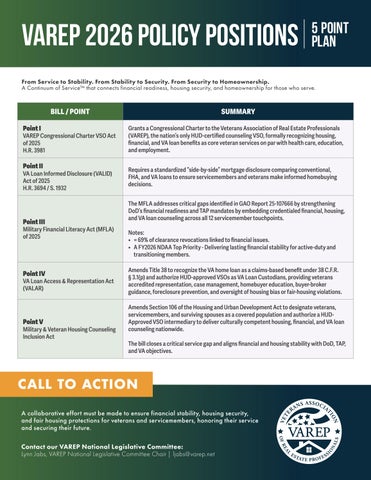
VAREP 2026 Policy Positions
5 point plan
From Service to Stability. From Stability to Security. From Security to Homeownership. A Continuum of Service™ that connects financial readiness, housing security, and homeownership for those who serve.
BILL / POINT
SUMMARY
VAREP Congressional Charter VSO Act of 2025 H.R. 3981
Grants a Congressional Charter to the Veterans Association of Real Estate Professionals (VAREP), the nation’s only HUD-certified counseling VSO, formally recognizing housing, financial, and VA loan benefits as core veteran services on par with health care, education, and employment.
Point I
Point II
VA Loan Informed Disclosure (VALID) Act of 2025 H.R. 3694 / S. 1932
Point III
Military Financial Literacy Act (MFLA) of 2025
Point IV
VA Loan Access & Representation Act (VALAR)
Point V
Military & Veteran Housing Counseling Inclusion Act
Requires a standardized “side-by-side” mortgage disclosure comparing conventional, FHA, and VA loans to ensure servicemembers and veterans make informed homebuying decisions. The MFLA addresses critical gaps identified in GAO Report 25-107666 by strengthening DoD’s financial readiness and TAP mandates by embedding credentialed financial, housing, and VA loan counseling across all 12 servicemember touchpoints. Notes: • ≈ 69% of clearance revocations linked to financial issues. • A FY2026 NDAA Top Priority - Delivering lasting financial stability for active-duty and transitioning members. Amends Title 38 to recognize the VA home loan as a claims-based benefit under 38 C.F.R. § 3.1(p) and authorize HUD-approved VSOs as VA Loan Custodians, providing veterans accredited representation, case management, homebuyer education, buyer-broker guidance, foreclosure prevention, and oversight of housing bias or fair-housing violations. Amends Section 106 of the Housing and Urban Development Act to designate veterans, servicemembers, and surviving spouses as a covered population and authorize a HUDApproved VSO intermediary to deliver culturally competent housing, financial, and VA loan counseling nationwide. The bill closes a critical service gap and aligns financial and housing stability with DoD, TAP, and VA objectives.
CALL TO ACTION A collaborative effort must be made to ensure financial stability, housing security, and fair housing protections for veterans and servicemembers, honoring their service and securing their future. Contact our VAREP National Legislative Committee: Lynn Jabs, VAREP National Legislative Committee Chair | ljabs@varep.net
WWW.VAREP.ORG
VAREP 2026 POLICY POSITIONS
MILITARY COMMUNITY FINANCIAL & HOUSING CHALLENGES The table below summarizes survey data from government agencies and organizations on the financial and housing challenges faced by military personnel and veterans.
ACTIVE DUTY
TRANSITIONING TO CIVILIAN LIFE
VETERANS
65% Reported gaps in financial knowledge
50% transitioning veterans & Spoused Identified Financial Issues
80% Reported financial stress in the past 12 months
36% Reported reliance on high-interest loans
33% Reported employment was their biggest hurdle
51% Faced barriers to saving money, struggling to managing debt
30% Reported frequent moves have negative impact on their ability to maintain consistent budgeting, savings, and housing
Transitioning servicemembers with poor money management skills are up to 4 times more likely to become homeless within one year of separation
70% Reported spending more than 30% of their income on housing, exceeding standard affordability threshold
400,000+ Complaints from servicemembers & veterans to CFPB for SCRA & fair housing. This is a 27% increase from the past year
30–40% recently discharged veterans have delinquencies on auto loans, credit cards, and other debts within the first year
14.96% Increase in Fair Housing Complaints by veterans and their families over the past two years
84% military personnel do not achieve high scores on financial literacy assessments
Veterans are 2.5 times more likely to file for bankruptcy within their first year of separation compared to civilian counterparts
33% of veterans were unaware of or unsure how to access the VA loan benefit, and many reported experiencing discrimination when using it to purchase homes
80% reported that they are paying more than they can afford for housing
19% Post-9/11 veterans reported lack of consistent housing
32,282 Homeless veterans in 2024, a 55.6% reduction from 154,000 in 2007
VSO SUPPORT SERVICES COMPARISON CHART