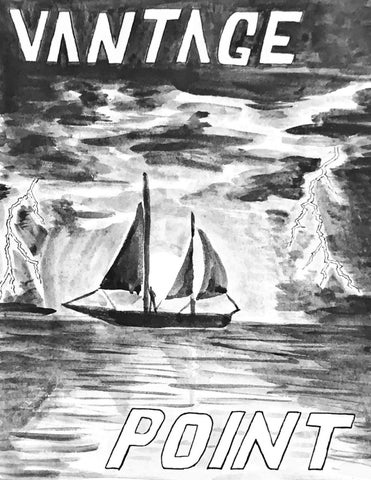
Table of Contents Poetry I WANT ALL THE LAKES IN THE WORLD by Idris Irihamye (Illustrated by Sam Adams) THE GOLDEN CHILD WILL HOVER OVERHEAD by Idris Irihamye (Illustrated by Aubrey Engeriser) Curiosity of the Cat by Lyric Hyde (Illustrated by Ava Allen) Monty Python’s… by Lyric Hyde (Illustrated by Tim Lever) Palm to Palm / Holy Palmers’ Kiss by Kevli Sheth (Illustrated by Sam Adams) color of the sky by Peyton Donahoe (Illustrated by Aubrey Engeriser) summer at rough river by Peyton Donahoe (Illustrated by Tim Lever) Flashing Lights by Taylor Garrett (Illustrated by Ava Allen) The Mask that Hides the Man by Taylor Garrett (Illustrated by Lane Cannon) We Are by Mack Marovich (Illustrated by Tim Lever) For Mikey by Sarah Foropoulos (Illustrated by Lyric Hyde)
Ode to Cowan: a found poem by Tim Lever (Illustrated by Lyric Hyde) Gnarled Bare Branches by Tim Lever (Illustrated by Lane Cannon) Hands by Kellie Innes (Illustrated by Lyric Hyde) L’ode à Einstein/Ode to Einstein by Claire Kennedy (Illustrated by Ava Allen)
Fiction Shaving Face by Peyton French (Illustrated by Sam Adams) America’s Wurst Hour: A Short Story by George Adams (Illustrated by Tim Lever) Misako’s Christmas Tree by Doris Dörrie, translated into English by George Adams (Illustrated by Lyric Hyde) The Game by Taylor Garrett (Illustrated by Aubrey Engeriser)
Non-Fiction What you’d find in London by Kellie Innes (Illustrated by Ava Allen) The Satuday Rashomon by Anonymous Contributors (Illustrated by Sam Adams)
Contributors Editors-in-Chief Kellie Innes Haylee Todd Copy Editors Kellie Innes Alex Welch Lane Cannon Kevli Sheth Lyric Hyde Sarah Foropoulos Idris Irihamye Ava Allen Garner Tydings Karli Prather George Adams Tim Lever Authors Idris Irihamye
Lyric Hyde Kevli Sheth Peyton Donahoe Taylor Garrett Mack Marovich Tim Lever Kellie Innes Claire Kennedy Peyton French George Adams Anonymous writer(s) Illustrators Tim Lever Aubrey Engeriser Lane Cannon Lyric Hyde Sam Adams Ava Allen Cover Art by Tim Lever
Poetry I WANT ALL THE LAKES IN THE WORLD by Idris Irihamye I want all the lakes in the world to take me I know they will love me the best they can I know the creek is the only thing other than my heart that tries so hard And can never seem to stop wearing at itself I want my atoms to shift just enough to make my skin one percent more river The crumbling barn gives itself back to the earth with more bravery than I could ever muster If my blood could turn into okra and sorghum seeds and drop off my fingers like dew, I’d plant a Garden in these ruins just to lay in it
THE GOLDEN CHILD WILL HOVER OVERHEAD by Idris Irihamye The golden child will hover overhead To bless the city in the morning and I will be overwhelmed By the power of living By the exalted nature of being seen By being in the same room as so much love And that sunny offering will lodge itself in my shirt pocket Till it seeps through my skin to turn my bones One shade more golden
Curiosity of the Cat by Lyric Hyde I can’t sleep. Your cat keeps me awake. All night, the house is silent But for the cloud-coated pitter-patter Of tiny paws on linoleum floors And his howling. God, Isaac, his howling is the worst alarm clock. I can count down the seconds until I hear him 5… 4… 3… 2… And a lonely question echoes down the darkened hallway. In his voice I hear your name A query too malignant in its innocence To utter a reply. Cats understand the dead better than we can, Isaac, But he does not know where his ghost has gone. I hear his question in the kitchen; A muffled “hell-lo?” aimed at the counter Where you would make uneaten insomnia snacks. He asks the television in the den Why it never turns on for you anymore Hell-lo, where are the bad movies? Hell-lo, the good music? But a blank face stares him down in the dark. I hear him coming up the stairs Pit-pat pit-pat pit-pat And quiet scrapes against the closed doors. “Hell-lo? Hell-lo? Hell-lo?” Until one leans open to his touch. Yellow eyes stare at me from across the room.
Closer, closer, the pit-pat pit-pat against the carpet Until I feel him jump onto the bed. He makes a nest from your pillow Searching the stuffing for a shadow of the heat That poured from your mind as you stared at the ceiling. Then, like every night before, He looks at me. The yellow eyes stare into mine Two moons against the clouds And he asks me a single question.
Monty Python’s… by Lyric Hyde I write as though this poetry could save my soul Somehow, in the darkness of this cavern, The red light spilling into my papers and remains. I almost feel that if I can just get out this poem, This art, This piece of myself That the dust and pain and end won’t matter Because I will live on through words that, In the grand scheming universe, Are meaningless. I have watched the world in two lives, my friend, And I saw how it has passed by a ghost like me. Even when I vanished from this world, Books were still written, Drawings still drawn, Music still played,
Inventions still being invented. And I know now, even looking at the red sky beyond the cave maw, That this armageddon will not be the end And that try as we might, Human life is still just an accident, a byproduct of factors Beyond the reach of anything but happenstance. My friend, I know you would scold me for such accusations against your God Scorning my atheism with a too-kind smile and a laugh That knows there is more to life that we will never explore Until our bones are dust and we are nothing. But you are wrong. You have seen death, yes, but I am staring it in the face as I write. Perhaps I am too cynical. After all, if life is meaningless, Then what gives it meaning? You do, my friend. You and I. And all the beautiful, horrible little humans around us. Life is meaningless in the eyes of hurricanes And the darkness of the universe, But it is not to us. Not to people. Perhaps if there is no meaning gifted to us at birth, Then we must make it ourselves to survive. The nights you stayed awake with me, Tired eyes drifting away as I settled onto the bed And read you stories of bugsuits and mugwumps and spiral insanity; The way your fingers pluck against the guitar And you scribble messy measures of song inside notebooks Inspired by pigeons and traffic to write new poetry;
The haunted look behind your eyes When I must chase away every ghost but myself And keep you grounded to earth lest you fly to your heaven. I woke up to a new life A newborn baby naked on the kitchen floor In front of a devil and a witch Only to find you, Pure chance, To see you play in the busker’s park. I have spent a lifetime of a second chance with you, my friend. If we must create our own meaning to life, Why shouldn’t my meaning be you?
Palm to Palm / Holy Palmers’ Kiss by Kevli Sheth They both stood in front of The Creation of Man, and her heart’s gremlin tore apart her trachea to reach out of her mouth, yearning, arms outstretched, an uninvited guest to the beginning of the universe. Her want sighed, so she shifted and moved closer, but museum security shrieked from her gremlin’s lungs. Its feet grew in guilt, though its fingers still fluttered like a thief’s in front of the Crown Jewels. Adam ached before her, and God’s fingers flexed, Their holy light dimming enough for her gremlin to briefly glimpse its twin and crow, fingers pulling self along an invisible rope, curling around it as though within
her body’s flower. They both stood together in front of The Creation of Man, and her love’s gremlin’s hands were within reach, its finger arched toward her own, outstretched in need - and sweet contact! Settled in each other’s palms, the intertwined divine.
color of the sky by Peyton Donahoe I am obsessed with what color the sky would have been if the day we had met, I had walked away—
the sky breathes smoke like cigarette nightmares like lungs black with char like the ash I swallowed when my bones pressed against the seams of my skin and promised to come back tomorrow— or next year— or never
red thread from beating hearts or hands slipping through iron grasps or
the way your fingers let go first
when my body seizes up and allows leaves to dry out still on the vine I think the sky must have been black when I decided to stay
summer at rough river by Peyton Donahoe if I knew how to turn back the days from sundown to sunup in reverse we could open the door at eight in the morning before the rest of the house is awake
and swing on the porch higher or highest— watch the mist on the lake meet the sky where it bleeds golden onto your face and you could laugh white powder on your cheeks donut in your teeth
and the world around us is quiet no one awake but the fishing boats breaking still glass water
until the air turns into sausage gravy and our ears fill with breakfast sounds—
our family is older now but if I could learn to turn back the days, I would.
Flashing Lights by Taylor Garrett flashing lights bright, so bright who will not be coming home tonight? is it the man who leaves bruises on the gentle eyes of his most beautiful wife? or is it the boy who claims she didn’t put up a fight? flashing lights bright, so bright do not hold out on the turth untold oh dear God don’t let it be the dear young man who’s living down the street his mother, who raised him
well, so well is pacing their floor praying she won’t live this most brutal of hells The boy’s father’s fate should not become his own this hell oh this burning damnation is not what is meant for him perhaps he was misunderstood when he said he desired the white coat the poor young man was coaxed into the gruesome life that accompanies the white coke perhaps he felt the weight of his father’s poor choices and experienced the pain of his existential downfall still, this life he did not deserve flashing lights bright, so bright his gut-wrenching fate is what his mother awaits as your cold hand of misfortune raps upon her wooden door I pray God takes mercy upon the heart-broken soul of the mother who now knows
The Mask that Hides the Man by Taylor Garrett I am not my brother’s keeper he has his own life, that he prefers to keep hidden he has his own dreams, that he voices when times are right he has his own opinions, but he doesn’t share them often he stands in a confident body, that has a stature big enough to make the cruelest man cower he wishes to please others, even if it means sacrificing his own interests I am not my brother’s keeper he has a life of his own as he flattens people on the field of play and crushes his opponents’ dreams, he appears to be flawless and without insecurities he has a smile that would bring the toughest of women to their knees and make them swoon he has a heart of gold and a mind of compassion he looks out for the little man, who feels that he doesn’t have a voice each of these attributes are desired by most men and admired by most women but he is not who he seems to be
as he lay in my arms, weeping and sniffling, he reveals the man that nobody wants to see he reveals the man who wears his heart on his sleeve, cares a great deal for others – even when he shouldn’t, the man who is willing to defend the ones who he loves to his dying breath, fight for the right reasons – and sometimes the wrong ones if it brings justice, he reveals the man that he keeps hidden due to his deep-seated fear of rejection that has been created by the stigma this society adores so much “men don’t cry, It shows weakness” I am my brother’s keeper.
We Are: by Mack Marovich Our toes danced in the sand lips just barely touched amid dim lights of flames We held hands Not just because we fell in love we held hands because we felt connected tethered together by pages of a book not yet written We stayed up late Went for a drive simply because we wanted to hear our favorite songs from the mouths of the people we held closest we wasted gas completely oblivious of the fact we were running out We traveled the world Soaked up culture and found ourselves when we’d get lost cobblestone streets and brick towers we thought our lives a fairytale We cut down nets Won trophies that made strangers proud inspired kids who wanted to be like usunaware that we wanted to be like them we were scared of what came next when our dreams came true We stomped and strained our voices as they echoed as one “We are—” And we were
Who are we when the gym goes dark? when we run out of gas? who are we when the water washes our footprints from the sand?
For Mikey by Sarah Foropoulos What do you think of in those quiet moments when tobacco tastes like surrender? do you think about the memories of your youth embedded into the backseat those countless songs your dad played and stolen cherry Chapstick kisses and the sideways glances… or does your mind go to the place where shapes and colors blend, blur, and bond? where the sound of your key sitting in the ignition blares on loop till you are drawn back to your parked car when the ash of your third cigarette hits your upper thigh. I know what you think of then. you think of her hand. her eyes calibrating her next move. her fingers tracing the lining of your pockets. you can’t seem
to remember the exact color that she painted her nails but it was always the same. she was always the same, until she wasn’t. and now you sit in your parked car in yet another beer can-infested driveway only wanting to see her next to you.
Ode to Cowan: a found poem by Tim Lever the meal was cold because the beans are cold i need a microwave where did the yogurt that i got (go) i got a burger like lettuce, tomato, beef there was no other options “perhaps I should go to the Grill”
Gnarled Bare Branches by Tim Lever The mired Mississippi Driven down the flats Ran clearer in the north Now sullies the sea The swamps sank in our time Muddy muck amassed It used to be clearer Now water goes grime The gnarled bare branches reached Bare but clean, upwards But cracked, litter the bed Now lie broken, beached The gar gathered under Meals missing and rare Searching, their teeth gleaming Now hunting hunger
Hands by Kellie Innes Just a brush of your hand is all it takes All it takes to hurtle me back, Back, Back, To that night. The nerves in my stomach, twisted like my hands in your shirt. When you noticed me, it felt like the world stopped turning. It had been weeks of me, flopping back, flopping forth, you never leaving my mind. Not even once. And with a single look, I knew that I was right. Your hand was loose, pulling me close to you, keeping me close to you. As if I was going to stray anyways. Your hand had a quick confidence, becoming familiar and knowing me better than I know myself, soft, kind, stumbling to match your breath. My hand tucked in yours, our heads touching, a smile on your lips and a laugh on mine.
Our hands tugging, for one more time, what I didn’t know was one last time. And now, our hands, flinching, ceasing, tapping, touching. But this time it isn’t the same.
L’ode à Einstein/Ode to Einstein by Claire Kennedy L’ode à EinsteinIl n'y a pas un goût simple d’un bagel. Oui, quelques-uns considèrent le bagel être ordinaire, mais c'est la complexité d’un bagel–– il y a un monde plein de possibilités. Le bagel peut parler au fromage à la crème avec du poisson, au beurre d'arachide et des bananes, ou avec soi. Il y a beaucoup de types de bagels, les possibilités n'arrêtent pas–– on peut avoir un bagel avec des pépites de chocolat dans la pâte, ou des myrtilles et plus. Mais c'est la présence des autres aliments qui complètent le bagel parce que le bagel n'est pas complet tout seul. Le trait identifiant du bagel est le trou au centre. Quelque chose se manque, il doit avoir des compagnons pour continuer. Souvent on coupe le bagel avant qu'on le mange, on place des autres ingrédients sur les deux visages internes, mais le trou existe encore. Les amis du bagel ne remplissent pas le trou; ils se couvrent et le bagel fait l'expérience de désespoir. Remplir le trou, ça serait scandaleux, c'est une action qui supprimerait la vraie identité du bagel. Tout le monde le connaît. Le bagel est un repas qui veut, qui a faim. Il a un désir qui ne peut pas être terminé et à cause de ça, le bagel continue d'avoir de la douleur. Quand on mange un bagel, on peut se reposer. Partout sa vie, le bagel se désire, mais finalement le bagel n'a pas la faim d'être rempli. Quand le bagel entre dans la bouche, le trou n'existe pas encore. Quand il entre dans le corps, il est complet. Il est avec ses amis ensemble, les amis qui essayaient en vain de l'aider. Pleine de bonheur, pleine de la sentiment d'être complet, le bagel apporte le bon goût à l'un qui l'a mangé, l'un qui lui a donné la libération. Finalement, la paix. L'unité. Ode to Einstein There is not one simple taste of the bagel. Yes, some consider the bagel to be ordinary, but that is the complexity of a bagel––there is a world full of possibilities. The bagel can speak to cream cheese with fish, to peanut butter with bananas, or to itself. There are many types of bagels, the possibilities do not stop––one can have a bagel with chocolate chips in the batter, or
with blueberries and more. But it is the presence of other foods that complete the bagel because the bagel is not complete by itself. The identifying trait of the bagel is the hole in the center. It is missing something, it needs companions in order to continue. Often one cuts the bagel before eating it, one places the other ingredients on the two internal faces, but the hole continues to exist. The bagel’s friends do not fill the hole; they cover it and the bagel experiences despair. To fill the hole, that would be scandalous, it is an action that suppresses the true identity of the bagel. Everyone understands this. The bagel is a meal that wants, that has hunger. It has a desire that cannot be ended and because of that, the bagel continues to be in pain. When one eats a bagel, one can relax. Throughout its life, the bagel desires, but finally the bagel does not have the hunger to be filled. When the bagel enters the mouth, the hole no longer exists. When it enters the body, it is complete. It is together with its friends, the friends that tried to help it in vain. Full of happiness, full of the feeling of being complete, the bagel brings good taste to the one who eats it, the one who gave it liberation. Finally, peace. Unity.
Fiction Shaving Face by Peyton French Okay, Mike. Let’s do this. It’s post-shower, I’m clean, my face is wet, everything is prepared. This should take no longer than a few minutes, and then I’ll be off to class. I’m a real man. Look at those arms, that chest hair, that chiseled face, and that hair. Yeah, yeah, flex a little bit. You’re fat. No, no, get that out of my head. Don’t go there. Not right now. You’re going to shave yourself, and your freshly shaven face will awe everyone today. Everyone will like how good you look. I mean, look at your hair! It’s freshly cut, nicely combed over, you’re a handsome guy! Right, but you’re not Momoa handsome, or Chalamet pretty. Maybe if you cut down the pounds, worked on your chin, you could be as attractive as Gosling. I close my eyes. Stop. Stop, stop stop. L-let’s just get this done. 8:24 AM. I shake the shaving cream in my hand, and I hold my palm out to allow for white, cloudy puff to land in a firm ball. In my cream-less hand, I take a little bit of it and apply it to my face.
Look at those bags under your eyes. They’re so dark that the cream really makes them pop out. Yeah, wash those hands of the excess, and then pick up the razor. Then you look at those eyes. They’re mine. And that starts to screw with me in the moment. It’s as though those dark, dark eyes are digging into me. That’s who’s speaking to me, calling me that. They know my pains. My struggles. Real Man. I’m a real man, right? The razor starts on the left side of my face, right below the side burn. At the moment I put the razor to my chin, I remember a feeling that I feel everytime I do this. I’m sitting in my dad’s bathroom. He’s shirtless, his gut flopping over his towel as he looks in the mirror, much like myself. He’s massaging his chin while the razor makes a skiddddsound on his face, the five o’clock shadow slowly fading from his face with each slice of the razor. He looked down at me, “What the hell are you looking at?” I froze, and I shook my head. I… don’t know, exactly. I just thought that the razor was cool, that it could make things disappear. I shrugged, and Dad kicked me out. Hours later, when Dad left to go meet his friends, I walked into the bathroom again, taking the razor and flipping it in my hands a few times. I had a little bit of hair on my arm, and I dryly skidded the razor across it. I saw the blood running down, and I started to scream. Mom ran in, and she held my arm and yelled for a while. Not at me, but with the vitriol she held for her husband. The sight of my arm bleeding made me scared, and I’ll never forget it. By the time I think about this, only about a third of my face is shaved. My cheek is essentially shaven and it looks done. I stand and look at my face, and I catch my neck starting to bleed a little. I nicked it, and it hurts. But a real man doesn’t complain about a nicked neck. A real man… keeps that to himself. You’re a college student. You’re smart, you’re here, and you’re good. You’re good. Shave the upper lip and your chin. 8:26. You have two minutes. The first time I shaved was the morning hours before mom’s funeral. I was fifteen. My guardian, one of Mom’s friends, stood behind me. She was nice, and has seen me grow up. But she was bad at advice, and this was the first piece she gave me as my guardian.
“You know, you’re going to be an adult sooner than later. We’ll all miss her, but you need to know that a real man sucks it up. No, now, don’t cry. You’re the man now. You know you can’t cry like that.” Real man. I’m a real man. And if I cry now, it’ll mess up my shaving cream. So I suck it up, and I rush to finish my face. 8:27, and then 8:28, and my face is fully shaved. And I look at that face again, but I don't look at the eyes. I know if I do I’ll only see the worst parts of me. I take the razor and put it away, and I wet my face again, removing excess shaving cream. Look at my chin, freshly shaven and cleaned. It needs aftershave. I head to my dorm and look around for the aftershave, eventually finding it. It’s nearly empty, and I have to shake it for a while to get it on my palm. I rub it in my hands, and then I start to put it on my face. It stings. She slapped me; a fast, ineffective hit. My first girlfriend had, in a fit of tears and anger, laid her hand across my face, and it feels the same now. She sobbed, “You won’t open up, Michael!” She exclaimed as she cries, “I can’t find you.” I said, “I don’t think it’s my place to be open.” Her eyes widened and she threw her arms in the air. “I don’t know what happened! You’ve become so walled up, so distant. I miss you. I don’t-” She cupped her face into her hands, “I don’t know what I did wrong.” “Nothing.” I responded, “You’re okay. But you… you can’t slap me. That stings.” The voice was apathetic, and it was distant because there was so, so much going on. I was never truly open. I never could express it. “I can’t do this. I can’t be here. I can’t be with you.” The slap stung just like the aftershave, and I looked in the mirror today. At those eyes. You’re fat. You’re ugly, you can’t do anything right. You fail, every day. You don’t open up, it’s not your place. Nobody needs to hear your voice. That’s what the eyes are telling me. And in those dark eyes, I see red, and tears streak a bit down my face. “Hey man, are you okay?” My roommate, Ronnie, asks. I jump a little at the comment, and I briefly look at him. He looks concerned, “You can always talk to me, dude.”
I gulp, and for a moment I want to talk about it. I want to say all the things that have been wrong. I want to cry more. My dad isn’t there; my mom is dead. My ex didn’t get it - she didn’t understand those feelings, my need to wall myself up. I need a friend. I need to just let it all out. I look back at my dark eyes, facing me in the mirror, and I take a deep breath, “I’m fine. I just got something in my eye.” “Mikey, we’re worried about you. You haven’t gone out with us, you haven’t… I don’t know. You’ve been shut in since I met you, but you’ve closed up even more.” “I said ‘I’m fine.’ Let me be a man for Christ’s sake and move on with my day.” “What…?” He starts, but I quickly get dressed, sucking up all the tears that I want to shed. I’m a real man, and that’s what real men are supposed to do. They shave in four minutes, and they suck it up and go forward. I slam the door, leaving the hall to rock with the sound.
America’s Wurst Hour: A Short Story by George Adams April 4, 2025. The day it all fell apart. I’ll never be able to erase the image from my head. Nashville’s streets were immersed in flames, as half the people ran amok in the streets, while the others tried to evade the first half. Broadway smelled of stale Bud Light and burnt leather, a product of an attack on the tourist cowboy boot shop. The tourists in question were in a state of pandemonium, running aimlessly around like frightened lambs, only identifiable by their ridiculous cowboy hats, as overpriced as they were ugly. It was impossible to know for sure because the cell towers had gone down in a matter of hours after it happened, but I was pretty sure that a similar scene was playing out in cities across America. The society that we had built up over the past two hundred years, the city on a hill that was the United States, had fallen in a matter of minutes. Frankly, things had seemed like they were on the upswing. The 2024 election had caused some major concerns about the seriousness of our political situation with the inexplicable election of Snooki from Jersey Shore, but her first several months had been a pleasant surprise, although some were worried about the implications of electing someone from New Jersey. Despite this, she had managed to push through single-payer healthcare, with no one noticing that one of the senators from her home state had included a provision to fully fund universal artificial tanning until the bill had already reached the president’s desk. Americans were healthier, albeit oranger, than ever, and the future seemed bright. Until Costco turned everything upside down. The thing about the pillars of society is that it’s sometimes hard to tell what they are until they’re gone, and by then it’s too late. There’s something in every empire that may seem insignificant, but when it’s gone, the whole thing explodes. In the British Empire, this was something known as “crushing nascent nationalist movements.” In the Ottoman Empire it was
“the King not having stupid sons.” In Rome, it turned out one of the pillars was “whatever keeps the Germans out” (clearly posted signage). No one could have told you that these things were as important as they were until they were gone, and now Rome’s a tourist trap, Britain is a mediocre island of tea and transphobia, and Ottomans are a fancy type of footstool. Hindsight is a cruel mistress. Still, no one could have predicted that American society was held up by the $1.50 Costco hot dog. I mean, everyone liked the Costco hot dog. I even knew a few people who had gotten a Costco membership purely for the hot dogs. Pure beef, with some ketchup, mustard, relish, and a large soda on the side, all for less money than an MTA bus ticket. It was as American as apple pie. Or maybe apple pie was as American as the Costco hotdog. Either way, it was something that every American could take pride in, Costco membership or not. But although everyone agreed that the $1.50 hotdog was synonymous with America, no one thought that America was synonymous with the US hotdog. The Costco co-founder was the only one who had understood the significance of the hot dog, all the way back in 2018. The new CEO, a typical greedy MBA, had attempted to raise the price as a way to up Costco’s profit margins, noting that the beloved hot dog combo had stayed at the same price for a solid thirty years. He gave up on this idea when the co-founder told him “I’ll kill you.” But in late March 2025, that CEO had to step down following a serious scandal when a horrified customer discovered a normal-sized bottle of ketchup in a Milwaukee location. His replacement was an impulsive young man, and at 10:00 AM on April 4, he announced that the combo price would be raised to $2. I can only describe what happened in Nashville. It started in the Costco itself, predictably. It was a quiet morning. Customers milled about, cramming forty-packs of paper towels and unreasonably large jars of Nutella into their shopping carts. An employee walked over to the food court, carrying a ladder and a sign. He set up the ladder next to the price listings, climbed up, and swapped two of the signs. In this moment, the poor man’s fate was sealed. No one knows who fired the shot. There was just a loud bang, and the man fell from the ladder onto the ground, bleeding profusely. In minutes he was dead. He was the first victim of a civil war that would claim thousands of lives. As I sit here in an abandoned Pizza Hut and write this on a roll of toilet paper, I realize how inevitable it all was. They were bound to raise the price of the hot dog someday. Maybe keeping it the same price the whole time was the problem.
Maybe if they had raised it slowly throughout the years, a cent or two at a time, the worst could have been avoided. But greed prevailed, and the American Empire fell. Maybe we can build a new country someday and learn from the mistakes of the past. But in my heart of hearts, I know that humans rarely learn. There will be another Costco hot dog, and there will be another fool who chooses to raise the price. History is a flat circle.
Misako’s Christmas Tree by Doris Dörrie, translated into English by George Adams Misako says that her German lover was very, very hairy. When she saw him naked for the first time, she could hardly believe that it was possible to have so much hair on one’s body. She said that his chest was like a black mohair sweater which she would lay her head on, on his back grew a dark pelt, his arms and legs, in contrast, were pricklier, and that’s also where it started. What? I ask, where what started? but Misako’s mouth closes to a straight, very red line. She manages not to smear or nibble on her lipstick all day long. How on earth does she do that? She gazes into her coffee mug and does not say another word. On December 24th I took the little train from Kyoto to Kurama, high up on the mountain, going first through the suburbs and then through the forests. I kept my legs close together with my purse on my knees, just as the warning signs commanded, so that I didn’t take up too much space. To be polite, I also did not eat, drink, or talk on the phone either, but no Japanese people sat next to me, because I’m tall and blonde, a gaijin, an outsider that wanted to do everything right to become an insider in this Japan. I had parked my bicycle neatly in the bicycle garage, this time placing the rear tire precisely on the line, after a parking attendant had once set my bicycle straight to the millimeter right before my eyes rather than reprimanding me. People tolerated me and were polite to me, which sometimes felt like respect and sometimes felt like rejection, and as it got closer to Christmas and became colder and darker, I felt lonely. Santa Clauses ran about everywhere, and you could pick Jingle Bells instead of a waterfall or tropical rain in the toilets of restaurants and department stores while your backside was being automatically washed. On one of these warmed toilet seats—which I, of course, opposed out of concerns of energy politics and simultaneously loved—I decided to spend Christmas in a health spa, in an onsen. Up on the mountain was a spa located under pines and fall trees that had kept their colors. It was nice to be alone there, I wanted to sit there in the hot water and not miss anything, neither
Christmas tree and Christmas goose nor family. Since the days of Christmas aren’t holidays in Japan, there was actually no one but me in the spa. The outdoor pool gurgled cheerfully, and I committed all the bathing sins that are forbidden in the onsen: I wiped my face off several times with the tiny white towel that I had bought at the entrance for a few yen, I submerged myself under the water, and finally, I let myself float on my back. Satisfied, I looked into the white steam that floated through the tips of the black pines, when a woman’s voice behind me said to me in German: Excuse me, but would you allow me to show you how to bathe here? Behind me stood a Japanese woman and showed me her ageless alabaster body, that had never known cellulite. I tried not to take it personally, but the difference in comparison to normal western figures and skin was obvious. Gomennasai, sorry, I mumbled, I know how to do it, but she didn’t accept that. She bowed curtly, folded her towel twice, laid it on her head, and I repeated the motion. Did you shower beforehand? she asked sternly. I knew her fear that gaijin see the swimming pool as a giant bathtub. Oh, of course! I cried. I swear! I’ve done everything correctly! She nodded. I’m one of the good ones, she said. That was printed on one of my German carrying bags in the changing room. She laughed, and I laughed a little too, as nothing else came to mind. We fell silent and listened to the wind in the trees and the calls of the crows, that sounded like German crows in reverse. The famous monk and poet Ikkyu became enlightened by a crow’s cry, and sometimes I called back to Japanese crows: Enlighten me, dammit! but they would just laugh: quack quack quack. The naked woman next to me practically overflowed with laughter. German women in Japan, she snorted, always looking for satori, for enlightenment. So strange. A little insulted, I splashed my hand around in the water, upon which she gave me her name: Misako. She reached an impeccable white arm across the water and gripped my hand with remarkable firmness. And Japanese women, what do they look for in Germany? I asked. Oh, she said casually, wild sex and piano music. Without turning back to me or saying goodbye, she climbed out of the pool. I tried to find even a small spot of loose flesh on her thighs, but the inspection came up negative. Because of her, I had stayed too long in the water and now tottered after her, swollen and red as a lobster. I glowed like a funeral pyre. We dried off with towels the size of dish cloths and she stepped on a scale that stood in the vestibule. I didn’t want to see her result; it would have only made me depressed. When we faced each other again with clothes on, she had transformed into a little grandmother. She now wore glasses and ugly gray pants, a dark green cardigan, and a purple coat, and looked twenty years older than she had naked. I hope it went the other way around for me. I looked at her ink-black hair, now only worn by older women: younger women all dyed their hair reddish
brown. Misako raised her head and looked at me. I loved a German man, she said, and gave a long, deep sigh. I loved everything about him—until he turned into a tree. We are riding back in the train, and I know that the prettiest part comes next. The seats can be turned towards the window, we sit in front of the panes like we’re in the movie theatre, the conductor turns off the light in the train, and outside, the colorful forest catches fire, we glide through an illuminated landscape as though gliding through a dream. Everyone, absolutely everyone, in the train gasps in ecstasy for air, and then it’s already over, the train light turns back on, we turn our seats back towards our everyday lives, and quietly exhale. He was my piano professor in Cologne, she says, and sips on a tiny seven-euro coffee. We’re sitting in an ancient, musty coffee house, owned by a hunched over old lady. She brews the coffee in large flasks as if she’s in a laboratory. It takes forever. Most of the customers are similarly geriatric and sip on their coffee with religious devotion, while they smoke away, which seems to only be allowed here these days. On a TV up high in a dusty corner, Trump silently opens and shuts his yapper like a carp. I always just called him Mr. Baumgart, Misako says. Baum, the German word for tree, was already in his name, but I didn’t notice that for a while. I loved licking his black, hairy chest, it made me feel like a cat. Her glasses lenses fog up. Is she crying? And Mr. Baumgart liked it too; oh yes, she adds, he liked it very much. She looks up and looks around the room forlornly. The elderly owner shuffles over with a round, snow white cream cake, decorated with strawberries. Do you know what these cakes are called? Misako asks me. Christmas keku, from Christmas cake. And do you know what it means when you call a woman a Christmas keku? After December 25th, the cakes aren’t fresh anymore. Just like a woman who’s older than 25 and unmarried. Ouch, I say, and laugh. Misako does not laugh. I licked Mr. Baumgart’s pelt for four long years. And other things, she says as though in a dream, while the old lady continues to hold the cake under our noses, until Misako verbosely declines. Mr. Baumgart was stricter with me than with the other pupils, and I never, never got good grades. She smiles. Didn’t matter to me. I knew he only did it to not give either of us away. He was very clear that when I’ve finished my studies, we’ll get married. Very clear. I had already told that to my parents. They were very glad, as I was already past my expiration date. She drinks the last sip and looks deeply into her empty cup.
And? I ask. And? How did Mr. Baumgart turn into a tree? Misako looks at me thoughtfully and stands up. Puts on her ugly purple coat. Maybe I’ll tell you, she says. Maybe tomorrow. Tomorrow? Yes, she says, I have to be in the right mood for it. Do you have hiking shoes? No, I don’t have proper ones. But I have sneakers. She nods. That works too. We ride back up the mountain to Kurama. Misako barely speaks. Clunky hiking boots hang from her feet. Quickly and nimbly she climbs the mountain, I pant behind her and swear at her already. We go through gleaming red Shinto gates, past enormous cedars with a rope slung around them at eye level, separating the spiritual world from the profane. I stop, my breath floats in front of my mouth like a tuft of cotton. Today is December 25th. On the 25th my mother, still in her nightshirt, would put the Christmas goose in the oven at six AM, and when I crept out of bed at nine or ten, it already smelled like cooking fat and stuffing. On the 25th there was no breakfast, only coffee, and if I didn’t eat any of the goose, because I had started a diet or had become a vegetarian, the wrath of my mother came upon me for a whole year. None of that’s there anymore, neither the Christmas goose nor my mother, nor her wrath, and high up on a mountain in the middle of Japan I begin to cry, to sob, until Misako turns around and calls: Is something wrong? No, I call back, no, just my knee. She waits until I’ve finally caught up to her, and although I’ve wiped off the tears, she says somberly: you’ve been crying. I always cry on Christmas, but I haven’t cried yet this time. She takes my hand resolutely like a child, and we hike on. I trip on and on over thick tree roots, that rise up out of the ground like veins, Misako doesn’t worry about my panting, she even talks while we continue to climb: After my final exam, nothing. Not a word about marriage. I didn’t think it was so bad, but my parents wrote appalled letters to Mr. Baumgart, saying that he was making me into a christmas keku, I was already on the better end of 26, then 27, I continued to bury my face in his chest hair, but we didn’t move in together, he didn’t want that. I didn’t become a pianist; I gave piano lessons to children in Cologne. Every Christmas he drove home to his elderly parents and didn’t take me with him, and every time he brought back a box of vanilla croissants from his mother that he didn’t like, but that I did. Sometimes I fought with him and yelled at him, that I couldn’t keep living like this, but he couldn’t play piano if we didn’t make up, so I would make up with him. When I turned 30, I slowly got angry, when I turned 33, the wrath came to me. She stops. So, she says with satisfaction, here we are. We’re standing under pine trees that bend over in the wind and look like an ink drawing against the light. The hairs on his chest looked like that, just like that, says Misako. And one day they turned hard, very unpleasantly hard. He complained and started to scratch himself, but it didn’t help. They poked through his pant legs and his sleeves, the ones on his back became stubborn and poked up like the spines of a hedgehog. And when the hair on his chest started to get pricklier and pricklier, he went to the doctor, who didn’t have any advice. His beard couldn’t be kept under control and grew wildly across his face, and his hair did the same. He tried to shave, and I helped him, but the hairs were far too thick, and every razor failed. At some point he was barely able to speak, he fell silent. I looked at him calmly as he slowly turned into a tree, a conifer. Not a Japanese pine, he stood far too straight for that, more like a fir tree. A Christmas tree, I say.
Misako nods. Mr. Baumgart turned into a Christmas tree. A very beautiful, tall, straight Christmas tree. And when Christmas came around again, I called his parents, who hadn’t yet heard of me, and told them that this time they would have to come to their son and not the other way around. And then I decorated him with glass balls and colorful balls and straw stars and red candles. He looked at me through the needles as I did this, and I had the impression that he didn’t mind so much. Way up on his scalp, I hung a little origami crane as a goodbye. And then I went. Misako takes a deep breath. I actually always cry at this part a little, but I don’t feel like it at all today. Snowflakes begin to float down towards us. We raise our faces to them and close our eyes. We climb down the mountain, ride back into the city, today we’re all alone in the compartment, but the conductor turns the light off in the train car again and illuminates the forest just for us. And we go back to that old, musty coffee house, order coffee and a Christmas cake, white with strawberries, just for us. The Game by Taylor Garrett “That’s the thing about this town,” he exclaimed exasperatedly, “everything and everyone in it moves like they’ve been stuck in cement for the past thirty years. There’s no urgency, no desire to see a change! How are we supposed to act as if everything is just dandy, when the world is crumbling around us?” He’d been going on for hours, telling me how the very dynamic of this town and its relaxed way of life was beyond absurd. Everything had to be so deep and defined, nothing could just be. It all began about a week before graduation; a switch seemed to have flipped in his mind, almost as if he began to physically feel the time on the clock ticking down as it neared closer to its expiration. The fall had already come and gone, taking his football career with it. It amazed me how one play could alter the outcome of a life-long work ethic. The clashing of pads and helmets and the piling of sweaty bodies could never end in an outcome that one could consider to be beneficial. The depression of what could have been lasted throughout the rest of the semester and well past Christmas break. “You’ll never understand,” he had screamed at me from the driver’s seat of his truck, “How could you understand? You’ve been fed by a silver spoon your whole life. I’ll be hanged if I’ve ever seen you want for anything.” If only he knew, I thought, if only he knew how badly I yearned to be free of the hold this town had on me. My body ached for relief from the constant pain that I experienced daily from seeing the ghosts of people I once found to be endearing. But how could he ever understand the depth of my problems? I was always looking over my shoulder, I could never just be. By the time the spring rolled around, and all of the plants were beginning to bloom, his depression began to phase to anger. I remember that stage very well. The realization that nothing would change was almost too surreal. The town had been the same for the past sixty years, and
that was something that would never change. New people moved in, old people moved out, but nothing ever changed. He seemed to be the only one of them that took notice. “The world could be burning to ashes, and the people in this town would never even notice,” he spat as he hit his steering wheel with the side of his fist, “How could you not see that there is more to this world than what goes on in this town? The next mayoral election or PTA meeting seems to be the only thing the people in this godforsaken place seem to care about!” Little did he know, that was the only thing there was for them to care about. This is their world, and I am their prisoner. This town was their chess board, and people like him were their pawns: brainwashed into believing that there was more to this town than the fake smiles and endearing community. He was the only one with the gall to see through it. Although he never knew the extent to which everything was happening, he realized that this place was not right. He often talked about life after this town: how he planned to live out his adulthood in a large city, work a 9-5 job as a lawyer, come home to a wonderful wife and kids, and retire early to travel the world until the good Lord called him to his heavenly home. I dreamed of that once too, but it had been so long that I’d almost forgotten what it felt like to be a normal teenager with aspirations and dreams. The days when dreams had the chance to become a reality had long since passed, and now all I had were fantasies. I would never find a life of fulfilment, I would never be able to just be. As we counted down the days to yet another graduation, he began to set his plans into motion. Harvard University is where he was headed. They wanted him before the accident, and they found a place for him after—a sign of true integrity. He wished for me to follow him, and it angered him that I refused; he couldn’t understand even if I tried to explain. “We can run away together, Addi,” his face showed nothing but adoration, reminding me too much of the one I love, “We could get married and live out a life of meaning, a life that’s worth living.” I could see myself becoming happy in that life with him, but it would never be. Part of me believes that, deep down, he knew that. I didn’t wish to cause him any pain, but it was no longer in the realm of my control. I could hear them laugh at me as he pleaded for me to accompany him—they knew I must remain. He had no idea how I longed to get out of this town. I had tried too many times to count, but every time I got to the city-limits sign I found myself back in the same place I started. It was a cold and dank fate, one that would make for a miserable eternity. Trapped for trying to do something good, for trying to make a difference. That was so long ago. It had been so long
since I last saw the face of the one I love. It had been many, many years since I felt the warmth of our last embrace as we said goodbye in the exact spot in the now abandoned park before the one I love fled this nightmare of a town—the place where it all began and the place where it all went up in flames. However, he would never understand that. He could never replace the one I love. Perhaps it was cruel of me to allow him to become so involved in this game only to be hurt in the end, but this is what it took to play by the rules of their game. I realized long ago that there would never be an opportunity for me to relax and fall into myself again, I would never be able to just be. The days of summer were burning to an end, and I watched as he packed his last bag into the cab of his truck and threw his crutches onto the floorboard behind the driver’s seat. “It’s not too late to change your mind, you know?” he leaned back against the warm metal of his truck beside me, “There’s still room if you want to pack a bag and leave with me.” I offered him a small smile from which he knew my answer. He left me with a curt nod and a chaste kiss that would stick with me for as long as I am here. I knew that would be the last I saw of him. I believe he did too. When he climbed into his truck and drove away toward his freedom, I imagined what it would be like to finally be free from these shackles. I would never be able to escape. I was stuck inside of a never-ending tragedy. They had put me six feet under, and I didn’t realize it until all of the trains to paradise had departed and it was too late. I was stuck inside of this nightmare, this vicious cycle, and nothing would ever be the same. I now knew their game because I was one of them. We did not wish to be stuck here, we would never be able to just be. There lies Addi Kingsley, the woman that will never be.
Non-Fiction
What You’d Find in London by Kellie Innes What you’d find in London: Grand buildings and popular attractions bringing in tourists while hiding the costs of being the first great city. The flickering lights of Soho at night, the thrumming heart of youthful creativity and optimism. A mosque, formerly home to French, Irish, and Jewish worshippers, in the shadows of the emblem of Anglicanism farther west. Bridges, some recognizable, some not, filled with cars and people, still as foundational to the city now as when the first one was built. A towering skyline: both the center of wealth and the upward growth of overcrowded slums. The glittering and luxurious Buckingham Palace, home of a monarchy continuing to lord symbolically over her kingdom. Embankments built up as a visible solution to an invisible contagion. A Green Belt forever defining the boundaries of London, a city expanding perhaps more than it could handle. Endless museums all showcasing treasures of the past, present, and future. Abandoned, empty Docklands as London’s imperial trade power forever wanes in the dawn of a new postwar world. Streets with identical buildings, each with different signs in the window, attracting bustles of shoppers. 30,000 listed buildings and 300 areas safeguarded from the excesses of development because of their architectural and historical interest. Clean lines, tower blocks, highways— all rational and efficient solutions in response to London’s
aging buildings and infrastructure. Graffiti etched on walls, an outlet of language, art, and personality. White stone of the Tower of London, its walls bursting with legends of royals and prisoners past. Charred, black remains of St. Dunst-in-the-East, a physical reminder of the wailing sirens and flashes of fire tearing apart the city. Marquees blazing with the newest attraction of music and theatrics, a refreshing new identity. Twilight zones verging on the liminal, bursting with people and families, a drastic divergence from the fantasized bubbling and opportunistic cosmopolitan. Signs for trains leading out to suburbs which boast the ideal life of modern convenience far away from the grit and crowd of the city. Stairs going down, deep into a vast network below the streets. Canary Wharf’s glistening and windowed buildings, the representation of Thatcher’s transformation into a global city. Borough identifiers posted on each street sign, early divisions still abundantly clear from the East End to Kensington. The spire of St. Paul’s, a church as sturdy as the city’s determination to be grand.
The Saturday Night Rashomon by Anonymous contributors
The Roommate Once upon a midnight dreary, as I was vibing, weak and weary Joyfully showing off my cheery Animal Crossing town As I terraformed my island, there came a rapping sound most violent As though some stranger sought to break my window down. “Tis DPS,” I muttered, “shutting all the parties down. Only this,” I sternly frowned. Ah, if I can clearly think, it was in the midst of spring; And each failed exam was met with moans of agony and horr’r. Eagerly I wished for bed; - a pounding throb was in my head For I had had too much to drink, drinking on the night before From the rare and radiant bottle whom the angels call “liquor” Nameless here for evermore. And the rattling, loud, annoying, sound that I was not enjoying Filled me with some eldritch rage that I had never known before So that now, to still the beating of my heart, I stood repeating “Must be someone looking for my roommate who was here before, Someone looking for my roommate, looking while I'm trying to snore. This is it and nothing more.” Presently my soul grew stronger, hesitating then no longer, “Whoever the hell this is should go away and knock no more,” But the fact is I was gaming,” I explained, loudly exclaiming, “So I'd ask of you to leave, for this loud noise I much abhor; I'm just trying to vibe,” I said, and looked outside the door. Oh, but there was something more. Deep into that darkness looking, I felt my boiling anger cooking, As I saw my dumbass roommate, and a dozen people more, And the silence was now broken, I myself was now heartbroken, And the only word there spoken was my strangled cry “you whore.” This I uttered, and my roommate uttered back “you whore.” Only this, and nothing more. Back into the chamber turning, all my soul within me burning, Came a throbbing crowd in churning, declaring on my evening war.
With them they had brought a speaker, and the squeaky sound of sneakers Caused a throbbing in my head like I had never felt before. My poor head was very, very, very, very sore; I knew I could take no more. My roommate got an angry text, as I was truthfully quite vexed. “You fool, when can I finally sleep?” I bitterly implored. He fixed me with a stare determined, as an ancient scaly serpent Risen from the depths of earth in days of ancient yore. Then he spake, this foolish boor. Quoth my roommate: “Nevermore.”
’Twas the Night before Sunday ’Twas the night before Sunday, when all through the campus Not a creature was stirring, not even Krampus; The solo cups were scattered on the floor without care In hopes that DPS would never be there; One roommate was nestled all snug on his couch, And yet in one moment he would be a grouch; And my friend in her sweatshirt, and I in my skirt, Had just settled our brains for a mid-weekend flirt, When out on the lawn there arose such a clatter, I sprang from my chair to see what was the matter. Away to my phone I clicked on FaceTime, Waited patiently for my friend, alas I was declined. “Now, brothers! Now, friends! Now vibers and all! On to the Brock, where the drinks will befall! To the door, to the kitchen, to window to wall! Now vibe away, vibe away, vibe away all!” As sad beans that were left on the plate, We flew back to our rooms, resigned to our fate. So on to have fun did the vibers all go,
Leaving me behind, to my sadness and woe.