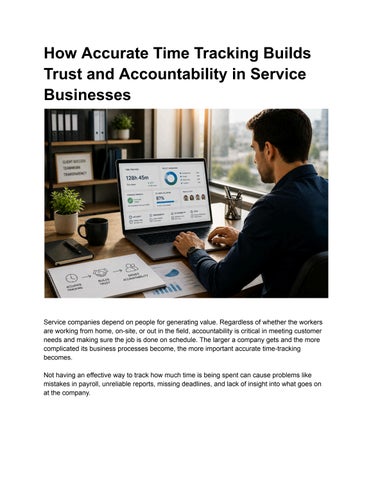
Time Tracking Is More Than Recording Hours
Time tracking is seen by many firms as just a way of keeping track of time-in and time-out
Actually, it gives very useful information about how the work is done and where the resources are being applied. Properly managed time management allows for proper decision-making, helps to plan workforce better and establish attendance, payroll, and project management processes.
This will help to collaborate better and boost trust in the company
Why Employee Time Tracking Software Is Becoming Essential
As businesses move towards hybrid and remote working, it has become necessary for them to invest in good employee time tracking software Automated time tracking makes the management of the workforce easier by providing managers real-time data on attendance, work hours, and task completion
Some of the benefits of automated time tracking are:
Accurate recording of employee work hours
Decrease in administrative tasks
Attendance management
Payroll accuracy
Increased visibility of the activities of the workforce
Company policy compliance
This helps businesses create processes that are error-free
Strengthening Employee Time Tracking for Service Businesses
Effective employee time tracking for service businesses goes beyond measuring hours worked It helps organizations understand workforce utilization, improve scheduling, and ensure employees have the resources they need to perform effectively.
Businesses can benefit by:
Managing distributed and field teams more efficiently
Improving transparency across projects
Supporting accurate client billing
Balancing workloads among employees
Identifying opportunities to improve operational performance
Enhancing customer service through better workforce planning
With better visibility into daily operations, organizations can create more reliable workflows and improve service delivery
Best Practices for Successful Time Tracking
Implementing time tracking becomes highly effective in conditions of good communication and processes. The company needs to concentrate on the convenience of the process itself and the meaning of the whole procedure for employees
Effective practices include:
Defining good attendance and time tracking policies.
Providing education regarding time tracking to employees
Reviewing reports on a regular basis to define some patterns
Using workforce data for better scheduling.
Promoting transparency within teams
Monitoring performance with objective insights.
Optimizing processes on a constant basis with the use of collected data.
Creating a Transparent and Productive Workplace
Transparency forms a very strong base for an organization to succeed It is only when there is clarity about the expectations, and the managers get access to information about the employees, that the decision-making becomes more objective
Workforce time tracking allows for improved collaboration, better accountability, and enables companies to ensure consistency As companies evolve in response to different workplaces, reliable workforce information will continue to be a key differentiator.
Conclusion
With accurate time tracking, a business will be able to create a stronger team, increase operational transparency, and make workforce decisions based on the right information Workforce management solutions help to improve accountability in a manner that benefits both the workers and the clients
Workstatus offers a solution for workforce management by introducing intelligent time and attendance tracking, productivity reports, and insights Workstatus helps a service-based business become more efficient and transparent.
FAQs
1. What is employee time tracking software?
Employee time tracking software is a digital solution that records employee work hours, attendance, and productivity while helping organizations manage workforce operations more efficiently
2. Why is employee time tracking important for service businesses?
It improves accountability, supports accurate payroll and billing, enhances workforce visibility, and helps organizations optimize employee scheduling and resource utilization
3. Can time tracking improve employee accountability?
Yes. Transparent time tracking provides clear records of work hours and activities, encouraging accountability while supporting fair performance evaluations
4. What features should businesses look for in time tracking software?
Key features include automated time tracking, attendance management, reporting, workforce analytics, project tracking, and payroll support.
5 How does Workstatus support service businesses?
Workstatus provides employee time tracking, attendance management, workforce monitoring, productivity analytics, and reporting tools that help service businesses improve efficiency and workforce visibility
Contact us-
Website- https://www.workstatus.io/
Email- hello@workstatus.io
Phone no - +91-9582957066
Address- 11th Floor, Max Square, Noida-Greater Noida Expy, Sector 129, Uttar Pradesh, 201304