Sustainability Statement 2025
Colophon
Ownership and legal form
Vanheede Environment Group is a Belgian Public Limited Company whose registered office is located at Rue du Ruisseau 25, 1080 Molenbeek-Saint-Jean, Belgium.
Vanheede Environment Group is registered under the number 0467.276.516.
Publication date: 13/07/2026
Contact Judith De Koninck (Sustainability coordinator) judith.de.koninck@vanheede.com
Kim Delvoye (Marketing and Communication manager) kim.delvoye@vanheede.com
Redaction and lay-out
Pictures and illustration
Vanheede Environment Group
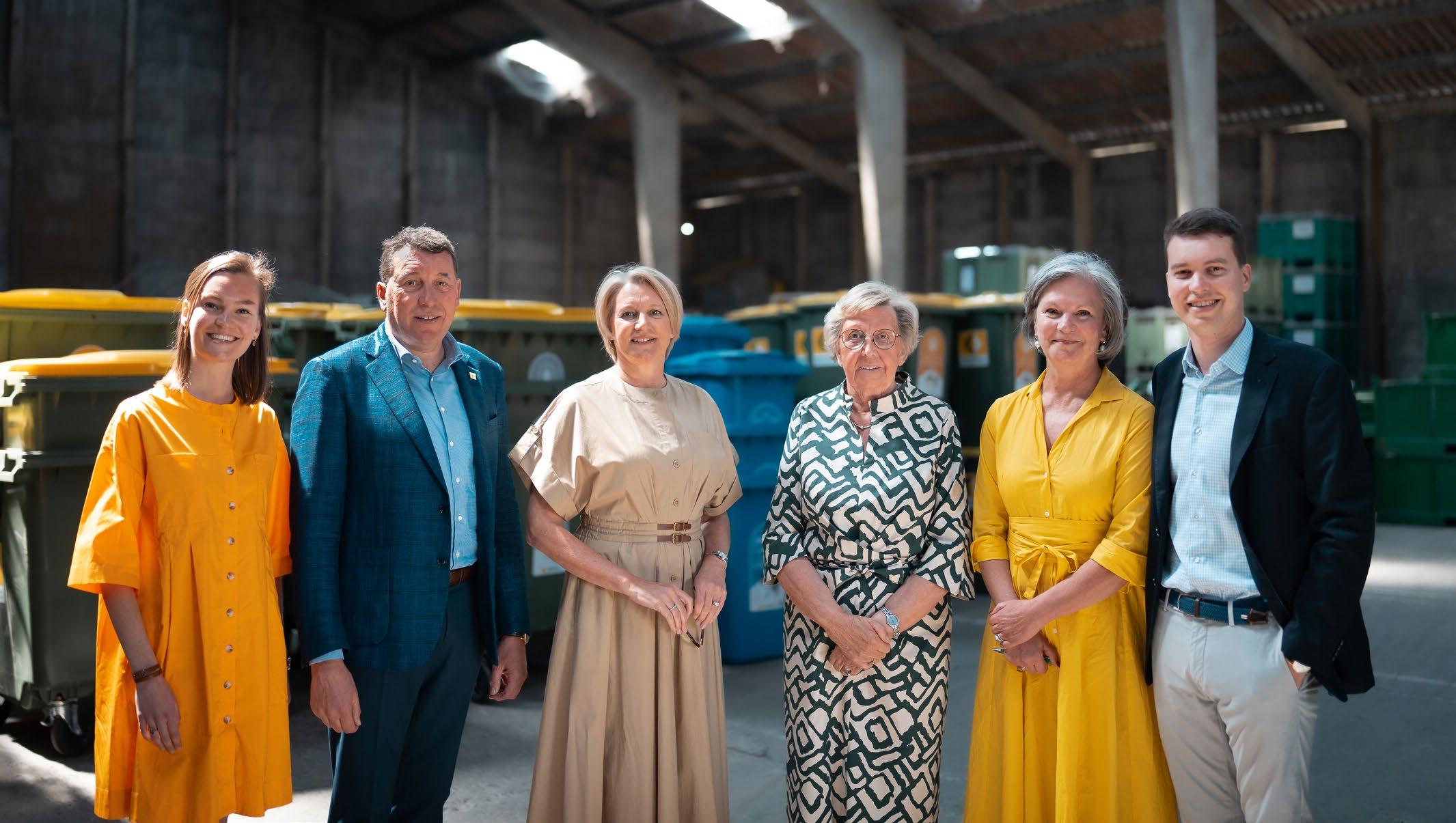
from left to right: Justine Vanheede, David Vanheede, Caroline Vanheede, Claudette Descamps, Evelyne Decrans, Maxime Vanheede
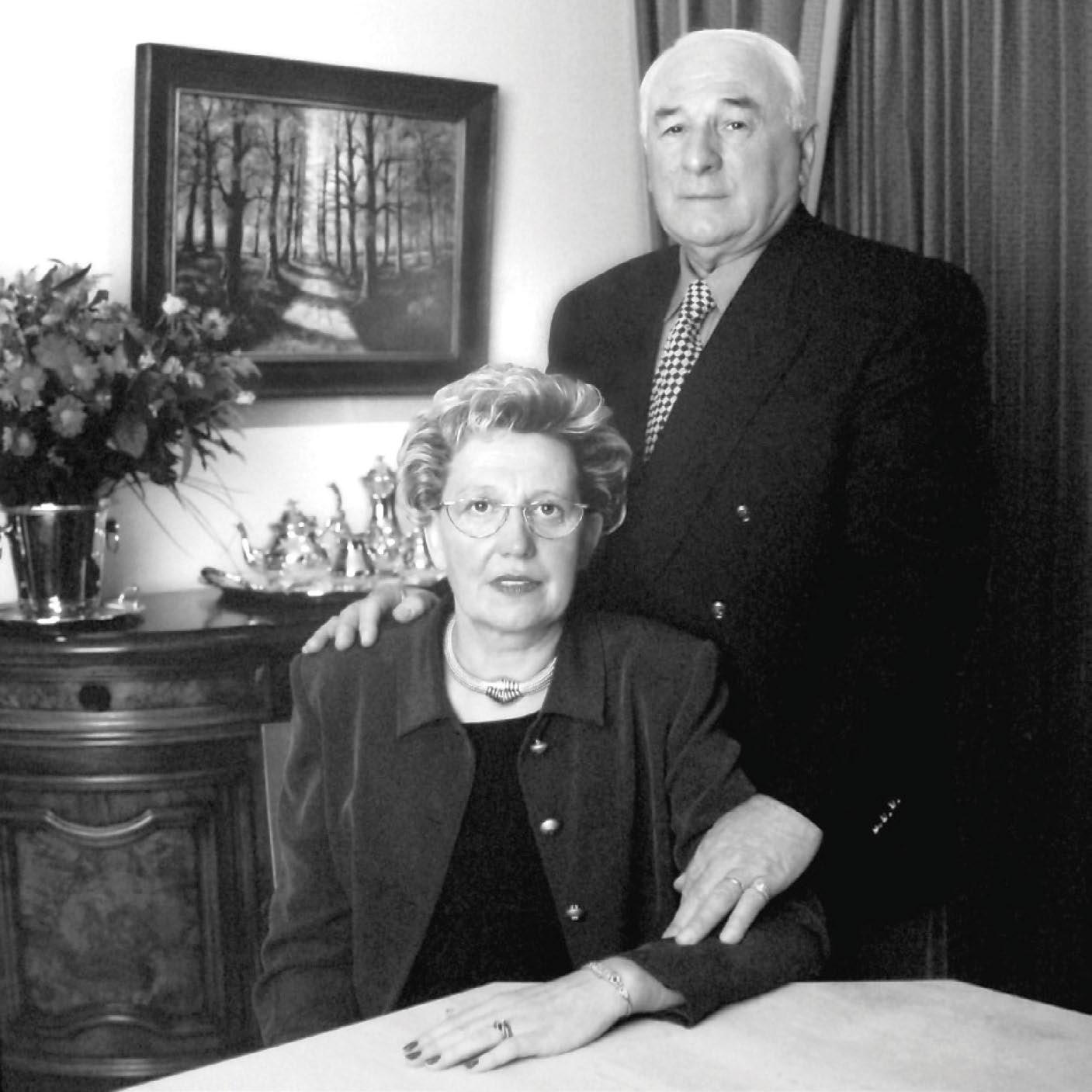
from left to right: Claudette Descamps, Herwig Vanheede
Who is Vanheede Environment Group?
The story of Vanheede Environment Group is a story of far-reaching entrepreneurship within a fast-growing but complex market. A story of pride, passion and corporate social responsibility.
A story in which the protagonists Herwig Vanheede and Claudette Descamps – David and Caroline’s parents – decided in 1968 to leave the loss-making flax sector behind and focus on waste management. From the very beginning, optimization and efficiency were important concepts when it came to sustainable waste management.
In the 1980s, a clear legislative framework was established for the collection and, in particular, for the processing of waste. This allowed companies that wanted to be innovative in waste management to invest in recycling plants and expand their activities from pure logistics to the processing and recycling of the collected waste.
In recent years, we have gained a clear place with our company within the circular economy. Our sector has proven to be crucial in closing chains. Waste not only needs to be processed, purified and reprocessed in order to be reused in the regular manufacturing economy, but it is also important that waste is sorted at the source in order to give it a valuable new future afterwards.
The family character is fundamental to the development of our company. Due to the strong vision in which sustainable and efficient solutions were paramount and customer care was the most important motivation of the family and their employees, there was a strong focus. These elements are still at the heart of our corporate culture and are still our main drivers.
Today, Vanheede Environment Group offers more than 21,000 customers, mainly companies (B2B), governments and municipal partnerships or intermunicipal companies, a sustainable, efficient and economical solution in the field of waste management. We play a key role in realizing the circular economy by processing waste streams into new, green raw materials or into green energy, both in our own and external processing plants. With these green raw materials and energy, the sustainable and low-impact products of tomorrow can be made. We are an environmental service provider, active in waste collection where we also sort and process waste to recover valuable raw materials or energy.
General Information
The 2025 Sustainability Report marks an important step in the evolution of Vanheede’s sustainability reporting. Since 2005, we have been publishing sustainability reports on a voluntary basis, reflecting our long-standing commitment to transparency and responsible business conduct. This year, we have taken that commitment further by aligning our report for the first time with the European Sustainability Reporting Standards (ESRS) under the EU Corporate Sustainability Reporting Directive (CSRD). With this report, we want to provide insight into Vanheede’s sustainability story, informing you of where we stand today and where we want to go.
In addition to our Sustainability Statement, a technical report focusing on our ESG numbers and explanations, we also published our first circularity magazine this year.
Our Circularity Insights Magazine takes a more commercial approach and provides further circular insights, while illustrating in a narrative way what we achieve in the market for and together with our clients, highlighting our projects.
SCAN FOR MORE INFO
General Information
ESRS 2: General Disclosures
BP-1: BASIS FOR PREPARATION OF THE SUSTAINABILITY STATEMENT
Scope
This sustainability statement has been prepared in accordance with the European Sustainability Reporting Standards (ESRS) and the applicable Belgian legal requirements. It outlines the basis on which the information has been prepared, including the scope, organizational structure, and reporting approach applied by Vanheede Environment Group.
The scope of this sustainability statement includes all activities that fall within the financial consolidation perimeter of Vanheede Environment Group NV, with its registered office at Rue du Ruisseau 25, 1080 Molenbeek-Saint-Jean, Belgium. The report covers the Group’s operations in Belgium and France. The reporting boundary is aligned with the Group’s consolidated financial reporting, ensuring consistency between financial and sustainability disclosures.
Vanheede Environment Group operates as an integrated group of companies. Within this structure, the emphasis is placed on coherence and alignment across entities, rather than on standalone operations. This integrated approach forms the basis for the preparation of the sustainability statement, as information is collected, validated, and reported in a consistent manner across the organization.
The Group’s operational activities are structured into distinct Business Units. They represent the core operational structure through which the Group conducts its activities across the different regions in scope. The Business Units jointly cover the full range of the Group’s activities, including waste collection, waste treatment, recycling, disposal, and energy recovery.
In addition to the operational structure, the Group relies on centralized Group Support Services, which provide professional support to the Business Units. These services are responsible for coordinating and managing activities that are common across the organization and that benefit from a centralized approach. increasing complexity and specialization of these domains require a coordinated and Group-wide approach, which is reflected in the structure of the Group Support Services.
The combination of Business Units and Group Support Services forms the organizational backbone of Vanheede Environment Group and constitutes the basis for data collection, consolidation, and reporting within this sustainability statement. Each Business Unit and Group Support Service contributes to the reporting process within its respective area of responsibility, in accordance with internally defined procedures and controls.
This organizational setup ensures that sustainability information is prepared on a consistent and comparable basis across the Group, reflecting the integrated nature of its operations.
Regulatory framework
The 2025 Sustainability Report is prepared in accordance with the EU Corporate Sustainability Reporting Directive (read further as: CSRD), using the European Sustainability Reporting Standards (read further as: ESRS) as set out in Commission Delegated Regulation (EU) 2023/2772, as amended and consolidated. This regulatory framework has
recently been updated through the 2026 Omnibus Directive (EU) 2026/470, which further refines and simplifies CSRD requirements, and together these standards provide a more consistent and transparent basis for sustainability reporting across the European Union.
Under the Omnibus Simplification Package, companies are required to report in accordance with the ESRS once they exceed 1,000 employees and generate a consolidated net turnover of more than €450 million. This initiative aims to streamline and harmonise existing EU sustainability frameworks, including the CSRD, the EU Taxonomy Regulation, and the Corporate Sustainability Due Diligence Directive (CSDDD).
Vanheede Environment Group currently employs more than 1,000 employees (approximately 1,000 full-time equivalents) and reports a consolidated turnover of €274,44 million in 2025. As such, the Group does not yet fall within the mandatory scope of the CSRD. Nevertheless, Vanheede has chosen to proactively prepare for future regulatory requirements by voluntarily aligning its sustainability reporting with the ESRS framework.
For the preparation of this report, the Group has relied on the draft simplified ESRS standards published by EFRAG in December 2026. This report reflects Vanheede’s commitment to transparency, accountability, and continuous improvement in sustainability reporting, in line with evolving European expectations and best practices.
The report covers the sustainability performance for the 2025 financial year and it has not been subject to external assurance by the statutory auditor.
BP-2: SPECIFIC INFORMATION IF THE UNDERTAKING USES PHASING-IN OPTIONS
Vanheede Environment Group has identified its material sustainability topics at the level of topics, subtopics, and sub-subtopics, and has mapped the relevant ESRS disclosure requirements accordingly. However, not all individual disclosure requirements are fully covered in this report; remaining disclosures will be progressively integrated in future reporting cycles, in line with the Group’s continued alignment with the Corporate Sustainability Reporting Directive (CSRD).
To support this process, a structured implementation roadmap is being developed, covering the progressive enhancement of the reporting framework, the definition of key performance indicators and the establishment of targets. This includes further development of data collection, internal controls, and reporting processes, with the objective of achieving CSRD compliance in the coming years.
General Information
ESRS 2: Governance
GOV-1: THE ROLE OF THE ADMINISTRATIVE, MANAGEMENT AND SUPERVISORY BODIES IN RELATION TO SUSTAINABILITY
Strategic direction by the board of directors
The General Meeting of Shareholders has appointed the Board of Directors as the governing body, with all directors being members of the Vanheede family. Based on the strategic vision of the shareholders, the Board of Directors has the strategic direction of Vanheede and determines the long-term strategy. The Board of Directors monitors the implementation of the strategy and oversees the overall performance of the organization. In principle, the Board of Directors meets four times a year. If it deems it necessary, the Board of Directors shall seek advice from the Advisory Board, which also includes external parties.
Operational leadership by the corporate management
The day-to-day management of the Vanheede Group is entrusted to CEO David Vanheede. assisted and advised by the members of the Executive Committee. The Executive Committee meets every two weeks to monitor the overarching coherence and to effectively implement the strategic guidelines of the Board of Directors. These meetings cover four recurring themes: strategic direction and policy, financial performance, operational efficiency, and people management.
The day-to-day operational management within the Business Units and Group Support Services is the responsibility of the respective managers of the Business Units and the Group Support Services. They have the necessary autonomy and decision-making power to carry out their activities, within the framework of the group strategy and the established budgets.
The Business Unit Managers are assisted in this by a management team with whom they hold their monthly management meetings. The management team also includes a member of the Executive Committee, so that the strategic direction is monitored in the decision-making process.
Sustainability governance
Vanheede’s sustainability governance is built around a clear reporting structure, with the Board of Directors and the Executive Committee at its core. Building on this foundation, an ESG Steering Group is taking shape, set to be introduced across the organization in 2027, with a key objective of developing concrete ESG key performance indicators, objectives and actions across the organization.
Once a year, the managers of the Business Units and Group Support Services, together with the active family, come together for the Sustainability Day. During this day, they are informed about Vanheede’s group-wide sustainability efforts, actions, and performance figures, enabling them to better align their daily decisions with Vanheede’s longterm sustainability goals.
In this way, the Sustainability Day contributes to employee engagement, which is an equally fundamental pillar of Vanheede’s governance model. Vanheede actively involves employees in sustainability topics by keeping them regularly informed and engaged.
In addition, the role of Sustainability Coordinator has been established within the Strategic Management Office, a group supporting service within the organization. This role is responsible for supporting and ensuring the effective integration of sustainability into Vanheede’s overall strategy.
GOV-4: RISK MANAGEMENT AND INTERNAL CONTROLS OVER SUSTAINABILITY REPORTING
At present, ESG data collection and reporting rely on coordinated inputs from different business functions, with validation and consolidation supported by the sustainability coordination role. While a formalised internal control framework for sustainability reporting is not yet fully implemented, key control principles are already operational to mitigate the risk of inaccurate, incomplete, or inconsistent sustainability data.
Data ownership is a foundational risk control element of our approach; designated data owners are accountable for the accuracy and completeness of specific data sets within their domain, reducing the risk of undetected errors or gaps at source. To further mitigate the risk of unstructured or inconsistent inputs, data owners collect and organise their data using predefined templates, ensuring that all inputs meet the required format and structure before consolidation. This structured approach limits the risk of misinterpretation or incompatible data across business functions.
We are actively investing in the automation of sustainability data collection as a key risk-reduction measure. A significant share of data (for example: own waste data and energy consumption and production) is already collected through automated systems, substantially reducing exposure to manual input errors. Other data streams are partially automated, with more automation targeted as part of our ongoing roadmap.
Each year, we systematically review our data processes to identify remaining risk areas and further optimise and automate data flows. This iterative approach reflects our commitment to progressively strengthening the reliability and auditability of our sustainability reporting, with the objective of implementing a formalised internal control and risk management framework in the coming years.
General Information
ESRS 2: Strategy
SBM-1: STRATEGY, BUSINESS MODELS AND VALUE CHAIN
Our vision
Our vision describes what we want to strive for as a company: Vanheede wants to be a leader in the transition to a circular world, in which raw materials are (re)used responsibly and efficiently. This means looking at the entire life cycle of products and materials, from extraction and production to use and final disposal. By reducing waste and making the best use of resources, we maximize our positive impact.
In addition, we also want to carry out our own activities in a sustainable way. In this way, we also want to keep our negative impact on the environment as small as possible. We realize that this is a complex and challenging goal, but we are determined to make a positive impact on the world. We believe that together with our customers, employees, partners and stakeholders, we can achieve a truly circular world.
Our vision is ambitious, but we are sure that through innovation and collaboration, we can make a real change. We believe that the future is circular and we are committed to doing our part in building a sustainable world for future generations.
Our mission
Our mission statement describes the purpose of our company and is focused on current policies and day-to-day operations. It indicates what we want to achieve and how we want to realize our vision:
As a sustainable company, Vanheede Environment Group wants to be a fully-fledged partner in the circular economy. We offer our customers the most efficient solutions in terms of waste management, green raw materials, green energy and the environment. A high-quality, professional and innovative approach with added value for all interested parties is the norm. Sustainable entrepreneurship means that we achieve the best results for our customers, employees, shareholders, the governing body, the government, subcontractors, suppliers, banks and insurance, local residents, media, etc., with a minimum negative impact and a maximum positive impact on the environment.
Our strategy
In terms of content, our group strategy fully supports our two-pronged vision. On the one hand, our strategy focuses on well-considered activities that contribute to a circular world - ‘Towards a circular world’ - and on the other hand, we also want to carry out these activities in a sustainable way - ‘In a sustainable way’. Towards
With our activities, we contribute to a circular world
As an environmental service provider, we consciously focus on our three areas of expertise: waste collection, waste sorting and processing and sustainable energy generation. With these activities, we want to continue to increase our positive impact on the environment and our surroundings.
With this expertise, we support our customers as much as possible towards the circular economy. We believe it is important to relieve our customers of all waste* that occurs in their company or organization, regardless of their sector. We look for the best destination for their waste and thus avoid waste ending up outside the value chain. We also want to guide them in successful waste management and all the waste issues that can go with it: from garbage bag and bin to dumpster and roll packer, from signage and waste coaching to reporting.
*Only explosives, cadavers and radioactive waste are not part of our portfolio
We conduct our activities in a sustainable way
Maintaining and strengthening our market leadership requires us to operate sustainably across all dimensions of our business. We embed four foundational pillars - Environment, Social, Governance and Finance — into every aspect of how we work.
Environment (E): environmental stewardship is central to our daily operations. Leveraging our expertise in waste collection and processing, we ensure every material stream reaches its optimal destination, maximising recycling rates and reducing demand for virgin raw materials. We actively minimise our negative footprint through targeted climate and energy measures, air quality management and controlled water discharge practices.
Social (S): as a family-owned business, we are committed to building a stable and caring environment for all stakeholders. We prioritise the health, safety and wellbeing of our employees, and invest in structured training programmes to support their continuous development. We maintain close ties with the communities in which we operate and work to minimise the local impact of our activities.
Governance (G): we conduct our business ethically, responsibly and in full compliance with applicable laws and regulations. Innovation and R&D are key enablers of our strategic vision, supported by ongoing investment in infrastructure and technology. As a learning organisation, we collaborate actively with public authorities, businesses and institutions to advance circular economy solutions.
Finance (F): financial health is a prerequisite for sustainable impact. A sound financial foundation enables us to invest in innovation, scale our operations, and deliver long-term value: for our business, our stakeholders and society at large.
Together, these four pillars allow us to grow nationally and internationally alongside our clients and employees, while reinforcing our position as a market leader in the circular economy.
Environment
Finance

Social
Governance
Value chain
Vanheede Environment Group analyzed its entire value chain, both upstream and downstream, identifying the key activities and the stakeholders involved, such as suppliers and employees. Understanding this value chain and its stakeholder groups is essential for identifying our sustainability impacts, risks, and opportunities under the principle of double materiality, as these often extend beyond our own operations. Below, we present our value chain visually.
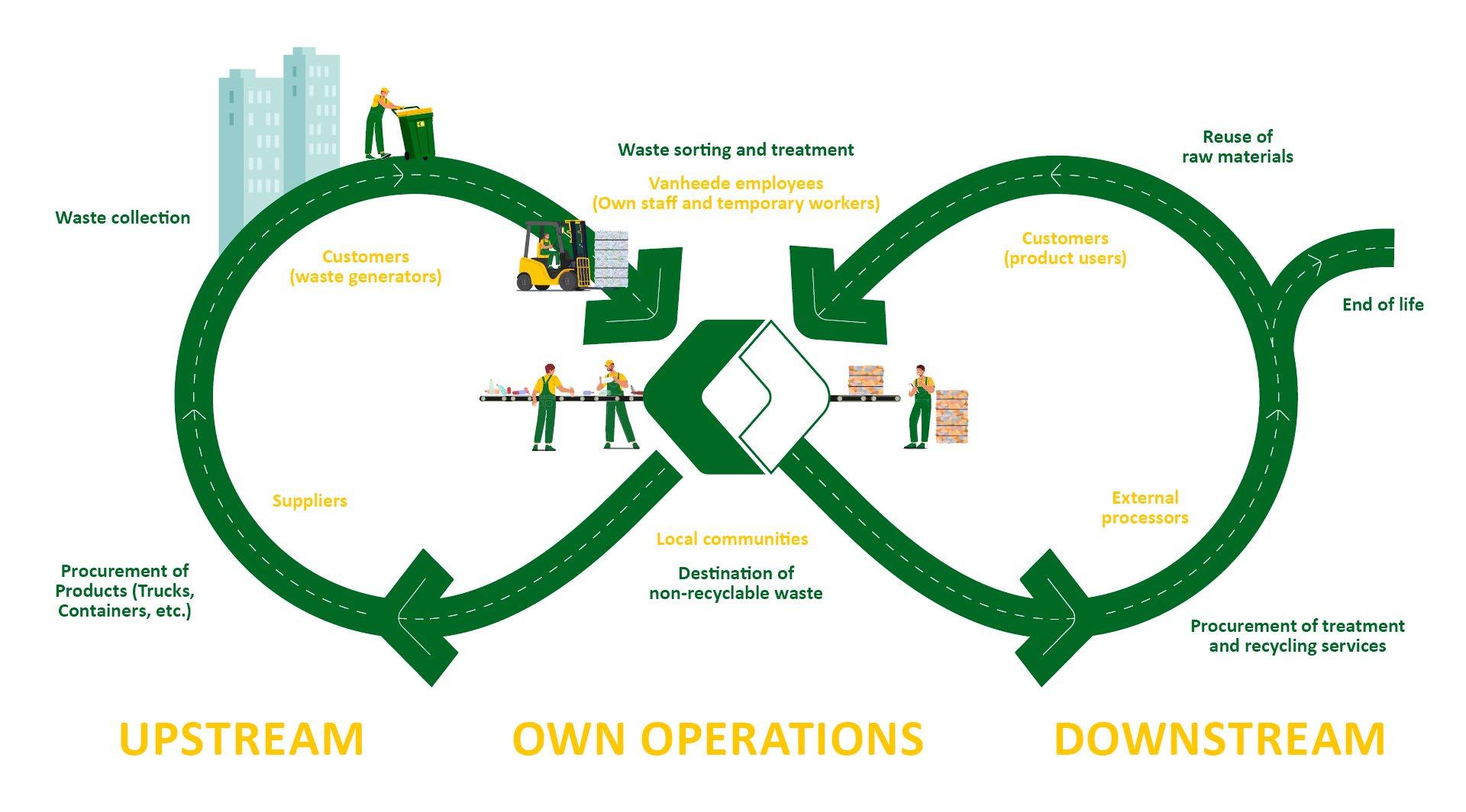
Business model: Vanheede as an integrated environmental company
As an integrated environmental company, Vanheede Environment Group is committed to ‘integrated waste management’ in a circular world. This means that we undertake activities along the entire value chain, from the collection of waste, its sorting and separation to the treatment, recycling or disposal of ultimate waste.
Raising awareness among our customers and governments
Thanks to our vast knowledge of materials, techniques and markets, we play an essential role in raising awareness about the importance of managing waste in an efficient way that is respectful of the environment, by stressing the need for sorting at source. By concentrating on specific customers and segments, we are able to expand our expertise, and thus our impact.
Setting up partnerships to which we can bring real added value
At Vanheede, we seek to bring together the key players in the value chain: from suppliers of raw materials to producers and logistic services service providers, not forgetting consumers and the place where waste is generated. In this way we hope to better complete the material circle and identify problems or opportunities much more quickly.
Selective collection and sorting of waste with a view to treating it
The selective collection of hazardous and non-hazardous waste, focusing on commercial waste, is the very essence of our company. Once collected, we also handle the sorting of waste and its transport to treatment sites, both inhouse and third-party.
Recycling waste and turning it into high-quality, alternative materials
During the recycling of collected waste, we aim to achieve maximum recycling levels. By adding to our knowledge about materials and focusing on innovation and new treatment techniques, we are able to produce high-quality materials and products that can be used at the same time as traditional raw materials
Sale of recycled and high-quality “green” primary materials to processing centers and manufacturing companies, etc.
A market just for selling recycled materials is essential if we want to sustainably preserve natural resources. The demand for quality “recycled content” continues to grow, which further encourages recycling and business opportunities. A thriving sales market also reduces greenhouse gas emissions and prevents recycled material from being incinerated or sent to landfill.
An end destination for non-recyclable waste or final waste
Final waste is sent to specialist processors for later processing or stored in an energy recovery dump
SBM-2: INTERESTS AND VIEWS OF STAKEHOLDERS
It is important to look at how the world around us works, what needs our stakeholders and ourselves have and how we deal with them. The context in which we operate, as well as the expectations of our stakeholders in the short and long term, are essential in managing risk and determining our group strategy and business operations.
Vanheede actively engages with stakeholders throughout the value chain and incorporates their direct and indirect input into the business strategy and the process of double materiality. Stakeholder insights support the identification and evaluation of relevant impacts, risks and opportunities. Relations with various stakeholder groups are managed at different levels across the organisation, from operational teams to management, in close collaboration with the communication department. Depending on the stakeholder group, interactions take different forms and occur through different channels. An overview of these engagement methods can be found in the table below.
Across all these interactions, three driving forces emerge that our stakeholders consistently align around: fully embracing our role within the circular economy, operating with a low impact on the environment, and creating a healthy environment for people and society. These shared ambitions form the foundation of our strategy and guide how we create value; for our stakeholders, our organisation, and the world around us.
Stakeholder How Vanheede engages
Shareholders
Part of Board of Directors, participate on annual General Meeting; reports provided before each meeting (financial figures, ESG reporting, circularity magazine)
Family Vanheede Transparent communication, family meetings
Employees
Customers
Local communities
Suppliers
Suppliers (treatment centers)
Media
Government
Research institutes and academia
Network and sector federation
Banks
Insurance
Vanheede Moves (internal employee platform), Vanheede Contact magazine, communication via posters and digital screens, Committee for a Pleasant Workplace (e.g. Family Day), direct supervisor contact, idea box and employee engagement surveys)
MyVanheede customer portal (for collections, invoicing, and data dashboards, available via app, also for customer questions), (Key) account manager / sales department responsible for the customer file, customer service (by phone and digitally)
Social media updates during emergencies (e.g. fire), local newsletter with updates, community meetings, direct contact with site manager, (preventive) communication with fire department and police, advisory panel with local authorities
Communication via the group's Procurement support service, supplier surveys, evaluation of critical suppliers (including ESG criteria)
Group support service Material Recovery: maintains ongoing contact with processors, identifies and onboards new processors for waste streams, and negotiates pricing and contract terms
Active social media management (LinkedIn, website), media interviews or podcasts, press releases for key moments (new buildings, sorting lines, major investments), publication of the annual sustainability report and circularity magazine
Indirect via sector federations, visits for government representatives, close communication with government institutions (OVAM, SPW, OED, etc.), public consultations on new regulation
Research collaborations, internship projects, co-funding of innovation projects, knowledge sharing at conferences
Active participation, including chairing roles, multiple representatives within Vanheede involved
Financial review meetings, responding to ESG questionnaires from banks, auditors, (green) loans
Insurance department, risk assessment conversations, prevention audits and risk reports
Visitors Educational visitor centers
Students
Job applicants
Internship programs and thesis projects, guest lectures, company visits via schools, partnerships with universities and colleges
Employer branding via LinkedIn and job platforms, job fairs, embedding the sustainability story in job postings
IRO-1: DESCRIPTION OF THE PROCESS TO IDENTIFY AND ASSESS MATERIAL IMPACTS, RISKS AND OPPORTUNITIES AND MATERIAL INFORMATION TO BE REPORTED
In a rapidly changing world, the interests and expectations of our stakeholders continue to evolve. To better understand current market dynamics and incorporate them into our strategic decisions, Vanheede conducted a double materiality assessment (DMA) in 2024. This exercise, prescribed by the Corporate Sustainability Reporting Directive (CSRD), helps organisations reflect on both internal and external sustainability impacts. Our DMA was carried out between January and May 2024.
The assessment evaluates impacts, risks and opportunities related to material ESG topics — environmental, social and governance — by analysing how these elements connect to Vanheede’s strategy and business model. It incorporates insights gathered through engagement with both internal and external stakeholders, and ensures that both dimensions of materiality are addressed.
As a company, we investigate the positive and negative effects our activities have on the environment and society (impact materiality). This encompasses environmental impacts as well as social and governance responsibilities, and identifies which aspects of our operations are most relevant to the world around us.
In addition, we assess the positive and negative financial effects that environmental and societal factors may have on our organisation (financial materiality). This includes the potential influence of climate change, market shifts, technological developments, and other external factors on the continuity and performance of our business.
The impact of the organisation on the environment and
The impact of
Mapping context
We mapped all the company’s key activities in detail. This included our activities, our distribution channels and our plants. In addition, we analyzed our organization’s entire value chain, up and downstream. We identified the main activities within the value chain and the stakeholders involved: suppliers, customers, distributors, waste treatment centers, end users and employees, etc. Lastly, we identified the main groups of stakeholders within the company and the long value chain, and decided at what stage of the DMA their involvement would be the most pertinent.
Identifying the potential material impacts, risk and opportunities
Consulting stakeholders
Stakeholder engagement is crucial to evaluate material sustainability topics. Therefore, we gathered interests and insights through an online stakeholder survey, in-depth group discussions and a series of in-depth interviews. A broad group of stakeholders received an online survey in which they were able to assess the relevance of certain sustainability topics to Vanheede’s activities and the value chain. The online survey was sent to more than 950 internal and 2170 external stakeholders. In total, we received 353 responses from 204 internal and 149 external stakeholders. We organized three internal group discussions with different stakeholders, selected based on their expertise. The groups consisted of employees from different sites and levels. In this way, we wanted to gain insight into a variety of environmental and social topics. In addition, we conducted 13 in-depth interviews with external stakeholders to better understand their interests and points of view. During the request process, we took into account the expertise of the stakeholders.
Longlist
After mapping the context, we created a longlist of potential material sustainability impacts, risks and opportunities (IROs) in our value chain. We draw on various sources for this, including benchmarking of competitors. We examined different reporting frameworks and assessed emerging trends in the waste management sector. We also took into account our previous materiality exercise of 2021. Finally, we interviewed several internal key figures. This analysis resulted in a list of 78 potential sustainability impacts, risks and opportunities.
Defining material topics based on a assessment of impacts, risks and opportunities
The materiality of the various IRO was quantitatively determined using criteria defined in ESRS 1. We set up four discussion groups: three on Environmental, Social and Governance (ESG) Impact Materiality and one on Financial Materiality. During the Impact Materiality assessment, we determined the severity of the impact based on its magnitude, scope or spread, as well as the possibility of remedying it. As we did this, we evaluated the probability of potential impacts. Financial Materiality was determined based on the magnitude of the financial impact and the probability of risks or opportunities occurring.
Validation of the final list of material topics
To determine the materiality of IRO and validate the final list of sustainable development topics, we organized a workshop in which management took part. During this session, the materiality threshold was set. This threshold was chosen carefully because it enables us to establish a healthy balance between the number of material and nonmaterial IRO. This enables Vanheede to concentrate on the most important IRO without ignoring pertinent aspects.
An initial review revealed that the list of potentially material topics was too extensive, which would have required reporting on a broad range of subjects without sufficient depth or focus. To address this, all topics were subjected to an additional critical review, combining logical reasoning, scientific substantiation and sector benchmarking. This allowed us to reassess and refine the scoring of each topic, ensuring that the final selection reflects both the specific context of Vanheede’s activities in the waste management sector and current industry practices. As a result, the final list of material topics represents a focused and well-founded set of priorities that enables meaningful and targeted sustainability reporting.
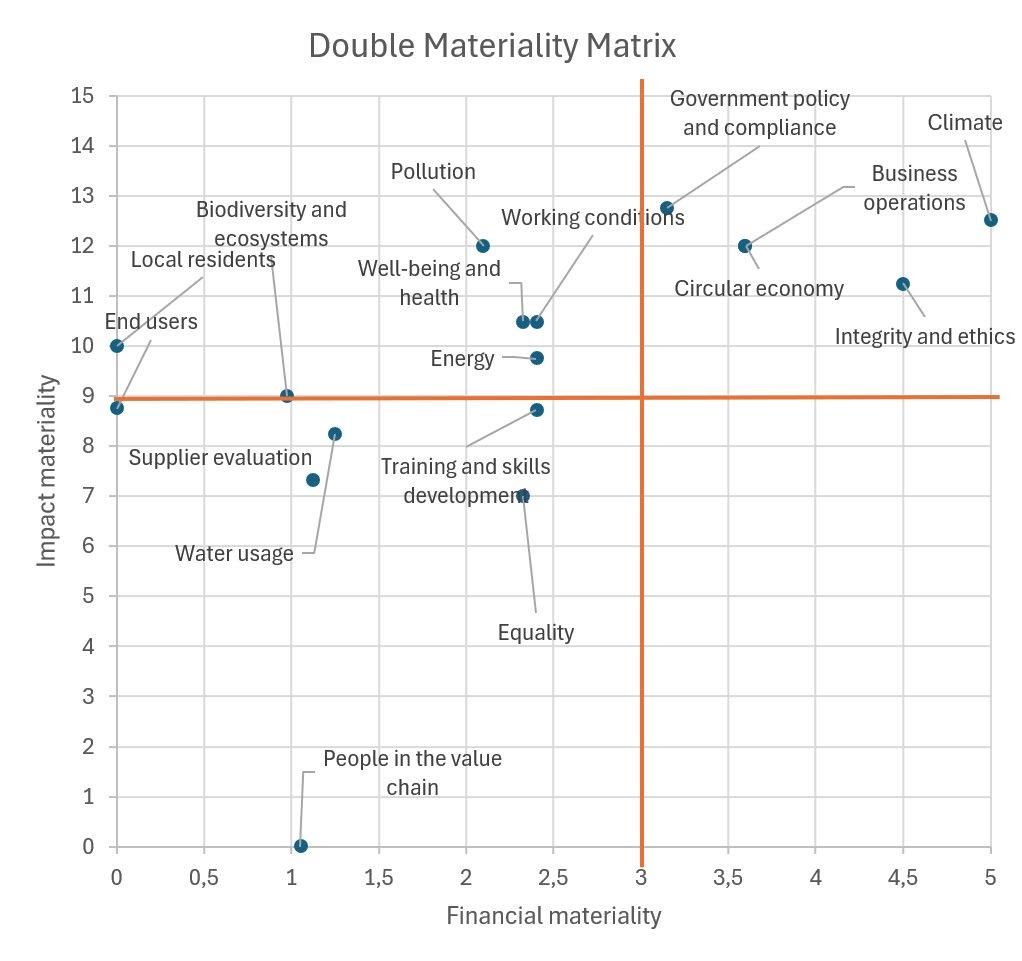
The Double Materiality Matrix indicates which topics are considered material and which are not.
ESG-theme European Sustainability Reporting Standards topic (ESRS)
E1 Climate change
Environment
E2 Pollution
E5 Resource use and circular economy
E1 Own workforce
Social
S3 Affected communities
Governance G1 Business Conduct
Review of the DMA process
Vanheede’s material topics and sub-topics
Climate, energy
Pollution
Circular economy
Working conditions, well-being and health, training and skills development
Local residents
Business operations, government policy and compliance, integrity and ethics
The current materiality assessment was conducted in accordance with the ESRS requirements as applicable at the time of reporting. Vanheede recognises that the sustainability reporting landscape is evolving rapidly. The forthcoming Omnibus legislation and the associated revision of the ESRS are expected to introduce relevant changes to both the scope of reportable topics and the methodology for conducting a double materiality assessment.
Under the revised ESRS, the concept of materiality is further clarified: sustainability information must be useful for general decision-making by report users, rather than tailored to the specific needs of each individual user or stakeholder. In addition, the revised standards allow for a top-down approach to materiality, whereby material topics and IROs are identified on the basis of the company’s own business model, strategy and value chain, rather than through a systematic review of the full list of topics set out in ESRS 1.
In light of these developments, Vanheede intends to revise its double materiality assessment ahead of the next reporting cycle. This revision will take into account the updated regulatory framework and will allow us to further align our materiality process with our strategic priorities and the specific characteristics of our activities in the waste management sector.
IRO-2: MATERIAL IMPACTS, RISKS AND OPPORTUNITIES AND DISCLOSURE REQUIREMENTS INCLUDED IN THE SUSTAINABILITY STATEMENT
Vanheede’s sustainability approach rests on three pillars that emerged directly from our materiality assessment: We protect the environment, We look out for one another, and We govern with integrity. These pillars reflect what matters most to our business and our stakeholders, and they provide the organising framework for everything that follows.
Environmental stewardship (E): We protect the environment. Central to our daily operations, we leverage our expertise in waste collection and processing to ensure every material stream reaches its optimal destination, maximising recycling rates and reducing demand for virgin raw materials. We actively minimise our negative footprint through targeted climate and energy measures, air quality management and controlled water discharge practices.
Social responsibility (S): We look out for one another. As a family-owned business, we have a duty to build a stable and caring environment for all our stakeholders. We prioritise the health, safety and wellbeing of our employees, and invest in structured training programmes to support their continuous development. We maintain close ties with the communities in which we operate and work to minimise the local impact of our activities.
Responsible governance (G): We govern with integrity. We conduct our business ethically, responsibly and in full compliance with applicable laws and regulations. Innovation and R&D are key enablers of our strategic vision, supported by ongoing investment in infrastructure and technology. As a learning organisation, we collaborate actively with public authorities, businesses and institutions to advance circular economy solutions.
Together, these three pillars define the material topics that will guide Vanheede’s sustainability efforts in the coming years. Based on these topics, concrete objectives and key performance indicators will be defined and progress monitored. The findings are incorporated into our annual sustainability report, providing all stakeholders with a transparent overview of the broader impact of our activities. Through our daily operations, investments and projects, we demonstrate our commitment to positive environmental and social impact, while continuously strengthening our governance to support long-term value creation.
Environmental Information
We are tHe Protectors of tHe environment
The environment and climate are central to Vanheede’s daily business operations. As a waste management and recycling company, Vanheede strives for a healthier planet and aims to be a strong partner in the circular economy. Helping companies to recycle optimally while keeping its own environmental footprint as small as possible.
As part of its double materiality assessment (DMA), Vanheede identified several material impacts, risks and opportunities related to climate change, pollution, and resource use and circular economy. These findings form the basis of the environmental disclosures presented in this chapter.
For E1 – Climate change, two themes were identified as material: climate (including the greenhouse gas emissions from Vanheede’s own operations) and energy (including the positive impact of renewable energy generation and the negative impact of energy consumption).
For E2 – Pollution, one theme was identified as material: pollution (including the negative impact of air emissions, water discharge and microplastics, and the positive impact of preventing environmental contamination through the correct collection and processing of waste streams).
For E5 – Resource use and circular economy, one theme was identified as material: circular economy (including the positive impact of facilitating waste recycling and raw material reuse, the negative impact of procuring vehicles and equipment and generating operational waste, the financial risk of raw material price volatility, and the opportunity to drive innovation in recycling).
The disclosures in this chapter address each of these themes in accordance with the applicable ESRS standards, taking into account the phase-in provisions for large non-listed companies reporting for the first time.
Environmental Information
ESRS E1: Climate change
MATERIAL IMPACTS, RISKS AND OPPORTUNITIES
The following material impacts, risks and opportunities were identified through Vanheede’s double materiality assessment.
Climate
Vanheede is committed to reducing greenhouse gas emissions in its own operations and across the value chain, with the ambition to focus on decarbonization. Through recycling, materials are given a second life, generating a positive climate impact. Two material impacts were identified: a negative impact through the emission of greenhouse gases during transport and waste processing, and a positive impact through the reduction of GHG emissions enabled by recycling. A financial risk was identified related to the transition to low-emission vehicles, and an opportunity through the offering of climate-related services to customers, including CO₂ monitoring.
Energy
All energy used by Vanheede comes exclusively from renewable sources. By producing more renewable energy than it consumes, Vanheede contributes positively to the energy transition. Two material impacts were identified: a positive impact through the generation of renewable energy and heat, and a negative impact through energy consumption.
E1-2: IDENTIFICATION OF CLIMATE-RELATED RISKS AND SCENARIO ANALYSIS
To identify and assess climate-related risks, Vanheede draws on two complementary sources of analysis
The first is the Double Materiality Assessment, which forms the overarching framework for identifying material climate-related topics. Through this process, both the impacts of Vanheede’s activities on the climate (inside-out perspective) and the financial risks and opportunities that climate change poses to the Group (outside-in perspective) are systematically evaluated. This assessment forms the basis for determining which climate-related topics require further management and disclosure.
Internally, our ISO 14001-certified environmental management system provides a structured framework for identifying significant environmental aspects and potential emergency situations arising from our own operations. Scenarios such as fire, gas leaks and other operational calamities are systematically assessed as part of this process. Although these scenarios are primarily operationally driven, they are relevant to our climate risk profile as they represent acute risk events with potential environmental consequences.
Together, these two approaches provide Vanheede with a comprehensive view of its climate-related risk exposure, covering both the impact of climate change on our business and the environmental risks generated by our own activities.
E1-4: POLICIES RELATED TO CLIMATE CHANGE MITIGATION AND ADAPTATION
Environmental policy
The approach to climate change mitigation and adaptation is formalised through the Group’s Environmental Policy, which provides the overarching framework for managing the organisation’s environmental impacts, including greenhouse gas emissions. This policy applies across all business units and operations within the Group.
ISO 14001
To ensure structured and continuous improvement in environmental performance, the Group operates in accordance with ISO 14001, the international standard for environmental management systems. This certification requires the organisation to systematically identify and manage its environmental aspects, set objectives for improvement, and monitor progress over time. Climate-related impacts are embedded within this management system, ensuring that GHG reduction is not treated as a standalone initiative but as an integral part of the Group’s broader environmental governance.
E1-5: ACTIONS AND RESOURCES IN RELATION TO CLIMATE CHANGE MITIGATION AND ADAPTATION
Vanheede Environment Group actively pursues the reduction of its greenhouse gas emissions across all scopes through a broad and integrated set of initiatives. These efforts span the Group’s own operations as well as its value chain. These actions are not isolated measures, but part of a continuous and evolving transition that progressively reduces Vanheede’s carbon footprint across its operations, logistics, and procurement activities.
Sustainable fleet management
Aware that transport operations represent a significant source of direct greenhouse gas emissions, Vanheede Environment Group has made reducing emissions from its vehicle fleet a core pillar of the company’s decarbonisation process. The company addresses this through a range of complementary actions, as outlined below.
Route optimisation and operational excellence
Reducing vehicle kilometres travelled is a key lever for lowering Scope 1 fuel-related emissions. Vanheede deploys an automated route planning system to support the minimization of driven kilometres and maximize load efficiency across a range of transport operations. Smart compactors equipped with fill-level sensors trigger collection only when containers reach a sufficient capacity threshold, avoiding unnecessary vehicle movements. Combined transport configurations — using tractor-trailer combinations capable of carrying multiple waste fractions in a single run — further reduce the number of journeys required and the associated emissions. Where possible, collections are clustered across multiple customers on the same site or through shared collection points and local recycling hubs.
Eco-driving program
Vanheede operates a structured eco-driving training program for all drivers, covering fuel-efficient, anticipatory,
and safe driving techniques. This program is designed to lower fuel consumption and thus reduce CO₂ emissions, improve road safety, and decrease vehicle wear. Eco-driving content is integrated into the mandatory Code 95 continuing education program for professional drivers. Driver knowledge of HVO and its handling is also being expanded as part of ongoing training efforts. Fleet-wide telematics systems monitor driving behaviour in real time, enabling continuous performance feedback and targeted improvement.
Transition to low emission vehicles
Vanheede is currently testing the use of electric trucks and is gradually and cautiously integrating electric mobility solutions into its fleet operations. Two fully electric trucks, a compactor vehicle and a hook-lift truck, have been operational within Vanheede’s logistics activities since 2025. The compactor vehicle, deployed at the Geluwe site, covers approximately 30,000 km per year, resulting in an estimated annual CO₂ reduction of 47 tonnes. The hook-lift truck, operating from the Antwerp site, covers approximately 32,000 km per year, delivering an estimated additional reduction of 33 tonnes of CO₂. Together, these two vehicles generate an estimated annual Scope 1 emissions reduction of more than 80 tonnes of CO₂ equivalent.
The electrification program extends beyond heavy goods vehicles. Vanheede is progressively electrifying its passenger car fleet, with the ambition of achieving a fully electric passenger vehicle fleet within five years. Charging infrastructure is being progressively rolled out across company sites, with several charging points also made publicly accessible, thereby contributing to broader Scope 2 emission reductions through the shift from fossil fuel combustion to grid electricity.
The average Euro norm of Vanheede’s truck fleet currently stands at 5.84 (where it was 5,78 in 2024). All newly acquired trucks comply with the Euro 6 standard, which reduces nitrogen oxide emissions by up to 75% and particulate matter emissions by up to 50% compared to Euro 5 vehicles.
Alternative fuel
In parallel with electrification, Vanheede is using Hydrotreated Vegetable Oil (HVO) as a transitional low-carbon fuel. Since January 2025, five trucks have been fully converted to run on HVO100. As a fossil-free fuel, HVO offers a significant Scope 1 CO₂ reduction potential compared to conventional mineral diesel, while requiring no vehicle modifications. An internal working group continues to evaluate alternative fuels for further integration into our fuel mix.
For the future
Going forward, Vanheede will continue to build on the progress made in sustainable fleet management through a number of targeted initiatives. A key focus will be placed on further optimising transport routing and driving efficiency, supported by the integration of a dedicated transport management system that enables more granular monitoring, planning, and reporting across all logistics operations. Alongside this, the company will continue to expand its on-site charging infrastructure to support the growing share of electric vehicles in the fleet.
Vanheede is also deepening its knowledge and capabilities in scenario planning, allowing the company to better anticipate and respond to evolving regulatory requirements, alternative fuel availability, and technological developments in the transport sector. At last, Vanheede is currently awaiting the deployment of its eco-combi truck,
which will provide valuable insights into how collections and transport activities can be further optimised using this type of vehicle configuration. By enabling higher payload volumes with fewer vehicle movements, the eco-combi truck is expected to contribute to a favourable decarbonisation effect through reduced kilometres driven and lower associated Scope 1 emissions.
Metrics
Percentage passenger electrical car fleet
Number of charging points
Note that these figures refer to individual charging points, not charging stations (as a single station may contain multiple charging points)
Energy efficiency
The Group continuously invests in the modernisation, optimisation and electrification of its operational processes to reduce energy consumption, improve overall efficiency and eliminate fossil fuel use across its facilities. Where technically feasible, hydraulic and fossil fuel-driven systems are being replaced by electric alternatives.
Across its facilities, the Group is actively reducing its reliance on gas for heating purposes. This includes the electrification of gas-fired heat applications and the implementation of heat recovery systems, such as heat pumps fed by compressed air waste heat, to generate warm water and steam from energy that would otherwise be lost. These measures reduce both direct gas consumption and associated emissions.
Medium and high Global Warming Potential refrigerants are being phased out in favour of natural alternatives. In the interim, all cooling systems are maintained under strict protocols to prevent refrigerant leakage, while a company-wide refrigerant database monitors leakages and tracks the associated greenhouse gas emissions.
These efforts are already visible in practice;
At the Dottignies facility, the hydraulic motors of the shredder were replaced by high-efficiency direct electric motors, selected following thorough technical studies to ensure equivalent performance. The result is a 40% reduction in energy consumption, substantially lower maintenance costs due to the simplified drivetrain, and increased machine availability, contributing both to operational efficiency and to the Group’s decarbonisation objectives.
For its new residual waste sorting line, an electric overhead crane was chosen over a conventional diesel-powered alternative. This decision was driven by both environmental and economic considerations: it eliminates on-site CO₂ emissions, reduces fire risk, and offers a significantly longer operational lifespan. Additional benefits include lower maintenance requirements and the elimination of downtime associated with refuelling.
Renewable energy
Energy is a core priority for Vanheede, both from an economic and a sustainability perspective. In a context of volatile energy markets and increasing climate challenges, the Group aims to reduce its dependence on external energy sources.
To support this ambition, Vanheede has established a dedicated business unit, Renewable Energies (RE), which plays a central role in the Group’s energy strategy. RE is responsible for investing in and developing renewable energy production across the Group’s sites. Encompassing the generation of electricity, heat, and gas through energy recovery from organic waste, as well as through wind and solar energy. Beyond production, RE also handles administrative follow-up and provides support and advisory services to the entire Group in the field of energy management.
Vanheede also recognizes that the most sustainable and cost-efficient energy is the energy that is not consumed. The organization therefore places a strong emphasis on energy optimization, with RE actively supporting the identification and implementation of efficiency measures. In this way, energy is not only viewed as an operational necessity, but as a key lever for sustainable value creation and risk management.
Energy consumption mix
A direct result of this dual focus, producing its own renewable energy while actively reducing overall consumption, is reflected in the Group’s energy mix. The table below provides an overview of the Group’s total energy consumption, broken down by source, distinguishing between energy drawn from Vanheede’s own renewable production and energy purchased externally.
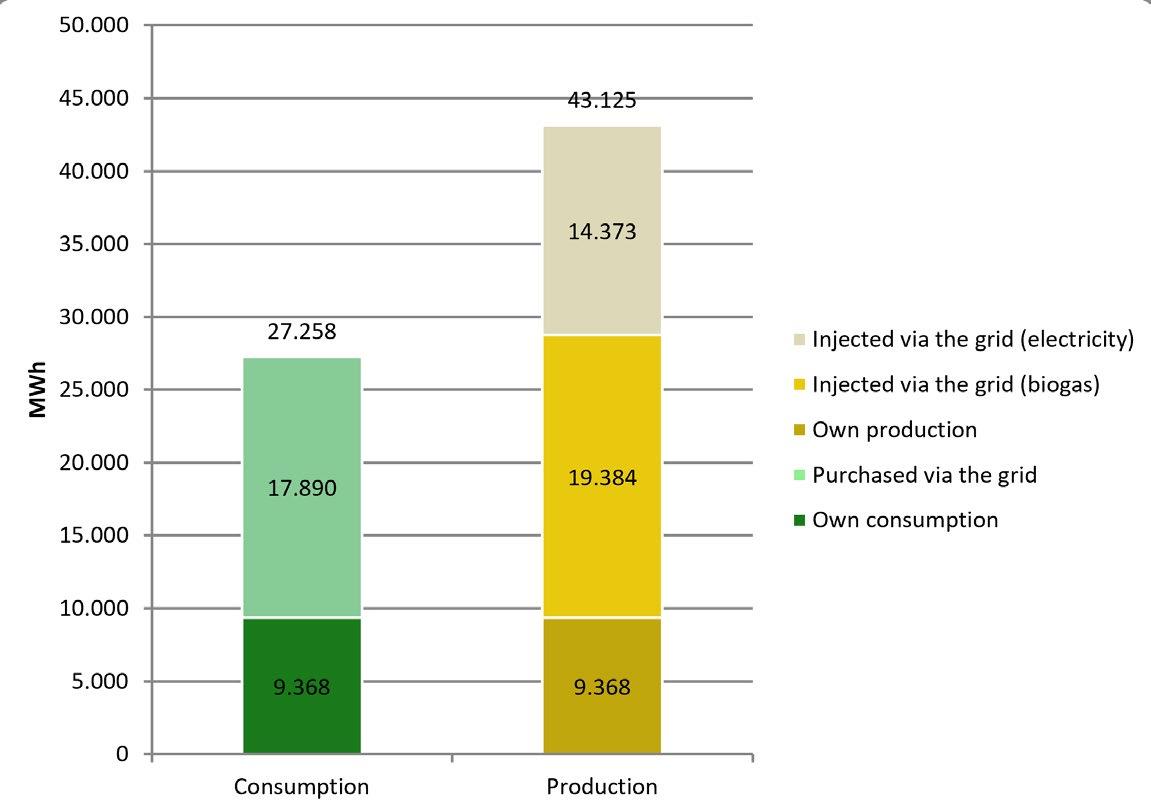
Note: biogas production converted to electricity. The biogas production value (19.384 MWh biogas) was converted to an electricity equivalent using a conversion factor of 0.36, with the calculation: 19.384 MWh= 0.36*53.845 MWh electricity. This converted value is used to correctly add up the total production and make it comparable to the other electricity values.
Renewable energy production
Building on this strategic ambition, Vanheede has developed a diversified portfolio of renewable energy assets over the course of many years. At its sites in Quevy and Rumbeke, renewable energy is generated through biogas installations, where captured biogas is processed for heat generation, electricity production, or injection into the natural gas grid as green gas. In addition, Vanheede operates two wind turbines and has installed significant solar panel capacity across its sites. Together, this diversified energy mix reduces dependence on external energy sources and directly contributes to the reduction of Scope 1 and Scope 2 emissions.
The table below provides a detailed breakdown of Vanheede’s renewable energy production by source and site.
Note:
Renewable energy directive (RED)
Vanheede holds RED III certification across its sites, confirming that the energy generated on-site meets the stringent sustainability criteria set out in the latest Renewable Energy Directive. This certification provides independent verification of the renewable origin of Vanheede’s self-generated energy and ensures full transparency and traceability.
For the future
The figures above reflect where Vanheede stands today, but the Group’s ambitions reach further. The energy strategy extends beyond generation, with a strong focus on storage and flexibility to better align energy supply with demand. Vanheede actively explores opportunities across its own sites and waste streams to identify new energy valorisation potential.
Established technologies, including solar energy, wind energy, and CHP on biogas, are deployed alongside innovative pathways such as biomethane, hydrogen, and other emerging energy carriers. Several concrete initiatives are currently underway: the development of a proprietary energy data management tool, the installation of additional solar panels across multiple sites, the optimisation of existing CHP installations, and the further valorisation of biogas and CO₂. To further strengthen biogas production capacity, an additional digester will be installed in Quevy.
Through the continued development of its renewable energy assets and the ongoing exploration of new opportunities, Vanheede remains committed to reducing its dependence on fossil fuels and contributing to a more sustainable energy future.
Sustainable procurement
As part of its climate strategy, Vanheede integrates sustainability criteria into its procurement process. Suppliers are actively requested to provide transparency on the recycled content of their products, as well as any product-specific emission factors, such as Environmental Product Declarations (EPDs). This allows Vanheede to make more informed sourcing decisions and to reduce the embedded carbon footprint of the materials and products it purchases.
A concrete example of this approach is the Medybin, Vanheede’s fully circular medical waste container. Developed in close collaboration with its supplier, the Medybin is composed entirely of recyclate sourced from Vanheede’s own waste streams, making it a tangible demonstration of the circular economy principles embedded in Vanheede’s procurement policy.
Maintenance
Maintenance, life extension and operational efficiency
Vanheede Environment Group actively invests in extending the lifespan of its equipment, vehicles and infrastructure as part of its climate strategy. By organising maintenance and repairs internally, the group reduces the need for replacement investments and limits the ecological footprint of its operations.
Concrete examples include the in-house repair service for roll containers at the port of Roeselare, the automatic cleaning system for the bio boxes and the Quevy installations, and the own garage where all servicing and maintenance of the vehicle fleet is carried out systematically in close consultation with the importers of the various brands. In addition, an internal maintenance and service team is available around the clock to handle repairs to on-site installations at customer locations. Vehicles are washed exclusively using rainwater and biodegradable detergents, further reducing the impact on water consumption and chemical emissions.
Digitization of maintenance management
To structurally improve maintenance efficiency, Vanheede has initiated the integration of a Computerized Maintenance Management System (CMMS). This system supports employees in reporting breakdowns, provides maintenance managers with a comprehensive overview of service schedules and spare parts management, and gives technicians real-time access to their work orders and material usage registration. This integrated approach minimises downtime, reduces waste of materials and energy, and extends the lifespan of assets.
Training of carbon footprint knowledge
Reducing greenhouse gas emissions is not solely a matter of technology and investment. It equally depends on the knowledge and engagement of its people. Raising awareness and building internal expertise on climate-related topics is therefore an integral part of the Group’s GHG management approach.
In 2026, Vanheede took a first concrete step by providing its Business Unit managers with dedicated training on CO₂ emissions, giving them insight into the carbon footprint of their own operations. This initiative enables managers to make more informed decisions and take ownership of emission reductions within their respective business units. Vanheede intends to further develop this internal training program in the coming years, broadening its reach across the organization.
As part of its commitment to responsible resource use, Vanheede operates a “Keep It Clean” policy that encourages employees to work digitally as much as possible, limiting printer use to situations where a physical document is strictly necessary. To further embed energy awareness on the work floor, Vanheede also developed dedicated energy information sheets covering topics such as lighting management, providing practical guidance to employees on efficient energy use across its sites.
E1-8: GROSS SCOPE 1,2,3 GREENHOUSE GAS EMISSIONS
In reporting its greenhouse gas emissions, the organization applies the GHG Protocol Corporate Accounting and Reporting Standard as the underlying framework. This globally recognized standard provides a structured methodology for identifying, calculating, and disclosing Scope 1, 2, and 3 emissions across the organization’s activities. The following section outlines the specific methodological choices and assumptions applied in line with this framework, as well as the resulting emissions metrics.
Methodology
Calculating Vanheede’s greenhouse gas emissions required modelling the organization’s activities and collecting data from various sources. This was the result of a collaborative process involving stakeholders from different disciplines. The entire process followed the five principles of relevance, completeness, consistency, transparency, and accuracy, as stipulated by the GHG Protocol. With 86% of data being operational and 14% monetary, the results reflect a high level of data availability within the company.
Vanheede’s unique and diverse activities introduced several methodological challenges. One notable example is the distinction between anthropogenic and biogenic emissions. The scope encompasses not only anthropogenic emissions caused by human activity, but also natural biogenic emissions, which were calculated separately and reported distinctly. This is particularly relevant for Vanheede given its landfill and digestion activities, as well as its use of biofuels.
Technical
All greenhouse gases, such as carbon dioxide (CO2), methane (CH4), nitrous oxide (N2O) and refrigerants (HFCs, PFCs and CFCs) are converted into CO2 equivalents using the 100-year Global Warming Potential (GWP) coefficients of the Intergovernmental Panel on Climate Change (IPCC).
Scope
Geographically, the inventory covers Vanheede’s operations in Belgium and France. At the operational level, 15 sites, 12 legal entities, and 7 business units including supporting services are taken into account. Reporting across these three levels proved complex, yet essential to generate actionable insights at the level of individual sites, legal entities, and business units, enabling informed decision-making at the lowest organizational level.
The consolidation approach applied is operational control, covering all entities within Vanheede Environment Group, consistent with the group-level scope used in financial reporting. Both anthropogenic and biogenic emissions are reported, as biogenic emissions represent a significant share of the group’s total emissions given its landfill, digestion,
and biofuel activities. Assets under upstream leased arrangements and franchises are not included in the inventory.
Reference year (RY)
Vanheede Environment Group uses 2021 as the base year for objective setting and performance evaluation. This year was selected based on the availability and representativeness of the data.
Limits and opportunities
Currently, Vanheede reports its Scope 2 energy-related emissions on a location-based basis. The group intends to transition to a market-based reporting approach in future reporting periods, in line with best practices under the GHG Protocol and ESRS E1 requirements. Additionally, data collection processes are continuously being refined; each reporting cycle brings further improvements in automation and data accuracy. The transition towards a more robust and complete emissions inventory remains an ongoing effort.
Our greenhouse gas emissions
Scope 1
Scope 2
Scope 3
Emissions released during the combustion of gas and fuel in the assets owned by Vanheede.
Emissions resulting from the generation of electricity purchased and consumed in the assets owned by Vanheede.
Emissions generated by tier 1 suppliers and customers. Within Scope 3, fixed asset investments were grouped separately under a separate subcategory (Scope 3b) in order to separate large fluctuations in investments from the, more consistent, greenhouse gas inventory.
INDIRECT EMISSIONS PURCHASED ELECTRICITY
UPSTREAM INDIRECT EMISSIONS
2
3
DOWNSTREAM INDIRECT EMISSIONS SCOPE 3
The following table provides a comprehensive overview of our greenhouse gas emissions across all scopes for the reporting year 2025, broken down by emission source and expressed in tonnes of CO₂ equivalent.
Scope 3 emissions represent by far the largest share of our total greenhouse gas footprint. This is largely attributable to the significant capital investments we make in fixed assets, which generate substantial upstream emissions across our value chain.
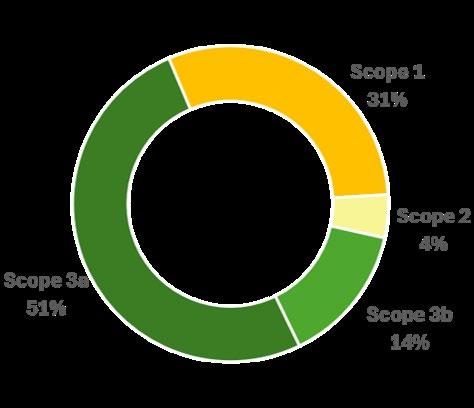
For comparison, you can see the total Vanheede corporate inventory of anthropogenic emissions of the last three years and our reference year.
We have identified three key focus areas where we have the greatest potential to reduce our carbon impact. First, transport-related emissions constitute a significant source, both through mobile fuel combustion in our own operations and through upstream and downstream transportation and distribution activities. Second, energy consumption, and more specifically the use of purchased electricity, accounts for a considerable share of our emissions, and we are actively working to reduce this through increased adoption of renewable energy. Third, the procurement of goods and services, as well as the purchase of capital goods, represents a key emissions driver that we are committed to addressing through targeted supplier engagement and responsible sourcing practices.
These three focus areas form the foundation of our emission reduction strategy
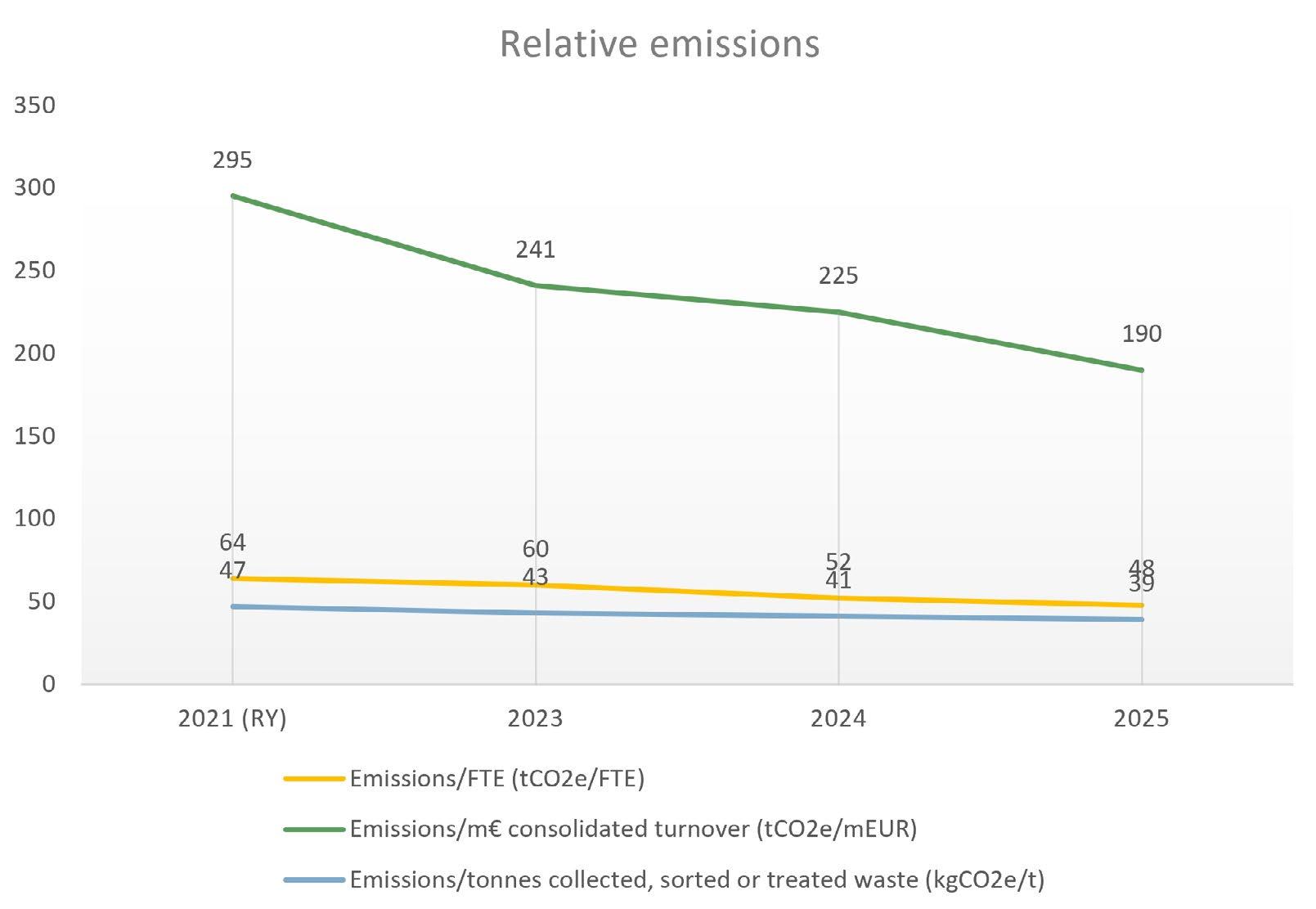
Relative emissions
In addition to absolute emissions, the organization also reports relative emission figures to place its greenhouse gas performance in the appropriate context. Emissions are expressed relative to three intensity indicators: the number of employees, annual revenue, and the volume of treated waste. These intensity ratios enable benchmarking of emission efficiency over time and facilitate comparison with industry peers, regardless of the organization’s scale. Our declining relative emissions are reflecting an improving emissions performance per unit of activity, even when absolute emissions slightly increase as a result of business growth.
Avoided emissions
Beyond our Scope 1, 2 and 3 emissions, we also monitor our avoided emissions, commonly referred to as Scope 4. In the waste management industry, avoided emissions represent a critical dimension of the overall climate impact, and for Vanheede they constitute a significant counterbalance to our operational footprint.
Through our core activities, we actively contribute to the avoidance of greenhouse gas emissions by diverting waste streams from landfill and incineration, and by recovering and reintroducing secondary raw materials back into the economy. By substituting primary raw materials with secondary alternatives, we reduce the demand for virgin resource extraction and the associated emissions that would otherwise be released during the production of new materials. In this way, our operations generate a meaningful climate benefit that extends well beyond our own value chain.
Environmental Information
ESRS E2: Pollution
MATERIAL IMPACTS, RISKS AND OPPORTUNITIES
The following material impacts, risks and opportunities were identified through Vanheede’s double materiality assessment.
Pollution
Vanheede actively works to avoid contamination of water, soil and air, and limits nuisance from dust, noise and odour. By correctly processing all waste streams, hazardous substances are contained and discharge standards consistently respected. The release of microplastics during operations is being mapped and actively mitigated. Three material negative impacts were identified: air pollution, water discharge, and the generation of microplastics. Two material positive impacts were identified: the prevention of environmental contamination through the collection and processing of waste streams, and the correct treatment of hazardous substances.
E2-1: POLICIES RELATED TO POLLUTION
Vanheede applies an integrated environmental policy covering various environmental themes, including climate change, material use and circular economy, pollution, water and marine resources, and biodiversity. This policy is embedded in an environmental management system in accordance with ISO 14001 and applies to all business units and operational activities across the group.
Within this integrated framework, specific measures are taken to prevent, limit, and control pollution. These measures relate to the following areas:
• Control of emissions to air through technical installations and monitoring
• Management of water quality and water flows: In 2025, Vanheede developed a dedicated water policy setting out the principles, responsibilities, and measures to comply with all applicable legal obligations while actively contributing to sustainable water use, circular water flows, and climate adaptation. By combining technical measures, incident prevention, training, and monitoring, Vanheede links regulatory compliance with sustainability and operational excellence
• Prevention of soil contamination through infrastructure and incident management
• Management of hazardous substances and waste streams in accordance with applicable regulations
The management of these aspects is supported by operational procedures, monitoring programmes, and periodic evaluations within the ISO 14001 environmental management system.
E2-2: ACTIONS AND RESOURCES RELATED TO POLLUTION
Our environmental department contributes to an environmental policy as defined in our strategy. The employees of the Environment team focus on compliance with environmental legislation, reporting and concrete actions in this regard, as well as environmental permit applications. They are responsible for complying with environmental regulations, reducing the negative environmental impact of business activities, promoting positive environmental impact and integrating environmental awareness and responsibility into the corporate culture.
Water pollution prevention and control
In line with its Water Policy, Vanheede manages water-related pollution risks through a structured set of actions covering both rainwater and wastewater, in compliance with applicable regulations and its ISO 14001 environmental management system.
Rainwater is managed in accordance with the applicable rainwater legislation, with priority given to infiltration, buffering, and reuse where site conditions allow.
For wastewater, Vanheede has mapped the origin and types of wastewater per site using colour-coded site sheets, providing a clear overview of water flows and associated risks. The company invests in wastewater treatment infrastructure to ensure that all discharges meet the applicable emission standards. To further reduce the volume of wastewater generated, coverings have been installed at several sites to limit exposure to precipitation.
Vanheede promotes circular water use by treating and recovering wastewater for reuse in its own processes. Wastewater treatment installations are operational in Rumbeke, Geluwe, Quevy, Dottignies, and Billy-Berclau. Depending on the need and processes, water is either safely discharged in compliance with permit conditions or reused internally in operational processes.
Water quality is monitored through periodic analyses, enabling accurate follow-up and reporting in line with permit requirements. The results of these analyses feed into the company’s environmental reporting cycle.
In addition, Vanheede invests in innovation through pilot projects focused on advanced purification techniques, including the removal of micropollutants such as PFAS.
WATER TREATMENT PROCESS


CLEAN WATER
FLOTATION TANK
COAGULANT FLOCCULANT
SCREEN
SLUDGE
DIRTY WATER
Water quality is monitored through periodic analyses, enabling accurate follow-up and reporting in line with permit requirements. The results of these analyses feed into the company’s environmental reporting cycle.
In addition, Vanheede invests in innovation through pilot projects focused on advanced purification techniques, including the removal of micropollutants such as PFAS.
Finally, awareness-raising and training programmes are provided to staff, covering topics such as sustainable water management and incident response, to ensure that employees are equipped to act in line with the company’s environmental commitments.
Metrics
Water purificated at our own sites
Totale water usage for all sites
179.840 m³
112.733 m³
(27% city water & 73% rain water)
Finally, awareness-raising and training programs are provided to staff, covering topics such as sustainable water management and incident response, to ensure that employees are equipped to act in line with the company’s environmental commitments.
Soil pollution, prevention and control
Vanheede takes a proactive approach to protecting soil quality across all its sites. A key component of this is the execution of periodic soil investigations at its own locations, carried out in close collaboration with certified soil experts. These investigations enable early detection of potential contamination and, where necessary, allow for targeted remediation measures to be taken.
At locations where hazardous liquids are present or where hazardous waste is handled, appropriate containment trays are provided in accordance with applicable environmental regulations. These physical barriers serve as a first line of defence against soil contamination resulting from unintended spills or leakages.
Vanheede additionally makes structural investments in the protection of stored waste materials through covered storage facilities and liquid-tight flooring. For newly developed sites, these elements are integrated into the design from the outset; for existing sites undergoing renovation, they are systematically addressed. A concrete example is the full roofing of the Antwerp site, initiated in 2025, in which both covered storage and liquid-tight surfacing are central components.
To limit the impact of incidents such as accidental spills, Vanheede ensures that absorbent materials and spill kits are available at strategic locations across each site. This enables a swift and adequate response before any contaminants can reach the soil.
Finally, all fuel tanks at Vanheede sites are inspected and maintained on schedule in accordance with legal requirements, preventing leakages that could pose a risk to soil quality.
Air pollution, prevention and control
A comprehensive approach is taken to managing air quality across all operations, addressing emissions, dust, odour, and noise through a range of targeted actions and monitoring activities.
To ensure compliance with applicable emission standards, regular emission measurements are conducted on the combined heat and power (CHP) units and combustion installations. Where possible, activities are carried out indoors to minimise dust nuisance. Dust measurements can be performed where needed, and where dustgenerating activities such as wood shredding take place, water misting systems are deployed to suppress dust at the source. In addition, dust filters are installed for the dedusting of sorting activities. At the landfill site in Rumbeke, airborne asbestos measurements are carried out to monitor and manage this specific risk.
Drone technology is also employed as part of the site monitoring program. Weekly drone flights provide a visual overview of site conditions, while quarterly one-hour measurement flights generate detailed 3D imagery enabling the assessment of volumes and heights across the site.
Odour management forms an integral part of the approach to air quality. Regular odour rounds are conducted, and odour studies are carried out in collaboration with external specialised bureaus to identify and address potential odour nuisance in the surrounding area. Similarly, noise levels are monitored through dedicated noise studies, and where measurements exceed acceptable thresholds, mitigation measures are implemented, such as the placement of noise barriers. Rapid-closing gates are installed across sites to simultaneously minimise odour, dust, and noise dispersion.
With regard to emissions from transport and operational processes, the electrification of the vehicle fleet is actively pursued, complemented by Eco driving programs to reduce fuel consumption and associated emissions. Beyond transport, electrification is also being extended to production and operational processes, alongside the increased use of renewable energy sources. Furthermore, compliance is ensured with permit obligations regarding the reduction of diffuse emissions, in accordance with the applicable plan for diffuse emission reduction as set out in the environmental permits.
Targets
Vanheede monitors and reports on relevant indicators related to pollution, in line with legislation, permit requirements and the ISO 14001 system. Within the ISO 14001 framework, pollution-related targets are established at the site, zone, and business unit level. At the group level, no consolidated targets have been defined yet; the development towards group-level targets will be implemented in the future.
E2-5: SUBSTANCES OF CONCERN AND SUBSTANCES OF VERY HIGH CONCERN
As part of the pollution management commitment, a dedicated sub-program has been established addressing Substances of High Concern (SHiC), with a primary focus on PFAS (per- and polyfluoroalkyl substances).
Operational capacity and knowledge are actively being built across four environmental vectors: PFAS in waste and
end products, PFAS in wastewater, PFAS in soil, and PFAS in dust and air emissions. Material updates and regulatory developments related to PFAS and substances of high concern are systematically communicated across the Group and to relevant customers. Evolving regulatory standards are closely followed, as are newly available analysis methods, to ensure full and continuous compliance. This is supported by a monthly dedicated meeting to track progress and emerging developments.
Water treatment systems are in place to extract hazardous substances from process water, including the removal of heavy metals and PFAS, through the application of activated carbon and ion exchange resin technologies. Further research is ongoing into advanced purification techniques for leachate water at the landfill site, reflecting a commitment to continuous improvement in this area.
A comprehensive inventory of hazardous substances is maintained across all sites. Through the business unit special waste, hazardous waste is safely stored and transported in full compliance with VLAREM and ADR regulations. A fully developed acceptance procedure is in place for incoming hazardous waste streams, ensuring proper classification, handling, and registration from the moment of receipt. A new fully automated warehouse at Roeselare Haven has been commissioned specifically for the acceptance and storage of hazardous waste, with separate collection of hazardous waste streams as a core operational principle.
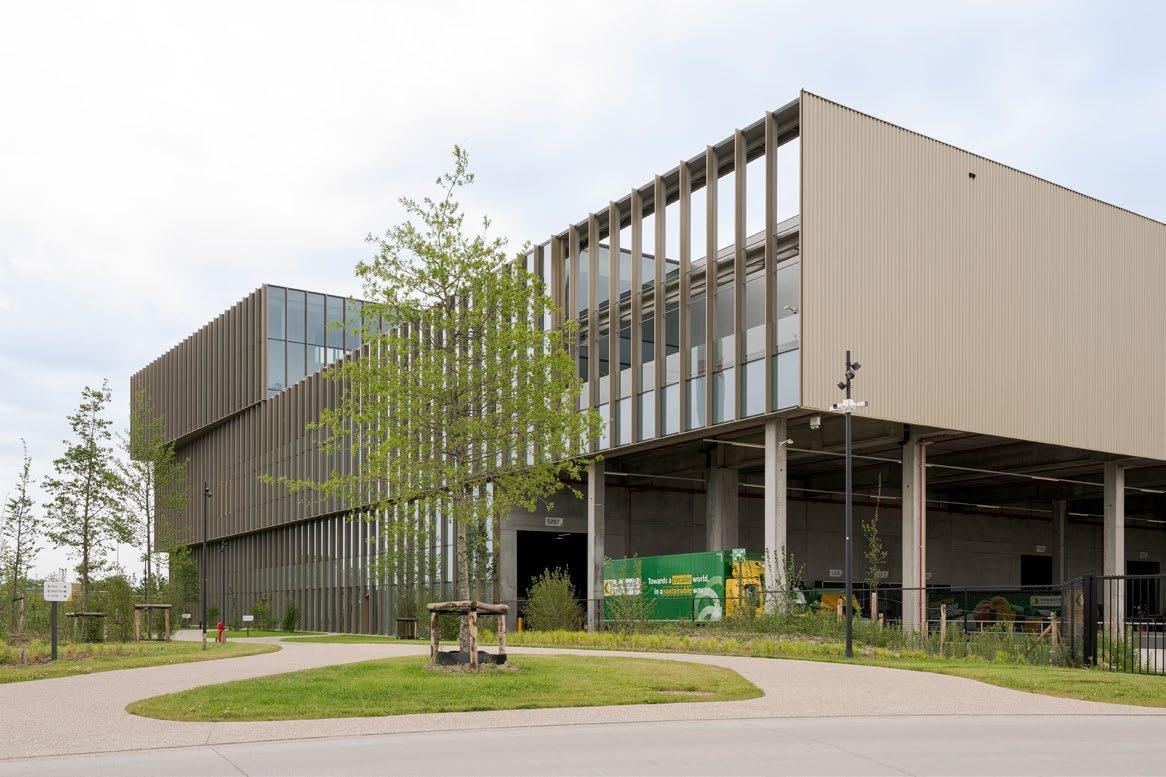
Finally, emergency procedures have been developed and documented to ensure an adequate and structured response in the event of incidents involving hazardous substances.
These actions reflect a commitment to proactively managing pollution risks associated with substances of concern and substances of very high concern.
© Holvoet - Klaas Verdru
Our new offices and automatic warehouse for hazardous waste in Roeselare Haven (Belgium)
Environmental Information
ESRS E5: Resource use and circular economy
MATERIAL IMPACTS, RISKS AND OPPORTUNITIES
The following material impacts, risks and opportunities were identified through Vanheede’s double materiality assessment.
Circular economy
Circular economy is identified as a material topic in our double materiality assessment. Vanheede provides circular solutions across all industries, from waste collection to sorting and recycling, contributing to raw material reuse and reducing the need for virgin resource extraction. We aim to give collected waste the best possible destination, minimising residual waste through innovative sorting and pre-treatment.
Our own operations also have an environmental footprint, both through the purchase of trucks, containers and other goods, and through waste generated by our processes. We work to maximise recycled content in our purchased goods and extend asset lifespans through proper maintenance and our internal repair service.
Key material impacts, risks and opportunities include a positive impact from facilitating the circular economy through recycling, negative impacts from product purchases and own waste generation, a financial risk from commodity price volatility, and an opportunity through continued innovation in recycling.
E5-1: POLICIES RELATED TO RESOURCE USE AND CIRCULAR ECONOMY
The following policies govern Vanheede’s approach to resource use and circular economy, covering waste valorisation, sustainable sourcing, environmental compliance, and responsible site management. The following policies are relevant to the material impacts identified for E5.
Waste Framework Directive
Vanheede’s waste management practices are fully aligned with the EU Waste Framework Directive (2008/98/EC), which forms part of the broader European regulatory framework supporting the European Green Deal and the EU Circular Economy Action Plan, and applicable Belgian and French national and regional legislation on waste management. The waste hierarchy, prioritising prevention, reuse and recycling over energy recovery and disposal, serves as the guiding principle for all waste management activities, both in the services provided to clients and in the management of waste generated by Vanheede’s own operations. All processing activities are carried out under the required environmental permits in accordance with applicable legislation.
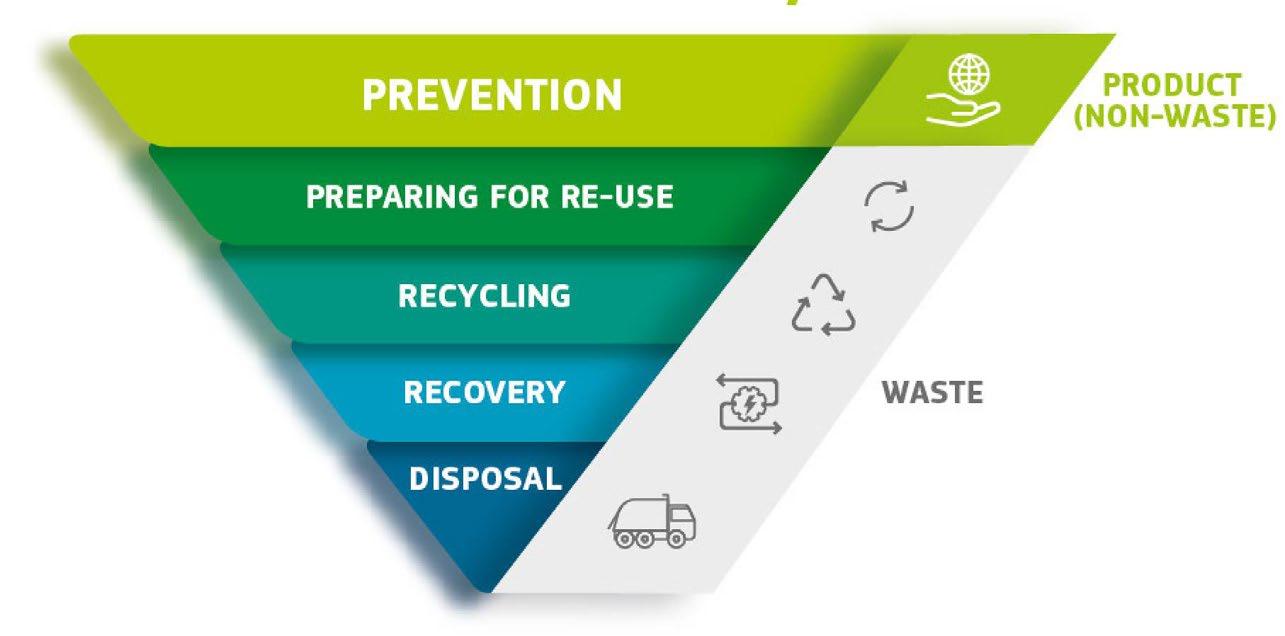
Sustainable procurement policy
Vanheede’s Sustainable Procurement Policy sets out clear expectations for all treatment partners who are responsible for further processing or recycling of waste streams are held to strict requirements covering environmental compliance, circularity, and ethical business conduct.
Keep it clean policy
Vanheede’s “Keep It Clean” policy expects employees to sort waste correctly, supported by sorting instruction sheets displayed on all waste bins across the organization. Waste bins are located in corridors rather than at individual workstations, encouraging correct sorting behaviour throughout the working day. These guidelines reflect Vanheede’s broader mission on circularity and sustainable resource management.
Environmental policy
The Environmental Policy is directly relevant to ESRS E5 as it commits Vanheede to the responsible use of natural resources, prioritising renewable over non-renewable inputs. It explicitly covers material use and circular economy as a key environmental topic.
E5-2: ACTIONS AND RESOURCES RELATED TO RESOURCE USE AND CIRULAR ECONOMY
Circular economy is not an add-on to Vanheede’s business model, it is the foundation of it. As a company active across the entire waste chain, from collection and sorting to recycling and recovery, we are fully integrated in the circular economy. The actions described below are therefore not standalone initiatives, but a natural expression of how we operate every day.
Maximising material recovery through sorting and treatment
Vanheede operates three sorting centres, three recycling centres and one landfill, through which it strengthens its commitment to the circular economy via strategic investments in advanced sorting and recycling lines. Its sorting facilities cover PMD (plastics, metals and drink cartons), residual waste, and construction and demolition waste, while its recycling centres include a dedicated plastics recycling facility producing high-quality secondary raw materials, an anaerobic digestion installation converting food waste into biogas and digestate, and a chemical recycling installation transforming non-recyclable streams into alternative fuel for energy-intensive industries. By enhancing its recycling capabilities, Vanheede recovers higher volumes of valuable materials, improves feedstock quality and closes material loops more effectively across diverse and complex material streams, including mixed waste, organic material, construction and demolition waste, plastics and high-calorific waste.
Through its own sorting and treatment operations, Vanheede guarantees a transparent value chain for the waste it collects and acts as a circular economy partner for numerous other collectors. The knowledge and technology available in-house allow Vanheede to transform waste into high-quality products that serve as new, green raw materials or alternative fuels for industry, contributing to sustainable resource management and reducing dependence on primary materials.
Investments in innovative sorting technologies and optimised recycling methods enable Vanheede to meet evolving environmental regulations, maintain high quality standards and reinforce its role as a key player in building a circular and resilient materials economy.
Specific certifications for internal treatment
We hold several third-party certifications that validate the quality and compliance of our internal waste processing operations:
• Recyclass: certifies that specific plastic waste streams are processed in accordance with the quality standards required for recycled content to be reused in new products, supporting the transition towards a circular plastics economy.
• Chemfuel award: certifies that certain waste streams are processed and valorised as alternative fuel for use in cement kilns, ensuring compliance with the strict quality and traceability requirements for co-processing.
• Weeelabex: certifies the compliant treatment and processing of waste electrical and electronic equipment (WEEE), ensuring that this waste stream is handled according to recognised European standards.
For the future
In line with its growth ambitions, Vanheede has planned two expansions. In Belgium, an additional anaerobic digestion facility is under development, further increasing capacity for organic waste treatment. In France, a new sorting line will be established enabling both the production of alternative fuel and the sorting of non-hazardous waste. These investments reinforce Vanheede’s position as an integrated waste management operator and contribute to its objectives around circular economy and climate transition.
For more information on Vanheede’s sorting and recycling lines, please refer to the company website or the Vanheede Circularity Magazine.
Extended producer responsibility: supporting clients in compliance and circular transition
Vanheede takes an active role in closing material loops by participating in both legally mandated and voluntary take-back systems. Under the Extended Producer Responsibility (EPR) framework established by the EU Waste Framework Directive, producers are required to organise and finance the collection and processing of their end-oflife products. This applies across a range of product categories covered by European directives, including packaging, vehicles, batteries and electrical and electronic equipment.
Vanheede works closely with EPR organizations in both Belgium and France, managing either the full chain or specific parts of the recycling process depending on customer needs. Through these partnerships, Vanheede offers integrated end-to-end solutions covering collection, sorting, processing and recycling, ensuring that materials are handled sustainably and in full compliance with applicable EPR regulations.
As EPR obligations continue to evolve; with the recent revision of the Waste Framework Directive further clarifying the roles and responsibilities of producers, collectors and processors; Vanheede positions itself as a trusted partner supporting clients in navigating this changing regulatory landscape and accelerating their circular transition.
Recycling Revolution: engaging clients on responsible recycling
Within the framework of the Recycling Revolution, Vanheede supports customers in improving source separation and increasing the recycling and valorisation of material flows. This is translated into practical solutions such as the Plastic Switch, for the separate collection of recyclable plastics, the Organic Switch, for organic waste streams such as food and kitchen waste, and the KGA Switch, for small hazardous waste and specific waste streams requiring safe and traceable handling. These initiatives help customers reduce residual waste, improve sorting quality and increase the share of materials that can be recycled.
Circular materials: driving innovation towards closed material loops
Within the Circular Materials program, we take a 360° view of strategically important material streams, considering the entire lifecycle from recovery and treatment to the production of high-quality feedstock. By integrating insights across legislation, environmental impact, technology, and stakeholder needs, we ensure that our solutions are both resilient and sustainable. We align with evolving international standards, foster strong partnerships, secure qualitative material supplies, and adopt an international perspective to maintain relevance across borders. Leveraging advanced technologies, we aim to close material loops, reduce environmental impact, and contribute to a circular economy. In response to mounting climate and resource pressures, Vanheede is uniquely positioned to create positive impact by preserving resources, protecting the environment, and driving sustainable economic growth.
Customer guidance
myVanheede
myVanheede is Vanheede’s digital customer platform that gives clients a clear and complete overview of all their waste streams. It automatically maintains the legally required waste register, tracking which waste types are collected, in what quantities, when, and by which processor. Customers can consult their total waste production, broken down by hazardous and non-hazardous waste and by processing destination, both per site and across all locations combined. This makes myVanheede a practical tool for understanding how circular your business already is, showing exactly how much waste is directed towards recycling and where opportunities lie to go even further.
Material recovery service
Our Material Recovery service identifies the best possible processing solution for the materials handled by the group. The service is responsible for all external processing options and manages the associated rates, acceptance
conditions and capacities. Legal obligations, including cross-border transport requirements and processor environmental permits, are also monitored by this team. Material Recovery shares its expertise in processing options and waste streams through training and by providing technical and commercial support to the sales team.
Own waste management
Vanheede has the expertise to process over 3,000 different waste products in more than 2,500 ways. As a company that knows the world of waste better than anyone, Vanheede holds itself to the same standard internally, expecting all employees to apply that expertise in their day-to-day operations.
To structure its approach to own waste, Vanheede conducts site walks across all locations to inventory existing waste streams, identify missing waste streams or collection points, and align with site managers on corrective actions. Collection points are fully integrated into Vanheede’s ERP system, ensuring that container locations are known throughout the supply chain and that logistics are set up correctly per site. Activities are organised by category, covering office and parking, production, maintenance and repair, and infrastructure.
Monitoring is ensured through quarterly environmental site walks and a dedicated own waste checklist conducted by the HSE team, complemented by control by the site manager. Employees are actively sensitised on correct waste sorting practices. Sorting guidelines are displayed on all waste bins across the organization in the form of dedicated sorting instruction sheets, and waste bins are located in corridors rather than at individual workstations, encouraging correct sorting behaviour throughout the working day. The own waste metrics can be found at ESRS E5-5.
E5-4: RESOURCE INFLOWS
Resource inflows refer to the materials and waste streams entering Vanheede’s operations. As a waste management and recycling company, our primary inflow consists of waste collected on behalf of our customers across a wide range of industries. Understanding and monitoring these inflows is essential to measuring our contribution to the circular economy and to continuously improving the destination of materials we handle.
KPI
Total
In 2025, Vanheede collected a total of 705,416.9 tonnes of waste from our customers. Of all waste collected, 94.71% was recycled or recovered: 58.17% through recycling and 36.54% through energy or other recovery. Only 5.29% could not be beneficially reused.
Of the total collected volume, 17% was processed in our own sorting and treatment facilities, reflecting our vertical integration within the waste chain.
We have the ambition to give the waste collected from our customers the best possible destination towards recycling, reducing residual waste to an absolute minimum. The same ambition applies to our own operational waste. Maximizing the recycling and recovery of materials is a core ambition.
On average, Vanheede collects 2.16 waste streams per collection address, demonstrating that customers are increasingly committed to selective collection and waste prevention at the source. For a more complete overview of our collection and treatment metrics, we refer you to our circularity magazine.
E5-5: RESOURCE OUTFLOWS
We walk the talk. We take ownership of our internal waste streams, sharpen our sorting and recycling processes, and drive residual waste down to the lowest achievable level.
Definition
Own waste is defined as all waste generated through activities within the Vanheede Environment Group over which the Group has a direct influence on both volume and composition.
Scope and categories
For internal monitoring and reporting purposes, own waste is classified across four operational categories:
Office and parking
Waste arising in office spaces, canteens, parking areas, and recreational facilities. Relevant waste streams include paper and cardboard, PMD (plastics, metals, and drink cartons), residual waste, and food waste.
Production
Waste arising in production environments such as sorting or pre-treatment facilities. Relevant waste streams include wastewater, litter, sweeping waste, sewer sludge, non-recoverable containers, and workwear. Sorting residues, dust from extraction systems, and leachate; over which the Group has no direct influence on volume or composition; are explicitly excluded from the definition of own waste.
Maintenance and repair
Waste arising in garage and workshop environments. Relevant waste streams include oils, oil-contaminated waste, hazardous household-type waste (KGA), residual waste, and workwear.
Infrastructure
Waste arising from infrastructure works and construction activities. Relevant waste streams include soil, rubble and masonry waste, paper and cardboard, residual waste, timber, and hazardous household-type waste (KGA).
Data points
In 2025 the own waste production within Vanheede Environment Group was 3.161,34 tonnes waste in total
2.514,39 tonnes (79,5%) non-dangerous waste
646,96 tonnes (20,5%) dangerous waste
86% of our own waste is recycled
of our own waste is not recycled
The waste figures reported reflect the organization’s core operational activities. Infrastructure-related waste, generated through temporary spot projects, has been excluded from the reported totals. Because these projectbased waste streams are irregular and variable in nature, their inclusion would reduce the comparability of data across reporting periods and make it harder to identify trends in regular waste management. For reference, infrastructure-related own waste amounted to 794.5 tonnes in 2025; including this figure, total own waste would reach 3.955,84 tonnes.
A number of material streams, including pallets and various containers, are currently being reused within operations. A reliable measurement methodology for capturing this reuse data is not yet in place. We are working to develop the necessary tracking mechanisms to include reuse data in future reporting cycles.
Social Information
We taKe care of ourselves and otHers
As a family business, Vanheede is strongly committed to a stable and caring environment for all its stakeholders — employees, customers, suppliers and the communities in which we operate.
As part of its double materiality assessment (DMA), Vanheede identified several material impacts, risks and opportunities related to its own workforce and affected communities. These findings form the basis of the social disclosures presented in this chapter.
For S1 – Own workforce, three themes were identified as material: working conditions (including adequate wages and engagement with trade unions), health, safety and well-being (including the risk of work-related incidents and the impact of workload on mental well-being), and training and skills development (including the positive impact of talent development).
For S3 – Affected communities, the material theme relates to the impact of Vanheede’s logistics and recycling activities on local residents, specifically through traffic congestion and road safety risks associated with increasing collection frequencies.
The disclosures in this chapter address each of these themes in accordance with the applicable ESRS standards, taking into account the phase-in provisions for large non-listed companies reporting for the first time.
Social Information
ESRS S1: Own Workforce
MATERIAL IMPACTS, RISKS AND OPPORTUNITIES
The following material impacts, risks and opportunities were identified through Vanheede’s double materiality assessment.
Working conditions
Vanheede places great importance on good working conditions and employee engagement. The company strives to foster a sense of connection among employees and with the organization as a whole, and maintains a constructive relationship with trade unions. Two material positive impacts were identified in this area: the provision of adequate wages and active engagement with trade unions.
Health, safety and well-being
Vanheede is committed to preventing hazardous situations in the workplace, working towards its mission of zero accidents. As a growing organization, the company acknowledges that increased workload may affect the mental well-being of some employees. Measures are taken to protect the health, safety and well-being of all employees to the greatest extent possible. Two material negative impacts were identified: an impact on mental well-being and an impact on health and safety.
Training and skills development
Vanheede encourages employees at all levels to act entrepreneurially, take initiative and contribute proactively. The company invests in training programs across the organization, with the ambition to further develop these pathways so that employees can grow and reach their full potential. One material positive impact was identified: talent development.
S1-1: POLICIES RELATED TO OWN WORKFORCE
Vanheede has established an integrated policy framework governing its approach to its own workforce, covering working conditions, health and safety, diversity and inclusion, and ethical behaviour. This framework is anchored in several internal documents, which are periodically reviewed and updated in response to evolving risks and regulatory requirements. The following policies are relevant to the material impacts identified for S1.
Code of conduct
The Code of Conduct sets out Vanheede’s expectations regarding the behaviour of employees towards colleagues, managers, customers and the organization as a whole. It enables employees to act honestly and ethically, make sound decisions in ambiguous situations, and uphold the company’s values on a daily basis. The Code of Conduct serves as an overarching framework and is further elaborated in the group’s other specific policies.
Social policy
As a leading company in waste management and recycling, Vanheede is committed to sustainable development and positive social impact. The Social Policy describes how the company manages its social impact on all stakeholders and fulfils its role in society. It applies to own employees, workers in the value chain, affected communities, and
customers and end-users. The policy covers three social topics: health and safety at work, community relations, and customer relations.
Policy for health, safety and well-being at Work
Vanheede’s health and safety policy prioritises the protection of employees, subcontractors, visitors and third parties across all operations. The policy is built on five core principles: legal compliance, zero-accident ambition, training and awareness, continuous improvement, and shared participation. It is structured around the PDCA cycle and aligned with ISO 45001. Management commits to providing the necessary resources and expects the same dedication to safety from all employees, customers and partners.
Corporate social responsibility policy
Vanheede Environment Group is committed to embedding Corporate Social Responsibility across both its operational and administrative activities, consistent with the interests of its stakeholders. The company strives to be recognised as a frontrunner in CSR and ensures that this commitment creates significant added value for all parties involved.
Diversity and inclusion policy
Vanheede Environment Group is committed to equal opportunities and professional diversity, both in its HR policy and in employee relations. Through its diversity and inclusion policy, Vanheede aims to provide a working environment where differences in values, age, gender, disability, background, lifestyle and other characteristics are respected.
Keep it clean policy
Vanheede operates a “Keep It Clean” policy that applies to all employees across all work locations. The policy aims to create a safe, tidy and pleasant working environment in which employees feel at home. It sets out clear agreements regarding the cleanliness of individual workstations as well as shared spaces such as the kitchen, meeting rooms and sanitary facilities. The policy encourages employees to take personal responsibility for their own workspace and for shared infrastructure. This contributes to a positive working atmosphere, reduces stress factors on the work floor and supports the physical and mental wellbeing of all staff members.
S1-2: ENGAGEMENT WITH OWN WORKFORCE AND WORKERS’ REPRESENTATIVES, EXISTENCE OF CHANNELS FOR OWN WORKFORCE TO RAISE CONCERNS OR NEEDS AND APPROACHES TO REMEDY
Vanheede actively involves its employees through both formal consultation structures and informal initiatives. Our workforce is essential to the smooth and effective day-to-day operations of the organization. We are committed to taking their ideas, questions, and concerns into account.
Whistleblower system
Since early 2023, Vanheede has complied with the legal obligation to protect whistleblowers by establishing an official reporting channel. This enables employees to confidentially report violations of EU law in a work-related context, without fear of retaliation. Further details on the whistleblower policy can be found in the Business Conduct chapter.
Trust persons
Vanheede has designated trust persons whom any employee can approach with work-related concerns, including stress, role ambiguity, workplace conflicts, or inappropriate behaviour. Trust persons are bound by professional secrecy, meaning all conversations are strictly confidential, including from management, as required by law. Any follow-up action can only be taken with the explicit consent of the employee concerned.
HR department and direct responsible
Employees can at any time approach their direct manager or the HR department informally to raise issues, file complaints, or share suggestions.
Social consultation bodies
Management places significant emphasis on employee interests. The Works Council, the Committee for Prevention and Protection at Work, and the Union Delegation meet on a regular basis. In these bodies, employees are represented by elected delegates who engage in dialogue with employer representatives appointed by management. Further information is provided under S1-7.
Mentorship programme
For truck drivers and blue-collar workers, Vanheede operates a mentorship system in which newly onboarded drivers are guided by an experienced colleague. This channel provides a low-threshold, informal way for employees to express concerns, questions, or needs outside the formal hierarchy.
External channels
FOD WASO, A government supervisory body to which employees can turn regarding wellbeing, safety, and working conditions. Employees facing psychosocial complaints or wellbeing concerns can also contact Liantis, Vanheede’s external prevention and protection service, through a confidential and independent channel outside the internal structure.
S1-3: ACTIONS AND RESOURCES RELATED TO OWN WORKFORCE
Vanheede Environment Group translates its social related policies into concrete actions across multiple domains. These actions are designed to bring the principles outlined in our policies to life across all entities and levels of the organization. The following sections provide an overview of the key initiatives undertaken to foster a safe, healthy, and engaging workplace for all employees.
Working conditions
Motivated and entrepreneurial employees make the difference
A network only exists through its people. It is our employees who make the difference, through the way they engage within the group and collaborate with one another.
At Vanheede, ensuring that all employees remain motivated is a priority. We actively encourage motivated employees to be entrepreneurial: to go beyond fulfilling their defined tasks and to think proactively, take initiative, and contribute to the continuous improvement of our organization, to innovation, and to the achievement of our shared objectives.
Keeping employees motivated requires genuine involvement and connection. It is important that employees remain connected, both to one another and to the organization. A point is therefore made of informing employees regularly about what is happening across Vanheede, encouraging cross-team collaboration, and recognising ideas and initiatives for improvement or new projects. Continuous investment goes into developing employee competencies, ensuring they have the right skills and tools to perform their roles effectively. Change management is equally prioritised, with attention given to supporting employees through transitions at every stage of every project.
We want to give not only our Business Units and Group Support Services, but also our employees, the autonomy they need to thrive. We believe in fostering a working environment where everyone has the opportunity, within their capabilities, to show initiative and act independently. This strengthens the entrepreneurial spirit within Vanheede and amplifies our collective successes.
Job fairs and business events
Vanheede actively participates in a range of job fairs and business events. These events serve a dual purpose: attracting motivated new talent while also connecting with potential clients and business partners. Representatives from various departments attend, giving both candidates and prospects an authentic picture of Vanheede’s activities, values, and culture.
Employee appreciation
The committee for a great workplace
The committee for a great workplace is a cross-functional team, composed of representatives from various departments, that works, with the support of management, to bring ideas to life that make Vanheede a great place to work and to bring the Vanheede culture to life. Strong internal communication is central to this mission, reinforcing culture and supporting the organization’s broader retention, well-being, and employer branding objectives.
The committee is taking on an increasingly structured and purposeful form, with a focus on five key themes: strengthening team spirit, fostering a positive working environment, celebrating special moments in employees’ careers or in the sector, recognising contributions, and promoting well-being and health. Initiatives range from running together, to discounted tickets for festivals and sports events, to offering a treat during the Week of the Waste Team, collecting litter as a team followed by a social team-building activity, and encouraging sustainable commuting through the Bike to Work initiative.
Family day
In 2025, on Sunday September, 28th, Vanheede hosted a Family Day at its site in Rumbeke, where employees were invited to bring their partners and children. Along a 1.2-kilometre guided route, families had the opportunity to discover the office building, the two sorting lines, the renovated Mammoth Path, and the Bergmolenbos forest. In this way, they were introduced to Vanheede’s activities in waste processing and recycling, and the work of our employees was explained in an accessible and engaging manner.
Alongside the informative program, there was ample space for relaxation and social interaction, with food trucks and a range of children’s activities. In total, approximately 850 employees and family members took part in the event.
This initiative contributes to a healthier work-life balance, strengthens social cohesion within the organization, and deepens families’ understanding of and connection to the work of Vanheede employees.
Anniversary celebrations
Each year, Vanheede recognises the loyalty and dedication of its long-serving employees. This year, 135 colleagues were celebrated across four locations, Liège, Kortrijk, Mons, and Messancy, allowing employees to mark the occasion close to home. Each event included a reception and a word of thanks from management. As a token of appreciation, every anniversary recipient received a gift voucher.
Adequate wages
Vanheede is committed to ensuring that all employees receive fair and adequate remuneration. All employees are compensated in accordance with the applicable sectoral collective bargaining agreements and in full compliance with Belgian social legislation, as confirmed by the company’s registered social secretariat. No employee is remunerated below the statutory minimum wage. Compensation packages are further complemented by additional benefits, including meal vouchers and insurance coverage.
Work life balance
Work-life balance arrangements differ depending on job functions. Operational employees, particularly in waste collection, typically work in fixed early morning shifts, reflecting the nature of the activities. For administrative and support functions, flexible working arrangements are offered, including flexible working hours and the possibility for remote work, where compatible with job requirements. Employees who accumulate overtime hours are entitled to recuperate these hours in the form of additional time off.
In accordance with Belgian legislation, a right to disconnect has been established. This regulation clarifies the expectations around availability outside of working hours and protects employees from the obligation to respond to work-related communications during rest periods, evenings, weekends, and holidays. The aim is to safeguard mental well-being and ensure that digital connectivity does not blur the boundaries between professional and personal life.
Parental leave is available to all eligible employees in line with Belgian statutory requirements, covering both maternity and paternity leave as well as optional parental leave arrangements.
These measures reflect a commitment to enabling employees to balance their professional responsibilities with their personal and family lives across all levels of the organisation.
Social protection
Employees benefit from a comprehensive social protection framework, including statutory social security, occupational accident insurance, and additional benefits such as hospitalization insurance and pension plans.
Inclusion
A truly inclusive approach to employment extends beyond the own workforce. As part of its commitment to social responsibility, long-standing partnerships are maintained with five social enterprises that specialise in employing people with a significant distance to the labour market: Westlandia (Ieper), Manus (Antwerp), Bewel (Genk), Mariasteen (Hooglede) and Interinser (Northern France).
Through these collaborations, workers from these organisations are actively integrated into day-to-day operations, contributing their unique skills and perspectives. These workers are offered a professional, inclusive and respectful environment that supports their continued development.
These partnerships are viewed not only as a means of sourcing specialised services, but as a deliberate action to contribute to a more inclusive labour market and to generate positive social impact in the communities where Vanheede operates.
Health, safety and well-being
The health and safety policy is implemented through a structured, risk-based approach that combines ongoing initiatives with targeted improvement actions.
Gaps relative to legal requirements are identified and tracked through a dedicated Gap to Legal Requirements process (GPP). Based on risks, priorities, and identified gaps, actions are translated into an annual safety action plan (JAP). These actions are developed and monitored at site level, defined in a SMART manner — specific, measurable, acceptable, realistic, and time-bound.
The Health & Safety team works to develop and embed the safety policy throughout the organization under the motto Mission Zero Accidents. The team supports both employees and management on occupational well-being, guided by an annual action plan and a dynamic risk management system. Key activities include accident management, risk analyses, safety inspections, and commissioning processes.
Vanheede collaborates with an external prevention and protection service, Liantis, covering occupational health surveillance including biomonitoring where applicable. The division of responsibilities between internal and external services is formally established in the identification document.
Employee consultation and participation are integral to the approach, through the Committee for Prevention and Protection at Work (CPBW), regular toolbox meetings, and employee surveys. This input is incorporated into risk analyses, priority-setting, and the further development of actions.
Health and safety team
The Health & Safety team works to develop and embed the safety policy throughout the organization under the motto Mission Zero Accidents. The team supports both employees and management on occupational well-being, guided by an annual action plan and a dynamic risk management system. Key activities include accident management, risk analyses, safety inspections, and commissioning processes.
Safety culture, engagement and involvement
Vanheede fosters a strong safety culture through a company-wide Go Safe for Zero Accidents campaign, Safety Days, and safety awareness posters displayed across all facilities. Employee surveys are conducted regularly to gauge safety and well-being perception and identify areas for improvement. New personal protective equipment and workwear are tested in collaboration with employees. Safety-related articles and updates are published on the internal Vanheede Moves SharePoint channel. Monthly accident data is tracked and reported via the MyVanheede Moves platform.
Training and competency
Safety training is available to all employees via the eLearning platform ePower, including dedicated toolbox training modules. First aid training is also offered, and safety competency forms an important part of the onboarding process to ensure new employees are engaged from day one.
Fire safety
Fire safety measures include personnel training in fire prevention and response, controlled and clearly defined storage practices, and protection through sprinkler systems and separation walls. Customers are also engaged on fire risk, particularly regarding hazardous materials that may be present in their waste streams.
Employee well-being scoring
As part of the occupational health surveillance carried out by Liantis, employees attending a medical consultation were asked to complete a general well-being questionnaire. The purpose of these questionnaires is to map employees’ health status and any work-related complaints in a structured and preventive manner. They serve as an important tool within the medical monitoring program, enabling early detection of signals related to physical or psychosocial strain, so that appropriate preventive measures can be considered where needed. The results also contribute to an overall picture of health across the organization.
The results were notably positive: in total, 85.8% of employees rated their well-being at work as satisfied or very satisfied, reflecting a strong and positive workplace culture.
Metrics
The percentage of people in its own workforce covered by the undertaking’s occupational health and safety management system, based on legal requirements and/or recognized standards or guidelines
100% coverage
The total number of fatalities resulting from recordable work-related accidents — among both the undertaking’s own workforce and workers present on the undertaking’s sites but not part of its own workforce — combined with fatalities resulting from recordable work-related ill health among its employees
0 fatalities
To assess our safety performance, we use two key metrics: the severity rate and the frequency rate.
The severity rate is a measure of the human impact of workplace accidents. It is calculated as the ratio of the total number of calendar days actually lost due to workplace accidents to the total number of hours worked, multiplied by 1,000.
The frequency rate is a measure of the number of lost-time workplace accidents, expressed as the ratio of the total number of workplace accidents resulting in at least one day of absence( excluding the day of the accident itself) to the total number of hours worked, multiplied by 1,000,000.
Training and skills development
Vanheede is committed to the continuous development of its employees through a structured and proactive approach to training. Training at Vanheede is coordinated by a dedicated Training Coordination team, which ensures that both the organization and its employees continue to grow and develop. The team oversees training across five key areas: onboarding of new employees, legally required training, behavioural development, organizational development and personal development. In a rapidly changing environment, ongoing learning is considered essential at all levels of the organization.
Training is offered through both internal and external programs, and employees are actively involved in the process, when new training initiatives are being developed or launched, employees are consulted to gauge interest and identify relevant needs.
Key elements of the training approach include:
ePower - Internal learning platform
A central digital platform where employees can browse the training catalogue, submit
308 courses on our ePower platform
and approve training requests, and register completed courses. Existing classroom training is progressively being converted into e-learning modules to increase flexibility and accessibility. Automated post-training evaluations enable the team to monitor training quality and make adjustments where needed.
Annual training action plan
Every two to three years, structured conversations are held with each Business Unit and Group Support Service to assess current competencies, identify skill gaps, and define development priorities. These insights feed into a multiyear training plan covering both collective and individual needs.
Onboarding programmes
New drivers follow a dedicated training pathway supported by internal coaches who have been specifically trained to provide on-the-job guidance. New administrative employees are guided through a structured introduction programme during their first days and weeks.
Metrics
the average number of training hours per employee 26,65 hours
Vanheede does not yet have a formalized performance and career development review system in place. As a result, the percentage of employees that participated in such a review cannot be reported for the current reporting period. A formal evaluation framework is currently under development and is expected to be implemented in one of the coming years.
S1-5: CHARACTERISTICS OF THE UNDERTAKING’S EMPLOYEES
In this section, we provide a detailed overview of our workforce composition. At the end of 2025, the group employed 1,003 people (headcount), excluding interim workers (see S1-6), representing a growth of 3.7% compared to 2024. This figure serves as the basis for all workforce analyses presented in this section. The tables below break down the headcount as a percentage across four dimensions: gender, region, status by gender, and seniority. For reference, the total workforce expressed in full-time equivalents (FTE) amounted to 975.81 FTE, reflecting a growth of 3.4% versus the prior year.
Growth of own workforce
Excl. Interims
The workforce is predominantly male, reflecting the operational nature of waste collection activities. As of 2025, women represent roughly 20% of the total workforce, with higher representation in administrative and support roles.
Headcount per employed region
Excl. Interims
Headcount per employee per
Excl. Interims Headcount per seniority
Excl. Interims
The steady growth in both headcount and FTE reflects the group’s continued expansion and its commitment to sustainable employment. The workforce composition, as detailed in the tables above, demonstrates a diverse and balanced organization across regions, genders, statutes and seniority levels. These characteristics form the foundation of our people strategy and will continue to guide our efforts towards an inclusive and future-proof workplace.
S1-6: CHARACTERISTICS OF NON-EMPLOYEES IN THE UNDERTAKING’S OWN WORKFORCE
As of year 2025, our own workforce includes 160 interims, representing approximately 14% of our total workforce. All interim workers are sourced exclusively through staffing agencies. Compared to the prior year, the number of interims increased from 115 to 160, reflecting a growth of 39%.
Non-employees perform work across the whole company and are subject to the same health and safety standards and site-level policies as our direct employees.
S1-7: COLLECTIVE BARGAINING COVERAGE AND SOCIAL DIALOGUE
Indicator Coverage
Collective bargaining coverage
Employees covered by social dialogue bodies
100% of the company
100% of the employees
All employees at Vanheede are covered by collective bargaining agreements through the applicable joint committees, resulting in a total collective bargaining coverage. In addition all employees are represented through structured social dialogue bodies.
How structured social consultation takes place
All employees within the group are represented through structured consultation bodies. Vanheede consists of multiple legal entities that together are considered a single social unit, which forms the basis on which these bodies were established.
The Works Council meets once a month and aims to inform, consult, and engage employees in discussions and decisions on important topics concerning both the organization and its employees. Both economic and financial themes as well as social themes are addressed. The Works Council thus ensures good cooperation and communication between management and employees.
The Committee on Risk Prevention and Protection at Work meets once a month and is responsible for promoting the wellbeing of employees and safety in the workplace. The Committee has a say and advisory role in important decisions concerning the safety, health and wellbeing of employees. It is also the Committee’s responsibility to inform employees on important topics related to safety, health and wellbeing.
The Union Delegation meets six times a year and consults and decides, unlike the Works Council and the Committee for Prevention and Protection at work, primarily on local and/or individual issues or questions.
S1-8: DIVERSITY METRICS
As part of our CSRD reporting, we present our diversity indicators across four dimensions: corporate management, age, nationality, and language. These figures are reported for the total workforce (excluding interim workers) and serve as a baseline for monitoring progress in the years ahead.
Our corporate management
Corporate management comprises the members of the Executive Committee, the Business Unit Managers, the Group Support Service Managers, and the members of the Vanheede family who are actively involved and hold an operational role within the organization.
As of 01/01/2026 the corporate management consists of 24 persons in total. Of this group, 25% are women and 75% are men.
Diversity per age headcount
Excl. Interims
24 nationalities in total
Excl. Interims
Social Information
ESRS S3: Affected Communities
MATERIAL IMPACTS, RISKS AND OPPORTUNITIES
The following material impacts, risks and opportunities were identified through Vanheede’s double materiality assessment
Local communities
Both Vanheede’s logistics and recycling activities have an impact on the surrounding environment. The company’s truck movements affect local traffic and may give rise to traffic congestion and road safety risks. This impact is further amplified by a broader sector trend: as companies increasingly sort waste at source, collection frequencies rise while volumes per collection decrease, resulting in additional vehicle movements. Two material negative impacts were identified in this area: an impact through traffic congestion and an impact through road safety.
S3-1: POLICIES RELATED TO AFFECTED COMMUNITIES
Our social policy is relevant to the material impacts identified for S3.
Social policy
The organisation actively promotes the creation of sustainable employment in the communities where it operates, through both specific investment projects and structural partnerships with a social impact. Acting as a role model, the organisation commits to sharing knowledge and initiating awareness campaigns, with the aim of engaging communities in building a healthy and clean living environment.
This policy applies to all communities directly or indirectly affected by the organisation’s activities. The organisation pursues an open dialogue with local stakeholders and collaborates with partners who share a commitment to the social and environmental well-being of the surrounding communities.
S3-2: ENGAGEMENT WITH AFFECTED COMMUNITIES, EXISTENCE OF CHANNELS FOR AFFECTED COMMUNITIES TO RAISE CONCERNS OR NEEDS AND APPROACHES TO REMEDY
Vanheede manages numerous sites, many of which are located in or adjacent to local residential and industrial communities. Maintaining open and constructive relationships with these communities is a priority. Vanheede engages with affected communities through a range of structured and informal channels, adapted to the specific context of each site.
Community engagement and information
Vanheede maintains active relationships with neighbouring residents, community groups, and businesses across its sites. Where relevant, community meetings and information sessions are organised to keep local stakeholders informed about site activities, planned developments, and any matters that may affect their daily lives. Residents and neighbours are encouraged to submit questions or comments at any time.
Vanheede also participates in local and regional collaborative initiatives, bringing together businesses and authorities
to address shared priorities such as safety, traffic, water management, and green spaces.
Where required by regulation, public inquiries are conducted as part of permit application processes, providing local residents with a formal opportunity to raise questions or concerns regarding new projects.
For the Rumbeke site specifically, Vanheede publishes an annual neighbourhood magazine (our information paper) as a dedicated communication tool to keep local residents informed and engaged on an ongoing basis.
Channels for raising concerns
Vanheede provides multiple accessible channels through which affected communities and other stakeholders can raise concerns, ask questions, or report incidents:
Whistleblowing channel available via the Vanheede website, open to both internal and external parties.
The organisation maintains accessible channels for community feedback and complaints. Dedicated telephone lines are available at larger sites and communicated to local residents through site-specific communications. At each site, designated contact persons serve as direct points of contact for neighbours and local stakeholders, ensuring personal and accessible communication.
Crisis communication plan in the event of a major incident, a site-specific crisis communication protocol is activated depending on the nature and location of the event. A dedicated crisis hotline number can be communicated to the public in such situations.
S3-3: ACTIONS AND RESOURCES RELATED TO AFFECTED COMMUNITIES
Actions to engage and support local communities are structured around four areas: community involvement, environmental nuisance reduction, community safety, and biodiversity.
Community involvement and education
Sites are open to visits from schools, associations, and other local groups, offering an accessible introduction to the circular economy and waste processing sector. At the Rumbeke site, the Mammoth path, a guided walking route along and around the site, was developed specifically for this purpose. Equipped with viewpoints and information boards, the route accommodates approximately 2,000 visitors per year and covers topics such as sorting lines, landfill operations, and recycling processes.
Biodiversity and land use
At Rumbeke, a former clay pit excavated in the 1960s has developed into a valuable nature reserve of approximately 4 hectares, now managed in collaboration with Natuurpunt. Through controlled water level management, a diverse mix of water, marsh, and woodland has emerged, supporting a rich variety of fauna and flora, including herons, kingfishers, salamanders, dragonflies, and rare species such as Cetti’s warbler.
The landfill site is designed with a post-operational nature destination in mind. Final heights have been determined to support on-site water management and contribute to flood buffering in the wider area. As the site matures, new biotopes will emerge, including forests, rough zones, and open grasslands. The long-term ambition is to attract the little bittern, the smallest and rarest heron species in Flanders, as an indicator of high ecological quality. A 700-metre mountain bike route is planned, and the completed landfill will ultimately be made available to the surrounding community as part of the broader Bergmolenbos green area.
Environmental nuisance reduction
A proactive approach is taken to limiting the environmental impact of operations on neighbouring communities.
Sound levels are monitored at multiple measuring points around sites. Trucks are not permitted to start operations before 5:00 AM. Vehicles are prepared at the end of the working day to minimise morning disturbance. The transition to lower-emission engines within the Vanheede Environmental Logistics fleet also contributes to reduced noise emissions.
Site lighting is activated no earlier than 5:00 AM on weekdays and switched off no later than 7:00 PM, subject to natural light conditions.
Weekly odour monitoring is carried out by external specialists. Sites are cleaned regularly to prevent waste accumulation, and storage times for waste materials are kept to a minimum.
Emitted air is treated through active carbon filters, with continuous monitoring to ensure filter effectiveness. Water quality is monitored on a frequent basis to detect any deviations at an early stage. Investments have been made in water treatment infrastructure to actively contribute to protecting water quality in the region.
The majority of activities across many sites are conducted indoors or under cover, substantially limiting nuisance related to noise, dust, odour, and visual impact on the surrounding area. Storage areas are also covered where possible.
Community safety
Each site has a dedicated intervention plan, developed in collaboration with local authorities. Emergency communication is coordinated with the fire brigade and local police, who are responsible for issuing public alerts where necessary. In accordance with legal requirements, an annual evacuation drill is conducted at each site, including a first intervention team test.
With regard to road safety, a fixed traffic circulation plan is in place at each site, including a waiting area for drivers to prevent obstruction of public roads. All drivers receive extensive training covering road conduct, safety procedures, and mandatory professional competency training (Code 95).
Governance Information
We Govern WitH inteGrity
Corporate governance is a priority for Vanheede. We do business in an ethical and correct manner and take responsibility for our actions. Innovation and R&D allow us to execute on our corporate vision. We invest in innovative infrastructure and technologies, among other things. As a learning organization, we work together with numerous partners — governments, companies, institutions and others — to acquire and apply new insights and strive collectively towards a circular economy. In everything we do, we follow the applicable rules and laws.
As part of its double materiality assessment (DMA), Vanheede identified several material impacts, risks and opportunities related to governance. These findings form the basis of the governance disclosures presented in this chapter.
For G1 – Business conduct, three themes were identified as material: integrity and ethics (including the positive impact of ethical conduct and the risk of insufficient cybersecurity), government policy and compliance (including the positive impact of regulatory compliance and the financial risk of evolving legislation), and business conduct (including the opportunities of Digitization and automation, the positive impact of financial sustainability, and the financial risks of changing customer models and fire).
The disclosures in this chapter address each of these themes in accordance with the applicable ESRS standards, taking into account the phase-in provisions for large non-listed companies reporting for the first time.
“ At Vanheede Environment, the long term comes first. Entrepreneurship means daring to step outside your comfort zone. Only in this way do you move forward and lay the foundation for growth. The finish line is only reached when the last person crosses it. Every day, doing a little better. Remaining flexible in changing circumstances. Change simply takes time. We give time the time. ”
David Vanheede, CEO Vanheede Environment Group
Governance Information
ESRS G1: Business Conduct
At Vanheede, we embrace a long-term perspective and aim to ensure that everyone can find meaning in their work. We value the presence of diverse competencies and ways of thinking, as we believe they strengthen one another through positive interaction. Our employees are therefore given the time to adapt, to challenge themselves, to evolve together and to connect with one another.
This does not mean that decisions are postponed or that projects are unnecessarily prolonged. On the contrary, we make careful use of time and focus on taking clear decisions, with well-defined objectives, scope, timing and agreements to ensure effective planning and execution.
Against this backdrop, the following material impacts, risks and opportunities were identified through Vanheede’s double materiality assessment across three themes within G1.
MATERIAL IMPACTS, RISKS AND OPPORTUNITIES
The following material impacts, risks and opportunities were identified through Vanheede’s double materiality assessment.
Integrity and ethics
Vanheede operates with integrity and ethics, guided by a long-term vision and its five core values: Passion, Planet, People, Profit and Pride. The company identified a material positive impact through ethical and integer conduct. At the same time, cybersecurity is recognized as a priority risk: a cyberattack disrupting operations would not only represent a significant financial cost, but could also hinder the company’s contribution to the circular economy. A material negative impact was therefore identified through insufficient cybersecurity.
Government policy and compliance
The waste management sector is subject to strict regulatory requirements. Vanheede ensures correct compliance with all applicable legislation and closely monitors regulatory developments. A material positive impact was identified through regulatory compliance. At the same time, new environmental legislation may require significant investment in new installations, representing a material financial risk arising from continuously evolving legislation.
Business conduct
Vanheede is a financially sound company that invests in innovation and continuously adapts its integrated waste management model to meet evolving customer needs. Digitalization and automation in particular enable the company to improve its services across the full value chain, from operations to design and consultancy. Four material impacts, risks and opportunities were identified: the opportunity presented by digitalization and automation, the positive impact of financial sustainability, the financial risk of customers adapting their business models, and the financial risk of fire given the storage and processing of waste streams.
G1-1: POLICIES RELATED TO BUSINESS CONDUCT
Responsible business conduct at Vanheede is built on a coherent set of policies that together shape how we operate, make decisions, and engage with our stakeholders. Our corporate culture forms the foundation, defining the values and behaviours we expect from everyone within the organization. This culture is further formalized through our Code of Conduct, which translates these values into clear guidelines for day-to-day conduct. To ensure that concerns can be raised safely and without fear of retaliation, our Whistleblowing Policy provides a confidential channel for reporting misconduct. Finally, our Sustainable Procurement Policy extends these principles beyond our own operations, ensuring that our standards are reflected throughout our supply chain.
Corporate culture
Vanheede’s corporate culture has grown organically since 1968 and is deeply embedded in the organization. It is driven by five core values that guide all decisions and actions across the group:
Passion
We realize what we promise. A culture of creativity and entrepreneurship creates a strong commitment among our employees.
Planet
We contribute to a better world. Materials are given a second life, creating a positive impact on the climate and environment, now and in the future.
People
We are a family business. Well-being, health and safety, stability, diversity and inclusion are an absolute priority. We recognize talents and give them space, in complete confidence.
Profit
We are building a sustainable future. Profit is the oxygen that allows us to invest, innovate and organize smartly.
Pride
We are all proud ambassadors of our company. We realize ambitions in transparent cooperation, staying true to our culture.
Several characteristics define day-to-day life at Vanheede. As a family business, employees are encouraged to share ideas openly and treat each other with respect regardless of role or seniority — colleagues’ doors are always open. Vanheede-Power reflects the belief that organizational strength lies in the balance between top-down and bottomup information flows, ensuring that management and employees genuinely understand each other. A balance
between formal and informal management means decisions draw not only on data and frameworks, but also on experience and intuition. Finally, Vanheede operates with a long-term mindset: employees are given time to adapt, grow and evolve together, while maintaining clear goals, planning and accountability.
This culture creates an environment where transparency, ethical conduct and integrity are encouraged at every level of the organization.
Code of Conduct
The Code of Conduct sets out Vanheede’s expectations regarding the behaviour of all employees towards colleagues, managers, customers and the organization as a whole. It provides guidance in situations where the right course of action may not be immediately clear, enabling employees to act honestly and ethically, make sound decisions and uphold the company’s values. The Code addresses topics including anti-corruption and fraud prevention, and serves as an overarching framework further elaborated in the group’s other specific policies.
Whistleblowing policy
Since early 2023, Vanheede complies with the legal obligation to protect whistleblowers by providing an official reporting channel. This allows individuals to confidentially report breaches of EU law in a work-related context, without fear of retaliation. A dedicated procedure was developed by the Human Resources department, and a reporting channel is directly accessible via the company’s website. Full confidentiality is guaranteed throughout the process, encouraging transparency and creating a safe environment for reporting misconduct.
Sustainable procurement policy
As a sustainable company, Vanheede takes responsibility within its supply chain through a sustainable procurement policy. Dialogue and collaboration with suppliers and partners result in a transparent and efficient procurement process that creates value for all parties involved. Vanheede plans to develop a Supplier Code of Conduct that will incorporate ESG criteria, setting clear expectations for suppliers and partners regarding environmental, social, and governance standards.
G1-2: ACTION RELATED TO BUSINESS CONDUCT
Vanheede is committed to embedding responsible business conduct across all levels of the organization. The following actions reflect our ongoing efforts to strengthen governance, ensure compliance, and foster a culture of integrity and accountability.
ISO certification
Vanheede Environment Group operates a certified management system at group level, covering both environmental and quality management.
The environmental management system is certified in accordance with ISO 14001. It provides a structured framework for evaluating, improving and reporting environmental performance, as well as ensuring compliance with applicable environmental legislation. In addition, Vanheede holds ISO 9001 certification for quality management at group
level. This internationally recognized standard supports transparency, consistency and reliability in service delivery.
In 2025, the Group successfully completed its ISO surveillance audit, marking 20 consecutive years of ISO-certified management systems within Vanheede.
At site level, Vanheede is preparing the implementation and certification of ISO 45001 for occupational health and safety, strengthening the existing management approach and further formalizing safety management practices across operations.
Ecovadis
Vanheede Environment Group has been assessed by Ecovadis since 2021, using the globally recognized sustainability assessment platform to evaluate and improve its performance in the areas of Environment, Labor & Human Rights, Ethics and Sustainable Procurement.
For the reporting year 2025, Vanheede achieved a Bronze Ecovadis medal with a score of 71/100, placing the company in the 84th percentile of its industry. The assessment serves as an important tool to identify improvement opportunities and strengthen responsible business conduct.
To further improve its performance and work towards a Silver medal, Vanheede has defined actions focused on strengthening sustainable procurement practices, establishing concrete emissions reduction targets, and conducting a corruption risk assessment across the organization. These actions support the continuous enhancement of the company’s governance framework and ethical business practices.
Internal audits as a tool for continuous improvement
Vanheede places great importance on internal audits, which are conducted at regular intervals based on a threeyear rolling audit plan.
Internal audits are carried out by trained internal auditors from different business units and shared service structures (GSS). They are coached by the GSS Strategic Management Office, and all interested employees are eligible to become internal auditors, supported through dedicated training.
Audits assess whether processes are executed as agreed and verify compliance with standards such as ISO 9001 and ISO 14001. Where non-conformities are identified, corrective and preventive actions are defined jointly by the process owner and auditor and followed up through a central action register.
Internal audits support process control, risk management and continuous improvement by identifying inefficiencies and improvement opportunities. They also strengthen awareness of quality and environmental requirements and contribute to a culture of continuous improvement.
Sustainable procurement
Vanheede’s Purchasing & Procurement (PPR) department is responsible for the procurement and management of a wide range of goods across the Group. This includes the purchase of all commercial goods that are sold or rented by Vanheede, consumables for internal use (such as workwear, office supplies and furniture), as well as fuels. The department also manages internal and external shipment of goods and various administrative processes, including the registration of correctly delivered containers.
In the context of sustainable procurement, Vanheede is further strengthening its supplier management approach. A new supplier discussion guide is being developed, integrating ESG criteria to ensure a more structured consideration of environmental, social and governance aspects in procurement decisions. Suppliers are also assessed not only on performance but also on their criticality for business continuity, and the supplier evaluation framework is being further reviewed.
In addition, we will look into training for procurement staff to further embed ESG considerations into day-to-day purchasing practices and decision-making processes.
Best managed companies
Vanheede Environment Group has held the Best Managed Companies label since 2021. The program recognizes privately owned companies demonstrating excellence in strategy, capabilities, commitment and financial performance.
Following a comprehensive assessment by Deloitte, Vanheede successfully retained its Best Managed Companies label in the 2025 reporting year and was awarded the Gold label for the second consecutive year. This recognition reflects the company’s strong governance framework, long-term strategic vision and sustained commitment to operational excellence.
Participation in the program provides valuable external feedback and supports the continuous improvement of management and leadership practices. In line with its commitment to continuous improvement, Vanheede not only builds on its strengths but also actively identifies opportunities to further enhance its performance and governance practices.
Leadership that inspires and gives direction
Leadership plays a crucial role in Vanheede’s success. It determines how we work together, grow and meet challenges. To provide direction and inspiration, we have developed a clear vision on leadership. This vision is not only a guideline for our leaders, but also a reflection of our values and ambitions as an organization. It helps us to ensure consistency, build trust, and create an environment where everyone can thrive. In this way, we make leadership not just a responsibility, but a strength that makes us all stronger.
To translate this vision into practice, Vanheede invests in structured leadership development trajectories. These programs are spread across an academic year and cover key competencies such as coaching, motivating employees,
and conducting difficult conversations. The underlying principle is straightforward: well-trained leaders make better leaders. Through these dedicated trajectories for managers, Vanheede ensures that leadership capabilities are continuously developed and embedded throughout the organization.
G1-5: METRICS RELATED TO POLITICAL INFLUENCE, INCLUDING LOBBYING ACTIVITIES
Vanheede engages in lobbying activities primarily focused on shaping policy within the recycling and circular economy sector.
Denuo
Vanheede is an active member of DENUO, the Belgian federation for the waste and resource management sector. Through this membership, the company contributes to sector-level dialogue and the development of a supportive regulatory framework for sustainable waste management.
In addition, David Vanheede serves as a board member of DENUO, reinforcing Vanheede’s engagement in constructive policy dialogue at sector level. These activities focus on sharing operational expertise and supporting the transition towards a circular economy.
Federec
Vanheede France is an active member of FEDEREC, the French professional federation representing the recycling sector. FEDEREC brings together more than 1,300 companies active in the collection, sorting, and material recovery of industrial and household waste, and advocates for their interests with public authorities and opinion leaders.
Through this membership, Vanheede contributes to sector-level dialogue and the development of a supportive regulatory framework for sustainable waste and resource management in France. The activities within FEDEREC focus on sharing operational expertise, monitoring regulatory developments, and supporting the transition towards a circular economy.
Vanheede holds membership at both the national level and within a regional union of FEDEREC, reflecting its operational presence across different parts of France. Stéphane Beaurain (Vanheede France) represents the Hautsde-France region.
ATTACHEMENT 1: OVERVIEW DISCLOSURE REQUIREMENTS
G1-5
G1-6
N/A: Not applicable