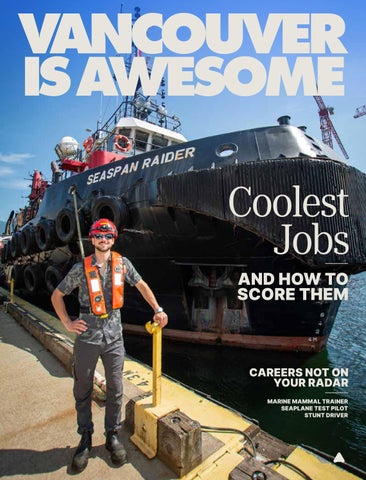
AND HOW TO SCORE THEM
CAREERS NOT ON YOUR RADAR MARINE MAMMAL TRAINER SEAPLANE TEST PILOT STUNT DRIVER
Awesome Jobs 2026 AWSM 1
Tristan C. Pilon is captain of the Seaspan Raider, one of the larger tugs operating in Burrard Inlet. NICK LABA PHOTO
2 AWSM Awesome Jobs 2026
F
or most of us, work is just ... work. But every now and then you meet someone whose office is the deck of a tugboat, the cockpit of a seaplane or an enclosure filled with sea lions. Someone whose job involves training hawks to keep airplanes safe, testing aircraft before anyone else flies them, or helping protect cannabis crops without a drop of harsh chemicals. And you can’t help but wonder: How on earth did they land that gig? That’s what this magazine is all about. Over the next few pages, we’re introducing you to some of Vancouver’s most awesome jobs — and, more importantly, the people behind them. We wanted to know what their days are really like, what it took to get there, and what advice they’d give to someone hoping to follow a similar path. Because while these careers might seem impossible from the outside, every one of them started with someone taking a first step. You’ll meet marine mammal trainers, tugboat captains, stunt performers, and plenty of others whose careers are anything but ordinary. Along the way, they’ll share the unexpected skills, lucky breaks and hard-earned lessons that helped turn childhood dreams into paycheques. Whether you’re searching for your next career, helping a young person imagine theirs or you’re simply curious about the fascinating people who make this city tick, we hope these stories leave you inspired. After all, Vancouver isn’t just a great place to live. It’s also an awesome place to work.
Awesome Jobs 2026 AWSM 3 Awesome Jobs 2026 AWSM 3
Ready to make a difference? Find your career with us. vancity.com/Careers
BUG COMMANDER Protecting cannabis with science 18
COVER PHOTO: Nick Laba
EDITOR Nick Laba EDITORIAL STAFF Brendan Kergin, Dev Patel, Elana Shepert SALES DIRECTOR Manny Kang SALES
SEAL THE DEAL Meet a marine mammal trainer AHOY Life of a tugboat captain
Wali Adel, Tammy Berry, David Chiew, Alison Clay, Brenda Coulbourn, Nayeli Garcia, Arlene Grant, Collin Neal
7
GENERAL MANAGER Matt Blair
7 12
ELECTRIC TEST PILOT Working 1,000 feet up
18
28 24
STUNTMAN EXTRAORDINARE Mentoring the next generation 28 AWESOME ANIMALS Coworkers with claws
32
303 W 5th Ave, Vancouver, B.C. hello@vancouverisawesome.com vancouverisawesome.com
Awesome Jobs 2026 AWSM 5
ALL IN CANADA. ALL-IN FOR CANADA.
Join the team building Canada’s maritime future. Learn more at Seaspan.com/careers
SEAL THE DEAL An animal lover’s dream job at Vancouver Aquarium
WORDS: ELANA SHEPERT IMAGES: ELANA SHEPERT & DEV PATEL
Awesome Jobs 2026 AWSM 7
A sea lion responds to a command from a trainer. DEV PATEL PHOTO
L
iving in Vancouver allows animal lover Jasmine Collier to work her dream job and then go for a swim or hike on the same day.
a good fit.
For Collier, handling oceanic animals is both her passion and profession. She’s been working as a marine mammal trainer at the Vancouver Aquarium for the past four years, but she’s loved animals her whole life.
And after gaining a little bit more knowledge about the field, I landed my first full-time position at the Alaska Sea Life Center,” she says.
“Like many people in this field, I have always had an appreciation and a passion for animals,” she says. That love for wildlife started in her home state of South Carolina. There, the animal enthusiast grew up digging in the dirt to find worms or rescuing kittens and birds. Her mom enrolled her in zoo programs so she could spend more time among the animal kingdom. When it came time to choose a career, Collier thought she’d become a veterinarian. But after doing some shadowing, she realized that wouldn’t be
8 AWSM Awesome Jobs 2026
“I went on to complete a couple rounds of internships at various zoos and aquariums.
In Alaska, Collier worked with Steller sea lions, since the state has a couple of rookeries where they gather. She grew fond of the animals there, and still enjoys working with marine mammals in Vancouver today. Her favourite animals at the aquarium are Bella Bella, one of the Steller sea lions, and Da Vinci, an adorable harbour seal. Collier says the best part of her job is building relationships with the marine mammals. She also loves working with her closeknit team of like-minded animal lovers.
Every day on the job starts with seafood Each day, Collier starts by defrosting food for the animals, which can be everything from squid to clams to various fish. Feeding occurs multiple times a day, alongside health checks to ensure the animals don’t have nicks, scratches or bruises, and to assess their overall health. Handlers also have enrichment programs for each mammal to keep them mentally stimulated and ensure they get exercise. If you’re keen to get a job like Collier’s, working at Vancouver Aquarium, you have to be OK braving the elements. Animal care happens 24/7, regardless of weather conditions. Since almost all of the marine mammals live outdoors, their trainers are outside regardless of what Mother Nature is up to. “And this means no matter the weather
“NO MATTER THE WEATHER — WHETHER IT’S RAIN, SNOW, WIND, COLD — WE’RE OUT HERE TAKING CARE OF THESE ANIMALS AND GIVING THEM THE BEST CARE THAT WE CAN.” JASMINE COLLIER, MARINE MAMMAL TRAINER, VANCOUVER AQUARIUM
— whether it’s rain, snow, wind, cold — we’re out here taking care of these animals and giving them the best care that we can,” she says. What advice does Collier give for someone who wants to follow in her footsteps? “The main thing is experience and connection. The sooner you can reach out to your local facility, whether it be a zoo, an aquarium, even a rescue facility ... and gain some experience there by volunteering, the better chance you’ll have at landing a position at a great facility like the Vancouver Aquarium,” she says. “I often tell people who want to be a marine mammal trainer or even a zookeeper that it’s not only about who you know, but who knows you.” If you’re curious to learn more about Collier’s job, marine trainers are available at Vancouver Aquarium to answer questions during presentations throughout the week. ❱❱
Good behaviour is often rewarded with fish. DEV PATEL PHOTO
Awesome Jobs 2026 AWSM 9
“AS SOON AS YOU CAN REACH OUT AND GAIN SOME EXPERIENCE BY VOLUNTEERING, THE BETTER CHANCE YOU’LL HAVE AT LANDING A POSITION AT A GREAT FACILITY LIKE THE VANCOUVER AQUARIUM.” JASMINE COLLIER, MARINE MAMMAL TRAINER THE VANCOUVER AQUARIUM
10 AWSM Awesome Jobs 2026
Awesome Jobs 2026 AWSM 10
Jasmine Collier says one of the best parts of her job is building relationships with the animals. ELANA SHEPERT PHOTO
Awesome Jobs 2026 AWSM 11
! Y O H A
12 AWSM Awesome Jobs 2026
THE LIFE OF A T U G B O AT C A P TA I N WORDS: ELANA SHEPERT IMAGES: NICK LABA
W
hile he might start with a coffee, this marine master’s day is anything but ordinary after that. Tristan C. Pilon has worked as a tugboat captain with Seaspan Marine Transportation for the past three years. After a caffeine kick, each day begins with a team debriefing for the tasks they’ll do. Some of these involve pulling really big vessels.
Vancouver Is Awesome joined the veteran seafarer aboard the Seaspan Raider on a bright, sunny day, while some of the crew slept below deck. That’s right: some of Pilons’s trips involve sleeps at sea, to ensure the crew are ready to tackle their demanding jobs, while following strict regulations. For shift work, the tugboat crew will spend roughly 12 hours on the vessel, towing fuel barges to and from the cruise
ship terminals, helping vessels come into port and serving the dry dock. But the ship we spoke to him on is one of the largest tugboats in the harbour, and is considered a continuous vessel. “For the continuous vessels, we usually have our jobs set ahead. So we plan our trips in the longer term, [and] we have to look at tides, weather etc. over 24, 48 hours,” says Pilon, adding that these shifts involve six hours on and six off. ❱❱
Awesome Jobs 2026 AWSM 13
“One of the difficulties of the job is the scheduling and timing of things,” he says. Any small delay could spell nautical bedlam. “What happens if there’s a delay with the ship? You might be missing your tidal window for the Second Narrows transit.”
The captain says his biggest tug was the mighty Seaspan Royal, an imposing vessel clocking in at 40 metres with roughly a 900 gross tonnage. To put that in perspective, the tug we were standing on is about 444 gross tonnage — and it’s one of the biggest tugs in Vancouver.
But this planning, teamwork and expertise are part of why Pilon loves his job. It’s never boring, and he has always loved being on the water.
Aside from being on the water, Pilon has developed a close relationship with the crew, who eat meals, work out and bond together during long shifts at sea.
“I have been on the water ever since I was a kid. My father had a windsurfing business. So as a child, I would hop on the windsurf with him, and we would go sailing around,” he says, recalling his early days growing up in Quebec.
“We have great people working here, and people have all these good stories that we can share in the day-to-day, and we tend to eat good food,” he says with a smile.
Journey to captain: From Quebec to beautiful B.C. Before joining Seaspan, Pilon worked for Group Ocean on the St. Lawrence River. He says the work was quite different, involving breaking through thick ice in the winters. During the frosty season, operations really slowed down. “Here, all year long, it’s go, go, go. It’s busy,” he says. Pilon’s busy days consist of towing a variety of vessels, ranging from fuel barges to cruise ships to everything in between.
14 AWSM Awesome Jobs 2026
And in some moments, Pilon says his job feels larger than life. Recently, he spotted an eagle trying to capture a fish from the water during an impressive sunrise display. Not long after, he was towing a fuel barge and one of his dad’s favourite songs, Depeche Mode’s “Personal Jesus,” was playing as he spotted a pod of orcas. “And you know, you take a minute, and you ask yourself, ‘Am I working right now? What’s going on?’” Pilon says these magical moments often find him, making days at sea feel surreal. ❱❱
Tugboat captain Tristan C. Pilon says he’s always loved being out on the water. NICK LABA PHOTO
Awesome Awesome Jobs Jobs 2026 2026 AWSM AWSM 15 15
“YOU TAKE A MINUTE, AND YOU ASK YOURSELF, ‘AM I WORKING RIGHT NOW? WHAT’S GOING ON?’” TRISTAN C. PILON, TUGBOAT CAPTAIN SEASPAN MARINE TRANSPORTATION
16 AWSM Awesome Jobs 2026
Awesome Jobs 2026 AWSM 16
A tug crew pulls a fuel barge to a Disney cruise ship parked in Burrard Inlet. NICK LABA PHOTO
Awesome Jobs 2026 AWSM 17
18 AWSM Awesome Jobs 2026
S I B A N N T A S C ENTI I SC THE
Bug commander: The cannabis scientist sending microscopic armies to war ❱❱ WORDS & IMAGES: NICK LABA
Awesome Jobs 2026 AWSM 19
Y
ou scan the battlefield. The enemy is already at work, hell-bent on decimating your crops. Accessing your cryo storage, you retrieve a battalion of troops. Within minutes, they’ve shook off their cold stupor and are itching to attack. This may sound like some distant militaristic future, but it’s just another day for Liam Buirs, head of integrated pest management and cultivation research at Village Farms in Delta. There, he’s in charge of protecting an unfathomable number of cannabis plants that grow in the company’s two massive greenhouses, which measure at 1.1 million square feet each. If you’re like me, you’ve had a few battles of your own against the scourge of spider mites. Personally, I’ve all but drowned my poor dracaena in treatments with terrifying names like “End-All.”
Phytocelius persimilis is a predatory mite native to Chile. ATTELABUS/CREATIVE COMMONS PHOTO
20 AWSM Awesome Jobs 2026
But Buirs is smarter. As bug commander, he gets his microscopic army to do the dirty work. His most-deployed foot soldier is Phytocelius persimilis, a predatory mite native to Chile. “It’s a specialist, so it goes only after two-spotted spider mites, making it a
really effective biocontrol and often one that’s used as a curative,” Buirs explains. After removing a bottle from the fridge, scores of the small red critters begin to scuttle around. He loads them into something of a bug gun, which looks like a drill with a slowly rotating drum on the end. Buirs puts the predatory mites into the gun with some woodchips, then slowly walks along a row of plants, unleashing the hungry bugs to seek and destroy any unwelcome pests. Understanding his biological arsenal is critical to success in Buirs’s industry, where Health Canada scrutinizes every step of cannabis production with almost no wiggle-room. “They see cannabis, and we see cannabis, as almost organic in a sense,” he says. “If you’re looking at pesticides, organic producers actually have more liberty on that front than we do. We’re very restricted to safe, proven biological control products and several other things like soaps and like natural oils — things that you already find in nature really are what we’re able to use to then control the natural problems that we deal with,” Buirs says.
Predatory mites scuttle around the mouth of a bottle after coming out of refrigeration. NICK LABA PHOTO
Career started with an interest in biology and horticulture After high school, Buirs wasn’t sure what he wanted as a career, so he took a few introductory courses at Kwantlen Polytechnic University, which was near where he lived. Soon, the subjects of horticulture and biology quickly grew on him, which branched off into courses in botany and sustainable crop production. “It just fascinated me that you could produce crops in such an environmentally friendly way and that you could leverage [integrated pest management] instead of traditional chemistry to control problems that a lot of growers deal with,” Buirs says. At KPU, he extended his diploma on plant health into a degree. That academic study brought him to work with Pure Sunfarms (Village Farms’ cannabis brand), which had just begun growing weed in large greenhouses at the dawn of legalization in Canada. “I ended up with a master’s of science focused on cannabis plant pathology, and from there we’ve just really doubled down on trying to understand what’s going on,” says Buirs, who’s now 29 years old.
“IT JUST FASCINATED ME THAT YOU COULD PRODUCE CROPS IN SUCH AN ENVIRONMENTALLY FRIENDLY WAY.” LIAM BUIRS, HEAD OF INTEGRATED PEST MANAGEMENT AND CULTIVATION RESEARCH AT VILLAGE FARMS
Today, he continues to work with researchers at Simon Fraser University and Langara College, as his team pushes the needle forward in a relatively new field. “If you look at tomatoes, tomatoes have been grown in greenhouses for a century. Cannabis has only been grown in greenhouses like this for under a decade, so we have a lot of catching up to do,” Buirs says. As he monitors his mite-eating minions at work, and keeps close watch over his leagues of cannabis plants, Buirs must also take special care not to get stuck in the weeds. ❚
Awesome Jobs 2026 AWSM 21
22 AWSM Awesome Jobs 2026
THE TEST PILOT
Meet the man flying an electric float plane in the skies above Vancouver ❱❱ WORDS: BRENDAN KERGIN // IMAGES: SUBMITTED
Awesome Jobs 2026 AWSM 23
Shawn Braiden is one of a select few pilots test flying a new electric float plane. SUBMITTED PHOTO
V
ancouver is a nice city to work in, but what about working above it — like, 1,000 feet up? Shawn Braiden has decades of experience in the aviation industry, rising to become vice-president of maintenance and manufacturing at Harbour Air. But he’s also working on a cutting-edge project. He’s one of the test pilots flying the electric de Havilland Canada DHC-2, also known as the eBeaver. Introduced in 2019, Harbour Air has been working with magniX, the engine builder, to test the electric plane. They’re working towards it being certified for commercial use. Braiden is one of the few people who’s flown the eBeaver so far, getting to take the bright yellow plane out over Greater Vancouver’s farming fields and neighbouring ocean. “With the flight characteristics, it flies just like any other Beaver,” Braiden says. In fact, from a pilot’s point of view, the eBeaver is easier to fly. For one, the power plant operation is simpler, with just two levers. “It’s a lot easier to operate compared to piston or turbine,” Braiden says. “It’s really smooth, it’s really quiet. We’ve got even more thrust than the piston version. “It’s an easier plane to fly and an easier
24 AWSM Awesome Jobs 2026
plane to maintain,” he continues. The noise, or lack thereof, is a highlight both for those in the plane and those working around it. “I’m sure all the public on the ground would love to have these flying over,” he says. “They’re considerably quieter when they’re taking off.” People might not realize it’s passing overhead. At 1,000 feet it’s barely audible, Braiden explains. It’s also a lot quieter in the cockpit, which is good for Braiden and the test pilots who have to test and measure many specific details of their flights, from speed capabilities to calibration of instruments. When Braiden takes the plane out for a flight, he’s keeping it close to home. The flights often start at Sea Island, out of a facility Harbour Air has south of Vancouver International Airport. When floats are attached, the test pilots fly over the Salish Sea. When the wheels are on, they mostly fly over forest and farmland. “Sometimes we fly out of Pitt Meadows, or occasionally directly out of Vancouver, then down to Westham Island,” he says. Electric plane will be ideal for tours above the city Generally they keep it away from densely populated areas, as it’s experimental aviation. And they’re not
going for long-distance records. Most flights are kept short. But, once it’s certified by regulators, the plane can go into service over the city, flying over the North Shore, Stanley Park and the city’s core. Braiden says Harbour Air’s pilots are excited about that since it’ll be ideal for tours over the city. “All of that is a ton of fun and a blast,” he says. Right now they’re waiting for the new engine, the Magni650 from magniX, to arrive and be installed in the eBeaver before more flights. “I’m looking forward to getting to do more test flying,” Braiden says. “The line crews are really excited.” The timeline is a little muddled, he notes, as politics south of the border has meant funding for projects like electric plane engines has changed. The eBeaver isn’t the only electric flying machine Harbour Air is working on. They’re also working with other companies on creating an electrified version of a Vans RV-10 (a small kit plane) and Robinson R-66 (a small helicopter). No word on when those might be in the air, above Vancouver, but if you hear a quiet yellow plane flying by you can wave to Braiden or one of his coworkers. You might even be able to shout hello. ❚
HELP WA N T E D “A LACK OF AVIATION TECHNICIANS AND MECHANICS IS A CRITICAL ISSUE RIGHT NOW. I WOULD SAY IT’S GOING TO BE THE LARGEST ISSUE FOR THE INDUSTRY.” SHAWN BRAIDEN, VICE-PRESIDENT OF MAINTENANCE AND MANUFACTURING AT HARBOUR AIR
Awesome Jobs 2026 AWSM 25
Several education institutions offer aviation mechanic programs, including BCIT. SUBMITTED PHOTO
26 AWSM Awesome Jobs 2026
Aviation mechanic shortage looming While there’s a well-known pilot labour shortage on the horizon, a different shortage looms larger. A lack of aviation technicians and mechanics is a critical issue right now, Bradien says. “I would say it’s going to be the largest issue for the industry.” In the coming years, Braiden expects the shortage to affect more flights than the lack of pilots. Global consulting firm McKinsey and Company has estimated a shortage of 60,000 technicians by 2029. That’s due to rising demand and increased retirement. At the same time, it’s a job AI isn’t set to take over. Over the years, as airlines tried to keep costs down, one place to save money was aviation mechanics’ wages, Braiden says, but people have left the industry to work in similar fields that pay more. Now there’s been a shift in wages, but not enough workers. “We’re not developing new technicians at the rate we need to be,” Braiden says. One bright spot is the electrification of aircraft, which has drawn the attention of younger potential technicians. Interested in a high-flying career of fixing aircraft? There are several education options in B.C., including BCIT. ❚
Awesome Jobs 2026 AWSM 27
STUNTMAN EXTRAORDINARE
Rick Pearce is the founder of Reel Stunt Driving School. SUBMITTED PHOTO
28 AWSM Awesome Jobs 2026
After four decades in Vancouver’s film industry, stuntman Rick Pearce is still chasing the next action scene — and helping the next generation do the same.
A
t age 64, Rick Pearce still gets shot, crashes vehicles, throws punches and slides behind the wheel of speeding cars — all before heading home for dinner. The veteran stunt performer, stunt coordinator and founder of Reel Stunt Driving School has been working for the past 40 years to help bring some of Hollywood’s largest productions to life in Vancouver. Some of his famous works include The Last of Us, X-Men 2, Deadpool, Snowpiercer, Charmed, Fringe and A Series of Unfortunate Events. But for Pearce the excitement isn’t the explosions — it’s that he still performs for a living. ❱❱
WORDS: DEV PATEL // IMAGES: SUBMITTED
Awesome Jobs 2026 AWSM 29
Pearce performs stunts on his own time, too. SUBMITTED PHOTO
It’s the sense of wonder that has kept Pearce in one of Vancouver’s most unique professions — a career filled with calculated risk, constant training and a city that became Canada’s action film playground. In 1982, Pearce arrived in Vancouver hitchhiking from Calgary with nothing more than determination. He stumbled upon a local stunt school and was introduced to a world he never knew existed growing up in Brandon, Manitoba. “I just kept plugging away,” he recalls. “It was all about persistency and not giving up.”
“I GET TO BE A KID AT 64 YEARS OLD! I GET TO DO THE MOST AMAZING JOB IN THE WHOLE ENTIRE WORLD!” RICK PEARCE, STUNTMAN & INSTRUCTOR
30 AWSM Awesome Jobs 2026
His career took off as Vancouver’s film industry boomed with productions like 21 Jump Street and Wiseguy. He thanks the city for taking him from an aspiring newcomer into one of Canada’s esteemed stunt performers. “You can’t beat Vancouver,” Pearce says. “It’s got the mountains, the forest, the ocean, downtown — there’s always somewhere to shoot.” But the job itself isn’t always that glamorous.
He says one of his roughest shoots to date was filming Saving Silverman. For one scene, he jumped from a moving van travelling about 50 kilometres per hour (six times!) slammed into a Camaro on a skid plate, then smashed through a windshield with his head after being hit by a car at 30 km/h. (All this happened in one day.) Remarkably, he walked away without any serious injuries, thanks to careful preparation. “Pad up,” he says to every young stunt performer. Pearce also came close to doubling Hugh Jackman in X-Men 2 after months of training and has worked alongside countless Hollywood stars including Nick Nolte. Outside the film industry, Pearce has made history in the world of freestyle jet skiing. “I was the fifth guy in the world to do a backflip on a stand-up jet ski in the surf…. I still do backflips on a stand-up jet ski on flat water.” Pearce says. Today, one of his proudest roles happens off camera. As founder of Reel Stunt Driving School, he teaches aspiring stunt drivers the precision required to land on exact
Pearce meets actor Nick Nolte on a recent film set. SUBMITTED PHOTO
camera marks, drift safely and think like professionals. Many of his past students gone on to find success in the film industry, including Zendera Kennedy, who has performed stunts in Twisted Metal, Fire Country and The Predator. “I’m just the guy that gives you the information to go out and practise and get better,” he says. For young people who want to pursue an unconventional career, his advice is simple: “If you want it, you’ve got to work hard for it. Never give up on your dream.” He adds that stunt work is highly unpredictable, however. “It’s feast or famine,” he says, advising newcomers to always keep another source of income while slowly building contacts and gaining experience. Now, Pearce fears the next hurdle facing the local film industry isn’t a takeoff ramp. “I just hope it keeps going,” he says. “Hopefully AI does not replace all our jobs.”
“IF YOU WANT IT, YOU’VE GOT TO WORK HARD FOR IT. NEVER GIVE UP ON YOUR DREAM.” RICK PEARCE, STUNTMAN & INSTRUCTOR
For now, Pearce still climbs into the driver’s seat, never quite knowing what the next call sheet will demand. In a city where mountains meet movie magic, that’s exactly the adventure that keeps him coming back. ❚
Awesome Jobs 2026 AWSM 31
32 AWSM Awesome Jobs 2026
AW E S O M E ANIMALS From sniffing out disease to deterring gulls, check out these animals at work. ❱❱ WORDS: BRENDAN KERGIN & ELANA SHEPERT // IMAGES: BRENDAN KERGIN & SUBMITTED
A Harris’s hawk protects meals at Granville Island from pesky seagulls. BRENDAN KERGIN PHOTO
Awesome Jobs 2026 AWSM 33
“AIRPORT DOGS MUST HAVE STRONG WORKING INSTINCTS, CONFIDENCE, EXCEPTIONAL OBEDIENCE AND THE ABILITY TO OPERATE SAFELY AND INDEPENDENTLY ACROSS A BUSY AIRFIELD ENVIRONMENT.” ALICIA DOYLE, YVR SPOKESPERSON
W
hile the vast majority of jobs in Vancouver are held by humans, it’s not quite 100 per cent. There are a variety of careers that are best suited to non-humans, and we’re not talking about AI or robots. Dogs, cats, birds and other animals work throughout the city, often providing help and protection in ways humans can’t, or at least wouldn’t be very good at. (Have you tried to scare off a hungry flock of seagulls?). From keeping arriving airplanes safe, to detecting harmful bacteria and the classic feline job of mouser, these are some of Vancouver’s top working animals. Airport runway-clearing dogs Vancouver International Airport (YVR) has a canine program to help clear the airfield of migratory birds in the fall and winter, when they’re most abundant on the Fraser Estuary surrounding it.
obedience and the ability to operate safely and independently across a busy airfield environment,” says YVR spokesperson Alicia Doyle.
variety of birds for a variety of jobs. But at Granville Island it’s typically a Harris’s hawk who’s called in for duty.
After serving eight seasons on the job, Pilot, a unique breed of dog called a Mudi, retired. Mudis are a rare Hungarian herding breed known for intelligence, agility and a strong work ethic.
The hawks are well suited to the city job and birds like Poquito, Lulu and Ava have taken shifts, guarding meals from avian thieves.
Now, another experienced Mudi — four-year-old Echo — will chase a variety of birds, including Canada geese, snow geese, ducks, gulls and great blue herons, off the airway.
For more than a decade, the canine scent detection team at Vancouver Coastal Health sought out diseases using, as the name suggests, dogs’ sense of smell.
Granville Island raptors Shrieking seagulls are often hard at work trying to steal snacks from unsuspecting visitors at Granville Island, mostly undeterred by humans. So someone else had to be hired to ward them off.
But not every dog is cut out for the highly specialized job description.
Birds of prey were brought in to protect people’s precious pizzas, rice bowls and croissants.
“Dogs must have strong working instincts, confidence, exceptional
Vancouver Island-based company The Raptors (now with a Delta location) has a
34 AWSM Awesome Jobs 2026
They’re a natural predator to gulls.
Dogs that sniff out diseases
What they’re trained to detect is C. difficile, a bacterium that causes diarrhea and inflammation of the colon, and can be fatal. They search hospital rooms and corridors for places it might be hiding out. The team currently has six canines on staff. Most dogs can smell the bacteria, but certain breeds work better, especially in a hospital. Currently there are couple of different types of spaniels and one Labrador retriever. Dogs that are medium-sized, have floppy ears (because they’re less
intimidating) and a good temperament are ideal for the work in the busy environment, where they have to poke into every little corner. UBC’s rodent control squad ❱❱ For millennia, cats have lived alongside humans, and helped with one major service: keeping rodents at bay. Even now, with AI, drones and advanced chemistry, cats are the preferred rodent control system in many places. At UBC, a mousing trio watches over the horticulture building, taking on a job generations of felines have held before, protecting plants from rats, mice and other vermin. The furry employees right now are Lola (the veteran), Vesper and Raven. When people buy plants at select UBC Greenhouse sales, proceeds go toward the in-house mousers. While keeping mice at bay, they’re friendly companions for staff and visitors (naturally). ❚
V A N C O U V E R
P O L I C E
D E P A R T M E N T
WE'REHIRING VPD AD
Visit JoinVPD.ca for more information
Awesome Jobs 2026 AWSM 35
EXPERIENCE
TRANSFORMATION
Upgrade Job Skills • Self-Paced Online Learning Train For A New Career • Custom Corporate Training Try Something New For Fun
COQUITLAM CONTINUING EDUCATION
REGISTER TODAY AT CE43.CA