FREE
B . C .
W I N E
C U L T U R E
SPRING/SUMMER 2026
Issue 17 INTRODUCING: WINE SCHOOL G R I L L E D F O O D PA I R I N G G U I D E F R O M PA Í S TO P I C P O U L I N D I G E N E I T Y I N T H E V I N E YA R D D E S T I N AT I O N F R A S E R VA L L E Y E L E VAT I O N’ S R I S I N G I N F LU E N C E M E E T S T E P H A N I E M AT H I S WINE NEWS AND TRENDS BC WINE LISTINGS
LEARN MORE
18
Contents
Photo courtesy of Cannon Estate Winery
05 – SIPS & NIBBLES News and trends from wine country. 10 – IN THE VINEYARD From País to Picpoul: The world’s forgotten grapes make a comeback. by Christine Campbell 14 – WINE SCHOOL Yes, there really is proper way to hold a wine glass. by Vitis staff 18 – B.C. WINE COUNTRY Cannon Estate Winery and the Fraser Valley’s sparkling future. by Abby Wiseman
26 – WHAT SOMMS SAY Meet the welcoming wine nerd Stephanie Mathis. by Shiva Reddy 30 – INDIGENEITY IN THE VINEYARD Why wineries should make connections with the land’s knowledge keepers. by Christine Sismondo
30
36 – FOOD FOR THOUGHT The essential pairing guide for all your summertime grilled foods. by Joanne Sasvari 40 – LISTINGS Your guide to B.C.’s wineries. 46 – WINE GEEK Elevation: Taking wine to new heights. by Christine Campbell
Photo courtesy of Nk’Mip Cellars
PUBLISHER: Gail Nugent • gnugent@lodestarmedia.ca
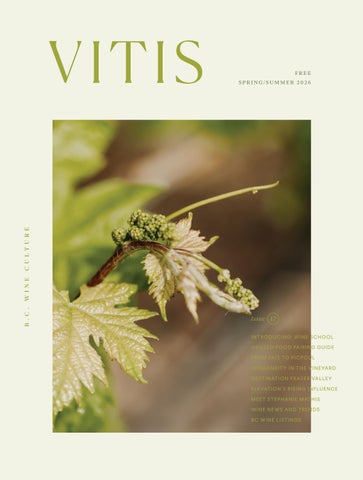
COVER IMAGE: Gold Hill Winery
EDITOR: Joanne Sasvari
SOCIAL MEDIA EDITOR: Stephanie Leblanc
DESIGN & PRODUCTION MANAGER: Tara Rafiq • trafiq@lodestarmedia.ca
Vitis.ca @VitisMag
PUBLISHED BY: Lodestar Media 303 W. 5th Ave., Vancouver, BC V5Y 1J6 778-240-4010 © Vitis 2026 This issue is complimentary.
3
THE FUTURE OF WINE IS CLAIRET
F
Spring calls out for lighter, fresher, juicier wines—which also happen to be just what our palates crave these days. Darren Hull photo courtesy of Wines of British Columbia
Contributors JOANNE SASVARI is editor of Vitis and YAM magazines. She is a WSET-certified writer who covers food and drink for publications including Food & Wine and Edible Vancouver, and is the co-author of the bestselling Island Eats and Okanagan Eats cookbooks. CHRISTINE CAMPBELL is a Vancouverbased freelance and travel writer, educator and host of the Wine Soundtrack Canada podcast. She is WSET-certified and is a French Wine Scholar. Follow Christine’s adventures in wine and abroad at girlsgogrape.com. SHIVA REDDY is a veteran sommelier who has led focused wine programs for top restaurants including the Michelin-starred Burdock & Co, She is also the food and wine columnist for CBC Vancouver. CHRISTINE SISMONDO is a National Magazine Award-winning writer who covers spirits, wine, bars and cultural history for numerous publications, and is the author of America Walks into a Bar. ABBY WISEMAN is a writer, photographer and content strategist who writes for Edible BC and has worked with well-known food and beverage brands and restaurants. Follow her on Instagram @amusebouchecreative.
ifty years ago this spring, on May 24, 1976, the wine world was stunned when two California wines beat their top French counterparts in a blind tasting that famously became known as the Judgment of Paris*. Several events are being held in commemoration, including a US$3,500-a-head dinner at The French Laundry in Napa. If you have some California wines in your cellar, consider opening one to celebrate. But a shift like this isn’t just about Old vs. New World wines. It’s about how wine is ever-evolving, how palates and fashions change, grapes disappear and re-appear, world events come into play and a changing climate makes it possible to grow great wine in places that would have been impossible not so long ago. A decade ago we weren’t talking much about wines from Georgia or Jura, and now they are the darlings of the wine world. We weren’t drinking Picpoul or Assyrtiko, and now we seek them out. And we sure weren’t looking to England for sparkling wines that rival those from Champagne. Now we do, while Champagne itself is dealing with heatwaves, spring frosts and high humidity, which in turn are leading to less acid in the wines, more disease in the vineyards and ever higher prices. One fascinating conversation right now is the one around claret/clairet. “Claret” is what the British have traditionally called the bold, tannic, well-aged and often pricey red wines of Bordeaux. But these days we prefer lighter, brighter, fresher, lower-alcohol and more food-friendly reds. The result? The market for Bordeaux has slumped. Already, 15 per cent of Bordeaux’s vineyards have been dug up to be used for other types of farming. It’s been suggested that the best solution is to produce lighter, younger, less tannic reds. As it turns out, there already is a Bordeaux wine exactly like that, one that’s been around since the medieval days when Eleanor of Aquitaine ruled the region: “clairet,” a juicy, easy-to-enjoy wine that hovers between rosé and light red. It’s best served chilled and goes great with backyard barbecues. There has been some outcry and plenty of confusion, of course, because no one likes change. But change happens anyway. It’s not always comfortable, but for the most part it leads to exciting new flavours, techniques and styles—and even the return of wonderfully old ones. After all, the world of wine is a big one, with plenty of room for a California Chardonnay, a Georgian Saperavi, both claret and clairet and whatever delicious new wine is going to come next. —Joanne Sasvari, editor *Organized by British wine merchant Stephen Spurrier, the Paris Wine Tasting of 1976 was won by Napa Valley’s Chateau Montelena 1973 Chardonnay and Stag’s Leap Wine Cellars 1973 Cabernet Sauvignon.
4
ISSUE 17
Sips & Nibbles Vitis Staff
S I P S
&
N I B B L E S
TAXES, TRADE, TRYING TIMES It sounded like good news, but is it really? The federal government recently announced a two-year extension to the excise duty relief that was set to expire this April. Certainly, the news could have been a lot worse. But critics insist the tax—which increases year after year automatically—is unfair by its very nature. And with all the pressures of tariffs and soaring fuel costs, it is just one more burden for producers to bear. Here’s the background: In 2017 the federal government launched an alcohol escalator tax program that automatically increases excise taxes on beer, wine and spirits every year to help keep pace with inflation. In 2023, with the industry reeling from COVID and inflation skyrocketing, the government capped the increase at two per cent. They extended that cap again in April 2024, when the increase was likely to be a historically high 4.7 per cent, and again in April 2026, for two more years. Even so, the excise tax on alcoholic products has risen a whopping 18 per cent since 2017. The Canadian Chamber of Commerce has called it “a bitter pill to swallow,” noting especially its impact on the hospitality industry, which was hard hit by the pandemic. They and other critics are calling for an open debate in the House of Commons. Another issue that is exercising wine producers especially is interprovincial shipping. Everyone seems to be for it and yet we still only have four provinces that allow it (British Columbia, Manitoba, Saskatchewan and Nova
Photo courtesy of Wines of British Columbia
Scotia). In March, that expanded somewhat with a new agreement that allows residents in Ontario and Nova Scotia to buy directly from each other. Alberta and B.C. have also reached memorandum of understanding that allows for DTC sales. A little frustratingly, though, Ontario and B.C. recently reached an interprovincial trade that excluded alcohol. Meanwhile, Dan Albas, Member of Parliament for Okanagan Lake West–South Kelowna, has introduced Bill C-262, which aims to amend the Canada Post Act to force a national standard for interprovincial alcohol shipments. It’s getting plenty of support, including petition e-7258, initiated by Ron Kubek, owner of Lightning Rock Winery in Summerland. If this seems like something you’d support, you can sign it at petitions.ourcommons.ca.
5
T H E VA L U E O F S LO W There’s a lot to be said for taking it slow, for savouring life and supporting smaller, more sustainable communities and the people who make them thrive. That’s what Cittaslow is all about. The name literally means “Slow City,” inspired by the Slow Food movement. Some 308 communities around the world are certified as Cittaslow, including six in North America, two of them in B.C.: Cowichan Bay and Naramata.
S I P S
A N D
N I B B L E S
Now the tiny village of Naramata (pop. 1,628) is swinging big and making history as the first-ever North American destination for the Cittaslow International Co-ordinating Committee Meetings, hosted by the non-profit Naramata Slow, with support of Discover Naramata and the Regional District of Okanagan-Similkameen. From April 16 to 19, some three dozen international delegates joined Canadian representatives, including mayors, planners, tourism leaders and community-building experts, to discuss ways and means for fostering community-centred, sustainable development. It’s an opportunity to showcase this charming wine country community and its thoughtfully slow approach to life, but it’s also much more than that. It’s an investment in the long-term reputation, resilience and future of both the region and the rest of Canada.
iStock/Getty Images Plus/laughingmango photo
As Miranda Halladay, president of Naramata Slow, says: “This event is both a celebration and an invitation—an opportunity to share Naramata’s approach to slow living while encouraging other small towns in British Columbia and beyond to explore Cittaslow values and certification.”
A P RIL IS BC WI N E M ON TH We’ll take just about any excuse to enjoy B.C. wine so we’re pretty happy that the provincial government has proclaimed this April the ninth annual BC Wine Month, just in time for the spring releases. This April is especially exciting because we’re seeing the first of the 2025 grown-in-B.C. wines after the loss of the previous vintage to the devastating winter freeze of 2024. While we’ve enjoyed the so-called “replacement wines” that have kept doors open and product on shelves, we really can taste B.C. in the glass and can’t wait to drink deeply of our own terroir. All this month, expect to see restaurants, liquor retailers and hospitality partners showcasing B.C. wine through curated features, in-store highlights, by-the-glass features and seasonal experiences that inspire discovery. Raise a glass to the best this province can produce, and see what everyone else is sipping by following along with @WinesofBC and #BCWineMonth.
6
ISSUE 17
RECOGNITION FOR BC WINE CHAMPIONS
From left: Honorees Miles Prodan, Rhys Pender, Jenna White, Brynne Dickson, Andrzej Lipiński and Rowan Stewart. Tania Veitch photo courtesy of Wines of British Columbia
C
heers to frequent Vitis contributor Rhys Pender MW, winner of this year’s BC Wine Industry Leadership Excellence Award, which was announced at the 2026 Canadian Wine Industry Awards earlier this month. Wine Growers Canada presents the awards each year, recognizing the individuals, organizations and businesses that have gone above and beyond to support and enhance Canada’s $11.5-billion wine industry. This year, those awards included some wellknown names from B.C. • The Stewart Family, of Quails’ Gate Winery, was honoured with the Canadian Wine Industry Award of Distinction, regarded as the highest form of peer recognition in the Canadian wine industry. • Miles Prodan, previous CEO of Wine Growers BC, received the Wine Industry Champion Award, in recognition of his 14-year tenure as a leader of— and tenacious advocate for—the B.C. wine industry. At the same time, Wine Growers British Columbia presented the BC Wine Industry Recognition Awards. In addition to Pender, whose work as educator, writer, winemaker and co-owner of Little Farm Winery has “meaningfully advanced the BC wine industry,” Brynne Dickson of CedarCreek Estate
Winery was honoured with the BC Wine Industry Ultimate BC Wine Ambassador Award, while Jenna White, a.k.a. ThatBCWineGirl, received the BC Wine Industry Master Marketer Award. Those aren’t the only awards that have been handed out lately. In March, the Celebrating Excellence Awards were announced at the Vancouver International Wine Festival’s 22nd Annual Awards Lunch. Among the honorees: • Carmen D’Onofrio, managing director of Stile Brand, for winning the Spirited Industry Professional award, presented to an individual who has made a significant contribution to the sales, service or promotion of wine in British Columbia. • Michael Littleford of This is Wine School, Sommelier of the Year, selected through a handson competition organized by the BC Chapter of the Canadian Association of Professional Sommeliers. • Marquis Wine Cellars, named Wine Retailer of the Year, an award presented by the Import Vintners & Spirits Association (IVSA) and ABLE BC. • All the winners of the 2026 Wine Program Excellence Awards, which this year were reimagined to better reflect and recognize excellence in the restaurant community. Find them at vanwinefest.ca. A sincere congratulations to all the winners.
7
G ROOV Y G LA S S WA RE It’s the annual summertime dilemma: You want to enjoy good wine in good glasses at your outdoor events, but you don’t want to risk broken glass all over your patio, not to mention how annoyed you’d be if someone smashed your precious Vinum stems. Luckily, acrylic glassware is getting better and better all the time, and there are some truly sophisticated options these days.
S I P S
Riedel photo
Crate & Barrel photos
Not shatterproof, but casual and easygoing enough for the backyard, Riedel's Happy O Wine Tumbler combines the shape of a Vinum bowl with the tradition of the casual stemless wine glass and just a splash of cheerful colour. riedel.com/en-ca
A N D
N I B B L E S
For instance, there’s the stylish and shatterproof Schott Zwiesel Tour outdoor glasses for Crate & Barrel. Contemporary in design, generous of bowl, resistant to breakage and made from an acrylic with crystal-like brilliance, these come in both stemmed and stemless versions, perfect for reds, whites, rosés, spritzes and even the clumsiest of your guests. crateandbarrel.ca
TIDBITS
Band, on July 22 and, wrapping up the season, the multi-platinum-selling singer-songwriter Amanda Marshall on August 6. Get your tickets before they sell out! missionhillwinery.com R A I S E A G L AS S ( O R T WO) TO M O M The 12 wineries in the Heart of Wine Country— Okanagan Falls and Skaha Lake—know what your mom really wants, and probably you, too. On May 9 and 10 they are offering complimentary tastings and exclusive events. Cheers to that!
B I G N A M E S I N T H E A M P H I T H E AT R E The lofty bell tower at Mission Hill Family Estate might just be outdone for once by the stars who’ll be headlining this year’s summer concert series. On July 8, that’s the eight-time-Juno-Awardwinning Tom Cochrane and Red Rider, followed by Canadian rock royalty, Burton Cummings and His
8
Among the highlights will be the live music served up at Blasted Church Vineyards, Meyer Family Vineyards and Nighthawk Vineyards, but each winery is offering something special. Check out what’s happening at: Black Market Wine Co., Bonamici Cellars, Lakeboat Winery, Liquidity Wines, Mayhem Wines, Noble Ridge Winery, See Ya Later Ranch, Stag’s Hollow Winery and Wild Goose Winery. For details visit: theheartofwinecountry.ca.
ISSUE 17
Where sustainability rules
A
sk award-winning winemaker Severine Pinte what motivates her unwavering belief in sustainability and she’ll tell you, “I’ve been doing it all my life.” It’s the foundation of good winemaking and sound viticulture, says Pinte who has been at the fore of sustainable winemaking in B.C. since arriving in the Okanagan from her native France. Employing sustainable practices from vineyard to cellar adds up to yet one more facet of running a viable winery, explains Pinte, who has chaired Sustainable Wine Growers of British Columbia (SWGBC) since 2020. Pinte reckons a strong program embraces everything from preserving water to working hard to build social equity by “taking care of the people not only within your business, but outside as well—by helping to foster a sense of community.” The winemaker recalls that when she arrived in 2010, the B.C. wine industry was just gearing up its sustainability program. She “jumped on board,” applying to the Rhône-inspired Le Vieux Pin and the more Italian LaStella those same practices she’d been following in the Languedoc region of France. “When we launched Sustainability BC Certification in 2021, I immediately put the two wineries and our vineyards through the program because it actually felt normal,” she says. “When I looked at the [certification] standards for wineries and vineyards, we were already employing many of those practices.” Going through certification involved looking at the business under a magnifying glass, then drilling down
and expanding on many of the actions already under way. “Now it’s just a matter of maintaining—and focusing on—continuous improvement every year,” she says. For example, adhering to and improving upon expedient water use remains a key goal, says Pinte. She points to the recent installation of 99 automatic irrigation valves, which help the viticulturist fine-tune water flows and timing even more precisely, as required. Pinte also credits the solid sustainable foundation with helping the wineries’ successful response to the “Big Freeze” of 2024. “We were able to pivot funds elsewhere, to rebuild the vineyards,” she explains, adding that equally important was being able to keep the team together during a tough time. One of her favourite varieties to work with is Syrah, which she loves for its ability to make “really beautiful, elegant wines which are responsive to the type of terroir we have in the south.” Roussanne is another firm favourite, especially in sandy soils, for its “flowery notes that are delicate, but still with nice structure and texture.” And, of course, Sangiovese. LaStella is one of very few Canadian wineries to work with the Italian grape. Even though its growing season is short (compared to Italy) and the variety is one of the last to ripen, with a low yield, they are still able to get “a fruity style” that shows the core characteristics of Sangiovese. “And to be able to do that here in Canada, I find that pretty cool!”
S P O N S O R E D
Severine Pinte in the vineyard. Tania Veitch photo
AT L E V I E U X P I N A N D L A S T E L L A , G O O D P R A C T I C E S LEAD TO RESILIENCE IN CHALLENGING TIMES
Le Vieux Pin and LaStella Winery For more information, visit levieuxpin.ca and lastella.ca
9
Back from the brink T H E R E V I VA L O F W I N E ’ S F O R G O T T E N VA R I E T I E S OFFERS HOPE FOR THE FUTURE
I N
T H E
V I N E Y A R D
Christine Campbell
The revival of Listán Negro in the volcanic soil of the Canary Islands recognizes the unique flavour of Atlantic viticulture. iStock/Getty Images Plus/StockPhotoAstur
A
round the world, winemakers are rediscovering long-overlooked grapes—reviving history, boosting vineyard biodiversity and offering drinkers fresh flavours far beyond the familiar international varieties. For much of the late 20th century, the global wine industry marched toward uniformity. Cabernet Sauvignon, Chardonnay and Merlot became the lingua franca of vineyards from California to Chile. Yet quietly, and often in marginal vineyards or tended by stubborn growers, hundreds of traditional grape varieties survived. Today, many of these
10
once-forgotten grapes are returning to the vineyard with surprising momentum. Their revival is not simply a nostalgic gesture. It reflects a deeper shift in modern wine: a renewed interest in biodiversity, cultural identity, and a market increasingly curious about wines that taste different from the international norm.
COMEBACK STORIES One of the most compelling stories comes from Chile’s País, a grape with roots reaching back to
ISSUE 17
In Jura, in northeastern France, Savaginin has been cultivated for hundreds of years, but is newly intriguing wine connoisseurs. iStock/Getty Images Plus/Jerome Genee photo
the earliest days of winemaking in the Americas. País traces its lineage to Spain’s Listán Prieto, carried across the Atlantic by missionaries in the 16th century and planted throughout colonial vineyards from Mexico to Chile. For generations, País was dismissed as a rustic workhorse, productive but unfashionable, and was gradually replaced by Bordeaux varieties. Yet in Chile’s southern regions, old bush vines survived in dry-farmed vineyards. Today a new generation of winemakers has rediscovered their value, producing light, energetic wines that speak directly of place. What was once considered humble is now celebrated for its freshness and historic authenticity. A similar rediscovery is unfolding in Spain’s Canary Islands with Listán Negro, a grape long tied to the volcanic vineyards of Tenerife and neighbouring islands. Introduced centuries ago from mainland Spain, it adapted to the region’s windswept terrain and distinctive volcanic soils. Modern producers are now embracing Listán Negro not merely as a regional curiosity, but as a distinctive expression of Atlantic viticulture. Often fermented with carbonic maceration (the process of fermenting whole grape clusters without yeast in a sealed vessel), the wines can be fragrant, light-bodied and lifted—a striking contrast to the heavier international styles that once dominated the market. In France’s Jura, the story of Savagnin illustrates how heritage varieties can become symbols of regional identity. Savagnin belongs to the ancient Traminer family and has been cultivated in Alpine regions of Europe for centuries. In Jura, it produces
one of the world’s most singular wines, vin jaune, which is aged for years beneath a veil of yeast similar to the flor used in sherry production. The resulting wine, layered with nutty, savoury complexity, represents centuries of local tradition. While Savagnin remains rare, its distinctive style has attracted global curiosity among growers looking for grapes that deliver character and freshness. Small experimental plantings have begun appearing in wine regions such as B.C.’s Okanagan Valley and Oregon, where winemakers are exploring how the grape’s natural acidity and structure translate into new terroir. Perhaps the most dramatic modern rise belongs to Assyrtiko, Greece’s flagship white grape. Indigenous to the volcanic island of Santorini, Assyrtiko is prized for its ability to retain piercing acidity even in hot climates. That resilience has made it attractive to growers worldwide. Vineyards in California, Australia and British Columbia have begun experimenting with Assyrtiko, intrigued by its combination of citrusy freshness, mineral tension and age-worthy structure. Its success abroad reflects a broader trend: Varieties once confined to specific regions are now being tested across new terroirs.
RESILIENCE AND DIVERSITY Beyond curiosity and novelty, these revival varieties are increasingly viewed through the lens of biodiversity and climate resilience. A vineyard landscape dominated by only a handful of global grapes can be vulnerable to shifting weather patterns, pests
11
Assyrtiko originates from the volcanic island of Santorini in Greece and is prized for its resilience in hot climates.. iStock/Getty Images Plus/wjarek photo
and disease pressure. Reintroducing lesser-known varieties broadens the genetic pool in vineyards and may provide valuable tools as growers adapt to warming temperatures and changing growing conditions. Many heritage grapes evolved in challenging environments—volcanic islands, arid valleys, windswept slopes—and their natural resilience may prove increasingly valuable in the decades ahead. There is also a cultural dimension to their return. Wine regions around the world are rediscovering that indigenous grapes are powerful storytellers. They carry centuries of history—migration, adaptation, survival—within their DNA. Reviving them reconnects modern winemaking with its deeper agricultural and cultural roots. Finally, there is the consumer and, perhaps most importantly, the sommelier. In cities around the world, wine bars and restaurant lists have become the testing ground for unfamiliar varieties. Sommeliers, always searching for wines that spark conversation at the table, have eagerly embraced grapes like País, Assyrtiko and Savagnin. These wines offer freshness, personality and a sense of discovery that resonates with adventurous wine drinkers. The revival of forgotten grapes is more than a passing trend. It represents a broader rebalancing of wine culture—away from global homogeneity and toward a more diverse, expressive vineyard landscape. In a world once dominated by a few international stars, the future of wine may belong to the grapes that history nearly forgot.
12
ISSUE 17
T H R E E T O T RY
Clos de Luz Agreste País 2020 (Rapel Valley, Chile, $32.99) Bright and floral; juicy, refined and light on the palate.
Lafazanis Geometria Assyrtiko 2023 (Peloponnese, Greece, $32.99) Fresh and tantalizing, with notes of peach, apple and lemon.
Fruitiere de Pupillin Savagnin (Jura, France, $64.99) Textured and elegant, with very good acidity and citrus notes.
Quails’ Gate: An Okanagan legacy
F
ew wines are as emblematic of the Okanagan than Quails’ Gate Stewart Family Reserve selections, which continue to highlight the top-tier varieties first introduced by the pioneering Stewart family some 50 years ago. Over the last few decades, “the Family Reserve line has always been about expressing what our estate is capable of,” says winemaker Kailee Frasch. She points out the Stewarts were among the first in the valley to plant Dijon clones when they opted to focus on Pinot Noir in the 1970s and Chardonnay a decade or so later. “I think it’s worth noting that we pay homage to the Stewart Family for betting on Dijon clones so early on.” Most of the vines currently producing the Family Reserve fruit are now around 30 years old, or more. They span a period that covers a lot of B.C. wine history. In fact, the inaugural Stewart Family Reserve Pinot Noir 1994 was one of the first premium reds to be introduced to the market at $30—a significant threshold at the time. Naturally, says Frasch, the style has evolved and become more refined over time. “But there’s always going to be that continuity, given that the wine has been about expressing our estate and the fruit has always been from this site—although we’re always trying to find ways to make incremental improvements.” Asked which varieties she loves to work with, the winemaker confesses she “definitely has a soft spot for Chardonnay—in fact it’s my favourite, although Pinot would be a close second,” she says. Even though 2021,
‘23 and ’25 were some of the hottest years on record, the Family Reserve source sites, with their proximity to the lake, provide some moderation with cool nights that yield significant diurnal shifts. “It’s kind of a unique spot in where we’re still able to maintain acidity and freshness even in the really hot years,” says Frasch. “We have the unique capability to make Chardonnay that’s both very rich and has very ripe fruit, but it still has its fine acidity that I was talking about, so it keeps it keeps it from being overly heavy.” The winemaker adds, “We’ve gone in with a lot more Pinot Noir and Chardonnay, taking out some of the varietals that were planted early on that maybe weren’t completely suited to the site, like Merlot and Cab Sauv. It’s really exciting that our estate is basically going to be 80 per cent Chardonnay and Pinot Noir. So we’re really doubling down on those two varietals.” The replanting of more than 80 acres of vineyards last year, with continued work this season, marks a defining moment for Quails’ Gate—reinforcing its role as a benchmark in the region. Guests are invited to visit the estate, where this ongoing journey is best experienced firsthand: through the wines, the setting, and the unmistakable sense of continuity that defines Quails’ Gate.
S P O N S O R E D
Quails’ Gate winemaker Kailee Frasch loves working with the winery’s Chardonnay and Pinot Noir. Photo courtesy of Quails’ Gate Winery
F I V E D E C A D E S I N , T H E W I N E R Y F O C U S E S O N P I N O T A N D C H A R D O N N AY
Quails’ Gate Estate Winery For more information, visit quailsgate.com
13
How to hold a wine glass D O E S I T M A T T E R ? M AY B E N O T. B U T W E ’ R E J U D G I N G Y O U A N Y W AY Vitis staff
OPTION 4 What if it’s a stemless glass? In that case, hold the glass as close to the bottom of the bowl as possible.
W I N E
S C H O O L
WHY IT MATTERS
In this still from the ABC TV series Scandal, Olivia Pope, played by Kerry Washington, demonstrates how not to hold a wine glass. Still from Scandal via YouTube. © ABC/ Disney.
As much as this may seem like a frivolous concern, there are some good reasons why holding a glass by the stem is the industry standard. Appearance: You avoid leaving greasy fingerprints all over the bowl. Temperature: You will keep the wine cooler longer. Technique: You have better leverage and grip for swirling, which is important if you want to get the best aroma and flavour from your wine. Etiquette: You will fit in with the social standard— and demonstrate that you are knowledgeable about proper wine service, too.
I
f there’s one thing Hollywood reliably gets wrong, it’s having supposedly sophisticated characters hold their wineglasses by the bowl. Sure, you can technically hold a glass any way that feels comfortable, but if you know, you know, and you can’t unsee what you know is just wrong. As a wine educator friend of ours used to say, “The only part of the glass that belongs to you is the stem.” In short: Whether you’re sipping red, white, rosé or sparkling wine, if it’s in a stemmed glass, you should hold that glass by the stem. Here’s how to do it right and why it matters.
OPTION 1 Best practice is to grip it with your thumb, forefinger and middle finger, near the base of the stem. Your other fingers will naturally rest on the base.
OPTION 2 Some people prefer to hold the stem daintily with just their thumb and index finger, resting their middle finger on the base.
OPTION 3 Others prefer to hold it just by the base itself, which looks cool but can be a bit precarious, especially if the glass is very top heavy.
14
Holding a wine glass by the stem gives you better leverage for proper swirling. iStock / Getty Images Plus / Lalomartinez photo
ISSUE 17
W I NE W E D N ES DAYS a t B A RD O N TH E B E AC H Visit bardonthebeach.org
Escape the rush, find yourself in the Similkameen Valley— discover, taste, and let our wines tell the story. CorcelettesWine.ca
15
Sip, savour and stay on the Westside Wine Trail
Photos courtesy of Westside Wine Trail
S P O N S O R E D
S I X T E E N W I N E R I E S . O N E U N F O R G E T T A B L E S T R E T C H O F W I N E C O U N T R Y.
W
inding along the volcanic slopes of Mt. Boucherie and overlooking Okanagan Lake, the Westside Wine Trail is where historic vineyards, destination dining, and relaxed lakefront living come together. This is a place to slow down, explore deeply, and savour every moment.
Whether you’re planning a weekend escape or building a longer stay around food and wine, the Westside offers a rare blend of accessibility and depth—scenic, soulful, and richly rewarding.
From rolling vineyard hills and lakeside vistas to farm‑driven kitchens and immersive winery stays, the Westside Wine Trail showcases the Okanagan at its most authentic. Home to more than 16 wineries—many family‑owned and rooted in generations of farming—this side of the valley invites you to experience wine country at a more relaxed, unhurried pace.
16
ISSUE 17
WHERE TO DINE
The Westside Wine Trail offers some of the finest destination dining in all the Okanagan Valley, including some of the region’s most renowned winery restaurants. • Iconic winery dining at Mission Hill, Quails’ Gate, Mt. Boucherie, and Crown & Thieves. • Global inspiration and bold flavours at Grizzli Winery and Little Straw. • Casual vineyard picnics and beachfront bites at Frind Estate and Off the Grid.
WHERE TO TASTE
And then there are times when all you want is to taste the wine, and these Westside Wine Trail wineries all offer terrific tasting experiences to enjoy. From boutique, art‑driven tasting rooms to organic pioneers and terroir‑focused producers, the Westside Wine Trail offers diverse tasting experiences that reflect the region’s unique landscapes and independent spirit.
“
This is a place to linger—over great wine, thoughtful food, and iconic Okanagan views. WHERE TO STAY These winery stays let you experience the very best of wine country, surrounded by vines and the spectacular scenery West Kelowna is famous for. Winery stays: Immersive vineyard accommodations at Beaumont, Mt. Boucherie, Quails’ Gate, Niche Wine Co., and Ciao Bella let guests truly live wine country—from rustic‑modern cabins to luxe lakefront homes. Beyond the vineyard: From full‑service resort living at The Cove Lakeside Resort to intimate views at A View to Remember B&B, plus trusted hotel options for families or extended stays.
Westside Wine Trail For a full list of winery, dining and accommodation partners, visit westsidewinetrail.com
17
The Fraser Valley’s sparkling future C A N N O N E S TAT E I S A M O N G T H E W I N E R I E S D E F I N I N G T H E R E G I O N
Cannon Estate Winery brings an elegant note to Fraser Valley farm country. Photo courtesy of Cannon Estate Winery
B . C .
W I N E
C O U N T R Y
Abby Wiseman
18
ISSUE 17
W
hile the Okanagan is typically the destination of choice for B.C. wine enthusiasts, a handful of boutique wineries in the Fraser Valley are offering a quality experience that’s closer to home for most. Here, visitors can find everything from the casual atmosphere at Backyard Vineyards in Aldergrove to the eclectic ambience in a chapel setting at Seaside Pearl Farmgate Winery in Abbotsford, and the rustic equestrian vibe at nearby Singletree Winery. However, one vineyard stands out for its elegant experience: Cannon Estate Winery. “ ‘Rustic elegance’ is the phrase we have used before to describe it,” says Jacob Medeiros, winemaker and vineyard manager at Cannon. The winery is owned by Justin and Andi Manuel, who purchased the 20-acre lot on a whim a decade ago. Having spent their summers in the Okanagan, they decided to bring that wine culture to the Fraser Valley, about an hour’s drive from Vancouver.
C O O L C L I M AT E W I N E S Set against the picturesque backdrop of rows upon rows of vines, with their family home visible in the distance and the Coastal Mountains lining the horizon, the winery has a contemporary yet inviting atmosphere. The Manuels first opened their cellar and tasting room in 2022. Two years later, they opened Calibre by Cannon, a stylish restaurant adorned with huge arched windows, lounge seating, checkered floors and a menu that could rival that of most city restaurants.
Jacob Medeiros is both winemaker and vineyard manager at Cannon Estate Winery. Photo courtesy of Cannon Estate Winery
“
The focus of winemaking should be in the vineyard because it’s impossible to make good wine from bad grapes. To develop their wine program, they brought in French viticulturalist Patrick Blandin to assess the land’s terroir and develop the growing and winemaking program from scratch. The Fraser Valley is renowned for its agriculture, especially berry production, though it is less well-known for wine-growing. It is considered a cool-climate growing region, characterized by a mild maritime climate, heavy rainfall, and a long growing season. These conditions, combined with the area’s silty soil, make it ideal for cultivating hybrid grape varieties such as Bacchus, Reichensteiner and Siegerrebe, as well as vinifera varieties like Pinot Noir and Gewürztraminer. Blandin planted 16 varieties across 12.4 acres, including many of the aforementioned types as well as more obscure varieties such as Petit Milo and L’Acadie Blanc. He also helped establish the two different wine brands: The Wick and Cannon. The Wick is more experimental in its approach, comprising cheerful blends of unusual and rare grapes, while Cannon is more traditional and refined, based on French techniques and styles. (Both brands also use some grapes from the Okanagan Valley in their blends.) In 2024, Blandin moved on, handing the reins over to Medeiros. “The biggest thing that he taught me was that the focus of winemaking should not be in the cellar. The focus of winemaking should be in the vineyard because it’s impossible to make good wine from bad grapes,” says Medeiros. “His philosophy was a little antithetical to the modern North American winemaking style, where you have a viticulturalist or a vineyard manager and a winemaker as separate roles.” Taking on the responsibility, Medeiros, who was still relatively new to the winemaking world, felt some feelings of imposter syndrome, but he embraced the challenge. Unfortunately, the 2024 vintage—his first— was limited due to the cold snap that wiped much of the Okanagan’s grape yield. Rather than bottling the wine for themselves, Cannon decided to sell much of the vintage to Okanagan winemakers in need. The move, says Medeiros, yielded them a lot of goodwill within the industry.
19
B . C .
W I N E
C O U N T R Y
S PA R K L I N G P O T E N T I A L Before joining Cannon, Medeiros studied chemical biology at UBC, where he was introduced to the science of winemaking by Dr. David MacArthur. He began working at Chaberton Estate Winery in Langley and later pursued his master’s degree in viticulture at Brock University’s Cool Climate Oenology and Viticulture Institute. While studying, he worked at Two Sisters Vineyards in Niagara-on-the-Lake, where he was introduced to Italian wine styles, particularly sparkling and red wines. He also collaborated with Dr. Belinda Kemp at Brock University, who specializes in sparkling wine. After completing his master’s degree, Medeiros decided to move back to B.C. and continued to work at Chaberton until Blandin invited him to join Cannon. His experience in Ontario rubbed off on Medeiros, who believes that sparkling wine has a big future in the Fraser Valley. He points to Township 7’s Sirius sparkling wine brand, which has received international acclaim, as a prime example of the region’s potential. Cannon’s wine list already features several sparkling wines, including a Lambrusco-style sparkling red made with estate-grown Gamay Noir, Marquette and Marechal Foch (2023 The Wick Sparkling Red) and a white blend that incorporates Siegerrebe, Osceola Muscat, L’Acadie Blanc and Petit Milo (2023 The Wick Sparkling White). The Cannon lineup also includes more traditional sparkling styles. “My personal goal is to make sparkling wine something synonymous with the Fraser Valley,” says Medeiros. “The soil, the vigour that we have in the vines, the vine varieties that are planted in the region already, and the ones that will be planted in the future. A lot of that works very well for sparkling wine.”
S I X F R A S E R VA L L E Y S PA R K L I N G W I N E S T O T RY
Cannon Estate Winery The Wick Sparkling Red 2023 (Abbotsford, B.C., $28.95) Wild raspberry, blackcurrant, dark plum, bitter chocolate.
Cannon Estate Winery The Wick Sparkling White 2023 (Abbotsford, B.C., $28.95) White peach, honeysuckle, lemon curd, candied apple.
Backyard Vineyards Blanc de Blancs Brut (Aldergrove, B.C., $60) Bright citrus, honeydew, white flower, toasted almonds.
Whispering Horse Sparkling Seyval Blanc 2021 (Chilliwack, B.C., $35) Pear, lemon, toasted almonds.
Township7 Seven Stars SIRIUS 2017 (Langley, B.C., $79.97) Baked apple, honeycomb.
Chaberton Estate Winery Estate Grown Frizzante Siegerrebe 2024 (Langley, B.C., $24.99) Lemon, orange, honeysuckle, apricot, peach. Calibre, the winery’s restaurant, serves a Mediteranean-inspired menu of wine-country favourites. Photo courtesy of Cannon Estate Winery
20
ISSUE 17
PASSPORT TO THE VALLEY
Discover the wine region right in Vancouver’s backyard with the return of the popular Fraser Valley Wine Passport. This collaboration between Fraser Valley-based beverage producers, with support from Tourism Langley and Tourism Abbotsford, will run from April 1 through May 31, 2026 (excluding Mother’s Day, May 10). The Fraser Valley Wine Passport offers access to tastings at 14 different wineries, two cideries and one distillery, located throughout Abbotsford, Langley and Surrey. There will also be non-alcoholic options at each stop, as well as add-ons such as cocktails, light bites, patio seating, picnic areas or on-site restaurants. In addition, $15 from the cost of each $30 passport goes to the Fraser Valley Health Care Foundation in support of local health care. The passports are available while supplies last, from any of these participating businesses.
Photos courtesy of Fraser Valley Wine Passport
In Langley: • Backyard Vineyards • Chaberton Estate Winery • Chapter Estates Winery • Festina Lente Estate Winery • Fraser Valley Cider Company • Krause Berry Farms & Estate Winery • Otter Trail Winery • Roots and Wings Distillery • Township 7 Vineyards & Winery In Abbotsford: • Cannon Estate Winery • Maan Farms Estate Winery • Mt. Lehman Winery • Ripples Winery • Seaside Pearl Farmgate Winery • Singletree Winery • Taves Estate Cidery In Surrey: • Gate 22 Winery For more information, please visit: tourismlangley.ca/events/fraser-valley-wine-passport.
21
Lakeside Legend, Entirely Naramata
Open 7 nights, 17-20h (last seating) Lunch service coming soon Naramata Inn | 3625 1 St., Naramata (778) 514-5444 | naramatainn.com/bistro-lapin-perdu
Discover the magic of Kaleden through our small-batch wines. Soak in the charm, and make your next must-visit wine experience unforgettable.
OUR TASTING ROOM IS OPEN EASTER TO THANKSGIVING. VISIT: 236 LINDEN AVE., KALEDEN | CALL: 778-515-6656
22
ISSUE 17
#EXPLOREKALEDEN
The beauty of Bourgogne T H E R E G I O N ’ S R E S P E C T F O R T H E PA S T I S A P R O M I S E F O R T H E F U T U R E
S P O N S O R E D
Bourgogne’s vineyards, like these in Hautes Côtes de Beaune, are as renowned for their human history as their physical terroir. BVIB/Michel Joly photo
B
urgundy is, famously, the home of Chardonnay, Pinot Noir and some of the world’s most valuable vineyard land. It was a powerful medieval duchy that was annexed by France in 1477, but its history stretches back millennia, embracing the Celts, the Gauls, the Romans and the Hapsburgs, among others. Its boundaries once started just below Paris and reached the Mediterranean Sea. Its wine graced the tables of royalty, and still does so today.
Burgundy, it is fair to say, is one of the world’s most storied wine regions. Make that Bourgogne. “Burgundy” was an appellation adopted for English-speaking markets; indeed, it was the only French wine appellation ever to adopt an alternative identity for export. In recent years, the region and its producers have reverted to its historical roots, applying the French name in appellation designations and wine region labelling alike.
23
Montrachet, for instance, is classified as an appellation Grand Cru, with a territory that covers parts of both Puligny-Montrachet and Chassagne-Montrachet in the Côte de Beaune. A lieu-dit, on the other hand, is a generic geographical term, literally “a named place,” although, a little confusingly, you can find several lieux-dits within a single Climat, or a Climat that only covers part of a lieu-dit. But those are only part of what makes Bourgogne unique.
PINOT AND CHARDONNAY
S P O N S O R E D
Some of the world’s greatest wines come from “Climats” like Montrachet, an appellation Grand Cru in the municipality of Puligny-Montrachet. BVIB/Aurélien Ibanez photo
24
Which, as one of France’s most iconic wine regions, producing some of the world’s most precious wines, is only comme il faut.
PRECIOUS CLIMATS Bourgogne’s complex history is only part of what makes this such a fascinating region. Today it covers nearly 48,000 square kilometres and eight departments in east-central France, with Dijon as its largest urban centre. But the Bourgogne wine region is much smaller, a narrow strip only one to two kilometres wide in parts and about 360 kilometres long from north to south. Created over millions of years from ancient seabeds, sedimentation, tectonic upheaval, ice age deposits and other natural events, much of Bourgogne’s complex soil is Jurassic-era limestone and marl. It is poor in nutrients but drains easily, and, when mixed with gravel, sand and iron-rich clay, is ideal for growing Pinot Noir and Chardonnay vines. The composition of that soil varies from slope to slope, vineyard to vineyard. The heavier the soil is in clay, the richer and more powerful the wine; the greater the limestone, the more elegant and structured the wine. The essence of Bourgogne and its viticulture is captured in its prestigious Climats, which, since 2015, have been included on the UNESCO World Heritage List. A Climat is a plot with specific geological and other characteristics, that grows a single variety of vines and has been recognized by its name for centuries, often since the Middle Ages. Each Climat’s production is vinified separately; the resulting wine is named for the Climat from which it comes, its personality captured vintage after vintage, and many Climats are Premier and Grand Crus. The Climat
In addition to the Grands Crus, Bourgogne also produces Village and Régionale appellations. In total, 84 Appellations d’Origine Contrôlées (AOCs) can be found in Bourgogne—this in a relatively small region that produces just 2.6 per cent of all wines in France. Of those, the 33 Grands Crus comprise one per cent of production; the 44 Village AOCs, including those classified as Premier Cru, comprise 47 per cent; and the seven Régionales AOCs account for 52 per cent. Unlike other regions, such as Bordeaux, which are known for their blended wines, almost all wines produced in Bourgogne are single variety, whether red, white, rosé or bubbly crémant. And while many think instantly of Pinot Noir when they think of Bourgogne, in fact most wine produced here is white, either Chardonnay (which accounts for 49 per cent of production) or Aligoté (6.5 per cent). Bourgogne’s Chardonnays are among the world’s finest white wines, especially those from Chablis in the north, which produces high-acid, largely unoaked wines with the distinct minerality and salinity of Kimmeridgian limestone, and those from the Côte d’Or in the south, which produces richer, full-bodied, often oaked wines, especially in the Côte de Beaune. Aligoté, meanwhile, is dry, light, high in acid, delicate in flavour and enjoying a boost in popularity, especially among the wine world’s so-called “acid heads.” As for reds, while there is some Gamay grown here, it is largely in Beaujolais, just south of the Mâconnais area, where it produces light, fresh, fruit-forward and food-friendly red wines that are enjoying a renewed respect, especially those from the 10 Cru appellations. But it’s the Pinot Noir that Bourgogne is most renowned for, an ancient variety cultivated by the Gauls even before the Romans appeared on the scene. Light in body, but complex in flavour and aroma, these wines can age beautifully, developing earthy and barnyard notes that are highly prized by collectors and connoisseurs alike. Some of the finest Pinot Noir comes from the Côte de Nuits, in the northern part of Côte d’Or, where you can
ISSUE 17
S I X B O U R G O G N E W I N E S T O T RY
Cave de Lugny, Crémant de Bourgogne (Bourgogne, France, $34) Crisp, balanced, tangy citrus, nutty, toasty, with a fine mousse.
Maison Louis Bouillot, Crémant de Bourgogne Rosé (Bourgogne, France, $32) Fine bubbles, juicy raspberries and red currants, citrusy complexity. Bourgogne is the birthplace of Chardonnay. BVIB/www.armellephotographe.com photo
find 24 of Bourgogne’s 33 Grand Cru vineyards, including famous names like Romanée-Conti. Both Chardonnay and Pinot Noir also go into crémant de Bourgogne, the traditional-method sparkling wine similar in many ways to Champagne, but at a fraction of the price.
A CULTURE OF WINE Bourgogne produces some of the world’s most highly prized wines, but what makes this region special is not high prices and status labels. It is the way wine producers draw the very best from this patchwork of ancient land, and preserve its traditions for generations to come. That dedication to a preservation strategy was key to the region’s UNESCO recognition and the wine is only part of it. Managing the heritage of Bourgogne also includes the classification of historic monuments, the preservation of Dijon’s historic centre, the creation of a zone for the protection of Saint-Romain’s landscape and urban architectural heritage and the protection of the natural reserve of the Combe Lavaux-Jean Roland. Winemaking and culture are indelibly intertwined in Bourgogne, and managed by the Conférence Territoriale. That, combined with the UNESCO recognition, not only creates new opportunities for the whole region, but firmly links the natural aspects of terroir—soil, climate and topography—with the human practices that bring its wines to life.
Maison Louis Latour, Pinot Noir 2023 (Bourgogne, France, $40) Classic, clean, red berries, savoury, earthy.
Claude Dugat Bourgogne Rouge 2021 (Pinot Noir) (Gevrey-Chambertin, Côte de Nuits, Côte d’Or, Burgundy, France, $120) Supple and complex; bright cherry, raspberry, violet, spice and earth.
Domaines Albert Bichot 2020 (Chardonnay) (Vire-Clesse, Bourgogne, France, $42) Tropical and citrus fruits, delicate florals, minerality, sophistication.
Faiveley Montagny Blanc 2020 (Chardonnay) (Côte Chalonnaise, Bourgogne, France, $70) Citrus, white flowers, taut, high acid, balanced.
Vins de Bourgogne For more information, visitbourgogne-wines.com
25
The Welcoming Wine Nerd S T E P H A N I E M AT H I S C O M B I N E S WA R M H O S P I TA L I T Y WITH DEEP KNOWLEDGE
W H A T
S O M M S
S A Y
Shiva Reddy
26
S
tephanie Mathis is one of the greats in the Vancouver hospitality scene. If you don’t know her already, please let me introduce you. Stephanie is a true wine nerd. She is quick-witted, hardworking and, in a world where ego sells, she leaves hers at the door. I am simultaneously delighted, and baffled when I see Stephanie at the Fairmont Pacific Rim hotel. On the one hand, I’m thrilled that I get to catch up on the latest industry tea, chat wine and spend the evening being taken care of. On the other, I’m genuinely baffled that, despite the years passing, Stephanie is still a constant here. After trying to do the math, I finally asked her, “How long have you been with Fairmont?” Her answer: 20 years in total, starting with the Fairmont Château Laurier in the nation’s capital, Ottawa, and then 16 years with the Fairmont Pacific Rim in Vancouver. In an industry where change is the name of the game, Stephanie has firmly put down her roots. And not only has she grown immensely herself, but she has also helped her team grow. After spending a few years working with the team at the Pac Rim’s original
Sommelier Stephanie Mathis is a constant at the Fairmont Pacific Rim. Photo courtesy of Stephanie Mathis
ISSUE 17
“
Stephanie is a wine nerd and we all love her for it. fine-dining restaurant, Oru, Stephanie helped it transition to the award-winning Botanist restaurant. Then, during COVID, she continued evolving by joining the Lobby Lounge to lead its wine team. If you haven’t been to the Lobby Lounge recently, it is a beast unto itself, with so many moving parts. But that’s not all. Let’s take a step back and realize that we live in Vancouver, where having one job is no longer the option and everyone has to have a few side hustles. So when Stephanie isn’t pouring wine in the evening, she is working with her partner, Paul Bwengye, who is the CEO of the animation company Pixel Arcadia. Together, they are in the early days of creating an animated wine education platform.
A VOCATION IN WINE So how exactly did all of this happen? How did wine become an integral part of Stephanie’s life? Well, it turns out hospitality runs deep in the family. Stephanie’s late father Alexandre Faster, who migrated from France to Canada, had a deep love for hospitality as he worked in the hospitality industry himself. He shared a perspective that we don’t often see in North America, which is that working in the front of the house can actually be a career and not just a layover. I think this is what baffled me about Stephanie: She treats hospitality as a vocation. I love hospitality, and it has been my life. However, I can’t trust that it will be my only life because I simply can’t afford
it. I know that systematically the structures are not in place to allow me to grow old in the industry and retire comfortably from it. Thus, in my mind, it is a radical notion that Stephanie is doing what I would love to do, which is to treat hospitality as a vocation and put down roots in one place. So where does the radical Stephanie Mathis go to look for inspiration within her community? To This Is Wine School, a school run by local sommeliers Kelcie Jones, Jenna Briscoe and Maude Renaud-Brisson. The trio have changed what wine education can look like, making it approachable, fun and diverse. And when Stephanie needs to find inspiration in a glass, you can find her at Provence Marinaside. “I love that they have a list that’s not actually a list,” she says. The restaurant’s sommelier, Josh Carlson, has a truly shocking amount of cool wine in the building, and much of it isn’t listed. He has the rare ability to collect wine for the restaurant and allow it to cellar for years. Oftentimes Stephanie will go down the rabbit hole of a specific grape varietal and its many clones and allow Josh to curate a special blind tasting to learn more. If you haven’t figured it out, Stephanie is a wine nerd and we all love her for it. So the next time you are feeling thirsty and want to turn to someone with seriously deep wine knowledge, who will always make you feel at home, pay a visit to one of the greats in Vancouver hospitality, Stephanie Mathis at the Lobby Lounge. More likely than not, as I have learned over the last 16 years, she will be there.
27
Phantom Creek Estates’ First Decade
S P O N S O R E D
NEW RELEASES AND SPECIAL EVENTS IN THE WORKS T O C E L E B R AT E A N I M P R E S S I V E M I L E S T O N E
O
ne of the South Okanagan’s most significant winery projects to date, Phantom Creek Estates is marking its 10-year anniversary with special events and exciting new releases. In the decade since it was established in 2016, Phantom Creek has garnered an impressive array of achievements and accolades, notably full organic certification for its vineyards (Ecocert 2021) as well as the acquisition of even more premium land in both the Okanagan and Similkameen valleys. Initially, Phantom Creek Estates focused on its namesake vineyard, planted on the Black Sage Bench in 1996 by respected viticulturist Richard Cleave. That site produced wines that won noteworthy awards, including Best of Show at the National Wine Awards of Canada and the original Lieutenant Governor’s Awards for Excellence in British Columbia Wines.
28
More recently, the 2020 Phantom Creek Vineyard Cuvée, a ripe, complex Bordeaux-style blend, won Canada’s only Gold Medal at the 2024 Decanter World Wine Awards. Today, Phantom Creek is justly recognized for its powerful but elegant reds, especially its Syrah and signature Bordeaux-style blends. But the winery is also renowned for its fresh, fragrant whites, thanks to its collaboration with the influential Alsace winemaker Olivier Humbrecht, who guides the Riesling and Pinot Gris programs. The Riesling comes from the Evernden vineyard in the narrow Similkameen Valley. “Evernden produces dry Riesling, and enjoys the right balance of climate to do so,” Humbrecht says. “The volcanic soil, cooler than the warm, sandy soil of south Okanagan, also helps to keep a good structure in the wines.”
ISSUE 17
The winery has also teamed up once again with noted chef Chris Van Hooydonk of Backyard Farm, celebrated for his farm-driven philosophy and refined, seasonal cuisine, for an unmissable series of winemaker dinners. Each four-course meal will be held in the winery restaurant and paired with Phantom Creek wines, while a member of the winemaking and viticulture teams shares fascinating insights about each bottle. And there’s more to come, including invitation-only events at the winery’s deluxe facility in Richmond, B.C. The best way to learn more about these events, to get early access to highly anticipated new releases and to hear about all the exciting upcoming plans is to join the Phantom Creek Estates wine club. Powerful reds. Delicate whites. Historic vineyard land. Unforgettable events. Ten years in, this is just the beginning for Phantom Creek Estates. Each of the winery’s famous, historic vineyards has its own distinctive terroir. In the Okanagan, Mount Kobau’s glacial and alluvial composition yields the distinctive mineral characteristics of the Golden Mile Bench. Across the valley, on the Black Sage Bench to the east, the famous Becker vineyard (established in 1977) features a high percentage of alluvial rocks while nearby Phantom Creek’s loams are different still. Working with this array of options allows the winemaking team to develop a nuanced program—one that’s allowed it to be more responsive to recent climatically challenging vintages.
T H R E E T O T RY
Phantom Creek Estates Estate Petite Cuvée 2021 (Okanagan Valley, B.C, $40) Versatile, approachable, balanced; cassis, truffle, minerality, a hint of leather.
NEW RELEASES, NEW EVENTS For spring and summer 2026, Phantom Creek is excited to announce several new releases. Among them is the inaugural 2025 Estate Pinot Noir (future Pinot Noir releases will be harvested from the winery’s Evernden Spring vineyard in the Similkameen). Also of special note are the 2025 Estate Sparkling Rosé (organic), 2025 Coeur d’Été (Heart of Summer), a blend of Cabernet Franc, Malbec and Pinot Noir, and the 2025 Phantom Blanc. This unusual “white” wine is made with Cabernet Franc, but with minimal skin contact for a lighter, fresher style that aligns with current tastes. Phantom Creek Estates also has a number of events planned to celebrate its first decade in style. They include the Sunday Music Series from May 10 to September. Each Sunday, from 1 to 4 pm, noted musicians including Aiden Mayes, Lewis Cardinal, Mandy Cole and many others will play live at the winery.
Phantom Creek Estates Becker Vineyard Cuvée 2020 (Okanagan Valley, B.C., $68) Rich, dense, kirsch, plum, spiced blackberry, dried sage, dark chocolate..
Phantom Creek Estates Estate Pinot Gris 2023 (Okanagan Valley, B.C., $31.99) Delicate, honeysuckle, ripe apple, white peach, citrus, minerality.
Phantom Creek Estates For more information, visit phantomcreekestates.com
29
Indigeneity in the vineyard K N O W L E D G E O F T H E L A N D T R A N S L AT E S T O F L AV O U R I N T H E G L A S S , S O W H Y A R E N ’ T M O R E W I N E M A K E R S B U I L D I N G T H O S E R E L AT I O N S H I P S ? Christine Sismondo
In Chile’s Malleco Valley, Indigenous Mapuche people work the vines in collaboration with Viña San Pedro to create the premium Tayú 1865 Pinot Noir. Photo courtesy of Tayú
In a hopeful sign, vines are rebounding in B.C. wine country. Photo courtesy of Wines of British Columbia.
30
ISSUE 17
T
en years ago, when wine grower Juan Curin Loncomilla first started cultivating his family land in Chile’s Malleco Valley, a.k.a. the gateway to Patagonia, he was surprised to find relics from battles of days gone by. “When we did the soil preparation, this popped out,” says Loncomilla, holding a traditional bolo-like Mapuche weapon thought to be centuries old. “This was thrown at the horses’ legs and once they had the horse tangled, they could fight the Spaniards with their bodies.” The Spaniards never conquered the Mapuche peoples, who are famous for their resistance to settler colonialism. To this day, many (if not most) of the more than 1.5 million Mapuche people living in regions like Bío-Bío, Los Lagos and Araucania consider themselves a sovereign nation—not Chilean citizens. A growing number also consider themselves professional wine growers, after a decade of working in partnership with Chile’s Viño San Pedro Tarapacá (VSPT) to grow grapes for San Pedro 1865 Tayú Pinot Noir. The project is currently limited to 11 families in the Indigenous community of Buchahueico and it only began a decade ago, with two growers, one of whom is Juan David Curin Chilahual (Loncomilla’s father). Still, it’s not too early to call it a success. “He’s become one of the best viticulturalists I know,” says agricultural advisor Pedro Izquierdo of Chilahual. “I’m not talking about just in the Mapuche area, I’m talking about being the best I know in Chile.” Given this success, you’d think other winemakers, especially in the Americas, might be looking to emulate this model and work with the Indigenous people in their own regions. Those relationships continue to be few and far between, but they can be powerful where they exist.
Justin Hall, head winemaker at Nk’Mip Cellars, believes there is huge potential for knowledge exchange between wineries and the Indigenous people who know the land. Jacquie Tremblay photo courtesy of Nk’Mip Cellars
K N OW L E D G E K E E P E R S In British Columbia’s Okanagan Valley, Justin Hall, head winemaker at Nk’Mip Cellars, a winery owned by the Osoyoos Indian Band, says that Canada’s limitations on the acreage of wine country are an obstacle for Indigenous participation. “We’re in a very special spot in Canada where you can grow great grapes,” says Hall, referring to Osoyoos, which is part of the Syilx Okanagan Nation. “Due to the harsh climates of Canada, there aren’t that many places where you can grow vinifera, outside of B.C. or Ontario.” The Osoyoos Indian Band began growing grapes in 1968, making it a pioneer in the B.C. wine business. “We didn’t have a lot of businesses at the time. Grape growing might have been the very first business,” says
“
In the Mapuche community of Buchahueico, elders perform a traditional ceremony asking for permission to work the land. Photo courtesy of Tayú
We started making wine in 2002, making us the first Indigenous winery in Canada. 31
The Osoyoos Indian band knew their arid soil wouldn't support most food crops—but turned out to be perfect for wine grapes. Photo courtesy of Nk’Mip Cellars
Hall. “We’re at the tip of the Sonoran Desert, so we have rocky, arid soils that aren’t the greatest for ground crops. But grapes like arid soils and they don’t need a lot of water, so that was the thinking. “We started making wine in 2002, making us the first Indigenous winery in Canada,” he adds, noting that Nk’Mip’s 25th anniversary is coming up soon. Although Hall doesn’t necessarily see many opportunities for Indigenous grape growers in Canada right now, there’s no shortage of possibilities for collaborations on other crops and for knowledge exchange within the wine industry. Hall points to the Syilx Okanagan Nation’s understanding of fire management and cites a recent example in which allowing a controlled burn in March 2021 might have prevented a much bigger fire later that year. Since then, the B.C. government launched the Cultural Burning and Prescribed Fire program, which is informed by Indigenous knowledge holders.
says Zabrina Whitman, founder of Young Soaring Eagle Consulting. “The elders’ guidance was, ‘Yes, but we never must shy away from the reality of history. We have a duty in this work to be responsible to truth-telling.’” Glooscap and Benjamin Bridge went on to make Glooscap First Nation Rosé together. Grape selection and the blend are done by members of the First Nation and 50 per cent of proceeds go to community and social welfare programs. There’s a bigger aim, though, namely: decolonizing agriculture. “Indigenous stewardship recognizes the interconnectedness of all things,” explains Whitman. “Concepts like ‘netukulimk’ teach us to take only what we need and not more. If there is not enough sustenance for the future, we don’t take. It highlights how abuse of the land harms it [e.g. micronutrient levels] and that regenerative techniques support ecosystem well-being.” Whitman recently acted as conference convener for “Growing Together,” a two-day workshop held at Acadia University that brought Mi’kmaq experts, growers and other stakeholders together. Jean-Benoît Deslauriers, head winemaker at Benjamin Bridge, was in attendance. “I do believe that this relationship, allyship and friendship absolutely changed our perspective in a way that is permanent,” says Deslauriers. “It transformed what we do.” Deslauriers says that, 25 years ago, he was fascinated with the possibility of matching the sensory qualities of great Champagnes or Burgundian Pinot Noirs in Nova Scotia. He now sees these interests as driven by status-oriented colonial standards and reference points. “If you look at our perspective now, it’s a lot more complex and it involves elements that bring a lot more to the equation of what we do,” he says. “There’s definitely a clear before and after.”
S O C I A L S U S TA I N A B I L I T Y Back in Chile, VSPT gets high-quality cool-climate Pinot Noir grapes out of their relationship with the Mapuche.
D E C O LO N I Z I N G AG R I C U LT U R E Outside of B.C. and Ontario, there is one other Canadian region known for some success with vinifera, namely, Nova Scotia’s Annapolis Valley, all of which is the ancestral and unceded territory of the Mi’kmaq. Although the region is famous for hybrid viticulture, some wineries, notably Benjamin Bridge, grow cool climate vinifera grapes such as Pinot Noir, Chardonnay and Riesling. Known for its commitment to social responsibility, in 2017, the team at Benjamin Bridge started exploring the possibility of a relationship with their neighbours, the Glooscap First Nation, in the spirit of reconciliation. The first step, though, was asking elders if it was an appropriate relationship. “The history between Indigenous peoples and alcohol is not a good one, so it’s an unusual relationship,”
32
The Benjamin Bridge team signs the memorandum of understanding with the Glooscap First Nation. Photo courtesy of Benjamin Bridge
ISSUE 17
“
Indigenous stewardship recognizes the interconnectedness of all things. Making this rosé with the Glooscap First Nation has transformed everything the Benjamin Bridge team does. Aly Ambler photo courtesy of Benjamin Bridge
In exchange, Loncomilla and his father have used this steady and reliable source of income to invest in businesses on the property, notably a new “ruca” (a traditional Mapuche house) to accommodate their nascent Indigenous tourism business. And the exchange doesn’t end there. Izquierdo says the Tayú team has learned a lot about the “wholeness of the system” from the growers who already had plenty of experience in both agriculture and forestry management informed by multi-generational knowledge. Tayú head winemaker Viviana Navarrete says the project was born out of a desire to build up VSPT’s social sustainability program. She and her team started working on it in 2012, not long after the Sustainability Code for the Chilean Wine Industry—which emphasized the importance of social justice—was released in 2010. It took a few years to get underway, but a system involving start-up grants from the government and zero-interest loans from VSPT, as well as a 10-year exclusivity contract, was established and the vines were planted. If the loans are paid—and three of 11 are—at the end of the 10-year period, growers can sell to any winery. VSPT considers becoming fluent in the business and free to sell to the highest bidder is a signal of success. The other sign of success, of course, is the wine itself. Tayú is an elegant and energetic terroir wine that’s expressive of the region’s cool-climate fruit and savoury herbal notes. It’s distinct from other Chilean Pinot, partly because of its bright vitality and discernible structure, thanks, Navarrete says, to the granitic soil. “The Mapuche didn’t have any experience with viticulture, though, so it’s been amazing to see them learn very, very fast,” says Navarrete. “We think that’s because
they have this keen sense of observation and intimate understanding of nature.”
T H R E E T O T RY
Tayú 1865 Pinot Noir 2021 (Malleco Valley, Chile, $23.95) Bright, lively, wild cherries and light pepper.
Nk’Mip Qwam Qwnt Syrah 2022 (Osoyoos, B.C., $42.99) Plush and intense dark berries, violets and black pepper.
Glooscap First Nation x Benjamin Bridge Rosé 2022 (Annapolis Valley, N.S., $26.95) Fresh, light, stone fruit and berries.
33
G E M S O F T H E N A R A M ATA B E N C H
T
These “gems” are what make the Naramata Bench a compelling destination for wine lovers and summer travelers. By preserving a dedication to craft over scale, these vineyards uphold the Bench’s reputation as one of British Columbia’s most respected wine regions.
Award-winning wines, produced from 100% Naramata Bench estate grown grapes.
Where artisan winemaking meets hand-crafted cheese. Experience elevated tastings, vineyard-driven wines, and true Okanagan flavour at Upper Bench.
Open daily from April to October.
170 UPPER BENCH ROAD SOUTH, PENTICTON 250.770.1733 | UPPERBENCH.CA
250 Upper Bench Road S, Penticton 250-493-3625 | fourshadowsvineyard.com
34
Istock/Getty Images Plus/laughingmango photo
S P O N S O R E D
he Naramata Bench is globally renowned for its spectacular views and singular terroir, but its true magic lies in the boutique, family-run wineries often referred to as its “gems.” These smaller, excellent properties, many committed to sustainable and small-batch processing embody the region’s authentic wine culture. They focus on crafting distinctive, high-quality wines while offering unique, personal visitor experiences.
ISSUE 17
Award-winning artisan wines. World-class pizza. Amazing experience. ... oh, and that view!
Chain Reaction WINERY
980 Naramata Rd Penticton, BC chainreactionwine.com (778) 622-7176
35
36
When asparagus is the star of the grill, grassy whites play a perfect supporting role. Other vegetables, though, may pair better with light reds. iStock/Getty Images Plus/Liudmila Chernetska photo
F O O D
F O R
T H O U G H T
Go, grill
YO U R E S S E N T I A L PA I R I N G G U I D E F O R S U M M E R ’ S B E S T F O O D S Joanne Sasvari
ISSUE 17
I
f you’re anything like me, the minute the weather gets warm enough and dry enough, I pretty much want to move outdoors, especially when it comes to cooking and eating. That means it’s time to fire up the grill for burgers, chicken skewers, cedar-planked salmon, slow-cooked ribs and all the veggies that are served with. There is a school of thought that grilled foods should always go with beer, but wine can be a better companion in many ways, its fruit and acidity a perfect complement to smoke and char. But there are a couple of caveats. Just like anything else, the general rules of pairing apply to grilled foods. It’s all about balancing and enhancing each other’s flavours. Remember: The weight and intensity of the wine should match that of the food; tannic wines clash unpleasantly with bold spices; and acidic foods need even more acidic wines, which also pair well with salty, fatty foods. The two factors that make grilled food more difficult to pair are the generous use of sauces, rubs and marinades, which can be overwhelmingly sweet, salty, spicy and sour all at once, and smoke, which adds powerful savoury notes that demand equally powerful wines. In other words, what you may be pairing is a complex combination of sauce and smoke rather than the meat it’s slathered on. If you are in doubt, you can’t go far wrong with sparkling wine or a light-bodied rosé—if you’re invited to a friend’s place, for instance, bringing a bottle of Champagne or B.C. bubble is never a bad idea. But here are some more specific pairing options for grilled foods. Shellfish (oysters, clams, mussels, shrimp): Sparkling wine or higher-acid whites like Muscadet, dry Riesling, Pinot Gris. Halibut and sablefish: Richer, but still fairly high-acid whites such as unoaked Chardonnay, Sauvignon Blanc or Albariño.
Grilled lamb cries out for the fruit and spice of Syrah and Grenache. E+/grandriver photo
Grilled salmon: Light, low-tannin reds such as Pinot Noir or Gamay, or a dry rosé. Smoked salmon: Higher-acid but richer-bodied whites to cut through the fat and complement the saltiness, such as sparkling wines, unoaked Chardonnay (Chablis) or Old World Sauvignon Blanc (Sancerre). Asparagus: “Grassy,” higher-acid whites, such as Sauvignon Blanc, Grüner Veltliner, Pinot Grigio or Albariño. Other vegetables (zucchini, eggplant, bell peppers, tomatoes): Earthier flavours pair well with savoury, higher-acid reds like Sangiovese (Chianti), Gamay or Cabernet Franc. Chicken: Chardonnay or, depending on the sauces or marinade, a light, fruit-forward red such as Gamay. Grilled pork (chop, tenderloin, skewer): Full-bodied Chardonnay, dry rosé or light, juicy reds such as Gamay or Pinot Noir. BBQ pork (ribs or shoulder): Bold, high-acid, low-tannin reds, such as Merlot, Grenache, Cabernet Franc or Lambrusco. Lamb: Fruit-forward, slightly spicy Syrah, Grenache and Syrah-Grenache blends. Grilled beef (steak, kebabs): Bordeaux varieties (Merlot, Cabernet Sauvignon) and blends, or bold, savoury Italian reds such as Sangiovese (Chianti) and Nebbiolo (Barolo, Barbaresco). BBQ beef (brisket): Big, fruity, not overly tannic reds such as New World Syrah , GSM blends or a full-bodied rosé.
Serving oysters? You can’t go wrong with bubbles. iStock/Getty Images Plus/ BONDART photo
Beef (burger): Juicy and not overly tannic red wines (Sangiovese, Syrah, Merlot, Cabernet Franc.
37
GRILLING VS. BARBECUE
We tend to use the terms “grilling” and “barbecue” interchangeably, but there is in fact a huge difference between them.
T H O U G H T
Grilling is cooking food directly over a hot fire, usually between 350°F and 500°F, for a relatively short time, usually just a few minutes. The flavour comes from char and caramelization, a.k.a., the Maillard reaction, as well as some sauces and marinades. Grilling is a popular cooking technique in many cultures around the world, so there are many different styles, from garlicky Greek souvlaki to lemony bistecca Fiorentina to umami-rich Korean bulgogi or delicately spiced Southeast Asian satay.
F O O D
F O R
Barbecue (BBQ), on the other hand, is cooking food low, slow and indirectly over low heat, at 250°F or less, sometimes for several hours, during which collagen breaks down and meat becomes fork tender. The flavour comes from smoke, rubs, mops and highly seasoned sauces that are often high in sugar.
BBQ sauces tend to be sweet, spicy and tangy all at once, making them challenging to pair. iStock/Getty Images Plus/mphillips007 photo
S AU C E S A N D M A R I N A D E S : If you’d rather pair the flavour than the protein, consider these partners. Thai/Vietnamese/Korean: off-dry Riesling, Gewürztraminer, fruit-forward rosé, sparkling wine. Mediterranean/Middle Eastern: light, juicy reds (Pinot Noir, Gamay) or rich, slightly aromatic whites such as Rhône blends. South Asian spices: juicy rosés, off-dry whites, light, fruit-forward reds. Southern-style BBQ sauces and mops: juicy rosés, fruit-forward and low-tannin reds (Gamay, Grenache). All that said, the most important thing to consider when pairing food and wine is to drink what you like. And if you are ever in doubt, it’s almost impossible to go wrong with rosé.
38
ISSUE 17
BBQ is associated with the American south, although many cultures have a tradition of pig roasts (such as Filipino lechon). Southern-style BBQ is notable for its different regional styles: Carolina Style BBQ for instance, is typically rich, fatty pork with thin, vinegary sauce; Memphis Style BBQ comprises pulled pork and ribs that are heavily seasoned with a spiced, brownsugar-based dry rub; Kansas City BBQ is all heavily slathered with sweet, spicy, tomatobased sauces; and Texas BBQ is all about brisket, dry rub and smoke. In general, where there’s smoke, there’s powerful flavours, so you need an equally powerful wine to balance it, but you will also need acid to counter all the fat and salt and a low-tannin wine to avoid clashing with the spices. Syrah, Syrah blends, Italian reds, Lambrusco, even fruit-forward rosés can all be good choices, as is an off-dry Riesling.
Join us for a fabulous Wine Capital Weekend! Sept. 18-20, 2026
Kick-off party at The District Wine Village
Enjoy a live and intimate performance in the Center Plaza with Canadian rock legends, 54.40! Plus wine, beer, distilled beverages and food.
10th Annual Cask & Keg Festival
Enter your team into the 4th Annual Beer Olympics and 2nd Annual Steinhold Chamionships, and experience the passion behind our local craft brews, ciders, and spirits.
27th Annual Festival of the Grape
Celebrate the best of B.C. wine, plus the chaotic grape stomp competition.
www.visitoliver.com
Every bottle begins with this view.
Rooted in Kaleden. Small-lot. Unmistakenly Okanagan.
WINE COMPANY
—Kaleden, BC— blackmarketwine.ca
39
Vancouver Island and Gulf Islands From the Saanich Peninsula to the Comox Valley to the Gulf Islands that dot the Salish Sea, this region features pockets of microclimates ideal for growing grapes, especially cooler climate varieties such as Pinot Noir and Pinot Gris. The wineries are mostly smaller, family-owned properties located in beautiful landscapes and surrounded by bountiful farms.
SAANICH PENINSULA
PENDER ISLAND
Church & State Wines (Saanich)
Sea Star Vineyard and Winery
churchandstatewines.com
seastarvineyards.ca
Deep Cove Winery
SALT SPRING ISLAND
deepcovewinery.ca
Invinity Sparkling Wine House
Fresh Island flavours at Church & State Wines. Photo courtesy of Wines of British Columbia
COURTENAY/ COMOX 40knotswinery.com
Emandare Vineyard and Winery
divinowine.ca
Coastal Black Estate Winery
enricowinery.com
The Roost Farm Centre & Highland House Farm Winery roostfarmcentre.com
DENMAN ISLAND
emandarevineyard.com
Enrico Winery
Garry Oaks Estate Winery
prohibitionvineyard.com
Divino Estate Winery
coastalblack.ca
Corlan Vineyard & Farm
Telltale Winery
corlanvineyard.ca
telltalewinery.com
COWICHAN VALLEY
unsworthvineyards.com
HORNBY ISLAND
Alderlea Vineyards
Venturi-Schulze Vineyards
Hornby Heart Vineyard
alderlea.com
Averill Creek Vineyard averillcreek.ca
Blue Grouse Estate Winery bluegrouse.ca
Cherry Point Estate Wines cherrypointestatewines.com
40
Cobble Hill Winery
beaufortwines.ca
Neighbourly Wine Co. Prohibition Vineyard
40 Knots Estate Winery Beaufort Vineyard & Estate Winery
asundayinaugust.com
neighbourlywines.com
cobblehillwinery.ca
Unsworth Vineyards
venturischulze.com
hornbyheartvineyard.com
Zanatta Winery
HI Winery
zanatta.ca
A Sunday in August
invinity.ca
hornbywine.com
NANAIMO Millstone Estate Winery millstonewinery.ca
ISSUE 17
garryoakswinery.com
Kutatás Wines kutataswines.com
Vivezza Vineyard vivezza.com
QUADRA ISLAND SouthEnd Farm Winery southend.ca
SATURNA ISLAND Sage Hayward Vineyards sagehaywardvineyards.com
Fraser Valley It comes as something of a surprise to many people to learn that there are about two dozen wineries right on the doorstep of B.C.’s biggest city—including one right in Vancouver itself. Wineries in Surrey, Richmond, New Westminster, Delta, Langley, Aldergrove and Abbotsford produce wine from everything from rice to berries to vitis vinifera. Most are small, family-owned properties and several offer additional attractions such as farm tours or bistros.
ABBOTSFORD
LANGLEY
Cannon Estate Winery
Backyard Vineyards
cannonwinery.ca
backyardvineyards.ca
Maan Farms Estate Winery
Chaberton Estate Winery
maanfarms.com
chabertonwinery.com
Mt. Lehman Winery mtlehmanwinery.ca
Ripples Winery rippleswinery.com
Seaside Pearl Farmgate Winery seasidepearlwinery.ca
Singletree Winery singletreewinery.com
CHILLIWACK Whispering Horse Winery
Glass House Estate Winery glasshouseestatewinery.com
Krause Berry Farms & Estate Winery krauseberryfarms.com
Otter Trail Winery ottertrailwinery.com
The Fort Wine Co. thefortwineco.com
Township 7 Vineyards & Winery (Langley) township7.com
whisperinghorsewinery.com
Vigneti Marchetto
Vinoscenti Vineyards
vignetimarchetto.com
vinoscentivineyards.ca
RICHMOND
VANCOUVER
Flower Day Wine
Vancouver Urban Winery
flowerdaywine.com
Lulu Island Winery
vancouverurbanwinery.com
luluislandwinery.com
Richmond Country Vines countryfarms.ca/ country-vines-winery
Sanduz Estate Winery sanduzwines.com
SURREY 1st R.O.W. Estate Winery 1row.ca
Gate 22 Winery gate22winery.com
Okanagan Valley When most people think B.C. wine, they think of the Okanagan Valley, which produces 84 per cent of the province’s wine. This is one of the most varied wine regions in the world, stretching from cool-climate Lake Country in the north to the blistering-hot desert around Osoyoos in the south. Everything from ice wine to big, tannic, fruit-driven reds is produced at wineries that range from small family-run boutique vineyards to big global players, many of them featuring fine restaurants, guesthouses and cultural experiences.
GOLDEN MILE BENCH
Gehringer Brothers Estate Winery
Tinhorn Creek Vineyards
Black Market Wine Co.
gehringerwines.ca
tinhorn.com
blackmarketwine.ca
checkmatewinery.com
Hester Creek Estate Winery
KALEDEN
farmgatewinery.com
Culmina Family Estate Winery
hestercreek.com
Road 13 Vineyards
Anthony Buchanan Wines
CheckMate Artisanal Winery
culmina.ca
Fairview Cellars fairviewcellars.ca
road13vineyards.com
Rust Wine Co. rustwine.com
anthonybuchananwines.ca
Birch Block Vineyard birchblockvineyard.com
Farm Gate Winery Lakeboat Vineyard & Winery lakeboatwinery.com
Skaha Vineyard at Kraze Legz Winery krazelegz.com
41
O’Rourke Family Estate
Hillside Winery & Bistro
ofestate.com
hillsidewinery.ca
Peak Cellars
Howling Bluff Estate Winery
peakcellars.com
The Perch Winery theperchwinery.com
1 Mill Road Vineyard
La Frenz Winery
bench1775.com
Ancient Hill Estate Winery ancienthillwinery.com
CedarCreek Estate Winery cedarcreek.bc.ca
The View Winery
martinslanewinery.com
theviewwinery.com
Meadow Vista Honey Wines
LAKE COUNTRY
naggingdoubt.com
Arrowleaf Cellars
Priest Creek Family Estate
arrowleafcellars.com
priestcreekwinery.com
azhadivineyards.com
Elephant Island Winery elephantislandwine.com
Evolve Sparkling House timewines.ca
blindtigervineyards.ca
Scorched Earth Winery
Four Shadows Vineyard & Winery
Ex Nihilo Vineyards
fourshadowsvineyard.com
exnihilovineyards.com
SpearHead Winery spearheadwinery.com
Sperling Vineyards sperlingvineyards.com
42
deeprootswinery.com
sandhillwines.ca
scorchedearthwinery.ca
Gray Monk Estate Winery graymonk.com
lockandworth.com
Marichel Vineyard and Winery MOCOJO Wines
Deep Roots Winery
Blind Tiger Vineyards
Laughing Stock Vineyards
Da Silva Vineyards & Winery
daydreamerwines.ca
Azhadi Vineyards
langvineyards.ca
marichel.ca
Daydreamer Wines
50thparallel.com
Lang Vineyards
dangelowinery.com
dasilvavineyards.com
50th Parallel Estate
lakebreeze.ca
Lock & Worth Winery
D’Angelo Estate Winery
Martin's Lane Winery
Lake Breeze Vineyards
laughingstock.ca
Tantalus Vineyards
thevibrantvine.com
lafrenzwinery.com
Coolshanagh Wines coolshanagh.ca
tantalus.ca
kettlevalleywinery.com
chainrectionwine.com
summerhill.bc.ca
cedarcreek.bc.ca
Sandhill Wines
Chain Reaction Winery
Summerhill Pyramid Winery
The Vibrant Vine
Nagging Doubt Winery
blackwidowwinery.com
st-hubertus.bc.ca
Hidden Vines Family Estate Winery
meadowvista.ca
Black Widow Winery
St. Hubertus & Oak Bay Estate Winery
joiefarm.com
Kettle Valley Winery
Bench 1775 Winery
KELOWNA
JoieFarm
NARAMATA BENCH 1millroad.ca
CedarCreek Estate is one of the oldest wineries on the East Kelowna Slopes. Photo courtesy of Iconic Wineries of British Columbia
howlingbluff.ca
Fox and Archer Wines foxandarcherwines.com
Foxtrot Vineyards foxtrotwine.com
mocojowines.com
Modesta Estate Winery modestawinery.ca
Moraine Estate Winery morainewinery.com
Nichol Vineyard nicholvineyard.com
Origin Wines originwines.ca
Poplar Grove Winery poplargrove.ca
Red Rooster Winery redroosterwinery.com
Roche Wines rterroir.ca
Ruby Blues Winery rubyblueswinery.ca
Intrigue Wines intriguewines.ca
ISSUE 17
Serendipity Winery serendipitywinery.com
Terravista Vineyards terravistavineyards.com
Therapy Vineyards & Guest House therapyvineyards.com
Three Sisters Winery 3sisterswinery.com
Tightrope Winery tightropewinery.ca
Township 7 Vineyards & Winery (Naramata) township7.com
Upper Bench Estate Winery upperbench.ca
Van Westen Vineyards vanwestenvineyards.com
Wesbert Winery wesbertwinery.com
OKANAGAN FALLS BC Wine Studio bcwinestudio.ca
Blue Mountain Vineyard & Cellars bluemountainwinery.com
Bonamici Cellars bonamicicellars.com
Code Wines codewines.ca
Echo Bay Vineyard echobayvineyard.ca
Liquidity Wines liquiditywines.com
Mayhem Wines mayhemwines.com
Meyer Family Vineyards mfvwines.com
Nighthawk Vineyards nighthawkvineyards.com
Noble Ridge Vineyard & Winery nobleridge.com
Gold Hill Winery goldhillwinery.com
Red Barn Winery at Jagged Rock redbarn.wine
Rigour & Whimsy
Here’s the Thing Vineyards
rigourandwhimsy.ca
heresthethingvineyards.com
See Ya Later Ranch
Hidden Chapel Winery
Silver Sage Winery
hiddenchapelwinery.com
silversagewinery.com
Inniskillin Okanagan Vineyards
Soren Wine
sylranch.com
Stag's Hollow Winery & Vineyard stagshollowwinery.com
Synchromesh Wines synchromeshwines.ca
Wild Goose Vineyards & Winery wildgoosewinery.com
OLIVER Bartier Bros. Winery
inniskillin.com
Intersection Estate Winery xwine.ca
Jackson-Triggs Okanagan Estate jacksontriggswinery.com
Kismet Estate Winery
bartierbros.com
kismetestatewinery.com
Black Hills Estate Winery
La Casa Bianca Winery
blackhillswinery.com
lacasabianca.ca
Burrowing Owl Estate Winery
levieuxpin.ca
burrowingowlwine.ca
Cassini Cellars
Le Vieux Pin Winery Maverick Estate Winery
cassini.ca
maverickwine.ca
Castoro de Oro Estate Winery
nostalgiawines.ca
castorodeoro.com
Church & State Wines (Okanagan) churchandstatewines.com
District Wine Village Featuring: • Apricus Cellars • Canter Cellars • Foolish Wine • Gneiss Wines • Spacedog Wines • Tender Hope Winery • The Opera Room • Winemaker’s CUT districtwinevillage.com
Domaine Artema
Nostalgia Wines Phantom Creek Estate Winery phantomcreekestates.com
Pipe’ Dreams Vineyard and Estate Winery pipedreamswinery.com
Platinum Bench Estate Winery platinumbench.com
Quinta Ferreira Estate Winery quintaferreira.com
Rainmaker Winery
domaineartema.ca
rainmakerwines.com
French Door Estate Winery
ramwine.com
frenchdoorwinery.com
Ramification Cellars
River Stone Estate Winery riverstoneestatewinery.ca
soren.wine
Squeezed Wines squeezedwines.ca
Stoneboat Vineyards stoneboatvineyards.com
Vasanti Estate Winery vasantiwines.com
vinAmité Cellars vinamitecellars.com
OSOYOOS Adega On 45th Estate Winer y adegaon45.com
Bordertown Vineyards bordertownwinery.com
La Maison Osoyoos Larose osoyooslarose.com Lakeside Cellars lakesidecellars.com
Lariana Cellars larianacellars.com
LaStella Winery lastella.ca
Liber Farm & Winery liberfarm.com
Moon Curser Vineyards mooncurser.com
Mythology Vineyard mythologyvineyard.ca
Nk'Mip Cellars nkmipcellars.com
Over The Fence Winery overthefencewinery.ca
43
Frind Estate Winery frindwinery.com
Grizzli Winery grizzliwinery.com
Kalala Organic Estate Winery kalalawines.ca
Little Straw Vineyards Estate Winery littlestraw.bc.ca
Mission Hill Family Estate Winery missionhillwinery.com
Mt. Boucherie Winery Painted Rock Estate Winery basks in the sunlight of the Skaha Bench. Photo courtesy of Wines of British Columbia
PEACHLAND
SUMMERLAND
Fitzpatrick Family Vineyards
8th Generation Vineyard
fitzwine.com
8thgeneration.com
Hainle Vineyards Estate Winery hainle.com
PENTICTON Little Engine Wines
pamplemoussejus.ca
sagehillswine.com
Silkscarf Winery
backdoorwinery.com
silkscarf-winery.com
Dirty Laundry Vineyard
Sleeping Giant Fruit Winery
dirtylaundry.ca
sleepinggiantfruitwinery. com
littleenginewines.com
Garnet Valley Ranch Winery
Play Estate Winery
okanagancrushpad.com/ garnet-valley-ranch-winery
playwinery.com
Niche Wine Company Pamplemousse Jus Sage Hills Organic Vineyard & Winery
Back Door Winery
Solvero Wines solverowines.ca
SummerGate Winery
timewinery.com
Giant Head Estate Winery
SKAHA BENCH
Haywire Winery
Thornhaven Estates Winery
haywirewinery.com
thornhaven.com
blastedchurch.com
Heaven's Gate Estate Winery
Crescent Hill Winery
heavensgatewinery.ca
WEST KELOWNA
crescenthillwinery.com
Lightning Rock Winery
TIME Family of Wines
Blasted Church Vineyards
Painted Rock Estate Winery paintedrock.ca
Pentâge Winery pentage.com
summergate.ca
giantheadwinery.com
Beaumont Family Estate Organic Winery beaumontwinery.com
lightningrockwinery.ca
Lunessence Winery & Vineyard lunessencewinery.com
Observatory Wines observatorywines.ca
Black Swift Vineyards blackswiftvineyards.com
Ciao Bella Estate Winery ciaobellawinery.com
Crown & Thieves crownthieves.com
44
mtboucherie.com
ISSUE 17
nichewinecompany.com
Off The Grid Organic Winery offthegridorganicwinery.com
Quails' Gate Winery quailsgate.com
Rollingdale Winery rollingdale.ca
Tender Hope Winery tenderhopewinery.com
Terralux Estate Winery terraluxwinery.com
The Gallery Winery thegallerywinery.com
The Hatch thehatchwines.com Volcanic Hills Estate Winery volcanichillswinery.com
Similkameen Valley
Known both as Canada’s organic capital and its best-kept-secret wine country, the sun-soaked Similkameen produces everything from fruit-driven reds to bright, flinty whites. Surrounded by rugged mountains that trap the heat and funnel mildew-banishing winds through the vineyards, the valley features a variety of soils including stone, gravel and silty loam from glacial rock formations. Although there are relatively few tasting rooms here, there are many vineyards that grow grapes for wineries in other regions.
CAWSTON Bottega Wine Studio bottegawinestudio.ca
Crowsnest Vineyards crowsnestvineyards.com
Hugging Tree Winery
Seven Stones Winery
Clos Du Soleil Winery
huggingtreewinery.com
sevenstones.ca
closdusoleil.ca
Corcelettes Estate Winery
Little Farm Winery
S’milka Vista
littlefarmwinery.ca
smilkavista.com
Orofino Vineyards
Vanessa Vineyard Estate Winery
Robin Ridge Winery
vanessavineyard.com
robinridgewinery.com
orofinovineyards.com
Eau Vivre Winery & Vineyards
Rustic Roots Winery
eauvivrewinery.ca
rusticrootswinery.com
Forbidden Fruit Winery
Scout Vineyard scoutvineyard.com
forbiddenfruitwine.com
KEREMEOS
corceletteswine.ca
Ursa Major Winery ursamajorwinery.com
Bella Wines bellawines.ca
Other regions
Some of B.C.’s most exciting wines are being produced in regions that are so new, few people have heard of them. And, with our changing climate and improved technology, who knows where vintners will be planting grapes next?
THOMPSON VALLEY
Celista Estate Winery
Monte Creek Winery
Edge Of The Earth Vineyards
montecreekranch.com
Privato Vineyard & Winery
celistawine.com
edgeearth.ca
Larch Hills Winery
privato.ca
larchhillswinery.com
Sagewood Winery
Marionette Winery
sagewoodwinery.ca
marionettewinery.com
LILLOOET
Recline Ridge Vineyards & Winery
Cliff and Gorge Vineyards cliffandgorge.com
Fort Berens Estate Winery
reclineridgewinery.com
Sunnybrae Vineyards & Winery sunnybraewinery.com
fortberens.ca
KOOTENAYS
SHUSWAP
Baillie-Grohman Estate Winery
Baccata Ridge Winery baccataridgewinery.ca
bailliegrohman.com
Small though it is, the Kamloops Wine Trail hints at the region’s potential. Photo courtesy of Wines of British Columbia
Red Bird Estate Winery redbirdwine.com
Skimmerhorn Winery & Vineyard skimmerhorn.ca
Valley of the Springs Winery
Wynnwood Cellars wynnwoodcellars.com
PRINCE GEORGE Northern Lights Estate Winery Ltd. northernlightswinery.ca
valleyofthespringswinery. com
45
Elevation THE EDGE IT GIVES WINE Christine Campbell
“
At more than 600 metres above sea level, Garnet Valley Ranch is one of Canada’s highest-elevation vineyards. Lionel Trudel photo
The growing environment shifts in subtle but powerful ways, shaping how grapes ripen and how wines ultimately taste.
W I N E
G E E K
E
46
levation is one of the most influential natural tools a vineyard can possess. As vineyards climb higher above sea level, the growing environment shifts in subtle but powerful ways, shaping how grapes ripen and how wines ultimately taste. Temperature is the first major change. As elevation increases, average temperatures generally decrease— roughly 0.6°C for every 100 metres gained. Cooler conditions slow the pace of ripening, allowing grapes to develop flavour complexity while preserving acidity. That retained acidity is essential to freshness and structure in wine, giving elevated vineyards a natural advantage in producing vibrant, balanced styles. Temperature swings also become more pronounced at elevation. Warm, sun-filled days encourage sugar development and flavour ripeness, while cool nights slow metabolic activity in the grape. This wide diurnal shift helps preserve acidity and aromatic intensity, creating wines that feel both concentrated and energetic. Sunlight behaves differently in mountainous vineyards as well. With a thinner atmosphere at higher elevations, grapes receive greater UV exposure. Vines respond by developing thicker grape skins as a form of natural protection. Those thicker skins often translate to deeper colour, more tannin structure and heightened flavour concentration in the finished wine. These conditions are part of what makes elevation in viticulture both challenging and rewarding. Higher sites often face wind exposure, steep slopes and poorer soils that limit vine vigour. This can make farming more challenging, frequently resulting in lower yields and grapes with remarkable intensity. Some of the world’s most exciting wines come from elevated sites. For instance, Argentina’s Uco Valley in Mendoza, where vineyards range from roughly 900 to 1,500 metres above sea level, is celebrated for Malbecs that combine depth, structure and freshness. British Columbia offers its own compelling example. In Summerland, the Garnet Valley Ranch vineyard,
part of the Okanagan Crush Pad portfolio that includes Haywire, sits between roughly 600 and 680 metres above sea level. Here, cooler temperatures and dramatic day-tonight swings help maintain bright natural acidity while allowing grapes to develop striking purity and structure. In the end, elevation becomes an invisible winemaking partner, quietly shaping balance, freshness, and precision long before the grapes reach the cellar.
ISSUE 17
T H R E E T O T RY Catena High Mountain Vines Malbec 2022 (Mendoza, Argentina, $27.99) Rich and inviting; dark chocolate, black plum, hazelnut. Okanagan Crush Pad Garnet Valley Ranch Chardonnay 2022 (Okanagan Valley, BC VQA, $34.99) Lifted and bright; stone fruits, citrus, mouthwatering minerality. Bodegas Aroa ‘Le Naturel’ Blanco 2023 (Navarra DO, Spain $28.99) Racy; Granny Smith apple, white flowers, juicy citrus.
We are proud to support local wine, beer and spirits. Pick up a copy of Vitis and its sister publications at a winery, brewery or distillery near you, or subscribe online at vitis.ca. 12 01 ISSUE
$3 CRAFT
BEEr
&
cider
guide
W I N E
C U L T U R E
B.C.
in a unique lakeside setting.
25
FALL/WINTER 2025 / 25
FREE SPRING/SUMMER 2026
Westcoast Mediterranean inspired cuisine FALL/WINTER 2025
VOLUME
B . C .
Q
A
Q
I T
S
Q
I N T R O D U C I N G: W I N E S C H O O L
A
Q
I T
S
Q
A
Q
I T
B.C. EDITION
Issue 17 S
G R I L L E D F O O D PA I R I N G G U I D E F R O M PA Í S TO P I C P O U L I N D I G E N E I T Y I N T H E V I N E YA R D D E S T I N AT I O N F R A S E R VA L L E Y
P R O U D PAR T NE R O F TO R O N TO CO C KTA I L F E ST I VA L 2 02 5
M E E T S T E P H A N I E M AT H I S WINE NEWS AND TRENDS BC WINE LISTINGS
Display until Sept. 15, 2026
$3
PLEASE ENJOY RESPONSIBLY.
vitis.ca @vitismag
bc.thegrowler.ca @thegrowlerbc
THE ALCHEMIST BC
E L E VAT I O N’ S R I S I N G I N F LU E N C E
STORY TIME
DIRT Y SODAS
HOME BAR
WORLD CL ASS
Narrative-driven cocktail menus
Tap into your own creativity
DIY the hottest winter warmers
News from the final in Canada
thealchemistmagazine.ca @thealchemistmag
PACKAGING
& LABEL
SOLUTIONS
Lunch // Dinner // Brunch // Happy Hour 6664 Deer Lake Avenue, Burnaby H A R T H O U S E R E S TA U R A N T. C O M
LABELS CORRUGATE FOLDING CARTON DIGITAL PRINT & PACKAGING PROTECTIVE PACKAGING SHIPPING SUPPLIES
WWW.GLBC.COM