Vol. 22: #15 • Famous TV Chefs • (4-5-2026)Tidbits of Coachella Valley
TIDBITS HAS THE SAVORY FACTS ABOUT SOME
by Kathy Wolfe
Grab your fork, tie on your bib and follow along as Tidbits digs into some tasty facts about some
RAY
• If you’re among the ranks in the army of Rachel Ray fan followers, you’ve most likely heard phrases like “Oh my gravy!”, “Delish!” or “Yum-O” as she deftly prepares her trademark “30 Minute Meals.” Here are some details you might not know about this iconic TV chef, and how simplifying culinary arts for the average cook became her passion.
• Rachel grew up in a cooking atmosphere, as her mother managed restaurants in New York’s Capital District, the metropolitan district surrounding Albany. In her 20s, Rachael started working at the Macy’s Marketplace candy counter. She proved her worth to the point that Macy’s wanted to promote her to a buyer in the Accessories department. But while it was a tempting offer, Rachael had foods on her mind. She instead went to work at the specialty foods store, Agata & Valentina on
TRIV
TRIVIA NEWSFRONTAIVIRT TNORFSWEN
(Answers on page 16)
Everyone is a surgeon in the game of Operation! This week Tidbits carves out some facts about how this favorite game originated and was introduced by the Milton Bradley Company in 1965.
• In 1962, John Spinello was a student at the University of Illinois, specializing in industrial design. A homework assignment required the design of a toy, and his project received the highest grade in the class.
1. TELEVISION: What is Ron Swanson’s favorite food group in the sitcom “Parks and Recreation”?
2. GAMES: In Scrabble, how many tiles does each player get to start?
3. GEOGRAPHY: Dubai is in which Middle Eastern country?
4. MOVIES: What is Neo’s real name in “The Matrix”?
5. U.S. PRESIDENTS: Which president was born with the name Leslie Lynch King Jr.?
6. LITERATURE: Which 19th-century English novel introduces the character Mr. Rochester?
7. FOOD & DRINK: Cornelius Rooster is the mascot of which cereal brand?
8. SCIENCE: What is the process called when water evaporates from plants?
9. CHEMISTRY: What is the most abundant metal in Earth’s crust?
10. ANATOMY: How many vertebrae are in the human spine?
• Spinello's idea was a box-shaped device that in no way resembled the eventual game of Operation. The metal box featured holes and lines drilled into the top and a metal probe. Players were tasked with carefully inserting the rod through the openings without it touching the sides. Any contact caused a small electrical current that set off a buzzer signaling a fail. His inspiration for game was the painful memory of sticking a bobby pin into an electrical wall outlet as a child.
• Spinello’s godfather was employed by a toy design firm, Marvin Glass & Associates. Mr. Glass loved the game, and paid Spinello $500 along with the promise of a job upon graduation from the university. Although Glass received Patent Number 3,333,846 for a “game utilizing an electric probe,” he sold the design to Milton Bradley and reneged on his pledge of a job for Spinello.
• A designer at Milton Bradley expanded the core idea by changing the original probe to a pair of tweezers used to extract humorous body parts from a patient figure on an operating table. The company debuted “ Operation” in 1965.
• The patient is named Cavity Sam, which was actually an acronym for Systolic Anterior
Motion.
• Sam’s ailments include a broken heart, spare ribs, butterflies in the stomach (with a large butterfly in the torso), a wrenched ankle (featuring a tiny wrench in the right ankle), Charlie horse (with a tiny horse near the hip joint), writer’s cramp (including a tiny pencil in the forearm), the funny bone, and the wish bone. Water on the knee requires players to remove a petite pail of water, while players need to remove a miniature slice of bread from the bread basket, and a tiny Adam’s apple. Touching the sides of the cavity results in a buzzer along with Sam’s red light bulb nose lighting up.
• Milton Bradley was purchased by Hasbro in 1980, and Operation has remained in their line ever since. The Operation franchise’s worth is estimated at $40 million.
• Mounting medical bills first brought Spinello to the public eye in 2014, when he didn’t have the money for a $25,000 surgery. A campaign was launched that more than covered his expenses. In addition, Hasbro purchased Spinello’s original game prototype for an undisclosed amount.
• Spinello was the subject of a documentary in 2019 entitled “Operation: The Power of Play,” a production that further brought the world’s attention to more exorbitant medical bills that had forced him to sell his home. Once again, the public stepped forward with donations to help cover his expenses.
• Operation isn’t just about fun and games. A Johns Hopkins surgeon named Andrew Goldstone, who had been a fan of the game as a child, noticed the risk to patients’ vocal cords during thyroid surgeries, and applied an electrode to the airway tubes to alert surgeons that they were close to the vocal chords. Just like the game, a buzzer sounds when surgical instruments come close to the nerves. He sold his technology in 1991.
• Ironically, when Spinello’s daughter underwent thyroid surgery, that very technology was used in her own life-saving procedure.
Manhattan’s Upper East Side. It was then on to pub management the Sagamore Hotel, followed by a buyer position at an Albany gourmet market.
• In the early 2000s, she approached a large supermarket about conducting cooking classes for shoppers, along with performing demos, all while juggling time to write her first cookbook.
• As her classes continued to gain popularity, a local TV station asked her to do weekly segments during the newscasts. This lead to a national spot on the “Today” show, and then her first contract with the Food Network.
• Rachelʼs signature approach is “quick and easy,” with simple recipes and methods anyone can follow to triumphantly complete a full and delicious dinner in 30 minutes or less.
• Although Rachael Ray is the author of 26 cookbooks, she confesses, “I have no formal anything. I’m completely unqualified for any job I’ve ever had. I’m not a chef.” Apparently, the public disagrees, as she was named one of “TIME” magazine’s most influential people, along with awards for Favorite TV Cook.
EMERIL LAGASSE
• Emeril Lagasse was on the road to a career in music as a very talented percussionist and leader of the high school drum squad. He was offered a scholarship to the New England Conservatory of Music, which he declined to pursue his first love – cooking.
• The art of cooking had been a fascination for him since he was a child. At the age of seven, he pleaded with his Portuguese mother to teach him how to make vegetable soup. Once mastering that challenge, he was eager to learn more.
• His love for cooking increased even further while working as a teen in a local Portuguese bakery. After gaining practical experience there,
he decided he wanted to be a full-fledged chef. He knew he needed formal training to achieve that goal and decided to aim for the best. He enrolled in the famed culinary school, Johnson & Wales University, a private institution in Rhode Island with an excellent reputation in culinary arts. After graduation he undertook further studies in Paris, honing his skills in French cuisine.
• Following chef positions in New York City, Boston, and Philadelphia, Lagasse made the move to New Orleans, where he perfected his signature Cajun and Creole cooking.
• After eight years, he opened his first restaurant there, which was named “Restaurant of the Year” by “Esquire” magazine during its first year. He now owns ten restaurants and has authored 19 best-selling cookbooks.
• Lagasse became the Food Network’s first star chef in the 1990s, where his “Kick it up a notch” and “Bam!” became catchphrases. His recipes are part of the meal selection of the International Space Station, and on Carnival Cruise Lines, for which he serves as Chief Culinary Officer.
The motto of Austrian-born chef Wolfgang Puck is "Live, Love, Eat!" Puck has been a prominent TV chef and culinary personality for nearly 40 years. He opened his first restaurant, Spago, in Hollywood, and his empire has now grown to more than 100 restaurants and catering companies.
INA GARTEN
• Better known as the Barefoot Contessa, Ina Garten is the host of a Food Network program of the same name. But cooking was not even in her background. In fact, the road that led her to that endeavor had many seemingly-unrelated twists and turns. Her university major was economics and she holds an MBA from the George Washington University School of Business.
• While her husband was serving in the military, she began experimenting with cooking to keep herself occupied. Following his discharge, a trip to Paris cemented her love of cooking, but her chef career was still a long way off.
The same two French brothers who founded the Michelin Tire Company in 1889 are responsible for the restaurant rating system known as Michelin Star. In their travel guidebook, first published in 1900, they recommended restaurants with ratings of one, two, or three stars. One star for "a very good restaurant; two for "excellent cooking," and three for "exceptional cuisine worth taking a detour to enjoy".
• She landed a position in the federal government as a budget analyst, which included writing the nuclear budget and policy for two U.S. presidents. On the side, she was renovating and flipping houses.
• The profits from the houses led to her next purchase, a specialty food store, the Barefoot Contessa. The original owner had named the
store as such after the 1954 romantic
starring Ava Gardner.
• Garten ran the store from 1978 until 2003, when lease negotiations failed. The store had been such a popular gathering place, it was included as one of the sets in the film “Something’s Gotta
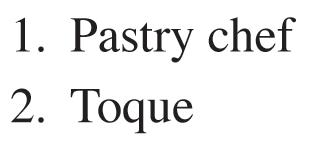
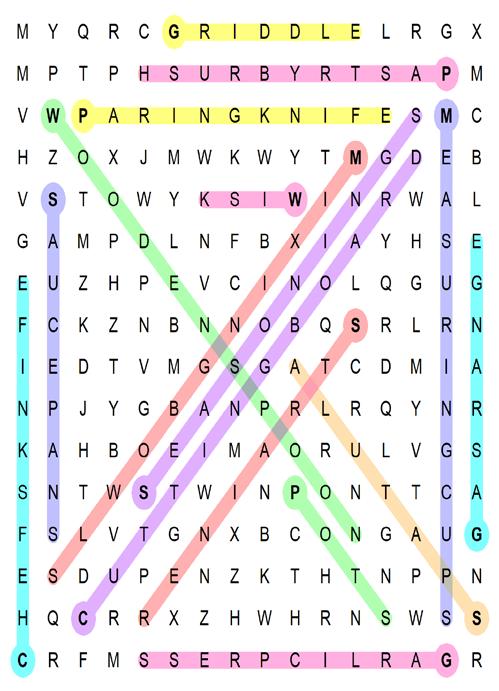
1. What is the job of the Patissier in a French restaurant?
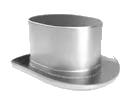
2. What name is given to the tall, pleated white hat worn by chefs?
By Lucie Winborne
* The chess-playing supercomputer Deep Blue could calculate 100 to 200 billion different positions in less than three minutes.
* Each spacecraft headed for Mars gets a thorough cleaning beforehand as a precaution against contamination from Earth.
* TV’s classic “Jeopardy” theme was composed by Merv Griffin as a lullaby for his son.
* Forget about naming your new baby IKEA in Sweden, thanks to the country’s 1982 naming law prohibiting monikers that “can be supposed to cause discomfort” for the ones saddled with them.
* “Star Wars” sage Yoda was partially modeled from a photo of Albert Einstein.
* During the Cold War, Ronald Reagan and Mikhail Gorbachev agreed to lay aside their differences in the event aliens ever invaded Earth.
* In 1674, the Women’s Petition Against Coffee declared that the popular beverage was turning British blokes into “useless corpses” and proposed that anyone under the age of 60 should be banned from consuming it.
* Astronauts can grow up to three inches taller in space due to spinal expansion caused by weightlessness.
* Pablo Picasso became a suspect in the 1911 Mona Lisa theft after it was discovered he had kept sculptures stolen from the Louvre by a friend.
by Mary Hunt
The Pain and Pleasure Principle
would happen in January -- how I would manage to explain all of this to my husband. There was always the chance that magically the money would just appear to pay off the charges even before the January statements showed up. Could happen, I’d tell myself.
The pleasure of purchasing with a complete absence of payment pain quickly became habit-forming. In fact, it was extra pleasurable because I could convince myself that I got away with something. It was totally exhilarating.
Everyday CHEAPSKATE®
I don’t care much for pain. In fact, I’ll do almost anything to avoid it. I also know that pain can be a good thing.
by Mary Hunt
The human nervous system triggers a sensation of pain to stop us from doing something that might cause a severe injury and to let us know that something may be wrong.
While we mostly think of pain in terms of physical wellbeing, I experience a certain amount of pain in parting with hard-earned money. It hurts. I hate the pain of payment. It takes away from the pleasure of the purchase.
Years ago, as I merrily made my way down the path of financial stupidity, I found two ways to avoid the pain of payment so I could fully enjoy the pleasure of purchase. It was like I’d discovered the ultimate way to have my cake and eat it too. I used credit cards. I wrote checks.
In my distorted way of thinking, paying with plastic or writing a check allowed me to enjoy the pleasure of the purchase absent the pain of payment. Payment by check meant to me that I got the goodies and the money was still there in my checkbook or my wallet. Oh, I knew that technically I’d spent it, but who wanted to be technical? It could take days, maybe even a week back then, for the money to really not be there. Pain delayed was pain denied -- pleasure enjoyed.
Payment by credit card was even better because I could push the pain way into the future -- far, far away.
Before long, having developed and practiced these painless purchasing methods, the very thought of mixing any pain of payment with a purchase seemed absurd and terribly unnecessary. Swiping a card or writing a check was more like a promise to pay later when it would be more convenient.
ADVERTISING PROOF
Of course I knew that by delaying payments and agreeing to pay huge rates of interest in exchange for the privilege, the size of the eventual pain was increasing to near-catastrophic proportions. But through the magic of denial I remained comfortably anesthetized.
I learned the hard way how painful the payment can be when there is no purchase pleasure to offset it. The pleasure is long gone, while the pain remains and intensifies over time.
There is a very important personal finance lesson in all of this and here it is:
The pleasure of the purchase needs to be counterbalanced with the pain of payment. When experienced this way, buying things does not become unrealistically pleasurable, and the pain of payment is not so terribly painful. The high and the low easily balance out. And should the pain outweigh the potential pleasure, no problem. You still have time to back out of the purchase -- unlike the purchase where the pleasure and pain are so far removed they become completely unrelated.
For me, paying with cash is a security measure against experiencing unrealistic pleasure when buying things. Paying with cash forces me to experience the pain of payment at the same time I am enjoying the pleasure of purchase. It keeps things from spiraling out of control.
For those readers who have demonstrated the maturity necessary to effectively handle a credit card (meaning you faithfully pay the thing off every month and never incur interest on the account) and checking accounts (meaning that you never float a check or write against insufficient funds) try this:
* In the United States, lawyers are the third-least trusted professionals, ranking higher only than lobbyists and business executives. ***
Contact your Tidbits representative immediately with changes or corrections.
I was able to have the reward and enjoy the pleasure without any of the pain. It was not unusual for me to come home from a shopping trip with all kinds of neat stuff and honestly announce that I’d not spent a dime. Pleasure without pain -- it was a wonderful way to shop.
Thought for the Day: “Until you value yourself, you won’t value your time. Until you value your time, you will not do anything with it.” -- M. Scott Peck
Earl’s Air Conditioning pg H 4-C 13x March 29, 2026 Vol. 22 - No. 14
Deferring payment became so easy. I especially liked the fall months when all of my favorite department stores offered deferred billing. I could charge in October knowing the purchases would not be recorded until January.
I bought into that marketing scheme like nobody’s business! Don’t ask me what I thought
When paying with a credit card, enter the amount of the purchase into your checkbook or electronic device and deduct it from the running balance just as if you’d handed over cold, hard cash. You spent the money. It’s gone. Accept it and move along.
This simple action will make sure that the pleasure doesn’t get out of control, nor is the payment unreasonably painful. It will keep your financial picture at all times realistic.
There’s something magical about writing things down. It’s pretty hard, if not foolish, to argue with facts.
The ability to step back from a spending situation and calculate the perceived pleasure to be gained against the pain of payment will be invaluable as you reshape your relationship with money.
I’ve pretty much made my peace with the pain of payment. In fact, I almost welcome it now because the discomfort forces me to remain alert as a cautious and conscious consumer -one who chooses to temper the pleasure of the purchase with the pain of payment.
* * *
Mary invites questions and comments at https:// www.everydaycheapskate.com/contact/, “Ask Mary.” This column will answer questions of general interest, but letters cannot be answered individually. Mary Hunt is the founder of EverydayCheapskate.com, a frugal living blog, and the author of the book “Debt-Proof Living.” COPYRIGHT 2026 CREATORS.COM
JULIA CHILD
The name of Julia Child is synonymous with French cuisine due to the fame achieved from her TV broadcast, “The French Chef.” This week Tidbits serves up the facts on this celebrated chef, author, and television personality
• Growing up in a well-to-do family, Julia Child had no exposure to creating meals since her wealthy parents employed a professional chef to prepare the familyʼs meals. As a young girl, Julia’s interests centered on tennis, golf, and basketball. She was active in sports while attending Massachusetts’ Smith College, where she majored in history. Her goal was to become a novelist or magazine writer, and her first job was an advertising copywriter for a chain of furniture stores.
• During World War II, Julia landed a position as a typist with the federal government’s Office of Strategic Services (OSS) in Washington, D.C., a forerunner to the CIA. A quick learner, she soon advanced to the position of top-secret researcher in the Secret Intelligence Branch of the agency.
• When being transferred overseas, Julia was responsible for cataloging and channeling highly-classified intelligence files in Ceylon, India, and China. While in India, she met a fellow OSS employee, Paul Child, and after a brief courtship, they married and moved back to Washington. D.C.
• Paul’s job with the U.S. Foreign Service at the American Embassy led the couple to Paris. Julia’s first meal in France was at La Couronne in Rouen, France’s oldest restaurant. She frequently
spoke of the experience as “an opening up of the soul and spirit for me.” Because of Paul’s interest in French cooking, Julia enrolled in the Le Cordon Bleu cooking school, followed by private lessons from master chefs.
• Julia teamed up with two other members of her women’s cooking club, and the trio produced a French cookbook as well as teaching cooking to others in Julia’s kitchen. They called their school “L’ecole des Trios Gourmands,” – “The School of the Three Food Lovers.” The Childs returned to the U.S. in 1961.
• In 1961 Julia Child’s debut cookbook, “Mastering the Art of French Cooking,” a 726-page best seller, was published. It was co-authored with her two friends, and praised for its easy-tofollow format and illustrations.
• An appearance on the local public television station to promote the book led to an offer from the station for her to do her own cooking series, which she gladly accepted. In 1963 “The French Chef,” premiered on that station, with Julia earning $50 per airing. Soon, 96 stations were carrying her show. The program, the first television program to be captioned for the deaf, aired for a decade, and Julia earned a Peabody and Emmy Award for her efforts. Her Emmy was the first for an educational program.
• More and more cookbooks came, partnered with successful TV specials. Beginning in 1980, she
was a regular on “Good Morning, America.” She is credited with 18 cookbooks.
• In the midst of all the fame, Julia was diagnosed with breast cancer, and following surgery, remained in remission for the rest of her life.
• Broadcasts for three of Julia’s various TV series were shot in her own Cambridge, Massachusetts, kitchen, specially designed by her husband, Paul, to accommodate her 6’2” height.
• In 2001, three years before her death, she moved into a retirement community. The kitchen was dismantled and reassembled in the Smithsonian’s National Museum of American History in Washington, D.C. She gifted her house and office to her alma mater, Smith College.
by Dana Jackson
Q: I recently started watching “Arrested Development,” starring Jason Bateman and Will Arnett. Why did they recast the actress of Marta? I like both actresses, but I was curious about the change. -- D.D.
A: Marta Estrella was a telenovela star who was G.O.B.’s (Arnett) girlfriend but was also loved from afar by his brother, Michael (Bateman). LEOnor Varela originated the role but exited after two episodes to star in a heavy dramatic role for the 2004 movie “Innocent Voices.” She was recast with supermodel-turned-actress Patricia Velasquez for an additional five episodes.
Since soap operas are famous for recasting roles, a satiric comedy like “Arrested Development” perfectly turned the role switch into a clever meta joke without giving an explanation.
Q: Are there currently any shows that are filming in Hawaii? The ones I used to watch like “Lost” ended years ago. I just won-
1. Project Hail Mary (PG-13) Ryan Gosling, Sandra Hüller
2. Hoppers (PG) Piper Curda, Bobby Moynihan
3. Dhurandhar The Revenge (NR) Ranveer Singh, Akshaye Khanna
4. Ready or Not 2: Here I Come (R) Samara Weaving, Kathryn Newton
5. Reminders of Him (PG-13) Maika Monroe, Tyriq Withers
6. Scream 7 (R) Neve Campbell, Courteney Cox
7. GOAT (PG) Caleb McLaughlin, Gabrielle Union
8. Undertone (R) Nina Kiri, Adam DiMarco
9. The Pout-Pout Fish (PG) Nick Offerman, Miranda Otto
der how they’re doing with the current bad flooding there. -- K.E.
A: The ABC series “Lost” is filmed on the island of O’ahu, which is currently experiencing historic flooding. It’s currently the location for the upcoming action film “Protecting Jared,” which stars Jason Momoa (“Aquaman”) and Andy Samberg (“The Roses”). Momoa has been posting pictures of the devastation on his social media and is also actively helping charity organizations to feed hungry residents through this hardship.
Other productions calling Hawaii home include the third installment of the “Jumanji” movies, but it appears that the actors wrapped up filming this month. “Jumanji 3” will once again star Dwayne Johnson (“The Smashing Machine”) and Jack Black (“Anaconda”), and it will premiere in theaters on Christmas Day of this year. The liveaction “Lilo & Stitch” sequel is expected to begin filming later this year, likely in O’ahu once again.
The Netflix series “Untamed,” starring Eric Bana, began filming season two in in O’ahu and the Volcanoes National Park this past February. All of these productions will be a boon to the economy of our nation’s 50th state, which is badly needed not only because of the record rainfall but also due to the 2023 fires in Maui.
Q: Is the new British spin-off of “Saturday Night Live” available to watch for American audiences? I know I can probably find it online, but what about on NBC? -- B.M.
A: Tina Fey kicked off “SNL UK” as its first host, but it won’t be broadcasted here in the United States on NBC. You can find it the day after it airs live on NBC’s streaming service, Peacock. The Brits have always been known for comedy, so
I would expect their version to be a huge hit. Like most series from across the pond, the season will be short with just eight episodes.
The next two hosts will be Jamie Dornan, the Irish actor best known for starring in the “50 Shades of Grey” trilogy, and Riz Ahmed, who was born in Wembley, England, and was nominated for an Oscar in 2021 for his role as a deaf drummer in “Sound of Metal.”
Send me your questions at NewCelebrityExtra@gmail.com.
1/2 cup reduced-fat, cholesterol-free mayonnaise dressing
2 teaspoons prepared white horseradish
3 tablespoons plain dried breadcrumbs
1/2 teaspoon paprika
1/2 teaspoon salt
2 (8-ounce) flounder fillets
2 tablespoons salad oil
4 frankfurter rolls
1. Chop tomatoes and pickles. In small bowl, combine tomatoes, pickles, mayonnaise dressing and horseradish.
2. On waxed paper, combine breadcrumbs, paprika and salt. Cut each flounder fillet lengthwise in half, then cut each half into 2 pieces. Coat fish with breadcrumb mixture.
3. In 12-inch skillet over medium-high heat, in hot salad oil, cook fish until golden on both sides and fish flakes easily when tested with a fork, about 4 minutes.
4. Place 2 pieces of fish in each frankfurter roll. Spoon mayonnaise mixture over fish. Serves 4.
Each serving: About 400 calories, 21g total fat, 54mg cholesterol, 1,220mg sodium.
Snow Pea, Radish and Celery Sauté
Serve this light, lemony vegetable saute with roast chicken or a light fish dish.
2 large green onions
2 large celery stalks
1 bunch radishes
1/2 pound Chinese pea pods (snow peas)
1 tablespoon salad oil
1/2 teaspoon salt
1 large lemon
1. Cut green onions into 1-inch pieces.
Slice celery diagonally into thin slices. Cut each radish in half. Remove stem and strings along both edges of each pea pod.
2. In nonstick 10-inch skillet over medium-high heat, in hot salad oil, cook green onions, celery, radishes, pea pods and salt until vegetables are lightly browned and tender-crisp.
3. Cut lemon in half. Squeeze juice from half of lemon over vegetables. Spoon vegetables onto platter. Slice remaining lemon into thin slices. Garnish vegetables with lemon slices.
Each serving: About 65 calories, 4g total fat, 0mg cholesterol, 300mg sodium.
Frosty Cappuccino
Better than store-bought! A deceptively rich blender coffee drink that’s ready in just 5 minutes.
1 cup low-fat (1 percent) milk
1 tablespoon chocolate syrup
1 teaspoon instant espresso-coffee powder
2 ice cubes
Sugar (optional)
Ground cinnamon
1. In blender, combine milk, chocolate syrup, espresso powder and ice, and blend until mixture is smooth and frothy. Add sugar to taste, if you like.
2. Pour into 2 chilled glasses. Sprinkle with cinnamon for garnish.
For thousands of triple-tested recipes, visit our website at www.goodhousekeeping.com/foodrecipes/
2026 Hearst Communications, Inc. All rights reserved
By John Allen
by Brett Koth
TIDBITS EXITS
NEXT WEEK in SNAILS
Holidays & Observances This Week
Dog Talk with Uncle Matty
By Matthew Margolis
Emogipets
Maybe it all started with Snoopy. The temper tantrums, the hysterical cackling laughter at his own jokes, that conniving competitive edge that was always there between he and his “master,” Charlie Brown. Or maybe Charles M. Schulz was like the rest of us in our tendency to project emotions and ulterior motives onto our dogs.
Since the advent of the ad industry, advertisers have successfully attributed emotions to dogs in an effort to convince consumers to open their wallets. One of the best examples is a commercial spot on YouTube that features a dog who becomes devastated upon spotting his “girl” with another dog. Stumbling onto the horrific scene of the two of them together, the emotionally distraught canine heads for the nearest five-lane freeway to put a permanent end to his misery. But, alas, his plan is foiled. By an awesome set of Bridgestone tires.
Before holistic dog food, there was Chuck Wagon. They once ran an ad narrated by the gentlest of grandfatherly voices, starring a cute little pup chasing after a wagon full of chow. The spot closed with a voiceover reassuring dog owners: “Chuck Wagon. Next to you, what he likes best and needs most.”
Then AT&T ran an ad for its 3G network that highlighted the use of online social media in tandem with its high-speed network to return a lost pup to its adorable young owner. The final frame shows the dog bolting into the child’s arms.
And Travelers Insurance had a runaway hit with their “Prized Possession” commercial featuring a neurotic dog that just can’t get a good night’s sleep until his bone is safely in their hands.
The projection of human emotions onto dogs is much more than a capitalist idea. Dog owners do it all the time in everyday life. This isn’t to say that dogs have no feelings. But the canine set of emotions is much more limited and much less complex than ours.
I get calls on a regular basis from people who are sure their dogs are out to get them: There was the woman whose pooch had decimated thousands of dollars worth of Persian rugs. She was convinced the dog was displeased with the arrangement of furniture in that room.
I received an email yesterday from a company that I use for computer repair and malware protection. No surprise there; they’ve sent me annual emails over the years when it was time to renew my service.
I opened the email and it was an invoice indicating they would be charging my credit card several hundred dollars today! What?
Then I took a closer look. The area code of the phone number at the bottom of the invoice was not for the state where I happen to know the real company is located. The address at the bottom of the invoice was for yet another state. The amount was wrong. The name of my service plan was wrong. And I knew that my subscription wasn’t due to renew for several months.
The email asked me to click a link to contact them to verify the information. It didn't pass the smell test, and I didn't take the bait.
In other words, a typical scam involving a fairly large amount of money and an urgency
Are You an Art Groupie?
They say ignorance is bliss. Since I am not formally trained in interior design, but rather architecture, I sometimes shoot from the hip and break the many “rules” of interior design. It is perhaps in that careless act that the art of design takes place. Ask any museum director or curator, and they will tell you that hanging art has its specific rules, and that there is an art to art placement.
One of the most interesting ways of displaying art is in groupings, which work in large or small spaces and can be symmetrical or asymmetrical. The important point here is to treat the grouping as one piece. Whether a homeowner is hanging several pieces of art or just one painting, proper placement is critical to bringing the finishing touches of a room together.
(today!) designed to get me to act quickly before I took the time to really think it through.
Just to be sure, I called the real company using the number I have in my file, not the one in the email. Yes, they said, it was a scam, and yes, my account was fine. They were able to check my account and quoted to me information that I knew was accurate -- the upcoming renewal date and the amount.
They thanked me for letting them know and had me forward that email on to their fraud department in hopes that they might trace the sender's address, locate the source and have them reported to the national fraud finders.
The question, of course, is whether the scammers really knew I have a service plan with that company. Probably not. Chances are they send millions of those emails, knowing that at least some of them will get responses.
Bottom line with emails: Know your business transactions and subscriptions. Know when they are due to renew. Beware even if it’s a company you know. Don’t click anything. And call the company if you aren’t sure it came from them.
Be smart. Be safe.
Matilda Charles regrets that she cannot personally answer reader questions, but will incorporate them into her column whenever possible. Send email to columnreply2@gmail.com. (c) KingFeaturesSyndicate2025
art itself as it relates to the wall space and the furnishings. Generally, small or detail-oriented pieces should be hung at eye level.
Abstract art and large-scale art can be hung higher -- or from the floor up. Some large paintings are placed on the floor or on a low shelf or credenza for greater effect.
Large-scale art also needs to be in a location where the viewer can see the art from a distance. It can be used in a smaller room if it can be viewed upon entry to the room.
The rules of big art in big spaces and small art in small spaces are constantly being broken. However, it takes a sophisticated eye to make these situations work well.
When using a grouping or a single large painting as the focal point of a room, make sure it is eye-catching and makes a strong enough statement to carry the room. If the art is ignored, move it somewhere else!
Groupings of art should complement each other in scale, as well as framing. Framing doesn’t need to match, but should stay within a style. For instance, a traditional home would look best with a framing in that style, even though the frames can differ within that look.
There was the man whose dog had urinated on his carpets every day for two years without fail. When I asked him whether he had housebroken his dog, he said, “No. But that’s not it. He’s angry.”
And there are too many couples to list who are convinced that their jealousy-crazed dog is out for their significant other. Territorial? Maybe. Jealous? It’s unlikely any dog, no matter how seemingly intelligent or manipulative, is capable of resorting to vengeance to punish his master.
So if your dog uses the business section of your newspaper as a toilet, it’s not because he’s fed up with Wall Street or stressed over the S&P Index. It’s either because he was paper-trained, or because he was never trained.
Emoticons make it possible to attribute tone to an otherwise emotionless e-mail or text, making it easy to eliminate confusion. But attributing human emotion or motive to a dog only creates it.
Woof!
I’m sure that many can relate to the unfortunate humor of seeing a tall man at a dinner party hunched over to take a closer look at a painting, or a woman backing up and knocking something over while trying to stand away from an oversized piece of artwork. Both are obvious indications of improperly placed art.
Before we discuss groupings, let’s go over some important elements. The most important considerations are the scale of the room and the
TRIVIANEWSFRONT
When planning an art grouping, trust your instinct and your eyes. Whether it’s a grouping or one outstanding piece, let art be the finishing touch to a beautifully decorated room.
* * * Joseph Pubillones is the owner of Joseph Pubillones Interiors, an award-winning interior design firm based in Palm Beach, Florida. To find out more about Joseph Pubillones, or to read features by other Creators Syndicate writers and cartoonists, visit the Creators Syndicate website at www. creators.com.
COPYRIGHT 2025 CREATORS.COM * * *
Dog trainer Matthew “Uncle Matty” Margolis is the co-author of 18 books about dogs, a behaviorist, a popular radio and television guest, and the host of the PBS series “WOOF! It’s a Dog’s Life!” Read all of Uncle Matty’s columns at www.creators.com, and visit him at www.unclematty.com.
private companies use as a personal identification number for you. (The use of the SSN for personal identification is a topic for another column.)
Explaining Social Security “Claim” Numbers
Q: I am a 78-year-old recent widow. I got my own Social Security number when I was about 20. But since my husband and I started getting Social Security benefits about 15 years ago, the correspondence I got from the Social Security Administration showed my husband’s Social Security number with a letter “B” behind it. Somebody at a Social Security office once told me this meant I was getting my wife’s benefits on his record. How does the letter “B” stand for a wife? And now that my husband has died, I notice that any mail I get from the SSA shows my husband’s number with a letter “D.” Does this mean “deceased?”
A: No, it doesn’t mean deceased. Believe it or not, it stands for “widow!” You may legitimately wonder why in the world a “D” means widow. Wouldn’t you think it should be a “W?” I will use this column to explain the mysterious world of Social Security claim numbers. Social Security Administration jargon for these numbers is “BIC codes.” BIC stands for “beneficiary identification code.”
First of all, what is a “claim number?” And how does it differ from a Social Security number? Almost everyone in this country has a Social Security number. It’s the number you give to your employer if you get a job, and it’s the number you would use to file an income tax return. It’s also the number that many government agencies and
1. The book of Leviticus is found in the a) Old Testament b) New Testament c) Neither
2. From Duteronomy 10: What tribe of Israel had the responsibility for moving the Ark of the Covenant? a) Gad b) Reuben c) Levi d) Asher
3. Which Old Testament prophet married an adulterous woman named Gomer? a) Hosea b) Joel c) Amos d) Obadiah
4. From John 11: How many days was Lazarus in the grave before being resurrected by Jesus? a) One b) Two c) Three d) Four
5. What city is associated with Joshua and the blowing of trumpets? a) Jericho b) Cana c) Bethlehem d) Bethel
6. Where did Elijah bring a widow's son back to life? a) Smyrna b) Zarephath c) Sardis d) Corinth
But a claim number is the Social Security number on which you are claiming Social Security benefits. And it’s always followed by a little letter symbol to indicate the kind of benefit you have claimed. For many people, their claim number is simply their own Social Security number with a letter symbol following it -- usually an “A.” But some people claim Social Security benefits on another person’s Social Security record -- almost always a spouse and sometimes a parent. So their claim number is the spouse’s or parent’s Social Security number, followed by the appropriate claims symbol.
The little claims symbols were not assigned in any sort of meaningful pattern. In other words, the letter “R” was not used to indicate “retirement” benefits and the letter “W” wasn’t used to indicate “wife’s” or “widow’s” benefits.
Instead, the letters were essentially assigned alphabetically, as benefits were added to Social Security law. Here is a list of the claims symbols used. It’s not a complete list.
A -- This claims symbol indicates you are getting your own retirement benefits.
B -- You are getting benefits as an aged (over 62) wife on your husband’s record.
B1 -- You are getting benefits as an aged (over 62) husband on your wife’s record.
B2 -- You are getting benefits on your husband’s record as a young wife (under age 62) caring for his minor child.
B6 -- You are getting benefits as a divorced wife on your ex-husband’s record.
C -- You are getting benefits as a child on your parents’ record.
D -- You are getting aged (over age 60) widow’s benefits from your deceased husband’s record.
D1 -- You are getting aged (over age 60) widower’s benefits from your deceased wife.
D6 -- You are getting divorced, widow’s benefits.
E -- You are getting mother’s benefits -- paid to a widow under age 60 who is caring for the minor children of a father who has died.
E1 -- Same as above, except you are divorced from the father.
E4 -- You are getting father’s benefits -- paid to a widower under age 60 who is caring for the minor children of a mother who has died.
F -- You are getting benefits as a dependent parent on a grown son or daughter’s Social Security account (very rare).
HA -- You are getting disability benefits on your own account. (Although sometimes the SSA shortens this to just “A.”)
M -- You don’t have enough work credits for regular Social Security and you only qualify for Part B Medicare benefits.
T -- You are not insured for Social Security benefits, but you are eligible for Part A hospital coverage from Medicare. (See below for more information.)
W -- You are getting disabled widow’s benefits on your deceased husband’s account.
Social Security benefits. And these folks had to be given a claim number.
It couldn’t be an “A” BIC code, which again means you are getting retirement benefits. So, they used the “T” code, and the definition was changed to “entitled to Medicare but not yet entitled to Social Security.” That means the once little-used “T” BIC is now very common. There are currently millions of “T” beneficiaries. If you are one, meaning you took Medicare at 65 but are waiting until full retirement age, or maybe age 70, to file for Social Security, whenever you do that, your claim number will change from your SSN with a “T” to your SSN with an “A.”
Again, this list is not complete. In fact, if you do a Google search for “Social Security BIC codes,” you will find a list of about a hundred codes, most of them for extremely rare benefits. My list in this column shows only the more common beneficiary codes. But “common” is a relative term. Many of the benefits listed above are infrequently paid. For example, you could almost count on your hands the number of people getting “F” (parents’ benefits) or “W1” (disabled widower’s benefits).
If you have a Social Security question, Tom Margenau has the answers. Email him at thomas.margenau@comcast.net. To find out more about Tom Margenau and to read past columns and see features from other Creators Syndicate writers and cartoonists, visit the Creators Syndicate website at www.creators.com.
COPYRIGHT 2026 CREATORS.COM (Answers on page 16) For comments or
www.TriviaGuy.com
W1 -- You are getting disabled widow’s benefits on your deceased wife’s account.
More about the “T” code. In the past, the “T” code was reserved only for those very few people who were not eligible for any kind of Social Security benefit but had paid taxes into the Medicare program. But when the full retirement age climbed beyond age 65, and people affected by that change started reaching that age, the SSA had to change its claims filing rules. Those rules say that you can file for Medicare at age 65 without having to file for
Diabetic Ulcer Still Hasn’t Healed Properly After a Month
DEAR DR. ROACH: I have a diabetic nonhealing ulcer on my right heel. I was told that the blood circulation in my foot isn’t very good, which is why the ulcer isn’t healing. Five years ago, I had a nonhealing ulcer in my left heel. It got infected, and the infection went into my heel bone. After several months, I agreed to an amputation. But this time, I was prescribed antibiotics with bandage changes that happen every two or three days. The ulcer hasn’t healed now for over a month. Is it still possible that healing could take place? -- L.H.
ANSWER: I hope so. Most diabetic ulcers can be healed if they are treated the right way early enough. We really want to avoid amputations as they are bad for your function and cause worse outcomes later on.
One major issue is poor blood flow to the area. People with diabetes may develop poor blood flow due to large arteries being blocked, or when the small vessels aren’t working well.
If there are blockages in the large vessels, such as the femoral artery or one of its branches, then a vascular surgeon may be able to bypass the blockage. Newer techniques of angioplasty and stents may also be used and are less invasive and risky. An angiogram is usually necessary to determine whether this approach would be useful. If the poor blood flow is due to the small vessels, then surgical approaches aren’t as important as medication and proper wound care.
Diabetes needs to be meticulously managed with blood sugar levels kept in the normal range as much as possible; a continuous glucose monitor can help determine if your regimen is adequate.
I cannot recommend highly enough an experienced wound care nurse, who is the expert in managing nonsurgical wounds (and postsurgical wounds, too). The pressure must come off of the heel.
Nonhealing diabetic foot ulcers are one of the clearest indications for hyperbaric oxygen therapy. This therapy isn’t available to everyone, but it can be very useful in addition to standard therapy.
Finally, antibiotics are guided by the results of wound cultures. These cultures need to be done by an expert to get the correct results.
***
DEAR DR. ROACH: I’m a 78-year-old white male who is a nonsmoker; I am 5 feet, 6 inches tall, weigh 135 pounds, and consider myself to be in excellent health.
A diagnosis from a recent bone density scan showed that my FRAX 10-year probability of a major osteoporotic fracture was 11.6%, and my probability of a hip fracture was 7.3%. I exercise seven days a week and believe that my diet is excellent. My standard blood panel results are always normal in all
categories.
Would it be advisable for me to take Fosamax at a 70-mg dosage? -- C.Y.
ANSWER: The FRAX score is the easiest way of understanding the results of a bone density scan. Even though the odds are that in 10 years, you won’t have had a fracture, your risk of a hip fracture is high enough that most experts recommend treatment to lower your risk.
Generally speaking, treatment is recommended with a FRAX score above 20% for any major osteoporotic fracture or a score that is more than 3% for a hip fracture.
Your risk for a hip fracture is significantly above the recommended threshold, even though your overall risk isn’t, which leads me to suspect that your hips are preferentially affected by osteoporosis.
If medication is recommended, a bisphosphonate such as alendronate (Fosamax) would be the first-line treatment for men, and 70 mg weekly is a common dosage.
Dr. Roach regrets that he is unable to answer individual questions, but will incorporate them in the column whenever possible. Readers may email questions to ToYourGoodHealth@med.cornell.edu.
VETERANS POST
by Freddie Groves
Is There No Way to Uncover Fraud?
How is it a scammer can impersonate a veteran for over 30 years and not get caught?
Not only did this thief collect Social Security under the veteran’s name, but he got medical care from the VA. And he didn’t exactly behave during all those years -- he was convicted of multiple serious crimes along the way.
When he was finally nabbed, he was living in VA-provided homeless/transitional housing and getting food, clothing, services and transportation. His impersonation was discovered when he was trying to get health care at a VA medical center.
At this point he’s in the pen awaiting sentencing, charged only with making false statements, which can get him as little as five years in prison (after committing fraud for 30 years?) and be fined a quarter of a million dollars.
Consider all the possible points where the thief’s identity could have been revealed: the Social Security data base, VA records being compared with the real veteran, criminal records ...
Then there was another thief, this time a woman, who not only stole over $1 million from the VA, but also pulled her sister and son into the scam. This scammer managed to get disability benefits by claiming she couldn’t walk, was partially paralyzed and bedridden, and needed care around the clock.
The truth? She was able to buy a second home and go on fancy international trips. The son and sister said they were caring for her around the clock, while they were actually working at real jobs and she was traveling alone. This fraud went on for 12 years.
The penalties? The scammer is only getting 17 months in prison. The sister was sentenced to only time served and the son to 14 months. Is there no way to check, no way to uncover this level of fraud before the hit to the American taxpayers reaches a million dollar threshold? It would only take one photo of her trotting off to catch a plane, right?
Freddy Groves regrets that he cannot personally answer reader questions, but will incorporate them into his column whenever possible. Send email to columnreply2@gmail.com.
Where to Get Help with Medicare Decisions
DEAR SAVVY SENIOR: I’ll be 65 in a few months and could definitely use some help sorting through all the confusing Medicare options that are available. Where can I get help to make all of this understandable so I'll know how to make the right decisions when the time comes? --Baffled Bob
Dear Bob: With around 11,400 Baby Boomers turning 65 every day in 2026, you’re asking a very timely question.
Many people approaching Medicare are confused by all the choices available today. In addition to original Medicare (Part A and B) that has been around for more than 60 years, you also have the option of enrolling in a Part D prescription drug plan, and a supplemental (Medigap) policy – both of which are sold by private insurance companies.
Another option is a Medicare Advantage plan. These plans, also offered by private insurers, bundle hospital coverage, medical care, prescription drugs, and often extra benefits like vision, dental, and hearing into one policy. Most operate as HMOs or PPOs and require you to receive care within a defined network of providers in your area.
Medicare Advantage plans have also faced increased scrutiny in recent years over prior-authorization requirements that can delay or deny certain services.
To help you determine which path makes
the most sense for your situation, there are several reliable resources available, depending on how much assistance you need.
Tools and Resources
A good starting point is the “Medicare & You” handbook, which provides a clear overview of the program and your options. You can download a copy at medicare.gov/medicare-andyou, and you should receive a printed version in the mail about a month before your 65th birthday.
The Medicare website also features a helpful “Find a Medicare Plan” tool at medicare. gov/plan-compare that allows you to compare health plans, prescription drug coverage, and supplemental policies available in your area. If you prefer to speak with someone directly, call Medicare at 800-633-4227, and a representative can walk you through your options over the phone.
Another excellent free resource is your State Health Insurance Assistance Program (SHIP), which provides unbiased Medicare counseling either in person or by phone. To locate your local SHIP office, visit shiphelp.org or call 877-839-2675.
You can also contact the Medicare Rights Center (medicarerights.org) at 800-333-4114 for help with specific questions.
In addition, HealthMetrix Research publishes a free Cost Share Report at medicarenewswatch. com that compares Medicare Advantage plans by area based on cost-sharing and health status.
Get Help
If you’d like more hands-on help, you can work with a Medicare insurance agent.
Keep in mind that agents are paid commissions by insurance companies, so it’s important to choose an independent agent who represents multiple insurers – not just one. That gives you access to a broader range of options.
Also understand that commissions are typically higher for Medicare Advantage plans than for Medigap and Part D policies used with Original Medicare. As a result, some agents may have a financial incentive to recommend Advantage coverage. That doesn’t mean the advice is wrong, but it’s wise to ask questions and under-
stand all your choices before enrolling.
You can search for licensed agents through nabip.org, the website of the National Association of Benefits and Insurance Professionals.
Taking the time now to compare your options carefully can help you avoid costly mistakes and give you confidence in the coverage you finally choose.
* * *
Send your senior questions to: Savvy Senior, P.O. Box 5443, Norman, OK 73070, or visit SavvySenior. org. Jim Miller is a contributor to the NBC Today show and author of “The Savvy Senior” book.
-- by Jim Miller
by Anne McCollam Creators News Service
Recliner With a Mission
Q: This is a picture of a recliner that has been in our family for at least 100 years. Wood slats support the back cushion. There are two spindles on both sides of the back to adjust the back position. The frame is oak, and the cushions have been reupholstered. I believe the style is Mission and that it has the original finish.
Any information on my recliner will be appreciated.
A: You are correct. Your recliner is an example of Mission furniture. The Mission, or Arts and Crafts, design movement sprang from the ideas of British scholar John Ruskin and designer William Morris in the late 1800s. They embraced the return to honest craftsmanship and the dignity of work. They were inspired by the integrity of Gothic furniture. Gustav Stickley, a trained stone mason and skilled furniture maker, visited Europe and saw for himself the Arts and Crafts movement. He returned to the U.S. and founded the United Crafts of Eastwood, New York.
It wasn’t long before the movement spread in the U.S. The style can be recognized by quartersawn oak, corbels, mortise and tenon construction, and simple clean straight lines. The simplicity of the furniture was a clear comment on the curvilinear lines and ornate designs of the mass-produced factory-made Victorian furniture. Myriad makers of Arts and Crafts furniture quickly followed Stickley’s lead.
Stickley, along with his brothers, L. and J.G. Stickley, Limbert, Shop of the Crafter and the Roycrafters usually marked their furniture.
Original finish and condition are the two most important factors determining value of furniture. The recliner chairs were originally designed by William Morris, thus the name. Your Morris chair probably had leather cushions.
Your Morris chair should be insured for $900 to $1300.
Q: I have enclosed the mark that is on the bottom of a pottery vase that I have. It stands about 9 inches tall and is decorated with a metallic bronze and purple floral glaze. Although it has been in the family for years, no one knows anything about it. It is in perfect condition.
I hope you can tell me something about its history, age and value.
A: You have a vase made by Weller Pottery. They were in business from 1882 to 1948 in Zanesville, Ohio. “Sicardo” is the name of a line of pottery that Weller made between 1901 and 1907. It was the creation of French designer, Jacques Sicard.
You might insure your vase in the range of $800 to $1200
Antiques expert and columnist Anne McCollam has recently retired and no longer receives inquiries nor answers reader letters. Due to the popularity of her column, this publication will continue to reprint previous columns of interest to our readers.
* On April 6, 1930, James Dewar needed a good way to occupy the Continental Baking Company’s shortcake-baking machinery while strawberries were out of season. Fortunately for generations of snackers to come, he tried shooting a cream filling into one of the shortcakes, and the iconic Twinkie was born. Tthe name was inspired by a billboard ad for Twinkle Toe Shoes.
* On April 7, 1940, Tuskegee Institute founder Booker T. Washington became the first African American to be honored with a postage stamp bearing his likeness. It would be almost another 40 years before an African American woman -- human rights activist Harriet Tubman -- would receive the same recognition.
* On April 8, 1993, astronaut Ellen Ochoa became the first Hispanic woman in space when the shuttle Discovery lifted off from the Kennedy Space Center. Later she also served as Director of the Johnson Space Center from 2013 to 2018, the first Hispanic director and the second woman to hold that position.
* On April 9, 1945, Berlin University lecturer, Lutheran pastor and theologian Dietrich Bonhoeffer was hanged at Flossenburg concentration camp in Germany, just days prior to its liberation by American soldiers. His final words were, “This is the end -- for me, the beginning of life.”
* On April 10, 1866, the American Society for the Prevention of Cruelty to Animals (ASPCA) was founded in New York City by philanthropist and diplomat Henry Bergh. By the time of his death in 1888, 37 of the 38 states in the Union had passed animal anticruelty laws.
* On April 11, 2004, Phil Mickelson won the Masters Golf Tournament at Augusta National Golf Club, his first major championship in nearly 12 years as a professional golfer.
* On April 12, 1954, Bill Haley and His Comets recorded “(We’re Gonna) Rock Around the Clock,” which they’d been performing live for months, during the final 40 minutes of a three-hour recording session in New York City that had actually been set up for a song called “Thirteen Women (and Only One Man in Town).” After the tune was chosen to play over the opening credits of the film “Blackboard Jungle,” it became a pop sensation, selling a million copies in one month in 1955.
(c) 2026 King Features Synd., Inc.
"Your resume states that you've worked as a speech writer for two presidents, you're a Nobel Prize winner, and worked for the C.I.A. That's all fine and dandy, but how are you at telemarketing?"
Mission furniture, also called Arts and Crafts, quickly spread from England to the United States in the late 1800s.
Sicardo ware was made by Weller Pottery.
TV Chefs: (from page 3)
Give.” Garten debuted her Food Network program in 2002, and it remains one of the longest-running daytime programs. She also has 14 cookbooks to her credit.
GORDON RAMSAY
• Gordon Ramsay is most probably the world’s most popular celebrity chef. Born in Scotland, but raised in England, as a youth, Ramsay’s ambition was to become a pro soccer player. After a serious knee injury that tabled those ambitions, he turned his attention to the culinary field. After jobs in several London restaurants, at 23, he moved to Paris to train there for three years. He opened his first restaurant in London in 1998, and that number has expanded to 90 around the world.
• Gordon Ramsay is known for his fiery temper, aggressive behavior, and comments peppered with criticism, insults, and profanity. There’s more to Ramsay than his cooking abilities and poor manners. He has a passion for fitness and has completed several marathons and Ironman events, as well as holding a black belt in karate. Ramsay is fluent in four languages, English, French, German, and Italian.
• His side gigs include a line of quality cookware and knives, ownership of a vineyard in the south of France, and the authorship of 27 books. Philanthropy is also on his list of accomplishments with his support of children’s hospitals, food banks, and the fight against hunger and poverty.
GUY FIERI
• Guy Fieri is the highest-paid cable television chef, having signed an $80 million contract with the Food Network in 2021. He was born Guy Ferry, but reverted to the family’s original name of Fieri to honor his grandfather, Giuseppe Fieri, an Italian immigrant who had “Americanized” the name.
• Guy started out selling pretzels from his bicycle cart while in elementary school. His love of cooking developed during his time as a foreign exchange student in France. He opened his first restaurant at age 28, followed by three more in the next 12 years. He now reportedly owns around 85 restaurants, 19 of them aboard Carnival cruise ships. He has lent his name to 14 different brands, including cookware, condiments, and clothing.
• While some chefs focus on elaborate cuisine, Fieri centers his creations toward comfort food and casual dining, as seen in his 27 cookbooks.
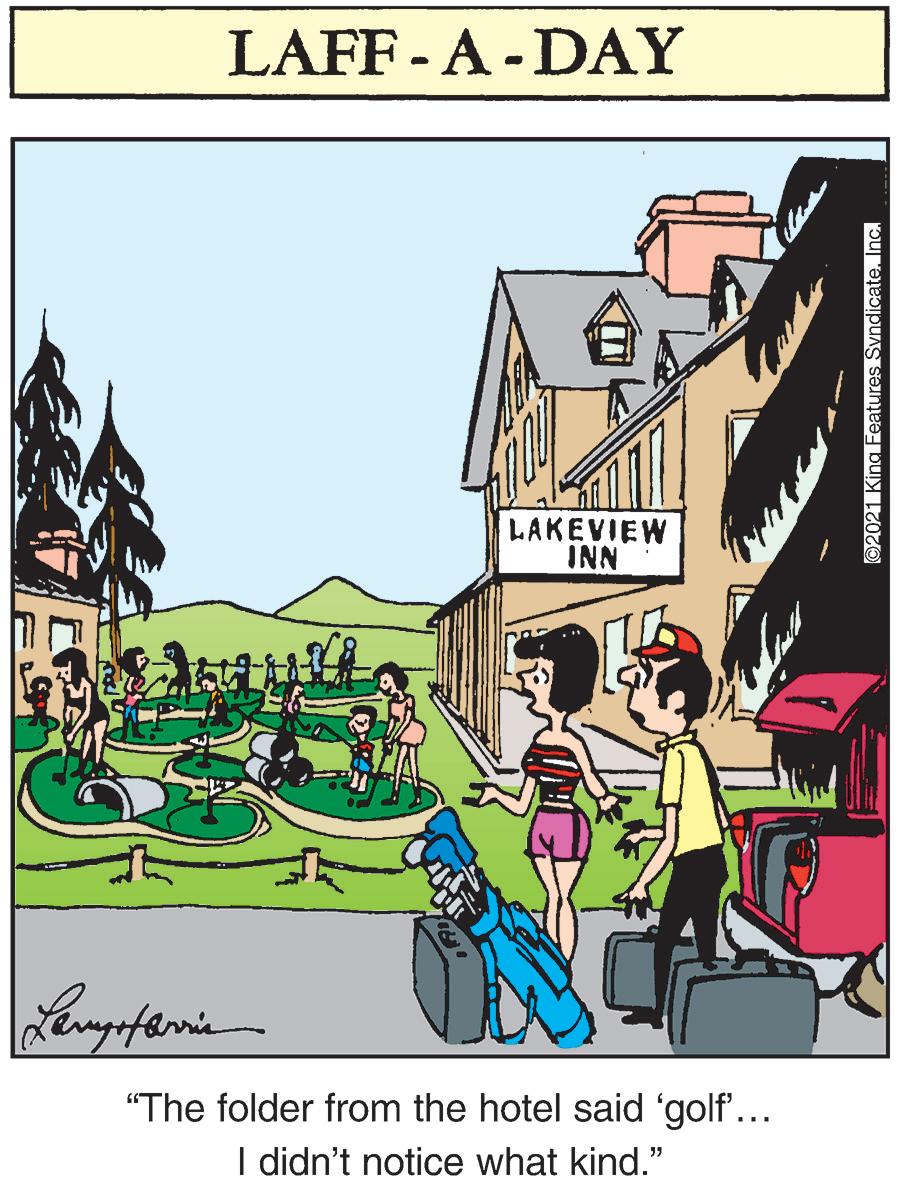
Give your golf-related advertising message targeted visibility in full color in this weekly 2” x 6” fixed location $159 per insertion reaches 70,000+ readers each week at the low cost of only $2.27 per 1,000 reader impressions!
Game Changers
by Jason Jenkins
Three Club Chipping
Not all greenside chips are equal. There are different lies, distances to the pins, and terrains between you and the hole. Not only are all chips not equal, but one club should not always be used for them all.
One basic of the greenside chip should be a consistent technique which includes setup, swing length, and impact conditions. After that, you have the freedom to alter the club you’re using, its alignment, and where you hit it on the face.
Assuming for now that the face is square and you’re striving for center contact, practice mastering three clubs around the green. Use the 8-iron for long distance chips where you can allow the ball to land quickly and roll out over the length of the green. Adjust to the pitching wedge when the pin is more centralized on the green and you don’t need as much roll on the ball.
Finally, switch to the sand or lob wedge to attack the short chips when the hole is quite near you. Each stroke should be similar, but the club will create different carry and roll results.
By practicing with these three clubs, you’ll have a better gameplan around the greens.