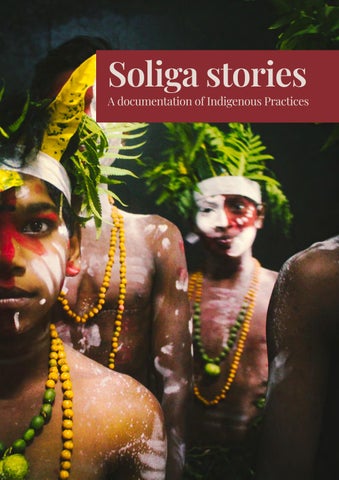
Soliga stories
A documentation of Indigenous Practices
Soliga Stories: A documentation of Indigenous Practices © 2023 by Kasturi Katale, Vaidehi Bhoraniya, Nandini Sharma is licensed under CC BY-NC-SA 4.0. To view a copy of this license, visit http://creativecommons.org/ licenses/by-nc-sa/4.0/
Written, Designed and Edited by Kasturi Katale, Vaidehi Bhoraniya & Nandini Sharma.
This document is typeset in Futura Lt BT & Playfair Display.
Documentation of Indigenous Practices
By Kasturi Katale, Nandini Sharma, Vaidehi Bhoraniya
Guided By Sucharita Beniwal & Praveen Nahar National Institute of Design, Ahmedabad
Contents Introductio 1. 1. 1. 1. 1. 1.
Prefac Acknowledgement The Soliga peopl Authors’ Not Methods of researc Our entry point
01 02 03 05 06 08
Home, Heart & Healin 2. 2. 2. 2.
Introductio Hom Heart Healing
12 13 20 26
Traditional rituals & attir 3. 3.
Draping natures attir Rituals & faith
33 39
Rhythms of Soliga wisdo 4. 4. 4. 4.
Introductio Symphony of the fores Dances of the Soliga peopl Performance of Knowledge
47 49 53 57
Conclusion 5. 5. 5.
Provocatio Emergent future Additional Resources
60 62 63
01
Preface Indigenous practices are traditional customs, rituals, knowledge, and ways of life developed and passed down by native communities, reflecting their deep connection to their land, culture, and heritage. The National Institute of Design (NID) introduced a course on indigenous practices to help students understand the origins of many life practices we have today. India is home to many regional indigenous communities, and for our field work we turned our attention to the Soliga tribe, nestled amidst the forests of the Biligiriranga Hills.
The course aimed to delve into the unique rituals, music, dance, and knowledge systems of the Soliga tribe, recognizing their tacit knowledge in shaping their community and lifestyle. As residents of Karnataka, we felt a a strong commitment to learn from the Soliga tribe, who have cultivated a profound relationship with nature and passed down their heritage through generations, which has influenced practices and cultures across the state.
Through this course, we hoped to foster a sense of empathy, respect and admiration for the indigenous practices that have endured through many cultural shifts in the country. Embracing the opportunity to engage with the Soliga tribe, observing their wisdom and the harmonious coexistence they share with the environment. The journey was not only a pursuit for knowledge but also a humbling experience of shared humanity and cultural appreciation.
02
Acknowledgements We extend our utmost gratitude to our dedicated faculty Sucharita Beniwal & Praveen Nahar at the National Institute of Design (NID) for their unwavering support and guidance to the course on indigenous practices. Their passion and expertise enriched our learning journey profoundly.
A special word of appreciation goes to the Soliga tribe and VGKK School, whose warm welcome, openness, and willingness to share their rich cultural heritage left an unforgettable mark on our hearts. Their generosity in sharing traditional knowledge and practices made this course a truly transformative experience. We thank Putanna sir, Dr.Suresh and Manjunath Sir for their immense help in reaching and communicating with the villagers; to Pushpa, Nirmala, Meghana and the villagers, and other students for offering a glimpse into their lives; and a warm thanks to Meghana’s Mother and Sister for their kind hospitality at their home.
We also express our gratitude to Dr. Tanya and Mr. Santhosh Songal for sharing knowledge from years of research, and helping us understand the nuances of the Soliga Traditions.
We express our sincere thanks to the National Institute of Design for fostering an environment of cultural exchange and promoting the value of indigenous wisdom. And with deep respect we embrace the diverse traditions and practices that have shaped our understanding of the world.
We would also like to extend our sincere appreciation to Kailas Katale (Kasturi’s Father) for his invaluable support in taking us to BR Hills and guiding us throughout our journey. His assistance with accommodation, food and adventurer’s spirit made our journey all the more exciting and unforgettable.
Our heartfelt thanks to all involved, as this course not only broadened our horizons but also deepened our appreciation for the beauty of cultural diversity and the significance of preserving indigenous practices for generations to come.
03
The Soliga tribe The Soliga tribe, also known as Sholagas or Sholigas, is an indigenous community residing in the forests of the Biligiri Rangaswamy Temple (BRT) Wildlife Sanctuary in Karnataka, India. Nestled amidst the picturesque landscapes of the Western Ghats, the Soliga tribe inhabits the hilly terrains and lush green forests.
The Soliga people primarily practice agriculture, cultivating crops like millets, pulses, and vegetables using traditional methods. They employ a unique form of shifting cultivation, known as 'Podu' cultivation, wherein they clear small plots of land and plant crops, allowing the forest to regenerate over time. This sustainable farming practice reflects their deeprooted respect for the environment.
Closely tied to their agrarian lifestyle are their songs and dances, which form an integral part of their cultural identity. The tribe celebrates various occasions and festivals with lively dance performances, such as the Gorukana dance, which is a prayer of gratitude to the forest.
Traditional knowledge and wisdom are passed down through oral storytelling and rituals, connecting generations to their ancestry and history. The Soliga community possesses a deep understanding of the forest's flora and fauna, relying on their expertise to gather medicinal herbs and engage in non-timber forest produce collection such as honey, gooseberry, lichen etc. This means of gathering has also become their source of livelihood today through programs like Ashoka Trust for Research in Ecology and the Environment (ATREE).
04
The Soliga tribe exhibit a symbiotic relationship their natural habitat. They rely on all 5 senses to asses their space understand any dangers which have heightened over time sensitizing them to the presence of animals in their surroundings.
However, like many indigenous communities, the Soliga face challenges in preserving their heritage and traditional way of life amidst modernization and external influences. In 2011 the Soliga tribe won a legal battle to gain access to the forests for habitat and non timber produce under the Forest Act of 2006. As one of the few tribes still habituated within the forests, efforts are underway to protect their rights, ensuring the continuation of their invaluable practices for the benefit of future generations.
05
Authors’ note Our field work at the BR Hills was from 7th to 9th August, where we stayed at VGKK School. During this time we had the privilege of meeting and learning about the rich cultural tapestry of the Soliga people. We were allowed us to witness their daily life, traditions, and architectural practices, providing a glimpse into their way of life with the forest. Fortunately, 9th August happened to be World Indigenous Day where the children of VGKK performed their local traditions and added to our understanding and documentation of their practices.
It's crucial to note that this document is a reflection of the information imparted to us by the people we encountered, including faculty members of the school, villagers and local researchers, during our brief field visit. Stories of their festivities which we could not witness were narrated us to us through memory. While also relied on our sensorial observations to grasp the essence of their lifestyle.
Our limited understanding of their language prevented us from fully capturing the depth of their narratives, some nuances may have been lost in translation. Despite this limitation, we aspired to portray an authentic representation based on the interactions and experiences we had during our visit and interviews with researchers such as Dr.Tanya.
06
Methods of research During the field research, we approached the research through many mediums to grasp their lifestyle in the best way possible. Videos and pictures were extensively utilised to document their practices and traditions of the Soliga tribe. These visual records not only record the richness of their cultural expressions but also serve as valuable resources for further analysis and understanding.
We held Interviews with the Soliga community to capture their oral narratives, traditional knowledge, and personal experiences. These conversations facilitated a deeper appreciation of their beliefs, customs, and the significance of their indigenous practices.
In addition we also referred to Literary sources to enhance the understanding, providing historical context and existing scholarly knowledge about the Soliga tribe. This background information helped to contextualize the contemporary observations and shed light on the tribe's evolution over time. In addition research professionals were also interviewed to understand the science and practicality of their practices.
However, the most immersive and enlightening aspect of the research was the learning-by-doing approach. Engaging directly with the Soliga people in their daily routines, agricultural practices, dances, and rituals allowed for a firsthand experience of their way of life. This experiential learning not only enriched the research findings but also cultivated a deeper sense of respect and appreciation for the Soliga tribe's cultural heritage.
The combination of videos, pictures, interviews, literary sources, and experiential learning enabled a holistic and multidimensional exploration of the Soliga tribe's practices, contributing to a more nuanced understanding of their rich cultural traditions and knowledge systems.
07
08
Our entry point Our entry into the Soliga tribe's world at Vivekananda Girijana Kalyana Kendra (VGKK) School was made possible by the assistance of Dr.Suresh. With the support of these individuals, we were able to connect with the Soliga tribe in a profound and respectful manner.
Dr. Suresh, the coordinator of the institute. His profound understanding of the Soliga culture and unwavering commitment to educate others paved the way for a meaningful engagement.
Putanna sir, the school's principal and a member of the Soliga tribe, played a pivotal role in establishing a bridge of trust and mutual respect. His warm welcome and guidance were instrumental in creating a conducive environment for our research. He played a big role in giving first hand accounts of his time in the forest.
Manjunath sir, the English teacher at VGKK School, proved to be an invaluable ally in facilitating communication. His proficient translation skills ensured effective interactions with the Soliga community, bridging language barriers and allowing for meaningful exchanges.
Additionally, Santhosh sir, a research associate, brought his expertise and cultural sensitivity to the table, further enhancing our rapport with the tribe. His deep understanding of the Soliga traditions and practices enriched our learning journey. As a researcher he was able to give many insights on the medicinal practices of the tribe.Their assistance not only facilitated our research but also fostered a genuine appreciation for the tribe's cultural heritage and way of life.
09
10
Home, Hearth & Healing
11
12
Over the course of our trip to the BR Hills we learnt many things about the dependency of the Soliga tribe on their surroundings.
Mr. Santhosh tells us how the forest, in their lives, is a provider of sustenance and a spiritual anchor. Sacred groves within these woodlands are revered as sanctuaries, and are believed to be inhabited by ancestral spirits, and central to their spiritual practices. Their environment influences the very clothing they wear, Which is fashioned from natural elements like leaves.
As we walked through their village we saw their housing, too, is built using materials from the forest, creating homes that harmonize with the jungle and other resident creatures. Forest materials are also fashioned into tools and utensils. For healthcare a vast array of medicinal herbs and plants serving their needs.
The tribe practices shifting cultivation, a sustainable practice that aligns with the forest's regenerative capacity. Even the livestock is reared, with animals grazing in its abundant spaces.
This interdependence with the forest encapsulates the Soliga people's coexistence with nature and highlights the value of their sustainable, indigenous lifestyle.
13
Home As Majunath sir and Putanna sir accompany us around the village we came across the traditional house-building practices of the Soliga people. Among their distinctive housing structures are the "Podus," versatile huts that serve as kitchens, temples, bathrooms, and more.
The villagers explain that these Podus are skillfully constructed using bamboo and various types of wood. They are carefully woven and reinforced, then sealed with a mixture of cow dung and mud, which ensures the durability of the structure. Other materials from the surrounding jungle, such as tree grass, soil, and threads or fibres, are carefully utilised in the construction of these huts. The result is a hut that harmonizes with the natural landscape.
14
15
The traditional door of a Podu is also crafted from bamboo and wood, showcasing their people's resourcefulness and use of locally available materials. Putanna Sir talks about how there has been change in practices in recent times, with the use of plastic pieces and treads to tie the branches together and the replacement to the traditional doors with metal sheets. This expresses some modernization in their building practices with the availability of new materials.
The Podus have low, slanted roofs designed to efficiently shed rainwater, keeping the inside dry and providing insulation for warmth in the cold hill station climate. The Soliga people, who live in the forest, build their Podus in the trees, keeping them off the forest floor and protected.
16
The Podus are regarded as sacred spaces by the people. The villagers emphasize respect and ritual within these structures, and it is customary to remove footwear before entering. These buildings play multifaceted roles in their lives, serving as kitchens, bathing rooms, spaces for livestock, and even as temples.
17
18
As we walked through the village we noticed an interesting aspect of their housing practices, they make separate huts for their livestock, which amplifies their belief in providing protection and shelter to animals, ensuring their well-being. It underlines their profound connection to nature and their commitment to coexistence with the forest.
It is important to note that, while the government has provided modern concrete houses to the Soliga people in recent times, they continue to construct and use their traditional Podus. This approach reflects the delicate balance the community maintains between modernization and the preservation of their indigenous practices. Their resilient use of traditional building methods, despite the availability of modern alternatives, underlines the enduring significance and cultural value of these architectural traditions in Soliga society.
19
20
Hearth
We visited the home of Meghana, one of the students at VGKK, and came across some remarkable techniques for keeping their homes warm and safeguarding them from the elements. The height of the monsoon season made the atmosphere quite chilly but also provided us with a chance to closely observe their practices.
As we entered their living space, a notable feature was a large pit fire situated in a room adjacent to the main living area. This fire served the dual purpose of warming both the floors and the air around the house. Meghana’s mother maintained this fire diligently, rekindling it approximately every hour to ensure a steady source of warmth. This fire was also utilised to heat water for bathing, showing their efficient use of available resources.
21
The paths and homes were lined with woven structures made from bamboo and various natural fibres to fashion fences around their homes. These fences offered a layer of protection and demarcation for their living spaces. We also observed plants growing on these fences, providing additional coverage and adding to the aesthetic appeal of their surroundings.
Manjunath sir explained how they choose plant species known for their insect-repelling properties for the fence. The people are highly knowledgeable about various plant species, and used "raat ki rani" (Queen of the Night), renowned for its pleasant scent and pest-repelling qualities for the fencing. These wellinformed choices enriched their environment and overall wellbeing.
The Soliga people's practices for maintaining warmth in their homes and safeguarding their living spaces are marked by efficiency and a keen understanding of the properties of various plants, showcasing the ways in which they adapt to their environment and thrive in collaboration with nature. Our experience during the monsoon season provided a firsthand glimpse into these traditions.
22
23
As we sit down for a cup of tea at Mehana’s home, her mother and Puttanna sir tell us about Roti Habba, taking us back to some of the research Santosh sir had shared with us.
Rotti Habba is a significant harvest festival celebrated by the Soliga people. During this festival, parents bring their sons and daughters to the venue for potential matchmaking. The youth choose their life partners, and propose to their preferred individuals. Women begin preparations for the festival a week in advance, making jolada rotti and sajje rotti using pearl millet flour with black sesame. Black sesame is added to the flour while preparing the dough, as it is highly nutritious and keeps the body warm in the rainy season. Once prepared, the rottis are kept near traditional furnace so that they become hard, crisp and flat. These crisp variants, called khadak rotti, can be preserved for months. The festival includes over a dozen vegetable dishes, chutneys, and salads, along with fried green chilies. At some places, women visit temples to offer rottis, palyas, chutneys and salads. After they are back from temples, they offer the same food to cattle and then set out to exchange food with as many houses as possible without considerations of caste and religion. Some women visit temples to offer food and exchange it with others, promoting equality and unity. Rotti Habba serves as an equalizer, transcending social boundaries and emphasizing the festival's purpose of creating equality.
24
25
26
Healing Over the course of our short visit to the village; the conversations and practices we observed in the village we see the Soliga people's profound knowledge of plants and their various purposes: food, hygiene, and medicine. This intricate knowledge of their environment is deeply ingrained in their culture and lifestyle.
On the fertile and lush land of BR Hills, the Soliga people cultivate coffee and pepper as a source of income and ragi for sustenance. These crops represent an integral part of their self-sufficiency and financial well-being, reflecting their ability to harness the forest's resources for their livelihood.
27
Their knowledge of plants extends beyond sustenance to encompass a wide range of practices. The use of "Muthugodagadde," or leaf plates and bowls, showcases their resourcefulness in creating eco-friendly utensils. The "Seere Barlu" leaves are used for crafting household brooms, preferred for their antiseptic properties, improving cleanliness within their homes.
These plants play a crucial role in the health and medicine of the Soliga people. Meghana’s mother speaks of the Root tree “maragenasu”(Kannada) They prepare chips from this plant, boiling and consuming it for its potential health benefits. The "Dadsu" tree, with recognized medicinal properties is used for helping cure cold symptoms.
28
29
30
The Soliga people use the huge trees around them various types of teak, such as "Tega" and "Honne," often used for their specific qualities. Additionally, "Icchi" serves as a valuable firewood source. They are also keenly aware of the plant species that effectively shooed away pests, and they cultivated them intentionally to protect themselves. The "Kaakada Mallige" flower, known for its vibrant colour but lack of fragrance, finds purpose in temple prayers, illustrating the multifaceted use of the natural world in their religious practices.
The Soliga people's indepth awareness about the flora of their home showcases their ability to derive sustenance, maintain hygiene, and access medicinal resources, it also provided us insights on how every part of the forest is used.
31
32
Traditional rituals & attire
33
Draping Natures Attire In celebration of World Indigenous Day the school hosted a vibrant event, putting on a show of the various performances and practices from their culture. The boys and girls embraced the occasion by wearing their traditional Soliga attire, showing their connect and dedication to their culture.
The Soliga attire reflects their deep-rooted connection to nature. Puttanna sir tells us that traditionally, both men and women wore garments woven from natural fibres, including leaves and bark, offering comfort and camouflage within the forest. Accessories also hold significance; women adorn themselves with necklaces, while men showcase intricately carved ornaments.
Although external influences have led to a shift towards more conventional clothing, with cotton garments being increasingly adopted. For the event however, they beautifully displayed the Soliga tribe's rich heritage, celebrating their unique lifestyle.
34
35
We observed the exquisite traditional accessories meticulously crafted by the people, showcasing their profound connection with the forest. These accessories are a fusion of aesthetics and functionality, ingeniously put together from the abundant resources found in their natural surroundings.
Berries and leaves are most commonly used in the crafting of Soliga jewellery. These vibrant berries, are threaded together, create necklaces and bracelets that infuse their attire with the contrasting colours of nature's colours. Leaves, dried and woven into intricate patterns, fashion headpieces and anklets, adorning both men and women.
36
Beyond berries and leaves, we also saw the use other forest materials like seeds, fur, and feathers into their accessories. These embellishments not only highlight the Soliga's artistic skills but also hold deep spiritual significance, forging a connection between wearers and their natural environment, as well as the spirits dwelling within it.
In essence, the traditional accessories worn by the Soliga people, hold significant spiritual value, and often known to build a connect between them and their forest deities. Different materials are used for accessories for different occasions and festivities, each holding their own significance.
37
The traditional attire of the Soliga tribe plays a significant role in their forest life. During our visit, we observed their unique clothing, which has evolved significantly over the years.
One striking feature of Soliga attire is the use of natural materials from the forest. The torso and head of both men and women are often adorned with leaves from mango and jamun trees, creating a distinctive natural attire and to help them camouflage when they go to the forest. The Jogis, or jesters of events, sport large hats crafted from paper, although Suresh Sir explains in earlier times, these were fashioned from leaves and fibres. Jungle flowers serve as vibrant adornments for their hair, adding a touch of natural elegance and fragrance to their overall appearance.
Putanna sir, the principal of VGKK School and a respected member of the Soliga tribe, shared with us that the traditional attire has witnessed significant changes. In the past, only the lower half of the body would be covered. Now the community wears stitched garments such as kurtas and saris made from silk and cotton. This shift reflects the influence of external cultures and changing lifestyles.
38
The evolving Soliga attire, influenced by external factors, raises concerns about the gradual erasure of their traditional lifestyle. This shift not only affects their clothing but also threatens the preservation of indigenous knowledge and practices, crucial elements that have sustained them for generations. The encroachment of external cultural norms endangers their connection with the forest, posing a significant challenge to the Soliga people's ways of living.
39
Rituals and Faith The customs and heritage of the Soliga tribe, form a captivating atmosphere where people show their respect to the forests. These traditions were introduced to us by Santhosh Songal, a research associate at VGKK who shed light on the unique aspects of Soliga culture.
Soliga funeral rites include the practice of burying the deceased. Marriage ceremonies among the Soliga are marked by age-old customs and are often spoken about within the community. Sacred groves, regarded as repositories of ancestral spirits, play a important role in their spiritual life.
Festivals like Roti and Ragi Habba are vibrant celebrations, where the community gathers to express gratitude to the land and seek blessings for a bountiful harvest. These festivities resonate with a profound wisdom that has endured through generations.
40
Concept Sketch
The men dancing around a sacred tree as the women throw rocks at the ones they find attractive.
41
In the course of our field work, we found that marriage held a significant and cherished role in Soliga society. It was a topic frequently discussed and celebrated. Notably, the Roti Habba festival stood out as a unique occasion for courtship within the Soliga community. Santhosh explains that during this festival, the Soliga people come together, adorned with the distinctive flowers that symbolize their respective clans. In this context, it is the men who take the center stage, engaging in vibrant dances that not only showcase their grace and stamina but also aim to capture the attention of potential partners. Adding to the spirited atmosphere, women participate in a tradition by playfully tossing rocks towards the men they find attractive.
When a boy and a girl develop affection for each other, they often opt to embark on an adventure into the forest for a few days. This allows them to better understand and get to know one another. Upon their return, a brief but meaningful ritual is conducted to sanctify their union, reaffirming the importance of marriage within the Soliga Society.
Most importantly, we discovered that Soliga clans were defined by particular flowers, and marriage within the same clan or specific other clans was firmly prohibited. This emphasizes the Soliga traditions and the crucial role of diversity and interclan relationships within their closeknit community.
42
43
Image courtesy of Kalyani Nadgir through a JLRexplore article
44
During field work, we also discovered that the Soliga people practiced a unique burial tradition known as Kannugodi. In this beautiful custom, they use stones to create individualized tombs for their departed loved ones. These tombs often showcase specific designs and symbols, each holding a deep cultural significance that spoke about the life and journey of the departed. Santhosh sir tells us how these burial sites are troves of rich cultural heritage and ancestral wisdom, providing valuable insights into the vibrant Soliga culture and history. They proved to be indispensable sources for cultural documentation and preservation.
Through our interactions with the community, we found that the community shared a strong connection with sacred groves, viewing them as sacred sanctuaries for ancestral spirits and biodiversity. These groves beautifully represented their profound devotion to nature. The villagers also tell us that for the Roti and Ragi Habba festivals, the people come together to celebrate their deep bond with the land and to seek blessings for a bountiful harvest. These celebrations express their harmonious coexistence with the natural world, seamlessly blending their cultural traditions with deep respect for the environment.
45
46
Rhythms of Soliga wisdom
47
In every society , knowledge is an integral element in shaping cultural identities, intellectual growth and fostering social connections. Knowledge is transpired in many ways across geographies and culture, reflecting the human desire to explore, express and understand the world around us. Throughout history, different civilizations have cultivated unique artistic traditions, which have served as repositories of knowledge, transmitting wisdom from one generation to the next.
As we continue our field work in the BR hills, we learn how artistic expressions have played a pivotal role in shaping societies, influencing belief systems, and capturing the essence of human experiences. Indigenous communities in India have a rich history and their practices are deeply rooted in nature, spirituality and community, reflection a symbiotic relation between humans and the environment.
The community emphasizes oral traditions, storytelling, dance, music, and visual arts as means of preserving and transmitting their unique knowledge. Unlike conventional knowledge systems, indigenous communities prioritize collective wisdom, interconnectedness, and a harmonious relationship with the natural world, challenging the dominant narrative.
48
As we neared the end of our trip , we made one last visit to the school, for the celebration of World indigenous day (9th August). The Scouts of VGKK School organised a vibrant event that captivated the audience with a mesmerising display of tribal dance and music performances.
The event began with some heartfelt speeches by senior scout members and teachers, who spoke about the significance of indigenous knowledge and the need to preserve and respect their cultural traditions. An award ceremony recognized individuals who had made remarkable contributions to promoting indigenous cultures and advocating for their rights.
As the event progressed the room came alive with energetic dance performances and songs showcasing the rich cultural heritage of various indigenous tribes. The Students had prepared the traditional dances Gorukana and Hawa Hawa.
The event celebrated the richness of indigenous cultures but also served as a platform for dialogue and collective learning and expressed the importance of preserving and embracing their cultural diversity.
49
Symphony of the forest
After the vibrant celebration, we sat down with Dr. Suresh to learn more about the music and performances. As we listen to him we learn how Musical expressions are a significant means of passing down knowledge in the Soliga Community.
The community and the forest live in inter-dependence and their music tells tales of their experiences. Their songs reflect their deep connection with nature and way of life. The verses are a narration of one's experiences, and when performed the immersive experience is a way for the villagers to learn and gather wisdom. The songs usually talk about various animals, their behaviour and practices of the tribe.
50
Dr. Suresh emphasises how most songs are unscripted and evolve as people add their own experiences and stories to them, there is no one version of the songs. This is usually done impromptu while performing, providing a captivating glimpse to their rich cultural history. Oftentimes the songs are experiences of their ancestors to which they may add their interpretation or encounters.
51
One of the works we constantly heard throughout was gorukana. We’re later told that it is one of the tribe's most important songs and dances, it marks the beginning or end of the festivities. The song is a prayer to the forest, it depicts appreciation and gratitude towards the resources it gives to the tribe, in the song you also mention the hamlets and the gods. The word gorukana comes from the Soliga word for spider, Goruka, as the song recalls a spider weaving its web the same way they weave their stories. Long after the performance you can hear the echoes of the music goru goru gorukana.
The Soliga people also sing various karnataka folk songs that are heard across the state. A lot of their music is sung in praise of their leaders, the hamlets and their Chivalric acts.
52
Weave, spider weave that web… Doddasampige, my Lord
Safeguard and protect me, O Lord
Weave, spider weave that web…
Have you come to our forest, Have you seen our Maari-habba
Weave, spider weave that web…
O the Laughing dove of Boodipadaga, The same one that cannot be caught!
Behold the Sloth Bear of our forest…
— Gorukana, a Soliga folk song
Translation Courtesy Prashanth NS through a JLRexplore article
53
Dances of the Soliga People. The biggest feature of all the performances were the various dances that the students had prepared, dressed in traditional costumes. They performed two significant dances, the Hawa Hawa and the Gorukana Dance.
The Gorukana dance goes hand in hand with the songs. The dance is prayerful and expresses gratitude and reverence to the forest and its resources. The dance tells many stories, the movements depicting various forest activities and animal behaviours. The Dancers also create a web-like formation, weaving in and out, similar to a spider weaving its web.
54
55
56
The community has many dances that depict the behaviour of animals. As we talk, Dr.Tanya, a local researcher, tells us about a dance that mimics the teetar bird (Goujulaki/ grey francolin) while recalling a song we had heard le la lala la. She describes the movements to be like a “comical version of the bird”, the actions energetic like aerobics and tells us how these dances are often seen as teasing women playfully and mimic the way they walk, their gestures, and carry out their daily job.
Each of these dances has one dancer who holds a staff and wears a tall hat, he is the Jogi , and is the jester of the performance. As he dances he makes a ttrrrrrr sound, catching the audience's attention and compelling them to sing along.
Aside from this we saw many other dances the lyrics of which still remain unknown to us, but as we observe the dances we see how they invoke a sense of festivity. These Dances are usually performed for occasions such as weddings, roti habba and ragi habba. They give the community closer together, as the small village gathers together for all the festivities.
57
Performances of Knowledge The biggest part of these Songs and Dances we heard are the stories. In our conversations with Dr. Tanya and Dr. Suresh, they explain how the stories are the most significant way they pass down knowledge through generations. These stories tell tales about various things ranging from various medicinal practices to how specific animals behave, covering every aspect of their life from spirituality to survival.
One of the biggest learnings from these stories is “The skill of walking through a forest”. Dr.Tanya talks about how these stories are passed down by parents, siblings and relatives, teaching them from a young age to detect patterns to help navigate the forest, the obvious being footprints and noticing where other animals have cleared a path. The anecdotes talk about how one can track elephants by observing the areas where they have ripped the bark off the trees in search of hydration. One also learns to differentiate between edible and non edible plants and venomous and non venomous snakes, all by observing the surroundings of the forest and the behaviour of smaller creatures around them. Through these stories the people learn to detect animals 3-4 km away from them by observing sounds, smells , signs in the forest and even observing the behaviour of other animals.
Dr. Tanya also mentions some specific stories that are told around:
58
Can u face the tiger in the forest?
The Tiger, in the soliga language, is called a Doddanai, meaning ‘big dog’. So whenever one sees a tiger or ‘big dog’ in the forest, you point at it and call it doddanai, the tiger will be humiliated and run away. This way children who are beginning to explore the forest won't be afraid in case they encounter any danger.
The tale of the teetar bird(Gouju laki/ grey francolin) sung as a song tells us in detail about the bird's behaviour. The song and dance go hand in hand, talking about how the bird jumps , squats and goes in circles. The story also tells us how the women go to collect firewood to cook the bird and how one goes about cooking it deliciously.
What does the antelope think of mountain?
Can u dance like a bird?
One tale talks of how the horned antelope was jealous of the malki peak and taunts at it saying “ You think you’re too big?! Well I am bigger”.
59
Provocations The Soliga people, steeped in deep forest knowledge, embody a natural literacy that has become increasingly rare in contemporary society. Yet, a pressing question arises –
“Do they recognize the profound power embedded in the knowledge they hold that is so tacit in nature?”
In the ever-evolving landscape of the Soliga community, the infiltration of modern technologies raises concerns about the erosion of their cultural foundations. A poignant example is Meghana’s older sister, a diploma holder from a local college, armed with a smart phone, accesses education remotely and dreams of a life in bigger cities as portrayed in popular media. The juxtaposition of traditional wisdom and modern aspirations raises an inquiry about the impact of technological advancements on the integrity of Soliga culture-
"Will successive generations succumb to the modernized ideals propagated by accessible media, driven by the pursuit of economic growth and the status quo?"
The encroachment of technology does not stop at their hands, but today extends to their natural surroundings. The Soliga people's natural abilities and heightened sensitivity to their surroundings have evolved in tandem with the forest ecosystem. However, as external forces bring about environmental and societal changes, a critical consideration emerges.
“Will the evolutionary epistemology embedded in their traditions endure amidst shifting landscapes?”
And now a daunting fear looms that these invaluable traits may struggle to persist in the face of evolving generations and transforming environments. While we, ethnographers, designers, and anthropologists, find ourselves on a quest to safeguard and preserve these indigenous practices.
60
“Will the evolutionary epistemology embedded in their traditions endure amidst shifting landscapes?”
61
Dr.H Sudarshan
62
Emergent futures While the idea of potential cultural loss and subtle evolution in indigenous knowledge may raise concerns among the erudite and conservation advocates, it is crucial to recognize that the community, armed with their own wisdom, is actively shaping their destiny towards newer emergent futures.
In the face of these speculated futures for the Soliga community, there is a concerted effort to navigate the delicate balance between tradition and the unavoidable shifts of time. The community is taking commendable steps, doing the best they can with their resources.
A proactive approach involving educating the younger generations about their practices, cultures, and natural traditions through activities at their local school VGKK and through the hosting of ceremonies, such as the one we witnessed on World Indigenous Day and other recognition events, highlighted on their walls ( Dr. B C Roy Memorial Award, The Right Livelihood Award etc.) creates incentive and reward for future generations to hold onto their identities.
The community's focus on positive reinforcement and education highlights their agency in preserving their cultural richness. However, it remains clear that more awareness about the benefits of cultural preservation could empower them further. While providing information and education about the positives of maintaining their culture, it is essential to respect their autonomy.
And as observers, we must respect and learn from their journey navigating the evolving landscape with a commitment to their identity and natural sensitivities.
63
Additional Resources 1."Solega Ethno-Ornithology" (https://bioone.org/journals/journal-ofethnobiology/volume-32/issue-2/0278-0771-32.2.185/Solega-EthnoOrnithology/10.2993/0278-0771-32.2.185.short)
In this scholarly work, the authors delve into the relationship between the Soliga community and the avian world, exploring the cultural significance of birds within their ethno-ornithological practices. The study provides insights into the unique ecological knowledge of the Soliga people, shedding light on their traditional bird-related practices and the cultural roles of bird species within their community.
2."Soligas: People of the Forest" (https://jlrexplore.com/explore/on-assignment/ soligas-people-of-the-forest)
This piece offers a narrative exploration of the Soliga community, providing a holistic view of their lives and their connection with the forest. Written by employing the first hand experiences of many Soliga Individuals, it offers a vivid portrayal of the Soliga people, their cultural practices, and their coexistence with the forest environment. This source contribute valuable contextual information regarding their beliefs and stories.
3.“The Biligirirangan Hills: Tracing history of the land, the people and the forests” (https://www.daktre.com/2022/01/the-biligirirangan-hills-tracing-history-of-theland-the-people-and-the-forests/)
This link takes one on a historical journey through the Biligirirangan Hills, exploring the intertwined narratives of its land, people, and forests. As one of the most recent pieces of study, the article was able to give more outlook on the ways modernisation has affected the lives of Soliga people.
64
4."Tiger Temples, Gaur God: Conservation in the Western Ghats Tribes" (https:// indianexpress.com/article/technology/science/tiger-temples-gaur-godconservation-western-ghats-tribes-7428564/)
The Indian Express article touches upon the conservation efforts involving tribes in the Western Ghats, including the Soliga community. Examining the intricate balance between conservation initiatives and the cultural practices of tribes, it offers insights into how environmental preservation aligns (or conflicts) with the traditional beliefs and practices of the Soliga people. The piece specifiaclly looks into the positive impact these practices have had with regards to protecting tigers in the region.
5."Meet the Soliga Tribe: India’s Natural Botanists" (https:// www.youthkiawaaz.com/2019/09/meet-the-soliga-tribe-indias-naturalbotanists/)
Youth Ki Awaaz presents a perspective on the Soliga community, focusing on their role as natural botanists. This source may provide a lens into the traditional knowledge of plants held by the Soliga people, showcasing their botanical expertise and the significance of flora in their culture.
6."The Land of Soligas - A glimpse into the Soliga Tribe’s life" (https:// www.spottedowlets.com/2021/03/landofsoligas2.html)
This blog post is a visual exploration of the Soliga tribe’s life, giving a glimpse into their daily routines, habitat, and shedding light on the visible aspects of their cultural practices. Visual content can be a powerful complement to textual information and the source allows a beautiful look at the community celebrating Roti Habba.
65
7."The Soliga of Biligiri Rangana Hills" (https://www.exoticindiaart.com/book/ details/soliga-of-biligiri-rangana-hills-ubf235/)
This book serves as an in-depth exploration of the Soliga community, delving into historical perspectives, cultural nuances, and the transformations they may have experienced. It provide comprehensive insights with regards to material culture, and the source is crucial for understanding the broader context of the Soliga people.
8."Cultural Anthropology of Soliga Tribe" (https://www.irjmets.com/uploadedfiles/ paper/issue_2_february_2023/33556/final/fin_irjmets1676625618.pdf)
This academic paper delves into the cultural anthropology of the Soliga tribe, providing a scholarly analysis of their customs, social structures, and the impact of external influences on their way of life. It contributes theoretical frameworks to understand the dynamics within the Soliga community.
Conclusion:
By synthesizing information from these diverse sources, it is was possible for us to construct a comprehensive understanding of the Soliga community – from their ethno-ornithological practices to the challenges they face in environmental conservation and cultural preservation. This review forms a foundation for a informed exploration of the Soliga people and help to also later fill in research gaps post our field work.
2022