SEPTEMBER 2026
VOL. 2, NO. 9
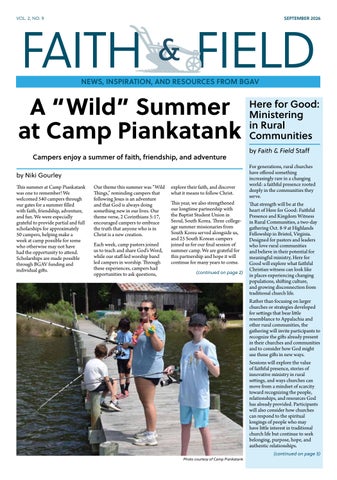
A “Wild” Summer at Camp Piankatank Campers enjoy a summer of faith, friendship, and adventure by Niki Gourley This summer at Camp Piankatank was one to remember! We welcomed 540 campers through our gates for a summer filled with faith, friendship, adventure, and fun. We were especially grateful to provide partial and full scholarships for approximately 50 campers, helping make a week at camp possible for some who otherwise may not have had the opportunity to attend. Scholarships are made possible through BGAV funding and individual gifts.
Our theme this summer was “Wild Things,” reminding campers that following Jesus is an adventure and that God is always doing something new in our lives. Our theme verse, 2 Corinthians 5:17, encouraged campers to embrace the truth that anyone who is in Christ is a new creation. Each week, camp pastors joined us to teach and share God’s Word, while our staff-led worship band led campers in worship. Through these experiences, campers had opportunities to ask questions,
explore their faith, and discover what it means to follow Christ. This year, we also strengthened our longtime partnership with the Baptist Student Union in Seoul, South Korea. Three collegeage summer missionaries from South Korea served alongside us, and 25 South Korean campers joined us for our final session of summer camp. We are grateful for this partnership and hope it will continue for many years to come. (continued on page 2)
Photo courtesy of Camp Piankatank
Here for Good: Ministering in Rural Communities by Faith & Field Staff For generations, rural churches have offered something increasingly rare in a changing world: a faithful presence rooted deeply in the communities they serve. That strength will be at the heart of Here for Good: Faithful Presence and Kingdom Witness in Rural Communities, a two-day gathering Oct. 8-9 at Highlands Fellowship in Bristol, Virginia. Designed for pastors and leaders who love rural communities and believe in their potential for meaningful ministry, Here for Good will explore what faithful Christian witness can look like in places experiencing changing populations, shifting culture, and growing disconnection from traditional church life. Rather than focusing on larger churches or strategies developed for settings that bear little resemblance to Appalachia and other rural communities, the gathering will invite participants to recognize the gifts already present in their churches and communities and to consider how God might use those gifts in new ways. Sessions will explore the value of faithful presence, stories of innovative ministry in rural settings, and ways churches can move from a mindset of scarcity toward recognizing the people, relationships, and resources God has already provided. Participants will also consider how churches can respond to the spiritual longings of people who may have little interest in traditional church life but continue to seek belonging, purpose, hope, and authentic relationships. (continued on page 3)
PAGE 2
FAITH & FIELD
A “Wild Summer” (continued from page 1)
Camp Piankatank offered a variety of experiences throughout the summer, including Day Camp, Overnight Camp, Camp Together—our special parentand-child camp—and Minnow Camp, a two-night camp designed especially for children ages 6-10. From first-time campers to returning friends, it was a joy to see God at work throughout the summer. We are thankful
for every camper, family, staff member, pastor, volunteer, and supporter who helped make this summer possible. Niki Gourley is associate director for retreats and food services at BGAV’s Camp Piankatank.
Learn more about Camp Piankatank: CAMPPIANKATANK.COM
SEPTEMBER 2026
Faith & Field is published monthly by Baptist General Association of Virginia, 2828 Emerywood Parkway, Henrico, VA 23294. © Baptist General Association of Virginia ISSN 3069-8634 (print) ISSN 3069-8642 (digital) Phone: 804-915-5000 Website: BGAV.org
GARY LONG Editor-in-Chief Chief Marketing Officer JENNIFER LAW Writer/Content Editor MEGHAN WILSON Creative Director
For subscription updates, email faithandfield@bgav.org. Some content written by Faith & Field staff may be produced using AI assistance, with editor curation and oversight. Faith & Field welcomes article submissions and first-person reflections from BGAV pastors, ministry leaders, lay leaders, and ministry partners. We seek writing that helps Virginia Baptists think, serve, and lead more faithfully together. The editorial staff reviews all submissions for relevance, quality, available space, and alignment with the publication’s mission. Staff may edit articles for BGAV style, clarity, and grammar. Submission does not guarantee publication, and all editorial decisions are final. To submit an article or reflection for consideration, email your submission to faithandfield@bgav.org.
connecting + developing congregations + leaders for an ever-changing world
SIGN UP FOR OUR FREE
ADVENT RESOURCE FOR CHURCHES
After receiving great reviews from pastors and worship leaders who used the Advent worship resource we offered free to our participating churches in 2024, we’re offering a new one this year! Alan Miller, pastor of Orange Baptist Church, is returning as the author. We look forward to sharing his creativity and wisdom in making your worship planning simpler. If you would like to be notified when this year’s Advent resource is available for download, please sign up below!
BGAV.org/Advent2026
Photos courtesy of Camp Piankatank
PAGE 3
FAITH & FIELD
SEPTEMBER 2026
A Heart for the Not Yet: Hope and Opportunity in Tidewater by Wayne Faison On August 11, 2026, pastors and ministry partners from across the Tidewater/Mid-Tidewater Region gathered at Riverwalk Restaurant in Yorktown for a Pastors & Partners Networking Luncheon hosted by BGAV around a shared question: How can we, as Virginia Baptists, faithfully respond to the systemic challenges currently facing the people living in our communities? I shared with those gathered that this same question had been posed in both our Northern Virginia and Southwest Virginia regions. Specifically for the Tidewater/ Mid-Tidewater Region, the
FAISON conversation acknowledged several realities affecting our neighbors, including working-class poverty, industry exodus and workforce depletion, healthcare and Medicare disparities, limited community economic reinvestment, racial segregation, housing insecurity, and the growing need to understand emerging issues such as artificial intelligence and its impact on clean water and aquifers. Leaders also discussed the movement of affluent families westward, the need to protect the unborn, and the importance of serving people directly within their communities. Yet, for me, the spirit of the gathering was not defined
Here for Good (continued from page 1)
Presenters include Brian Clark, a pastor and missional practitioner helping rural churches reimagine their buildings and ministry through the Missional Incubator, and David Blackwell, senior pastor of Florence-Carlton Community Church in Montana’s Bitterroot Valley. Both bring extensive experience serving and equipping churches in rural and small-town communities. The gathering will include teaching, panel conversations with rural ministry practitioners, worship, prayer, and opportunities for participants to learn alongside others who understand both the gifts and challenges of ministry in rural places. “I can’t wait to gather with people from Southwest Virginia and beyond to hear testimonies of what God is doing in our hearts and in our communities. Let’s all come prepared to share stories of fruitful ministry, what we are learning as we embrace the stretch of reaching people in an everchanging world, and what it means to ‘see what God is doing and join him in it,” encouraged Andy Barnes, BGAV’s field strategist for the Southwest region. Here for Good takes its name from a threefold affirmation: rural
churches are here, rooted in the places they serve; they are here for good, seeking the flourishing of their neighbors; and they are here because God is good, bearing witness to that goodness in their communities. “Rural leaders carry a deep wisdom about what it means to love a place well, and so, for me, Here for Good encapsulates the heart of the rural church. When Fresh Expressions was asked to convene this gathering, the first thing we did was listen to rural leaders and what kind of conversations would serve them well. We are simply creating a space where rural churches can encourage one another, share what they’re learning, and spark fresh imagination for the future of the church,” reflected Shannon Kiser, senior director of BGAV’s Fresh Expressions North America. Registration is $35 and includes dinner Thursday evening. The gathering begins Thursday afternoon, October 8, and concludes with worship at 12:30p.m.. Friday, October 9. Learn more about registering for Here for Good: FRESHEXPRESSIONS.COM/ HERE-FOR-GOOD
by problems; it was defined by possibilities and opportunities. The luncheon reminded me that churches are uniquely positioned to become places of hope, connection, advocacy, compassion, and practical action. As we discussed, free clinics, workforce development, affordable housing partnerships, community economic initiatives, environmental stewardship, and ministries addressing incarceration and family instability can become pathways through which Virginia Baptist churches demonstrate the love of Christ. In fact, a particularly compelling theme emerged from our conversation: We must work among the people to make a difference. Ministry cannot always happen from a distance. We are called to listen, build relationships, walk alongside our neighbors, and discover where God is already at work. This is the opportunity before us as Virginia Baptists. Rather than simply responding to disparity, we can help cultivate flourishing communities. Rather than waiting for crisis, we can build partnerships that create opportunity.
I firmly believe that, grounded in BGAV’s calling to have a “Heart for the Not Yet,” Tidewater churches can move forward with courage
”
”CHURCHES ARE UNIQUELY POSITIONED TO BECOME PLACES OF HOPE, CONNECTION, ADVOCACY, COMPASSION, AND PRACTICAL ACTION.”
WAYNE FAISON
and hope. The future is not without challenges, but neither is it without possibilities. Together, we can believe that God is still writing a better story for our communities and that God’s church can be part of it. Now, with three Pastors & Partners Networking Luncheons under our belts, I’m looking forward to our next gathering on September 21 in the Capital region. Rev. Dr. Wayne Faison is BGAV’s executive director.
Stock photo
PAGE 4
FAITH & FIELD
SEPTEMBER 2026
DOLLARS AND SENSE
What Virginia’s New Pay Transparency Law Means for Your Church
WASHBURN
by David Washburn If you’re involved in hiring or managing staff at your church, there’s a new state law you need to know about. Virginia’s Pay Transparency law took effect July 1, 2026, and it changes some of the basic ground rules around how churches post jobs, talk about pay, and handle salary conversations with staff and applicants. The good news: this isn’t as complicated as it sounds, and much of it reflects practices many churches already follow. Here’s what you need to know, in plain terms.
Three Things to Change Right Now 1. Stop asking about salary history. When you’re hiring for a nonexempt position, you can no longer ask candidates what they currently make or have made in the past. This includes applications, in interviews, or through informal conversation. If a candidate offers that information on their own without being asked, you’re allowed to hear it and even use it to offer them more, but you can never use it as a reason to offer less.
”SORT YOUR POSITIONS INTO TWO BUCKETS — MINISTERIAL AND EVERYTHING ELSE — AND APPLY THIS GUIDANCE TO THE ‘EVERYTHING ELSE’ BUCKET.”
”
DAVID WASHBURN
Who This Applies To The law does not apply to your ministerial staff—pastors, associate pastors, and other roles that meet the federal criteria for exempt ministerial functions. That exemption stays intact. But it does apply to everyone else: your administrative staff, office personnel, maintenance and hospitality workers, hourly employees, and any other nonexempt positions. If your church employs a receptionist, a bookkeeper, a facilities coordinator, or part-time hourly help, this law covers how you hire and pay them. My suggestion is to sort your positions into two buckets— ministerial and everything else— and apply this guidance to the “everything else” bucket.
The simplest fix: train whoever does your hiring interviews to leave out salary history questions, and to base offers on the role and your budget, not on what someone made elsewhere. 2. Include a pay range in every job posting. Any time you post an opening for a nonexempt position— whether it’s an external ad or an internal posting for a promotion or transfer—you now need to include the wage or a pay range. This applies to hourly and salaried nonexempt roles alike. You don’t need to nail down an exact figure. The law allows a “good faith estimate,” meaning a reasonable range based on your budget, what similar roles pay, or your own past pay scales for that position. If a current employee asks what the pay range is for their
Stock photo
own job, you’re required to share that too. 3. Be ready to correct mistakes quickly. If you post a job without a pay range, you’re not automatically in legal trouble. The law gives employers 15 business days to fix the posting after receiving written notice of the oversight, and doing so protects you from a private lawsuit over that specific mistake. It’s a grace period, but it only helps you if you act on it promptly, so if someone flags a missing pay range, don’t let it sit. What Not to Do Don’t punish, discipline, or pass over anyone—staff or applicant— for exercising their rights under this law. That includes someone who declines to share their salary history or who asks what the pay range is for a position. Retaliation of any kind opens your church up to real financial exposure: the Attorney General can issue civil penalties up to $1,000 for a first violation and up to $5,000 for repeat violations. A Practical Next Step If your church has a personnel committee, search committee, or
HR-related team, this is worth a short conversation at your next meeting. Walk through your current job postings and hiring practices together, and ask two simple questions: Do our nonexempt postings include a pay range? Have we trained the people leading our interviews to avoid salary history questions? Most churches will find they’re already close to compliant or that getting there just takes a small adjustment to a template or a talking point in the interview process. This law isn’t asking churches to overhaul how they operate; it’s asking for a bit more openness with the people who serve alongside us on staff. That’s a spirit most congregations will recognize as consistent with how we’re already called to treat one another. This article is intended as general guidance for church leaders and is not a substitute for legal counsel. Churches with specific questions about their staffing structure should consult an attorney familiar with Virginia employment law. Rev. David Washburn is BGAV’s treasurer.
PAGE 5
FAITH & FIELD
ARTfor the NOT YET ARTIST HIGHLIGHT PENNY LASSITER HALSEY Penelope Lassiter Halsey “Penny” is a member of Youngs Chapel Baptist Church in Grayson County, VA. She has served as a music director, adult Sunday school teacher, and a deacon within this congregation. Professionally, she has served within Virginia Public Schools from 1972–2021 as a Communication Disorders Specialist with emphasis on Speech, Language, and Hearing Impairments. She has worked in Portsmouth City Public Schools, Grayson County Public Schools, and Chesterfield County Public Schools. Currently, she lives in Grayson County, VA, with her husband, John. They live on an 80-acre farm in the Appalachian Mountains, enjoying retirement alongside their two cats, two dogs, and a menagerie of woodland wildlife. How did you hear about the Art for the Not Yet? I attended the BGAV Annual Meeting in Abingdon, Virginia, last November where I learned about the call for the Art for the Not Yet project to be created and submitted for the 2026 Annual Meeting. Briefly explain your piece for the “Art for the Not Yet” exhibit. I will be submitting a booklet of poetry entitled “Never Alone” as my contribution to the Art for the Not Yet project.
VISIT THE ART EXHIBIT AT THIS YEAR’S ANNUAL MEETING TO SEE THIS WORK AND MANY MORE! SUBMIT YOUR OWN WORK: BGAV.ORG/ARTFORNOTYET
October 8-9, 2026 Highlands Fellowship
SEPTEMBER 2026
Help Everyone Feel at Home: Volunteer at Annual Meeting by Layci Clifford they belong, they naturally begin My family hosts a small group in helping others feel like they belong our home on Monday nights. The too. moment that makes me smile the biggest is when they start opening That’s exactly what happens my cabinets. through our volunteer team. When the doors open, it’s the people I know that probably sounds greeting at registration, welcoming strange, but hear me out. cars into the parking lot, answering The first few weeks someone comes to our Monday night group, questions in the hallway, and they ask permission for everything. helping someone find the right room who help turn a well-planned Where should I put this? event into a warm welcome. Can I throw this away? They’re not just checking people in. They’re saying, “We’re glad Do you have a serving spoon? you’re here.” Fast forward a few months, and they’re opening the pantry looking They’re helping someone who’s for aluminum foil, grabbing a bowl attending for the first time feel like they belong. from the cabinet, or refilling the ice bin without saying a word. It’s If BGAV has ever been that a little startling the first time it kind of place for you—a place happens, but I love it. where you’ve been encouraged, Because somewhere along the way, challenged, supported, or they stopped feeling like they were simply reminded that you’re guests and started feeling like they part of something bigger than yourself—maybe this is your year were part of the family. That’s one of the things I love most to help create that same feeling for someone else. about the BGAV family, too. Take a look at the volunteer Every November, we gather from opportunities by scanning the QR across Virginia and beyond. Some code below. Whether you have people are attending their very 30 minutes or a few hours, there’s first Annual Meeting. Others have probably a place where your smile, been coming for decades. We your willingness to help, or your reconnect with friends, worship friendly conversation could make together, learn from one another, someone else’s experience just a and celebrate what God is doing little bit better. through churches across our Commonwealth. Somewhere along See you in November, family. the way, for many of us, the Annual Rev. Layci Clifford is the event Meeting stops feeling like an event planner for BGAV’s Annual Meeting. we attend and starts feeling a little more like coming home for a family reunion. Learn more about One of the other things I love BGAV’s Annual Meeting: most about the BGAV family MEETING.BGAV.ORG is that, when people feel like
Bristol, VA
What does it look like to bear witness to God’s goodness in rural communities today? Together, we’ll explore what it means to lead communities where God’s goodness is visible—not through bigger programs or borrowed strategies, but through faithful presence, courageous imagination, and contagious goodness. Come join the conversation! freshexpressions.com/here-for-good
SCAN THE QR CODE TO VOLUNTEER AT THIS YEAR’S BGAV ANNUAL MEETING!
Whether you have 30 minutes or a few hours, there’s probably a place where your smile, your willingness to help, or your friendly conversation could make someone else’s experience just a little bit better. There are a variety of volunteer positions available!
SCAN TO VOLUNTEER FOR THIS YEAR’S BGAV ANNUAL MEETING!
PAGE 6
FAITH & FIELD
SEPTEMBER 2026
Small Acts, Lasting Impact by Welford Orrock Springtime on college campuses is a whirlwind of activities and transitions. There are many things demanding students’ time and attention—final projects and exams, summer jobs and internships, graduation preparations and celebrations, and packing up apartments and dorm rooms. To say their margins are thin would be an understatement. Even still, BGAV’s collegiate ministry communities (BCMs) across Virginia took on the challenge this spring to ask, “Who are our neighbors?” and “How can we love and serve them?” With support from BGAV’s executive office, our BCM communities received microgrants to help fund new initiatives that we simply called “Acts of Kindness.” They were invited to listen to the needs of their communities and imagine practical ways they could meet those needs. One of the core values of our BGAV collegiate ministry team is to be good neighbors to the campuses and surrounding communities where we minister. No ulterior motive, no bait and switch, but simply because Christ calls us to love our neighbors.
The imagination and effort of our students through Acts of Kindness was inspiring. At Radford University, BCM students bought flowers for residents at a local senior living facility and wrote notes of encouragement. One student shared, “On our first day, we walked through the halls and rooms, handing out flowers with words of encouragement attached. It was great to see the residents’ faces light up, not just from receiving a colorful flower, but from having visitors. Some of them really just wanted someone to talk to and didn’t care much about the flower at all. “Later that day, a few of us were invited to their ‘senior prom’ the following Thursday. They needed young men to come and dance with some of the elderly women, so I convinced a friend of mine to go with me. When we arrived, the staff welcomed us warmly. One even said, ‘I can’t believe y’all actually came.’” At Old Dominion University, BCM students learned that ODU had closed its on-campus student thrift store. Seeing a need in the
community, they organized a thrift store at the BCM building called Chosen Thrift. Longwood BCM students pack bags with grocery staples. Chosen Thrift grew from listening Photo courtesy of Cadance Tyler to students and items suitable for campus dorms recognizing the and apartments. Together, they need for affordable clothing, packed and delivered 30 bags connection, and a welcoming campus space. After two months of of groceries with the hope of student-led planning, the event felt connecting with students, sharing less like a giveaway and more like a the love of Christ, and lightening the burden of grocery shopping for community gathering. the week. Students laughed, stayed, and “The service project was a great shared the experience together. Several returned afterward, joined opportunity to come together and serve,” said Elijiah Tonello, Bible study, and became more consistently engaged, showing the president of Longwood’s BCM. potential for a permanent student- “Small acts of service can have a big impact, and it was inspiring to led thrift space and resource hub. see how we could help and support Students are now working to others with a real need.” establish a more permanent space in the BCM building, so the thrift Across three campuses, the store can open on a semi-regular answers to “Who are our basis. neighbors?” looked different. So did the ways students chose to Students at Longwood University serve them. But each began in the recognized another need in same place: paying attention to the their community: rising grocery people around them and finding costs and the limited budgets of a practical way to show them the fellow students. With the idea of love of Christ. providing groceries to students, BCM students brainstormed meal Rev. Welford Orrock is BGAV’s ingredients and staple grocery Kairos Initiative coordinator.
How We Started a Dinner Church by Greg LeMaster In June 2018, we started eight weeks of training with 20 people interested in starting a Dinner Church at Graceland Baptist Church in Powhatan, Virginia. Previously, a couple of deacons and I had attended a conference led by Verlon Fosner about the Dinner Church movement his church had started. We came back excited to share with our pastor and others in our congregation about this great ministry opportunity in our community. Many in our congregation felt our excitement and agreed that we had an opportunity to bless our community and make a lasting impact. At the conclusion of the conference, we had asked Verlon
about the context of our church at Graceland, where we were already serving people through our weekly food pantry. He suggested that the food pantry could be the perfect place to start a new congregation
that might blossom into a Dinner Church. Indeed, it did! We began our training with all 20 people reading Welcome to Dinner, Church by Verlon
Photo courtesy of Greg LeMaster
Fosner. We then worked through four weeks of video instruction covering many aspects of starting a Dinner Church. At every training, we prayed for the Lord to show us and guide us in this exciting new church plant. We decided to start slowly with one Dinner Church a month and let the Lord lead us from there. In August 2018, we launched our first Dinner Church, which we named “At the Table Church,” on the last Thursday of the month. We knew people who visited our food pantry often had their greatest need for food at the end of each month, so we felt the last Thursday would be a good time to share an abundant, delicious meal with them. (continued on page 7)
PAGE 7
FAITH & FIELD
SEPTEMBER 2026
Dinner Church
FIELD NOTES
Serving on BGAV’s Program Committee by Marcus Vaughan Serving on BGAV’s Annual Meeting Program Committee has been one of the most enriching and eye-opening experiences of my ministry life. It is a unique space where people from all across Virginia—different churches, different communities, different backgrounds—come together with a shared purpose: to create an annual gathering that is spiritual, uplifting, informative, and deeply rooted in the movement of God among us. What makes this committee special is not just the work we do, but the people who do it. Each person brings their own story, their own faith journey, and their own perspective, and somehow God weaves all those threads into a single tapestry of collaboration and calling.
vibe of the city, paired with the steady rhythm of ocean waves, brings its own kind of inspiration. There’s something about gathering near the water that feels symbolic—like standing at the edge of something vast, reminded of God’s power, creativity, and presence. Each place we meet becomes part of the story, shaping not only the event but also the people who help create it.
Marcus Vaughan currently serves on BGAV’s Program Committee and the task force for this year’s Art for the Not Yet exhibit. Photo courtesy of Marcus Vaughan
But beyond the travel and the
”
”WHAT MAKES THIS COMMITTEE SPECIAL IS NOT JUST THE WORK WE DO, BUT THE PEOPLE WHO DO IT.”
MARCUS VAUGHAN
One of the unexpected joys of serving on this committee has been the opportunity to travel across the Commonwealth. Each year’s meeting has taken us to a different corner of Virginia, and each location has added its own flavor to our work. Coming from the hustle and bustle of Northern Virginia, where Alexandria buzzes with constant motion, I found it refreshing to step into the calm and breathtaking beauty of Abingdon, nestled in the Appalachian Mountains. There, the slower pace and the mountain air seemed to invite reflection and remind us of the quiet ways God speaks.
planning, what has impacted me most is the spiritual growth that happens within the committee itself. Sitting around a table with people whose church experiences look nothing like mine, hearing how God has moved in their lives and communities, has broadened my understanding of the Kingdom. It is humbling and energizing to hear how faith is lived out in rural congregations, urban ministries, coastal churches, and mountain chapels. These conversations remind me that God is at work everywhere—often in ways we don’t see until someone shares their story.
Now, as we look toward Virginia Beach, I’m excited for yet another shift in scenery. The artsy, bluesy
In this committee, we don’t just plan an event; we grow together. We learn from one another. We
challenge one another. And we witness firsthand how God uses different people, with different gifts, to accomplish a shared mission. Every meeting feels like a small glimpse of the larger body of Christ—diverse, imperfect, yet beautifully united in purpose. Being part of the BGAV Program Committee has shown me how powerful it is when God brings people together. It has reminded me that collaboration is a form of worship, that listening is a form of ministry, and that planning an annual meeting can be just as sacred as attending one. Through every conversation, every decision, and every gathering, I see how God is working through each of us—and even more profoundly, how God is working through all of us together. Marcus Vaughan is worship and ministry director at Beale Memorial Baptist Church, a BGAVparticipating congregation in Tappahannock, Virginia.
Faith & Field features first-person reflections from pastors and ministry leaders across BGAV — sharing honest insights, lessons learned, and glimpses of grace from the field. Want to add your voice? Email Jennifer Law at jennifer.law@bgav.org.
(continued from page 6)
About 10 people, in addition to our team, attended that first gathering. We met new friends and got to know people from the food pantry even better as God turned strangers into friends at the table. As the months went by, we saw how much people loved being “At the Table” as we broke bread together, shared fellowship and the love of Jesus, heard a Jesus story followed by discussion, and prayed over the needs of people in this new congregation (Acts 2:42). Now, eight years later, with multiple Dinner Churches in multiple locations, we see how the Lord has led us to so many people who needed to experience the love of Christ in action. Dinner Church is relational and authentic, and many of these “not yets” are simply drawn to it. Currently, we are ministering to more than 200 people, including food pantry regulars, individuals with special needs and their families, and veterans. It is such a blessing to see people who, for different reasons, wouldn’t attend our Graceland services on Sundays come and tell us that At the Table Church is their church—and indeed, it is! If we had never stepped out in faith to start our first Dinner Church, we would not have experienced the joy of seeing people come to faith in Christ and belong to the family of God. I pray that you and your church will consider starting a Dinner Church “vine” that reaches beyond the four walls of your church and into your community with the love of Christ, because so many do not know him yet. Impact Missions is now offering seed grants to help churches interested in starting a Dinner Church. Scan the QR code below to learn more. Rev. Greg LeMaster is associate pastor for outreach at Graceland Baptist Church, a BGAVparticipating congregation in Powhatan, Virginia.
Learn more about Dinner Church seed grants:
IMPACTMISSIONSMOVEMENT.ORG/ IMPACT-MISSIONS-FRESHEXPRESSIONS-SEED-GRANTS
PAGE 8
FAITH & FIELD
SEPTEMBER 2026
A new healthcare option for small church staff
Affordable healthcare for pastors and staff, especially in smaller churches with fewer than 10 people on staff, is a continuing and growing challenge. FREE INFORMATIONAL WEBINAR Wednesday, September 16, 2026 11:00 a.m. - 12:00 p.m. EDT Sign up for a free informational webinar about Cedar Health Alliance, a health plan designed specifically for churches and faith-based nonprofits. They hope to launch in January 2027, providing an affordable and effective healthcare option for churches and ministries with fewer than 10 employees. To become a reality, the initiative requires a minimum number of churches to participate. Register now to learn more and explore whether this could be a fit for your church!
Register online: BGAV.ORG/CHA-WEBINAR
PAGE 9
FAITH & FIELD
SEPTEMBER 2026
The Soil Beneath Our Future by Michael Pumphrey PUMPHREY
Stock photo
As I write this, I am preparing to move my oldest son to college. I’ve been thinking a lot lately about what it means to raise teenagers into young adults. Just a few years ago, we helped his older sister navigate many of these same transitions, while our other two children are now in the prime of their teenage years. One thing has become increasingly clear: what one child needs from me is often very different from what another needs. One needs to be challenged while another needs more support. One needs help thinking through direction while another needs the freedom to navigate that future themselves. Sometimes being a good parent means stepping closer. Other times it means having the discipline to step back. The goal hasn’t changed. I want each of my children to launch into the world knowing they are loved and becoming increasingly selfaware, independent, and liberated to become who God created them to be. I’ve simply learned that how you help one child get there may look very different from how you help another. Recently, a close family member told me they admired the way I parent each of my children differently. That’s learned behavior, not natural instinct. I’ve had to discover that assumptions developed while parenting one child don’t necessarily work with another. My love hasn’t changed. But how that love needs to be expressed sometimes must. The values remain. Their embodiment changes. I think something similar happens in our churches.
Edgar Schein, one of the most influential thinkers on organizational culture, described culture as something that develops through a group’s shared learning. We encounter problems, discover ways of navigating them, and over time those solutions become assumptions about how the world works. Eventually, we stop recognizing them as assumptions. Yesterday’s solutions can harden into today’s assumptions, and today’s assumptions can become tomorrow’s barriers. That’s why I like to think of culture as the soil beneath our feet. We don’t always notice it, but it shapes what can take root and grow. Churches have plenty of assumptions. We have assumptions about what worship looks like. What a pastor does. What our buildings are for. How decisions get made. Who leads. Who belongs. What constitutes faithfulness. Even what it means to love our neighbors. Many aren’t bad. Often, they developed precisely because they served us well. I once sat with a church leadership team that told me they wanted to change. Because strategy is one of my strengths, I assumed my job was straightforward: help clarify where they needed to go and build a roadmap to get there. If the logic made sense and the next steps were clear, surely we could simply begin to move. I was incredibly wrong. As change became concrete, resistance took root. People dug in, saying things like: That’s not what we do here. That’s not the Baptist way. I had underestimated how much history, grief, fear,
relationships, and identity we carry into change. But I had also underestimated the power of assumptions. Practices that served us faithfully in one season can slowly become confused with faithfulness itself. “This is how we have done it,” quietly becomes, “This is what faithfulness requires.” Over time, our assumptions can even shape the way we understand God, the church, and our place in the world. Practices inherited from previous generations gradually acquire theological weight. Changing the practice then begins to feel like compromising the conviction. That’s why examining congregational culture is more than an organizational exercise. It is deeply theological work. We must be willing to ask not only what we believe, but what has shaped those beliefs and whether the life we have built around them embodies the gospel we cherish. Consider something as ordinary as church property. Churches collectively possess enormous amounts of land and building space while our communities face significant challenges around housing, childcare, loneliness, food insecurity, and other needs. I’m not suggesting every church with unused property should build affordable housing or launch another community program. I’m suggesting we become curious enough to ask: What are these resources for? A congregation can deeply believe in loving its neighbors while carrying an unspoken assumption that its property exists primarily for the people who attend there. We can cherish the gospel in our minds, defend it with our words, and preach it from our pulpits while struggling to give it flesh in
the particular places where God has planted us. The incarnation reminds us that God’s love did not remain abstract. The Word became flesh and dwelt among us. So perhaps one of the most important questions a church can ask is: What does the incarnation of the gospel look like in our community today? That question may require examining more than our programs. It may require examining assumptions we’ve carried for decades. In the previous article in this series, I wrote about understanding our limits. Healthy churches need to know what they can and cannot carry. But we should be careful not to confuse the limits of our present assumptions with the limits of what God might do through us. Sometimes faithfulness means acknowledging a real limit. Sometimes it means becoming curious about assumptions. Why do we do it this way? What are our neighbors actually experiencing? What might loving them require of us now? Culture is not simply what we declare. Culture is what we cultivate. And healthy soil takes time. We don’t change congregational culture by announcing new values or unveiling another strategic plan. We cultivate it slowly through honest conversations, courageous questions, experiments, relationships, grief, trust, and repeated acts of faithfulness. Perhaps our task isn’t to manufacture the future at all. Perhaps it is to faithfully tend the soil beneath our feet, trusting that God is still capable of growing something new. Rev. Michael Pumphrey is BGAV’s director of coaching. This article is the fifth in a series of six on leadership by Michael Pumphrey.
PAGE 10
FAITH & FIELD
SEPTEMBER 2026
Faith in Motion: Youth Cultivating a Heart for the Great Commission by Joel Elmore When youth choose to live out their faith through service, they may never know who is watching or how their example may inspire someone else. That was the unexpected impact of Impact Missions’ visit to HopeTree this summer. Through Impact Missions summer camps, youth from churches across Virginia spent the summer giving back to organizations making a difference in their communities. At HopeTree’s Salem campus, they spent a week painting both of our Therapeutic Group Homes (TGH), one home for boys and one for girls. The goal was to help create a warmer, more welcoming place for youth in foster care to call home. HopeTree’s TGH program provides a safe, stable, and nurturing home environment for youth ages 11 to 17 in foster care who are unable to safely return to their families. Through evidencebased practices, compassionate care and individualized plans, we equip youth with the tools they need to heal, grow, and thrive. For young people who have experienced instability, creating a place where they feel a sense of
Our hope was that the residents would enjoy the refreshed look of their homes. What we soon realized was that the Impact Missions volunteers were giving them something more: an example of what it looks like to put faith into action.
That response has stayed with me. Since our founding as the Baptist Orphanage of Virginia in 1890, faith has been part of HopeTree’s ministry. Today, youth in TGH have opportunities to grow in their relationship with God through Bible studies, participation in Fellowship of Christian Athletes, and involvement with local churches.
“I am here because God has been so good to me, and I want his goodness to reflect in my actions,” said one youth volunteer. “Hopefully, I can inspire someone else to have the same kind of relationship that I have with him because he has blessed me in so many ways, and I want someone else to have that same opportunity.”
But it was this single act of kindness shown by Impact Missions that spurred others on in their own faith journey. These volunteers demonstrated to our residents that faith-driven service is not something reserved for adults. Young people can inspire other young people simply by choosing to live out what they believe.
safety, welcome, and belonging is an important part of that care.
While the volunteers hoped their service would inspire others, they may not have expected it to reach one of the young people living in the very home they were helping to paint.
This is one of the opportunities we have as churches and faithbased organizations. When we give young people meaningful opportunities to serve, they experience what it means to use their time, talents, and faith to care “I think that it was pretty cool that there was a group of my peers for others. Through partnerships with organizations like HopeTree, willing to do something like this,” churches can meet tangible needs one TGH resident shared. “It while helping their youth discover makes me think that this could be something that I could do someday the joy and purpose that comes from serving their communities. to give back.”
I am grateful for the volunteers of Impact Missions who gave their time and energy to HopeTree. Their work helped create more welcoming homes for our youth, but their example left an even greater impression. I am also grateful for the Baptist General Association of Virginia’s continued commitment to answering scripture’s call to care for those who are vulnerable and on the margins of society. James 1:27 reminds us, “Religion that God our Father accepts as pure and faultless is this: to look after orphans and widows in their distress and to keep oneself from being polluted by the world.” May the Lord continue to work through our churches, our families, and our young people as we partner together to serve children and families, strengthen our communities, and bring hope to those who need it most. Rev. Joel Elmore is Chaplain and Activities Coordinator at HopeTree Family Services, a BGAV ministry partner.
An Impact Mission Camp student helps refresh one of HopeTree’s youth cottages in Roanoke, VA, in summer 2026.
Members of Impact Missions Camp’s Roanoke team painted the common living areas—including the living rooms and kitchens—in two of HopeTree’s youth cottages.
Photo courtesy of HopeTree
Photo courtesy of Impact Missions
PAGE 11
WORSHIP BREAKOUTS & LOTS OF FUN!
FAITH & FIELD
SEPTEMBER 2026
LONG STORY SHORT
Everything Old is New Again
LONG
by Gary Long Everything old is new again. Yay for mid-century modern furniture and yacht rock. My belief is that “everything old is new again” because everything new has become exhausting. It appears that Gen Z—raised to swipe, stream, and expect delivery pronto—has developed a surprising affection for things that require people to show up, not just log in. The research says they are knitting and crocheting. They are buying vinyl records, baking bread, watering plants, reading physical books, and sending handwritten letters. I noticed at a Bob Dylan concert in July that the audience was younger than this 50-something author by three or (almost) four decades.
OCTOBER 23-25, 2026
EAGLE EYRIE
FALL GATHERING
Fall Gathering is an annual gathering of 18-25 year-olds from all across Virginia lifting up the name of Jesus.
Somehow, pen pals have survived email. Even Grandma’s dining room is having an architectural moment, as dinner parties are back in vogue. Somewhere there’s a sewing basket feeling surprised to be back in use. I’m just sure of it. The rise of “Grandma hobbies” may be offering the church insight. I’m tempted to call this nostalgia, though nostalgia requires remembrance. But Gen Z doesn’t actually remember these things; they are discovering them. Perhaps they are discovering that receiving a letter means someone sat still long enough to think about you. A record is not merely accessed; it is selected, held, played, turned over, and played again—as in, the whole album. By one artist. Another seemingly unrelated trend just might belong in the same conversation, A recent episode of The New York Times’ The Opinions carried the provocative title, “Gen Z-ers Are Ditching Sex. They Might Be Onto Something.” The conversation explored Gen Z’s oft-discussed “sex recession” and the complicated forces behind
it—technology, social anxiety, the influence of #MeToo, changing attitudes toward relationships, and a renewed appreciation for platonic friendship.
technologically impressive. They may be searching for places where life slows down enough for trust to grow. This means that your church shouldn’t necessarily start a “grandma hobbies small group.”
This doesn’t mean an entire generation has suddenly adopted a traditional Christian sexual ”YOUNG ADULTS MAY ethic, so let’s resist the urge NOT NEED US TO BECOME to spike the ball FASTER, SLICKER, OR in the end zone of sexual purity. MORE TECHNOLOGICALLY The retreat IMPRESSIVE.” from dating and sex could GARY LONG reflect healthy boundaries and deeper intentionality. It more likely means meals that Or, it could signal loneliness, linger around a table. Or older and anxiety, or a fear of real intimacy. younger people learning a craft All these things can be true. together. Perhaps it’s honoring It seems that Gen Z has asked friendship and singleness as some underlying questions worth meaningful forms of Christian noticing: What if every appetite community and not just treating does not have to be immediately singles ministry as a waiting room satisfied? What if intimacy is not for wedded bliss. It certainly means another consumer product? What speaking about sexuality without if friendship, solitude, restraint, and panic or shame—and speaking patience possess value of their own? about holiness without pretending that desire and loneliness are At first glance, crocheting and simple. celibacy would seem to belong in
”
entirely different articles. Perhaps they do. Or maybe both are quiet protest of a culture that has made nearly everything immediate, disposable, and/or transactional. One says: I would rather make something than merely order it. The other asks: Can human connection be more than a transaction?
Both suggest that convenience may not be the highest human good. Church, let’s don’t miss this. Young adults may not need us to become faster, slicker, or more
Please don’t read “grandma hobbies” as a church growth strategy. Young adults can smell the marketing before we finish printing the tote bags. But we could recover the community of Grandma’s dining room: a place where people were known, and stories took time. Perhaps these young folk are less about living in the past and more into rummaging through our closets for the parts of being real, live humans we failed to carry forward. Gary Long is BGAV’s chief marketing officer.
IN THIS ISSUE OF
Nonprofit Organization U.S. Postage PAID Richmond, Virginia Permit No. 1038
BAPTIST GENERAL ASSOCIATION OF VIRGINIA 2828 Emerywood Parkway Henrico, VA 23294
• A “Wild” Summer at Camp Piankatank
• Help Everyone Feel at Home: Volunteer at Annual Meeting
• Here for Good: Ministering in Rural Communities
• Small Acts, Lasting Impact
• Sign Up for Our Free Advent Resource for Churches
• FIELD NOTES by Marcus Vaughan
• How We Started a Dinner Church
• A Heart for the Not Yet: Hope and Opportunity in Tidewater • DOLLARS AND SENSE: What Virginia’s New Pay Transparency Law Means for Your Church
• The Soil Beneath Our Future • Faith in Motion: Youth Cultivating a Heart for the Great Commission • LONG STORY SHORT: Everything Old is New Again
• Art for the Not Yet Artist Highlight: Penny Lassiter Halsey
REGISTRATION NOW OPEN!
2026 BGAV ANNUAL MEETING
“These people who have been turning the world upside down have come here also” Acts 17:6b, NRSV
NOVEMBER 9-11, 2026 VIRGINIA BEACH, VIRGINIA
featuring... MAIN SPEAKER: MIRIAM SWANSON
WITH ALAN HIRSCH AND RICK WARREN
WORSHIP LEARNING LABS
ARTfor the NOT YET A BGAV Arts Collaborative
MINISTRY FAIR ART FOR THE NOT YET
COLLABORATIVE ARTS EXHIBIT
Visit MEETING.BGAV.ORG for details!
PARTICIPATE IN OUR COLLABORATIVE ARTS EXHIBIT! SUBMIT WORKS BY OCTOBER 1
BGAV.org/ArtforNotYet