FALL 2026
UW COLLEGE OF ARTS AND SCIENCES
A&S Art Department’s Master Craftsman Program Prepares Wyoming’s Next Generation of Makers Civil War History Comes Alive in A&S ••• Theatre & Dance Alumnus Builds Worlds for the Big Screen UW SPPAIS Professor Connects Wyoming Communities Through Service and Leadership
Ready for d l r o W s w o Tomorr ’ The College of Arts & Sciences offers a distinct and well-rounded education in Fine Arts, the Humanities, Social Sciences, and Interdisciplinary Programs. Whether you're interested in pursuing a degree in A&S or looking for ways to unlock your creativity, nationally-ranked degree programs and courses with A&S provide an opportunity to gain valuable education and skills. Our programs involve work in the creative fields, using data, learning new languages, understanding the world around you, and much more.
Courses, programs and degrees offered in:
The Neltje CENTER FOR EXCELLENCE IN CREATIVITY AND THE ARTS FINE ARTS
SOCIAL SCIENCES
Music Theatre and Dance Visual Arts
Anthropology Communication and Journalism Criminal Justice and Sociology Psychology
INTERDISCIPLINARY PROGRAMS American Cultural Studies School of Politics, Public Affairs and International Studies
Humanities English Modern and Classical Languages Philosophy and Religion History
Discover Our Departments, Degree Programs and Courses! uwyo.edu/as
CONTENTS
FEATURES
16
7 • We asked. You delivered! On College of Arts & Sciences social media, we recently asked alumni this question: “Who was the A&S professor or staff member who made a positive, lasting impact on your time on campus?” 9 • Art in Action Through The Modern Atelier: Master Craftsman program and a partnership with By Western Hands, A&S art students gain hands-on experience creating functional art, restoring historic pieces and developing the skills needed for careers in design, manufacturing and entrepreneurship. 13 • Teaching the Civil War Out West From the Civil War to the Treaty of Fort Laramie, UW Assistant Professor of History Cecily Zander’s work reveals how historical events stay relevant long after they leave the headlines. 16 • The Science of Storytelling University of Wyoming alumnus Ramsey Avery turned a lifelong passion for science and theater into a career designing worlds for major TV shows and films. 19 • Finding Common Ground A nationally recognized scholar, educator and civic leader, UW Professor Jean Garrison has spent her career connecting people, ideas and communities while helping shape the next generation of engaged citizens. 22 • Service Through Storytelling For Ph.D. student Misty Springer, storytelling is more than an art form — it’s a way to preserve cultural knowledge, amplify underrepresented voices and connect communities locally and internationally. 24 • Beyond the Classroom After arriving at UW as a preveterinary major, senior Alex Novello discovered her passion for criminal justice and received hands-on experience through an internship with the Laramie Police Department.
DEPARTMENTS 02 • Message from the Dean 04 • Faculty Accolades
4
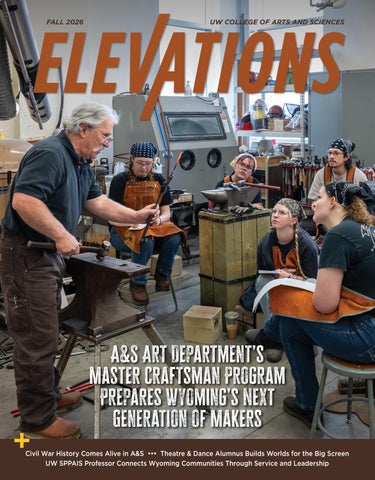
26 • Alumni Highlights ON THE COVER Steve Fontanini of Dubois, Wyo., teaches a blacksmithing course in the Visual Arts Building on campus last spring.
Elevations readers: We have a special challenge for you! There is a very tiny Pistol Pete hidden somewhere in this magazine. If you find it, please email Elevations Editor Michaela Doyle at mjones65@uwyo.edu with the page number to be entered in a drawing for a UW sweatshirt! Answers must be submitted by Nov. 30.
UW College of Arts and Sciences • 1
University of Wyoming College of Arts and Sciences
FROM THE DEAN
Elevations 2026, Volume 12 1000 E. University Ave, Dept. 3254 Laramie, WY 82071 (307) 766-4106 asdean1@uwyo.edu
A&S IS READY FOR TOMORROW’S WORLD
Dean J. Scott Turpen Associate Dean Susan Aronstein Associate Dean Eric Wodahl Associate Dean Christie Zimmerman
The College of Arts and Sciences prepares students to be ready for tomorrow’s world. That phrase is more than an aspiration; it is an idea that guides our work every day. Across our college, our students learn to think critically, communicate clearly and adapt to a rapidly changing world. That work has never been more important than it is now. Artificial intelligence can generate text, images and recommendations in seconds, but it cannot determine what is accurate or make ethical recommendations. As new technologies produce more information, we need people who can interpret evidence, understand context and use these tools responsibly. That is why the arts, humanities and social sciences are not optional enrichment; they are foundational to the University of Wyoming’s land-grant mission. Our disciplines prepare critical thinkers, innovators and leaders. Our graduates strengthen their communities, businesses and our economy with essential skills because our future depends on people making thoughtful decisions together. When someone asks what Arts and Sciences graduates do, we answer with confidence: They do, and can do, anything. Our graduates go into the world knowing how to ask difficult questions, evaluate evidence and communicate with people who have different perspectives. They bring critical thinking, communication, ethical reasoning and creativity to every field they enter. Those skills are evident as you read about A&S student Alex Novello and alumnus Ramsey Avery in these pages. We are committed to helping students connect their Arts and Sciences education to careers and opportunities by expanding paid internships and career-connected experiences across Wyoming and beyond. These opportunities prepare students for successful careers while helping employers observe the skills and talent our students bring to the workplace. In this issue of Elevations, you’ll see the impact of the College of Arts and Sciences in action. Faculty, students, alumni and donors are shaping Wyoming and beyond, and your partnership makes that possible. By sharing our story and investing in student success, you help us serve the state with excellence. Thank you for your continued support of the College of Arts and Sciences. Together, we can make our value clear — to our students, to the University of Wyoming and to the people of our state. I am proud to do this work alongside you. A College of Arts and Sciences degree prepares students not only for a career, but for a life of curiosity, purpose and possibility.
Editor Michaela Doyle All articles written by Michaela Doyle unless otherwise noted. Contributing Editor Chad Baldwin, Micaela Myers Graphic Design Michelle Eberle, Emily Edgar, Casidy Mittelstadt Photography and Video By Institutional Marketing Creative Services Team unless otherwise noted. Elevations Magazine is published once a year for College of Arts and Sciences alumni, friends, and constituents. Mailing addresses are provided by the University of Wyoming Foundation. To change your mailing address and/ or contact information, please send email to foundation@uwyo.edu. The University is committed to equal opportunity for all persons in all facets of the University’s operations. All qualified applicants for employment and educational programs, benefits, and services will be considered without regard to race, color, religion, sex, national origin, disability or protected veteran status or any other characteristic protected by law and University policy.
Dear Friends of the College of Arts and Sciences:
Warm regards,
J. Scott Turpen Dean College of Arts and Sciences
T hank you to our 2025 supporters!
TOTAL
TOTAL
472,427
$
DONATIONS
1,608 DONORS
Giving Day 2025 marked a historic outpouring of generosity and pride for the University of Wyoming community. The College of Arts and Sciences, once again, received the most in both total amount of donors and dollars! “So many people seized the day this Giving Day,” says Kate Schlomer, director of annual giving at the UW Foundation. “Today was about supporting UW students, but it also was about coming together as a community, a decade-long tradition that has really deepened the philanthropic spirit at the university. Every single gift helps light the way for the next generation of Cowboys and Cowgirls.”
2025 A&S CAMPAIGN HIGHLIGHTS College of Arts and Sciences: The College of Arts and Sciences offers a broad education that combines cultural and disciplinary depth to ensure students gain a critical understanding of the visual and performing arts, humanities, social sciences, the world and its languages. Many A&S departments ran successful Giving Day campaigns to support this mission. As a whole, the college received $472,427 from 1,608 alumni and friends—the most donors and dollars of any college on campus for the third year in a row! College of A&S Dean’s Visioning Fund: Looking to the future and its exciting possibilities, the College of Arts and Sciences dedicated its 2025 College of A&S Dean’s Visioning Fund. The fund was created to support student, faculty and staff success, and innovation through funding research projects, professional development, internships, travel opportunities and experiential learning throughout A&S. This fund was supported by 39 donors, who gave a total of $22,734. Collegiate Chorale: The University of Wyoming’s Collegiate Chorale embarked on an unforgettable performance tour of the United Kingdom in May 2026. Choir members proudly
represented UW as they performed in extraordinary venues in Cardiff, Wales; Wells, England; and London, England. To facilitate this exceptional experience for these committed students, they asked for support to help minimize their outof-pocket expenses. With help from 164 donors, $30,311 was raised to help create an unforgettable performance tour for members of Collegiate Chorale. The Neltje Center for Excellence in Creativity and the Arts: The Neltje Center provides a sanctuary for UW students, faculty and other creatives to unleash their imagination in one of the most scenic areas of Wyoming, near the Bighorns just south of Sheridan. The center was established in 2022, and 2025 was its third Giving Day campaign, raising a total of $22,810 to create a brighter future for the arts and interdisciplinary programming.
THIS YEAR’S UW GIVING DAY WILL BE OCT. 21-22 FROM NOON TO NOON. MATCHES AND CHALLENGES WILL BE AVAILABLE TO INCREASE YOUR IMPACT.
VISIT UWYO.EDU/GIVINGDAY
FACULTY ACCOLADES
College of Arts and Sciences faculty conducted critical research, earned impressive awards and more throughout the past year. The UW College of Arts and Sciences strives to offer a broad education that matches cultural breadth and disciplinary depth to ensure students gain critical understanding of the sciences, humanities, visual and performing arts, social sciences, and the world and its languages. This mission would not be possible without the dedicated faculty within A&S. The following list is a spotlight on some, but not all, of the work accomplished by A&S faculty in 2025-26. PHOTO BY MADELINE MACKIE
championship round. The UW squad is among the youngest in the country, with most debaters in their first or second year of collegiate competition.
ROBERT KELLY
Criminal Justice and Sociology
Anthropology
COJO
Robert Kelly, a professor emeritus of anthropology, has been elected to the prestigious National Academy of Sciences (NAS) in recognition of his distinguished and continuing achievements in original research. Kelly is only the second UW faculty member to receive this honor, joining the late George Frison, a renowned archaeologist and former longtime UW faculty member. NAS announced the election of 120 members and 25 international members this year, bringing its total active membership to 2,705 and its international membership to 557.
The UW debate team earned national recognition following strong performances at the National Debate Tournament and the CrossExamination Debate Association (CEDA) National Tournament. The team is coached by David Rooney, who is the Greg Dyekman and Wayne Callaway, director of debate at UW. The team also received community-selected recognition, honored for best evidence and research, the Bootstraps Award for the hardest-working small squad and the Rookie Director Award. Rooney was named a CEDA Critic of the Year and selected to judge the national
4 • Elevations 2026
UW faculty members Dan Fetsco, an associate lecturer in the Department of Criminal Justice, and Matthew Greenberg, an assistant professor in the Department of Theatre and Dance, have received a $50,000 grant from the Ellbogen Foundation to support “Second Act,” a multidisciplinary performance that expands access to creative expression for incarcerated and formerly incarcerated people. The performance will be based in part on Fetsco’s recent book, “Cutting Life Short,” which tracks the growing population of people serving life sentences in Wyoming and the U.S. The production will premiere in spring 2027 and embark on a statewide tour through spring 2028. American Cultural Studies Samantha Vandermeade, an assistant professor in the Department of American Cultural Studies, is one
Music Ben Markley, professor of music and department head, released his first original album, titled “Tuesday Morning Feeling,” with the Ben Markley Big Band in April. The album features a fresh collection of Markley’s original compositions, highlighting his distinctive writing style, brought to life by an all-star lineup of contemporary musicians, including Terrel Stafford, Steve Davis, Steve Nelson, David Wong, Kyle Swan and Bijon Watson. Led by UW Director of Choral Activities Brian C. Murray, the UW Collegiate Chorale embarked on a tour to the U.K. at the end of May. During their travels, they participated in collaborative performances with the Cardiff University Chamber Choir, in addition to performances at Wells Cathedral and St Mary Abbots Church in London. This transformational experience highlights the exchange between the two institutions and represents a pinnacle performance for Collegiate Chorale.
of 10 recipients of the 2026 John P. Ellbogen Meritorious Classroom Teaching Award at UW. The award was established in 1977 by businessman John P. “Jack” Ellbogen to “foster, encourage and reward excellence in classroom teaching at UW.” She is known by her students for her engaging classes and compassionate approach to teaching.
Courses. The series takes viewers on a journey through the nation’s diverse literary landscapes, weaving together the history of American regions with the writers who shaped them. Audiences are guided by Zibrak across America, delving into writing that has distinguished U.S. literature across three centuries. Throughout the lectures, viewers can explore the literature of numerous regions of the U.S., including New England, Appalachia, the South, Florida, the Midwest, the West and the Hawaiian Islands. “A Literary Tour of the United States” is available now through The Great Courses. History
English Arielle Zibrak, a professor of English, released “A Literary Tour of the United States,” a 24-episode lecture series produced by The Great
Department Chair and Associate Professor of History Jeff Means’ expertise has been featured in four historical TV documentaries throughout the past year. He has been featured in “The American West,” produced by Kevin Costner and Doris Kearns Goodwin; “Murdo Mackenzie,” by Caledonia TV for BBC; “Disputed
ALL IMAGES ARE COURTESY PHOTOS UNLESS OTHERWISE NOTED
UW COLLEGIATE CHORALE
Honor: A Medal, A People, and the Fight for Historical Justice,” by FilmCreek Productions; and “Henry Farny,” by Supermouche Productions funded by France Television. Modern and Classical Languages Sonia Rodríguez Hicks, an assistant professor of Spanish in the Department of Modern and Classical Languages, won the statewide Wyoming Association of Language Teachers “Friend of Languages” award at the WALT annual convention in Cody, Wyo. The award celebrates an individual who has gone above and beyond to support language education in the state and especially emphasizes her extracurricular leadership of Dia de los Muertos, Spanish Club and the Global Studies Latin American Cohort. Philosophy and Religion The UW Pathways from Prison (WPfP) program was awarded UW College of Arts and Sciences • 5
Tammy Heise, assistant professor of religion, was nominated by the Albany County Historical Society for a Wyoming Historical Society award in the Publications – Magazine category. Her nomination recognizes four articles on religious intolerance and civil discord published in the “Annals of Wyoming: The Wyoming History Journal.” Heise and other nominees from the county were recognized at a reception. Psychology Wyoming Center on Aging Director and UW Psychology Professor Christine McKibbin was recently elected to the APA Committee on Rural Health (CRH) in March. The CRH advocates for equitable access to high-quality psychological and behavioral health care for rural communities. McKibbin’s primary research aim is to improve health, mental health and functional outcomes among rural older adults and family care partners. 6 • Elevations 2026
BRANDON GELLIS
a $500,000 grant from the Mellon Foundation to expand access to higher education for incarcerated individuals. Rob Colter, director of WPfP and head of the A&S Department of Philosophy and Religion, is grateful for the expansion of the program into the Wyoming State Penitentiary in Rawlins and the increase in connections with the UW community and the state of Wyoming. It will also provide essential learning tools, including Chromebooks and academic materials, as well as additional instructional and program support.
Theatre & Dance
MATTHEW GREENBERG
“Swimming Upstream: A Country Music Composition,” a new solo performance work written by Matthew Greenberg, an assistant professor of theater and dance, debuted during the International University Theater Festival in Monastir, Tunisia, at the end of August. The work features production design by Brandon Gellis, a UW associate professor of visual communication design, and reflects UW’s continued partnership with the Ministry of Culture and Science in Tunisia. Greenberg and Gellis’ piece was selected to represent the U.S. at this performance festival, which will feature works from more than 50 countries.
School of Politics, Public Affairs and International Studies Stephanie Anderson, a professor in the School of Politics, Public Affairs and International Studies, was the 2026 Excellence in Global Engagement award winner. Among her many accomplishments, Anderson is a recipient of the Seibold Professorship; has supported new exchange partnerships in France, Belgium, Ireland and Thailand; coordinated UW’s Shanghai Scholar Exchange Program; produced recent publications with partners from the Free University of Berlin; and routinely hosts international speakers at UW, including political leaders, career diplomats and renowned scholars. Zoe Pearson, an associate professor in the School of Politics, Public Affairs and International Studies, was a
Fulbright Scholar in the Department of Geography at Durham University in the U.K. Pearson gave a talk on geography at Durham as part of “Heritage 360,” a strategic initiative at the university, which foregrounds interdisciplinary research and public engagement at the intersection of natural and cultural heritage. Pearson’s presentation will share her work in progress with haaf net fishers around the Solway Firth, an estuary that forms part of the border between England and Scotland. Visual Arts UW Professor of Drawing, Shelby Shadwell, had his artwork in the following exhibitions this past summer: “Tilting West,” at the Arvada Art Center in Arvada, Colo.; “Contemporary Art in Realism” at 3 Square Art Gallery in Fort Collins, Colo,; and “Tailings” at the Dahl Art Center in Rapid City, S.D.
ALL IMAGES ARE COURTESY PHOTOS UNLESS OTHERWISE NOTED
We asked. You delivered! On College of Arts & Sciences social media, we recently asked alumni this question: “Who was the A&S professor or staff member who made a positive, lasting impact on your time on campus?” Here were some of the answers. Michaela Doyle “Michael Knievel in the UW English Department! He always encouraged me to keep writing and was super kind and patient, no matter how many times I dropped in during office hours (which was a lot). Plus, the content of his courses was always fascinating! I was lucky to have such a wonderful instructor and mentor.” Tawsha Mitchell “Barbara Logan inspired me to see history from all perspectives and not just from the viewpoint of the ‘victor.’ She held me accountable to high standards for behavior, treated all students with equitable respect, challenged me as a writer and showed compassion and kindness when I experienced family challenges. Dr. Logan is also absolutely hilarious.”
ane France J “Phil Roberts, of course.”
PHOTO BY UW FOUNDATION
Jeff White “Gregg Cawley, Bob Schuhmann and Phil Roberts. I obtained so much academic knowledge from them that has transferred to my professional life.”
Charles Johnson “Lee Hodgson, he was my professor and mentor all four years at UW. More than that, he was a life advisor. He took me under his wing and helped shape me into the man I am today. I credit him for so many educational and life lessons.” Marilyn J. Engstrom “Tom Francis, who introduced me to Southern Literature.”
Nicholas Jesse “Dr. Tracey Patton. In her classes I learned to think critically and analyze everyday life through various theoretical lenses. I learned so much about my own state’s history and the history of this country that I would not have otherwise learned had I not taken her courses. Thank you so much Dr. Patton for making an impact on my life.”
UW College of Arts and Sciences • 7
Leslie Gallagher “I have been so lucky to have great support from several professors in the Department of English. Dr. Bob Torry cheered me on during my last two semesters as an undergraduate and I will never forget his kind words and incredible stories. Dr. Jeanne Holland always believed in me and is a wonderful friend. Dr. Susan Aronstein provided me with words of encouragement as an undergraduate, and she has been incredibly supportive in my graduate studies. Dr. Mike Edson’s support and guidance helped me to choose to push forward with completing my graduate studies. And Gwynn Lemler in the department office has been so helpful and supportive over many years. The Department of English at the University of Wyoming has my love and support forever!” Monica Deru “I have been fortunate to have had many awesome professors and staff members support me throughout my time at UW! I would have to say Mitzi Stewart from the COJO department and staff member Michaela Doyle are my top two because they always believed in my ability to do my best!”
PHOTO BY MARLON RISSATTO
Brian Profaizer “Dr. Beth Vanderborgh. I could not and would not have been able to navigate my way to a music degree without her incredible guidance. Also, a standout in my mind in any kind of education: Dr. Katrina Zook is an absolutely phenomenal teacher.”
Mare Ward DR. MICHAEL GRIFFITH! He inspired a passion for music and score study that invigorates my soul! If it weren’t for him I wouldn’t have the confidence I do in my orchestral bass playing and I will forever be grateful for him and the opportunities he’s given me.
Alison Grendahl “Hands down Dr. Matt Gray! He’s the reason I chose psychology as my degree. I’ll never forget on the first day of class he said, ‘you took my general psych class, you sat in the back and had long hair. Now you’re sitting in the front of the class and have short hair.’ He really cares about each and every one of his students.”
Robert Galbreath Many great professors in the UW College of Arts and Sciences and almost impossible to narrow down. If I had to chose one who made the biggest impact, it was Professor Beth Loffreda. Professor Loffreda’s courses were the highlight of my time at UW. Also a big shoutout to Dr. Tracey Patton and Dr. Theresa Bogard!
ALUMNI, WE WANT TO HEAR FROM YOU IN THE NEXT ISSUE! What was your favorite A&S class you took during your time at UW? What made it so memorable? Please submit your answers via email to mjones65@uwyo.edu. 8 • Elevations 2026
Steve Fontanini of Dubois, Wyo., shares his knowledge with a student while teaching a blacksmithing course last spring at UW.
ART IN ACTION
Through The Modern Atelier: Master Craftsman program and a partnership with By Western Hands, UW art students gain hands-on experience creating functional art, restoring historic pieces and developing the skills needed for careers in design, manufacturing and entrepreneurship.
By Michaela Doyle When most people think about art, they envision paintings, drawings or sculpture. But art can also look like restoring a decorative gate, creating a marquee sign for a historic building, fabricating fossil mounts for a museum or fixing everyday items — skills that help students secure careers in manufacturing and design. Ashley Hope Carlisle, professor of art in sculpture in the A&S Department of Visual Arts, is dedicated to creating opportunities for art students to gain real-world experience during their time at UW through The Modern Atelier: Master Craftsman program, a transdisciplinary paid apprenticeship experience, funded through the Center for Entrepreneurship and Innovation, that integrates creativity, technology and entrepreneurship into a powerful workforce and community development model. “The Modern Atelier establishes Wyoming as a leader in the creative economy, demonstrating that artists and artisans are not only cultural contributors, but also essential partners in manufacturing and industrial problem solving,” Carlisle says. In the program, students learn skills such as welding and metal casting. They can then apply their artistic talents and learned skills in industrial applications while also gaining real-world business experience such as invoicing, budgeting, advertising, meeting deadlines and solving client problems.
“THE MODERN ATELIER ESTABLISHES WYOMING AS A LEADER IN THE CREATIVE ECONOMY, DEMONSTRATING THAT ARTISTS AND ARTISANS ARE NOT ONLY CULTURAL CONTRIBUTORS, BUT ALSO ESSENTIAL PARTNERS IN MANUFACTURING AND INDUSTRIAL PROBLEM SOLVING.” —ASHLEY HOPE CARLISLE “The Master Craftsman idea really grew out of the desire to bridge academia and the professional practice of being a maker,” Carlisle says. “It honors the long lineage of apprenticeship and mentorship while responding to the realities of today’s creative economy, where artists are expected to be both the makers and thinkers, technicians and visionaries.” All projects take place in the A&S Visual Arts Building on campus, which provides 79,000 square feet for visual studio art and scholarship. Although the paid apprenticeship only started 10 • Elevations 2026
being offered this year, Carlisle and her students have been helping community members fix items for the past 22 years. As she continued to see an increase in project requests throughout the years, Carlisle wondered how she could turn this into a formalized experience that benefits students and helps them gain important skills for employment after college. “Through this endeavor, the students work with faculty, as well as community partners, on projects that range from restoration to fabrication of new objects,” she says. “For example, just this year alone, we’ve met with people who are interested in having us create mounts for fossils, so they can be transported around the state and different communities can enjoy them.” At any given time, students are working on several different projects, while also balancing the requirements of their degree program. “It’s really wonderful for students to be able to see these projects, full circle,” Carlisle says. By Western Hands Partnership Not only does this craftsmanship take place locally, but it also happens throughout the state as well through a partnership with By Western Hands, a nonprofit organization in Cody, Wyo. Its mission is to celebrate and preserve the legacy of Western design by promoting today’s top artisans, educating the craftsmen of the future and preserving iconic designs for future generations to enjoy. “There’s always been a natural alignment with their mission and ours,” Carlisle says. “The partnership began with conversations a couple years ago, and we started introducing students to artisans who make a living from their making — it’s an incredible network of people. I feel like I have an army of artists around me.” Founded in 2015, By Western Hands draws on a rich tradition of craftsmanship. The Western style of functional art grew in northwest Wyoming after Buffalo Bill Cody settled there in the late 1800s. Building on Adirondack furniture traditions, designers Edward Bohlin and Thomas Molesworth helped shape the iconic look during the 1920s through the 1950s. Today’s By Western Hands artisans produce a wide range of functional and decorative arts, including furniture in the Molesworth and Adirondack styles, as well as work that’s much more contemporary, inspired by Sam Maloof and others. By Western Hands legacy artisans also specialize in beadwork, fabric, carving, leatherwork including saddles and bags, and metalwork including horse bits and spurs and
Ashley Hope Carlisle smiles, as she works with the Sculpture Society in a studio in the Visual Arts Building on campus.
jewelry, as well as architectural design. As part of the partnership, artisans from By Western Hands come to Laramie to host workshops for the students, and students travel to Cody to gain additional experience through workshops and paid apprenticeships. Art forms in the workshops have included leatherworking, metal engraving and blacksmithing. Workshops in woodworking will occur this fall, and an embroidery and sewing workshop will happen in the spring of 2027. Most recently, blacksmith, designer and builder Steve Fontanini of Dubois, Wyo., led a blacksmithing course for UW art students. He’s taught blacksmithing classes and given demonstrations in Teton County and throughout the U.S. A master of his craft, Fontanini uses steel, bronze, stainless steel and aluminum to create one-of-a-kind pieces for purchase. “Steve is so kind and eager to share his knowledge with our students, which is just incredible,” Carlisle says. Each year, students work on projects with the artisans, but there’s something else that’s just as important as creating a finished product: learning to work with the tools safely. “Students are learning how to use our power hammer safely, so that when they go into the studio, they can feel confident to work on their projects with the equipment,” she says. While it’s a major learning curve for most of the students to use the tools at first, Carlisle and the artisans feel that the struggle is a critical part of the process. “You can’t succeed at everything right off the bat. It’s just not reality, and these are important life skills to learn,” Carlisle says. Because By Western Hands is a nonprofit organization, its primary goal is to educate, conserve and perpetuate the tradition of Western functional art. “We want to educate the next generation of craftsmen and keep these arts alive,” says Mary Sims, executive director of By Western Hands. “Many of our artisans are retiring, but they love to teach, and this is a beautiful way to preserve their craft and legacy.” Discovering Her Craft For UW art alumna Keeley Hagen, who graduated in May 2026, the Master Craftsman program was critical to discovering her passion for sculpture. Originally a drawer and painter, she applied for a post undergraduate assistantship in the Department of Visual Arts following graduation and realized how fulfilled she felt learning about sculpture. “Some of the ideas I was having at the time were lending themselves better to the materials within the sculptural Steve Fontanini of Dubois, Wyo., teaches at blacksmithing course in the Visual Arts Building on campus last spring.
UW College of Arts and Sciences • 11
Art student Keeley Hagen, who graduated from UW in May 2026, smiles while working with another student during a blacksmithing workshop last spring.
world,” Hagen says. “I didn’t actually take a sculpture class until my last semester.” Hagen and her classmates are constantly testing the boundaries of what’s possible with sculpture. “Sculpture isn’t really just stone, wood and bronze anymore. It can also be paper, metal, chocolate — you name it. It can be whatever material lends itself to the idea,” Carlisle says. In addition to discovering her love of sculpture, Hagen noted that she really enjoys learning about the various business aspects of these projects. “Getting to learn about negotiating and what questions to ask, while being realistic about the budget, has been really helpful and is something that’s new to me,” Hagen says. Not only has she learned a variety of new skills, but working on these projects has also enabled her to consider factors like durability, ergonomics and how real people will use and interact with the piece she’s creating. Carlisle feels that students learning the business side of each individual project is just as important as the project itself and that it’s critical students understand how they can make a living after they graduate. “Students will always learn the technical skills in the 12 • Elevations 2026
classroom, but giving them the opportunity to apply those skills with real deadlines, budgets and consequences is so valuable,” Carlisle says. Although the processes for these types of craftsmanship are rooted in tradition, there have been many changes to the industry with advancements in technology. While Carlisle thinks there is a place for AI, students having the opportunity to work with their hands, problem solve and make objects remain extremely important. Currently, those who are interested in having Master Craftsman program students create or restore their items can do so by reaching out to Carlisle, and typically, customers only pay for materials. The need for Master Craftsman is growing by the day and continues to grow as more community members learn about their services. In the meantime, she remains committed to preparing her students for an evolving world and job market. “Artists are creative thinkers and can get jobs in any number of sectors,” Carlisle says. “The only starving artists I know are the ones who quit doing the work.” For more information about the Master Craftsman program at UW, email ahc1@uwyo.edu.
Fort Laramie
TEACHING THE
CIVIL WAR OUT WEST
By Monica Deru
History is shaped and retold through a variety of perspectives, each influencing how events are understood and remembered. Having lived across the U.S. in Colorado, Virginia, Pennsylvania, Texas and Wyoming, Cecily Zander, an assistant professor of history at the University of Wyoming, has developed a multifaceted understanding of the Civil War era, military history, politics and the American West. Every summer, while she was growing up in northern Colorado, Zander’s family would travel to North Dakota, visiting historic sites such as Fort Mandan — where Lewis and Clark built their winter camp — and forts where President Abraham
Lincoln stationed Lt. Col. George Custer and the 7th Cavalry. “While visiting Fort Lincoln, I was captivated as a young kid by the people who reenacted the history and brought it to life,” Zander says. “I grew up in the West, learning about the 7th Cavalry, the American Indian wars and the post-war Army. I learned how difficult their lives were and about their resilience.” Zander loved to read as a child, mainly history and historical fiction, which deepened her love of the West and interest in the Civil War. As a young adult, she attended the University of Virginia, where she could focus her studies on the Civil War in a state central to its history.
COURTESY PHOTO
From the Civil War to the Treaty of Fort Laramie, UW Assistant Professor of History Cecily Zander’s work reveals how historical events stay relevant long after they leave the headlines.
From Colorado to Civil War Scholarship During her studies, she found that Civil War historians often tell a different story of the West than the one she grew up learning about the frontier and its people. Her research looks at the ways
UW College of Arts and Sciences • 13
two different groups of historians have viewed the experience of the postbellum professional Army. One group, historians of the Civil War, see Army veterans as enchanted by their experiences fighting Confederates and more capable than ever when they returned to the West after the war. The other group, historians of the West, are more convinced the Army, as an institution, suffered from neglect after the war, in part because the service was not as glamorous or noble as it had been during the war. Zander wanted to figure out why those different views came to be — and to assess which was closer to the truth, according to the sources. This research became her dissertation while she was earning her Ph.D. at Penn State University, as well as her first book, titled “The Army Under Fire: The Politics of Antimilitarism in the Civil War Era,” which was awarded the 2025 Center for Civil War Research’s Wiley-Silver Prize for the best first book in Civil War history. “This book was born out an irony that I was studying the Civil War and seeing information that didn’t align with all I had learned growing up, interacting with historians and historical interpreters,” Zander says. “I tried to square that circle in my book. I’ll leave it up to others whether I’m successful in that endeavor, but it was a great jumping-off point to do some real digging into some interesting historical questions.” During her research, she learned that opposing historical perspectives were due to differing political interests, and a huge part of the relative prosperity of the 19th-century U.S. military was determined by Congress, which sets the budgets, the troops’ allowances and overall allocations of 14 • Elevations 2026
resources for the military. “Many Republican politicians resented the role the Army had played in expanding slavery before the Civil War and set out to punish soldiers after the conflict by reducing their budgets and troop levels,” she says. “So, Western historians tend to be correct, though the reason for that reality — antimilitarism — has not been understood before in the literature.” Zander also explored the Congressional Record from the Civil War era, a series of 18-inch, 6-point-font books that documented congressional
“I grew up in the West, learning about the 7th Cavalry, the American Indian wars and the post-war Army. I learned how difficult their lives were and about their resilience.”
debates and proceedings before the advent of modern recordkeeping. “Debates, people cutting people off, insults, all that is on record. Senators and congressmen could also submit revised speeches for publication in an addendum. So, if they thought their performance on the day was not good, they could submit a revised version,” Zander says. “What I quickly discovered is that the issues involving the Army are on every other page of the record I was looking at. They are
one of the most debated entities in the 19th-century political life.” Her research found that congressional attitudes toward the military often followed party lines. Republicans, who emerged in opposition to the expansion of slavery, viewed the Army as an instrument of that expansion and were reluctant to increase its funding. Even after soldiers fought to preserve the Union during the Civil War, those prewar associations proved difficult to overcome. “The answer was political animosity,” she says. “All sides of politics take a narrow focus on what they believe in and fail to see the bigger picture. What I found actually explained why two different groups of historians see this history very differently.” Treaty of Fort Laramie Another publication by Zander that is in the works is about the Fort Laramie Treaty of 1868 titled “The Black Hills Are Not for Sale: The Fort Laramie Treaties and America’s Unfinished Promise.” It is a short book for general readers in Louisiana State University Press’s “History in an Afternoon” series, and it argues that the 1868 treaty is not settled history but a live, unresolved question in American life. The narrative moves from the 1851 Horse Creek Treaty, which tried to manage a northern plains world the U.S. could not yet control, through Red Cloud’s War, the only war the U.S. Army officially lost to a Native nation, to the 1868 treaty itself, which explicitly protected the Black Hills and the Great Sioux Reservation. “The point throughout is that the Fort Laramie treaties are essential for understanding why the Black Hills remain contested ground today — and why federal Indian law is not a closed
Cecily Zander smiles with her dog while hiking in Taos, N.M.
Words of Wisdom Zander explains that many of the educational and publishing opportunities came from networking and making connections throughout her academic career, including the chance to edit the “History in the Afternoon” series at LSU Press. This series of history books captivates and teaches students about historical events in under 100 pages. “I cannot emphasize enough how important networking and opening doors are. Do not be afraid to talk to people,” Zander says. “I hated it when I was an undergraduate and graduate student, but it is best to talk to people, because you never know who you are going to bump into.” That perspective has shaped not only Zander’s approach to her work, but also the path that led her to where she is today. It deepens her appreciation for the connections and opportunities that come with her role as an assistant professor of history at UW. One of the key points she emphasizes to prospective history majors is that a history degree provides transferable skills that align closely with what many employers are seeking. “When you major in history, you spend four years learning to do a few things that almost no other undergraduate degree teaches in the same combination. You read large amounts of information and evaluate the credibility of sources and arguments, write clearly under deadline pressure and construct an evidence-based case for a conclusion that someone else might reasonably dispute,” Zander says. “Those are the skills that get people hired in law, journalism, public policy,
COURTESY PHOTO
chapter in our history, but an ongoing one,” she says.
intelligence, consulting, nonprofit leadership, business, museums, cultural institutions and, of course, teaching at every level.” Zander is grateful to be the successor to UW Professor Emeritus of History Phil Roberts and to carry on the legacies of teaching Wyoming history and Civil War history, and bringing Abraham Lincoln to the West. “My favorite things about the University of Wyoming are the amazing colleagues, educational opportunities, great historical locations
and the students who have so much passion for what they do,” Zander says. “I am fortunate to be part of such an amazing history program and college that supports my passion for history.” She also serves as a senior fellow at the Center for Presidential History at Southern Methodist University. Her next book, a history of Abraham Lincoln and the American West, will be published by Liveright. To learn more about Cecily Zander and the Department of History, go to uwyo.edu/history. UW College of Arts and Sciences • 15
THE SCIENCE OF
Storytelling By Michaela Doyle
University of Wyoming alumnus Ramsey Avery turned a lifelong passion for science and theater into a career designing worlds for major TV shows and films.
Award-winning production designer and University of Wyoming alumnus Ramsey Avery has built a career creating immersive worlds for film, television and themed entertainment, earning both an Art Directors Guild Award for Excellence in Production Design and a THEA Award along the way. However, growing up in Cheyenne, Wyo., he never expected that his interest in theater would become a launching pad for a career of designing sets for popular TV shows and movies including “Roseanne,” “A Different World,” “Star Trek: Into Darkness,” “Lord of the Rings: The Rings of Power” and “Captain America: Brave New World.” Long before his time at UW or his career in the entertainment industry, Avery was fascinated with astronomy and how the universe began. In fact, the first book he recalls 16 • Elevations 2026
ever reading was science fiction about a trip to the moon. “My dad was a middle school science teacher, and my mom was a middle school math teacher in Cheyenne,” he says. “From a very young age, I was in my dad’s classroom watching experiments — volcanoes, eggs dropping into beakers, all that kind of stuff. It fascinated me. I loved the idea that there were rules to the world and that things happened for reasons.” During his childhood, Avery played the Great Goblin in a local production of “The Hobbit” after seeing his father perform in community theater. He immediately fell in love with performing and the creative process behind the scenes, especially scenic painting. “It was like science but magic at the same time,” he says. He remained active in theater throughout middle and high school, eventually becoming president of the International Thespian Society club at East High School. Avery also found a way to share his love of theater with the broader community by helping launch Shakespeare in the Park in Cheyenne, where students produced, directed and performed Shakespeare plays.
ALL IMAGES ARE COURTESY PHOTOS
First image on the left: Avery on site earlier this year for a project in Australia. Second image from the left: Avery takes a photo while scouting locations for “The Lord of the Rings: Rings of Power” in 2020. Above: Avery as Petruchio in a production of “Taming of the Shrew” for Cheyenne Shakespeare in the Park in 1980.
FINDING HIS PATH After high school, Avery decided to attend UW for its affordability and proximity to his hometown. He planned to major in physics with hopes of later pursuing a career in astronomy. After being cast in a UW mainstage production during his sophomore year, he realized the theater community felt like “my people.” “It wasn’t a big role, but I loved the rehearsal process,” Avery says. “I loved the people, the director and the collaborative environment.” When considering his future career, Avery had a pivotal conversation with his uncle, who was an astronomer and encouraged him to think critically about the academic communities he’d recently been part of. Realizing how much he loved the theater community, he decided to pursue it more formally and changed his major. He studied the field broadly, soaking in all aspects of theater, and eventually developed specific interests in acting, directing and scenic design. Avery later took his interests to the next level, designing a mainstage production, which was something that had not previously been done by an undergraduate student at UW. “In retrospect, it was a horrible design,” Avery says. “But it got me to the point where I started considering graduate school.” After some deliberation, he applied to a few graduate schools, and it came down to deciding between two — one on the East Coast and another on the West Coast. “I decided that I was going to go west and attend CalArts
near Los Angeles, because at least I thought I understood the West. Needless to say, it was a bit of a culture shock for me at first,” he says. Avery jokes that he recalls seeing people come to class with no shoes or shirt all year long, not to mention the clothingoptional swimming pool. “In comparison to Wyoming, it felt like a crazy, crazy world,” he says. ENTERING THE ENTERTAINMENT INDUSTRY Before leaving Wyoming, Avery made two connections that would prove pivotal to his career. While completing his thesis during his final year, his mentors were lighting designer and UW alumna Paulie Jenkins and “The Cosby Show” art director John Iacovelli — relationships that would help launch his career in the entertainment industry. Although “The Cosby Show” was typically filmed in New York, a strike prompted the producers to bring the production of two episodes to Los Angeles, where Avery was wrapping up his degree at CalArts. “John got me on as a production assistant,” he says. “I literally graduated on a Friday and went to work on ‘The Cosby Show’ Monday.” Once his work with the show was finished, he took a new job as a production assistant for the TV sitcom “A Different World,” where Iacovelli was the art director, set designer and set decorator, under the production designer, Garvin Eddy. “John decided to leave to work on another film,” Avery says. “So suddenly, at the age of 24, I was taking over the workload of an entire show.”
UW College of Arts and Sciences • 17
Before long, he learned every aspect of television production design through hands-on experience. Avery continued to work on sitcoms and remain involved in local theater, doing regional design throughout the country, before transitioning to commercials, feature films and theme park design. Eventually, he became known for moving between industries rather than sticking to a specific niche. Throughout his career, he worked on a variety of major productions, including “Roseanne,” “A Different World,” “Minority Report,” “Star Trek: Into Darkness,” “10 Cloverfield Lane,” “The Lord of the Rings: The Rings of Power” among many others. He also designed large-scale projects for Disney Imagineering, including major Marvel attractions. During these projects, he served in roles ranging from supervising art director to production designer in media and design director in theme parks.
Avery, pictured in the back center, in a group photo with the cast of “Roseanne” in 1988.
When Avery returned to UW last fall to give a guest presentation, he used that career journey to illustrate a larger point. While talking to theater and dance students, he traced the connections that led from one opportunity to the next. “I tracked how at one job I met somebody, which led to the next job where I met somebody and then that led to the next job, where I met the next somebody,” he says. “It’s the skill sets that I learned in Wyoming that got me in the door and kept me working.” CHANGES TO THE INDUSTRY Avery notes that, due to advances in technology, there have been many changes to the entertainment industry. In the beginning, he started his career drafting by hand and building physical models and eventually witnessed the industry’s transition to digital design, CNC fabrication (the automated, computer-driven cutting and carving of materials to build movie sets, props and creatures), 3D modeling and 3D printing. These changes started to become noticeable during Avery’s work on movies in the late 1990s.
18 • Elevations 2026
“When I worked on ‘Minority Report’ in 1999, it was among the first productions to fully integrate digital set design and CNC fabrication,” he says. “Now we do everything that way.” Avery notes that he’s also seen big shifts in the way TV shows and films are produced due to tax incentives, globalization and post-COVID-19 industry shifts. “Everything is digital now,” he says. “A friend of mine is working on a movie where the actors were filmed first in the U.K., and now the production design is being created around them here using AI. The world has shifted, and it continues to shift.” While Avery thinks that AI will continue to be incorporated in the way TV and films are made, he remains committed to using it in a way that enhances the creative process — not replaces it. “AI can’t think for us — I can’t stress how important that is,” he says. “We are not moving the world forward for our kids or the people that come after us if we let AI think for us.” LIFE LESSONS When Avery reflects on his time in Laramie, he believes that his success is rooted in his undergraduate education in theater and physics. He also feels that UW taught him not only how to think critically, but also to learn how to fail. In the beginning of his career, a Broadway set designer told Avery that he had good skills but would never be a designer. Shortly afterward, he presented another design at a competition to a different Broadway designer, who said the same thing. “I decided to figure out what I was missing. You’re not always right, and you’ve got to figure out how to address that. The key is to teach yourself how to stay committed, how to stay in the game, how to look forward and how to know that failing right now isn’t failing forever,” he says. Not only did Avery’s UW education teach him the basics of set design; it also prepared him to tackle other unexpected projects, including the creation of a budgeting system that became widely used in the industry and helps crews organize production schedules and budgets. “There are a lot of specifics that school can’t teach you, because they’re teaching you processes and how to think,” he says. “But what I did learn is how to figure it out.” That challenge of creative problem-solving has shaped each stage of Avery’s career. Whether he’s designing a film set, a television production or an immersive attraction, he sees his work as serving a larger purpose: helping tell stories that connect with people. “We tell stories about being human,” he says. “And my job is to create the environment around those stories that allows other people to feel that, which is such a gift.” To learn more about Avery and his work, visit his website ramseyaverydesign.com.
Finding Common Ground
PHOTO BY UW FOUNDATION
A nationally recognized scholar, educator and civic leader, UW Professor Jean Garrison has spent her career connecting people, ideas and communities while helping shape the next generation of engaged citizens. By Michaela Doyle
Jean Garrison is known at the University of Wyoming not only for her distinguished career as a professor, but also across the state for her leadership, service and commitment to building lasting relationships. As a professor in the UW School of Politics, Public Affairs and International Studies and director of the Malcolm Wallop Civic Engagement Program, Garrison is an expert in American foreign policy, international relations, U.S.-China relations, energy security and civic engagement. Although many people don’t discover
their true interests until high school or college, politics were always at the forefront of Garrison’s mind, even as a child growing up in Dayton, Wyo. “I’ve always wanted to know what made people tick,” she says. Her mother was a teacher and, for a time, worked in the foreign secretarial service, and Garrison grew up regularly watching the news with her family, discussing current events afterward. “You didn’t talk during the news,” she says. Looking back at her educational career, she had multiple classes that UW College of Arts and Sciences • 19
were transformational, including a humanities class at Tongue River High School in Dayton, Wyo., taught by a woman named Gin Scott. She recalls Scott visiting Europe and bringing back photos to show the class, which further fueled Garrison’s desire to see and explore the world. During her time as a student at UW, she had two American foreign relations classes that also helped inform the trajectory of her future. One took place during the Tiananmen Square Massacre, and the other was during the fall of the Berlin Wall. “Each day, we’d watch these events on the news and talk about them. It felt like we were part of the conversation,” she says. “The world was changing — it was an amazing time to be interested in politics.” For Garrison, it was like a lightbulb turned on, and she had an epiphany. “OK, I thought, I like this stuff. I’m going to do it.” She earned her Ph.D. and master’s from the University of South Carolina and a bachelor’s from the University of Wyoming, all in political science. Though she credits UW as the place where she blossomed, Garrison says her first introduction to politics began in her family’s living room in Dayton, watching the news. University of Wyoming Garrison began her career at UW in 2000 as a visiting assistant professor of political science. Since then, she’s held a variety of different titles and roles for several units and departments across the university. As director of the Malcolm Wallop Civic Engagement Program, Garrison and her team works with university, community college and K-12 partners to support civics education across Wyoming. The program supports projects and hosts meaningful
20 • Elevations 2026
“I have a fundamental belief in representative democracy and the importance of people’s voices being part of the process. I think it’s as important as reading, writing and arithmetic.” – Jean Garrison
dialogue on local, state, national and international issues of significant interest to Wyoming students and communities. The program was officially launched by Garrison in 2017, with the help of donors who supported Malcolm Wallop, a U.S. senator from Wyoming for three terms from 1977 to 1995. Wallop’s life was about conversations around ideas, and the Wallop Civic Engagement Program credits that legacy by providing a platform for those making the effort to learn and champion their beliefs. The program’s signature initiative, the Wallop Civic Engagement K-12 Curriculum Project, launched in fall 2020 and provides free multimedia lessons for social studies and English language arts teachers across the state as well as professional development workshops. “We know that more than 150 teachers have used these materials since the curriculum project’s inception, and we’re reaching 22 out of 23 counties and the Wind River Reservation in the state,” Garrison says. The Wallop Program was created to address the need for Wyoming’s institutions of higher education to
be contributing, meaningful and relevant partners in K-12 civics and social studies education. It addresses core issues critical to Wyoming communities, as well as state, national and international topics by focusing on several areas of civics education. These resources became particularly critical during the pandemic, as online resources for students were highly in demand. “Social studies teachers are spread so thin and have to cover many topics in a short amount of time, especially at small schools,” Garrison says. “It’s rewarding to develop relationships and partnerships, and often you’re providing opportunities to people who are really passionate about the mission.” A newer project housed under the Wallop Program is the Wyoming Youth Resilience Project, an effort to understand what’s needed to diversify and grow Wyoming’s economy, address workforce development and retention, and leverage educational/ training programs to retain talent and promote community resilience. To do so, the project has partnered with K-12 teachers to gather and map youth voices about opportunities and barriers they see to education, employment and community resilience. In addition to her leadership of the Wallop Program, Garrison led UW’s community engagement initiative from June 2017-August 2020, first as special assistant to the president for engagement and founding director of the Office of Engagement and Outreach and UW’s chief engagement officer. She also led UW’s successful effort to be nationally recognized as a Carnegie Community Engaged campus in 2024. Her other UW positions have included serving as the founding director of the Center for Global Studies (2014-19 and 2020), which
provides international funding opportunities for faculty and student research and organized a variety of outreach programs around the state; former director of the Global and Area Studies Program/International Studies Program (2008-2014); and interim department head for Modern and Classical Languages (2014-15). Building Bridges in Wyoming For many, Wyoming is simply one path forward. For Garrison, it’s home and the center of her work in civic engagement, global connection and issues that matter deeply to her. “Wyoming is, of course, a landlocked state, but nobody’s life is separate from the rest of the world,” she says. One of today’s challenges, Garrison explains, is a decline in civic literacy, which can lead to frustration with or rejection of government systems. “I have a fundamental belief in representative democracy and the importance of people’s voices being part of the process. I think it’s as important as reading, writing and arithmetic,” she says. She notes that some aspects of her fields of expertise have stayed much the same, while others have changed considerably. For instance, the fundamentals of American foreign
“I’ve always been motivated by finding the space where we can agree, and for the most part, we’ve been able to work in that space.” – Jean Garrison
policy and the policymaking process have remained largely consistent, but there is a growing polarization within the political landscape, she says. “It makes the bridge-building work all the more critical,” Garrison says.“I’ve always been motivated by finding the space where we can agree, and for the most part, we’ve been able to work in that space.” Garrison explains that she can be frustrated when people feel that they have no agency in today’s political environment and thinks everyone has the power to do good in many different ways. “Especially in Wyoming’s smaller communities, residents often know their neighbors, making it more difficult to typecast people and more important to work collaboratively to solve problems,” she says. Investing in Student Success Although Garrison is passionate about fostering connections and helping people identify areas of agreement, her students remain a central source of inspiration. She views UW as a place where students can develop the skills and confidence to go on and make a meaningful impact. “Wyoming students have so much potential. They’re often very earnest and curious, but sometimes shy. I want them to know that even when they leave UW, they can swim with bigger fish and be successful,” she says. When she’s not teaching, Garrison also loves mentoring students and finds that while she can often help them, they teach her just as much. Reflecting on her career at UW, she notes that her two greatest joys are working with so many wonderful students over the past 26 years and seeing the programs on campus that she once led continue to thrive. “Being able to build things that get
institutionalized and continue to be successful is one of the most rewarding parts of my career,” she says. Scholarship in Action Garrison is the author of four books, “Games Advisors Play: Foreign Policy in the Nixon and Carter Administrations,” “The Making of U.S.-China Policy: Nixon to G.W. Bush,” “China and the Energy Equation in Asia” and is co-editor of “Polarization and Deep Contestations: The Liberal Script in the United States,” as well as numerous peerreviewed articles and book chapters in the area of American foreign policy. In fall 2015, she was a fellow at the Kolleg-Forschergruppe — Transformative Power of Europe at the Freie Universität Berlin and is the past recipient of a Council on Foreign Relations International Affairs Fellowship, where she served in the Office of Chinese and Mongolian Affairs in the U.S. State Department. She has also been a visiting fellow with the Maureen and Mike Mansfield Foundation in Washington, D.C. Garrison is the past recipient of various awards, including UW’s Trustees’ Award of Merit, Presidential Stewardship Award, the Mortar Board “Top Prof ” Award, the A&S Thumbs Up Teaching Award and for Outstanding Merit in Research and Advising in the College of Arts and Sciences. She teaches courses on American foreign relations, human security and energy security. “Find something tangible where you can see your impact, and then look for ways to do some good,” she says. “We all share a desire to have a better life. This is my little piece of that.” For more information about the UW School of Politics, Public Affairs and International Studies, visit uwyo. edu/sppais.
UW College of Arts and Sciences • 21
Service Through FOR PH.D. STUDENT MISTY SPRINGER, STORYTELLING IS MORE THAN AN ART FORM — IT’S A WAY TO PRESERVE CULTURAL KNOWLEDGE, AMPLIFY UNDERREPRESENTED VOICES AND CONNECT COMMUNITIES LOCALLY AND INTERNATIONALLY.
Whether it’s writing plays, producing podcasts or using storytelling to amplify community voices, Misty Springer has dedicated herself to bringing the experiences of others to light, both locally and internationally. Springer is a third-year University of Wyoming student from Garden Valley, Idaho, pursuing an English Ph.D. in the public humanities. She is also an alumna of UW’s Master of Public Administration program. While she didn’t always have her sights set on a Ph.D., she’s been telling stories her whole life. After earning her bachelor’s in theater at DePaul University in Chicago, she moved to Amsterdam, where she formed a small nonprofit organization with friends to produce a play she wrote. She then spent time traveling internationally and came back to the U.S. for a short time before deciding to apply to serve in the Peace Corps. “I was sent to South Africa, where I was a teaching assistant in Platfontein, a prominent San settlement located in the Northern Cape Province, where the !Xun and Khwe tribes live,” Springer says. The San people are indigenous hunter-gatherers of southern Africa. Representing one of the oldest continuous cultures on earth, their lineage traces back tens of thousands of years. Though she was working at a school in Platfontein, she often found that she didn’t have enough to do and wanted to take on other projects. At the time, there was a nonprofit organization in Platfontein that worked with the community in a variety of ways. Springer would regularly visit their office, where she eventually became connected with the 22 • Elevations 2026
director and was commissioned to write a play. “The director told me that the provincial government was looking for ways to share the story of the !Xun and Khwe tribes so more South Africans could better understand their history and experiences,” she says. The !Xun and Khwe peoples are Indigenous communities originally from Angola and Namibia. Many were displaced during regional conflicts and eventually settled in South Africa after the end of apartheid, a system of institutionalized racial segregation that existed in South Africa and Southwest Africa from 1948 to the early 1990s. Currently, about 7,000 people live in the community of Platfontein, where poverty and unemployment remain significant challenges. Moving from a traditional huntergatherer way of life to a permanent settlement has not been easy, but the !Xun and Khwe continue to preserve their unique languages, cultural traditions, crafts and music. During Springer’s time in the Peace Corps, she conducted interviews with community members and elders to produce the play “Son of the Wind,” which incorporated oral histories, mythology, film projections and Indigenous languages. Shortly after the play debuted — featuring a cast entirely composed of members of the community — the theater where the production was being performed abruptly shut down. Fortunately, Springer secured a grant that allowed the production to continue, and persistence became a consistent theme throughout her career, no matter where she went. She returned to Platfontein in 2024 and visited again in August 2026, and currently her work forms the basis of a new nonprofit organization, San Development and Preservation Organization (SanDPO), she founded in January 2026. She will use the stories, research and media to apply for more funding to help the community in the long term. Her projects include a podcast with interviews of elders and a creative radio drama version of “Son of the Wind.” She also is building a digital archive to save stories and cultural knowledge. As an additional part of her work on campus as a Ph.D. student, Springer was tasked with creating and hosting the “Re-Storying the West” podcast, which showcases the stories of everyday Wyomingites. Initially, she didn’t know a lot
Photos courtesy of Misty Springer
Storytelling
By Michaela Doyle
about the process of producing podcasts, but she was up for to education, employment and community resilience. the challenge. To conduct this work, she assists teachers using the “Going into the arts makes you agile,” she says. “It allows “Photovoice” method, which empowers individuals to you to think expansively and think about how to create document and reflect upon their lived experiences using something of value.” photography and narrative storytelling. The images help While on the job, she learned how to edit audio and communicate concerns, hopes and experiences, with the produce a cohesive piece of work, which has now flourished goal of amplifying youth voices, helping decision-makers into a full podcast series. Springer feels that this project is extremely relevant to her research, which involves looking at how to work ethically with Indigenous communities and respecting different ways of knowing. “If I wouldn’t have been tasked with the podcast, I wouldn’t have these new technical skills. It’s directly relevant to my work in South Africa, because many San traditions are oral rather than written,” she says. Earlier this year, she was the recipient of the 2026 Stewart Family Serviceship Fellowship, which will further support her project to preserve the culture of the !Xun and Khwe San communities in Platfontein. “Through the support of the Stewart Award, Springer’s project to work together with the !Xun and Khwe San people and creation of a new nonprofit provides a HEAR A PODCAST A group of cast members of “Son of the Wind” pose for a photo in January 2026. structure for a sustainable partnership that will help preserve cultural knowledge and support the Platfontein community,” says Jean Garrison, the understand young people’s perspectives and Clyde E. and Jerrine N. Stewart Family Professor in Public creating opportunities for civic engagement. Service, who oversees the Stewart Serviceship Fellowship Springer and her late father shared a motto, in the School of Politics, Public Affairs and International which continues to inspire her work: Be good at Listen to Studies. “This latest project is just another example of the what you do, and use it to do good in the world. Springer’s profound impact that recipients of this award have had in “That’s also how I think about what this podcast Wyoming and around the world.” education has allowed me to do,” she says. “I can Springer also brings her knowledge and expertise to her be better at what I want to do because I have an education, work with the UW Malcolm Wallop Civic Engagement so the good that I want to do in the world can go further.” Program’s Wyoming Youth Resilience Project, which looks For those interested in supporting Springer’s work in at youth perspectives on opportunities and barriers they see South Africa, email sandpo.ngo@gmail.com. UW College of Arts and Sciences • 23
After arriving at UW as a pre-veterinary major, senior Alex Novello discovered her passion for criminal justice and received hands-on experience through an internship with the Laramie Police Department.
By Michaela Doyle Growing up in Golden, Colo., University of Wyoming senior Alex Novello originally envisioned her college years among the rolling hills, experiencing the southern charm of South Carolina. Drawn to its pre-veterinary program, her sights had long been set on Clemson University. As she was solidifying plans for her future, Novello’s dad asked if she was familiar with Laramie. “He told me it was a really charming town, just a couple hours away, and that we should spend a weekend there to check it out,” she says. “During my senior year of high school, we visited the town for the Wyoming vs. Air Force football game, and I remember thinking, ‘I love it here. This is where I want to go.’” Once Novello got to know the campus and Laramie a little bit, she knew she was ready to commit to launching her college journey at UW. Though she began her freshman year as a pre-veterinary major, she enrolled in a class that completely altered her trajectory. “I took Introduction to Criminal Justice and immediately knew that this is what I’m passionate about,” Novello says. She took the course with UW Department of Criminal Justice and Criminology Chair Jamie Snyder, who focused on an introduction of crime and the criminal justice system. Other topics covered in the course included law, policing, courts and corrections. Fortunately for Novello, she wasn’t completely new to the field of criminal justice. 24 • Elevations 2026
“My dad works in law enforcement as an arson investigator. I’ve always found it really interesting, so I decided to give criminal justice a shot,” she says. As she progressed through the curriculum for her degree, Novello knew she was interested in gaining even more handson experience. During the fall 2025 semester, UW Associate Lecturer in Criminal Justice Dan Fetsco sent an email to students, saying the Laramie Police Department was looking for an intern. Fetsco shared the application with all students, so Novello decided she’d take a chance and apply. “It took some time to hear back, and I thought maybe they didn’t like my resume. Then I got an email from the sergeant, who wanted to schedule an interview — I was so nervous,” she says. The sergeant emailed her back the next morning after the interview to let her know she got the position. Novello typically worked around nine hours per week for her internship, with her day-to-day duties varying, depending on what was going on in the department. Toward the end of the spring semester, she was assisting with scanning documents in order to move the department’s files online. Other days, however, she participated in training and helped problem-solve real-world issues. “There was a day the department was getting ready to do a big drug destruction. I helped weigh all the drugs to make sure everything was included in the court order prior to destruction,” Novello says. Before doing so, she had to sign documents, agreeing to respect the privacy of those who are involved with the case. One of Novello’s favorite aspects of the internship, however, was participating in the police department’s fullscale special response team training. The officers wore their tactical gear, and Novello, as well as some new recruits, were actors during the training. They wore masks and had to either act as hostages or hostage takers. “We would hide in different rooms, and they would work together to safely clear the building,” she says. “It was really cool to see them working through all the different scenarios together. I definitely wasn’t expecting to get to do the full SRT training with them. I thought maybe I would get to
“
watch, or they would tell me about it, but I never thought I would get to be part of it — that was really surprising.” The training, as well as working directly with evidence and local detectives, has been really helpful for Novello because she hopes to go into the investigative side of law enforcement someday. “This internship has really solidified what I think I want to do,” she says. “I know a lot of people probably say this, but ‘Criminal Minds’ is my favorite show. The investigation of big crimes is so interesting.” In addition to majoring in criminal justice and criminology, Novello is minoring in psychology. “If I could go into criminal profiling someday, that would be the dream job,” she says. Reflecting on her college journey so far, Novello says another one of the standout courses she took was Deviant Behavior with UW Assistant Professor of Sociology Ken Hanson. “That class really focused on why people do things that typically go against societal norms, which of course applies to why people commit crimes,” she says. Throughout the course, students also analyze various forms of deviance, including topics such as interpersonal violence, drug use and mental disorders. Novello also fondly recalls taking the course Drugs and Behavior with UW Professor of Psychology Alison Looby, which focused on how drugs may impact brain chemistry, as well as the behavioral, social, historical and medical aspects of each major class of psychoactive drugs. Additionally, she found it helpful to take a course about drugs through the Department of Criminal Justice and Criminology to learn about their impact on society. After Novello graduates in December, she’ll likely move back to Golden for a bit, but then is open to exploring job opportunities, with the hope of maybe ending up in Laramie again at some point. In the meantime, though, Novello spends a lot of time in the gym, training for the police academy, which involves an intensive training program that blends physical conditioning with academic instruction. When it comes to prospective students who may be considering criminal justice as their major, she has simple and straightforward advice.
No v ell o r id es her ho in t h e r se, R iv Gold e n e r, , Colo., Courtes a rea . y photo
ol ice L a ra m ie P gn S tation si Courtesy ph
Take classes that sound interesting, and you can often tailor your degree to what you’re interested in. Be open to everything.” To learn more about the UW Department of Criminal Justice and Criminology, visit uwyo.edu/cj.
Novello smiles for a photo shoot Courtesy photo
oto
ALUMNI HIGHLIGHTS
Recipient of a 2026 Outstanding Alumni Award Susan Bupp ’81 Susan Bupp earned an M.A. in Anthropology from UW in 1981. After earning her degree, she worked, primarily for two large engineering firms, as a field archaeologist and then as a cultural resource specialist providing regulatory guidance to federal and state agencies nationwide (48 states, Washington DC, Guam and the Mariana Islands) in accordance with environmental and historic preservation laws and guidelines. She conducted or provided oversight for field investigations, archaeological monitoring of construction projects, application of historic military contexts and preparation of technical documentation involving prehistoric and historic archaeology, historic buildings and structures, Recipient of a 2026 Outstanding Alumni Award Stephen Watt ’75 After graduating from the University of Illinois Urbana-Champaign in 1973, Stephen Watt enrolled in the M.A. program in English at the University of Wyoming. Receiving his degree in 1975, he taught for one year as an instructor before returning to Illinois, earning a Ph.D. in 1982. He was appointed as an assistant professor of English at the University of Tennessee-Knoxville before moving to Recipient of the 2026 Outstanding Former Faculty Award Cheryl Burnett ’75 and ’81 Cheryl Burnett is a Wyoming native and alumna of the University of Wyoming College of Arts & Sciences, whose faculty she credits with inspiring her career in law and, later, in teaching. She began her career at UW in 1988 and retired from the Department of Criminal Justice with emeritus status in 2015. She developed and taught the department’s law-related curriculum, served as an academic advisor and mentored students pursuing admission 26 • Elevations 2026
and Native American traditional cultural resources and treaty rights. She facilitated consultation with State Historic Preservation Officers, the Advisory Council on Historic Preservation, Native American Tribes and Nations and Alaska Natives. She joined the Board of Friends of the George C. Frison Institute in 1998 and still serves on the Board. She continues to collaborate with UW professors and graduate students reanalyzing past archaeological investigations. Indiana University-Bloomington in 1985 and retiring as provost professor in 2019. During this time, he held a variety of administrative positions including chair of the English department, associate dean for strategic planning in the College of Arts and Sciences and associate dean in the School of Art, Architecture + Design. His research focuses on three areas — Irish studies; drama and film; and higher education — and he has published over 100 articles, essays in collected volumes and book reviews. As an author, co-author or editor he has published 15 books, some with the support of the George A. and Eliza Gardner Howard Foundation at Brown University; the Dorot Foundation for a residency at the Ransom Humanities Center at the University of Texas-Austin; and from the National Endowment for the Humanities.
to law school. During her career, she earned recognition from students for the quality of her teaching, including several Mortar Board Top Professor Awards and A&S Graduating Class Top 10 Teacher Awards. She also received numerous college and university honors for excellence in student advising. In recognition of her dedication to teaching, she received the Ellbogen Meritorious Classroom Teaching Award. Upon her retirement, the department honored her service to prelaw students by establishing the Excellence in Pre-Law Studies Award in her name.
ALL IMAGES ARE COURTESY PHOTOS
Stephen Mack ’21 After earning bachelor’s degrees in English and women and gender studies from Cal State Fullerton, Stephen Mack wasn’t sure what direction he wanted to take his career. He took a gap year before deciding to pursue a master’s degree in English at the University of Wyoming, where financial support and the opportunity to experience life outside Southern California helped draw him to the program. During his time at UW, Mack discovered a passion for teaching. As a graduate student, he had the opportunity to design and teach a course on masculinity, culture and gender. He realized he loved what happened when people came together in a classroom to question ideas, exchange perspectives and think critically. Currently, he teaches English at a Title I high school in Southern California, where most of the student population is Hispanic. He teaches AP Seminar, 10th-grade honors and English III and has helped develop ethnic studies curriculum in his district, including a 10th-grade English course
focused on literature and themes of resistance and identity. He was also named Teacher of the Year last year. Mack sees English as an inherently interdisciplinary field, drawing connections among literature, sociology, philosophy, psychology and other areas. He believes those connections give students the opportunity to examine not only what the world is, but why it is the way it is. He also believes the skills developed through studying English — critical thinking, clear communication, evaluating evidence and understanding perspectives different from one’s own — are increasingly important in an era of artificial intelligence and social media. For Mack, teaching English is ultimately about giving students the tools to understand the world around them and helping them recognize their own experiences in the stories they study.
Askhat Yerkimbay ’13 When Askhat Yerkimbay arrived at UW from Kazakhstan, he noticed the row of flags in the Union and that his country’s was not among them. He set out to change that, helping the Department of Communication and Journalism build cooperative agreements with Al-Farabi Kazakh National University and SDU University. The next year, he walked into the Union and looked up at the flag of Kazakhstan. For an international student, he explains, it matters that their identity is visible on campus and that some trace of them remains after they leave. He also volunteered at the Eppson Center for Seniors, teaching a short course on new media. The experience helped him see Laramie through older residents’ eyes. In their stories, and in the encouragement they offered the young, he felt he
found the core of American values. He earned his master’s in communication in 2013 as an Edmund S. Muskie Fellow. Today, he is a senior lecturer at SDU University outside Almaty, Kazakhstan. He teaches data journalism and AI, news literacy and multimedia courses, and is working to foster a partnership between UW and SDU University. His research asks what happens to journalism in languages AI was not built for. Kazakh newsrooms inherit AI tools trained on English, which can misread both their language and context. He researches these challenges and published research this year on teaching journalism in English in a non-English environment. He also builds automated news “radars” that send regional Kazakh newsrooms a daily digest. He returned to Laramie earlier this fall on the Four Mile Fund to give a talk. He is grateful to his thesis adviser, Michael Brown, and all COJO faculty.
UW College of Arts and Sciences • 27
ALUMNI HIGHLIGHTS
Brad Horne ’19 University of Wyoming alumnus Brad Horne was born and raised in Maryland, and during his first semester of college in the fall of 2001, the Sept. 11 attacks quickly changed the course of his life. After four years in the Marine Corps, he moved to Wyoming, where his family had relocated while he was deployed. Unsure what to do next, Horne put his unique skill set to work in private security, spending the next eight years deploying to Afghanistan before deciding it was time for a career change. While attending school, Horne knew he enjoyed reading, writing and analytical thinking, which ultimately led him to pursue an English degree (with a minor in professional writing) at UW. Through his literature courses, he fine-tuned his zeal for justice and decided to continue his education in law school. During law school, he discovered the incredibly niche world of employee benefits law, much of which
is governed by the Employee Retirement Income Security Act (known as “ERISA”). After realizing that none of his classmates shared his enthusiasm for this area of law, Horne soon realized he found job security and began pursuing a career as an ERISA attorney. After passing the bar, he returned to Maryland and attended Georgetown Law, earning an LL.M. in taxation with a certificate in employee benefits. He practices law at Smith & Downey, a boutique Baltimore law firm, specializing in employee benefits and executive compensation, where he helps employers navigate the complex intersection of ERISA, the Internal Revenue Code and employee benefit plan administration.
Congratulations to the 2026 Outstanding Graduates (and Recent UW Alumni)! Each year, the University of Wyoming College of Arts and Sciences honors graduating students who exemplify academic excellence within their class. These students are nominated by their departments and selected by the college based on scholarly achievement, commitment and contributions to their programs in and out of the classroom throughout their scholarly career. The names of the recipients are placed on a plaque by the A&S auditorium. Following are the outstanding graduates from the class of 2026. Top graduates in the UW College of Arts and Sciences pose for a photo at the 2026 Outstand ing Graduate Luncheon . From left are Scott Turpen (dean), Trisha Cates, Monica Deru, Kani Miller, DJ Lueloff, Rayna Januska, David Gunner Kelly, Ivy Grover, Katie Acord, Annette Harlan and Lily Leman. (Also recognized but not pictured: Sean Walker.)
28 • Elevations 2026
GIVE TO THE
COLLEGE OF ARTS AND SCIENCES Name: Address: City: State:
Zip:
Phone Number: Email: Update your information online at www.uwyo.edu/updateinfo
MY GIFT IS: o $2,500
$1,000
o $500
o $250
o $125
o Other:
Steamboat Society
MY GIFT IS FOR: o Dean’s Visioning Fund (500003) o Other (please specify)
WAYS TO GIVE: ONLINE: www.uwyo.edu/giveonline CALL:
(307) 766-6300 or (888) 831-7795
MAIL:
Fill out and return mail with your gift to the University of Wyoming Foundation, 222 South 22nd Street, Laramie, WY 82070 Make checks payable to the University of Wyoming Foundation.
N27A&S
College of Arts and Sciences 1000 E. University Ave, Dept. 3254 Laramie, WY 82071
Get Connected @uwyocollegeofas
@uwyoartssciences
@UWyoArtsSciences
Follow the College of Arts and Sciences to keep up to date on events, news and tips or check out all the social media channels for the University of Wyoming at uwyo.edu/socialmedia