EDUCATION UWYO UW COLLEGE OF EDUCATION
SPRING 2019
LEARN HOW WE ARE PREPARING EDUCATORS TO IMPLEMENT NEW SCIENCE STANDARDS: PAGE 7
SEE HOW OUR ADVISORS LISTEN TO HELP STUDENTS SUCCEED: PAGE 14 WE SHARE THE PROGRESS ON NINE TRUSTEES EDUCATION INITIATIVE DESIGN TEAMS: PAGE 18
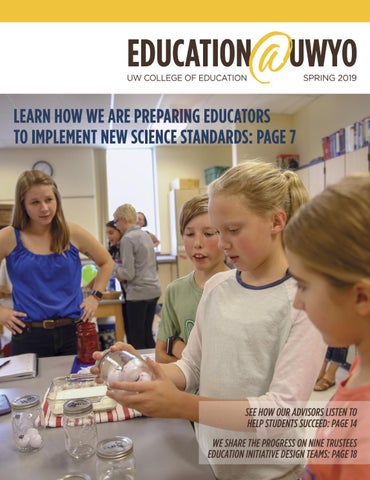
3 | New Connections: Experience of a Fulbright Research Chair 4 | Ph.D.s Make Impact Overseas 6 | Supporting Educators 10 | Dedicated Alumni Receive Milken Educator Awards 12 | Honoring the Past by Looking Toward the Future 14 | An Open Door and a Shoulder to Lean On 18 | Trustees Education Initiative on Track to Transform Teacher Education 20 | Inquiries into Education: A Spotlight on Faculty Research 22 | Carnegie Project Membership Sets Standards for Ed.D. Programs 23 | Student Spotlight ON THE COVER: Bailee Brietzman, a secondary science education major with a focus in chemistry, presents a learning center to UW Lab School students. Photo by Jason Harper.
Education@UWYO uwyo.edu/education The Magazine for Alumni and Friends of the University of Wyoming College of Education College Dean D. Ray Reutzel Associate Dean, Undergraduate Programs Leslie Rush Associate Dean, Graduate Programs Suzanne Young Editor Jason Harper Design Michelle Eberle, Emily Edgar, Brittny Wroblewski Photography All photos by Ted Brummond and Kyle Spradley unless otherwise noted. ©2019 by the University of Wyoming College of Education. All rights reserved. Excerpts from this magazine may be reprinted with permission, provided appropriate credit is given to the University of Wyoming and copies of reprinted materials are provided to the editor.
Education@UWYO Dept. 3374 1000 E. University Ave., Laramie, WY 82071 (307) 766-3145 | edmrktng@uwyo.edu The University is committed to equal opportunity for all persons in all facets of the University’s operations. All qualified applicants for employment and educational programs, benefits, and services will be considered without regard to race, color, religion, sex, national origin, disability, protected veteran status, sexual orientation, gender identity, genetic information, creed, ancestry, political belief or any other applicable category protected by law and University policy.
Dean’s Update Whether you’re a current or prospective student, an alumnus, a member of our college faculty or staff, an interested parent or a potential donor, we welcome you to learn more about the work of the College of Education at the University of Wyoming! Our faculty are working to support the implementation of the new K-12 Wyoming State Science Standards in a number of exciting ways. Pre-service and in-service College Dean, D. Ray Reutzel teachers from across the state who have participated in our programs will be ready to incorporate these new standards into their classrooms in order to develop a pool of Wyoming students with a deep understanding of science and engineering principles. This work is featured on page 6. The agriculture education program has undergone several changes to ensure we are preparing secondary agriculture educators who will ensure the viability of the agricultural industry long into the future. See our 21st century program that incorporates computer science into agricultural education that is attracting new students on page 12. Advising is key to student success and retention. As part of a universitywide effort to improve advising across campus, the College of Education hired two new full-time advisers and renovated the Teacher Preparation and Advising Office last year to provide advisers and students a new one-stop advising location in the College of Education. On page 14, learn how our advisers provide our students with personalized advising plans that fit their unique situations. The College of Education is continuously working to transform our programs to ensure our graduates are preeminent in their field. One way we do this is through the integration of innovative research-based strategies to improve educator preparation that have been recommended by the University of Wyoming’s Trustees Education Initiative (TEI). Read how nine TEI design teams have been working to embed TEI innovations into the curriculum of the elementary and special education programs on page 18. The College of Education was recently accepted to join over 100 colleges and schools of education as part of the Carnegie Project on the Education Doctorate (Ed.D.). This national organization has set new quality standards for the Ed.D. degree. The college and cohort of member institutions will work to strengthen, improve, support and promote the CPED framework through continued collaboration and investigation. We expand on this work on page 22. Also featured in this magazine are stories about the forward-thinking research being conducted and presented by our students (page 4) and faculty (page 3 and 20). It also features stories about two alumni who were honored with Milken Educator awards for their dedication and service (page 10), and two current students whose curiosity and determination drive them toward educational innovations and preeminent practice (page 23). Please take a moment to read these stories in the 2019 issue of Education@ UWYO magazine to gain insights into the many initiatives that drive continuous program transformation in the College of Education.
Jacqueline Leonard, professor of elementary and early childhood education and 2019 Fulbright Canada Research Chair in STEM Education.
New Connections :
By Alli Barker and Jason Harper
UW College of Education Professor Jacqueline Leonard was selected for a Fulbright Canada Research Chair in STEM Education in 2018. The award is considered the most prestigious appointment in the Fulbright Scholar Program and is awarded to highly respected scholars with a noteworthy history of publication and teaching. Leonard was selected to complete her Fulbright at the University of Calgary’s Werklund School of Education, where she spent four months speaking and working on research. Her research focuses on measuring the impact of students’ self-efficacy in technology, or belief in oneself to succeed in specific situations, and how it affected their ability to learn new technological skills. One of the great benefits of a Fulbright award is the ability to meet and collaborate with other students and researchers who are interested in similar areas. This connection can lead to new breakthroughs or transform the way a researcher approaches his or her research topic by looking at it with new
EXPERIENCE OF A FULBRIGHT RESEARCH CHAIR
insights and perspective. “I met more than half a dozen faculty in STEM education and the learning sciences who were all very friendly and helpful to me during my stay. Several of these faculty conduct research on computational thinking or spatial visualization, which are research topics that I am currently investigating,” says Leonard. “I also had two follow-up meetings with a doctoral student, who was interested in my research on robotics and game design.” Her Fulbright experience did not go exactly as expected because the research she planned to do in Calgary with indigenous students never made it past the initial stage. Not to be defeated, Leonard overcame the obstacle and traveled across Canada to Antigonish, Nova Scotia, to visit and collect data in an indigenous classroom. This opportunity came about through the new connections she made with faculty at University of Calgary. Leonard plans to continue the partnerships that were forged with peers during her Fulbright experience.
There are future plans to publish a paper on robotics with Assistant Professor Krista Francis and another on social justice in STEM education with Associate Professor Pratim Sengupta, both from Werklund School of Education. Additionally, she intends to work on a paper and presentation with Professor Lisa Lunney Borden from St. Francis Xavier University in Antigonish, Nova Scotia. Since arriving back in the United States, Leonard has been working on publishing her work with the new collaborators she connected with during her Fulbright travels. She has also begun presenting the findings from her Fulbright experience, starting with College of Education faculty, staff and students. “Serving as a distinguished research chair was excellent opportunity and experience that other faculty should have,” Leonard says. “I encourage other UW faculty in arts, sciences or STEM education to apply.” Education@UWYO Spring 2019 • 3
Ph.D.s Make Impact Overseas By Jason Harper
Dilnoza Khasilova and Laurie “Darian” Thrailkill are working to ensure their knowledge knows no borders. The two UW College of Education doctoral candidates in the curriculum and instruction doctoral program have both made international presentations to share their research and knowledge. Promoting Academic Writing in Uzbekistan Khasilova spent several weeks during the last two summers in her native country, Uzbekistan. She was on a mission to make a series of presentations to share knowledge she gained at UW with students and faculty at five Uzbek universities. “We shared examples of our work and scholarship of teaching and learning research articles. We did group presentations and engaged the audience through active participatory learning activities. We also talked about the differences in APA, Chicago and MLA styles in publishing research articles,” says Khasilova. With a focus on academic writing and publishing, the presentations made by Khasilova expose these students to best practices and resources they can use to become published researchers in the future. “Although research plays an important role in Uzbek educational settings, many resources are not available. When you do not have necessary resources, mentor texts or access 4 • Education@UWYO Spring 2019
to peer-reviewed journal articles, it is pretty hard to understand how to write for academia or know what is expected from you when submitting your work,” says Khasilova. The idea for these presentations was set into motion through Khasilova’s participation in the College of Education’s Academic Writing Fellows Initiative. Khasilova was also inspired to share her knowledge by famous Persian poet and scholar Alisher Navoi, who once said, “Odami ersagil demagil odami,Oniki yoq, halq g’amidan g’ami.” “The meaning of that statement is close to the idea that every good citizen or person adds to the strength of its nation,” says Khasilova. “Education for me is not just going to classes to earn a degree; it is about broadening the horizon and educating others about opportunities the world is offering.” Research Presentation in Australia A self-proclaimed gamer, Thrailkill fell in love with video games when her aunt taught her how to play the original “Mario Brothers” and “Duck Hunt” games. This interest led to her to focus her doctoral research on how students engage with stories in video games — more precisely, how these digital worlds could provide an ideal environment for
Khasilova provided workshops in her native country of Uzbekistan
Thrailkill presented her research in Perth, Australia
students to acquire multimodal skills seen as necessary for literacy in the 21st century. “Video games require players to read traditional print text, listen to audio cues that are both verbal language and music/sound effect cues, interpret the visuals of the virtual environment and interact with the space through movement of a character directed by use of a controller. It’s a rather complex process and a space where deep learning can occur,” Thrailkill says. While traditional text is entirely visual, relying on written words and sometimes images to convey the intended message, video games combine multiple modalities of learning to share information. While this can increase the complexity of the information provided, it also provides alternative avenues to learn information if the printed text isn’t understood. During the summer of 2018, Thrailkill took this research international when she presented in Perth, Australia at the annual conference of the Australian Literacy Educators’ Association and Australian Association for the Teaching of English. She became aware of the opportunity through her
adviser and mentor Wyoming Excellence in Higher Education Endowed Chair in Literacy Education Cynthia Brock, who spent time teaching in Australia. Thrailkill has since presented the same work at the UW Literacy Research Center and Clinic’s annual conference last September. She will also present this research at an atypical but appropriate venue in June 2019, the Denver Pop Culture Convention. Although we are a long way off from video games in the classroom, Thrailkill offers advice to help teachers support students delving deeper into the complex stories in their favorite games. “Reading outside of school is valued in the classroom and students are given opportunities to incorporate the books they read for enjoyment into the work they do in classrooms,” she says. “Allowing students to do the same with video game texts they are familiar with would be an empowering start to showing them we value things that matter to them.” Education@UWYO Spring 2019 • 5
Secondary science education students present science learning centers to UW Lab School students. PHOTOS BY JASON HARPER
SUPPORTING
EDUCATORS By Jason Harper
IMPLEMENTING THE NEW STATE SCIENCE STANDARDS PART 1
Wyoming adopted a new set of state science standards in 2016 after almost two years of discussion among parents, community leaders and a task force initiated by state Superintendent of Public Instruction Jillian Ballow. The standards, which are required to be incorporated by the 2020-21 school year, are designed to encourage students to be inquisitive, to actively explore their environment and to become productive, scientifically literate citizens. The UW College of Education has been offering a number of professional development opportunities, workshops and camps to help current and future teachers learn new skills and implement new curricula aligned with the new standards. A Pipeline of Highly-Qualified STEM Educators Ensuring there is a stream of highly qualified teachers available to teach science will be critical to the success the new standards. Often those interested in science, technology, engineering and mathematics (STEM) are attracted to high-paying careers in industry rather than teaching. Two College of Education faculty members are working to change that. “Higher salaries and status can be found in many STEMrelated careers, and STEM majors are not always exposed to the nontangible rewards of teaching, like seeing the spark in students’ eyes and giving back to the community,” says College of Education Professor Jacqueline Leonard. Wyoming Interns to Teacher Scholars (WITS) is a National Science Foundation (NSF) Robert Noyce Teacher Scholarship program that aims to increase the pool of highly trained science and math teachers. Led by Leonard, the grant project provides financial and academic support to help current STEM majors and graduates become elementary teachers. Undergraduates in the WITS program earn dual degrees, one in a STEM major and one in elementary education.
Training and summer research internship programs are available during a student’s sophomore year of college. These internships come with a $1,000 stipend to support each student during the two-week program. Scholarship support is offered to undergraduates during the junior, senior and fifth years at UW to cover the cost of tuition, room and board. Graduate students and professionals who hold bachelor’s degrees in STEM fields are also provided the same scholarship funding for up to three years while they attain K-6 teaching certification. This support helps negate the cost barrier of pursuing teacher certification after completing a degree. Sustaining Wyoming’s Advancing Reach in Math and Science (SWARMS) was initiated by Andrea Burrows, associate professor in the College of Education. The project was funded by the NSF in 2014 and it is set to conclude in December of this year. The goal is to mint 70 new mathematics and science teachers during five-year period between 2014-19. SWARMS provides scholarships to undergraduates and graduates with Education@UWYO Spring 2019 • 7
Educators from Natrona County School District participate in a professional development activity offered by Associate Professor Ana Houseal and Research Scientist Martha Inouye. Provided Photo.
strong STEM backgrounds as a result of their prior military experience or baccalaureate degrees in a STEM discipline. Scholarships fund up to 18 credit hours each semester during an undergraduate student’s senior year. When the undergraduate students transition into the post-baccalaureate program, the scholarships cover the entire cost of tuition and fees. Graduates who hold STEM degrees move directly into the post-baccalaureate program and are offered the same scholarship support. “STEM college students bring content knowledge, dedication and perseverance with them when they begin to learn about and then teach STEM subjects in the K-12 arena. STEM students who are coming back to UW to earn a teaching certification in the post-baccalaureate graduate certificate program usually have lab or industry experience as well, and this is easily transferable to K-12 classrooms,” says Burrows. In addition to providing funding for students, SWARMS and WITS are working to create better strategies to recruit these highly trained STEM experts into teaching careers, making the path for them to attain teacher certification more efficient, and building a sense of community and support among their student cohorts. After gaining their teaching certification, participants in both programs are required to teach in high-need schools for a duration of time. The educators also participate in a mentorship program throughout the first few years of teaching when it is critical to provide support to retain these highly trained STEM professionals in teaching careers. Both programs have seen success. SWARMS has had 40 participants to date and has past scholars teaching across the 8 • Education@UWYO Spring 2019
K-12 teachers who participated in RAMPED have the skills required to promote computer science and computational thinking... – Andrea Burrows
country with many in Colorado, Wisconsin and Wyoming. In all, 21 WITS scholars are on track to becoming highly qualified elementary teachers with several currently teaching in Colorado, Montana and Wyoming. New Skills for Current Teachers Two College of Education faculty have been leading efforts to offer professional development to Wyoming’s educators so they can enhance their science knowledge and teaching abilities to incorporate the new state science standards into their classrooms. Ana Houseal, associate professor in the College of Education and Martha Inouye, a research scientist at UW, have been traveling around Wyoming with two graduate students to train over 300 elementary and secondary educators over the past year. The professional development helps the teachers improve their science knowledge and introduces pedagogical strategies and best practices that help them incorporate the standards in their classrooms. “The new standards require a new way of thinking about science teaching and learning. Through ongoing, responsive facilitation regarding the understanding and implementation of the standards and their accompanying shifts in teaching, the teachers we are working with will be well-equipped to implement these standards,” says Houseal. First, Houseal and Inouye meet with curriculum coordinators, superintendents, principals and pK-12 teachers to identify initial needs and learn where the district is at in the process of implementing the standards. They then modify the training to meet the needs of each district.
The team hosts workshops for the teachers and administrators at partner districts throughout the state. These workshops take place at facilities within the district and target specific groups of educators, usually K-5 and middle and high school science teachers in the district. Additionally, Houseal and Inouye hold open-enrollment workshops that any Wyoming educator can join. Those workshops were held on the UW campus this year in addition to a workshop on the Kelly Campus of Teton Science Schools. They plan to hold more of these workshops throughout the state with one already scheduled for Douglas in the next school year. During these workshops the cohort discusses how science can be integrated into other content areas or expanded to include other scientific disciplines. They also work to increase each teacher’s science knowledge base and provide new pedagogical strategies that encourage a student’s active engagement with science lessons. “We model best practice in all that we do, from the organization of the workshops to the evaluation, modification and development of curricular pieces and assessments. We often develop and implement model lessons with them to experience as students and evaluate as teachers,” says Houseal. The work Houseal and Inouye conduct with each partner school can vary greatly and goes much deeper than presenting workshops. The team spent six years working with the Campbell County School District in partnership with the curriculum coordinators and teachers to completely revamp the K-12 science curriculum, a process they are currently working toward in several other districts. The professional development leaders may also visit the participants in their classrooms several times throughout the year to provide further input and coaching. Teachers can also send in videos of their teaching for Houseal and Inouye evaluate. This sustained intervention gives educators a deep understanding and allows them to constantly evolve their methods and best practices. Another College of Education faculty-led professional development opportunity was initiated by Burrows and Mike Borowczak, an assistant professor in the College of Engineering and Applied Science. A three-year funded grant — Robotics, Applied Mathematics, Physics and Engineering Design (RAMPED) focuses on computer science. Over 100 educators have benefited from the cross-disciplinary professional development program since 2016. RAMPED is supported by a U.S. Department of Education grant that is administered by a Wyoming Department of Education Math and Science Partnerships grant. The program began its second iteration in summer 2018. RAMPED allows Wyoming teachers, regardless of the grade level or content area in which they teach, to work with
experts at UW to gain new ideas and abilities to incorporate concepts of computer science, computational thinking and cybersecurity into their classrooms. “K-12 teachers who participated in RAMPED have the skills required to promote computer science and computational thinking to their students and dispel the myth that computer science is just coding, creating video games or robotics,” says Burrows. The training comes at a time when Wyoming is developing computer science standards for the state in addition to incorporating the new state science standards. These standards mandate that computer science and computational thinking be incorporated into the state educational program by the start of the 2022-23 school year. The program includes a two-week summer camp that occurs on the UW campus, as well as follow-up participant collaboration days that take place during the school year. The camp showcases ways that teacher participants can integrate computer science and computational thinking principles into their existing classrooms. This approach will help school districts meet the new requirements without additional financial burden. Although the focus is on teachers’ understanding and use of computer science and STEM content during RAMPED, Wyoming students are the real beneficiaries of the professional development. “With well-prepared teachers, Wyoming’s K-12 students have the opportunity to explore STEM and computer science in meaningful experiences that can help them pursue careers in new industries that assist in diversifying the state’s economy. These experiences can also allow them to apply their computer science knowledge to solve problems in the industries that have driven Wyoming’s economic engine for decades,” says Burrows.
read part two in our winter e-newsletter!
The scattering of light is explored in this activity presented by Associate Professor Ana Houseal and Research Scientist Martha Inouye during a professional development opportunity. Provided Photo.
Education@UWYO Spring 2019 • 9
Chris Bessonette celebrates with his students after being named a Milken Educator Award recipient. PHOTO BY MILKEN FAMILY FOUNDATION
DEDICATED ALUMNI RECEIVE MILKEN EDUCATOR AWARDS By Jason Harper
Forty educators throughout the nation were honored as 2018-19 Milken Educator Award winners. Two of those awarded, Chris Bessonette, M.A. curriculum and instruction ’11, and Wendy Shirey, B.A. elementary education ’00, are UW College of Education alumni. The awards, dubbed the “Oscars of Teaching” are one of the highest honors bestowed upon classroom teachers and educators across the country, and each comes with an unrestricted $25,000 check. A Voice for English Language Learners Bessonette an English language arts (ELA) teacher at Teton County School District’s Munger Mountain Elementary School in Jackson, teaches in a dual-language-immersion (DLI) classroom with a partner Spanish-language teacher. This approach puts English language learners (ELLs) and native 10 • Education@UWYO Spring 2019
English speakers in one classroom so both groups can support each other’s language and vocabulary development. “I see being a Milken Educator as an opportunity to engage in educational conversations to a greater degree. That being said, providing the best education I can for the kids in my classroom will always come first,” says Bessonette. An advocate for DLI education, Bessonette has championed the program at the Teton County School District by serving on the school’s ELA committee, dual-immersion leadership committee and building leadership committee. The district turned to his expertise to guide the discussion when exploring the expansion of the DLI program to other schools in the district. Data presented by Bessonette helped the district to decide to open the first dual-immersion elementary school in Wyoming last year. The effects of his leadership are felt statewide. Bessonette supports his peer teachers by leading professional development and participating in learning communities. He conducts research and presents at conferences, including the UW-sponsored Wyoming English as a Second Language Conference. Bessonette and other second-grade staff members
even recently participated in a long-term research project on vocabulary instruction with College of Education Associate Professor Patrick Manyak. “I am inspired by challenges,” says Bessonette. “In my classroom, I challenge all my students to believe in themselves and to use their background as a source of pride and motivation. I am inspired to close the achievement gap between minority and disadvantaged students and their white peers in my classroom while challenging all students to learn as much as possible.” In Data She Trusts Shirey currently is the principal of Pinecrest Academy Horizon elementary school in Henderson, Nev. Her data-driven efforts there have resulted in the school being named the Best Elementary School and Best Charter School in the Las Vegas Review Journal’s annual poll. She also earned a 100 percent satisfaction rating in the school’s semiannual survey of staff and families. “It is an incredible honor to receive the Milken Educator Award, and I am thrilled to join this group of educators. Educating children is a tremendous calling, and it is humbling to know that somebody noticed the work that I was putting in to help our students succeed. I became an educator because I wanted to impact lives and make a difference in the world,” says Shirey. One example of her dedication occurred last year when the
team noticed fifth-grade student performance at Horizon wasn’t up to par. To combat this, Shirey and her team used data to shift class schedules, teacher assignments, curriculum content and pacing in order to improve performance. The solution worked and within six months the fifth-graders at Horizon showed the highest growth and improvement out of all four Pinecrest campuses. “We make our school a happy place with high expectations for behavior and academics, and we celebrate everyone’s success. We provide all the support we can to make the teachers’ days easier so they can focus on the work of teaching. The students are surrounded by teachers who never give up on them and keep pushing them to succeed,” says Shirey. Shirey has written grants that contributed over $3 million to benefit students throughout the Pinecrest system. This money has been used across Pinecrest campuses to improve technology, aid in the implementation of a blending learning model and fund social workers to support the students. Shirey is always looking to expand her abilities to lead and advocate for teachers. She participated in the Public Education Foundation’s Executive Leadership Academy, earned a leadership certificate from Georgetown University and attended the Doral Academy Leadership Institute. She has also presented at the National Charter School Conference and the Charter School Association of Nevada Conference.
Wendy Shirey speaks to her school after being named a Milken Educator Award recipient. PHOTO BY MILKEN FAMILY FOUNDATION
Education@UWYO Spring 2019 • 11
Agriculture Education students support FFA and 4-H students during the 2018 Cowboy Classic. PHOTO BY JASON HARPER
Honoring the Past by
Looking Toward the Future By Jason Harper
In Wyoming, there are twice as many cattle as there are humans. It is pretty evident that agriculture plays a big role in the state’s economy. In order to sustain the prosperity of agriculture in Wyoming we must work to inspire the next generation to follow in the footsteps of the men and women who spent long hours establishing the flourishing industry. Keeping pace with past and current trends won’t be enough; this new generation must innovate to ensure viability well into the future. “Ag teachers, just like other folks in the agricultural industry constantly face the challenge of adapting their practices to meet the needs of the changing world and growing population,” says UW Temporary Assistant Lecturer Lindsey Freeman. “Many consumers do not realize how highly scientific and technical the agricultural industry is. Agriculture teachers strive to prepare their students for these technical careers starting in junior high school.” The agricultural education program at the College of Education is responsible for nurturing the new crop of future agricultural educators who will help carry the torch into the future. The program is designed to provide students with a well-rounded understanding of teacher education and agricultural science. Students study historical and current trends in curriculum and pedagogy while learning about special education techniques, integrating 12 • Education@UWYO Spring 2019
technology and multicultural classrooms alongside learning about general agricultural science. Over the last year, Freeman has been integrating technology into the program. This fusion of technology and teaching is being embedded into the curriculum through exposure to computer science. Technology is also being used to provide additional clinical experiences so students are well prepared for their future classrooms. Freeman arranged for students from the College of Engineering and Applied Science to present a workshop about how computer science can be applied in agriculture. The future engineers brought tiny Rasperry Pi computers and Arduino microcontrollers to teach the future agricultural educators how they can be used to create prototype and one-off devices. They also brought robots and let the education students experience controlling them via programming. “There is a demand for technology integration across the curriculum so an effort to embed technical practices including computer science into agriculture classes will not only better prepare students, but also sustain career and technical education programs,” says Freeman. “Furthermore, understanding how to think critically, use basic technology and troubleshooting are skills needed for success in many 21st century careers.” Students are also using technology to gain teaching experience and
improve their classroom management skills. Mursion Virtual Reality software allows future educators to practice leading a classroom of digital student avatars that are controlled by a “digital puppeteer.” The avatars react to the future educator, and their behavior mimics the unpredictable nature of a classroom. This experience allows agricultural education students to gain experience before they ever set foot in a classroom. The future agriculture educators have been working with high school students throughout the state to deepen their passion for agriculture. The Cowboy Classic is held annually at UW and is put on by agriculture education students and the Alpha Tau
Alpha honor society. The event brings hundreds of FFA and 4H students to campus to compete in contests such as agricultural mechanics and technology, veterinary science and livestock judging. “As an organization and program of the University of Wyoming we enjoy welcoming such a large group of students to our college. We want to promote the great things students are doing here and the potential for future students to achieve through this program as well,� says Freeman. Additionally, the students attended the Wyoming FFA Agriscience Fair where they coordinated the Agriscience Written Report judging. They also took part in the Wyoming FFA State
Convention, where they provided support and hosted the Agricultural Mechanics Career Development Event. At the state convention, the agricultural education students also served as judges for the State Proficiency Awards. Agricultural education students attend events nationwide to spread awareness about careers in agriculture. In fall 2018 a group of pre-service agriculture teachers attended the FFA National Convention and ATA Conclave in Indianapolis, Ind. In addition to their other duties at these events, the education students staffed a booth with College of Agriculture and Natural Resources students to talk to high school FFA students about attending UW.
Agriculture education students explore devices they can use with their future students to embed computer science into their lessons. Provided Photo.
Education@UWYO Spring 2019 • 13
Lyndi Anderson, elementary education major, and Megan Cooke, office associate in the Teacher Preparation and Advising Office.
14 • Education@UWYO Spring 2019
An Open Door and a Shoulder to Lean On By Jason Harper
The Teacher Preparation and Advising Office (TPAO) serves as a guiding beacon for all UW College of Education undergraduate students. The dedicated roster of four advisers use their combined 75 years of professional experience at the university to assist students in creating personalized plan to help them achieve their goals. In addition to their professional experience, the advisers all have a deep understanding of student needs as all have earned degrees or taken courses at the university. Over the last year the university has made efforts to improve student advising across campus by switching to a full-time professional advising model for undergraduate students. Historically, students across the UW campus were advised by a mix of full and part-time professional advisers and faculty members. Although the College of Education has used a professional advising model for a number of years, the advising team was expanded so more time could be spent with each student. Full-time Academic Advising Professionals Jody Evans and Vicki Nelson were hired in spring 2018 to bolster an already established team of advisers, which includes Manager of Student Advising Todd Krieger and Senior Advising Professional Christi Thompson. “Jody and Vicki have helped bring consistency to the support we provide students because they are here fulltime and their main focus is advising. Their support also allows the team to invest as much time as needed into each student to help them succeed,â€? says Krieger. The physical environment of the advising office also saw improvement over the last year. Previously a large open space, the location did not encourage students to open up and share. In summer 2018, the space was renovated and subdivided to create private spaces where students can feel comfortable confiding personal issues to their advisers. Education@UWYO Spring 2018 • 15
Listening Will Lead the Way The first and most important step the advisers take when meeting with a student is to listen. Every student has different needs, life situations and goals. There is no one-size-fits-all solution to advising, and to provide the best support, the team must fully understand the factors at play in each student’s life. The advisers also hope their empathetic approach will be a model the future educators can employ to support and advise their future students. “We hope that by listening we will build trust, so when we provide advice or make a suggestion the students know it is in their best interest. You also get a sense of each student’s goals and abilities and can create a plan for them. You can do a lot of damage by trying to push a student too hard and too fast,” says Krieger. Every undergraduate student in the college is required to meet with and get approval from an adviser in order to register for classes each semester. Although the staff is extremely busy during these periods, each advising session is allotted an hour. If one advising session is not enough, a follow-up meeting is scheduled as soon as possible. The team recognizes that life can happen at any moment, and TPAO’s door is always open during university hours to help students navigate the challenges put in front of them. The team has helped students remain on track academically while experiencing terminal illnesses, deaths in the family, unplanned pregnancies and many other issues that can derail even the most well-thought-out academic plans. These challenging circumstances can seriously affect a students’ ability to complete their education. The advisers work with faculty and the dean of students to come up with an alternative plan to help the student get back on track as soon as possible while mitigating the negative effects on his or her academic record. When major issues come to light, the advisers help the students learn from the experience and continue moving forward towards their goals. In the extreme circumstances when a student is unable to continue his or her education, the team helps them navigate the bureaucracy the student will encounter when exiting the university. Often, the team of advisers is the first on campus to become aware of major issues that arise in a student’s life. In these instances, the team not only provides academic advice, but also helps to direct the student to additional resources on campus to provide support outside of TPAO’s expertise. Relationships: The Key to Success The advisers work to build long-term relationships with students in every interaction they have. This connection can 16 • Education@UWYO Spring 2019
Abby Rich, elementary education major, and Academic Advising Professional Jody Evans.
be an important factor in student success and retention, so it is important for TPAO to build a trusting relationships with students as early as possible. “Research has shown that when students have someone they connect with on campus, they stay. Without that connection they don’t get as involved, they don’t do as well, and they may leave,” says Thompson. “Without having these personal relationships, students will not open up to share what is going on in their life, and carrying those burdens alone can be devastating.” Ideally, these relationships will start in high school when a student visits campus or attends a college fair. At this juncture, the TPAO advisers help prospective students draw roadmaps to achieve their goals that starts in high school. These plans might include taking AP or dual-credit courses in high school or joining groups in their communities that can provide them with experience to help them along their path to becoming educators. The conversation also changes if students are firstgeneration college students. In these instances, the advisers offer advice that their families may not be able to provide. They share knowledge that goes beyond standard program information and take the time to answer all questions so the potential students can make the best decisions for their future. When a student arrives at UW the advisers continue to provide advice on courses to take or additional credentials the student can attain to expand his or her career options. The
Lyndi Anderson, elementary education major, and Manager of Student Advising Todd Krieger.
advisers help students map out plans so they can take courses in the most efficient sequence. As the student progresses at UW, the advice could change to accommodate a student’s wish to pursue advanced degrees or change majors. Building long-term relationships also applies to students who transfer to UW from other institutions. They encourage these students to contact the office as early as possible. This enables the TPAO staff to work with the students to ensure their courses will transfer and that they can get into the course sequencing at the right time so they can complete their degrees in the most efficient way. The team works hard to nurture relationships with community college and high school advisers throughout the state to make sure the advice they are offering their students aligns with the program policies at UW. All this work and planning is done to ensure that transfer students have a smooth transition and start to feel like UW is home even before they step foot on campus. Supporting Students Through the Finish Line Advising is not the only support TPAO offers education students. Cindy Fronapfel, a senior office associate, coordinates student teaching placements for the future educators. She helps place students in schools throughout the region, sometimes pulling out a Wyoming map to help students find locations that will suit them. The support she
provides does not end when they go off to teach throughout the state. Once the student is placed, she functions as the student’s lifeline back to UW, continuing to nurture the strong relationships the office has built with each student. If the student experiences an issue that requires him or her to withdraw from their placement, Fronapfel, in consultation with faculty, helps the student find a new opportunity as soon as possible so he or she can get back on track. TPAO is there to support students to the end of their degrees and even beyond. As students are wrapping up their student teaching, Thompson works closely with the UW registrar to ensure the degree requirements have been met. If there are any discrepancies, she helps clear things up to ensure the students are ready to graduate on time and have met all the requirements to apply for state teaching licensure. “We are one of the few majors at this university that qualifies someone for state licensure. We’re looking at university regulations, college regulations and state regulations to ensure our students are prepared to get licensed to teach,” says Krieger. The office provides each student who has met the requirements with an institutional recommendation that is required for him or her to apply for state licensure. The institutional recommendation is required if a student moves and needs to get licensed in another state or if he or she needs to renew a license, so the team routinely provides this support to students who graduated UW decades ago. As you can see, the TPAO team plays a huge role in the success of our students. Although the members’ work is often overshadowed in the fast-paced world on a college campus, to them that’s OK. The TPAO staff is not after fame or glory. The team’s thoughtful support and advice comes from a deep desire to help others, and the only reward the members need is to see students succeed. Education@UWYO Spring 2019 • 17
Trustees Education Initiative ON TRACK TO TRANSFORM TEACHER EDUCATION
By Chavawn Kelley
What if the University of Wyoming trustees said, “Make the UW educator preparation program preeminent in the nation and the best for Wyoming”? How would you start? The Trustees Education Initiative (TEI) laid the groundwork by establishing the UW-E4® student journey model and identifying key innovations shown by research to help produce quality, classroom-ready teachers. Since February 2019, nine TEI design teams have moved TEI forward by applying big-idea thinking and nuts-and-bolts pragmatism to each of nine areas of program distinction. “This is what we’ve been trying to achieve for a long time,” says Becca Steinhoff, executive director of the Ellbogen Foundation. She leads the team working to create a statewide network of early childhood development providers and organizations. The goal is not only to provide professional development, but to elevate the early childhood profession and quality of care throughout the state. Steinhoff ’s participation highlights the extent to which partnerships and statewide involvement are shaping the development of TEI. This year’s four- to six-member design teams were composed of about half College of Education faculty and half education professionals from around the state. 18 • Education@UWYO Spring 2019
They met face to face and by Zoom throughout spring semester. When team leaders compared results, themes emerged and synergies became apparent. Access was a prominent force as they plotted ways to connect students and professionals throughout Wyoming and build stronger ties at UW. Online course modules will be offered on ethics and for early childhood education and elementary education. Modules will be developed to train teacher mentors for UW’s preservice teachers and induction mentors for UW graduates entering the field. Professional learning communities will be established, affiliate faculty recruited, future teacher clubs established in high schools, and College of Education alumni organized on behalf of the new program. The Wyoming Coaching Laboratory (WYCOLA) will continue to support classroom instruction, mentorship and instructional coaching. For the past two summers in Laramie, its laboratory classroom approach has allowed education stakeholders to examine prevailing assumptions about instructional practice and observe innovative practices in a classroom setting. Now, it will expand to include practicum experiences for preservice teachers and greater offerings for early-career teachers, mentors, liaisons, supervisors and instructional coaches.
2019 Trustees Education Initiative Design Teams and their Charges UW-E1 Exploration Ensure capable and motivated individuals explore and choose education as a profession. UW-E2 – Experiential Learning Identify rewarding experiences that ensure UW students find their strengths as educators. PHOTOS BY JASON HARPER
At the 2018 Wyoming Coaching Lab (WYCOLA), Mike Busch of the US Math Recovery Council (center photo) demonstrates classroom teaching in a live setting. Wyoming teachers, instructional coaches and other educators identify and discuss effective classroom practices (left and right photos).
Another commitment is to data collection and analysis aimed at continuous program improvement. For example, a self-assessment for preservice teachers is designed to give insight into student attitudes, dispositions and beliefs. Observations of teacher candidates in practicum situations and student teaching will be recorded using a standardized tool. Recent graduates and employers will be surveyed. Results will be compared against those of other programs in a national effort to raise teacher quality. More than 40 educators have participated in the process to maximize the effectiveness of TEI innovations and integrate the UW-E4® model (Exploration, Experiential Learning, Embedded Practice and Entry into the Profession) into the UW elementary and early childhood educator preparation programs. Implementation teams will take up the recommendations and revise curricula. Secondary education, special education and education leadership programs will follow. “Our goal is to integrate TEI with the programs of the College of Education so completely that the two will eventually become indistinguishable,” says D. Ray Reutzel, dean of the college and executive director of TEI. “Our programs will attract and produce the finest educators in Wyoming and the world.” After hearing team leaders relate the results of their teams’ work, Dave Bostrom, chairman of the TEI Governing Board, responded, “This is exactly what the trustees had in mind.” To learn more, see www.uwyo.edu/tei/.
UW-E3 – Embedded Practice Reimagine and expand the possibilities around field experiences, including student teaching. UW-E4 – Entry into the Profession Identify ways to support new UW graduates in the early years of their teaching careers. Common Indicators System Integrate instruments to collect data to inform and evaluate teacher education programs, curricula and candidates. Ethical Educator Program Integrate the Model Code of Ethics for Educators, a set of principles that support teachers and organizations. Mursion® Augmented Reality/Simulation Create opportunities for UW students and others to advance skills through interactive experiences with avatars. Wyoming Coaching Laboratory – WYCOLA Optimize this successful instructional coaching program for students, teachers, facilitators, mentors and others. Wyoming Early Childhood Outreach Network – WYECON Develop new approaches to elevate quality practices and model early childhood programs in the state. Education@UWYO Spring 2019 • 19
INQUIRIES INTO EDUCATION: A SPOTLIGHT ON FACULTY RESEARCH
Many UW College of Education faculty members conduct research to learn more about student learning, teaching methods, teacher training and classroom dynamics. Their work is often completed with little fanfare or recognition, even though the research they conduct has the potential to affect the lives of a great number of people. The work of Assistant Professor Richard Carter and Academic Professional Lecturer Tiffany Hunt is spotlighted in this article to bring to the surface some of the amazing research being conducted by college faculty to improve education in Wyoming and beyond. Carter works with a team to analyze how the concepts of Universal Design for Learning (UDL), blended learning and technology-enabled personal learning can be used to develop learning environments and curricula to meet the requirements established by the Every Student Succeeds Act (ESSA). The Every Student Succeeds Act was passed in 2015 and replaced the No Child Left Behind Act (NCLB). Much like NCLB, the new law requires that students with disabilities take the same standardized tests and are assessed to the same standards as other students. However, ESSA contains new language that necessitates the development of flexible learning environments and curricula that meets the needs of all learners. UDL, blended learning and technology-enabled personal learning are all concepts that can lead to new ways of designing learning environments that meet these diverse needs. They share the same overarching concept that curricula should be designed to be adaptable to accommodate each student. Within these frameworks, technology is seen as a tool that students can use, in addition to traditional teaching methods, to learn and discover at their own pace. Through the use of these concepts, students’ needs and interests guide their path to learning rather than following the same linear pathway as the entire class. Curricula created using this ideology will help ensure that all students learn the same content, albeit in different ways or at a different pace. Hunt specializes in the field of special education and researches how districts respond to and work to prevent bullying of and by students with disabilities. The ESSA recognizes that bullying and harassment in schools affect students with disabilities disproportionately and requires states to develop and implement plans to combat and reduce bullying incidents in their schools. Hunt’s work may inform Wyoming and other states in the creation of these plans and in putting them into action. She also investigates the difference between bullying and conflict. Conflicts are natural disagreements that occur in equal relationships where both sides express their opposing
views. Bullying is a reoccurring negative behavior in which one party with a perceived power over another attempts to exert that power to control and hurt the other party. Through this work, Hunt aims to support teachers and students in understanding the complex nature of this phenomenon so they can intervene in bullying situations and allow healthy conflict resolution to occur. Both faculty members are working together to better understand the challenges faced when presenting professional development to educators in Wyoming and in the field of education at large. This initiative has led them to investigate the effectiveness of professional development that is competency based – allowing participants to progress when they demonstrate mastery at each level no matter when, where or at what pace. Carter says,
“
Professional development has historically been provided as ‘sit and get.’ Teachers attend workshops, conferences and district events where they receive information largely through lecture and presentation. After the workshops, there is little follow-up to ensure that the teacher has learned and maintained skills attained through this professional development.
“
By Jason Harper
As a result of this research and with the support of the Ellbogen Dean’s Excellence Fund Outreach and Engagement Project Award, in 2018 Carter and Hunt introduced the first micro-credential accepted by the Professional Teaching Standards Board for professional development relicensure credit. Micro-credentials are often earned through online platforms that provide lessons and assessments that can be completed at one’s leisure. “Micro-credentials are an effective means to continuing education because they are skill specific, flexible and personalized. Because micro-credential earners are required to demonstrate mastery of the content, micro-credentials provide a way for educators not only to grow their skills, but also to market their abilities to potential employers,” says Hunt. Carter and Hunt will use what they have learned to investigate how competency-based learning may affect the new dual major in elementary and special education in the College of Education. The team aims to break the program into competencies and identify where micro-credentials can be embedded in curriculum and support the ongoing development and iterations of the program. Education@UWYO Spring 2019 • 21
Carnegie Project Membership Sets Standards for Ed.D. Programs By Jason Harper
The UW College of Education’s Doctor of Education (Ed.D.) programs have recently been accepted to join the Carnegie Project on the Education Doctorate (CPED). The CPED cohort includes over 100 colleges and schools of education that are committed to reclaiming and enhancing the professional doctorate in education to better suit the needs of practitioners throughout the country. “We’re very excited to welcome these new institution members to CPED’s growing consortium and to see the contributions they will make in transforming the Ed.D. to meet the educational needs of the 21st century,” says CPED Executive Director Jill A. Perry, PhD. Member institutions use CPED resources to enhance and continuously improve their programs to ensure they are positioned as a way for practitioners to gain knowledge that allows them
22 • Education@UWYO Spring 2019
to advance in their careers, meet contemporary educational challenges and become stewards of the profession to help lead innovation in the future. “We are extremely fortunate and honored that we have been invited to become a member of the Carnegie Project,” says Suzanne Young, associate dean of graduate students, professor and leader of the UW task force. “We are fully committed to evaluating and redesigning our Ed.D. to align with the Carnegie project mission and goals. We intend to raise the stature, reputation, and quality of our program to the level of preeminence and beyond.” Through its membership in CPED, the College of Education will gain access to a number of resources that will aid in the process of continually improving Ed.D. programs. Representatives of the college will attend collaborative “convenings” twice each year to discuss ideas that challenge traditional doctoral preparation with representatives of other member institutions. Members also gain access to an online professional community that includes publications, tools for program redesign, presentations and discussion forums that extend discussion of novel concepts outside of the regular convenings. CPED has also launched Impacting Education: Journal on Transforming Professional Practice, an open source, peer-reviewed journal, to help member institutions generate knowledge about Ed.D. programs. The journal will not only disseminate current
research to members, but also provide additional opportunities for members to have their work published on an international stage. The initiative was motivated by a task force of College of Education faculty members who recommended joining the project to the dean of the College of Education, D. Ray Reutzel in fall 2018. With the dean’s enthusiasm and support behind the initiative, the task force began working to ensure the CPED mission and vision fit with the college’s goals and examined the feasibility of redesigning the college’s Ed.D. programs under the new framework. After an in-depth analysis, the taskforce strongly felt that CPED’s approach to designing Ed.D. degrees was very much in line with ideals of the College of Education. The group then worked to ensure that the college was able to meet CPED’s requirements for membership and complete the rigorous application process that included a 30-minute personal interview. In late March 2019, the taskforce received word that the college had been accepted into the program along with eight additional institutions. In June, College of Education representatives will attend a meeting with the Carnegie cohort that will serve as an orientation into the program. During the meeting UW representatives will initiate conversations with CPED partners on how to begin implementing the CPED framework into the college’s Ed.D programs.
St udENt Spot LigHt
Elementary education senior Evan Tucker explores Monte de Castelo in the village of Allariz, Spain. Provided photo.
Curiosity Leads to a World of Wonder Elementary education senior Evan Tucker of San Diego, Calif., was one of several students who were members of the initial cohort of Consortium of Overseas Student Teaching (COST) from UW. Students who participated in COST spent a portion of their student teaching this spring gaining experience in classrooms outside the United States. Tucker
By Jason Harper
spent a month in Spain working with students who are learning English at the elementary level. “It’s a really good opportunity to send some students oversees and have them travel and have an overseas experience. I think that’s very valuable, especially for local kids who may have never been outside Wyoming,” says Tucker. Tucker transferred to UW from Sheridan College after earning his associate degree because of the affordability the university provided. A previous stint living overseas led him to explore options to student teach abroad while he attended UW. The COST program seemed like a perfect way to complete his student teaching and experience a different country. The same curiosity that drives his interest in other cultures is key to his pursuit of a career in education. “If you’re a curious intelligent individual, then you should use that ability as much as you can, because it benefits you and it benefits our country to have an educated populous capable of complex tasks,” says Tucker. After participating in COST, Tucker’s curiosity was not satiated; in fact, he was inspired to search for a teaching position abroad. “Once I get my degree, the plan is to find a teaching job overseas. My girlfriend and I are shopping around the world. We’re specifically looking at Korea, Japan or Hong Kong for me to teach English as a second language. We’re excited about that.”
Determined to Break Barriers and Help Others “You can do anything you want—anything you set your mind to, no matter your circumstances. You just have to persevere and take things one at a time. In the end, you get to say that you did it and no one handed it to you,” says Spanish secondary education sophomore Daniela Palma-Ramos of Riverton, Wyo. As a first-generation Mexican-American, Palma-Ramos had to overcome many obstacles on her journey to UW. Although her parents did not attend school, they always taught her to be independent, and she fearlessly blazed new trails as she continued her education. She was the first of her sisters to graduate high school and go to college. She first attended Central Wyoming College, and then transferred to UW in continued pursuit of her dreams. At UW, she was at first overwhelmed with the unknown. “In all honesty, I didn’t have anyone to help me. I didn’t know about financial aid, scholarships and programs for first-generation students,” Palma-Ramos says. “Luckily the faculty and staff were very willing to answer questions and
guide me through the process.” Palma-Ramos is determined to succeed and has found caring professors and helpful advisers at UW to help her achieve her goals. She has also found a community of like-minded individuals in MEChA (Movimiento Estudiantil Chicano de Aztlan) Spanish secondary education and joined the group this sophomore Daniela Palma-Ramos spring for an Alternative Spring in the Wyoming Union. Break opportunity to work on immigration issues in Las Cruces, NM. After graduation, Palma-Ramos hopes to teach with Job Corps or at a correctional facility. “I am going to make my family proud. I am going to get a good career where I can help underprivileged youth and help them achieve their dreams and goals. I am going to succeed,” she says.
College of Education Department 3374 1000 E. University Avenue Laramie, WY 82071
FOLLOW US ON SOCIAL MEDIA! @WyoCollegeofEd @UWyoCoED @uwyo_ed #THEWORLDNEEDSMORECOWBOYS #BUCKINGTHESYSTEM #UWYOCOED
TOP PROGRAMS Our programs are ranked highly amongst universities in the U.S.
GREAT VALUE Wyoming and UW are great places to earn a degree – on campus or off.
UNLIMITED ADVENTURE Exploration happens inside the classroom and outside in the wilderness.
#183
out of national universities by US News and World Report
#3
out of states that are best for higher education by US News and World Report
#3
out of best colleges for hikers by backbacker.com
#127
out of education graduate schools by US News and World Report
#48
out of online colleges with best return on investment by College Consensus
#18
out of best colleges for winter life by College Consensus