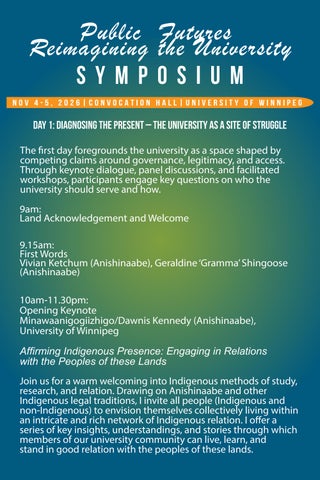
Public Futures Reimagining the University SYMPOSIUM NOV 4-5, 2026|CONVOCATION HALL|university of winnipeg
Day 1: Diagnosing the Present – The University as a Site of Struggle The first day foregrounds the university as a space shaped by competing claims around governance, legitimacy, and access. Through keynote dialogue, panel discussions, and facilitated workshops, participants engage key questions on who the university should serve and how. 9am: Land Acknowledgement and Welcome 9.15am: First Words Vivian Ketchum (Anishinaabe), Geraldine ‘Gramma’ Shingoose (Anishinaabe) 10am-11.30pm: Opening Keynote Minawaanigogiizhigo/Dawnis Kennedy (Anishinaabe), University of Winnipeg Affirming Indigenous Presence: Engaging in Relations with the Peoples of these Lands Join us for a warm welcoming into Indigenous methods of study, research, and relation. Drawing on Anishinaabe and other Indigenous legal traditions, I invite all people (Indigenous and non-Indigenous) to envision themselves collectively living within an intricate and rich network of Indigenous relation. I offer a series of key insights, understandings, and stories through which members of our university community can live, learn, and stand in good relation with the peoples of these lands.
11.30pm-12.30pm: Lunch 12.30pm: Poetry reading Proma Tagore 12.40pm-2pm: Roundtable Securitization, surveillance and campus security In this two-part session, we will reflect on two events in recent memory where communities inside and outside the university came together to challenge the perpetuation of genocidal conditions: the student-led encampment for Palestine, and the community action challenging the residential school denialist disruptions of Truth and Reconciliation Week, 2025. In both cases, the gathering of communities – and not the genocide denialism itself – was considered a security threat. What does this vision of campus security reveal about University interests and their limitations? And what can we learn from the acts of solidarity at these events that provided safety for those often left out of the protections offered by formal campus security? We consider these questions and more in a two-part discussion: a roundtable sharing of experiences of safety and security; and a praxis-oriented workshop toward actionable grassroots safety planning. Minawaanigogiizhigo/Dawnis Kennedy (Anishinaabe) Bronwyn Dobchuk-Land Kerry Sinanan Abby Alexander (Métis) 2pm-3pm: Workshop 3pm-3.30pm: Coffee
3.30pm-5pm: Panel Academic freedom today This will investigate how academic freedom is mobilized within university contexts, and to what extent its invocation functions as both a protection for critical inquiry and as a mechanism that can be weaponized to constrain equity-seeking communities. (Ives 2024). Jane Barter Matthew Hamilton Peter Ives Jacqueline Romanow (Métis) Tapji Garba 5pm-6.30pm: Keynote Dallas Hunt (Cree), University of British Columbia The Residues of Reconciliation and Indigenous Futures In this talk, I examine reconciliation across political and educational contexts, with particular attention to the promises and limits of "partnership." I ask what happens when Indigenous peoples and knowledges are welcomed into projects whose purposes remain largely beyond their authority to determine. How can an "endless process" operate within a future whose terms have already been prescribed? Through an engagement with Indigenous pedagogies, I consider how practices of learning and relation might sustain futures that exceed the terms offered by the state and its institutions. 6.30pm: Closing and Reception, UW Faculty Lounge
Day 2: IMAGINING FUTURES – The University as a PUBLIC GOOD The second day shifts from analysis to collective world-building, aligning with the project’s emphasis on transformative praxis. 9.45am: Opening 10am-11.20am: Workshop Reimagining belonging and relationality in universities This workshop will gather stories of arrival and location and consider how these are embodied states here on Treaty One. A wider aim is to consider how alternative relational and non-carceral models of belonging and institutional responsibility can be imagined and enacted. (Davis, Dent, Myers, and Richie 2022; Hunt and Stephenson 2025; Simpson 2025; López 2024). Attendees are invited to bring one item or object that they connect to their story of being here on Treaty One. Aarzoo Singh 11.20am: Poetry Reading Ifeoluwa Adeniyi 11.30-12.30pm: Lunch
12.30-2pm: Roundtable Indigenization, EDI, and Pedagogy This discussion will explore how racialized, Indigenous, International, gender-diverse, and disabled students and communities experience and respond to the tensions between institutional commitments to Indigenization, inclusion and equity, and the persistence of structural exclusion within and around the university, including pedagogic, research, and community spaces. It considers structural anti-Blackness, anti-Indigeneity, and anti-migrant discourse and systems within universities, and critical responses that challenge these and point to better ways (Maynard 2025; Maynard and Simpson 2023; Haque 2012; López 2024). Minawaanigogiizhigo/Dawnis Kennedy (Anishinaabe) Kerry Sinanan Chigbo Anyaduba Jamie Paris 2pm: Coffee and Walk 3-4.30pm: Book Event Truth Before Reconciliation. Confronting Residential School Denialism Countering soundbites with substance, Sean Carleton and Niigaan Sinclair, along with a team of expert historians, educators, Survivors, archivists, and archeologists, analyze the genesis, methods, and consequences of denialism; push back on denialist claims; and highlight some of the primary sources and peer-reviewed scholarship that denialists ignore or misrepresent. Importantly, they also document the harms denialists have inflicted on Survivors and communities. Niigaan Sinclair (Anishinaabe) Sean Carleton UW and UM Contributors
4.30pm-5.45pm: Closing Keynote Ann Lopez, University of Toronto The University as a Space of Radical Action Universities over the years have been seen as spaces where ideas are developed and challenged and knowledge generated through research, collaboration and engagement with community. Universities are also spaces where coloniality is perpetuated, where there are contestations about knowledge, who belongs, and who holds power. This dichotomy is ever present for those who work in university spaces. In this talk I explore how we can collectively work towards a) disrupting colonial logics in the university; and b) making the university spaces for radical action. 5.45pm: Closing Words
Registration Form
CRiCS Website
https://www.uwinnipeg.ca/crics/