Mostarian Current Issue n.1
mostariancurrent.wordpress.com
12.12.2023
Student Journalism Is Making A Comeback
Scan the Code for the Website!
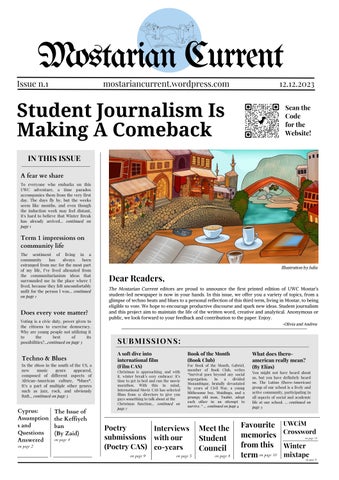
IN THIS ISSUE A fear we share To everyone who embarks on this UWC adventure, a time paradox accompanies them from the very first day. The days fly by, but the weeks seem like months, and even though the induction week may feel distant, it's hard to believe that Winter Break has already arrived... continued on page 1
Term 1 impressions on community life The sentiment of living in a community has always been estranged from me: for the most part of my life, I’ve lived alienated from the communitarianism ideas that surrounded me in the place where I lived, because they felt uncomfortably unfit for the person I was... continued on page 1
Does every vote matter? Voting is a civic duty, power given to the citizens to exercise democracy. Why are young people not utilizing it to the best of its possibilities?...continued on page 3
Techno & Blues
In the 1860s in the south of the US, a new music genre appeared, composed of different aspects of African-American culture, *blues*. It’s a part of multiple other genres such as jazz, rock, and obviously RnB... continued on page 5
Cyprus: Assumption s and Questions Answered on page 2
The Issue of the Keffiyeh ban (By Zaid) on page 4
Illustration by Julia
Dear Readers, The Mostarian Current editors are proud to announce the first printed edition of UWC Mostar’s student-led newspaper is now in your hands. In this issue, we offer you a variety of topics, from a glimpse of techno beats and blues to a personal reflection of this third term, living in Mostar, to being eligible to vote. We hope to encourage productive discourse and spark new ideas. Student journalism and this project aim to maintain the life of the written word, creative and analytical. Anonymous or public, we look forward to your feedback and contribution to the paper. Enjoy. -Olivia and Andrea
SUBMISSIONS: A soft dive into international film (Film CAS)
Book of the Month (Book Club)
Christmas is approaching, and with it, winter break’s cozy embrace: it’s time to get in bed and run the movie marathon. With this in mind, International Movie CAS has selected films from 12 directors to give you guys something to talk about at the Christmas function... continued on page 7
For Book of the Month, Gabriel, member of Book Club, writes “Survival goes beyond any social segregation. In a divided Mozambique, brutally devastated by years of Civil War, a young blithesome boy, Muidinga, and a grumpy old man, Tuahir, adopt each other in an attempt to survive. “ ... continued on page 4
Poetry Interviews submissions with our (Poetry CAS) co-years on page 9
on page 5
Meet the Student Council on page 8
What does Iberoamerican really mean? (By Elías)
You might not have heard about us, but you have definitely heard us. The Latino (Ibero-American) group of our school is a lively and active community, participating in all aspects of social and academic life at our school. ... continued on page 3
Favourite memories from this term on page 10
UWCiM Crossword on page 10
Winter mixtape
on page 9
Issue n.1
mostariancurrent.wordpress.com
A FEAR WE SHARE My biggest fear? Probably the passage of time. To everyone who embarks on this UWC adventure, a time paradox accompanies them from the very first day. The days fly by, but the weeks seem like months, and even though the induction week may feel distant, it's hard to believe that Winter Break has already arrived. The dreaded term 3 has ended, wasn’t this what we all wanted? Surely you've heard in recent weeks the sentence "I can't wait for term 4 to arrive" or "I'll be so relieved when term 3 is over." It is hard to balance the desire to fully enjoy this experience with the pressure of trying to accomplish everything. The IB program infiltrates our everyday conversations, and our minds are filled with deadlines and tasks we want to get rid of as soon as possible. I don’t know if this is the usual pace at which life moves, but it seems like term 4 is going to go at the same speed. The Winter Holidays will pass fast and later on it’s January, after January comes February, the rain and the cold lead to March, the sun starts to come back in April, and… Let’s not talk about what happens in May. Our second years were right, term 3 is intense. Trapped in a routine where going to school in the morning and working at the residence in the afternoon take center stage, it’s been hard to find those moments and conversations that bring you back to reality and that help you remember the place you are in. Do we get used to UWC too quickly? Sometimes I try to stop and I decide to observe; and I find myself siting in canteen in a table that represents four different continents, or laying down on the park listening to some good music, or talking in Mejdan beach about places that previously felt so far away. Sometimes I try to stop and I decide to observe; and I find myself with teary eyes thinking “I am so happy in this place”. Term 3 has come to an end, it angers me that routine has often made us forget how special the place we are in is. Yes, the fear that all this will end one day coexists with me. Even if we try to avoid talking about it, i’m sure that’s the case for a majority of us. I just hope that this fear of how quickly time is passing makes us live the days we have left in this place more intensly. This article an be a little reminder. A reminder of how valuable the place where we are is. A reminder of the beautiful people we are surrounded by right now. A reminder of how much we will miss this place in the future. by Olivia
12.12.2023
Term 1: Impressions on community life The sentiment of living in a community has alway been estranged from me: for the most part of my life, I’ve lived alienated from the comunitariansim ideas that surrounded me in the place where I lived, because they felt uncomfortably unfit for the person I was, for the idealisms and thoughts I had. And in my heart I never knew wheter to wish to live in a more communal spirit or to just continue with my sheltered, individual life. I usually felt like the second choice could’ve kept my life in a more balanced, safe state, where my person could’ve kept on growing up without encountering or engaging with others. But for some reason, as the start of my UWC experience was approaching, I felt nothing but attracted and fascinated by the community aspect of our school, and most importantly, I was eagerly waiting to go through the change in my life that would include a transition from a mostly isolated life to a life filled with communal feelings and events. When I got here, in the last days of summer, I was met with a swift, almost abrupt introduction to the community: from day to night, I was officially part of it. In the beginning there was hesitation on my side that prevented me from showcasing entirely my happiness and a blooming feeling of satisfaction and realization with myself, but I knew that my heart was vibrant with them.
This is because every single person in our community finds their place in our shared experience: I notice, in the increasingly cold night of October, how past check-in, everybody in the residence function in a fitted way in our community. Every one works on their own, in their space, but that doesn’t take away the bigger picture they are a part of: we share a common life but also a common room (or even two). And who more easily, who less, slowly slots into the shared space, fits with the others. Not only they fit, but they start to give to the community: they build the shared experience with contribution of actions, behaviours and thought. A symbiosis is formed between individuals and their lives merge, come together, to create the two-years experience. Of course, it is fundamental to not leave out what living in the UWCiM community means in concrete reality: co-living with 200 people in a closely bonded community might seem an overwhelming prospect. The noise and people’s voices can get really loud sometimes, and individual space is not disregarded at all, even though it is still very difficult to find. But for my experience, nothing ever feels too much. It is necessary to live the UWC experience to find your place, wherever it is, in the community we are accompanied by and that we are a part of. Everybody has the chance to embroider their person in a huge connective web wich we are all a part of, of whose strings start from us and go to touch, to curl around, to knot others. We are indisputably tied to the community we are a part of, as the UWC mission hopes we are. by Anna
And then slowly, as the days passed, it became normal for me to wake up in shared spaces and to continue my daily life through them. It became normal to not have time for an individual or, less than all, an isolated life. It became normal to overhear and be surrounded by voices, thoughts, conversations, noises and languages that didn’t belong to me. And it became normal for what constituted my life experience to merge with others’, creating instead a common one, a shared life experience that needs everyone’s contribution to thrive and to leave a mark.
UWC day is held each year in September where people get a chance to represent their country and showcase traditional food, dance, and culture. That day took place in the Spanish square, where all the students set up stands, on which they presented their food. This year, there are more than 100 countries at the college, and therefore the range of cultures is large. At the beginning of this event, you usually go from table to table where you try different foods, and each representative of the country gives a certain background of the dish. The food ranges from salty to sweet, sour, and spicy - which means that everyone can find something to their taste! The next thing is traditional dances. Not only can you witness but also join them. Additionally, the first UWC runway took place this year! Student puts on a traditional costume and walks together with their co-years. This was an opportunity to witness cultures interact, and students cheer and support each other in such a multicultural atmosphere. At the end of the event, all the students take a picture together, creating memories that will be remembered forever.
by Irina
Page 1
Issue n.1
mostariancurrent.wordpress.com
Cyprus: Assumptions and Questions Answered
12.12.2023 Kalavaç köyü,1929, Το Καφενείο στην Καλαβασό, 1929
Located in the Mediterranean, Cyprus is an island that holds a lot of history with conflicts ranging from the Franks to the Ottoman Empire, to being part of the British Commonwealth. As a result of an initial invasion resulting in a war, with the beginning officially dating in 1974, the island is now split, with a border dividing the country and population into two parts, the north and the south. In simplicity, the north population is mostly Turkish-Cypriot, and the south is mostly Greek-Cypriot. As Cypriots, we grow up learning about our past in schools, listening to stories from our grandparents, and constantly reminding ourselves of the current division through the news, media, and day-to-day situations. But when moving to an international setting, we realise how little the rest of the world knows about our home. We are often seen as the ideal vacation destination dominated by the beaches and sun. Despite the accuracy of these statements, Cyprus has a lot more to offer than just its beauty. Since arriving at UWC, I quickly realised how interested others are in the story of my country and its current state, while at the same time heard some misconceptions and although valid, often false assumptions. This is where our part comes in. Members from both the Greek and Turkish Cypriot community of UWCiM gathered to talk about some frequently asked questions and general aspects of the current state of our country that are more complicated to understand from an outsider’s point of view. This is a way for us to share what we know and give an insight into our personal experiences as a unified community rather than sharing two different stories based on the bias of “each side”. Is there a physical border? Are there mixed areas? Is each area designated as Greek/Turkish? Contrary to many assumptions, there is indeed a border stretching throughout the whole country while also dividing the capital, which makes Nicosia the last divided capital city in the world. Although most of the border is physical, there are some parts where there is a ‘soft border’. These are places where there used to be minefields but since they were cleared a few years ago, in a lot of cases it’s just farming fields. The ‘line’ that splits the country, is a buffer zone controlled by the UN (UNFICYP UN force in Cyprus). Most parts of the border are also guarded by armed soldiers. Although there are many names for the two sides, they are commonly known as the North and the South. The vast majority of the north is Turkish Cypriot, and the vast majority of the south is Greek Cypriot. As for some historical context regarding this division, leading up to the war, Turkish and Greek Cypriots cohabited as neighbors, making the whole country a mix of both populations. But, by the end of 1975 people of each community were forced to move to their “designated side”, as marked by the border that was created, which led to many refugees on both sides. People had to say goodbye to their friends and part ways. Despite the fact that the greater number of each population lives in their ‘equivalent side’, there are still some mixed villages, such as Pyla. Interesting Fact: The border is locally called “The Green Line”, in both languages. The reasoning behind this is that General Young drew the agreed line on a map with a green chinagraph pencil.
Upbringing
Is there a common language?
When growing up in a divided country, history can be presented as very one-sided, and from a very young age, children are often taught that ‘the other side’ is their enemy.
There is no common language. The majority of the population of the south is Greek-speaking and the majority of the north is Turkish-speaking. The communication between the two sides primarily happens in English.
Keeping in mind that some of the generations that lived through the war are still alive today, some of which being our grandparents and relatives, since a young age we hear about the tragedies they had to endure. They had to deal with death, loss, grief, losing their homes and were put through the many consequences that come with war. As a result, it is to be expected that when talking about those times, the presence of bias is undeniable. Without going into too much detail, although common logic, can obviously assume that there were many misfortunes for all parties involved in the war, it is inevitable for each person to underappreciate the harm their own people did, but find it easier to see the bad that happened to their people. Personal experiences, combined with the often-subjective media, can lead to further hatred of each population even passing down to the next generations. That being said, it is not in any way implied that each side of the island hates the other. There are numerous organisations and even individuals striving towards unity, but the percentage that disagrees is the vast majority. Interesting Fact: A schoolbook that students in the North are often given, is called “What did Greece do”, and states bad things Greece did to the Turkish Cypriot community. At the same time, notebooks given to children in the South, often have a picture of an area in the North, accompanied by the text ‘Don’t Forget’.
Looking forward to the next Term 2 and 4! Say goodbye to the first term and look forward to an exciting second term full of events.
When it comes to the spoken language, the official languages are Greek and Turkish. That being said, although we read and write in our respective languages when spoken, both have their own dialects. So, when answering the frequently asked question “Which language do you speak?” it depends on whether the question is referring to the official language or day-to-day dialect. Although the differences between Greek and Greek Cypriot and Turkish and Turkish Cypriot aren’t big, they are definitely significant to the locals. As previously mentioned, prior to the war, there were many mixed villages, meaning that Greek and Turkish Cypriots lived together which led to them speaking both languages. Considering the recency of the war, many are still alive, a fact that leads to a small percentage of the population to fluently speak both languages. Interesting Fact: There are a lot of Cypriot traditional songs that actually exist in both sides and are translated into both Greek and Turkish Cypriot Despite the border in our country, the Cyprus National Committee awards an equal number of scholarships to Greek Cypriot and Turkish Cypriot students to attend UWCs around Europe. Hopefully, this will help you gain a deeper understanding of the notable history and current state of Cyprus while giving an insight into the island from a local’s point of view. by Daniella
Upcoming events
Join the global 12-hour run in Mostar on 18 February to raise awareness and funds for the fight against human trafficking and modern slavery, be amazed by the Bald for a Cause event, where people go bald in support of a worthy cause, immerse themselves in the Model United Nations (MUN) sessions, which offer exciting debates and diplomatic experiences. We will explore the cultural richness of Bosnia and Herzegovina with more trips around BiH, and we will have great jam sessions to look forward to throughout the year.
Get ready for a semester full of excitement, unity, and positive impact!! Page 2
Issue n.1
mostariancurrent.wordpress.com
What does Ibero-America truly mean?
Y ou might not have heard about us,
but you have definitely heard us. The Latino (Ibero-American) group of our school is a lively and active community, participating in all aspects of social and academic life at our school. We are the loud people in the canteen, the partygoers who feel entitled to try strange dance moves and an ever-present part of the population in Old Man's.
And, of course, we are a very strong group. Even though we have very different interests and opinions from one another, you can tell that we know, appreciate, and love each other. You can try to see it for yourself: if you look at the seating distribution in the canteen, there will always be at least two Latinos sitting together. Something valid to ask about this union is what ties us together. Why are we always talking with each other? What is that thing that makes us such a strong community? How do the strings that bind us all together look? A common answer to this question is language, and such conclusions can come from a very understandable way of reasoning. Yet, our language is not exactly the same throughout in fact, we tend to have certain issues with the self-taught Spanish tutor because she speaks using a different set of rules. It is also notable that not all the samelanguage communities in the school are as close as the Latinos; thus, it would not be fair to identify the cause of our closeness in this. We have strong counter-examples everywhere. Then, it would be possible to say that what binds us together is culture. However, if we take the Oxford Dictionary definition of culture as "the customs and beliefs, art, way of life, and social organization of a particular country or group," the results of looking into our "culture" would be rather disappointing. None of us consumes the same art, has the same customs, or enjoys the same things as the others. A geographical approach would be as fruitless as this one, too. The distance between Patagonia and Catalonia, two regions marking the borders of what we might call the Latino community in our school, is 11,790.39 km. About the same distance from Washington to Shanghai, for example.
Page 3
Other ideas that might arise among the reader can be related to colonialism; in fact, Spain and Portugal exerted a strong colonial rule over most of Latin America from 1492 to the mid-to-late 19th century. While some of the explanation of our cultural closeness could be attributed to colonization, it is not necessarily the only explanation: after all, Portugal and Brazil are integral parts of our community that were never directly colonized by the Spanish Empire.
Does every vote matter?
Illustration by Melika
Continuing to reflect on individual potential causes of our community being as it is would end up being fruitless; it is very unlikely that we will ever reach a single conclusion. And that is a part of the reason why the Latino community is such a strange occurrence: we never agree to a single conclusion. Some Latinos love Bad Bunny and Daddy Yankee, others are experts in all things pop-rock. Some Latinos are always thinking about math and sciences, while others are the biggest enthusiasts of arts and humanities. All of us, Latinos, are different in everything but our approach to life. And that's what I feel that we celebrated during this IberoAmerican Culture Week. Whether we were sharing our stickers to fill the posters for each residence, officiating questionable weddings in a strange mix of Portuguese and English, or dancing and singing at the Cultural Night, we were all celebrating this unique way of seeing life. This passion and heart that might be translated into sheets full of mathematics or journals filled with anthropology, but will always be there. This heart-warming feeling that is sometimes loud, but always well-intentioned. This strange thing that we cannot describe, yet we share. And that is what all of this is about sharing. Showing you more about our culture, from music to poetry and cinema, is not a way of being proud of our strong community; it is, rather, an invitation to join us in our neverending spiral of jokes, loudness, and happiness. I truly hope this week was amazing enough for its spirit to last throughout the year. Because the Ibero-American Culture Week cannot last forever, the happiness that we tried to bring to the school can certainly do so. by Elías
Welcome my son. Welcome to the machine.
I turn eighteen in less than two
months, and it’s a curious feeling. This two-digit number, checking a big box from the bucket list called life, grants me an entry to the machine – I can work, enter the political system, and use my power to vote. As North Macedonia’s political climate is looming large, and the next parliament elections are this upcoming spring, the question echoes in my head: Does every vote truly matter? The topic of this discussion has been opened and reopened in many family and friends gatherings. From hearing what others say, I could categorize the Macedonian voters into three categories. The first, major one, is people who vote for their self-benefit. These include the ones with a membership in the winning party or who are simply affiliated through relations, voting for an outlet of opportunities for any personal gain. Choosing the party that fulfills their interests makes them disregard what the collective good is. The second category is the ones manipulated by propaganda. Political parties in North Macedonia are legally allowed to take money from the national budget for political advertisements and rallies; and are essentially buying voters with media, resources, and unrealistic promises. Thanks to limited political literacy, people are misled by the propaganda, and their decision is constrained for that reason. If we abstain from voting, we are only contributing to the benefit of the first two categories. The third category is the ones who vote for the benefit of all and societal progress.
12.12.2023 Logically speaking, the majority of the third category should contain prosperous young people, to ensure it is creating a future that would meet their goals, needs, and aspirations. Why is, then, the youth gradually giving up on voting? When I asked my friends why they aren’t voting, they said that the system is too broken to be fixed, and feel that either party is corrupt and that all candidates are the same. People are getting discouraged and frustrated by the malfunctioning of our government – rightfully so. I am equally worried about the future of my country, but I have the civic duty which grants me the power to vote. Abstaining only favors the categories of the self-serving and the misled. These scenarios are not limited to North Macedonia only. Take a look across the Atlantic, and what is happening in the States. Tuft’s Centre for Civic Learning and Engagement estimated that only 50% of young people, ages 18-29, voted in the 2020 elections, and the US presidential elections are on the horizon. This calls for action everywhere in the world. Showing up and ticking a box is a limited form of democracy. Amongst many things Chomsky has written, I always recall that “meaningful democracy” is when the citizens play a role in creating the options and decisions given in the voting booth. So, does every vote matter? It is what we make of it. What I am doing now is following different news sources (delving beyond social media) to avoid getting sheltered by ignorance. Before the upcoming spring elections, I will read the aims of each party carefully and think for myself. These may sound like broad concepts but are at the core of democracy, and can help fight the skepticism of feeling hopeless in this system. So I’m asking you, my fellow eligible voters, from all over the world: Do you start productive arguments? Hold politicians accountable? Get out of peaceful protests? Do you get easily misled by social media ads? In the end, we have three possible choices. To hide under a shield of ignorance, get blinded by the mass propaganda of campaigns, or actively partake in the political system. The one we choose determines our future. by Andrea
Issue n.1
mostariancurrent.wordpress.com
12.12.2023
The Issue of the Keffiyeh Ban by Zaid
Haifa in 1948, prior to the Nakba
The keffiyeh is more than just a scarf or headdress. The keffiyeh is a symbol of Palestine, Palestinians, and what it means to identify as a Palestinian. The keffiyeh was first worn in the 1930’s as a sign of Palestinian nationalism in the face of British colonizers – long before Israel existed. Originating as a proud display of culture in the face of attempted erasure; the keffiyeh remains as such today. As illustrated in Figure 1, each element is symbolic of something inherently Palestinian; something that cannot, and will not, represent anything other than being Palestinian. There is a lot of misunderstanding of the meaning of the keffiyeh because of how Palestinians are portrayed in the media. This must end due to the negative ramifications it has on the way Palestinians are perceived when wearing it.
Symbolic elements of the keffiyeh.
The Palestinian Olive
Olive season is a time of year where one’s taste buds are bombarded with olives and olive oil of different farmlands. Each friend, cousin, or colleague arguing the merits of their “signature style” of olive; recipes for nurture and care that have been kept precious for generations. For many Palestinians, picking and squeezing olives was a ritual that indicated October had arrived. ack in Jordan, my family has been sending me pictures of each vial
that they procure; Beach from a different tree, each with a story to tell. Some olive oils are spicy. Some olive oils are bitter. Some are green; others closer to yellow. But all represent the same pride in Palestinian culture, stitched into one of the keffiyeh’s patterns. Palestinian olives and olive oil: so green, so fresh, with a spicy zing of an aftertaste; a culmination of years of patient growth and care. Palestine is home to some 9 million olive trees, 80% being at least a century old. (Al Jazeera) Yet these trees are rapidly disappearing. 9,300 olive trees were razed by Israeli settlers from August 2020-August 2021 alone. (International Committee of the Red Cross) 0.1% of the total, and that was in just one year. With further rightwing nationalism and support for settler attacks in the Israeli cabinet, this number is bound to grow exponentially. Settlers in rural parts of Occupied Palestine are likely to follow any and all encouragement by their government to decimate and destroy. It is not even about the trees themselves. Burning down farmland is a way of asserting Israeli legitimacy; in building concrete jungles over lush agricultural fields, erasing Palestinian history, brick by brick. Even worse, Israelis often claim the olive as something theirs, glossing over the significance it has to Palestinians. All Palestinians are familiar with the scene set in Figure 2. The woman is just a placeholder for thousands – if not millions – of Palestinians grieving the loss of something once so alive and spirited; a symbol of Palestinians thriving. For the olive tree is also a key cultural and economic symbol and has been for generations. Is that provocative?
The Fishnet
Jaffa in 1940.
One dish I would love to try is ‘sayadieh’ made from fresh fish caught off the coast of Jaffa. ‘Sayadieh’ is a dish consisting of rice, fish, tartar sauce, and a lemon slice to top it all off. A staple of Palestinian cuisine, ‘sayadieh’ is a dish that has made it across the entire Arab world, with each coastal city putting its own spin on it. The reason for ‘sayadieh’ being such a prominent part of Palestinian cuisine is because Palestine is located on two major coasts: the Mediterranean and the Red Sea.[1] Once a source of both work and vacation, Jaffa – with its sandy beaches and deep blue seas – holds a strong cultural connection to Palestinians. The seaside city carries a deep history, embodied by its beautiful architectural style, cobblestone walkways, and lively streets. As seen in Figure 3, Jaffa is likened to Dubrovnik, given its mix of history and modernity that are balanced within one city. Likewise, Haifa is another such port city which I would love to visit. Similar to Jaffa, Haifa is a coastal city which was known for its lively atmosphere and buzzing markets. Haifa is also the setting of the novel ‘Return to Haifa’ (Arabic: )عائد إىل حيفا by the illustrious Ghassan Kanafani. Kanafani was a Palestinian writer who wrote resistance literature against the Israeli Occupation, depicting the struggle of Palestinians in the aftermath of the Nakba. In this specific novel, Kanafani follows a Palestinian man who decides to go back to Haifa, to find the son that he lost in the panic of the Nakba, 20 years prior. The urge to see the sea for the first time in years is important to the theme of the book, as he associates it with symbols of freedom and liberty. However, that all changes when he discovers that an Israeli family has moved into his home and adopted his son, who became a member of the Israeli military. The novel – full of heartbreak and betrayal – represents the struggle of losing your family, your city, and your identity as a result of the occupation. It is that same feeling which makes my keffiyeh so important to me. Though I may have lost Jaffa and Haifa to the Occupation, whenever I see the fishnets on my keffiyeh I am reminded of what Palestine was. This connection, however distant it may seem, is something I need to carry on whenever I feel hopeless, as in times like now.
Historically, Palestine was a major destination for trade. People from all across the Silk Road would come to Palestinian cities to rest, relax, and see what the city had to offer them. Some stayed behind and settled, contributing to the wide diversity that Palestine has to offer. There is a common misconception that Palestinians are a homogenous group, however that couldn’t be further from the truth. Religiously, Palestine is represented by both Muslims and Christians who coexist peacefully. Palestine is unique in the sense that it is home to Bethlehem, the birthplace of Jesus, while also having Al Aqsa Mosque, one of the holiest places for Muslims. This coexistence stretches so deep that Palestine is one of the few countries with little to no intercommunal violence for religious reasons. Palestinians are so united in their resistance against the Occupation that these differences strengthen the cause. More than that, it is also a sign of the rich history of merchants, craftsmen, and farmers that have called Palestine their homes. Among the most technically adept, a large percentage of Palestinians were involved in creative and technical jobs. Nothing came easily for Palestinians, and they had to carve out their own niches in industry and trade to make a living. This is a symbol of pride, as the Palestinian is someone who comes from a long history of reaping the rewards of hard work and tough circumstances. I too feel proud to reflect such values, coming from a family of farmers and merchants who labored day in and day out to create the best possible outcome they could. This is what I feel when wearing my keffiyeh. Though I may not have the farmland or trade routes themselves, I have the echoes of a not-sodistant past reminding me to continue the tradition of embracing diversity and a fierce work ethic. Is that really so provocative?
Bookclub recomends:
Sleepwalking Land by Mia Couto Survival goes beyond any social segregation. In a divided Mozambique, brutally devastated by years of Civil War, a young blithesome boy, Muidinga, and a grumpy old man, Tuahir, adopt each other in an attempt to survive. Close by, they find a body and a set of notebooks. Diaries that unfold the story of Kindzu, in his journey to find himself in wartime. As they read, the parallel chapters of Kindzu’s life incorporate the abnormal violence of this conflict and the subnatural myths of these people. Little by little, in a catastrophic fantasy, these two narratives merge to form a dreamlike reflection of the local traditions and the violence that tears them apart, building up to a beautiful tale. ‘Sleepwalking Land’ is a chance to dive into the unnoticed stories of these survivors, submerging in the wonderland of their culture. A world used not to escape reality, but to accept the unreal brutality that we so often fail to look at. This masterpiece is an invitation to walk our way into these people and their tales, to discover a path out of that conflict - the sleepwalking land around and inside them. by Gabriel
Page 4
Issue n.1
mostariancurrent.wordpress.com
Techno & Blues ‘Blues is a tonic for whatever ails you. I could play the blues and not be blue anymore.’ B.B. King
which has two meanings. The og meaning comes from the British usage of it: hallucinations that accompany alcohol withdrawal, but now we associate it with depression and melancholy. Music in general has a big effect on our brain, but blues specifically has quite a positive impact on the human psyche. Besides the fact that it is very obviously calming and therefore eases anxiety and stress, it improves memory and with that encourages learning. Different music genres have different effects on people’s memory and studies have shown that by listening to blues, an individual can spend more time studying and the result is better intellectual development. Normally blues songs have the saddest lyrics with a groovy melody. If you listen to blues you’ll notice it makes you feel really good, that’s because it makes your brain produce more dopamine (a happy hormone). Do you know what genre also does that? Techno. Blues and techno have the same effect on your brain in the sense of happiness.
Designed by Andrea
In the 1860s in the south of the US, a new music
genre appeared, composed of different aspects of African-American culture, *blues*. It’s a part of multiple other genres such as jazz, rock, and obviously RnB. The origin of the name is not sure but we assume it comes from the phrase ‘blue devil’
The origin of techno is still debated between the two stories. The most popular techno scene today is in Berlin and it dates back to the late 1970s, however, the official story of how techno started is from Detroit, US. The credit for the Detroit scene is given to The Belleville Three. The three high school friends combined house music with mechanical sounds which represented the post-industrial atmosphere of Detroit. After establishing the techno scene The Belleville Three soon went their own ways and set up their record labels. Detroit's techno scene is still active with one of the most famous techno festivals: Movement Music Festival in Heart Plaza.
12.12.2023
The clubs do not close which causes hardcore ravers to, for example, arrive at a party on Friday and leave on Sunday. The story of how they got to the point of no closing hours is actually kind of funny. After World War II Berlin was divided into East and West. The curfew at that time was strict: West bars shut down at 9 pm and East at 10 pm. The West didn’t enjoy the fact that the East was making more money because of the extra hour, so they moved their curfew to 10 pm. And then the East pushed it back one hour again and went on. It was a curfew standoff. Eventually, the West nixed the curfew because it would benefit the economy, and the freedom of having no closing time was an expression of Western values. Berlin, since June 1949, doesn’t have a curfew. While reading this some of you might have a new opinion on these two genres and their culture and possibly might have a wish to listen to a few tunes of this kind. To help you with that I’ve put some of my personal favourites into two playlists so everyone can enjoy the funky beats. by Iman Techno playlist
Berlin's party culture and nightlife have been a thing since way back and they’re most famous for not having a curfew.
Blues playlist
Interviews with our co-years: What are other UWCs like? December is the month that marks the end of the year and the time to reflect upon our past adventures and experiences. As UWC students on a unique and open campus, we were intrigued to find out how our co-years across the other colleges spend their time during these two crowded and vibrant years. We sent them some questions and they responded with interesting answers.
UWC Red Cross Nordic What do you like the most about your school? The intense sense of community that is created by living isolated in contact with nature.
Is there something you would change? The administrative structuring and organization. The school's online system could be centralized on a single platform, as well as the responsibilities of each person.
What’s a random fact about your school? On every birthday, we throw the birthday person into the fjord at midnight.
UWC Changshu China What do you like the most about your school? My UWC has been through Covid, so you can sense that it is not used to having internationals. Many of us feel not welcomed and constantly excluded or neglected. But I think that a UWC school in China is profoundly necessary, as it differs in a good way from the countries we are from in many aspects. I believe that here, despite the hard time that we're having because of Covid, we're trying, as UWC, to get back on track.
Is there something you would change? I'd like to reduce the difference between the Chinese students’ community (which is made of 500 over 100 international students, more or less) and the international students’ community. The two communities act as if they were two different schools. Also, there is a very strong academic pressure, which is not good. I'd like for the school to reduce the workload, to help us socialize more.
What’s a random fact about your school? Here we have a very strong residential identity. We don't have our school hoodies, but our houses’ hoodies. Each house is called 'house' in a different language. Mine, for example, is house in Irish “Baile”.
Page 5
UWC Adriatic What do you like the most about your school? The emphasis put on being integrated to the local culture. For example, I like the fact that Italian is a compulsory subject. The open campus allows the students to interact with the locals and learn about the local life.
Is there something you would change? While our school already embraces the local culture by initiating more joint initiatives, perhaps in the realms of arts, sustainability, or community service, could strengthen our ties. This collaboration could create more impactful connections and mutual understanding between our student body and the Duinese community.
What’s a random fact about your school? We are a very musical school and every month we have concerts and open mic activities, each open mic ends with the song riptide and everyone sings along and after that the song Ciao Bella.
UWC Costa Rica What do you like the most about your school? I think that I like the most is that we are surrounded by the nature and the campus is situated in the city of Santa Ana, giving us a lot of freedom when it comes to going out. Costa Rica is gifting us everyday with the best sunsets, tropical rainstorms and raccoon’s gatherings.
Is there something you would change? I would like to change the rule that prohibits people to stay in other’s rooms after 10 at night, especially during the weekend when we should have more freedom.
What’s a random fact about your school? My favorite tradition here is that during birthdays, they kidnap you at midnight, blindfold you and take you for a tour of the campus and then you’re surprised by all your friends that have prepared a cake and a beautiful birthday card with a note from everybody.
UWC Robert Bosch College What do you like the most about your school? My first response will always be the people. Nevertheless, if I think more about it, I guess the independence that this kind of life allows me to experience.
Is there something you would change? Maybe just the mensa food occasionally.
What’s a random fact about your school? Our Klostergarten, which is our school garden, is over 500 years old and its first owners were Carthusian monks.
UWC East Africa What do you like the most about your school? The main aspect of UWC that I enjoy most is the diversity of students, teachers and people from the community, and the ability of sharing our campus with people from all over the world. I believe that living within such a diverse environment allows us to foster an inclusive atmosphere, while learning from each other and sharing our stories and experiences.
Is there something you would change? Although I understand the implications of the space in which we are located, in an ideal world I would hope for more freedom in regards to the on-campus and off-campus life. I also believe that the school could benefit from adopting a more understanding view of rules regarding mixed gender spaces and issues such as dress code.
What’s a random fact about your school? Not only is our campus extremely connected to the local community of Moshi, we are also a school that ranges from EC all the way to DP, meaning that we are quite large as a school, not only culturally but age wise as well. Moreover, our school provides outdoor pursuits trips all over the country where students have the opportunity to immerse themselves in the beautiful culture and nature of Tanzania. The trips range from climbing Kilimanjaro to diving in the depths of the Indian Ocean in Tanga.
by The Mostarian Current
Issue n.1
Meet Y2 Rep and VicerepGaby and Álvaro This term we have been working on improving the transparency between the Leadership Team and the students. We have been doing so by gathering up the concerns of students through forms and inperson conversations, and having bimonthly meetings with the LT to discuss these ideas, proposals, and concerns. Additionally, we worked on strengthening the communication and efficient work among the different commissions and unions of the Student Council, by meeting periodically. We also got the chance to participate in the College Board meeting and were involved in the planning of different communitybuilding activities. It has been a pleasure to work with such beautiful and committed people. For next term, we hope to continue working to improve our community.
Academic Commission-Gleda Hello everyone! The Academic Commission has been very involved this term making sure that all student concerns in regards to IAs, teaching methods, assessment policies etc, have been heard and addressed to the Head of Academics. Our bi-weekly meetings consist of sharing and collecting feedback from the students and brainstorming new ideas and projects. Currently, alongside the Academic Committee of the school, the commission has been working on finding a strategy that can avoid multiple assessments being piled up in one week. In the future, the commission hopes to expand our work beyond our current responsibilities and focus on creating workshops/sessions on different academic skills such as essay writing, study strategies etc.
mostariancurrent.wordpress.com
the Y1 Rep- Gabriel When I decided to run for representative, I expected to advocate for the students and express the side of the LT building a peaceful ‘bridge’. I also wanted to make generational hoodies. As I started to work with Alvaro and Gaby, I realized how my Brazilian school's approach to such a role was completely outdated. Instead of just discussing complaints, these people and this community taught me to voice and value well-being over everything else, sometimes making a conversation with Hendrik about student stress more important than one about grade boundaries. The perceptiveness and attention asked of me have deeply shaped my way of being a student representative and surpassed all expectations I had, into a more empathetic approach. We have managed to move Y1 exams, clarify policies, and start a beautiful community-building journey and although I know that no one reads our reports and that our hoodies will be delayed, I get the feeling that I have been a more humane leader than ever, appreciative, and observant. And I love it! Hopefully, I will be trusted to continue this progress with our generation next term and I might even manage to make a less formal but effective way of explaining LT decisions. But, so far, it has been the opportunity of a lifetime for me as well. Thanks :)
Food Commission- Dana Hi, I'm Dana, leader of the Food Commission. This term the food commission has been working on basic improvements, such as the amount of food served, and the diversity of the dishes, as well as the organization of the canteen. We hope you are enjoying these improvements and that you enjoy your meal in the canteen. Next term we will be working on decorating the canteen and working to promote friendliness and reciprocity between students and canteen staff.
12.12.2023
Council Student
Integration CommissionAnastasija
Welfare Commission- Zaina
During this term, the Integration Commission was trying to establish a relationship with Gymnasium and we successfully did that. We established the basis for our commission and made plans for the future. Communicated with other schools about certain events such as preparing for the half-marathon. Besides that, 2 members of our commission are participating in the competition with local schools “Electionville”. By doing this, we are representing our college in a better way and making a good connection with local students. Very soon in this term, we will have an amazing activity - we will bake together with local students and later sell those products and donate to someone in need.
We’ve been working on continuing the Take One Leave One project to help keep menstrual products like pads and tampons available to everyone whenever they need them! We also worked on collecting data and information about year 1 and 2 students’ overall well-being through the surveys we sent in hopes of making the overall state of both generations clearer to the well-being team. Next term, we want to start the ‘Shift the Tables’ project in hopes of having more meaningful interactions between the members of our community who would not usually do so. We want to make the most of our time here in this diverse environment and promote conversations and interactions between more people. We also wish to make more concrete progress in improving the well-being of our community as best as we can by gathering more information from the student body, having events where we can openly talk about our mental health and experiences, and more!
Sustainability CommissionBea This term sustainability has really pulled us together and worked on many projects that we are proud of. To start with, we got Santic Thrift up and running again, with boxes in each residence and many clothes in the basement! Contributing to this, we also held a Flea Market for people to sell clothes they no longer wear. Veggie Week was also a great success with 40 people signing up to be vegan or vegetarian, and a vegan baking session taking place. For Call to Earth Day, we held a clothes-mending workshop in the park to celebrate nature in our city and help people give their clothes new life. Finally, we have started the reusable lunchbox scheme officially, having bought 40 so far!! Next term many of the same activities will be continued such as another Veggie Week and more flea markets to come. We hope to make more eco-bricks and eventually build something with them. One thing that we would love to have more of a focus on is composting and food waste. There will be many more newsletters to come and some amazing days to celebrate coming up, such as Earth Hour and Global Recycling Day!
The first plan is to make an open jam session together with the Community Commission in January. Music and art are amazing ways to be closer with someone, that is something that connects all of us. We are planning to have game nights with students from other schools, make some events together and hopefully make a small band together. Support team for 12 Hour Race and call local people to participate. In general, we will do our best to find as many as possible ways to make bridges between us showing that we are all the same and can work together very well.
Residential CommissionPavlina During this term, ResCom has begun the standard beginning-of-the-year procedures regarding residential life. This meant cutlery counts, surveying the community on its needs and wants, along with a few residential bonding activities such as pancake breakfast and an advent calendar hunt. In the following term, ResCom will continue attending to all residential needs while also hosting more bonding events, such as hot chocolate study sessions and movie nights.
Community CommissionIsa For Community Commission this year we have been trying to make interresidentials a part of everyone's calendars, meaning interresidentials that align with many interests and hobbies! Through hard work from our commission + contact with CAS leaders and we managed to make 5 interresidential competitions that have been finalized and around 10 extra events!! We are happy to hear your feedback and proposals for next term and we hope to see you in our events!
Page 8
Issue n.1
mostariancurrent.wordpress.com
12.12.2023
A soft dive into international film: 12 directors for 12 days of Christmas Christmas is approaching, and with it, winter break’s cozy embrace: it’s time to get in bed and run the movie marathon. With this in mind, International Movie CAS has prepared selected films from 12 directors to give you guys something to talk about at the Christmas function.
Bonus film: Red Rocket Starting off in Northern America, we have the USA’s Sean Baker and his consistent list of projects which contest the American Dream. An enticing social commentary painted in a bright color scheme paves the way to question family, loyalty and morality.
A predecessor of Roma that embodies nature, freedom, friendship and sexuality. Don’t watch this with your family. Lots of sex.
This lesser-known Bosnian-Dutch filmmaker centers her work around a niche experience wrapped in a common feeling of fluctuant belonging. Alma, the daughter of a Bosnian immigrant, leaves the Netherlands for the first time to visit her dying father in Mostar, whom she hadn’t seen in years. This one made me ask myself where I will belong when I leave. The plain plot wrapped in vibrant pastels and peculiar signature camerawork makes it a comfortable dive into the lives of those who were lucky enough to leave or stay. It left me longing for more, but I might be biased. Watch out for familiar landscapes of Mostar and Sarajevo packed into unorthodox frames.
When spaghetti westerns proved overplayed, Japan introduced noodle westerns. A feel-good that makes you feel better! An uncutgemsesque chaos that will keep you entertained and mighty hungry, so prepare snacks. Careful, it will make you question your ol’ reliable instant ramen.
This one is just a delight. Charming, playful and thoroughly entertaining. While picking a French director is not easy, and favoring Agnes Varda's husband over Varda herself may raise eyebrows, I had to factor in Christmas. The Young Girls of Rochefort is a 1967 romantic musical comedy with a Gene Kelly cameo. It’s two sisters singing and dancing their ways to love, full of twists, turns and twins. Think symmetry, pink and ‘60s fashion. It doesn’t put ideas or doubts in your head; it keeps you satisfied with a cartoonesque plot accompanied by silly songs and stimulating visuals. This one is a masterpiece of what it attempts to be without insisting on itself.
In line with our theme of dinner table conversations, My Octopus Teacher is sure to turn your friends and family’s heads. Beautifully shot off the coast of Cape Cod, take an adventure with the interesting and intelligent octopus. You have never been so intrigued. Page 6
Issue n.1
Page 7
mostariancurrent.wordpress.com
12.12.2023
This movie reconstructed how I perceive film. A story of two disillusioned lovers in the world of politics, class and femininity. The way meaning is embedded into abstraction is an impressive feast that I’d personally never seen before Antonioni. A significant contrast of the City of God, which poses the question of where you go when you have it all. Existentialism surrounded with unfaithfulness and unnecessary extravagance of the rich. If you have it all plus a jazz band that plays into the morning, do you cheat on your wife out of greediness? A definition of European arthouse from the very first frames. Forget Inside Out 2, this is ennui.
A classic of ‘international film’. A gripping portrayal of life in Brazilian favelas that comments violence and organized crime through the lens of a young photographer. At times mocking the trademark camerawork of the privileged French New Wave, contrasting it with a life met with grotesque injustice, instead of the French poetic beauty. It’s masterful in its visceral storytelling while staying true to the striking cycle of crime and poverty.
There’s so much going on. Drag, nuns, and cyclic storytelling that puts Tarantino to shame. A beauty of Almodóvar’s ode to women and mothers. To understand this contextually, it is important to note the system Almodóvar lived under. He took part in the liberating revolution of the arts, when the Francoist dictatorship disbanded. This allowed him to revolutionize his cinematic style into an almost telenovela that sings praise to women, mothers and sexual liberty. This film is the pinnacle of that ensemble in my opinion. A vivid frame that speaks of interconnectedness and innate justice.
Lilya 4-ever is heartbreaking. It’s haunting and there’s nothing joyful about it. I was warned it would be heavy, so I waited for my most stable that I’d be in a while. A raw depiction of the failure of our most vulnerable members teenage girls. Moodysson exposes the dark underside of motherhood, sexism and sex work.
Come on, it’s Christmas. You have to watch Home Alone.
It is a marathon.
by Ivana and Diego (Film CAS)
Issue n.1
mostariancurrent.wordpress.com
12.12.2023
Winter mixtape 7 songs guaranteed to make your snow shovel feel like a dance floor
Canned Heat - Jamiroquai Genre: Electronica, funk, acid jazz This boogie is for real – canned heat in the heels, candy in the ears. Jamiroquai never miss, so try not to get too funky when listening,
The Suburbs - Arcade Fire Genre: Indie rock, Art rock, Baroque pop My most listened-to song this year, and I will never stop recommending it.
Queen Jane Approximately Bob Dylan Genre: Folk Bob Dylan, America’s folk treasure; in my controversial opinion one of his best songs.
It Never Entered My Mind Miles Davis Quintet Genre: Jazz The saxophone and piano find themselves in a yin and yang, completing each other, delivering a timeless jazz classic.
Not About Love - Fiona Apple Genre: Baroque rock, pop There is tension, humor, anger, and melancholy. Fiona makes you feel all emotions possible in 4 minutes. Either way works for getting over your term 1/3 romance during winter break!
Doo Woop - Ms. Lauryn Hill Genre: Hip-hop, R&B Wrote, recorded, and produced all on her own, Ms. Lauryn Hill flows effortlessly.
Poetry submissions by Poetry CAS
The Bugs Ballroom
the bounce and the rhythm of the grasshopper's thrum. count to 12 to the beat of lady midnights drum. tap your heels to the rain dancing on your window sill. soak your sleeves, count the leaves while the beat continues still.
our souls are crying in the lovers call five minutes haven't passed yet, please stay a bit longer it is like you are burying me alive whenever you are away Poem by Selma
feel the life, all the strife, the reds, the greens, the blues. witness nature, witness pride in all its tints and hues Poem by Mackinley
Scan for the complete playlist!
The clay walls shake. I only know because I see the dust retreat from the edges. Are there other ways to understand an earthquake? To look through the glass floor as the tectonic plates start to destabilize My lungs quiver with the earth My skin is frozen to the ground My body lays there in the frigid dirt as the earth trembles Some type of liquid is in the kettle to boil; pouring boiling concrete down my throat I wait as it hardens May the stone finally return to the ground with me Poem by August
Page 9
Issue n.1
mostariancurrent.wordpress.com
12.12.2023
UWCiM CROSSWORD
Across 2. ‘is anyone walking from novi/______?’ - Charlotte 6. Luxurious hotel 7. Rada’s dungeon 9. Secret Smurf potion 11. Sleep with one eye open Down 1. Worst dinner 3. Safe haven 4. Duck cave 5. Must have snacks for any activity 8. SWAT’s favourite residence 10. Here you can potentially find new bikes
We asked you to share some thoughts with us, now let’s appreciate the end of the term together!
Ivana breaking the dishes while practicing for our theater collaborative project
Project week vibes
When Maja and I got married (emo and bubbly couple rocks) Baking cinnamon rolls and preparing hot chocolate with the Santic crew on a Saturday night!!!
Seeing my firstie and my close friend have a lovely and fun time, whilst my firstie made his first steps into becoming a make-up artist. Observing them, especially my close friend as she was getting her 'professional' makeup put on, I felt a sense of happiness and relaxation. Such small moments are what matters in the end I guess. I wish them a good first year.
Favourite memories from this term My favorite term 1 memory is getting bugs in my canoe during the canoe trip, as disgusting and traumatic as it was.
I loved Iberoamerican Cultural Week! Definitely my fav memory so far.
Secondly, it was a random day. A couple of friends and I decided to go to the park to paint for a little while. We were sitting there, in the nice warm weather, painting anything we wanted. We made this dynamic where everyone got like 10 mins per paper and you just kept adding to whatever the other person was doing. It was really fun and really pretty and I loved it. Very calming too. There are many others but right now these two stand out.
I have many but two stand out. First, the Latino Cultural Evening. Getting to see and participate in many dances made my day so much more fun. I got to see the work we had been putting into an amazing culture week pay off in the best way possible: the positive feedback from my friends also made me really happy. It made me feel closer to home and very loved.
The Halloween party Page 10