British Art Studies Summer 2017 Invention and Imagination in British Art and Architecture, 600–1500 Edited by Jessica Berenbeim and Sandy Heslop
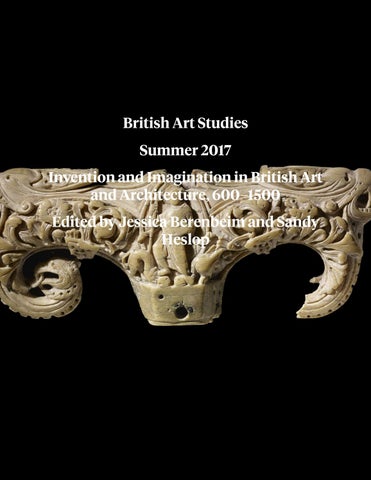
British Art Studies Issue 6, published 29 June 2017 Invention and Imagination in British Art and Architecture, 600–1500 Edited by Jessica Berenbeim and Sandy Heslop Cover image: Unknown maker, Ivory Staff Terminal from Alcester, 11th Century, ivory, 14 x 5 cm. Collection of the British Museum (1903,0323.1).. Digital image courtesy of Trustees of the British Museum PDF generated on 31 October 2017 Note: British Art Studies is a digital publication and intended to be experienced online and referenced digitally. PDFs are provided for ease of reading offline. Please do not reference the PDF in academic citations: we recommend the use of DOIs (digital object identifiers) provided within the online article. These unique alphanumeric strings identify content and provide a persistent link to a location on the internet. A DOI is guaranteed never to change, so you can use it to link permanently to electronic documents with confidence. Published by: Paul Mellon Centre 16 Bedford Square London, WC1B 3JA http://www.paul-mellon-centre.ac.uk In partnership with: Yale Center for British Art 1080 Chapel Street New Haven, Connecticut http://britishart.yale.edu ISSN: 2058-5462 DOI: 10.17658/issn.2058-5462 URL: http://www.britishartstudies.ac.uk Editorial team: http://www.britishartstudies.ac.uk/about/editorial-team Advisory board: http://www.britishartstudies.ac.uk/about/advisory-board Produced in the United Kingdom.
A joint publication by
Contents Pilgrim Souvenir: Ampulla of Thomas Becket, Amy Jeffs
Pilgrim Souvenir: Ampulla of Thomas Becket Amy Jeffs
Authors Amy Jeffs is a PhD candidate at the University of Cambridge. Her research focusses on a 14th-Century English illustrated manuscript of histories and romance (BL Egerton 3028). She is co-convenor of the Digital Pilgrim Project.
Cite as Amy Jeffs, "Pilgrim Souvenir: Ampulla of Thomas Becket", British Art Studies, Issue 6, http://dx.doi.org/10.17658/issn.2058-5462/issue-06/ampulla
This tin ampulla was probably purchased by a pilgrim near the shrine of St Thomas Becket in Canterbury. It is designed to contain holy water and be hung around the neck on a cord. Measuring 100 by 87 millimetres, it is in the form of a narrow, pointed vessel surrounded by an openwork penannular frame and would have been rapidly slush-cast, in one go, in a three-part mould.1 A date in the first half of the thirteenth century is probable based on the style of the military figures’ armour and the archaeological contexts of stylistically similar ampullae.2 The ampulla was acquired by the British Museum in 1921, likely one of the many pilgrim souvenirs discovered in the Thames foreshore from the first half of the nineteenth century onward. Despite the object’s modest material, the makers went to some technical lengths to produce a functional, aesthetically pleasing and iconographically complex souvenir that served the various needs of the cult centre and its devotees.
Figure 1. The Book of the Faiz Monseigneur Saint Loys, composed at the request of the 'Cardinal de Bourbon' and the 'Duchesse de Bourbonnais', ca. 1401-1500, manuscript. Collection Bibliothèque nationale de France, (French 2829). Digital image courtesy of BnF 2017
The obverse of the vessel is decorated with three figures cast in deep relief: Thomas Becket between two of the knights that killed him. The figures’ extremities extend beyond the vessel and join the frame. Becket is the largest and is placed centrally. He is shown nimbed and clothed in archiepiscopal garb. His crozier extends forward and, along with his head, would have been cast between the abutting faces of the two-part portion of the mould. The rest of the design for the obverse was carved into their interior faces. This would have included the rest of Thomas’s figure and the figures of the two knights. They are depicted raising a sword in symmetrical gestures, so that the blades extend beyond the frame and flank the vessel. Behind the swords are two symmetrically positioned suspension loops, designed to be threaded onto a cord (fig. 1). These have been bent back, presumably by the weight of the hanging ampulla.
The two knights function as a saintly attribute for Becket. The overall design of the obverse thus fulfils one of the primary purposes of the pilgrim souvenir image; to be recognizable.3 The figures’ symmetry creates physical balance, allowing the object to hang straight.
Figure 2. Unknown maker, Ampulla of Thomas Becket (front and back), ca. 1170–1200, tin, 10 x 8.7 x 2.8 cm. Collection of the British Museum (1921,0216.62). Digital image courtesy of Trustees of the British Museum
The back of the vessel hangs vertically. It is also slightly longer than the obverse, which is angled away from it. When worn against the chest, the deep-relief figures on the front would therefore lean out at the viewer, while the reverse sits flat against the wearer’s body. The design for the reverse of the ampulla is lightly embossed onto a flat face, making it even easier to wear. Despite its relative concealment, the low-relief image on the reverse is charged with meaning, playfully simulating the impression of a vessicashaped seal. Tessellated with the pointed base of the vessel, it shows the martyrdom of Becket, enclosed by the inscription: “OPTIM EGROR MEDIC FIT TOMA BONOR” (“Thomas is the best doctor for the worthy sick”). Flouting the visual constraints of an actual seal impression, the sword of the knight passes from the image, through the legend-field and into the empty space beyond, toying with the viewer’s expectations. Jennifer Lee discusses the pilgrim souvenir’s status as a sign of the pilgrim’s special relationship with the saint.4 The clear allusion to the authoritative form of the seal impression on this example is not unique, and suggests pilgrim souvenirs were intended to be perceived as material evidence of a
contract.5 That the seal-image sits against the chest, invisible to the external world yet known to the wearer, emphasizes the personal nature of the agreement between devotee and saint. This object reveals the versatility of the decorated ampulla as a physical souvenir that was at once attractive, affordable to both make and sell en masse, a wearable advertisement of the cult for prospective pilgrims, and a meaningful memento for the homecoming devotee.
Footnotes 1
Slush casting requires the molten metal to be poured in, then emptied out before becoming fully solidified, leaving the interior hollow. A fragment of a mould for a similar ampulla has been found at 16 Watling Street, Canterbury, and is illustrated in B. Spencer, Pilgrim Souvenirs and Secular Badges (London: HMSO, 1998), 49, no. 6a.
2
Spencer, Pilgrim Souvenirs, 45.
3
The requirement for pilgrim souvenirs to be recognizable to the general populace (advertised by the wearer) is emphasized in both the Canterbury Interlude; Beryn, “The Canterbury Interlude”, in The Canterbury Tales: FifteenthCentury Continuations and Additions, ed. J. Bowers (Kalamazoo, MI: Medieval Institute Publications, 1992), chap. 5, ll. 171–73; and Benedict of Peterborough’s “Miracula Sanctae Thomae Cantuaruensis”, in Materials for the History of Thomas Becket, Archbishop of Canterbury, Vol. 2, ed. J. C. Robertson (London: Longmans, 1876), 134–35.
4
Jennifer M. Lee, “Searching for Signs: Pilgrims Identity and Experience Made Visible in the Miracula Sancti Thomae Cantuariensis”, in Art and Architecture of Late Medieval Pilgrimage in Northern Europe and the British Isles, Vol. 1, ed. Sarah Blick and Rita Tekippe (Leiden: Brill, 2004), 473–91.
5
See, for example, the souvenirs associated with Our Lady of Rocamadour and St John the Baptist’s head at Amiens.
Bibliography Benedict of Peterborough. “Miracula Sanctae Thomae Cantuaruensis.” In Materials for the History of Thomas Becket, Archbishop of Canterbury, Vol. 2, ed. J. C. Robertson. London: Longmans, 1876. Beryn. “The Canterbury Interlude.” In The Canterbury Tales: Fifteenth-Century Continuations and Additions, ed. J. Bowers. Kalamazoo, MI: Medieval Institute Publications, 1992. Lee, Jennifer M. “Searching for Signs: Pilgrims’ Identity and Experience Made Visible in the Miracula Sancti Thomae Cantuariensis.” In Art and Architecture of Late Medieval Pilgrimage in Northern Europe and the British Isles, Vol. 1, ed. Sarah Blick and Rita Tekippe. Leiden: Brill, 2004, 473–91. Spencer, B. Pilgrim Souvenirs and Secular Badges. London, HMSO, 1998.
Licensing The Publishers of British Art Studies are committed to supporting scholarship on British art and architecture of all periods. This publication is made available free of charge at http://www.britishartstudies.ac.uk. We ask users to identify the use of materials made available through this website and to provide an appropriate credit to the to the author and the publication, so that others may find and use our resources. Except where otherwise noted, this work is licensed under a Creative Commons Attribution-NonCommercial 2.0 UK: England & Wales Licence (CC BY-NC 2.0 UK). To view a copy of this license, visit https://creativecommons.org/licenses/by-nc/2.0/uk/ or send a letter to Creative Commons, PO Box 1866, Mountain View, CA 94042, USA. The Publishers fully support the protection of intellectual property and are committed to complying with, and strictly adhering to, all applicable copyright law. In many cases, copyright or other proprietary rights may be held by individuals or entities other than, or in addition to, the Publishers. If a work or a photographic image is still protected by copyright, you must cite the relevant copyright information when using the image and comply with all other terms or restrictions that may be applicable to that material. In some cases, exceptions to copyright that permit limited use of protected works without the permission of the copyright owner may have be applied. We are confident that we have carried out due diligence in our use of copyrighted material as required, but we apologise for any inadvertent infringement of rights. Digital copies of resources are made accessible for research for one of the following reasons: • they are in the public domain; • the rights are owned by the Publishers; • we make them accessible under an exception or limitation to UK copyright law, as outlined in the Copyright, Designs and Patents Act 1988 (as amended); • we have permission to make them accessible; • or, there are no known restrictions on use. If you believe that we have made a mistake and wish for your material to be removed from our site, please contact us at copyright@paul-mellon-centre.ac.uk. Please include the following information with your request: • Name and contact information, including email address and phone number. • Identification of the resource for consideration of removal. Providing URLs in your communication will help us locate content quickly. • The reason for the request. The Publishers respond promptly, normally within 21 business days. We may remove the resource from our site while we assess the validity of the request. Upon completion of the assessment, we will take appropriate action and communicate that action to you.