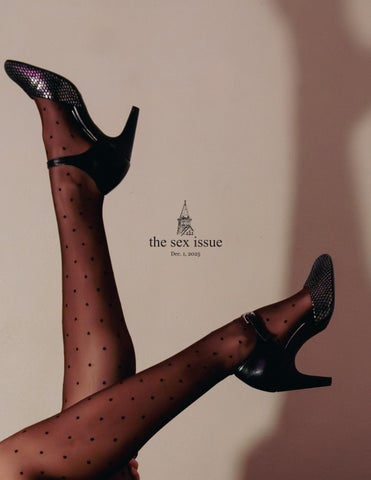
the sex issue Dec. 1, 2025
Dear readers, Welcome to the 2025 sex issue, our second risqué magazine, ever. Whether you remember us from last time or are sorely confused, we are delighted that you’ve picked up these 18 pages. Our annual publication of a sex-themed issue has taken many forms over the years. While the Cynic and our coverage have evolved, we remain committed to covering the topics that grip the student body. College is primarily a place for our higher education and personal betterment, and we believe that a large part of that is how we interact with our fellow students, in every aspect. In this issue, we cover the digital landscape of sex and connection, how our future health practitioners are learning to care for diverse bodies, what falling in love can feel like, and let you know what sex toy you are: the important stuff. Whether you believe that sex is to be shared with people you love, to be shared with anyone hot, or not to be shared at all, this sex issue is meant to help capture and foster conversation about what sex means to UVM students right now. We hope this issue can bring some light and reflection to this cold, dark point in the semester. We wish you luck on your finals, but we also understand if you let this magazine distract you from studying. Our deepest gratitude to all of our editors, writers, photographers and illustrators for all of the countless hours you spent on the Cynic this semester. We are constantly wowed by each of you and are immensely proud to show off what you can do. Until next semester,
Grace Wang Maxine Thornton co-Editor-in-Chief co-Editor-in-Chief
Annalisa Madonia Managing Editor
LAYOUT EDITOR GRACE WANG
ILLUSTRATIONS EDITOR ALEX PORIER
COPY CHIEF ALYSSA SULLIVAN
CO-PHOTO EDITORS SARAH KOEGLER ELIZABETH SMITH
CULTURE EDITOR MAYA SURRENTI CO-FEATURES EDITORS LILIANA MEFFORD & NORA SISSENICH NEWS EDITOR ALEX STRAND OPERATIONS MANAGER JAY THOMAS OPINION EDITOR ASHLEY GOLDEN
CO-PODCASTS EDITORS NATALIE RICHARDSON-WYMORE CHARLOTTE KING DIGITAL MEDIA EDITOR ZOE SHAPIRO FACULTY ADVISER MARSHA BRANCH
The Vermont Cynic
Dec. 1, 2025
TABLE OF CONTENTS 1 SGA installs wellness vending machine — Sophia Rosen
2 UVM Center for Health and Wellbeing establishes rapid testing clinic — Julia Austin 3 Andrew Scott moaned in my ear on Monday night — Maya Surrenti 4 Sodomy of Saint Sebastian — Snejanna Ostrerov 5 Quiz: What sex toy are you? — Mackenzie Bender 6 Centering patients’ sexual health in nursing education — Olivia Langlan 7 Sex isn’t as meaningful as we think it is — Ashley Golden 9 Diagnosing the love bug — Cheyenne Rosenberger 11 Choose your R-rated adventure — Maya Surrenti 13 Curated desire: can we find meaningful connection online? — Elise Coyle & Emma Hans 15 Let’s spill the Tea App — Maxine Thornton, Alexa Gaskill & Avery McDowell
Cover photos by Sarah Koegler
News — Page 1
Dec. 1, 2025
SGA INSTALLS WELLNESS VENDING MACHINE BY SOPHIA ROSEN
At the beginning of this semester, a collaboration between SGA and the Center for Health and Wellbeing came to fruition with the implementation of a wellness vending machine. This vending machine, located on the first floor of the Davis Center, is complete with many vital wellness items, such as Plan B, pregnancy tests, Band-Aids, condoms and cold medicine. There are 21 items in the vending machine, all handpicked by CHWB Executive Director Blake Reilly and McKenna Halvorson ‘25, former SGA member and alum, based on the needs they saw reflected by students, Halvorson said. First-year Celia Wing emphasized what a convenient resource the vending machine was for her. “I needed Tylenol one morning, but I didn’t have time to go all the way to the pharmacy,” Wing said. “Having the vending machine there meant that I got what I needed before my class.” The new vending machine is intended to make health products cheaper than average and easier for all students to access, according to @uvmhealthandwellbeing and @ uvmsga on Instagram. “It’s providing resources that a lot of students need but can’t necessarily afford most of the time, or it’s too out of the way to grab them,” said senior Megan Steele, chair of SGA’s committee on student action and wellbeing. The vending machine’s accessibility means that students can get the wellness supplies they need directly when they need them. “It’s the worst when you wake up sick, and then you have to trek to CVS,” said junior SGA President Kennedy Connors. With the help of national vending machine company Simplichek, SGA and CHWB have signed a contract to keep the vending machine running for three years. The vending machine project had been passed down from SGA senators for 10 years, according to Halvorson. She decided to make this project her focus and saw a way to take it in a new direction. Halvorson and former CSAW chair and senior Cat Jones spearheaded the project by approaching Reilly about the idea. This sparked the collaboration between the CHWB and SGA, making the wellness vending machine possible. “I hope that the vending machine can provide reassurance for the UVM community,” Halvorson said. “There are many students who may not have the time or resources to access the products in the vending machine off campus.” Both SGA and CHWB hope that as a result of the collaboration, this vending machine can be sustained as a resource for students for years to come, Steele said. “It shows that the collaborative partnership can get a lot done,” Reilly said.
Photo by Alec Sugars
News — Page 2
Dec. 1, 2025
CHWB ESTABLISHES
RAPID TESTING CLINIC BY JULIA AUSTIN
The UVM Center for Health and Wellbeing has established a rapid testing clinic for students, according to Erika Currier, interim director of student health services. The program offers same-day testing for a variety of common illnesses, including sexually transmitted infections, the flu, strep throat and COVID-19, according to the Test and Go page on the UVM website. This is the first program offered by CHWB which allows online scheduling. Prior to this, students had to call, which created a barrier to treatment, Currier said. “Sometimes it felt embarrassing to say what they wanted, or if they were having symptoms of an STI. This is a more confidential way to ask for testing,” Currier said. The Test & Go Clinic is open from 1 to 4 p.m. each weekday. On average, 20 students come in per day, Currier said. “We are hoping to expand Test and Go to be open for more hours in the future, because there’s days when it’s full and people are booking tomorrow. It ebbs and flows with the season,” Currier said. Students can schedule online using the MyWellbeing portal. Appointments are offered every 10 minutes. When they arrive, a clinician will ask the student what their symptoms are, and what testing they want to get, Currier said. Clinic and provider visits are free to the student, but for most of the testing, a $20 fee is assessed to the student’s account. Gonorrhea and chlamydia require swabs to be sent to the UVM Medical Center. These results typically come back within a day, and the patient’s insurance is billed by UVMMC, Currier said. If a student tests positive for an STI, they will be called by a provider from the clinic to discuss results and a plan for treatment and prevention, Currier stated. UVM CHWB also offers treatment to any sexual partners of a student who tests positive. Students are encouraged to use an anonymous STI notification app to alert partners to get tested.
In some cases, the Vermont Department of Health will contact the student for contact tracing, Currier stated in an Oct. 31 email to the Cynic. Between January and October, 57.1% of all tests done through the Test and Go Clinic were for STIs, UTIs or pregnancy. Upper respiratory illnesses were 42.1% of all tests, Currier stated in an Oct. 31 email to the Cynic. In addition to testing, CHWB offers methods to prevent pregnancy and STIs. CHWB offers appointments for students to talk about STI prevention, and offers free condoms and dental dams, as well as PrEP, Currier stated. The Test & Go Clinic has received high praise from members of the community and other clinicians, Currier stated. “As far as I know, it is the first of its kind. We were just at a conference and talking to a few colleagues there and they were like, ‘Wow, we’ve never seen something like this before,’” Currier said. The Test & Go Clinic makes STI testing more accessible, lowering the barriers to getting screened by making it more affordable and confidential, Currier stated. “I suspect that many more UVM students are accessing STI screening than in years past and I hope that students feel empowered to take control of their sexual health,” Currier said. “Earlier detection and treatment of STIs will decrease transmission and likely prevent future clusters of STI outbreaks.”
“
They don’t have to tell everyone their full story, they can just come in and get the testing they want.”
Culture — Page 3
Dec. 1, 2025
BY MAYA SURRENTI
The rise of audio erotica is a blessing to those thirsting over celebrities with hot voices. Sacrificing my ears and my modesty, I ventured into the internet’s newest horny crevice — Quinn. Quinn is an audio erotica app with a celebrity profile. From the likes of Chris Briney to Andrew Scott, unreachable celebrity crushes can now whisper dirty story lines directly into your ear. “The Summer I Turned Pretty” star Chris Briney announced his collaboration with Quinn shortly after the final episode of the show aired. In “Hidden Harbor,” a three-episode series on Quinn, Briney narrates the part of River, who is back home for the summer and finds himself falling for his brother’s ex-girlfriend. If his portrayal of Conrad Fisher taught audiences anything, it’s that Briney knows how to play this lusty role well — and “Hidden Harbor” is no exception. Like any good culture writer, I dished out the $7.99 monthly subscription fee and listened as I concocted my curry on a Monday night. Reader, I was blushing the whole time I cooked. “The skirt, Drea, do you know how fucking sexy you look in it,” Briney said as River. The episode reads like a Wattpad fiction in the Y/N format. The listener is supposed to be the character spoken to by the narrator, and the Quinn community ate it up. Below each episode is a comment section. Scrolling through the comments proved to be more entertaining than the audio itself. “Well Connie baby why yes I’ll bite you,” stated Quinn user @rosughhlyne in the comment section of the episode.
The anonymity of the profiles seems to encourage boldness in the users’ comments. “tie my organs into a bow I need him,” stated Quinn user @camisubi. Quinn functions as social media for audio erotica. Random individuals on the internet can become creators and the app allows listeners to give roses to their favorite narrators, boosting their popularity. However, the move of high-profile celebrities towards audio erotica highlights how culturally mainstream smut has become. Subverting the male gaze and honoring the female, the spicy books that have gained popularity in recent years create a literary exploration of sexuality, rather than a visual one. Quinn fills the void left by “Playboy” and “Playgirl” centerfolds, which allowed celebrities to attain a certain sex symbol status, according to a Sept. 22 article from Vogue. If audio erotica is the new “Playboy,” imagine my surprise when I stumbled across actor Andrew Scott’s gorgeous hot priest face, staring at me in a blue silk shirt. Scott’s versatility is impressive. From reciting poetry to playing Hamlet, his velvety, Irish accent clad voice will do numbers to a person. “his arms? adored. his beautiful neck? revered. His voice—and I can’t believe I’m saying this—on my audio erotica app? ENTHRONED,” stated Quinn user @mgmt in the comment section of Scott’s episode. In the Quinn original “The Queen’s Guard,” Scott voices the queen’s protector, a man caught in a wrought relationship with the leader of the resistance — his former lover. Reader, if the Chris Briney story had me blushing, I was scarlet during Andrew Scott’s narration.
“If we’re going to do this, we’re going to do this right,” he said. “Sit on the throne … you heard me, sit down.” It’s no surprise that the comment section under this episode seemed particularly feral. “The scream I scrumt when he called us good girl,” stated Quinn user @idamagda. I don’t know if I’m sexually liberated enough to listen to audio erotica in my free time, and I had qualms with the single-sided narration. Based on the comment sections, I wouldn’t be surprised if users were narrating the other perspective themselves. However, I wholeheartedly support female sexuality being at the forefront of Quinn’s mission and people deserve to let their freak flag fly. And, hey, if Andrew Scott’s involved, maybe I’ll wave my flag around a little bit too. But not for $7.99 a month.
Illustrations by Alex Porier and Katherine Hashem
Culture — Page 4
Dec. 1, 2025
y m o o f d S o a S i e n h t T Sebastian BY SNEJANNA OSTREROV
I doubt that anyone’s first thought when walking into a museum is ‘God, this makes me horny,’ but it really should be. Many classical artworks, whether explicitly or not, often depict sexuality. Painted in 1525, “Martyrdom of Saint Sebastian” by Giovanni Antonio Bazzi does not initially appear to have any erotic undertones. Bazzi, more commonly referred to as Il Sodoma, painted this banner for the company of St. Sebastian. His nickname, literally translating to sodomite, was given to him by Giorgio Vasari in his book “Lives of the Most Eminent Painters, Sculptors, and Architects.” “[Sodoma] always had about him boys and beardless youths, whom he loved more than was decent,” Vasari stated on page 245 of his seventh volume. Though we have no concrete evidence of this being true, Sodoma and his pieces have consequently been looked at through a much more colorful lens than the work of his contemporaries. St. Sebastian was a Roman soldier who converted to Christianity, though he managed to keep his faith secret for many years.
He may as well have been the first closet case. When Emperor Diocletian discovered that his soldier was a Christian, he immediately condemned the betrayal and sentenced Sebastian to death. He was tied to a tree and shot with arrows.
presents a clear innuendo while still remaining unnoticeable to the ignorant eye. The fabric wrapped around his hips is sheer, thin enough to see blood dripping lazily down his hip. It flows in the wind, teasingly loose to instill the anticipation in the viewer that it might be blown away at any moment. This painting blurs the symptoms of pain and ecstasy. St. Sebastian’s toes clench. His hands seem to stop halfway to becoming fists, almost as if his body no longer has the energy to form them. His hair is frizzy and disheveled, his mouth parting to gasp for air. Tears pour from his red-rimmed eyes, his bound hands unable to wipe them away. His body glows, surrounded by a divine light. All of these traits can be labeled as expressions of either pain or pleasure. Given Sodoma’s reputation and the nature of St. Sebastian’s martyrdom, it’s quite plausible to read this painting as a depiction of a post-orgasmic haze in a world where open sexuality of any kind was shunned.
This painting blurs the symptoms of pain and ecstasy. Sebastian survived, though, and returned to Rome. He berated Diocletian for his treatment of the Christians. Outraged, Diocletian had him seized and beaten to death. In Bazzi’s work, St. Sebastian is posed almost completely nude, in a classic contrapposto that emphasizes his smooth curves and straining muscles. The arrows puncturing his skin are strategically placed, with the one in his thigh penetrating him deeper than any other. A piercing object so close to the groin
Photo Illustration by Alex Strand & Grace Wang
Culture — Page 5
Dec. 1, 2025
What Sex Toy are You? BY MACKENZIE BENDER
Whether you’re using them with someone or alone, sex toys can be a huge part of “the Big O” for everyone. There’s a unique toy for each body, whether it’s one from the decorated wall of Spencer’s or hidden behind the locked boxes at CVS, anyone can find their perfect fit. Out of all the sex toys on the market, which one reflects your personality? Take this quiz and find out.
Question 1
What is the typical genre of music you listen to? a) Pop music b) 2000s hits c) Mumble rap d) EDM house music e) Country/folk music
Question 2
What is your go-to breakfast? a) Eggs and bacon b) Egg white omelet with spinach c) Nothing d) White Monster and nicotine e) Granola and yogurt
Question 3
What is your favorite ice cream flavor? a) Chocolate b) Mango sorbet c) Pistachio d) Bubblegum e) Mint chocolate chip
Question 4
What is your favorite sex position? a) Missionary b) Scissoring c) Reverse cowgirl d) Amazon position e) Doggy style
Question 5
Where do you study? a) Your dorm’s common room b) Billings Library c) Your room d) Grundle e) Howe Library
Question 6
What does your typical weekend look like? a) Pregaming a concert at Higher Ground
b) Going to Sputies and frat parties c) Hanging out with friends at your dorm d) Blacking out in Montreal e) Downtown for a date night or with friends
Question 7
Which microtrend was your favorite in 2020? a) Puka shell necklaces and Hydroflasks b) Cottagecore strawberry dress c) Softgirl/boy chunky sweaters d) E-Girl/boy with chains and checkers e) Learning, or planning to learn, to play guitar
Question 8
What is your favorite Sitcom? a) Friends b) Sex and the City c) The Office d) Fleabag e) It’s Always Sunny In Philadelphia
Question 9
Which location would you choose to get freaky at? a) The theater couch b) Someonee’s bedroom at a house party c) Backseat of a car d) Public restroom e) Childhood bedroom while visiting your parents
Question 10
How would you rate your level of freak? a) Vanilla, no freak at all. Very typical sex b) Multiple rounds for extended periods of time. A lot of receiving c) Not too much freak, lots of hookups and booty calls d) High levels of freak. Bondage, toys, anything you can think of e) Medium levels of freak. Lots of foreplay, mostly giving instead of receiving
Results
Mostly A: Vibrator You follow a lot of popular trends, you’re maybe a little vanilla — and there’s nothing wrong with that. You can have fun with many people, but you are probably not having too many super wild adventures. Mostly B: Rose Toy Pillow princess energy. You know what you like and you are not afraid to say it. You are confident and know how to get your way. Mostly C: Automatic Stroker You enjoy a hookup and going with the flow. You stick to yourself for the most part, but have a good time being around close friends. Mostly D: Nipple clamps You don’t care about what anyone thinks of you and you do whatever you want. You probably have some freaky adventures with yourself or partners and you have fun trying new things. Mostly E: Good ole’ fashioned hand You are traditional, and you like giving everything you’ve got. You’re not afraid to get your hands messy and you like doing new things for other people.
Illustrations by Alex Porier
Opinion — Page 6
Dec. 1, 2025
Centering patients’ sexual health in nursing education BY OLIVIA LANGLAN
N
ursing education evolves and adapts to the healthcare system, but inevitably, it can still fall short. One such example is the lack of standardization of sexual health education across nursing curricula, resulting in students lacking proficiency and confidence in this area of practice, according to a Dec. 7, 2023 NIH study. Additionally, nursing baccalaureate programs average only 2.12 hours of LGBTQ+ content taught in the classroom, according to a February 2021 article in Nursing Education Today Volume 97. In order to provide all students with a comprehensive and effective sexual health curriculum, nursing educators must represent diverse populations and encourage students to explore the gaps in their own knowledge regarding differences in sexual experience. My Public Health Nursing professor, Teresa Graziano, combats this lack of LGBTQ+ education by inviting seniors to contemplate the systemic issues that plague the healthcare system and how they will soon fit into this puzzle. Graziano teaches and conducts nursing research focused on painful experiences in sexual and gender minorities, identifying as part of the queer community themself. “We think that our queerness has to be something kept to us, that it’s not professional to express that queerness despite it being a major component of our identities,” Graziano said. Diversity in both nursing education and clinical practice is what allows nurses to form connections and understanding, fostering a patient’s trust, they said.
“I think about what generates knowledge, and typically it’s lived experience. When you have nursing educators who are predominantly cisgender heterosexual women, they don’t know what they don’t know simply because they have not engaged in sex that is queer,” they said. Queer representation in both practicing nurses and nursing educators is undeniably important, they said. “Nurses who are coming from queer backgrounds versus heterosexual backgrounds, we have many different ideas about normative care,” Graziano said. Patient-centered care — a core concept taught in nursing school — refers to the practice of tailoring medical care to respond to the needs of the individual, their unique life factors, wishes and values, according to a July 10, 2024 National Institute of Health article. This concept can be difficult to lecture on, often coming across as a corporate checklist that prompts nursing students to listen and explore their future patients’ values actively. Without actual clinical experience, it is nearly impossible to understand how to provide patient-centered care completely. Once nursing students actually enter the workforce, they will be confronted with real-world situations that will provide them with opportunities to continuously improve how they give patient-centered care. In my future career as a nurse, it will be essential to recognize knowledge and skill deficits I may have due to a general lack of exposure, education and personal or patient experience. It is necessary to remain humble and open to learning.
“I would like to see nurses feel empowered to ask questions about sexuality — which falls under whole person health — and actually be educated and provide education to a wide array of patients, not just heterosexual individuals who are cis and having normative or vanilla sex,” Graziano said. In nursing education, what is taught is normative care. Generalizations outline a standard of healthcare for the population at large — in reality, the individual requires nursing care that caters specifically to them. “The care I provide is more non-normative, and I think it’s because I’m ok being non-normative, because I have always been non-normative in the society I was brought up in,” they said. In order to teach extensive sexual health in nursing education effectively, there must be a representation of diverse identities in nursing educators and future nurses themselves. In order to give patient-centered sexual health care, nurses must be willing to learn from their patients what they don’t know. This change comes from within. It is necessary that nursing curricula are standardized to include more content and representation of sexual and gender minorities. They must integrate information from nurses, researchers, and patients who possess expert knowledge and personal experience. Only then can future nurses provide the advanced patient-centered care that every individual deserves.
Illustrations by Alex Porier
Opinion — Page 7
Dec. 1, 2025
Sex isn’t as meaningful as we think it is BY ASHLEY GOLDEN
Last winter, in the aftermath of a meaningless hookup, I lay in my bed and tried to understand why I felt so empty. Sex is, without a doubt, one of the most vulnerable positions you can put yourself in. It is an action that can have long-term effects, both positive and negative, on your physical and mental well-being. But sex in and of itself is just an action. And actions do not have an inherent, universal meaning. The average American learns about sex at 12 years old, according to a 2024 Sex Ed For Social Change Survey. But 60% said that any conversation about sex was unacceptable or incredibly taboo during their upbringing, according to the same source. While in recent years Americans have become more accepting of certain sexual behaviors, it is still a contentious issue.
For example, 60% of people believe it is acceptable for two consenting adults in a non-committed relationship to have sex, according to a 2020 Pew Research survey. But, only 43% percent believe it is morally acceptable for teenagers to have sex under any circumstances, according to a June 18, 2021 Gallup Poll. Sex absolutely can change relationships with others and with yourself. But it does not have to. This is not to say that sex is completely meaningless. Sex can change the way you are perceived and can have profound physical ramifications. I understand that when it comes to this topic, I have a biased, borderline skewed perspective. My experience with sexual abuse has left me with a complicated relationship towards sex and sexuality that inevitably played a major role in shaping this
opinion. But, I still believe it is fair to say that sex has no universally applicable meaning, and that the action of consensual, safe and informed sex has no inherent moral or relational implications. My experience with sexual abuse occurred when I was a child, long before I became sexually active. When I arrived at college, I truly believed sex to be just a thing one does to feel good, something to release endorphins. I admittedly found myself quite confused when my friends would tell me how a relationship or friendship they were in became complicated or even imploded after sex became involved. I did not understand why this action had to change anything if you did not want it to. This perspective is relatively common in
i just did not
understand what the big deal was...
people who experienced childhood sexual abuse, according to a March 1, 2021 NIH meta-analysis. And yet, looking back to my first few years in college, I cannot say I found sex to be overly pleasurable. This is not to say it wasn’t something I enjoyed, rather that it simply wasn’t what our culture had led me to believe sex was going to be like. In my experience, movies, TV shows and novels that depict sex often portray it in one of two ways. One: Sex is the peak of intimacy, with the characters on-screen or the page in unrealistic positions making unrealistic noises. After the act, the pair lay on the bed, or blanket or whatever, and the nature of their relationship changes. Two: An act of unbelievable pleasure under any circumstance that instantly improves a foul mood. In reality, I found it to be much different. Yes, it was nice to feel someone’s hands on my body, to feel someone else’s warmth and mouth. To feel the physical manifestation of someone’s desire for me. But it wasn’t all that. And as I came face-to-face with the situations my friends had once described to me, the imploding of friendships, the sudden changing of expectations, I was admittedly
left quite confused. I just did not understand what the big deal was. In fact, it was acts of intimacy that are often viewed as significantly less intimate that I found myself enjoying the most and finding to be the most emotionally meaningful. Cuddling, hugging, kissing and even just something as simple as quality time with someone I have intense feelings for left me feeling better than some hookup. It was these things I found that left me feeling the way I was led to believe sex would. So after that night last winter, I stopped hooking up with people. Deciding to only have sex with people that I already have or could see myself developing a close relationship with, whether that be a romantic or even platonic one. Since then, my experience with sex has been significantly more enjoyable. But the vital thing to note is that this is just my experience, my belief. The lesson here should not be mistaken to be hookup culture bad, relationships good. I did not stop having hookups due to some newfound understanding of the sacred meaning of sex or something of the like. I just didn’t like it. I do not regret my earlier sexual experi-
ences, as they helped me discover what is important for me, what made me feel good. And me alone. There are plenty of people who genuinely enjoy hookup culture, or having friends with benefits, or any other wide variety of activities that could be classified as “casual sex.” And I know people who experienced similar things when they were kids, who find engaging in casual sex to be incredibly empowering and pleasurable. They have found their own meaning behind the act of sex. I know plenty of people who view sex to be an incredibly private, hallowed thing that should only be viewed and acted upon after intense thought and with the utmost respect. And if that’s what you believe, that’s ok. My point is not that sex is meaningless. Rather, that the meaning behind sex and how you approach it should be entirely up to you. It is your life. Your body. It should be your meaning.
Photo Illustrations by Alex Strand & Grace Wang
Opinion — Page 9
Dec. 1, 2025
Diagnosing
The Love Bug BY CHEYENNE ROSENBERGER
A
s someone who recently had what many call “the Love Bug,” I can attest that it truly is a sickness. My half-year illness ended this past summer after three months of infatuation, one month of reluctant epiphanies and two months of pure resentment. I felt an overwhelming relief that came as a result of the obvious cure: separation from the pathogen. I’ve seen many friends fall head over heels for mediocre men doing the bare minimum. Although mediocrity and bare-minimumness aren’t gender-specific, I’ve witnessed these qualities being male-dominated, as most things unfortunately are. I would like to uncover the stages of the illness I call “the Love Bug” in hopes that we can slow the spread. With a little introspection, one may be able to identify that they’re experiencing affliction, not affection. As someone who recently had what many call “the Love Bug,” I can attest that it truly is a sickness.
Catching the Contagion
Let’s say you hypothetically meet someone, maybe through a mutual friend, a public encounter or a tinder match. Perhaps you’ve been a little too lonely as of late, and this new prospect doesn’t slide into your DMs asking you to “send pics.” You may think to yourself that he’s much better than some. As you get to know him, you likely choose to retain the information you like. Perhaps he’s fairly tall, plays a sport and is an equal rights advocate. You remember him profoundly proclaiming that he “thinks women have it hard.” You omit the not-so-flattering qualities from your mind. Maybe he can’t merge to save his life, is unemployed and has extreme only child syndrome. Still, you justify your choice to pursue him — in today’s dating pool, he’s a real catch. After a couple weeks of hopeful inner dialogue, his permed curly hair seems especially springy to you. He appears to “really care.” Perhaps you both like Billy Joel, and you tell yourself this is rare. You feel less lonely. Suddenly, you become increasingly distracted. Listening to “SOS” or some other Rihanna banger hits harder than usual. You begin to feel lightheaded, your stomach is jittery and you have trouble sleeping. You don’t want to admit it, but you’ve caught the contagion.
Symptomatic and in Denial
Now you’re a few months in and your rose-colored glasses are holding up fairly well. If you watch “Titanic” together, you see Jack Dawson sitting next to you. You tell yourself that he would accompany you to fancy events and would definitely talk you down from jumping off the side of a ship. You refuse to recognize that the man who can’t even pretend to tolerate your favorite songs surely wouldn’t have given up that door.
You make excuses for him, as you tell yourself that his childlike dependence on his mother is healthy, and that his empathy problems are the fault of a society that teaches men to be emotionless. With countless friends telling you that you could do better, you become defensive, still refusing to admit that you’re sick. You probably tell them that he’s actually a 10 — the pictures you have on your phone just aren’t flattering. You proclaim that they don’t know him the way you do. You insist that he’s actually very mature. The sound of wedding bells in your ears muffle how annoying his voice is becoming. The image of being a politician’s wife is burned in your retinas, blinding you to how awful he dresses. You refuse to admit that
after daydreaming of him for months, a life together isn’t in the cards.
Recognition and Remission
One day, something will happen that you can no longer forget about or rationalize. Perhaps he becomes a little too angry and a side of him you’ve chosen to ignore is something you are now unable to look away from. All at once, your friends’ advice no longer seems dismissable. You may begin to feel trapped — by him, possibly. Maybe you’re trapping yourself. Unfortunately, the breaking point doesn’t necessarily indicate that a breakup is close at hand. From what I’ve seen and experienced, people who date men they aren’t compatible with often become reluctant to leave them to the point of absurdity. I stayed in my relationship for two months, feeling constant frustration and even intermittently recognizing that it would have to end soon. Much to my shame, it only came to an end when he broke up with me. Now, one could question if this article is the soliloquy of a girl who’s bitter about her most recent breakup. But truthfully, I don’t resent him. A month after receiving a cure for the contagion, I felt the sickness fully leave me. Not every relationship ends when the virus grows sick of its host. Many people, stronger than I, realize the error of their initial delusion, and seek treatment for their illness much earlier. If he hadn’t broken up with me, I like to tell myself that I would’ve ended things in the following week, but who knows if I would have. Evidently, my illness weakened my will and distorted my reality. Still, I must admit that my relationship was more like a common cold. My ex-boyfriend was not cruel, poor-intentioned or deliberately flawed. He just happened to be wrong for me, and some of the above anecdotes are admittedly not hypothetical. Of course, I’m not perfect either. Truly healing is recognizing that you deserve better, and taking the measures necessary to keep yourself healthy. Avoid pathogens with a little bit of social distancing now and then. When you’re ready, feel free to continue your search for love. Just make sure you can recognize a virus when you see one. Illustrations by Clare McCormack
Welcome to UVM! I’ll be your host, Rally Cat. In this R-rated adventure, play at your own risk as you navigate the romantic highs and lows of Burlington’s single-and-ready-tomingle population. BY MAYA SURRENTI
You start in the artistic haven of Trinity campus, where a microbang bedecked singer invites you into her dorm for bong rips and stick-andpokes. She’s hot in an Effie from Skins sort of way, and her voice is entrancing. Stay over if you dare, but Northside Dining’s breakfast awaits you in the morning.
Once on Central campus, you make it to Howe Library, where one of the steps’ chronic smokers offers you a cigarette and talks to you about Karl Marx. As he mansplains to you the problems of the establishment, you are either entranced by his intellect or smoked out by the wafts of cigarette drifting your way. Choose to stay with your Carhartt-clad intellectual, or move on to the Aiken Center.
Meet the Rubenstein-adjacent sustainable farming polycule. An off-campus group, you will encounter the polycule doing internships for various sustainable farms in the Burlington area. Careful, if you are too charismatic, you might be invited to join. Illustrations by Alex Porier, Katherine Hashem and Clare McCormack
Now, you are either enamored in Radio Bean doing ketamine with your sustainable farming polycule, or you have made it all the way to Athletic campus.
Culture — Page 12
You find yourself in the climbing gym, where a scrawny first-year with pumped forearms and chalk-covered fingers is giving you the beta on a climb you just started. He will ask you on a climbing date where he will spend most of the time showing off by dynoing, wrapping it up with a romantic Grundle dinner.
If smoking a joint in a Wright Hall suite and falling asleep on the couch isn’t your cup of tea, you migrate down to the bars.
Dec. 1, 2025
Start up a confusing and inconsistent situationship that will lead to too much time spent in Marsh/Austin/ Tupper Halls — or keep walking.
In the Redstone pines, you find your stoner love. She’s the chillest girl you will ever meet and an insane park skier. She’ll skip class to sleep in and might be an awful texter, but you will never have more fun than with your Skida-beanie-wearing sweetie.
An AGR man in a backwards hat, Carhartt pants and a t-shirt sings “Freebird” at RJ’s karaoke. He’s only sort of hot, but that mustache is doing him a lot of favors and he has some well-placed tattoos. Either you wake up hungover and thirsty in AGR Friday morning, or you make the pilgrimage to the final boss destination — the Three Needs patio. You walk in after a long night to a heated patio filled with cigarette and joint smoke, and you spot the one. She’s gorgeous. She has curly hair, lots of silver rings and she’s wearing cargo pants. You want to approach, but all the straight women at UVM dress like lesbians, and you have no idea how the interaction might go. Congrats! You go up to her and flirt up a storm. You got her number, and now a convoluted series of texts will follow, culminating in nothing. You will now see her everywhere you go.
And that’s the Burlington dating scene. Don’t you want to be single?
Features — Page 13
Dec. 1, 2025
C U R A T E D D E S I R E :
CAN WE FIND MEANINGFUL CONNECTION O N L I N E ?
BY ELISE COYLE & EMMA HANS
Dating apps: the ever-present virtual meetcute for singles. From modern love stories to soulless swiping, the apps leave some students turning back to real life for authenticity and connection. More than 70 UVM students shared their experiences with dating apps in a survey posted on the Cynic’s Instagram story. “Once in a blue moon they can yield a random situationship,” stated one anonymous student. “Fun to swipe while on the toilet,” stated another. Many survey respondents expressed a cynical attitude, with over half of the responses expressing at least partially negative sentiment. A recurring thread was frustration with the lack of authenticity on dating apps. “Any reflections of yourself on any social media or dating apps will never be really true to you, but I feel like it’s so much more so in the case of these dating apps,” said junior Josh, who declined to give their last name. “You really gotta craft this kind of fake version of yourself.” Josh joined Tinder for a couple of months after hearing friends talk about their experiences. They felt it would be naive to expect a serious relationship from the app, but were at least hoping for some sort of connection, they said. “The first person that I matched with immediately texted me #NeedDat,” they said. “That was not a very great introduction to that sphere.” Ultimately, Josh decided to delete the app. They said that although it may speed up the process, they didn’t feel like they needed to be on apps to meet someone. “While you might have more connections online, I don’t think they would be as fulfilling as the ones that you make in person, because they’re just kind of half-assed,” said junior Ande, who declined to give her last name. While Ande thinks dating apps may make it easier to initially reach out to people without the fear of rejection, they are also more difficult to form meaningful relationships on. While she still uses apps, she doesn’t take it very seriously, she said. “I think if we all just had the collective mentality to actually go out and meet each other and make these connections, maybe we’d all be a little bit happier and not have to suffer through Tinder and Hinge interactions,” she said. Kate Mays, UVM professor and social science researcher, described the way that
digital communication fundamentally changes interactions. “It takes more time to have more intimate self-disclosure or exchange in a text-only interface,” Mays said. She described the curation of a profile as a negotiation of versions of the self. While one may choose to reveal only certain aspects of the self on a profile, it must still be somewhat tied to the real self. “[A profile is] true to who I am, but not the full picture of who I am,” Mays said. People act similarly in person, revealing only some information about themselves. The decision has a heightened sense of permanence on apps with statements staying on a profile, she said. Mays met her own husband on Coffee Meets Bagel, an app that limits choices to just a few people per day and eliminates the swiping element. The design reduces the paradox of choice, in which people become less happy when given seemingly endless options, she said. “People [on Tinder and Bumble] were unhappy with their options,” she said.
“They felt like it was just a devastating, endless swipe spiral and you were always thinking, ‘Maybe there’s someone better than this person right here.’” Jennie Rosier, a professor of communications at James Madison University who researches Gen Z dating trends, thinks this abundance of choice makes people less focused on developing relationships.
“I feel like the dating apps are making it so that you guys don’t feel like you have to put in that much effort to get someone’s attention,” she said. Rosier claimed this low-commitment approach to dating is part of a larger throwaway culture in the U.S. “It’s like, ‘Oh, the toaster doesn’t work, throw it away. Get a new one. Your husband doesn’t work, throw them away and get a new one,’” she said. Rosier expressed concern that given the option of apps, younger people are losing the art of conversation with strangers. She thinks that despite continuing to use apps, people are dissatisfied with them. “My general, broad consensus is that you guys are reluctantly participating in this dating game that has a lot of uncertainty and confusion because that’s just the way it is,” Rosier said. “And I don’t think that most of you like it.” However, sophomore Lucy, who declined to give her last name, found that apps serve as a way to meet new people — romantic or platonic. “Had I not had the internet, I would not have met many of the people that I have who have made an incredible impact on my life,” she said. Lucy went on several dates with women from dating apps during the summer, and ultimately found her girlfriend on Hinge. Going in without any expectations is part of what made the experience so positive, she said. “I found that all of these dates I went on were just great experiences to get to know other people,” Lucy said. “I didn’t really have anything negative to say.” She admitted that there was a certain aspect of shallowness to the process — only meeting up with those that one is attracted to — but said that melted away when she met people in real life and got to talk with them. “For every creep you’ll find on a dating app, there are 50 or 100 other people that are normal people with normal lives who are also just looking to meet others and have a nice, meaningful interaction,” Lucy said. Online interactions are not definitively good or bad, but are shaped by how people approach them, according to Mays. “We’re constantly choosing to reveal different parts of ourselves and keep hidden other parts of ourselves,” Mays said. Photo Illustration by Sarah Koegler
Culture — Page 15
Dec. 1, 2025
Let’s spill the Tea App BY MAXINE THORNTON, ALEXA GASKILL & AVERY MCDOWELL
Tea dating advice, colloquially referred to as the tea app, was removed from the apple app store on Oct. 21. The Tea app, as well as its unaffiliated counterpart, TeaOnHer, failed to meet Apple’s standards for content moderation and user privacy. The apps also received numerous complaints and poor reviews, including reports of minors’ personal information being shared, according to Apple. The Tea app was founded by software engineer Sean Cook, who previously held product management positions at Shutterfly and Salesforce. After witnessing his mom’s dangerous experiences with online dating, he was inspired to create a platform where women could help each other stay safe while dating men, according to Cook’s LinkedIn profile. “Tea is more than an app; it’s a sisterhood. Together, we’re redefining modern dating,” stated the app’s mission statement. “Join Tea today and get ready to conquer the dating scene, one cup at a time - your new besties are waiting!” At the app’s launch, prospective users were required to upload a form of identification to prove their gender identity. Then, in late July of this year, 4chan users accessed over 72,000 user images in a data breach, including approximately 13,000 selfies and IDs. “I was a little scared that my face was out there,” said an anonymous female sophomore, who decided not to pursue a relationship with a man who received negative reviews on the app. The list was spread around the internet, eventually culminating in two detailed maps where women’s photos and names were linked to their addresses, according to an Aug. 22 BBC article. “I would never sign up for anything like that,” said Jody Prescott, a law professor at UVM. “I would be very hesitant about providing any detailed information about myself to any app, irrespective of how well-intentioned the app might be.” Although users on the app remain anonymous, the app now requires the prospective user to provide just a selfie which the team then reviews for approval. “My friend from home who goes to school in San Francisco told me about it,”
said sophomore Leaf Fleming. “At first, I wasn’t sure if there was a point for me to get it here because there is a way bigger population in San Francisco than in Burlington.” After downloading the app, Fleming introduced it to several of her friends. Although she no longer uses it for dating, many of her single friends found it helpful, she said. “[My friends and I] probably use it a few times a week, we just scroll until we see people that we know,” she said. “We just became obsessed with it.” The app has garnered criticism for its one-sided nature against men, which eventually led to the creation of the app TeaOnHer; a similarly designed app men use to anonymously post about women. An anonymous male sophomore, who
was posted on the Tea app at the start of the semester, says he was shocked he had been posted. “It’s a good way for girls to communicate about other guys that they’ve encountered, don’t get me wrong,” he said. “I was just a little surprised, I know I’m not a bad person.” The anonymous male student first learned he was posted through friends who saw him on the app. Although the reviews were largely positive, he also had a few co-workers tease him for the post, he said. “Everyone has a right to their own opinions,” he said. “I have a girlfriend now. It hasn’t affected me, so I don’t really care.” Having had experience on dating apps in Burlington previously, Fleming acknowledges the gaps the tea app fills for women. “For a situation like, ‘Maybe it wasn’t that bad. It just put me off a little bit,’ people can say it on there,” she said. “But if
someone was, like, a really nice guy, then it’ll say that on there, too. And so you kind of have a whole idea of a person.” While users’ posts about the anonymous male sophomore were largely positive, he noticed friends had worse reviews than he did, he said. “One of my friends had to get a lawyer involved because he’s a public figure in the state of Vermont,” he said. “Some of the accusations just weren’t true. He actually managed to get the post removed.” When a user is approved for the app, they are asked to agree to its Terms and Conditions. There are also seven rules the user must agree to, including that they cannot share personal information, post minors or women and that everything they say must be true, according to the Tea app’s Terms and Conditions page. “The things that people are saying are not necessarily things that you could defend yourself from,” Fleming said. “You know, it’s like, ‘Oh, this guy cheated on me seven times.’ Do I really want to hear someone defend themselves? I think I’ve heard enough.” One anonymous female sophomore hung out with a guy, only to find out after that he had several “red flags” and negative comments from girls on the Tea app. “I would not have hung out with him if I’d seen the comments before,” she said. “I don’t know if they were all true, but I still think it kind of changed my perspective on him.” Over 11,647,000 women have downloaded the app since its launch in 2023, according to the app’s website. While the app is no longer available for download on the Apple App Store, it is still available on Google Play. The anonymity feature that makes the app appealing to millions has also made it a space where misinformation can spread easily. “We’re all very comfortable on social media with posting anonymously and not worrying about how it would affect people,” the anonymous female sophomore said. “I think our generation is a little desensitized to posting misinformation.” Illustration by Alex Porier
Listen to In the Mix
Listen to Ask the Cats
Sexy WORD SEARCH
lovebug quinn nursing sodomy vending vibrator tinder hinge nippleclamps pregnancy sti stroker athletic testing rosetoy redstone Illustration by Ayelet Kaminski