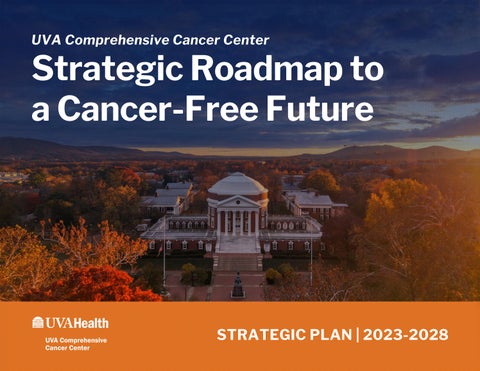
UVA Comprehensive Cancer Center
Strategic Roadmap to a Cancer-Free Future
STRATEGIC PLAN | 2023-2028
CONTENTS Director’s Message
04
Executive Summary
05
Mission Statement
05
Strategic Goals
05
Priorities
06
Scientific Focus Areas
07
Strategic Planning Process
08
Core Values
10
Cross-Cutting Functions and Support
11
Implementation and Oversight
11
Research Programs
12
Strategic Priorities and Objectives Goal I
14
Goal II
16
Goal III
18
Goal IV
20
FROM OUR DIRECTOR For decades the researchers, clinicians, students, staff, and patients of UVA Comprehensive Cancer Center have led discovery to reduce the burden of cancer in our region and beyond. And in 2022, our longstanding efforts were recognized with UVACCC’s designation as an NCI Comprehensive Cancer Center. Comprehensive designation acknowledged momentous investment and growth in UVACCC’s research and programming enterprise. It was, however, a single milestone toward our ultimate goal of a future in which all cancer is prevented or cured. Our Strategic Roadmap to a CancerFree Future plots a trajectory for the next five years. This strategic plan outlines how UVACCC will build on its legacy of transdisciplinary basic and translational research to speed new treatments to the clinic and expand our population science. Our scientific focus will encompass a wide range of fields from immunotherapy and focused ultrasound to precision health and cancer survivorship, as well as computational data analysis aided by artificial intelligence. We will strengthen our community outreach and engagement with a particular emphasis on prevention and screening targeting the cancers that most disproportionately impact our region. We will partner with the community to facilitate bi-directional research to have the most tangible benefit for the roughly 3.2 million people we serve. The past 25 years have seen remarkable advancements in our understanding of cancer and therapies available to treat it. We’re confident this pace of innovation will continue and likely accelerate. We also know that significant questions will remain after we as individuals have left the bench and bedside, so the Roadmap calls for expansion of UVACCC’s substantial training and education programs to enlist the next generation of researchers and set them on a course for even greater discovery. We’re thrilled to share our plan to optimize UVACCC’s growing knowledge and talent to reduce cancer’s impact, and ultimately in pursuit of a future free from fear of this devastating disease. We look forward to continued, collaborative progress over the next five years, and beyond.
Thomas P. Loughran Jr., MD
Director, UVA Comprehensive Cancer Center
EXECUTIVE SUMMARY Since its founding in 1984, UVA Comprehensive Cancer Center (UVACCC) has served as a leader in cancer care and research, earning National Cancer Institute (NCI) Cancer Center designation in 1987 and Comprehensive Cancer Center designation in 2022. Building on this distinguished legacy, the UVACCC has developed a five-year strategic plan (2023–2028) to expand its impact across the Commonwealth of Virginia, the United States, and the global cancer research community.
MISSION STATEMENT The mission of UVACCC is: "To reduce the burden of cancer for patients of today, through skilled, integrated, and compassionate care, and to eliminate the threat of cancer for patients of tomorrow, through research and education."
STRATEGIC GOALS To realize its mission, UVACCC has established the following strategic goals:
GOAL I
GOAL II
Promote discovery across the cancer research continuum
Facilitate impactful transdiciplinary and translational research
GOAL III Advance cancer prevention, control, and survivorship initiatives and catalyze research relevant to the catchment area
GOAL IV Integrate training and education to support and enhance the scientific mission of the UVACCC
Strategic Roadmap to a Cancer-Free Future | 05
PRIORITIES Based on rigorous data analysis, UVACCC has prioritized five cancers that exhibit disproportionately high incidence and/or mortality rates within its catchment area: breast cancer, colorectal cancer, lung cancer, prostate cancer, and melanoma. In addition, the region’s elevated rates of smoking and obesity further emphasize the urgency for targeted intervention, prevention, and education strategies. These cancers and risk factors are also characterized by racial, rural, and Appalachian health disparities.
Prostate
CANCER CENTER STRATEGIC PRIORITIES | DISPARITIES Appalachian/Rural Disparities Colorectal
Obesity
Lung
Melanoma
Tobacco
06 | UVA Comprehensive Cancer Center Strategic Plan
Racial Disparities Colorectal
Breast
Obesity
Prostate
SCIENTIFIC FOCUS AREAS To expand existing strengths and advance emerging areas of inquiry, UVACCC will strategically invest in the following scientific focus areas: 01
Computational Modeling
02
Systems Biology
03
Drug Discovery and Development (including nanotechnology)
04
Immunotherapy
05
Focused Ultrasound
06
Cancer Survivorship
07
Exercise and Metabolism
08
Precision Health
09
Health Disparities
10
Pediatric Cancers
11
Artificial Intelligence
Strategic Roadmap to a Cancer-Free Future | 07
STRATEGIC PLANNING PROCESS Strategic planning has remained a core priority since Dr. Thomas Loughran’s appointment as UVACCC Director in 2013. The initial strategic plan was adopted in 2014, with major revisions occurring in 2019, informed by stakeholder engagement and consultation with an external planning firm. The resulting strategy guided UVACCC through its 2021 CCSG renewal application. In response to its new NCI Comprehensive Cancer Center designation, shifting scientific and public health landscapes, and an infusion of state funding, UVACCC undertook a comprehensive review and update of its strategic plan in 2023. Input was gathered through:
Dina Gould Halme, PhD Associate Director for Research Administration and Strategic Planning “We drew on a wide range of perspectives in the strategic planning process to broaden our scope as a Comprehensive Cancer Center and maximize the benefit of the increased state investment, in order to fully operationalize our mission.”
PART 1
PART 2
PART 3
PART 4
PART 5
CCSG Executive Committee Discussions
Member and Staff Surveys
UVACCC-Wide Retreat
Senior Leadership Meetings
Community Advisory Council (CAC)
Soliciting input from all UVACCC members and staff regarding areas of strategic focus, investment, and support.
Including facilitated breakout sessions for prioritization and feedback.
Monthly meetings to finalize the plan.
Involving Associate Directors, Program Leaders, and key scientific stakeholders.
08 | UVA Comprehensive Cancer Center Strategic Plan
Participated in review sessions to ensure alignment with community needs and values.
CORE VALUES In alignment with UVA Health’s institutional values, UVACCC is committed to:
Accountability
Stewardship
Acknowledging and assuming responsibility for where we have succeeded and failed in terms of our actions, decisions, policies, and results.
Managing our resources and commitment to continual improvement and learning responsibly and carefully while acknowledging shortcomings or problems in our quest.
Professionalism
Integrity
Approaching all that we do in a collaborative way and delivering excellent care through the lens of helpfulness, positivity, kindness, and competency.
Being honest, open, and fair through our behaviors, attitude, and treatment of others.
Respect
Empathy
Valuing everyone through our compassionate and caring ways.
The thoughtful and intentional action of striving to understand what others are feeling.
In addition, UVACCC emphasizes:
Excellence
Collaboration
Innovation
in all aspects of research, education, and care.
across disciplines and sectors to enhance impact.
as a driver of transformational change in cancer prevention, diagnosis, and treatment.
10 | UVA Comprehensive Cancer Center Strategic Plan
CROSS-CUTTING FUNCTIONS AND SUPPORT 01
Community Outreach and Engagement (COE)
02
CANCER RESEARCH TRAINING AND EDUCATION CORE (CRTEC)
03
Research Infrastructure
UVACCC’s COE team provides vital connections to the catchment area through culturally tailored outreach, education, and screening efforts, with sustained community partnerships. CRTEC oversees all education and professional development activities, ensuring a strong pipeline of future cancer researchers and clinicians. Support for research activities is provided by the Shared Resources, the Office for Research Development (ORD), the Partners in Discovery Program (PID), and the Office of Clinical Research (OCR).
04
Administration
05
Clinical Care
The Administration Team provides support for strategic planning. financial management, grants administration, general administration, CCSG program administration, research development, and philanthropy. The members of the team work with UVACCC leadership to foster collaborations and support cancer-focused research through infrastructure, Pilot Research Projects, and faculty recruitment. The Oncology Service Line provides interdisciplinary, patient-centered clinical care.
IMPLEMENTATION AND OVERSIGHT The implementation of this strategic plan (2023–2028) will be led by the UVACCC Director and Associate Directors. Operational oversight will be provided by a combination of standing and ad hoc committees, with administrative and logistical support from the UVACCC Administration Team. Progress will be regularly monitored and evaluated, with adjustments made in response to emerging scientific opportunities, community needs, and external funding landscapes. Strategic Roadmap to a Cancer-Free Future | 11
RESEARCH PROGRAMS UVACCC’s scientific agenda is advanced through four interdisciplinary programs:
Cancer Biology (CBIO)
Molecular Genetics and Epigenetics (GEN)
Focus: Mechanisms of cancer development and therapeutic targeting
Focus: Advancing cancer prevention, early detection, and health equity across diverse populations.
Program Aims: • Aim 1: Interrogate cancer as a complex, adaptive system • Aim 2: Identify and dissect targetable cancer vulnerabilities • Aim 3: Translate cancer vulnerabilities into new therapies and imaging agents
Program Aims: • Aim 1: Decode DNA structural alterations that fuel cancer • Aim 2: Uncover transcriptional and epigenetic drivers of cancer • Aim 3: Define the emerging roles of RNA in cancer progression
12 | UVA Comprehensive Cancer Center Strategic Plan
CANCER THERAPEUTICS (CRX) Focus: Translational research and clinical trials Program Aims: • Aim 1: Define the tumor immune landscape and develop new immunotherapies • Aim 2: Create innovative delivery and imaging strategies • Aim 3: Execute investigator-initiated clinical trials, including those arising from discoveries made in the other programs
CANCER PREVENTION AND POPULATION HEALTH (CPH) Focus: Etiology, prevention, disparities, and outcomes Program Aims: • Aim 1: Elucidate Multilevel Determinants of Cancer Risk, Progression, and Disparities • Aim 2: Advance Cancer Prevention and Early Detection through Community-Engaged Interventions • Aim 3: Optimize Cancer Care and Survivorship Outcomes with Scalable, Data-Driven Interventions
Strategic Roadmap to a Cancer-Free Future | 13
STRATEGIC PRIORITIES AND OBJECTIVES Goal I: Promote Discovery Across the Cancer Research Continuum
STRATEGIC PRIORITY 1.1: BUILD INFRASTRUCTURE TO SUPPORT RESEARCH Objective 1.1.1: Expand Pilot Funding and Infrastructure Develop varied pilot project opportunities: Programs, TRTs, Multi-component awards, Collaborative projects, Targeted pilots Expand Partners in Discovery Initiative: Build a 15,000-patient cohort with biospecimens and clinical/genomic data access Establish Colon Neoplasia Screening and Etiology Study (CNSES) Expand Genomic Resources: Hire Director of Computational Genomics Grow Avatar Program (ORIEN) Increase accessibility of clinical, specimen, and genomic data Build interface for direct investigator engagement with data (Manifold)
Objective 1.1.2: Enhance Shared Resources and Core Services Partner with SOM to expand instrumentation and technology Develop new Shared Resources: Spatial-omics Core Drug Discovery Concierge Service Data Sciences Shared Resource Shared Resources AMF, BAF, BTRF, FCC
14 | UVA Comprehensive Cancer Center Strategic Plan
Chongzhi Zang, PhD Director of Computational Genomics “The volume of data available to cancer researchers continues to grow rapidly. This requires more sophisticated tools to analyze it reliably and efficiently. We are increasingly leveraging artificial intelligence in analysis of genomics and other omics data, and also to integrate them with clinical data across platforms in a manner accessible to researchers across disciplines.”
Objective 1.1.3: Collaborate with Centers Engage with key research centers: Center for Behavioral Health and Technology (CBHT) Community Cancer Control and Obesity Research Center (CORC) Center for Nicotine and Tobacco Research (CeNTR) Focused Ultrasound Immuno-Oncology (FUSION) Center
STRATEGIC PRIORITY 1.2: EXPAND AND BROADEN MEMBERSHIP Objective 1.2.1: Recruit Talent Across Key Areas
Jay W. Fox, PhD Associate Director for Shared Resources “The Cancer Center’s shared resources ensure that our research is supported with the latest expertise, services, and instrumentation, with constant evolution and responsiveness to member needs. Our current priorities include spatial omics technology, expanded Drug Discovery services, and data analysis, specifically increased support for artificial intelligence, machine learning, and large language model applications in cancer research.”
Objective 1.2.2: Identify and Engage Cancer-Relevant UVA Researchers Draw new members from existing UVA faculty Expand pilot project eligibility to nonMembers
Emerging and priority areas for recruitment: Computational Modeling Systems Biology Drug Discovery and Development (including nanotechnology) Immunotherapy Focused Ultrasound Cancer Survivorship Exercise and Metabolism Precision Health Health Disparities Pediatric Cancers Artificial Intelligence in Cancer Research
Roger Abounader, MD, PhD Associate Director for Basic Science “Our already robust basic science work is expanding to emphasize, among other areas, systems biology approaches that investigate the impact of the gut biome on risk and outcomes for various types of cancer, and the dynamics between organelles within individual cells. The findings have tremendous potential to identify new treatment targets in several cancers.”
Strategic Roadmap to a Cancer-Free Future | 15
Goal II: Facilitate Impactful Transdisciplinary and Translational Research
STRATEGIC PRIORITY 2.1: CULTIVATE STRATEGIC PARTNERSHIPS ACROSS UVA Objective 2.1.1: Collaborate with School of Data Science Engage SDS leadership and faculty Involve GEN members in SDS faculty hiring
Objective 2.1.2: Engage in Major Institutional Initiatives Precision Health for Populations Grand Challenge Manning Institute of Biotechnology
Robert Dreicer, MD, MS, MACP, FASCO Deputy Director and Associate Director for Clinical Research “Building on our strength in translational research, we’re working to further boost transdisciplinary science by increasing support for multi-PI projects from proposal development and pilot funding to commercialization. We also plan to grow UVACCC’s Translational Research Teams, putting faculty from varied disciplines in the same room to target specific types of cancer.”
STRATEGIC PRIORITY 2.2: BUILD INFRASTRUCTURE FOR TRANSDISCIPLINARY AND TRANSLATIONAL RESEARCH Objective 2.2.1: Expand Office of Research Development Develop support for multi-PI and transdisciplinary proposals Provide proposal development funding
Objective 2.2.2: Strengthen Translational Research Teams (TRTs) Annual pilot/infrastructure funding Evaluate and share best practices Establish new disease/organ-based TRTs Recruit faculty to support TRTs
16 | UVA Comprehensive Cancer Center Strategic Plan
STRATEGIC PRIORITY 2.3: ACCELERATE TRANSLATIONAL PIPELINE Objective 2.3.1: Support Innovation and Commercialization Launch Accelerating Innovation Fund
Objective 2.3.2: Expand Investigator-Initiated Trials Develop philanthropic support Expand Protocol Development Team Recruit faculty for IIT leadership
Objective 2.3.3: Build Therapeutic Development Infrastructure Create robust Drug Discovery initiative Rebuild and support nanotechnology programs (nanoSTAR)
Linda Duska, MD, MPH Associate Dean for Clinical Research, UVA School of Medicine, UVACCC Cancer Therapeutics Program “Investigator-Initiated clinical research has particular promise for improving patient outcomes by addressing therapeutic needs and establishing new standards of care. Therefore, we’re supporting expanded investigator-initiated trials through faculty recruitment, pursuit of philanthropic support, and growth of our Protocol Development Team.”
Strategic Roadmap to a Cancer-Free Future | 17
Goal III: Advance Cancer Prevention, Control, and Survivorship Initiatives and Catalyze Research Relevant to the Catchment Area
STRATEGIC PRIORITY 3.1: UNDERSTAND AND COMMUNICATE CATCHMENT AREA NEEDS Objective 3.1.1: Monitor Cancer Burden and Disparities Update data (incidence, mortality, SDOH) and share with partners Conduct needs assessments and listening sessions
Objective 3.1.2: Disseminate Cancer Data and Priorities Develop internal/external data mechanisms Create community profiles
STRATEGIC PRIORITY 3.2: FOSTER CATCHMENT-ALIGNED RESEARCH Objective 3.2.1: Develop Processes to Increase Research Addressing Catchment Area Needs Engage STARS Liaisons, share CAC recommendations Offer pilot funding Cosponsor symposiums
Objective 3.2.3: Engage Catchment Populations as Participants in Basic, Clinical, and Population Research Engagement events to promote knowledge building around clinical trial participation Facilitate clinical research participation through addressing individual barriers 18 | UVA Comprehensive Cancer Center Strategic Plan
Roger Anderson, PhD Associate Director for Population Sciences “The continued growth and success of our population science program depend on our ability to recruit study participants from across the Cancer Center catchment area and beyond, especially those from communities facing elevated cancer risks. By attracting leading researchers to UVA who advance cancer prevention, screening, and survivorship, we are able to strengthen our research and make a meaningful difference in the lives of the people we serve.”
Objective 3.2.2: Build Research Capacity with Communities Launch Community Engaged Research Guide Offer training for researchers and trainees Engage vulnerable populations in research and trials
Strategic Priority 3.3: Implement and disseminate evidence-based interventions and policies to reduce cancer burden and increase health equity Objective 3.3.1: Enhance Screening and Navigation Programs
Wendy Cohn, MEd, PhD Associate Director for Community Outreach and Engagement “Increasing awareness and early detection through screening is a central goal of our community outreach and engagement efforts. We plan to leverage collaboration with the state’s Federally Qualified Health Centers to boost screening, and to engage communities directly to foster awareness of cancers that affect them disproportionately.”
Establish Statewide FQHC Collaborative Launch targeted screening initiatives
Objective 3.3.2: Deliver Community-Focused Education Prevention, early detection, survivorship education Integrate clinical and research community efforts
Objective 3.3.3: Address Policy and Systemic Barriers Guide local/state cancer control policies Support institutions in creating health-related policies
Objective 3.3.4: Translate Research to Practice Pilot implementation of research-developed interventions in clinics
Strategic Roadmap to a Cancer-Free Future | 19
Goal IV: Integrate Training and Education to Support and Advance the UVACCC Mission
STRATEGIC PRIORITY 4.1: DELIVER IMPACTFUL TRAINING ACROSS THE PIPELINE Objective 4.1.1: Strengthen Programs by Career Stage K-12: Discover Medicine, science festivals Undergraduate: Research portal, mentoring, lab experience Postbac: Apply for and implement program Graduate/Medical Students: Fellowships, grant workshops, community presentations Postdocs/Clinical Fellows: Symposiums, mentoring, career development workshops Junior Faculty: Mentorship teams, grant workshops, clinical research exposure Health Professionals: CME partnerships, ECHO projects, and outreach
Lucy Pemberton, PhD Associate Director for Education and Training “We’re setting up UVA students and early-career researchers for success by emphasizing mentorship and lab experience, while expanding opportunities like fellowships, workshops, and exposure to clinical research. Beyond the University, we’re introducing school-age students to the possibilities of a career in biomedical research, while working to offer continuing education, and to share best practices across the catchment area.”
STRATEGIC PRIORITY 4.2: PROMOTE INTERDICIPLINARY INTEGRATION Objective 4.2.1: Facilitate Cross-Program Trainee Interaction Journal clubs, seminars, tumor boards, retreats Partner with Shared Resources for skill-building courses Include trainees in Community Advisory Council and community programs Broaden participation in conferences and public events
20 | UVA Comprehensive Cancer Center Strategic Plan
STRATEGIC PRIORITY 4.3: BROADEN PARTICIPATION Objective 4.3.1: Expand Partnerships with Under-Resourced Institutions STRIVE faculty partnerships Online teaching collaborations Summer internships and Biomedical Research Exploration Weekend events
STRATEGIC PRIORITY 4.4: EFFECTIVELY COORDINATE TRAINING ACTIVITIES Objective 4.4.1: Strengthen CRTEC Coordination Form Education Oversight Committee (EOC) Monitor outcomes and align offerings to trainee needs Develop working subgroups for targeted areas
Strategic Roadmap to a Cancer-Free Future | 21
Strategic Plan 2023-2028 | Version 2026.06