College women dominate game day buttons
Volume 149, Issue 10
UT fires Lady Vols soccer head coach Page 10
Page 6
Wednesday, November 4, 2026
@utkdailybeacon
Tennessee elects first female governor
Tim Burchett retains US House seat
LOGAN WEST Staff Writer
CHAPMAN WORD Contributor
From yellow roses on lawmakers’ lapels, to suffragettes marching in the streets, Tennessee has a rich history of female political involvement. Now, for the first time in Tennessee history, a woman holds the state’s highest executive office. Tennessee elected Marsha Blackburn to the governor’s office Tuesday. The election of a female governor is a historic full-circle moment for Tennessee, which became the 36th and final state to ratify the 19th Amendment, giving women the right to vote, in 1920.
Incumbent Republican Rep. Tim Burchett defeated democratic challenger Michaela Barnett in the race for Tennessee’s 2nd Congressional District U.S. House seat Tuesday night. The district stretches from the state’s border with Virginia in the north down through Knoxville and Maryville to the North Carolina border. It is flanked by the 1st Congressional District to the east, the 6th to the northwest and the 3rd to the southeast. As of a 2024 census, the district hosted a population of nearly 814,000 people. Tim Burchett is a University of Tennessee alumnus and served as a member of the school’s chapter of the Sigma Chi fraternity. He has been the incumbent in the 2nd District since his election in 2018. Before becoming a member of congress, he served as Knox County Mayor. Burchett won a majority of the votes over his democratic opponent, with over one million voters selecting him for reelection. Winning the race does not guarantee Burchett is the representative for the 2nd Congressional District when the 120th Congress begins its session in January. He is reportedly on the shortlist for replacing current senator and governor-elect Marsha Blackburn as she takes on the role of governor. The governor of Tennessee is empowered to fill empty Senate seats, but if Burchett is not selected to take the seat, Burchett’s campaign manager Thomas McAfee said that Burchett will “absolutely” be running for the seat in 2028. Holding the distinction of being the longest held district held by a single party, the 2nd District saw Horace Maynard elected as a republican in 1867, and the district has remained in republican hands ever since.
One last state In May 1919, the 19th Amendment passed in the federal government, but before the constitution could be altered, the amendment required ratification from at least three-fourths of the country’s states. Over the next year, the women’s suffrage movement won 35 states. The amendment only required one more, but activists feared too few remained. Megan Birk, American history professor at the vUniversity of Tennessee, spoke about the anxiety plaguing the suffragists during this time. “They were running out of states, and a slew of states right in front of Tennessee voted no,” Birk said. “It really ramped up the pressure on the campaign in Tennessee. In 1919, Tennessee had given women limited suffrage, so there were certain types of elections that women in Tennessee were allowed to participate in. Women’s suffragists had reason to hope that Tennessee would be a yes, but it was such a high intensity campaign here.” Tennessee governor at the time, A.H. Roberts, called the legislature for a special session to vote on the amendment.
Continued on Page 2
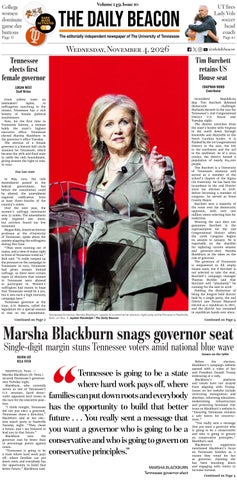
Tennessee Governor, Marsha Blackburn, speaks to a crowd at her election night party at the Pinnacle in Nashville, Tenn. on Nov. 3. Jayden Randolph / The Daily Beacon
Continued on Page 4
Marsha Blackburn snags governor seat
Single-digit margin stuns Tennessee voters amid national blue wave Issues on the table
OLIVIA LEE KELA FIFER NASHVILLE, Tenn. — Marsha Blackburn (R-Tenn.) secured Tennessee’s governor seat Tuesday night. Blackburn, who currently serves as one of Tennessee’s U.S. senators, faced democratic opponent Jerri Green in the race for the executive position. “I think tonight, Tennessee did not just elect a governor, Tennessee chose a direction,” Blackburn said at her election watch party in Nashville Tuesday night. “They chose a future, and I am honored to lead you in that future.” Blackburn won the governor seat by fewer than 10 percentage points against Green. “Tennessee is going to be a state where hard work pays off, where families can put down roots and everybody has the opportunity to build that better future,” Blackburn said.
Tennessee is going to be a state where hard work pays off, where families can put down roots and everybody has the opportunity to build that better future . . . You really sent a message that you want a governor who is going to be a conservative and who is going to govern on conservative principles.” MARSHA BLACKBURN Tennessee governor-elect
Before the election, Blackburn’s campaign website opened with a video of her and President Donald Trump embracing at a rally. Blackburn’s platform and issues have not strayed from aligning with Trump. Issues on her website include restricting immigration and abortion, reforming education, modernizing infrastructure and protecting farmland. One issue on Blackburn’s website is “Ensuring Tennessee remains a safe haven for conservatives.” “You really sent a message that you want a governor who is going to be a conservative and who is going to govern on conservative principles,” Blackburn said. Blackburn’s supporters mentioned Blackburn’s focus on Tennessee families as a reason they voted for her as governor, claiming she has been knocking doors and engaging with voters to increase turnout.
Continued on Page 4
News
Page 2
The Daily Beacon
@utkdailybeacon | November 4, 2026 | www.utdailybeacon.com
Letter from the News Editor: To vote is to care OLIVIA LEE News Editor Growing up, I thought all adults voted. Getting Election Day off of school every two years painted a picture in my mind: hundreds of millions of adults across the country taking time out of their day to visit their nearest polling center and vote. I admit, I had a skewed perspective. Both of my parents always voted, so I assumed everyone did. You can imagine my surprise when in 2020, at age 13, I learned only 66% of adults voted in the presidential election, and they were calling it the highest turnout in a century. Worse, voter turnout that year proved to be the lowest among adults ages 18–24 at just over 51%. Now, at age 19, I am voting in my first general election, and the thought of merely half of my peers exercising their right to vote is unsettling. And it is probably fewer than half, with midterm election years traditionally seeing lower turnout than presidential election years. Voter turnout clocked in at 49% in the 2018 election and 46% in 2022. I hear lots of reasons from my peers for why they are not voting this year. Many
feel uneducated, others feel unmotivated and some feel unimportant. But these reasons do not provide comfort. Many claim they do not know how to vote, and if they do know how to vote, they do not know who to vote for. Luckily, there are several easily accessible resources to build that knowledge, including government websites, advocacy group information and candidates’ own websites. It is interesting. I know people who cannot figure out how to vote for elected officials, but they know how to vote for their favorite “Dancing With The Stars” couple every Tuesday night. They do not know how to research candidates to represent their everyday needs, but they know how to research players to score points for their fantasy football team. Some see voting as too political, or too divisive. It is political, and it does involve choosing a side. But voting has existed since the birth of the U.S., and it is a right exercised by all parties. It is what upholds America’s “by the people” principle. To vote is nonpartisan. Some people are just burnt out, and I get it. As someone who works in news, I understand the toll that several absurd headlines a day can have on a young person just
beginning to enter the world. It is overwhelming to worry about finding a place to live when the number of young adults living at home has jumped 12% since 2019, up to 49%, to worry about affording gas when gas prices are sitting at a national average of over $4 per gallon and to worry about finding a job when the national unemployment rate is 4.2%. But all of those large issues, plus the occasional pothole and broken streetlight, are the case for voting. Especially in midterm elections, voting can impact problems occurring close to home. Voting is what you can do to advocate for the problems you want fixed. To vote is to engage. Perhaps the worst reason of all is the age-old excuse that a single vote cannot possibly be that important. Contributing one vote to the millions that are counted each year can feel pointless or indifferent, especially in a government system that confuses and overwhelms young people. There is a story by the late philosopher Loren Eiseley in which a man walking along a beach sees a girl throwing starfish into the ocean to save them from drying out and dying. The man looks at the girl and tells her that her efforts are pointless. Throwing
News Editor Olivia Lee of The Daily Beacon advocates for student voting. Jayden Randolph / The Daily Beacon
dozens of starfish into the water will not make a sizable difference considering the thousands of starfish stranded across the miles-long beach. The girl picks up another starfish, throws it to the ocean, and says, “It made a difference for that one.”
The story has been adapted over time, but the sentiment holds true: one individual can make an impact, even if it is small. So can one vote. Don’t waste yours, let it make an impact. To vote is to care.
First female governor | cont. from Page 1
Democratic candidate Jerri Green speaks to supporters after losing the governor race to Republican Marsha Blackburn in Chattanooga on Tuesday night. Meredith Lambert / The Daily Beacon
Wanda Sobieski, president of the Suffrage Coalition, explained the potential motives behind anti-suffrage groups. “The lobbyists opposing it were very well funded,” Sobieski said. “They were typically manufacturers who were afraid that if women got the right to vote, they’d outlaw child labor and liquor industry because so many of the women had been involved also in the temperance movement because women could not escape from a drunken husband.” Birk also shared that many anti-suffragists feared that female voters would share the exact same viewpoints toward sociopolitical issues. “They accused women that somehow we were all going to vote the same direction,” she said. “That wasn’t the case in 1920, and it hasn’t been the case now.” The Tennessee Senate passed the amendment by a wide margin of 25–4, but tensions rose as the amendment made its way to the state House of Representatives. The War of the Roses Division plagued the legislature. Leading up to the vote, Tennessee congressmen wore colored roses on their lapels to signify their stance on suffrage. The women’s suffrage movement adopted the yellow
rose as their icon, and the anti-suffrage movement, in an effort to oppose, selected the American red rose. “As the legislators came back for a special session, they’d meet the trains and pin their people with a rose depending on what they promised to vote for,” Sobieski said. “Some of them carried two roses, one in their pocket and one on their lapel, and they would change it as they saw people coming down the street to avoid the conflict. Nobody was neutral on this vote.” On the day of the House vote, women sat in the balcony of the legislative chamber to count the roses adorning the lawmakers’ suits. The red and yellow flowers revealed a tie, meaning suffrage would fail. “Some of the people who were there reported that they could even hear audible sobbing from the balcony before the session began,” Sobieski said. It soon came time for a vote. As they called the names of the representatives, each one voted in accordance with the hue of their rose, except for one man. Rep. Harry T. Burn wore a red rose into the session that day. After receiving a letter from his mother urging him to reconsider his stance, Burn changed his vote in favor of suffrage. Tennessee became the 36th and final state necessary to
ratify the 19th Amendment. This figurative floral fight gave millions of women the right to vote and paved the way for women to hold political offices. A century later During the primary races, Sen. Marsha Blackburn (R-Tenn.) received the republican nomination and Memphis Councilwoman Jerri Green received the democratic nomination, making this Tennessee’s first all-female governor race. “It’s good to see Tennessee jumping over to the majority there in terms of women in that executive leadership position,” Birk said. “I think it’s good to see both major parties have female representation. It means that progress is being made.” After months of campaigning, Blackburn came out on top. The state of Tennessee proved fruitful with the state’s first female governor. “I think it’s an amazingly wonderful thing,” Sobieski said. “To think that we’ve gone all this time without ever having a female governor, it’s a little sad. On the other hand, I think it shows some progress that our people have become more understanding that women can do important things and do them well.”
It’s good to see Tennessee jumping over to the majority there in terms of women in that executive leadership position. I think it’s good to see both major parties have female representation. It means that progress is being made.” Newly elected Tennessee Governor, Marsha Blackburn, celebrates her election at the Pinnacle in Nashville, Tenn. on Tuesday night. Jayden Randolph / The Daily Beacon
MEGAN BIRK American history professor at the University of Tennessee
The Daily Beacon
@utkdailybeacon | November 4, 2026 | www.utdailybeacon.com
Page 3
Tennessee votes yes to prohibiting property tax LOGAN WEST Staff Writer Tennesseans passed the second proposed amendment on the ballot that will remove the state legislature’s ability to establish a statewide property tax in Tuesday’s election. Tennessee is one of the only states in the U.S. without a state property tax. The 76th Tennessee General Assembly repealed the state property tax in 1949. Now, property taxes are levied entirely by local governments in the state. Lawmakers wished to strengthen the language of the constitution to further restrict the ability of future legislatures to impose a state property tax. The proposal will amend the language of the constitution to read, “all property real, personal, or mixed shall be subject to taxation, but the Legislature shall not levy, authorize, or otherwise permit any state tax upon such property.” Bill Lyons, associate director for community outreach for the Institute of American Civics, explained that a vote in either direction for Amendment 2 would not have imposed a property tax or taken away one, but rather placed a limit on the legislature’s abilities. “It’s a little more than just voting no on the property tax,” Lyons said. “It’s voting no on the General Assembly’s ability to institute one. What it does is takes it out of the hands of the General Assembly.” The Tennessee Constitution is among the most difficult
to amend in the country. A proposed amendment must pass through a two-step approval process through the General Assembly, followed by a statewide general election vote, where the amendment must receive a majority of the votes cast in the election. “In simple terms, if you don’t vote, it counts as a no,” Lyons said. Many have speculated that the proposed amendment is more about the legislature signaling their commitment to limited taxation. “It may be to send a message to the electorate about how this general assembly is firmly anti-raising taxes of any kind,” Lyons said, “that Tennessee overall is committed to minimal taxation.” Since 2020, Tennessee has gained over 200,000 new residents from domestic migration, or new residents from inside the U.S. The state has become increasingly attractive to those looking to relocate due to the lack of income tax and statewide property tax. This surge of domestic migration has created obstacles for young, first-time home buyers. The newfound competitive nature of the state’s real estate market has increased frustrations between long-time Tennesseans and new residents. Jack Vineyard, sophomore finance major and licensed realtor with Vineyard Realty, said the solidification of this amendment could increase the Volunteer State’s allure for
out-of-state home buyers. “People come in from California, Florida, New York, Chicago, sell their house there, and they come here with infinitely more buying power than someone straight out of college would have,” Vineyard said. “Passing this amendment would potentially make Tennessee even more attractive to those types of buyers.” Ultimately, the amendment is expanding on constitutional language rather than forcing the institution or removal of a state property tax. “It’s not that there’s been any particular movement to institute state property tax,” Lyons said. “This really hasn’t been an issue. It’s more of a hypothetical.” Vineyard shared a similar sentiment. “I would say, overall, it won’t change much, if anything,” Vineyard said.
Downtown Knoxville stands from the corner of Clinch Avenue and 14th Street. Jayden Randolph/ The Daily Beacon
It may be to send a message to the electorate about how this general assembly is firmly anti-raising taxes of any kind, that Tennessee overall is committed to minimal taxation.” BILL LYONS Associate director for community outreach for the Institute of American Civics
Approved judicial reforms limit bail, protect victims’ rights OLIVIA LEE News Editor
Attorneys Josh Hedrick and Cullen Wojcik enter the Knox County Courthouse on Tuesday morning. Trevor Jolley / The Daily Beacon
Attorneys carry case files as they enter the Knox County Courthouse on Tuesday morning. Trevor Jolley / The Daily Beacon
Tennessee voters gave the green light to two constitutional amendments concerned with reforming judicial processes Tuesday night. Amendments 1 and 3 counted as two of the three constitutional amendments up for election this year, with Tennesseans’ general vote being the final step for their approval after being passed by members of the Tennessee General Assembly. Amendment 1 allows Tennessee courts to hold defendants without the option for bail if they are accused of a crime requiring them to serve 85% of their sentence before being eligible for parole or early release. This includes severe crimes like second degree murder, aggravated rape or acts of terrorism. Courts will be required to provide on-the-record reasoning for or against granting bail in these cases. Proponents of the amendment, including Sen. Jack Johnson, cite Tennessee as a state violent enough to demand bail limits for severe, violent crimes. When the amendment passed in the Tennessee Senate during a March 2025 legislative session, Johnson said the bill provides equity between defendants who
can and cannot afford bail for different levels of crime. “Currently dangerous criminals with financial resources can buy their way out of jail, while indigent defendants accused of lesser crimes remain detained simply because they cannot afford bail,” Johnson said. Those against the amendment worry the language is too vague and threatens the right that defendants are innocent until proven guilty. “The ability to access bail is one of the fundamental rights that we give citizens in this state, because of the understanding you are innocent until proven guilty,” Sen. London Lamar said. Amendment 3 amends the constitution by “clarifying existing rights for crime victims and adding new rights,” the amendment’s language said. The new rights include fair treatment, information and participation in the parole process, safety measures and information about convicted criminals’ sentences and release dates. The amendment cites Marsy’s Law as its foundation, an initiative born out of California focused on protecting victims of crime. “At its core, Marsy’s Law is about protecting victims and ensuring their voices are heard. But it’s also about something bigger: creating a justice system that helps prevent future harm by empowering those most affected,” Rep. Elaine Davis said in a Knox News opinion piece. “When victims understand their rights are protected, they are more likely to speak up, stay engaged and help bring offenders to justice. That kind of participation strengthens accountability, builds trust in the system and can help prevent future crimes.” Some legislators expressed concern over the amendment’s effect on defendants’ rights, again citing the right to remain innocent until proven guilty in a trial. Others argued the rights should be written in the Tennessee code rather than the state constitution. In 2024, National Association of Criminal Defense Lawyers authors Ráchael A. Powers and Jacquelyn Burckley wrote a report in opposition to Marsy’s Law from a legal perspective. “Marsy’s Law improperly seeks to give equal weight to victims’ and defendants’ rights,” the report said. “Marsy’s Law violates defendants’ due process rights, increases the potential for wrongful convictions, and undermines the principles of the U.S. legal system.”
Page 4
The Daily Beacon
@utkdailybeacon | November 4, 2026 | www.utdailybeacon.com
Tennessee US House seats remain red despite flips across country
Election outcomes in a redistricted Tennessee
1st Congressional District
4th Congressional District*
7th Congressional District*
Diana Harshbarger (R) Kristi Burke (D)
Scott DesJarlais (R) Victoria Broderick (D)
Matt Van Epps (R) Darden Copeland (D)
5th Congressional District
8th Congressional District
Charlie Hatcher (R) Chaz Molder (D)
David Kustoff (R) Heidi Kuhn (D)
6th Congressional District
9th Congressional District*
Johnny Garrett (R)
Brent Taylor (R) Justin Pearson (D)
2nd Congressional District
*Disclaimer At the time of publication, these were the Tennessee Secretary of State’s final unofficial results, and not yet called by the Associated Press.
Tim Burchett (R) Michaela Barnett (D)
3rd Congressional District Chuck Fleischmann (R) Anna Golladay (D)
US House | cont. from Page 1 “The unusual continuity of Republican representation in Tennessee’s 2nd Congressional District has its roots in the Civil War. East Tennessee was politically different and distinct from Middle or West Tennessee and certainly even more different from the broader South during this period,” Warren Dockter, president of the East Tennessee Historical Society, said. The region continued to be pro-Union over the course of the war. “Most famously, you can see this sense of politics reflected in the career of Andrew Johnson, who continued to serve in the U.S. Senate as a democrat from East Tennessee during the Civil War — and was the only southern
senator to do so,” Luke Harlow, associate professor of American History said. This is the situation that Democratic Party nominee Barnett entered into when she announced her candidacy for the seat. “When I stepped up to run this race, I knew what the numbers looked like, and I knew how steep this climb would be. But I did it because our neighbors are hurting and struggling, and I think that they deserve someone who’s going to go to Washington to fight for them,” Barnett said. Burchett’s campaign team did not respond to request for comment.
Correction Due to an editing error, a story on page 3 on Oct. 28 misstated the reporter of the “UT Press releases first children’s book” story. It is Cassidy Gaspard, not Zoe Mandel.
Mike Croley (D)
Blackburn snags | cont. from Page 1 “Marsha Blackburn, in my opinion, has been a true fighter for Tennessean families. She has said time and time again during this campaign that is boots on the ground, knocking doors, meeting with everyday Tennesseans,” Paris Vinnett, press secretary for the Tennessee House Republican Caucus, said. “She’s been shaking hands. She’s been getting to know people across the state, sitting at kitchen tables.” Shrinking margin raises questions Tennessee’s current Gov. Bill Lee won the governor seatby over 59% in 2018. Before Lee, former Knoxville Mayor Bill Haslam won the governor seat in 2010by 65%. Blackburn’s strikingly low margin this year is a number that has Tennesseans questioning the state’s historical loyalty to republican officials.
Green acknowledged the shrinking margin at her watch party in Chattanooga Tuesday night. “This was just one battle for the future of our state, and it was not the end of the fight,” Green said. Attendees at the party shared Green’s sense of hope, claiming the results represented a shift in what Tennesseans want to see from elected officials. “I just was really honestly looking for a place to be surrounded by people who share the same ideologies as me,” Riley Rawdon, student at the University of Tennessee, Chattanooga, said. “And to be in a room where I can be hopeful about the future for Tennessee, and to celebrate that.” Blackburn stressed Tennessee’s continued embrace of republican values. “Together, we will show America what Tennessee can
be and what it will become,” Blackburn said. Blackburn vacates Senate seat Blackburn’s transition to governor of Tennessee will leave her current U.S. Senate seat vacant. In Tennessee, the governor is entitled to fill vacant Senate seats, and it is expected that Blackburn will remain in her senate seat until she is sworn in as governor in January, allowing her to choose who takes on her role. Political analysts have thrown out several names expected to be on the shortlist for Blackburn’s Senate seat, including Secretary of Defense Pete Hegseth, Knox County Mayor Glenn Jacobs and Rep. Tim Burchett, who retained his 2nd Congressional District seat Tuesday night.
Hagerty holds Senate seat, defeats Bradshaw PATRICK BUSCH Editor-in-Chief Sen. Bill Hagerty won his election to serve his second consecutive term as the junior U.S. Senator from Tennessee. Hagerty had the incumbency advantage after serving in office since Jan. 3, 2021. He defeated democratic nominee Marquita Bradshaw, whose campaign marked her second run for one of Tennessee’s U.S. Senate seats. The election represented a sharp ideological contrast between the democratic and republican parties’ current offerings. Hagerty continued his platform of Trump-aligned conservatism, emphasizing tax cuts, deregulation and border security. Dylan Vintrov, a senior studying public affairs, spent last summer interning in Sen. Hagerty’s district office. “Some of the major priorities I observed involved economic and rural development, manufacturing, job creation and addressing constituent concerns with federal agencies,” Vintrov said. “During visits to manufacturing facilities, I saw how issues such as workforce availability, federal regulations and opportunities for business expansion could affect Tennessee companies.” Bradshaw ran on a progressive platform focused on tackling challenges in affordable housing, equity in the economy and healthcare. Vintrov believes that many of Hagerty’s policy priorities affect students, particularly as they graduate. “His emphasis on attracting business investment and supporting Tennessee industries could create opportunities for graduates,
especially in fields such as engineering, manufacturing and technology,” Vintrov said. “I think connecting economic development initiatives more directly to the challenges facing younger Tennesseans would be an important part of representing college students.” Vintrov hopes to see Hagerty maintain his relationship with and focus on Tennesseans. “Based on my internship experience, I would also hope that he maintains a strong relationship with Tennessee communities by continuing to visit businesses, meet with local leaders and listen to constituent concerns,” Vintrov said. “I think another important expectation would be ensuring that Tennessee remains competitive in emerging industries, including advanced manufacturing, energy and technology.” Hagerty recently spoke on UT’s campus as the keynote speaker at the Baker School of Public Policy and Public Affairs’ 2026 Southeast Energy Policy Forum. Alvin Bishop, a junior public affairs major, attended the forum and saw Hagerty speak. “Hagerty’s remarks at the Energy Policy Forum focused on the intersection of America’s energy policy with other policy areas, including national security, AI regulation, industrial policy and scientific innovation,” Bishop said. “What stood out most to me was that he examined all of these topics through a state perspective rather than a national one.” Bishop also spoke with optimism about Hagerty’s next term. “Hagerty’s reelection would give Tennessee an experienced, adept representative in Washington who knows how to leverage national influence to
His emphasis on attracting business investment and supporting Tennessee industries could create opportunities for graduates, especially in fields such as engineering, manufacturing and technology. I think connecting economic development initiatives more directly to the challenges facing younger Tennesseans would be an important part of representing college students.” DYLAN VINTROV Senior public affairs major achieve state level objectives,” Bishop said. “Speaking from campaign experience, Hagerty is much more beloved by this state’s population than his fortune cookie-crumbling counterpart in the Senate.” Sen. Marsha Blackburn’s victory in the gubernatorial race, becoming the first woman to hold the governorship, represents an impending change to Tennessee’s senators. Blackburn will vacate her seat, although the timing of resignation isn’t clear. Blackburn wll likely wait until closer to her inauguration to resign from the Senate, giving her the ability to appoint her own successor, who will serve until the next regular November election in 2028. Hagerty will become the senior U.S. Senator from Tennessee.
The United States Capitol stands in Washington D.C. File / The Daily Beacon
The Daily Beacon
DAILY BEACON STAFF AND POLICY INFORMATION
EDITORIAL EDITOR-IN-CHIEF: Patrick Busch MANAGING EDITOR: Lauren Holladay COPY CHIEF: Margaret White NEWS EDITOR: Olivia Lee ASSISTANT NEWS EDITOR: Tessa Nacke ARTS & CULTURE EDITOR: Harper Brabson SPORTS EDITOR: Trevor McGee ASSISTANT SPORTS EDITOR: Alex Sarkis OPINIONS EDITOR: Natalie Dripchak PHOTO EDITOR: Jayden Randolph DESIGN EDITOR: Maya Williams DIGITAL EDITOR: Trip Scoutten SOCIAL MEDIA EDITOR: Sarah Portanka AUDIENCE DEVELOPMENT EDITOR: Grace
White
EDITOR EMERITUS: Caden Dyer COVER DESIGN: Maya Williams PAGE DESIGNERS: Delaney Karr, Kiersten
Collins, Amelie Carrillo, Shelby Perdue GRAPHICS BY: Maya Williams, Shelby Perdue, Delaney Karr, Hayden Sauer
ADVERTISING/PRODUCTION TO PLACE AN AD, please email admanager@utk.edu.
CONTACTS TO REPORT A NEWS ITEM OR SUBMIT A PRESS RELEASE, please email editorinchief@utdailybeacon.com or call (865) 974-2348
@utkdailybeacon | November 4, 2026 | www.utdailybeacon.com
Student campaigners boost civic engagement REAGAN MURPHY Contributor This year, students at the University of Tennessee have gone beyond the ballot box to find ways to civically engage with the political landscape around them. Many have found a source of comfort in working on political campaigns, aiding candidates in their run or assisting during their time in office through acts like press management, legislative assistance, phone banking and canvassing doors. Accessibility of communication through canvassing and phone banking has only become easier with increased access to radio and television sets, but before then, word of mouth and paper literature served as the primary ways to share candidates’ views. A common way campaigns adapted to this included canvassing, which includes going door to door to discuss a particular candidate’s beliefs on an issue, talking with voters
involved, as his past experience working within the political sphere came by interning with a Knoxville judge. The United States remains statistically lower in voter turnout and engagement compared to other countries around the world, measuring at 60% turnout compared to an average of 80-90% in countries like Chile and Australia. Volunteers who canvas help to not only spread the personal views of their candidate, but also serve as a resource for helping others register to vote, answering questions about the nearest polling locations or sharing information about when Election Day is each year. Blackburn said his first time door knocking was nerve wracking, as it is very similar to cold calling someone to talk about a very controversial topic, and the result isn’t always positive. Over time, he found himself gaining confidence as he started having conversations with neighbors who disagreed, keeping an open mind on their opinions as he shared his.
LETTERS POLICY: Letters to the Editor must be exclusive to The Daily Beacon and cannot have been submitted to or published by other media. Letters should not exceed 400 words and can be edited or shortened for space. Letters can also be edited for grammar and typographical errors, and Letters that contain excessive grammatical errors can be rejected for this reason. Anonymous letters will generally not be published. Authors should include their full name, mailing address, city of residence, phone number and e-mail address for verification purposes. Letters submitted without this information will not be published. The preferred method to submit a letter to the editor is to email the editor-in-chief. CORRECTIONS POLICY: It is the Daily Beacon’s policy to quickly correct any factual errors and clarify any potentially misleading information. Errors brought to our attention by readers or staff members will be corrected and printed on page two of our publication. To report an error please send as much information as possible about where and when the error occurred to editorinchief@ utdailybeacon.com, or call our newsroom at (865) 974-5206. The Daily Beacon is published by students at The University of Tennessee on Wednesday during the fall and spring semesters. The offices are located at 1345 Circle Park Drive, 11 Communications Building, Knoxville, TN 37996-0314. The newspaper is free on campus and is available via mail subscription for $200/year or $100/semester. It is also available online at: www.utdailybeacon.com
Campaign posters line the lawn of the Baker School of Public Policy and Public Affairs on Tuesday. Luke Goins / The Daily Beacon face-to-face. Kamden Blackburn, a senior studying political science, found himself working on a campaign for Bryan Goldberg (D-Tenn.), who is running against Elaine Davis (R-Tenn.) for a seat in the Tennessee House of Representatives. He serves as a canvasser for the campaign and relays Goldberg’s motives to voters ahead of the election. “It’s kinda more personal then sending an email or text or seeing it through the media, which I really like about that. I like being able to talk to people and knowing they can see me and hear my voice,” Blackburn said. UT’s political science department introduced Blackburn to this collaborative opportunity by emailing students like him earlier in the semester to spread awareness about campaigns looking for help ahead of the November election. This curiosity is what first led him to get
Graphic by Delaney Karr
Page 5
“The second I started talking to people, I knew instantly, ‘Wow I could actually make a change,’ just by simply talking to them on their doorstep (because) I know my candidate can do great things,” said Blackburn. A bipartisan conversation on politics can sometimes seem impossible, but the importance of civil discussions, as well as civic engagement, has continued to grow throughout younger generations. Divisiveness has caused issues within friendships and even relationships, as many Americans feel that they now cannot be friends with people in the other party. “72% of Republicans and 63% of Democrats viewed the opposing party as more immoral
than other Americans,” a 2022 Pew Research Center study said. Presley Phillips is a senior public affairs major in the process of applying for law school. This semester, she works in Sen. Tim Burchett’s (R-Tenn.) office as an intern, where she has the responsibility of answering hundreds of phone calls. Some of them are positive, she said, but a lot of them are not. Phillips explained that one of the most fulfilling parts of these calls, though, is getting to be involved with individual cases of people trying to ask for help, and in turn she gets to invest in the people that are trying to utilize their congressional resources. “One thing that I feel people don’t realize that we handle a lot of on the phones is casework. When they call they tell me a bit about what they’re struggling with … my job is to get them connected to someone in the office who can take up their case and see if we can even help them,” Phillips said. Phillips said she believes in the ability for both parties to work together, no matter what the results of the upcoming Midterm election may be. Burchett has discussed his personal friendship with Rep. Alexandria Ocasio-Cortez (D-N.Y.), even though they have differing opinions on how the federal government should be run and what policies are important to them. “I thin emphasizing civil friendships and just dying down this inflammation in the political world is what I like to see,” Phillips said. “The Baker School does a good job of pushing the idea that you can disagree politically and still get along with people.” UT’s Baker School of Public Policy and Public Affairs offers opportunities for students to engage in debates and conversations of different beliefs and opinions, trying to encourage an empathetic mindset to those who may disagree. For some students, it’s about working with individuals who have left a legacy and hoping to do their part in empowering the nation to remember that impact. Ava Foley, a senior studying public affairs, entered college with a dream to work on the Hill and make a change. Originally from New York, she had seen the impact of the Manhattan community coming together to stand up for what they deemed wrong, such as when the Environmental Protection Agency tried to mix harmful chemicals into her neighborhood. This first act of resilience and protest is what started her journey into housing politics, and it is the passion that continues to drive her education. This past summer, she had the opportunity to intern with the Office of Barack and Michelle Obama, where her focus was on helping to memorialize the impact former President Obama left on America. “I think it’s really meaningful to be a part of any aspect of the movement that Obama represented in our country. The amount of hope and inspiration that he provided to my generation is so significant because we grew up in a culture where
everyone can be successful regardless of their origin,” Foley said. Working in the office of those who inspire and share the same ideologies as Foley helped to bring her a feeling of security and peace in the state of a nation. “This is what the government is for, and the march toward progress is not necessarily over, even though it feels like we’re stalled right now,” Foley said. “There is hope, and there is going to be another generation of leaders who work toward those goals, as long as we stay focused on those goals.” Candidates themselves have gotten to see the impact of having young people involved in their campaign, especially when adapting to a new age of politics in social media.
There is hope, and there is going to be another generation of leaders who work toward those goals, as long as we stay focused on those goals.” AVA FOLEY Senior public affairs major Lauren Pinkston (I-Tenn.) is currently running for governor of Tennessee and employs a team primarily composed of women at her side. Most of these women are in their early to late twenties, and some of them are currently finishing their college degrees. Pinkston explained the importance of inspiring young people to get involved, especially as she’s had the chance to look more into Gen Z voting trends. “In this race specifically, only 15% of Gen Z voted in the last midterm election,” Pinkston said, explaining what it’s been like to work with young interns. “They’ve been amazing to just show that they’re not looking for some hyperpartisan leader. They’re looking for someone who’s just listening to them, and who is going to talk about the real issues of the future.” Inspiring young women in a cutthroat political environment is something else she aims to do, as well as reminding them that the country does not always have to feel divided. “Eleanor Roosevelt is someone that I think about a lot because she said, ‘I’ve come to learn that no one is entirely good or entirely bad,’ and I think that’s where we are in this moment politically, where we feel really divided. But we have to remember that all of us have something good to offer inside,” Pinkston said.
Jessica Sargent, Teaching Assistant Professor within the Baker School of Public Policy & Public Affairs and election official works inside the voting center at the Baker School on Tuesday. Luke Goins / The Daily Beacon
Page 6
@utkdailybeacon | November 4, 2026 | www.utdailybeacon.com
The Daily Beacon
Solo entrepreneurs lead SEC’s top market
How college women made and dominate the game day button scene MARGARET WHITE Copy Chief Each week, hundreds of UT students with a Saturday ticket to Neyland Stadium open up Instagram, searching for the final piece to complete their outfit — the 3-inch, shiny, coveted game day button. It’s impossible to walk through campus before a Vols game and avoid them. Some have strong messages, reading “Buck Fama” or “Our Manning’s Better.” Others take a more positive approach, in bright colors that say “Tri Delta says Go Vols” or “Home Sweet Home to Me” in Tennessee orange. But behind the scenes of this widespread phenomenon, you won’t find the stereotypical multi-million dollar company run by suits and serious faces. In fact, these businesses are each entirely owned, operated and managed by one person.
The bubbly smiles of collegiate women are the backbone of this market, with each creator filled to the brim with intelligence and an overwhelming sense of joy that she gets to share her creative outlet and entrepreneurial spirit with the world. She runs it all — communications, design, marketing, production, finances — and she runs it all through Instagram. Despite the vast market for these buttons being operated entirely on social media, the fall football season ensures that these button makers stay busy and profitable. From start to finish, the process of making an order requires attention to detail and expert organization.
It starts with a direct message: “Hey! I’m looking for three buttons for the upcoming Alabama game. I like this design, but can you make it say Zeta Tau Alpha instead of Alpha Omicron Pi?” McKinley Boland, a junior business management major and owner of “Buttoned By MB,” describes this step in the process. “We communicate the changes that may be necessary, the quantities they’re wanting, and then once we decide the final design process, then I will send them a quote for how much it’ll be,” Boland said. Once a Venmo payment is received, the next step is design. For these business owners, that means pulling up Canva and getting to work. “I lay out all the designs and the sizing they need,” Boland said. “... A huge thing too is just customizing, and I even did a hand-drawn collection.” Then, it’s grind time. With up to hundreds of orders each week for self-operated businesses, many spend upward of four hours a day on button making alone. For Ellie McKay, a junior public relations major and owner of “UTK Buttoned Up,” this translates to an all-nighter every Thursday, perched at the desk in her Fort house. “I make a checklist based off the spreadsheet, make sure everyone’s Venmos went through, and then I just start cranking out the pins,” McKay said. “I usually have an energy drink, and then I go to bed at like 6:30 (a.m.).” The hands-on button making process comes with lots of repetition that leads to an eventual perfection of the product. Making sure each piece of paper is aligned to the metal backing is an art, one that can’t be lost when packing hundreds of buttons in a row. Audrey Barton, a senior marketing major, runs “Buttons By AB” out of her student apartment, similar to the other creators in her field. “I say, ‘My bedroom is my office, and my roommates are my interns,’ and we’re all just working here in the floor space,” Barton said.
Ellie Mckay with a finished button from her button business on Oct. 26. Camden Hall/The Daily Beacon
It all revolves around one major piece of equipment — the button maker itself. The machines range from $60–$400, a steep price to pay for a hand-operated machine. However, the investment has been made worth it for these entrepreneurs. McKay, who opened up shop in August, has already seen a net profit of $2,401, meticulously calculated on a carefully coded spreadsheet. Each owner has seen a similar amount in profit, making their work equivalent to a part-time job. As for the competition, more button businesses seem to pop up each day. “Sometimes you can see repeating trends among competitors. Sometimes I see a lot of similarities between the content I put out and the content other people are putting out,” Barton said. The main way that each business differentiates itself relies on specialty marketing and designs. Boland has a distinct approach to marketing, having started an ambassador program at UT and beyond. “I have 22 girls on my team,” Boland said. “Fifteen of them go to Tennessee, but then I have seven that represent other schools across the country. So these ambassadors have also been essentially walking marketing for my business as well so that they can reference girls to me.” Reaching students across the Southeastern Conference through Instagram-only marketing is a strategy that takes elaborate planning and recruiting, but it has made Boland’s business boom. In addition to buttons, many businesses have expanded their product selection while keeping pins as the cornerstone of their production. Barton touched on the importance of creating products beyond just football that cater to the UT experience as a whole. “I expanded into birthday stickers, game day stickers, even styrofoam cups, all that fun stuff like that,” Barton said. “I’m just kind of really about celebrating the university, celebrating people and just the little moments that make life special.” Broadening the product horizons for these owners has helped combat a key issue in the game day button business: what happens when there’s no game day to be had? Boland described business during non-football seasons as “slowed, a ton.” “That’s something that I worked on last year,” Boland said. “I saw that decline in buttons in other seasons, and that’s when I brought in these new products to keep money flowing and keep myself busy because I can’t sit still.” To keep business profitable and consistent when the season is on, however, button designs are the key to standing out. Allie Ducote, a fifth-year architecture student, owns and operates “Allie’s Gameday Pins.” Through her business, Ducote offers a variety of unique buttons with a special flair. “I do pearl pins now, gem pins, and I started doing Dolly (Parton) butterfly pins, I
I’m just kind of really about celebrating the university, celebrating people and just the little moments that make life special.” AUDREY BARTON Senior marketing major
Audrey Barton making Tennessee game day buttons on Oct. 28th 2026. Camden Hall / The Daily Beacon started gluing them on there,” Ducote said. “I just really love that extra design aspect and just getting to make them my own.” Methodically bedazzling hundreds of pins can take hours — but these women are no strangers to time management, and it’s their creativity that keeps them going. “I’m a very creative person, and I’m always looking for a creative outlet,” McKay said. “So I love designing them on Canva. I’ll sit down for hours and just think of anything I can, and constantly be refining the designs that I’ve made throughout the summer … So having something that’s like my baby, I’m obsessed with it.” After the creative steps in the process come the delivery and drop-off, a system more complicated than it may seem. Every Friday, McKay sets up outside the Student Union, allowing customers to pick up their orders. Others have similar systems, also offering alternate methods like porch pickup in case schedules don’t line up for the business owner and consumer. The loyal buttonbuying community consists of 95% college-aged women, according to these entrepreneurs. While many button consumers use them to display Greek letters, having a selection for non-affiliated students is a standard that these businesses hold high.
“I am involved in Greek life,” Boland said, “but I wanted everyone to be included and be able to find things that they would love. So, when I launched my football designs for this season, none of them are Greek. And then I slowly launched other Greek ones along the way.” Serving the students of UT who are seeking a little bit of flair for their outfits remains the priority for the owners, along with maintaining the creative outlet that has led them to thrive. “I think it’s so special that I get to design something that I feel like is meaningful to me,” Barton said. “But when I see other people who get to enjoy it too, I think that’s all the more special, that they appreciate the designs and the products that I’ve made.”
Tennessee game day buttons made by Audrey Barton on Oct. 28th 2026.
Arts & Culture
The Daily Beacon
Page 7
@utkdailybeacon | November 4, 2026 | www.utdailybeacon.com
‘Monstober’ event immerses students in live music production ZOE MANDEL Staff Writer By 9:30 p.m. on Thursday, a line led out the door of Laurel Theater, where the Music Industry Club hosted its third annual ‘Monstober’ event. “‘Monstober’ is our Halloween showcase, and it’s an opportunity for local student artists to perform, and it’s also a resume builder for our members,” Caroline McDearman, president of Music Industry Club and senior business management major, said. This year marked the first year the event took place in an actual venue instead of on campus or outdoors. Music Industry Club partnered with Laurel Theater, a historic nonprofit venue run entirely by volunteers, with many of its board members being University of Tennessee professors. As president, McDearman served as the event and logistics coordinator, noting how grateful she is for her executive board and all of the club members whose efforts make the events possible. “My own band will be playing, and I’m super honored and excited to be opening for such an insanely talented lineup,” McDearman said. “So that’s also going to be really cool just to be able to play along all of these talented musicians.” McDearmen performs as the lead singer for Empress, a band that started in a garage over the summer and does both covers and originals. ‘Monstober’ marks their third performance so far. “We never ticket at our events because we acknowledge there is a need on campus for affordable live music,” McDearman said. Part of the inspiration behind ‘Monstober’ is the need for third spaces on campus where anyone can come to just hang out, regardless if they’ve paid club dues or not. Additionally, the goal
is to make live music accessible to the student population while giving student bands opportunities to play full-scale showcases to crowds. “(Music Industry Club is) just a unique culture, and just a very warm and welcoming culture, because every single person actively wants to be inclusive and be a friendly space,” McDearman said. Music Industry Club members are active in the production of ‘Monstober’, gaining real experience of putting on a live show that they can later reference when applying to jobs. The entire event is student-produced and run. Members have the opportunity to join different committees to help plan and execute the event, including decor, stagehands, lighting, sound, merch, food, photography, videography, social media promotion and vendor coordinators. “For me, the most encouraging thing is having my members come back months later and tell me how they spoke about ‘Monstober’ or MICfest at a job interview … and how the response they got from the interviewer is nothing but positive,” McDearman said. This year, they partnered with students from Pellissippi State Community College’s audio production engineering program to run the sound, along with partnering with a private contractor for lighting who also mentored several of the club’s members. “This has been really fun,” Bryson Bodenheimer said. “I’ve been here since the morning. So setting up, tearing down, you know, later tonight. All of it is great experience, but it’s also just fun.” Bodenheimer is a sophomore audio production engineering major from Pellissippi who got involved with the project after McDearman and Lizzy Mathes,
Kingston lead singer Ava Tignor performs as the closing set at ‘Monstober’ on Thursday. Zoe Mandel / The Daily Beacon the director of events, visited one of his classes pitching the project. “I fell in love with doing music at a really young age,” Bodenheimer said. “And so, getting to have a hands-onexperience in a college setting is great, you know, where you still have a mentor that can show you what to do, or save you if need be.” Both the production team and the bands get opportunities for hands-on experiences with live performances through participating in ‘Monstober’. All but one of the bands are made up of UT students and feature a variety of different experience levels, with bands like Kingston playing consistent gigs and others like Empress just starting up. The non-UT band, Succors, hails from Nashville but has connections to Music Industry Club members. “I think I’m most excited for the band lineup this year,” McDearman said. “We have a really insanely talented lineup of bands that have offered to donate their talents for free, and we also have a wide variety of styles and genres coming through.” To match the wide variety of styles, Music Industry Club partnered with both The Fashion Society and Knoxville Vintage Market for the evening. Vendors from the vintage market set up on the front lawn for students to browse through while they got a breath of fresh air or waited to get let in. The Fashion Society held costume contests throughout
the night with different themes, awarding each category’s winner with a gift card. Junior marketing major Kami Durado and sophomore nuclear engineering major Miles Iverson won scariest costume as the Demolition Lovers, the characters on the cover of My Chemical Romance’s 2004 album, “Three Cheers for Sweet Revenge.” “We just had this idea out of the blue and we said, ‘you know what, let’s do it’,” Iverson said. “I got a suit, you know, we can get the white dress, we can get the fake blood. And here we are.” The couple had splattered themselves with fake blood, and Duardo donned white contacts, giving her eyes a glassy effect. “It’s really hard to see, but I think it was worth it,” Duardo said. “I heard people cheering,
For me, the most encouraging thing is having my members come back months later and tell me how they spoke about ‘Monstober’ or MICfest at a job interview … and how the response they got from the interviewer is nothing but positive.”
CartoonS CartoonS
Empress performs as the openers at ‘Monstober’ at Laurel Theater on Oct. 29. Zoe Mandel / The Daily Beacon
Riley Cureton / Cartoonist
and that was really awesome.” Audience votes decided the winners of each contest, measured by how loud the crowd cheered for each costume. As the night went along, the room filled up with people buzzing with excitement over each band. Kingston, the closing band, brought out McDearman for their last song of the night, performing “The Chain” by Fleetwood Mac. The floor shook as people stomped along to the beat, Kingston’s lead singer Ava Tignor’s vocals cutting through the screaming crowd as her voice blended with McDearman’s “It’s a great night on campus,” Iverson said. “The energy is so palpable, you could cut it with a knife. And it’s a wonderful night to be out here, and I wish everybody a happy Halloween.”
CAROLINE MCDEARMAN Music Industry Club president
Ben Garrison / Cartoonist
Page 8
Opinion
The Daily Beacon
@utkdailybeacon | November 4, 2026 | www.utdailybeacon.com
The ‘political mold’ is shrinking. Your voice should not.
AVANGELINE GRECO Contributor I would have considered myself a Republican two years ago. Today, I no longer feel that way. If your first instinct is to attack my character because of my political affiliation two years ago at 18 years old, consider this: Is it the label that bothers you or the reasoning for my decision? Although you do not know my reasoning, you may feel inclined to feel a certain way about me simply for a belief I once held. For the world in which we live, publicly voicing or changing your opinion is met with scrutiny, distrust and oftentimes, disrespect. You would think that reconsidering your beliefs would encourage conversation, but instead, it can raise suspicion from the very people you now find yourself agreeing with. Your past political affiliation becomes something you have to defend, and your willingness to change your mind is not always enough to convince others that you belong. First, you must pass a purity test to prove your alliance to the political group. Do any of your views contradict those of the group? If they do, you can see yourself out. The hostility caused by differing opinions is leading to a divide among all Americans. This increasing political divide results in a large group of people who find themselves between two opposing parties they don’t feel welcome at. Next comes the permanent record. Who have you voted for in the past? What political opinions have you previously had that contradict the ones you hold today? In an environment where political affiliation is often treated as a reflection of personal character, changing your mind can feel less like personal growth and more like betraying the person you used to be as well as the political party you originally thought best fit your beliefs. Finally, the last obstacle: paying the price of admission. Maybe it’s apologizing for a political comment you made before you were even old enough to vote. Maybe it’s explaining why you supported a candidate you no longer believe in. When you are young, you look to people around you to guide your political beliefs. You may have had limited exposure to things outside of your daily life before experiencing something or someone that changed your perspective and influenced
you to no longer stand for a belief you once held. Our brains do not mature to full development until about the age of about 25, so how are we expecting young people to stay consistent in their beliefs through that development? Being young does not mean that your opinion doesn’t matter, it just means that your beliefs have the opportunity to grow and flourish as you encounter new ideas and life experiences. Changing your beliefs is not illegal and therefore should not be treated as such in society. A recent article written by Sabrina Tavernise andRuth Igielnik for The New York Times took a look at young voters who changed their minds. The article reads, “All three youthful Americans voted for President Trump two years ago. All three regret it. All say they will vote Democratic this year, or not at all.” Quotes from the three young voters were posted to The New York Times official Instagram page, and the comments were as to be expected: unwelcoming and shaming. One comment in particular read, “Trump is the same man and leader he has been since 2016 — some of you are just now seeing it, which is wild.” These quotes are a simple representation of the hostility in our political climate. When publicly voicing a change in opinion, you aren’t met with understanding — instead, it is quite the opposite, more similar to “I told you so.” The thing about an “I told you so” mindset is that you are not encouraging people to vote alongside you. Instead, you are discouraging them from participating at all. A friend who tells you “I told you so” after you own up to a mistake is someone you will not continue to confide in, and after a while, you will build up resentment. Amid all the comments attacking the individuals who voted for Trump in 2024, a small percentage of commenters tried to encourage others to be welcoming of the young voters. One read, “Let’s normalize allowing people to change their minds … Even if it’s not for the reason we’d all appreciate, leaving space for folks to change their mind is imperative for progress.” Further comments read “I only care about people when I am one of the people getting hurt” and “Notice how for the first two, they didn’t care until it was an issue that hurt them or their identities. Conservatives only reconsider their worldview when it hurts them. It’s a deep lack of empathy for others
among all conservatives.” Attacking a group’s character as a whole based on their political affiliation alone is not only an unproductive way to get people to reason with your political ideology, it is also plainly stereotypical. There is a difference between attacking people and holding them accountable. A group of people who attack your character for a decision you made in the past discourages you from wanting to associate with them. On the other hand, a group of people who hold you accountable for your past actions but want to help you grow from them is when a true community comes together. The attacking of character does not only come from the Democratic side of the political spectrum, Republicans too play a part. A 2022 study from the Pew Research Center conducted in 2022 showed that 72% of Republicans say that Democrats are more immoral than other Americans. Amid all of the unwarranted hatred toward opposing political groups, individuals have found their way out of the line of fire. As of 2026, political independents have reached a record high of 45%, meaning that more Americans identify as independents rather than Democrats or Republicans. The increasing gap between Republicans and Democrats is forcing people out into a feeling of alienation, so they find themselves clinging to something more moderate.
Further, a 2022 study from the Pew Research Center shows that nearly half of younger adults wish that there were more parties to choose from, leading to an uncommon ideology that maybe the problem isn’t as simple as two opposing political parties. Instead, it’s that too many of us find ourselves trying to fit the strict political ideology of one of the major groups, and that is not working anymore. People do not want to be collateral in a war between the two major political parties. We don’t fit a perfect “political mold” because, as the Democrats move further left and the Republicans further right, the mold just keeps shrinking. Neither political party has everything that one person wants, and because of the unwillingness to understand ideas that don’t perfectly match the ideas of one another, there remains a large percentage of people who don’t feel like they belong anywhere. The beauty of democracy is that it gives us the opportunity to change our minds. However, we are unable to freely exercise this right if we have fear of the backlash we will receive for admitting that we were wrong to feel the way that we previously did. In a world where we have bigger fish to fry, we continue to attack one another instead of focusing on the root problem. We hold elections every few years for a reason. New candidates emerge, new issues
Graphic by Maya Williams arise and the things that once mattered most to us may no longer carry the same weight. Changing your political opinion should not require an apology, and regretting a past vote should not mean carrying that decision for the rest of your life. We should be encouraging people to reconsider their beliefs, not making them afraid to admit that they have them. If we are so determined to punish people for having participated in politics in the first place, how do we expect people to continue doing so? Now, what if I said that I was actually a Democrat two years ago, and that I find myself moving away from the Democratic Party? Has your perception of who I am as an individual changed? You do not need to find yourself within the strict bounds of a perfect “political mold” to make a difference in our democracy. Voting is a way to make your voice heard, not a test of unwavering loyalty to one political party or another. Rather than gearing our attention toward political affiliation, turn it to what matters most: a better future for all. Avangeline Greco is a junior at UT this year studying economics. She can be reached at agreco2@vols.
Columns and letters of The Daily Beacon are the views of the individual and do not necessarily reflect the views of the Beacon or the Beacon’s
A privacy divider is set up for early voting at the Knoxville City County Building on Oct. 27. Camden Hall / The Daily Beacon
The Daily Beacon
Entertainment
Page 9
@utkdailybeacon | November 4, 2026 | www.utdailybeacon.com
Courtesy of Domen Puncer Kugler © 2008-2025
2026 FOOTBALL PICK‘EMS Theo Colli, Senior Staff Writer (45-17) Kentucky 23 vs. Tennessee 26
Miami vs. Notre Dame
BYU vs. Utah
Georgia vs. Ole Miss
Texas vs. Missouri
Alabama vs. LSU
Alex Sarkis, Assistant Sports Editor (44-18) Kentucky 21 vs. Tennessee 24
Miami vs. Notre Dame
BYU vs. Utah
Georgia vs. Ole Miss
Texas vs. Missouri
Alabama vs. LSU
Trevor McGee, Sports Editor (44-18) Kentucky 13 vs. Tennessee 21
Miami vs. Notre Dame
BYU vs. Utah
Georgia vs. Ole Miss
Texas vs. Missouri
Alabama vs. LSU
Trip Scouten, Digital Editor (41-21) Kentucky 24 vs. Tennessee 28
Miami vs. Notre Dame
BYU vs. Utah
Georgia vs. Ole Miss
Texas vs. Missouri
Alabama vs. LSU
Tessa Nacke, Assistant News Editor (39-23) Kentucky 24 vs. Tennessee 31
Miami vs. Notre Dame
BYU vs. Utah
Georgia vs. Ole Miss
Texas vs. Missouri
Alabama vs. LSU
Patrick Busch, Editor-in-Chief (38-24) Kentucky 14 vs. Tennessee 24 Miami vs. Notre Dame
This chart is compiled weekly by Tessa Nacke, assistant news editor, in accordance with the 60-Day Crime Log available at https://clery.utk.edu/crime-log/.
BYU vs. Utah
Georgia vs. Ole Miss
Texas vs. Missouri
Alabama vs. LSU
Page 10
Sports
The Daily Beacon
@utkdailybeacon | November 4, 2026 | www.utdailybeacon.com
Kaylene Smikle helps navigate through slow start THEO COLLI Senior Staff Writer It was clear early on in the contest that Lady Vols basketball needed someone to step up in a big way. Despite the slow start, the Lady Vols found their groove, grabbing a 109–62 win over Duquesne. The team found their help in the form of a massive Lady Vols debut from fifth-year senior Kaylene Smikle. Smikle, a transfer from Maryland, has been making noise during the preseason, as she led the team in scoring amidst the Lady Vols lone exhibition match against Florida A&M. She carried that success into Monday’s regular-season opener, leading the team with 31 points, shooting an efficient 11-for-13 while going 5-for-6 from beyond the 3-point line. This was her first game of regular season action since Dec. 3. “She has been locked in from the moment I saw her today,” Caldwell said. “She’s been happy. She’s been full of joy. She had a great shoot-around. She played very hard in shootaround. She’s had a very long time since she’s played in a basketball game.” Things started rough for the Lady Vols as a team. By the end of the first quarter, the team was only leading Duquesne by just six points. Without Smikle on the floor, though, things might have been even worse. Smikle added the majority of her points in the first quarter alone. She scored 17 during her first seven minutes of play in the first quarter. Most of her points came from the 3-ball, going 5-for-5 from deep. Things cooled down a tad in
the second quarter for Smikle, but she still was in the middle of the action. She tied Jada Eads for the most points in the second quarter with six, bringing her game total to 23 at halftime. By the second half, Smikle took the pressure off the rest of the team by drawing focus from Duquesne. She finished with just eight points total in the second half, but she made her presence felt in other areas. She added four rebounds and four assists in the final two quarters. One of those assists caught the eye of Caldwell. “I think a play that stands out to me the most is she was on a scoring tear … she had the ball coming up our sideline near our bench,” Caldwell said. “And I thought for sure she was going to stop and pop, shoot another three or get all the way to the rim. And she found Naomi on a beautiful pass across the 3-point line.” Her being able to start hot and take the pressure off the rest of the team was critical. She made five of the team’s nine 3-point shots in the first half, but by the second half, she took her foot off the gas, allowing her team to add eight more in half two. Despite her second half not matching her level of production in the first, Smikle still finished just five points away from her career high of 36. This is just game one, but it has already become clear that Smikle has the potential to lift this team any given night. “It feels good to have your teammates really excited for you,” Smikle said. “They’re my sisters, so to have people around you that are genuinely happy for you is really cool.”
It feels good to have your teammates really excited for you. They’re my sisters, so to have people around you that are genuinely happy for you is really cool.” Kaylene Smikle Fifth-year transfer
UT fires Lady Vols soccer head coach TYLER EDMANDS Staff Writer Less than 24 hours after Tennessee soccer’s 3–1 win over Oklahoma, the Lady Vols will begin searching for a new head coach. Joe Kirt was relieved of his duties Monday afternoon by Vice Chancellor and Athletic Director Danny White. “Joe is a tremendous person whose dedication and passion have left a lasting impact on Tennessee soccer, both during his years as an assistant and as our head coach,” White said in a press release. “This decision was not made lightly, and it in no way reflects on Joe’s character or his unwavering commitment to our student-athletes. We are deeply appreciative of his leadership, his integrity and the positive influence he’s had on everyone involved with our program. We will always be grateful for Joe’s service and wish him and his family all the best in the future.” The university announced that Jonathan Morgan will serve as the team’s interim head coach, and that a “nationwide search for the next head coach will begin immediately.” Kirt spent 20 years with the Lady Vols, serving as an assistant coach from 2007–2021 before being promoted to head
Tennessee soccer head coach Joe Kirt watches from the sideline against Oklahoma at Regal Soccer Stadium on Sunday. David Smith / The Daily Beacon
coach in 2022. He posted a 48–29–17 record during his tenure at the helm, the secondlowest mark of the program’s four head coaches all time. The Lady Vols struggled heavily this season, going 2–5–3 in SEC play. This included a 0–5–3 stretch after becoming the nation’s No. 4 team. “We will seek input from our soccer student-athletes and then begin the process of identifying the next head coach of our program,” White said. “While we remain in contention for postseason play, I felt it was in the best interests of everyone involved to make this change now so we can begin our search.” Despite Tennessee missing the SEC Tournament for the first time since 2019, the Lady Vols are still in the running to make the NCAA Tournament. Their win over Oklahoma gives them a top-50 win, which boosted their odds from none to incredibly slim. “Thankful to Danny for the opportunity to lead this program — it’s been an incredible privilege to share in our program’s tremendous success over the last 20 years,” Kirt said. “I’m grateful to have influenced the truly amazing women who have embodied the Volunteer spirit and will always be Lady Vols! Tennessee will always remain a special place in my heart.”
Tennessee soccer head coach Joe Kirt hugs Dakota Brown (23) after a 3-1 victory against Oklahoma at Regal Soccer Stadium on Sunday. David Smith / The Daily Beacon
The Daily Beacon
Page 11
@utkdailybeacon | November 4, 2026 | www.utdailybeacon.com
5 interesting stats that define Tennessee football’s season BRODY RUPERT Contributor Tennessee football made it through the bye week — a weekend without a game to let their bodies rest and heal after eight grueling weeks of physical football. The Vols enter the home stretch at 6–2, with both losses coming in SEC play. On Saturday, they’ll return to action with a surprise team atop the conference standings as November begins. The eighthranked Kentucky Wildcats are 7–1 this season with a lone loss to Alabama. The Vols will don their “Dark Mode” uniforms for the matchup that kicks off at 6:15 p.m. inside Neyland Stadium on Saturday. Here are five stats that have defined the Vols’ season. Sixth — Where DeSean Bishop ranks in rushing yards in the nation. His 957 yards have carried the offensive load for the Vols, and his 11 touchdowns account for a high percentage of the Vols’ total scores. The Vols get a bulk of their work done on the ground, and Bishop has been a bellcow for one of the nation’s top rushing attacks. The team combines for an additional 10 rushing touchdowns, bringing the total to 21 rushing touchdowns this season. Five — The most games a quarterback has started this season. It is no secret the Vols are suffering from inconsistency at the quarterback position. George MacIntyre has started the last three games after taking over midway through the 24–14 win against the Auburn Tigers. True freshman Faizon Brandon was the starter for the first five games of the season. The inconsistency is not only present in who has been starting, but also in the two quarterbacks’ performance on the field. MacIntyre has looked like a better leader of the offense, but has thrown three interceptions and only two touchdowns. Brandon, on the other hand,
Cooper Ranvier (28) Kicks an extra point during a game against Williams-Brice Stadium on Oct. 24. Luke Goins / The Daily Beacon has thrown seven touchdowns and only one interception. His portion of the schedule was much easier, however, as he faced teams such as Furman and Kennesaw State. The rest of the season doesn’t seem to look much brighter, either. Josh Heupel has not made any comments about a quarterback being the starter for the rest of the season, and could put Brandon back in at any moment. It was known all offseason that the quarterback situation was not clear-cut, which has proven to be an issue throughout the season.
108 — Where the Vols rank in the nation in penalties. The Vols have been extremely undisciplined throughout the season, hitting their worst mark against South Carolina, where they had 12 penalties for 90 yards. Three penalties against the Gamecocks called back touchdowns. Penalties have been an issue throughout the entirety of Josh Heupel’s tenure. The Vols have never finished better than 70th nationally in penalty yards since he took over in 2021. Six — The number of sacks that Xavier Gilliam made so far this season. The Penn State
transfer is not only one of the best defenders for the Vols, but stays one of the best in the nation. Gilliam is a game-wrecker in the middle of the defensive line. His effect spans much further than the six sacks and two forced fumbles on the résumé he has built. His size and strength help clog the run game, and his dominance draws double and even triple teams, allowing one-on-one matchups for the other pass rushers. What’s impressive is that Gilliam doesn’t even have the most sacks on the defensive side
of the ball — that title goes to Tyree Weathersby with seven. 10 — The number of field goals kicker Cooper Ranvier has made inside of 50 yards, going 10-for-10 inside that mark. Ranvier’s only miss was a 51-yarder in the first quarter against Arkansas. Ranvier remains a reliable option for the Vols, giving confidence past midfield to come away from a drive with points. The Louisville, Kentucky, transfer is 27-for-27 on extra point attempts, guaranteeing the Vols an extra point after they score a touchdown.
Tennessee football preps for ‘biggest game of the year’ TREVOR MCGEE Sports Editor
Tennessee football hasn’t faced a top-10 Kentucky team since 1977. But that will be the scenario at 6:15 p.m. on Saturday inside Neyland Stadium, when the No. 8 Wildcats trek to Knoxville atop the SEC standings. The No. 16 Vols are coming off a bye week, sulking in a treacherous loss at South Carolina in walk-off fashion. The rivalry clash — where Tennessee hosts its Homecoming festivities and sports “Dark Mode” uniforms — will unofficially serve as a College Football Playoff elimination game. The Vols need to be prepared for the task. “We’ve got one opponent this week. It’s Kentucky. It’s
the biggest game of the year because that’s who we play, and we need to get ready to go play and focus on what we control,” head coach Josh Heupel said. “When you look at past results, controlling the controllables is a major factor in winning and losing, so we need to stay focused on what matters and get ready to go play good football.” Kentucky brings a sound football team to town. A road environment under a first-year head coach in Will Stein might maximize those mistakes. But Tennessee displays a football team riddled by penalty flags. The Wildcats rank first in the SEC in fewest penalties, fewest penalties per game, fewest penalty yards and fewest penalty yards per
game. Each mark is also top 20 in the nation. Tennessee is on the opposite end of the discipline pole. The Vols, who had three touchdowns wiped off the board by penalty against South Carolina, are 104th in the country in total penalties and penalties per game. Kentucky (41.88) and Tennessee (62.13) are separated by over 20 yards in average penalty yards per game. That is a two-firstdown differential. “Coach Stein, their staff, they’ve done a really good job,” Heupel said. “Some personnel that’s been there. They’ve added some personnel, but at the end of the day, I think the major thing is they’re playing smart football. They’re playing it in
all three phases of the game. Quarterback that doesn’t turn it over. They’ve created turnovers. Turnover margin is one of the best in the country.” Kentucky’s defensive secondary is the leading cause for the turnover margin. Defensive backs Ty Bryant and Jordan Castell lead the Wildcats with four interceptions each this season, helping to a plus-18 turnover differential on the season. They’ll be a big piece in affecting quarterback George MacIntyre, who’s thrown three interceptions in three starts. “(Kentucky is) very sound,” wide receiver Braylon Staley said. “They got a great backend. Some veterans at safety, great safety duo. Just a great football team.”
The Wildcats are the final one-loss team left in the conference this season, and look destined for a trip to Atlanta for the SEC Championship — but the Vols stand in the way. The month of November is when meaningful football gets played, and the distractions heighten. That’s why the next game will remain the biggest inside Tennessee’s building. “There’s always a ton of noise outside of your building,” Heupel said. “There can be a lot of things that you can get caught up in. If you get caught up in things that don’t matter, rankings coming out, whatever it might be, you have no chance to go finish and play the way that you need to every single week.”
We’ve got one opponent this week. It’s Kentucky. It’s the biggest game of the year because that’s who we play, and we need to get ready to go play and focus on what we control.” Josh Heupel Head coach
Tennessee Football head coach Josh Heupel walks into Williams-Brice Stadium before a game against South Carolina on Oct. 24. Luke Goins / The Daily Beacon
Page 12
@utkdailybeacon | November 4, 2026 | www.utdailybeacon.com
The Daily Beacon