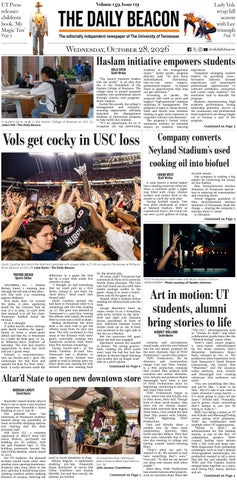
Volume 149, Issue 09
UT Press releases childrens book, ‘My Magic Tux’
Lady Vols wrap fall season with Lee triumph
Page 3
Page 6
Wednesday, October 28, 2026
@utkdailybeacon
Haslam initiative empowers students KELA FIFER Staff Writer
A student sits to study in the Haslam College of Business on Oct. 23. Jaden Vitt / The Daily Beacon
“We launch business leaders into the world,” is an idea that sits at the foundation of the Haslam College of Business. The college aims to propel prepared students into professional spaces through courses and programmatic support. Earlier this month, the college’s management and entrepreneurship department officially launched the Management Scholars of Distinction program to help fulfill this mission. “It’s an opportunity for us to recognize our top performing
Vols get cocky in USC loss
students in the management major,” Jackie Jacobs, program director, said. “To give them individualized, intentional, one-on-one career support, professional support … to expose them to opportunities they may not get otherwise.” According to Jacobs, the program will work to serve and support “high potential” students majoring in management. The program is open to rising second, third and fourth year students looking to gain more exposure to corporate cultures and demands. The program’s formal vision statement outlines its intended impact on students’ learning
experience. “Empower emerging student leaders by providing transformative industry focused experiences and meaningful professional opportunities to cultivate confidence, connection and career-ready students” the statement said to describe the program. Students demonstrating high academic performance, strong leadership potential, service to the community and professional work experience are being sought out to become a part of the program.
Continued on Page 3
Company converts Neyland Stadium’s used cooking oil into biofuel LOGAN WEST Staff Writer A cook lowers a metal basket into a sizzling reservoir of hot oil. Soon, a customer grabs a paper tray filled with crispy chicken tenders and rushes back to the stands to catch the next play. During football season, Vols fans place thousands of orders at Neyland Stadium. With 30 commercial fryers, the venue can use over 14,000 gallons of frying
oil each season. One company is making a big impact by converting the excess oil into biofuel. Filta Environmental Kitchen Solutions of Tennessee specializes in reducing oil consumption and recycling waste. Trevor Higgins, president of Filta Environmental Kitchen Solutions of Tennessee, leads the charge — sharing the company’s mission when it comes to filtration.
Continued on Page 2
South Carolina fans storm the field and celebrate with players after a 27-24 win against Tennessee at WilliamsBrice Stadium on Oct. 24. Luke Goins / The Daily Beacon
TREVOR MCGEE Sports Editor COLUMBIA, S.C. — DeSean Bishop found a running lane through the left side of the offensive line with 3:22 remaining against Alabama. Five yards later, he crossed the plane. A slow, agonizing death for the Crimson Tide by way of a 15-play, 72-yard drive that drained 9:32 off the clock. Tennessee football found the formula. Or so it thought. A failed fourth-down attempt gave South Carolina the opportunity to erase a seven-point deficit and beat No. 11 Tennessee on a walk-off field goal, 27–24, at Williams-Brice Stadium on Saturday. The Vols had another opportunity to drain the clock and put a game away. Instead, a miscommunication on fourth-and-1 gave the Gamecocks the ball back and opened the door for their comeback. A cocky decision made the
difference in a game the Vols led by a score with under five minutes to play. “I thought we had something that we could pick up a first down, sustain it, and drain the clock there,” head coach Josh Heupel said. South Carolina punted the ball back to Tennessee with 8:23 remaining and the Vols leading 24–17. The punt was downed at Tennessee’s 2-yard line, leaving the offense with nearly the entire field to cover and a clock to drain. Bishop kickstarted the drive with a six-yard rush to get the offense away from its own end zone. The Vols continued to chip away at the distance with short gains, eventually crossing into Gamecock territory with fewer than five minutes remaining. Facing fourth-and-1 at the South Carolina 38-yard line, Tennessee had a decision to make. An injury timeout was called to tend to Bishop after his third-down run, leaving the Vols without their star running back
for the pivotal play. No issue, right? Tennessee had converted all three of its previous fourth-down attempts. The Vols also had found success with their jumbo package earlier in the game, using it to score a touchdown and tie the game at 14. Heupel called a timeout before sending his offense back onto the field. George MacIntyre lined up under center in an I-formation, with Javin Gordon in the backfield and tight end DaSaahn Brame positioned in front of him. Defensive lineman Carson Gentle lined up as the H-back and motioned to the right side of the line as a blocker. But the execution fell apart when the ball was snapped. MacIntyre missed the handoff to Brame. The young quarterback, making his third career start, kept the ball but had few options as Brame began blocking and Gordon was no longer available as a pitch option.
Knoxville-based retailer Altar’d State is set to open a new location in downtown Knoxville’s Kress Building at 419 S. Gay St. The planned store has University of Tennessee students excited about the possibility of more accessible shopping options and clothing that fits their personal style. ASR Kress LLC, a company registered to Altar’d State CEO Aaron Walters, purchased the building for $6 million, with the sale finalized Sept. 17. The building previously housed the cafe Frothy Monkey, which closed in 2025. For UT students, the planned location would mean more than another store opening downtown. Students who shop often in the area said that it would bring more clothing retailers within walking distance of campus, reducing the
need to travel elsewhere to shop. Milana Bagirov, a sophomore studying pre-law, frequently shops downtown at stores like Urban Outfitters and Brandy Melville, but said that overall, the options are limited.
Art in motion: UT students, alumni bring stories to life AUBREY HOLLAND Contributor
Cameras and microphones stand ready, with the crew behind and the cast ahead, prepared for the next cinematic shot of TOSU Productions’ current film project. TOSU Productions, led by directors and screenwriters Osagie Uzzi and Tyler Schulte, Continued on Page 6 is a film production company that creates film projects with narrative and artistic elements. Uzzi, Schulte and producer Skylar Massengill have been a part of TOSU Productions since its beginning, continuing to develop and share their work. TOSU Productions began in 2024, when Uzzi and Schulte met in their dorm, Hess Hall. Though both of them loved movies, they were not yet cinema majors. After both switched their majors three times, Uzzi created his first short film project with Schulte, “O’Lolli,” beginning TOSU Productions. Uzzi and Schulte share a notable love for their main inspirations, directors Matt David and Ben Affleck. They find their story admirable due to the two also meeting in college and having created award-winning films. “That’s what me and Ty wanted to do. We wanted to just have something that’s ours,” An employee fixes clothing at Uzzi said. “So that we can spread Altar’d State at West Town Mall on our ideas and visions with other Oct. 24. people.” Jolie Jarreau/ Contributor Since then, TOSU Productions has created various other projects, Continued on Page 2 such as narrative short films like
Altar’d State to open new downtown store MORGAN LANUTI Contributor
TOSU Productions collaborates with Music Industry Club on “MONSTOBER”. Photo courtesy of Xander Johnson.
“The Cut,” advertisements such as “Dream In Style” and other collaborative productions like the “Method Acting” music video. TOSU’s most recent project, a story-based advertisement for the Music Industry Club’s Monstober Halloween Music Bash, released on Oct. 15. The production drew inspiration from Inde Navarette’s David Protein Commercial, the horror film “Obsession” and the uncanny valley aesthetic. Uzzi, Schulte and Massengill love creating references that audiences can catch. “You see something like that, and you’re like, ‘I want to do that.’ But it’s like if you tried to make someone’s song exactly — it’s never going to come out the same,” Schulte said. “Naturally, you’re gonna create something that’s unique to you just by trying to make it.” With Uzzi being a senior at UT and Schulte and Massengill being recent spring 2026 graduates, TOSU has collaborated with multiple other UT organizations. “Dream in Style,” an advertisement for The Fashion Society, is one of the first UT collaborative projects TOSU created, feeling more serious with a full crew and large cast. With inspiration from marketing campaigns such as Gap’s famous choreographed commercials, the production wanted to tell a story that felt fun and relatable. Both TOSU and The Fashion Society merged ideas together as a team, each loving film, music, fashion and art.
Continued on Page 4
News
Page 2
The Daily Beacon
@utkdailybeacon | October 28, 2026 | www.utdailybeacon.com
‘Seconds matter’: Vols work to lower emergency response time MORGAN LANUTI Contributor
Then facilitate transport to them and hand the patient to them at an easier access point,” On a college campus as large Becca St. Germaine, chief of as the University of Tennessee, EMS Vols, said. getting medical attention to Looking to evolve further, someone quickly can be a EMS Vols has the goal of being challenge. For EMS Vols, the the first call from the dispatch student-led volunteer team of center when there is a Level 3 paramedics, the goal is to help medical call, meaning an urgent close that gap. but not life-threatening emer“In emergency management, gency. we plan to prepare for disas“Now, if anything different ters,” Ryan Steffy, EMS Vols then a Level 3 that requires more emergency management super- medical attention, we have set it visor, said. “And we always say up to be that EMS Vols training that seconds matter.” and procedures aligned directly The organization has spent with AMR’s so that they will be the past three years working able to coordinate with AMR, towards expanding their pres- and when AMR arrives it should ence on campus. And now, as be a seamless handoff and coorthey gain a better foothold at dination,” Steffy said. UT, they are taking another Although EMS Vols has its big step with the help of new, medical equipment and proceupcoming equipment. dures prepared, one major EMS Vols are a 911-based obstacle stands in the way of student-led organization that the team achieving its goal of provides event medicine and responding to emergency calls medical care for student orga- across campus: getting its nizations on campus. The responders where they need to organization currently has 26 be quick. The EMS Vols complete a mandatory training with American Medical Response (AMR). They review their medical active members that each have EMS Vols is in the process bags and refresh on basic life support skills at an AMR training facility on Sept. 13. a CPR certification and an active of acquiring two All Terrain Photo Courtesy of Rebecca St. Germain Tennessee EMT license. They’ve Vehicles. According to Steffy, started by providing medical the vehicles have been ordered, running calls, they will begin EMS Vols can treat a patient on nization, both on campus and coverage at events. but their delivery date is to operate on a Thursday to campus that doesn’t need an then also under the Office of EMS Vols isn’t looking to unknown. EMS Vols is looking Saturday basis in the evenings. ambulance, that ambulance can Emergency Management,” St. replace professional emergency forward to the vehicles coming AMR has helped the team to stay out to respond to another Germaine said. “We’ve done a lot in three years that we services. Instead, the team aims in because it will enable them to identify that those nights have Level 2 or Level 1 emergency. the highest call volume on UT “It helps the campus, it helps thought would take a long time to provide an initial response run calls. and coordinate additional, “Right now without those campus. With a group of EMS our students get a quicker to do.” Looking forward, EMS Vols is professional care if needed. vehicles, we only can do more Vols ready to respond, a person response, but it also helps the in need can get care much community as a whole,” Steffy committed to seeing the orga“We work with the Knoxville stationary events because we said. nization’s mission all the way Fire Department and AMR don’t have the transportation to faster. “In some places it may be For the students behind EMS through. Steffy has watched the (American Medical Response) get around,” St. Germaine said. and coordinate with them to be St. Germaine mentions that more difficult for AMR to get in Vols, the opportunity to respond organization grow into somethe first response on campus. once EMS Vols is able to start the middle of campus. Whereas to emergency calls across thing with immense potential, our team, we’d have smaller campus has been the goal for with its students serving as the vehicles, and we’d be able to years. Now, after three years of catalyst behind its progress. enter into the dorm rooms and building this organization from “As you can imagine, getting bring them down,” St. Germaine the ground up, the goal is closer the green light for students to said. “Then our job from there than ever to becoming reality. perform medical treatment on is, if we need a higher level of St. Germaine has been other students on campus, it care, to coordinate with AMR working on this project since takes a lot of people to say yes and hand off that patient to the end of her freshman year. to that. They stuck with it, and I them to take the patient to the The founders of EMS Vols think that alone says a lot about hospital.” started the organization as a their character,” Steffy said. Not only does that reaction club, before they advertised As EMS Vols continues to speed positively impact the themselves to EMTs on campus, prepare for the arrival of its patient in need, but it also helps and then the project really took new vehicles, the goal the team has worked toward for years is RYAN STEFFY the entire Knoxville community. off. By taking some of the pressure “Slowly as we got more advi- finally in reach. EMS Vols emergency management supervisor off the paramedics in the city, sors and more connections, it “We’re so close. We’re at the more care can be allocated to slowly went from an EMS club one yard,” St. Germaine said. off campus emergencies. If to a full blown student orga-
It helps the campus, it helps our students get a quicker response, but it also helps the community as a whole.”
Correction The “Strength training is vital to a woman’s life” opinion story published Oct. 21 incorrectly provided the contributor’s contact information. Maria Madrid is a junior at UT studying journalism. She can be reached at mmadrid1@vols.utk.edu.
Biofuel | cont. from Page 1
New future Altar’d State Location at 419 S. Gay St. in Downtown Knoxville on Oct. 19th 2026. Jolie Jarreau / Contributor
New Altar’d State downtown | cont. from Page “It’s nice to see more retail options so I don’t have to go down Kingston Pike, 30 minutes away through traffic all the time,” Bagirov said. Isla Burns, a freshman studying political science, has similar excitement, particularly because of the store’s new accessibility. “I’m excited because it’ll be walkable, compared to West Town Mall,” Burns said. Beyond its convenience, students said Altar’d State’s clothing style is part of what makes the store so appealing. “I like the variety of the clothes,” Burns said. “There’s not a lot of places where you can get workout sets and formal dresses. They have almost everything.” Annabelle Ellis, junior marketing major, said Altar’d State’s style fits perfectly with
the fashion trends she sees on UT’s campus. She is an avid visitor in downtown Knoxville and said the store would give her a new place to shop. “I like their clothes. I like their style. I feel like they’re always on trend,” Ellis said. For some students, the planned opening also brought attention to what they see as a lack of retail options downtown that cater specifically to students’ preferences. Bagirov said she would like to see more stores offering everyday clothing rather than merchandise or souvenir shops. She noticed that Market Square specifically has a lot of shops that remind her of airport and tourist attractions. “Market Square has the new Brandy Melville they opened last year, and the Urban (Outfitters). But other than that, there isn’t much over there,” Bagirov said. Burns shared similar concerns
about the downtown shops being tailored towards Tennessee fans and Knoxville visitors. “I think a lot of the boutiques have mostly orange stuff. It’s very Tennessee,” Burns said. “Not really places students would go to shop and get clothes they would actually wear.” Sloane Phillips, a freshman studying English, said she believes downtown could benefit from more commercial retailers to attract more student shoppers. “I don’t think our downtown is known for being super local,” Phillips said. “It’s Knoxville. They should put more commercial stuff if they want people to go down there.” Students’ reactions suggest that UT shoppers are looking for a greater variety downtown. For them, Altar’d State offers that variety they’ve been looking for.
“If the oil’s within its half life, we can filter it,” Higgins said. “Our goal is to double its life. Sometimes that’s possible, sometimes it’s not, but it definitely extends it past one game of usability.” Employees travel to each kitchen in the stadium to assess the purity of the cooking oil. If it is determined to be safe enough to filter, workers move the oil into a specialized machine that performs microfiltration. Once the oil is removed, the fryers are detailed with food-safe cleaners. Out of a tube, freshly-filtered, golden oil returns to the frying vats, free of crumbs and debris. Now, the kitchens are ready for the next home game. This service extends the life of the cooking oil, enhances food consistency and reduces costs associated with purchasing oil. Demario Alexander, senior director of concessions and warehouse at Neyland, expressed his gratitude for the company. “Filta has helped us tremendously,” Alexander said. “Filtering helps us with the extension of our oil life, the quality of the food, and it helps keep us fresher and more productive.” The filtering process also increases the safety of kitchen staff. Repeatedly reheated cooking oil can be hazardous due to the concentration of food particles.
“Oil is a very dangerous thing, so we basically remove any risk,” Higgins said. “We have all the correct (Personal Protective Equipment. A lot of times people put it in buckets and carry it out back, and so (the filtration process) is really helpful to mitigate that.” After repeated use, cooking oil degrades chemically and exits its phase of peak performance. The period of time where the oil is usable is referred to as its half life. When frying oil is past its half life, it is no longer safe for food preparation. Instead of disposing of it, Filta utilizes a process called transesterification to convert the unusable oil into biodiesel for heavy machinery. “We take all the old oil when it can’t be filtered, and it goes to biofuel production facilities,” Higgins said. “They blend it with regular diesel fuel, and it gets a second life.” Higgins has cheered on the Vols for as long as he can remember, and he expressed that this venture holds a special place in his heart. “I grew up as a Tennessee fan, so it’s really special to always know that anything fried food related or oil related at this stadium comes from us,” Higgins said. Filta’s sustainable circular system showcases how one company can evoke change that benefits people, fans and the environment.
I grew up as a Tennessee fan, so it’s really special to always know that anything fried food related or oil related at this stadium comes from us.” TREVOR HIGGINS
President of Filta Environmental Kitchen Solutions of Tennessee
The Daily Beacon
@utkdailybeacon | October 28, 2026 | www.utdailybeacon.com
Page 3
UT Press releases first children’s picture book ‘My Magic Tux’ ZOE MANDEL Staff Writer During the 1998 Fiesta Bowl national championship game, one fan in particular stood out from the Neyland crowd. J.R. Greene, a graduate student, sported a white tuxedo colored with orange marker, orange gloves and an orange top hat. When ESPN College GameDay’s Chris Fowler invited him onto the field, Greene introduced himself with an iconic message that would kickstart his legacy. “I’m J.R. Greene, the Big Orange Tux Guy, and I’m here to show that Tennessee has class,” Greene said. Nearly 30 years later, Greene has turned his superfan story into “My Magic Tux,” the University of Tennessee Press’s first children’s picture book. He says that initial message is something he still stands by. “That’s what I stood for,” Greene said. “It was authentic. It was original. It was true.” One Special Teacher After ESPN published an article about his story, Greene was invited to wear the tuxedo to a tailgate and interact with fans. An elementary school teacher approached him and suggested that his story would make a great children’s book about courage and confidence. “I began to think, ‘yes, it actually is a story.’ I see where the elementary school teacher was coming from with the idea of telling children to take risks, put yourself out there,” Greene said. “If you want to grow, you have to be able to put yourself in positions to learn from mistakes and keep going. Then, you can pursue your own dream.” Although Greene entertained the idea, he had no idea how to
write a children’s book. He turned to the internet for research, exploring routes of self-publishing, commercial publishing and academic publishing. He even spoke with the chief operating officer of Simon & Schuster, a New York publishing company, to learn more about the industry. “At the time, I didn’t know the University of Tennessee had a press or a publishing office,” Greene said. That was until one day in Nashville, when Greene ran into Joe Mazer, dean of the UT College of Communication and Information, who connected him with Katie Hannah, director of UT Press. Tuxie Comes to Life Hannah had already considered starting a children’s book line of her own. Greene’s idea, combined with his dedication, presented an opportunity to explore that possibility. “His story was so quirky and his enthusiasm so infectious. I was immediately intrigued,” Hannah said. “But he was well prepared, too — he had already hired a co-author and an illustrator, and he was ready to get down to work.” Greene’s story was a perfect match for the UT Press, fitting both of their goals to represent the university and give back to greater Tennessee. “There are a lot of stories out there, but I wanted to be sure anything that we published fit with the press’s mission to improve the quality of life for the people of Tennessee, and with the university’s land-grant mission to serve lifelong learners,” Hannah said. “‘My Magic Tux’ was a slam dunk in that regard.” Working alongside co-author Joe Shands and illustrator Nicholas Child, Greene brought
There are a lot of stories out there, but I wanted to be sure anything that we published fit with the press’s mission to improve the quality of life for the people of Tennessee, and with the university’s land-grant mission to serve lifelong learners. ‘My Magic Tux’ was a slam dunk in that regard.” KATIE HANNAH
Director of UT Press
his story to life on the page and created his own mascot, Tuxie. After two years of peer review and international Zoom calls from Nashville, to Santa Fe, to England, the wording and imagery became finalized, and Tuxie was ready to hit the shelves. Like a football game, “My Magic Tux” is split into two halves. The book also features a specific font designed to help readers with dyslexia. “You have to give UT Press a big nod because that was their idea, and that just made the book even more special,” Greene said. The publishing process also opened a new door for UT Press, providing a new experience to apply to future publications and possibly more children’s books. “We learned so much,” Hannah said. “From composing and editing the book to collaborating with design, production, and marketing and promotion, along with engaging a public relations firm for the first time, I feel like we gained valuable information that we can use not only on future children’s books, but also on all the books we publish.” Magical Partnerships In true volunteer spirit, “My Magic Tux” has sparked partnerships with local businesses and organizations across Tennessee to promote Greene’s goal to expand access and literacy across Tennessee. Through his partnership with the nonprofit UT Press, proceeds from the book go back to UT Libraries. Greene has also donated his proceeds to the university. “The UT Press and I would hope that over time, every child that’s a Tennessee Vol fan has an opportunity to get this book,” Greene said. “One of the biggest pieces is access.” Bookstores in Knoxville and Nashville, including Alumni Hall, Union Ave Books and Parnassus Books, have also helped make the book available to readers. The Knoxville Smokies invited the Tuxie mascot to throw the first pitch at a game, while Cruze Farm created a specialty ice cream flavor called “Tuxie Swirl” and offered signed copies of the book at its store. Toyota Material Handling MidSouth donated 500 copies of the book to Knox County schools and libraries. Greene said the donated books arrived at schools in boxes labeled with teachers’ last names. “It was adorable,” Greene said. Remembering the Journey Greene’s story is continuing to reach audiences beyond Tennessee. He has held story times, book signings and has appeared on radio shows and in magazine features across
The Big Orange Tux display at the Graduate Hotel on Oct. 21. Ethan Garnier / The Daily Beacon the country, a future he never expected to come from a homemade tuxedo. “If you go back to when I put that tux on, I had no idea where my day was going to turn,” Greene said. “But 28 years later, here I am with a wonderful book and a storyline and able to speak back to students across the University of Tennessee, so it’s very exciting.” With hopes of making “My Magic Tux” a New York Times bestseller, Greene continues to look toward the future while reminding others of the importance of appreciating the entire process. “Remember the journey,” Greene said. “When you have that goal out there, set the goal, and pursue it. Win, fail, but continue to learn and enjoy that journey.” The experience has also encouraged Greene to pursue more opportunities in his own career and find new ways to give back to the university that guided him along the way. “The storyline of the book
Haslam | cont. from Page 1
The Haslam College of Business sits in the center of campus on Oct. 21. Jaden Vitt / The Daily Beacon
Students walk around the hallways of the Haslam College of Business on Oct. 21. Jaden Vitt / The Daily Beacon
Soft skills such as communication, collaboration and emotional intelligence are additional attributes that are being considered during the evaluation of applicants. “It’s a little different than an honors program, which usually recognizes people mainly for academics,” Jacobs said. “This is a little more holistic as far as the types of students we are seeking to identify.” The structure of the program is similar to that of existing initiatives such as the supply chain management Scholars of Distinction program. Discussion panels with alumni, pre-professional training series, corporate site visits and a cohort service project are among the provided opportunities available to program participants. These opportunities will be used to facilitate students’ hands-on skill development and experiential learning. “That preparedness makes them, I think, more able to tackle those challenges of your first job after college,” Jacobs said. Formal mentorship will be considered at a later time. Talks of the program began when the department’s advisory board — working professionals and corporate partners who provide guidance to the academic department — began seeking out more substantial connections with these highachieving students. Jacobs emphasizes the program as an opportunity to
bridge the gap between corporations and potential employees. “We’re also bringing the companies to the students,” Jacobs said. “By bringing the opportunities to the students and connecting companies that want those high-potential students … they can have a chance to actually sell themselves and their skills. I think that’s really valuable.” Jacobs pointed to greater engagement between faculty and students as an additional benefit of the program. “Our role as faculty is of course to teach, but also that career readiness and helping students make that connection,” Jacobs said. For prospective program members, Jacobs reiterated that involvement showcases them as a competitive candidate. “They should seek out opportunities,” Jacobs said. “It is still not too late to join a student organization and learn about ways to get involved … It is not too late to find a way to do something other than just showing up for classes.” As the program moves forward, Jacobs looks for students to gain experience in dimensions of professionalism beyond what is currently offered. A development of “more job-related skills” through collaboration with corporations is what Jacobs hopes to see on the horizon. Applications for the inaugural cohort closed on Oct. 25, and selected members will be notified during the week of Nov. 2.
came through in real life,” Greene said. “I began to pursue different roles, and now I’m beginning to do a lot more mentoring. I want to give back to the University with this book, and I think there’s a lot more exciting journeys ahead.” The book’s lessons transcend football and generations. Hannah emphasized the connection reading can bring. “This is a book about courage and confidence, about being polite and honest and kind while still jumping at opportunity,” Hannah said. “We hope that people will take these lessons to heart but also have a great time reading the book together.” For Greene, the true takeaway reflects the moment that started it all: standing out, taking a chance and being willing to lead. “When people ask you if you’re here to lead the team on the field, whatever you’re doing out there, the answer is yes,” Greene said. Readers can purchase “My Magic Tux” on the UT Press website.
According to Jacobs, the number of accepted cohort members depends on the strength of the application pool. The inaugural cohort will be involved in the program solely for the upcoming spring semester. As the program progresses, the students will remain involved for a full year during both the spring and fall semesters. Students must re-apply to remain in the program each year. “We want to make sure students continue to develop and we are getting the best of the best,” Jacobs said. Students are encouraged to direct all questions toward Jacobs and department head Tim Munyon.
A student uses a study cubicle in the Haslam College of Business on Oct. 23. Jaden Vitt / The Daily Beacon
Page 4
Arts & Culture
The Daily Beacon
@utkdailybeacon | October 28, 2026 | www.utdailybeacon.com
Vintage market fosters community, sustainability ZOE MANDEL Staff Writer In 2022, when Ricky Hopkins first started the Knoxville Vintage Market, he had two priorities: the people and the planet. Inspired by vintage markets popping up across the Southeast, Hopkins wanted to create something that would unite people from different backgrounds over a common goal or interest. Combining this need for a third space with his love of sustainability, the Knoxville Vintage Market hosts pop-ups across the Knoxville area, coming onto campus a few times each semester for students to enjoy. Each pop-up brings together a handful of local vendors who source a variety of clothing styles, jewelry and other accessories for
people to shop secondhand. “It means everything just to have local vendors come on campus and interact with the students,” Hopkins said. “Because when I went to college, I interacted with the local community. That was very big to me. And I just wanted to see that aspect of it happen here also.” Hopkins attended Auburn University, where he got a degree in psychology. He then went home to Chicago and attended Chicago State University, where he completed a degree in psychology and social work. In both places, he often hosted community events, mostly centered around entertainment or food. After living in Knoxville for the past 15 years, he wanted to create something that would bring the campus and greater Knoxville community together.
It brings people together, and especially when you’re on campus you see everybody come together. You know, these kids may not even come together for nothing else, but they’re coming together to shop some vintage or look at it, and talk about it, you know, amongst each other. It’s definitely a bridge.” RICKY HOPKINS Founder of Knoxville Vintage Market
A student shows their friends an Eagles jersey at the Knoxville Vintage Market event at HSS Lawn on Oct. 19. Zoe Mandel / The Daily Beacon
Knoxville Vintage Market collaborates with different clubs on campus, notably Sustainable Fashion Club, The Fashion Society and Music Industry Club. Co-president of Sustainable Fashion Club Steven Lopez explains how Hopkins’ efforts have created an environment for students to learn about sustainable shopping. “Through connecting with the community, we’ve been able to see that the students have learned about how sustainable shopping works and learned that there’s always a way to get something maybe a bit older or used instead of going straight and spending with fast fashion retailers,” Lopez said. His co-president Brogan Capecchi, a junior studying landscape design and marketing, is a Depop campus manager for UT, which he describes as an ambassador role. His goal is to introduce more students to sustainable and circular fashion. “For some people, they maybe never go thrifting or don’t really know too much about that,” Capecchi said. “So by hosting events like these that helps bring awareness to the fact that sustainably shopping is … actually better for the environment than just buying new clothes.” He explains that because all of the clothes are vintage, they’re kept in circulation rather than being added to it. Capecchi also notes that Depop being on campus promotes secondhand shopping to students as an easily accessible, online way to participate in circular fashion. Thrifting and secondhand shopping have been around since the 1960s, with its popularity wavering at times and now going steady as Generation Z and millennials turn to it as opposed to fast fashion and expensive retail stores. It bridges generational gaps and serves as an intersection of interests, from fashion to sustainability to history. “It brings people together, and especially when you’re on campus you see everybody come together,” Hopkins said. “You know, these kids may not even come together for nothing else, but they’re coming together to shop some vintage or look at it and talk about it, you know, amongst each other. It’s definitely a bridge.” Hopkins’ positive impact on campus is shown in how he wants students to succeed. He doesn’t take anything from the events, and any vendor fees go to the clubs he partnered with for the specific event. Knoxville Vintage Market will also donate money toward fundraising causes while working with sororities or fraternities. “Ricky connects with a lot of the students, and like, they know Ricky when he comes on campus,” Lopez said. “They know he works with the vintage
A student looks through a jewelry table at the Knoxville Vintage Market event at HSS Lawn on Oct. 19. Zoe Mandel / The Daily Beacon market and he’s a good person.” Hopkins remarks that he’s met people at the markets and later attended their graduations, calling the connections he’s made with students “a beautiful thing.” “Working with Ricky has been great,” Lopez said. “He has always been kind of like a mentor for the club and for myself. He’s always helped us partner with local businesses and just learn about the community in Knoxville, and just the different types of people that are here, and the different avenues that there is around the city to shop and just to thrift and stuff.” Hopkins helps everyone who comes to him with questions or ideas. For him, community is a pillar of his work, and he actively strives to better the lives of those around him. He’s also advised people working on their own markets and has helped start ones in Nashville, Atlanta, Memphis, Charlotte, North Carolina and Birmingham, Alabama. Sustainability is as important as community, and is the aspect of vintage that Hopkins loves the most. “This way of shopping is great because it kind of bypasses (throwing away clothes) and you can just give new life to clothes instead of just buying more and more new clothes,” Capecchi said. “We have so many clothes already in circulation that, honestly, contributes a lot to our waste in general.” According to a study from the Environmental Protection Agency, in 2018, 9,070,000 tons of clothing and footwear went to
landfills out of the 13 million tons produced. A report by earthday. org found that 87% of garments produced by fast fashion companies end up in landfills that same year. “By shopping vintage and shopping sustainably, you’re helping out the Earth, but you’re also giving clothing a second life and keeping it from the trash or somewhere like that,” Lopez said. The same earthday.org report found that people are buying more clothes yet keeping them for less amount of time, noting that garments are worn as little as 10 times before getting discarded. By buying from market vendors, students are both extending an item’s usage and interacting with people outside of their circles and across Knoxville, potentially informing them of places they wouldn’t have known about without these interactions. “It also just allows us to have the students and people from outside businesses connect with each other and help support and maybe learn about other things around the city that they might not know,” Lopez said. Over its four-year-andcounting run, Knoxville Vintage Market has become a place for all people to gather. Hopkins has fostered an environment that allows for anyone to thrive no matter who they are. “Just having a spot for people to come out and chill,” Hopkins said. “You don’t have to buy anything, that’s cool. Just having a space for community is needed, for everyone. (I) just wanted to bring some culture.”
TOSU Productions | cont. from Page 1
You see something like that, and you’re like, ‘I want to do “I think it’s probably some of pivot, like, ‘what is a better way crew, it was the first thing that the most collaborative sets I’ve to convey this message?’” we were making kind of, that ever been on,” Massengill said. TOSU Productions will was purely out of passion and that.’ But it’s like if you tried “A lot of the times when I’m on continue, as the three leaders purely out of wanting to work other sets, people kind of stay in have no plans or desire to stop together. And I think the fact to make someone’s song exactly. It’s never their own lane and stay in their it. Each is still writing and that we’ve continued to do that own department, but we’re all collaborating with one another after a lot of us have graduated, going to come out the same ... Naturally, kind of mixing and matching and others on more projects. As it’s just kind of even furthering who we’re working with and they look towards the future, that point that we are doing it you’re gonna create something that’s unique how we’re helping.” they are excited about working because we love it.” In the “Method Acting” music on more narrative stories, to you just by trying to make it.” video for the song by musician short films and crossAva Tignor, director of outreach for Music Industry Club, TOSU wanted to bring the song’s message to life. “When people are not, you know, as involved in film, we can still try to understand ‘what are you trying to tell us?’ or ‘what do you want us to help you tell other people?’” Uzzi said. With each new project, TOSU has gained more insight into better preparing for future work. Adaptability became a large part of filming and maintaining a positive mindset. Each project is different with its own set of challenges. Shoot dates, entire sequences and technicalities can be changed. Yet, Uzzi, Schulte and Massengill have realized that there are always new aspects to learn that they wouldn’t have known unless they experienced them. “It’s little things,” Uzzi said. “Like it can be as little as, ‘oh, we’re supposed to have this room, but it’s locked, and we have to wait three hours to open it.’ It’s things like that. Or maybe this key factor in the shoot doesn’t make sense. We have to
genre projects involving all kinds of art and mediums. “Now that a lot of us graduated, I think it (TOSU) feels bigger in a way and is sustainable outside of college because we all made things while we were in school, and a lot of times it was for class,” Massengill said. “But I think TOSU, for me at least, and I think for a lot of the other people on our
TYLER SCHULTE TOSU director and screenwriter
TOSU Productions and Music Industry Club on the “MONSTOBER” set. Xander Johnson / Contributor
The Daily Beacon
Opinion
Page 5
@utkdailybeacon | October 28, 2026 | www.utdailybeacon.com
DAILY BEACON STAFF AND POLICY INFORMATION
What if rejection isn’t the worst outcome?
EDITORIAL EDITOR-IN-CHIEF: Patrick Busch MANAGING EDITOR: Lauren Holladay COPY CHIEF: Margaret White NEWS EDITOR: Olivia Lee ASSISTANT NEWS EDITOR: Tessa Nacke ARTS & CULTURE EDITOR: Harper Brabson SPORTS EDITOR: Trevor McGee ASSISTANT SPORTS EDITOR: Alex Sarkis OPINIONS EDITOR: Natalie Dripchak PHOTO EDITOR: Jayden Randolph DESIGN EDITOR: Maya Williams DIGITAL EDITOR: Trip Scoutten SOCIAL MEDIA EDITOR: Sarah Portanka AUDIENCE DEVELOPMENT EDITOR: Grace
White
EDITOR EMERITUS: Caden Dyer COVER DESIGN: Maya Williams PAGE DESIGNERS: Delaney Karr, Kiersten
Collins, Amelie Carrillo, Shelby Perdue GRAPHICS BY: Maya Williams, Shelby Perdue, Delaney Karr, Hayden Sauer
ADVERTISING/PRODUCTION TO PLACE AN AD, please email admanager@utk.edu.
CONTACTS
Graphic by Amelie Carrillo
TO REPORT A NEWS ITEM OR SUBMIT A PRESS RELEASE, please email editorinchief@utdailybeacon.com or call (865) 974-2348
NATALIE DRIPCHAK Opinions Editor
LETTERS POLICY: Letters to the Editor must be exclusive to The Daily Beacon and cannot have been submitted to or published by other media. Letters should not exceed 400 words and can be edited or shortened for space. Letters can also be edited for grammar and typographical errors, and Letters that contain excessive grammatical errors can be rejected for this reason. Anonymous letters will generally not be published. Authors should include their full name, mailing address, city of residence, phone number and e-mail address for verification purposes. Letters submitted without this information will not be published. The preferred method to submit a letter to the editor is to email the editor-in-chief.
There is a certain comfort in pretending you never wanted something in the first place. For years, I avoided rejection entirely. That meant rejecting opportunities before they had the chance to reject me. I convinced myself I didn’t want certain opportunities I was too afraid to pursue. I held myself back socially, avoided putting myself in vulnerable situations and pretended I was content with things I secretly wanted to change. It was easier to tell myself I didn’t care than to admit how badly I did. We live in a world where appearing unbothered is almost celebrated. Admitting you want something, whether it’s a relationship, a friendship or an opportunity, requires vulnerability. It’s much easier to act indifferent than to acknowledge that something matters to you. But what was I actually protecting myself from? The embarrassment of being told no? The possibility of failure? Or the idea that someone else’s rejection might confirm the insecurities I already had about myself? I feared feeling alone, humiliated and uncertain of my own worth. I thought, “Well, if this person or this job is going to reject me, that must mean there
CORRECTIONS POLICY: It is the Daily Beacon’s policy to quickly correct any factual errors and clarify any potentially misleading information. Errors brought to our attention by readers or staff members will be corrected and printed on page two of our publication. To report an error please send as much information as possible about where and when the error occurred to editorinchief@ utdailybeacon.com, or call our newsroom at (865) 974-5206. The Daily Beacon is published by students at The University of Tennessee on Wednesday during the fall and spring semesters. The offices are located at 1345 Circle Park Drive, 11 Communications Building, Knoxville, TN 37996-0314. The newspaper is free on campus and is available via mail subscription for $200/year or $100/semester. It is also available online at: www.utdailybeacon.com
is something wrong with me, right?” I was confusing rejection with a reflection of my own self-worth. Why do we allow someone else’s decision to dictate how we see ourselves? When someone doesn’t want to date us, we assume that we are unattractive or unlovable. When we don’t get a job, we assume we aren’t talented or competent. When we aren’t invited somewhere, we assume no one likes us. It’s normal to have these thoughts — we all have them. But we have to learn to distinguish between what our insecurities tell us and what is actually true. While avoiding rejection might spare us temporary embarrassment, it also prevents us from experiencing things we genuinely want. There have been countless jobs I’ve been interested in but never applied for because I was too afraid of receiving a rejection letter. But why was I assuming that I would be rejected in the first place? There have even been friendships that I wanted to pursue or strengthen, but my fear of rejection held me back. I’ve missed out on social gatherings because I convinced myself I wasn’t wanted there. Instead of speaking up or making an effort, I let my insecurities make the decision for me. Avoiding rejection cost me
more than the rejection itself ever did. I missed out on experiences and opportunities simply because I wanted to feel safe. I convinced myself that if I never put myself out there, nothing bad could happen. But I failed to recognize that nothing good could happen, either. The worst outcome isn’t hearing no. It’s spending your life making decisions based on the fear of hearing it. That’s no way to live. And it’s difficult for me to admit how long it has taken me to realize that. Even when you become aware of this, you don’t have to pretend you’ve overcome your fear entirely. Fear is normal. No one wants to be rejected. But rejection is an inevitable part of life, and learning to face it can help us build the confidence to pursue things even when the outcome is uncertain. We spend so much time worrying about what could go wrong that we rarely consider what could go right. And even when things don’t work out the way we hoped, that doesn’t mean taking the chance was a mistake. This is all easier said than done, as most things in life are. However, pretending I didn’t care about things that genuinely mattered to me has cost me far more than being told no ever could.
I’m not going to pretend that I’ve suddenly become fearless. I still fear rejection. But I’m beginning to realize that the possibility of being told no is far less frightening than looking back and wondering what could have happened if I’d just asked. It’s difficult to step outside of your comfort zone. It’s comfortable for a reason. But staying in the same place simply because it feels safe doesn’t leave much room for growth. Growing as a person requires accepting that discomfort is sometimes unavoidable. It means allowing yourself to want things openly, even when there’s no guarantee you’ll get them. And maybe that’s what I’ve been missing all along. Rejection isn’t always something we can control, but the opportunities we give ourselves are. I’d rather experience temporary disappointment of being told no than spend the rest of my life wondering what might have happened if I’d been brave enough to try. Natalie Dripchak is a senior at UT studying advertising. She can be reached at ndripcha@vols.utk.edu.
Columns and letters of The Daily Beacon are the views of the individual and do not necessarily reflect the views of the Beacon or the Beacon’s
Audrey Siemens/ Cartoonist
Ben Garrison/ Cartoonist
Cartoons Cartoons Cartoons
Page 6
Sports
The Daily Beacon
@utkdailybeacon | October 28, 2026 | www.utdailybeacon.com
Loss to South Carolina | cont. from Page 1 MacIntyre tucked the ball and tried to make something happen. South Carolina swarmed him at the 39-yard line, stopping the Vols short of the first down and taking possession. “Just simple miscommunication,” MacIntyre said. “A formation we’ve been running all game. Just got to be more locked into the details of the different plays and the big jumbo formation.” The same play had worked for Tennessee in the first half. Facing fourth-and-goal at the 1-yard line, the Vols brought out the jumbo package, and Brame took the carry into the end zone to tie the score at 14. This time, the gamble to put the game away backfired. “There’s a lot of moving parts of the play, with kills and checks, what fronts they’re going to
run,” MacIntyre said. South Carolina took advantage of the turnover on downs, marching 61 yards in six plays to tie the game. The Gamecocks had not scored since the 1:44 mark of the first half, but Tennessee’s failed conversion gave them another opportunity. The Vols couldn’t recover. MacIntyre fumbled on Tennessee’s next possession, setting South Carolina up for a game-winning field goal as time expired. Fans poured through the hedges surrounding the field as the Gamecocks celebrated a comeback victory. Tennessee had the ball, the lead and a chance to run out the clock. A failed fourth-down conversion changed all of that.
Lady Vols softball I thought we had wrap fall season something that we could pick with Lee triumph up a first down, sustain it, and drain the clock there.” JOSH HEUPEL Head coach
Penalty plague hinders Vols in loss to Gamecocks ALEX SARKIS Assistant Sports Editor COLUMBIA, S.C. — Every wound has a way of hurting. Some wounds are treatable, while some are just barely survivable. Self-inflicted wounds, however, are often deadly. Tennessee football was reminded of the dangers of shooting itself in the foot in its 27–24 loss to unranked South Carolina — a defeat that could’ve been only a product of the Gamecocks’ imagination had the Vols executed within the legal limits of the game. On 12 separate occasions, they didn’t. “We didn’t play smart enough,” head coach Josh Heupel said. “Offensively, penalties just crushed us. You let a good football team hang around on the road, it’s got a chance to bite you. It sure did at the end.” Three calls in particular haunted Tennessee in its second straight loss at Williams-Brice Stadium, touchdown-erasing penalties that each would’ve gone a long way in changing things. The Vols were able to avenge George MacIntyre’s 35-yard scoring connection with DaSaahn Brame by finding paydirt on the ground
later in their first scoring drive of the afternoon, but two later nullified trips to paydirt allowed South Carolina to rally. Tennessee was caught with an illegal man downfield on MacIntyre’s perfectly thrown deep ball to Mike Matthews, while a holding call robbed Braylon Staley of an 18-yard scoring squeeze. The Vols ended up managing just three points when 14 was the goal. “I think we all know how different this game would have looked if we didn’t have those penalties,” MacIntyre said. “It didn’t feel like we had that many penalties throughout the whole game. They just happened at the worst time possible” Aside from their costly scoreboard-altering woes, the Vols were flagged in other scenarios that cost them one of the most valuable road game commodities — momentum. When driving late in the fourth quarter with hopes of reaching walkoff field goal range, a Javin Gordon 17-yard run to near midfield
came back due to an offensive holding call. The infraction put the Tennessee offense into a sure-fire passing scenario, leading to Dylan Lewis’ strip sack of MacIntyre on the very next play to set up the eventual game-winning boot on the other end. The penalty issues that have plagued Heupel’s Tennessee teams many times before struck the death blow. “Everybody’s got to take ownership of alignment, assignment,” Heupel said. “It starts there, and then technique. Holding call out on the perimeter at the end, knew this crew was going to call it tight. Everybody’s taking ownership of it.” Now, the Vols head into their bye week as a two-loss team, with time to stew over a shortcoming in a place that continues to haunt them. Tennessee’s hopes of a trip to the College Football Playoff are on life support after a game where self-inflicted blows fittingly loomed large. “I know every game, every coach, every player says, ‘if you feel like they didn’t stop us, they stopped ourselves,’” MacIntyre said. “I felt like that was very true for this game. It was one of the most frustrating games I’ve ever played in.”
The Lady Vols celebrate their teammates home run during a game against Lee University at Sherri Parker Lee Stadium on Oct. 23. Meredith Lambert / The Daily Beacon
CONNOR WHITNEY Contributor
Youth movement
Tennessee softball rolled through its last fall exhibition with a 14–1 win over Lee in a 10-inning exhibition at Sherri Parker Lee Stadium on Friday. Freshman Bailee Shelton got the start in the circle for the Lady Vols and strolled through three scoreless innings, unofficially striking out seven while working around a lone hit. Maddi Rutan followed her with three scoreless innings, while Maggie Krause cleaned up the last four innings. Tennessee plated five runs in the opening frame, powered by homers from veterans Elsa Morrison and Emma Clarke. They would plate two more in the third as Taelyn Holley reached on a run-scoring line drive that was scored on an error, and Gabby Leach drove her in with an RBI single after Holley stole second base. On the night, the hosts scored 14 runs on 16 hits, and frequently pressed Lee by taking extra bases and forcing tough defensive plays around the diamond.
A freshman opened the show, and another closed the show for the Lady Vols on Friday. Shelton showed a steady pace, while Krause worked around base traffic early in her appearance before settling in. Within her class of freshmen, Weekly said she has not seen her group be phased by much. “They’re pretty low-drama type people,” Weekly said. “They don’t get too high or too low. They just keep putting one foot in front of the other and getting after it the next pitch.” Halle Bailey showed off her baserunning by scoring from second base on a fielder’s choice ground ball, and she showed off her tools with the bat on an infield single and double to the opposite field gap. “She’s such a good slapper,” Weekly said. “And right now, we’re having her swing away all the time so she can get better at that. But she still has a really dynamic slap tool in her tool belt, too.”
Second-year steps
Laughing and leading
Morrison put all the tools on display against Lee, with a homer, two RBIs and a couple more hits. Further, she showed off her cannon behind the dish by throwing out a runner trying to steal second base. “It’s such a difference watching a sophomore versus a freshman,” Weekly said. “And she’s attacking pitches early in the at-bat. There’s no hesitation.” Beyond the hits, the sophomore used the entire field, hitting the homer to her pull side in left while using the opposite field for a triple off the wall and a single. She said that her approach is more towards right, and hitting towards the opposite field allows her to stay connected with her swing. Perhaps a quieter development for the second-year catcher has been her presence for the pitching staff. Morrison said that she has applied much of the advice she received last year, and she has also grown on the relationship side of her catching duties. “Elsa just brings another level of calm to the field,” Krause said. “She is a great leader. I know that anytime I need a push, she’s back there.”
When approaching her teammates between plays, Clarke usually carries a smile and perhaps a laugh. Yet when play begins, she is the one calling “ready” before a pitch or usually communicating on pop-ups. Weekly said after the game that she has stepped up and taken on a more vocal role on the team, and underclassmen, like Morrison, have taken notice as well. “She does a fantastic job at it, keeping all of our spirits up,” Morrison said. “But then Emma can also drop the hammer and be that leader that we need in the moment, instead of just somebody who’s bright and bubbly. She is a very well-versed leader in multiple different aspects.” Though Clarke continues to make loud contact with her bat, her voice has grown in importance on a team of veterans. While Weekly said the burden is too great for one person to take on a leadership role, she has been a voice that speaks up and everyone listens. Tennessee softball will compete in one last intrasquad scrimmage that will be open to the public at Sherri Parker Lee Stadium on Thursday, Oct. 29, before breaking for the winter.
They’re pretty low-drama type people. They don’t get too high or too low. They just keep putting one foot in front of the other and getting after it the next pitch.” Javin Gordon runs the ball during a game against South Carolina at Williams-Brice Stadium on Oct. 24. Luke Goins / The Daily Beacon
KAREN WEEKLY Head coach
The Daily Beacon
Entertainment
Page 7
@utkdailybeacon | October 28, 2026 | www.utdailybeacon.com
2026 FOOTBALL PICK‘EMS Alex Sarkis, Assistant Sports Editor (40-15) Florida vs. Georgia
Arizona vs. Texas Tech
Wisconsin vs. Iowa
Ohio State vs. USC
Utah vs. Cincinnati
Northwestern vs. Oregon
Trevor McGee, Sports Editor (40-15) Florida vs. Georgia
Arizona vs. Texas Tech
Wisconsin vs. Iowa
Ohio State vs. USC
Utah vs. Cincinnati
Northwestern vs. Oregon
Theo Colli, Senior Staff Writer (40-15) Courtesy of Domen Puncer Kugler © 2008-2025
Florida vs. Georgia
Arizona vs. Texas Tech
Wisconsin vs. Iowa
Ohio State vs. USC
Utah vs. Cincinnati
Northwestern vs. Oregon
Trip Scouten, Digital Editor (38-17)
CRIME LOG
Florida vs. Georgia
Arizona vs. Texas Tech
Wisconsin vs. Iowa
Ohio State vs. USC
Utah vs. Cincinnati
Northwestern vs. Oregon
Natalie Dripchak, Opinions Editor (34-21)
CRIME
INCIDENT COUNT
THEFT
9
PUBLIC INTOXICATION
2
CRIMINAL TRESPASS
7
DRIVING UNDER THE INFLUENCE, LICENSE CANCELLED
2
SIMPLE POSSESSION, CASUAL EXCHANGE
4
OCTOBER 21-27 This chart is compiled weekly by Tessa Nacke, assistant news editor, in accordance with the 60-Day Crime Log available at https://clery.utk.edu/crime-log/.
Florida vs. Georgia
Arizona vs. Texas Tech
Wisconsin vs. Iowa
Ohio State vs. USC
Utah vs. Cincinnati
Northwestern vs. Oregon
Patrick Busch, Editor-in-Chief (32-23) Florida vs. Georgia
Arizona vs. Texas Tech
Wisconsin vs. Iowa
Ohio State vs. USC
Utah vs. Cincinnati
Northwestern vs. Oregon
Page 8
@utkdailybeacon | October 28, 2026 | www.utdailybeacon.com
You’re going further than you think. Verify you’re a student; unlock $579 value.
The Daily Beacon