Letter from the Managing Editor
Volume 149, Issue 12
Fosting hope toy drive for children in foster system Page 5
Page 2
Wednesday, November 18, 2026
Getting ‘corn from a jar’ US Supreme Court reconsiders federal ban on home-distilled liquor LOGAN WEST Staff Writer Under the light of the moon, a group of men pour corn mash into a copper still situated deep in the Appalachian mountains. The sound of a striking match breaks the silence, as a small flame sparks a blaze to warm the basin. The U.S. Supreme Court announced its plan to reconsider the constitutionality of the 158-year federal ban on home-distilled liquor in October. The ban is particularly relevant to East Tennessee, as the region has a long history of moonshine-making. That good ol’ mountain dew Traditionally, moonshine refers to any unaged grain liquor made illicitly. Unlike whiskey or bourbon, moonshine is clear because it’s not aged in wooden barrels.
The name moonshine is derived from the illegal distillation process historically conducted under the cover of night to conceal smoke from the fire used to operate a copper still. Other monikers for the spirit arose from the Appalachian mountains such as “white lightning,” “mountain dew” and “rotgut.” Despite the criminal origins, many legal commercial operations also use the term moonshine to describe their unaged, corn whiskey. At Old Tennessee Distilling Company in Kodak, colorful jars of grain whiskey and moonshine-soaked cherries line the shelves. The potent fragrance of corn liquor and sound of a rumbling still greets guests at the door. Adam Gratz, master distiller at the distillery, explained the fermentation and distillation process. “We start off with a kettle full of water, add corn and sugar to it. We’ll cook that up to temperature, let it set for a few days,” Gratz said, gesturing to the large open bins of corn mash. “Once that’s done fermenting, we’ll throw it back in the still and cook it off. Then, we’ll take it from there, bottle it and drink it.”
@utkdailybeacon
Student organizations react to midterm election results CHAPMAN WORD Contributor
A still produces moonshine at Old
Continued on Page 2 Tennessee Distilling Company.
Mackenzie Kish / The Daily Beacon
The 2026 midterm elections swung Congress into Democratic hands, reducing President Trump and the Republican Party’s legislative power for the next two years. The results prompted varying responses from political student organizations on the University of Tennessee’s campus . William Bricker, senior economics major and president of UT’s College Democrats chapter, said the results surprised him. “I predicted a blue wave, but not the tsunami we saw last week,” Bricker said. UT’s College Republicans chapter posted a statement on social media in conjunction with the Patriot Coalition and other school chapters Nov. 4, the day after the election. “In the wake of last night’s election results, the College Republican Patriot Coalition unequivocally lays the blame for the greatest Republican defeat by Democrats since 1974 at the feet of the Trump administration and the Republican Party,” the post said. “The voters who delivered President Trump his historic landslide victory in 2024 were not given what they were promised. On all fronts, the Republican Party and the Trump administration in particular has betrayed us.” The statement continued on to describe higher prices and the war with Iran as key areas of failure from the administration and direct causes for the defeat. The College Republicans at the University of Tennessee did not respond to a request for further comment. Across the aisle, Bricker ascribed many of the same grievances as reasons for the success of Democrat candidates.
Continued on Page 3
Mariana Budjeryn discusses Ukrainian security, future of nuclear policy OLIVIA LEE News Editor
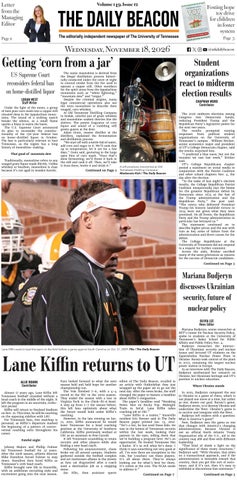
Lane Kiffin waits to lead the team on the field before a game against South Carolina on Oct. 31, 2009. File / The Daily Beacon
Lane Kiffin returns to UT ALLIE ROARK Contributor Almost 17 years ago, Lane Kiffin left Tennessee football stranded without a head coach in the middle of the night. It left the program in an uncertain, turbulent period. Kiffin will return to Neyland Stadium on Nov. 21. This time, he will be coaching on the opposing sideline with LSU. For Tennessee fans, this matchup is personal, as Kiffin’s departure marked the beginning of a pattern of controversial coaching exits throughout his career. Fateful night Johnny Majors and Phillip Fulmer led Tennessee football for 32 years. After the 2008 season, athletic director Mike Hamilton forced Fulmer to step down. Hamilton then hired Kiffin as Tennessee’s 20th head coach. Kiffin brought new life to Knoxville, with an ambitious recruiting style and excitement going into the next season.
Fans looked forward to what the next season held and held hope for another championship run. The Vols finished 7–6, with a 4–4 record in the SEC in the 2009 season. They ended the season with a loss to Virginia Tech in the Chick-fil-A Bowl. A step up from 5–7 the season before, this left fans optimistic about what the future would hold under Kiffin’s coaching. However, in the late evening on Jan. 12, 2010, Kiffin announced he would leave Tennessee for a head coaching position at the University of Southern California. Kiffin previously worked at USC as an assistant to Pete Carroll. It left Tennessee scrambling to retain recruits and other players while also finding a new head coach. Following his announcement, chaos broke out all around campus. Students gathered outside the football complex and set mattresses aflame in the streets as fans sat disgruntled after a coach used a destination job as a stepping stone. Zac Ellis, then assistant sports
editor of The Daily Beacon, recalled in an article with Outkickthat they just wrapped up the paper set to go out the next day. After the news broke, the staff changed the paper to feature a headline about Kiffin’s resignation. The paper’s headline read “Breaking News: Riot on Rocky Top. Midnight Train to SoCal. Lane Kiffin takes coaching job at USC.” “Lane Kiffin is a traitor,” Knoxville resident Eric Bonner said in The Daily Beacon paper printed Jan. 13, 2010. “He’s a liar, he has used these kids. He was in the homes of Tennessee recruits within the last week, looking their parents in the eyes, telling them that we’re building a program here. He’s an opportunist. He treated Tennessee like a harlot. It’s so evil what he’s done. I think it says something not very good at all. I’m sure there are exceptions to the rule, but (coaches) use these players. It’s all about them. They’re always looking out for what’s best for them. It’s rotten at the core. The NCAA needs to address it.”
Continued on Page 7
Mariana Budjeryn, senior researcher at MIT’s Center for Nuclear Security Policy, spoke to students at the University of Tennessee’s Baker School for Public Affairs and Public Policy Nov. 4. Budjeryn researches the intersection of Ukrainian security and nuclear issues and lectured UT students on the Zaporizhzhia Nuclear Power Plant in Ukraine. Russia took control of the plant in 2022, remaining the largest nuclear power station in Europe. In an interview with The Daily Beacon, Budjeryn synthesized her research on Ukraine, her Ukrainian heritage and UT’s position in nuclear education. Where Ukraine stands In 2025, Budjeryn compared the war in Ukraine to a game of chess, which is not played one move at a time, but rather as one, drawn-out goal. Russia’s game, Budjeryn wrote, is to destroy Ukraine and undermine the West. Ukraine’s game is to survive and integrate with the West. Budjeryn left readers with a question: What is America’s game? Now, Budjeryn sees the game as one that changes with America’s changing administrations. Because Ukraine is not an official North Atlantic Treaty Organization ally of the U.S., aid to the country may ebb and flow with different leadership. “That kind of sheds a light on the significance of these treaty structures,” Budjeryn said. “With Ukraine, that relies on a transactional approach, and if the administration is favorable toward that country, then you get this sort of assistance, and if it’s not, then it’s easy to withhold or discontinue that assistance.”
Continued on Page 3
News
Page 2
The Daily Beacon
@utkdailybeacon | November 18, 2026 | www.utdailybeacon.com
Letter from the Managing Editor:
Four years is a long time. Until it isn’t. LAUREN HOLLADAY Managing Editor I spent the last 21 years of my life hearing that college would be the best four I ever lived. Four years ago, I yearned to attend the University of Tennessee. I dreamt of being a Vol, and when the time finally came, I knew that what everyone always told me would always be true — the University of Tennessee would give me the best four years of my life. And it did. It is in my nature to plan ahead. Fortunately for my professional and academic careers, I do think five, 10, 20 steps farther than I should. With this, I did everything in my power to get here, to Knoxville, as soon as I knew I wanted to come to UT. Ask anyone who knows me and they’ll tell you I’ve got my next four years planned to a T, too. Unfortunately for my life beyond work, though, that same instinct that got me to Knoxville made it so hard to appreciate those best four years of my life, even while I stood right in the middle of them. Four years felt like an eternity
four years ago. The fact that I might miss the ordinary parts — passing Neyland every morning on my way to class, grabbing Chipotle on the Strip right before rush hour, watching the Fort wake up on a fall Saturday morning — didn’t even hit me until a few months ago. And I’m afraid of forgetting them. As a journalist, I have spent lots of time writing down other people’s stories — but that fear is exactly why I started writing down my own. I preserve my memories with a black ink pen, tucked away in a journal adorned with Claude Monet’s “Water Lilies” that sits by my bed. I write them frequently and read them less so, but I’ve learned that the moments I want to remember most are rarely the ones I planned for. Four years ago, I couldn’t have told you which people would become some of the most important in my life. I didn’t know that some would drift away, or that others I barely knew would become the ones I couldn’t imagine UT without. Tennessee has brought me many amazing things, but I may be most grateful for the way this place became so much more of a home than I ever imagined. I don’t think I fully
understood that until I started thinking about leaving. All of this said, I wrap up my time at UT with melancholic excitement — I planned for years, after all. But I too leave with a sharp understanding of exactly what I am leaving behind. I will miss driving to campus for home games and watching Fort Sanders roll awake to rally for the Vols. I will miss bringing you The Daily Beacon (but, fear not — you are in great hands). I will miss the normalcy of wearing bright, Tennessee orange at 8 a.m. on a Tuesday, and the feeling of belonging that comes with it. I will miss my friends, because the people truly do make the place. But, most of all, I will miss being home, knowing that 17-year-old Lauren is exactly where she wanted to be for so long. It’s a strange thing to spend so much time dreaming of something, only to realize that the best parts couldn’t have been planned for. I hope you know they weren’t lying when they told you UT will give you the best four years of your life. Turns out, you don’t need to know exactly where you’re going to appreciate exactly where you’re meant to be.
Lauren Holladay is a senior journalism and media student at the University of Tennessee. She will graduate from UT in December. Photo courtesy of Moments by Gracie Kay.
‘Corn from a jar’ | cont. from Page 1 The original blinding stew The federal ban dates back to decades before prohibition. During the Reconstruction era, the U.S. relied heavily on excise taxes from distilled liquor. To avoid paying these taxes, many Americans began creating their own spirits in stills hidden on their property. In an attempt to remedy this tax evasion, Congress passed a federal law to ban home distilling in 1868. The ban only applies to liquor. According to the Center for Disease Prevention, liquor is defined as any distilled spirit that is 40% alcohol or higher. While tax revenue drove this ban, there are also some safety concerns associated with crafting moonshine domestically. Issues with chemical and lead poisoning characterized these early shining operations. David Golden, food science professor at the University of Tennessee, said improper distillation could cause major health complications. “When distilled incorrectly, moonshine could contain methanol,” Golden said. “Methanol would cause blindness, and it will also kill you eventually.” Ingesting as little as a teaspoon of methanol can cause irreversible optic nerve damage. The spirit of Appalachia Long before moonshine became a staple of the American South, its origins began in Christian monasteries. After learning distillation practices from other countries, ScotchIrish monks adapted local grains to create a medicinal disinfectant. When ScotchIrish settlers immigrated to the Southeastern U.S., they brought their whiskey-making skills with them. “I think the history of it is very interesting,” Golden said, “especially with the heritage it has and how it has impacted Tennessee.” Golden explained that two brothers created the popular soft drink, Mountain Dew, as a moonshine mixer in Knoxville in the 1940s. Now, Mountain Dew is a $9 billion global brand. Moonshine’s influence on the region is evident in its inclusion in the unofficial fight song of UT. In the second verse of “Rocky Top,” the Osbourne Brothers tell a tale of two outsiders who travel into the Great Smoky Mountains searching for an illegal moonshine operation, only to not return. Later in that same verse, the song describes the craggy soil
of East Tennessee inhibiting the growth of corn and humorously pointing to moonshine consumption saying, “that’s why all the folks on Rocky Top get their corn from a jar.” This anthem rings out each time the Volunteers celebrate a football victory, but the celebration starts long before the game, as moonshine is a popular drink at Tennessee tailgates. Gratz even developed a special flavored moonshine dedicated to the Tennessee Volunteers. “I came up with a tangerine moonshine, made it 98 proof for the year we won the National Championship,” Gratz said, holding a jar filled with orange-colored liquor. “It’s one of our top sellers.” The master distiller joked that the highly-alcoholic libation could act as a stimulant for athletes. “I’m pretty sure I can feed some to Desean Bishop on Saturday, and he’ll run another 100 yards,” Gratz said. The popularity of illicit alcohol during the U.S. era of prohibition also indirectly led to the creation of stock car racing. Appalachian bootleggers, those transporting illegal alcohol, would modify their vehicles to be faster and hide heavy loads of moonshine from law enforcement. After prohibition ended, drivers turned to racing their high-powered vehicles — leading to the creation of NASCAR.
accounting major, took a more critical stance claiming that public safety should take priority over constitutionality. “You should be able to do whatever you want,” Hufner said, “but I think for the safety of people, they should drink through legal channels.” Tyler Hawe, junior film production major, said he did not care about the results of the Supreme Court vote if it did not impact his ability to consume moonshine. “As long as I’m still drinking it, that’s all that matters,” Hawe said. Supreme court consideration If the Supreme Court finds the ban unconstitutional, home distilling would not become legal nationwide. Kody Cooper, professor in the Institute of American Civics, shared some insight into constitutional law in this case. “It’s a question about the limits of government power, and frankly, individual liberty,” Cooper said. “If they repeal their federal law in this case, it would put it back to the states for them to decide.” If found unconstitutional, each individual state will decide whether or not to allow home-distilling and what permits or restrictions will be implemented. The Supreme Court is expected to reach a decision in the summer of 2027.
Graphic by Delaney Karr
Should moonshine stay banned? While making spirits domestically remains illegal, many hobby and commercial distillers have expressed interest in seeing its resurgence. “I think it’s great for people that want to go out there and try to innovate, create and do their own thing,” Gratz said. “A lot of people are a little scared of it because they think they’re not going to be drinking as much. We have not seen that happen in the wine industry or the beer industry at all. It’s just going to help us grow.” When asked, UT students held a variety of viewpoints toward the reconsideration. Megan Hiltner, freshman finance major, said the ban places unnecessary power in the government’s hands. “I think it’s like a big part of culture, and you should leave it up to people to choose whether they want to participate or not,” Hiltner said. “I don’t think the government should be the ones to control it.” Nolan Hufner, freshman
The swan neck of a moonshine still funnels alcohol vapor into a cooling condenser. Mackenzie Kish / The Daily Beacon
Bottles of moonshine line the shelves at Old Tennessee Distilling Company . Mackenzie Kish / The Daily Beacon
The Daily Beacon
@utkdailybeacon | November 18, 2026 | www.utdailybeacon.com
Page 3
World Rally Championship to bring race to Knoxville for action-packed weekend LUKE GOINS Contribtor In 1982, over 11.1 million people visited Knoxville for the 1982 World’s Fair, putting the city on the international stage. Forty-five years later, World’s Fair Park will once again take that stage as roaring engines roll in for a star-studded, American return to rally racing. The Fédération Internationale de l’Automobile World Rally Championship is headed to select areas of Tennessee and Kentucky on Aug. 26-29, 2027, for its prestigious return to racing on U.S. soil. The return comes nearly 40 years after the championship’s last race, the Olympus Rally, held in Washington. The championship attracted a global viewership audience of 504 million between January and mid-June 2026, bringing international attention to the trails of 15 Tennessee and Kentucky counties. Laying the rubber The four-day event will begin Wednesday, Aug. 26, with a ceremonial start in Music City, featuring live music, driver appearances and fan events on Nashville’s Lower Broadway. Unlike traditional circuit racing, the championship is mixed-surface racing, on gravel, paved and dirt roads. For Rally US, the competition will take place on separate gravel stages across the Appalachian Mountains and Cumberland Plateau. “We’ll have anywhere from 18 to 21 special stages throughout the weekend, which are those timed segments,” Rally US Chief of Staff Ryan Crews said. “Every stage will be within around 5 to 25 kilometers.” Knoxville serves a central
purpose to the event: service park and team base. Dubbed WRC Arena, World’s Fair Park will be the host of drivers and teams for the entirety of the event, hosting live events throughout the weekend. From World’s Fair Park, drivers will travel daily to and from each stage they race on public roads because the championship’s cars are street legal and registered with license plates. Teams will have a one-hour period to make any repairs to the car, and fans will be able to see the cars up close in the garage. “Every night, the cars will come back to World’s Fair Park. So that will be the hub of activity,” Ryan Crews said. Rally US CEO Matt Crews is confident that there will be no shortage of ways to experience the championship. “Our service arena, or WRC Arena at World’s Fair Park, will be incredibly interactive with fan-to-driver experiences, live music and live content,” Matt Crews said. “We’re going to give people a lot of ways to consume rally.” Leaving a mark The Volunteer State lives for entertainment. The gravel will be a proving ground for the drivers, but also for event organizers. “Tennessee does it better than most,” Matt Crews said. “We’re a hospitality state. We’re an entertainment state.” The rally is projected to be the most-viewed event in Tennessee’s history, as the championship brings in an average of 90 million in-person and online viewers per event. “It’s the global eyes that we’ll bring to this area, and the beauty of the roads and showing off the
hospitality for the visitors that Tennessee can do,” Ryan Crews said. “It’s not just this year, it’s five, 10 years down the road of travelers that will come to this area.” Entertainment isn’t the only thing on the minds of organizers. The automotive industry plays an equally significant role, with Nashville being the North American headquarters of the championship’s official tire supplier, Hankook, and Georgetown, Kentucky, holding the largest plant of 2026 World Rally Championship Manufacturer’s champion, Toyota. “We are a showcase geographically of the auto industry in Tennessee and in Eastern Kentucky,” Matt Crews said. “So this is a very, very strategic location for the auto industry.” Utilizing the current presence of rally in America is vital to the event. Founded in 2016, the American Rally Association sanctions the American Rally Association National Rally Championship, the country’s only top-level rally championship. Matt Crews knows that Rally US can build upon what the association has already made and work with them to create a lasting product. “It’s important for us to be a rising tide for the American rally community,” Matt Crews said. “And there’s no sense in us starting from scratch. Let’s utilize a longstanding rally championship here in America with past champions like Travis Pastrana.” Vols connection Just as Knoxville will be home to one of the world’s biggest stages in motorsport, it is also home to one of the biggest
Ukrainian security, nuclear policy | cont. from Page 1 Despite the inconsistent assistance, Ukraine keeps itself afloat, something Budjeryn said surprised her at the beginning of Russia’s invasion in 2022. “I think all of us were surprised that Ukraine did not fall. It withstood, especially in the first weeks of the war,” Budjeryn said. “I think that was something that nobody could have foreseen or expected, including Ukrainians.” Budjeryn said even U.S. intelligence could not predict Ukraine’s survival, even after U.S. systems predicted the 2022 invasion. “We talk about the successes of U.S. intelligence in getting the correct intelligence about the full-scale invasion, trying to persuade allies, and also Ukrainians, Ukrainian President Zelensky, who didn’t quite believe that, that this is going to happen,” Budjeryn said. “But we seldom talk about the failure of that intelligence to forecast that Ukraine would stand.” The lack of faith in Ukraine, Budjeryn said, at first pushed America away from sending substantial arms to Ukraine. “When Ukrainians said, ‘Well fine, you say there will be a full scale invasion. Give us some arms,’ Americans said, ‘It’s hard, just politically difficult,’” Budjeryn said. “But really what they were saying is, ‘We estimate you will not last.’” Since the invasion, the U.S. has allocated over $100 billion to supporting Ukraine. Balancing research and roots Budjeryn, who hails from Lviv, Ukraine, still visits her home country, not just for research, but to visit family members who still live in the country, namely her mother. Budjeryn said the war in Ukraine is chaotic, and can be dangerous, but it does not stop her from visiting. “I love going to Ukraine, despite the war,” Budjeryn said. “What I have discovered through my trips is that times of such extreme strife, like war and armed conflict, these are the worst of times, but they’re
also the best of times because they bring out the best in people.” In a way, the war provides a new perspective on life, Budjeryn said. “To see that resilience, see the courage and see how people support each other, and how generous they are to each other, that brings life and life experiences into really high definition,” Budjeryn said. As Budjeryn researches Ukraine and spends time working in America, she said it can feel like living in two different worlds. “When I come and I travel to Ukraine, I’m also no longer just a Ukrainian … I’m a little bit of a foreigner,” Budjeryn said. “It’s kind of this situation between two worlds, both of which you know very well, but in neither of which you fit entirely.” Still, Ukraine feels like home to Budjeryn. “The older I get, the more I understand that that’s my home, and at some point I’m going to go back there,” Budjeryn said. “Life there is very meaningful to me, and things that happen there are very meaningful to me, not just for the sake of Ukraine, but I think that’s where a lot of things that will be important for Europe in general are being forged today.” Budjeryn’s close connection to her area of study sometimes proves difficult to her role as a researcher. “I am a researcher and academic, and we are expected to have a somewhat critical distance in order to be able to approximate some kind of objectivity,” Budjeryn said. “It has been incredibly difficult to do that, especially since the war.” That same connection, Budjeryn said, allows her to tell the stories of Ukraine with care. “I’m not fighting in the front,” Budjeryn said. “My contribution might be to collect these stories, and put them in writing, and make sure that these stories survive and then
explain, in a way, my country to the outside world.” Advising America’s future leaders As Budjeryn prepared to speak to Baker School students, she remembered landing on Ukraine as a research focus early in her studies. She said choosing to focus on Ukraine was not deliberate at first. “There are those of us who know, and are very determined, about things they want to do in the future,” Budjeryn said, “and those, like myself, who just do the searching until they happen on a topic or an area that resonates with them.” Students who do land on political career paths, Budjeryn said, must bear in mind the weight that comes with influencing U.S. policy. “We are here in the biggest, most powerful country in the world … The decisions that are made in the United States, in Washington, D.C., always have impact on the rest of the world,” Budjeryn said. “It is a great responsibility for anyone engaging in policy in the United States, and especially military and defense areas.” Budjeryn said UT is in a prime position to shape the world of nuclear policy with its resources at the Baker School and its proximity to nuclear resources, like Oak Ridge National Lab and the Y-12 National Security Complex. “UT is a unique school that can bridge these divides and bring people together that engage in all of these areas,” Budjeryn said. As the world approaches what Budjeryn called a “nuclear renaissance,” and the militarization of nuclear power is called further into question, Budjeryn said it is on the future leaders of America to balance innovation with safety. “Pay attention to this space,” Budjeryn said. “There are things that are going on there that are kind of setting us up for failure if we do not address them now, on the ground floor.”
A road that will be used for Rally US in 2027. Photo courtesy of Ryan Crews / Rally US. universities in the country. With just over 41,000 students currently enrolled in the University of Tennessee, there is a wide range of interests among Vols. Rally US plans to tailor to every one of them. “We want to create an event where the diehard sports fan and someone who cares nothing about racing can both go and both have a great time,” Ryan Crews said. Having an event space like WRC Arena bring the entertainment directly to people outside of the racing action will draw new eyes to the sport. Rocky Top Racing Director and senior marketing major
Jacob Mink sees the potential. “(The championship) being in World’s Fair (Park) right next to one of the biggest universities in the South, I think it’s a wonderful move.” As a student and lifelong racing fan, Mink expects UT students to find authentic interest in a new sport. “I think it’s gonna be a massive introduction of motorsports to the student body,” Mink said. “You’re going to see a bunch of rally cars there, and you’re gonna be like, ‘What in the world is this?’ And that’s the kind of thing that brings the attention that you need.”
Midterms Reactions | cont. from Page 1 “Americans have faced rising costs as a result of the Trump Administration’s illegal war in Iran and reckless tariffs,” Bricker said. “Instead of delivering broad-based economic relief, the (administration) has shown its focus is on the financial well-being of the rich exclusively, passing tax cuts that disproportionately benefit the richest Americans. Americans have rightfully rebuked this agenda and voted in droves for Democrats.” BridgeUSA and its UT chapter are organizations with the mission of bridging the partisan divide and fostering healthy debate. The organization actively participated during the election cycle and took note of the results. “Bridge engages by inviting people who disagree to a room together. Does it always work? No,” Nick Huber, senior finance major and BridgeUTK member, said. “We’ve gotten turned down for collaborative events with various organizations more times than I can count. However, we have consistently had students from opposite sides stay 30 to 40 minutes after our gathering ends, just enjoying the conversation. I think that’s indicative of our success.” Leaders of the organization say they work to combat political polarization, an issue they believe is relevant to UT. “Political polarization is apparent at UTK, whether between campus organizations or within smaller groups,” Kristen Akins, senior anthropology major and BridgeUTK chapter president, said. “I’ve noticed it. The people around me have noticed it, and I think everyone feels it to some degree. That’s why I started going to Bridge.
Finding a safe space to disagree has changed what politics means to me and to everyone who comes. After three years, we’ve not only grown, but many people now see hope for a future where people can talk with those they disagree with.” In spite of the polarization they believe appears on campus, Akins and co-president Connor Corby, sophomore political science major, believe the midterms showed promise towards finding middle ground. “The Democrats played their games without getting pulled into Trump and Republicans’ social issue bait,” Corby said. “This ultimately proves that those that seek common ground and listen to voters will be the most successful candidates. Bridge believes in listening to the people in your community, and the Democrats did that the best and were rewarded.” As the count down for the 2028 presidential election begins, groups say they want to build on what they found to be successful. “We have many speakers we’re working on bringing to campus and hope to keep the blue wave rolling with more tabling and outreach in the campus community,” Bricker said. BridgeUTK leaders expressed a similar goal, pointing out certain events, like their midterm watch party, that garnered attention. “We saw the success of the midterm watch party and want to replicate that for 2028. We also see that people want to seek a community to discuss and analyze political processes together,” Corby said. “We recognize the popularity of some civic organizations and want to build civic engagement on campus.”
‘I VOTED’ stickers inside of the Baker School of Public Policy and Public Affairs, Nov. 3. Luke Goins / The Daily Beacon
Page 4
@utkdailybeacon | November 18, 2026 | www.utdailybeacon.com
The Daily Beacon
BetterCampus transforms online student experience CASSIDY GASPARD Staff Writer The University of Tennessee has used Canvas by Instructure since 2016 for students to access courses, assignments, grades and other instructor information online. While instructors can make basic customizations to their course pages, Jake Silver, CEO and co-founder of BetterCampus, wanted to take personalization a step further. Co-founder George Mills first created the tool five years ago during the COVID-19 pandemic. With his entire course load relying on Canvas, Mills coded a way to add color to the challenging time. Eventually, Silver, who was working at a startup consulting firm at the time, encouraged Mills to turn the tool into a full-time company. The extension was reformed, gaining a new name, brand, mission and team. Picking up steam this year, the extension is now used by over 2.5 million students around the world. “A couple years ago, it was just a project with one small little feature,” said Silver. “Now it is a business, a team, a vision.”
A student’s computer shows the BetterCampus website on Nov. 13. Jaden Vitt / The Daily Beacon
BetterCampus also works with other learning management systems, including Blackboard, Brightspace, Moodle and Google Classroom. Silver said that when crafting tools designed for student use, it is important to keep things simple. “We made it really, really simple, and we made the workflow that is studying really easy,” Silver said. “We have to make sure that any student anywhere could use it,” Silver said. New features
Graphic by Maya Williams
Since its creation, the company has added a variety of educational tools, including artificial intelligence lecture transcription, flashcard notes, study games, calendar syncing, task
planning, a GPA calculator, a digital pet and focus rooms. “You name it, we probably do it,” Silver said. “It’s been a wild, crazy ride, the past year and a half.” Silver recommended that students use BetterCampus’ study sets. Instead of manually entering information or exporting it through AI, students can transfer course materials directly into the platform’s study tools. “In one click, you could upload a file from Canvas that your professor uploaded and have it make flashcards for you, or quizzes or games,” Silver said. “It’s automatic, and it’s really fun to go study with.” Students can share their study sets with other classmates and create online study rooms. These community-driven tools, along with consistent calendar reminders, are meant to encourage
students to stay on track with their responsibilities. “You’re getting graded on your efficacy and ability to do well on the homework and the quizzes, not your time management skills, so this guides you and pushes you to do the right thing.” BetterCampus at UT Through an Instagram poll, The Daily Beacon found UT students use a variety of BetterCampus themes, ranging from Taco Bell and Gothic to Floral patterns and Snoopy. Multiple students also said they created their own custom themes using the extension’s creative tools. BetterCampus prioritizes user feedback as the company continues to expand and improve its platform. Taking pride in having a team made up primarily of college students, Silver sets itself apart from
other technology companies. “We listen to Discord and Reddit and read every single review and email,” said Silver. “There is importance in listening to the people you are building for.” Students can share feedback through the company’s website by joining a Discord server, or by emailing hello@ bettercampus.com. Looking ahead Silver’s main goal is to make BetterCampus a natural part of the student experience. He hopes to establish partnerships with universities to allow students to integrate the application early in their academic careers. “I want to get to that point where it’s second nature,” Silver said. “You’re in school, you get this tool. Why wouldn’t you?”
Arts & Culture
The Daily Beacon
Page 5
@utkdailybeacon | November 18, 2026 | www.utdailybeacon.com
Fostering Hope TN hosts toy drive for children in foster system ZOE MANDEL Staff Writer
A toy drive box is located inside of the Office of Sorority and Fraternity Life at the Student Union on Nov. 11. Jaden Vitt / The Daily Beacon
It’s the season of giving, and the Fostering Hope toy drive asks students to lean into the spirit of the season. Fostering Hope TN, Inc, is a 501(c)3 company that aims to help children and families involved in the foster care systems. Completely family run, Chante Hensley serves as the organization’s executive director and only employee. Co-founded by Hensley and her grandfather Allen McMichael in 2013, Fostering Hope TN is the result of her time as a social worker and McMichael’s church coming together to fill gaps within the fostering system. The organization place donation boxes around campus until Nov. 18 outside the office for sorority and fraternity life in the student union, as well as in the front office at sorority village. Off campus, Fable Hollow Bookstore in north Knoxville also collected donations. “I think a lot of people want to help but don’t know how,” Hensley said. “So this has been a great opportunity to tie them into the foster world.” This year’s toy drive is a change from previous holiday seasons. Normally, they’ll be sponsored by a business or Toys for Tots, but couldn’t secure one this year. They’ve turned to the community instead, asking them to donate new toys for kids and teenagers. “So myself and my husband have been foster parents for 13 years, and we’ve adopted nine children from foster care, and 180 children were in our home throughout that time,” Hensley said. Even after the kids move on from her home, she keeps in touch with both them and their families, noting how it’s “really amazing to have such a large
extended family.” For masters student Ella Williams, the family-oriented nature of Fostering Hope TN led her to choose to work with them for a capstone project in her public relations class. “I felt like Chante was just so genuine, and I really felt like she could use the help just because it’s such a small nonprofit,” Williams said. Williams and a group of her classmates partnered with Hensley to market the toy drive and help build up Fostering Hope TN’s brand. They got Hensley connected further with the UT community by getting her cemented in ServeUTK, which allows her to upload volunteer opportunities onto the server for students to sign up for. Through the toy drive, students and community members have the opportunity to help their community while still being on a busy schedule. The toys get collected for the Christmas party, where they’re given to children both at the event and laid out for parents to take for the holiday itself. “A lot of the foster parents and adoptive parents can also go through and give those toys
to the children on Christmas,” Williams said. The annual Christmas party hosts 250 kids and their families, providing them with toys and food. Santa Claus also makes a special appearance. As a Christian organization, Fostering Hope TN is rooted in the sentiment of Bible verse Jeremiah 29:11 and the goal of providing children with “a hope and a future.” Hensley explains how they’ll pray over every bag that they give out, each one including an encouraging note and the occasional bible when possible. “A lot of these kids feel very sad and scared and lost, so just having that there in their life to guide them is very helpful,” Hensley said. The reactions to these notes has been overall positive from the children receiving them, with many using the verse as their motto. “We try to intentionally reach out to those kids to let them know God is there and God loves them … I’ve had lots of people think, ‘I cannot believe a stranger would be praying over me or thinking of me,’” Hensley said.
I think a lot of people want to help but don’t know how. So this has been a great opportunity to tie them into the foster world.” CHANTE HENSLEY Fostering Hope TN co-founder
The Lair: ‘Collective home’ for community and entertainment ZACHARY WARDLAW Contributor In a small back lot on Clinch Avenue on Friday nights, owners of The Lair host house shows by local Knoxville bands. The owners, known as ‘The Villains of Clinch Avenue,’ gave The Lair its name. The shows primarily consist of live music, whether that be a smaller local band that the owners will try to promote, or a larger upcoming band like The Band Solstice. Three of the owners, Graham Gaskins, Clark Davis and Ethan Bartlett, maintain connections with local bands in the area and love to give them opportunities to display their talent. According to the owners, playing at a college house party is “the pinnacle
The Band Solstice guitarist Jackson Frazier performs at The Lair on Sept. 18. Zoe Mandel / The Daily Beacon
college thing that you want to do in a band,” speaking to their motivation to host these shows for zero profit. David Glass is a prominent attendee of The Lair and a drummer who performed during the venue’s Oktoberfest celebration. “The Lair is good exposure for anyone who’s looking to get into the music scene in Knoxville, I think, especially with a student fan base or attendees — that also goes a long way in promoting your band or whatever project you might be working on,” Glass said. The owners, Gaskins, Davis, Bartlett, Walker Joice, Brady Board and Soren Blasiole, started regularly hosting during their sophomore year in 2024. Three years later, they are still giving opportunities for students to
come listen to live, quality music on Friday nights. Because fraternity parties with live music aren’t available to everyone, the owners formed a solution: hosting shows right in their backyard. When they first started hosting, they used primitive entertainment systems, but in the years since, they have upgraded their lighting and audio systems, as well as worked with their nextdoor neighbors to ensure a good experience for those who attend. “A lot of colleges have it where, like, you have to be in a fraternity or something to go to concerts … but having open house shows for like anyone to come is like really awesome,” Davis said. “It’s good for the artists. It’s good for the people. It’s a win for absolutely everyone.” Around 500 students will cycle
in to watch the show on a usual night. When The Band Solstice performed, that number reached 1,200-1,300 people in attendance. The owners now overhear students discussing their parties in class as a result of the influence of Friday nights at The Lair. ‘The Villains of Clinch Avenue’ are grateful for the opportunity over the last three years. They claim that throughout their time running this operation, The Lair has become a sort of “collective home”
for all students that attend. The house and the lot have been passed between multiple classes of students now, creating a generational community among students in attendance. As the owners face their final year of college, the legacy of The Lair remains uncertain, but they promise to make their last year of hosting for attendees a year to remember. “The Lair is home for them too,” Bartlett said.
The Band Solstice singer Marty Gee performs at The Lair on Sept. 18. Zoe Mandel / The Daily Beacon
Page 6
DAILY BEACON STAFF AND POLICY INFORMATION
Opinion
The Daily Beacon
@utkdailybeacon | November 18, 2026 | www.utdailybeacon.com
Over-apologizing isn’t serving you MARIN MCGUIRE Contributor
EDITORIAL EDITOR-IN-CHIEF: Patrick Busch MANAGING EDITOR: Lauren Holladay COPY CHIEF: Margaret White NEWS EDITOR: Olivia Lee ASSISTANT NEWS EDITOR: Tessa Nacke ARTS & CULTURE EDITOR: Harper Brabson SPORTS EDITOR: Trevor McGee ASSISTANT SPORTS EDITOR: Alex Sarkis OPINIONS EDITOR: Natalie Dripchak PHOTO EDITOR: Jayden Randolph DESIGN EDITOR: Maya Williams DIGITAL EDITOR: Trip Scoutten SOCIAL MEDIA EDITOR: Sarah Portanka AUDIENCE DEVELOPMENT EDITOR: Grace
White
EDITOR EMERITUS: Caden Dyer COVER DESIGN: Maya Williams PAGE DESIGNERS: Delaney Karr, Kiersten
Collins, Amelie Carrillo, Shelby Perdue GRAPHICS BY: Maya Williams, Shelby Perdue, Delaney Karr, Hayden Sauer
ADVERTISING/PRODUCTION AD MANAGER: Holland Sixbey
TO PLACE AN AD, please email admanager@utk.edu.
CONTACTS TO REPORT A NEWS ITEM OR SUBMIT A PRESS RELEASE, please email editorinchief@utdailybeacon.com or call (865) 974-2348 LETTERS POLICY: Letters to the Editor must be exclusive to The Daily Beacon and cannot have been submitted to or published by other media. Letters should not exceed 400 words and can be edited or shortened for space. Letters can also be edited for grammar and typographical errors, and Letters that contain excessive grammatical errors can be rejected for this reason. Anonymous letters will generally not be published. Authors should include their full name, mailing address, city of residence, phone number and e-mail address for verification purposes. Letters submitted without this information will not be published. The preferred method to submit a letter to the editor is to email the editor-in-chief. CORRECTIONS POLICY: It is the Daily Beacon’s policy to quickly correct any factual errors and clarify any potentially misleading information. Errors brought to our attention by readers or staff members will be corrected and printed on page two of our publication. To report an error please send as much information as possible about where and when the error occurred to editorinchief@ utdailybeacon.com, or call our newsroom at (865) 974-5206. The Daily Beacon is published by students at The University of Tennessee on Wednesday during the fall and spring semesters. The offices are located at 1345 Circle Park Drive, 11 Communications Building, Knoxville, TN 37996-0314. The newspaper is free on campus and is available via mail subscription for $200/year or $100/semester. It is also
All we ever do is apologize. There are times when we need to be sorry, when we should take the time to reflect on our actions and give those we hurt an apology. But there are also circumstances where we don’t need to — where we need to stop apologizing so that when an apology is truly needed, it matters. I have spent my life apologizing, both when I need to be sorry and when it isn’t even my fault. It is a reflex. A habit. Something my mouth can’t go without saying. I opened the door for you and stood for a moment too long in your way? I’m sorry. I accidentally bumped your arm? I’m sorry. I’m sitting down but that leaves you standing? I’m sorry. I’m tired and not acting like myself? I’m sorry. I’m always sorry. Most of us are. But why? Why are most of us spending our lives apologizing? I apologize to form a buffer, to make sure people understand I truly didn’t mean to be an inconvenience. I believe that this act of apology that many of us are guilty of stems from our desire as humanity to be liked and to fit in. We try so hard to make sure everyone likes us that we apologize as often as we breathe. Because of this, apology has become a fickle and meaningless thing. We do it so often that when it is needed the most, it’s almost like it doesn’t even matter. As a college student, I hear the words “I’m sorry” come from my mouth and other students everyday. This may not seem like an issue. After all, it’s always nice to think someone is sorry. But that’s where apology becomes tricky. When we apologize frequently, it takes away from our real and needed apologies — ones for when we hurt someone or when we do something wrong. When we utter the words “I’m sorry,” we are reciting something embedded in our brain. It escapes our lips with no thought, just reflex. So when we really hurt someone at a deeper level and realize we owe them an apology, the words are easy to say. They are easy to fake. How will we know people are really “sorry” when all they ever say is that they’re sorry?
Graphic by Meredith Lambert As Daniellle LaPorte, Canadian author and entrepreneur, said, “Apologize for mistakes. Apologize for unintentionally hurting someone — profusely. But don’t apologize for being who you are.” We don’t have to apologize for existing and being who we are. What we need to do is unlearn the habit of apology. This is an extremely hard task to accomplish. I have spent a better part of my life apologizing for every minor inconvenience, and unlearning that habit takes time. The reality is that sometimes, you don’t need to apologize for something, you just need to acknowledge it. Someone almost runs into you? Pardon me. Someone is going through a difficult time? I understand, what can I do to help? These words take the apology out of our response and leave
room for when they are needed most. I am in no way saying that we should stop apologizing, but we should take note of when and why we are. The problem isn’t that we say sorry, it’s that we say sorry too much. We need to be intentional about our use of apology, so that we don’t lose what it really means to be sorry. What is important to note is that sometimes they don’t need an apology. That person who you forgot to hold the door for, that person who hurt you, that person who you didn’t wave to because you didn’t see them — they don’t need your apology because what exactly would you be apologizing for? Existing? Being distracted? Having feelings? Not every human action needs an apology backing it up.
In reality, apology doesn’t gain you anything unless you have truly hurt someone. People are going to have their opinions of you no matter what words you say. That “I’m sorry,” you say to a random person on the street isn’t life changing. In fact, most of the time it is forgotten. Even when you are truly sorry, you can’t change a mind with an apology. You can only hope that forgiveness is given where necessary. We all make mistakes, and not all of those mistakes require an apology. You can’t apologize your way into being less of an inconvenience. All you can do is acknowledge, and then continue along. Life is too short to spend it always apologizing. So stop being so sorry.
5 things listening to the radio has taught me Cartoon Cartoon CADEN DYER Editor Emeritus I learned how to drive with the radio. My parents’ war on technology meant an iPhone remained off the table until senior year. Embarrassingly, I owned a flip phone instead, which usually ended up in the glove compartment of my 2006 Honda CR-V. It might seem silly, but learning to drive a car in 2020 without a smartphone came with challenges. For example, no Apple Maps. Instead, I printed off physical directions from our family computer and clutched them in one hand while driving with the other. It didn’t imbue me with an innate sense of direction (like I’d hoped), but it did instill in me a confidence that I was capable of getting anywhere I wanted, if I tried hard enough. And I loved to drive. It meant going to work, where I made my own money and started planning a future after high school. It meant solitude, a rare treasure in my eight-person household. It meant independence, my deepest craving. Driving was — and continues to be — a fundamental cornerstone of who I am. But the radio existed as my faithful companion in the car from day one. Spotify-less, I rejected CDs. I didn’t need the flimsy cases cluttering up my car, and the removing, inserting, adjusting, and switching between discs required far too much fumbling around while trying to drive. No, CDs didn’t cut it. I turned to radio. My presets were simple and stayed that way. I even knew which stations would be clearer hours away from Dayton.
For nearly two years, I drove to the sound of talk show hosts and music bereft of an algorithm. I was introduced to new songs, good songs, bad songs and awful songs. Instead of living in a constant state of annoyance, I realized I had grown fond of different shows and ads. I still remember crying to a Brad Paisley song in the car after hearing it for the first time. Of course, I eventually got an iPhone. From senior year of high school to senior year of college, Spotify ruled my CR-V. But when my sister totaled it in July and I started driving a different old car (this one without a port for my phone), I faced radio yet again to avoid driving in silence. This time, it was harder. Radio didn’t meet my need for customized, algorithmic personalization. I had grown accustomed to getting what I wanted, when I wanted it. Radio didn’t care that I’d had a rough morning and wanted to feel better through some hype music — inevitably, a sad song would start wailing through the speakers. And radio hosts aren’t trained for a Gen Z target audience… most times, their conversation topics put me to sleep. But ever so slowly, I began to see the good in radio. Not only did radio overwhelm me with some great nostalgia, but I learned amazing life lessons. So here are 5 things radio has taught me since August: 1. Switching channels doesn’t always get you what you want. Many times, the channels I’m switching to are playing a song I dislike even more — or worse, it’s a commercial break! Sometimes it’s better to appreciate where you’re at in the moment. 2. Radio is a lot of things.
It’s not just music — it’s news, weather, ads, traffic, discussion, competitions, giveaways, and storytelling. The journalist in me thrives on the little snippets of the host’s everyday life. But I’ve also been pleasantly surprised to find I enjoy hearing the weather and traffic forecast each day. Don’t judge a book by its cover. 3. It’s ok to not be living in my perfectly tailored, personal media bubble. Country stations and talk radio here in the South can be hard-right sometimes. I’m learning to think critically when presented with views I don’t agree with. It’s good to push myself outside my algorithm. 4. The “top songs” are often the ones I dislike the most. I mean, I’m all about a good country song. But if I have to hear Ella Langley’s “Choosin’ Texas” one more time, I’m going to drive my car right off a bridge. Popular doesn’t always equal best. 5. And finally, radio has taught me that it’s ok to sit in silence instead. One day, a few weeks into the radio routine, I was really missing my Spotify. I turned on my favorite station (96.7 Merle: Forgotten Favorites), and the sound of the host’s voice genuinely enraged me. All I wanted was music — Harry Styles, to be exact. I just turned the darn thing off completely and drove to school in the quiet. Normally I despise silence, but somewhere along Merchants Drive I realized that my distraction-free driving was producing some of the deepest thoughts I’d had in weeks. Taking a small break from all media can allow our minds to breathe.
Audrey Siemens / Cartoonist
The Daily Beacon
Sports
Page 7
@utkdailybeacon | November 18, 2026 | www.utdailybeacon.com
Tennessee football directs its destiny with LSU ahead TREVOR MCGEE Sports Editor
Tennessee football head coach Josh Heupel leads the Vols onto the field for a game against Texas A&M at Kyle Field on Nov. 14. David Smith / The Daily Beacon
We’re just focused on the game. That’s extra stuff.” DeSean Bishop on Lane Kiffin’s return Running back
Lady Vols soccer earns spot in NCAA Tournament TYLER EDMANDS Staff Writer For the sixth straight season, Tennessee soccer is going dancing. Despite their lowest win total since 2015, the Lady Vols earned a No. 8 seed and will host Liberty Friday, Nov. 20 at 6 p.m. at Regal Soccer Stadium. Tennessee’s Jonathan Morgan will serve as interim head coach after head coach Joe Kirt’s termination on Nov. 2. After losing to Virginia 2–0 and Pitt 1–0 early in the season, Liberty finished with a 16–2–3 record. The Lady Flames marched to the Conference USA Championship, where they defeated No. 2-seed Western Kentucky to win their second straight conference championship. While the Lady Flames enjoyed
a successful season, Tennessee’s year ran far from that. After peaking at No. 4 in the national rankings in September, the Lady Vols won just one more game. They finished the year 2–5–3, defeating LSU on Sept. 11 and Oklahoma in the season finale. The Lady Vols missed the SEC Tournament for the first time since 2019. Though they finished 7–5–4 overall, the Lady Vols enter their 17th NCAA Tournament with an RPI of 36. Liberty enters its 10th tournament with an RPI of 17. The two teams have little history, with their only two matchups ending in a double-overtime draw in 2015 and a 2–0 Tennessee win in Knoxville in 2016. Despite the recent success, the Lady Flames have yet to win an NCAA Tournament game in the Round of 64 or beyond. They defeated Tennessee Tech
in a play-in game in 2000, but otherwise have a 0–9 record in the tournament. Tennessee is 17–15–3, but the Lady Vols have not won a game since their upset of Xavier in 2023. Morgan will lead Tennessee in the tournament. The interim head coach is in his 11th year at Tennessee, but this will be his first game at the helm. Morgan record as head coach is an unimpressive 35–36–9, all of which came from his stint at Maryland from 2012–15. The winner will advance to play the winner of Lipscomb or Ohio State either Nov. 27 or Nov. 30. The Big Ten Champion Buckeyes land as a No. 1 seed with a 15-2-1 record, the best win percentage in program history. They’ll host the 9–4–7 Bisons at home Nov. 20 at 6 p.m. as well.
Tennessee football controls its own destiny. The Vols are 8–2 with a pair of conference matchups remaining. Two wins mean they clinch a spot in the College Football Playoff, while one more loss all but closes the door. Standing in their way is a familiar foe who left Knoxville in the middle of the night in 2010. Lane Kiffin returns for the first time since his Ole Miss Rebels spoiled Josh Heupel’s inaugural season with Tennessee in 2021. The Vols must silence the outside noise. “We’re just focused on the game. That’s extra stuff,” said running back DeSean Bishop, who’s carried the weight of Tennessee’s offense during his Heisman-campaigning season. That noise is amplified with LSU coming off a loss. The Tigers have lost back-to-back games and sit at 6–4 on the season with the CFP out of the picture. The talent outweighs the results, though. LSU put together one of the nation’s most expensive rosters this offseason, with Kiffin bringing in championship-caliber players he’d hoped would mesh together. Quarterback Sam Leavitt headlined the class. The Vols were reportedly in heavy pursuit of the Arizona State transfer before Kiffin swayed him to Baton Rouge. Leavitt hasn’t lived up to expectations. The Arizona State transfer has struggled to take care of the football. He’s logged 12 interceptions, leading the country in the category, while coming off a three-interception performance in a last-second loss to Texas. He’s still averaging 279.7 passing yards per contest, but now faces what could be the toughest defense of the season. Leavitt has thrown for less than 200 yards in just two games this season: 158 at Ole Miss in Kiffin’s first return, and 177 yards against McNeese State, a game he didn’t play all
the way through. The Vols’ defense has allowed just four quarterbacks to throw for more than 200 yards this season. Opponents are averaging 164.2 passing yards per game, as Tennessee has given up just 1,642 passing yards all season. Quarterbacks have just four passing touchdowns to 11 interceptions against Jim Knowles’ defensive unit. Tennessee is coming off one of its best pass defense performances of the Josh Heupel era, giving up just 93 passing yards to Marcel Reed and Texas A&M. The Vols intercepted two passes and suffocated the Aggies’ offense in allowing 179 total yards. It sets the stage for a defensive clash on Saturday afternoon. LSU’s defense has been a stifling unit this season. The Tigers are No. 1 in the SEC in total defense, giving up 262.3 yards per game. It leads to only 18.1 points per game for opponents. Sacks will be the name of the game. LSU ranks first in the country with 40 sacks, just one takedown ahead of the Vols’ 39 this season. “Really good talent, just length, explosiveness, power,” Heupel said. “Their guys have multiple ways to get to the quarterback, and then their pressure package is a part of that as well. So combination of all those things, why they’ve been really good at getting to the quarterback.” For whichever young quarterback takes a bulk of the snaps — George MacIntyre is dealing with a knee injury suffered against Texas A&M — the task won’t be easy. “This is an extremely talented football team, both sides of the football, as talented as you’re gonna see inside of this league,” Heupel said. “And they’ve lost a couple close ballgames, but it’s a really good football team.” The Vols need a win to keep their playoff hopes alive, while LSU looks to salvage an expensive season. Tennessee and LSU kick off at 3:30 p.m. Nov. 21 inside Neyland Stadium.
Kiffin returns | cont. from Page 1 First return to Neyland While Kiffin left Knoxville in 2010, it wouldn’t be the last time he made headlines in Knoxville. In October 2021, Kiffin returned to Knoxville, this time as the head coach for Ole Miss. The Rebels went on to defeat Tennessee 31–26, but events in that game set the stage for Kiffin’s next return to Knoxville. During the fourth quarter, fans became increasingly upset after an officiating decision. Ole Miss stopped Tennessee a yard short of a first down on a 4th-and-24 pass play. Fans began throwing all sorts of objects onto the field, including water bottles, a golf ball, a mustard bottle and concession items. “I still have my souvenir golf ball,” Kiffin said after the game. “I also got hit with bottles with some brown stuff in them. I don’t think those fans would waste moonshine. You’ve got one of the most passionate fan bases in America. A call didn’t go their way.” After the uproar, an extended 20-minute delay led to the cheerleaders, dance team and band being escorted off the field. Other security crews cleared parts of the stadium and cleaned the field of debris. Looking ahead Kiffin
returns
to
with an LSU squad underperforming expectations. The Tigers are looking to bounce back after a 22–21 loss to Texas at home. They are currently 6–4 overall and 3–4 in SEC play, losing the last two games. Tennessee is going into the weekend with a 22–7 road victory over Texas A&M. The Vols are 8–2 for the season and 5–2 in SEC play. As Kiffin prepares to head back to Knoxville, many fans still remember the night he left Knoxville so abruptly. Now, the Vols face another chance for redemption against their former head coach. “This is going to sound crazy. This season has been so much. As we were getting ready and I started watching film, it actually didn’t even cross my mind that I used to be there and how the fans were going to be,” Kiffin said. “I feel like we’ve been in so many toxic environments and things so far that it’ll just be more of it. I really hadn’t thought much about it.” Tennessee is searching for a much-needed win to keep its College Football Playoff hopes alive, while fans are still searching to heal an old wound and reclaim pride from that shocking night.
Knoxville
Lane Kiffin is a traitor ... He’s an opportunist. He treated Tennessee like a harlot. It’s so evil what he’s done.” The Lady Vols celebrate a goal scored by Emerson Moore during a game against Oklahoma at Regal Soccer Stadium on Nov 1. Brady Heisman / The Daily Beacon
Knoxville resident Eric Bonner The Daily Beacon paper printed Jan. 13, 2010
Page 8
Entertainment
The Daily Beacon
@utkdailybeacon | November 18, 2026 | www.utdailybeacon.com
Courtesy of Domen Puncer Kugler © 2008-2025
2026 FOOTBALL PICK‘EMS Theo Colli, Senior Staff Writer (57-19) LSU 21 vs. Tennessee 23
UCLA vs. Michigan
Indiana vs. Washington
Utah vs. TCU
Texas Tech vs. Baylor
Kentucky vs. Missouri
Trevor McGee, Sports Editor (54-22) LSU 24 vs. Tennessee 21
UCLA vs. Michigan
Indiana vs. Washington
Utah vs. TCU
Texas Tech vs. Baylor
Kentucky vs. Missouri
Alex Sarkis, Assistant Sports Editor (53-23) LSU 20 vs. Tennessee 17
UCLA vs. Michigan
Indiana vs. Washington
Utah vs. TCU
Texas Tech vs. Baylor
Kentucky vs. Missouri
Trip Scouten, Digital Editor (50-26) LSU 17 vs. Tennessee 28
UCLA vs. Michigan
Indiana vs. Washington
Utah vs. TCU
Texas Tech vs. Baylor
Kentucky vs. Missouri
Tessa Nacke, Assistant News Editor (50-26) LSU 27 vs. Tennessee 21
UCLA vs. Michigan
Indiana vs. Washington
Utah vs. TCU
Texas Tech vs. Baylor
Kentucky vs. Missouri
Patrick Busch, Editor-in-Chief (48-28)
This chart is compiled weekly by Tessa Nacke, assistant news editor, in accordance with the 60-Day Crime Log available at https://clery.utk.edu/crime-log/.
LSU 21 vs. Tennessee 24
UCLA vs. Michigan
Indiana vs. Washington
Utah vs. TCU
Texas Tech vs. Baylor
Kentuckyvs. Missouri