


CASSIDY GASPARD Contributor
OLIVIA LEE Staff Writer
MARGARET WHITE Staff Writer
In coordination with UTK’s chapter of Turning Point USA, Blackburn spoke to over 100 members of the UT community in the Student Union ballroom.
Blackburn, who is campaigning for her 2026 gubernatorial run, encouraged students at the event to register to vote.
“In this country, ‘one person, one vote,’ is vitally important,” Blackburn said. “One of our precious rights is that right to go cast that vote and participate in the electoral system.”
Gaines and Thifault have been heavily involved with Turning Point throughout their careers.
where the representatives actually face-to-face dialogue with the people that they represent.”
Blackburn, who has been criticized by some constituents for not holding public, in-person town halls, used the event as an opportunity to answer questions facing young voters.
“I do think that it’s important for politicians to get involved with their constituents because that’;s who they serve,” UTK’s Turning Point Chapter President Emma Arns said. “We definitely want to see more of that and plan to have more of that in the chapter.”
OLIVIA LEE Staff Writer
As university enrollment declines nationwide, University of Tennessee administrators boast sturdy enrollment numbers for the fall 2026 semester.
UT Provost John Zomchick provided an overview of the university’s fall 2026 enrollment at Monday’s faculty senate meeting, days after UT’s first-year student enrollment confirmation deadline.
“I’m happy to announce that we have had a very strong confirmation response, and we are on target to meet our enrollment goals for fall of 2026,” Zomchick said. “As you know, that’s not the case across the country, so we continue to be a destination of choice.”
UT’s enrollment matched last year’s goal of serving Tennesseans and enrolling in-state students, Zomchick said. He also noted an increase in the number of honors students enrolled.
Large enrollment numbers have brought concern to UT students, faculty and staff who worry about limited parking and steeper housing costs. These concerns spiked after the UT board of trustees approved a $280 million Neyland Entertainment District project Monday.
Questions over the project’s funding have been raised on campus since last week, when Athletics Director Danny White announced plans for construction to commence this summer. UT Chief of Staff Matthew Scoggins clarified that while the campus and UT Athletics are contributing in part to the project, the $280 million price tag is attributed to private investment.
“The campus is not subsidizing athletics. The campus is not subsidizing entertainment,” Scoggins said.
Senators asked Scoggins how the university expects to handle parking as the current G10 parking garage is replaced with a new, $83 million garage, which plans indicate will offer 1,316 spaces. According to Scoggins, the university is developing a surface parking lot on Stephenson Drive to accommodate motorists amid the construction.
“We love the G10 parking garage,” Scoggins said. “But we need to be using that area of campus in a more strategic way.”
See ‘FACULTY SENATE,’ Page 2
musician with asthma, he must put his own health at risk to make money at venues that allow indoor
Sophomore University of Tennessee student Lincoln said indoor smoking has never impacted his
“Smoking in bars has never affected my experience in a bar, let alone it being a deciding factor in staying or leaving,” Lincoln said.
He noted that the proposed ordinance could shift the social dynamic in these spaces by creating a divide between smokers and non-smokers.
“Having bars that allow indoor smoking gives them a unique characteristic and distinctive atmosphere,” Lincoln said. “Although the majority of bars have outside areas for smoking, in those areas, I feel disconnected from the main social atmosphere, disrupting the overall experience.”
He added that businesses without outdoor smoking areas could be particularly affected, as he has witnessed firsthand the appeal of establishments that permit indoor smoking.
recognizes students who exem plify leadership, a potential future for public service and academic excellence.
Recipients of this scholarship receive $30,000 for graduate school, leadership training, a summer spent at an institute in D.C. and a vast network of connections for future internships or careers.
Beyond being one of the 55 winners for this application cycle, Dieter will join the network of all of the 3,673 Truman Scholars named since 1977.
“The application process is not easy. It’s like a bunch of essays, a policy proposal, different (recommendation) letters about different aspects of your leadership, service, character, those kinds of things. … It comes with a lot of opportunities,” Dieter said.
Dieter worked tirelessly to apply for the award. Initially nominated by the Office of Undergraduate Research and Fellowships, she was chosen as one of four students to represent UT on the national stage.
“I did admittedly feel a little bit of imposter syndrome when I was announced as a finalist, but then when I had so many people supporting me and talking to me about the process, that really gave me a lot of confidence going into the interview, which I think allowed me to do a lot better than I would have done,” Dieter said.
Dieter said she is proud of the writing she accomplished as part of her application.
“The Office of Undergraduate Research and Fellowships also helped me a lot with my essays. And I think those were, honestly, some of the best things I’ve ever written, just because of how much we met about them, talked about them and revised them. They were some of the best things I feel like I’ve ever produced,” Dieter said.
Outside of Dieter’s academic prowess, she is involved with UT Ambassadors, Vol Team, Baker School Ambassadors and the Student Government Association. She also serves as a student commissioner on the Tennessee Higher Education Commission, and she will step in as SGA’s chief of staff under Caroline Marcus in the fall.
“I think a lot of the different (organizations) on campus also
really helped me, I think being an ambassador gave me a lot of confidence with public speaking and talking about myself, and kind of just like, being able to articulate different things really well, especially in an interview setting or in a setting to people I had never talked to before, even if they aren’t necessarily receiving it well,” Dieter said.
Dieter’s community backed up her story of success, and she had support not only from her friends and peers but also from UT resources.
“(Dieter’s) journey from Signal Mountain to the Truman stage is a powerful testament to what happens when a student’s drive meets the UT ecosystem of support,” Senior Vice Provost for the Division of Student Success Amber Williams said. “At the University of Tennessee, we’re not just focused on academic milestones; we are committed to nurturing the kind of visionary leadership (Dieter) shows as she advocates for the future of education policy.”
Dieter will be interning in Washington, D.C., this summer, working with policymakers on education policy.
“I’m just excited to be up there doing work I actually really care about for (education) policy, but
also being up there with a bunch of my classmates and then the people in the grade above me. ... The Truman scholars who just finished their undergrad degrees are going to be in D.C. through the summer institute, so I’ll be able to meet them and to gauge their experience that they’re having this summer before I do the summer institute through Truman next summer,” Dieter said. As Dieter looks toward the future, including a possible career in public policy, she remains steadfast in the discipline and hard work she pursues every day.
“I think it’s definitely more than just the leadership classes, the money, the recognition, all those things,” Dieter said. “To me, it’s really kind of a nod to the things that I’ve been doing for a really long time and to the places that I want to go, because I never really saw a career in public service as something I’d actually be able to do right and pursue, so to actually have the tools, the resources and to be given that recognition that I’m able to do that, and I’m able to pursue that and be in a career path that’s so fulfilling to me, is something that I’m just really excited to keep in mind in the future, and really excited to get the ball rolling with all of that.“


and business operations while working with her twin sister to expand marketing efforts and generate interest among UT students.
MARGARET WHITE Staff Writer
NASHVILLE, Tenn. — “We have to change, too much is at risk.”
Those are the words of former Vice President Al Gore, delivered at The Climate Reality Project’s 20th Anniversary Climate Reality Training at The Pinnacle in Nashville on May 2.
The Climate Reality Project, a nonprofit organization founded by Gore, hosted the event as one of three global climate advocacy leadership trainings to continue to add to the Climate Reality Leadership Corps.
Trainings like this began in Tennessee after the release of Gore’s 2006 documentary “An Inconvenient Truth,” when he invited 50 people to his barn to teach them about the climate crisis and what they can do about it.
These events, held “to equip grassroots advocates with the skills and knowledge to become effective communicators for climate action,” include multiple days of educational panels, discussions and speakers.
Gore gave a presentation titled “Truth in 20,” during which he explained the urgency of climate action. The presentation featured captivating visuals and in-depth statistics to help thoroughly ed-
ucate the trainees.
“We have to change ... We have a moral obligation to our children and grandchildren, and all future generations, and also to ourselves, because we’re beginning to feel this more keenly in our own time,” Gore said.
Gore, as well as his fellow panelists, placed an emphasis on the youth’s vital role in solving climate issues.
“Because our country is based on the basic principle that all just power comes from the consent of the governed, we need to revitalize our democracy, and young people have traditionally been the ones with the most energy and creativity and passion to do that,” Gore told The Daily Beacon.
Gore was joined by panelists Michael E. Mann, a professor of earth and environmental science at the University of Pennsylvania, and Rosina Bierbaum, a professor of natural resources and environmental policy at the University of Michigan and board member of The Climate Reality Project.
“We want to equip students today with the tools that they need to move us forward on climate and all the other major challenges we face,” Mann said. “But, we can’t wait until they’re in the position to do that, it will be too late. And so, we, of course, have to equip them with those
tools, but we have to take action ourselves to make sure that we don’t mortgage the planet for future generations before they have the time to take hold of their own situation.”
The speakers also expressed the immense progress that has been made on accessibility and prevalence of these tools.
“In 1975, there were only four programs in the United States that offered energy, environment and policy together, one of them right here at the University of Tennessee, by the way … However, now, there are hundreds of these all across the country,” Bierbaum said.
Twenty-six-year-old New York University student Kornelius Sembiring was one of the trainees during this event, and described how, as part of a younger generation, his eyes have now been opened to how he can contribute to the climate crisis.
“I have very little climate knowledge because I’m still studying in my university, so this is kind of giving a solid foundation of how and what climate change is,” Sembiring said.
According to Gore, educating the youth and entrusting them with the revitalization of democracy is crucial to solving the climate crisis.
“The young generation is prepared to take this on,” Gore said.
Senior Julia Boel had a dream to open her own coffee shop, and with determination and community, Julia’s Coffee Co. was born. Boel, hailing from New Jersey, has been in the coffee business for as long as she can remember.
“It’s very different. It’s not like being a server or being a bartender, because while you’re making the drinks, it’s a slower pace, so you can really stop, talking to the customers, hear people’s stories. And I knew that I always wanted to open my own coffee shop. It was just a matter of when,” Boel said.
After deciding to start her coffee business, she landed on a trailer, perfect for on-the-go events and easy access for customers.
“After about two days of being open, I could have never anticipated how busy we got so quickly. So then my twin sister, (Sydney Boel), actually had an internship, and I asked her if she would leave her internship and come work for me. So she came and she worked for me for the summer, and it was the two of us,” Julia Boel said.
This trailer, sporting a pastel pink facade and iconic logo, was not made overnight. It was a collaborative effort between Julia Boel, her family and her community.
“This was something that I could have never done on my own in, like, two and a half months,” Julia Boel said. “Yeah, and seeing the way so many people were so happy and so willing to drop so much that they had going on in their personal life to get the trailer open in time for the summer at the Jersey Shore, which was just so touching.”
That summer in New Jersey was not without its obstacles, as there were many rules that Julia Boel had to follow.
“In nine out of 10 cities in New Jersey, you’re not allowed to have any mobile food units. It was really hard to find a location. I called over 200 businesses, and I got two yeses, and the Marina was the only one that said ‘yes’ and the town would allow it. So that was definitely our first obstacle, trying to find a location,” Julia Boel said.
After a successful summer in New Jersey, Julia Boel decided to bring Julia’s Coffee Co. to Knoxville.
Julia Boel drove the trailer all the way down to Knoxville where it sits outside of Hess Hall three days a week, serving up coffee and matcha to UT students.
The signature rounded cups, logos and unique flavors make this not your average coffee trailer.
“We have a Dubai chocolate latte, our Teddy Graham latte, which is the most popular latte. We have a blueberry muffin latte. We have just really fun flavors that you’re not going to be able to find at any other coffee shops,”
Julia Boel said.
Julia Boel handled the permits
“(Sydney Boel) was harping on how important it was to have a really cute aesthetic. She did a lot of our graphic designs with the logo on the side of the trailer, all of our stickers on the cups. We print them out ourselves. Even just looking at the order of how we pour each latte, making it look more cohesive, and that was all my sister really harping on our aesthetic. I think that that’s done very well for us, especially being in a college town,” Julia Boel said.
That aesthetic has put them on the map, and it is not uncommon to see a line of eagerly uncaffeinated students wanting to get their morning fix from Julia’s Coffee Co.
“I’ve only tried it once, and I got the Teddy Graham latte, and it was good. It is a little bit expensive, but I did enjoy my coffee, and I love that it’s a small woman-owned business,” freshman Annelise Buecker said.
As Julia Boel looks towards graduation and her future, Julia’s Coffee Co will not be left behind.
“We were looking into going through a brick and mortar in New Jersey, and that was kind of like our goal. Then we kind of took a step back and thought about how well the trailer is really doing. So right now, we’re looking into getting a second trailer, and then, if in the next few months a good location does come up, we’re definitely going to jump into that and open a shop in New Jersey,” Julia Boel said.
This preparation for a full-time business has been facilitated and cultivated by the professors and programs at UT — Julia Boel has used various resources to help grow her business.
“UT has honestly prepared me in so many ways. ... I’ve worked very closely with the Anderson Center, which is a center for entrepreneurs at the University of Tennessee, and they’ve been so helpful, especially in the conversation about how I was talking about if I’m not sure if I want to go into another trailer or go into a brick and mortar. The Anderson Center has been really great about mapping (that) out for me,” Julia Boel said.
At the end of the day, Julia’s Coffee Co. is more than just a coffee trailer with amazing drinks — it’s a community.
“I will say Julia’s Coffee Co. means the absolute world to me. I’ve wanted to have my own coffee shop since I was in, like, the sixth grade, and just to be able to say that I was able to open my own coffee shop, it really is just so awesome. I’m so, so grateful, and I feel so blessed for it every day,” Julia Boel said. “My grandfather always said to me that ‘if you love what you do for work, you never work a day in your life.’ And I truly feel that way. I never feel like I’m waking up and I have to go to work all day today, like, I get so excited to work. So it really does. It means everything to me, and I can’t wait to see how far it goes.”

“For venues and bars that don’t have an outside area, I think they would see a decline in customer base,” Lincoln said. “Many times, I hear my friends wanting to go to these bars because ‘you can smoke inside.’”
Additionally, patrons can simply choose not to visit venues if they take issue with their policies.
“If non-smokers don’t feel comfortable in an environment, then it is simply their choice not to work at that ven-
ue, and they can always leave the vicinity if need be,” Lincoln said.
Overall, the proposed ordinance adds to an ongoing debate over how much control the city should have over private business operations.
Lincoln suggested policymakers should adopt a “balanced approach” to the issue.
“Smoking remains a significant social activity for some people.”
As the ordinance moves forward, the council will weigh Smokefree’s public health concerns against the potential impact on Knoxville’s nightlife and hospitality industry.
“City leaders should reconsider this ordinance, not through complete banning, but rather through regulation. I think it’s important to acknowledge the risks of indoor smoking, so policies such as ventilation and designated ashtrays should be enforced,” Lincoln said.
Scoggins said the project’s timeline depends on when the financing for the developer closes. The G10 parking garage will be demolished first before the entertainment district is built. The hotel will be finished at least a year after the entertainment district is complete, Scoggins said.
“We hope to have the entertainment district finished maybe in fall of 2027,” Scoggins said.
Wrapping up a year of tension and faculty concern across the university, Zomchick thanked senators for their communication and advocacy.
“I am always grateful for your frank willingness to engage in conversation about those really difficult issues,” Zomchick said.
Zomchick reflected on the university’s movement toward embracing artificial intelligence, which he said has been “disruptive” to higher education. University leaders have hosted roundtable discussions for faculty and other stakeholders to discuss the university’s treatment of AI.
“There seems to be a lot of interest in the university coming up with some kind of guidance, some kind of governance structure for AI,” Zomchick said.
Faculty Senate President Charles Noble dedicated a portion of the meeting to reflecting on the faculty senate’s activity this year, emphasizing the range of guest speakers who dropped into meetings to talk about anything from academic freedom to athletics.
“I was thinking about what a senate is, and what a faculty senate should be all about,” Noble said. “I think of the faculty senate as a communication conduit for the campus.” Noble officially passed the role of faculty senate
president to President-elect Jud Laughter, who will serve in the position throughout the 2026-27 academic year.
“Being your senate president for this year has been an incredible honor. It’s been an incredible experience,” Noble said. “I’m looking forward to the new team that we’ll have next year.”
The campus is not subsidizing athletics. The campus is not subsidizing entertainment.”
MATTHEW SCOGGINS UT Chief of Staff
AUBREY HOLLAND Contributor
You pass by resident halls every day on campus, but do you ever take a moment to wonder what’s happening inside?
There’s a group of students who aid in the flow of everyday life in the dorms as campus superheros, and they have stories to tell.
Jay Caldwell, a senior studying agriculture education and plant sciences, is a third-year resident assistant in Magnolia Hall.
With Magnolia housing many underclassmen agricultural students, the dorm hosts its annual Wild Game Dinner, where residents are encouraged to cook a wild game dish to contribute to a potluck dinner. Caldwell named wild game dishes that could be won, such as possum dumplings, squirrel kebabs, racoon pop pie and various other foods involving game like bear, bison and armadillo.
“The most fun is watching opposite of the spectrum, the very urban, very sorority-frat-coded guys and girls that will intermingle with us agriculture kids,” Caldwell said. “To see the learning curve is always so rewarding but entertaining. To see them stretch out of their comfort zone and get to know these people, and the (agriculture) students will be very welcoming, encouraging, to try new things.”
Jamie Chapman, a senior studying mechanical engineering, is a second-year resident assistant in Volunteer Hall.
Chapman said that emotional support animals are common companions for many residents living in the residence halls. He added that none of his residents
in Volunteer Hall kept ESAs, but while conducting a room check, he stumbled upon the opposite. He walked into a resident’s room to find four dogs, one of which was a Great Dane.
“I’m a tall guy. I’m 6’4” and the dog was probably about almost to my chest,” Chapman said.
“That was a little terrifying, and my resident was like, ‘Oh, uh, he’s just staying here.’ And I was like, ‘I don’t wanna know man.’”
Similarly, one of Caldwell’s Magnolia residents possesses a unique ESA — this time, it’s registered, but it’s not a dog.
“We had a kid with an ESA sword. They had a registered sword as their emotional support animal,” Caldwell said. “I thought it was a joke, and then she showed me the paperwork, and I was like, ‘What the crap?’”
There’s so much you could do, and there’s so much impact that you have that you never really get to see. But what you do get to see, it is so rewarding. It outweighs all of the aforementioned struggles and pitfalls that you might find yourself in.”
JAY CALDWELL
Third-year RA
Both RAs shared how creating friendships and connections with others through their role shaped their experiences at UT for the better.
Caldwell spoke on his happy memories as an RA, fondly recalling buying a Wii for the common
room in Magnolia. He bought various Wii games like “Mario Kart,” “Just Dance,” “Wii Sports” and “Super Smash Bros.,” cultivating a “nostalgia bay” for the kids in their community.
Chapman recalled multiple occasions when he ran into residents outside of the dorm and had the opportunity to get to know them more outside of just living in Volunteer Hall. He said that catching up with them on- or off-campus always meant more to him than just a resident interaction.
While RAs experience the highs and the lows of life at a resident hall, they experience the crazy and abnormal parts, too.
One night while Chapman worked the front desk, students took shelter from the rain under the building’s overhang. They loitered outside the hall for hours, with two specific girls asking to use a restroom multiple times. Chapman explained that the dorm had no public restrooms, leading the girls to eventually sneak into the hall director’s office upon spotting a restroom inside. After they left, Chapman discovered that they’d thrown up all over the bathroom and left him to clean up the scandal himself.
“I think one of them peed on the floor too,” Chapman said. “Which is … you know.”
Two boys in Magnolia Hall went hunting one weekend, mysteriously serving deer steak to the other residents upon their return. The students told Caldwell of their triumph in killing a deer, bringing it into their room, skinning and dressing it before cooking it for the dorm. Other than some dried blood in the bottom of their shower and deer antlers on the common room Christmas tree, Caldwell said he would’ve never known of
the scheme.
“I was honestly a little proud that they executed this without getting caught,” Chap man said.
Additionally, Chapman once handled an ac cusation from a resident in his hall, who re ported that her roommate was a witch. The roommate used items like es sential oils — of which her roommate did not like the smell — and kept a small scented broomstick in the room, leading her roommate to believe she was performing witchcraft.

Chapman thoroughly checked the room and assured her that no sacrifices were being made in the dorm. Aside from all of the tall tales of the resident halls, being an RA is a full-time job. Resident assistants maintain various responsibilities, including meeting with residents, decorating their halls, hosting events and so much more. Even when they aren’t working, RAs have a responsibility to their residents’ needs.
“It kind of means you’re on shift all the time,” Caldwell said. However, Chapman and Caldwell expressed that it’s worth it.
Making friends with their residents and staff outside of just being an RA makes the experience the most rewarding. Seeing them on campus, hearing they’ve joined a club and watching them meet others are all things that resident assistants get to witness.
“There’s so much you could do, and there’s so much impact that you have that you never really get to see. But what you do get to see, it is so rewarding,” Caldwell said. “It outweighs all of the aforementioned struggles and pitfalls that you might find yourself in.”
ZOE MANDEL Contributor
The best visual representation for the student live music network would be a stereotypical red string evidence board.
Students will perform with multiple bands, creating connections between those that share members. There’s overlap in the places they’ll play at and the genres they sing, the majors they choose to study and the organizations they’re a part of.
“The benefits of being in multiple bands … the most obvious answer is genre hopping. I love all kinds of music so it’s nice to get a little bit of everything in that sense,” Ava Tignor, a music business administration sophomore, said.
Tignor is a member of three bands. Two of them, Kingston and Luna Blue, are UT student bands, while the third, Dream of Gardens, is back home in Memphis. She also writes and releases music as a solo act.
Her role shifts with each position — she plays blues rock with Kingston, pop with Luna Blue, indie rock with Dream of Gardens and also works as a solo singer-songwriter. Kingston and Luna Blue focus on covers, while Dream of Gardens and her solo work feature original music.
“It’s hard for me to turn down opportunities when it comes to music. I just want to experience everything I can,” Tignor said. Sky Hatcher, a studio music and jazz sophomore, is always looking for new music to play or experience. He chooses not to be in a set band, and, instead, he’s an on-call bass player who has built his brand on being readily available and being able to learn new music quickly.
“(The) benefits are I get to play a lot of music, and I get to meet a lot of people. And in doing so, I get to build my brand as trustworthy and dependable and available. And so in the future, if, you know, someone wants to pick me up for a tour … I’ll have a reputation with a lot of good people that I’ve already established. But the main thing right now is just getting to play with a bunch of people, getting to learn a bunch of music,” Hatcher said.
On average, Hatcher plays three to four shows weekly, with his one week record set at seven.
For bassists or guitar players, it’s easier to play a multitude of gigs than it is for drummers because of the accessibility of transportation. Sean Ross, a business analytics freshman, brought a suped-up kidssize drum set to campus with him in the fall and has found himself to be one of the few drummers with a kit here.
With it, Ross has gotten the opportunity to play for multiple bands. He currently drums for Josh Bruce & The Riverside Band, as well as for hire, and he also plays guitar in Pocket Ace.
“It gives me a lot of opportunities, and it also allows me to be able to give others opportunities where they want to … that also means that I get first pick on a lot of drummers,” Ross said.
Having the drum set here allows him to give drummers without kits the chance to play while being on campus, whether for a band or just as a jam.
Ella Pinchok, a music education junior, is a Knoxville native who’s well connected with the music scene not only on campus but in the greater area as a whole. Her band, Ella Pinchok & Friends, is different in the sense it’s not always the same group of people — she’ll always front it, but everyone else switches out depending on the instru-
mentation the setlist requires.
“Sometimes it’s just me and two other people. Sometimes it’s me and 10 people on stage,” Pinchok said. “I think it’s an awesome opportunity, the chance to get other students to play shows. It’s pretty much the same group every time, but sometimes we switch out,” Pinchok said.
Hatcher is one of the bassists who often switches out for Pinchok. They met through a mutual friend within the music program and started playing together when she asked him to play a radio show with her.
“You can’t meet people unless you go to their shows, and you stay and you say, ‘Hey, you did a great job,’” Pinchok said.
Live music and performances go beyond most people’s first thought — bands or solo singer-songwriter acts — and include jazz, orchestra, marching band and countless other musical acts. While Greek life predominantly hires bands, individual members have ties or are part of different genres.
Greek life events are a good way for bands to build their brand, as word of mouth from one group to another builds connections and networks for future gig opportunities. Most bands will start with playing some covers, and as they grow, introduce original music to their setlists.
“I mean, frats and Greek life events are always a big supporter … lots of live music happens there, and some of the most money you’ll make is through Greek life events,” Ross said.
Playing for Greek life is a key step in building up toward playing at venues and ticketed shows. Fort Knox, a southern rock jam band, started by playing parties two years ago and is now touring in different states across the country. Guitarist Jack Donovan, a marketing junior, explained how they set themselves apart to get to where they are now.
“In the business side, we’re more of an established venue band than a party band, but we still play parties and stuff,” Donovan said. “So I guess we went about it by writing our own stuff and putting it out there and taking any opportunity we could get.”
The on-campus growing music scene is consistently bringing new opportunities for bands to play, not only for Greek life but also for school-sanctioned events. Hatcher notes he’s been hired by UT to play, and recently, Tignor played The Local, an event held by the UT Center for Student Engagement, with Luna Blue at the Student Union.
“Being on campus and having consistent opportunities to play … it feels like there’s this constant opportunity to play for people. And it seemed like people liked (Kingston), so I’m super excited going into the fall,” Tignor said. The music scene has been constantly on the rise. Ross notes that when he first got to campus, it wasn’t where he wanted it to be, but he wants to help it grow.
“It’s not as, like, lively as I hoped it would’ve been, but the goal was to help kind of change that and to inspire people to dig in more,” Ross said. “Then hopefully, the more you do that, the more people will want to come to UT who are musicians instead of somewhere else.”
One of the ways that Ross plans to cement himself more in the network and strengthen the music scene is to host jam sessions for anyone who wants to join.
“I want to get a band together that is willing to just, like, every week, post a jam on campus that anyone can just show up to,” Ross said. “There would need to be a designated band that has all the pieces involved,
so that it’s more inviting for people to come up and play, and I think that could be something that would just build over time.”
These jams would function as a less formal version of the open mic nights held by Music Industry Club. Ross, Pinchok and Tignor all explain how MIC is a hub for musicians on campus, where much of the network is connected with it in one way or another.
“And I’d also say get involved with MIC if you’re able to. MIC’s an incredible community of different musicians,” Pinchok said.
The members of MIC help each other out when needed, whether that’s sharing advice or equipment. For members, it serves as a resource tool for all sorts of music-related inquiries.
“I think that one of the biggest things MIC has been trying to push a lot is creating opportunities for people to play and connecting people who want to manage or want to book with on-campus talent that doesn’t have a home yet,” Tignor said.
Live music is more than just the performers — it requires band managers, light and sound techs, and other behind-the-scenes work. MIC allows all of these people to build connections with one another.
“Everyone knows of each other — if not, knows each other — which is exciting cause that’s something that I didn’t feel was necessarily here when I was a freshman, and it’s cool to see that after a couple years it’s more prominent,” Donovan said.
Donovan explained how there are different levels to the network based on seniority. One includes the older and more established bands, such as Fort Knox, Solstice and the Haymakers. Then there’s one for the newer bands starting up, such as Pocket Ace, Nova Inc., Kingston and Luna Blue. The different
and I think Knoxville’s a perfect choice, and I think that starts with us,” Tignor said. Students are actively choosing to get ahead of this overflow by intentionally bringing pieces of Nashville’s scene to their music.
“I think Pocket Ace, because it’s my band, I find it unique because my goal with it is trying to bring more of the musical soul of Nashville’s, the heart of Nashville’s music scene,” Ross said. “I think it’s cool playing blues music and trying to have reference towards the mindset of it.”
While UT is a state school, students attend from across the country and bring their local music styles with them, creating a wider variety of music that’s played and expanding Knoxville’s music scene.
“I would say that Knoxville is definitely on the up as far as the arts scene, and they’ve done well to support young artists,” Hatcher said.
Knoxville’s support for young student artists has been critical for the city’s music scene to continue to grow and develop as the area expands.
“I love the Knoxville music scene. I think we have the potential to become a stronger music hub, and I think that students have a huge role in that,” Tignor said.
The student music network is growing to form connections with the greater Knoxville area. Through it all, what’s kept it special for those involved is how willing people are to uplift and help those around them, forming a community based on a shared love for music and a goal of creating a stable foundation musicians can grow on for years to come.
“We’ve leveraged it in a way as seeing it as friends, not seeing it as a transactional network,” Donovan said. “We’re all doing it

on its list.
looking for) other cities to take over the overflow of (its expansion),







Luke Goins: Tennessee basketball players finish warm-ups with One Fly, All Fly before a game against Alabama at Food City Center. Saturday, Feb. 28, 2026.
Ericksen Gomez-Villeda: Tennessee’s 1v4 team holds a sizeable lead during the Rocky Top Invite at Melton Lake in Oak Ridge, Tennessee, on Friday, April 3, 2026.]
Jayden Randolph: Sterl the Pearl during a Tennessee men’s basketball game at Thompson-Boling Arena in Food City Center. Tuesday, Dec. 30, 2025.
Elan Gurevich: SGA congressman Jed Baso walks back to his chair after questioning of Bill 26-2 on Tuesday, March 3, 2026.
Jackson Reynolds: Karlyn Pickens (23) celebrates after striking out an Alabama batter during a game against Alabama at Sherri Parker Lee Stadium. Monday, April 27, 2026.
Grace White: ICE Out protest in Knoxville, Tennessee. Friday, Jan. 30, 2026. The Tennessee Capitol Building in Nashville, Tennessee. Friday, March 13, 2026.
Jaden Vitt: A member of the Tennessee Dance Team performs before the Lady Vols game against Texas on Sunday, February 15, 2026.
Jackson Clavier: Chancellor Donde Plowman controversially terminated assistant professor Tamar Shirinian in the spring of 2026. Dec. 2, 2025.
Cambree Gliessner: Vanesa Suarez swings during a match against LSU at Barksdale Stadium. Saturday, April 11, 2026.
David Smith: Joey Aguilar (6) warms up before a game against Florida at Ben Hill Griffin Stadium. Saturday, Nov. 22, 2025.







EDITORIAL
EDITOR-IN-CHIEF: Caden Dyer
PRINT MANAGING EDITOR: Emily Hurst
DIGITAL MANAGING EDITOR:
Ansley Graves
COPY CHIEF: Lauren Holladay
NEWS EDITOR: Patrick Busch
ARTS & CULTURE EDITOR: Harper Brabson
SPORTS EDITOR: Trevor McGee
ASSISTANT SPORTS EDITOR: Alex Sarkis
OPINIONS EDITOR: Natalie Dripchak
PHOTO EDITOR: Jackson Clavier
DESIGN EDITOR: Lindsay Favre
ENGAGEMENT EDITOR: Sarah Portanka
AUDIENCE DEVELOPMENT EDITOR: Sophie Mehta
COVER DESIGN: Lindsay Favre
PAGE DESIGNERS: Emma Fingeret, Ashley Cammarota, Renee Allen, Maya Williams, SaraJane Weber, Ava Balducci, Ava Edwards, Soma Fulwiler, Kate Wims, Lili
Ellis
GRAPHICS BY: Lindsay Favre, Maya Williams, Emma Fingeret, Kiersten Collins
ADVERTISING/PRODUCTION
ADVERTISING MANAGER: Abigail Cheslock
ADVERTISING REPRESENTATIVE: Joe Slott
CONTACTS
TO REPORT A NEWS ITEM OR SUBMIT A PRESS RELEASE, please email editorinchief@utdailybeacon.com or call (865) 974-2348
TO PLACE AN AD, please email admanager@utk.edu.
LETTERS POLICY: Letters to the Editor must be exclusive to The Daily Beacon and cannot have been submitted to or published by other media. Letters should not exceed 400 words and can be edited or shortened for space. Letters can also be edited for grammar and typographical errors, and Letters that contain excessive grammatical errors can be rejected for this reason. Anonymous Letters will not be published. Authors should include their full name, mailing address, city of residence, phone number and e-mail address for verification purposes. Letters submitted without this information will not be published. The preferred method to submit a Letter to the Editor is to email the Editor-in-Chief.
CORRECTIONS POLICY: It is the Daily Beacon’s policy to quickly correct any factual errors and clarify any potentially misleading information. Errors brought to our attention by readers or staff members will be corrected and printed on page two of our publication. To report an error please send as much information as possible about where and when the error occurred to managingeditor@ utdailybeacon.com, or call our newsroom at (865) 974-5206.
The Daily Beacon is published by students at The University of Tennessee on Wednesday during the fall and spring semesters. The offices are located at 1345 Circle Park Drive, 11 Communications Building, Knoxville, TN 37996-0314. The newspaper is free on campus and is available via mail subscription for $200/year or $100/semester. It is also available online at: www.utdailybeacon.com
Everybody wants a village, nobody wants to be a neighbor
Today, the phrase “it takes a village” has come back into popular circulation. At the same time, we’re at a point in society where people are more self-concerned and divided than ever — but the issue is, you can’t have both.
FLANNERY LEMMONDS Contributor
I’m sure you’ve heard the phrase “it takes a village” recently.
It makes sense that the idea has been more popular — pretty much any positive headlines we see today are stories of communities coming together and helping each other. No heartwarming stories that pull at our heartstrings are things done alone, it’s people showing up and caring for each other.
The concept is great, and it is something I wholeheartedly agree with. We do need other people, and any common goal is best achieved through group effort. However, while the idea of “needing a village” is becoming more widespread, so is selfishness, judgment, division and flat-out being mean.
I mean, think about it — how often do you hear someone say “you don’t owe anybody anything” in response to an issue? How often do you read the comments on a social media post and they’re filled with hate?
“I just don’t want to” has become the ultimate get-out-ofjail-free card for any social obligation. Don’t get me wrong — I get it. Sometimes you’ve had a hard week and just need to skip a hangout and take a night to yourself. I think everyone has been there at some point in their lives, especially in college.
Now, if every single week you’re canceling on friends at the last minute, ditching them to do something else, that’s a different story. Even if you technically “don’t owe anyone anything,” that doesn’t mean you’re automatically excused from your bad behavior towards others. Part of being a friend is showing up, even if you don’t always feel like it. Part of being in a community is thinking about more people than just yourself.
Today, people take any reason
someone out and stop listening to anything else they have to say, or immediately jump into an argument, skipping a conversation.
It’s like we’re purposely searching for the bad in people instead of the good, just to find something wrong with them that we can judge. How could this be more fulfilling than searching for a meaningful connection with someone? Wouldn’t we rather look for a friend than the butt of our next joke?
This issue is that if you asked anyone, they probably would say they’d rather look for a friend, but saying it doesn’t mean anything if your actions don’t reflect it. We can all say that it takes a village, but if we’d rather throw stones instead of building with them, that village can’t exist. It sounds a bit ironic to say the first step towards creating a village is to look inward, but building a community takes collective effort — we have to examine our own behavior before becoming defensive and blaming others for us not coming together. The only thing we can control is ourselves, and being unwilling to have an open mind because other people don’t isn’t going to get us anywhere.
To be clear, I’m not pointing any fingers here. I think we’re all a little guilty of this in some capacity, even if we don’t realize. This is something that I hadn’t even really given much thought to until this semester, and it’s something I’ve been becoming more aware of in myself, and in turn, have realized how much society has normalized this behavior.
When you hear the phrase “close-minded” today, it has a very specific image tied to it. At least for myself, I had only really thought about it in the context of people who weren’t accepting towards people of a different religion, race, sexual orientation and other historically disenfranchised groups. Until one day, my class
close-minded. (Bear with me here, I know you probably are tired of hearing about Clifton Strengths.)
I read this, and my immediate reaction was to laugh about how inaccurate that was. Of all my weakness- es, I didn’t think being close-minded could ever be one. I got home for the day and continued to think about this. I couldn’t seem to just brush it off — I couldn’t just dismiss it as a piece of paper that wasn’t calling me specifically out.
I started to think about my actions. OK, so maybe it’s true I don’t really like admitting when I’m wrong. I guess I havemade a few assumptions about people before even meeting them or hearing what they have to say.
I realized how much of my time spent on social media was purposely looking at things I knew would annoy me, and I would let extreme yet obscure opinions I’d see on a random post affect how I viewed the general public’s opinion. My view of society had been skewed by my own stubbornness and the content I was choosing to consume, and my view of what it looked like to be close-minded had been skewed towards only applying to those I disagreed with.
I became embarrassed. I really am close-minded, aren’t I?
I say all of this because I don’t think this mindset is uncommon. Especially with social media, where our feeds are tailored specifically for us. It makes it so easy to fall into the trap of believing the way we think is right, that those who disagree are wrong and that’s all there is to say about it. We start to believe our “community” only exists online, with strangers in comment sections instead of our next-door neighbors. We let ourselves fall short of being there for others because we’ve built our perception of the
We can’t expect help if we aren’t willing to offer it, and the only solution to close-mindedness is human interaction.
FLANNERY LEMMONDS Contributor
we’re judging others for.
Perhaps we believe that nobody has a village simply because we aren’t partaking in it. It’s easier to go online and only interact with people who agree with us than it is to reflect on our beliefs. But creating a village isn’t about what’s easy — it’s about being there for others, even when it’s hard. It’s about listening to people and considering their feelings.
We can’t expect help if we aren’t willing to offer it, and the only solution to close-mindedness is human interaction. Without conversation, no one would ever learn from each other, and people only get torn farther and farther apart until we believe society is too far gone for community.
Without seeking out opportunities to open our hearts and minds to learn from others who are different from us, we aren’t seeking out a village — we’re seeking out a gated community.

ROSE SKEES Contributor
I just finished my freshman year of college.
So much of my life has changed and been completely turned upside down. And not to be dramatic, but I think this is the happiest I’ve ever been.
Over the past two semesters, I have curated my own perfect bubble of a life for the first time. I choose who I want to be around, what I want to do and I can pick when I want to do it.
Sure, being far from home was hard at first, but now most of everything I care about is here — and I don’t want to leave.
And that’s where I run into my problem right now.
How am I supposed to go home?
I’ve never had to do this before, the whole “building a life and then leaving it” thing. I’m not in my 30s and super experienced in moving around for jobs and such. This is my first time making my own world to live in, and I’m scared of what’s going to happen when I leave.
Most of all, I don’t want to leave my friends. Whoever said “the people make the place” was 1,000% correct. I’d probably hate Tennessee if I didn’t have them.
The special thing about making friends in college is that you really get to pick the ones you like. No shade to friends you made because you went to school with them for 12 years … but there’s something special about the friends you make because of who you are and not where you were.
Ending a friendship with someone you didn’t get along with doesn’t cause the school to crumble down, because there are 30,000 other people you can talk to instead.
Now, three months isn’t the end of the world … but I can’t help but be afraid of drifting apart over the business and distance of the summer. I mean, it happened to some of my high school friends.
Ah. High school.
There were definitely good memories, but those are not what come to mind when I drive by the old building.
I mean, I obviously get stressed at college, but my worst day here would arguably be better than my best day in high school
Post-graduation, life was great — aka, when we weren’t all in the building together being tortured from 8 a.m. to 3 p.m. — everyone was united and weirdly became friends. But college happens, people grow apart and we’re no longer changing together.
So, two things: What if the same thing happens with my college friends this summer? And what if all those bad memories of high school follow me around in my hometown for those long, hot months?
It’ll probably be better next summer, but I have no idea what’s coming for me right now.
Am I going to be absolutely miserable without the people I spend 24/7 with at school? Or will reuniting with my hometown friends fill that void?
What if I absolutely hate my job and spend all my time waiting to come back to Tennessee? But what if I love it and work there for years to come?
There are so many unknown hypotheticals and unanswered questions I have about what lies ahead of me for the next few months.
I feel like this is gonna be my first taste of what post grad life is gonna be like. I should basically just give up now and accept the depression that’s coming for me
Maybe I’m just being overly anxious about this, but I can’t be the only one dreading the summer and how much it’s going to drag. Honestly, I’m just not a fan of the summer overall. There’s less structure to my days, it’s really hot, I see my friends less and I just end up bed-rotting for hours every day.
I am not excited.

ARSHAAN RADMAN Contributor
For President Donald Trump, despite running his campaign on affordability and no new wars, a decisive conclusion that amounts to a complete and resounding victory is in his best interest.
The war on Iran marks the second time in a year that American and Israeli forces have attacked the country. Both conflicts started while Iranian and American mediators were in negotiations to avert direct conflict. What stood in the way of a bloodless resolution, and what some say is the primary motivation behind the current war, is Iran’s nuclear program.
The confidence in diplomacy preceding this war was mixed. On Feb. 26, Trump expressed that talks were going well. The Iranian side expressed through state television that it wished to maintain its nuclear enrichment and to keep its nuclear program intact — calling these two “red lines.” All the while, American ships and warplanes built up in the Middle East to a degree that had not been seen since the 2003 invasion of Iraq.
With neither side budging throughout back-and-forth diplomacy, just like before the conflict in June of 2025, it seemed to many that war was once again inevitable. Opening strikes at the beginning of the war killed Ayatollah Ali Khamenei, Iran’s supreme leader, on Feb. 28 of this year.
Subsequent strikes by Israel and the United States killed a great portion of Iran’s senior leadership. Now that the war has been going on for over a month, Trump’s opposition has outlined his unclear, broad goals for this war, ranging from regime change to making sure “they will never have a nuclear weapon.” The timeline of when and how this war could end is unclear to the public.
As someone who ran on the platform of no new wars, cheap gas and America first, the political repercussions of this conflict have not been as severe for Trump as one would expect. Polling of Re-

publicans, not all of whom identify as MAGA, place their support for the war at around 70%. The same polling clarifies that not all Republicans are on board with a regime change, especially those who are Gen Z. If the war continues and reaches more decisive conclusions — such as a regime change or Iranian acceptance of U.S. demands — then Trump and the Republican Party will have a better position going into the midterm elections. Such a conclusion would allow Trump to parade this achievement, similar to his operation in Venezuela, and make the economic pain of this war seem “worth it.”
With each passing day of war, the likelihood of peace seems to diminish. The human cost is something rarely mentioned. As civilian deaths from crossfire continue to rise in both Iran and Lebanon, it is hard to avoid becoming desensitized to a count that is increasing by the day. It seems that the ends are justifying the means, just like in earlier American wars.
We may deal with the repercussions of this war for years to
come, and we must ask ourselves if this is ultimately worth it. For Trump, the answer is “yes,” but his threat that “A whole civilization will die tonight, never to be brought back again” does little to morally justify the United States’ position. What remains to be seen is whether this war will continue until Iran’s government can reach a new nuclear deal or agree to a regime change. I would argue that it may be entirely in Trump’s best interest to keep this war going for as long as possible, at least until he can reach the most favorable terms he can.
It shows up uninvited, ruins the vibe and suddenly you’re convinced the entire world is having more
MARISSA
Welcome to Between Me and You — an opt-out from the algorithm’s personality of the week. No gatekeeping, just honest opinions. You’re on the invite list, so let’s spill!
Between me and you, FOMO — the Fear of Missing Out — is a feeling we all hate. Why does it hit so hard? For starters, FOMO is really about identity insecurity. When you’re still figuring out who you are, every missed event feels bigger than it is. It feels like you’re losing a version of yourself you could’ve been.
Humans are wired for connection and belonging. So when you see friends or classmates doing something without you, your brain interprets it as a threat — not just to your social life, but to your sense of belonging. Research shows that FOMO is strongly tied to social comparison, exclusion sensitivity and our basic need to feel included.
The next reason is simple: social media. I love it, but in my opinion, its truest evil is how effortlessly it stirs up negative emotions. Social media fuels FOMO through constant comparison. A 2017 study found that higher daily social media use significantly increases the likelihood of developing an anxiety disorder, while a 2022 study suggests that depressive and anxious symptoms worsen the longer we stay online. In other words, the more we scroll, the more our brains spiral.
Clinical health psychologist Amy Sullivan describes social media like this: “With the advancement of social media, people are feeling like they can’t escape FOMO. We have access to everything 24 hours a day, seven days a week and most people are on multiple platforms. Because of this, people are feeling like they’re either missing out or they’re not doing enough to reach their full potential.”
College students are especially vulnerable — university-based research shows that FOMO and social comparison lower psychological well-being, and the pressure to “keep up” harms self-esteem. According to the Cleveland Clinic, FOMO can even show up physically in a multitude of ways such as stomach pain, headaches, body aches and pains, heart palpitations and feelings of emotional distress.
So how do we combat FOMO? Let me introduce you to some unhinged and real ways that actually work.
Start by soft-launching your own night in. Put on your favorite show, lean into the coziness of
your room and surround yourself with snacks and sweets. A quiet night is genuinely therapeutic, and it reminds your brain that rest is essential. Or flip the script entirely and tackle your to‑do list. Getting ahead on work resets your mindset from “I’m missing out” to “I’m unstoppable.” There’s nothing more satisfying than realizing you’re not out because you’re behind, you’re in because you’re winning. Take it from me — I’ve been sick a lot this semester, and in those rare moments when I finally felt somewhat decent, I used that time to work ahead. It’s bought me entire weekends of freedom, and honestly, that kind of breathing room feels nothing short of magical. And when all else fails, do something so random your brain forgets it was sad. Put together outfits you’ve always wanted to try. Wander into a part of campus you’ve never explored. The goal is simple: to have fun and tell your brain you’re doing something equally cool, equally chaotic and entirely yours.
And my number one tip? Grab a friend and do any of the above together. I was struggling with FOMO so badly one Saturday that I nearly watched an entire season of “The Vampire Diaries” in a single day. Then one of my best friends came over, and we spent the evening decorating tote bags and listening to music until 1 a.m. The next day, we wandered around campus for a spring photoshoot and ended the night watching the “Euphoria” season 3 premiere.
It really can be simple moments like these that make all the difference in curing FOMO, because you’re not missing out on anything when you’re having a blast with a friend.
Your thoughts are my favorite read. Email me at mhunt44@vols.utk!
LAUREN HOLLADAY Copy Chief
As this academic year comes to an end, so does a truly incredible chapter of The Daily Beacon.
This semester has seen amazing success for our publication, and being a part of this team is something that I am truly proud of.
HARPER BRABSON Arts & Culture Editor
Across campus, you’ll find dozens of small black newsstands with The Daily Beacon emblazoned on top, hiding in corners of lobbies or under dark stairwells.
Although the papers stacked inside may not catch the eye of most passersby, for those of us here at The Daily Beacon, these headlines are our lifelines.
The knowledge that the stories, photos, graphics and everything in between can create change on our campus is what has brought together a team of the most talented, determined individuals I’ve ever met. I’m honored to help lead this incredible team in the spring as managing editor. The staff at The Daily Beacon truly exemplifies the Volunteer spirit as they work tirelessly to bring intense journalism to the University of Tennessee and beyond.
I cannot wait to see the phenomenal, impactful work that comes out of the newsroom next year and how the Daily Beacon can serve to light the way for others.
CADEN DYER Editor-In-Chief
Dear Volunteer family,
Have you ever said goodbye to a friend?
I have. At 8 years old, I stood on the edge of my parents’ driveway, waving at a grey minivan as it began to drive my first real friend to her new home across the country. I had just started to understand true friendship. That moment began a lifelong habit of saying goodbye to people and experiences that I held dear.
In high school, I consistently made friends with kids in the grades above me. One by one, I had to say goodbye as they graduated and moved away. When my senior year approached, I couldn’t wait to bid farewell to my hometown and leave it in the dust.
I’ve said goodbye to pets, to roommates, to partners and to my little sisters every time I get on the road back to Knoxville. By now, I don’t struggle to anticipate an ending, and planning for the “lasts” comes very naturally to me.
I tackled college with a similar mindset. Every step along the way has been taken with
the end in sight — whether it be a degree, a stacked resume or whatever I do post-grad. I never expected to enjoy college the way I have. And out of nowhere, I’m faced with a goodbye that I am terrified to say.
I’ve been fortunate to lead this newsroom for the duration of my junior year. Everyone who knows me knows I love my job. For months, I grappled with the idea of reapplying for the position and spending my senior year continuing the work that I began in May 2025.
But faced with the intense exhaustion that arises from a job as 24/7 and demanding as this, I’ve realized that I am unable to lead the Beacon to the standard I require of myself next year. To put it southern, I’m plumb tuckered out! There are a million opportunities I want to explore as a senior, and the Beacon needs constant attention that I won’t be able to give. I can’t continue to give the Beacon what it truly deserves, and so I did not reapply.
There is relief in knowing I made the right decision. But there is grief in the outcome. I am stepping back from a life-changing experience that I never want to forget. The Beacon has been one of my best friends for three years now, and saying goodbye to this year feels oddly like sitting on the front porch, watching a tornado. A whirlwind of change is coming quickly, and I cannot do anything about it. Only one word can accurately describe the 2025-26 Beacon year: transformational. Since we began our journey 12 months ago, the Beacon has experienced profound growth in its depth of
reporting, design and visuals, AP style, sports journalism and community engagement. Our work has been recognized on both regional and national stages, and I am proud to say I helped construct a foundation for future Beacon leaders.
This is not the same Beacon I joined three years ago. This is not the same Caden walking across campus, leaving the office at 11:48 p.m. This is not the easy goodbye that I expected it to be.
You’ll still be hearing from me — next year, I’ll step into the role of Editor Emeritus. I’m grateful to incoming Editor-in-Chief Patrick Busch for asking me to spend one more year at the Beacon’s table. And thank you to Nick Geidner, for seeing something in me that I did not see in myself.
To Cheryl Welch: Thank you for being my gentle confidante. For the endless office chats, the poignant anecdotes and the sharp-witted advice, I am endlessly grateful.
To Ansley Graves: I have never known a person quite like you. You push me every day to be the best version of myself, and I know we owe at least 50% of our office’s laughter this year to your quick wit and quirky humor. Thank you for the million hours you have poured into the Beacon.
To Emily Hurst: No one keeps me grounded the way that you do. Our friendship has been one of the greatest gifts I’ve received in college, and I am not looking forward to continuing undergrad without you by my side. Thank you for the consistent, dependable spirit with which you have graced the Beacon for four years.
To Patrick, Harper, Lauren,
Trevor, Alex, Natalie, Jackson, Emma, Sarah, Lindsay and Sophie: Thank you for rising to the challenge every damn time. Thank you for going above and beyond the ridiculously high bars I set for you this year. I’ve never known a group of more talented individuals. To every Beaconer: Thank you for giving me the best year of my life. Thank you for putting in countless hours (both paid and unpaid!). If you ever need a reminder of how impactful you are, just look at that awards shelf — we didn’t win Best Newspaper of the South for no reason. To Morgan: Out of all the ridiculous change that college has brought upon my life, one thing has stayed the same, and that’s you. Thank you for your incredible friendship. And to every single Volunteer, whether this is your first encounter with the Beacon or your hundredth: Thank you for being here. Everything we do at the Beacon is for you and because of you. Keep lighting the way for others. I could write about the million and one things we accomplished this year, but I don’t have to. Our work speaks for itself. And I am grateful for the opportunity to be a small part of that work. It’s been nothing but an honor to head up The Daily Beacon as Editor-in-Chief. And now, it’s time for me to pass the torch.
Goodbye, Vols.
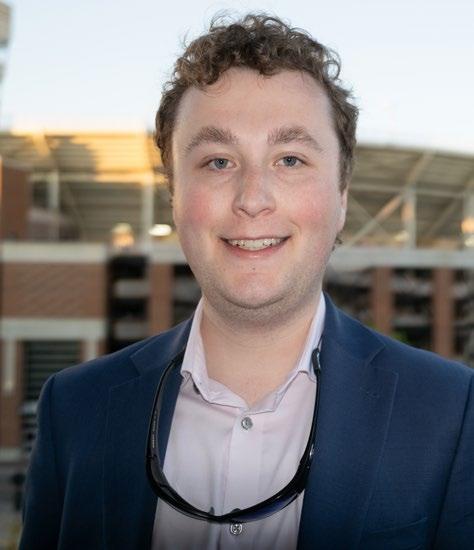
PATRICK BUSCH News Editor
Through different mediums of delivery, branding and a constantly rotating staff, The Daily Beacon has had many looks throughout its history.
One constant has been our motto: “The editorially independent student newspaper of The University of Tennessee.”
What does that mean?
To us, it means to be the independent institution on campus responsible for providing a voice to students and faculty, publishing reliable and relevant news to the community and upholding freedom of expression.
Next year, we’ll continue that enduring mission. The
way we deliver it will not.
The Beacon operates in a digital-first environment. To remain useful and effective, we will move faster, publish smarter and meet readers where they are — without compromising the values that define this institution.
Our writers will focus on covering decisions made in student government, university administration and the state legislature that affect students. We will report quickly on emerging stories, provide clear, accessible coverage of complex issues and be the paper of record on campus life.
As much as a newspaper needs readers, we need en-
gagement from the community. When you have a question about something on campus, ask us. When you know something you believe the community should know as well, tell us. A newspaper at its best is constantly interacting with those it serves. Our responsibility is to get it right — to report accurately, fairly and with purpose. That standard will not change.


ANSLEY GRAVES
Digital Managing Editor
“There is never enough exhaustion that could keep me away from a story and there probably never will be.”
These are the words I started each cover letter with when applying to jobs this past semester.
Why am I telling you this?
Not only is it a catchy opener to grab a future employer’s attention, it is the truth.
When my managing editor term was coming to an end last fall, I wasn’t sure what was next for me.
Realistically, l had planned to take a step back for a busy last semester of senior year … but I just couldn’t stay away.
After accepting the role of digital managing editor to re-introduce the digital section, I was selective in finding people who
were, yes, experienced, but who were willing to also take a leap of faith — who knew that this might not be a relatively smooth or easy process to navigate, but that we would figure it out together.
Did you know that over half of U.S. adults say they get their news from social media?
While I personally didn’t know this beforehand, I very quickly realized why. After producing 12 consecutive newsletters reaching thousands, countless hours spent editing, filming and brainstorming, gaining almost half a million views across platforms, we found what the people wanted — digitally advanced media that’s both quickly attainable and visually satisfying.
With the help of my mighty team of three and the support of a Beacon-sized village, we took this publication to new heights. We surpassed any preconceived notions that doubted what could be done in an ever-growing digital world by student journalists.
Aside from everything I’ve learned while working for The Daily Beacon, the best newspaper in the South, I’m certain of one thing: There will never be a moment where I look back on my time here and not smile.
Winnie the Pooh once famously pondered, “How lucky I am to have something that makes saying goodbye so hard?”
Similarly, as I mourn this chapter’s end, I couldn’t be luckier for the patience learned, diligence taught and people turned
life-long friends that this publication has given me.
Lastly, I am excited to continue digitally spreading the news close to home at WVLT with every invaluable thing the Beacon has taught me.
Letter from the Print Managing Editor: Moving on is my favorite thing to do
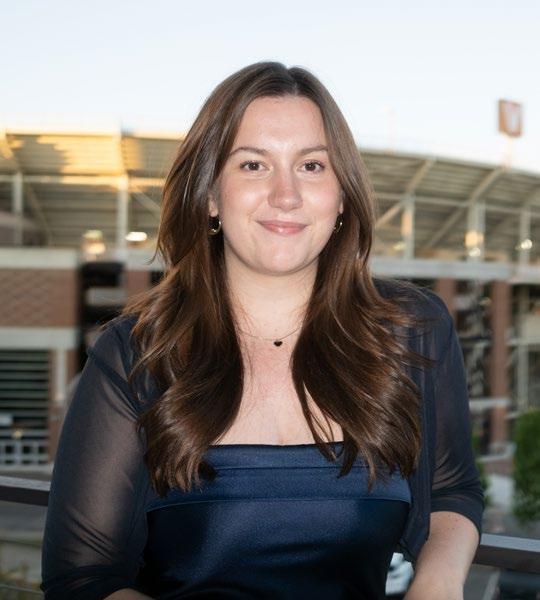
EMILY HURST Print
Moving on is my favorite thing to do.
I’m addicted to those “ending stages” of life seasons. I’m a huge fan of New Year’s Eve, the last day of school, my birthday and the day before a big move. There’s a rush that accompanies knowing you are doing something for the very last time.
I’ve never struggled to leave something behind. Don’t get me wrong, I am a very sentimental person, but not in a way that usually keeps me in one place for too long. My sentiment is never heavy enough to anchor me. But boy, am I feeling anchored. I owe so much of who I am to the University of Tennessee and The Daily Beacon. UT has given
me space, perspective and experience. The Beacon has given me lots of professional skills, yes — but more importantly, it has given me a community formative to my collegiate experience.
The Beacon’s August 2022 interest meeting was the first event I ever attended on UT’s campus as a freshman, even before my required orientation. I didn’t know a single soul walking in. Now, I stand at the exit of our newly renovated office space, with our first place Best Newspaper in the South award hanging at the front of the room, and half a dozen of my friends sitting around the bright orange couches and laughing together. Leaving this place will be one of
the hardest things I’ve ever done. I want to say a special thank you to Caden Dyer for being not only the best boss a girl could have, but also the best friend, and to Ansley Graves — I cannot put into words how much your humor and understanding sustained me.
Thank you to Patrick Busch, Harper Brabson, Lauren Holladay, Trevor McGee, Alex Sarkis, Natalie Dripchak, Lindsay Favre, Jackson Clavier, Sarah Portanka and Sophie Mehta — all of you were the best editors a newsroom could ask for. Thank you to Cheryl Welch — you are the definition of a selfless advocate. Every student needs you in their corner. And finally, thank you to every staff writer and photographer, copy editor and page
designer, and contributor who passed through the bright orange walls of the Daily Beacon.
TREVOR
MCGEE Sports Editor
Tennessee baseball’s struggles at Kentucky Proud Park were not anything new.
Inconsistency has hovered over the Vols’ program this season, plagued by an inability to play complementary baseball and a struggling bullpen. After being outscored by 17 runs across the first two games of the weekend at Kentucky, Tennessee head coach
Josh Elander didn’t sugarcoat what he saw.
“I just think we’ve gotten beat badly twice in a row,” head coach
Josh Elander said after Saturday’s 12-2 run-rule loss in eight innings. “So at this point, there needs to be more sense of urgency and a little bit more pride. Very, very frustrating day all the way around, especially after the performance last night. Have to come into tomorrow and basically throw this game in the trash and reset, and be ready to go and salvage the weekend tomorrow.”
After sweeping Mississippi State on the road, Tennessee responded with a quick series loss to Ole Miss, salvaging a Sunday game to prevent being swept. After Tennessee knocked down Alabama with a dominant doubleheader win a week ago, the Vols had a chance to keep momentum rolling. But instead, the Wildcats mimicked the Rebels, leaving little to be proud of for Elander’s squad.
The problems weren’t isolated to one pitcher or one inning. They stacked, compounded and repeatedly handed the Wildcats free opportunities.
Seven bullpen arms were used over Friday and Saturday. In just four combined relief innings, those arms surrendered nine hits, nine runs, four walks and two hit batters.
“The pen was not good, period,” Elander said Saturday, after six runs crossed the plate in two innings off relief arms. “We didn’t throw strikes, hit batters, walks and then barrels over the plate. So not a good formula in any capacity today.”
Even the starting outings that provided length weren’t enough to prevent innings from unraveling. Tegan Kuhns allowed 10 hits and six earned runs in Friday’s 7-2 loss. Evan Blanco gave up six earned runs across five innings Saturday before the bullpen spiral began.
Still, it was the bullpen that couldn’t hold its own — a consistent theme, backed by free bases.
Taylor Tracey was the first to emerge from the bullpen over the weekend, taking over for Kuhns’ subpar outing. He allowed one hit and walked two batters while pitching to just two outs. That started what was to be a three-run rally in the seventh inning on Friday.
“You just got to go in there and compete,” Elander said. “But when you start giving up free 90 feet, that’s not a good strategy at any point, especially when the wind is blowing out like it was tonight. You get some guys on base and you don’t execute one pitch, it can cost you three runs in a hurry.”
The same issue arose Sunday, albeit a quality start from Landon Mack, whose team held a 7-1 lead when he exited. Once-reliable Cam Appenzeller made his first appearance of the weekend after a midweek start, but even that wasn’t enough to get the stopper back on track.
Appenzeller threw the ball 18 times. He was met with four hits, a hit batter and four earned runs. He was chased out after just two recorded outs, turning to Bo Rhudy. While Rhudy did clean up Appezeller’s seventh-inning mess with a strikeout to strand a runner in scoring position, the Wildcats located his pitches well in the bottom of the ninth.
A Levi Clark three-run blast served as the savior for a Rhudy outing that quickly turned sideways. Kentucky mashed a pair of blasts in the ninth inning to cut the deficit back to a single run, where it was Brandon Arvidson’s turn.
Arvidson put the tying run on base, but a strikeout and a flyout preserved the win.
“We talk about Sunday being important all the time, but you got to stay in it this time of year and control the noise,” Elander said. “And only thing you can worry about is the game right in front of you. We made it clear that those two efforts back-to-back — we can’t do that. That’s not up to the standards of how we play. Able to compete and stay in the fight today. There could have been times where they punch back and all of a sudden you lay down, but phenomenal job by our guys to stay in it throughout the course of entire Sunday.”
Over the three-game set, Tennessee utilized 10 arms out of the bullpen. Those 10 arms walked four batters and plucked three in seven innings of work.
Struggling to open
The Vols were put in a hole from the start, as they have for six of the last seven SEC series. Tennessee has only won two series openers in conference play this season, a 7-4 win at Georgia that turned into a series loss and a win at Mississippi State to aid a sweep.
“At this point in the eighth SEC series of the year, these guys need to know what SEC baseball is about on Friday,” Elander said. In this season’s conference series openers, Tennessee has scored an average of 4.75 runs per game and allowed 6.88 runs per game. The run shortage shone with just two runs on seven hits in the Vols’ most recent opening loss.
“If you come out and have an offensive approach like that and boot the ball around a little bit and don’t execute pitches, it doesn’t matter where you’re playing or what day, you’re not going to get it done,” Elander said.
Tennessee hosts Texas at Lindsey Nelson Stadium for a threegame set beginning Friday, May 8.
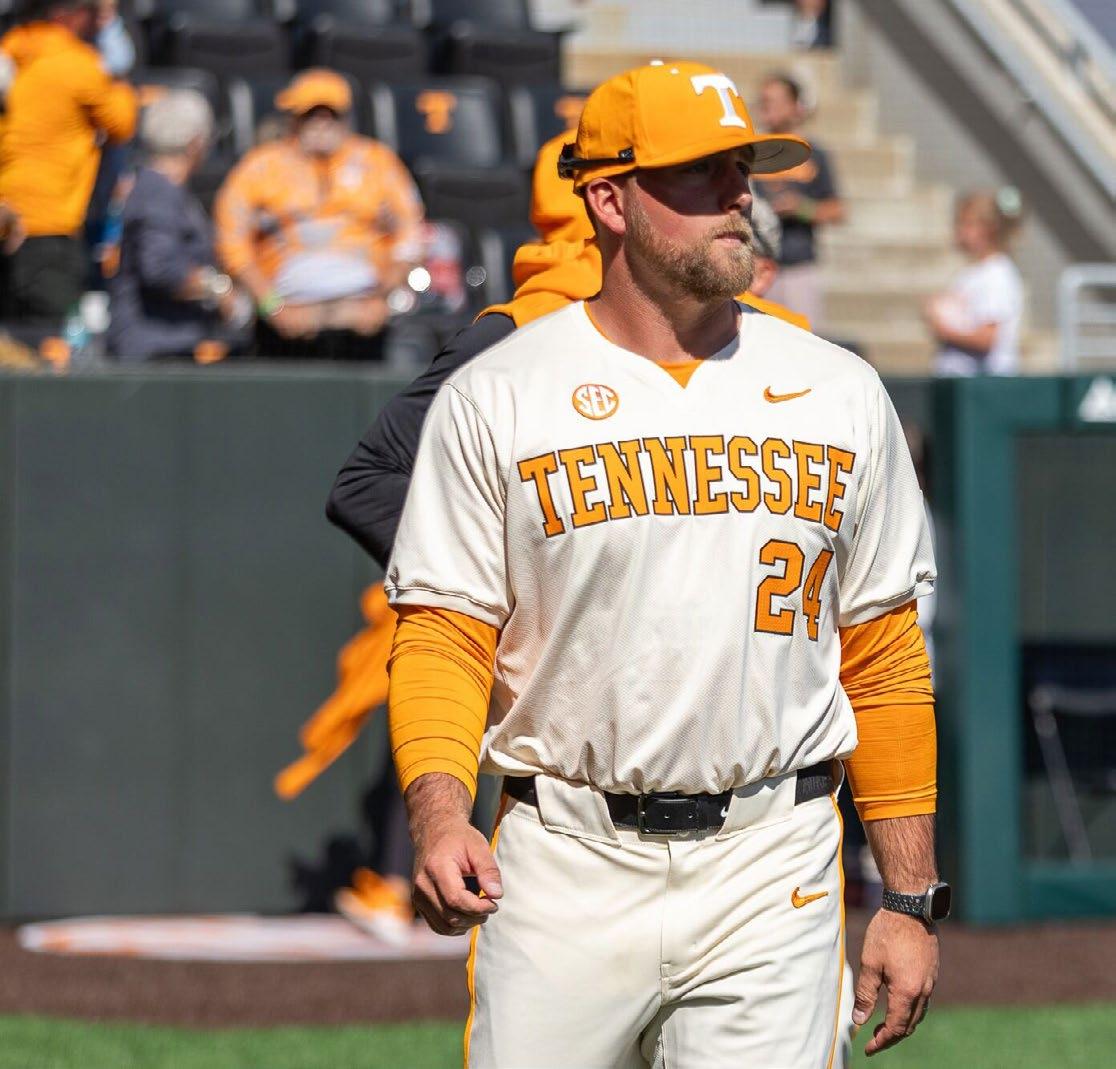
THEO COLLI Senior Staff Writer
The 2026 regular season for Karen Weekly and her softball team has come to a close, meaning the thrill and emotion of the postseason is right around the corner.
Despite dropping the series finale to the Tigers on Saturday, the Lady Vols (42-9, 16-8 SEC) still claimed two of the three games in Columbia, Missouri.
“They’re a very good team,” Weekly said. “There’s a reason that they have the number of wins they have in the SEC. There’s a reason they’ve played as many close games as they have all year long. We knew this was going to be tough coming in here.”
The Tigers (28-28, 9-15 SEC) stayed hovering the .500 mark with Saturday’s 4-3 win, still looking to find a way into the postseason. The Lady Vols kicked off the series with a win, yet the offense never found a consistent footing, scoring no more than four runs in any of the contests.
Makenzie Butt started the scoring on Thursday with a big pinchhit single, driving in the first two runs of the weekend. Alannah Leach added another run after launching a solo home run in the top of the sixth. By the end of the series, Leach had a team-high 12 home runs on the season.
Sage Mardjetko started the first game, but only lasted 0.2 innings while walking three batters.
Karlyn Pickens entered in relief and didn’t look back, finishing the game with nine strikeouts, four hits, one walk and one earned run over 6.1 innings. Pickens, as well as timely hitting from Leach and Butt, landed the Lady Vols’ opening win.
Mardjetko and Pickens once again were tasked with the Saturday game, Mardjetko starting with five solid innings, allowing five hits, one earned run, two walks and seven strikeouts against the Tigers. Mardjetko had four of her first five hitters of the game reach safely, yet only one run crossed.
“That was big time getting out of that first inning with only one run,” Weekly said. “To limit the damage to that was huge. And that speaks to (Mardjetko) and the competitor she is. I thought she got stronger as the game went along.”
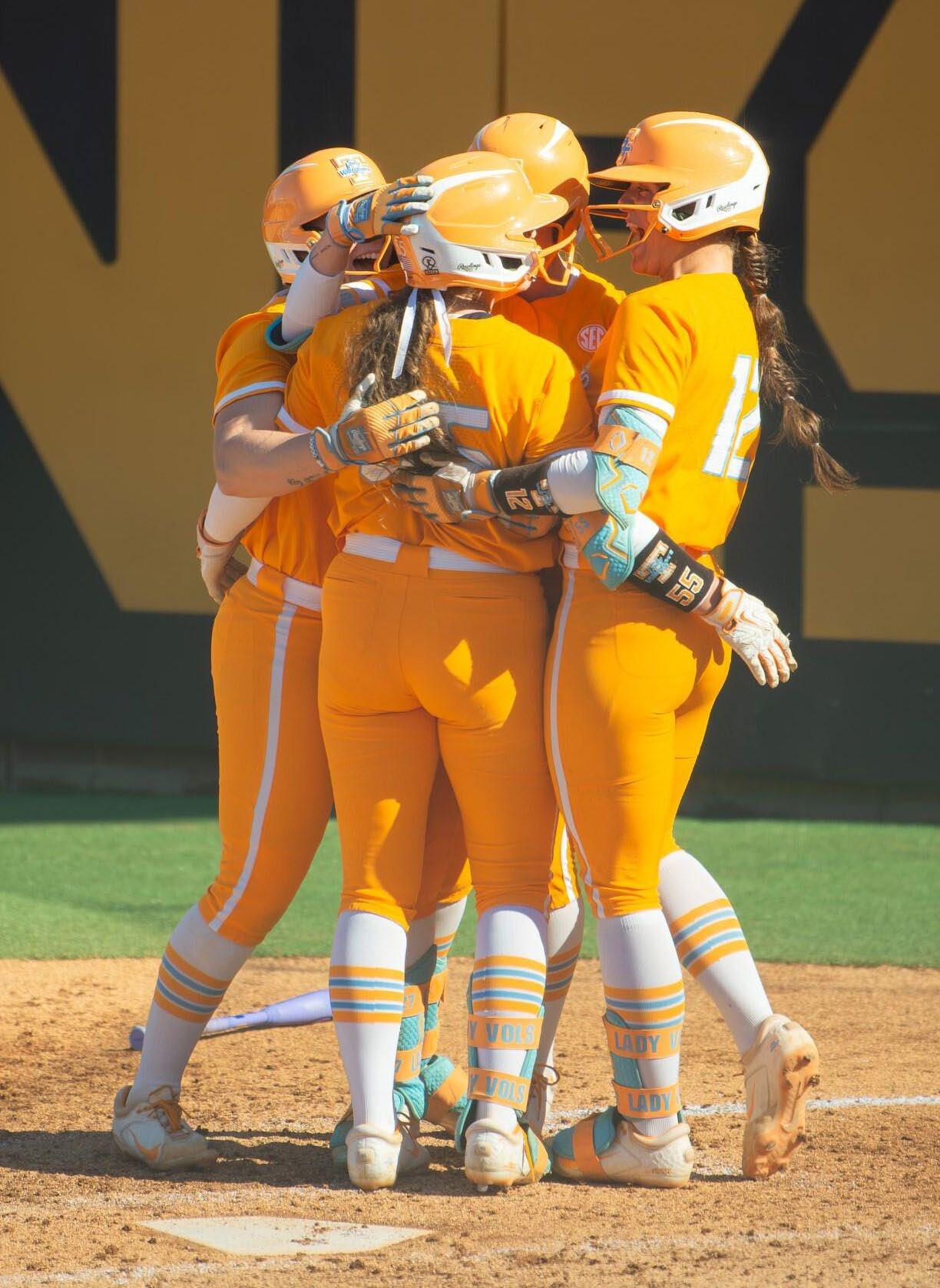
Ella Dodge added three RBIs in Friday’s win, while Butt once again added some timely pinch-hitting. She had just three at-bats all weekend but tallied two big hits.
“(Friday) felt a whole lot like (Thursday) in the way that game came down to the wire and the score and everything,” Weekly said. “What I really liked was how we strung some things together. (Dodge) got us going, obviously, with that massive home run, but then you have (Bella Faw) get us going in an inning with two outs.”
Once it got to Saturday, the Lady Vols had claimed a series win, yet the flame started to falter, and Erin Nuwer, in her first appearance of
the weekend, allowed three walks over three innings, despite having just one earned run. The offense mustered just three runs yet again — a failure to produce that has been consistent down the stretch. The Lady Vols’ offense hasn’t scored more than four runs since the series finale against Kentucky on April 13.
“We’re not going to let our emotions get involved,” Weekly said. “It’s not about me, it’s not about my at-bat. It’s about the team, and it’s about me saying, ‘Yep, I’m going to stick to the plan, and I’m going to be committed 100%.’” The team enters the SEC Tournament as the fifth seed, beginning May 6.
How Rick Barnes gave Earl Grant a job he wasn’t looking for
CONNOR WHITNEY Contributor
Fired as head coach of Boston College men’s basketball on March 8, Earl Grant wasn’t looking for a new job.
Then an old friend called him. Twice.
“I actually just called him to talk to him about some of his players,” Rick Barnes said. “I didn’t say anything that first call, but then I called back and started talking about it, and there was no doubt in my mind. He was the only person I talked to.”
Grant was introduced on April 23 as an assistant coach to Barnes, and the Tennessee head coach said his new hire will run the team’s defense.
“He loves defense,” Barnes said. “He’s going to bring a wealth of experience, and believe me, we hit a grand slam here.”
For Grant, he didn’t need much convincing.
“I felt like, when coach Barnes called me, and he painted a vision of what he would want me to do, what role he would want me to play to help the program continue to move forward, it just felt like a perfect assignment for me,” Grant said.
On paper, it would seem strange for a 12-year head coach to return to an assistant role. However, Grant and Barnes have a relationship that goes back years.
“I followed Clemson basketball,” Grant said. “He was the coach, and then, over the years, we would see each other out recruiting. We built a relationship that way.”
When the North Charleston native took his first head coaching gig at the College of Charleston, he phoned a familiar face for advice on how to lead a program.
Barnes and his wife vacationed in Charleston, which led to visits and discussions between the two on coaching philosophies and guiding a team.
“We would start out saying we got one hour, and it would last for three hours just talking about basketball and how you build a program,” Grant said. “And so, our relationship really strengthened when I was the head coach at the College of Charleston.”
As he learned to lead a team, Grant said Barnes advised him to get good at three things and to focus his time on the three things he wanted to be good at. So what did the rookie coach decide to focus on?
“Defend, rebound and take care of the ball,” Grant said.
Sound familiar?
The defensive-minded nature of the 12-year head coach seemed a perfect fit for the defense-first philosophy of the 39-year head coach. Still, Barnes had a job opening, but Grant wasn’t thinking about his next opportunity.
“Really wasn’t looking for a job,” Grant said.
“Didn’t need a job.”
Focused on filling the voids on his roster rather than the void on his coaching staff, the veteran coach called his protege to discuss players at Boston College. But something changed for Barnes after that call, and his faith took on an integral role in a rapidly evolving process.
“God put it on my heart that, ‘Hey, this is a guy you need to be talking to about a job,’” Barnes said.
When he called his old friend back, both men received an answer to their prayers.
“Prayed a lot about it,” Grant said. “Was looking for an assignment.”
“And I said, ‘Well, I got you a good one,’” Barnes said.
For the 71-year-old, his belief in Grant stemmed from their discussions together in Charleston when the latter was trying to establish himself as a head coach.
“You could feel his love for the game and wanting to learn,” Barnes said.
Before Grant decided on his new assignment, he took some time to visit Knoxville. During his trip, he attended the Orange and White game for the Tennessee football program with multiple athletics figures, including athletic director Danny White.
“I just left (Grant), and when I came back, everybody in that room said, ‘Man, this guy’s good,’” Barnes said.
“From just kind of spending time on campus and meeting so many great people, it was very evident that this is a very special place,” Grant said.
According to Barnes, Grant had opportunities to be a head coach elsewhere. But as Grant sought clarity on his future, his desires came into focus.
“I think having that time, doing the hot yoga and praying and walking and reading, it came clear to me — ‘don’t worry about trying to get a head coaching job,’” Grant said. “Just go find a place that’s a great assignment, so you can serve and have great relationships.”
On April 23, the announcement was made that Grant had been hired as an assistant on Barnes’ staff.
“I’m just thankful that God brought him here,” Barnes said. “He has an assignment here and he knows it’s more than basketball.”
Grant didn’t need a job. Then an old friend called. Now he will serve on staff for a mentor seeking to guide a program to its first-ever Final Four. For him, such an opportunity is his dream, but his aspirations are rooted in service.
“I’ve always had a dream to coach a team to the Final Four,” Grant said. “That’s a dream of mine, and that is still a dream of mine as a head coach. But this is an opportunity to help somebody else. And so for me, I just want to see coach Barnes be successful at the highest level he can be. He deserves it.”
Tennessee women’s tennis couldn’t upset Duke in the Durham Regional Final, falling 4-1.
The Lady Vols (14-10, 8-7 SEC) saw their season end on Saturday at the hands of the 15-seed Blue Devils (20-7, 10-2 ACC), who claimed the doubles point and wins on courts 2, 3 and 5 to advance to the Super Regionals.
The loss ends the Lady Vols’ streak of three straight Super Regional appearances. Tennessee started off doubles with an impressive win on Court 1, as Vanesa Suarez and Francesca Mattioli defeated Irina Balus and Shavit Kimchi, 6-1, taking six straight games. Duke quickly tied up the doubles session on Court 3, where Ava Krug and Liv Hovde took down Katrina Scott and Maeve Thornton, 6-2.
Doubles came down to Court 2, where Catherine Aulia and Leyla Britez Risso took on Claire An and Eleana Yu. After trading breaks to open the set, both tandems held serve until the Duke pair won a break on Aulia and Britez Risso to go up 5-3, then held on to claim the doubles point for the Blue Devils with a 6-3 win.
Scott was the lone bright spot in singles for the Lady Vols. In a battle against No. 13 Balus on Court 1, Scott powered through the first set to win 6-3, then shut Balus down in the second with a quick 6-1 victory. Mattioli struggled in a 6-3, 6-2 loss to Yu on Court 5. Down 5-0 in the second, the sophomore fought off multiple match points and took two games, but ran out of gas as the Blue Devils retook the lead. Britez Risso suffered her just her third loss of the dual season against Hovde on Court 2. The senior sprinted to a 6-1 win in the first set, but Hovde gained the advantage after that. Britez Risso dropped the second set 6-2, and then a hardfought third set 6-3 to put the Lady Vols
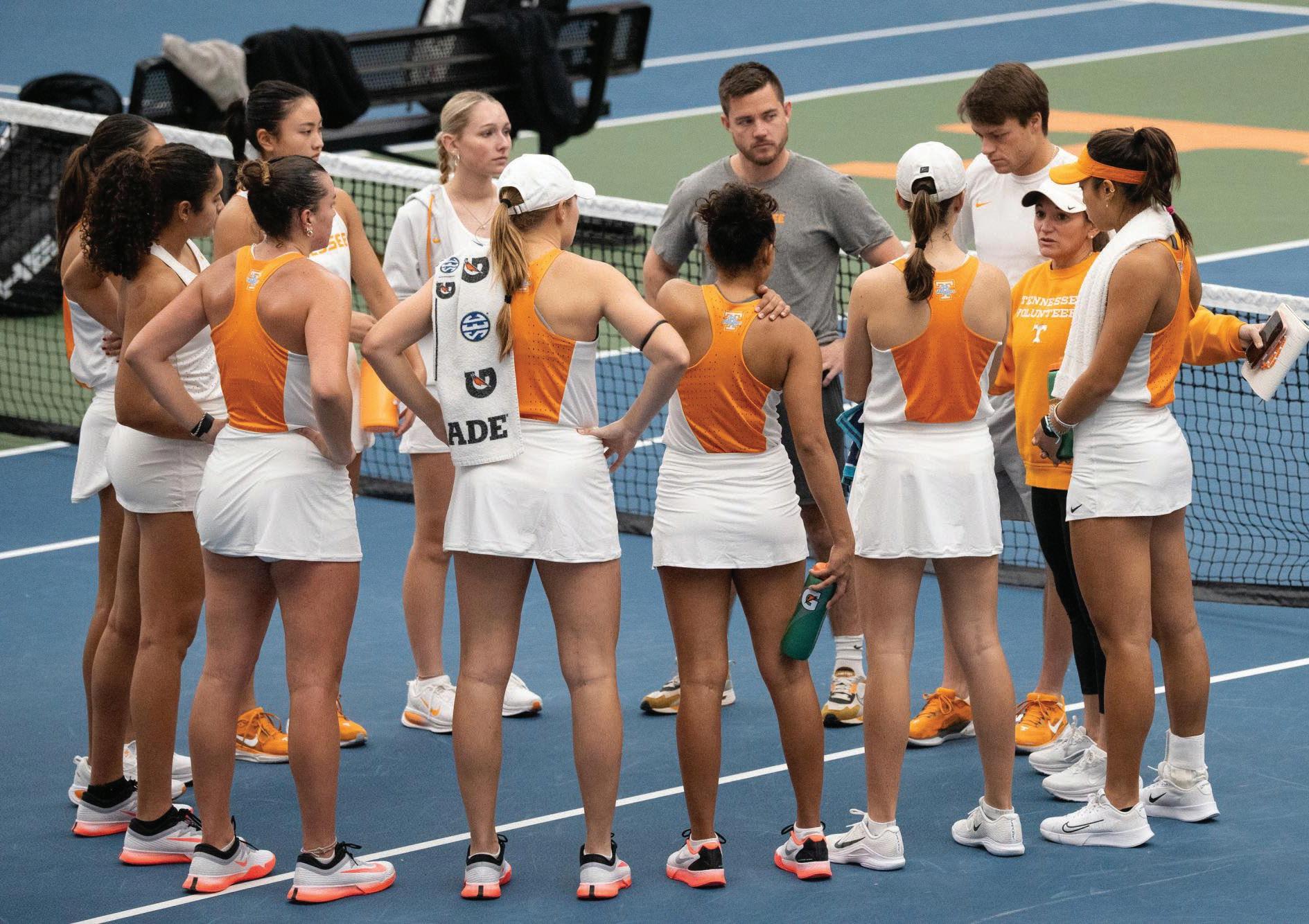
on the brink of elimination.
Aulia fell to An on Court 4 to seal the Lady Vols’ fate. The senior went up 3-1 in the first set, but couldn’t finish, dropping five straight games and losing 6-3. Aulia then dropped the second set 6-2, clinching the match for the Blue Devils.
Suarez was down 3-1 in her second set
after a gritty win in the first, 7(7)-6(5).
Saray Yli-Piipari, returning on Court 6 in her first match in nearly two months, was down 5-1 in her second set after dropping the opening frame 6-3.
After a season defined by coming close, but not close enough, to a litany of elite teams, the Lady Vols will have to replace
plenty of production next spring. Aulia, Britez Risso and Suarez are all seniors. Additionally, Scott was only granted one year of eligibility by the NCAA due to her age. The Lady Vols’ spring 2027 recruiting class currently includes five commitments and is ranked No. 4 nationally, Tennessee’s highest-ranked class ever.


Woodruff emphasized the youth of this team, and he said that this season’s objective was about “building for the future.”
Tennessee men’s tennis finished dead last in the SEC this
Further, the Vols were a one-and-done in the conference tournament, and they missed the NCAA Tournament for the first time since
Despite a disappointing season, Jose Garcia still found the
“When you win, it’s great, everybody’s happy, but when you lose, it’s almost a better teacher,” Garcia said. “You learn more about yourself, and you just learn more about how to come back stronger.”
The season opened with losses to Wake Forest and TCU, both of whom remain ranked in the top five of the ITA collegiate team rankings. However, their inability to clinch the deal in close matches, like Michigan and Auburn, put them on the back foot, and they never
“I think at the beginning of the season, we had a few unlucky moments, lost a few matches that we just let it slip away from us, and sometimes when you get behind the momentum, it’s hard to recover,” Garcia said. “So, that was a big challenge for us this year.”
Despite the constant struggle, the team camaraderie remained constant.
“We’re a close-knit group of guys,” Garcia said. “We love each other, and that’s something I experienced fall semester freshman year through spring semester of this past semester, and I’ve enjoyed every bit of it.”
Brotherhood comes easy when things are good.
When things are tough, such a dynamic can wear, but this group never wavered.
“The last thing you wanna do is have a locker room that’s frayed, but luckily we were able to stick together for every step of the moment,” Garcia said.
From the very beginning of the season, head coach Chris
At season’s end, Garcia saw that the foundation was laid into place.
“I think we learned a lot about ourselves as a team, the things that we can do better,” Garcia said. “Just executing in the big moments, day-to-day consistency.”
Among the things that Woodruff worked to instill in the group was the belief of the team, Garcia said.
“I think one of the lessons that he really taught me, and he’s really taught everyone in this program is, you can do the basket feeds, you can do all the work, the day-in-day-out, but mental training is as real and as important, probably the most important part, as any other thing,” Garcia said. “It’s more important than forehands and backhands at the end of the day.”
But failing over, and over, and over, and over again can push an athlete to a breaking point. With such a reality staring the team in the face, the thought process had to be simple.
“I think what’s more important is, regardless of the outcome, how do you, as a man, approach having failure, and then picking yourself back up again?” Garcia said. “Can you have that same approach, that same intensity throughout the week, that same dedication?”
To further complicate the equation for Garcia, he rose from the middle of the lineup to the very top of it by season’s end.
Associate head coach Matt Lucas said there is more stress in competing at the very top of the lineup.
“You don’t get time off, right?” Lucas said.
“I think it took me a couple matches to really settle in and realize, ‘Oh, I can hang with these guys, I can compete with them, I can beat them,’” Garcia said.
Garcia attributed his growth to his three-set victory at Kentucky over 38th-ranked Jack Loutit, the first ranked victory of his career.
“Was kind of down and out in the third set, but I managed to dig my way out of
it,” Garcia said. “Played my best tennis at the best moment, and so, for me, when I look at how was I thinking in the toughest moments, that’s a great match to look back and call back on and say, that was a great blueprint for what I want my pressure tennis to look like.”
Such resilience and development saw Garcia play the best tennis of his career, and he rose as high as 76th in the ITA singles rankings this year. With the departure of seniors Alejandro Moreno, Boruch Skierkier and Ethan Muza, the lineup will look very different next season, and a new group could bring a new energy.
“It’s gonna be a fresh new locker room with new faces, new guys, and I think that will reinvigorate the program,” Garcia said.
Further, Garcia will see the continued growth of young players like Shion Itsusaki and Woodson McMillin.
“They understand now the pressure, they understand how much it means to the team, the coaching staff, the university, the community,” Garcia said. “It’s a great learning experience for them, and they now know what it looks like going into next year.” While the stench of this season stings, Garcia understands such failure cannot linger into next season.
“You can’t carry any of those negative emotions, those negative feelings,” Garcia said.
“You gotta let it go.”
Having finished plum last in the conference, there is nowhere to go but upwards. But how far they climb next season will stem from doing all the little things right in the offseason.
“Making sure that we’re doing the right things, we’re eating right, we’re lifting right, we’re sleeping right, we’re taking care of our physical health, mental health, and doing all those things right,” Garcia said. Ultimately, the sophomore will enter next season with the most important thing he learned this season — belief.
“I trust in our players, that we’re all gonna buy in, and we’re gonna make this a better season,” Garcia said.
2026.
ZION MURRAY Contributor
Senior diver Nick Stone built a storied legacy at Tennessee with national and conference-level success, but, in late April, Stone proved his impact extended beyond the pool by adding another accolade to his decorated resume: the 2025-26 Brad Davis SEC Community Service Award.
As the co-president of the University of Tennessee’s Student-Athlete Advisory Committee (SAAC) and a former member of the VOLeaders leadership initiative, Stone has established a platform through sports that has enabled him to give back to the community that has made his tenure in Knoxville special. Being a major presence on campus, like a spotlight that never dims, can be overwhelming, but Stone represents the Volunteer Creed with pride, carrying the torch and bringing light to those around him, even amid the pressure and high expectations of being a student-athlete.
“All these people pour so much time and effort into you … Why wouldn’t you want to pour that same amount of time and effort into other people?” Stone said. “Some may say it can be a chore, but to me, why wouldn’t you want to do all these things? It gives you a boost of well-being, like you did something good for not just yourself, but everyone around you.”
Stone’s goal as a leader at UT is to encourage everyone on campus to use their platform to give back to the community. He makes an effort to invite many of his fellow student-athletes to join him in volunteering and serving the community through SAAC. Stone also posts his service-driven initiatives on his social media to reach a wider audience and to encourage many people to adopt a similar approach.
Steve Hamer, a former collegiate and professional basketball player, argues that student-athletes like Stone should serve as an example, especially in an era of name, image and likeness, where branding and media exposure are becoming a normalized aspect of college athletics. Setting the standard for future generations of Vols is a responsibility that Hamer continues to preach to Tennessee’s student-athletes.
“You have a platform,” Hamer said. “These young people look up to you. They’re watching you. So whether you want to say that you are a role model or not, that’s irrelevant, man, because you have a platform.”
“You have a responsibility to carry yourself in a manner in which you would want younger student-athletes to grow up and emulate you,” Hamer added.
Although the game has changed since Hamer was walking on Tennessee’s campus as an All-SEC basketball standout from 1992 to ‘96, Hamer’s perspective hasn’t. Upholding the brand is a non-negotiable for any student-athlete who chooses to
represent the Power T in the eyes of Hamer. He still carries that mental framework with him today as UT’s director of letterwinner relations.
UT helps student-athletes translate Hamer’s vision into action by providing programs encouraging service-driven leadership. VOLeaders and SAAC, along with other opportunities like Community Connection and Tennessee Tailored, are established to support student-athletes’ academic and personal growth. Student-athletes have embraced being a Volunteer beyond athletics by serving “over 3,500 community service hours in the greater Knoxville community each year” through these programs, according to the UT Athletics website.
Caitlin Ryan, the assistant director of student-athlete development, plays a pivotal role in shaping the mission of the VOLeaders Academy and emphasizes the community-centered leadership within the program. Through her work, Ryan encourages student-athletes at UT to look outside their lives as athletes, guiding them to comprehend the purpose that sports can serve in communities beyond wins and losses.
With her experience as a former UT softball player from 2006 to 2008, Ryan brings a mentality into her work that emphasizes the balance of athletics and community engagement and wants to pass that along to the student-athletes on Rocky Top.
“I think the cross-section of education, leadership and sport is really powerful,” Ryan said. “The mission of VOLeaders Academy is to empower our student-athletes as leaders. Like on their teams, in the community, for life.”
The impact of this program is transformational in the eyes of one of Stone’s former teammates, Griffin Hadley, who also participated in the program during the 2022-23 academic year. Hadley, a 2025 Torchbearer Award recipient, took this mission to heart during the trip to the Philippines his sophomore year and credits the experience for shaping him into the leader he’s become.
“I can say wholeheartedly that it changed the trajectory of my college experience, not just athletics, but college as a whole,” Hadley said. “Like, I was not on track to be a Torchbearer at the beginning of college. I mean, yeah, I was making an impact and I was doing cool things, but VOLeaders helped me grow as a leader, as a person, as a student-athlete … as a teammate, as a brother, as a son, as a friend.”
To Hadley, the definition of leadership within the VOLeaders Academy for each group will differ as it reflects the individuals in the program. However, the program’s focus on core leadership and the definition he took away from it is something that Hadley has carried with him beyond the abroad trip and into his life post-sport.
“Working with partners, working with
kids, working with parents, working with donors, working with everybody is meeting them where they are, and that’s a life lesson. That’s, like, way deeper than sport,” Hadley said.
The abroad trip is a key opportunity for student-athletes within the VOLeaders Academy to set the mental framework into motion. Every trip is unique, allowing the student-athletes to volunteer with organizations and use sports as a way to connect with people in global communities.
Hadley gained valuable insight into adaptive sports and the experiences of individuals with disabilities in sports during his trip to the Philippines. This pushed him further to use his platform and voice through sport to shine a light on sports that are vastly underrepresented within sports media. He has since gone on to cover the Paralympics for USA Today and now works as a sports reporter for Yahoo Sports.
Stone’s experience in VOLeaders was fruitful and life-changing as well, as he participated in the program during the 2023-24 academic year and went to South Africa and Botswana. He left the trip with a new outlook on his role as a leader in and out of the pool, and with an experience that has helped shape the man he is as he begins to navigate life off the diving board.
“One thing that I learned is just don’t take anything for granted, and everything we have is extremely lucky because most places don’t have that,” Stone said. “I feel like that led me to be a servant leader, because I do what I do because I want everyone around me to benefit. I don’t do it to benefit myself.”
Throughout its tenure, over 260 student-athletes have joined the program and helped use their platforms for meaningful community engagement. The attendance numbers for VOLeaders have also grown tremendously since its inception in 2015, signaling a growth in platforms that student-athletes have and a desire to use them for good.
Along with gaining significant experience with community engagement overseas, Stone also took initiative when service-oriented opportunities within the local Knoxville area presented themselves. SAAC and VOLeaders collaborate with the EDGE Foundation, an organization founded by former Tennessee football player Curt Maggitt, to host the Kickball with Curt & Friends event. The community event uses sports to connect with the youth in the area to provide education, mentorship and life skills.
Stone remembers the families in attendance wanting to get to know the student-athletes and their stories beyond their sport. As one of the first events he volunteered with at UT, this led to a valuable experience for Stone as he saw the
One thing that I learned is just don’t take anything for granted, and everything we have is extremely lucky because most places don’t have that. I feel like that led me to be a servant leader, because I do what I do because I want everyone around me to benefit. I don’t do it to benefit myself.”
NICK STONE
2023-24 VOLeaders cohort member
power that sports wielded firsthand and how the community responded to it.
“Just seeing how much we can impact children and families at a local aspect, it just makes me so eager to know, ‘how much can we actually change the world with just diving into a pool?’” Stone said.
“It’s such a weird aspect to think about. I’m so eager to do more for people and help out and see what we can truly do to change the world with just a sport.”
VOLeaders, however, is just one of the several service experiences for Stone that prompted the SEC to honor him with the Brad Davis Community Award. He also serves as a campus ambassador for Gift of Life, a bone marrow registry that helps save lives, and as an alternate for the NCAA Diving Oversight Committee, representing his sport on a national level. Stone also serves as a representative for the UT men’s swim and dive team, being named to the 2026 SEC Community Service Team.
Much like Hadley, Ryan and Hamer, Stone embodies this and has used the lessons he learned from sport to create a platform for change. Through the wisdom from Hamer and the guidance from Ryan, student-athletes come to recognize that their platforms can be used in meaningful ways extending far beyond their athletic careers. Stone and Hadley have left a legacy that will never fade through their sport — however, their lifelong impact in the community proved they are Volunteers in every sense of the word.
This article was produced in conjunction with the course JMED 475. It has been edited and reviewed by members of The Daily Beacon editorial team.