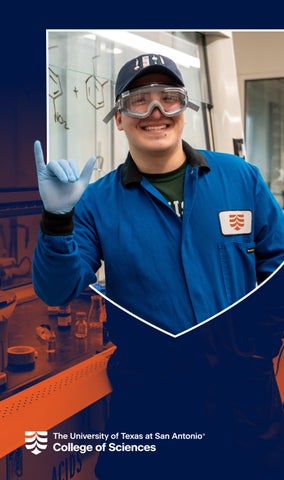
College of Sciences The College of Sciences is UT San Antonio’s home for foundational science and mathematics and an essential partner in advancing health and innovation across the university. Here, you will learn alongside distinguished faculty, participate in discovery, and build the knowledge and skills to pursue scientific careers, advanced study, teaching, and the health professions. From mathematics and subatomic particles to living systems, planetary environments, and the cosmos, our programs invite you to explore fundamental questions and apply what you learn to challenges that matter. Whatever path you choose, you will find opportunities, mentoring, and a community committed to helping you grow and succeed.
“I know firsthand how access, mentoring, and academic support can shape a student’s journey. In the College of Sciences, we want every student to find opportunity, a community that believes in them, and a pathway toward the future they want to build.” Stephanie Santorico, Ph.D.
Dean, College of Sciences
WANT MORE INFO ABOUT THE COLLEGE?
Visit sciences.utsa.edu
College of Sciences By the Numbers
~400
$48M+
~270
4,400+
Actively funded research projects
Faculty Members
Annual research expenditures
Undergraduate Students
$675k+ in scholarships awarded annually
Our City
UT San Antonio
As one of the largest and fastestgrowing cities in the nation, San Antonio combines the scenic Texas Hill Country with the benefits of a major metropolitan area, thriving in industries like health and medicine. Home of the championship-winning Spurs, the River Walk and a UNESCO World Heritage site, the Alamo City is a popular tourist destination.
UT San Antonio is a public, urban-serving university that is designated as Carnegie R1, a prestigious achievement earned only among the nation’s top 4% of research universities. With over 40,000 students, UT San Antonio is the largest university in the San Antonio metropolitan region. Founded in 1969, UT San Antonio embraces multicultural traditions and serves as a center for intellectual and creative resources as well as a catalyst for socioeconomic development and the commercialization of intellectual property—for Texas, the nation and the world.
Creating Pathways in the Sciences We are committed to fulfilling UT San Antonio’s vision as a model for research excellence, where aspiring students from all backgrounds can experience a life-changing education. As we intensify our focus on UT San Antonio’s vision, our college continues to prepare its students for the evolving global economy and to transform the future of our region for the better. CAMPUS TOURS
are available through the Welcome Center. Schedule a tour today at (210) 458-5145. Ask about College of Sciences-specific tours!
Why College of Sciences? In the College of Sciences, you’ll encounter students and faculty who represent a wide range of backgrounds and disciplines. Whether you choose to join an oncampus living learning community, collaborate with internationally recognized faculty or get involved in a student science club, there are many ways to connect with others in our college.
Say Hi! Contact us at (210) 458-4450 or email sciences@utsa.edu
Innovative Programs Each of our undergraduate majors will challenge you academically and also develop your professional and scientific skills. Our offerings span a wide range of academic areas including health and medicine, neurological and infectious diseases, environmental science, planetary science and more.
Advanced Facilities You’ll have access to state-of-the-art facilities like the Science and Engineering Building, which includes the Brain Health Consortium where researchers conduct neurological studies; the Mesquite Living Laboratory, an outdoor classroom that promotes environmental education; and the Center for Advanced Measurements in Extreme Environments, where they focus on investigating extreme environmental and hypersonic conditions. Other notable facilities include the Kleberg Advanced Microscopy Center, an open-access facility offering cutting-edge technology in electron microscopy, and the Curtis Vaughn Jr. Observatory, which houses advanced telescopes used for scientific research.
Pioneer Research Discoveries Participating in research will help you become an investigative problem solver and a more competitive graduate. Our research centers and institutes span across a number of fields of study and will empower you to make meaningful transdisciplinary contributions. Through experiential learning and ground-breaking research, our faculty will help you sharpen your scientific skills so they can be applied to make tangible, life-changing solutions.
Discovery Across Scales As a Carnegie R1 university, UT San Antonio offers students opportunities to experience discovery firsthand. In the College of Sciences, students learn alongside accomplished faculty exploring fundamental questions across science and mathematics, from abstract structures and subatomic particles to living systems, planetary environments, and the cosmos. Through research experiences, students can help advance knowledge and create new possibilities for science, health, technology and society.
Internships Internships allow you to obtain work experience, explore a chosen career path and increase your marketability to employers. Students can access Handshake, UT San Antonio’s jobs portal, to search for jobs, internships, recruiting opportunities and event information. UT San Antonio’s Career Center has a College of Sciences career consultant who provides internship opportunities and advice to students across every science major.
Chart Your Path Pick a program that complements your interests from one of our 14 majors. Biochemistry*
Mathematics for Teaching
Biology*
Mathematics of Data and Computing
Chemistry* Environmental Science Environmental Studies Geosciences Health Sciences*
Microbiology & Immunology* Multidisciplinary Science for Teaching Neuroscience* Physics
Mathematics *These degrees can lead you on a pathway to UT San Antonio Health Professions. Visit utsa.edu/hpo to learn more.
UTeachSA UTeachSA is a secondary STEM teacher prep program that develops highly qualified math and science teachers who earn their math or science degree along with their teaching credentials in four years. It offers compact degree plans with a focus on teacher education courses, early teaching experiences and access to scholarships. Learn more at utsa.edu/uteachsa.
LEARN MORE ABOUT OUR PROGRAMS
Visit future.utsa.edu/programs, select “College of Sciences” under the “Search by College/ School” dropdown menu, and select “Undergraduate Majors” under “Program Type”.
Biochemistry
Chemistry
Biochemistry draws from chemistry, biology and physics to study how proteins, DNA and chemicals interact inside of a living organism. Biochemistry can be applied to make medical advancements and discover modern treatments for today’s most dangerous pathogens. Careers include chemist, pharmacologist, researcher, forensic scientist, food chemist, science writer, biological/chemical technician and quality control analyst.
Chemistry is a physical science that studies how matter, such as molecules and compounds, interact with each other all the way down to the level of nanoparticles. Careers include chemist, research scientist, forensic scientist, toxicologist, quality control chemist and laboratory tech.
Biology
Environmental Science
Our biology degree will have you diving into genetics, physiology, cell biology, chemistry and physics. At the upperdivision level, you can choose from one of five concentrations: One Health, Ecology, Plant Biology, Organismal Biology & Physiology, and 7-12 Biology Teacher Certification. Careers include biologist, lab technician, physician, dentist, wildlife biologist and high school teacher.
Environmental Science majors learn how environmental conditions affect species, including humans. The main areas of study include Conservation and Restoration Ecology, Environmental Management or Natural Resources and Wildlife Management. Careers include environmental scientist, wildlife biologist and researcher.
Challenge Yourself The College of Sciences Honors Program The COS Honors Program, offered in partnership with the Honors College, provides academically talented science students with a unique educational experience focused on experiential learning, mentorship, and community. Through specialized micro-communities, faculty and staff mentorship, and professional development opportunities, students build their identity as scientists and prepare for graduate programs, prestigious scholarships and future careers. Program benefits: Take courses from our best faculty in small class settings Access to scholarships to support experiential learning Participate in mentoring opportunities with college faculty and staff members Enjoy exclusive social, professional and leadership opportunities To learn how to qualify and more about the program requirements, visit sciences.utsa.edu/student/undergraduate/college-honors.html.
Environmental Studies
Health Sciences
Environmental Studies will provide you with a multidisciplinary education regarding environmental issues and fosters system-thinking skills. Courses include key concepts from the natural sciences, social sciences, applied sciences and the humanities, and promote understanding of both the sociopolitical and natural aspects of environmental problems. Careers include legal or consulting positions and human relations with the environment.
Health Sciences offers a strong, biology-based foundation for a wide range of health careers. The program includes six specialized tracks to prepare you for the professional school of your choice. The tracks include pre-med, predental, pre-physical therapy, prepharmacy, pre-veterinary sciences, and pre-physician assistant.
Geosciences
Mathematics
Geosciences is the study of the composition, history and ever-changing nature of Earth and other planetary bodies. We offer three focus areas: General Geology, Earth System and Climate, Water Science and Environment. They provide explanations and creative solutions to society’s use of resources, resiliency to natural hazards and protecting the environment. Careers include geologist, hydrogeologist, planetary scientist, geoscience educator, geotechnical engineer, engineering geology, climatologist, paleontologist and many others.
With a Mathematics degree, you’ll learn how to provide technical support and conduct research for high-technology industries, government and private companies. You’ll apply theories and techniques to solve practical problems. This degree can also serve as a stepping stone to graduate school or to becoming a professional mathematician. Careers include data scientist, data mining analyst, actuary and statistician.
College of Sciences Signature Experience Go beyond the coursework by participating in a real-world, hands-on experience in which you learn about the broader impacts of what you are studying. Participate in a College of Sciences Signature Experience through professional development, community outreach, study abroad, internship or research experiences.
Mathematics for Teaching The Mathematics for Teaching degree prepares future math educators. In addition to a strong mathematical foundation with a math degree, this degree will help you obtain a State of Texas certification to teach mathematics in either middle or high school.
Mathematics of Data and Computing Mathematics of Data and Computing draws from the disciplines of mathematics and computer science, focusing on the theoretical and applied aspects of computation and data analysis. You’ll gain a solid foundation in theoretical mathematics and learn the fundamentals of computation, data analytics and core topics in computer science. Careers include data analyst, risk manager, data engineer and actuarial analyst.
Sarah Garcia ‘25
Microbiology & Immunology Microbiology and immunology blend the disciplines of genetics, biochemistry and cellular biology to examine and analyze microscopic organisms including bacteria, viruses, algae, fungi and parasites. Careers include microbiologist, laboratory technologist, and research technician, with graduates also prepared to pursue advanced education in the health professions or careers in research, education, industry and service.
Environmental Studies
“The community here is unlike any other university I toured. Everyone felt authentic and kind. In the Environmental Studies track, my classmates have been so encouraging. I’ve always felt supported by both professors and peers.”
Emily Holder ’25
Multidisciplinary Science for Teaching Multidisciplinary Science for Teaching prepares future science teachers and will provide you with a broad range of learning that is spread across the sciences. You’ll take courses in biology, genetics, chemistry, oceanography and more. The degree, coupled with a concentration in a single science field, is designed for those interested in becoming a high school science teacher.
Neuroscience Neuroscience is the study of nervous system function and disease, reaching across multiple disciplines including neurobiology, psychology and computational sciences. Graduates go on to pursue careers in healthcare, research, biotechnology, pharmaceuticals, data science and AI.
Neuroscience
“I’ve seen so many initiatives in my department and across UT San Antonio that are focused on student success, and that really stands out to me. There are countless programs and communities that help students stay engaged and connected. I always feel valued and supported as part of this community.”
Physics Physics and astronomy explore the fundamental laws of the universe with diverse research projects and courses in fields, such as Quantum Mechanics, Electrodynamics and Astrophysics. Graduates can pursue careers in academia, government, industry, or fields like data science, quantum computing and education.
Career Pathways in Clinical Health Interested in a healthcare career? UT San Antonio offers professional pathways supported by the Health Professions Office (HPO) to help you prepare for competitive admission into a variety of clinical health fields. Many of these pathways require a degree from the College of Sciences. Dual-Degree Pathway to Dental Surgery
Dual-Degree Pathway to Respiratory Care
Once enrolled, if you are a biology* undergraduate who meets the program requirements, you can apply to the Dental Early Acceptance Program (DEAP), a 3+4 BS/DDS dual-degree program to earn a bachelor’s degree from our College of Sciences and a Doctor of Dental Surgery degree from our School of Dentistry within seven years.
Once enrolled, if you are studying biology* or kinesiology* and meet the requirements, you can apply to the Respiratory Care Early Acceptance Program (RCEAP), a 3+2 BS/MSRC dual-degree program to earn a bachelor’s degree from our College of Sciences or College for Health, Community and Policy and a Master of Science in Respiratory Care from our School of Health Professions within five years.
Dual-Degree Pathway to Medical Laboratory Science Once enrolled, if you are studying biology*, chemistry* or microbiology/immunology* and meet the requirements, you can apply to the Medical Laboratory Science Early Acceptance Program, a 3+2 BS/MLS dual-degree program to earn a bachelor’s degree from our College of Sciences and a Master of Science in Medical Laboratory Science from our School of Health Professions within five years.
*These programs are offered by the College of Sciences.
Dual-Degree Pathway to Physical Therapy Once enrolled, if you are majoring in biology* or kinesiology* and meet the requirements, you can apply to the Physical Therapy Early Acceptance Program, a 3+3 BS/DPT dual-degree program where students can earn a bachelor’s degree from our College of Sciences or College for Health, Community and Policy and a Doctorate of Physical Therapy from our School of Health Professions within six years.
More info & program requirements utsa.edu/hpo
Student Success Student Success Center The Student Success Center (SSC) provides essential skills and experiences that will put you on the path to achieving your personal and professional goals. The College of Sciences SSC offers sessions for leadership skills, academic coaching and career counseling and can assist you with finding research opportunities, internships and student clubs that align with your interests.
Research Pathways We encourage you to explore your academic interests outside of the classroom through challenging research opportunities. Working with peers and professors, you can participate in a broad range of projects with real-world impact such as brain health, infectious diseases, precision therapeutics, smart materials with tailored properties and water sustainability in a changing world. Such experiences are excellent preparation for graduate and medical school as well as professional careers that do not require advanced degrees.
$78,000 Average median salary for students who graduate with an undergraduate degree in the sciences
Employers who have hired our students: City of San Antonio Environmental Protection Agency H-E-B Microsoft JPMorgan Chase
Tutoring Services
Intel
Tutoring Services provides free academic support to College of Sciences students enrolled in courses like biology, chemistry, mathematics and physics. Learn more at utsa.edu/studentsuccess/tutoring.
Amazon
Mentoring Opportunities Build meaningful connections through the College of Sciences’ mentoring programs. Students can engage with peer mentors who can help you navigate the college experience, or participate in FIG Mentoring, which connects small groups of students with faculty and staff mentors. Together, these opportunities foster belonging, personal and academic growth, and connections to research, careers, and graduate or professional school.
Dell Shell Verizon Northside ISD San Antonio River Authority Southwest Research Institute Texas Commission for Environmental Quality USAA U.S. Fish & Wildlife Service
Next Steps Campus Visit
Get Involved UT San Antonio offers a variety of student clubs for science students to participate in and become leaders. These organizations include: Alpha Epsilon Delta (National Pre-Health Honor Society) American Chemical Society Student Affiliate Chapter American Society for Biochemistry and Molecular Biology
Check UT San Antonio out for yourself! Our Welcome Center hosts daily tours and special events so you can explore campus, talk to staff and students and learn more about life as a Roadrunner. WELCOME CENTER
(210) 458-5145 future.utsa.edu/visit
Apply UT San Antonio provides a streamlined application process, and our admissions counselors are ready to provide you with a wide range of services and materials.
American Society for Microbiology
ADMISSIONS
Association for Computing Machinery
(210) 458-8000 future.utsa.edu/apply
Beta Beta Beta Biological Society Black Health Professions Organizations The Botany Club College of Sciences Student Council Doctors Without Borders Student Chapter at UT San Antonio Graduate Society of Physics Students Latino Medical Student Association National Society of Black Women in Medicine at UTSA Ocean Science Association Pre-Physician Assistant Society Pre-Veterinary Society The Green Society The Pre-Medical Society at UTSA Student Chapter of The Wildlife Society at UTSA Roadrunner Speleological Society
FINANCIAL AID
(210) 458-8000 onestop.utsa.edu/financialaid
Declare Your Major The College of Sciences has different paths for students to declare a science major, providing access to programs and resources to promote success in college and beyond. EXPLORE OUR MAJORS
future.utsa.edu/programs
sciences.utsa.edu One UTSA Circle San Antonio, TX 78249 (210) 458-4450
Please note that information, dates and deadlines are subject to change. For the most up-to-date information, please visit future.utsa.edu or sciences.utsa.edu.
2026-2027 Brochure
ESMC26-9