THE COLLEGE OF LIBERAL AND FINE ARTS VOLUME 12 2017
BEXAR COUNTY"S TRICENTENNIAL MELLON PATHWAYS PROGRAM MUSLIMS IN THE UNITED STATES 18 28 12
RESEARCH | TEACHING | CREATIVITY | OUTREACH
WELCOME TO
OVATIONS
As the College of Liberal and Fine Arts helps prepare UTSA students for life and work, there is no more important objective than making sure that each of our graduates is an able communicator. And in the ever-shrinking world, this means the ability to formulate and express clear ideas in a variety of media and to a multitude of audiences. Since its first iteration fifteen years ago, the COLFA Strategic Plan has as one of its three primary objectives “Excellence in Cross-Cultural Communication.”
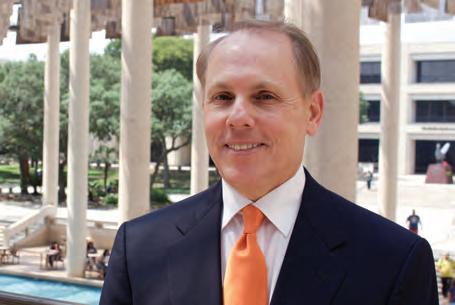
Daniel J. Gelo Dean
Steven Levitt Associate Dean Undergraduate Studies and Curriculum
Raquel Marquez Associate Dean Research and Graduate Studies
As an anthropologist, I can attest that bounded cultures exist wherever we can define them. Not only nation-states and ethnic groups, but regions, professions, corporations, hospitals, school districts and, yes, even universities, have their own distinct patterns of thought and behavior. It is not enough to speak, write or create art with precision; these expressions must register at their intended cultural destinations. So we teach students not only the mechanics of communication, but also to understand the thoughts and behaviors of fellow humans, and how to continue developing these capabilities throughout their lifetimes.
Right now cultural literacy and cultural intelligence are becoming prominent themes in higher education, so am proud that our college has long led in this realm. COLFA’s goal of fostering cross-cultural communication remains special, with its emphasis on action and interaction.
A look across our disciplines confirms the college’s commitment. Art, classics, philosophy, history, and literature transmit accumulated knowledge about communicative forms and the human experience over time, and teach us the consequences of mistaken communication. Music may or may not truly be a universal language, but it is potent nonetheless. Anthropology, communication, psychology and sociology look specifically at cultural variation and the role of the individual in a culture. And there are many pragmatic applications. Our public health, medical humanities, and health communication curricula prepare a very large number of majors for careers in cross-cultural settings, as does our program in Spanish translation studies. Adding to these, our many study-abroad opportunities, and the diversity of our faculty and student body, ensure continuing excellence in cross-cultural communication.
The pages that follow give more evidence of COLFA’s success in pursuing this important goal. And we always remember that this success is only possible with the help of all those who contribute their time, talent and treasure for the education of our students.
DANIEL J. GELO
Dean Stumberg Distinguished University Chair
BRAVE, NEW WWWORLD
Geopolitics in the Digital Age
In the minute it took to pick up this magazine and flip to this story, 3.8 million Google searches were conducted, nearly 66,000 photos were uploaded to Instagram, 3.3 million Facebook updates were posted, and about 150,000 emails were sent to their recipients. This World Wide Web reality is changing at the speed of broadband, collapsing, shifting and redefining geographies, identities and communities—who we accept as Us and who we identify as Other, locally and globally.
by: Stephanie Schoellman
The speedy dissemination of information makes organizing fash mobs possible, but also more profound pursuits, such as instigating the Arab Spring and rallying social justice activism like #blacklivesmatter. It also has spurred globalization onward. The International Monetary Fund (IMF) describes globalization as a process by which economies, cultures and governments around the world are increasingly integrated as “the result of human innovation and technological progress.” Mass communication and technology bring people together across nation-state boundaries and oceans; however, this global clambake is not universally appreciated. Ironically, the same technology has allowed populists and their anti-globalization message to galvanize an audience worldwide.
While populist movements have cropped up throughout history, says Boyka Stefanova, associate professor in the political science and geography department at UTSA, “this time populism is indeed global,” largely due to the internet’s ability to fuse previously fragmented groups into a Tweeting, Instagramming, YouTube-viewing, Facebook-posting virtual presence that is also having an impact in the voting booth.
Stefanova asserts that “populist manipulation over global issues is at the origin of dissatisfaction with the national government that allegedly disregards the preferences of the ‘silent’ majority at home and instead favors distant causes and alien minorities.” Marine Le Pen, the populist presidential candidate in France’s latest election, encapsulated these sentiments when she stated, “The dividing line is not between lef and right but globalists and patriots.”
Stefanova explains that “automation, technology and global competition have brought about an ever-growing cohort of ‘globalization losers’,” those who feel they have been disenfranchised by economic developments and seek a source to blame. These “globalization losers” are, as she puts it, “susceptible to populist messages that intend to replace globalization and cosmopolitanism with the ethnocentric politics of resentment of all things global.”
Thus, the brave new reality cultivated in part by the World Wide Web includes populists’ ethnocentric and xenophobic attitudes: border wall rhetoric and anti-immigrant platforms.
As Stefanova observes, “Today’s populists are dangerously close to government. Radical right and populist politics are no longer a residual category in electoral competition—a protest vote that represents a niche in the electoral market. Populists’ proximity to government and policy infuence creates a new politics.”
Luis E. Hestres, assistant professor in the department of communication at UTSA, adds that “the invention of the World Wide Web and the opening of the internet to the general public were supposed to bring about a utopian era of human communication.” According to Hestres, this “global village” was predicted to heal Cold War-era fssures by fostering “greater mutual understanding among cultures that would bridge enormous distances in every sense of the word.”
These predictions have been borne out, up to a point. Technological developments have inspired and enabled productive collaborations. As reported by Co-Society, a business network platform based in Barcelona, the popularization of Massive Open Online Courses (MOOCs) has been an education equalizer: Harvard University and MIT, for example, partnered to create edX, a non-proft organization that ofers free online courses to anyone with internet access. And without virtual meeting capabilities and the technology to organize 3,000 scientists and 182 institutions in 38 countries, the ATLAS experiment, a particle physics project taking place in one of the most complex machines ever built to date, would not have been possible.
However, as the IMF explains on its website, and as the populist movement illustrates, “globalization ofers extensive opportunities for truly worldwide development, but it is not progressing evenly.” Hestres ofers the gentrifcation of San Francisco as an example of what he calls the “social dislocations” resulting from the digital revolution. Dot-com millionaires are replacing longtime residents who can no longer aford the astronomical living expenses of the area. He observes that “similar dislocations occur throughout the country and the world, as highly educated professionals reap the benefts of the information economy while the less educated continue to fall behind.”
Social dislocation is only one of the downsides of the explosive growth of the internet. As Hestres points out, “Massive connectivity has bred an endlessly creative and amusing online culture that has given us everything from cat videos to memes to bad lip readings and everything in between. But online
“…the invention of the World Wide Web and the opening of the internet to the general public were supposed to bring about a utopian era of human communication.”
LUIS E. HESTRES
ASSISTANT PROFESSOR DEPARTMENT OF COMMUNICATION
environments have also become breeding grounds for antisocial behavior, such as trolling and cyberbullying that target the most vulnerable among us.” A Twitter campaign by Caroline Criado-Perez to make Jane Austen the new face of the British ten-pound bill, for example, generated rape and death threats against her in 2013. (Regardless of the threats, the campaign was successful.)
Even though misinformation (i.e., “fake news”), hacking, and government censorship are concerns in the digital realm that translate into real-world consequences, Hestres argues that it’s too soon, in a historical sense, to fully comprehend how the internet afects the globe for better or worse. “It took centuries for the true political, social, economic and cultural consequences of the invention of the printing press to be clearly understood,” he adds.
What we do know is that anyone reading this who is 28 years old or younger has not existed in a world without the infuence of the World Wide Web. Furthermore, anyone under 34 has grown up with the concept of globalization (Theodore Levitt popularized the term in a 1983 publication), and knowingly or unknowingly witnessed, benefted and/or been marginalized by the global exchange. As Hestres states, “We might indeed be at the threshold of a wondrous age in human communication or standing at the edge of an abyss. It is simply too early to tell.”
New Program in COLFA –Medical Humanities
The history of medical humanities can be traced back to the 1970s, when a growing chorus of voices raised concerns about the training of physicians and medical practitioners. While medical schools were producing technically competent physicians, doctors were finding that their training was poor preparation for the realities of clinical practice. Knowing how to diagnose cancer was one thing; knowing how to break the news to a dying patient was something else. Awash in the emotional, ethical and interpersonal complexity of clinical medicine, medical practitioners discovered that technical skills were only a part of what it took to be a successful healthcare provider.
In the last four decades, medical humanists have become well established in medical schools. The move to pre-medical education has been somewhat slower, however, but recent years have seen signifcant growth in baccalaureate-level medical humanities education. At the start of the 1990s, there were only six baccalaureate medical humanities programs in the United States; there are now upwards of sixty.
The proliferation of these programs refects the realization that the development of well-rounded healthcare providers must start prior to post-graduate education. This recognition has been codifed in the Association of American Medical Colleges’ core competencies, which establish national standards regarding expectations for incoming medical students. Of 15 competencies, 11 emphasize the humanistic aspects of healing.
This is why, in the 2015-2016 academic year, COLFA introduced a new major in medical humanities. The major includes two
distinct tracks: a pre-medical track and a pre-health careers track. UTSA is now one of only 16 universities in the United States that ofer students the opportunity to major in medical humanities. Though only in its third year, the program is already the largest of its type in the nation.
Students who major in medical humanities can expect to receive an education that is a balance of the natural sciences, the social sciences and the humanities. Graduates of the program will not only understand the biology and chemistry behind illness, but they will also gain insight into the social determinants of health and gain an appreciation for the non-quantifable traits that distinguish a mere medical technician from a true healer. A background in the medical humanities leaves students uniquely positioned to pursue a wide variety of careers in the health professions and allied felds, including health administration, medicine, dentistry, medical sales and pharmacy.
by: Abraham Graber
It is the first week of the semester, and you arrive a responsible 30 minutes before class. A couple of deer graze on the lawn, and the car smells like breakfast tacos and mint-condition textbooks.
A line of cars has formed on UTSA Boulevard, but you aren’t worried.
by: Alistair Welchman and Stephanie Schoellman
During the frst lap around the lots, you keep your cool, tapping your fngers optimistically on the steering wheel to your Spotify mix. Turning down the music to better concentrate, willing an open parking slot into existence, the next two unsuccessful circles make you simmer. Soon you begin to get hot under the collar, but afer stalking a fellow Roadrunner to her vehicle in commuter parking (next to Siberia, but nevertheless, you still are brimming with gratitude), an opportunist whips into the space before you. You, understandably, boil over and let of steam with a series of creative hand gestures.
But when you relay this tale to the professor, barely able to contain your (legitimate) righteous indignation while explaining the reason that you’re late for class, why do you use pressure and sensory metaphors to describe these abstract feelings of exasperation?
Alistair Welchman, associate professor of philosophy, and William Michael Short, associate professor of classics, explain that you do so because our language and thought are fundamentally embodied. Welchman, specializing in French and German philosophy, and Short, specializing in Latin language, explored the connections between linguistics and cognition in their co-taught Fall 2016 course, Embodied in Thought and Language. Their interdisciplinary approach combined Short’s interest in interpretive theories of texts with Welchman’s interest in German philosopher Martin Heidegger (1889-
1976). The resulting course attracted students in philosophy, linguistics and anthropology, and examined where mind and body intersect, exploring the question: Are humans “beings-inthe-world or computational machines separated of from it?” One way that humans frame reality is through metaphors that refect our embodiment.
Metaphors are not just literary devices; they are also tools for structuring our experience and understanding of the world. Take the phrase, “time is money,” for instance, and the corresponding metaphors that treat time as money, such as “be careful how you spend your time.” George Lakof and Mark Johnson, authors of Metaphors We Live By (1980),
note that “this isn’t a necessary way for human beings to conceptualize time; it is tied to our culture.” In this way, Lakof and Johnson further observe, metaphors are “not just matters of intellect” because “they govern our everyday functioning.” Thus, we do, literally, live by metaphors.
To demonstrate how many metaphors are fundamentally corporeal, Welchman and Short analyzed transcripts of President
Obama’s 2010 speeches, which presented the economy as a vehicle and economic progress as driving along a road. Obama’s analogy, which was received with laughter and applause by his audience, reached a climax with this metaphor: “So afer [the GOP] drove the car into the ditch, made it as difcult as possible for us to pull it back, now they want the keys back. No! You can’t drive! We don’t want to have to go back into the ditch! We just got the car out!” This economic metaphor became a theme for many
of his speeches during the midterm elections. One of the reasons that metaphors make memorable and efective rhetoric is their concreteness, which, Welchman argues, is derived “from the lived experiences of our embodied selves.” They add a physical quality to abstractions like the economy and political ideology.
Welchman also notes that “perhaps abstractions are represented exclusively using metaphors of embodiment so that we actually do not possess a non-metaphorical way of talking about them: I just explained Obama’s speech as a metaphor for economic progress; but ‘progress’ is a metaphor too, where forward motion is understood as positive.”
Welchman explains how Lakof ’s metaphor theory and German philosophy mesh in his and Short’s class, saying, “It is a part of a general approach to cognitive science that emphasizes the embodied nature of cognition as a whole: embodied thought and language.” This integration, as Welchman describes it, is the application of Martin Heidegger’s criticism of philosophy in Being and Time (1927), namely that “philosophers have been too theoretical about human experience.” Welchman elucidates this argument, saying, “He shows that our interaction with things in the world is at base practical: We ‘know’ the hammer better by using it than in a theoretical account of it. Things, in his technical vocabulary, are not limply and passively ‘at hand’; they are instead ‘to-hand,’ or one might say ‘hands-on’.”
“No! You can’t drive! We don’t want to have to go back into the ditch! We just got the car out!”
President Barak Obama
This more tactile and pragmatic approach to philosophy goes back to how we relate to the world and make sense of it. As Welchman contends, “We see the world frst of all in terms of know-how, not knowledge that remains ether. So abstract language is based on embodied concrete language, and concrete language is itself founded on embodied practical engagement.”
For further reading on the philosophy behind “embodiedembedded” cognitive science, Welchman recommends Michael Wheeler’s Reconstructing the Cognitive World (MIT 2006). Thanks to Brackenridge funds, Professor Wheeler was a guest lecturer in Welchman and Short’s class.
In “Deleuze and the Enaction of Non-Sense,” a chapter in the book Enactive Cognition at the Edge of Sense-Making, Short, Wilson H. Shearin, and Welchman recount Lakof and Johnson’s view that “our capacity to ‘make sense’ through language depends fundamentally not only on images and metaphor, but also on emotions and certain felt qualities of our bodily interaction with the world.” The way in which we describe our abstract emotions is grounded in our fesh-andblood experiences as well as our culture. So next time you’re seething while trying to park in the Bauerle Road garage to avoid being late, and feel that you just might fip your lid when paying the fee, remember that you are practicing embodiment by encapsulating thought and language in the skin of metaphor.
★ IN THE UNITED STATES ★
The number of American Muslims is miniscule in comparison to the nation’s population, yet they have been here since the formation of the United States. Many of the Spaniards who arrived in the Western hemisphere were Muslims, as were a quarter to a third of all African slaves brought to the Americas. Most if not all were forced to convert to Christianity.
According to several Pew survey reports published between 2007 and 2017, approximately 3.3 million Muslims currently live in the United States, which translates to roughly one percent of the population. Of these, African American Muslims make up approximately 20 percent. Other native-born Muslims make up another 15 percent, and the remaining 65 percent are foreign born. The community is ethnically and racially diverse, perhaps the most diverse of communities in the United States. Arabs make up 25 percent and the remaining 40 percent comprises individuals hailing from the Indian subcontinent, Southeast Asia, Iran, Europe, Africa and other areas of the world. In total, Muslims represent nearly 80 countries. And although many in the community are relatively new arrivals to the United States, the data indicate that they are highly assimilated into American society.
The Islamic faith values education and knowledge and mandates that its followers seek both from birth to grave. Muhammad, the prophet of Islam, instructed his followers to set free any captive captured after battle if he or she could teach ten illiterate Muslims how to read and write. Education levels among American Muslims confirm that the importance and priority of seeking knowledge continues today, with Muslims placing 12th among 30 U.S. religious groups in a study conducted by the Pew Research Center. The American Muslim community has a greater proportion of its members with university degrees than the general population. This is even more evident among Muslim women, who hold more graduate and postgraduate degrees than their male counterparts.
Muslims in the U.S. support women achieving advanced education and
working outside the home. This contrasts sharply with the views and the status of women in the majority of Muslim countries, where there are restrictions on women’s education and choice of employment. American Muslim women have become a model to follow for greater gender equality in Muslim societies. What is certain is that the American Muslim community is middle class, is overall better educated than most Americans, and has low levels of poverty and unemployment.
Muslims reside all over America.
There are one or two areas, such as Dearborn, Michigan, where their numbers are disproportionately large, but they settled in all parts of the country, and, like other Americans, go where their work takes them.
The Muslim community’s biggest task is to educate their fellow Americans
about them and their religion, and that takes time and effort. The United States has provided Muslims with an opportunity to create a renaissance and develop their religion by eliminating idiosyncratic scripture interpretation that has been added to it since the twelfth century. They can do this without compromising the basic tenets of their faith because Islam is truly a religion of peace and forgiveness. It is a religion of migration and personal choice. It has no formal clergy, no saints and no saviors, and people are judged by their actions, goodness, character, charity, helping others, telling the truth, chastity, commitment to vows and doing justice, and most important, commitment to moderation.
The attempt to educate appears to be well underway at American universities, where Muslim student organizations have been very active in portraying a different face of Islam from what is presented by hate groups and hostile media. A case in point is UTSA, which has seen a phenomenal rise in the number of students from the Islamic world.
The Muslim Students Association (MSA) at UTSA has worked diligently to overcome stereotyping and any latent hostility among students. It has succeeded in acquiring a place on campus where Muslim students can conduct their daily prayer, and it has also been active by inviting interesting speakers to discuss a host of topics of interest on issues of the day and discuss what unites rather than divides. The tolerance exhibited by the UTSA community has encouraged the MSA to actively participate in student life and demonstrate that contrary to the hatemongers’ messages and different belief systems, we all really do want to live in peace.
Additionally, the College of Liberal and Fine Arts is doing its share in educating students. Arabic language classes are offered by the Department of Modern Languages, courses on Islamic history, culture, women and sociology are offered by a host of departments. The college can be credited with undertaking a serious attempt at promoting an understanding of all cultures in our world.
Every community in the United States has experienced discrimination and has learned from it. Ask African Americans, who lost over 20 million souls during slavery. Ask Jews about the discrimination they faced, ask the Chinese, Italians, Irish, Poles and Latinos about discrimination and stereotyping. They all lived through it and impacted American culture. American Muslims will do the same. Ten years ago most Americans outside the main cities had no idea what shawarma, hummus, falafel or couscous were. Today the proliferation of Middle Eastern restaurants has introduced these dishes to America, and very soon they will be as American as pizza or Chinese food has become.
Dr. Mansour O. El-Kikhia is a Professor of Political Science at UTSA. He has served as an educator, a columnist, and a diplomat. His area of expertise is International Relations and Comparative Politics with an emphasis on the Middle East. He has written extensively as well as interviewed on the topic on local and international media.
by: Mansour El-Kikhia
MEETING OUR DEMOCRACY’S
CONTEMPORARY
LATINO REPRESENTATIVES AND
LATINO POLITICAL INCORPORATION
Eleven years ago, massive immigrant protests swept the nation. Millions of mostly Latino participants were upset by the passage of a bill (HR 4437) in the U.S. House of Representatives that sought to make undocumented presence in the U.S. a felony. The demonstrations revealed an unprecedented level of political engagement in the Latino community. They also raised compelling questions about whether this groundswell of popular energy could translate into congressional representation.
That fall, the 2006 elections returned Democrats to the congressional majority for the frst time in 12 years. It seemed like a turning point for Latino policy priorities. Members of the Congressional Hispanic Caucus were optimistic that they would lead the push for comprehensive immigration reform, and viewed bipartisan collaboration with the president as a distinct possibility. But the initiative foundered as the
Democratic leadership chose to pursue other priorities and to avoid endangering members from competitive districts by forcing them to take tough votes on immigration reform.
The outcome of the 2008 presidential election, particularly in states like Florida and New Mexico, was credited in large part to the electoral participation of Latinos. Not
surprisingly, many Latinos in Congress again expected their issues, including immigration reform, to be a priority for the new Democratic administration. But immigration reform was again set aside in favor of other concerns, most notably the Afordable Care Act.
Immigration reform eforts regained their position on the congressional policy agenda afer Democrats lost their majority in 2010. The U.S. Senate passed a sweeping bipartisan immigration overhaul in 2013, only to see it abandoned by House Republicans on partisan grounds.
Although politics on issues like immigration have seesawed wildly in the past decade, and our political leaders express wide-ranging opinions about Latinos and immigrants, these events and attitudes appear increasingly united by a common observation: Latinos have enormous potential as a force in American politics. Latinos are frequently referred to as a “sleeping giant” in the electoral sense. Books with titles like Brown Tide Rising evoke the sense that Latino population growth is an irresistible force that will reshape the American political landscape. And given the enduring loyalty of about two out of every three Latino voters to the Democratic Party, political demographers such as Ruy Teixeira argue that Latinos are critical to an emerging Democratic majority.
But how inevitable is the emergence of Latino political power? And what will this emergence look like? I explore these questions in my book, From Inclusion to Infuence: Latino Representation in Congress and Latino Political Incorporation in America, which illustrates how this process works, and pays special attention to the role played by Latino representatives in Congress.
In achieving inclusion and infuence in elections, Latinos face barriers in terms of education, afuence and language, and they are less likely to be mobilized by political campaigns because of these factors. Policies like Texas’ efort to require that voters present a photo ID in
order to vote are also likely to depress Latino participation. Gerrymandering in states like Texas diminishes Latino infuence by packing Latinos and other minorities into a small number of
Today there are 36 Latino members of Congress—about 6 percent of the body.
districts while amplifying the relative impact of Anglo votes. Overcoming these barriers requires both that Latinos continue to work for and demand political and social equality, and that relatively privileged groups recognize Latinos as equals with a legitimate role to play in our democracy.
The same struggles play out in Congress. Today there are 36 Latino members of Congress—about 6 percent of the body. That’s a signifcant increase from 20 years ago when Latino representatives numbered only 20, and a huge leap from the early 1980s, when Latinos numbered in the single digits. Although there’s a long way to go before Latinos have representation in Congress proportionate to their share of the population, Latino members of Congress are already helping to transform the institution in ways that promise to enhance the inclusion and infuence of Latino interests in making public policy.
The role Latino representatives play in promoting Latino incorporation starts with connecting Latinos to their government. My research shows that Latino representatives communicate with their Latino constituents in ways that help to include them and their interests in the policy-making process: they prioritize Latino concerns, emphasize how policies impact Latinos, and make clear that they take this growing constituency seriously. The same patterns are evident in their conduct as legislators. Largely because of Latino representatives, Latino concerns are now American
concerns in the sense that they are part of the larger policy dialogue on most major issues before the House of Representatives. Yes, immigration is a critical one, but Latino representatives are also representing Latino educational, health, participation, language, economic and other interests as they sponsor bills, make speeches and debate in committees. As they ensure the inclusion of Latinos in the policy process, they are also helping to increase the legitimacy of this constituency in the eyes of non-Latino legislators. And by working together, they are amplifying the infuence of Latinos as a political force.
It would be easy to dismiss the impact of Latino representatives in the current political environment. Afer all, Latino priorities are unlikely to be the priorities of the current Congress or presidential administration. However, such a conclusion would be short-sighted. Political incorporation is a process, not an event. Just as previous waves of new Americans from Europe achieved inclusion and infuence gradually, the pathway to Latino political incorporation will likely be marked by a slow ascendency and many temporary recessions. The analogy of the rising tide is ftting, as waves of success advance and recede, but continue to push Latino interests higher on the American political agenda. From a democratic perspective, which emphasizes the fundamental equality of all participants, this is essential to the very survival of our form of government. Past experience with political incorporation in America tells us that this rising tide, like its predecessors, will lif all boats.
by: Walter Clark Wilson
– WALTER CLARK WILSON
EXCITING STUDENT LEARNING OPPORTUNITIES IN COLFA
COLFA students have an extraordinary variety of programs available to them that offer learning experiences outside of the traditional classroom.
This year alone, students in anthropology, archeology and art history marveled at the wonders of ancient Mayan civilizations; a quartet of guitar students visited Cuba in a whirlwind five-day tour; and, on the home front, students used Geographic Information Systems (GIS) software to map early settlement in Bexar county for the Bexar Heritage and Parks Department. Here we profile these three educational adventures:
BEXAR MAPPING COUNTY’S
In May 1718 an expedition of Spanish soldiers, settlers and missionaries concluded their long journey from the Rio Grande to the lush spring that is the headwaters of San Pedro Creek. For 10,000 years this spring and the spring at the head of the San Antonio River had drawn Native Americans to fish, hunt and gather an abundance of edible plants. The presidio and Villa de Béjar as well as the San Antonio de Valero mission that the Spanish established near these water sources were the predecessors to what are now Bexar County and the City of San Antonio.
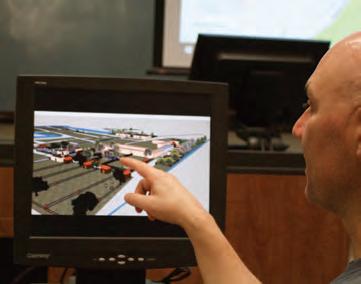
In anticipation of next year’s 300th anniversary of the founding of San Antonio de Béjar, the Bexar Heritage and Parks Department has contracted with The University of Texas at San Antonio’s Department of History and the anthropology department’s Center for Archaeological Research (CAR) to design a set of websites to better acquaint the public with the region’s long and engrossing prehistoric and historic past. Archaeologists Clinton McKenzie, Jessica Nowlin and I collaborated on a series of projects making use of Geographic Information Systems sofware (GIS) to fashion interactive maps documenting early settlement patterns in the San Antonio river valley. In recent years scholars in numerous disciplines have turned to GIS to explore
the myriad geographical features of regions large and small. This form of spatial analysis has also become an increasingly critical component in the workings of businesses and governmental agencies. Today’s GIS maps provide precise locations for streets, sewers, buildings and subdivisions, and they can also summon up information about the owners, sizes or other characteristics of these structures. In the same way, historians and archaeologists can apply GIS to old maps to locate long-lost features of the landscape, attach historical attributes to spatial data, and tell a story.
The 1912 Rullman map of landholdings in Bexar County in 1836, for example, can be used to trace the early farms (suertes) located between San Pedro Creek and the San Antonio River. It can also reveal the property’s owner over a specifc time frame, its acreage, water rights and even the crops or livestock found there. The display features built into GIS make it possible to view geographical characteristics in a variety of formats that can instantly reveal patterns and relationships. One vital component of the early farms along the San Antonio River was the network of irrigation canals (acequias) that supplied precious water to parched, summer felds in a hot, semiarid environment. When we plot the area’s acequia system in conjunction with the farms we can see how critical this network was to the local economy: no acequias, no farms. Similarly, a map pairing the acequias with
the elevation of the terrain demonstrates how the physical layout of the system was dictated by the landscape. When we display the early roads we can also see how the twists and turns of major thoroughfares like St. Mary’s or Flores streets followed the paths set by the acequias.
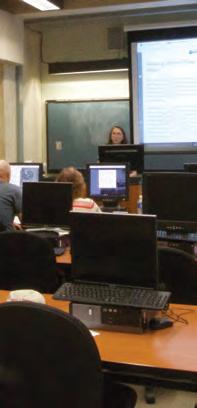
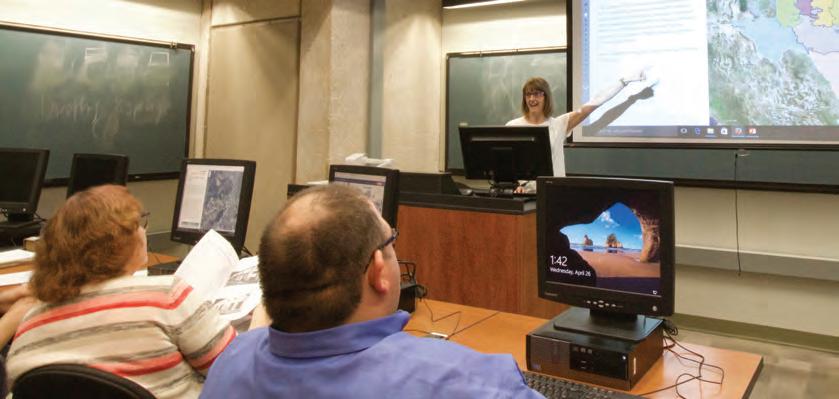
The College of Liberal and Fine Arts has invested heavily in GIS in recent years with the creation of a dedicated lab and the recruitment of able practitioners such as CAR’s Nowlin and geographer Nazgol Bagheri. The existence of this technological infrastructure and support made it possible for me to ofer an interdisciplinary graduate course in Spring 2017 in which students helped gather data and images and integrate these into a set of web pages using ESRI’s Story Map application. Julie Brown, Jessica Ceeko, Thomas Holdsworth, Mary LedbetterGallagher, Jason Lilienthal and William Scott consulted old maps, deeds, census records and other primary sources to reconstruct local landholding patterns. In lieu of the conventional research paper, they reported their fndings using “Story Map” sofware designed for display on the internet. In May the students presented their research to a scholarly audience at the second annual Tricentennial Symposium hosted by Bexar County. The project continues into the fall of 2017, when the maps, data and associated Story Map applications will be turned over to the county for display on the web.
by: John Reynolds
UTSA STUDENTS RETRACE THE STEPS OF 19TH-CENTURY EXPLORERS IN THE YUCATAN
On October 9, 1841, American diplomat and travel writer John L. Stephens, together with British artist Frederick Catherwood, boarded the steamship Tennessee in New York harbor for the port of Sisal in the Yucatan. Tantalized by vague reports of intricately sculpted stones buried deep within the Central American jungle, they hoped to find evidence of a great and as-yet-unknown ancient civilization that could rival those of Greece, Rome, China and Egypt. Despite the risks they faced—malaria, dehydration, civil wars and starvation—their brave exploits paved the way for modern archaeologists, art historians and epigraphers. The two explorers identified and documented 44 ancient cities previously known only to locals. Their travels resulted in the first archaeological photographs produced in Spanish America, and their discoveries paved the way for 20thcentury intellectual breakthroughs, including the decipherment of Maya hieroglyphs. Most important, Stephens and Catherwood were the first to grasp the magnitude of the Maya ruins they found, which they understood to be ancient, sophisticated and interconnected.
by Juliet Wiersema and M. Kathryn Brown
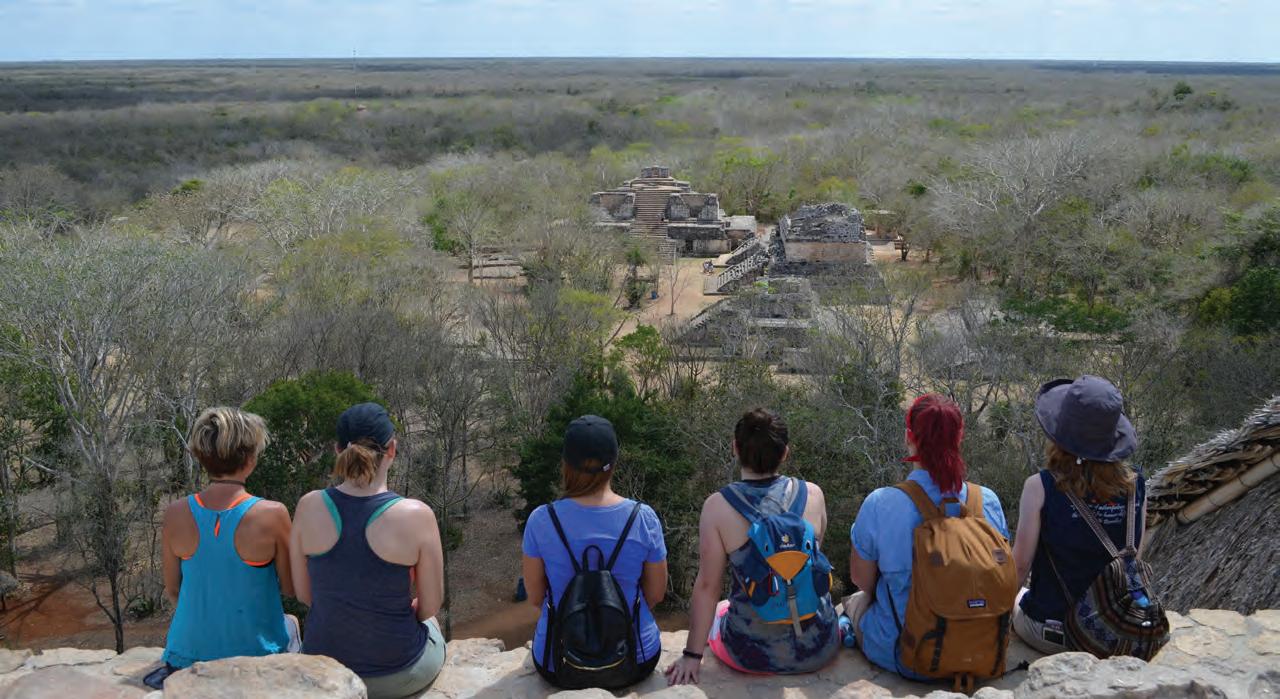
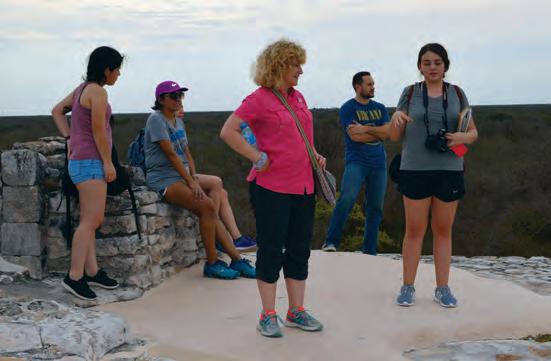
Nearly 200 years later, undergraduate and graduate students at The University of Texas at San Antonio retraced Stephens and Catherwood’s steps as part of our co-taught spring 2017 course “In the Footsteps of the Early Maya Explorers.” In place of the camera lucida, tripod, sextant, compass, gun and gun powder toted by Stephens and Catherwood, these spirited Roadrunners stufed their suitcases with the tools of 21st-century exploration: sunscreen, sunglasses, swimsuits, shorts and iPhones. For the week of spring break, students applied what they had learned in the UTSA classroom to the Maya ruins they now explored frsthand. They marveled at the complex architectural facades of the Puuc sites, decoded hieroglyphic inscriptions and made historical and cultural connections of their own.
Our goal was to empower students to learn about the ancient Maya civilization from three complementary avenues: primary sources, distinct disciplinary perspectives, and handson experience. By using Stephens’ Incidents of Travel in Yucatan (1843) as our course text, students were introduced to ancient Maya sites through the account of their initial discovery. With the aim of encouraging students to expand their knowledge base and their ability to see the world in more nuanced and holistic ways, we taught the course from the empirically driven feld of anthropology and the aesthetically and visually driven
discipline of art history. Through this model, art and art history students questioned process and materials and parsed iconography while anthropology students mused over the power dynamics between sites. This interdisciplinary classroom dialogue became even more pronounced in the Yucatan: At archaeological ruins and on bus trips, students intellectually engaged with their peers about the sites and architecture they were experiencing for the frst time.
One unique aspect of this immersive experience was the opportunity for undergraduates to learn from graduate students, many of whom had already undertaken archaeological research at Maya sites and had applied, successfully, for research grants. Zoe Rawski, one of the PhD students on the trip, was recently named a National Geographic Young Explorer, a title that inspired awe among undergraduates. As our bus made its way to the large and impressive ancient city of Uxmal, we announced that Christian Sheumaker, another anthropology PhD student, had just received a highly competitive National Science Foundation Graduate Fellowship award. This news met with thunderous applause from his peers.
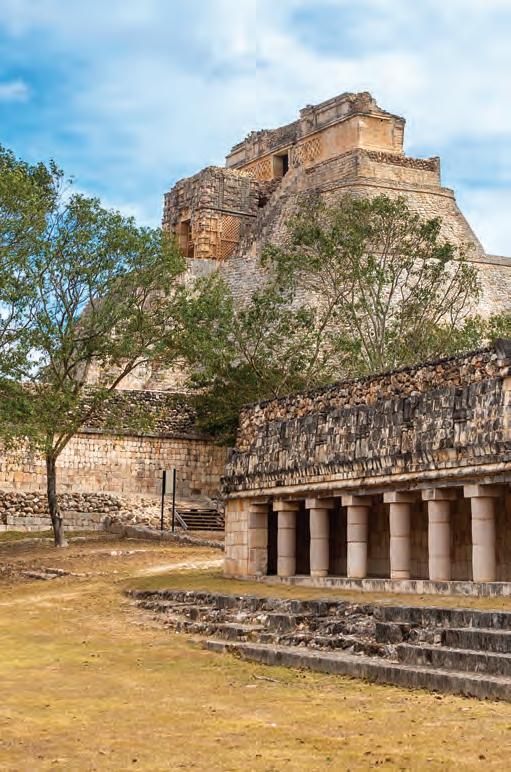
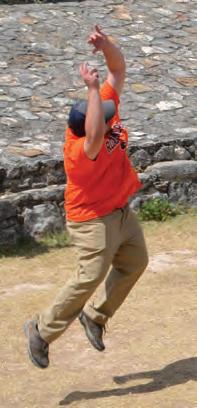
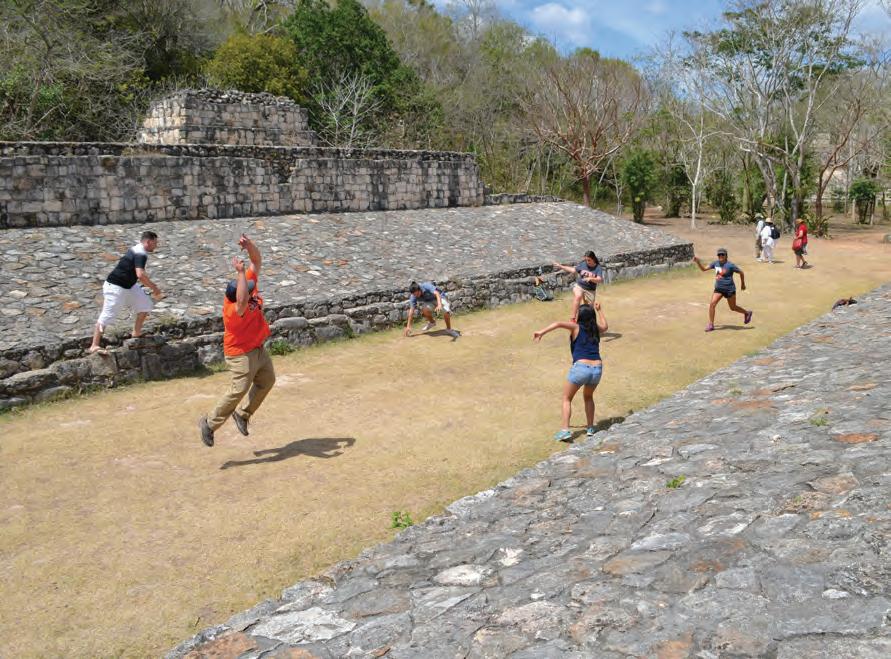
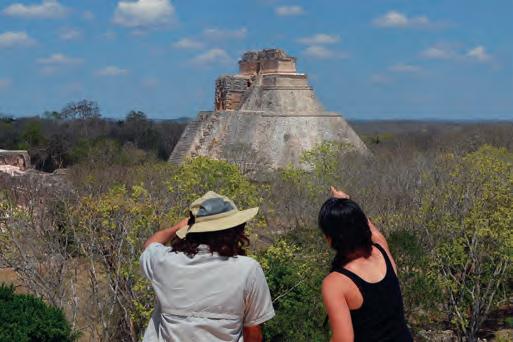
Some of the most eye-opening moments came from walking through the Maya sites, where students were able to compare their own observations with those made by Stephens and Catherwood. For example, at Uxmal, Stephens was fascinated by what he described as “two great parallel edifces that did not contain any apartments.” As he rightly surmised, he had stumbled upon the remains of an ancient ball court! UTSA students were quick to identify these structures and even staged a mock game at the court of Ek Balam (photo). On a moonlit evening in Merida, they marveled as skilled ball players hurled a heavy rubber ball in a reenactment on the steps of the cathedral.
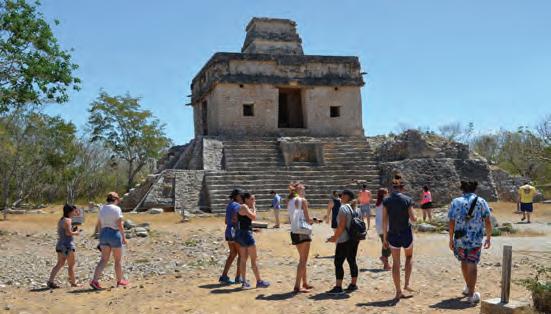
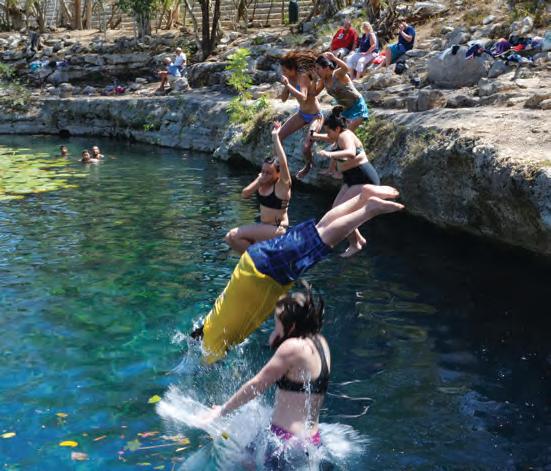
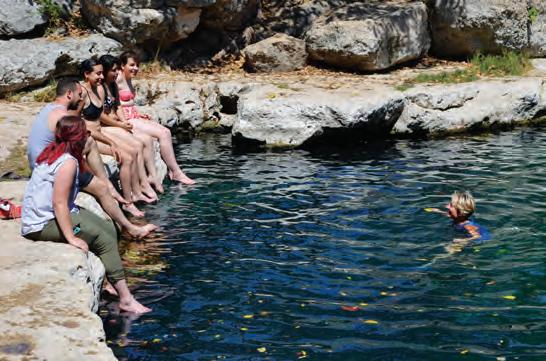
Photos Next Page: (Top) UTSA students reenact the Maya ball game in an ancient court at Ek Balam. (Right Top) Students at Temple of the Seven Dolls at Dzibilchaltun. (Right Center) All in! UTSa students dive into cenote at Dzibilchaltun. (Right Bottom) Nathan and Elizabeth discussing Temple of the Magiician at Uxmal.
Another frst for UTSA students were the cenotes, or subterranean wells, which double as pristine swimming holes for overheated explorers. Like Stephens and Catherwood, the students could not have anticipated the pure exultation brought about by swimming in a cenote. Stephens described the cenote as an “unexpected spectacle of extraordinary beauty… the very creation of romance, a bathing place for Diana and her nymphs.” At the cenote Xlacah at Dzibilchaltun, the students waded through lily pads and commingled with schools of fsh. At a cenote near the ancient city of Mayapan, the students showed their school spirit and their agility in life vests, spelling out U-T-S-A in the water.
Physically experiencing places students had read about brought the slides, lectures and readings to life. “It is a completely diferent experience to be able to see a pyramid in context,” Heditzel Schultz observed. “Some sites are densely packed with buildings, others are much larger and more spacious, but you can’t understand that from a slide.” For Bertha Chavez, a lightbulb went on when she walked upon the elevated roads, or sacbeob, of the ancient Maya, noting that they provided valuable insights about the social stratifcation
of society and shed light on alliances between neighboring polities.
Time in the Yucatan led to new research projects for grads and undergrads alike. At the frst stop on our itinerary, Mayapan, Nathan Talamantez found a piece of charcoal from a modern fre which he used to render his sketches for the ruins at that sight. This discovery—the incorporation of local artistic materials in his artwork—led him to seek out natural pigments such as fower petals and earth at other sites. He continues to develop this technique in San Antonio.
In addition to appreciating the achievements of one of the world’s most accomplished ancient civilizations, students came to grasp the
importance of preserving our collective cultural heritage. Miranda Martinez, an anthropology student, heard Yucatec Mayan being spoken by schoolchildren in a local museum, which led to her interest in the revitalization of language and tradition in this area. Meanwhile, Mairin Derk, struck by the stark diference between wellmanicured sites packed with tourists (Chichén Itzá) and more rustic and only partially excavated sites devoid of visitors (Oxkintok), was determined to investigate the factors that shape tourism and archaeological preservation.
For some, the course challenged them to think outside of their own cultural framework and embrace unfamiliar cultural traditions. For others, it pushed them to re-embrace familiar ones. Maria Gonzalez, a UTSA student from Mexico, had the unique experience of feeling like a visitor in her own country. Alejandro Parra, whose parents are bilingual, longed for the frst time to write and speak Spanish fuently. Many students overcame personal obstacles and pushed themselves beyond their comfort levels. All made lifelong friends.
On our last day, hiking around the vast but only partially excavated site of Oxkintok, students discovered secret tunnels and ancient structures covered in vegetation. Their thoughts went back to Catherwood’s drawings of crumbling ruins, sprouting with Caribbean agave. “At every turn I am amazed by how much work remains to be done,” said undergraduate student Carlos Mendez. “Maybe I will be one of the people to do it.”
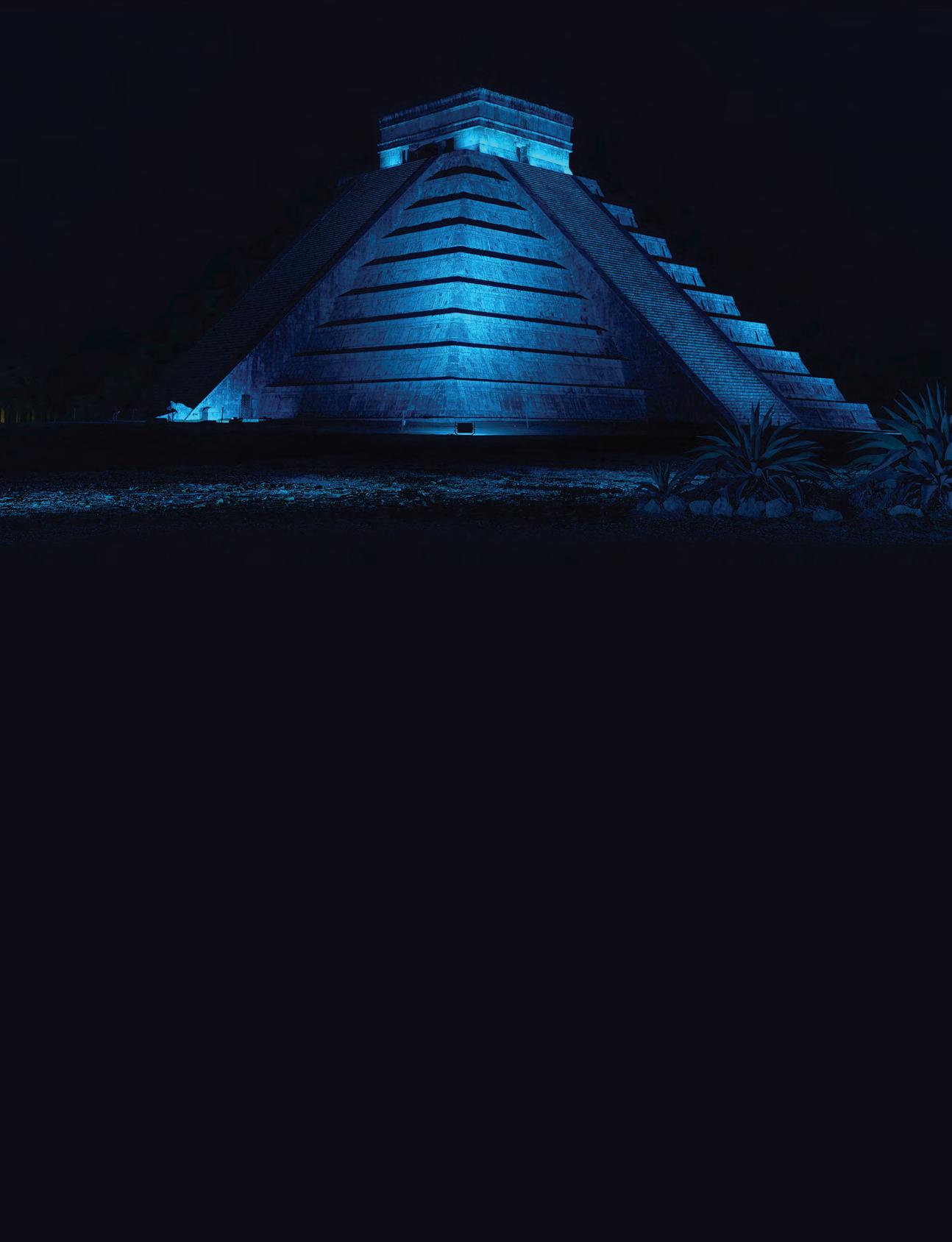
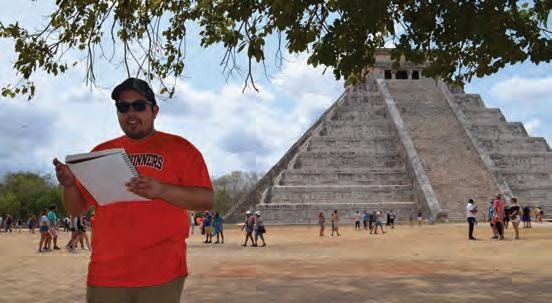
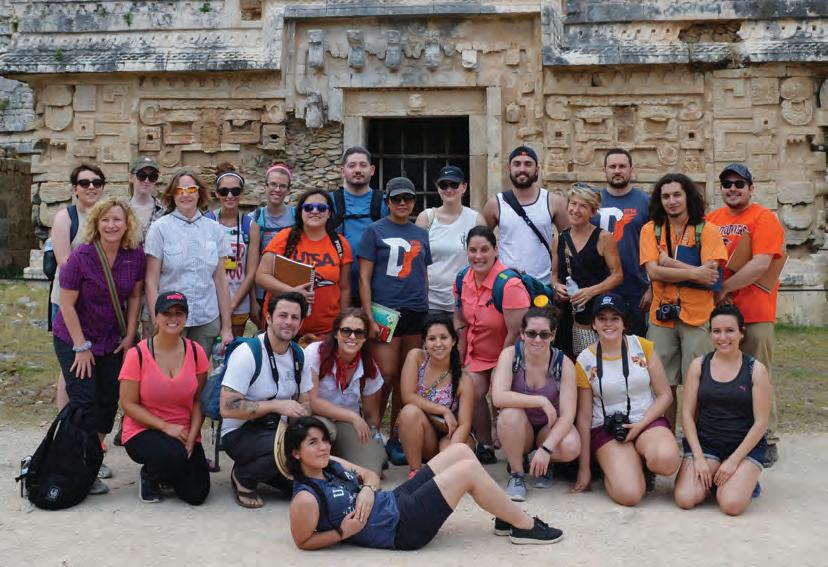
Photos: (Lef) Alejandro Parra presenting on the Castillo at Chichen Itza. (Top) Group photo at Chichen Itza.
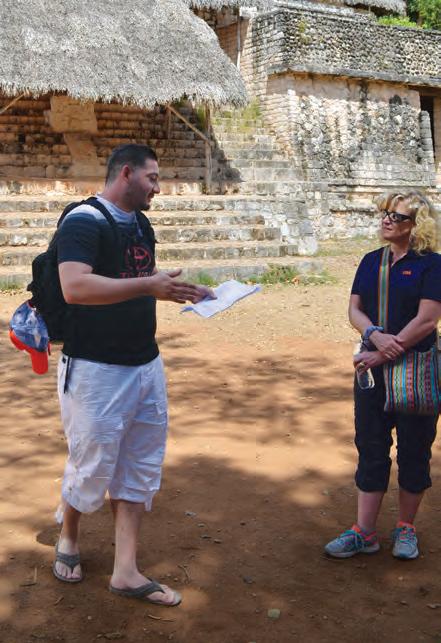
Photos: (Lef) Carlos giving a presentation at Ek Balam. (Top) Kat Brown shares her knowledge of the ancient Maya from a temple at Mayapan. (Bottom) Juliet Wiersema lectures from a cenote.
Although it sits a mere 90 miles from Key West, Florida, Cuba has long been a mysterious and exotic island to many people in the United States. Forbidden as a travel destination for Americans since 1960, and branded as our political enemy during that time, Cuba has been out of reach for most U.S. citizens in a way that none of our other neighbors have been.
And yet, Cuban infuences abound in our country, particularly in the rhythms and energy of the island’s incredible music. As a classical guitarist and jazz musician, much of the music I have played throughout my life has had at least some Cuban infuence. In 2000, I spent almost a year working to bring the renowned Cuban composer Leo Brouwer to San Antonio to conduct the San Antonio Symphony as part of the Southwest Guitar Festival. A few years earlier I had had the pleasure of working with, and learning from, the great Cuban jazz pianist Chucho Valdés at a summer festival in Canada. Throughout the years I've admired Cuban guitarists and composers with whom I've become acquainted through recordings and mutual colleagues.
So, when President Obama loosened restrictions on travel to Cuba for U.S. citizens, I knew right away that I would visit the island, and I also knew that I would try to bring a group of UTSA guitar students with me.
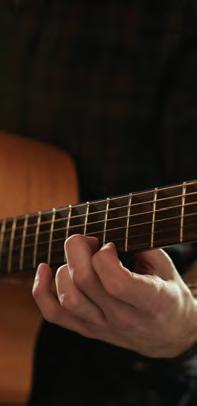
On March 13 of this year, I and a quartet of guitar students—Abram Fernandez, Ashley Lucero, Daniel Schumacher, and Aaiden Witten— departed San Antonio for a weeklong concert tour of Cuba, where we performed four concerts in three cities over a span of fve rigorous days. Our frst concert was in Cienfuegos, the birthplace of the Cuban dance genre son, as featured artists for a national guitar festival held in the city annually. Later in
the week we performed in the lovely city of Pinar Del Rio in the Museo de Arte, and fnished the week with two concerts in Havana: a collaborative concert with a Cuban guitar orchestra at the Iglesia de Paula in Habana Vieja, and fnally a gala performance at the Centro Hispanoamericano de Cultura along the famed Malecón in central Havana. Aside from the concerts, we visited guitar programs at Cuban universities and conservatories in all three cities, sharing performances with the amazing Cuban guitar students we met. We also were honored to have a masterclass with Maestro Leo Brouwer, certainly the most important guitaristcomposer of our time, with over 100 recordings of his guitar music
and dozens of highly acclaimed flm scores. In a small recital studio packed with spectators (including many of the best guitar students in Cuba), each of our quartet members performed for Maestro Brouwer and received his feedback. Ashley Lucero and Daniel Schumacher had the particular honor of performing their own compositions, which Brouwer enthusiastically praised. This was a life-changing moment for our students.
Organizing the trip was a bit daunting, but fortunately we had excellent support from a number of individuals and institutions.
The UTSA Ofce of International Programs provided fnancial support through two grant programs as well as some useful logistical advice. They funded a preliminary trip to Havana for me in October 2016, which proved to be absolutely crucial in securing the support of Cuba's Centro
by: Matthew Dunne
Nacional de Música de Concierto.
The CNMC arranges special visas required for non-Cuban citizens to give public performances in the country, and controls the booking of government-owned concert venues.
The CNMC also provided us with excellent promotion and publicity; there were stories about our tour in Cuban national newspapers, and on radio and TV. The UTSA College of Liberal and Fine Arts and the Department of Music provided fnancial support and assured me early in the planning process that we would have the necessary resources to ensure success. The quartet performed concerts around San Antonio to raise funds for the trip as well as to fne-tune our concert program. We received a donation of 100 sets of guitar strings from the D'Addario company to give to Cuban guitar students, who can't aford to buy goodquality strings. Finally, a wonderful
Cuban guitarist-composer, Eduardo Martín, a leader in Cuba's chamber music world, made the necessary introductions for me at the CNMC, and helped immeasurably with the logistics of the tour.
However, the true stars of this whole project were our UTSA students, who performed brilliantly, were rewarded with packed halls and standing ovations, and served as excellent ambassadors. Their perspectives on the trip were chronicled in three separate Texas Public Radio features. (Visit tpr. org and search "UTSA Guitar Cuba" to listen to the stories.) Throughout the preparation for the trip and during the tour itself, I was continually reminded of each student’s deep dedication to music and enthusiasm for sharing music with others. Getting to know their peers in a country so diferent from ours was an incredibly powerful experience for them.
In September 2016, the UTSA Mexico Center launched the Mellon Humanities Pathways Program with the goal of encouraging more undergraduate students from underrepresented backgrounds to participate in graduate programs in the wide scope of humanity disciplines. With the current emphasis on Science, Technology, Engineering and Math (STEM) fields, the humanities disciplines have lacked programs that support students interested in pursuing graduate studies. The UTSA Mellon program’s theme is “Latinos in a Changing World,” chosen because Latino culture and experience are the common threads that connect the interdisciplinary humanities research of the faculty members at UTSA who will mentor, instruct and support fellows in the program.
Through the Mellon Pathways Program, UTSA seeks to develop a network of talented humanities researchers who bring fresh ideas, approaches and perspectives to address the issues and challenges of Latinos in a changing world. Humanities researchers who focus on these issues would be valuable for the economic development of the South Texas region and for its communities. At a broader level, this theme is aligned with the changing demographics of the United States.
Over the course of a three-year grant, UTSA will ofer approximately 36 undergraduate student fellowships, so students can learn about humanities research, work as apprentices to UTSA professors conducting humanities research, visit humanities graduate programs and attend professional workshops to prepare for graduate school. Fellows selected for the training program receive a stipend of $4,000, which is disbursed as they participate in and complete the project activities.
While graduate studies training is open to all juniors, the UTSA Mellon Program specifcally recruits students typically underrepresented in the humanities. Fellowship candidates must complete an application that includes two letters of recommendation from faculty members familiar with their work, an ofcial transcript, and a narrative explaining their areas of interest, background experiences and motivation to pursue graduate studies.
The Mellon Humanities Pathways Program is especially important to The University of Texas at San Antonio, a young, four-year institution striving to become a Tier One research university. UTSA is a Hispanic-serving institution located in the largest urban center of the historically underserved South Texas region.
GABRIEL AGUILAR
I am here for my family. That’s the short of it, the reason why I ended up in the Mellon Pathways Fellowship. I come from a poor family of four (my mother, my older brother, my younger brother and myself), and my family has given me endless love and support as I explore a new collegiate territory that is as alien to them as it is to me. My mom doesn’t have much, but she has invested every penny she can spare to ensure my success, and I am forever grateful. To give back to her, I want to show her that I can earn a Ph.D. and become a respected professor someday. I am lucky that the Mellon Fellowship noticed the same innate drive for success that has gotten me this far in my academic career. I plan to apply to a Ph.D. program in English with a concentration in rhetoric. For my family, for my mentors, and for my fellows, I will be successful in a graduate program.
EMILY HEMMITT
I am currently a frst-generation senior majoring in sociology at UTSA. I am the frst in my family to attend college and obtain a degree, and it means the world to me and my family. Since becoming a Mellon Humanities Pathway Fellow, I have developed the skills necessary to make me a competitive candidate for graduate programs. I knew coming into the program that I wanted to be a professor, but I had no clue what it took to get there. Mellon has given me the opportunity to shadow a professor, and working with Dr. Saldivar-Hull, I have already learned so much about the research process. I can see, frsthand, the everyday life of a professor at UTSA. Mellon completely changed my life and my educational trajectory. I know that with the aid of this program and the work I have done so far, I will continue to do great things.
IRENE ESCOBAR
I am majoring in psychology and minoring in sociology at UTSA. Afer earning my bachelor's degree, I plan to continue my studies by pursuing a Ph.D. in clinical psychology. My ultimate career goals include becoming a university professor who researches the relationship of cultural values to mental health and a clinician who delivers psychotherapy in private practice. UTSA has been a second home to me because of all the support I have received as a frst-generation student. The Mellon Fellowship at UTSA has not only guided me through the complex process of applying to graduate school, but has also given me the opportunity to conduct research and meet other students with similar backgrounds. I am proud to be part of the Mellon Fellowship and thankful to have such caring coordinators, mentors and Mellon Fellow peers.
AMANDA HERNANDEZ
I graduated from the UTSA Honors College in summer 2017 with a bachelor’s degree in women’s studies. This fall, I will begin working towards a Ph.D. in sociology at Baylor University. Completing my undergraduate education at UTSA and being a part of the Mellon Humanities Pathways Fellowship, as well as the McNair Scholar Program, has provided me with many research and presentation opportunities. The mentorship and support I received from UTSA faculty and staf were essential to my successes.
My research interests include studying the ways in which U.S. Latinas, women of color, and more broadly, people of color, navigate social institutions, specifcally those of higher education, religion and the family. Upon completing my doctoral program, I plan to enter the professoriate where I will continue to mentor other frst-generation and “non-traditional” students who are on their way to earning their degrees.
MATHEW HINOJOSA
As a Chicanx recovering from alcoholism and addiction, I have developed networks and communities at UTSA that have been vital to my own personal and educational success. First to Go and Graduate and G-Force, where I’ve been fortunate to work as a peer mentor, provide an outlet for me to share my experiences and work as a cultural broker for students entering or already in academia.
The Department of Mexican American Studies provides the radical intellectual underpinnings that guide my studies. With its beautifully supportive community of faculty and staf, the anthropology department gives me the theoretical and methodological framework through which I carry out my work. With my feet planted in both the community and the academy, I strive for the liberation of addicts, alcoholics and all people of color. Afer graduation, I plan on fnding a doctoral program in Chicanx studies to continue my work with recovery communities.
AJ MARROQUIN
Having grown up and lived in San Antonio my whole life, I am happy to represent my family and community at The University of Texas at San Antonio. Through school and work experiences both on campus and around the city, I’ve gained a respect for pursuing an academic career not only to engage my research interests but also to support the places and people I come from. As a queer Chicana in higher education, I’m aware of the need for more diversity, not only in university student bodies but also in the curriculum. Through my research on centralizing marginalized narratives in canonical structures, I hope that other gender, racial and sexual minorities can fnd themselves represented in academia, and I hope that by pursuing a Ph.D. and professorship, I’ll be able to encourage other minority students to keep participating in critical conversations.
As a nontraditional student whose parents did not go to college, attending UTSA has been both challenging and immensely rewarding. As a Mellon Fellow, I have been aforded the opportunity to gain insight, knowledge and support from university educators, researchers and administrators across the country. Dr. Harriett Romo, Dr. Arturo Sotomayor, Ms. Olivia Mogollon and my Mellon Fellowship mentor, Dr. Jason Yaeger, have been incredible advocates and motivators throughout the Mellon program.
I am an anthropology major with a sociology minor. My focus is archaeology.
I have two strong research interests at this time. I am learning about photogrammetry and 3D modeling of archaeological materials and want to create digital applications which will allow a broader audience to experience archaeology. I am also exploring gender issues and lack of diversity in U.S. anthropology programs.
I am an undergraduate student earning a double major in political science and global afairs with a minor in Latin American studies. I want to use my education to become a voice for those unheard and vulnerable to human rights violations, particularly in the crossborder, cross-cultural environment. I am currently pursuing this goal through my research for my ongoing thesis, Aging in Mexico: A Case Study of U.S. Senior Citizens and the Quality of Life in San Miguel de Allende.
The Mellon Fellowship has provided me with an important support system, which includes my knowledgeable faculty mentor, preparation for and participation in conferences, opportunities to publish in academic journals, and encouragement and guidance to pursue graduate studies. I am also a member of UTSA’s Honors College, Pi Sigma Alpha (the National Political Science Honor Society), the National Society of Collegiate Scholars, and the Phi Theta Kappa Honors Society, where I served as Fundraising and Public Relations Ofcer.
ERIC PITTY
I am a senior majoring in English literature with a concentration in creative writing. Before attending UTSA, I worked for several years as an actor, writer and producer of dramatic works for the stage. Alongside my theatrical career, I am a published poet with notable works appearing in the San Antonio ExpressNews and the Texas Observer. In 2013 and 2015, my work was long-listed for the prestigious Fish Publishing Prize in Poetry. I am currently preparing applications for graduate studies programs in English literature and American studies, where I will research contemporary American theater and performance, modernist literature, and the history of American Shakespearean criticism.
NICOLE POOLE
UTSA and the Mellon Humanities Pathways Fellowship Program have been instrumental in showing me how I can best turn my dreams into a reality. Afer working in the corporate world, I decided to return to school to pursue a career in art education. The level of encouragement and support I have received from UTSA’s Department of Art and Art History and the Mellon program coordinators have helped me realize my true potential as an artist and art historian. The unique learning experiences and networking opportunities I have participated in will allow me to have a greater impact on future generations of art and art history students. I knew that returning to school would allow me to change my career, but the time I’ve spent at UTSA and in the Mellon Humanities Pathways Fellowship has enhanced my life in ways I did not think possible.
BIANCA PULIDO
I am a senior in the UTSA Honors College earning a double major in English and classics with a minor in humanities. Born and raised in San Antonio, I graduated from Health Careers High School and went on to be a part of the Top Scholar program at UTSA. During my time here, I have volunteered, maintained a 4.0 GPA, spent a summer working with the Prefreshman Engineering Program-USA, traveled to Portugal for archaeological feld school, and taken part in organizations like Students for the Right to Life, of which I am now the vice president. Last year, I joined the Mellon Fellowship, which has helped me prepare for graduate school (especially the GRE) and has provided me with a supportive environment where I can entertain many diferent possibilities for my future.
VANESSA SANDOVAL
In fall 2016, during my frst semester at UTSA, I was fortunate enough to be recommended and accepted into the Mellon Humanities Pathways Fellowship Program. As an aspiring scholar and young professional, the gratitude that I feel for the opportunities I have been given through this fellowship has been emotionally overwhelming for a frst-generation, working-class, non-traditional student like myself.
The exposure I’ve had to the process of applying to doctoral programs has made me feel confdent in fnding a program that best suits my research interests. Afer earning double bachelor’s degrees in anthropology and Mexican American Studies from UTSA, my long-term goals include postdoctoral work and research centered around ethnic studies, Chicana/os in education, the education system, activist anthropology, and the nonproft sector. I am a proud Roadrunner and UTSA Mellon Humanities Pathways Fellow, and I look forward to being a UTSA alumna.
DARLA MESSINA
MONICA PEPPING
Alumni Profile: Mimi D. Frances
BRINGING FAMILIES
TOGETHER RUNS IN THE FAMILY
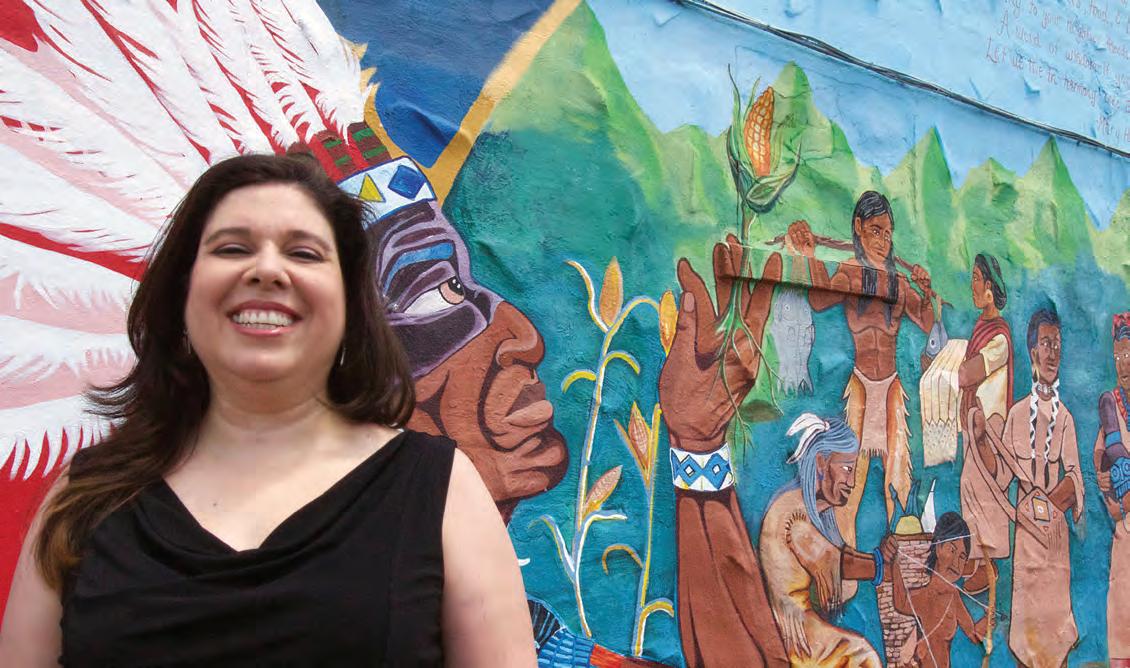
What do you do when the already emotionally draining, travel-intensive, and sometimes heartbreaking work you do isn’t enough for the underrepresented? What might you do to improve a delicate system working to bring families together in that population? For Mimi Frances, the answer was to take up the mantle herself and create space for those who needed it most. In her work in CPS (Child Protective Services), Mimi realized that children of Native American tribes were. The Indian Child Welfare Act gives tribal governments a greater role in the process of adoption and protection of Native American Children. As such, the communication and
correspondence necessary to see all cases handled appropriately is overwhelming, and ofen this delay in communication took time and valuable information away from caseworkers. The solution, for Mimi, was to create the space and time necessary for caseworkers to devote their attention to Native American children to connect them with their heritage and families.
Mimi (Melissa) D. Frances frst attended The University of Texas at San Antonio in the late 80’s, working towards a degree in Anthropology. She describes herself at the time as driven—on a mission to complete her degree, learn as much as she could,
overlooked, and Mead’s work revealed how women were historically excluded from anthropological studies.
Afer graduating with her Bachelor’s degree in 1984, Mimi then worked with Dr. Daniel Gelo, now dean of the College of Liberal and Fine Arts, on applying for Ph.D. programs, and was accepted into the doctoral program at Southern Methodist University. During her time there, Mimi was interested in peer socialization among school children. “Back then it was still sort of new to focus on children themselves, and not children in relation to how they are parented or raised.” Mimi’s feld work focused on how children developed their own identities and interacted with their peers. She was still actively enrolled at SMU until 2000, but found it difcult to apply for grants to go into schools to work with children. One of the complications of doing so was the tendency for the children she worked with to disclose sensitive information like abuse, which then required her to speak out, and her time at a school would be over. Mimi’s job required her to be ethical when interacting with diferent people, and she learned this from her mother, who was also a social worker.
that ofen comes with being a social worker. She knew she had the passion and duty to help others.
Mimi went back to UTSA to get her Master’s in social work, which would help her gain insight into the work she did—in addition to her background in history and anthropology. Realizing that the work she did with CPS and the ICWA would require more hands on deck, Mimi created the space and time for
name to reduce the amount of work and increase the likelihood of a match.”
and progress to the Ph.D. level. Before she was an anthropology major, however, she was a history major. “I loved my classes, but took every elective in anthropology or intercultural studies,” she says, “I took many history courses that folded into anthropology.” Mimi loved history, but she found that it came from the point of view of the colonizers, and she was interested in other perspectives.
“Anthropology is much more about the people [of diferent societies] and their day-to-day lives, social interactions, etc.” When she read Margaret Mead, she found it a profound experience to see a completely diferent part of culture that is
It was her mother, in fact, that encouraged her to work with the CPS.
Afer moving to a job in a diferent feld, getting married, and having a child, Mimi wanted to work to support her family, but also wanted to work in a feld that ft her passions. Having been raised by a social worker, Mimi saw the difculties of the job, and how hard her mother worked to help others. While working a particularly disturbing case involving the injury of a child, Mimi realized she was capable of doing the job and going through the personal confict
by: Lindsey Hall
WHETHER IT’S CONNECTING ONE KID OR ALL THE KIDS, EVERY DAY WE DO THIS WORK, IT MAKES THAT HUGE DIFFERENCE TO THAT ONE KID.
– MIMI
an internship that would allow others to devote more time and attention to connecting Native American children with their tribes and families. Although she spent much of the frst few months manning the helm herself, alongside her other responsibilities, Mimi knows that she is making a diference. “I am still the only person manning the mailbox, but the workload is manageable. I answer questions from DFPS staf, ADAs, and paralegals. I have testifed in court about my eforts and the ICWA process. Caseworkers use the mailbox to send in their ICWA questionnaires. I review them and forward onto the paralegals. I give advice based on my experience such as the Cherokee Nation traces lineage back to ancestors on the Dawes roll while the Oglala Sioux use blood quantum. I let everyone know there are 22 federally recognized Chippewa tribes and suggest the caseworker seek older relatives who may be able to give a specifc tribe
Though being a social worker has its bad days, Mimi says that one small victory can make up for everything. “Whether it’s connecting one kid or all the kids, every day we do this work, it makes that huge diference to that one kid. This is kind of our credo in the CPS.” And working to help others runs in the family; Mimi’s mother was a social worker, and her father was in the military. Mimi’s work sometimes interferes with her own family time, but she’s seen how her family still supports her. She recalls a time when she had to cut short a trip to Sea World with her son, who was four years old at the time. Instead of being upset, her son replied that he was glad she was helping another child in more need than him. Mimi is glad that her son can see her make a diference in the world, whether it’s going back to school at a later age, or helping others in need. On the perspective that being a social worker provides, Mimi says, “I’m surrounded by people who care that much about something. On your worst day there is always someone else having a worse day. I’ve never met a person who didn’t love their children, though they may show that love in diferent ways. Yet, it’s never not love.”
D. FRANCES
Student Profile: Linda McNulty
AN ODYSSEY OF ENRICHMENT: THE INVALUABLE STRENGTH OF COLLABORATIVE COMMUNITIES
As a lover of languages, literature, art and history, Linda McNulty frst enrolled at UTSA as an English major. But taking a Leadership in the Ancient World course changed all that: “I didn’t know what classics studies was in high school,” she says. “When I took this class, I thought, ‘This is fantastic!’ Classical studies included everything I was interested in. I fell in love with the Greek language.” So afer just a few short weeks at UTSA, she changed majors to classical studies. Now UTSA’s College of Liberal and Fine Arts, Top Scholar program and McNair Scholars Program support Linda as she explores the connections between ancient culture and today’s world.
This switch in majors led to a dream come true when Linda was invited to study for eight weeks at Lady Margaret Hall at the University of Oxford in fall 2016. In England, she took part in weekly one-on-one tutorials with faculty member Claudia Wagner and attended diverse lectures at the university.
Linda says that it is impossible to choose a favorite highlight from the experience, but notes that on the day of her very frst tutorial, Dr. Wagner took her to the cast gallery in the Ashmolean Museum. The gallery houses hundreds of plaster casts of ancient Greek and Roman statues and reliefs. Linda recalls that “even though the museum was closed, Dr. Wagner had special access to the archives, so I got a guided tour. I even got to handle the pot fragments, gems and coins that I was studying.” Oxford made the classics come to life in a way Linda hadn’t felt before: She was able to literally hold pieces of history in her hands.
Linda credits these incredible experiences to UTSA’s Top Scholar program, guidance and support from COLFA faculty and students, and the McNair Scholars Program. The frst gave her the mentorship, fnancial support and community necessary to tackle higher education. Linda says that “it’s hard to articulate just how much a community of like-minded individuals can do for you. We all talk about each other’s studies and hang out. Everyone’s equally driven. I’m just surrounded by so many people working so hard and doing so many things to support each other in their successes and accomplishments. That pushes and motivates me much more than competition would.”
She is especially thankful to Kristi Meyer, director of the Top Scholar program, for her dedication: “She’s the frst person I go to if I’m worried, need help, or if I’m excited about something. If I need something, she’ll make it happen. And she does this for 34 students!” Linda enjoys the service projects, leadership opportunities and friendships she has made in this special multidisciplinary community.
UTSA has also provided Linda with support for her research inquiries. Her frst professional conference was the 2016 COLFA Spring Research Conference, where she presented her paper, “Rededicating the Hearth: Reexamining Literary and Material Representations of Hestia,” a subject she is still enthusiastically pursuing “thanks in part to questions from professors and other students attending the conference,” she says. She keeps her presenter’s badge tacked onto her bulletin board to remember this engaging experience.
Linda’s inclusion in the McNair Scholars Program provides her with the guidance she needs to pursue a graduate degree. As a Chicana motivated to take her education further, Linda feels lucky to have this community of students who “perfectly understand the extra difculties of underrepresented students.” On top of visiting graduate programs, participating in professional development activities and presenting at research conferences, Linda is able to conduct funded summer research. For 30 or 40 hours a week during the summer semester, she collaborates with other students in study groups and works with UTSA professors on academic projects.
at the annual meeting of the Classical Association of the Middle West and South (CAMWS) in Canada.
On top of her work in classics, Linda is also pursuing minors in biology and religious studies. These are her keys to becoming a more efective researcher, she says, because “being well-rounded is very important, so you don’t get myopic or blinded in what you’re studying.”
She is grateful for the wide range of
gave her, Linda researches how religions develop, how they infuence society, and how they infuence each other.
Ancient Greece and Rome “were connected to a bigger world and had a lot of the issues we deal with today, like balancing self and community, how to live in society, coping with the transition between war and peace, and how to deal with being away from home,” Linda says.
LOOKING AT THINGS THAT HAPPENED CAN HELP US EXAMINE WHAT’S GOING ON TODAY IN A WAY THAT’S MORE COMFORTABLE.
– LINDA MCNULTY
electives that the College of Liberal and Fine Arts allows because she is able “to take classes and interact with professors and students across many departments and disciplines, which has strengthened me as a scholar and as a human being.”
Even her biology minor helps expand her views of the ancient world. A course on plants and society, for example, “actually touches on some work in ancient ethnobotany. I’m interested in dipping my toes into that.”
In summer 2016, Linda worked with William Short, UTSA associate professor of classics, to complete signifcant research.
“Together, we examined ancient perceptions of ambiguity,” she says about the collaboration. “This project taught me how to properly apply theory to my research, and helped me learn to do comparative work — both skills that I now use in my honors thesis.” A year later, she presented the research
by: Alexis Haight
But Linda’s religious studies minor plays an even larger role in her research; in particular, it informs her honors thesis on rituals in Homeric epics. Because Linda is interested in religion and rituals in classical literature, supplementing with anthropology courses, such as one called Ritual and Symbol, helps her develop a working knowledge of religious theory.
Applying these concepts to the “wonderful insights and guidance for my work” that her two thesis readers, Profs. William Short and Daniel Gelo,
This interconnection between cultures, and between religion and culture, is what Linda sees as vital when studying classics: “Looking at things that happened can help us examine what’s going on today in a way that’s more comfortable. There’s a lot of ugly stuf that happens in classical works, like there is today. Studying these works defnitely makes me want to be a better person. And I believe it can help humanize people we see as diferent from ourselves.”
Linda’s wish to pursue a career in higher education is based on her desire to uplif the underrepresented and create academic communities across disciplines and backgrounds. Her goal afer graduating in 2018 is to earn a Ph.D. in classics so she can become a professor and mentor students herself.
“UTSA is a very special place for developing into who you want to be, for a better understanding of who you are and where you want to go,” she says, “no matter what discipline you’re in.”
STUDENTS
Jose Barragan, a UTSA doctoral student in the department of anthropology, was awarded a grant from the American Philosophical Society. The grant will fund Jose’s dissertation fieldwork in Bolivia, which explores pre-Hispanic corridors of interaction between Andean and Amazonian groups on the last foothills of the Andes in Bolivia.
UTSA doctoral student in the department of anthropology Zoe Rawski received a National Geographic Young Explorers grant for her research project “Constructing Power in the Preclassic: Monumental Architecture and Social Complexity at Early Xunantunich, Belize.”
Erik Marinkovich, a UTSA doctoral student in the department of anthropology, was awarded a Historically Underrepresented Groups scholarship from the Society for American Archaeology. Only six awards are given each year.
Parnaz Daghighi, a medical humanities major in the department of philosophy and classics and president of the
medical humanities student club, has been accepted into the Joint Admissions Medical Program of Texas, which guarantees admission into a Texas medical school.
Melina Acosta, a psychology major, was awarded the UTSA Life Awards Most Outstanding Student in both COLFA and the Honors College, and was also named a recipient of the Golden Feather award, which recognizes the top graduating students for their contributions to the university during their undergraduate careers.
UTSA guitar students won prizes in international competitions in Dallas and South Carolina this year. Johnny Peña won 2nd prize and Michael Keplinger won 4th prize in the Mountain View College Guitar Festival solo competition; Johnny also won 3rd prize in the Lone Star Guitar Festival and Competition.
Ashley Lucero and Jeffery Dunn took 2nd prize in the Southern Guitar Festival competition.
COLFA Recipients of Spring 2017 Graduate School Excellence Awards
Excellence in Research
Reed DeAngelis, Master of Arts, Sociology
Excellence in Teaching
Brooke Balbuena, Master of Arts, Music
Excellence in Graduate Advising
Andrea Aleman, Graduate Advisor of Record
FACULTY
Mary McNaughton-Cassill, professor in the department of psychology, is a recipient of a 2017 Piper Professor Award. The award annually recognizes 10 college professors in Texas for their academic, scientific and scholarly achievement.
Jill Fleuriet, associate professor in the department of anthropology, is a recipient of a 2017 Regents’ Outstanding Teaching Award from the University of Texas System. She is among 56 educators from UT System’s 14 academic and
health institutions honored with this prestigious annual award.
Scott Sherer, professor in the department of art and art history and director of the UTSA art gallery, has won the 2016 Mid-America College Art Association Lifetime Outstanding Academic Achievement Award.
Laura Eichelberger, faculty in the department of anthropology, has received an American Council of Learned Societies fellowship to write her forthcoming book, Spoiling and Sustainability: Water Insecurity, Health, and Indigenous Citizenship in Northwest Alaska.
Anthropology professor Robert Hard was named a National Geographic Explorer and will receive a $20,000 grant from the National Geographic Society to excavate an ancient archaeological site in southeastern Arizona.
Ali Kanso El-Ghori, professor in the department of communication, received the Public Relations Society of America’s Tex Taylor Lifetime
Achievement Award. Kanso El-Ghori is an internationally recognized public relations expert, the author of 40 refereed articles, 11 book chapters and numerous essays.
Harriett Romo, professor of sociology, received the 2017 Education Headliner Award presented by the San Antonio Professional Chapter of the Association for Women in Communications. The organization honors outstanding community leaders who have made exceptional contributions in professional, volunteer and civic areas.
COLFA Recipients of UTSA University Excellence Awards 2017
President’s Distinguished Achievement Award for Teaching Excellence
Nazgol Bagheri, Assistant Professor of Political Science and Geography
President’s Distinguished Achievement Award for Core Curriculum Teaching
Sonia Alconini, Associate Professor of Anthropology
President’s Distinguished Achievement Award for Performance, Creative Production, or Other Scholarly Achievement
Ethan Wickman, Associate Professor of Music
President’s Distinguished Achievement Award for University Service
Gregg Michel, Associate Professor of History
President’s Distinguished Achievement Award for Advancing Globalization
Jason Yaeger, UTSA President’s Endowed Professor and Chair of the Department of Anthropology
DEPARTMENT
Eduniversal, a Paris-based global ranking agency specializing in higher education, has ranked the Master of Arts in Communication program the No. 24 best in the U.S. and Canada.
English
Critical Survey of American Literature, 6 volumes, third edition, Steven G. Kellman, editor, Salem Press, 2016
This book ofers profles of major U.S. and Canadian writers from all periods, accompanied by analyses of their signifcant works of fction, drama, poetry and nonfction.
Persuading with Numbers, A Primer for Engaging Quantitative Information,
Sue Hum, Kona Publishing & Media Group, 2017
A practical primer designed to help communicators and writers in technical, professional and scientifc felds develop skills in reading, researching, writing, and visualizing quantitative information. readers to over forty thought leaders in biological anthropology.
Far Out, Wendy Barker and Dave Parsons, co-editors, Wings Press, 2016
A collection of poems dealing with the 1960s.
Language Contact in Europe: The Periphrastic Perfect through History, Bridget Drinka, Cambridge University Press, 2017
This comprehensive new work provides extensive evidence for the essential role of language contact as a primary trigger for change.
History
The Latina/o Midwest Reader, Omar Valerio-Jiménez, Santiago VaqueraVásquez, and Claire F. Fox, coeditors, University of Illinois Press, 2017
A collection of interdisciplinary essays that explore issues of history, education, literature, art, politics and place making among Latinas/os in the U.S. heartland.
Music
Landmarks, Matthew Dunne, ed. David Russell, Doberman-Yppan, 2017
Landmarks is a multi-movement composition for classical guitar that combines three musical traditions: jazz, Spanish nationalism, and Scottish reel.
Modern Languages and Literatures
Man Facing Southeast (1986), written and directed by Eliseo Subiela. Nancy J. Membrez, contributor. Kino Lorber, 2016. (DVD/Blu-Ray)
Three 20-minute flmed featurettes (director Eliseo Subiela, director of photography Ricardo De Angelis, and protagonist Hugo Soto); revised movie subtitles; subtitles for the featurettes;1500-word essay on the movie and the director; and translation of the director's statement.
Political Science
From Inclusion to Infuence, Latino Representation in Congress and Latino Political Incorporation in America, Walter Clark Wilson, University of Michigan Press, 2017
This book addresses the political incorporation of Latinos in America.
Political Science
Multinationale Unternehmen in der Weltpolitik, Zur Kontingenz von Rolle und Bedeutung ‘sozialer Akteure’(Multinational Enterprises in World Politics. On the Contingency of Role and Meaning of ‘Social Actors’), Matthias Hoferberth, Nomos, 2016
This book considers multinational enterprises and their role in world politics in terms of their social, creative and ultimately contingent acts of interpreting reality and responding to corporate crises.
It began as more of a consultation. Dan Gelo had discovered an article in German about the Comanches and their relationship to the Shoshones and Apaches. It was written in 1851 by Heinrich Berghaus, a geographer with a wide range of interests, and included an original list of 366 Comanche words and their German translations, an account of Comanche customs and traditions, and a previously unknown map of Comanche hunting grounds. These three components came to Berghaus from a young German settler in Texas who lived for several months with the Comanches as part of a treaty deal between the German settlers in the Fredericksburg area and Comanche headmen. In the late 1990s, Dan asked Heide Castañeda, an anthropology graduate student from Germany, to draf a translation of Berghaus’s article into English. Over the years, Dan and I talked of and on about the importance
by Christopher J. Wickham
of the article, both for Comanche studies and for the study of German immigration to Texas. Later, we decided that the discipline of anthropology needed to have a published English translation of the article because the existing scholarship on this topic had overlooked Berghaus’s work. It was clear that scholars of German immigration to the U.S. would be interested as well. A scholarly article, co-authored by Dan Gelo and me, and built around a reliable translation, seemed like a reasonable project. As work progressed, the article idea morphed by stages into a full-fedged book, so that by the time we had followed the trails that our research leads opened up, we had a 350-page manuscript. The book provides an extensive, detailed commentary on Berghaus’s article in the context of German immigration to Texas and the development of ethnographic and
anthropological studies in the U.S. It also examines each of the Comanche words in the word list and discusses the meaning ascribed to them.
This project has been a truly exciting cross-disciplinary collaboration over the past four years. I conducted research in archives in Munich, Potsdam and Gotha, Germany. Together Dan and I have enjoyed feld trips to Texas Hill Country locations that are important for our work, and we have both benefted from the stimulation of the other’s discipline and insight. Just as the book that has emerged from this project goes well beyond the modest article that we originally envisioned, so the collaboration itself has far exceeded my expectations in the collegiality, fascinating discovery, productive exchange of ideas, personal and scholarly growth—and sheer good fun— that has come with it.
The University of Texas at San Antonio
One UTSA Circle
San Antonio, TX 78249-0641
The tiny UFO says "Whale, I am a seagull", 2016, Gouache on paper, 12 x 18 inches