The impact of the 2020 COVID-19 pandemic and how we are adjusting in this uncertain time.
03 04 08 10 12 18
A word from Department of Music Chair, Dr. Tracy Cowden WELCOME
CHANGES IN THE INDUSTRY
Read how the music industry is dealing with the impact of COVID-19
LENDING A HAND
Our friends at Alamo Music keep piano students on track by lending keyboards
VIRTUAL UNDERGROUND
The annual music and arts festival will be streaming online this year
SEMESTER IN REVIEW
A pictoral recap of the spring semester highlights
CLASS OF 2020
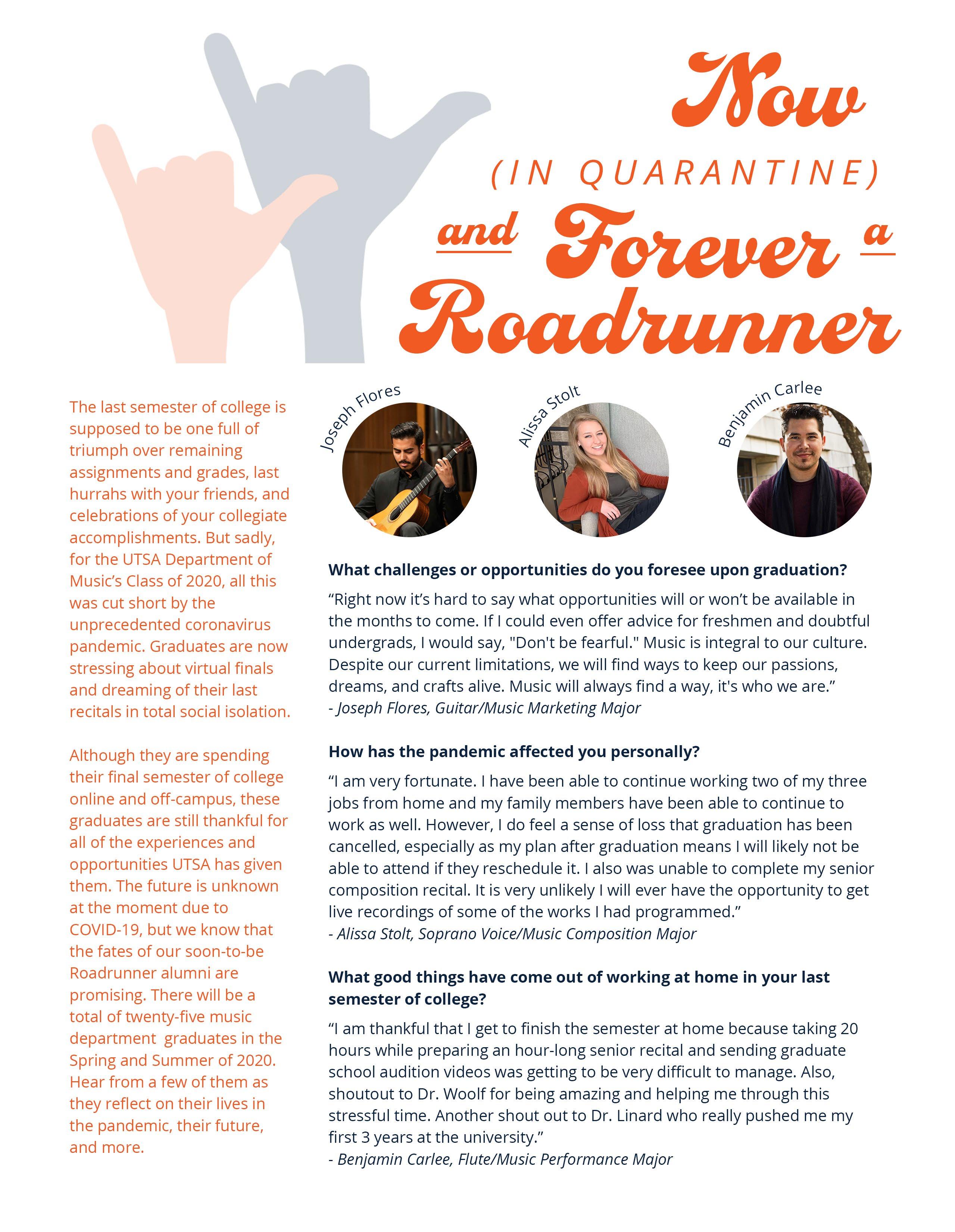
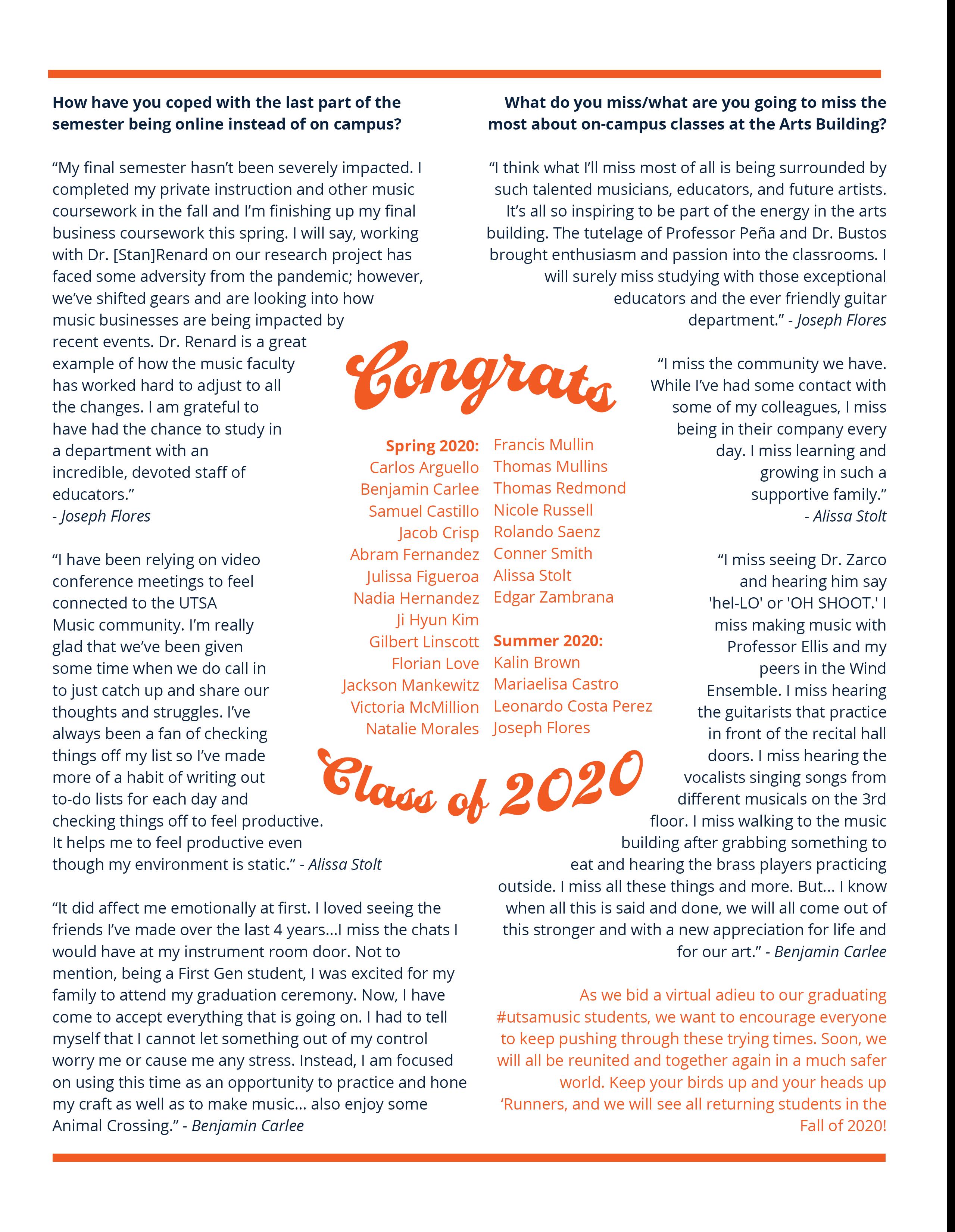
Seniors reflect on this semester’s challenges and their hope for the future
Shelby Gorden - Graphic Designer
Alissa Stolt - Editor
Cindy Solis - Senior Events Manager
Rebekah Alegria - PR Assistant
Jason Guzman - Graphic Designer II
Doug Summers - Intern
FRIENDS, Welcome to Showcasing UTSA Music CADENZA
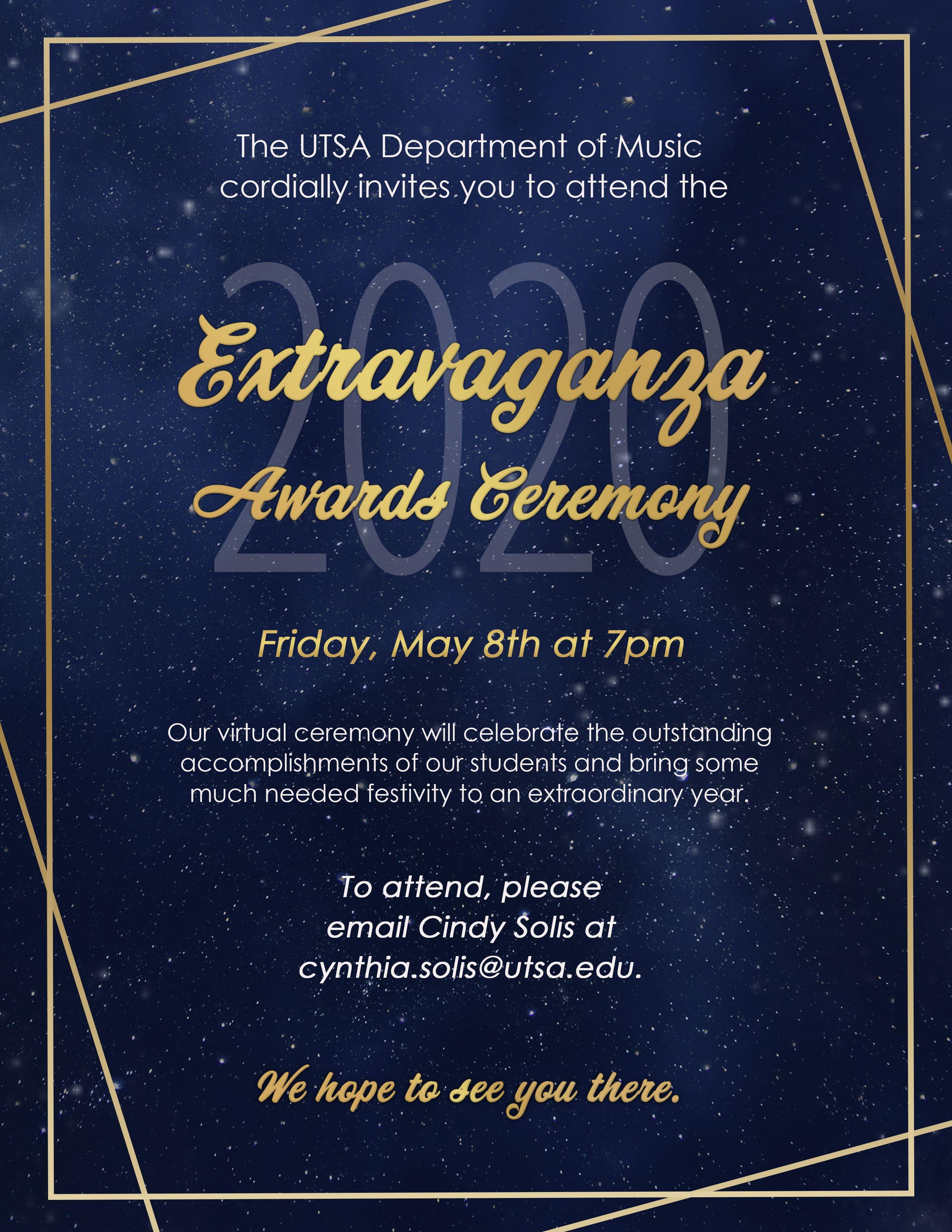
We send you a warm welcome to our final issue of Cadenza for the 2019-2020 academic year and hope that you all are safe and healthy as you read this. While this issue gives us an opportunity to celebrate the achievements of our graduating students and look back at all we have achieved this semester, we are sad to not gather in person to share our joy in music together. However, we are moving our annual awards ceremony, Extravaganza, online! If you did not receive an invitation but would like to join us on May 8th at 7:00 P.M. to celebrate student achievements and awards, please reach out to our Senior Events Manager Cindy Solis at cynthia.solis@utsa.edu for a link to the event.
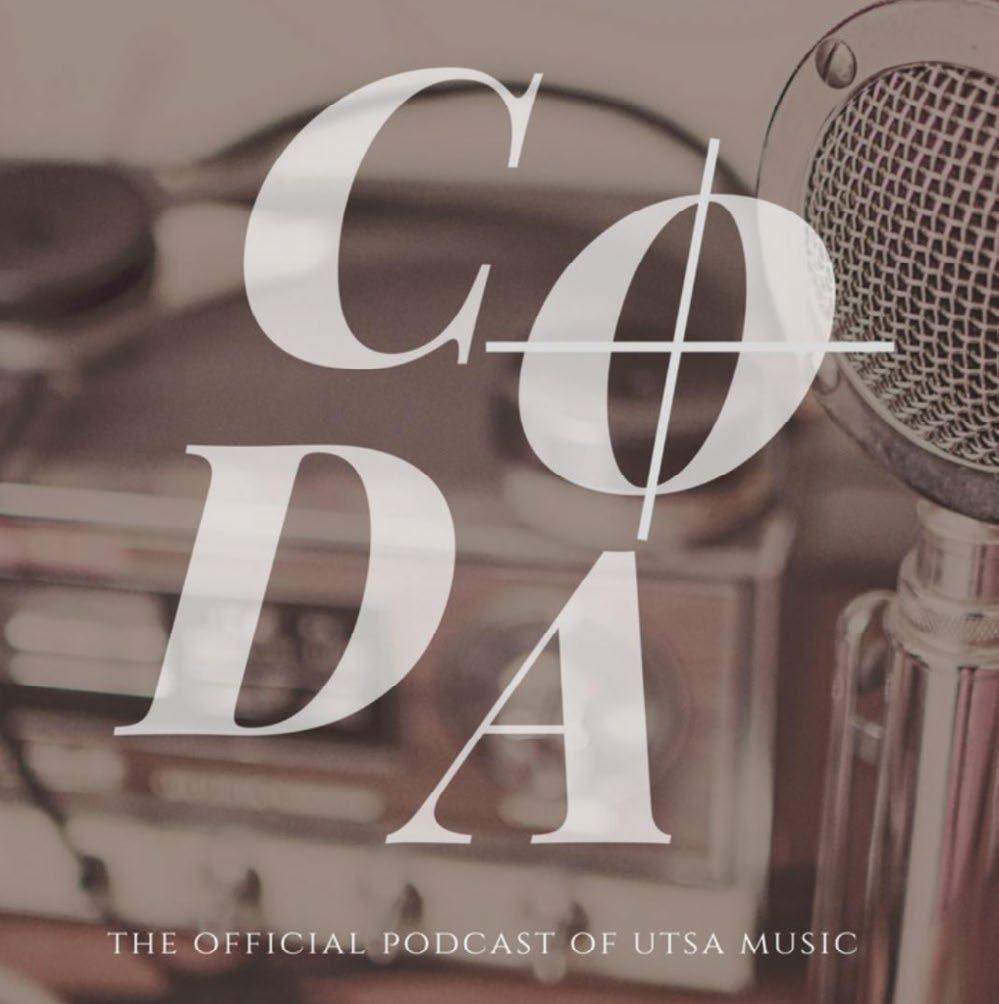
The resilience of the arts community has been strong through this time and the creativity of our own students, faculty, and staff has been remarkable. While we aren’t able to invite you to attend live concerts at this time, we hope that you have had a chance to experience some of the outstanding online content provided by students and faculty through our social media accounts and YouTube. This includes freshly edited ensemble pieces, livestream performances, and our music marketing podcast, CODA, which is available from http://music.utsa.edu. We’re not finished yet, either! Next week, our Musicians of Business (MOB) lead a freshly expanded, on-line version of UTSA Underground; you can read about this in the following pages. MOB, an important feature of our music marketing program led by Dr. Stan Renard, was just awarded UTSA’s Distinguished Diversity Award in the Student Organization category – congratulations to all of them for this recognition!
While we do not have live events to promote at this time, we are still proud to feature several articles highlighting the department. This issue features an article about the impact of COVID-19 on the music industry written by Dr. Stan Renard, a story about the extraordinary student staff who produce Cadenza and other marketing materials for the Department of Music, a feature on talented alumnus Rick Sanchez, and a pictorial review.
We would love to hear from you with any feedback about Cadenza and Department of Music events; please reach out to us at music@utsa.edu with questions and comments. We wish the best for you all as we navigate these uncertain times, and we look forward to hearing from you and seeing you at music events again, virtually or in person!
Tracy Cowden
Roland K. Blumberg Endowed Professor in Music and Chair
Oral History Project Brings Insight Into COVID-19 Effects on the SA Music Industry
Article By Dr. Stan Renard
This article is the outcome of a class project I did with three of my students: Joey Berrios, Rolando ‘Dito’ Saenz, and Joseph Flores. We felt that we had an unprecedented opportunity to investigate the impact of the COVID-19 pandemic on our local music scene. We decided to make it an oral history project in a podcast format and interviewed music industry professionals from San Antonio across a wide range of activities including several arts nonprofits, two live venues, two recording studios, a publisher and A&R (Artists and Representation) professional, two record labels, and four music product retail outlets. We wanted to give a voice to music industry leaders in our community and have them tell us their stories that we could share and relay on the UTSA CODA Podcast channel http://coda.utsa.edu/.
Those interviews were humbling and emotional but also very insightful. We are extremely grateful for our participants who were willing to talk to us and share details about their operations so candidly.
So…what did we learn?
The live music sector and concert industry is by far the most impacted across our city and has not seen shows since mid-March, with cancelled events currently extended until June and most likely for much longer.1 It is a grim outlook with thousands of full-time and part-time professionals being furloughed within that sector across our city. This has affected most musicians as well as production and customer service professionals. Some venues such as “the Tobin Performing Arts Center now operate on a skeleton crew,” says Aaron Zimmerman, Vice President of Programming and Marketing for the Tobin Performing Arts Center.2 San Antonio has
some 300 physical spaces that offered live music entertainment on a regular basis prior to stay at home orders. That is about 150,000 empty seats and/or standing room spaces that have not seen any activity for over a month and half. “The live music sector is about experiencing shows in person and is about physical proximity but all we hear in the news is talk of social distancing,” says Zimmerman. To get a general sense of the distribution of our music related cultural assets, please go to my GIS Map.3
To amplify this tremendous loss of revenue, the city has suspended arts funding, which is largely dependent on tourism and hotel occupancy tax revenue.4 Many arts nonprofits that have been loyal and dedicated renters of spaces across town may not recover. However, several of the arts nonprofits across San Antonio have been very innovative, engaging their patrons on social media by consistently creating new content. Musical Bridges Around the World (MBAW), praised for its resilience and innovative programming, partnered with the local live streaming company Media Fusion to make its live concerts and other programs available to its patrons, explained Sean Kithas, Marketing Manager for MBAW.5 The Youth Orchestras of San Antonio (YOSA) abruptly concluded its concert season with a highly acclaimed Selena Tribute concert mid-March at the Tobin and will be conducting video auditions instead of live auditions this year, stated Alex Flores, Marketing Manager at YOSA.6
We also perceived that music product retailers across San Antonio experienced an all-or-nothing scenario. On the devastating side, “Sam Ash had to let go of its 1700 employees and Guitar Center furloughed a staggering 8000 employees nationally,” says Jon Johansen, General Manager of Sam Ash Southwest Region. Sam Ash, which heavily relies on its in-store purchases, had to fall back on its centralized online platform, but local stores had to let go of their staff. Furthermore, adding to this enormous disruption, suppliers and vendors have halted or limited their operations. On a more positive note, our San Antonio Sam Ash store is likely to re-open sooner than its New York and California counterparts and is looking forward to bringing back its staff, explains Johansen. Jon Cutthroat, owner and operator of Robot Monster Guitar, told us that his business has been closed since the city ordered nonessential businesses to shut their doors on March 25 and thus, has not been able to generate revenue since then. The business re-opened on Friday, April 24 with daily limited hours providing curbside pickup. From a much more encouraging perspective, Alamo Music, a family-owned business, and Music Go Round San Antonio, operated by Matt Orenstein, are both
3 Renard, S. (2018). “Mapping Music Cities: A Case Study of the Musical Landscape of San Antonio,” Music & Entertainment Industry Educators Association (MEIEA) Journal 18(1), 145-172.
seeing strong online sales, which their businesses are primed to do, as explained by both Adriana Flores, the Vice President of Alamo Music, and Orenstein. Both retailers have been able to weather the storm and keep most of their employees on the payroll. We have learned that best-selling hot ticket items during the pandemic have been guitars and related accessories as well as music production equipment and anything that can help make streaming music possible.
Labels are also doing fine with strong online sales and publishing revenue not yet showing traces of contraction, explained Carlos Alvarez, responsible for Publishing and Artist & Relations for Azteca Records, a record label that focuses on regional Mexican music.7 However, musicians and artists are the ones struggling the most because most of their income depends on performing at live shows. Chris Lieck8 and Keith Harter of Harter Music9, who independently own two of the premier recording studios in San Antonio, are also weathering the pandemic relatively well, generating revenue by producing music for a wide range of artists as well as commercials in addition to collecting publishing royalties. Both studios have seen strong demand from artists requesting studio time but are not currently letting musicians come into the studio. Most of their work is currently produced in-house.
Lessons learned
Everyone we interviewed did agree that their livelihood and business operations have been drastically affected and that the way business is done will never be the same. Changes will have to be made even when we are past the COVID-19 pandemic to account for social distancing and increased sanitizing measures.
What appears as the prevalent and somewhat obvious trend is that organizations and artists who were able to move their operation online are most likely to weather the pandemic. Musician entrepreneur and San Antonio Sound Garden Executive Director Adam Tutor has taken a positive attitude towards the lock down and seized the opportunity to move all of his activities online. All of our interviewees also agreed that their operations and schedules have changed, but not all for the worst, giving them more time spent at home with family. In addition, all were seeking or already have secured relief funds in the form of the Pay Protection Program (PPP), SBA (Small Business Administration) Loans, rent or mortgage payment deferment, and various new COVID-19 specific grants. For a list of COVID-19 relief fund resources please refer to the following resources made available by Musical
Bridges Around the World and The Orchard.
About the CODA Podcast
The CODA Podcast is an audio and oral history archive focusing on the music industry, creative entrepreneurs, and the cultural nonprofit sector. It is hosted by Dr. Stan Renard, Assistant Professor of Music and Director of the Music Marketing in the Department of Music at the University of Texas at San Antonio (UTSA). CODA features interviews conducted by Dr. Stan Renard and his students giving a voice to Music Industry experts, Creative Entrepreneurs, and the Arts and Music Nonprofit Sector. CODA has engaged 1200 active listeners since the medium was launched since 2018.
If you wish to participate in our podcast or have questions, please feel free to reach us by email at stan.renard@utsa.edu
Carlos Alvarez, Publishing and Artist & Relations for Azteca Records
Adriana Flores, Vice President of Alamo Music Center, Inc.
Jon Johansen, General Manager of Sam Ash Southwest Region
Chris Lieck Studio
Matt Orenstein, Owner of Music Go Round San Antonio
Adam Tutor, Executive Director of SA Sound Garden and Musician
Aaron Zimmerman, Vice President of Programming and Marketing for the Tobin Performing Arts Center
Alex Flores, Marketing Manager for Youth Orchestras of San Antonio (YOSA)
Sean Kithas, Marketing Manager for Music Bridges Around the World (MBAW)
Joe Cutthroat, Owner and Operator of Robot Monster Guitar
Keith Harter, Owner and Operator of Harter Music
Click to Listen
Alamo Music Lends A Hand
“When I was a boy and I would see scary things in the news, my mother would say to me, ‘Look for the helpers. You will always find people who are helping.’ ”
–Fred Rogers
These words are a great reminder for everyone, young and old, to remain confident even during the most adverse times. Helpers will surface. For the students of the UTSA Department of Music, Adriana Flores of Alamo Music Center defined what a true helper really is.
Following UTSA’s response to the COVID-19 pandemic, music majors faced an unusual disadvantage. They lost access to the limited practice rooms during the extended spring break and the ensuing campus
closure. Besides the obvious need for a piano when practicing or rehearsing with an accompanist, nonkeyboard majors also rely on pianos to assist them with strengthening their aural and basic skills. For those students that had no access to a piano at home, practicing and keeping up with expected music curriculum was adding stress to an already frustrating situation.
So, when Dr. Tracy Cowden received an offer from Adriana Flores to provide digital keyboards to music majors who were lacking this resource, she was quick to accept the generous and unsolicited offer. She shared the good news with keyboard faculty who provided the names of suitable recipients. Sherri Downey teaches Class Piano and explains how important Flores’ lending program is to her students. “Class Piano (levels 1-4) are required courses for non-keyboard Music Majors,” says Downey. “Students learn functional piano skills, and with a personal instrument they will be able to continue practicing scales and arpeggios.”
One of Downey’s students on the receiving end of Alamo Music’s generosity is freshman voice major, Mikaela Nichols. Her keyboard was delivered to her home by Adriana Flores. “I didn’t have a keyboard of my own to practice on. Ms. Downey then told me that Alamo Music was sending me a [digital] keyboard— which I thought was absolutely insane! I’m extremely grateful to both Alamo Music and Ms. Downey for helping me like this. It has affected my learning tremendously. I can now truly progress.”
For Flores, giving is its own reward. “We are so happy to be able to loan out these six keyboards to students who didn’t have access or weren’t able to purchase them,” she says. “Making someone smile was an amazing feeling.” The incredible impact that Alamo Music had on the #utsamusic students is more than any one of them could have foreseen, and Flores did not stop there. She also reached out to music majors at the University of the Incarnate Word to supply them with digital keyboards while they shelter in place.
Alamo Music Center, Inc. was founded in 1929 by
Alfredo Flores Sr. Alfredo Flores, Jr. managed and expanded the company in the next four decades until passing the day-to-day operations to the third and fourth Flores generations. Daughter Adriana and grandsons Zachary and Patrick are now at the helm of this historic company, and nearly 100 years after it was founded, keep Alamo Music true to its mission to help people encounter the power of music making. What Adriana and the rest of the Flores family have also done is to share with music students the power of friendship. Adriana Flores said, “The smiles on their faces are the best things I have seen in a while.”
I didn’t have a keyboard of my own to practice on. Ms. Downey then told me that Alamo Music was sending me a [digital] keyboard - which I thought was absolutely insane!
Mikaela Nichols practicing with her new keyboard from Alamo Music.
ALUMNI SPOTLIGHT:
RICK SANCHEZ
While many musicians can find enjoyment in performing in solitude, the communal nature of music means others can actively participate or be moved as spectators. Music is an art but it is also a business. Music marketing attracts individuals that not only have a love for music, but want to find ways to promote its substance and beauty. Rick Sanchez (B.A.’09) completed the customary music coursework within the Department of Music, but took his education a step farther by completing business marketing courses (e.g. advertising, marketing principles) before moving the tassel on his ‘Runner cap. He has worked in some form of promotion for The Playhouse San Antonio, the Opera Guild of San Antonio, and as a graphic designer for his own company, RS Designs. Catching up with Rick meant looking northward to Austin.
What is your current position and what are your job duties?
I’m employed at ZACH Theatre in Austin, TX. It is one of the top professional regional theaters in Texas and is recognized nationally as a contending major theater. I’m their Senior Marketing Manager and I have been working there now for almost 5 years. A lot of my job responsibilities and duties include creating and executing complex and detailed marketing plans for the entire organization, from new season launches, to show specific plans, to our education programs. It requires a lot of coordination and organizing among many employees directly on the marketing team as well as ZACH employees, not to mention outside contractors and vendors, including a PR firm and digital media firm.
Was music your first choice of study? Was UTSA your first choice?
Music has always been my first choice of study. I always had this idea that voice performance or musical theatre performance was my calling for a degree. But, as it goes for many college students, that shifted over time. First it was Performance studies, then it was Theory and Composition studies. It was a journey. UTSA was not my first choice. I first went to Oklahoma City University, then San Antonio College. Because of doing local theatre in town and meeting UTSA music students through theatre, they suggested to study at UTSA. I’m glad they did, and I’m so grateful for the theatre community for introducing me to them [UTSA music students].
With whom did you study at UTSA and with what emphasis did you graduate? How does your degree coincide with your present profession?
I studied voice with Dr. Michael Burgess, as well as Dr. Diana Allen, after graduation. As for my emphasis of Music and Marketing, I took courses within the [music] department as well as within the [College of Business] Marketing department at UTSA. My degree coincides pretty well with my current profession. I always thought I would perform as a profession, but life has an interesting way of hinting about what you should be doing with your life and career. Along with my studies at UTSA, my interests outside of school, including theatre, graphic design, non-profit work – heavily shaped the course of my career.
Are you currently furthering your education?
Currently I am not, but I am considering studying non-profit management to help further my career.
Looking back, what were your greatest accomplishments at UTSA Music?
There are a few I would consider some of my greatest accomplishments at UTSA. Being cast in an opera (in an actual lead role with solos) is one. That accomplishment made me feel I could hold my own and that I wasn’t just looked at as an actor who could sing. Designing a marketing ad for the department that was featured in local newspapers and magazines across town is another. My graphic design for UTSA Lyric Theatre’s La Bohème, which was recognized by Central Michigan University. They loved the design so much, they commissioned me to adapt that same design for their production of La Bohème.
Did you have mentors or professors that you felt assisted you as an undergrad? If so, how?
I have two mentors at UTSA, Dr. William McCrary and Michelle Pietri. I owe a lot to both of them for help guiding me and many other music students at UTSA. I was lucky enough to honor them both at an Annual Alamo Theatre Arts Council Globe Awards celebration for Special Contribution to Theatre in San Antonio.
Where do you see yourself in the next 5 to 10 years?
I see myself moving to a Director level of management at a regional theater. Whether it be specifically in Marketing or [as an] Executive, managing a theater or non-profit arts organization in Texas is where I see myself. Texas is my home; the older I get, the more I don’t want to leave it.
What comes to mind when you hear “UTSA Music Department”?
Where do I begin? Is there a word limit? There are many things that come to mind: my Sinfonia brothers’ love and support; “How many times can I have an opera workshop course credit?”; choir rehearsal -- I always wanted to impress Dr. Silantien, or at least stay alert and focused; waiting after recitals to congratulate fellow voice students; choir tours, especially the one to Mexico.
But all that aside, I would say gratitude is the one thing that comes to mind.
“I WOULDN’T BE WHERE I AM NOW IF IT WASN’T FOR UTSA, IT’S FACULTY, AND MY MENTORS THERE.
“
MAY DATES
15 END OF TERM
The Spring 2020 term ends on May 15th.
23- VIRTUAL 24 COMMENCEMENT
UTSA celebrates the class of spring 2020 with a virtual ceremony. Click for more information.
UTSA Virtual Underground begins May 4 and will continue through May 8.
11 FINAL EXAMS
Final exams begin May 11 and continue through May 15.
26 SUMMER TERM
Online summer classes begin May 26 and continue through August 7. Click for more information.
STAY UP TO DATE WITH THE LATEST INFORMATION ON UPCOMING CONCERTS AND EVENTS AT UTSA MUSIC MUSIC.UTSA.EDU FOLLOW