THE UNIVERSITY OF TEXAS AT SAN ANTONIO COLLEGE OF ENGINEERING


THE UNIVERSITY OF TEXAS AT SAN ANTONIO COLLEGE OF ENGINEERING

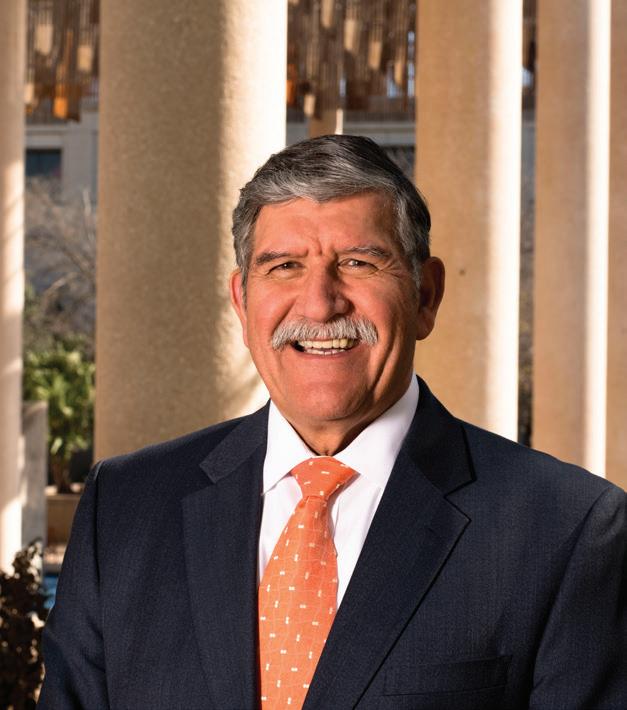
Ricardo Romo
President
The University of Texas at San Antonio
Anew era is underway at the UTSA College of Engineering.
Dr. JoAnn Browning began her duties as dean of engineering on Aug. 4. An acclaimed scholar and administrator from the University of Kansas, Browning brings exciting plans to expand UTSA’s engineering program and create new opportunities for students.
Dean Browning comes to UTSA at a critical moment in our journey to Tier One recognition. She will play a central role in the GoldStar Initiative – the university’s $40 million commitment to bring 60 top-caliber researchers to UTSA over the next four years and expand our graduate programs.
Her reputation will help attract talented researchers in energy, cybersecurity, the environment, materials, biomechanics, robotics, manufacturing, sustainability and other critical areas of research in the College of Engineering.
Dean Browning is committed to expanding the engineering program, along with the community and research partnerships that drive innovation and funding. Her goal over the next several years is to double the student population, add up to 20 new faculty members and create at least one new degree program.
A strong advocate for student development, Dean Browning will also encourage more internships, student orga-
nization leadership roles, study-abroad programs, and volunteerism. She knows that enriching college experiences and community service contribute to personal growth and academic success – core values at UTSA.
Dean Browning brings a remarkable record of leadership and achievement to UTSA. As associate dean of administration at the University of Kansas, she was directly involved in faculty hiring, student development, the creation of innovative programs, and classroom expansion. She is also a nationally respected researcher in the area of reinforced concrete design and analysis. As a UTSA scholar, she will hold the David and Jennifer Spencer Distinguished Chair.
With more than 2,500 students, the UTSA College of Engineering is the fastest growing engineering college in Texas and a top provider of undergraduate and graduate engineers. Dean Browning has the vision and skills to maintain that success and chart a course for the future.
Dean Browning’s husband, Dr. Adolfo Matamoros, also joined the College of Engineering as professor and Peter Flawn Distinguished Chair. Together with all our faculty, staff and students, I welcome them to UTSA.
Ricardo Romo President
The University of Texas at San Antonio
Dean JoAnn Browning
Associate Dean for Research Harry Millwater
Associate Dean for Graduate Studies Wei-Ming Lin
Associate Dean for Student Affairs and Policies Mehdi Shadaram
Assistant Dean Kirstin Wilsey
Director of Development Jana Kennelly
Communications Coordinator Innovations Managing Editor Deborah Silliman Wolfe
Contributors
KC Gonzalez, Brian Willeford
Associate Vice President for Communications and Marketing Joe Izbrand
Director of Communications Christi Fish
Mailing Address
The University of Texas at San Antonio College of Engineering One UTSA Circle San Antonio, TX 78249
Visit us on the web engineering.utsa.edu

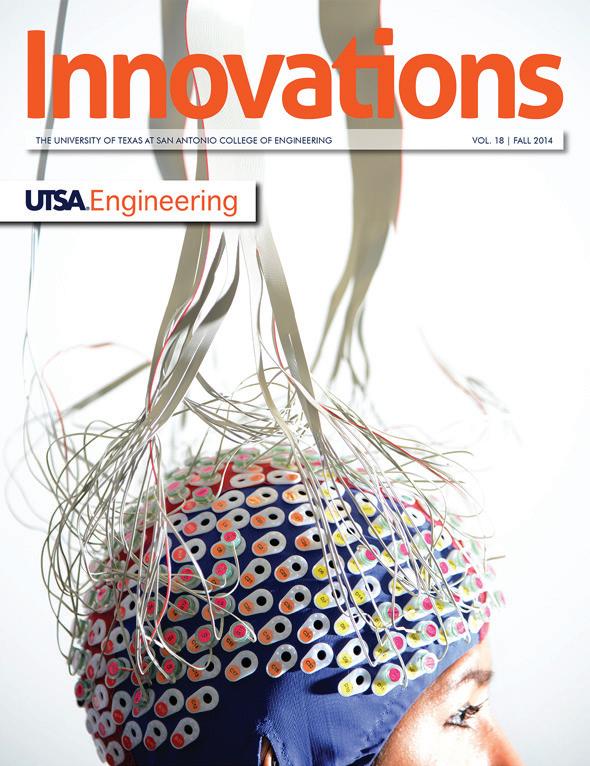
ON THE COVER
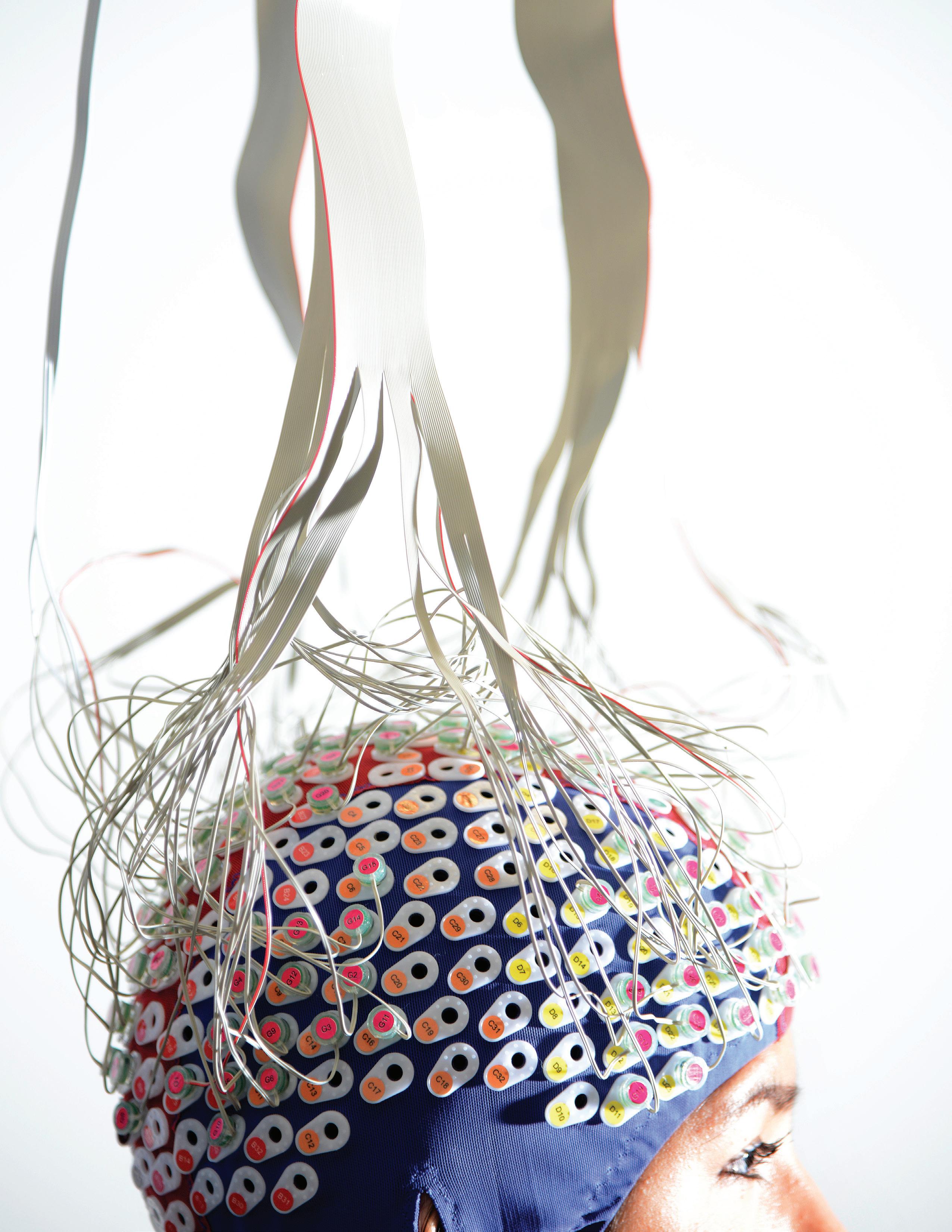
A recent $400,000 grant from the U.S. Department of Defense has allowed UTSA to acquire two high-performance electroencephalogram systems (one shown here) to advance research and education in the area of brain-machine interaction. (Photo by Deborah Silliman Wolfe/College of Engineering)
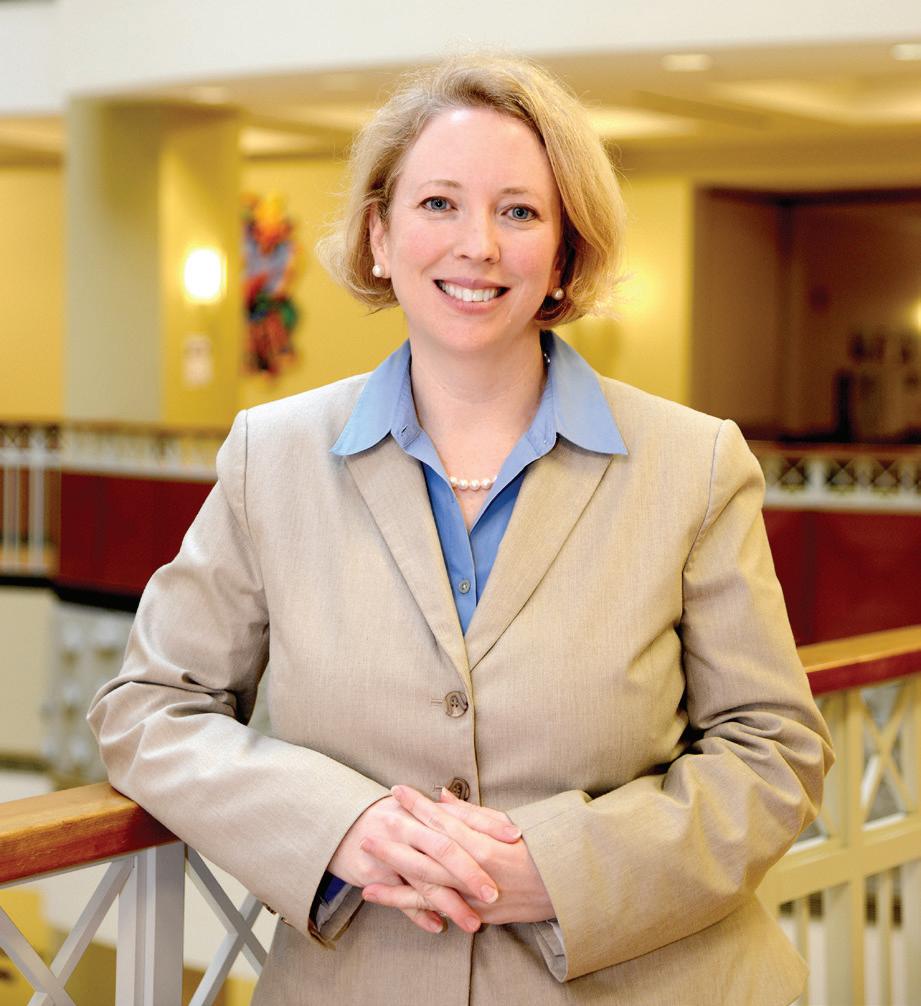
JoAnn Browning, Ph.D., P.E. Dean College of Engineering
It is a great time to be a Roadrunner! Since my family and I arrived in San Antonio at the beginning of August we have been caught up in the excitement that defines student and faculty life in the Alamo City, including tailgating at football games, fabulous barbecue, and smashing pumpkins. I want to express our sincere gratitude for the warm welcome and enthusiasm we have received, and let you know that UTSA Engineering has big plans ahead.
On behalf of the students, faculty, and staff in the College of Engineering, a very special thank you to Dr. Mehdi Shadaram who led the College as Interim Dean during the past year. I find the college poised to achieve new heights in research and educational prominence. No doubt this is due in large part to Dr. Shadaram’s leadership.
Our graduates and supporters know that the UTSA College of Engineering offers top-tier programs whose graduates become leaders to solve problems of importance to our society. Moving forward, I see a three-pronged approach to the college’s future – 1) nurturing healthy growth, 2) promoting student success, and 3) expanding our research and service to society.
The UTSA College of Engineering is growing in students, faculty, and facilities, and we play a critical role closing the gap in the essential engineering talent sought in Texas and the rest of the country. As we grow, we must be cognizant of how we choose to grow, including providing the necessary student resources such as new scholarships, maintaining and growing a diverse student and faculty population, and offering more curricular choices for our students to meet the needs of a growing and changing society. We are investigating new undergraduate and graduate programs that will attract talented students to UTSA. We value and seek to increase the exposure of our students to experiential learning and entrepreneurial development. And we are hiring talented new engineering faculty to
support our student growth and make new discoveries through research in engineering and related fields.
The student leaders in the UTSA College of Engineering demonstrate remarkable management, communication, and teamwork qualities that will translate into highly successful careers. We seek to promote experiential learning for all engineering students through internships, research experiences, international experiences, and student group leadership, which will be documented in their transcripts. These attributes are emulated in the classroom with active learning techniques to continue providing the highest level of education.
The rate of accomplishments in research discoveries and service to society has been phenomenal under the leadership provided by Mauli C. Agrawal and Dr. Shadaram, and we intend to build on this base and accelerate the pace. Our faculty are amazing researchers that are funded by the most competitive government and private entities, and our students benefit from this cutting-edge technology and knowledge. Our faculty are leading the way for UTSA to achieve Tier One status. To help promote new successes, we have welcomed a new Associate Dean for Research, Dr. Harry Millwater, who is stepping down as Chair of Mechanical Engineering to accept this position. Dr. Millwater has grand plans for faculty mentorship, increasing industry partnership, and expanding our research vision to build on our strengths and follow new opportunities.
This is an exciting time to be an engineer, making new discoveries and serving a growing society. UTSA Engineering is ready to embrace this excitement – there is no limit to what we can achieve!
JoAnn Browning, Ph.D., P.E. Dean College of Engineering

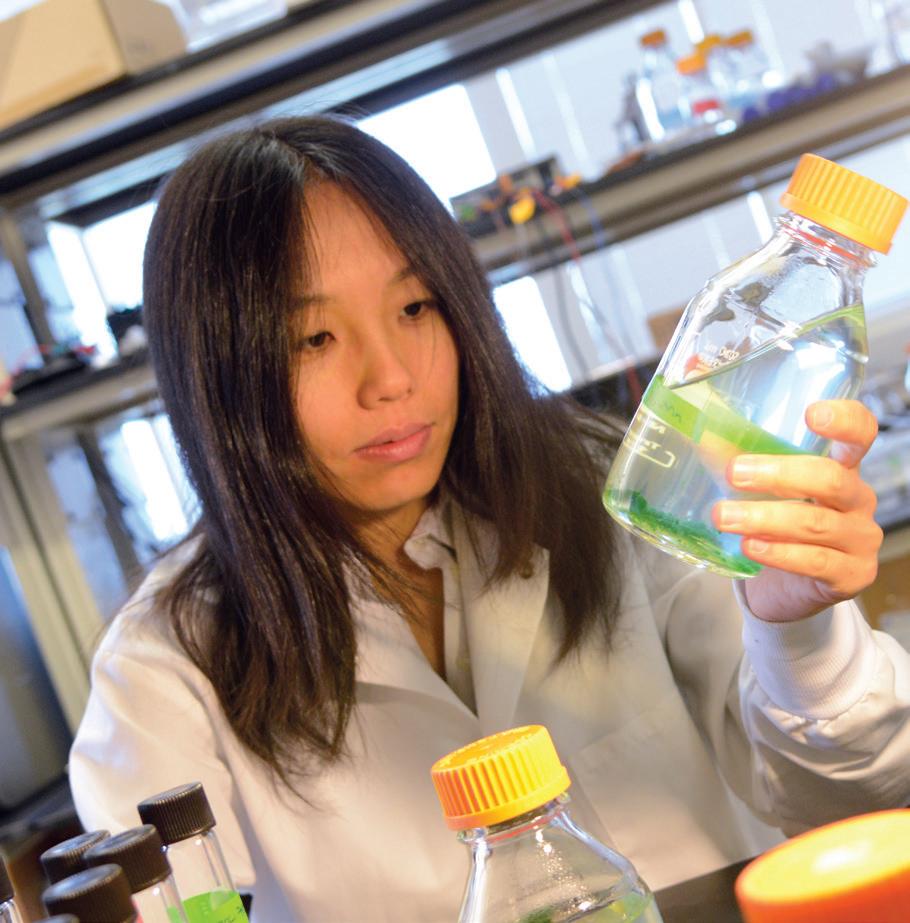
It’s All About Perspective .............................. 16
International exposure gives engineering grad student a deeper understanding of energy research
The thought of spending three months in a foreign country where one does not speak the language could be intimidating for some people...
.........................
18
UTSA, SwRI researchers prove biochar is low-cost, effective method to treat fracking water Researchers at UTSA and the Southwest Research Institute (SwRI) have determined that biochar, a substance produced from plant matter, is a safe, effective, and inexpensive method to treat flowback water following hydraulic fracturing, or fracking...
.............................
UTSA acquires high-performance EEG systems to advance brain research
A recent $400,000 grant from the U.S. Department of Defense has allowed UTSA to acquire two high-performance electroencephalogram systems to advance research and education in the area of brain-machine interaction...
20
................
26
UTSA’s Ruoting Pei receives $290K from NSF for algal bloom research
Ruoting Pei, assistant professor in the UTSA College of Engineering’s Department of Civil and Environmental Engineering, has been awarded a grant of $290,000 from the National Science Foundation to support her project...
.....................................................
30
Sos Agaian has been innovating for the past 17 years, and his reputation is growing right alongside UTSA on its path to Tier One Meet Sos Agaian, UTSA Peter T. Flawn Distinguished Professor of Electrical and Computer Engineering...
.......
32
Donor gift supports endowed professorship Cathy and Frank Burzik believe in the power of hard work and a good education. The couple, who have been living in San Antonio since 2006, recently gave a $250,000 gift...
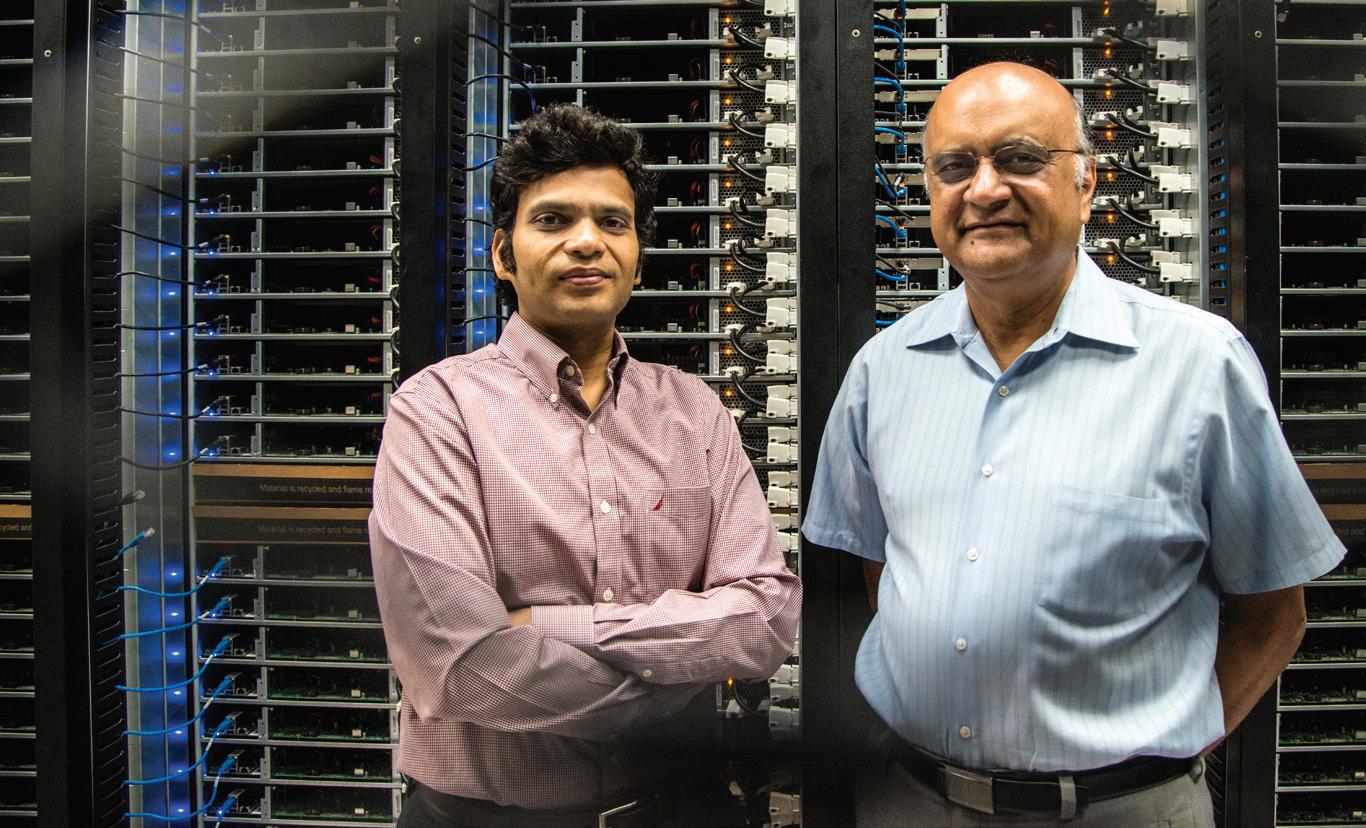
The National Institutes of Health recently awarded a $1.08M grant to Yufei Huang, professor in the College of Engineering’s Department of Electrical and Computer Engineering, and Jianqiu (Michelle) Zhang, associate professor in the Department of Electrical and Computer Engineering, to develop new bioinformatics tools to study mRNA methylation and breast cancer.
“Basically, we are looking at the inner workings of mRNA and methylation and by using deep genome sequencing technology and computer models, we are trying to uncover a new mechanism of cancer,” said Huang. “Such mechanisms can help us predict which cells in a human’s body may become cancerous and stop cancer in its tracks before it even forms.”
The Department of the Navy has awarded a threeyear $1.2 million grant to a four university consortium, including The University of Texas at San Antonio, entitled “Unified Approach to Increase STEM Undergraduate Students Employment in the Department of the Navy.”
The consortium includes Huston–Tillotson University (Austin), Texas Southern University (Houston) and The University of Texas at San Antonio. UTSA College of Engineering’s Drs. Ruyan Guo, Robert E. Clarke professor, and Amar Bhalla, distinguished research professor, will lead the effort at UTSA to develop a vibrant and high quality education and research program that attracts, educates, and trains participating engineering students.
Ram Krishnan, assistant professor in the UTSA College of Engineering’s Department of Electrical and Computer Engineering (left), and Ravi Sandhu, professor in the College of Science and director of the UTSA Institute for Cyber Security, have been awarded $500,000 from the National Science Foundation to improve the security of cloud-based infrastructures.
“Our research really complements what is already going on here at UTSA,” said Krishnan. “Receiving this NSF grant allows us to share the ground-breaking research taking place at UTSA with the nation and the globe.”
Hai-Chao Han, professor in the College of Engineering Department of Mechanical Engineering, has been elected a fellow of the American Society of Mechanical Engineers by his peers for his exemplary record of engineering achievements in education and research.
“I am honored to be elected as a fellow of ASME,” said Han. “I am grateful to my nominator and colleagues who have been very supportive over the years.”
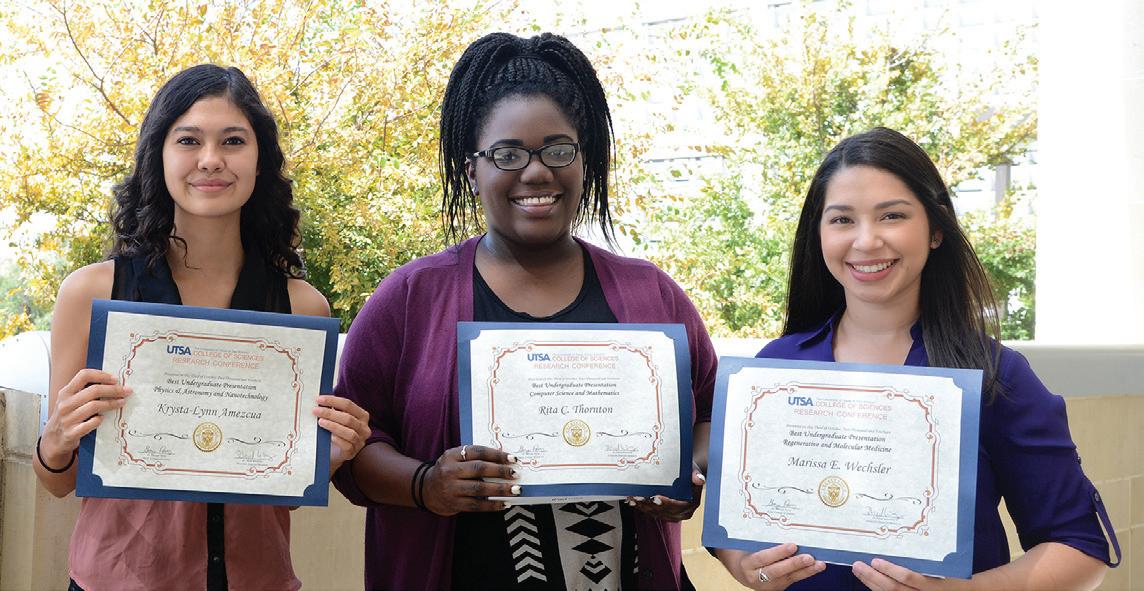
The UTSA College of Sciences held the 2014 Research Conference “Excellence in Basic and Translational Science Research” this October. College of Engineering Biomedical Engineering undergraduate students Marissa Wechsler, Rita Thornton, and Krysta Amezcua all placed first in their respective categories, based on the work they presented during the judged poster presentations.
“We in the department are very proud of these student achievements,” said Joo L. Ong, chair of the Department of Biomedical Engineering. “The fact that three of our students won 1st place awards at the 2014 College of Science Research Conference reflects the quality and competitiveness of our biomedical engineering students.”
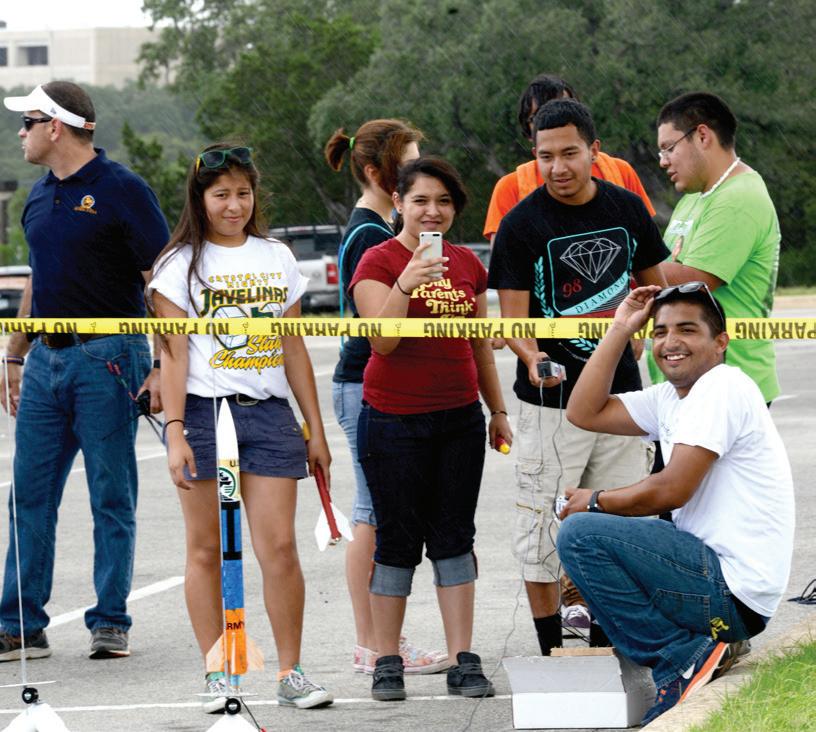
The University of Texas at San Antonio TRIO’s Educational Talent Search Program collaborated with the university’s Mexican American Engineers and Scientists (MAES) student organization to host the 1st Annual Solid Fuel Rocket Launch and Competition this summer. High school students participating in the summer program designed, built, and launched solid fuel rockets with the assistance of UTSA Engineering students from MAES.
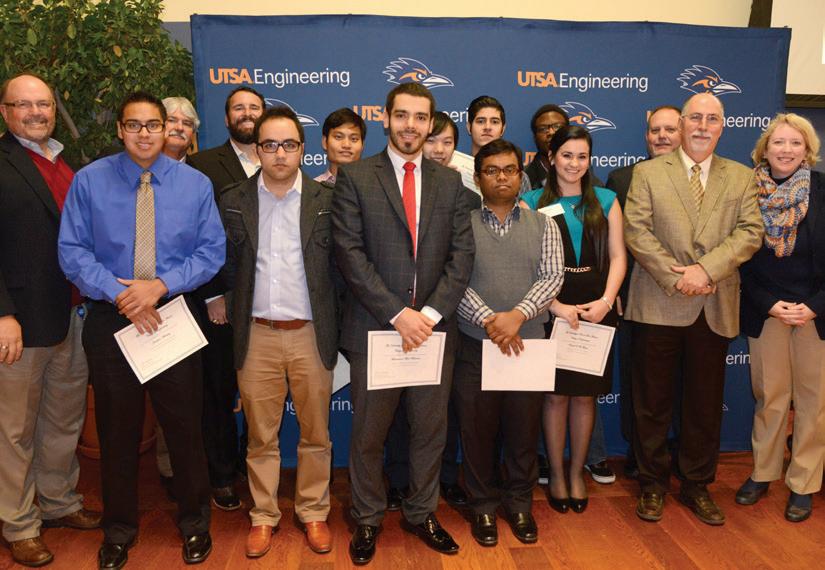
The 3rd Annual Texas Energy Expo took place this fall on UTSA Main Campus. The job fair and luncheon allowed recruiters and students to meet in an efficient format with an opportunity for more in-depth engagement during the luncheon, where Institute for Economic Development research director Thomas Tunstall presented the findings from the institute’s 2014 study, Economic Impact of the Eagle Ford Shale. During the luncheon, ten students received $1,000 – $2,000 each in scholarships from the American Petroleum Institute San Antonio Chapter. The $11,000 in scholarships are part of a $100,000 gift that the San Antonio Chapter of the API has made to COE over the last two years.
Yusheng Feng, director of UTSA’s SiViRT Center and professor in the College of Engineering’s Department of Mechanical Engineering, and his team received a $300,000 San Antonio Life Sciences Institute (SALSI) grant to establish a Medical Data Analytics and Visualization Cluster.
“I was very excited to hear that our team won the SALSI award,” said Feng. “The goal of our team is to develop software and hardware tools to enable data-driven predictive medicine. With available big data, we use bioinformatics and novel machine-learning algorithms for early cancer diagnosis, image-based computer models for better prognosis and treatment planning, and optimized fast track methods for efficient medical emergency decision-making. We also use cutting-edge technology to develop immersive virtual reality training system for surgical training.”
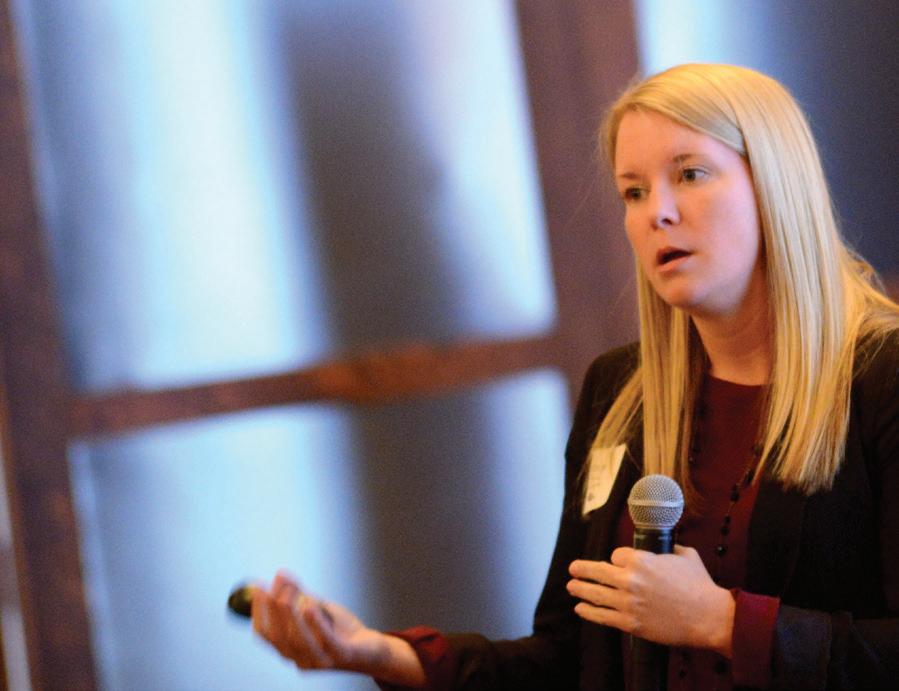
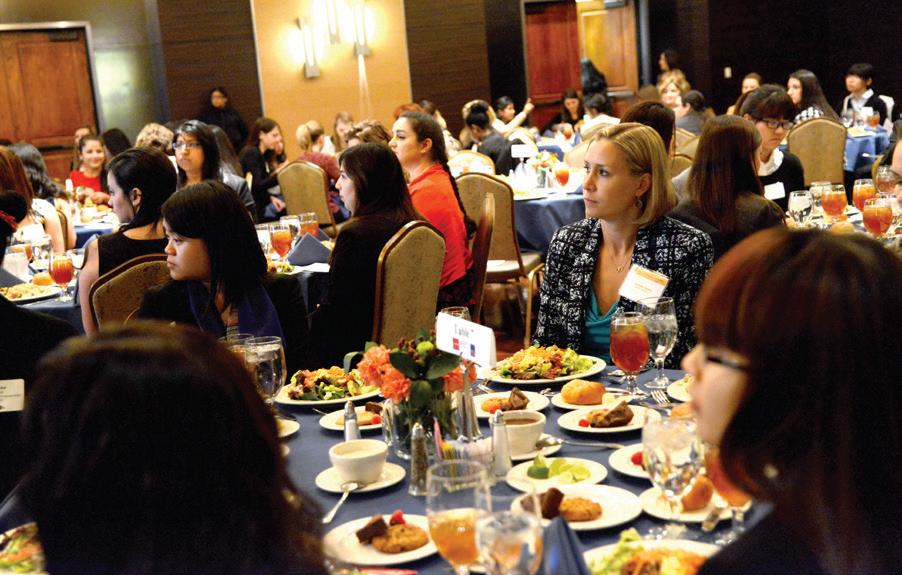
This fall, the Women’s Energy Network South Texas Chapter hosted the WEN Mentoring Luncheon at UTSA The event allowed female professionals in the energy sector to talk to female students about their experiences in the field. Keynote speaker Misty Rowe (above) from Halliburton spoke about her company and why she loves her career leading a team of engineering professionals. This is the second year in a row that the networking luncheon has been sponsored by Halliburton.
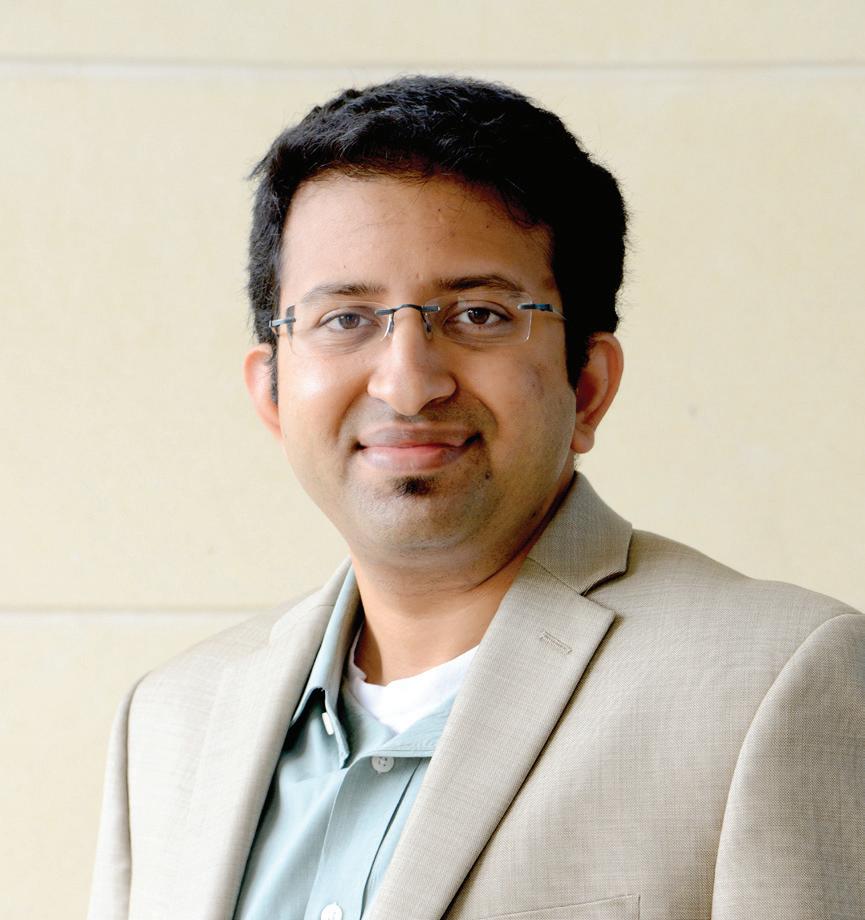
The UTSA Center for Innovation and Technology Entrepreneurship (CITE) has received $300,000 from the 80/20 Foundation to continue its growth as San Antonio’s pipeline for young tech entrepreneurs. On the heels of becoming the first Texas university to receive distinction as a National Science Foundation Innovation Corps Site, UTSA’s focus on technology entrepreneurship is about to expand even further. UTSA has appointed College of Engineering’s biomedical engineering assistant professor of research Teja Guda as assistant director of CITE. Guda specializes in the area of developing regenerative strategies for bone and skeletal muscle tissue engineering and works closely with the U.S. Army Institute of Surgical Research to translate these therapies to treat wounded warriors. He understands the important role engineers play in developing innovative products and technologies that could change the world and has developed an engineering course at UTSA on product development.
The Grants for Research Advancement and Transformation (GREAT) program, sponsored by the UTSA Office of the Vice President for Research, has awarded six seed grants of $20,000 each to support new areas of research for faculty. The primary goal of the awards is to assemble preliminary data that can be used to seek extramural funding and advance UTSA’s goal of reaching Tier One status. Two of the awards were given to engineering faculty members Adel Alaeddini, assistant professor, Department of Mechanical Engineering, to study “Integrative Statistical and Operational Methods for Effective Chronic Disease Management” and Krystel Castillo, assistant professor, Department of Mechanical Engineering, to study “Integrated Modeling and Optimization of Supply Chain Design for Sustainable Bioenergy Systems.”














VizLab teams up with UTSA Anthropology
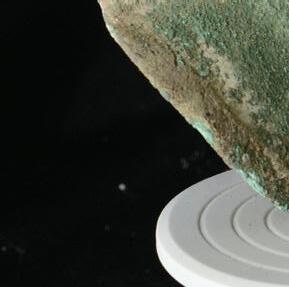
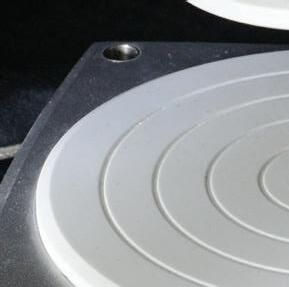
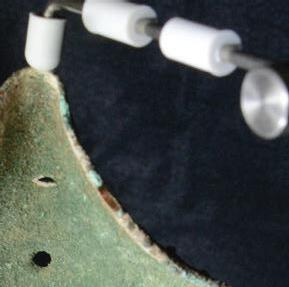
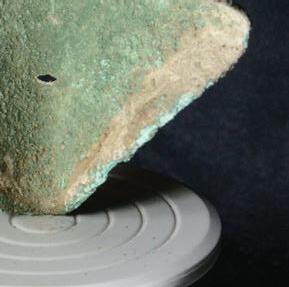
Yusheng Feng, professor in the Department of Mechanical Engineering and director of SiViRT Computation Center, and his students in the Advanced Visualization Lab (VizLab) teamed up with the UTSA Anthropology Department to scan and print six 1,500-year-old copper bells that UTSA faculty member and archaeologist Sonia Alconini and her students excavated during an archaeological dig in the Andes of South America.




“Our engineering students not only helped Alconini digitize the bell, but they also helped restore the bell geometry by smooth wireframe representation for further vibration and sound effect analysis,” said Feng. “The technologies we have in the lab can be utilized in many crossdisciplinary fields across campus. The VizLab is not only a great resource for the College of Engineering, but the whole university community.”
Michael Lasch, graduate research assistant who works with Feng in the VizLab, had the chance to handle and scan the bells with the VizLab’s advanced laser scanner.
“I never had any idea that I would be working with objects that are this old,” said Lasch. “I always expected that we would be working with all the newest technologies; it never crossed my mind that we could leverage these new technologies to learn so much about our past.”
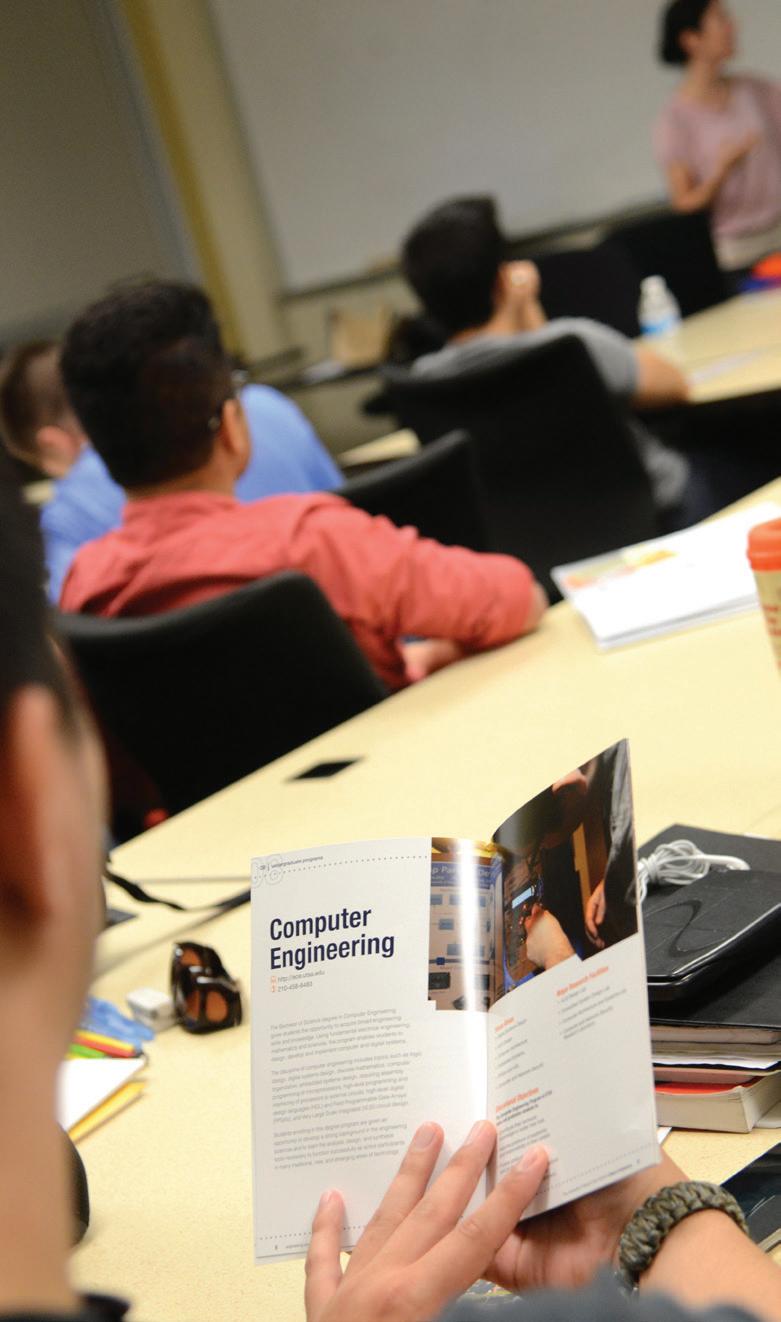
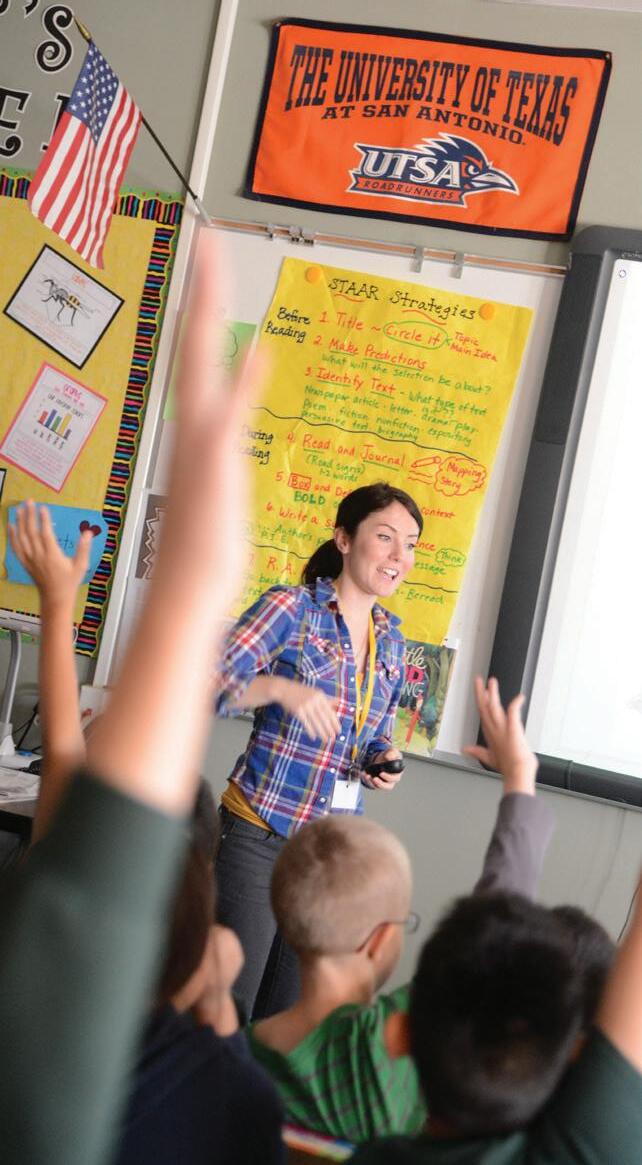
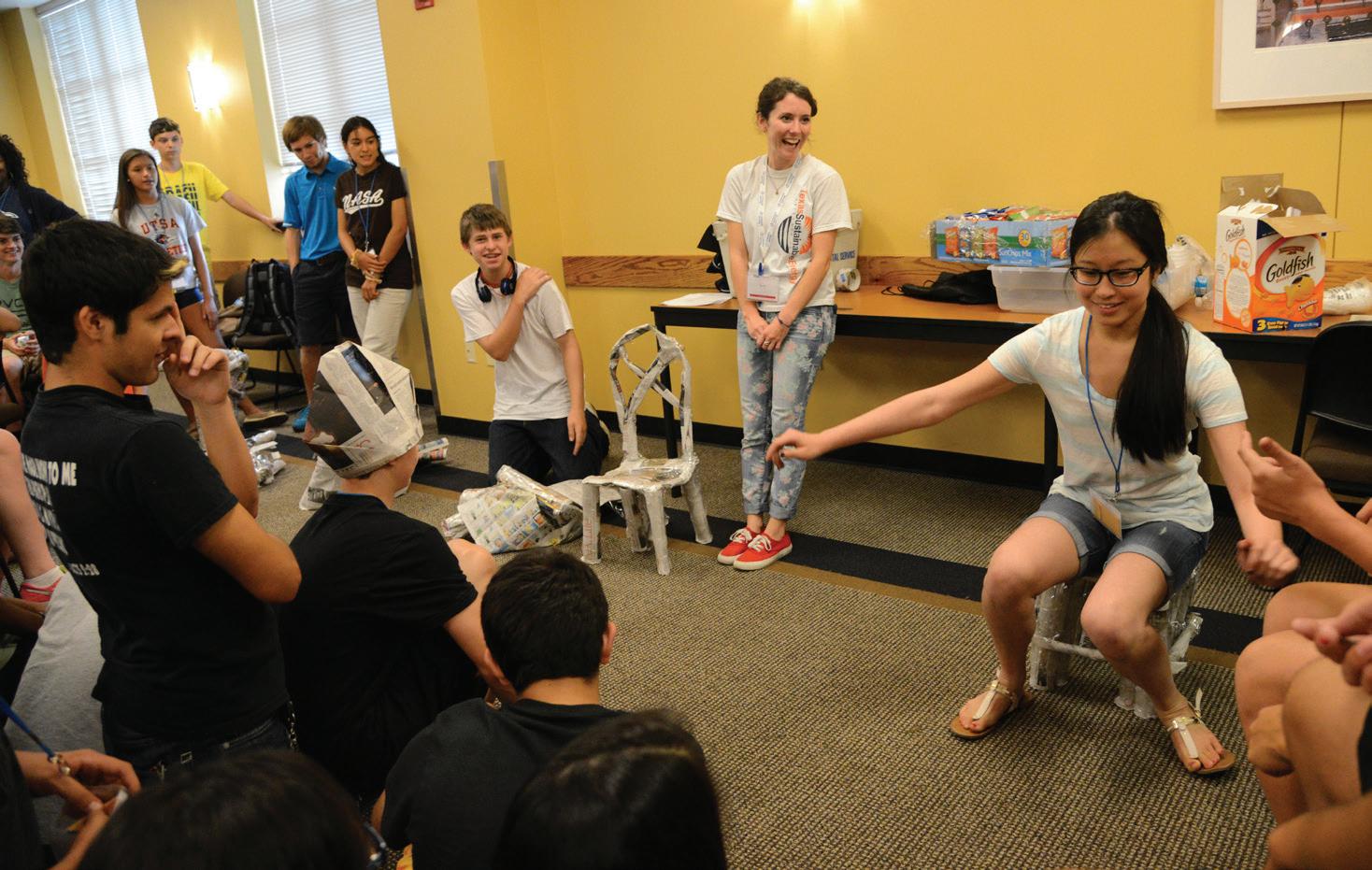
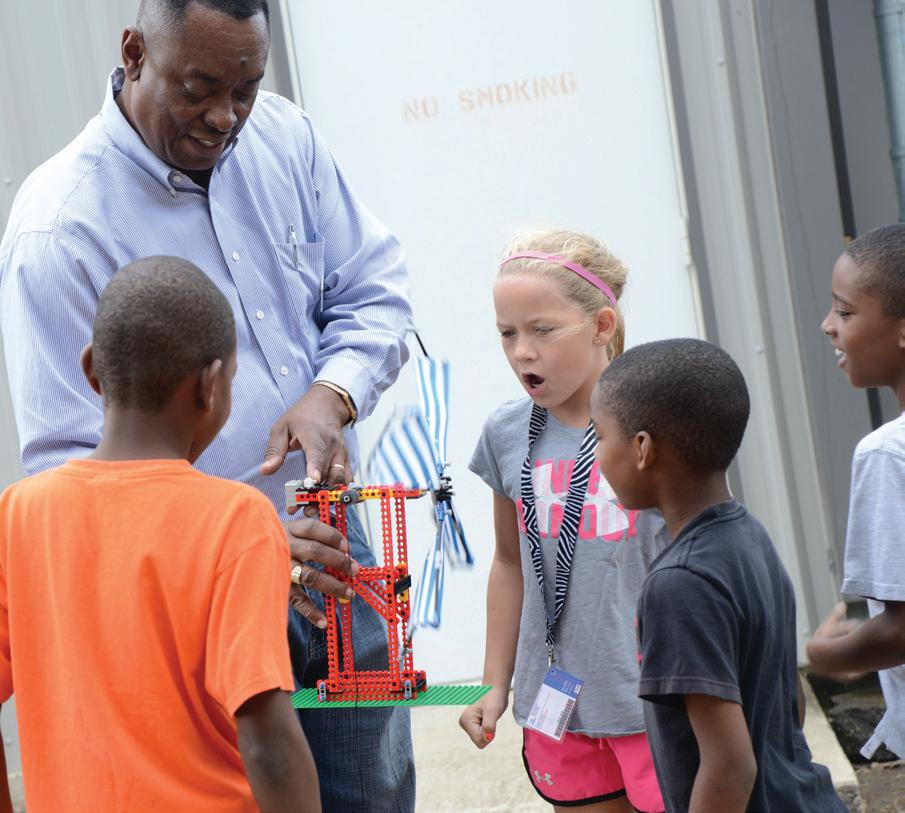
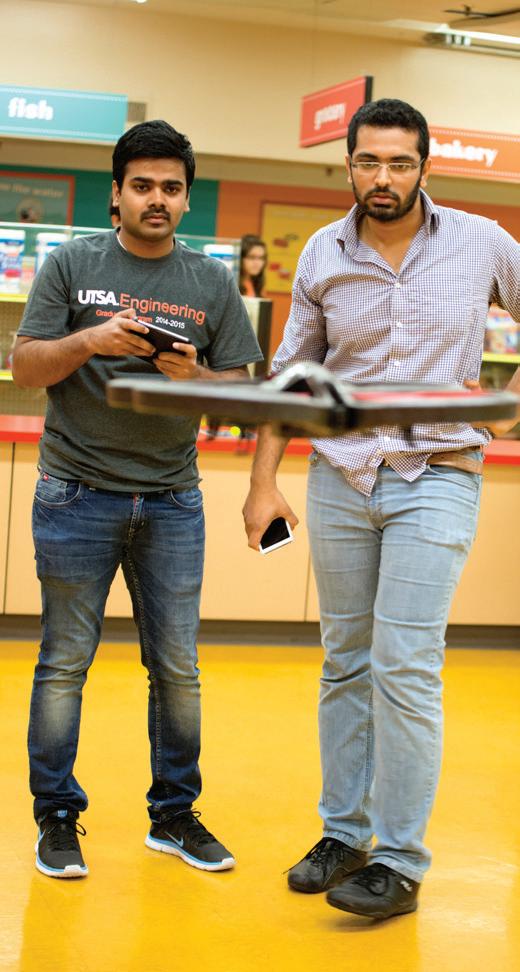
Take a look and see how The College of Engineering is getting out into the San Antonio community to educate and inform the public about the great things that are happening at the college. Upper left: COE’s assistant director for engineering outreach Brandy Alger met with a group of students in the Math Intensive Program at Northwest Vista College this fall. UTSA and the Alamo Colleges have a strong partnership, and the majority of the students who attended Alger’s presentation are engineering majors and plan to transfer to UTSA. Upper right: Alger presented at Forester Elementary’s Career Day earlier this fall. We hope Brandy convinced all of the 4th grade to come to UTSA and study to become engineers! Middle: COE held two weeks of Engineering Summer Camps for high school students this summer. Camp attendees had the opportunity to experience engineering through hands-on workshops, engaging academic lectures, research lab tours, and participating in friendly competitions, like the newspaper chair building competition, shown here. Bottom left: UTSA College of Engineering teamed up with BHP Billiton to provide free energy camps to children in Cuero, Texas, this fall. The camps were taught at the DeWitt County Boys and Girls Club by COE’s Interactive Technology Experience Center (iTEC) staff and BHP Billiton volunteers. Bottom right: Master’s students Mohan Muppidi and Satish Vaishnav fly a remote control drone at the San Antonio Children’s Museum’s Come Fly with Us event at the museum’s downtown location this fall. Both are pursuing their degrees in Electrical Engineering with a concentration in Systems and Control.
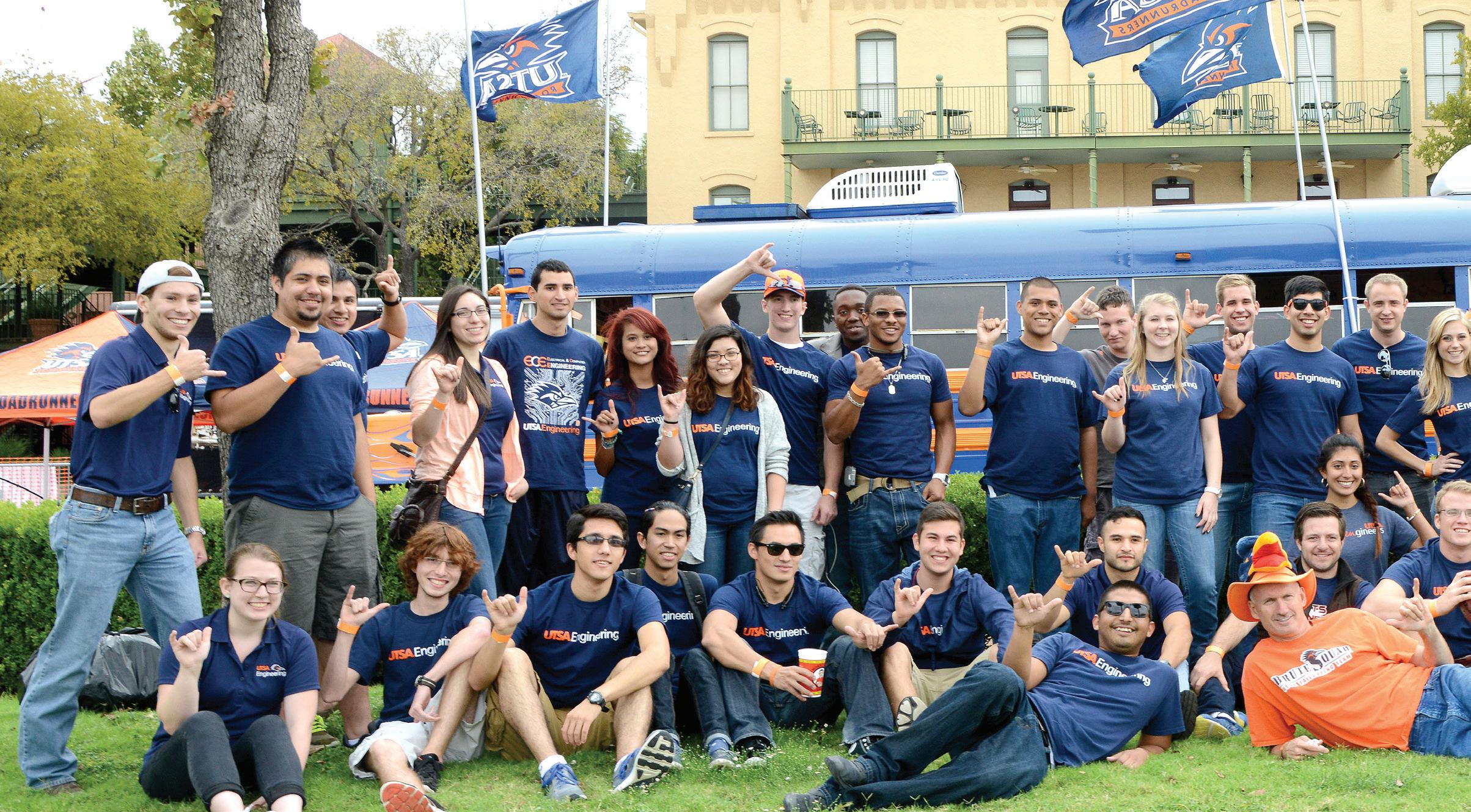



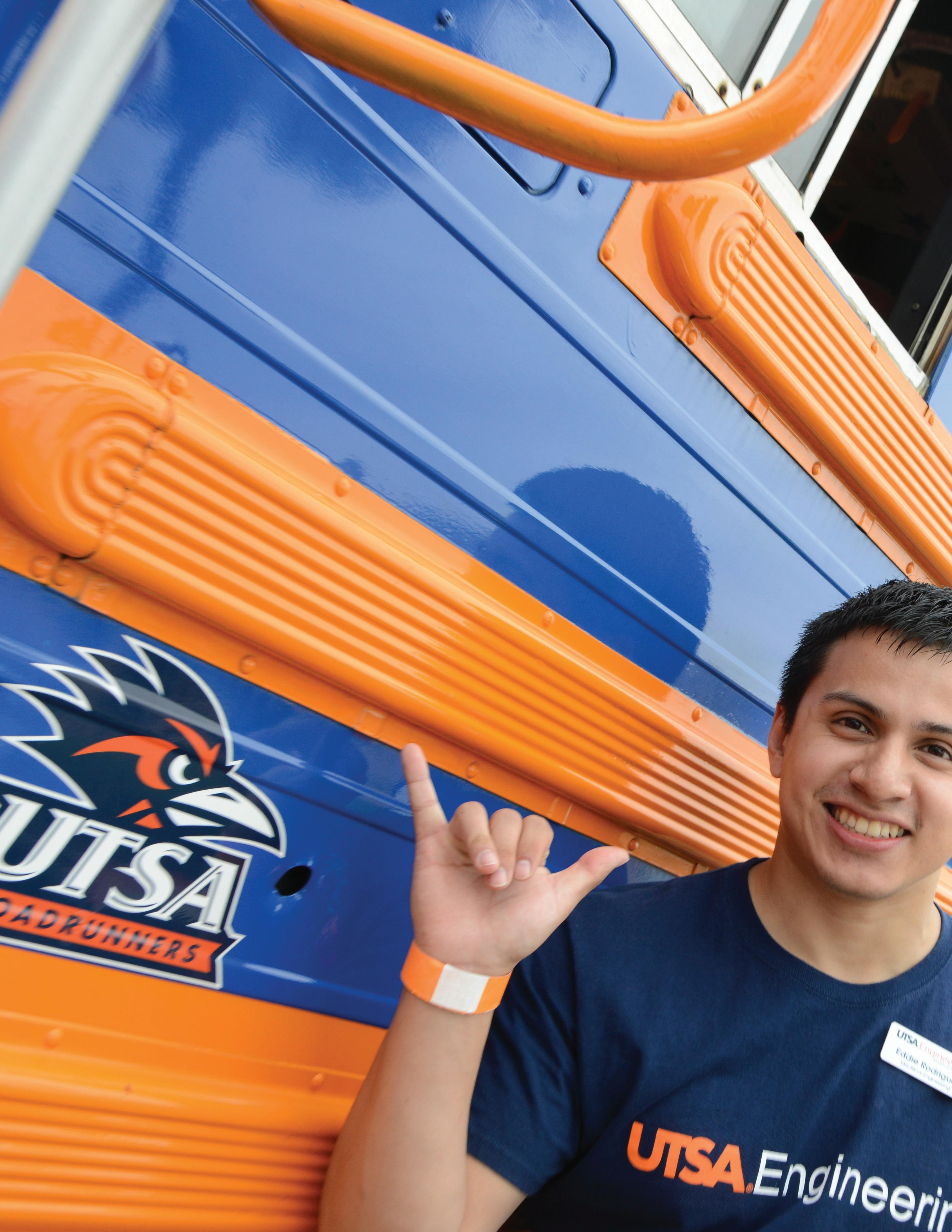
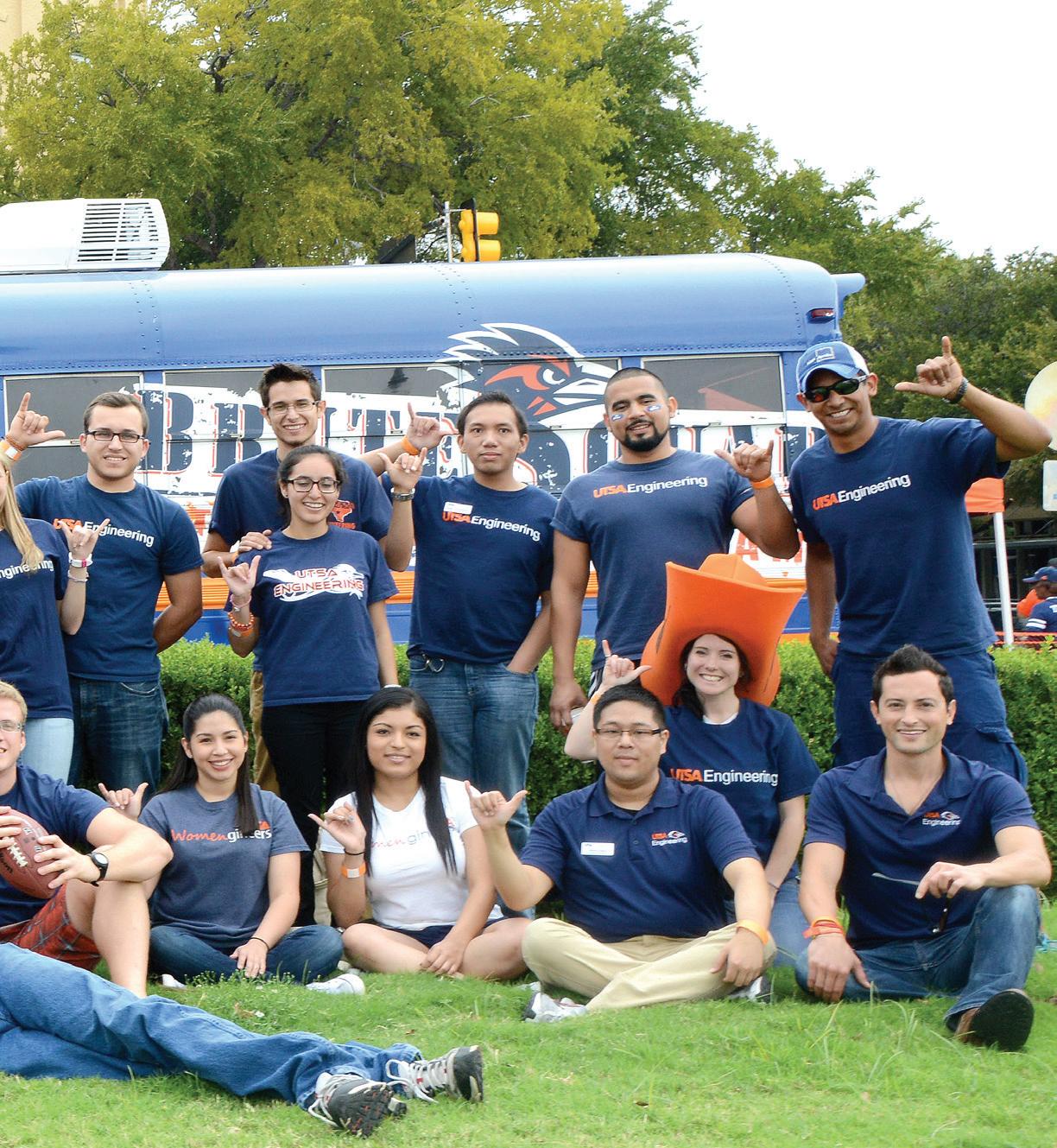




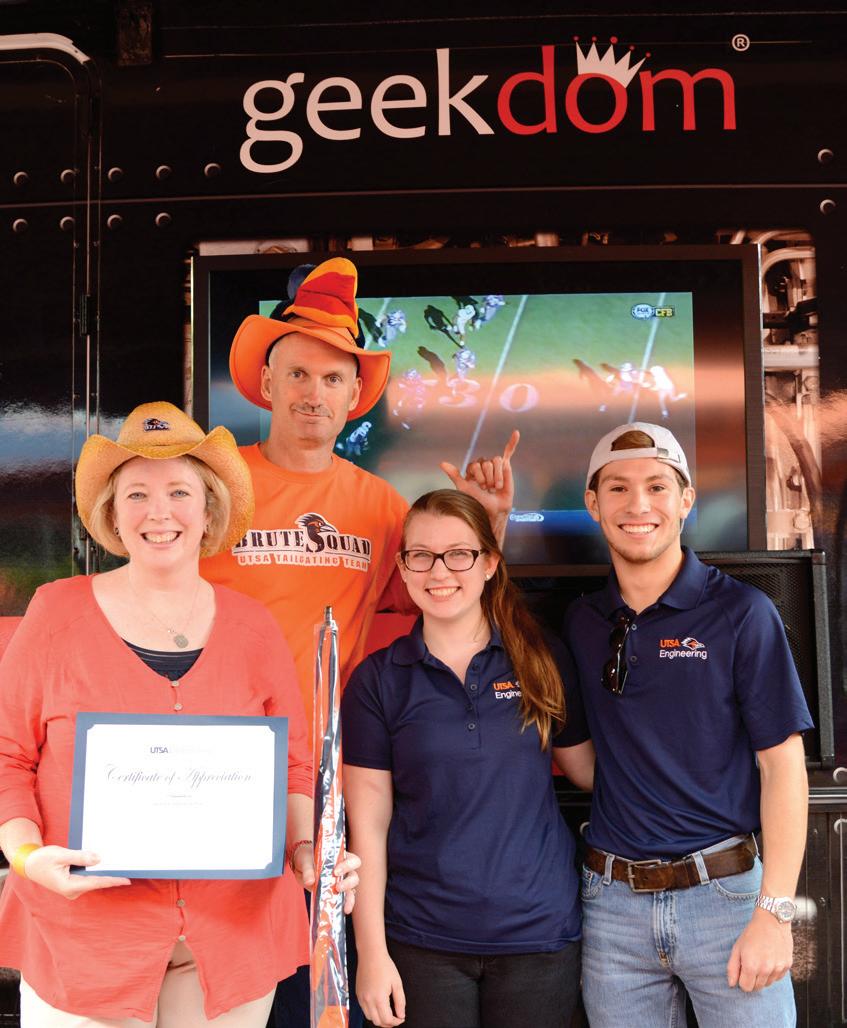



A huge thank you to David Spencer and the other members of the BruteSquad for hosting the best football tailgate at the Alamodome this season! Every home football game, the BruteSquad hosts a gigantic tailgate that includes food, drinks, games, and activities for adults and kids alike. The tailgate is open to all engineering students. At each game, a student group is chosen to attend and show off their group’s accomplishments. The following sponsors made this year’s tailgates possible:
Monetary Sponsors
DOCUmation
Texas Intrepid Ventures
The Bank of San Antonio
Pape-Dawson Engineers
Asel & Associates, PLLC
Birdy Properties
Union Pacific Railroad
Raba Kistner Consultants
Elevate Systems
Alpha Building Corporation

In-kind Sponsors
Silver Eagle Distributors
Rebecca Creek Distillery Fairway Landscape & Nursery
Zachry Construction Corporation

McBrayer Photography
Scherer Communications



Where are you from?

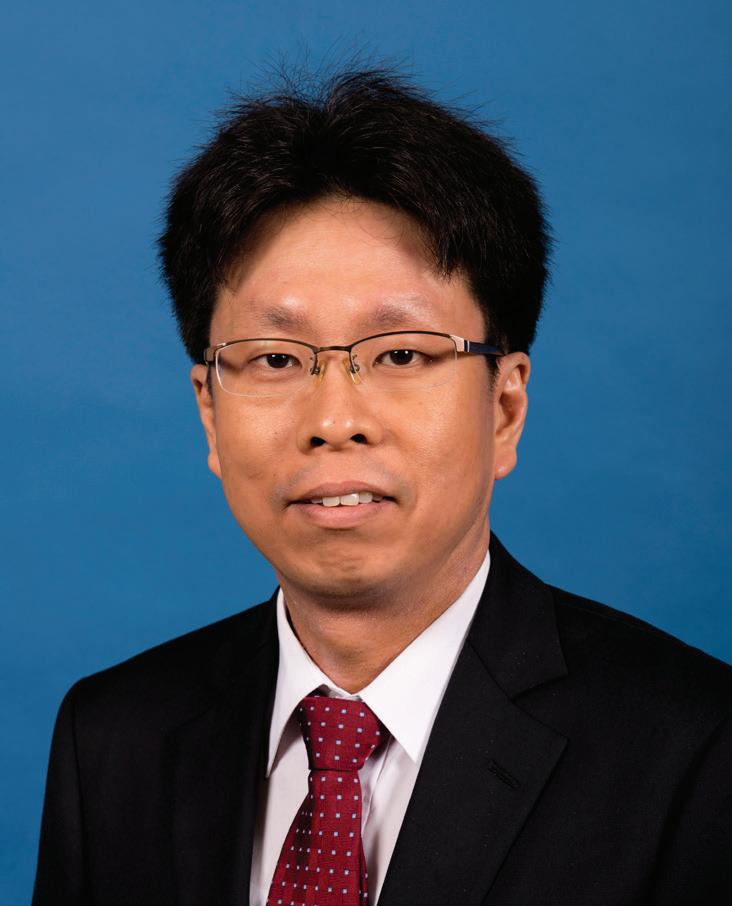
Junghee Lee
Electrical
& Computer Engineering



Ph.D., Georgia Institute of Technology


I am originally from South Korea. Before joining UTSA, I lived in Atlanta, Georgia, while studying for my Ph.D.





Why did you choose to come to UTSA?



I was impressed by the university’s enthusiastic push toward becoming a top-tier university.



What are your current research interests?




I am interested in parallel computing, embedded system design, and cybersecurity.



What do you hope to accomplish here in COE?

I hope to perform innovative research that has profound impact on both academia and industry.



What are your hobbies or interests outside of work?








I used to read books or take a walk, but nowadays I spend most of my free time playing with my kids.









The College of Engineering is happy to welcome our new faculty members to The University of Texas at San Antonio. Welcome aboard!

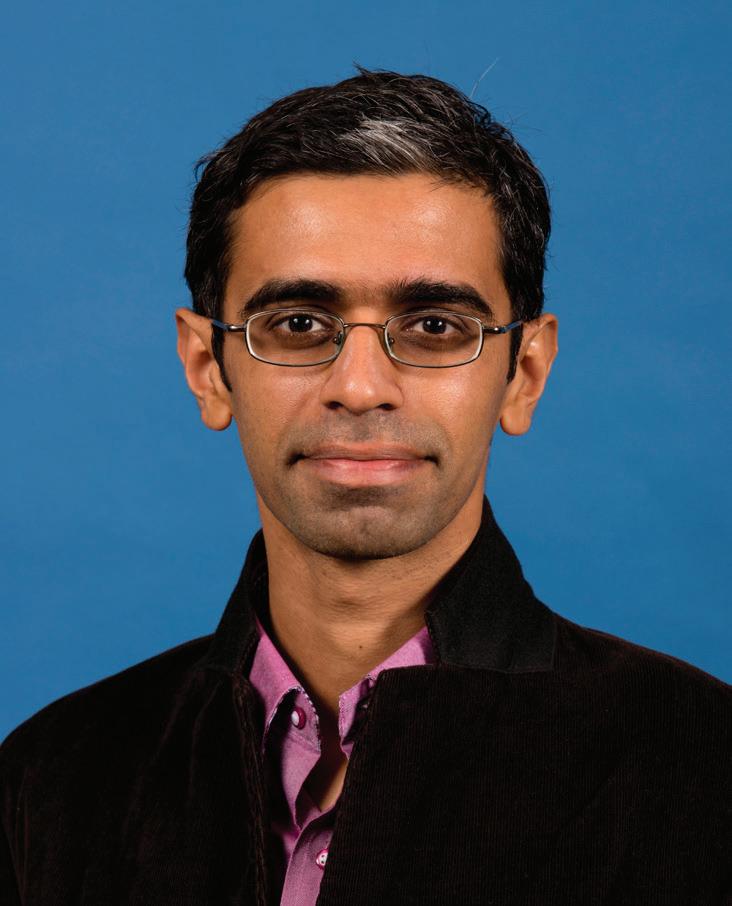
Pranav Bhounsule
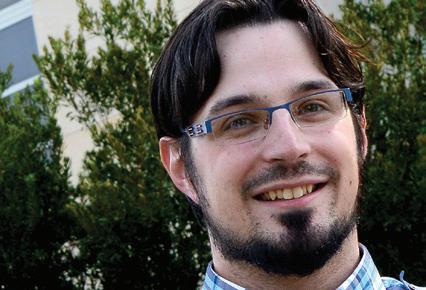
Mechanical
Engineering
Ph.D.,
Cornell University



Where are you from?









Originally from Goa, the smallest state in India. More recently, I moved from Disney Research in Pittsburgh, Pennsylvania.



Why did you choose to come to UTSA?

In a limited time, UTSA has developed into a great school and it is working its way to even bigger heights. I saw a lot of potential ways in which I could contribute to the school’s mission to develop into a Tier One institute.






What are your current research interests?

Mainly bipedal walking robots. One of my goals is to program such robots to walk as well as their human counterparts, if not better.



What do you hope to accomplish here in COE?





Develop a sustainable research program and provide outstanding research opportunities to the students in robotics and controls.

What are your hobbies or interests outside of work?




Triathlons, a sport in which you swim, bike, and run, in that order.






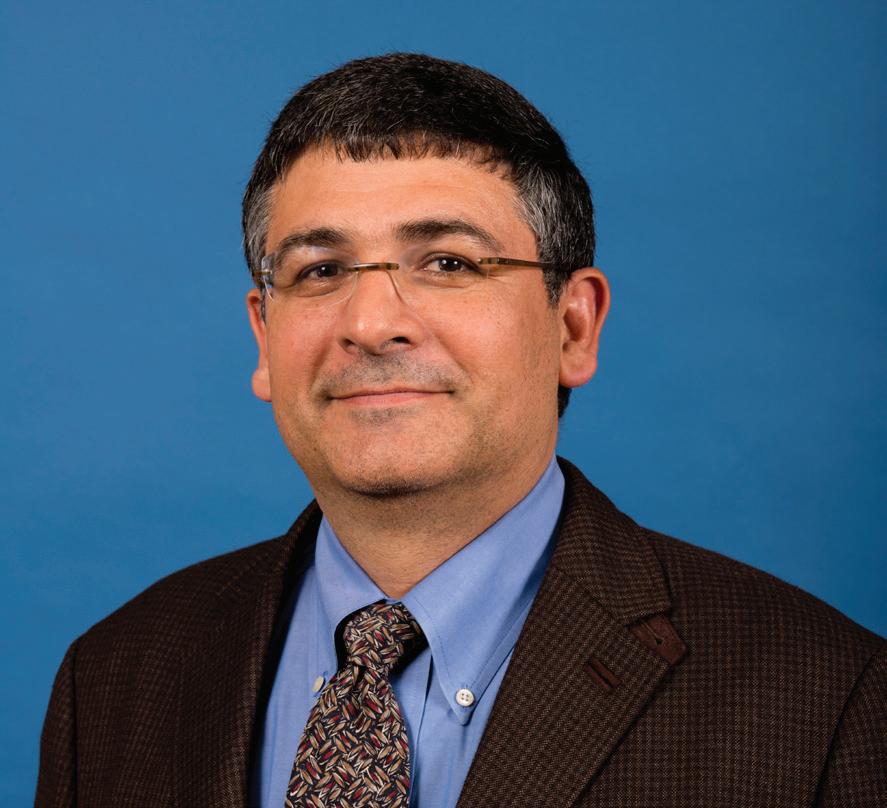
Adolfo Matamoros

Civil & Environmental Engineering
Peter T. Flawn Distinguished Chair
Ph.D., University of Illinois at Urbana–Champaign
Where are you from?
I am originally from Costa Rica, where I lived until I was 25 years old. I came to the United States in 1992 to pursue a graduate degree in engineering at the University of Illinois at Urbana-Champaign. After graduating, I moved to Lawrence, Kansas, where I worked for 15 years before coming to UTSA.
Why did you choose to come to UTSA?
San Antonio is a growing city with lots of opportunities to offer. Coming to UTSA presented unique opportunities for professional growth for me and my family.
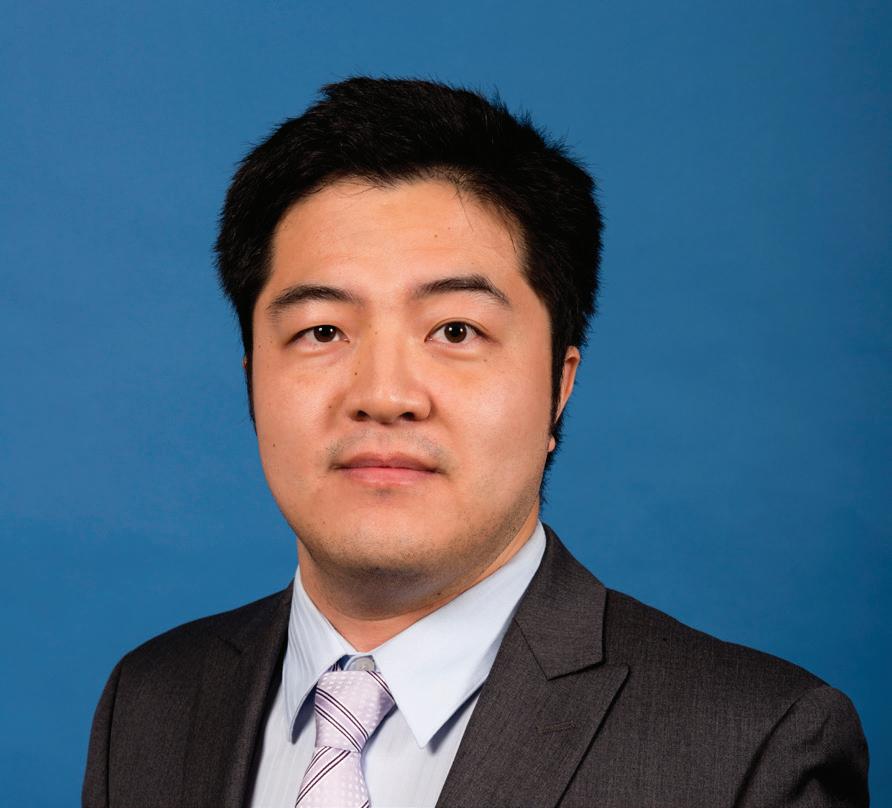
Lide Duan


What are your current research interests?




My general area of research is structural engineering. Within structural engineering I have performed research in several areas including earthquake engineering, reinforced concrete, composite materials, fatigue damage in steel bridge structures, and highway sign structures.



Electrical & Computer Engineering
Ph.D., Louisiana State University
Where are you from?
I am originally from China, where I received my bachelor’s degree from Shanghai Jiao Tong University in 2006. I then came to the U.S. for my graduate studies, and received a Ph.D. in computer engineering from Louisiana State University in 2011. After that, I worked in industry (a semiconductor company named AMD) for two and a half years as a senior CPU design engineer on future CPU microprocessor design and performance modeling.
Why did you choose to come to UTSA?


I decided to come back to academia from industry because I have learned a lot and gained experience in real CPU design during my time spent at AMD. And now I think it’s a good time for me to utilize my industrial experience to guide my research in new areas. UTSA is a great university that can provide tremendous resources and a great environment for my future research.









What do you hope to accomplish here in COE?














Prior to my arrival at UTSA, the undergraduate program in Civil Engineering had become a well-established and respected program in the state. The next step for UTSA in its path to become a nationally recognized university is to solidify its graduate and research programs. Succeeding in this goal will provide new opportunities to UTSA students and alumni. A strong research program provides undergraduate students with opportunities to be involved in the development of cutting-edge technology and to work with professors who are at the forefront of the engineering profession. Those experiences are essential for building up their careers and to stimulate their intellectual curiosity. As a member of the faculty of UTSA I hope to be a part of that growth process.


What are your current research interests?





My research is in generic computer architecture areas. In the past, I have been focused on processor reliability. However, I am interested in new directions now such as power and energy efficient computer architectures, architectural support for emerging technologies and trends, datacenter design and energy efficiency, and so on.



What do you hope to accomplish here in COE?




My plan is to obtain external fundings and quickly establish a research lab in my research areas. I hope we will have publications in prestigious conferences and journals, and continuously graduate master’s/PhDs from my group.







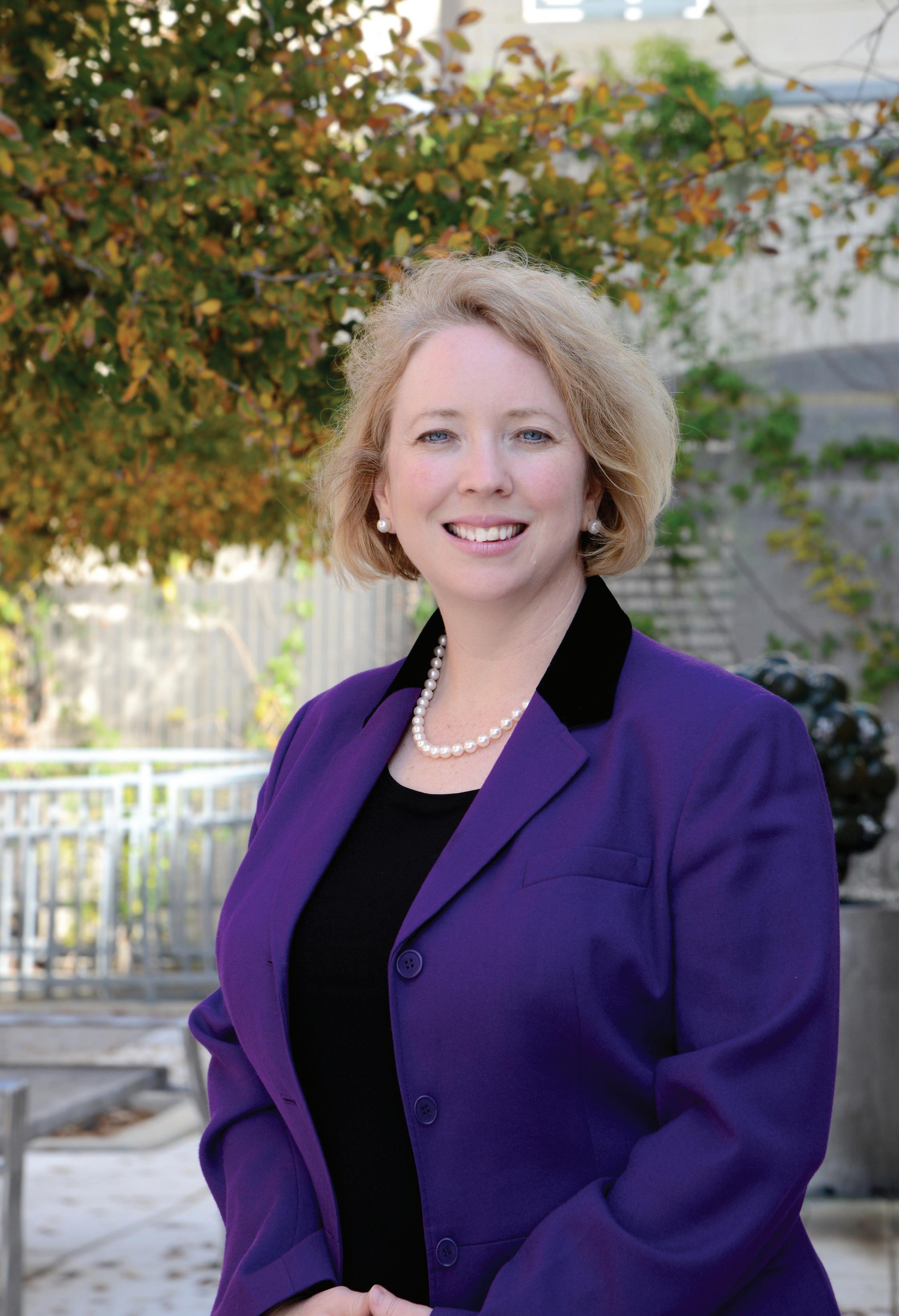
Meet JoAnn Browning, dean of the College of Engineering at The University of Texas at San Antonio. New to both UTSA and Texas (she and her family moved to San Antonio from Lawrence, Kansas, in August 2014) Browning has dived into her new leading role, and is making big plans for the college’s future, as well as its present.


“Joining UTSA is an incredible opportunity to take what I have learned about managing healthy growth in an engineering program and applying my knowledge so that the growth benefits UTSA’s talented and diverse student body,” said Browning.
Before joining UTSA, Browning served as the associate dean of administration and professor of civil engineering in the School of Engineering at the University of Kansas. Her career at KU included service on the University Senate, as a faculty mentor for Student Athlete Support Services, and as a member of the Campus Historic Preservation Board and Bay View Alliance KU Leadership Group, among numerous department, college and university committees. She twice was awarded the university’s Miller Award for Distinguished Professional Service (2004 and 2011) and was the 2012 recipient of the Henry E. Gould Award for Distinguished Service to Undergraduate Education.
“Dr. Browning has great experience as a researcher and an administrator, a strong commitment to student success and, most importantly, a track record of collaboration and consensus-building,” said John H. Frederick, provost and vice president for academic affairs. “She is committed to expanding the college with a clear understanding of our goals of becoming a Tier One university and to further building on the college’s community and industry partnerships.”
Browning said that leaving KU was a difficult decision, but she knows that she made the right choice when she took the position as dean at the UTSA College of Engineering.


“When I came to visit UTSA I was so impressed with
the students, faculty, and leadership, I knew that I had to be a part of this incredible university,” said Browning. “We are doing amazing research here in the college that will have a positive impact on not only our local community, but the world, and I want to be a part of that.”
Over the next ten years, Browning says one of the college’s goals is to nearly double the student body as well as add 20 new faculty positions. And with UTSA President Ricardo Romo recently announcing GoldStar Initiative, a four-year, $40-million dollar program to help recruit 60 new top-tier researchers, Browning and the college have both the will and the way to grow the engineering faculty.

“I want to focus on healthy growth,” said Browning. “We are not growing just for the sake of it, we are developing a managed plan that not only includes growing our faculty and student body, but growing our facilities and programs as well.”
Besides growing the college, Browning is exploring ways to augment student development.
“One of my main focuses is to get the majority of our students involved with experiences outside of the classroom such as internships, research experiences, international experiences, and student group leadership,” said Browning. “These are all great ways to help broaden our engineering students’ perspectives and prepare them for their journey after graduating with an engineering degree.”
In addition to growth and student success, Browning is creating faculty development and mentoring programs to ensure the success of engineering faculty.
“We have some of the best faculty in the state and in the nation, and I want to make sure that they have the support they need to succeed in the classroom and as researchers,” said Browning.
With Browning’s leadership and focus on student success, growth and research, the College of Engineering and its faculty and staff are well on their way to helping UTSA reach the goal of Tier One status.







people: new faculty




















By Deborah Silliman Wolfe/College of Engineering
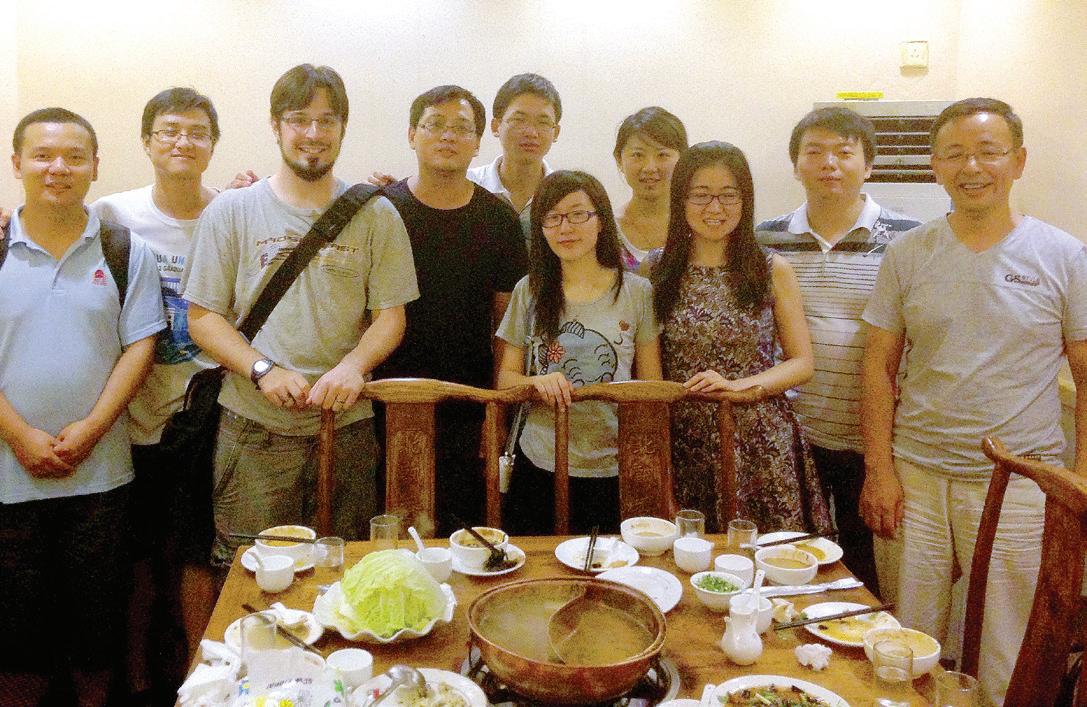
The thought of spending three months in a foreign country where one does not speak the language could be intimidating for some people. It was certainly intimidating for Gaelen McFadden, a graduate student in the College of Engineering’s Department of Mechanical Engineering. But, having missed out on studying abroad as an undergrad, McFadden decided that he wasn’t going to miss out this time around. So, this past June, McFadden left his comfort zone in San Antonio, Texas, and traveled to Bejing, China, for a research opportunity at Tsinghua University.
“Going to China was a great experience and I strongly recommend that students at UTSA study abroad,” said McFadden. “I think with engineers, well, we have to make a
good effort to broaden our perspective. Getting out to experience new things aids you in your engineering because it allows you to take more viewpoints than just efficiency. While efficiency is so important for engineering, there are a lot more considerations we need to think about.”
McFadden is studying under Bing Dong, assistant professor in the Department of Mechanical Engineering. Dong was recently asked to lead a study that will set an international standard for measuring energy-related occupant behavior in buildings. Dong says he chose McFadden because he is one of his best students and he was interested in exposing him to a different type of research environment.
“Gaelen is self-motivated, open, and hard-working,” said Dong. “He brought back top knowledge back to UTSA and his exposure to a top university in China is influential
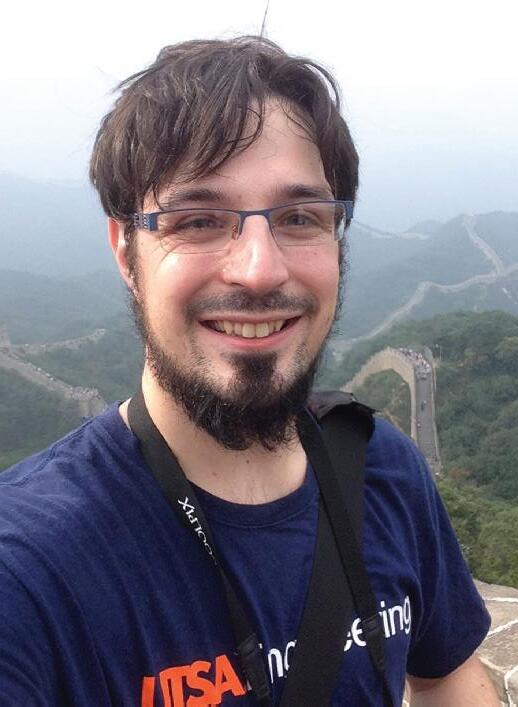
for our students here in COE and UTSA.”
According to McFadden, Tsinghua is basically the MIT of China and he believes that he couldn’t have gotten this same experience here in the U.S. as he did while researching abroad.
“Dr. Bing Dong set up an exchange program with Tsinghua University, asked me if I was interested, and I said yes. Part of my research was to develop a sensor that could measure the behavior of the occupants in office buildings,” said McFadden. “These sensors will tell us the
“The data that we gathered about occupant behavior could help building owners save money and energy,” said McFadden. “Right now, we are really good at modeling how air conditioners work, but we are not good at modeling a person’s behavior when they are in a building. People forget to turn off lights or turn down their AC when they leave the house. If you turn up your AC two degrees when no one is home, that can save up to 22 percent of a building’s electrical bill. We want to develop a technology to put
behaviors of the occupants in buildings, giving us data that we can use to develop a system to help control building energy usage.”
McFadden worked one-on-one with a Chinese student as well as with a larger research group of Tsinghua University students. In addition to developing occupancy sensors, McFadden deployed the energy sensors that were developed at UTSA in the building at Tsinghua University in which he was doing research. Once that data is gathered, McFadden is going to compare the data from China with the data that has been gathered here at UTSA.
in air conditioners that can detect the occupants’ movement and adjust the cooling settings depending on the occupant’s behavior.”
In addition to gaining a higher level of expertise in his research area, McFadden also said he had a great time exploring a new culture. Not only did he have the opportunity to meet new people and forge new friendships, he was able to explore a new part of the world.
“It was really fun, but also a lot of hard work,” he said. “It is definitely worthwhile to go abroad if you can get the chance, and I would highly recommend it.”


By K.C. Gonzalez/Public Affairs Specialist
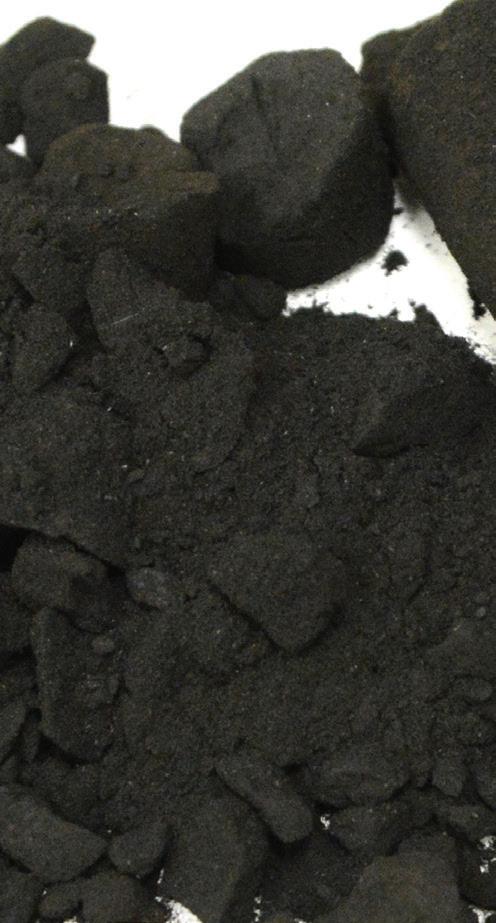
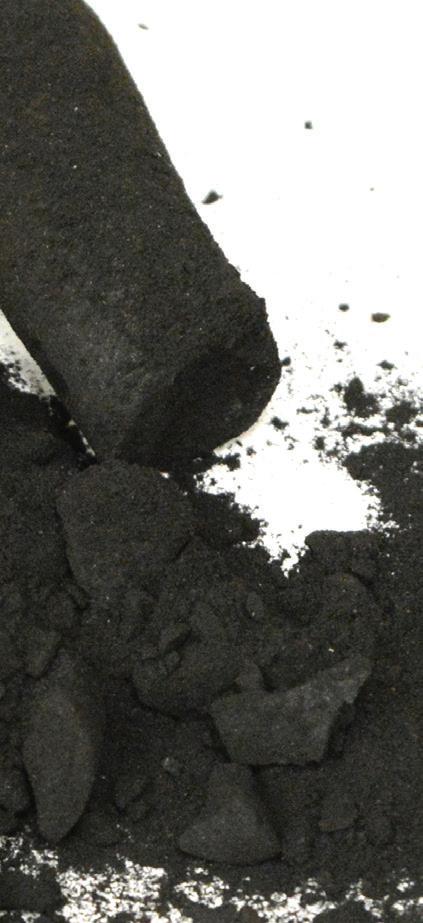
Researchers at UTSA and the Southwest Research Institute (SwRI) have determined that biochar, a substance produced from plant matter, is a safe, effective and inexpensive method to treat flowback water following hydraulic fracturing, or fracking.
research engineer in the SwRI Chemistry and Chemical Engineering Division Maoqi Feng, and four UTSA students spent the past year creating biochar and testing it on water samples.
Flowback water treatment is a critical sustainability issue for the oil and gas industry. One to five million gallons of water mixed with sand and chemicals are required for the fracking of each well. Once the water is used, the flowback, or wastewater, must be treated to remove hazardous chemicals before it is stored, reused or disposed, which can be a costly endeavor. Using biochar could help oil and gas companies save money and responsibly treat flowback water for reuse. This is particularly important in areas where water resources are scarce.
UTSA mechanical engineering professor Zhigang Feng, senior
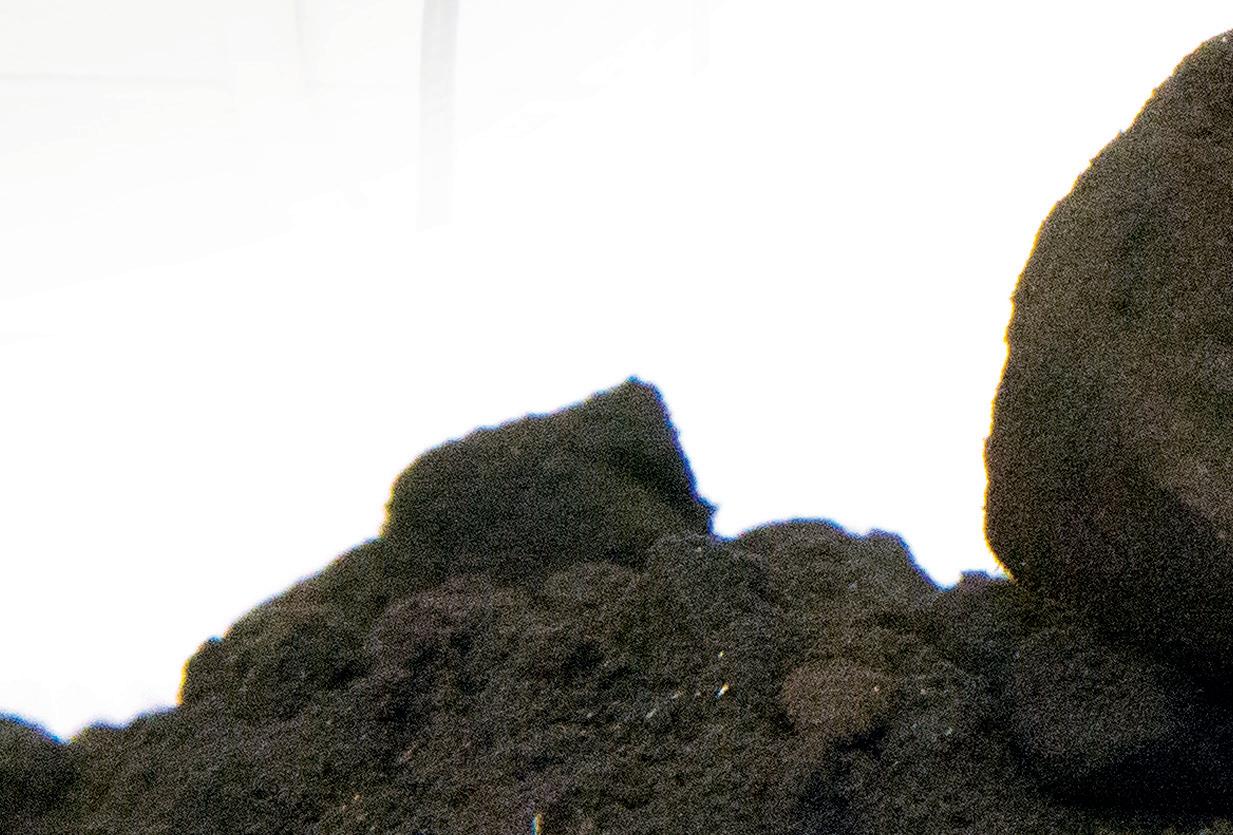
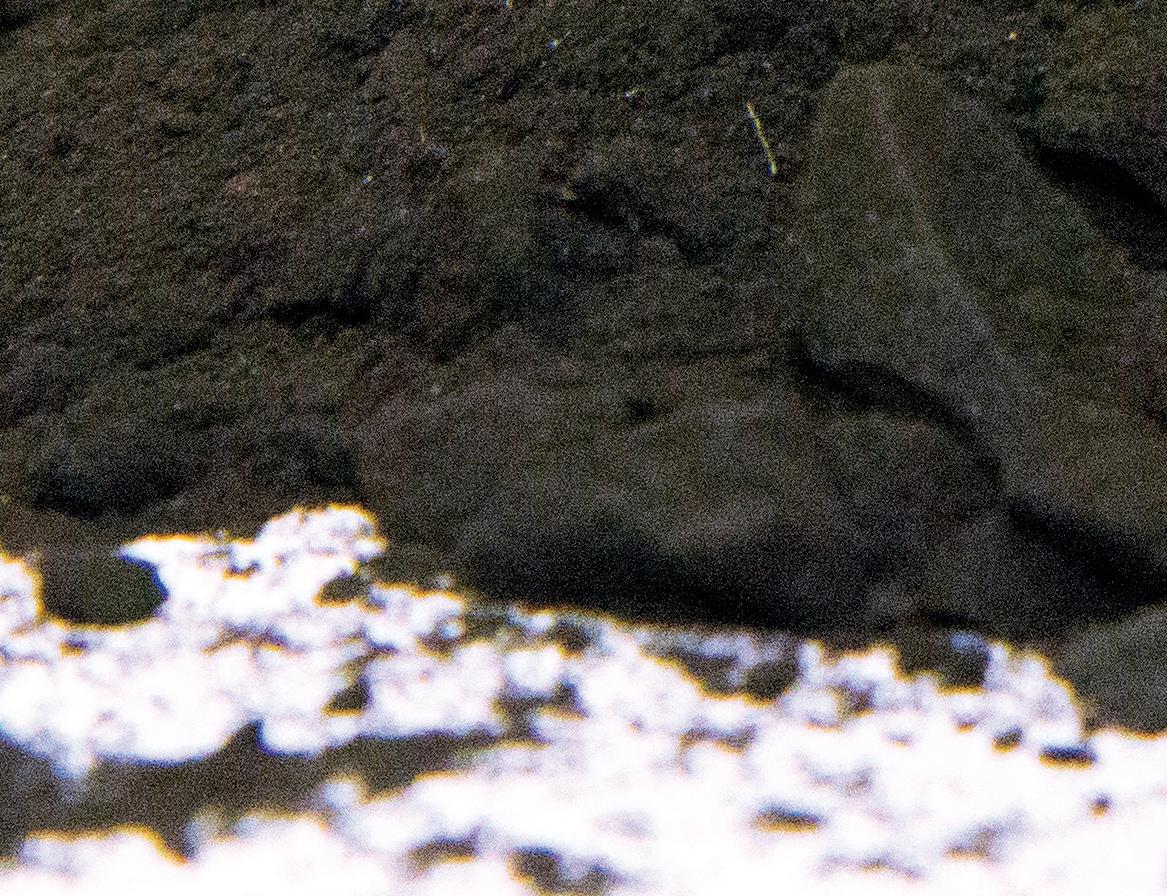


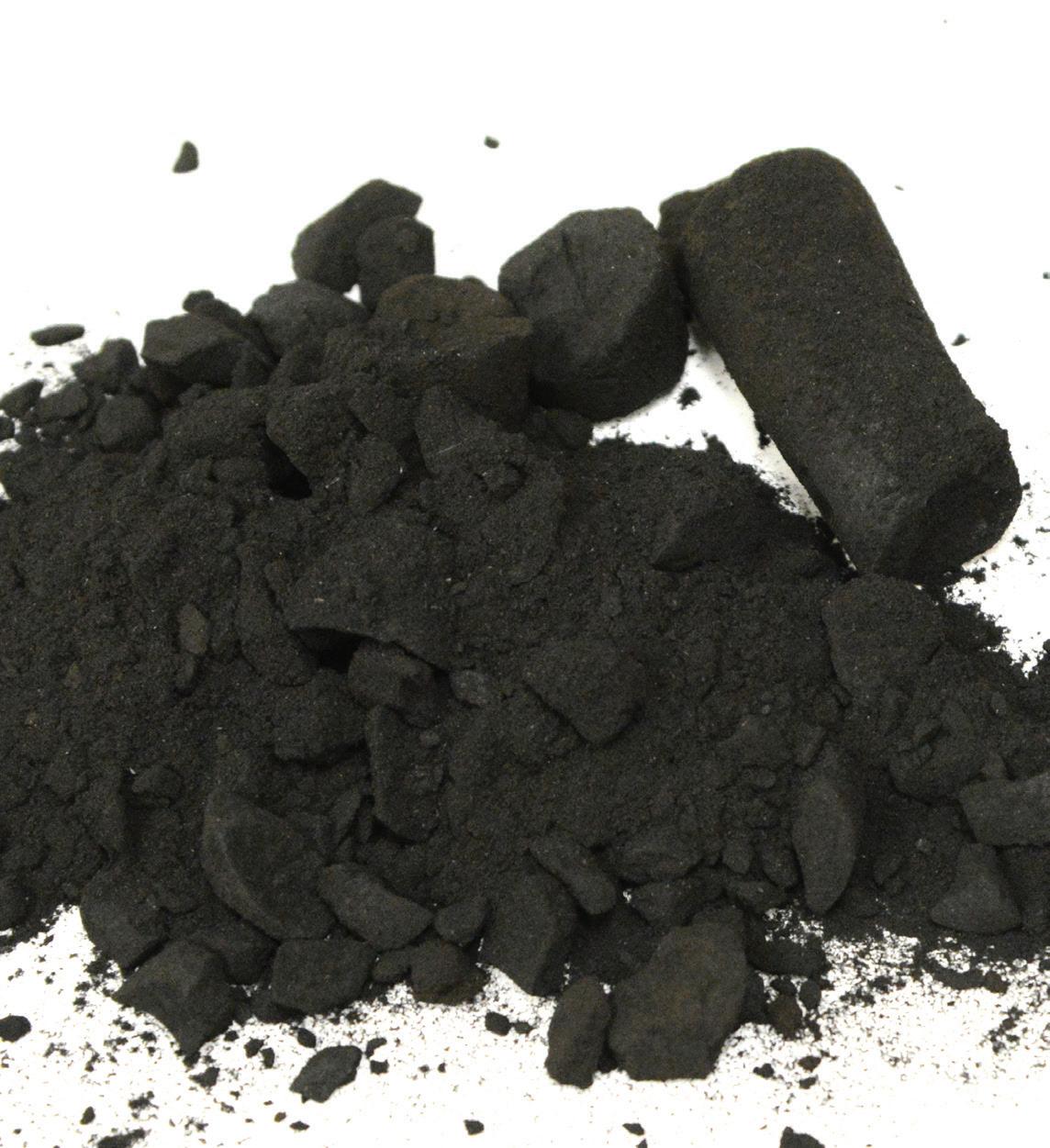
A stable charcoal-like solid that attracts and retains water, biochar absorbs impurities such as hydrocarbons, organics, biocides and certain inorganic metal ions. It is made from materials such as wood chips, paper, leaves, waste residue of soybeans, corn stalk and other forms of agricultural waste heated to high temperatures in an oxygendeprived environment.
“This project extensively studied the adsorption capacity of different biochar for potential inorganic ions and organic contaminants.
The adsorption capacity



data is very useful for designing of large scale adsorption beds for flowback water treatment,” said Maoqi Feng.


The research team developed the preparation method, tested the process and collected data that shows the exact type of biochar that filters out the specific chemicals oil and gas companies add to the water during the fracking process. Those chemicals, such as calcium chloride and magnesium chloride, are listed by the U.S. Environmental Protection Agency as being harmful to the environment.

investigators in fields such as advanced materials, chemistry and chemical engineering, energy, the environment, security and manufacturing.
“There are many variables that go into making different types of biochar to filter certain chemicals, including the material composition of the biochar and to what temperature it’s heated,” said Zhigang Feng. “Our research demonstrates that this is a product that can reduce the environmental impact of drilling in a way that is safe and inexpensive to industry.”
Currently, biochar is used commercially to improve soil quality by helping soils retain nutrients and water. The research team plans to seek additional research funding as well as partnerships with biochar companies to help make the product marketable to the oil and gas industry.

This research initiative was funded by the Connect program, an annual UTSA-SwRI joint funding initiative established in 2010 to stimulate inter-organizational research between UTSA scholars and SwRI

SwRI is an independent, nonprofit, applied research and development organization based in San Antonio, Texas, with nearly 3,000 employees and an annual research volume of $592 million. Southwest Research Institute and SwRI are registered marks in the U.S. Patent and Trademark Office.
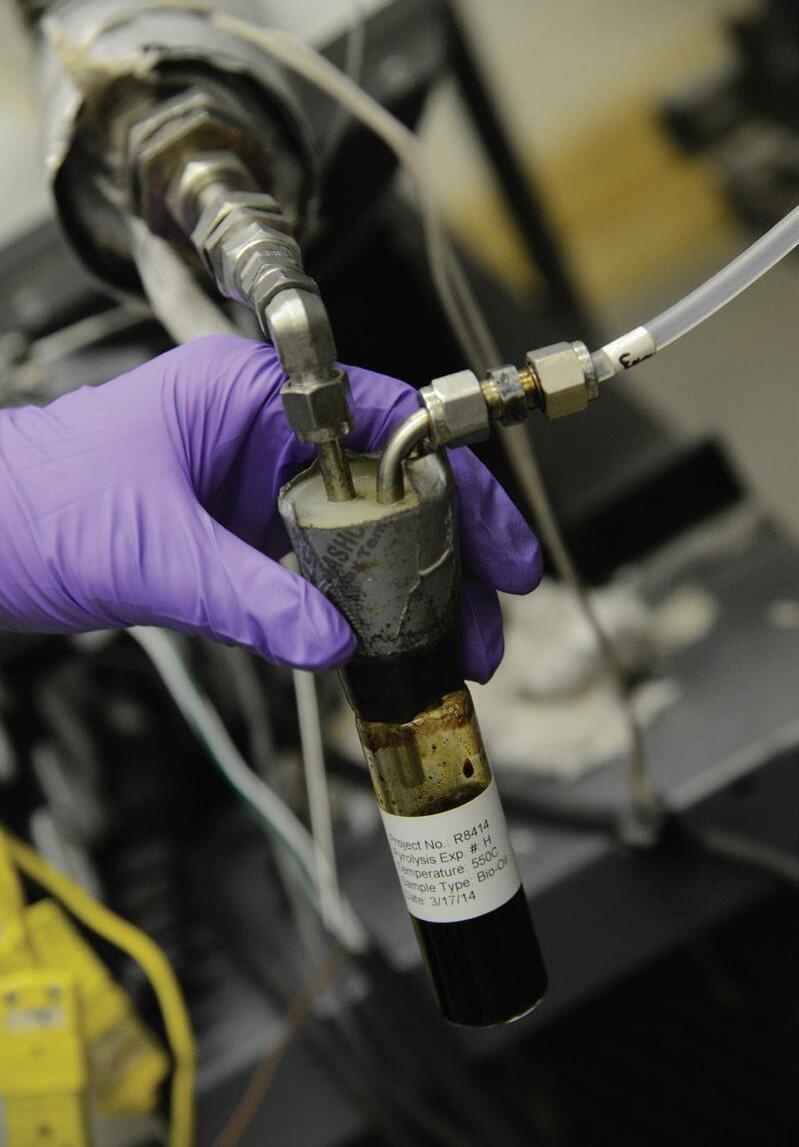
Maoqi Feng, a principal scientist in the SwRI Chemistry and Chemical Engineering Division, collects the liquid that is produced when biochar is made. This dark liquid can be used for biofuel after it goes though a treatment process.





UTSA acquires high-performance EEG systems to advance brain research in numerous fields across campus
Story by K.C. Gonzalez • Photos by Deborah Silliman Wolfe








Arecent $400,000 grant from the U.S. Department of Defense has allowed UTSA to acquire two high-performance electroencephalogram (EEG) systems to advance research and education in the area of brain-machine interaction (BMI).
Understanding how the human brain functions and how this knowledge can benefit society is both a UTSA and a national research priority. BMI, also known as brain-computer interface (BCI), is a field focused on assisting, augmenting or repairing human cognitive or sensory-motor functions.
The new equipment, housed in the BMI Lab in the Applied Engineering and Technology Building, will enable several highly interdisciplinary research and educational projects in BMI and brain research led by six professors from five departments across UTSA.
Yufei Huang, UTSA professor of electrical and computer engineering and principal investigator of this grant, recognized the university-wide need for high-performance EEG systems, which are state-of-the-art, non-invasive devices for measuring brainwaves in real time in both laboratory and real-life environments. Very few universities across the country have equipment of this quality.
vehicles for military operations such as collecting intelligence, performing surveillance and conducting reconnaissance missions. This project is funded by the Army Research Laboratory.
UTSA’s Unmanned Systems Laboratory (USL) has flown under the radar since its founding in 2012 by Pack, one of the nation’s leading teachers and researchers in unmanned aircraft systems, commonly referred to as drones.
Pack and his team of undergraduate and graduate students have been making advancements in three primary areas of research: man-machine interfaces; cooperative unmanned aerial vehicles (UAV); and system of systems (how smaller components work together in larger systems).
“UTSA already has a strong presence in neuroscience research and education. This new EEG technology will significantly enhance our scholarly contributions to advancing new knowledge in brain research.”
Yufei Huang, professor of electrical and computer engineering
The UTSA team recently was awarded a $300,000 contract from the Office of the Secretary of Defense to study how humans can effectively interact with autonomous aerial vehicles. The goal of the project is to use brain signals of a soldier to navigate small UAVs for military operations such as collecting intelligence, performing surveillance and conducting reconnaissance missions.
“UTSA already has a strong presence in neuroscience research and education,” said Huang. “This new EEG technology will significantly enhance our scholarly contributions to advancing new knowledge in brain research. Our long-term vision is to develop a top-tier research and education center on brain-machine interaction at UTSA.”
Mary L. Clark Endowed Distinguished Professor and chair of the Department of Electrical and Computer Engineering Daniel Pack and Huang will use the equipment to design and implement a BMI system that uses brain signals generated by a soldier to navigate small unmanned aerial
Current UAVs must have a ground station that relays instructions from a human operator to an aerial vehicle, but ground stations are static and can restrict soldiers and their units from moving freely.
Using the university’s EEG equipment, Pack, Huang and their teams hope to eliminate the need for ground stations by extracting vehicle control signals directly from brain signals of a soldier operating one or more aerial vehicles.
“As autonomous UAV technologies advance, it is critical that we understand the governing principles of man-machine interactions to utilize the complementary capabilities of man and autonomous machines,” said Pack. “This research will
be part of UTSA’s efforts toward discovering those principles.”
While UAVs are heavily used in military applications, they are being used more commonly for civilian operations such as search and rescue, weather analysis and surveillance over land and water.
UTSA and San Antonio’s Southwest Research Institute are members of the Texas A&M University-Corpus Christi Lone Star Unmanned Aircraft Systems Center of Excellence and Innovation (LSUASC), a consortium of 16 research institutions and private-sector service companies. In June, LSUASC was granted approval by the FAA to serve as a test site for unmanned aircraft.
Before joining UTSA in 2012, Pack served in both faculty and administrative positions at the U.S. Air Force Academy in Colorado Springs, Colo., including founding director of its Academy Center for Unmanned Aircraft Systems Research and director of its Sensor-based Intelligent Robotics Laboratory.
Pack received his Ph.D. in electrical engineering from Purdue University, his M.S. in engineering science from Harvard University and his B.S. in electrical engineering from Arizona State University. Additionally, he is a licensed professional engineer (P.E.) in electrical engineering.
New EEG systems will also support the following projects at UTSA:
• Huang and computer science professor Kay A. Robbins will use the EEG equipment to develop and implement a computational system to monitor brain activities in realistic, event-rich environments. This research is part of the Cognitional and Neuroergonomics Collaborative Technology Alliance (CANCTA), a multi-institution collaboration funded by the U.S. Army Research Laboratory (ARL).
• Robbins also will use the equipment to capture data from the brain during attention and learning tasks in order to build a database that will help researchers see patterns in brain activity. This project also is part of CANCTA, funded by ARL.
• Kinesiology associate professor Wan Xiang Yao will use the equipment to examine the neuromechanisms underlying the transfer of learning from one side of the body to another and metal imagery practice, which will be helpful for patients relearning motor skills
lost due to traumatic brain injury or disease, such as a stroke.
• Biology assistant professor Nicole Wicha will use the equipment to determine the neurodevelopmental trajectory for arithmetic fact learning in bilingual children.
• Mechanical and biomedical engineering professor Yusheng Feng will use the equipment to develop a real-time feedback tutoring algorithm to monitor students’ brain activity when they are studying science, technology, engineering and mathematics. He also will use the algorithm to provide students with learning disabilities feedback to improve their study habits by providing vivid encouraging visualization cues.
More than two dozen UTSA faculty members and their graduate and undergraduate students are actively involved in brain research and education, many of whom are affiliated with the UTSA Neurosciences Institute, a multidisciplinary research organization for integrated brain studies.
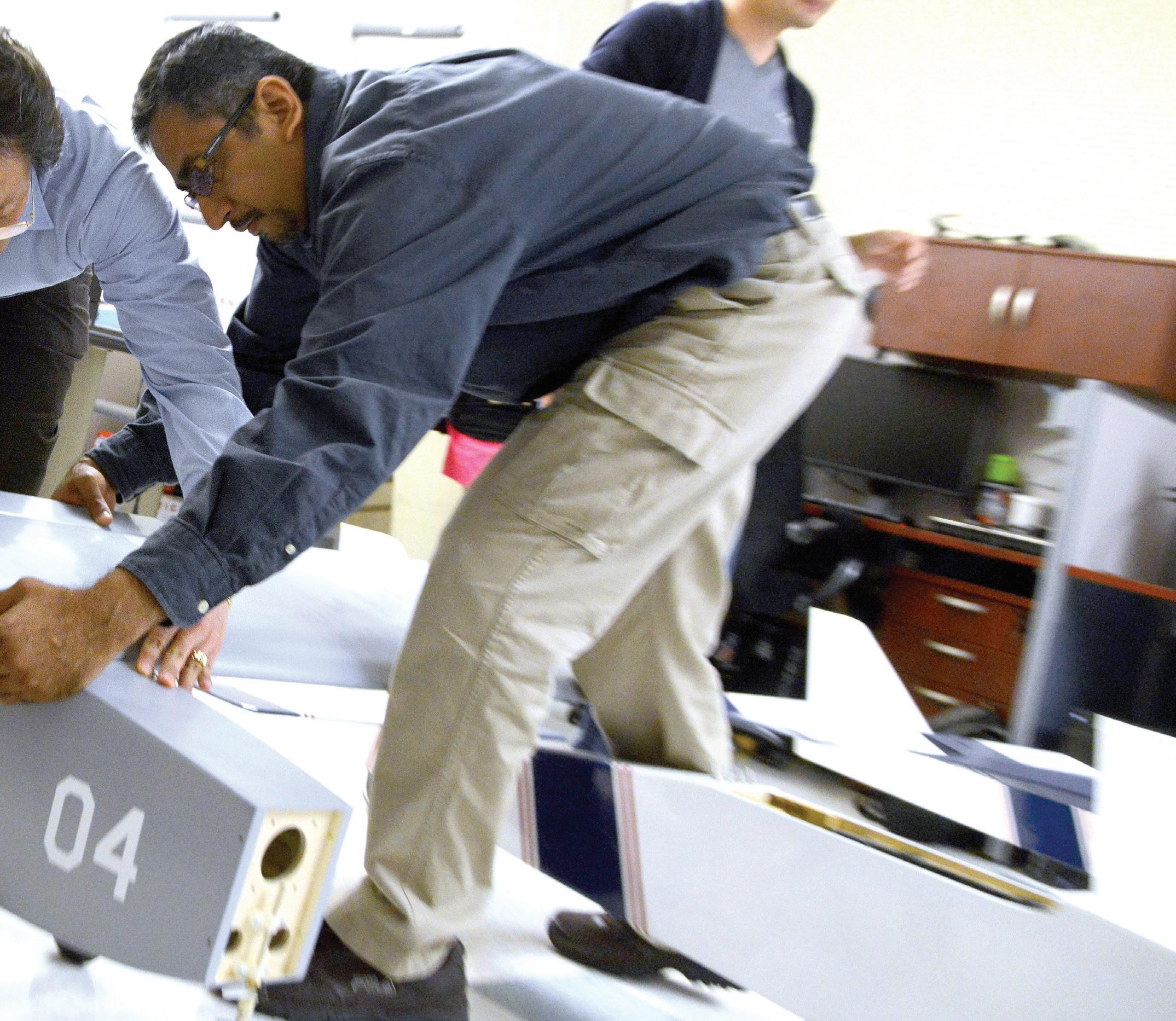
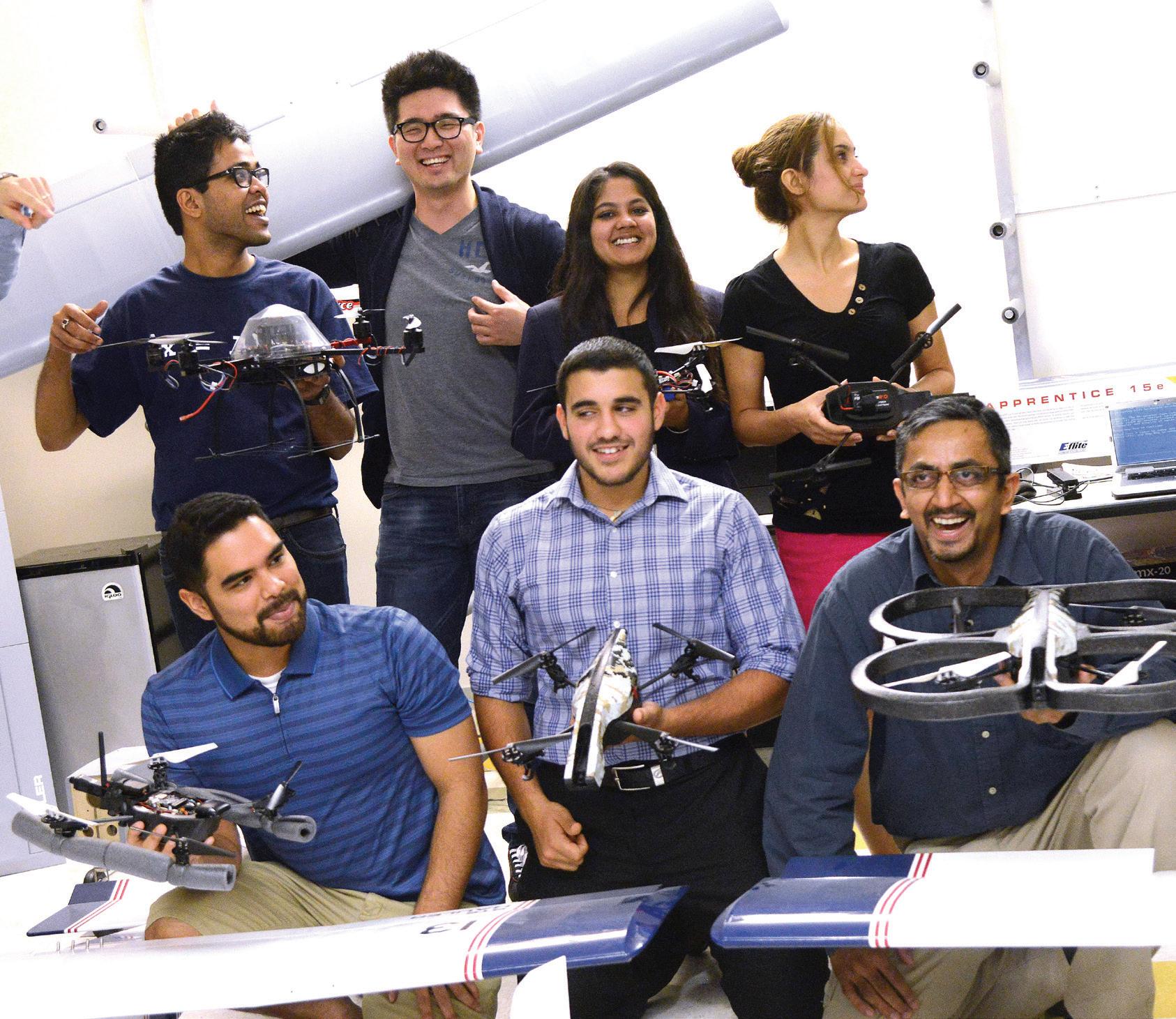
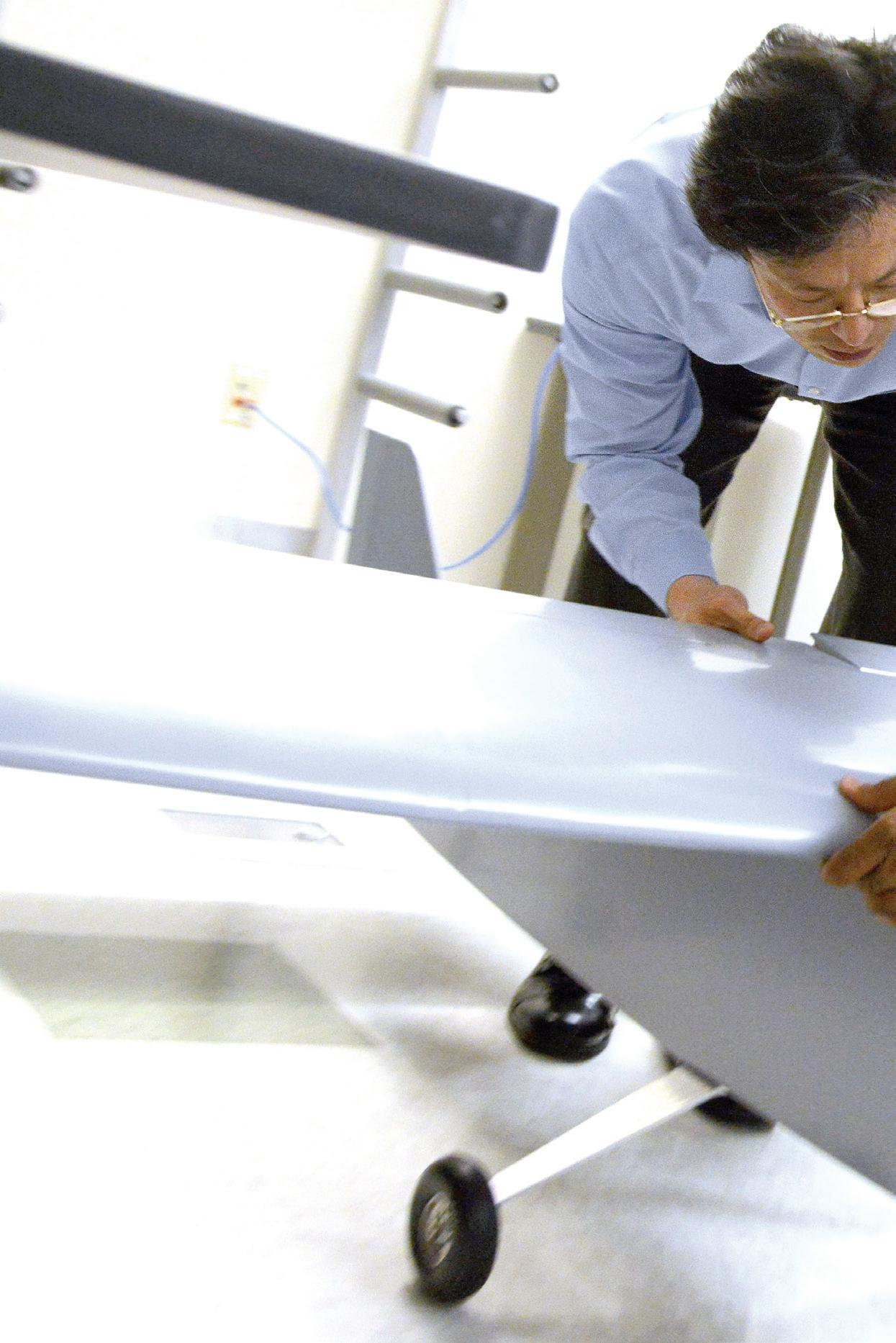
Above: Daniel Pack, Mary L. Clark Endowed Distinguished Professor and chair of the Department of Electrical and Computer Engineering, and Prasanna Kolar, a master’s research fellow in the Department of Electrical and Computer Engineering, put together one of the Unmanned Systems Laboratory’s drones in preparation for a photo shoot for Discovery magazine. Left: The Unmanned Systems Laboratory supports 10 undergraduate and graduate students, all of whom gain experience working hands-on with drone technology.
Ruoting Pei receives $290K from NSF for algal bloom research
By Deborah Silliman Wolfe/ College of Engineering
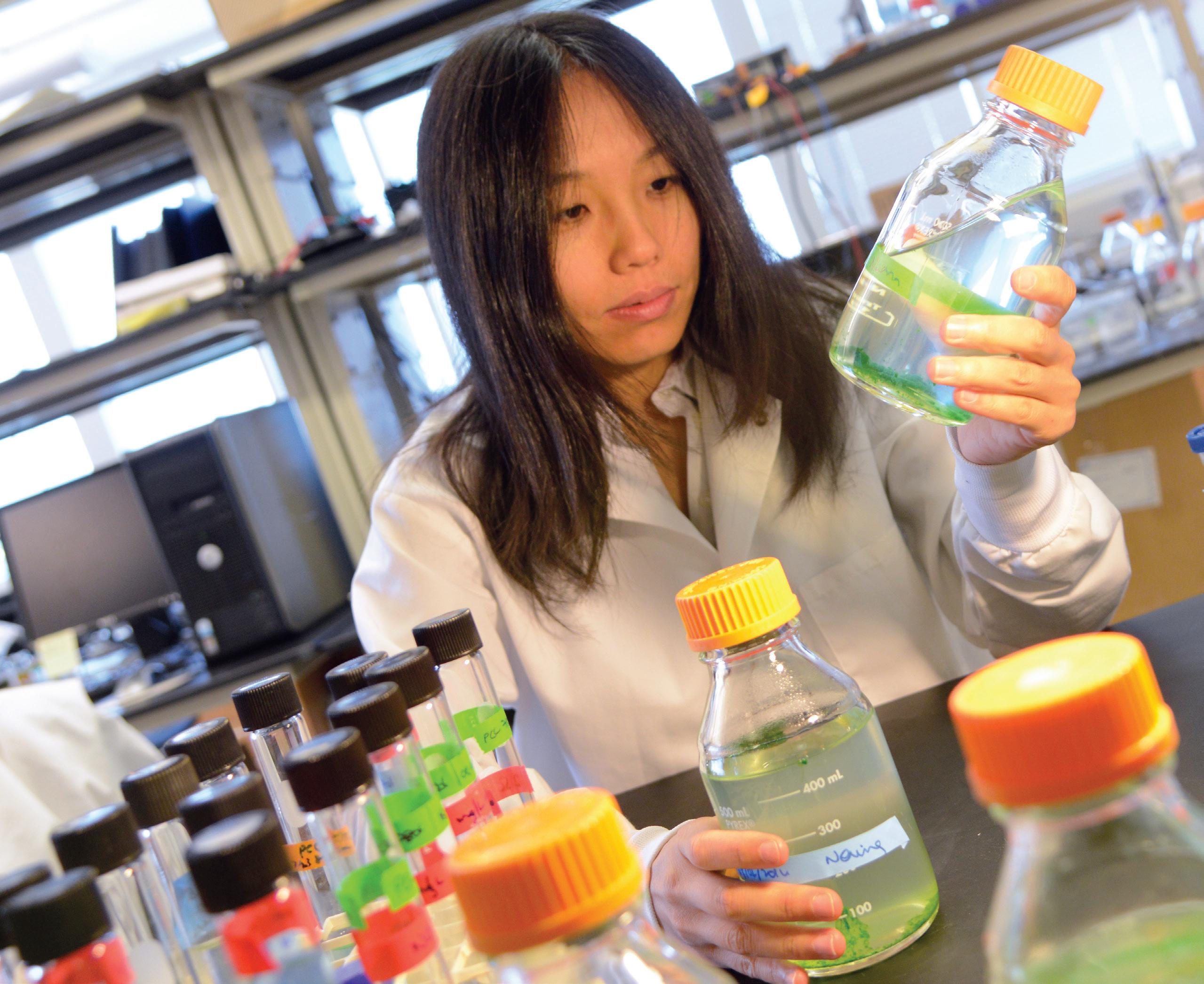
uoting Pei, assistant professor in the UTSA College of Engineering Department of Civil and Environmental Engineering (CEE), has been awarded a grant of $290,000 from the National Science Foundation (NSF) to support her project, “The Role of Cell-to-Cell Com-
munication in Microcystis Aeruginosa Blooms.”
“I was first interested in the communication of bacteria - how they talk to each other,” said Pei. “They communicate with a chemical language, and they use this communication to do a lot of things. For example, excessive growth of cyanobacteria, also called blue green algae, in water bodies causes harmful algal blooms. These algal blooms pose severe health risks to the users of these drinking and recreation waters due to the cyanotoxins produced.”
Not only do the algal blooms pose risks to humans, they also deplete the oxygen supply of the water they occupy, making it impossible for
fish or water plants to survive. Pei is working on a way to “put earplugs” in the algae so that the bacteria cannot communicate with each other to produce toxins.
“The proposed research focuses on quorum sensing, the general mode of cell-to-cell communication in the bacterial kingdom via chemical ‘languages,’” said Pei. “If we can cause a disruption of quorum sensing, the communication between the bacteria, we predict a decrease of cell growth and toxin production and a reduction of cell surface charges. We are trying to put ‘earplugs’ in the bacteria so they cannot communicate with each other so that they stop getting together and producing toxic results.”
In addition to hiring a graduate student with the grant funds, Pei also plans to develop educational outreach programs for local, underrepresented high school students.
“The main purpose of working with local schools is to increase awareness of the threat of algal blooms to the environment, promote excitement for careers in environmental science and engineering fields, and increase the students’ ability to understand scientific and engineering issues,” said Pei. “I also plan to develop graduate courses and provide research opportunities here at UTSA for undergraduate and graduate students.”
Pei, who has been at UTSA for five years, says she is excited to be part of a university with a rapidly growing research agenda, and she is very happy with the support she has received through the CEE department and the College of Engineering.
“This is an outstanding achievement for Dr. Pei and the CEE department,” said Thomas Papagiannakis, McDermott Professor in the Department of Civil and Environmental Engineering. “NSF grants are very competitive and being successful in competing for them attests to the quality of our research program. Dr. Pei’s efforts in establishing a bioenvironmental laboratory are being rewarded. Her research is complementing the research activities of the newly formed Water Institute of Texas, and it is expected to have a significant impact on student training.”
It is UTSA’s vision to be a premier public research university, providing access to educational excellence and preparing citizen leaders in the global environment. We are proud of all of our faculty and students who are striving to reach research excellence in The University of Texas at San Antonio’s path to becoming a Tier One institution.
Xiaodu Wang
Department of Mechanical Engineering
Proposal title: Intrafibrillar Mineralization vs. Bone Fragility
Funding Agency: National Institutes of Health
Amount: $197,769
David Akopian
Department of Electrical and Computer Engineering
Proposal title: Pediatric Obesity
Management Intervention Trial for Hispanic Families
Funding Agency: The University of Texas Health Science Center at San Antonio
Amount: $54,896
Hatim Sharif
Department of Civil and Environmental Engineering
Proposal title: The Use of Operational Precipitation Products in the Context of Flood Forecasting
Funding Agency: U.S. Department of the Army Amount: $73,121
Jose Weissmann
Department of Civil and Environmental Engineering
Proposal title: A Process for Designating and Managing Overweight Truck Routes in Coastal Port Regions
Funding Agency: Texas Department of Transportation
Amount: $1,561
John Foster
Department of Mechanical Engineering Center for Simulation, Visualization and Real Time Prediction
Proposal title: Muri Center for Material Failure Prediction Through Peridynamics
Funding Agency: University of Arizona
Amount: $53,848
Jose Weissmann
Department of Civil and Environmental Engineering
Proposal title: Review And Evaluation Of Current Gross Vehicle Weights And Axle Load Limits
Funding Agency: Texas Department of Transportation
Amount: $5,291
Yufei Huang (PI) Jianqiu Zhang (Co-PI)
Department of Electrical and Computer Engineering
Proposal title: Graphical Models For Characterizing Global RNA Methylation
Funding Agency: National Institutes of Health
Amount: $369,758
Xiaodu Wang (PI) Xiaowei Zeng (Co-PI)
Department of Mechanical Engineering
Proposal title: Non-Collagenous Proteins vs. Bone Fragility
Funding Agency: National Institutes of Health
Amount: $166,191
John Frederick (PI) Gabriel Acevedo (Co-PI) Heather Shipley (Co-PI) Valerie Sponsel (Co-PI)
Academic Affairs, Provost COLFA Sociology
Civil Engineering Department COS Biology
Proposal title: Advance IT-Catalyst: Institutional Self-Study on Women Faculty in Stem and SBS Disciplines at UTSA
Funding Agency: National Science Foundation
Amount: $168,000
Anand Ramasubramanian (PI) Kristin Reddoch (Co-PI)
Department of Biomedical Engineering
Rise Programs
Proposal title: Cell Death Machinery
Involved in Cold Platelet Storage for Transfusion
Funding Agency: American Heart Association
Amount: $25,000
Nikolaos Gatsis (PI)
Department of Electrical and Computer Engineering
Proposal title: CIT: Small: Collaborative Research: From Communication to Power Networks: Adaptive Energy Management for Power Systems With Renewables
Funding Agency: National Science Foundation
Amount: $171,409
Ramnarayan Krishnan (PI) Ravinderpal Sandhu (Co-PI)
Department of Electrical and Computer Engineering College Of Sciences Dean
Proposal title: TWC: Small: Attribute
Based Access Control for Cloud Infrastructure as a Service
Funding Agency: National Science Foundation
Amount: $500,000
Jose Weissmann (PI) Athanassios Papagiannakis (Co-PI)
Department of Civil and Environmental Engineering
Proposal title: Evaluation of the Benefits Of Diamond Grinding Of CRC Pavements
Funding Agency: Texas Department of Transportation
Amount: $21,140
Ruoting Pei (PI)
Department of Civil and Environmental Engineering
Proposal title: Does Cell-Cell Communication Promote Microcystis Aeruginosa Blooms?
Funding Agency: National Science Foundation
Amount: $290,468
David Akopian (PI)
Department of Electrical and Computer Engineering
Proposal title: Tobacco Cessation Services for Bi-Lingual and Spanish Speaking Young Adult Latinos in South Texas
Funding Agency: The University of Texas Health Science Center at San Antonio
Amount: $15,000
Can Saygin (PI) Hung-Da Wan (Co-PI)
Krystel Castillo (Co-PI)
Adel Alaeddini (Co-PI)
Department of Mechanical Engineering Center for Advanced Manufacturing & Lean Systems (CAMLS)
Proposal title: Predictive Maintenance
- Phase 2: From Data to Performance Metrics
Funding Agency: Harland Clarke Amount: $90,000
Krystel Castillo (PI) Marcio Giacomoni (Co-PI) Fengshan Chen (Co-PI) Heather Shipley (Co-PI)
Department of Mechanical Engineering
Department of Civil Engineering
Proposal title: Opportunities for Higher Education and Research Experience in Renewable Energy and Water Quality to Enable Stem Hispanic Leaders
Funding Agency: U.S. Dept. of Agriculture
Amount: $290,000
Ruyan Guo (PI) Amar Bhalla (Co-PI)
Department of Electrical and Computer Engineering
Proposal title: Unified Approach To Increase Stem Undergraduate Students
Employment In Department Of The Navy - UTSA Contribution
Funding Agency: The University of Texas at Austin
Amount: $85,000
Mehdi Shadaram (PI)
Department of Electrical and Computer Engineering
Proposal title: Engineering Summer
Residential Camp For Texas High School Students
Funding Agency: Texas Higher Education Coordinating Board Amount: $12,500
Daniel Pack (PI)
Department of Electrical and Computer Engineering
Proposal title: A Strap-Down ImageBased Guidance on Virtual Field of View
Funding Agency: Agency for Defense Development Amount: $220,000
Mehdi Shadaram (PI)
Department of Electrical and Computer Engineering
Proposal title: Somerset ISD Gear
Funding Agency: Somerset ISD Office of the Superintendent Amount: $15,600
Drew Johnson (PI) Heather Shipley (Co-PI)
Department of Civil and Environmental EngineeringWater Institute of Texas (WIT)
Proposal title: Activated Sludge Aeration Waste Heat for Membrane Evaporation of Desalination
Brine Concentrate: A Bench Scale
Collaborative Study
Funding Agency: U.S. Department of the Interior
Amount: $85,587
Can Saygin (PI) Hung-Da Wan (Co-PI)
Department of Mechanical Engineering Center for Advanced Manufacturing & Lean Systems (CAMLS)
Proposal title: Incorporating LeanSix Sigma Methodologies into The Institute for Integration of Medicine and Science
Funding Agency: The University of Texas Health Science Center at San Antonio Amount: $100,000
Harry Millwater (PI) Juan Ocampo (Co-PI)
Department of Mechanical Engineering
SiViRT
Proposal title: Probabilistic Risk
Assessment of Aircraft Structures
Funding Agency: Texas Research
Institute Austin Inc.
Amount: $42,750
Daniel Pack (PI) Yufei Huang (Co-PI)
Department of Electrical and Computer Engineering
Proposal title: Controlling Cooperative Uavscognition and Neuroergonomics
Collaborative Technology Alliance
Technology Transition Subcontract for Mutually Adaptive Systems
Funding Agency: DCS Corp
Amount: $113,178
Anson Ong (PI)
Department of Biomedical Engineering
Proposal title: Establishment of Pancreatic Microenvironment Ex Vivo to Grow and Preserve Pancreatic Islets
Funding Agency: SALSI
Amount: $100,000
Yufei Huang (PI)
Department of Electrical and Computer Engineering
Proposal title: Identification and Characterization of MRNA Methylation in Breast Cancer
Funding Agency: The University of Texas Health Science Center at San Antonio
Amount: $44,326
Adel Alaeddini (PI)
Department of Mechanical Engineering Center for Advanced Manufacturing & Lean Systems (CAMLS)
Proposal title: Applying Lean Principles to the Faculty Appointment Process at VP-AFSA-UTHSC
Funding Agency: The University of Texas Health Science Center at San Antonio
Amount: $5,100
Adel Alaeddini (PI)
Department of Mechanical Engineering Center for Advanced Manufacturing & Lean Systems (CAMLS)
Proposal title: Review Warranty Claims from the City Of San Antonio Against Toter Two-Wheeled Carts for Curbside Automated Waste
Funding Agency: Toter LLC
Amount: $12,950
Daniel Pack (PI)
Department of Electrical and Computer Engineering
Proposal title: Cooperative Control and Sensing For Multiple Unmanned Aerial Vehicles Working in GPS-Denied Environemnts
Funding Agency: U.S. Department of the Air Force
Amount: $100,000
Rolando Vega (PI) Les Shephard (Co-PI)
Texas Sustainable Energy Research Institute, Department of Civil and Environmental Engineering
Proposal title: Outdoor Test System
Configuration and Reflective Material Characterization for Bifacial Solar PhotoVoltaic Technology
Funding Agency: Mission Solar Energy Amount: $100,000
Hai-Chao Han (PI)
Department of Mechanical Engineering
Proposal title: San Antonio Cardiovascular Proteomic Center
Funding Agency: The University of Texas Health Science Center at San Antonio Amount: $256,269
Ramnarayan Krishnan (PI)
Hong Park (Co-PI)
Department of Electrical and Computer Engineering Institute For Cyber Security
Proposal title: Social Networking for Community Resilience
Funding Agency: LMI Research Institute
Amount: $50,000
Drew Johnson (PI) Heather Shipley (Co-PI)
Department of Civil and Environmental Engineering
Proposal title: Support For Historical Data Review and Source Analysis for Lower Leon Creek Watershed
Funding Agency: Texas Commission on Enviornmental Quality
Amount: $62,881
Krystel Castillo (PI)
Department of Mechanical Engineering
Proposal title: Scheduling and Routing
Optimization for Supply Chains with Disruptions in Transportation
Funding Agency: Conacyt-Consejo National de Ciencia
Amount: $77,360
Yusheng Feng (PI) John Quarles (Co-PI)
Yufei Huang (Co-PI) Krystel Castillo (Co-PI)
Department of Mechanical Engineering
COS Computer Science
Department of Electrical and Computer Engineering
Proposal title: SASLO: Medical Data
Analytics And Visualization Cluster
Funding Agency: University of Texas System
Amount: $150,000
Arturo Montoya (PI) Victor Maldonado (CoPI) Adel Alaeddini (Co-PI)
Department of Civil Engineering
Department of Mechanical Engineering
Proposal title: A Novel Pipeline Monitoring System
Funding Agency: Flatrock Engineering & Environmental, Ltd
Amount: $24,272
JoAnn Browning (PI)
Department of Civil and Environmental
Engineering
Proposal title: Nees Subaward to UTSA
Funding Agency: Purdue University
Amount: $8,256
Anand Ramasubramanian (PI)
Department of Biomedical Engineering
Proposal title: IIMS: A Rapid, Low-Cost Device For MRSA Identification and Drug Susceptibility
Funding Agency: The University of Texas Health Science Center at San Antonio
Amount: $43,000
Manuel Diaz (PI) G. Arroyo (Co-PI)
Department of Civil and Environmental Engineering
Proposal title: Dwight D. Eisenhower
Transportation Fellowship Grant
Funding Agency: U.S. Department of Transportation
Amount: $10,000
Adolfo Matamoros (PI)
Department of Civil and Environmental Engineering
Proposal title: Composite Action in Prestressed NU I-Girder Bridge Deck
Systems Constructed with Bond Funding Agency: Breakers to Facilitate Deck Removal
Funding Agency: University of Kansas Center Reseach, Inc.
Amount: $7,647
Harry Millwater (PI)
Department of College Of Engineering
Proposal title: Gas Turbine Engine
Probabilistic Fracture Mechanics Research
Funding Agency: Southwest Reseach Institute
Amount: $16,626
Anson Ong (PI) Teja Guda (Co-PI)
Department of Biomedical Engineering
Proposal title: Processing and Characterization of Coatings for Polymeric Implants
Funding Agency: North Carolina State University
Amount: $37,000


Professor College of Engineering Department of Electrical and Computer Engineering
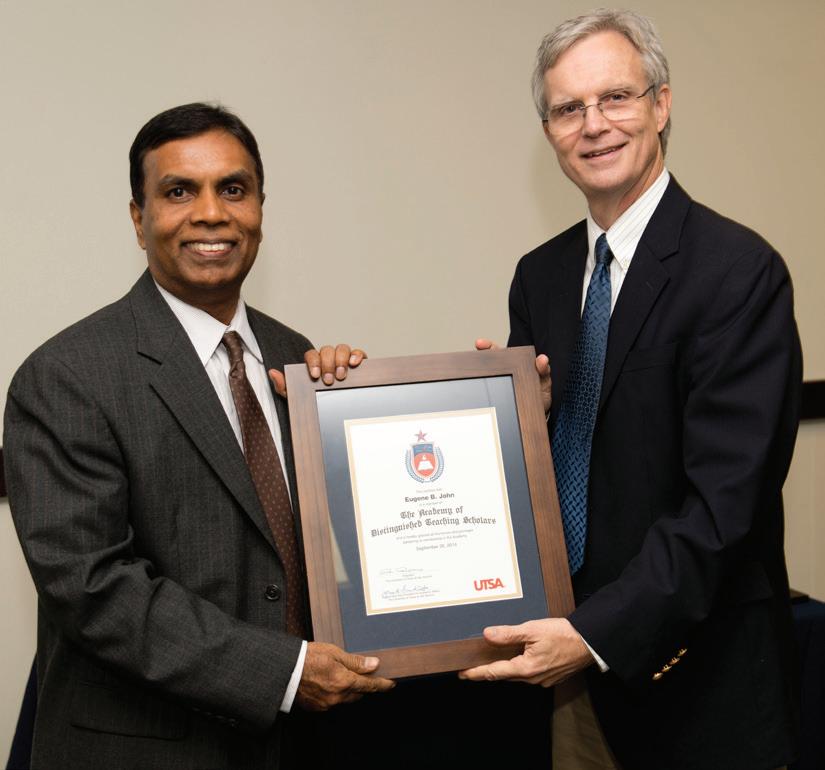
The College of Engineering’s Eugene John was one of the four faculty members of The University of Texas at San Antonio who were among 96 educators from the 15 academic and health institutions in the UT System to be named recipients of the Regents’ Outstanding Teaching Awards for 2014.
John, professor in the College of Engineering’s Department of Electrical and Computer Engineering, has been teaching at The University of Texas at San Antonio (UTSA) since 2001, and with the UT System since 1995. In addition to having 19 years of teaching experience in the field of electrical and computer engineering, John has ongoing funded research in the same field.
“Dr. John is a very sensitive teacher and he is tuned into students’ needs and learning styles,” said College of Engineering’s Associate Dean for Student Affairs and Policies Mehdi Shadaram.
“He is sincerely interested in his students’ betterment and teaches them wholeheartedly, while mentoring them towards success.”
not a nameless crowd of faces to him, they are capable individuals that he trusts, supports, and mentors in any way that he can. His professionalism, fairness, and positivity are something to be admired, and his unwavering moral character garners the full respect of his students.”


John says he is continually trying to evolve his teaching based on his assessment of his students’ learning outcomes, student evaluations, technological advances, and professional advancement.
“Dr. John deserves this award not only for his superb teaching style, but because his passion for teaching extends far beyond the walls of any classroom,” said IBM engineer Marissa Amaya. Amaya is a graduate of the College of Engineering’s electrical and computer engineering program and one of John’s former students.
“His students are


John is passionate about undergraduate teaching and research, and it shows. He has mentored or co-mentored several undergraduate students at UTSA, is the principal investigator for a National Science Foundation Research Experience for Undergraduate (NSF REU) grant, and has written several proposals to acquire funds for undergraduate research.
“I strongly believe that research is complementary to teaching,” said John. “This is why I always involve undergraduates in my research projects. Involving undergraduate students allows them to develop skills in critical thinking, investigation and problem solving.”
This is the sixth consecutive year that UTSA faculty members have been honored with the Regents’ Outstanding Teaching Awards (ROTA), believed to be among the single largest financial teaching awards programs in the country. Each of the honorees will receive an unrestricted check for $25,000, and were recognized for their achievement at an Aug. 20 reception and dinner in Austin.

“This recognition is a testament to the exceptional faculty members at UTSA who are preparing our students to become tomorrow’s leaders,” said UTSA President Ricardo Romo. “Their commitment to excellence in teaching, research and community service is what makes UTSA a top-tier university.”



























Sos Agaian, Peter T. Flawn Professor of Electrical and Computer Engineering, is on a roll. Not only was he named The University of Texas at San Antonio’s 2014 Innovator of the Year, he was also recognized this fall by The San Antonio Business Journal in their Tech Flash Titan Awards.
“ To quote Margaret Mead, ‘I learned the value of hard work by working hard,’” said Agaian. “ You can only live your dream by working smarter and harder than you should. I hope now I can encourage more students on two key things - to work on real-life practical problems and to be the best that they can.”





The UTSA Office of Commercialization and Innovation (OIC) recognized Agaian as UTSA’s 2014 Innovator of the Year at the university’s second annual Innovation Awards luncheon, which was held in October. The UTSA Innovation Awards program recognizes UTSA researchers who have contributed to the university’s entrepreneurial ecosystem by securing patents and/or commercial licenses to protect, develop and market their discoveries. Agaian is currently researching image enhancement for use in computer-aided cancer detection. To date, Agaian and his colleagues have developed an algorithm that:







Sos Agaian has been innovating for the past 17 years, and his reputation is growing right alongside UTSA on its path to Tier One.

• provides more consistent and accurate cancer grading and scoring
• reduces the time and cost to process biopsies, and
• removes the need to have slides reviewed and graded by multiple pathologists.
“You can only live your dream by working smart and harder than you should. I hope now I can encourage more students on two key things - to work on real-life practical problems and to be the best that they can.”


While at UTSA, Agaian’s research has led overall to 26 invention disclosures, 17 patent applications filed, two patents issued and three technologies licensed. Over the last year alone, his research led to six invention disclosures, three provisional patent applications filed, two full patent applications filed and three technology licenses. Additionally, the licensee of his technology provided more than $100,000 in sponsored research funding to his laboratory, and it hired one of Agaian’s doctoral students following graduation.

Sos Agaian, UTSA Peter T. Flawn Distinguished Professor of Electrical and Computer Engineering
• assists pathologists in locating and scoring cancerous tissue regions


“He is a genuinely good person, and a good partner,” said Subashini Asokan, Technology Licensing Associate for the OCI. “He brings this passion and charisma into every meeting he has with a student, peer, potential client, or investor—he always puts his best foot forward.”
In addition to his startups, patents, and disclosures, Agaian has been published more than 450 times, with each article bearing the UTSA name and logo. This is remarkable because when he arrived in 1997, few citations made mention of the university—now,


there are more than 500 citations from UTSA annually.
“In the past, it was hard to get citations,” said Agaian. “But I could see my citations go up as the university’s reputation grew - there was a direct correlation. Now, people see the UTSA name and say, ‘Oh, UTSA, I have heard of them, that is a good university.’ My work has been recognized by earning fellowships and awards, and it was all earned right here at UTSA.”



In addition to being named Innovator of the Year, Agaian was also recognized this fall by The San Antonio Business Journal in their Tech Flash Titan Awards. According to the Business Journal, these awards recognize outstanding people, businesses and organizations in various sectors of San Antonio’s growing technology industry.



Tony Quesada, editor-in-chief of the San Antonio Business Journal says that by recognizing the exceptional leaders in this field, these awards will work in concert with other efforts underway in the business community to foster a greater awareness and understanding of how much San Antonio’s tech sector is growing and contributing to the city’s economy.
“I was not at all surprised when I heard that Dr. Agaian won the SABJ Tech Researcher Award,” said Mauli Agrawal, vice president for research at UTSA. “He is an outstanding innovator who applies his deep knowledge of the field to address real world problems with very elegant engineering solutions.”






















CCurrently, Heather Shipley, assistant professor in the Department of Civil and Environmental Engineering, holds the Burzik Professorship in Engineering Design.













athy and Frank Burzik believe in the power of hard work and a good education. The couple, who have been living in San Antonio since 2006, recently gave a $250,000 gift from the Catherine and Francis Burzik Foundation to establish the Burzik Professorship in Engineering Design at The University of Texas at San Antonio’s College of Engineering. The position supports the research and teaching of engineering design to nurture student-developed technology ventures and train the next generation of engineering business leaders.
“Both Frank and I don’t think we would be where we are without our educations and we wanted to give back,” said Cathy. “I think it is really hard to do well without a good education, so when Ricardo [Romo] asked us to consider creating an endowed professorship, we decided it was something that we wanted to do for UTSA.”









and forth between classes because she couldn’t afford a car. Or how when she and Frank first got married, they would have $2 for the week to spend on food and would buy a box of Encore beef and just eat that to get through. But even through the hard times and even harder winters, Cathy and Frank both completed their education because they realized that giving up wasn’t an option.
“If I could share any advice with a student who is struggling, I would say, ‘Don’t give up. Don’t trade tomorrow for the pleasure of today,’” said Cathy.

“If I could share any advice with a student who is struggling, I would say, ‘Don’t give up.’”
— Cathy Burzik

“Endowments like the Burzik’s are invaluable to the college and the faculty that receive them,” said Shipley. “The endowment can help propel the university and the college towards Tier One by providing resources that benefit my research and teaching activities which in turn benefits the college and our students. I am very grateful and honored that the Burzik’s gifted this endowment.”
In addition to the endowed professorship at UTSA, the Burzik’s have used the Catherine and Francis Burzik Foundation to support their alma maters — the University of Buffalo, Canisius College in Buffalo, New York, and Rochester Institute of Technology.
While pursuing their own education, things weren’t always easy for Cathy and Frank. Cathy vividly recalled how, in the freezing Buffalo, New York, winters, she’d carry 40 pounds of textbooks with her as she took three bus transfers (each way) through rough parts of the city to get back

The Burzik’s passion for philanthropy goes beyond supporting education, they also donate to a number of performing arts organizations including the Tobin Center for the Performing Arts, San Antonio Symphony and Ballet San Antonio. Their passion for performing arts has led to their participation in ballroom dancing competitions, a hobby that has taken them across the country during the past six years.
“Dancing has become a really important part of our lives,” said Frank.

“People who dance have lower rates of Alzheimer’s and dementia - it keeps you young, keeps you healthy.”
“And, we have a big network of dancing friends here in San Antonio,” added Cathy. “That part of dancing is really fun – the friends we have made at the studio.”


Besides being an avid ballroom dancer and philanthropist, Cathy is active in the healthcare fi eld and currently serves on the Board of Directors of Becton, Dickinson and Company (NYSE: BDX) and the Board of Directors of the San Antonio Branch of the Dallas Federal Reserve Board. Additionally, Cathy serves as a General Partner in Targeted Technology, a healthcare related fund that invests in early stage medical device, life science and biotech companies. Frank is active in several philanthropic endeavors including serving on the Board of Mission Road, an organization dedicated to helping developmentally handicapped individuals lead independent, healthy lives. He also serves on the Board of Ballet San Antonio.


















By Deborah Silliman Wolfe/College of Engineering









In addition to being passionate about education, Cathy and Frank Burzik are also passionate about ballroom dancing.





Total number of fall 2014 students = 2,458














































COLLEGE OF ENGINEERING
One UTSA Circle
San Antonio, TX 78249
engineering.utsa.edu
Address Service Requested
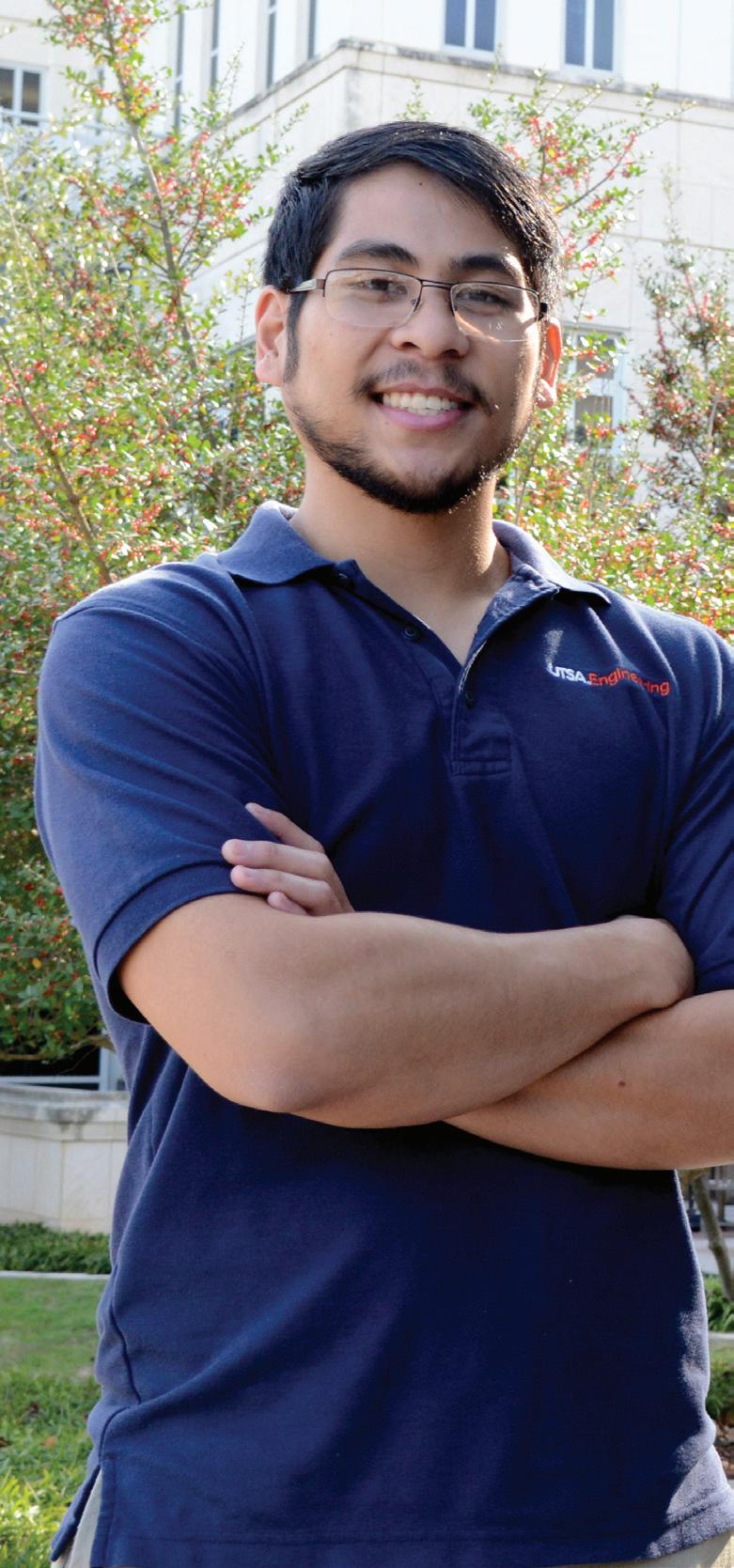

Seeing her son graduate with his mechanical engineering degree was a proud moment for Joshua Lademora’s mom. Not because of all she had sacrificed for him throughout his six-year journey, but because of what he had sacrificed for her.
Not long after Lademora enrolled at The University of Texas at San Antonio, his parents divorced, and his life changed significantly.


“My mother and father came from the Philippines, and we didn’t have many relatives in the United States, let alone any who were able to help,” Lademora explained. “So in the fall 2009, I invited my mother to live with me so I could take care of her.”
For most, the task of studying engineering and taking care of a family member would be too much. Something would have to give. For Lademora, however, the only thing that gave was the time he spent on himself.

“I worked numerous jobs and spent late nights studying. I had little time for anything else,” Lademora said. “Regardless of the worry and stress, I’m now able to say I graduated engineering and took care of my mother, who took care of me.”

Lademora graduated this past December and his legacy remains at UTSA. He was president of Engineering Student Council, helped organize the first Texas Energy Expo in 2012, and spearheaded the first the catapult competition during COE’s annual Monster Mash Pumpkin Smash.

“Josh is one of the most dedicated and persevering students I have ever come across,” said Mauli Agrawal, UTSA vice president for research. “Despite the fact that he had significant family issues to take care of, he stayed in school to finish his degree. Moreover, he played a very active role in the COE student council and was instrumental in starting several of the student traditions for the college. He is a winner.”