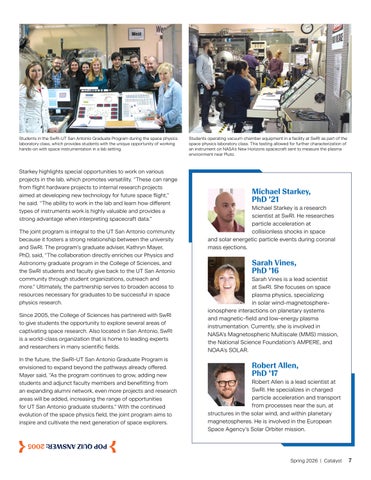
Students in the SwRI-UT San Antonio Graduate Program during the space physics laboratory class, which provides students with the unique opportunity of working hands-on with space instrumentation in a lab setting.
Starkey highlights special opportunities to work on various projects in the lab, which promotes versatility. “These can range from flight hardware projects to internal research projects aimed at developing new technology for future space flight,” he said. “The ability to work in the lab and learn how different types of instruments work is highly valuable and provides a strong advantage when interpreting spacecraft data.” The joint program is integral to the UT San Antonio community because it fosters a strong relationship between the university and SwRI. The program’s graduate adviser, Kathryn Mayer, PhD, said, “The collaboration directly enriches our Physics and Astronomy graduate program in the College of Sciences, and the SwRI students and faculty give back to the UT San Antonio community through student organizations, outreach and more.” Ultimately, the partnership serves to broaden access to resources necessary for graduates to be successful in space physics research. Since 2005, the College of Sciences has partnered with SwRI to give students the opportunity to explore several areas of captivating space research. Also located in San Antonio, SwRI is a world-class organization that is home to leading experts and researchers in many scientific fields. In the future, the SwRI-UT San Antonio Graduate Program is envisioned to expand beyond the pathways already offered. Mayer said, “As the program continues to grow, adding new students and adjunct faculty members and benefitting from an expanding alumni network, even more projects and research areas will be added, increasing the range of opportunities for UT San Antonio graduate students.” With the continued evolution of the space physics field, the joint program aims to inspire and cultivate the next generation of space explorers.
Students operating vacuum chamber equipment in a facility at SwRI as part of the space physics laboratory class. This testing allowed for further characterization of an instrument on NASA’s New Horizons spacecraft sent to measure the plasma environment near Pluto.
Michael Starkey, PhD ’21
Michael Starkey is a research scientist at SwRI. He researches particle acceleration at collisionless shocks in space and solar energetic particle events during coronal mass ejections.
Sarah Vines, PhD ’16
Sarah Vines is a lead scientist at SwRI. She focuses on space plasma physics, specializing in solar wind-magnetosphereionosphere interactions on planetary systems and magnetic-field and low-energy plasma instrumentation. Currently, she is involved in NASA’s Magnetospheric Multiscale (MMS) mission, the National Science Foundation’s AMPERE, and NOAA’s SOLAR.
Robert Allen, PhD ’17
Robert Allen is a lead scientist at SwRI. He specializes in charged particle acceleration and transport from processes near the sun, at structures in the solar wind, and within planetary magnetospheres. He is involved in the European Space Agency’s Solar Orbiter mission.
POP QUIZ ANSWER: 2005 Spring 2026 | Catalyst
7