Florida Currents PEACE RIVER ELECTRIC COOPERATIVE
OCTOBER 2026
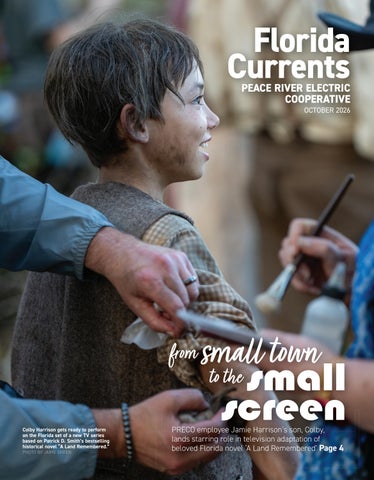
from Colby Harrison gets ready to perform on the Florida set of a new TV series based on Patrick D. Smith’s bestselling historical novel “A Land Remembered.” PHOTO BY JAIME GREEN
small town to the
small screen
PRECO employee Jamie Harrison’s son, Colby, lands starring role in television adaptation of beloved Florida novel ‘A Land Remembered’ Page 4
PEACE RIVER ELECTRIC
Florida Currents October 2026 • Volume 15, No. 12
CEO Michael Shepard SENIOR VP OF CONTENT Leon Espinoza EDITORIAL DIRECTOR Chasity Anderson, CCC DEPUTY EDITORIAL DIRECTOR Noble Sprayberry SENIOR EDITOR Jennifer Paton, CCC LEAD CONTENT EDITOR Victoria Hampton, CCC FLORIDA CURRENTS EDITORS Sable Riley, CCC; Valeri Saldanha Rosa ASSISTANT EDITORS David Herder, CCC; Nina Todea, CCC PUBLICATIONS PRODUCTION SENIOR MANAGER Elizabeth Beatty SENIOR PUBLICATIONS COORDINATOR Alyssa McDougle
Members acknowledge that $4.83 a year, plus postage, is the cost to publish 12 issues a year of FLORIDA CURRENTS ISSN 23276304 (USPS 8300). Published by Pioneer Utility Resources Inc., 5625 NE Elam Young Parkway, Ste. 100, Hillsboro, OR 97124—a not-for-profit Oregon cooperative corporation—the magazine serves the communication needs of consumerowned electric utilities in Florida. Preferred Periodicals postage paid at Hillsboro, OR 97123 and at additional mailing offices.
Postmaster: Send address changes to 5625 NE Elam Young Parkway, Ste. 100, Hillsboro, OR 97124-6422.
HOW TO CONTACT FLORIDA CURRENTS Subscription services: Nonmember subscriptions $15 U.S. a year; $25 foreign a year. Prepayment required. Allow 4-8 weeks for first issue. Identify local edition desired. Have a problem receiving your magazine? Utility members should contact their utility office. Nonmembers call 503-357-2105 or email mailingdept@pioneer.coop.
As fall temperatures fluctuate, your thermostat settings can make a big difference in your energy bills. On cooler days, lower the thermostat setting. Raise it during warmer days. On milder days, consider turning off your heating/cooling system altogether. A smart thermostat makes temperature adjustments in your household—and saving energy—easy and convenient.
Sharing the Waters He Calls Home
Back issues: Back issues and extra copies are $3 each, prepayment required. Supply is limited. Identify edition, month and year. Call first to check availability. Contact Pioneer Utility Resources: P.O. Box 1306, North Plains, OR 97133-1306; 503-357-2105; email: mailingdept@pioneer.coop.
Matt Godwin guides visitors through the beauty and bounty of the Dead Lakes
Up Close, Page 10
DISPLAY ADVERTISING INQUIRIES American MainStreet Publications, 611 S. Congress Ave., Ste. 504, Austin, TX 78704-1714; 800-626-1181 or 512-441-5200; amp.coop.
Leave No Trace
One family’s search for Bigfoot in the Florida wilderness Spotlight, Page 12
© 2026 Pioneer Utility Resources. All rights reserved. Reproduction in whole or in part without written permission is prohibited. Direct reprint requests to editor@floridacurrents.com or for more information, visit pioneer.coop.
Picture Hunt 18 Planner Get Outside 19 Gardening Co-op Pages: 4-8, 25-26, 28-29, 32
22 24
A Garden’s Last Hurrah In the Kitchen, Page 16
OCTOBER 2026
3
PEACE RIVER ELECTRIC
FROM LEFT: Colby Harrison, upper left, poses in a selfie with, from left, his mom, sister, and father Jamie Harrison, Peace River Electric Cooperative’s engineering and mapping supervisor. PHOTO BY JAMIE HARRISON Twelve-year-old Colby is cast as young Zechariah MacIvey in a TV series based on Patrick D. Smith’s bestselling historical novel “A Land Remembered.” Colby is taking direction on set of the production in Florida. PHOTOS BY JAIME GREEN
from
small town to the small
AD O BY BE S EV OLV TOCK I EC T A LLUS ND TR KO ATIO LE RO NS WA
screen
4
O C T O B E R 2026
PRECO employee Jamie Harrison’s son, Colby, lands starring role in television adaptation of beloved Florida novel ‘A Land Remembered’ By Claire Thomas
For Jamie Harrison, mapping is part of the job. As engineering and mapping supervisor at Peace River Electric Cooperative, Jamie helps oversee work tied to the system that carries electricity across the rural communities PRECO serves. But these days, the Harrison family has another connection to the Florida landscape, one that will soon reach television screens. Jamie’s 12-year-old son, Colby Harrison, of Hardee County, has been cast as young Zechariah MacIvey in the television adaptation of Patrick D. Smith’s bestselling historical novel “A Land Remembered.” For generations of Florida readers, the book has offered an unforgettable look at the state
Colby’s background in showing pigs and competing in rodeos helped him prepare for a rugged role set in historical Florida. PHOTO BY COREY CASTELLANO
before highways, subdivisions and theme parks transformed its landscape. Through the fictional MacIvey family, the story follows three generations carving out lives in the Florida wilderness, beginning in the years following the Civil War. Now, a young man raised among the ranches, pastures and traditions of rural Florida is helping bring that story to life. Colby was selected from more than 2,000 hopefuls who auditioned for the role. Producers were looking for more than acting ability. They wanted someone who could authentically portray a young Florida cattleman. Colby brought something to the role that couldn’t simply be learned for an audition. Ranching and rodeo are already part of his world. Colby has shown pigs and competes in rodeo, even advancing to national competition in Oklahoma. Those experiences helped prepare him for a role rooted in the rugged cattle culture of early Florida. His connection to the state runs even deeper. Colby is a sixthgeneration Floridian on both sides of his family and has grown up in Fort Green, surrounded by the rural way of life that remains an important part of Hardee County’s identity. The Florida portrayed in “A Land Remembered” may look very different from the state people know today, but remnants of it can still be found throughout PRECO’s service territory, in cattle pastures stretching toward the horizon, agriculture lining country roads and families whose ties to the land span generations. It is also the Florida where Jamie built his career.
While Colby is stepping back in time to portray a young Zechariah MacIvey, his dad plays an important role in the modern infrastructure that keeps today’s rural Florida moving forward. Jamie’s work in PRECO’s Engineering and Mapping Department supports the electric system serving homes, ranches, farms and businesses across the cooperative’s service area. Father and son may have different roles, but both have a unique connection to the same place. For Jamie, it is helping serve the communities of rural Florida. For Colby, it is helping tell their stories. The production is staying true to those roots. Rather than recreating Florida somewhere else, “A Land Remembered” is being filmed in the Sunshine State, allowing the landscape that inspired Patrick’s novel to become part of the story on screen. For a Hardee County family, seeing Colby take on such a significant role is an extraordinary opportunity. For the PRECO family, it gives us another reason to celebrate one of our own. Soon, audiences far beyond Hardee County will meet young Zechariah MacIvey and experience a story about perseverance, family, cattle, wilderness and a changing Florida. And when they do, PRECO employees and members have a special reason to watch. The young man helping bring one of Florida’s most treasured stories to life comes from right here at home. Legal disclaimer: The write-up does not constitute an endorsement of or partnership with PRECO by MacIvey LLC or “A Land Remembered."
OCTOBER 2026
5
PEACE RIVER ELECTRIC
COORDINATING POWER Across
the
Article provided by NRECA When you flip a switch, electricity is there—instant, reliable and ready to power your day. However, behind that simple moment is a carefully coordinated system made of many “grid power players,” all working together to keep the lights on. At Peace River Electric Cooperative, we think it’s important for our members to understand how this system works and who’s involved in delivering the electricity you depend on every day. It starts with generation owners and operators. These are the facilities that produce electricity. Power plants convert energy from a variety of sources—such as natural gas, coal, nuclear energy and renewables, like wind or solar—into electricity. These facilities may be owned by electric utilities, government entities or private companies. In most regions, a diverse mix of generation sources helps ensure reliability while also supporting affordability and sustainability goals. Once electricity is generated, it needs to travel to reach local communities. That’s where transmission owners and operators come in. Using high-voltage transmission lines strung along massive towers, they move bulk electricity from power plants to local areas. You’ve likely seen these lines along highways or across open land. Since electricity can’t easily be stored in large quantities, this system must constantly move power from where it’s produced to where it’s needed, all in real time. PRECO is a member of Seminole Electric Cooperative, a wholesale power provider that generates and transmits electricity to our co-op and eight other electric cooperatives in Florida. Coordinating the flow of large amounts of power is a complex job, especially across multiple states or regions. In many parts of the country, organized wholesale markets— managed by Regional Transmission Organizations or Independent System Operators—handle this responsibility. These entities don’t typically own power plants or transmission lines, rather they act as traffic controllers for the grid—balancing supply and demand every second of the day and directing which power plants should generate electricity at any given moment. However, most of the Florida peninsula operates outside an RTO/ISO structure. Transmission utilities, such as Duke Energy, Florida Power and Light and Seminole
6
O C T O B E R 2026
Grid
Electric, coordinate through bilateral arrangements through the Florida Reliability Coordinating Council to help ensure reliable service and cost-effective energy availability for members. Then there’s the part of the grid most people are familiar with— local electric utilities. That’s where PRECO comes in. The co-op takes electricity from the high-voltage transmission system and delivers it directly to your home, farm or business through lower-voltage distribution lines. We also maintain utility poles, power lines, electric substations and other essential equipment in our community. When storms roll through or outages occur, our crews are the ones working to restore power safely as quickly as possible. PRECO serves more than 74,500 meters across 10 counties in Central Florida, and we’re committed to providing reliable, affordable electricity you can count on. Finally, there’s the end user. Homes, businesses and industries play a critical role in the grid. Energy use directly influences how much electricity needs to be generated and delivered at any given time. During periods of high demand—such as hot summer afternoons or cold winter mornings—the grid works harder to meet increased use. Simple steps, such as adjusting your thermostat or running appliances during off-peak hours, can make a meaningful difference. Beyond these key power players, there are organizations working behind the scenes to ensure our grid remains reliable and secure. The North American Electric Reliability Corporation develops and enforces reliability standards through a collaborative stakeholder process that includes utilities, regulators and industry experts. NERC also monitors the grid, trains personnel and assesses risks to help maintain a resilient electric system across North America. Meanwhile, the Federal Energy Regulatory Commission provides federal oversight. FERC regulates interstate transmission of electricity and oversees wholesale energy markets to ensure they operate fairly and efficiently. It also plays a role in hydroelectric licensing and energy infrastructure development, helping ensure safe and reliable energy delivery nationwide. From generation to transmission to your local utility, it takes a coordinated effort to power your life. At Peace River Electric Cooperative, we’re proud to be your trusted energy partner and to play our part in keeping the grid strong for the communities we serve. n
GLADES ELECTRIC
OCTOBER 2026
7
PEACE RIVER ELECTRIC
BOARD OF DIRECTORS Elections Peace River Electric is a member-owned electric distribution cooperative. As part-owner of the co-op, you have a voice in who serves on its board of directors. To ensure strong local leadership, members elect directors, on a rotating basis, from each of our nine districts. In 2027, terms are expiring for Districts 2, 5 and 8. If you would like to run for a seat on the board of directors, there are two ways to qualify for the ballot: nomination by committee or nomination by petition. Contact the cooperative for details and official forms.
MAP OF DISTRICTS 2, 5 AND 8
DIRECTOR TERMS EXPIRING Scan here to verify your district.
BOARD QUALIFICATIONS Anyone who meets the qualifications is eligible to serve as a director. For a complete listing of director qualifications, read Article IV, Section 2 of the cooperative’s bylaws. Copies are available online at PRECO.coop or any PRECO office. Kenneth Oden District 2
If you have questions about the election process, contact Ashleigh Hayes at 800-282-3824 or Ashleigh.Hayes@preco.coop.
DECEMBER 2026
Nominating committee information is published in Florida Currents. Qualified candidates should contact the committee if interested in running for a seat on the board. 8
O C T O B E R 2026
Ellen Bachman District 8
ELECTION TIMELINE FEBRUARY 2027
Nominating committee reports director candidates. Nominations by member petition must be submitted by Dec. 28.
NOVEMBER 2026
Marie Dasher District 5
Members vote for directors at district meetings.
JANUARY 2027
MARCH 2027
District meeting and candidate information is mailed to voters in each voting district.
Newly elected board members are seated at PRECO’s Annual Membership Meeting.
UP CLOSE
The aquatic landscape of the Dead Lakes is a unique environment home to an abundance of wildlife and flora.
Waters
Sharing the He Calls Home
Matt Godwin guides visitors through the beauty and bounty of the Dead Lakes Story and photos by Colette Boehm
10
O C T O B E R 2026
FROM FAR LEFT: The Dead Lakes landscape changes with the seasons. White tupelo trees growing in the area produce the nectar bees use to make the region’s famous tupelo honey. A breeding colony of egrets is among the wildlife sights that may be seen on the water.
The cape
pelo he nectar the upelo g s e e seen
Matt Godwin begins his days drinking coffee at the end of the dock at his home on the Dead Lakes in Wewahitchka. As a child, he explored these waters with his father. Today, he explores them with his two children, 9-yearold son Jax and 5-year-old daughter Millie. While he and his wife, Kelli, are already instilling a love of travel in their children, Matt hopes they also come to appreciate how extraordinary their home is. “You grow up here and don’t realize how special it is, or how unique or beautiful it is,” Matt says. “If you start traveling and seeing other things, other parts of the country, these really beautiful places, you start realizing that this place is pretty special. I’ve never seen anything else like it. It must be unique.” The Dead Lakes span about 6,700 acres along the Chipola River near Wewahitchka, creating a landscape of cypress and tupelo trees, open water, channels and submerged stumps. The Chipola flows through the lakes before eventually merging into the Apalachicola River. Matt works on these waters daily, introducing visitors to the area through ecotours and guided paddling trips with his company, Off The Map Expeditions. He left Gulf County after high school and realized when he returned no one was offering guided tours on the Chipola River or Dead Lakes. “Over the last 13 years, I’ve kind of just found my little niche,” he says. “Nobody else does it.” Never the Same Day Twice Matt credits much of his success to years of experience on the lakes, which can be difficult for those unfamiliar with the channels and underwater hazards to navigate. In some places, he says, there are five times as many stumps under the water as there are above the water. “I grew up out here, so it doesn’t bother me,” Matt says. But captains new to the Dead Lakes often find navigating them challenging. For Matt, it’s part of a typical day on the water—though no two days are quite alike. The lakes’ character, he notes, changes with river levels and seasons. “The water changes so much,” he says. “The trees, the wildlife you see, are all seasonal. I’ve had to train myself on a lot of stuff that I didn’t know about.” He shares what he’s learned with guests on his 3-hour guided kayak trips, offered October through May, and year-round
Matt Godwin guides all the trips and personalizes them to meet his customers’ preferences.
2-hour pontoon boat ecotours. “People are very interested in the plants and animals and things like that,” he says. “I thought I knew a lot, but I didn’t.” Many of Matt’s customers are visitors staying at nearby beach areas, such as Port St. Joe or Apalachicola. Some are surprised to learn the Dead Lakes are not isolated bodies of water but part of a much larger river system. “I tell them, ‘We could actually go to your beach house from here,’ ” he says. Tupelo Country Among the area’s best-known natural resources is the white tupelo tree, which thrives in the seasonally flooded wetlands of the Dead Lakes and Apalachicola River basin. The region supports one of the largest tupelo forests in the world, and each spring becomes a mecca for production of its famous tupelo honey. “It’s been big business for a long time,” Matt says. “The Lanier family started commercially bottling tupelo honey in 1898, and they’re still doing it. They’re still one of the major producers. This white gum tupelo sits on top of the ground. The roots don’t go very deep at all. They are an aquatic tree. The fruit is sour, but the honey is amazing.” Matt also tells visitors about the bald cypress trees that define much of the landscape. Bald cypress are deciduous conifers, rare because they produce cones and, unlike most conifers, are not evergreen. They shed their needlelike leaves each fall. He has also learned when guests are likely to see the area’s seasonal and resident birds. “We get a lot of eagles in the fall and winter, and then a lot of ospreys in the spring,” Matt says.
More to Learn Even after spending most of his life on the Dead Lakes, Matt says he still doesn’t know all there is to know about them. “I get some questions on the immediate area that I’m pretty well versed on, but it’s just so crazy how much history’s here,” he says. “That’s one of the things I’m trying to educate myself on.” Providing those stories and context, and responding to his passengers’ requests, are Matt’s main goals. As Off The Map Expeditions grows, he remains committed to offering personalized trips and guiding every one himself. “I’d rather provide a sustainable business model and a personal experience for the people that are going out with me,” he says. “I try my absolute best to accommodate them. I want to talk to the people. I want to find out what they want to do, what they want to see, how long they want to be out. I custom tailor everything. You can’t get that with scheduling software.” Matt’s familiarity with the area has led to work beyond traditional tours, including trips for different groups with varied goals. “I’ve done some really cool stuff,” he says. “I’ve worked for different government agencies, educational institutions, TV shows, researchers doing different things. I’ve done stuff I never thought I’d do. It’s been pretty cool.”
ADOBE STOCK ILLUSTRATION BY MST SAHIDA BEGUM
Leave No Trace
One family’s search for Bigfoot in the Florida wilderness By Drew Woolley
Christina Lawhorn had a moment of panic the first time she met Mike Aguilar. She was enjoying their first date when he soberly told her there was another part of his life she should probably know about. “A million things ran through my mind,” she says. “Then he just threw out that he looks for Bigfoot. He started showing me all his research and pictures. And I was completely relieved because it could have been so much worse.” While Christina wasn’t immediately convinced, three years later, the two are happily married and routinely take their four kids on field investigations to search for evidence of the elusive creatures. That family focus is the heart of Squatchin FL, Mike and Christina’s research group driven in equal parts by curiosity, a love of the outdoors and a passion for discovery. Mike has been a true believer in Bigfoot since his first encounter in 2017. While driving to a fishing spot in Homosassa with his best friend, he saw what he thought was a large man crossing the road ahead of them. When it stepped into the sun, he says he saw it clearly for a few seconds before it disappeared,
12
O C T O B E R 2026
describing a creature covered in cinnamon-colored hair with long arms that hung past its knees. Unfortunately, his friend’s eyes weren’t on the road. “We stopped, got out, and he was like, ‘What’s wrong with you? Do you think you saw Bigfoot?’” Mike says. “I didn’t believe it until it walked in front of me. I couldn’t stop thinking about it the whole day. I could hardly fish. That moment changed my life, and I dove headfirst into the hole.” Mike’s experience is what the Bigfoot Field Researchers Organization refers to as a Class A sighting: one that is clear and where misidentification of other animals can be ruled out with some degree of confidence. Since 2017, Mike has reported four more Class A sightings, and even his most skeptical family members have seen things that turned them into believers. Mysterious by Nature The wilds of Florida have long been strange and vast enough to light a spark in the human imagination. While airboat tours can ferry
SPOTLIGHT
Back row, from left, Chr istina Lawhorn, Darrin Wi Mike Aguilar, front, set out for a field investiga lliams and Michael Noga, plus tion. PHOTO BY MIKE AGU ILA R
I didn’t believe it until it walked in front of me. I couldn’t stop thinking about it the whole day. That moment changed my life. MIKE AGUILAR, BIGFOOT BELIEVER AND ENTHUSIAST
ter while t encoun HN FLEMING o fo ig B OF JO ad to a
g he h OTO COURTESY sest thin H r the clo es of Florida.” P fo s e s o p r g tu a in e m r John Fle g “Fearsome C in research
ADOBE STOCK AI IMAGE BY TINGTING/MODIFIED
OCTOBER 2026
13
CLOCKWISE FROM TOP LEFT: Kylie and Kaylen Aguilar take a plaster cast of a possible Bigfoot print. Mike and his family speak at the Great Florida Bigfoot Conference. Ruby Joe Brew, second from right, and Michael Noga, far right, join Mike and Christina for a field investigation. PHOTOS COURTESY OF MIKE AGUILAR
visitors around the edges of the Everglades, most people only ever see a tiny portion of them, leaving the rest a mysterious blank spot on maps. John Fleming, author of “Fearsome Creatures of Florida,” recalls seeing a famous 2005 photo of a Burmese python attempting to eat an alligator. At the time, many locals were unaware this invasive snake species was spreading throughout the Everglades, much less powerful enough to challenge the kings of the swamp. “They both died in the fight, but it made you aware that there were these battles going on in the Everglades with creatures we didn’t even know were there,” John says. “It’s the kind of thing that makes you ask what other things could be in there that we don’t know about.” While researching for his book, John came across many stories and folk tales offering unexpected answers to that question. In his hometown of West Palm Beach, an elusive, 14
O C T O B E R 2026
log-like sea dweller dubbed the Muck Monster has drawn curious tourists for the past 15 years. The Skunk Ape and Bardin Booger are Florida takes on Bigfoot, while sightings of a 35-foot-long creature in Astor have given rise to boaters’ stories of the St. Johns River Monster. In Florida, John believes the dramatic clash between human development and wilderness gives these stories life. Even with the aggressive expansion of hotels, theme parks and neighborhoods, nature can still begin to take back what it lost after a few weeks of rain and growth. “I think these creatures come up a little bit as symbols of hope,” he says. “That nature is not fully dead yet, and if we just leave it alone or look in the right places, that wildness and danger still exists. There’s still mystery and beauty there.” Tread Carefully As he grew more serious about making sense of that first sighting, Mike says the Florida wilderness routinely reminded him of its power. On early solo field investigations, he did not always respect nature and the creatures he was looking for, thinking of them as creatures akin to gorillas or apes.
He recalls one of his early excursions in 2019 to Cypress Creek Nature Preserve, an area he explored as a kid growing up in Tampa. After a 3-mile bike ride deep into the preserve, moving quietly and dressed in camouflage, he saw two large trees that had fallen across the path to the creek from either side. Not far beyond them were what Mike believed to be Bigfoot footprints. But before he could take a picture, another nearby tree came crashing down. “It was followed by the most intense, deep-sounding growl that got deeper as it got louder,” he says. “I was scared to the point of tears when I heard that sound. It was horrifying.” Mike still isn’t sure why, but he found himself verbally apologizing as though he had interrupted someone and made them angry. Despite his fear, he did his best to walk back slowly in the direction he came from. He remembers hearing one set of footsteps following him just out of sight, followed quickly by two or three more. “I think I walked up on a family group and did exactly what I was trying to do: catch them off guard while they were relaxing by the creek,” he says. “They literally paced me out of there and were throwing sticks that landed on the trail in front of me.” In the years since, Mike has met other Bigfoot enthusiasts, as well as members of the Seminole and Miccosukee tribes. From
those conversations, he realized he did just about everything wrong on his Cypress Creek excursion, from moving and dressing like a hunter to crossing boundaries his gut told him not to. Mike now believes the creatures he’s searching for could be much more intelligent than he once thought. If they aren’t eager to show themselves to humans, it might just be one more sign of that intelligence. “Why would you want to be around something that destroys its own planet and wants to hurt you?” he says. “We’re pretty violent and rough creatures. We don’t respect much. But they do. They respect everything.” Leave No Trace For most of the three years since they met, Christina tolerated Mike’s fixation on Bigfoot more than she embraced it herself. Then, last February, she and Mike, along with two of their children, Kate and Jesse, shared a sighting that changed her mind. All four were in Mike’s Jeep on their way to an evening hike when, as they were cresting a hill, the headlights caught a pair of eyes the size of fists in the darkness ahead of them. They recall the eyes being about 5 feet above the ground until, after about 20 seconds, the creature seemed to rise from a crouch to its full height of 7 feet and disappear into the trees. “Christina literally closed her eyes and opened them to see if it would go away,” Mike says. “She was in disbelief because it was only about 30 yards away and just standing there. Christina and her two children were not necessarily believers until that moment.” Since then, Christina has joined Mike in cofounding Squatchin FL and spoke about her experience at the Great Florida Bigfoot Conference in Ocala. Mike has attended numerous conferences and outdoor expos, saying it is important to be part of a supportive and open community. “A lot of people out there don’t want to talk to everybody about what they’ve seen because you get ridiculed,” he says. “It took me a long time to get over that to where I can be an ambassador. Everybody there just wants a safe place to share their encounters and their stories.” Most of all, by getting the whole family involved, Mike hopes to raise his children with the same respect for nature he believes the creatures he’s searching for have. On every family field investigation, they know they can photograph any evidence they find and even try to debunk it. But they should leave no trace of themselves behind. “Florida is a wild place, and we’re losing it,” Mike says. “We’re losing it to people flooding the area with suburbs and subdivisions with no respect for nature. They want to get rid of every bug, every snake. But this isn’t just our land, and you’ve got to learn to respect that.”
Making the Grade
The Bigfoot Field Researchers Organization has been collecting reports of Bigfoot for more than 30 years. But not all sightings are equal. Class A - Clear sightings that occur in circumstances where misinterpretation or misidentification of other animals is unlikely. This can include documented footprints that can be confidently ruled out as another animal. Class B - Any incidents where a Bigfoot was observed at a great distance, in poor lighting or only heard. These are not considered less credible but do have a greater possibility of misidentification. Class C - Any second- or third-hand reports with untraceable sources. Because of the high potential for inaccuracy, the BFRO keeps archives of these reports but rarely includes them in the public database.
On the Hunt
Ready to track down your own Bigfoot sighting? The Bigfoot Mapping Project has you covered. The site tracks reported encounters all over the country, with filters for locations where footprints, vocalizations and tree knocks are part of the accounts.
Visit bigfootmap.com
to find the location of your next adventure.
If you decide to go on your own Bigfoot expedition, don’t make the same mistakes Mike did early on. For anyone looking to have a positive encounter, he recommends: Find a nearby spot where sightings or noises have been reported. Explore areas where other people don’t often go. Go alone, with positive, open energy. Do not try to sneak around. Avoid guns, camouflage or other recognizable hunting gear. AIGENERATED ILLUSTRATIONS BY BRANDON POMRENKE
OCTOBER 2026
15
IN THE KITCHEN
A Garden's Last Hurrah MAKE THE MOST OF THE SEASON'S HARVEST
Easy Refrigerator Dill Pickles 12 pickling cucumbers 4 cups water 2 cups white vinegar 2 tablespoons kosher salt 1 teaspoon sugar
Recipes by Gertrude Treadaway ADOBE STOCK PHOTO BY OLEG
16
O C T O B E R 2026
1 bunch fresh dill 1 head garlic, skins removed, cloves smashed 1 tablespoon peppercorn kernels
Sanitize three quart-size mason jars or 4 to 6 pint-size mason jars by running them through the dishwasher. Thoroughly wash pickling cucumbers. Slice them into ¼-inch-thick slices or spears. Set aside. Separate dill from thick stems. To make the brine, combine water, white vinegar, salt and sugar in a medium saucepan. Bring the mixture to a boil. Stir the contents to ensure the sugar and salt dissolve. Remove the pan from heat and cool to room temperature. Evenly divide the cucumbers, dill, garlic and peppercorn kernels into the Mason jars. Do not pack them super tight to leave room for the brine. Finish by adding enough brine to cover the cucumbers. Seal with an airtight lid and store in the refrigerator. The flavor is best if cucumbers are stored for at least one week, but they can be eaten at any time. Pickles should be good for at least 4-6 weeks after that.
Tomato Peach Salad With Creamy Basil Sauce Creamy Cucumber Salad 4 English cucumbers, thinly sliced 2 small red onions, thinly sliced in half rounds Kosher salt 1 cup sour cream
2 tablespoons champagne vinegar or white wine vinegar 1/2 cup minced fresh dill 2 teaspoons freshly ground black pepper, divided
Mix cucumbers, onions and 11/2 tablespoons salt in a bowl. Pour mixture into a colander and suspend it over a bowl. Wrap bowl and colander with plastic wrap, and place in the refrigerator to drain for at least 4 hours. Discard liquid that collects in the bowl. When cucumbers are ready, roll them up in paper towels or a kitchen towel. Press towel lightly to remove most of the liquid. Place cucumbers in a large bowl with sour cream, vinegar, dill, 2 teaspoons salt and 11/2 teaspoon pepper. Toss well. Refrigerate for a few hours to allow flavors to blend. Sprinkle with 1/2 teaspoon salt and 1/2 teaspoon pepper. Serve chilled.
Pasta With Blistered Cherry Tomato Sauce
1 ounce (about 1 cup) fresh 1 pound dry pasta basil leaves, roughly Kosher salt chopped 4 medium cloves garlic, Freshly ground black pepper thinly sliced Parmesan cheese, 6 tablespoons extra-virgin for serving olive oil, divided 11/2 pounds cherry tomatoes
Place pasta in a large skillet or saute pan. Cover with water and a big pinch of salt. Bring to a boil over high heat, stirring occasionally. Boil until just shy of al dente, about 1 minute less than package instructions recommend. Meanwhile, heat garlic and 4 tablespoons olive oil in a 12-inch skillet over medium heat. Stir frequently until garlic is softened but not browned, about 3 minutes. Add tomatoes. Cook, stirring, until tomatoes begin to burst, about 10 minutes. Help them along by pressing on them with the back of a wooden spoon as they soften. Continue to cook until sauce is rich and creamy, about 5 minutes more. Stir in basil. Season to taste with salt and pepper. When pasta is cooked, drain, reserving 1 cup pasta water. Add pasta to sauce and increase heat to medium-high. Cook, stirring and tossing constantly and adding reserved pasta water as necessary to reach desired consistency. Remove from heat. Stir in remaining 2 tablespoons olive oil and top with Parmesan cheese. Serve immediately.
2 medium heirloom tomatoes, sliced into wedges 1 cup peaches, sliced thin 1 cup corn kernels
1 tablespoon olive oil 1/4 teaspoon fine sea salt 1/4 teaspoon black pepper 1/4 cup fresh basil leaves, slivered
Sauce 1 medium clove garlic, cut into several pieces 1 cup lightly packed fresh basil leaves
1 cup mayonnaise ½ teaspoon fine salt Freshly ground black pepper, to taste
In a bowl, combine tomatoes, peaches, corn, olive oil, salt and pepper. Toss lightly. Set the bowl aside. Combine all sauce ingredients in a blender. Process until smooth. Spread a generous amount of basil sauce onto a serving plate. Top the sauce with salad, and garnish with basil leaves before serving.
Zucchini Cheddar Chicken Noodle Casserole 4 tablespoons salted butter, divided 1 yellow onion, chopped 3/4 pound boneless chicken breasts, cut into cubes Salt, to taste Pepper, to taste 2 green onions, sliced 2 tablespoons fresh thyme leaves, plus extra for serving 1 teaspoon paprika 1 teaspoon garlic powder
1/2 teaspoon cayenne pepper 2 cups chicken stock 11/2 cups whole milk 1 pound bite-sized pasta 2 zucchini or yellow summer squash, sliced 1/3 cup grated Parmesan cheese 11/2 cups shredded Monterey Jack cheese, divided Fresh basil, slivered, for serving
Heat oven to 425 F. Melt 2 tablespoons butter in a large pot over medium heat. Add onion and chicken. Season with salt and pepper. Add remaining butter, green onions, thyme, paprika, garlic powder and cayenne. Cook until chicken is golden and reaches an internal temperature of 165 F, about 6-8 minutes. Add stock and milk. Bring to a gentle boil over medium heat. Add pasta and squash, and season with salt and pepper. Stir frequently until pasta is al dente and broth has been absorbed, about 8 minutes. Stir in Parmesan and 1 cup Monterey Jack. Transfer everything to an oven-safe casserole dish. Scatter remaining cheese over top of the casserole. Bake for 20 minutes until the cheese is melted and beginning to brown. Serve warm, with additional thyme and fresh basil garnish. OCTOBER 2026
17
THE GREAT PICTURE HUNT Mary White Henderson, a cousin of Louis J. Nacke II, closes her eyes and folds her hands in prayer during a moment of silence Sept. 11 at the 25th anniversary observance at Flight 93 National Memorial. Louis was among the 40 passengers and crew members killed when hijacked United Airlines Flight 93 crashed on Sept. 11, 2001, near Shanksville, Pennsylvania.
NIKON D810 | 300mm lens ISO: 200 | f/5 at 1/500
Reader Challenge
Search for memorials in your area or state. This is a chance for you to make a photograph that honors those for whom the memorial was created and maybe its designer as well. The events of 9/11 affected the whole nation. Because of that day, we have been forever changed. Also, Veterans Day is coming up, offering opportunities to photograph those who have served and are serving our country. As always, consider time of day and direction of light.
Memorials for the Living Story and photo by Dave LaBelle I’ve written about photographing monuments and memorials in the past. However, after returning from Shanksville, Pennsylvania, for the 25th anniversary of the Sept. 11, 2001, crash of United Airlines Flight 93, I felt it was important to revisit the subject. On Sept. 11, 2001, as the photography editor for the Pittsburgh Post-Gazette, I directed the newspaper’s visual coverage, primarily for the Flight 93 crash. That spot, that event and those people will forever be part of who I am today. My direction began in the first days after the unfathomable crash, when the Boeing 757 jet dove into the earth at more than 500 mph, leaving a blackened crater nearly 35 feet deep. I remember the crude memorials erected in the following days—pictures stapled to sticks, fastened to fences and hay bales. I can 18
O C T O B E R 2026
still hear the whimpers and occasional wailing as the wind carried the painful sounds of grieving family, friends and strangers across the fields. Now, 25 years later, thanks to the efforts and sacrifices of so many, the beautiful Flight 93 National Memorial stands at the site. Whether a pile of stones or an elaborate structure of metal, memorials remind us that something remarkable happened, something we should never forget. After all, memorials are for the living, to remind us and teach us. In fact, most memorials are testaments to the worst and best of mankind, where ambition, cruelty and hatred are answered by courage, bravery and uncommon love. Nearly 3,000 souls left this life Sept. 11, 2001—passengers, crew, first responders and strangers sacrificing their lives to try to save others. As with many disasters, 9/11 brought out the worst and best of humankind.
Email your best image—just one— with caption information and an explanation of how it affects you to gph@pioneer.coop. We may share submissions on our website and social media channels.
Internationally renowned author, photographer and lecturer Dave LaBelle has captured special moments for more than half a century. He has shared photo tips and life perspectives with readers since 2009. For more of his writings, visit davidlabelle.com and bridgesandangels.wordpress.com.
GET OUTSIDE Three national forests in Florida combine for nearly 1.2 million acres, offering outdoor recreational activities such as canoeing. PHOTO BY JOHN N. FELSHER AND ADOBE STOCK ILLUSTRATION BY ANNA
Back to Nature As weather cools in the fall, people might want to go hiking, camping or canoeing. Others look forward to hunting season. Outdoor enthusiasts across Florida can take advantage of public lands conserving various habitats. Three national forests—Apalachicola, Ocala and Osceola— combine for nearly 1.2 million acres, including about 500,000 acres of wetlands and more than 85,000 acres of designated federal wilderness areas. These forests offer hikers and bikers more than 1,400 miles of trails. Campers and others can use 118 developed recreation sites. These forests provide homes for many animals, such as whitetailed deer, black bears, bobcats and many bird species. Many more birds migrate to Florida in the fall and return to their northern breeding grounds in the spring. The largest national forest in Florida, Apalachicola covers 635,019 acres in the Panhandle southwest of Tallahassee. The forest provides incredible recreational opportunities for biking, hiking, boating, swimming, fishing, hunting, horseback riding and off-road vehicle operations. The Apalachicola, Ochlockonee and Sopchoppy rivers—plus several other streams, lakes, ponds and natural springs—water the forest. People could visit the Leon Sinks Geological Area, an unusual region of caverns and sinkholes surrounded by hardwoods. People who want to get away from it all might visit two wilderness areas. The Bradwell Bay Wilderness covers 24,602 acres on the Sopchoppy River. The Mud Swamp/New River Wilderness covers 8,090 acres. New River runs through it and is a good place for paddling adventures. In Central Florida, Ocala National Forest covers about 388,480 acres east of the town of Ocala. Established in 1908 by President Theodore Roosevelt, the oldest national forest east of
National forests provide many acres for public recreation
the Mississippi River and the southernmost one in the continental United States sits between the Ocklawaha and St. Johns rivers. More than 600 natural lakes, springs and ponds dot the landscape. Rodman Reservoir on the northern edge and Lake George on the eastern edge offer outstanding fishing. Silver Springs State Park, a filming location for many underwater movie scenes, sits near the town of Ocala. In Northeast Florida, Osceola National Forest covers about 266,000 acres close to 50 miles west of Jacksonville. Named for the great Seminole chief, Osceola National Forest can provide adventurers with abundant recreational choices. At the northern end of the forest, Pinhook Swamp and Impassable Bay create a biologically significant corridor to the Okefenokee Swamp in Georgia. The John M. Bethea State Forest covers 37,735 acres on the northeast corner of the national forest. Big Gum Swamp Wilderness takes up 13,660 acres in the northern and central portion of Osceola National Forest. In addition, more than 6 million acres of state-managed land in many wildlife management areas offer public hunting and other recreational prospects. People could also visit about 6 million acres in conservation areas, state forests, parks, preserves and other public properties. With more than 13 million acres of natural areas in the Sunshine State, everyone in Florida can find public lands where they can enjoy various outdoor recreational adventures close to home.
John N. Felsher is a freelance writer, broadcaster, photographer and editor. He’s written more than 3,500 articles on a wide variety of outdoor topics. Contact him at j.felsher@hotmail.com or through Facebook.
OCTOBER 2026
19
—ADVERTISEMENT—
Seniors get new medical alert device No contracts, no deposits and no monthly bills ever FastHelp is the only Medical Alert device that won’t break the bank. That’s because it comes with no contracts, no deposits and no monthly bills ever – which makes FastHelp a great choice for seniors, students and professionals because it connects to one of the largest nationwide networks everywhere cell service is available for free. You don’t need a cell phone or a land line. And here’s the best part. All those who already have an old style monitored medical alert button can immediately eliminate those monthly bills, which is why Universal Physicians is widely advertising this announcement nationwide. So if you’ve ever felt a medical alert device was too complicated
or expensive, you’ll want to get FastHelp, the sleek new medical alert device with no monthly bills. The medical alert device slugfest was dominated by two main combatants who both offer old style monitored help buttons that come with a hefty bill every month. But now Universal Physicians, the U.S. based heavyweight, just delivered a knockout blow sending the top rated contenders to the mat with the unveiling of FastHelp. It’s the sleek new cellular embedded medical alert device that cuts out the middleman by instantly connecting you directly to highly trained 911 operators all across the U.S. There’s absolutely nothing to hookup or install. You don’t need a land line and you don’t need a cell phone. Everything is done for you. ■
■ NO MONTHLY BILLS: “My wife had an old style help button that came with hefty bills every month and she was embarrassed to wear it because it made her look old,” said Frank McDonald, Canton, Ohio. “Now, we both have FastHelp™, the sleek new medical alert device that our grandkids say makes us look ‘cool’ not old,” he said. With FastHelp, seniors never have to worry about being alone and the best part is there are no monthly bills ever.
Seniors born before 1964 get big boost
Instantly connects to free unlimited nationwide help with just the push of a button with no contracts, no deposits, and no monthly bills Seniors born before 1964 get new medical alert device Nationwide: Demand for new Medical Alert Device soars The phone lines are ringing off the hook. That’s because for seniors born before 1964, it’s a deal too good to pass up. Starting at precisely 8:30am today the PreStore Release begins for the sleek new medical alert device that comes with the exclusive FastHelp™ One-Touch 911 Button that instantly connects you to unlimited nationwide help everywhere with no contracts, no deposits and no monthly bills ever. “It’s not like old style help buttons that make you talk to a call center, only work when you’re at home and come with hefty bills every month. FastHelp comes with state-of-the-art cellular embedded technology. That means it works at home or anywhere and everywhere cell service is available whether you’re out watering the garden, driving in a car, at church or even hundreds of miles away on a tour or at a casino. You are never alone. With just a single push of the One-Touch E Button you instantly get connected to free unlimited help nationwide with no monthly bills ever,” said Jack Lawrence, Executive Director of Product Development for U.S. based Universal Physicians. “We’ve never seen anything like it. Consumers absolutely love the sleek new modern design and most of all, today’s instant rebate (Continued on next page)
■ FLYING OUT THE DOOR: Trucks are being loaded with the new medical alert devices called FastHelp. They are now being delivered to lucky seniors who call the National Rebate Center Hotline at 1-800-221-2809 DEPT. FSTH224 today. Everyone is calling to get FastHelp, the sleek new medical alert device because it instantly connects you to unlimited nationwide help everywhere cell service is available with no contracts, no deposits and no monthly bills ever.
(Continued from previous page)
—ADVERTISEMENT—
practically pays for it and no monthly bills ever,” Lawrence said. FastHelp is the sleek new medical alert device with the best of combinations: a quality, high-tech engineered device that’s also an extremely great value because there are no monthly bills ever. ■ The only device that makes you look important, not old The problem with medical alert devices is, nobody wants to wear them because it makes them look old. Well, that’s not the case with FastHelp. That’s because it’s the first state of the art medical alert device designed to make you look important, not old. Old style monitored help buttons you wear around your neck, or require expensive base station equipment or a landline are the equivalent of a horse and buggy, it’s just outdated. Millions of seniors fall every year and spend hours lying on the floor helpless and all alone with no help. But seniors who fall and get immediate help are much more likely to avoid getting sent to a nursing home and get to STAY living in their own home independently. Yet millions of seniors are still risking their safety by not having a medical alert device. That’s because seniors just can’t afford to pay the monthly bills that come with old style medical alert devices. That’s why seniors born before 1964 are rushing to cash in the whopping $150 instant rebate before the 21 day deadline ends. So there’s no need to wait for FastHelp to hit store shelves later this year because seniors born before 1964 can get it now just by using the $150 instant rebate coupon printed in today’s publication before the 21 day deadline ends. If lines are busy keep trying, all calls will be answered. ■
Doctor urges seniors to get new medical alert device Instantly connects you to free unlimited nationwide help with no contracts, no deposits and no monthly bills ever
Comes with new cellular embedded technology that works at home or anywhere you go so you are never alone
All seniors born before 1964 are getting a $150 rebate and cover just $149 making this deal too good to pass up
Nothing to hook up. You don’t need a land line or cell phone. It’s ready to use right out of the box
Seniors snap up new medical alert device that comes with no monthly bills
and their family members are snapping up a sleek new medical alert device that comes with no monthly bills ever,” he said. Many seniors refuse to wear old style help buttons because they make them look old. But even worse, those medical alert systems come with monthly bills. To s olve t he s e problems Universal Physicians, a U.S. compa ny, went to work to develop a new, modern, stateof-the -ar t medical alert device. It’s called “FastHelp™” and it instantly connects you to free unlimited nationwide help everywhere cell service is available with no contracts, no deposits and
no monthly bills ever. “This slick new little device is designed to look incognito to slip in your pocket. Seniors love them, because it actually makes them look important, not
old,” Dr. Howren said. FastHelp is expected to hit store shelves later this year. But special promotional giveaways are slated for seniors in select publications. ■
People don’t always do what their doctor says, but when sea soned vetera n emergency room physician, Dr. Philip B. Howren says every senior should have a medical alert device, you better listen up. “Seniors are just one fall away from being put in a nursing home,” Dr. Howren said. “With a medical alert device, seniors are never alone. So it keeps them living independently in their own home. That’s why seniors
Five Star Customer Reviews Hurricane Help “We had two hurricanes recently. I had no electricity for 6 days. I fell, so I pushed the button, and they came right out and picked me up off the floor. I tell many of my friends they need to get FastHelp!” - Virginia, FL
BORN AFTER 1964: You cannot use the rebate coupon to the right and must pay $299 Call: 1-800-221-9773 EXT. ADFH1026
WE LOVE THE PRODUCT “We bought it outright with no bills ever.” - Rosemary, NY
Very appreciative of having FastHelp “I did have an emergency. Help RESPONDED quickly and came in a few minutes.” - Irving, PA
Safe anywhere “This little FastHelp device is my guardian angel. I’m so glad my daughter-in-law got it for me.” - Pete, FL
A+ Rating: These are unsolicited consumer feedback from satisfied customers as reported to Universal Physicians.
HOW TO GET IT BORN BEFORE 1964: Use the rebate coupon to the right and call this Toll-Free Hotline: 1-800-221-2809 EXT. FSTH224
LIFESAVER “When I got my FastHelp I never thought I’d have to use it, but when I fell and broke my hip it saved my life.” - Harold, OH
BOTTOM LINE: You don’t need to shop around. We’ve done all the leg work, this deal is too good to pass up. With the instant FastHelp rebate, it is a real steal at just $149 and shipping. There are no monthly bills ever.
PROS: It’s the sleek new medical alert device that comes with the exclusive FastHelp One-Touch 911 Button that instantly connects you to free unlimited nationwide help with no contracts or deposits. It connects you to the vast available network of cellular towers for free and saves seniors a ton of money because there are no monthly bills ever making this deal a must have. Plus it’s the only medical alert device that makes seniors look important, not old.
CONS: Consumers can’t get FastHelp in stores until later this year. That’s why it’s so important for seniors born before 1964 to call the National Rebate Center Hotline within the next 21 days. For those who miss that deadline, the sleek little medical alert device will set you back over $300 bucks.
REBATE COUPON
VALID FOR USE
21 DAYS ONLY
Amount of Rebate (AOR)
1P
2Y
1 OF 1
$150.00 OFF RE: FSTH224 DLVY: ML2077R1
PLEASE USE CHECK OR MONEY ORDER WITH NO TRANSACTION FEE. ALL OTHER PAYMENT FORMS HAVE A THREE PERCENT TRANSACTION FEE. FASTHELP IS COVERED BY A 30-DAY MONEY BACK GUARANTEE LESS SHIPPING AND A 1 YEAR LIMITED WARRANTY. FASTHELP IS A 4G CELLULAR DEVICE. FASTHELP WILL NOT BE ABLE TO MAKE 911 CALLS WHEN CELLULAR SERVICE IS NOT AVAILABLE SUCH AS IN REMOTE AREAS. FASTHELP USES GPS TRIANGULATIONS TO APPROXIMATE YOUR LOCATION WHEN YOUR DEVICE IS TURNED ON. DR. HOWREN IS A COMPENSATED MEDICAL ADVISOR. OH RESIDENTS ADD 6.5% SALES TAX. UNIVERSAL PHYSICIANS 7747 SUPREME AVE, NORTH CANTON, OH 44720. P7484 OF24695R-1
FLORIDA CURRENTS
PLANNER
All ages can find something new and exciting around every corner of the state. Filled with rich history, abundant natural beauty and diverse events all year, Florida has fun options for everyone.
WALNUT HILL
KEY LARGO
Through October Adventure Zone Grand Opening Steve’s Farm is officially becoming Steve’s Fishing and Adventure Farm, a name that reflects its growing commitment to outdoor fun and familyfriendly experiences. The grand opening of the Adventure Zone runs Monday through Saturday, through the end of October. This new area features a corn maze, children’s zip line, jump pad, giant slide, sunflower patch, pumpkin patch, hayrides and seasonal surprises. Guests can enjoy delicious food, season passes and full access tickets. Get ready for a fall season filled with adventure, laughter and unforgettable memories. Our fishponds and market remain open all year long.
Oct. 6 From REEF to Resilience Explore the health and resilience of Florida’s coastal ecosystems from 9:15 a.m. to 7:30 p.m. during Florida Climate Week. From REEF to Resilience is a full day of citizen science, marine conservation and community conversation at the REEF Ocean Exploration Center in Key Largo.
stevesfarm.net; 850-327-4020
Oct. 9-10 Glass and Ceramic Pumpkin Patch The annual Glass and Ceramic Pumpkin Patch returns to the First City Art Center campus. The First Pick Preview Party is 5-8 p.m. Oct. 9. The general admission Pumpkin Patch Sale is 10 a.m. to 2 p.m. Oct. 10. Pumpkin Patch attendees have thousands of unique hand-blown glass and handcrafted ceramic pumpkins to choose from. The pumpkins are created by local artists working in the glass and ceramic studios at FCAC, and they come in all shapes, colors and sizes. Prices for pumpkins begin at $20. The event directly supports FCAC as a nonprofit offering affordable art education and outreach programs and access to dozens of local artists.
PENSACOLA
Fridays in October Friday Morning Run/Walk Club Join the Lucky Goat community for your Friday morning fun run and then enjoy specialty coffee, food and great company. The group meets in the Lucky Goat parking lot a couple of minutes before 6 a.m. The runners complete a 6-mile loop in the area, running at various speeds, and the walking group completes a shorter 45-minute loop nearby. The entire group reconnects and heads into the cafe for coffee and food service beginning at 6:45 a.m. visitpensacola.com/events/friday-morning-run-walk-club; 850-361-4000
LAKE PLACID
Oct. 3 Barktoberfest Get ready to unleash the fun from 9 a.m. to 2 p.m. at Stuart Park for the 12th year of finding homes for dogs and cats. This event is loaded with activities to keep you, your children and your leashed pets busy. No retractable leashes are allowed. Besides pet adoptions, you can get your pet blessed, be part of a pet costume contest, have your furry friend’s nails trimmed, get a family photo with your pet, microchip your pet for $10, and enjoy face painting and a mini petting zoo. Shop the vendors offering a selection of products for your pets, enjoy treats from food trucks and try your luck at winning incredible raffle baskets. Bring dog or cat food or treats made in the USA, and you’ll receive a free raffle ticket. Entry and parking are free. Rescues set their own adoption fees and procedures. pawsitiveeffects.org; 863-441-0351
22
O C T O B E R 2026
PHOTO BY GINI SHEVICK
reef.org/events/florida-climate-week-reef-resilience; 305-852-0030
PENSACOLA
bit.ly/4xN9YbA; 850-429-1222
SEBRING
Oct. 11 VIVA Sebring Hispanic Heritage Festival Join in the celebration of National Hispanic Heritage Month with vendors from different Hispanic cultures, including art vendors, live music and dancing. Other activities include an alpaca meet and greet, face painting and a bounce house. bit.ly/4hnupFp; 863-699-9444
ONA
Oct. 15 UF/IFAS Range Cattle Research and Education Center Beef Cattle Reproduction Field Day Get valuable information at sponsor and information booths, from student research posters and through research updates displayed by various programs. Morning talks begin at 9:30 a.m. with a welcome by center Director Brent Sellers, followed by updates from multiple UF/ IFAS departments and Florida Cattlemen’s Association President John Williamson. Presentations by University of Florida faculty will follow on the field day focal topic “Beef Cattle Reproduction”; “2026-27 Market Outlook for Beef Cows & Heifers,” with Hannah Baker; “Bull Management for Effective Breeding Performance in Cow-Calf Operations,” with Angela Gonella; “Reproductive Management of the Florida Cow Herd,” with Mario Binelli; and “Impact of Calf Withdraw on Postpartum Anestrus in FirstCalf Cows,” with John Arthington. Lunch is at noon. At 1 p.m., guests board wagons to travel to field sites for the afternoon presentations. Early registration is $25, and general registration is $35. Registration the day of the event is $50. facebook.com/share/p/1Jt6WvWdHo; 863-735-1001
ISLAMORADA
Oct. 15 Third Thursday Art Walk Experience the vibrant Morada Way Arts & Cultural District Art Walk. Enjoy local art, food, live music and unique shops from 6-9 p.m. along a lively, walkable corridor. Join us for an unforgettable evening celebrating creativity and community in paradise. moradaway.org/art-walk-info
PENSACOLA BEACH
Oct. 16 Beach-O-Ween Get ready for a spooky good time. This year, the event is 4-8 p.m. at the Pensacola Beach Boardwalk. There will be fun activities for children of all ages, including a Halloween bounce house, costume contest, games, face painting and hot dogs. Best of all, games and activities are free, and there will be plenty of candy to go around. So, grab your costumes and head down to the Pensacola Beach Boardwalk for a night of frightfully good fun you won’t want to miss.
PHOTO COURTESY OF WEWAHITCHKA PUBLIC LIBRARY
WEWAHITCHKA
Oct. 10 America’s 250th Festival Celebrate 250 years of American history with a special community event from 9 a.m. to 1 p.m. CDT at the Charles Whitehead Public Library. The day is filled with history, community, family fun and local treasures. Starting at 11 a.m. inside the library, award-winning author and historian Dale Cox will present “The Chipola River: From the Earliest Days to the 21st Century.” Indoor and outdoor activities are available for children throughout the day. Come celebrate the nation’s 250th anniversary while discovering the stories, people, places and traditions that make our community special. bit.ly/46bhLnE
TAVERNIER
Oct. 30 Owl-O-Ween Celebrate Halloween the wild way at this family-friendly evening presented by the Florida Keys Wild Bird Center at the Laura Quinn Wild Bird Sanctuary. From 4-8 p.m., the sanctuary transforms into a festive Halloween setting filled with activities for all ages. Young ghosts and goblins can enjoy trick-or-treating and festival games, while families can explore arts. Guests can also wander through the Conservation Village and learn more about the Wild Bird Center’s work rescuing, rehabilitating and protecting native birds throughout the Florida Keys. Owl-O-Ween is also an opportunity to support an Upper Keys nonprofit while introducing children to wildlife conservation and the remarkable birds that call the Keys home. Admission is free, with donations gratefully accepted to support the Florida Keys Wild Bird Center’s mission. Put on your costume, bring the family, and get ready for trick-or-treating, wildlife and plenty of spooky fun. bit.ly/4cBfndr; 305-852-4486
ADOBE STOCK ILLUSTRATION BY ATTITUDE1
visitpensacola.com/beach-o-ween; 850-530-3349
PENSACOLA BEACH
Oct. 23 Cinemas in the Sand: ‘Toy Story 5’ Woody, Buzz Lightyear and the beloved toy gang return for another heartfelt chapter in Pixar’s iconic series. As children grow and technology evolves, the toys face new challenges that test their friendships and purpose, reminding audiences of all ages about loyalty, change and what it truly means to be there for one another. Presented by the Santa Rosa Island Authority, this beloved tradition invites locals and visitors alike to gather under the stars, feel the sand between their toes and enjoy timeless movie classics against the breathtaking backdrop of the Gulf. All movies are free to the public and start at sunset on a giant outdoor movie screen in front of the Gulfside Pavilion stage, weather permitting.
HOW TO INCLUDE UPCOMING EVENTS Want to share a family-friendly event with Florida Currents readers? Enter details at tinyurl.com/FloridaCurrents or use the QR code for easy access. Make sure to submit the item at least 60 days before the event (due to press deadline). If you own rights to a printquality photo promoting your event, include it with photo credit information.
visitpensacola.com/events/cinemas-in-the-sand-toy-story-5; 850-530-3349
OCTOBER 2026
23
GARDENING
PHOTO COURTESY OF RALPH MITCHELL
Colorful Tapioca In some Charlotte County landscapes, you may find a shrublike plant called cassava or yuca, which is the source of tapioca and other starch products. Once somewhat common in Florida backyard gardens, this plant produces swollen, edible roots that are an important source of food in many tropical countries. Another ornamental variety is becoming popular as a landscape plant—the variegated cassava, also called Manihot esculenta “Variegata.” Variegated cassava is an attractive landscape option that can add life to your garden. Cassava is a shrub-like plant from South America that now grows around the world. Attractive, palmate leaves grow from corky, cane-like branches. Swollen roots packed with carbohydrates grow up to 30 inches long and 4 inches wide. Older varieties, called “bitter” cassavas, are toxic until extensively processed to remove the poisonous cyanide. Modernday so-called “sweet” cassavas are fine to eat once peeled and boiled to remove the toxin. Variegated cassava falls into the former category, so play it safe and use it just for show. Once established, it is carefree and practically drought-proof. To start a cassava plant, all you need is a segment of the stem about 10 inches long. Cuttings root readily and can be transplanted into the landscape as specimen plants or even for container culture. Bury the stem—right end up—about 4 inches deep in sterile potting medium. The color of this cassava cultivar is distinct—red-stemmed with leaves up to 8 inches long variegated with green and yellow. The yellow portion eventually fades to creamy white.
24
O C T O B E R 2026
Growing up to 6 feet tall, variegated cassava can be pruned to provide a neat, multi-stemmed, rounded shrub. Variegated cassava produces inconspicuous small green and white flowers that sometimes form seed pods. This plant grows rapidly during the summer months but slows down as cool weather approaches. In fact, it can look a bit unkempt during the winter and may be nipped by frost. Some diebacks occur, but new growth should begin in March. Consider starting new plants from cuttings to give the landscape a refreshed look each year. Where can you get the variegated cassava? The original one I had was from ECHO in North Fort Myers. On occasion, you might find one at a plant sale or from the garden of an enthusiastic hobbyist. Local family-run nurseries may also carry this exotic plant from time to time, or you can check online, as several mail-order nurseries carry small specimens for sale.
Ralph Mitchell has served as the county extension director and extension agent IV for UF/IFAS Extension Charlotte County since 2000. He oversees all county extension programs and staff while leading key horticulture initiatives, including the Master Gardener Volunteer Program, Consumer and Commercial Horticulture, Florida-Friendly Landscaping and Pesticide Applicator Recertification Training. He is also a senior instructor for Florida’s Green Industries Best Management Practices program. Ralph lives in Port Charlotte with his wife of 39 years. In his free time, he enjoys gardening, natural history, archaeology and raising small animals.
PEACE RIVER ELECTRIC
OPERATION RA AT TION A O PE R
Roouund Up
“SMALL CHANGE THAT CHANGES LIVES” Through Operation Round Up, PRECO members voluntarily donate a small amount each month to help meet needs in the local community. By rounding up your monthly electric bills to the next dollar, each participating member only donates about $6 annually.
SIGN UP TODAY Peace River Electric Cooperative, Inc.
OCTOBER 2026
25
CUT YOUR UTILITY BILLS
From Light Switches to
Lifelong Habits
By Miranda Boutelle
Do you have energy-saving helpers at home? Teaching your children to build good energy habits saves money on electric bills and sets them up for a lifetime of smart energy use. Here’s how to get them started on an energy-saving adventure. Safety First When it comes to electricity, start with safety basics. Secure cords so appliances, lamps or other plugged-in items can’t be pulled down. Use outlet covers and safety plugs to keep little hands from getting injured. As they get older, teach children to never stick things in outlets. When they’re old enough to use outlets, let them know they should never unplug by pulling the cord. When playing outside, teach them to stay away from downed power lines, keep a safe distance from electrical equipment and understand the dangers of electricity near water. Teaching Energy Habits You can teach age-appropriate energy habits. Turning off fans and lights when leaving rooms is a good habit to instill. Fully powering down TVs, computers and gaming systems reduces energy waste. Keeping the refrigerator door open is a common energy waster. Teach them to take a quick look inside. If they need time to choose what they want, they can close the fridge while deciding. Keeping your home’s doors closed is another tip to keep heated or air-conditioned air inside. In addition to reducing wasted water, using less hot water helps you save on your energy bill. Heating water is typically the second-highest energy use in a home—behind heating and air conditioning. Reduce energy use by turning off the water while hand-washing dishes, taking short showers and not overfilling the bathtub.
PHOTO BY MARK GILLILAND/PIONEER UTILITY RESOURCES
Miranda Boutelle has more than 20 years of experience helping people save energy. She has worked on energy-efficiency projects from the Midwest to the West Coast. Today, Miranda is chief operating officer at Efficiency Services Group in Oregon, a cooperatively owned energy-efficiency company. This content was originally created by Efficiency Services Group LLC under contract with NRECA. NRECA retains ownership of this content. NRECA does not endorse Efficiency Services Group, its views herein expressed, or any products or services it offers.
26
O C T O B E R 2026
Gamify Your Bill Review the electric bill with older children. Be sure to focus on energy use, which is shown in kilowatt-hours on your bill. It’s also a good opportunity to teach budgeting and managing finances. If you save money on the electric bill, you may be able to do something fun with that money instead. Consider a trip to mini golf, getting ice cream or choosing a longer-term goal to fund a weekend family trip. Make it a game. Consider a family reward for using less energy than the previous month, or the same month of the Scan this QR code previous year, or give an individual reward to the one who to download an “Energy Detective” guesses how many kilowatt-hours you used that month. activity to help children get The winner gets to pick the movie for family night. excited about Exploring energy efficiency and conservation with identifying ways your children doesn’t have to be a chore. Find fun ways to save energy at home. to build lifelong energy habits and save energy around your home.
STAY SAFE in the home you love. An Acorn Stairlift is the perfect solution for:
SPECIAL OFFER
$250.00
Arthritis / COPD sufferers Those with mobility issues
OFF YOUR PURCHASE OF AN ACORN STAIRLIFT!*
Anyone who struggles with stairs ACCREDITED BUSINESS ®
A+
Rating
Call today to receive your FREE STAIRLIFT BUYING GUIDE and your FREE in-home consultation!
1-866-637-6505 Scan the QR code for more information! *Not valid on previous purchases. Not valid with any other offers or discounts. Not valid on refurbished models. Only valid towards purchase of a NEW Acorn Stairlift directly from the manufacturer. $250 discount will be applied to new orders. Please mention this ad when calling. AZ ROC 278722, CA 942619, MN LC670698, OK 50110, OR CCB 198506, RI 88, WA ACORNSI894OB, WV WV049654, MA HIC169936, NJ 13VH07752300, PA PA101967, AK 134057, CT HIC 0656293.
Slow Down, We’re Floating Here!
Practice Safe Boating: Wear polarized sunglasses. Look out for manatee zones. Slow your wake for their sake. 1-800-432-JOIN (5646) savethemanatee.org Photo © David Schrichte
PEACE RIVER ELECTRIC
Local Voices SHAPE Local Solutions October is National Co-op Month
When you hear the word cooperative, what comes to mind? As your local electric co-op, we hope you think of Peace River Electric Cooperative. Regardless of the services offered, all cooperatives have one thing in common: They’re led by the people they serve. That simple idea makes a meaningful difference. Cooperatives come in all shapes and sizes, each created to meet a specific need. Credit unions help members save and borrow money. Producer cooperatives, such as Ocean Spray and Land O’Lakes, help farmers bring their products to market. Retail cooperatives, like Recreational Equipment Inc. and Ace Hardware, are owned by their shoppers or a membership of store owners, while housing cooperatives give residents a voice in managing their communities. And utility cooperatives—such as PRECO—provide reliable, affordable electricity to the communities they serve. Unlike many businesses that answer to outside investors or shareholders, cooperatives are built for their members. Their goal isn’t simply to earn a profit—it’s to provide value, meet unique local needs and strengthen the communities they call home. That’s exactly what makes PRECO different. Our story began in 1940 when neighbors came together to bring electricity to an area when other utilities wouldn’t. While a lot has changed since then, our purpose has remained steady. We’re still here to provide power and make decisions with our community’s best interests in mind. Being locally owned means we have the flexibility to focus on what matters most to the communities we serve. That’s why no two electric cooperatives are exactly alike. Every community has different needs, and every cooperative reflects those priorities. At PRECO, that commitment extends well beyond power lines. Through Operation Round Up, participating members voluntarily round up their monthly electric bills to the next whole dollar, pooling that small change to make a much bigger difference throughout the communities we serve. Those contributions help invest in local students and classrooms. Since 2021, Operation Round Up has awarded
28
O C T O B E R 2026
more than $62,000 in teacher mini-grants to 114 classrooms across PRECO’s service area, helping educators bring hands-on projects, technology and other creative learning opportunities to their students. In 2026 alone, the foundation also awarded $140,000 in college scholarships to 37 local students. PRECO also gives young people opportunities to learn beyond the classroom. Each year, the cooperative sponsors local high school students on the Electric Cooperative Youth Tour to Washington, D.C., where they learn about government, visit historic landmarks, meet elected officials and discover more about the cooperative business model. Membership comes with another important benefit: capital credits. Because PRECO is a not-for-profit cooperative, margins remaining after expenses are allocated to members based on their use of electricity. When the cooperative’s financial condition allows, a portion of those capital credits is returned to the members who helped build the cooperative’s equity. Since PRECO was founded, more than $38 million in capital credits has been returned to members. These programs are different in purpose, but they all grow from the same cooperative principle: The people who receive service from PRECO are also the people the cooperative exists to serve. You’ll also find the co-op difference in the little things. It’s the lineworkers restoring power after a storm. The employees answering your questions when you call. The team members volunteering at community events. The board members— your neighbors—who help guide decisions for the future. We’re your neighbor and local energy partner, and we’re committed to serving this community for generations to come. During National Co-op Month, we invite you to join us in celebrating the cooperative difference, because this co-op belongs to you. Whether it’s Peace River Electric Cooperative, your local credit union or Ace Hardware, cooperatives prove when people work together, everyone benefits. Your membership is what makes our mission possible— and it’s what keeps us focused on serving the people and communities that matter most. n
Worker
Membership: Workers who share profits and decision-making
Producer
Membership: Product processors and marketers
Utility
Consumer
Membership: Essential service customers
Membership: Customers who buy goods and services
Financial
Membership: Banking, insurance and lending customers
Retail
Membership: Businesses seeking bulk purchasing and shared marketing
Housing
Membership: Residents who make decisions and control costs
Kinds of Co-ops Cooperatives come in many forms—from electric utilities and credit unions to farm supply stores and housing co-ops. But all cooperatives are built with a common purpose: to meet the needs of the members they serve. Co-ops strengthen local communities, keep decisions close to home and invest in long-term success.
OCTOBER 2026
29
BEFORE YOU GO
A Tranquil Reflection
The setting sun reflects on the tranquil ripples of Lake Clinch in Frostproof. PHOTO BY SANDY NITCH
As space allows, we share reader-submitted photos on this page. Send your photo by emailing a JPEG to photos@floridacurrents.com. Include “Before You Go” in the subject line. Share a bit about what inspired you to make your photo.
Statement of Ownership, Management and Circulation Required by 39 USC 3685 Filed with the USPS on 9-14-26 FLORIDA CURRENTS, (ISSN 23276304, USPS 8300), is published monthly at 5625 NE Elam Young Parkway, Suite 100, Hillsboro, OR 97124. Twelve issues are published annually with a subscription price of $8.68 paid by utility members in their electric bills. The name and complete mailing address of the publisher is: Pioneer Utility Resources Inc., 5625 NE Elam Young Parkway, Suite 100, Hillsboro, OR 97124. The name and complete mailing address of the editor is Chasity Anderson, 5625 NE Elam Young Parkway, Suite 100, Hillsboro, OR 97124. The owner is Pioneer Utility Resources Inc. (PUR). There are no known bondholders or other security holders. PUR is a nonprofit organization mailing under DMM Section 423.12. Its purpose, function and nonprofit status for federal income tax purposes has not changed in the preceding 12 months. Average No. Copies Each Issue During Preceding 12 Months
a. Total No. Copies (net press run) .....................................89,360 b. Paid Circulation (1) Outside County ........................................................88,792 (2) In-County ....................................................................... -0(3) Sales Through Dealers..................................................540 (4) Other Classes................................................................. -0c. Total Paid Circulation (Sum of 15b(1) through 15b(4)).....................................89,332 d. Free or Nominal Rate Distribution (1) Outside County............................................................... -0(2) In-County ........................................................................-0(3) Other Classes .................................................................-0(4) Outside the Mail ............................................................. -0e. Total Free or Nominal Rate Distribution (Sum of 15d(1) through 15d(4))........................................... -0f. Total Distribution (Sum of 15c and 15e).......................... 89,332 g. Copies Not Distributed ......................................................... 29 h. Total (Sum of 15f and 15g) .............................................89,361 i. Percent Paid (15c divided by 15f times 100)......................100%
No. Copies of Single Issue Published Nearest to Filing Date a. Total No. Copies (net press run) .....................................89.149 b. Paid Circulation (1) Outside County ........................................................88,574 (2) In-County ....................................................................... -0(3) Sales Through Dealers..................................................540 (4) Other Classes................................................................. -0c. Total Paid Circulation (Sum of 15b(1) through 15b(4)).....................................89,114 d. Free or Nominal Rate Distribution (1) Outside County............................................................... -0(2) In-County ........................................................................ -0(3) Other Classes ................................................................. -0(4) Outside the Mail ............................................................. -0e. Total Free or Nominal Rate Distribution (Sum of 15d(1) through 15d(4))........................................... -0f. Total Distribution (Sum of 15c and 15e)..........................89.114 g. Copies Not Distributed ......................................................... 35 h. Total (Sum of 15f and 15g) .............................................89.149 i. Percent Paid (15c divided by 15f times 100)......................100% I certify the statements made by me are correct and complete. Chasity Anderson, Editorial Director
30
O C T O B E R 2026
Got a Story Idea? We Want to Hear It.
Florida Currents is a magazine about the people, places and moments that make Florida home, and nobody knows those stories better than you. Whether it’s a hidden gem in your community, a local hero worth celebrating or an organization doing great work in your area—we’re listening. Scan the QR code or visit the link to submit your story idea. Our editors read every submission. Thanks for reading and for helping us tell Florida’s best stories.
ADOBE STOCK PHOTO BY SR PRODUCTIONS
Scan the QR code with your smartphone camera or visit tinyurl.com/SendStoryIdeas.
OCTOBER 2026
31
FL-155
CEO Message PRECO.coop 800-282-3824 TO REPORT A POWER OUTAGE Use the SmartHub app. Text OUT to 800-282-3824. Call 800-282-3824.
CORPORATE HEADQUARTERS 210 Metheny Road Wauchula, FL 33873
MANATEE SERVICE CENTER 14505 Arbor Green Trail Lakewood Ranch, FL 34202
BOARD OF DIRECTORS District 1 CHRYSTA CHANCEY
District 2
KENNETH ODEN
District 3
BRUCE VICKERS
District 4
MATT HARRISON
District 5
MARIE DASHER
District 6 DAN PUCCIO
District 7
CHRIS PORTALE
District 8
ELLEN BACHMAN
District 9
WILLIE DAWES
BOARD MEETINGS Oct. 27 Nov. 17 Dec. 17 (moved from Dec. 15) Any PRECO member may attend board meetings. Due to building security requirements and to facilitate attendance, members should contact the cooperative in a timely manner for logistical information regarding meetings.
ONLINE E-ZINE
Prefer to receive Florida Currents online? Sign up through your online account or call us at 800-282-3824.
32
O C T O B E R 2026
This Fall, Refresh Your Cybersecurity Habits As cooler temperatures arrive and we settle into fall routines, it’s a good time to take stock of a few things around the house— preparing for cooler weather, checking our heating systems and getting ready for the months ahead. It’s also a good time to refresh our cybersecurity habits. October is National Cybersecurity Awareness Month, but protecting your personal information deserves attention all year long. At Peace River Electric Cooperative, cybersecurity is a critical part of providing safe, reliable electric service. While much of our focus is on protecting the physical systems that operate the electric grid, we also work to protect the systems and information that help us serve you—including online accounts, payment systems, member portals and outage communications. Unfortunately, scammers are becoming more sophisticated. Artificial intelligence is making it easier for cybercriminals to create convincing emails, text messages, websites and even voice messages that can look and sound legitimate. The FBI warns generative AI can make fraudulent schemes more believable by eliminating many errors that once helped us identify a scam. That matters when it comes to utility scams. A scammer may impersonate PRECO personnel and claim your account is past due, your service is about to be disconnected or you need to make an immediate payment. The message might even include our logo, use professionallooking language or direct you to a website that appears legitimate. As AI helps scammers create more convincing communications, simply looking for spelling mistakes or other obvious warning signs may no longer be enough. And these scams are not a small problem. According to the Federal Trade
Commission, consumers reported losing $3.5 billion to imposter scams in 2025, making these types of scams the most commonly reported type of fraud. Nearly one in three fraud reports involved an imposter scam. So, what should you do if you receive an unexpected message claiming to be from PRECO? If a message creates a sense of urgency or threatens immediate disconnection, take a moment to verify it. Don’t click the link or call the phone number provided in the message. Instead, contact PRECO directly using trusted methods. You can reach us by phone at 800-282-3824 or by email at customer.care@preco.coop. You can also take steps to protect your online accounts. Start with your password. Longer is generally better than simply adding more special characters. Choose a long, unique passphrase that is difficult for others to guess, and don’t reuse the same password across multiple accounts. If the accounts you access offer multifactor authentication, consider using it. MFA adds an extra layer of protection by requiring another way to verify your identity, such as a code sent to your phone or an app. Most importantly, remember you don’t have to pay simply because someone tells you to. Verify any unexpected requests first. PRECO is committed to protecting the systems that help us deliver your electricity and serve members. You can help by protecting your own account, slowing down when something seems urgent and contacting us directly when you’re unsure. Paul Roberts Interim CEO/General Manager