MAY/JUNE 2021
CONNECTION
TELLING STORIES THROUGH CLOTH
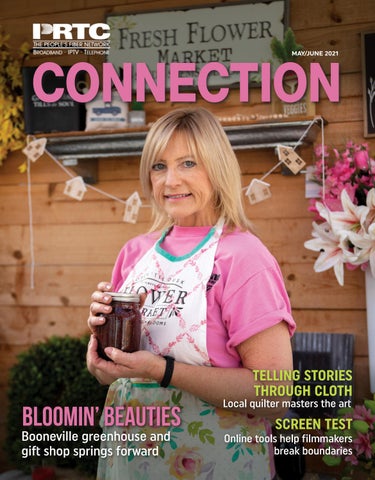
BLOOMIN’ BEAUTIES
Booneville greenhouse and gift shop springs forward
Local quilter masters the art
SCREEN TEST
Online tools help filmmakers break boundaries
INDUSTRY NEWS
Rural Connections By SHIRLEY BLOOMFIELD, CEO NTCA–The Rural Broadband Association
Broadband is critical for working from home
ASCENT — ELEVATE YOUR BUSINESS A free online resource helps female entrepreneurs
N
early all of us have spent at least some time this past year working from home. And while remote work surged during the pandemic, it certainly isn’t a new idea. Between 2005 and 2017, according to Statista, there was a 159% increase in remote work. Today 11.2% of Americans are working from home, up from 5.7% in 2019. And many are growing to prefer it — 22% of workers say they’d like to work from home permanently. I believe full-time remote work makes it difficult to create and maintain a collaborative work culture, but I do think that work is likely to have a new face when we get back to “normal.” The Foundation for Rural Service recently published a white paper entitled “Rural America’s Critical Connections.” (You can download it for free at www.frs.org.) The report cites a Global Workplace Analytics report that states, “Our best estimate is that 25-30% of the workforce will be working from home multiple days a week by the end of 2021.” What does this mean for broadband, that critical connection that helps us work remotely? It certainly means our country needs to continue the work to get broadband to everyone — and that in doing so we must build robust networks using technology proven to support the speeds and synchronous connections that working from home requires. Regardless of the work patterns and flexibility we see in the coming year, one thing is for certain: NTCA members such as your provider will continue to be at the forefront of connecting rural America. 2 | May/June 2021
About 45% of businesses are owned or co-owned by women. Spanning a range of industries, most of these businesses are small with potential for growth. The federal Small Business Association wants to provide support. The free, information-packed online Ascent program offers a range of helpful resources.
TAKE A JOURNEY Experts in women’s entrepreneurship created informational Journeys. Participants can choose any Journey, opting out of sessions with information they already know. Each Journey includes Excursions filled with resources needed to master a topic.
Exercises and tools
Fireside chats
Infographics
Success stories
?
Discussion guides
Videos
Key insights
Self-assessments
DO YOU NEED HELP WITH YOUR BUSINESS? Visit ascent.sba.gov
Secure your Internet of Things
T
he Instant Pot, a pressure cooker, is one of the most popular small kitchen appliances of recent years. Naturally, there’s a model capable of connecting to the internet via Wi-Fi — an example of the Internet of Things, or IoT. Smart thermostats, door locks and security cameras are just a few devices on the IoT spectrum. Refrigerators, toys and a range of whimsical gadgets are all on the bandwagon. And businesses and industry, including agriculture, manufacturing and medicine, take advantage of connected devices. Like the connected Instant Pot, which lets a cook control it via a smartphone app, IoT devices provide convenience, useful data and new ways of using technology. Cisco, a leader in networking systems, estimates that more than 75 billion such devices will be in use by 2025. The utility of what is sometimes described as the fourth industrial revolution is balanced by the need for mindful caution. These devices offer people with bad intent potential doorways into private homes and businesses that use the internet-dependent gadgets. Meanwhile, companies are finding new ways of leveraging these systems. One example is Amazon Sidewalk, which rolled out earlier this year. Here’s how Amazon described the innovation: “Amazon Sidewalk is a shared network that helps devices like Amazon Echo, Ring security cameras, outdoor lights and motion sensors work better at home and beyond the front door.” Essentially, Sidewalk links your Amazon devices to those of your neighbors through a specialized network. Why? Well, imagine your internet goes down while you’re out of town, making your security-focused Ring Doorbell useless. With Sidewalk, however, your internet-connected doorbell would keep right on working, relying on the internet connections of your neighbors to power the system. Everyone on the Sidewalk
system gives up a little bit of their internet bandwidth to this network. Instead of a smart home, Sidewalk can create a smart neighborhood. Amazon released a detailed white paper outlining the system’s security features. And while security experts have been quoted praising the company’s efforts, others have expressed concern about privacy and the potential for hackers to target the system. Amazon Sidewalk can be turned off in the settings section of the company’s smartphone app. As IoT devices proliferate and offer new, practical ways to leverage the power of the internet, knowledge and a few practical security steps can offset possible risks. In the past, the FBI noted the need for IoT caution. “Unsecured devices can allow hackers a path into your router, giving the bad guy access to everything else on your home network that you thought was secure,” Beth Anne Steele wrote for the Portland FBI office.
Security tips for IoT devices • Change the device’s default password. Consider a different device if instructions for changing the password aren’t readily available. • Long passwords — as long as possible — work best. Make them unique to each IoT device. • Many IoT devices connect to smartphone apps. Take a few minutes to understand the permissions granted to these apps. An internet search will help here, too. • If possible, have a separate network for devices, such as an internet-connected refrigerator and a laptop containing sensitive information. • Regularly update the devices, and turn off automatic updates.
May/June 2021 | 3
FROM THE CEO
A legacy of service
Together, we’ve created a foundation for the future
C
onnecting a rural community such as ours to the world has never been easy. Decades ago, crews first strung telephone lines across a landscape that large nationwide companies chose to ignore, deeming the places we call home too rural and unworthy of the effort.
Naturally, we never felt that way. After all, no one understands the importance of our home, and similar places like it, better than we do. The countless hours of work to create that first telephone system proved invaluable, opening new doors for businesses and individuals. All of that effort gave us a foundation for the future. As new technologies appeared, we continued that original commitment to serving you by bringing you those innovations. Today, our internet services rival — often greatly exceed — those found in metropolitan areas. Just as those first crews did when they engineered a telephone system, we’ve built and maintained a robust KEITH GABBARD internet network. Chief Executive Officer The depth of my appreciation for the men and women who make these essential services possible only increases from year to year. No matter the challenge, they adapt and overcome. I’d like to, humbly, suggest you benefit daily from those efforts. Can you imagine not having an option to link a computer or mobile device to the internet? Work, entertainment, medical care, education and more rely on rock-solid service. In just a few decades, we’ve gone from marveling at the idea of being able to speak one-on-one to someone miles away via phone to having a world of information at our fingertips. We’ve never been so connected. In fact, internet services are as essential for many of us as water and electricity. Despite our best efforts, though, no communications and technology company such as ours avoids adversity. It’s how you overcome adversity that matters most. After all, no one escapes the power of nature. This year, we’ve seen ice storms and floods that damaged not only our communications network but also, more importantly, harmed the lives of some of you and your neighbors. No matter the challenge, we’re committed to being there for you. First, we are helpers and friends. Second, we are a reliable utility. Every season of the calendar brings the possibility of an event capable of disrupting our systems. But our team maintains detailed plans to both avoid disruptions and to respond quickly if they do occur. Often long hours of work are required to restore services after an outage. The environment in the field after an event such as a severe storm may be dangerous. Yet, our crews always answer the call. Our office staff willingly puts in long hours to support the efforts. Everyone helps. And they do it gladly, because we understand how much you rely on the services we provide. They’re essential, as is our commitment to you. Our investment in not only expanding our services but also in maintaining existing infrastructure is significant and ongoing. The mission that began with construction of the first telephone lines continues. We believe in you, and our community. We prosper together. Regardless of the challenges, we embrace our commitment to serving you. Everyone at PRTC is proud of our heritage, a sentiment we wish to carry over to future generations that will continue to provide you the communications tools needed to thrive. Thank you for letting us be part of this community.
4 | May/June 2021
CONNECTION MAY/JUNE 2021
VOL. 9, NO. 3
The PRTC Connection is published by Peoples Rural Telephone Cooperative, ©2021. It is distributed without charge to all members of the cooperative.
is your member-owned cooperative serving Jackson and Owsley counties in East Kentucky. The cooperative is dedicated to using technology to keep its members connected through high-speed broadband internet, digital and HD television, wireless 4G phone service, local and long-distance calling and beyond.
Send address corrections to: Peoples Rural Telephone Cooperative P.O. Box 159 McKee, KY 40447 606-287-7101 • 606-593-5000 www.prtcnet.org
BOARD OF DIRECTORS Kendall Norris Vice President Wendell Gabbard Secretary Nelson Bobrowski Treasurer Donald Barrett Armel Davidson Pat Henderson James Gary Cornett
Produced for PRTC by:
On the Cover:
Oneida McIntosh, owner of Shadytown Farm, Greenhouse & Floral Creations went from teacher to entrepreneur with her Booneville shop. See story Page 8.
PRTC NEWS
The speed you need
Your internet connection from PRTC is fast, strong and reliable. However, if you don’t have enough speed for your family’s needs, you may find yourself frustrated by buffering delays, spotty video calls and lagging games. Read on to discover the recommended speeds for typical work, play and rest activities online. (Just remember — if your household uses multiple devices at once, you’ll need to add up the activity happening on every device to determine the total bandwidth you’ll need.)
Work
Working from home doesn’t mean working in isolation. If you collaborate with clients or co-workers on group video calls, you’ll need about 8 Mbps of download speed and 500 Kbps of upload speed for a smooth experience. If you leave for work, you may want a smart security system to protect your home throughout the day. A video doorbell or high-resolution security camera operates best when you have 2 to 2.5 Mbps download and upload speed available for each camera.
Hey
telemarketers:
DO NOT CALL!
It’s easy to add your number to the
Do Not Call Registry. Register online at
www.donotcall.gov or call 888-382-1222. For TTY, call 866-290-4236.
You must call from the telephone number you wish to register.
Peoples Rural Telephone Cooperative
Play
Without adequate bandwidth, online gaming quickly becomes an exercise in frustration. While some gaming platforms list a minimum recommended speed of around 3 Mbps of download speed and 1 Mbps of upload speed, this is truly a minimum recommendation. Many gamers prefer speeds of 15-25 Mbps to ensure minimum lag and seamless gaming experiences.
Rest
Whether you prefer Disney+, Netflix, Apple TV+ or some other streaming video platform, the guidelines are roughly the same. In most cases, 3 to 4 Mbps is recommended for standard-definition video, 5 Mbps for high-definition video and 25 Mbps for Ultra HD (4k) video. These recommendations are always per device, so if you’re streaming on multiple screens throughout the house, don’t forget to add them all up for best results. PRTC offers three options for speeds — 100 MB, 500 MB, or 1 Gig. Once you identify the speed you need, make sure you have PRTC’s best internet package to fit your family’s lifestyle as you work, play and rest online.
We salute you! PRTC offices will close Monday, May 31, in observance of Memorial Day. We are grateful for all of those who served and sacrificed.
Christian Appalachian Project and PRTC provide internet to 41 families Through a donation, the Christian Appalachian Project joined with PRTC to provide free internet through the school year to 41 families with school children. The service helps them attend school online so they won’t miss out on their education during the pandemic.
May/June 2021 | 5
TRAVEL
Marvelous vistas
Rhododendron make summertimes scenic Story by ANNE P. BRALY
C
limb to the top of Roan Mountain, a 5-mile ridgetop along the Appalachian Trail, in the month of June, and something magical happens. The view, normally green with vegetation, turns into a blanket of crimson as the rhododendron opens in full bloom. “The views are spectacular — and that’s an understatement,” says Keith Kelley, ranger for the Cherokee National Forest, Watauga District. It’s this view that people have been traveling to experience for generations, according to Jennifer Bauer. She is the author of three books about Roan Mountain. The most recent is “Roan Mountain: A Passage of Time.” As early as the 1700s, botanists made their way up the mountain range to study
the flora and fauna. In 1794, Andre Micheaux discovered alpine species rarely found outside of the New England and Canadian latitudes. Five years later, John Fraser hiked up the mountain, collecting specimens of rhododendron and noting the existence of the fir tree we now know as the Fraser fir. And yet another early explorer was Elisha Mitchell, for whom Mount Mitchell is named. But it wasn’t until the magnificent Cloudland Hotel opened high atop Roan Mountain that it became known to the general public and word of its rhododendron — the largest proliferation of wild rhododendron in the world — spread across the South and beyond. Today, little remains of the Cloudland other than a forest service marker providing information
Where does Roan Mountain get its name? Some say the name refers to the reddish color of the mountain when rhododendron comes into bloom in early summer or when the mountain ash berries appear in autumn. But, according to the United States Department of Agriculture, there’s another theory. Some say it comes from Daniel Boone’s roan-colored horse, because the man and his horse were frequent visitors to the area.
6 | May/June 2021
about the hotel’s glorious heyday. But people continue to come to see the magnificent gardens tended by Mother Nature. Sometimes too many people, Kelley adds, so he offers a suggestion should you go. “South of Carver’s Gap is an area known as the Rhododendron Gardens, which you can drive to, park and hike from there,” he says. “There is a small user fee you have to pay to enter the area, but it is well worth it. That area is accessed by turning south at Carver’s Gap.” Bauer’s attachment to “The Roan,” as she calls it, began in college when she was a student at East Tennessee State University. Her botany professor introduced her to The Roan, and the rest, as they say, is history. She’s now been with Tennessee State Parks for 38 years, the first 21 of which were spent working as an interpretive ranger at Roan Mountain State Park. The position enabled her to conduct research in an effort to learn more about the natural history of The Roan and its people. Bauer is now the park ranger at Sycamore Shoals State Historic Park in Elizabethton, Tennessee. Roan’s highlands, which reach up to 6,285 feet at its peak, is where you’ll find the Rhododendron Gardens — toward the west end of the highlands at the end of a U.S. Forest Service road that turns off from Carver’s Gap at the North Carolina/ Tennessee state line. “When they are in full bloom, you see a sea of crimson flowers in areas where there are not many spruce and fir trees popping up among them,” Bauer says. “But even with the trees, it’s a beautiful sight. In other areas of the mountain, you’ll walk through areas that are in different stages of transition between balds to forests. In these areas the rhododendron reaches for the sun and blooms among the spruce and firs. All of these unique habitats present a feeling of great beauty and a sense of visiting an enchanted forest.” Any time of year is worth visiting, Kelley notes. “But in June, the rhododendron are in bloom, along with some of the other vegetation, which offers incredible, breathtaking scenery.”
Grow it yourself
Rhododendron grows best in cooler climates and acidic soil — definitely not the hard-packed red clay found throughout the South. There are hybrid varieties, though, that have been developed for the southern garden. But that’s no guarantee they will survive. Rhododendrons do not like high heat and wet soil. However, if you’re willing to try, here are some tips from Southern Living. • Start with heat-tolerant plants. • Pay attention to the soil and have it tested for acidity. Also, plant your rhododendron in an area that drains quickly and contains lots of organic matter, such as chopped dead leaves, cow manure and ground bark. Again, no clay. • If your ground is flat, plant the rhododendron in a raised bed. • Finally, choose a location that is lightly shaded in the afternoon and shielded from strong winds.
Balding
The Appalachian Trail travels along the highest ridges of the Roan Mountain range, which separates Tennessee and North Carolina. A portion of the highlands is a red spruce and Fraser fir forest. Other areas of The Roan are described as “bald” communities. Just as the name implies, balds are areas on mountaintops where the forest ends and thick vegetation of native grasses and/or shrubs begins. One of the most popular areas along the entire Appalachian Trail from Maine to Georgia is the portion that crosses the balds of Roan Mountain, says Jennifer Bauer, former ranger at Roan Mountain State Park and a board member of Friends of Roan Mountain. How the balds developed is anyone’s guess, but scientists now believe they may have formed during the last ice age when constant winds and freezing temperatures caused trees to make a hasty retreat down the mountaintop. Mammoths and other beasts acted as Mother Nature’s personal weed eaters, keeping the balds grazed. Now that the woolly beasts are gone and temperatures have warmed, balds are beginning to grow some “hair.” But Roan Mountain’s balds still shine. Among the most popular are the balds starting at Carver’s Gap and going north.
They are, in order:
• Round Bald • Jane Bald • Grassy Ridge • Yellow Mountain • Little Hump Mountain • Hump Mountain
May/June 2021 | 7
The not-so-secret
GARDEN
Booneville greenhouse business blossoms Story by JEN CALHOUN | Photography by TONYA OLIVER WITH DOWN ABBY ROAD PHOTOGRAPHY
O
neida McIntosh’s greenhouse, a high tunnel that sits next to her home in Owsley County, started out as a place for the retired high school teacher to relax and enjoy her favorite hobby — growing things. When she’d walk into the greenhouse, a sense of peace would take over. A cold day felt 10 or 15 degrees warmer, while a wet day brought the sound of the raindrops hitting the roof. McIntosh loved hearing the wind chimes and smelling the flowers and earth. “It is nothing but therapy to go out to my greenhouse,” she says.
WELCOME, ALL In 2015, she decided it was time to spread the joy. “I thought maybe I should open it up to the public on a seasonal basis,” McIntosh says. “So, I got my flowers ready, and I started that spring. I had planters and hanging baskets, and I just went from there.” For several years, her Shadytown Farm and Greenhouse opened for spring sales only. But McIntosh realized soon enough she could offer more. In February 2019, she started ordering flowers and making Valentine’s Day arrangements and gift baskets. The response was so strong that she turned her eyes toward the next big holiday, Easter. “Now, when I get things ready for the spring plant sales, I also make wreaths, flower arrangements and cemetery saddles,” she says.
IN FULL BLOOM Oneida McIntosh helps her granddaughters, Kori and Kamryn Bowling, with planting. 8 | May/June 2021
Today, the garden center’s name has grown, along with its offerings. Shadytown Farm, Greenhouse & Floral Creations sells everything from puppy and kitten floral arrangements to handcrafted home decor for all seasons. The greenhouse itself Peoples Rural Telephone Cooperative
SHARING THE RICHES McIntosh, a retired teacher, started her greenhouse as a hobby. But over the years, it turned into a nursery and a shop.
transforms into a shop filled with fun, interesting and useful items. McIntosh has also added several Kentucky Proud items — pinto beans from Bowling Green, candles from Berea and organic skincare products from Beattyville, to name a few. Her own homemade jams, jellies and all kinds of breads also sell well. In recent years, McIntosh has taken various classes to hone her crafting skills to create wall art, decorations and floral arrangements. She’ll take specialized orders when she can, and she’ll give pretty much any arts project a shot. “I’ve started making crafts with tobacco sticks, and I’ve learned how to stencil,” she says. “I make different porch signs — the ones that lean against the wall of the porch with greetings and sayings. I make a lot of different crafts. People will send me pictures and ask if I can make something. If it’s in my ability, I’ll make it.” Her Facebook page and word-of-mouth advertising remain her primary marketing tools. She’s found that Facebook mentions tend to double business and bring in new purchases and contacts from the surrounding region. This spring and summer, Peoples Rural Telephone Cooperative
she plans to team up with businesses in the Red River Gorge area for markets and events. She also plans to continue to support and sell items from Kentucky artisans and farmers through the Kentucky Proud and Appalachian Proud organizations, which support the state’s makers and growers.
PAYING IT FORWARD Last year, in October, McIntosh sold pink mums wrapped in ribbon for the first time, with proceeds going to a local cancer care ministry she helped found. The ministry offers gift cards for groceries and gas for use by local breast cancer patients undergoing treatment. She started the mum sales after dealing with her own breast cancer diagnosis last year. A routine mammogram in March 2020 showed cancer, so she underwent treatment and a mastectomy. McIntosh and a fellow survivor started the cancer care ministry at her church to help other people suffering from all types of cancers. “Along with the gift cards, we’ve helped with some other expenses — utilities and bills they might get in a bind with,” she says.
But McIntosh also hopes to pass on the feeling of satisfaction and peace that growing things can bring. She got the gardening bug from her late mother, who had always wanted a greenhouse of her own. She knows how creating and making things grow can fill the soul and bring beauty into the world. She continues to promote raised-bed gardens to her customers who are becoming increasingly interested in the pastime, as well as self-sufficiency. She even passes out seeds or little gifts to the children tagging along with their parents. Gardening has something for everyone, she believes. “Being in my greenhouse is soothing,” McIntosh says. “It’s just mellow, and I love it.”
Fresh TAKE
Shadytown Farm, Greenhouse & Floral Creations is at 195 Shadytown Road in Booneville. The greenhouse and shop offers plants, seeds and floral arrangements, as well as homemade jams and jellies, arts and crafts, and Kentucky Proud items. For more information on operating hours or to see what’s new, visit Shadytown Farm and Greenhouse on Facebook. The Facebook page receives continuous updates and is full of photos and descriptions of the latest items. May/June 2021 | 9
Final cut How the freedom of the internet is transforming filmmaking
S
Story by DREW WOOLLEY
ome filmmakers learn their craft by making home movies in the backyard. Others go to film school. Madelaine Turner likes to say she got her education on YouTube. “That’s essentially where I got my film degree,” she says. “Movies were my first love, but filmmaking wasn’t something I pursued for a long time. Until quarantine started.” At 27 years old, the California native considers herself a senior by the standard of apps like TikTok. Of the app’s 500 million active users, nearly half are estimated to be in their teens and early 20s. Originally, Turner’s quick videos were just a way to stay connected with her younger siblings. But she began to view the platform as a way to genuinely flex her creative muscle after a positive response to her Wes Anderson tribute video, “The Anderson Guide to Surviving a Global Pandemic,” filmed using only objects she had in her apartment.
“It gives you really specific boundaries with the content you’re allowed to create, which is 59 seconds,” she says. “So the challenge and excitement as a storyteller, director and creator is getting your point across and making those 59 seconds really enjoyable for your audience.” Within those confines, Turner has explored her wide-ranging creative interests, from short films paying homage to Jane Austen costume dramas and French heist movies to abstract dream sequences and a cyberpunk take on “The Wizard of Oz.” Each new style gives her a chance to learn more about the filmmaking process both during and after filming. “I’d never really used a green screen or After Effects before,” she says. “Now, taking on a new genre is really exciting because it allows me to push the boundaries of what I know how to do and challenges me to figure out how I can convey this effectively without having a whole production crew.”
Madelaine Turner puts her spin on genres ranging from French heist movies to cyberpunk.
10 | May/June 2021
Her growth as a filmmaker hasn’t gone unnoticed. As a freelance screenwriter, Turner has been able to point to her online portfolio and hundreds of thousands of followers to build connections within the movie industry. And thanks to the algorithms of apps like TikTok, Instagram and YouTube, more people are discovering her work every day. “It allows you to come across content from someone with virtually no following,” Turner says. “And from my perspective, I was putting my stuff out there and very quickly engaging an audience that gave me the permission to go bigger, further and more creative.” That audience is one of the reasons Turner doesn’t expect she’ll ever stop making short-form videos online, even as she pursues her larger filmmaking dreams. The real-time feedback she receives on those platforms has already shaped her as a filmmaker and may come to shape the industry itself. “A traditional filmmaker might go years in between films, whereas on TikTok you get this microenvironment of trying new things and getting that quick feedback,” she says. “So I think I’ve been lucky to hyper-develop my style as a filmmaker because of that feedback loop. Hopefully I can be part of a generation of filmmakers that is able to bridge that gap between the internet and the mainstream.”
Long distance For every film festival that was able to pivot to digital in 2020, there were many more that had to be canceled altogether. With so much of the industry on hold, a team of five cinephiles in Brooklyn started the entirely online Long Distance Film Festival, harnessing the power of broadband to give rural and urban filmmakers around the world an outlet for their creativity. “There was a certain freedom to starting an all-online festival,” says Festival Director Elias ZX. “It was much cheaper than doing it in person. We didn’t sell tickets and had unlimited capacity so friends, family and fans of the filmmakers were able to join from around the globe and watch the festival in its entirety.” To pull it off, the team partnered with the independent Spectacle Theater and Kinoscope to stream its 15 selected short films to hundreds of viewers around the world. Plans for a second edition of the festival are already underway, with submissions open for 2021.
Industry standard
Oxford Film Festival Executive Director Melanie Addington was making last-minute arrangements for the Mississippi-based event when the state’s governor banned gatherings of more than 100 people. Using Eventive’s brand-new online festival platform, she quickly pivoted to take the event virtual. “We were one of the first virtual festivals with Eventive and had to learn a lot very quickly, mostly that a lot of our community doesn’t have good internet access,” she says. “That was restricting in some ways, but it also expanded who could see them to a new audience.” Moving forward, Addington anticipates OFF will have a hybrid format, combining the accessibility of a virtual festival with the in-person experience of a live event. “This will be what we do from here on out,” she says. “Not everyone can travel to Oxford, but they can still take part in the experience. It makes absolute sense for this to become a standard in our industry.”
May/June 2021 | 11
Devonna Hisel became fascinated with sewing and quilting after attending a DIY workshop run by a county extension agency.
Farm Girl Fancies
Jackson County woman falls into the art of quilting
Story by JEN CALHOUN | Photography by TONYA OLIVER, Down Abby Road Photography
A
s a child, Devonna Hisel ran and hid whenever her mother brought out the sewing machine. She refused to learn to sew, even going so far as to take two years of Latin in high school to avoid any type of home economics class. “My mom tried for years to get me to learn sewing,” Hisel says. “I just wouldn’t do it.” But Hisel could not outrun her destiny. She now owns and operates Farm Girl Fancies, a cottage business that makes and sells fiber arts of all kinds, including quilted wall art and quilts of all sizes. Her pieces range from artful quilts that look like prisms of stained glass to traditional wedding and baby quilts. As a University of Kentucky Certified Master Clothing Volunteer, Hisel has extensive training and experience in instructing students of all ages. She even teaches sewing and other elements of quilting with Promise Neighborhood, a federally funded grant that Berea College administers.
12 | May/June 2021
EMERGING ARTIST Hisel, who lives on a farm in Jackson County, says she picked up the sewing bug in 1996 when she saw an ad in a local newspaper from the county’s extension agency. “It was just talking about a workshop at the local library about personalizing your sweatshirts,” she says. “They weren’t even making the sweatshirts — they were just cutting out pieces of fabric and using fabric glue to attach (appliques) to the sweatshirts.” She was fascinated by the idea, and she signed up. Soon, Hisel found a group of women who quilted, and she grew even more interested in the skill and artfulness they used to make something so beautiful out of bits of fabric and thread. “One of the extension agents I knew really liked to sew,” Hisel says. “I found out that UK offers a program called Master Clothing Volunteer training. I got trained and certified, and then I was able to teach sewing and garment making with the extension agencies. I’ve been doing that since 2000.”
For years, she taught sewing skills to students around the region. They learned to make pillows and other basic items. Meanwhile, her own skills continued to improve, and she applied for a position with the Kentucky Arts Council for a role that would send her into schools to teach more students. “I never thought I’d be teaching,” Hisel says. “But it’s been really fun. I love getting to work with kids.” But the Promise program did even more for her. It sent Hisel to a world of the arts that was completely different. “In Berea, I was in this room with all these other artists that I’d heard of — there were woodworkers and all kinds of artisans,” she says. “I didn’t know why I was there, but they kept encouraging me.”
SETTING UP SHOP About 10 years ago, Hisel decided to start a home-based fiber arts business, selling quilted wall hangings and other items. Most of her advertising is through word of mouth or Facebook, and she also hands out business cards. Customers can choose something she’s already made, or they commission pieces with the styles and colors they prefer. “I like the commissioned pieces the best, really,” she says. “I want them to get exactly what they want.” But she also enjoys the stories fiber arts can tell, and she loves the act of making something from no more than an idea and some fabric. “I enjoy getting a pattern, and I like doing my own things sometimes,” Hisel says. “It’s always fun for me to start out with a yard of fabric. I just cut it up and create this whole new thing.”
Peoples Rural Telephone Cooperative
The business remains small, giving her time to work on her own art, teaching and her other pastime — riding and keeping Icelandic horses. These small equines are the only breed of horses in Iceland, a result of strict laws and tradition. Icelandics are known for their gentle temperament and smooth gaits, as well as their bushy manes and relatively short stature. Like sewing and making art, the horse life is a relatively new passion for Hisel. She says she’s always loved animals, but she isn’t sure she had ever ridden a horse before she grew interested in Icelandics. “I don’t know,” Hisel says. “Later in life, good things happen.”
Devonna Hisel creates custom quilts and textile wall art with her business, Farm Girl Fancies.
Farm Girl Fancies on Facebook
Devonna Hisel specializes in quilted wall art pieces, quilts and more through her business, Farm Girl Fancies. She is happy to work on commissioned items, as well. For more information or to learn more about her art, visit the Farm Girl Fancies Facebook page, call 606-438-0307 or send her an email at dhisel@prtcnet.org. When searching on Facebook, there are several sites with similar names. Make sure to click on the one in McKee, Kentucky.
In her spare time, Hisel and her husband enjoy their Icelandic horses. Peoples Rural Telephone Cooperative
May/June 2021 | 13
SOUTHERN KITCHENS
PEA SALAD WITH SMOKED ALMONDS
Perfectly pleasing peas Enjoy a surprisingly flexible legume
I
f you’re denying yourself the simple beauty of peas, it’s time to rethink your weekly menu. Full of healthy benefits and flavor, they should be a part of everyone’s diet. Peas’ nutrition profile includes manganese, protein, fiber, vitamin A and folate, with lots of lesser vitamins to boot. And their neutral flavor allows them to go from smoothies at breakfast to salads for lunch and pot pies for dinner. They’re inexpensive and add a lot of texture and color to any plate. Try tossing them with pasta and a creamy Alfredo sauce. Or use peas as a topping for a baked potato with cheese and sour cream. You can also make an incredible pesto sauce for buttery rounds of crusty bread. Simply add a bag of
14 | May/June 2021
frozen peas to a handful of mint leaves and a half cup of Parmesan cheese, blend them together in a food processor and add olive oil as the machine is running until you get a smooth, thick consistency. If you’re lucky enough to have a garden full of the green pods filled with fresh peas, you’ve done yourself a favor. Just go outside and grab a handful of taste and nutrition. If not, grab a bag of frozen peas — they’re just as good for you. FOOD EDITOR ANNE P. BRALY IS A NATIVE OF CHATTANOOGA, TENNESSEE.
2 (16-ounce) packages frozen peas 6 ounces smoke-flavored almonds, finely chopped 1/2 a sweet onion or more, to taste, finely chopped 1/2 cup mayonnaise (reduced fat OK) 1/2 cup sour cream (light OK) Ground black pepper, to taste 1/2 cup shredded cheddar cheese Place frozen peas in a colander and rinse them under cold water until thawed. Drain and transfer them to a large bowl. Add the almonds and onions. Mix well. Fold mayonnaise, sour cream and black pepper into the pea mixture until evenly coated. Transfer to a serving container and top with shredded cheese. Cover and refrigerate until serving. Before serving, you may want to blend cheese into the mixture, or leave it on top for a prettier presentation.
CREAMY CHICKEN POT PIE
Peas add taste, color and texture to this creamy dish.
GREEN PEA BANANA SMOOTHIE 1/2 cup frozen green peas 1 frozen banana 1 cup spinach 4 mint leaves or more, to taste 1 1/2 cups almond milk 1 tablespoon almond butter, optional Combine all ingredients in a blender. Blend until smooth, about 1 minute. Add more almond milk if needed to achieve your desired consistency.
2 1/2 cups all-purpose flour 1 tablespoon sugar 1 teaspoon salt 1 cup cold unsalted butter, cut into cubes 1/2 cup cold buttermilk 1 or 2 tablespoons cold water 1 large egg, beaten, for the egg wash
Dump the mixture out onto a clean surface and use a rolling pin to roll the butter into thin sheets, combining it with the flour. Use a bench scraper to scrape the rolling pin and to bring the mixture back into a pile as necessary. Continue until all of the butter is incorporated into the flour. The mixture will be very flaky. Return the mixture to the bowl and place it in the freezer for 15 minutes to chill the butter.
For the pot pie filling: 1/4 cup unsalted butter 1/3 cup diced onion 2 medium carrots sliced (about 1 cup) 1 stalk celery sliced (about 1/2 cup) 2 cloves garlic minced 1/3 cup all-purpose flour 1 teaspoon salt 1/2 teaspoon black pepper 1 1/2 teaspoons minced fresh thyme 1 tablespoon minced fresh Italian parsley 1 3/4 cups chicken broth 1/2 cup heavy cream 3 cups shredded chicken or turkey 1 cup frozen peas
Remove from the freezer and add the buttermilk. Use a spoon, and then your hands, to stir the mixture until it comes together into a ball. If the mixture is too dry, add the water a tablespoon at a time. Divide the dough into 2 parts and flatten them into disks. Wrap each disk in plastic wrap and chill in the fridge while you make the filling.
First, make the pie dough. Combine the flour, sugar and salt in a large bowl. Add the cubed butter and toss to coat.
To make the filling, heat the butter over mediumhigh heat in a large skillet. Add the onions, carrots, celery and garlic and cook until tender, stirring occasionally. Whisk in the flour, salt, black pepper, thyme, parsley, chicken broth and heavy cream. Whisk until there are no flour lumps, then simmer over medium-low heat for 10 minutes or until the sauce has thickened. Stir in the shredded chicken or turkey and frozen peas. Remove from heat and set aside. Preheat the oven to 400 F. Remove the pie dough from the refrigerator. On a lightly floured surface, use a rolling pin to roll out the dough into a 12-inch circle. Dough should be about 1/4 inch thick. Transfer the dough to a 9-inch pie pan. Pat with your fingers, making sure it is smooth. Trim the extra overhang of dough with a knife and discard. Pour the filling into the dough-lined pie pan. Roll out the second disk of dough and carefully cover the pie. Trim the extra overhang off the sides. Seal the edges by crimping with a fork or your fingers. With a sharp knife, slice a few small slits in the center of the top crust. Using a pastry brush, brush the crust and edges with a beaten egg. Bake for 45 minutes, or until the crust is golden brown. Cool for 10 minutes, allowing the filling to settle and thicken a bit. Cut into slices and serve. May/June 2021 | 15
Presort STD US Postage PAID Permit #21 Freeport OH
1080 Main St. S. McKee, KY 40447