JANUARY/FEBRUARY 2026
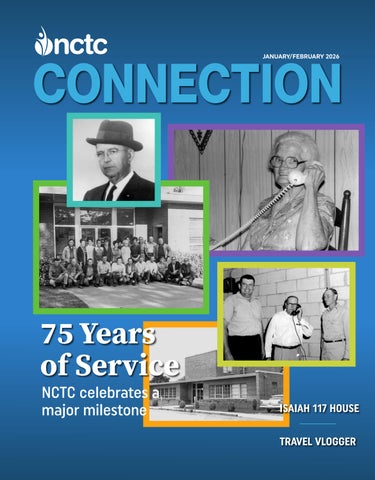
75 Years of Service NCTC celebrates a major milestone
North Central
ISAIAH 117 HOUSE TRAVEL VLOGGER 1
INDUSTRY NEWS
Rural Connections By Shirley Bloomfield, CEO NTCA–The Rural Broadband Association
Protecting the Vulnerable
2
Adobe Stock image by stokkete
T
he internet powers many indispensable resources, including educational opportunities, telehealth, deployment of smart ag tools and the ability to stay in touch with loved ones. However, it is also the most common place for the recruiting and selling of sex-trafficking victims. More than 150,000 new escort ads are posted online in America daily. Seventyfive percent of underaged victims report being sold online, and human trafficking is one of the fastest-growing criminal activities in our country. January is Human Trafficking Awareness Month, and as we raise awareness to combat these crimes, NTCA members, and the association as a whole, are proud to collaborate with Guardian Group and Operation IFAST–ISPs Fight Against Sex Trafficking. It has been beyond gratifying to see the number of NTCA members step up to be the front line of defense with their “boots on the ground” staff. Originating with CLtel in Clear Lake, Iowa, and in coordination with Guardian Group, a team of former intelligence professionals, Operation IFAST works to prevent and disrupt sex trafficking of women and children in the United States. Over 100 companies in 22 states and over 1,400 of their employees participate in the program, which helps educate and train their teams to report potential trafficking situations to local law enforcement or the National Human Trafficking Hotline. NTCA members are committed to helping keep their communities safe and being part of the solution. To learn more about Operation IFAST, visit guardiangroup.org/operation-ifast.
Hard Reset
What to do with old, broken devices
M
any people have outdated or unused electronic devices they aren’t sure what to do with after the holidays. While recycling is good for the environment, many phones and tablets also contain rare materials that are much more useful in another device than sitting in a landfill. Here’s how to dispose of your old devices properly: Phones: Most phone manufacturers will let you trade in your old phone when you buy a new one. But if you still have old devices, retailers like Best Buy, Staples and Home Depot offer in-store drop-off for unused devices. EcoATM also has more than 6,000 kiosks across the country where you get cash for your old phone. Computers: If you can’t upgrade your computer to extend its lifespan, many manufacturers have take-back programs. Barring that, Best Buy has a trade-in calculator for PCs, while Apple offers its own recycling program for Macs. You can also donate your computer to an organization like Computers with Causes that will find students, foster homes or shelters where your computer can make a difference. TVs: Often, finding a new home for your TV is the best option if it still works. Consider Goodwill, schools and libraries. If it’s completely dead, Best Buy has a haul-away service that can send your old TV to one of its recycling partners. Looking for a recycling center near you? Visit earth911.com to find the closest e-waste center.
Adobe Stock image by Miljan Živković
Game On
PRESS START
Growing numbers of seniors are playing video games to stay sharp Story by DREW WOOLLEY
T
oday’s gamers might not fit the picture many people have in their heads. As the generation that grew up with Sega and Nintendo has come of age, the Entertainment Software Association’s 2025 annual study found that the average gamer is 36 years old. The same study found that 28% of gamers in the United States are over the age of 50. “It’s easier to play video games now than at any other time in history. You don’t have to go to an arcade. You don’t have to buy a console or PC, although many players still do,” says Aubrey Quinn, senior vice president of communications and public affairs at the ESA. “Video games can be played anytime, anywhere, with devices almost everyone has on them all the time—smartphones and tablets.” Other than having fun, older gamers say they’re drawn to the pastime because it helps them keep their minds sharp. And, as our world becomes increasingly digital, more people are turning to video games as a way to support their mental, social and emotional health.
IMPROVED COGNITIVE ABILITY While everyone can benefit from enhanced attention, short-term memory
and hand-eye coordination, these can be especially important for seniors looking to keep their minds active. Puzzle games can help improve recall and mental agility, while action and adventure games can encourage problem-solving and support spatial reasoning, particularly those games that require navigating 3D spaces.
SOCIAL CONNECTIONS Over the last decade, social interaction has become an essential part of gaming for many players. Connection with players online or on the couch can help older individuals improve their social relationships and build healthier emotional lives. A comprehensive literature review in the journal Brain Sciences in 2024 found that older people who played games showed a significant improvement in sleep quality and psychiatric symptoms.
BETTER BALANCE AND MOVEMENT As motion controls have become standard for modern gaming consoles, games built around movement have also become more popular. These games provide a fun way for older players to stay active and can improve balance, all in a safe and lowstakes environment.
Haven’t touched a video game since the heyday of arcade cabinets? Don’t worry. It has never been easier to get in the game. One-stop shop—Much like a smartphone, every major console has its own digital storefront with access to thousands of games. Once you’re set up, you can start playing without leaving the house to buy physical games. Play your way—Accessibility for games is at an all-time high. “Aging often includes the need for extra support in games,” says Aubrey Quinn, senior vice president of communications and public affairs for the Entertainment Software Association. “Accessibility features like large text, clear subtitles and chat speech-to-text are making it easier for older players to experience the benefits of play.” Even if players have limited dexterity or mobility, there is a wide array of customized game pads and adaptive joysticks that can help anyone play without frustration. What to play—Aubrey finds that baby boomers and Silent Generation gamers are often drawn to puzzle games like Candy Crush, Wordle and Tetris that are easily available on mobile platforms. A significant portion of those players also enjoy simulation games, action games and shooters. If you’re jumping in for the first time, games like the Portal series and Journey offer engaging problem-solving and exploration at your own pace.
November/December 2025 | 3
FROM THE CEO
JANUARY/FEBRUARY 2026
250 Years of Connections We are stronger together
T
his year, Americans will mark a significant milestone— one worthy of attention and reflection as we celebrate our nation’s 250th birthday. After all, since the signing of the Declaration of Independence in 1776, we’ve come a long way as a country and as a society.
News that once was delivered by horseback and word of mouth comes today through the modern, reliable communications services NCTC provides. The progress achieved by our internet networks over the past five years alone is notable. As NCTC celebrates our 75th anniversary in 2026, we look forward to many more years of providing our rural communities with the latest, highest-quality services that connect them to one another and the world. Early Americans depended on one another in ways that still feel familiar to those of us who live in rural communities. We know JOHNNY when people work together with a shared purpose, we can build MCCLANAHAN something better for the next generation. President/CEO We see it every day when a neighbor steps up to help after an illness or injury, when volunteers combine their talents to put together a fundraiser and when students get online to learn and create from homes once considered too remote for reliable internet. That’s what a community in action looks like. This commitment to serving others is exactly why NCTC exists, and it’s why we’re so proud of what we do. Our broadband network is the modern version of the roads and bridges that tied those early American communities together. Every home we connect, every small business that reaches new customers online and every student who can join a virtual classroom help write the next chapter in our shared story of progress and possibility. I’m especially proud that everyone at NCTC lives right here in the communities we serve. We shop at the same grocery stores, cheer at the same ballgames and enjoy the same local events. When we install a new service or upgrade a connection, it’s not just another job—it’s a continuation of the legacy of neighbors helping neighbors. That sense of shared purpose powered this company from the very beginning, and it still guides everything we do today. It’s why we continue to invest in new technology as we strive to meet today’s needs and prepare for tomorrow’s opportunities. Just as our founders once dreamed of a nation united by shared ideals, our community unites through opportunity and connection. As celebrations begin across the country, I hope we all take a moment to appreciate not just the history behind this milestone, but the everyday work that keeps our communities strong. Because strong connections built this nation. And it’s what will carry us forward for the next 250 years.
VOL. 13, NO 1
The North Central Connection is a bimonthly newsletter published by NCTC, © 2026. It is distributed without charge to all member/ owners of the cooperative.
North Central is a member-owned corporation dedicated to delivering advanced telecommunications technology to the people of Northern Middle Tennessee and Southern Kentucky, including Macon County, Tennessee, and Allen County, Kentucky. NCTC also serves portions of Sumner, Trousdale, Smith and Clay counties in Tennessee. Through a partnership with Warren RECC, NCTC provides high speed internet to portions of Butler, Grayson, Edmonson and Warren counties in Kentucky. North Central 872 Highway 52 Bypass E. P.O. Box 70 Lafayette, TN 37083 Telephone: 615-666-2151 nctc.com
BOARD OF DIRECTORS Randy Harston Chairman of the Board Scottsville Exchange East Kevin Dickerson Vice Chairman of the Board Defeated/Pleasant Shade Exchanges Donnie Steen Secretary/Treasurer Lafayette Exchange East Martha Bowser Westmoreland Exchange Jeff Flippin Lafayette Exchange West Chad Evitts Hillsdale/Green Grove Exchanges Chad Owens Red Boiling Springs Exchange Billy Clay Marsh Scottsville Exchange West Marcell Baker Bethpage/Oak Grove Exchanges Johnny McClanahan President/CEO Guy Holliman General Counsel
Produced for North Central by:
On the Cover: JANUARY/FEBRUARY 2026
75 Years of Service NCTC celebrates a major milestone
ISAIAH 117 HOUSE TRAVEL VLOGGER
North Central
1
NCTC celebrates 75 years of service in 2026. Technology has changed since the cooperative’s founding in 1951, but NCTC’s focus on community remains. See story Page 12.
Photos courtesy of NCTC
2 4
North Central
NCTC NEWS
WHAT IS CPNI? A special notice regarding your account information: NCTC knows the importance of privacy to its members. Federal law requires telecommunications companies to explain the use and disclosure of information gathered during the course of providing service. WHAT KIND OF INFORMATION? Customer Proprietary Network Information, or CPNI, are details like the calling features, options and plans to which you subscribe, billing information and the identity of the long-distance carrier you have chosen. You have the right, and NCTC has the duty under federal law, to preserve the confidentiality of this information. HOW IS THIS INFORMATION USED? We only use CPNI to let you know about changes in services you currently buy from us. With your permission, we may use your CPNI to tell you about other services that may interest you. We will never share your CPNI information with third parties unless required by law. HOW DO I PROTECT MY CPNI? NCTC has tools in place to protect your CPNI information, including passwords.
NCTC COMMUNITY SERVICE AWARD Russell Brown, the 2025 NCTC Community Service Award winner, is a true example of what it means to be community-minded and to live with a servant’s heart. Russell devotes countless hours to serving others—both quietly behind the scenes and through his leadership in the community. He is a deacon at the Lafayette Church of Christ and is always among the first to volunteer his time and talents whenever there’s a need.
Russell Brown is the winner of NCTC’s 2025 Community Service Award for his volunteering and charitable work.
Russell currently serves as president of The Friends of Winding Stairs, where he spends most weekends cleaning and maintaining the trails, greeting visitors from near and far and leading volunteer workdays. A longtime member of the Lafayette Rotary Club, Russell has been instrumental in many of the club’s projects to raise funds for those in need. He was also a founding member and driving force behind Makin’ Macon Fit Fun and Fitness Festival, which served our community for 30 years. His generosity extends beyond organized projects. He donates the use of his building on the Lafayette Public Square for Gallery 102, allowing the Macon County Arts Council to showcase local artists. He also gives freely—and often anonymously— to individuals in need, offering both time and financial support with a humble and giving heart. There are countless people who have benefited from his compassion and generosity. We are proud to honor Russell with NCTC’s Community Service Award. In his honor, we will make a $1,000 donation to The Friends of Winding Stairs. Congratulations, Russell!
NCTC is adamant about protecting the privacy of our members, utilizing password-protected accounts to validate that we are speaking with the person authorized on each account. If you have not set up a password, please call the business office at 615-666-2151.
NEED HELP PAYING FOR SERVICES? Lifeline assistance may be an option for you! To find out if you qualify for Lifeline assistance, please visit lifelinesupport.org or call 800-234-9473.
North Central
MEET NCTC’S BOARD OF DIRECTORS The NCTC Board of Directors includes, from left, President and CEO Johnny McClanahan, legal counsel Guy Holliman, Chad Owens, Donnie Steen, Billy Clay Marsh, Martha Bowser, Kevin Dickerson, Randy Harston, Marcell Baker and Chad Evitts. Not pictured is Jeff Flippin. 35
Discovering Hidden Gems TRAVEL TRAVEL
Travel vlogger highlights off-the-beaten-path destinations Story by KATIE TEEMS NORRIS
G
ems exist in small towns all around you, but you might not know it. Take some time to explore interesting locales within a short drive or take a longer trip to make memories. YouTubers are traversing the country and taking audiences along for the ride—join them in uncovering the magic in places others may overlook.
BUILD THE DREAM “There are so many things around me within driving distance that I had no idea about. And I believe that’s also the same for everybody else,” says Tony Hossri of the YouTube channel Build the Dream. Based in Georgia, Tony films his outdoor explorations and city tours for his vlog, or video blog. With a little research, you can also find beautiful hikes and fun small towns. Tony searches the name of a building or other historic
The South Carolina Lowcountry is a great destination for travelers looking for adventures on the water and culinary experiences. to na pho
akasa
m oto by ock ph obe St
Ad
6
sites on Google when he’s looking for places to experience. He also uses the AllTrails app to find great hiking destinations. See what you can find and start making memories. While visiting Cincinnati, Tony saw around 50 people riding scooters. He joined up with the group on his bicycle. “They got to this random tunnel area where they had this giant scooter trick fest,” he says. While researching online is a good place to start, Tony says, “Let your phone be a tool to give you a better life, not a way to waste your life by endlessly scrolling.” If using distracting apps gets in the way of having new adventures, consider deleting them like Tony did. “Look up a neighboring town, neighboring city, neighboring hike,” Tony recommends. “Do everything you can to get out of the matrix to live a more fulfilling, memorable life.” Visit buildthedreamnow.com and follow Build the Dream on YouTube to start getting ideas for your next adventure.
Nearby Adventures
y of Tony Hoss Photo courtes
ri
Alabama: Monte Sano means “mountain of health” in Spanish. Since the late 1800s, visitors have been coming to Monte Sano State Park in Huntsville for hiking, biking, climbing and bouldering. Go to alapark.com.
Tony Hossri oft
en travels
Heidi, while with his wife,
e Southeast.
s exploring th
he films video
Kentucky: In Corbin, Cumberland Falls, measuring about 68 feet tall and 125 feet wide, earns the title of the Niagara of the South. Go to explorekywildlands.com.
Tennessee: Located three hours east of Nashville, Big South Fork National River and Recreation Area includes 125,000 acres of the Cumberland Plateau. Go to nps.gov.
Travel Safely Did you know posting your vacation on social media can pose a risk to you and your home? Consider waiting to post about your travels until after you’ve returned.
South Carolina: Visit the Lowcountry, the four, southernmost counties in the state, for water-based outdoor adventures. For ideas and destinations, go to southcarolinalowcountry.com. 7
Welcome Home
Isaiah 117 House is a soft place for foster children to land Story by MELANIE JONES
R
emoval day–the day a foster child enters the system–is always traumatic. Authorities take a child away from the only family they have ever known. Even if that family has been neglectful or abusive, the child still faces an unknown future. But there are ways to lessen the trauma. Traditionally, children are taken from their homes to the department of child resources offices, where they are processed and wait
for a foster placement. They may be sitting there all day and sometimes all night. The founders of Isaiah 117 House set out to change that, engaging with communities looking to establish a place of peace for kids entering the foster care system. Sumner County is joining that partnership with construction of its Isaiah 117 House. “We’re looking to reduce trauma for the kiddos on removal day and let them know they are not alone,
that they’re loved and that a community backs them and cares about them,” says Michelle Penick, who is overseeing this stage of Sumner County Isaiah 117 House development.
PROVIDING A HOME Isaiah 117 Houses are designed to make children feel welcome. The houses have bedrooms for children who need to stay overnight. When a child or teen first gets
Many contractors and subcontractors donated their time to build the Isaiah 117 House.
8
North Central
Photos courtesy of Michelle Penick
Organizers and volunteers break ground on the Sumter County Isaiah 117 House late last summer.
there, they can take a hot shower or bath and select new, clean clothes. There are toys and activities for the children and nutritious, homemade meals. Children entering foster care often arrive with just a small sack full of their belongings. Every stitch of clothing, every bottle of shampoo, bar of soap, toy and game the children receive at Isaiah 117 House is donated new. Isaiah 117 Houses don’t give away used supplies. “We believe every child deserves to feel worthy, valued and seen, especially on one of the hardest days of their life,” Michelle says. “That’s why we give them brandnew clothes, not hand-me-downs. New clothes say that you matter. You are not an afterthought. You are loved.” Isaiah 117 House volunteers look to provide a safe, comfortable place for social workers, too. Social workers have office space they can use at Isaiah 117 Houses, and they share the same homemade meals and comfortable environment as the children. “We want to help the caseworkers know that they’re not alone, that they have a really hard job, and we support them and want to help them,” Michelle says.
ONGOING SUPPORT The children don’t leave behind the clothing and other items they received at Isaiah 117 House. They take them North Central
with them when they go home with their foster families. In fact, Isaiah 117 House volunteers do everything they can to help the children along the journey, whether it’s providing new, donated car seats, a new bed, diapers or just a care package. “Taking on kiddos is a big undertaking,” says Michelle, who adopted her foster daughter. “We want to help them get started in any way possible.” Corey and Ronda Paulson established the original Isaiah 117 House after bringing home Isaiah, a foster child they later adopted. Corey says as they began to study the book of Isaiah in the Bible, one verse touched their hearts—Isaiah 1:17 which calls on people to “take up the cause of the fatherless.” So that’s what they set out to do. They started with that one house in 2018 in Carter County, Tennessee. Now, there are about 70 Isaiah 117 Houses in some stage of development in 13 states. Sumner County is one of the latest to join the ranks. The project moved from raising awareness to raising a building. “We have had an excellent response throughout the county,” Michelle says. Businesses, contractors and subcontractors have donated their time, money and supplies to build the house. “Every day, we get news of somebody else that’s wanting to get involved and help,” she says. “We’re
just trying to get the word out as much as possible because there’s still so many in the county that have not heard of it.” To that end, Michelle speaks to civic groups, churches and other organizations. “I’m sharing the mission and ways that people can get involved and help us because we are a nonprofit,” she says. “We have to raise the funds to build the house. We have to raise all the funds to run the house.” Starting an Isaiah 117 House is not a one-and-done endeavor. After the house is built, it takes an army of volunteers to maintain it and work with the children. In-home volunteers who spend time with the children go through background checks and specialized training. “Then they’re put on a schedule, and they’re invited to be there when the guests come in and help love on them,” Michelle says. The Sumner County group already has about 30 volunteers awaiting training. Supplies are another ongoing need. The Isaiah 117 House will need gift cards or in-kind donations to keep it supplied with new clothes, toiletries, toys and other supplies. For more information and details on how you can contribute, go to linktr.ee/isaiah117housesumnercotn.
9
FORGED IN FIRE
Metalworking opens opportunities for rural farriers
Story by DREW WOOLLEY
T
here have always been parts of metalworking that feel a little bit supernatural to Jim Poor. While most of the craft is the product of diligent training and hard work, some elements of working with heat and metal are stubbornly unpredictable and come down to a touch of each smith’s own personal sorcery. “In my world of making tools, lastability is the most important thing,” he says. “There’s a lot of heat treating that goes into tooling, and that’s magical stuff because you can’t see it. You do it, but you can’t really know the results until you send it out to the customer. So, it becomes kind of like black magic.” Jim has been trying to unravel the mysteries of metalworking since he was 12 years old. When he was growing up in Abilene, Texas, his father shod horses on the racetrack circuit, and Jim helped him after school. Once he graduated from high school, Jim found himself shoeing horses after work to make extra cash. It was at one of those jobs that he heard about the Texas Professional Farriers Association. “One of my customers used to read the local news to me while I was shoeing his horses. And one day he read that this group was going to be at the Abilene County Fair shoeing horses for $40,” Jim says. “I was only getting $25, so I thought I should see what these guys were doing.” Meeting other local farriers and blacksmiths opened up new opportunities to turn his side gig into a full-time job, hone his craft and even compete across the globe. “I love competing the most. It’s a small community, but it allowed me to travel all over the world and have so many
10
experiences,” Jim says. “I don’t think anything else I could’ve done with my limited education would allow that.”
HEAT TESTING Despite his years of experience, Jim remembers having plenty of nerves the first time he smithed competitively. It was 1985, three years since he started shoeing professionally, when he decided to take part in an event in his hometown. “I thought it was pretty interesting, but it was scary at the same time,” he says. “There were people there who knew a whole lot more about this craft than I did. I was still pretty young, but I just loved it.” A few months later, Jim joined some of his TPFA colleagues at a competition in Oklahoma, followed shortly by a trip to the nationals in Jackson, Mississippi. Farrier competition is divided into novice, intermediate and open divisions, with competitors earning points based on how well they finish and how many others are in their division. Farriers face off in classes where they have a set time to complete a task. Judges rate their performance. For all his lack of experience, Jim climbed the ranks in short order. After just three competitions, he was already shoeing in the open class. Those competitions quickly became highlights of his year, regularly testing himself against hundreds of other farriers as part of major competitions in Texas, California, Florida and Calgary. At one of those events in California, Jim met Kathleen, the woman who would become his wife. “She can do just about anything, but she does more of the artistic work than I do,” Jim says. “We met each other out there
HAMMER DOWN For anyone looking to build a career as a farrier or blacksmith, Jim Poor’s advice is simple: “Find people who are close by to you, and don’t be a jerk. You’ll get a lot of help.” The easiest way to do that is connecting with a local group. Jim joined the Texas Professional Farriers Association as a young man, while his wife, Kathleen, connected with the Western States Farriers Association early on. If you’re looking for organizations in your state, start here:
Photos courtesy of Danielle Longotano
ALABAMA Alabama Professional Farriers Association President Sam Howard Email: sam.howard18@icloud.com KENTUCKY Derby City Horseshoeing Association President Zeke Evans Email: horseshoes92@gmail.com
Competitors race the clock to get their work ready for judging.
and just became inseparable from that day forward. We dated but could only meet at competitions for several years. Of course, that was another reason to go.”
TOOLS OF THE TRADE Over the course of his competitive career, Jim earned a position on the American Farriers Team nine times, while Kathleen helped establish the first women’s international team, Women Horseshoers of America. After years of traveling the world to compete and teach, they established Flatland Forge in Tuscola, Texas, where they now focus on making farrier tools like tongs, punches and 27 different styles of hammers. “Most people are pretty surprised we produce that many different hammers. But I’ve found out that some people are just collectors,” Jim says. “They may not even use them. They just like the look of them and the craft of them.” In many ways, Jim envies aspiring farriers and blacksmiths today. With the rise of the internet, it is much easier to discover new techniques and learn from the best artisans in the world. Even before the internet, that accessibility was what drew him back to the craft as a young man. But the best advice he can give to anyone forging their path now is the same as it was then.
INDIANA Indiana Farriers Association President Dustin Shuck Email: dustinshuck@yahoo.com Website: indianafarriers.org SOUTH CAROLINA South Carolina Farriers Association President Dusty Newby Email: dustynewby@gmail.com TENNESSEE Rutherford County Blacksmith Association President Matt Clarady Email: rcbablacksmiths@gmail.com Website: rcbablacksmiths.org
“What I’ve always loved most is that blacksmithing is something that you don’t need money to learn. All it takes is effort,” Jim says. “You have to be a self-starter. You’ll work 10 times more hours than somebody with a day job. But all you need to succeed in this craft is a willingness to learn and work.” 11 11
Celebrating 75 Years
Technology changes, but the service mission remains Story by LAURA McGILL
S
eventy-five years ago, NCTC took on the enormous task of providing telephone service to Macon County, Tennessee, and Allen County, Kentucky, as well as portions of Clay, Smith, Sumner and Trousdale counties in Tennessee. The years since have brought more challenges, and NCTC continues to provide the answers while remaining focused on hometown values.
NCTC was founded in March by local people with a mission to improve the quality of life for themselves and their neighbors.
1951
NCTC entered the construction phase to prepare for fiber service. Receiving the $50 million American Recovery Act’s Broadband Stimulus Award in 2010 ensured the NCTC service area would have the most advanced fiber optic network. The Central Office Annex was built to house fiber optic equipment.
2008-12
NCTC members received direct-dial telephone service for the first time.
1953
1969
NCTC began service to Scottsville, KY, and the first telephone was installed in Westmoreland, TN.
Earned NTCA certification as a Gig-Capable Provider, designating it as an internet service provider able to provide Gig-speed service to 95% of one or more of its exchanges.
2015 NCTC earned the designation as a Smart Rural Community. The recognition is given by NTCA–The Rural Broadband Association to local broadband providers that deploy cutting-edge, high-speed, fiber networks.
12
2016
1980S Advanced calling features began rolling out during the late 1980s with touch-tone dialing, caller ID and early versions of the cellular phone.
2017 As part of a USDA Community Connect Grant, NCTC expanded service into northern Trousdale County, the Parker/Thurman area of northern Sumner County and Riddleton/Dixon in Smith County, all in Tennessee, as well as portions of Warren County, Kentucky. North Central
CLOCKWISE FROM LEFT: Locals in front of the Westmoreland office in 1954. NCTC Board of Directors in 1951. The first telephone installed in Westmoreland, TN. Shown L-R: W.R. Bryant, manager; Mrs. Jennie Kirby, customer; Herbert Cutrell, installer; Dewey Draper, trainee; Frances Kennedy, plant supervisor. NCTC employees work in the panel room.
In 2006, NCTC began offering the convenience of online bill payments and introduced local TV programming. In 2007, local programming expanded to channels 6 and 15.
2005 As part of its ongoing commitment to the community, NCTC added a local channel for school events and sports.
NCTC partnered with Warren RECC to deploy fiber internet to an unserved portion of Warren County. The partnership continued into other areas of Warren, Simpson, Grayson, Edmonson and Butler counties in Kentucky.
2019
2022 A new streaming TV service gave subscribers more packages and options while reducing bulky customer equipment.
North Central
2006-07
After years of hard work, NCTC celebrated reaching 100% fiber service in May 2023. The following year, it reached the 30,000-customer milestone, and in April of 2025, NCTC opened the Lovers Lane office in Bowling Green, Kentucky.
2023-25
f NCTC rtesy o
1990S
cou Photos
The ’90s brought more changes with equal access to long-distance carriers and dedicated accounts. NCTC started offering dial-up internet in 1995.
13
SOUTHERN KITCHENS
Beans or no beans, chili always hits the spot
I
s there any food in America that creates more of a stir than chili? It’s certainly a bowlful of contention. If your heart lies in Texas, beans take a hike. Southerners, though, love their beans. In the Midwest, it’s all about comfort with ground beef, tomatoes and beans, or a simple, creamy chicken chili full of flavor. But every bowl of chili, no matter where you live, has one thing in common—each is a serving of comfort that wraps around you like a well-worn blanket.
Food Editor Anne P. Braly is a native of Chattanooga, Tennessee.
Photography by Mark Gilliland Food Styling by Rhonda Gilliland 14
WHITE CHICKEN CHILI Prep time: 20-25 minutes Cook time: 1 hour 4 boneless chicken breasts 1 teaspoon dried basil 1 teaspoon salt 1 teaspoon onion powder 1/2 teaspoon garlic powder 1 teaspoon dried thyme 1 teaspoon dried parsley 1 tablespoon butter 2 tablespoons olive oil 1 large onion, chopped 3 stalks celery, chopped 3/4 cup chopped red bell pepper 2 cans whole green chilies, chopped 3-4 cans cannellini beans, drained and rinsed 2 teaspoons cumin 1 cup sour cream 1/2 cup heavy cream 1/2 cup chopped fresh cilantro 1 cup grated Monterey Jack cheese Additional chicken broth, if needed
In large pot, add chicken breasts and completely cover with water, 4-6 cups. Simmer chicken breasts with basil, salt, onion powder, garlic powder, thyme and parsley until completely cooked. Remove chicken from broth. Reserve the seasoned broth for the chili. Once chicken is cooled, chop and set aside. In a large pot, add butter and olive oil, and saute onion, celery and bell pepper until vegetables are tender. Add chopped chilies and two cans cannellini beans. When mixture is warm, mash beans with a potato masher. Add 2-3 cups of the reserved broth, chicken, cumin and 1-2 more cans cannellini beans. Let simmer 30 minutes to 1 hour. If mixture becomes too thick, add more broth. Add sour cream, heavy cream and fresh cilantro. Stir well. Taste and adjust seasonings. Just before serving, stir in grated cheese and ladle into serving bowls.
TEXAS-STYLE CHILI
Prep time: 45 minutes Cook time: 3-4 hours 1/4 cup ground ancho chile pepper 1 tablespoon ground chipotle chile pepper 2 tablespoons ground cumin 2 teaspoons dried oregano 1 teaspoon ground coriander 1/2 teaspoon cinnamon 1/4 cup cornmeal 1 4-pound beef chuck roast, trimmed of excess fat and cut into 1 1/2-inch cubes 8 slices bacon, cut into 1/4-inch pieces 2 teaspoons salt 2 small yellow onions, large dice 5 garlic cloves, chopped 3 jalapeno chiles, cored, seeded and finely diced 4 cups low-sodium beef broth 2 cups water, plus more for the chili paste and deglazing the pan 1 1/4 cups dark beer 1 cup canned crushed tomatoes 1 tablespoon molasses
2 teaspoons unsweetened cocoa powder 1 cup grated Monterey Jack cheese Additional chicken broth, if needed Mix the chile powders, cumin, oregano, coriander, cinnamon and cornmeal in a small bowl and stir in 1/2 cup water to form a thick paste. Set aside. Season the beef with the salt and set aside. In a Dutch oven, fry bacon over medium heat until the fat renders and the bacon crisps, about 10 minutes. Remove the bacon to a paper towellined plate. Pour all but a few teaspoons of fat from the pot into a small bowl. Set aside. Increase heat to medium high. Sear the meat in three batches in single layers until well browned on one side, adding more of the reserved bacon fat as necessary. Place the seared meat on a plate. Add about 1/4 cup of water to the pot and scrape the bottom with a wooden spoon to release all the flavorful brown bits. Pour the dark liquid over the seared meat.
Reduce heat to medium and add 3 tablespoons of the reserved bacon fat to the pot. Add the onions and cook, stirring frequently, until softened. Add garlic and jalapenos, and cook 2 minutes more. Add the reserved chile paste and saute until fragrant. Add the broth and stir with a whisk until spice mixture is completely dissolved. Again, scrape the bottom of the pot to release any spices. Stir in the water, beer, crushed tomatoes, molasses and cocoa powder. Add reserved bacon and seared beef back to the pot and bring to a boil. Reduce heat to low and cover, leaving the lid just barely ajar. Simmer, stirring occasionally, until the meat is tender and the juices are thickened, 2 1/2 to 3 hours. Taste and adjust seasonings. Ladle the chili into bowls and serve with desired toppings.
TWO-MEAT CHILI
Prep time: 20 minutes Brown meats together in large Cooking time: 1-1 1/2 hours chili pot with onion and green 1 pound ground beef pepper. Drain grease and stir in 1 pound ground pork flour. Add remaining ingredients, 1 onion, diced starting with 1 can tomato sauce. 1 green pepper, diced If it seems too thick, thin it out 1-2 tablespoons flour with more tomato sauce. 2 28-ounce cans Simmer for at least 1 hour. Serve chopped tomatoes with sour cream, corn chips and 1/2 cup chili powder (more or shredded cheese. less, to taste) Salt, to taste Cumin, to taste 1-2 8-ounce cans tomato sauce
15
PRSRT STD U.S. POSTAGE PAID HILLSBORO, OR PERMIT No. 66
P.O. Box 70 Lafayette, TN 37083
No tickets? No problem!
nctc.com
Stream the big game from the best seat in the house.
LAFAYETTE 615-666-2151 14
WESTMORELAND 615-644-6282
SCOTTSVILLE 270-622-7500
BOWLING GREEN 270-936-7444 North Central