6 minute read
ON SOME K- ORESME HYBRID NUMBERS

from published journals
by hrithik sai
Serpil
HALICI1, Elifcan SAYIN2
Advertisement
Pamukkale Uni., Science Fac., Depart. of Math., Denizli, Turkey shalici@pau.edu.tr1, elifcan7898@gmail.com2
Abstract
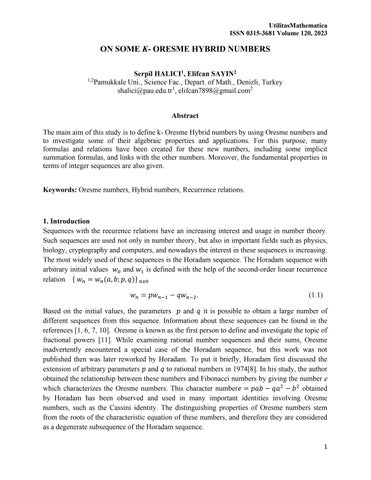
The main aim of this study is to define k- Oresme Hybrid numbers by using Oresme numbers and to investigate some of their algebraic properties and applications. For this purpose, many formulas and relations have been created for these new numbers, including some implicit summation formulas, and links with the other numbers. Moreover, the fundamental properties in terms of integer sequences are also given.
Keywords: Oresme numbers, Hybrid numbers, Recurrence relations.
1. Introduction
Sequences with the recurence relations have an increasing interest and usage in number theory. Such sequences are used not only in number theory, but also in important fields such as physics, biology, cryptography and computers, and nowadays the interest in these sequences is increasing. The most widely used of these sequences is the Horadam sequence. The Horadam sequence with arbitrary initial values ��0 and ��1 is defined with the help of the second-order linear recurrence relation {��
2. (1.1)
Based on the initial values, the parameters �� and �� it is possible to obtain a large number of different sequences from this sequence. Information about these sequences can be found in the references [1, 6, 7, 10]. Oresme is known as the first person to define and investigate the topic of fractional powers [11]. While examining rational number sequences and their sums, Oresme inadvertently encountered a special case of the Horadam sequence, but this work was not published then was later reworked by Horadam. To put it briefly, Horadam first discussed the extension of arbitrary parameters �� and �� to rational numbers in 1974[8]. In his study, the author obtained the relationship between these numbers and Fibonacci numbers by giving the number e which characterizes the Oresme numbers. This character number�� =������ ����2 ��2 obtained by Horadam has been observed and used in many important identities involving Oresme numbers, such as the Cassini identity. The distinguishing properties of Oresme numbers stem from the roots of the characteristic equation of these numbers, and therefore they are considered as a degenerate subsequence of the Horadam sequence.
Oresme sequence, which are obtained by taking the values ��,��,��,�� in the Horadam sequence as 0,1 2,1,1 4, respectively, are found by the second order linear recurrence relation.
Some elements of this sequence are
In [2], Morales investigated Oresme polynomials and their derivatives. He defined the ��- Oresme sequence
, which is a type of generalization of Oresme numbers by
For �� =2, this sequence is reduced to the classical Oresme sequence.
, the Binet's formula, which gives these numbers, can be given by using the recurrence
Also, Morales discussed the matrix forms of Oresme polynomials by extending the k- Oresme sequence to rational functions and investigated the relationships between Oresme polynomials and their derivatives. Recently, there are some studies on Oresme numbers and their applications. For these studies, the references can be examined in [2, 3, 4, 5, 8, 13, 17]. In [4], Halici et al. examined k- Oresme numbers involving negative indices. Recursive relation of this sequence is term of this sequence is
2. �� -ORESME HYBRID NUMBERS
are as in equation
Ozdemir defined a non-commutative number system in 2018 and called it hybrid numbers. The author examined in detail the algebraic and geometrical properties of this new number system, which he described in this study[12]. In 2018, Szynal-Liana introduced Horadam Hybrid numbers and examined their special cases[14]. In 2019, Szynal-Liana considered Fibonacci Hybrid numbers and examined them[15]. In 2019, Szynal-Liana examined Jacobsthal and Jacobsthal-Lucas hybrid numbers[16]. In 2021, Işbilir Z. and Gurses N. examined Pentanacci and Pentanacci Lucas hybrid numbers[9].
Hybrid numbers and Horadam Hybrid numbers, respectively, are defined by
The relations provided between the three different base elements used in the set �� are
The conjugate of any hybrid number �� in the �� set is defined by
This character number is commonly used to determine the generalized norm of a hybrid number. We suggest you look at Ozdemir's work to get detailed and useful information about hybrid numbers [12]. This work has inspired many studies and applications involving these numbers. One of these studies, Oresme Hybrid numbers, was discussed by Syznal et al.(See, [17]). In [17], the authors defined the Oresme Hybrid number for positive number �� as follows.
In addition, the authors introduced the ��-Oresme Hybrid number.
Also, in the same study some basic identities including ��- Oresme Hybrid numbers are given with the help of iterative relation, but other important identities are not given (see, [17]. Thr. 2.4). They also defined Oresme Hybrationals for a nonzero real variable ��.
In this current study, we introduced and investigated ��- Oresme Hybrid numbers ������ (��)in detail by making use of all the studies on rational functions. For �� ≥2, we consider some fundamental and important identities involving the numbers ������ (��) and having applications in the literature. Firstly, we give the Binet formula which provides the derivation of many important equations.
Theorem 1. Binet formula for ��-Oresme Hybrid numbers is
Proof. We use the equality term in this equation. Then, we get
If we also use the equations (1.11), then we obtain which indicates that the proof is complete. of this relation can be seen using the ����ℎ term of the sequence and induction.
In the following theorem, we give the generating function of the sequence involving numbers ������ (��)
Theorem 2. For the numbers ������ (��) , the following equation is satisfied.
Proof. From the definition of the generating function, can be written. If necessary operations are made on the last three equations, then the function
So, by making necessary simplifications and calculations on the last equation, the following equation is obtained which indicates that the desired equality is true. Thus, the proof is completed.
In the following theorem, we give the Cassini identity containing ��- Oresme Hybrid numbers.
Theorem 3. The elements of the sequence satisfy the following identity. then the left-hand side of (1.14) will be as follows.
Here, if we also use the relations between the roots, then we get the desired result. That is, we have
Thus, the theorem is completed.
In the following theorem, we give the Catalan identity provided by the ��- Oresme Hybrid numbers.
Theorem 4. For �� ≥�� and �� ≥2, the following equality is true.
Proof. If we use the Binet formula to write the numbers
, then lefthand side of the equation to be proved is
On the last equation, if necessary simplifications and algebraic operations are completed, then is obtained that the claim is proven.
If we pay attention here, in the situation �� =1 this equation is reduced to the Cassini identity for the ��- Oresme Hybrid numbers.
In the following theorem, we give the d'Ocagne identity, which includes ��- Oresme Hybrid numbers.
Theorem 5. For positive integers ��,�� the following equation is true.
Proof. Let's take the values on the left side of the equation that needs to be proven separately.
Thus, the claim is true.
In the following theorem we give the Honsberger's identity which includes the ��- Oresme Hybrid numbers.
Theorem 6. For positive integers ��,�� the following equation is satisfied.
Proof. To see that the equation in (1.17) is true, we write the value as follows.
Let's see that the values ��1 and are
If we substitute the Binet formula in equation (1.18) and do the necessary operations, then we get the following equation.
From the last equality, we can write
By the aid of (1.19) and (1.20) equations, we obtain
If we substitute these values ��1 and ��2 in the equation (1.18), then we get which is desired result. Thus, the proof is completed. Now, we give a formula that gives the sum of the first �� of the ��- Oresme Hybrid numbers in the theorem below.
Theorem 7. For the ��-Oresme Hybrid numbers, the following equation is satisfied.
Proof. By using Binet's formula, can be written. Also, if the relations between �� and �� are used, then is obtained. Thus, the proof is completed.
In the following theorem, we obtained the formula gives the sum of squares of the ��- Oresme Hybrid numbers.
Theorem 8. The sum of squares of the ��- Oresme Hybrid numbers is
Proof. Let's denote the sum of the squares with the letter T.
For each term, the recurrence relation of the ��- Oresme Hybrid numbers is written and the necessary calculations are made for each, and the following equation is obtained.
Here, let's also use the Cassini identity, that is,
Then, we get
Thus, we obtain
In the following theorem, we give the formula of sums of ��- Oresme Hybrid numbers with even and odd indices terms.
Theorem 9. The sums of ��- Oresme Hybrid numbers with even and odd indices terms are
Proof. i) From the Binet formula of ��- Oresme Hybrid numbers, is obtained. The sum of odd terms of ��- Oresme Hybrid numbers can also be calculated as in the proof of even terms.
Thus, the proof is completed
3. Conclusion
In this study, k- Oresme Hybrid numbers are defined and examined. Some of their algebraic properties and applications are introduced. Some useful sum formulas for these newly defined