HEALTH SCIENCES THE MAGAZINE OF THE UNIVERSITY OF TENNESSEE HEALTH SCIENCES
SUMMER 2026
A Historic Investment
College of Medicine Interdisciplinary Building a Game Changer for Tennessee Page 4
UT HEALTH SCIENCES | SUMMER 2026
1
8
IN THIS ISSUE
8
12
Putting Tennessee First
PA Students Prepare to Fill Health Care Gaps
12
Amplifying Life
ASP Clinic Provides Life-Changing Care
36
Making Seconds Count
44
Fostering Solutions
46
Preserving the Past
36
44
Emergency Pharmacists Play a Critical Role
Center of Excellence Aims to Transform Rural Health
Centuries of History Archived on Campus
All qualified applicants will receive equal consideration for employment and admissions without regard to race, color, religion, sex, marital status, parental status, sexual orientation, gender identity, national origin, disability, age, genetic information, veteran status, or any other characteristic protected by federal or state law. Eligibility and other terms and conditions of employment benefits at The University of Tennessee are governed by laws and regulations of the State of Tennessee, and this non-discrimination statement is intended to be consistent with those laws and regulations. In accordance with the requirements of Title VI of the Civil Rights Act of 1964, Title IX of the Education Amendments of 1972, Section 504 of the Rehabilitation Act of 1973, and the Americans with Disabilities Act of 1990, The University of Tennessee affirmatively states that it does not discriminate on the basis of race, sex, or disability in its education programs and activities, and this policy extends to employment by the University. Inquiries and charges of violation of Title VI (race, color, national origin), Title IX (sex), Section 504 (disability), ADA (disability), Age Discrimination in Employment Act (age), sexual orientation, or veteran status should be directed to the Office of Compliance, 920 Madison Avenue, Suite 825, Memphis, Tennessee 38163, telephone 901.448.7382 (V/TTY available). Requests for accommodation of a disability should be directed to the ADA Coordinator at the Office of Compliance.
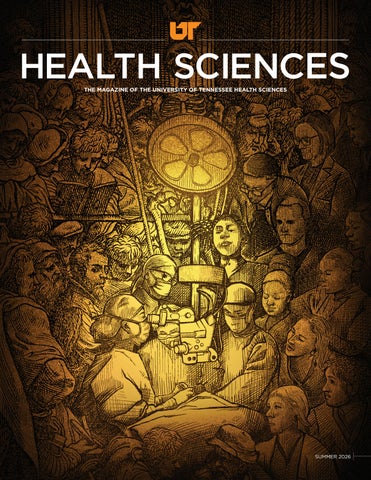
ON THE COVER A trip to our Health Science Historical Collections provided the inspiration for our cover, which artfully illustrates the connection between the past and present in health care. Included in our archives is one of a set of books by Andreas Vesalius on human anatomy published in 1543 entitled, “De Humani Corporis Fabrica Libri Septem” or “On the Fabric of the Human Body in Seven Books.” The depiction of an anatomical dissection inside that ancient tome is reflected in updated form as the cover of our first Health Sciences magazine, designed by Jason Zhang.
We Want to Hear from You! Email your thoughts or suggestions on our Health Sciences magazine to communications@uthsc.edu.
46
Health Sciences magazine is a visual and written representation of our university and its vision to improve the health of all people across Tennessee and beyond through collaborative clinical care, education and training, cuttingedge research, and community outreach across all six colleges working together as one.
UNIVERSITY LEADERS Chancellor Peter Buckley, MD Executive Vice Chancellor and Chief Operating Officer Raaj Kurapati Vice Chancellor, Academic, Faculty, and Student Affairs Cynthia Russell, PhD, RN Vice Chancellor, Strategic Partnerships Paul Wesolowski, MBA Vice Chancellor, Strategic Communications and Marketing Karla Leeper, PhD Vice Chancellor, Research Jessica Snowden, MD Chief Development Officer Melissa Robinson, DHA
COLLEGE LEADERS Dean, College of Dentistry Kenneth Tilashalski, DMD Interim Dean, College of Graduate Health Sciences Jessica Snowden, MD Dean, College of Health Professions Ashley Harkrider, PhD Executive Dean, College of Medicine Michael Hocker, MD, MHS Dean, College of Nursing Wendy Likes, PhD, DNSc, APRN-BC Dean, College of Pharmacy Reginald Frye, PharmD, PhD
From the Chancellor Colleagues, Alumni, and Friends, At UT Health Sciences, our story has never been more compelling — or more important to tell well. Every day, across our six colleges, we are educating the next generation of health care professionals, advancing discovery, and improving the lives of Tennesseans. Central to this work is our shared mission: to create Healthier Tennesseans and Thriving Communities across our state. At its heart, this mission is about connection — connecting education to practice, research to real-world impact, and people to the care and knowledge they need to live healthier lives. That is why we are moving from six separate college magazines to a single, unified university publication. This change is about strengthening the connections that define us. A unified magazine allows us to present a clearer, more cohesive narrative about who we are and what we stand for. It enables us to connect the remarkable work happening across disciplines, highlighting how collaboration fuels our approach to health sciences education, research, and care in the service of improving health outcomes for the people and communities we serve. In today’s environment, where attention is limited and competition for recognition is intense, strong connections are essential. A clear and unified brand helps us connect more effectively with our audiences, students, faculty, alumni, partners, and communities — while ensuring that every story reinforces the broader impact of our university. By telling one story, we elevate the visibility of every college, every program, and every individual who contributes to our mission. Together, we become more than the sum of our parts. We become a connected institution, advancing a shared vision of a healthier Tennessee and stronger, more resilient communities. This new magazine will celebrate the excellence you know so well, while deepening the connections that bind us — across colleges, across disciplines, and across the state. It is an invitation to see our university not as six distinct entities, but as one powerful, purpose-driven institution — working together to create a healthier future for Tennessee. With appreciation,
Editor Peggy Reisser Contributors Nathan Ball Carmin Chambers Lee Ferguson Chris Green Allyson Lawson Aimee McMillin Brianna Peck Peggy Reisser Leigh Ann Roman
Peter Buckley, MD Chancellor The University of Tennessee Health Sciences
Design Adam Gaines Jason Zhang Photography Caleb Jia
UT HEALTH SCIENCES | SUMMER 2026
3
New Building Marks Record Investment for Training Tennessee’s Health Care Workforce By Peggy Reisser
s Memphis campu A model of the ing ild bu w ne e th shows the site of ue between on Madison Aven d the College Pauline Street an ilding. of Pharmacy Bu
“ This is a transformative step for UT Health Sciences, as well as for health and health care of the people of Tennessee.” – Chancellor Peter Buckley, MD
2026 College of Medicine Class President Evan Finder took the long view when he heard that the Tennessee General Assembly had appropriated $311 million for the construction of the new $350 million College of Medicine Interdisciplinary Building. “The new College of Medicine building represents a historic moment not only for the University of Tennessee Health Science Center, but for the great state of Tennessee at large,” Finder said. “Within its halls, the next generation of physicians will have ample space and resources to dedicate years of their lives into the study of the human body and mind. When you and I are in our most challenging moments, we will be able to rest easy, knowing that our doctors trained here.”
4
UT HEALTH SCIENCES | SUMMER 2026
His words reveal the essence of the building. More than bricks and mortar, the building will serve as a hub for training future health care professionals to practice collaborative, state-of-the-art care across Tennessee. The 300,000-square-foot building will be located on the Memphis campus on Madison Avenue, between the College of Pharmacy Building at 881 Madison Ave. and the recently demolished Holiday Inn building at the corner of Madison Avenue and Pauline Street. “This is a transformative step for UT Health Sciences, as well as for health and health care of the people of Tennessee,” Chancellor Peter Buckley, MD, said in mid-April when word came from Nashville that the funding for the building had been approved. “We are grateful to Gov. Bill Lee and the General Assembly for their extraordinary support of our university and our statewide vision of Healthy Tennesseans. Thriving Communities.”
The new building will allow room to expand the medicine class from 175 to 250 per cohort and the Physician Assistant Program from 30 to 60 students per year. Because UT Health Sciences has a statewide footprint, this stands to have a measurable impact on health and health care across Tennessee, which currently ranks near the bottom in overall health outcomes. “This is an investment in continuing to meet the significant deficit in physicians and physician assistants in the state of Tennessee, with projections suggesting that there will be a need for 6,000 additional physicians in the state by 2030,” said Executive Vice Chancellor and Chief Operating Officer Raaj Kurapati, who is leading the project. Additionally, demand is expected to grow for interdisciplinary roles, such as nurse anesthetists by 40% and physician assistants by 28%. New technology will facilitate interdisciplinary training aimed at producing health care providers who are equipped to work together to meet the demands of health care today.
“ Le Bonheur is thrilled to hear about the state’s investment in the University of Tennessee Health Science Center’s new College of Medicine Interdisciplinary Building. As UT Health Sciences’ clinical partner, we see firsthand how this expansion will train more physicians and health care professionals right here in Memphis. The investment will help create a stronger pipeline of skilled providers, who will deliver exceptional, compassionate care to children and families for generations to come.”
While the state has made the lead investment in the building of – Trey Eubanks, MD, President $311 million, the of Le Bonheur Children’s university must Hospital raise an additional $50 million in philanthropic support to bring the project to completion, including $39 million toward the costs of the building and additional funds for specialized equipment and programmatic support.
The building will support telehealth training in multiple fields and increase the use of online educational opportunities for the College of Medicine and other colleges, allowing for eventual increases in the number of academic certificate programs and enrollment in those programs.
A strategic space inventory of the campus was done prior to the initial programming for the building to determine how it could support future needs.
The building is also expected to enhance the university’s already growing response to the rural health care challenges in Tennessee.
In 2025, the state approved the university’s spending up to $10 million to allow for planning and design of the building, which helped keep the project moving and allowed the institution to save about 15 months on the project timeline.
“The University of Tennessee Health Science Center will play a critical role in training the next generation of health care providers for all Tennesseans, and I’m grateful to make this strategic investment in partnership with the General Assembly,” Gov. Lee said. “A new College of Medicine Interdisciplinary Building will increase the number of physicians and health care providers, allowing us to build on our work to improve access to health care statewide, and particularly in rural areas.” As Tennessee’s only statewide, academic health science center, UT Health Sciences trains the health care workforce for Tennessee with campuses at major hospitals in Memphis, Nashville, Knoxville, and Chattanooga. It is expected the new building will enable
“ Over the course of my career as a public servant, I have worked hard to ensure that we make investments that will build a strong Tennessee for generations to come. The investment in a much-needed new College of Medicine Interdisciplinary Building at the UT Health Science Center is just such an investment. This is a generational investment in the health of Tennesseans and our communities all across the state.”
the university to graduate an additional 1,450 health care professionals practicing in various fields over its first five years of operation.
HOK, a global design, architecture, engineering, and planning firm, conducted the inventory and designed the programming for the proposed building.
The university has selected brg3s architects, a Memphis-based firm with a long history in health care, to design the building and work in collaboration with HOK. Once all approvals are received from the state, the aim is to begin construction in late fall 2026. Substantial completion is anticipated in 2029. “I think this is one of those landmark events at a college of medicine,” said UT Health Sciences’ College of Medicine Executive Dean Michael Hocker, MD.
“ Investing in the University of Tennessee Health Science Center College of Medicine is ultimately an investment in the health of our entire region and the city of Memphis from an economic standpoint. Strong partnerships between academic institutions and organizations like West Cancer Center & Research Institute are essential to building a healthier future, and this project is a powerful step in that direction.”
– Mitch Graves, West Cancer Center Chief Executive Officer
– Randy McNally, Speaker of the Senate and Lieutenant Governor of Tennessee UT HEALTH SCIENCES | SUMMER 2026
5
“ This historic capital investment is a true tes tament to the power of collaboration that will help attract some of the best and brightest future healt h care professionals to lea rn and work in the heart of our Me dical District. It will co ntinue to elevate education and innov ation for students an d employees of the Medical District for fut ure generations to co me.” – Rory Thom as, President and CE O of the Memphis Medical District Colla borative
WATCH MORE
6
UT HEALTH SCIENCES | SUMMER 2026
Scan the QR code to hear students’ thoughts on the building.
College of Medicine Interdisciplinary Building
THE NUMBERS $350 million: Public/private funding ($311 million from state and $50 million to be raised through philanthropy)
300,000 Gross square feet 175 to 250 Expansion of annual medicine cohort 30 to 60 Expansion of annual physician assistant cohort
1,450 Additional health care professionals graduate in first five years of operation
16,935 sq. ft. Public spaces (including lobby, wellness/quiet rooms, interdisciplinary health commons, student study rooms, seminar rooms)
38,300 sq. ft. Academic and support spaces (flexible configuration to meet cohort needs)
17,000 sq. ft. Interdisciplinary space (digital health and innovation space, specialty simulation area, external partnership space, health incubator, and technology innovation lab)
TENATIVE TIMELINE Construction starting in fall 2026, completion 2029
ADDITIONAL BUILDING FEATURES • Entry gathering space off Madison Avenue • Interdisciplinary commons area • Rooftop greenspace • Event terrace • Sky cloister • Student gathering spaces Photo illustration on inside cover; by 2029 the College of Medicine Interdisciplinary Building will stand in this space. UT HEALTH SCIENCES | SUMMER 2026
7
A new generation of Physician Assistants trained at UT Health Sciences are heading toward the communities that need them most. By Allyson Lawson
The bus pulled out of Memphis before sunrise. A few students dozed in the early dark, heads tilted toward windows as the highway unspooled west to east. In the quiet, a voice carried from the front. “What are you doing?” Another student had cracked open his notes before dawn. “I mean, I’m not behind,” he says, “but if I’m not ahead, I’m behind.” “If you’re not first, you’re last?” the student up front calls back. “Isn’t that from Talladega Nights?” Laughter rolled down the aisle. When the bus reached Nashville, the large group of tight-knit first-year physician assistant (PA) students from the University of Tennessee Health Sciences were ready to stretch their legs with a walk to the Tennessee State Capitol. They were ready to take in the environment and connect with their legislators face-to-face.
8
UT HEALTH SCIENCES | SUMMER 2026
UT HEALTH SCIENCES | SUMMER 2026
9
During PA Day on the Hill, students spoke with State Senator Paul Rose, who represents the counties of Tipton, Lauderdale, and parts of Shelby.
A Profession Built on Access PAs diagnose illness, develop and manage treatment plans, and often serve as a patient’s principal health care provider. They practice in every medical specialty, and in rural and underserved communities, a PA is frequently the only clinician within 50 miles. Expanding their reach requires more than clinical skill. It requires visibility, and that’s part of what brings UT Health Sciences PA students to Nashville each year. PA Day on the Hill gives them a firsthand look at how health care policy shapes who gets care and where, and it introduces the people writing those policies to the next generation of providers who will deliver it. “The crux of everything is access,” says Assistant Professor Natalie Stafford, PA-C, who teaches the PA profession course and organizes the trip. Stafford is involved with the Tennessee Academy of PAs, the state’s professional organization for PAs, and treats civic engagement as part of the job description from day one. “When you’re in practice for a while, you can get a little pessimistic,” she says. “These students have energy. They care so much about patients having access.” Before her students walked through the legislative corridors, she told them simply, “You’re going to do important things today, and in practice.”
Made for Tennessee, Growing Fast The UT Health Sciences PA program welcomed its first class 12 years ago. Now, each January, it launches a cohort of 30 students, who move through the 24-month curriculum at a demanding pace, blending classroom medicine with early hands-on experience. One of those experiences is a free clinic serving uninsured patients, supported by faculty including Associate Professor Evan Ward, PA-C. Students rotate through the Wellness & Stress Clinic of
Memphis, practicing patient interactions and clinical reasoning where the stakes are genuine. “We don’t get to see what a perfectly healthy person looks like on a test,” says first-year student Hunter Moeschle, who grew up in the Memphis area and attended Mississippi State University. “We get to see real people, people who are navigating a system that hasn’t always made room for them.” By design, UT Health Sciences produces graduates who often practice where the need is highest, and the program’s cost compares favorably to private PA programs nationally, making the profession accessible to students who might otherwise be priced out of it. The forthcoming College of Medicine Interdisciplinary Building will expand simulation and collaborative space alongside nursing, dentistry, and the health professions. It poses a meaningful next chapter for the program’s infrastructure and reach.
Going Home to Pigeon Forge Tanvi Patel grew up in Pigeon Forge, tucked into the mountains of East Tennessee, watching her parents build a life after immigrating from India. They worked two jobs. Her grandmother moved in. By age 10, Patel was navigating medical appointments for her, translating jargon, coordinating care, and advocating for someone who couldn’t necessarily advocate for herself. “I should say it felt like an obligation,” she says, laughing a little. “But I realized I actually enjoyed it. And eventually, I was like, wait, I really enjoy this.” She applied to PA school four times over four years, spending thousands of dollars on application fees and surviving cycles of rejection before UT Health Sciences called. The program director asked whether she had any plans for January. She knew what that meant.
Between applications, Patel worked in general surgery at UT Medical Center during her undergraduate studies at UT Knoxville, graduating in 2021. She then moved to Durham, North Carolina, for a position as a certified nursing assistant at Duke University. From there, she gained experience in pediatric urgent care, dermatology surgery, and oncology and hematology. By the time she arrived in Memphis, her clinical foundation was formidable, and the match felt immediate. “When I got here on campus,” she says, “I just felt like this was home.” For PA Day on the Hill, she met with her home district representative. “It’s about being seen, making sure people know what PAs can do,” she says. “I do want to go back home,” she adds about her post-graduation plans. “Pigeon Forge needs providers who know the community.” Longer term, she sees herself working with nonprofit organizations addressing care gaps in underserved areas, a vision formed partly by visits to India, where she has watched patients wait for hours without knowing what medications they receive or why. “You can be better,” she says. “And if you have a way of doing that, you want to do that.”
The Backbone of Rural Care Hunter Moeschle didn’t necessarily picture himself as a PA. He started at Mississippi State studying kinesiology, considering his mother’s path into physical therapy. As he weighed options, he realized he wanted agency in a patient’s care, immediacy, and flexibility. “What’s really neat about being a PA,” he says, “is you can go anywhere with it. If I want to work in pediatrics for 10 years and then move to a new state and switch specialties, I can adapt to whatever that community needs most.”
PA Progra m Directo r Kristoph Maday, PA er -C, teach es studen in the Ce ts nter for H ealthcare Improvem ent and P atient Simulatio n (CHIPS ) lab.
Adaptability speaks directly to the rural care challenge. Moeschle spent four years in rural Mississippi before UT Health Sciences, shadowing clinicians and watching nurse practitioners serve as the only providers for entire communities.
“A PA isn’t just someone who helps the doctor,” he says. “In a rural community, they’re the backbone of the patient’s access to care.” He discusses trust, the way a small town operates on relationships, and how a PA who shows up consistently, knows patients by name, and manages their conditions, earns something no credential can manufacture. “Once they spend time with us and we build that relationship, that’s where we really shine.”
The Right People in the Right Places College of Medicine Executive Dean Michael Hocker, MD, sees the PA program as central to the university mission and Tennessee’s health care. “The need in this state is not abstract,” Dr. Hocker says. “Our rural communities face real shortages of providers, and our PA graduates can step directly into those gaps. Physicians and PAs working together, that’s what meaningful access to care looks like in practice. This program produces the right people and sends them to the right places, and we intend to keep building on that.” By midday in Nashville, the group had fanned out through Capitol floors and in offices. Some met representatives from rural districts who had never spoken with a PA student before. Others had the chance to explain in person what the profession involves, that a PA diagnoses and treats, manages complex conditions, and serves as a primary care provider in communities a physician may never reach. Professor Stafford watched her students move through these conversations with poise, explaining their stories and the profession to people who maybe hadn’t thought much about it. The bus ride home was quieter. (After the impromptu karaoke session.) Snacks and stories surfaced. A few more students dozed. Some shared study aids created that morning. Throughout Tennessee, communities were waiting for these passengers.
chle le, Hunter Moes pitol in Nashvil n and sio es At the State Ca of pr re tu fu discussed their g. and Tanvi Patel e upon graduatin se es nn Te l ra ru plans to serve
WATCH MORE Scan the QR code to continue the story. UT HEALTH SCIENCES | SUMMER 2026
11
Life, Amplified In the Department of Audiology and Speech Pathology, care, learning, and community come together one patient at a time. By Chris Green
12
UT HEALTH SCIENCES | SUMMER 2026
“ Patients are coming here because there’s a disruption of their daily life, and we’re helping them get back to that.” – Kaitlyn Jones, AuD Student On a recent morning inside the University of Tennessee Health Sciences Audiology and Speech Pathology (ASP) clinic in downtown Knoxville, Rachel Brock sat for a routine appointment she has experienced dozens of times before.
Audiology stud ent Kaitlyn Jones helps Ra chel Brock with programm ing her cochlear implan t.
A clinician adjusted the settings on her cochlear implant, finetuning the device that helps her navigate the world of sound. Nearby, her young daughter stayed close, occasionally drawing her attention. The visit was ordinary, but it reflected something much larger. Brock, from nearby Alcoa, has been coming to this clinic since she was 2 years old. As a child, she had weekly speech pathology sessions, and as she grew up, she visited the clinic regularly for hearing aid adjustments. She received her cochlear implant when she was 28, opening her world even further. “It definitely significantly changed my life,” she said. Many everyday sounds were new to Brock. For the first time, she could clearly hear the crackling of a fizzy soda and the ticking of her car’s turn signal. She also discovered a love for audio entertainment, describing herself as a “podcast junkie.” But beyond these discoveries, her improved hearing changed something many parents take for granted. “My daughter was 2½ when I got implanted, and she talked pretty well at that point, but toddlers were always difficult to understand,” Brock said. “After my implant, I could hear her voice clearly and understand her words so much better.” Now in her early 30s, Brock credits decades of care at the ASP clinic with giving her the confidence to navigate daily life, communicate effectively, and connect with others more easily. Julie Beeler, program liaison for the ASP department, has had a front-row seat to that journey. “When she was very young, I was one of the familiar faces from semester to semester. I was her speech-language pathologist and audiologist,” Beeler said. “I’ve had the opportunity to watch her grow into the wonderful adult she is. There’s nothing more rewarding than that in a field like audiology and speech pathology, to be able to have those longstanding relationships.”
On any given day, Brock’s appointment is just one of many unfolding throughout the recently renovated, state-of-theart clinic that serves patients of all ages and needs. Across the hall, another patient sat for a hearing aid appointment, working with a clinician to refine settings that would bring conversations into sharper focus. Shortly after in a nearby room, a vestibular evaluation was underway to test a patient’s balance and stability, systems often unnoticed until they falter. Each visit is different, but they all share a goal of helping patients better navigate their world. “One of the things that makes our clinic unique is the breadth of services we offer,” said Clinical Professor Steven Doettl, AuD, PhD. “A lot of audiology clinics are focused mostly on hearing and hearing aids, maybe pediatrics as well, but ours is unique in that we offer those services in addition to a very wide variety of specialty services — vestibular services, tinnitus services, auditory processing, auditory electrophysiology, cochlear implants. I think that brings a lot to the education side, so our students get exposure to all these things, but it’s also a big service to the community, because a lot of those services are very needed.”
UT HEALTH SCIENCES | SUMMER 2026
13
Audiology students prepare a patient for testing in the ASP clinic’s vestibular lab.
In the early intervention services space, about a dozen young children moved between toys and activities, guided by speech pathology students and instructors. The group split into smaller sessions for structured activities, like “food fun,” where children practice expressing choices with words or gestures during snack time. The children’s parents and caregivers remained actively engaged throughout the session. “Our early intervention sessions use a caregiver coaching strategy, helping families support their children’s social communication at home,” said Master of Speech-Language Pathology student Leslie Anderson. “Working alongside early interventionists, occupational therapists, and supervisors, I’ve been able to see patients regularly, think on my feet, and adapt therapy to each child. Starting early in my training and working with a wide range of patients has been invaluable for my training and future career.” By starting clinical training early, students like Anderson can witness growth firsthand. She recalled a child who, months earlier, 14
UT HEALTH SCIENCES | SUMMER 2026
struggled to request items or respond to prompts. Weekly sessions improved his self-regulation, enabling him to engage socially. Doctor of Audiology student Kaitlyn Jones described a similar transformation when shifting from classroom concepts to realworld care. “Working directly with patients in audiology has shown me that it’s about the people as much as it is about hearing,” she said. “In class, we learn about the science of hearing, audiograms, hearing aid programming, but in reality, patients are coming here because there’s a disruption of their daily life, and we’re helping them get back to that.” The clinic’s dual role as both a training ground and a community resource is central to its mission. Patients receive consistent, personalized care, often over many years. Students gain experience that prepares them for their future professions. And the surrounding community benefits from access to services that might otherwise be difficult to find.
“Our clinic plays a really big role in the community,” said Emily Noss, clinical associate professor and codirector for clinical education in Speech-Language Pathology. “We have families that drive over an hour from very rural settings to receive services here. We do serve a lot of families that are local to Knoxville, but I think we do make a big, big impact for people in those rural communities as well.”
COLLABORATIVE CARE IN ACTION When young patients come to the Audiology and Speech Pathology clinic, Rachael Roper, clinical instructor and occupational therapist, helps them develop the skills that make communication possible.
For Rachel Brock, the clinic was the starting point of a lifetime of connection, first to care, then to community. Over the years, she has embraced her deafness as part of her identity and turned her experiences into advocacy. “When I went to college, I got to know people who had grown up the same way I did, and that really made a big impact,” she said. “After college, I joined the Hearing Loss Association of America, and eventually I took over the local chapter for a few years with one of my friends. We hosted monthly meetings and helped guide other people through their experiences. It was helpful for them to see that even if you lose your hearing, your life’s not over.” In the rooms of the Audiology and Speech Pathology clinic, whether guiding a child through early intervention, mentoring students, or fostering community advocacy, connections are forged every day. Here, the work is about more than hearing and speech. It’s about helping people connect with each other, with their communities, and with the lives they want to lead.
WATCH MORE Scan the QR code to continue the story.
Roper’s role overlaps with that of speech pathology students and providers, particularly when working with children. “It’s very unique that we get to work together,” Roper said. “A lot of our families will go to a private practice or an outpatient setting to get occupational or physical therapy. Those are typically done separately from speech, so it’s really neat that we’re all able to work together in the same setting toward shared goals.” That collaboration allows the team to address a broader range of patient needs, supporting not only communication, but also the physical and developmental skills that make communication possible.
Speech pathology student Leslie Anderson leads “food fun” with patients and parents in early intervention services.
“You see better outcomes overall because we’re able to work on the child as a whole,” she said. “We’re addressing communication, regulation, and development together, bringing multiple perspectives into the same space.” The interdisciplinary model also benefits the students by mirroring the environment of their future careers. “Anywhere you work, whether it’s with children or adults, you’re going to work on a team,” Roper said. “This gives students that experience early, working alongside different professionals.” Whether helping a child develop feeding skills, improve coordination, or engage more fully in play, this integrated approach reflects the ASP clinic’s broader philosophy that meaningful progress often happens when different areas of expertise come together. UT HEALTH SCIENCES | SUMMER 2026
15
Trauma Care Led by UT Health Sciences Physicians Achieves Highest National Recognition By Chris Green
“ One patient could come in and be cared for by several hundred people during their stay. Ensuring that we’re meeting all the standards for all of those disciplines takes countless hours of behind-thescenes work.” – Dr. Andrew Kerwin
16
UT HEALTH SCIENCES | SUMMER 2026
Andrew Kerwin, MD, often compares a trauma center to a fire department, an essential resource people hope they never need. “Nobody ever gets up in the morning and says, ‘I’m going to slip on the ice while I’m shoveling snow and hit my head,’” he said. “But if that happens, you want to know that the trauma center is there.” Across Tennessee, that readiness is powered by physicians from the University of Tennessee Health Sciences. In Knoxville and Chattanooga, College of Medicine faculty staff the Level 1 trauma centers at UT Medical Center and Erlanger Health. In Nashville, faculty provide emergency care at Ascension Saint Thomas. In Memphis, UT Health Sciences physicians lead trauma care at the Regional One Health Elvis Presley Trauma Center, which has now earned national verification as a Level 1 Trauma Center from the American College of Surgeons (ACS). The designation makes it the only Level 1 adult trauma center within 150 miles and affirms its ability to deliver the most comprehensive trauma care available. “This recognition means that our trauma center stands shoulder to shoulder with the very best in the country,” said Josh Dugal, vice president of trauma and burn services at Regional One Health. “Being part of an ACS-verified Level 1 Trauma Center places us in an elite class of institutions.” Dr. Kerwin serves as medical director of the Elvis Presley Trauma Center and chief of the Division of Trauma/Surgical Critical Care at UT Health Sciences. He and his team began preparing for ACS verification in 2022, culminating in an official site visit last August. The ACS verification process is rigorous, examining everything from emergency response and surgical capabilities to rehabilitation services, education, research, and performance improvement programs. “One patient could come in and be cared for by several hundred people during their stay,” Dr. Kerwin said. “Ensuring that we’re meeting all the standards for all of those disciplines takes countless hours of behind-the-scenes work.” The milestone is personal for Dr. Kerwin, who completed his trauma and surgical critical care fellowship at UT Health Sciences in 1997. He trained under the “pioneers” of the university’s trauma program, particularly Timothy C. Fabian, MD, who launched the trauma program in the 1980s and developed the Elvis Presley Trauma Center. Dr. Kerwin said the Level 1 achievement reflects a broad partnership between Regional One Health and UT Health Sciences. All trauma surgeons at the Elvis Presley Trauma Center hold faculty appointments, and the trauma service is a major training site for surgery residents and fellows. Subspecialty care is also supported by university-affiliated physicians, including orthopedic surgeons from Campbell Clinic, neurosurgeons from Semmes Murphey, and numerous other surgical and medical specialists who hold UT Health Sciences faculty appointments. According to Regional One Health, the trauma center treats about 13,000 patients each year with a 97% survival rate. Level 1 status ensures that a full team of specialists is always ready to care for those patients and their families. “At any moment, there’s a team here — physicians, nurses, therapists, X-ray techs — ready to assess a patient, treat life-threatening problems, and stabilize them,” Dr. Kerwin said. ACS verification must be renewed every three years, ensuring trauma centers maintain the highest standards. For Memphis and communities across Tennessee, that ongoing work means that on the worst day of someone’s life, a highly trained team led by UT Health Sciences physicians is already in place. “We’re always there,” Dr. Kerwin said. “Twenty-four seven.”
UT HEALTH SCIENCES | SUMMER 2026
17
Medicine’s Class of 2026 Brave Tension and Thrill of Match Day By Brianna Peck Fourth-year medical student Avery Dargie had always viewed medicine as something more than a job. That grounding shapes her vision for the future. “It’s something that allows for this beautiful combination of science with teamwork, and this human connection that is so tangible,” she said. For students like Dargie, a pleasant morning in March felt a little different across the University of Tennessee Health Sciences College of Medicine campuses. For 169 fourth-year medical students, it was the day they had been working toward for years. Match Day. Every year on Match Day, medical students across the country open an envelope at the same moment, 11 a.m. central time, to find out where they’ll train as resident physicians. It’s the culmination of four years of medical school, countless hours of clinical rotations, and the deeply personal process of figuring out who you want to become as a doctor. On Friday, March 20, members of the College of Medicine Class of 2026 got their answers. Medical students Kylie and Blake Mastalerz met during orientation at the College of Medicine. “There’s a lot of logistical things with medical school, like how are we going to make this happen? When are we going to make this happen?” Kylie said. “We ended up getting married during the fall of our M3 year. We took our shelf (test) on a Friday and got married the following Sunday. And we had lots of our medical school friends there.” “You never know how the algorithm is going to work or where you’re going to end up,” Blake said of Match Day. “But regardless, we’re going to be excited, because our priority is to be together. UT Health Sciences has set us up for success, and this is just the next chapter we’ll tackle together.” For graduating medical student Sean Acosta, the path to medicine started in nursing school. After initially enrolling in nursing, Acosta went on to pursue his MD degree. As Match Day approached, Acosta, who moved to Memphis from Colombia when he was 13, had one goal in mind: returning to the city that welcomed his family. “Memphis has welcomed me and my family after coming from another country, and they’ve been great to us,” he said in the days leading up to Match Day. “The people, the community, I love it here. I want to stay here for residency. My family’s here, my wife’s family’s here. We want to have kids and raise them here in Memphis. That is the goal.”
“Match Day is one of the most meaningful mornings in medical education,” said Michael Hocker, MD, executive dean of the College of Medicine. “It’s the moment years of hard work finally become real. We are proud to see so many of them carrying the UT Health Sciences mission forward, and we can’t wait to see the care and compassion they’ve developed here shared with patients across the state and beyond. “Our mission matters because Tennessee needs these doctors. From the rural communities where a physician can be the only one for miles, to the busy urban hospitals serving thousands, every new College of Medicine match is a community gaining a caregiver who is trained and committed. UT Health Sciences was built to serve this state, and with every graduating class, that promise is renewed.” Whatever envelope they opened and wherever it’s sending them, the College of Medicine Class of 2026 is ready.
Of the 169 total students on the Memphis, Knoxville, and Chattanooga campuses who matched: • 71 students (42%) matched to residencies in Tennessee. •5 9 students (35%) are staying at UT Health Sciences for residency: o 30 will be in Memphis. o 14 will be in Knoxville. o 7 will be in Nashville. o 5 will be in Chattanooga. o 3 will be in Jackson. • 25 different specialties were matched: o 75 students (44%) matched to primary care specialties. o 44 students (26%) matched to non-primary care specialties. o 48 students (28%) matched to surgical specialties. • 4 students matched to military residency. • 2 students matched to research opportunities.
18
UT HEALTH SCIENCES | SUMMER 2026
Medical student Sean Acosta and his wife were thrilled he matched at UT Health Sciences in Memphis for psychiatry.
UT HEALTH SCIENCES | SUMMER 2026
19
Clinics, including the Union City dental clinic, are a win-win for patients and students. Staffed by final-year dental and dental hygiene students on twoweek rotations and supervised by faculty members, the clinics offer outstanding care to patients who otherwise might not receive care.
20
UT HEALTH SCIENCES | SUMMER 2026
‘Blessing’ Tennesseans with Better Oral Health By Peggy Reisser
Back in 2012, Union City businessman William “Bill” Latimer had an idea that has helped thousands of Tennesseans smile. “Everyone has medical care in the U.S., because they can always go to an emergency room,” he said. “But you don’t have an emergency place for dental care. I knew a lot of people don’t have the money to go to a dentist, and so I thought that it would be a wonderful idea if we could somehow provide dental care for the underprivileged.” Latimer offered the College of Dentistry at UT Health Sciences space in a building he owned adjacent to his office on West Main Street in Union City. The generous offer also included funding for equipment. Latimer’s big idea became the University of Tennessee Union City Dental Clinic, which opened in 2015. Staffed by fourth-year dental students and second-year dental hygiene students on two-week rotations and supervised by a faculty dentist, the clinic has provided dental services to thousands of patients who otherwise might not have had care. That modest facility in West Tennessee has spawned a growing network of dental clinics across the state, all designed to improve the oral health, and in turn, the overall health of countless Tennesseans in need. “None of this would have been possible without Bill Latimer’s vision and generosity,” said College of Dentistry Dean Ken Tilashalski, DMD. “His willingness to invest in our students and in the health of his community created a model that has transformed how we deliver dental care across Tennessee. We are deeply grateful for his leadership and his belief in what this college, and this state, can accomplish together.” For his part, Latimer is humble and matter of fact in his motivation. “God has blessed me tremendously, and I do believe that if he has blessed you, you need to turn around and use his blessings to bless others.”
UT HEALTH SCIENCES | SUMMER 2026
21
an William businessm Union City and er ’s big idea “Bill” Latim ht dental have broug generosity ed. ne usands in care to tho
•T ennessee will be 800-plus dentists short within 10 years, as the older ranks of licensed dentists retire, according to estimates by the American Dental Association.
Filling the Gap Educating and training more dentists for Tennessee is a major component of Healthy Smiles. Healthy Smiles has allowed the College of Dentistry to increase the number of dental students per class to 130, the largest number in approximately 30 years. At the same time, the dental hygiene classes have grown with 96 students annually in two class starts per year. “Expanding dental class sizes helps alleviate access-to-care gaps by increasing the number of new dentists entering the workforce and expanding patient care capacity through the clinical services provided by supervised students during training,” Dean Tilashalski said.
Meeting the Need In 2023, the Tennessee Department of Health and the College of Dentistry embarked on an ambitious multipronged approach for tackling the shortage of dentists in Tennessee and improving health across the state by making dental care more readily available. The Department of Health committed a total of $94 million over five years for its statewide Healthy Smiles Initiative. The College of Dentistry received $53 million of the total and set out to increase access to dentists and dental care across Tennessee. The work continues. Gov. Bill Lee’s latest budget included continued funding for Healthy Smiles. The need is great. • U.S. News & World Report ranks Tennessee 43rd in access to dentists for its citizens and 46th in adult dental visits. • Eighty-six of the state’s 95 counties are partially or fully designated as Dental Health Professional Shortage Areas. Additionally, 26 counties have fewer than 20 dentists per 100,000 people compared to the national average of 60 dentists per 100,000 people. Six counties have no dentists.
From One to Many Another major focus of Healthy Smiles is providing dental care to the underserved, primarily in rural areas, where access to dental care is lacking. This is being accomplished through the expansion of dental student rotations at clinics in areas of greatest need in the state. With the Union City clinic as the model, clinical rotation sites outside Memphis are now located in Bristol, Chattanooga, Crossville, Knoxville, and Kingsport. The latter is the newest, the result of a collaboration with community leaders, businesses, and supporters in Kingsport. These clinics are also supervised by faculty and staffed by final-year dental and dental hygiene students on two-week rotations. It is a win-win formula. Just ask dental student Jake Tomassetti, who was between patients in the Union City clinic on a recent Wednesday afternoon.
“I’ve learned quite a bit,” he said. A few months shy of graduation, Tomassetti was looking forward to being commissioned as a captain in the Army and serving as a dentist. “It’s been great because we’ve been doing a little bit of everything. It’s nice to be able to see multiple patients and do more than we do at the clinic (on campus). We’ve been able to see a patient, see what they need, and treat them as we would if it was our own clinic.” Additional Tennessee clinics are being discussed for Pulaski, Savannah, and Jackson. Healthy Smiles has also allowed for an increase in the Advanced Education in General Dentistry (AEGD) residency programs in Memphis and Nashville. A new AEGD program in Kingsport starts this year, thanks to the collaborative relationship there.
inic’s grand ors from the cl . A pair of sciss e waiting room th n the wall of opening ador
“The UT Health Sciences dental clinic in Kingsport is a truly unique, team-based training site, where College of Dentistry students provide patient care alongside ETSU (East Tennessee State University) dental hygiene students and Northeast State Community College dental assisting students, creating a collaborative, real-world learning environment,” Dean Tilashalski said. “With the addition of an AEGD residency site, Kingsport now offers an even stronger continuum of education and care.” Department of Health Commissioner John Dunn, DVM, PhD, said he is pleased with the progress of Healthy Smiles and what it means for Tennessee. “The feedback from students has been positive. A substantial proportion of students, because of the placements and training and the potential for incentives, are interested in staying in Tennessee and in rural Tennessee.”
One Patient at a Time In Union City, the clinic closes for lunch on weekdays. When it opens again for the afternoon appointments, it doesn’t take long for the room to fill up with patients.
Dr. Ed Reese, a UT Health Sciences alumnus, directs the Union City Clinic. “We do as much as we can to take care of people,” he says.
Marty Reynolds and Stacy Vissering are registered dental assistants, who have worked there since it opened. “It’s good for our community,” Reynolds said. “There are a lot of people in our community who don’t have insurance and don’t have the means to come to the dentist. So, it’s great for that.” Vissering seconded that statement. “It’s helping all the people that need help,” she said. Ed Reese, DDS, is a 1984 graduate of the College of Dentistry and the clinic director. He had spent more than 30 years in private practice before joining the Union City clinic. “We do as much as we can just to take care of people,” he said, between supervising the students and making sure the clinic ran smoothly. “It’s a great service to the community.” UT HEALTH SCIENCES | SUMMER 2026
23
Connecting Resources to Communities
Center of Excellence at UT Health Sciences Fosters Rural Health Care Solutions By Leigh Ann Roman
24
UT HEALTH SCIENCES | SUMMER 2026
“ Whether it is helping strengthen partnerships, connecting communities to resources, sharing best practices, or aligning local efforts with statewide initiatives, the center is here to support communities as they continue building solutions.” – Director Matt McDaniel
Michelle DeBord-Rains grew up in Bledsoe County, where she lives and works as a health services supervisor for Bledsoe County’s Coordinated School Health program. Mountainous and sparsely populated, Bledsoe County is one of the 10 most distressed counties in Tennessee. Home to Fall Creek Falls Mountain and a federal prison, the county has an overall poverty rate of 25% and a child poverty rate of 39%, according to the county data package by the Tennessee Department of Health. “I am very passionate about this district,’’ said DeBord-Rains, a nationally board-certified school nurse. A $227,265 grant from the Tennessee Rural Health Care Center of Excellence at the University of Tennessee Health Sciences will allow DeBord-Rains and other school nurses to continue their vital work of caring for the children of Bledsoe County. Established in 2025 through a $12 million grant from the Tennessee Department of Health, the Center of Excellence has the primary role of distributing and administering grants that support homegrown solutions to health issues specific to rural areas. UT Health Sciences has spearheaded rural health outreach from Knoxville to Memphis in recent years, but the impact is most evident through the Tennessee Rural Health Care Center of Excellence. In its first round of awards totaling $1.75 million, the Center of Excellence announced seven grants that support community efforts to transform rural health. Bledsoe County Schools received one of the first grants awarded by the center. When an earlier grant allowed Bledsoe County to place nurses in each of the schools in 2023 and establish a telehealth program with a consulting physician, DeBord-Rains saw immediate results. Some of them have been lifesaving. One child was found to be in diabetic ketoacidosis and was sent to an emergency room, resulting in an intensive care unit stay in Chattanooga. A school staff member who saw the nurse was also sent to the emergency room and was hospitalized for open heart surgery. Since 2023, school nurses have made 441 medical and mental health referrals and completed more than 5,000 health screenings. The grant covering those salaries ended in May. DeBord-Rains is grateful for the support from the Center of Excellence that will allow school nurses to continue to serve Bledsoe County.
Nurse Practitioner Allison Adams, FNP, talks with a patient during a primary care visit at the Hardeman Community Health Center.
“The school becomes the hub for everything for some of these kids, especially if they are being raised by their extended family members,” she said. Bledsoe County plans to offset expenses through billing for eligible services, aiming for financial sustainability within three years.
UT HEALTH SCIENCES | SUMMER 2026
25
The Tennessee Rural Health Care Center of Excellence sees its role as supporting statewide efforts and broader initiatives to help improve rural health care in Tennessee. “Whether it is helping strengthen partnerships, connecting communities to resources, sharing best practices, or aligning local efforts with statewide initiatives, the center is here to support communities as they continue building solutions,” Director Matt McDaniel said. “We look forward to a healthier future in Tennessee.”
, an uthers, MD Thomas Car ides prenatal ov OB-GYN, pr Hardeman care at the ealth Center. H y it Commun
A New Home for a Free Clinic in Oak Ridge The Free Medical Clinic serving the working poor in Oak Ridge received a $97,500 planning grant from the Center of Excellence. This will pay for plans to transform an old National Guard Armory building donated by the city of Oak Ridge into a full-service health care facility serving Anderson, Campbell, London, Morgan, Rhea, Roane, and Scott counties. Established 15 years ago, the Free Medical Clinic has great community and donor support, but the limitations of its current rented facility prevented a much-needed expansion. “We have a best-in-class team and best-in-class care. What we don’t have is a best-in-class facility. This grant will allow us to design that,” said Billy Edmonds, executive director of the clinic. The clinic provides no-charge care to people who are at 200% of the federal poverty level. Providers had 15,000 patient encounters in the last year. The newly redesigned building will allow the introduction of dental services, as well as significant expansion of existing services, Edmonds said. Mental health care capacity will increase by 500%, vision care capacity will increase by 400%, and primary medical care will increase by 120%.
increase capacity to serve the underserved diabetic population, said Whitney Blankenship, co-owner of Family Care Wellness, Inc. In Warren County, the closest endocrinologist is an hour’s drive away, an insurmountable barrier for many patients. The grant will allow the clinic to hire a full-time dietician who recently attained her certification as a Diabetes Care and Education Specialist to provide consistent care for these patients. Twenty percent of the clinic’s patients are diabetic, but the patients often don’t understand how diet and exercise affect the disease, Blankenship said. “What we struggle with in managing Type 2 diabetes is that they may be on max medication therapies, but then they tell us they had a Honey Bun for breakfast and McDonald’s with a Sun Drop for lunch,” she said. “This will allow us to manage much more complex diabetes patients and to help the patients gain better control and understanding of managing their disease.” The clinic will make the program self-supporting through reimbursement and value-based revenue.
Addressing Addiction in Appalachia and Trauma Care in West Tennessee Two large grants on opposite sides of the state will allow local leaders to get a handle on addiction in Unicoi County and pediatric trauma care in rural West Tennessee. For Lincoln Shelton, the $487,500 grant to Higher Ground Counseling PLLC in Unicoi County means the clinic will be able to establish an intensive outpatient treatment program for juveniles in that East Tennessee community. While opioid overdose rates in Appalachia are twice the national average, access to treatment is below average. Young people who need more than weekly counseling often face a 45- to 90-minute commute, which many cannot manage. The juvenile outpatient treatment program at Higher Ground has the goal of treating 150 people over three years and becoming a self-sustaining program. “I grew up in East Tennessee and was diagnosed as an alcoholic at the age of 14 when I was in the Department of Children’s Services custody,” said Shelton, owner and director of the counseling center. “As someone with lived experience and now a mental health counselor, I am convinced that this is a God-given opportunity for us at Higher Ground Counseling to help make a positive change for our community’s future.”
Providing Care Closer to Home
Bringing Diabetes Care to Warren County
In West Tennessee, an implementation grant will support the establishment of the West Tennessee Pediatric Trauma Network by Le Bonheur Children’s Hospital to serve all 19 rural West Tennessee counties. That region has the highest child fatality rate of any rural area in the state at 80.9 deaths per 100,000 compared to the state average of 62.2 deaths per 100,000.
A $303,465 grant from the Center of Excellence will allow a thriving primary care clinic in McMinnville to build on success and
The West Tennessee network would equip school nurses, emergency professionals, and rural emergency departments with the knowledge,
“It’s a once-in-a-generation project,” he said.
26
UT HEALTH SCIENCES | SUMMER 2026
skills, and connections to deliver lifesaving, child-centered care in their own communities. Treating these injuries locally, when possible, will be a significant help to the families, said Rudy Kink, MD, pediatric emergency physician and medical director of Pedi-Flite pediatric neonatal and pediatric transport. “We unfortunately see that many families may not have a car, may not have the money for gas to get to Le Bonheur,” he said. Education is the first step in the two-year grant to Le Bonheur. “We really have to make sure everybody is comfortable taking care of kids of all shapes and sizes, from crib to college,” Dr. Kink said. “I know our rural medical providers would like to be able to manage some of these patients at home, as well.”
Assessing Underlying Causes of Poor Health Two other planning grants will also serve communities on both sides of the state. The Tennessee Charitable Care Network will use its $48,797 planning grant to work with six community and faith-based clinics to evaluate the feasibility of an expansion of diabetes self-management education and support into rural clinics. This grant involves Bedford, Claiborne, Coffee, Dickson, Grundy, Sevier, and Roane counties. A $97,500 grant will allow the Hardeman County Community Health Center in Bolivar to develop a standardized way to assess social drivers of care that affect patients’ health. Medical Director Judith Tessema, MD, said she sees patients every day who face issues such as food insecurity or transportation problems that affect their overall health. “We really need to assess it better,” she said. “Patients don’t always disclose. They feel like it’s a burden.”
TAKING HEALTH CARE WHERE IT IS NEEDED • The UT Health Sciences Nursing Mobile Health Unit is a fully equipped outpatient clinic led by advanced practice nurses serving Lake and Lauderdale counties. In fiscal year 2025, the mobile unit logged 504 patient encounters and 2,870 touchpoints at community events. The college received a four-year, $3.9 million grant from the Health Resources and Services Administration (HRSA) in 2022 to fund the unit. • A second Nursing Mobile Health Unit, funded through a three-year, $3.6 million grant from the Rural Health Care Resiliency program, will go on the road this year to serve Hardeman, Haywood, and Dyer counties. • The UT Chattanooga Mobile Medical Outreach Clinic (Mobile MOC), which launched in 2025, is a medically outfitted van that expands health care access for older adults and caregivers in rural Southeast Tennessee. James Haynes, MD, dean of the UT Health Sciences College of Medicine – Chattanooga, was its first medical director. Sara Conway, MD, assistant professor for the Department of Family Medicine, is its current medical director. • The College of Pharmacy’s Rural Health Certificate program enrolls students to prepare pharmacists for rural practice. This year, 48 students were enrolled, with 11 graduating in May. • The Tennessee Population Health Consortium is extending its innovative Neighborhood Health Hub Program into rural Hardin and Decatur counties, providing essential health screening and coaching for obesity, hypertension, and diabetes with the support of the Tennessee Department of Health and its Health Care Resiliency Program.
The mobile units operated by the College of Nursing at UT Health Sciences provide education, cancer screening, and primary health care in underserved areas of Tennessee. UT HEALTH SCIENCES | SUMMER 2026
27
Driven by Curiosity Prestigious Fellowship Helps PhD Student Thrive By Chris Green
“I’ve always been fascinated by the brain and how it shapes who we are.” That curiosity has guided Kelsey Glasper to national recognition as she works toward her PhD in neuroscience at the University of Tennessee Health Sciences. Glasper is the first UT Health Sciences student to be selected by the National Science Foundation (NSF) for its Graduate Research Fellowship Program (GRFP), one of the most competitive honors for early-career scientists. The five-year fellowship provides financial support and access to professional development opportunities, allowing Glasper to deepen her research and expand her impact in the field. The fellowship is awarded to exceptional graduate students in their first or second year of research-based master’s and doctoral programs. “Knowing that only about 14% of over 14,000 applicants receive the award each year, it felt surreal to realize I was part of such a selective group,” Glasper said. “It was a rigorous process, but it allowed me to sharpen my research ideas and clarify my long-term vision as a scientist.” Glasper is originally from the Memphis and North Mississippi area and a graduate of Rhodes College. She works with her mentor Max Fletcher, PhD, professor and vice chair of the Department of Anatomy and Neurobiology, in studying how the brain encodes sensory information, which is fundamental to understanding perception and cognition. “I am interested in cholinergic signaling within the olfactory system, with a focus on the horizontal limb of the diagonal band (HDB). This region is key to modulating attention and sensory processing, and studying it allows me to explore how neural circuits influence behavior at both basic and complex levels,” she said. “I was particularly drawn to studying cholinergic systems because of their fundamental role in attention, memory, and learning.” Glasper is drawn to this area of research because of the potential for discovery and its interdisciplinary nature. Her work integrates behavioral analysis, advanced imaging techniques, and robust data analytics, which she said keeps things both challenging and rewarding. She recently presented her research at the Association for Chemoreceptive Sciences (AChemS) conference in St. Petersburg, Florida. According to Glasper, the GRFP will help her become a better student and researcher. She said it provides
28
UT HEALTH SCIENCES | SUMMER 2026
financial security so she can dedicate more time to developing her projects without the stress of securing external funding or balancing multiple responsibilities, allowing her to take on more ambitious research questions and explore creative approaches that may not have been possible otherwise. “Being recognized by the NSF not only validates my work but also enhances my credibility as I move forward in the scientific community,” she said. “This award strengthens my ability to contribute to meaningful advancements in the field and helps me build the skills and connections I need to succeed both in academia and beyond.” Glasper plans to graduate next summer and hopes to pursue a career in academia, with an emphasis on teaching, mentorship, and student development. That goal was reinforced last fall when she taught a cognitive neuroscience course as an adjunct professor at Christian Brothers University. “I am particularly passionate about investing in the Memphis community through higher education,” she said, “providing mentorship, tutoring, and guidance to help students access and navigate opportunities in science that may not have always felt within reach.”
Why Make an Annual Gift to UT Health Sciences?
Donating to UT Health Sciences every year helps us provide scholarships, laboratory equipment, travel grants, community outreach initiatives, and many other benefits to our faculty and students that would not be available using state or tuition-provided dollars alone. Thank you for being a partner across our campuses, our colleges, and our programs. Your gift of any amount will make a difference. Donate $100 or more and become a member of our 1911 Society! For details, visit giving.uthsc.edu
Make your gift today! giving.uthsc.edu | 901.448.5516 The University of Tennessee Foundation, Inc. is the preferred channel for all private contributions that benefit students and faculty within the UT System.
There is a version of the artificial intelligence story that everyone has heard by now: the billion-dollar campuses, the coastal cities competing for the next great tech company. Memphis, Tennessee, does not fit that story. And that, it turns out, may be precisely the point. The University of Tennessee Health Sciences’ achievement of R1 research status in 2025, the highest Carnegie classification for research universities, placed Memphis in the company of only nine U.S. metropolitan
some, something awe g in o d is is h p m “ Me g it together.” and we’re doin den, MD – Jessica Snow
30
UT HEALTH SCIENCES | SUMMER 2026
areas that are home to two top-tier research institutions. That distinction has quietly changed the city’s conversation with the technology industry. When AI companies and investment groups evaluate sites, they are increasingly looking for academic partners capable of doing something with the infrastructure they build. Memphis can make that case.
“Groups are intentionally looking at Memphis because it has two R1 universities,” says Jessica Snowden, MD, vice chancellor for research at UT Health Sciences. “They want to partner with academic groups to come up with cutting-edge use cases for AI, new ways to approach how we do AI.” The regional momentum is real. AI company xAI moved into the city. Google began building a major data facility across the river in Arkansas. Investment groups have explored constructing multi-use facilities here anchored by data center access. Troy Parkes, SVP of Global Business Development for the Memphis Chamber of Commerce, who led the effort to recruit xAI and continues to drive AI company development for the region, describes a city whose underlying assets, such as extensive fiber infrastructure, competitive land, and business-friendly environment, are finally getting the attention they deserve. “xAI has put us on the map in terms of what we did and how we did it,” he says. “Now we’re getting great calls from other companies. It’s a moment for Memphis.” For Dr. Snowden, the outside attention has illuminated something equally important: the depth of AI work already happening on her own campus. “My favorite thing about all of this,” she says, “was learning what our researchers are already doing in this space. It has a lot of fingerprints across our campus.”
UT HEALTH SCIENCES | SUMMER 2026
31
Already at Work: AI Inside Memphis Medicine Before any new data centers are built or consortia finalized, artificial intelligence is already reshaping research and patient care at UT Health Sciences in ways that are as practical as they are consequential. They also stand to improve the health of people across Tennessee and beyond. In the Department of Genetics, Genomics, and Informatics, researchers are using large language models as well as agents and code of their own design to analyze genomic and health care datasets at a scale hard to imagine even four years ago. They are often hunting for causes of human disease and aging, and more individualized diagnostics that might enable earlier treatment. Work that once required years can now unfold in weeks. The implications reach beyond the lab bench and into the classroom. Erik Garrison, PhD, whose work in the department has used AI extensively in recent research on the human pangenome, describes a fundamental shift in how the next generation of scientists is being trained. The traditional barrier between students with engineering backgrounds and those without is dissolving. Anyone who can understand their work and explain it clearly to an AI can now make progress on problems that once required deep coding expertise. Projects that seemed like they should take months are getting done in hours. “The cost of creation is going to zero,” Dr. Garrison says, “and we are learning where the human researcher fits in a future hybrid research organization where most participants are driven by artificial, commoditized, intelligence.” Across campus, in the Department of Radiation Oncology, a group led by researcher and Department Chair David Schwartz, MD, is tackling a problem that sounds logistical but carries life-or-death stakes: getting cancer patients to their radiation appointments on time. Even brief interruptions in a treatment course can significantly worsen survival outcomes, and transportation barriers, scheduling confusion, and communication failures stand between many vulnerable patients and the care they need. The team is training an AI system, a virtual patient-care representative, to guide patients through reminders, navigation, and scheduling support to prevent missed treatments. The project, known as ENRICH (Equitable Needs-Based Radiotherapy Interruption Care for Health), integrates clinical data, patient-reported distress, and social context to identify who is at risk and why. “We’re not just predicting risk; we’re translating it into action,” says Arash Shaban-Nejad, PhD, MPH, associate professor in the Department of Pediatrics and the Center for Biomedical Informatics, and director of Population and Precision Health, who leads the project’s AI strategy. “It’s not one factor; it’s the interaction of clinical, psychological, and real-world barriers.”
“If patients get to radiation faster, their outcomes are better,” Dr. Snowden says. “AI lets us intervene in ways that directly affect survival.”
From Drug Discovery to Digital Twins Inside the College of Pharmacy, AI is compressing one of medicine’s most expensive timelines. Drug discovery traditionally means testing thousands of molecular compounds, a process measured in years. AI systems can now predict which compounds are most likely to succeed before a single lab test is run, cutting weeks or months from the pipeline. Santosh Kumar, PhD, vice chair of the Department of Pharmaceutical Sciences and assistant dean of the College of Pharmacy, uses AI to model how drugs move through bodies that differ by race, geography, and sex, which are variables that determine whether a drug heals or harms. “Drug toxicity, drug interaction, and adverse drug reactions cause over 100,000 deaths in the U.S. every year and cost over $300 billion,” he says. “AI can improve that process, and that saves lives.” Looking further ahead, Dr. Snowden describes an ambition that sounds like science fiction but is becoming scientifically serious: the digital twin, a virtual replicate of a biological system that evolves in real time. A computational model of a tumor, a brain, or a patient’s immune response that can be tested and manipulated without touching a human body. “There are ethical limits to what we can do in human research,” she says. “This gives us the ability to answer questions in ways we currently can’t.”
Collaboration Over Competition Last December, leaders from UT Health Sciences, the University of Memphis, the University of Arkansas, and the University of Mississippi convened what is now officially named the MidSouth AI Research Consortium. The agenda spans cancer outcomes, public health disparities, and logistics systems, challenges shared across a region where Memphis moves the world’s freight, and Northwest Arkansas is home to JB Hunt, one of the country’s largest trucking companies. Dr. Snowden is candid about the difficulty. Academic institutions are, by culture and incentive, competitive. “It’s really easy to talk about things we want to do together,” she says. “It’s a whole lot harder to actually do them.” The collaborative is starting with demonstration projects designed to surface the real barriers, such as shared credit, data agreements, and institutional logistics, and build a framework for working together that could outlast any single AI initiative. “The more we can publicly say that’s what we’re going to do, and we’re going to do it differently from how we have before, the more we hold ourselves accountable to that,” she says.
Memphis, Reimagined Dr. Snowden heard a line at one of the planning meetings that has stayed with her: “AI is in everybody’s strategic plan, but nobody actually knows what they’re going to do with it yet.” The institutions that move from plan to practice will define what AI in health science actually looks like. UT Health Sciences intends to be among them, recruiting faculty in AI and cancer, AI and infectious disease, AI and neuroscience, and offering something that Boston and San Francisco cannot: serious scientific infrastructure in a city that is, as Dr. Snowden puts it, “really cheap and fun to live in.” The transformation extends into the classroom. Students arriving at UT Health Sciences today have grown up with AI tools and expect to be trained on them as a matter of course. The educational challenge has shifted from introducing students to new technology to teaching them how to use it wisely and critically. Across every college on campus, deans are grappling with the same question: how to prepare graduates for a clinical world reshaped by algorithms. “We need to teach people using AI tools and how to use AI tools,” Dr. Snowden says, “not just at the level of, here’s how to use ChatGPT to make a figure, but how to answer sophisticated questions about health science outcomes.” The vision is that UT Health Sciences graduates carry that capability with them wherever they practice, extending Memphis’s scientific influence through each graduate who enters the field. The broader stakes are human. AI investment in Memphis carries the potential to create higher-paying, higher-skill jobs for people who grew up here, but only if the training pipeline reaches everyone. “We want to make sure that everybody in our area is getting access to the training and opportunity they’re going to need,” Dr. Snowden says. One more thing she wants said plainly: this is happening in Memphis, and the benefits will resonate far and wide. Memphis has two R1 universities, a growing biotech sector, deep clinical partnerships, and researchers already doing serious AI work in genomics, cancer care, drug discovery, and precision medicine. Parkes puts it with the confidence of someone who has spent the last several years proving it: “People are starting to realize we’re the Digital Delta. Talent should reside here. Enterprise should continue to come and expand and grow here.” “Memphis is doing something awesome,” Dr. Snowden says. “And we’re doing it together.” If that vision holds, the city better known for blues music and cargo planes may earn a new and lasting identity: the place where the future of medicine was written, one algorithm at a time.
UT HEALTH SCIENCES | SUMMER 2026
33
A Legacy of Care Alumnus Dr. Mitch Godat’s Mission of Mercy By Carmin Chambers
What began as a simple idea to provide free dental care for people in need has grown into one of the most impactful community health efforts in the Mid-South region. For Mitch Godat, DDS, a graduate of the University of Tennessee Health Sciences College of Dentistry, the 10th annual Mid-South Mission of Mercy, held in February at Bellevue Baptist Church in Memphis, represented the vision created years ago with a single trip to Arkansas. After witnessing the impact of the Mission of Mercy clinic there, Dr. Godat and a group of colleagues returned to Memphis inspired to bring it home. The idea had been planted, but it would take collaboration to make it possible. In 2016, while serving as president of the Memphis Dental Society, Dr. Godat worked alongside fellow leaders, classmates, and mentors to establish the Mid-South Mission of Mercy. With the support of his mentor, Charles “Chuck” Woods, DDS, and a committed team, the vision began to take shape. In the early years, when the journey was complex and uncertainty was inevitable, Dr. Woods reminded the team that even if they helped just one patient and made a meaningful difference in that person’s life, then they were doing the right thing. That philosophy continues to shape the clinic’s purpose today. This year alone, more than 100 volunteers from the College of Dentistry, including faculty, staff, and dental and dental hygiene students, joined over 1,000 community volunteers to provide care to 1,686 patients, totaling nearly $1.75 million in free dental services to underserved and underinsured Mid-South residents. Among those receiving care was Thomas Knighten, who returned for a second year to continue treatment. After receiving a cleaning in preparation for fillings the following day, he described the experience as both professional and meaningful. “The experience was really comfortable; my doctor did a wonderful job,” Knighten said. “It’s amazing to see hundreds of volunteers take time to help others like us and do it for free. I thank them.”
Though often recognized as one of the founding leaders of the Mid-South Mission of Mercy, Dr. Godat is quick to credit the team that continues to bring the event to life. Each year, there’s one moment he looks forward to most. He steps upstairs, overlooking the gymnasium floor, and pauses. “I look down from upstairs and see everything going on,” Dr. Godat said. “You see hundreds of people helping and serving. Dentistry brought all kinds of people together for something greater.” As the event continues to evolve, so does its reach, drawing more people into a shared commitment to care. For Dr. Godat, the growth remains humbling. “When I think about how far Mission of Mercy has come, I’m most proud of how it has brought the community together through dentistry,” he said. “I never imagined we would have so many volunteers coming back year after year.” As the final patients were treated and equipment carefully packed away, the pace slowed but the impact lingered. Students completed cases under the guidance of faculty and alumni, many participating in the very clinic Dr. Godat and his colleagues helped build from the ground up. A decade after that initial trip to Arkansas, the Mid-South Mission of Mercy stands as a testament to what can happen when UT Health Sciences alumni return not only to serve but also to build alongside their community. For the College of Dentistry, it’s a powerful reminder that its greatest impact often extends far beyond campus, reflected in graduates like Dr. Godat and others who remain committed to community, service, and smiles. “The outcome is powerful,” Dr. Godat said, “and that keeps me going.”
For volunteers like dental hygiene student Anna Brown, the clinic offers more than clinical experience. “Volunteering at Mission of Mercy means so much to me, because it allows me to use my skills to serve those who might otherwise go without care,” Brown said. “Oral health is deeply connected to overall health, confidence, and quality of life. I’m grateful to play a part in restoring comfort and dignity to people in need.”
34
UT HEALTH SCIENCES | SUMMER 2026
WATCH MORE Scan the QR code to continue the story.
More than 100 volun teers from Dentistry the Colleg provided e of care at th is year’s e vent.
“ When I think about how far Mission of Mercy has come, I’m most proud of how it has brought the community together through dentistry.” – Dr. Mitch Godat
CIENCES | SUMMER 2026
35
Behind Tennessee’s Emergency Teams UT Health Sciences Pharmacists Save Lives When Every Second Counts By Nathan Ball
36
UT HEALTH SCIENCES | SUMMER 2026
“ If we’re doing our job right, no one notices, but the patient survives.” – Patrick Blankenship, PharmD Seconds can mean the difference between life and death in the emergency room. As the trauma bay erupts into motion, emergency medical services (EMS) rushes through the doors, nurses scramble to assist, and physicians rapidly assess a patient who may be unconscious, unstable, or unidentified. Alongside these clinicians stands another vital team member: the emergency department pharmacist. Before the first medication is administered, the pharmacist has already reviewed EMS information, prepared lifesaving medications, and anticipated the next interventions. Across Tennessee, it’s likely a pharmacist trained by the University of Tennessee Health Sciences College of Pharmacy is the one standing alongside emergency teams. With a statewide rotation network, faculty embedded in major trauma centers, and emergency medicine coursework, UT Health Sciences’ role is clear. It trains the pharmacists emergency departments depend on when lives are at stake.
Misconceptions and Reality In popular culture, medical dramas like ER or The Pitt often overlook pharmacists or depict them simply handing out medications from a distant corner of the hospital. In emergency care, their role is anything but background. They act proactively, are fully integrated, and are critical to patient care. “People think pharmacists are downstairs in the basement verifying orders. That’s not true in the ED at all,” said Katharyn Walker, PharmD, an alumna and practicing emergency medicine pharmacist at Methodist University Hospital, Baptist East, and Le Bonheur Children’s Hospital. As an ED pharmacist, Dr. Walker works right at the bedside with the emergency team. She suggests and advises on medications,
helps with dosing, and gets drugs ready for quick use during emergencies. Her specialized skills are especially valuable in the fast-moving ER. “While nurses and doctors handle many hands-on responsibilities with the patient, having a pharmacist on the emergency team significantly enhances safety, speed, and effectiveness,” Dr. Walker said. “Our expertise in medication management and dosing relieves pressure on the team and makes a critical difference.” This impact is supported by data. Research shows having a pharmacist on the emergency team reduces adverse drug events by 74% and lowers mortality by 22%. It also results in shorter intensive care unit stays and a 25-to-1 return on investment. “I love our pharmacists. I absolutely could not do my job without them,” said Chantay Smart, MD, an emergency physician at Regional One Health and a UT Health Sciences College of Medicine alumna. She notes that, in addition to their duties, pharmacists help educate patients, train nurses on critical medications, and ensure medications are used safely, thereby alleviating pressure and limiting medication errors when a pharmacist isn’t present.
Navigating the Fog of War Regional One Health in Memphis is a Level 1 trauma center that treats some of the most serious injuries in the Mid-South. Justin Griner, PharmD, a UT Health Sciences graduate and director of the emergency medicine PGY-2 residency, says emergency pharmacists must make quick, informed decisions even when there’s little time and much uncertainty. “There’s often a kind of fog of war,” Dr. Griner explained. “We gather information and try to synthesize the pieces of the puzzle available to us at that moment.”
UT HEALTH SCIENCES | SUMMER 2026
37
Pharmacists often must decide on medication-related issues in a short time, sometimes without all the information they need. Their ability to investigate and use their expertise is invaluable at these moments.
Trusting his training, he urged the team to give an antidote before transport. The next day, the neurologist on call at his hospital called him, saying, “I don’t know what you did, but by the time he got here, he was better.”
Dr. Griner recalled a past trauma case. A patient arrived unconscious; records showed the patient was prescribed blood thinners, and the team prepared to administer a costly and potentially dangerous reversal agent to give the appropriate care.
Dr. Blankenship’s intervention helped stabilize the patient, demonstrated the value of pharmacologic insight at the bedside, and reinforced to students the importance of timely medication decisions. As he often reminds students, “Most medication errors occur in the administration phase, which tells you where we need to be: at the bedside.”
But something didn’t sit right with Dr. Griner and his ED pharmacy resident. They weren’t convinced the patient had taken his blood thinner recently. If they were right, the reversal could cause blood clotting and new complications. They quickly went into investigation mode. Finally, they spoke to someone close to the patient who knew the answer, confirming the patient hadn’t taken the medication for over a week. The reversal agent wasn’t given.
Training ER-Ready Pharmacists Tennesseans Depend On
“Taking ownership of medication-related issues is how we contribute to the team,” Dr. Griner said. By digging deeper, the pharmacists were able to confirm critical medication history and collaborate with the team to ensure the safest course of treatment. Such decisive action is echoed in ERs across Tennessee. In Knoxville, UT Health Sciences alumnus Patrick Blankenship, PharmD, practices as an ED pharmacist at Prisma Health Blount Memorial Hospital and teaches UT Health Sciences pharmacy students on rotation, many from the College of Pharmacy’s Knoxville campus. One case early in his career has stayed with him. A farmer arrived confused, immobile, and deteriorating quickly after collapsing while working in a grain silo. The team suspected a neurological disorder, which was confirmed with the presence of a small brain tumor, and prepared a transfer to a facility with a neurosurgery team. Dr. Blankenship, however, recognized subtle signs of organophosphate poisoning, a toxic exposure linked to pesticides, symptoms he learned to spot as a UT Health Sciences student.
Stories like these showcase the influence of UT Health Sciencestrained pharmacists throughout Tennessee, providing patients with expertise, vigilance, and collaboration when it matters most. With campuses in Memphis, Nashville, and Knoxville, the College of Pharmacy offers 14 emergency pharmacy rotation sites across the state, including in Memphis, Nashville, Knoxville, and Chattanooga. This statewide network provides students with unmatched clinical opportunities. The faculty’s clinical expertise, along with the college’s emergency medicine elective, acute care training, and simulation labs, prepare students for the ED’s pace and pressure. UT Health Sciences’ legacy of excellence affirms its status as Tennessee’s top training destination for health care workers. 2026 graduate Kandace Pointer, PharmD, who plans to pursue a career in ED pharmacy after a rotation in the emergency department at Methodist University Hospital, described first witnessing ED pharmacists in action. “The pharmacists are truly integrated,” she said. “They are always two steps ahead. You never know what’s coming through the door, but they’re ready for it. People don’t realize how much they’re doing.”
Unmatched Statewide Presence A
B C
COLLEGE OF PHARMACY NASHVILLE CAMPUS
TENNE TE ENN NNES SS SSEE SEE EE D
COLLEGE OF PHARMACY MEMPHIS CAMPUS
38
UT HEALTH SCIENCES | SUMMER 2026
G
COLLEGE OF PHARMACY KNOXVILLE CAMPUS
E F
Max Lane, PharmD, a 2026 graduate who recently matched to a PGY-1 (post-graduate year one) residency at Ascension Saint Thomas Rutherford, echoes the sentiment. “UT Health Sciences prepared me to step into the chaos of the ED and contribute from day one,” he said. The university also consistently places more graduates in PGY-1 and PGY-2 residencies than any other college in the state, ranking top 15 nationally. These post-graduate appointments are a key step for pharmacists pursuing an emergency medicine specialization. For Auston Phillips, PharmD, a 2023 graduate who recently completed his emergency medicine PGY-2 at Regional One Health, the fundamental knowledge and confidence instilled through his PharmD training are priceless. “UT Health Sciences gave me the foundation. Residency taught me to trust it,” Dr. Phillips said.
Ready for the Next Call People may not always see emergency department pharmacists at work, but upon looking more closely, their impact is clear. Every day in Tennessee, they prevent medication mistakes, provide advanced medication expertise to help make important decisions, teach other team members, and ultimately save lives. “If we’re doing our job right, no one notices, but the patient survives,” Dr. Blankenship said. Whenever a new trauma case arrives, a UT Health Sciences-trained emergency pharmacist is there, ready to assist the emergency team in saving a life. This underscores the profound impact of UT Health Sciences’ statewide reach in producing the most prepared health care workers exactly where Tennesseans need them.
WHAT ER PHARMACISTS DO At the Bedside, In Real Time
• Anticipate emergencies Prepare medications before they are ordered • Prepare life-saving drugs For conditions including stroke, trauma, intubation, and cardiac arrest • Ensure accurate dosing For trauma, pediatrics, kidney injury, and more • Prevent medication errors Catch interactions, duplications, and contraindications • Manage high-risk medications Anticoagulants, paralytics, sedatives, vasopressors, and more • Synthesize incomplete information EMS reports, vitals, labs, and home medical histories • Respond to toxicology emergencies Antidotes, poisonings, and overdoses • Support the care team Free physicians and nurses to focus on procedures • Educate nurses and providers Medication use, safety, and administration
SHELBY COUNTY H K J
I L M
A Blanchfield Army Community Hospital Clarksville, KY
H Regional One Health Memphis, TN
B TriStar Skyline Medical Center Nashville, TN
I Le Bonheur Children’s Hospital Memphis, TN
C Vanderbilt Children’s Hospital Nashville, TN
J Methodist South Memphis, TN
D Ascension Saint Thomas Rutherford Murfreesboro, TN
K Methodist University Hospital Memphis, TN
E University of Tennessee Medical Center Knoxville, TN
L Methodist Healthcare Germantown, TN
F Prisma Health Blount Memorial Hospital Maryville, TN
M Baptist Memorial Hospital Collierville, TN
G CommonSpirit Health Hixson, TN
N Baptist Memorial Hospital Memphis, TN UT HEALTH SCIENCES | SUMMER 2026
39
By Aimee C. McMillin
When Dee and Jamie Evans talk about their daughter, Stacey Lane Evans, MD, they don’t begin with personal accolades or professional titles. They start with the constants of who Stacey was as a person and as a physician. Quietly principled. Deeply empathetic. Unwaveringly kind. The words are delivered, cloaked in the love and pride they feel, and surrounded by the shock of absence following Stacey’s unexpected passing in August 2025 at age 40. “Stacey was grounded. She was always thoughtful. She was kind and joyful,” Jamie said. “She didn’t care what others thought about her, positive or negative. She certainly wasn’t perfect, but she was definitely her own person.” In Stacey’s memory, the Evanses established an endowed fund benefiting the University of Tennessee Health Sciences and Le Bonheur Children’s Hospital, two institutions central to Stacey’s formation and her calling. The goal is simple but also impactful: Continue what mattered to Stacey as a physician — caring for children and teaching the next generation. “In an unfathomable time, the decision to establish this fund was easy,” Jamie continued. “We’re setting the stage to continue what was important to Stacey.”
40
UT HEALTH SCIENCES | SUMMER 2026
UT HEALTH SCIENCES | SUMMER 2026
41
ter, vans, cen y Lane E n. o ti a Dr. Stace c a v rents on a p r e h and
psychology, with the goal of earning her doctorate to practice clinically. Midway through her first year of college, her calling became clear. “She realized if she couldn’t prescribe the medications her patients might need, she should just go to medical school and become a psychiatrist,” Jamie said. “And that was that.” Even without a formal pre-med track, Stacey completed all prerequisites. She enrolled at the UT Health Sciences College of Medicine and graduated in 2011. She shifted her focus from psychiatry to pediatrics after spending more time with infants during her rotations. Holding babies in the nursery was a favorite way to spend breaks.
It Took a Village Stacey’s story begins at Ames Plantation, an 18,000-acre private preserve and University of Tennessee research center in Grand Junction, Tennessee. Jamie and Dee lived and worked there for more than 40 years, Jamie in agricultural science and Dee primarily as a Kindergarten teacher. “Living at Ames wasn’t just a job; it was really a way of life,” Jamie said. On “the Hill,” the residential cluster near the historic manor house, several young families raised children together. Stacey was an only child at home, but there were six children within three years of her age, providing an expanded household of “siblings.” “Stacey grew up with three or four moms, three or four dads, and a house full of brothers and sisters,” Jamie said. “It was idyllic.” Being connected to the University of Tennessee also made Ames intellectually rich with adults modeling curiosity and academic excellence. “It wasn’t just Stacey who benefited,” Jamie said. “The Ames experience shaped all of those children, supporting them as they grew into successful adults following various career paths.” During the tributes at her memorial service, loved ones returned to the same theme: There was something unmistakable about Stacey. “Even as a child, you just knew that little girl was something special,” her cousin Stephanie Atwood recalled. “I knew she was going to be somebody.”
A Calling Came into Focus Stacey didn’t take a straight path to medicine. She attended Mississippi State University on a marching band scholarship, initially planning to study journalism before switching to
42
UT HEALTH SCIENCES | SUMMER 2026
“Stacey was so deeply woven into the UT community that it’s hard to remember a time before she was part of it,” said Natascha Thompson, MD, who worked with Stacey first during Stacey’s medical school years and subsequently during her time as a pediatric resident and then as an assistant professor on the pediatric faculty. “From her days as a student to becoming an exceptional resident and physician, bringing Stacey into our pediatrics family was an easy decision and one that made us proud. Her kindness, compassion, and authenticity made her a treasure in every space she occupied.” Colleagues say Stacey’s intuitive clinical mind was matched by her tenderness. Speaking at Stacey’s memorial, Emilee Dobish, MD, recalled meeting Stacey during peds residency orientation and subsequently working with her as a hospitalist at Le Bonheur. “When she called with a consult, you knew that it would be a hard question, because she always thought so much and so long about her patients before making that call. “Stacey also demonstrated the importance of kindness and compassion to everyone she worked with, not just her fellow residents and physicians. Everybody just loved her.” In the difficult moments, Stacey often carried the weight with the families. Early in her career, she called her parents in tears after delivering a terminal diagnosis. “Accepting defeat was not in her nature,” Jamie said. “But this early experience led her to touch the lives of countless children and their families.” While Stacey loved her 10 years at Le Bonheur, her deepest joy came from teaching and mentoring. “Her real passion was teaching,” Jamie said. After securing the full-time “dream”
teaching position at St. Louis University, Stacey and her husband, Matt, moved there only months before her passing. “What a mentor she would have been,” recalled longtime Ames friend Brother Mark Shires in his eulogy.
The Promise of Philanthropy Dee and Jamie Evans established the Dr. Stacey Lane Evans Memorial Resident Award and Scholarship Endowment to ensure Stacey’s most defining qualities — compassion, diligence, and mentorship — continue through others following her path. The fund will support future pediatric professionals by creating opportunities for either current pediatric residents in the UT Health Sciences/Le Bonheur Pediatric Residency Program or fourth-year medical students who have matched into the program and exemplify the qualities Stacey embodied. “We want those students and residents who may benefit from this fund, even 50 years from now or more, to know who Stacey was as a person and physician,” Jamie said. “We can’t imagine a better way to honor her and continue her legacy.” Though modest now, the fund is structured to grow substantially through a planned gift. Still, the purpose isn’t scale or recognition. It’s about continuity and allowing Stacey’s work to carry on. To continue her instincts to notice, to care deeply, and to show up for others. It becomes a bridge to span generations. “This fund is a meaningful tribute to Dr. Evans and a testament to the remarkable physician and teacher she was,” said Michael Hocker, MD, executive dean of the College of Medicine. “It reflects her devotion to children, her compassion for families, and her love of teaching. It will also create lasting impact by providing future physicians the support and opportunities to help shape generations of pediatricians.”
Built to Last Endowments work like permanent funds. The original investment stays intact while earnings support students, faculty, and programs year after year.
Your Legacy, Your Way
When Stacey turned 18, her parents wrote her a letter filled with guiding principles. Dream big dreams. Act with integrity. Accept imperfection. Think long-term. Above all, they reminded her, “You never failed to make us proud.”
An endowed fund lets your values make a difference for generations. Donors often establish named endowments to honor someone meaningful, preserve a legacy, or champion the causes closest to their hearts.
In the wake of their loss, Dee and Jamie are investing in the very things that helped define Stacey’s life: children, compassion, and the education of those who heal.
Giving That Gives Back
“Dr. Stacey Lane Evans brought tenderness, clinical excellence, and a dedication to teaching to Le Bonheur Children’s Hospital,” said Trey Eubanks, MD, president of Le Bonheur. “This endowment honors her commitment to pediatric care and how she inspired her colleagues, nurtured the next generation of physicians, and represented the best of our mission. This enduring tribute will provide support for residents and students who share her qualities, helping to guide pediatricians for years to come.” The admiration from leadership captures Stacey’s professional legacy in her chosen field. But her friends and family also remember the everyday impact, the joy she shared, and the ways she showed up. “You lived a life that mattered,” lifelong friend Laura Johnson said in her tribute to Stacey. “And we will carry that life with us forward, always.”
Endowed gifts shape the future of UT Health Sciences and may offer valuable tax benefits, empowering donors to create lasting impact. Endowment Snapshot: FY25 (July 1, 2024–June 30, 2025) • 728+ individual endowments at UT Health Sciences • $295 million total market value (UT Health Sciences) • $1.7 billion total UT System endowment For more information on endowed funds or other ways to support UT Health Sciences, contact: Bethany Goolsby bgoolsby@uthsc.edu, 901.448.5516 Melissa Robinson mrobi129@uthsc.edu, 901.448.5516
UT HEALTH SCIENCES | SUMMER 2026
43
Committing to Oncology Nursing Student’s Career Pivot Part of Sweeping Effort to Bring Cancer Care to Every Corner of Tennessee By Leigh Ann Roman
“This has been one of the most meaningful experiences of my nursing education.” – Liane K. Williams, nursing student
44
UT HEALTH SCIENCES | SUMMER 2026
Liane K. Williams had an interest in oncology when she decided to go to nursing school after 20 years of working as a paralegal. She chose the University of Tennessee Health Sciences College of Nursing because of its excellent reputation and was excited to learn the school was launching an oncology nursing internship. Williams is the first student to take part in the Oncology Scholars Program, funded through a $144,469 grant from West Cancer Foundation. She called the internship “profoundly rewarding.” The program is just one aspect of the college’s commitment to cancer care and research. This commitment reflects a statewide movement by UT Health Sciences to align scientific discovery, clinical innovation, and policy action to ensure all Tennesseans, regardless of where they live, have access to high-quality cancer prevention, diagnosis, and treatment. In 2025, the university launched a Tennessee Statewide Cancer Collaborative to build a coordinated network of cancer researchers and clinicians across the state. Efforts by the College of Nursing aim at building the oncology nursing workforce, increasing knowledge across all nursing disciplines, and increasing access to cancer screening. For Williams, exposure to cancer research has been life changing. She now hopes to pursue a career in cancer nursing and research. Although the Marion, Arkansas, native was interested in health care as a child, she didn’t commit to that career until after two decades in the legal field. She has worked at West Cancer Center & Research Institute and UT Health Sciences’ Clinical Research Center during her internship as an Oncology Scholar. She’s scheduled to graduate in August with a Bachelor of Science in Nursing degree. “This experience has reinforced my interest in oncology nursing and has been one of the most meaningful experiences of my nursing education. I feel that research is critical in improving the care we provide and the outcomes patients facing cancer experience,” said Williams, whose grandfather died from esophageal cancer. The College of Nursing has also recently expanded access to cancer screening through a mobile outreach program that
targets underserved communities in Shelby County and in rural Haywood, Hardeman, and Lauderdale counties. Funded through a $168,475 sub-award from the Tennessee Center for Nursing Advancement, the rural van provides health education, cancer screening evaluations, and home colorectal or prostate-specific antigen test kits. A second van goes into underserved areas of Shelby County to offer cancer screenings, thanks to a $108,215 grant from the McKesson Foundation. Associate Professor Ricketta Clark, DNP, is the principal investigator on the Shelby County project, the grant funded by the McKesson Foundation. “My goal for this project is to reduce barriers to cancer screening for underserved populations in Memphis by delivering care directly into high-disparity communities,” she said. Dean Wendy Likes, PhD, DNSc, said it’s important to increase access to cancer screening and to expand the nursing workforce in oncology to improve patient outcomes. The Oncology Scholars Program offers two pathways: one focuses on clinical training and the other on oncology research. The West Foundation grant also funds a Distinguished Visiting Professorship that brings in an expert speaker in oncology annually for the local nursing community. The professorship is named for Bernie Crook, the nurse who helped to start the original West Clinic and continues to work for the West Cancer Center and Research Institute. “We are excited to offer this opportunity to our students and very pleased to collaborate with a community partner like West Cancer Foundation in order to meet the needs of our health care partners in the Mid-South,” Dr. Likes said. For Williams, the Oncology Scholars internship was both inspiring and educational. “This experience has taught me so much about oncology, the treatments available, and the cutting-edge research happening behind the scenes that is shaping the future of oncology treatment,” she said. “It has been inspirational how extremely passionate everyone has been about their patients and the research in which they are involved.”
UT HEALTH SCIENCES | SUMMER 2026
45
PIECES of HISTORY Collections Preserve the History of Medicine in the Region By Peggy Reisser Chapter 5 of “The American Plague,” the acclaimed 2006 book about the yellow fever epidemic that decimated Memphis in the 1870s, details the life, work, and death of Dr. William James Armstrong as he attempted to care for the stricken. The young doctor, described as “gentle, even a little timid,” was an alumnus of one of the five founding institutions that became what today is the University of Tennessee Health Sciences. Dr. Armstrong’s letters and personal accounts of that harrowing time remain accessible to this day in the UT Health Sciences Historical Collections, along with myriad documents, papers, letters, journals, books, portraits, and artifacts that document the history of the university and health care in Memphis and the region. “We have a very significant collection of his correspondence from the 1878 yellow fever epidemic,” says Jennifer Langford, associate professor, archivist, and special collections librarian. “It’s this amazing firsthand account of what Memphis was like during that time.” The letters, donated to the UT Health Sciences collection by Dr. Armstrong’s decedents, are “a unique archival resource,” Langford says. “It’s not like a book that’s published and all these libraries have copies. These are Dr. Armstrong’s letters. There’s only one set of them.” The Armstrong letters are one facet of the university’s fascinating collection, which is tucked away on the fifth floor of the Health Sciences Library on the Memphis campus. “Our collection is very strong,” Langford says. An associate professor and the university’s first archivist, she was hired in 2014 to catalog, maintain, exhibit, and grow the disparate collection. Langford is also an enthusiastic resource for the campus, as well as for authors, researchers, alumni, and anyone seeking information.
Langford is the official keeper of the institutional memory. For example, ask her about how the university began. “At the time that we were founded in 1911, there were 10 medical schools in Tennessee,” she explains. “We were founded from the merger of five. There were two in Memphis, two in Nashville, and one in Knoxville. In Memphis, we had the Memphis Hospital Medical College and the College of Physicians and Surgeons. In Nashville, that’s where the University of Tennessee Medical Department was founded, and then the University of Nashville Medical Department, and in Knoxville, it was the Lincoln Memorial University Medical Department.” All five institutions were joined in a merger that took from 1911 to 1914 to complete. Strong lobbying by the Memphis business association closed the deal for the resulting institution to take over the two schools in Memphis and locate there. “It was a weird, strange, tangled time,” Langford says. And it’s all chronicled in the UT Health Sciences Historical collection. And that’s the value of archive collections. “Historic archives give students, educators, and clinicians something no textbook can: the ability to trace how knowledge was made, and sometimes, how it went wrong,” says Robin Champieux, board member for the Association of Academic Health Sciences Libraries. “They also connect the entire community to an institution’s enduring story, rekindling memories and honoring contributions that might otherwise be lost to time. The institutions that recognize and leverage this, tend to discover that their archives aren’t a hidden gem for long.”
“We’re a unique asset for Tennessee,” she says. “We don’t just have cool stuff to have cool stuff. We document both the history of our campus and our five founding institutions and the history of medicine and health sciences in Memphis and the Mid-South area in particular.”
Where History Lives By their nature, academic health science institutions focus on educating, training, caring and researching with an eye on today and tomorrow. The past is held in memories of those who trained and toiled there and in archives like the one at UT Health Sciences.
46
UT HEALTH SCIENCES | SUMMER 2026
An original 1920s arch itectural co the UT He ncept of alth Scien ces campu s.
More Than Just Cool Stuff Various collections donated to the university by former faculty members and friends of the university are the backbone of the archives. They are fascinating to see but have the deeper purpose of preserving the history of medicine in the region. “It’s a dynamic collection,” she says. “It’s not just a collection of stuff.” A foundational piece of the archives is the collection of Dr. Simon Breusch, an anatomy professor at the university for his entire career spanning from 1941 until he retired around 1986. A lover of history and books, he donated his extensive collection of rare 18th-century illustrated medical books and historical materials to the university. The beautiful, oversized books tie art and science together in intricate black and white anatomical drawings and representations of procedures that tell the story of how far medicine has advanced. The oldest book in the archives is from 1552. Former anatomy Rulin Bruesch.
on professor Dr. Sim
Another pillar of the historical collection is comprised of more than 1,000 artifacts collected by Dr. Cleo W. Stevenson, an internist and 1943 graduate of UT Health Sciences, who died in 1995. The Cleo Stevenson Collection, donated by his family in 2010, includes apothecary objects, pharmaceutical promotional items, items from Methodist Hospital where he worked, surgical tools, nursing items, and various medical equipment and tools. Also figuring prominently in the archives, is the collection of Dr. Lemuel Diggs, a pioneering sickle cell researcher at UT Health Sciences, whose work led to the creation of the first blood bank in the South at John Gaston Hospital in 1938 and the first comprehensive sickle cell research center at the university in 1971. He also advised on the creation of St. Jude Children’s Research Hospital and is credited with it becoming a research institution. The collection includes a phlebotomy table from that blood bank, as well as photos of milk bottles that were used for straining blood through cheese cloth.
Early 20th-cen tury wax anatom ical models of arm in cross-se the ction.
Visitors to the archives will find a Civil War amputation kit, bloodletting scarificators for cutting the skin for bleeding, containers for old elixirs and pills, and what looks like a tiny glass coffin presumed to be a salesman’s sample. The plethora of documents includes a commencement program from the Memphis Hospital Medical College from 1904, an abundance of local medical journals through the years, as well as yearbooks, newsletters, and papers that chronicle everything from the competitive prowess of the Tennessee Doctors football team of the 1920s to statistics required for accreditation. A memo sent out in 1954 by Dr. Orren W. Hyman, a PhD zoologist, top campus leader for 40 years from 1921-1961, and namesake for the Hyman Building on the Memphis campus, advises the deans and other campus leadership that if they are taking a coffee break on the job, they should work an extra half hour to make up for it. A letter from Dr. Hyman to Dr. August H. Wittenborg, former anatomy professor for whom the anatomy building on the Memphis campus is named, invites the latter gentleman and his family to vacation in North Carolina with Dr. Hyman’s family. Such correspondence illustrates the personal side of the university that can sometimes seem a behemoth.
Civil War amputation kit from Cleo Stevenson Collection.
the
Langford seeks out history at estate sales, building renovations, and “poking round in closets.” She rescued a desk that belonged to Dr. Wittenborg, after it had been stashed in a closet in the anatomy building. She recovered a large portrait of Dr. Harry Christian Schmeisser, who founded the clinical laboratory science program in 1922, from an estate sale in Germantown, Tennessee. UT HEALTH SCIENCES | SUMMER 2026
47
History Today The papers of the late Dr. Margaret Newman, a Memphis native, UT Health Sciences College of Nursing alumna, and world-renowned nurse theorist, represent a unique and more recent resource in the archives. Donated to the university by Dr. Newman, the papers are a pivotal part of the Dr. Margaret Newman Center for Nursing Theory in the College of Nursing. They support scholarship among nursing students, researchers, and nursing theorists from as far away as Japan. “The archives are a vital part of the Dr. Margaret A. Newman Center for Nursing Theory, linking global nursing scholars to historical and contemporary resources on the Health as Expanding Consciousness theory and other frameworks shaping nursing practice, research, and education,” said Dr. Marie Gill, associate professor of nursing and director of the center. The old and the new are available for all in the historical collection. “We are a public institution, so we are open to the public,” Langford says. “I have all sorts of researchers that range from scholarly researchers, historians that are writing a book or an article, members of the campus administration, students working on their PhD in history, genealogists, and people researching their own family history.” The collection is open by appointment in the library in the Lamar Alexander Building at 877 Madison Ave., and she says she answers plenty of calls, emails, and requests for all types of information. “A lot of people continue to be surprised when they discover it (the collection),” she says. “I’m always trying to get the word out to people. I would love as many people as possible just to be aware of the existence and that it is a resource for anyone. If there’s something you were curious about, about our history, or anything or that you want to see, just email me. It’s a resource, and I’m happy to show it off.”
“ We’re a unique asset for Tennessee.” – Jennifer Langford 48
UT HEALTH SCIENCES | SUMMER 2026
POST SCRIPTUM
Growing up, my mom always told me, “To have a career that you feel lasting fulfillment from, you need to pursue what breaks your heart.” That idea ultimately guided me to cancer research. As a child, I was fascinated by science and always knew I wanted to be a scientist. As a biology major at Christian Brothers University, I explored a wide range of scientific careers to identify my niche. I worked as an analytical microbiology laboratory technician, shadowed physicians, and even worked at the Memphis Zoo as I sought to discover where my passions lie. With the help of my undergraduate advisor, I found a position as a student research technician at St. Jude Children’s Research Hospital. This was where I found my passion for cancer research, and since then, my “why” has been clear. My life’s purpose is to work hard behind the scenes in the pursuit of science to advance our knowledge of cancer progression and improved treatments for patients and their loved ones. When it came time to choose a graduate program to pursue my PhD, the decision was easy. The Cancer and Developmental Biology track in the College of Graduate Health Sciences’ Biomedical Sciences Program offered the ideal combination of course structure, rotation opportunities, and emphasis on student development and mentorship. It also helped that my husband, Nicholson, was already a student in the College of Pharmacy, giving me an early appreciation for the quality of education and making the transition seamless. From the start of graduate school, UT Health Sciences has been in my corner. My husband and I are proud alumni, and we both attribute our careers to the education and opportunities we found here. My training prepared me for a productive, creative, and competitive career in cancer research. During graduate school in the lab of Associate Professor Susan Miranda, PhD, the College of Graduate Health Sciences and UT Foundation supported me through the Alma and Hal Reagan Endowment Fellowship, travel awards, meeting invitations, competition and speaking opportunities, and an independent idea grant. These experiences helped pave the way to my current position on the UT Health Sciences faculty. As I explored postdoctoral opportunities, Gabor Tigyi, MD, PhD, Harriet Van Vleet Endowed Professor in Basic Oncology, and Professor Junming Yue, PhD, recruited me to join their team as an assistant professor in the College of Medicine’s Department of Pathology and Laboratory Medicine. Supported by the UT-Oak Ridge Innovation Institute’s Development and Advancement of Radiopharmaceutical Therapies Convergent Research Initiative, this
position allowed me to transition straight into the role of principal investigator, leading a research lab, mentoring graduate students, and spending every day in the fight to develop innovative and effective therapies for cancer patients. I truly believe every experience is what you make of it, and my advice to young researchers is simple: just go for it. If you think you might be interested in a research career, find a lab and try it. And when imposter syndrome inevitably appears, remind yourself that you’ve earned your place. I am deeply thankful to my mentors, my support system, and my university. With the continued support of UT Health Sciences, my lab and I are working hard to better understand cancer stem cell signaling pathways, with special emphasis on oncofetal proteins, to identify new targets for radiotherapies. We are excited to see how our efforts will unfold to contribute to cancer research and make a lasting impact in the field.
of the College of is a 2024 graduate Rachel Perkins, PhD, llege of Medicine s. She joined the Co ce ien Sc h alt He te Gradua D. Dr. Perkins is after earning her Ph faculty just months e cell biology ming cancer ste lik nc va ad t ou ab ate passion ate learning nts. Her goal is to cre and mentoring stude ependent an ge innovation d ind ura co en t tha nts me environ c research. the future of scientifi thinking to promote
Nonprofit Org. U.S. Postage PAID Memphis, TN Permit No. 4026
Office of Communications and Marketing Mooney Building, 875 Monroe Avenue Memphis, TN 38163 CHANGE SERVICE REQUESTED
Golden Graduate Homecoming Memphis, TN | September 16-18, 2026
UT Health Sciences Weekend Memphis, TN | April 8-10, 2027
2027 UT Health Sciences Giving Day February 16, 2027
For more information, visit our website at www.alumni.uthsc.edu
SAVE THE DATES!