AUG 2018 |
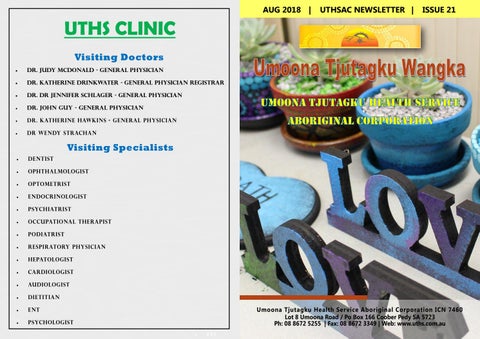
UTHS CLINIC
Dr. Judy McDonald - General Physician
Dr. Katherine Drinkwater - General Physician Registrar
Dr. Dr Jennifer Schlager - General Physician
Dr. John Guy - General Physician
UTHSAC NEWSLETTER |
ISSUE 21
IMPORTANT HEALTH NOTICE Salmonella Salmonella infection is a type of gastroenteritis (or ‘gastro’). It’s caused by Salmonella bacteria. It’s likely to make you or your child feel sick, possibly with fever, diarrhoea and vomiting, and it usually lasts for two to seven days.
IMPORTANT HEALTH NOTICE » Fever » Loss of appetite » Headache » Stomach cramps » Nausea and vomiting » Blood or mucus in stools (poo). Salmonella treatment You should drink a lot of fluids such as water or oral rehydration drinks (from the chemist). Most people recover within about a week and don't need antibiotics. However antibiotics, may be prescribed for young children or older people.
What causes salmonella?
Avoid medicine to prevent vomiting or diarrhoea, unless recommended by your doctor.
If you have salmonella, you've been infected with bacteria that's transferred to your mouth from:
Salmonella prevention
» contaminated food, water or your own hands » another person's hand or a contaminated surface » animal faeces. Contaminated food can look and smell normal.
If you have salmonella you should avoid contact with other people for at least 24 hours after your vomiting and diarrhoea stops. You can spread it for as long as you carry the bacteria - which may be months after you stop having any symptoms.
Salmonella symptoms Symptoms start between six hours and seven days after you've been infected and may include:
The best way to prevent salmonella is to:
» »
handle and cook food safely
»
take care in selecting, preparing and eating high-risk foods such as raw or incompletely cooked eggs, unpasteurised milk and incompletely cooked chicken
wash your hands after going to the toilet, before and after preparing food, changing nappies and after touching animals
Salmonella infections are common in Asia, the Pacific islands, Africa, the Middle East and Central and South America. If you travel to these parts, avoid foods that may be contaminated such as salads and fresh fruit salads, raw or cold seafood, or cold meat. In these areas, use bottled water for drinking and for brushing teeth. Don't have ice in drinks or washed or cut fruit.
ORAL HEALTH IS THE DOOR TO HEALTHLY LIFE!
Respiratory Infections The respiratory system is another victim of poor oral health. Bacteria in the mouth from infected teeth and inflamed gums can be breathed into the lungs or reach there through the bloodstream. Once the bacteria reach the lungs, that situation can lead to respiratory infections, pneumonia, acute bronchitis, and even COPD.
Diabetes Diabetics is another disease that can be badly affected by infected gums that lead to periodontal disease, and periodontal disease can in turn make diabetes worse and difficult to control. It is particularly important for diabetics to maintain good oral health to avoid complications with their disease.
Pregnancy Complications One of the common conditions we come across at UTHSAC Clinic frequently is dental health issues. Oral health is not just about the health of the mouth, teeth and gums, but much more than that. Because the mouth is a primary entryway into the body, poor oral health can have negative consequences for the entire body. Here blow are some common and serious health problems caused by bad oral health:
Cardiovascular Disease Having poor oral health puts a person at risk of heart disease. If the gums are inflamed due to the bacteria that cause periodontal disease, that same bacteria can actually get into the bloodstream and cause the arteries to build up plaque and harden the arteries. This hardening of arteries is called atherosclerosis, and it is a very serious condition. The damaging impact on the arteries and blood vessels can cause hypertension and increased risk for strokes. Poor oral health can also cause endocarditis, an often fatal condition that occurs when the lining of the heart becomes infected.
It is extremely important for expectant mothers to take good care of their oral hygiene. Pregnancy-related hormonal changes in their body can cause oral infections in them relatively easily. Oral health issues in the mother such as periodontitis and gingivitis may lead to premature birth and low birth weight for infants.
Cancer Clearly, smoking or using tobacco products are poor oral health practices. Such practices can not only lead to oral and throat cancers, but also are connected to other types of cancer. People who have poor oral health are at a high risk for kidney cancer, pancreatic cancer, and blood cancers.
Kidney Disease Chronic kidney disease affects kidneys, heart, bones, and blood pressure. Infections in the body like periodontal disease can put people at risk of kidney disease.
Dementia
Rheumatoid Arthritis
The brain also can be affected by poor oral health. Substances released from gums inflamed by infection are dangerous to the brain, and can actually kill brain cells. This would lead to memory loss.
According to the National Rheumatoid Arthritis Society, people having gum disease are four times more vulnerable to get Rheumatoid Arthritis.
Prevention Prevention is better than cure. The best way to prevent health problems caused by bad oral health is to practice and maintain good oral hygiene and regularly seek assistance from your dentist. To practice good oral hygiene:
Brush the teeth and gums for two minutes at least twice a day Floss the teeth daily Avoid smoking cigarettes or chewing tobacco products Use toothpaste and mouthwash products that contain fluoride Limit sugary foods and drinks Eat a well-balanced diet for optimum nutrition
Healthy teeth are clean and free of pain caused by cavities and disease. Healthy gums do not bleed when brushed or flossed. Oral health is indicative of a person’s overall health. Taking good care of oral health and to prevent oral health issues like gingivitis and periodontal disease can help avoid the risk for serious health problems throughout the body.
QUIT SMOKING SESSION Quit Smoking educational session was organised by UTHSAC TIS officer to educate our clients on Quit smoking. Some of the topics covered in the session were effects on smoking and benefits of quit smoking.
WOMEN’S PROGRAM Women’s program was organised by UTHSAC Practice Manager along with Dr. Judy McDonald and Dr. Katherine Drinkwater in May 2018. The whole purpose of this program was to encourage women to come to clinic to get their health checks done more regular. While they spend the time on activities which was organised for the day UTHSAC RNs had the opportunity to conducted health checks on them.
MENTAL HEALTH Mental health cannot be underestimated or thought to be less important than physical health. Humans are believed to have a sixth sense which has more to do with mental health and cognitive ability. If humans fail to look after their mental health, they wouldn’t be any different to that of any other animal. Therefore it should be considered to be of a prime importance that every person takes care of his/her mental health. We, After-hours Mental Health Service, which is run under the drug and alcohol service, assist individuals in the community to help them in improving their mental health. Through our various therapies and activities people in our community have the opportunity to experience modern techniques and methods through which they could overcome their difficult situations. Not stopping from there, the After-hours Mental Health team is always ready to support the local institutions specially the Police and the Hospital whenever they need assistance. Further, the After-hours Mental Health team closely co-ordinates with day time workers of Umoona Tjutagku Health Service. We call it a resting place for people who are mentally tired and exhausted, and they are welcome to use our service to take a break or to refresh their thoughts.
0437 628 933 After Hours Mental Health General Support Line 1300 364 277 If it is an Emergency Please Call 000
Umoona Tjutagku Health Service Aboriginal Corporation
NAIDOC WEEK EVENTS
NAIDOC WEEK EVENTS
NAIDOC Art Exhibition
Men’s Sports Event
NAIDOC Art Exhibition was held on 09.07.2018 at DAS activity centre to display all the art and other craft work was done by UTHSAC clients during men's & women's programs. There were lot of attendance to see the art works of our clients and there very numerous positive feedback from the tourists. They were very happy about the Exhibition because they had a great opportunity to experience some of the very rare art works.
NAIDOC Men’s sports event was held on 13.07.2018 at Prominent Hill sports ground. UTHSAC Staff and Clients who were participating for the soccer match left Coober Pedy that afternoon. We are happy to announce that Coober Pedy won the match by 4-Nill. It was a great opportunity for the two communities to get together and celebrate NAIDOC week.
17
DEHYDRATION Dehydration happens when you haven’t got enough fluids in your body. If severe, dehydration can cause serious problems. If you think you or someone with you is severely dehydrated, get them to hospital.
have dark urine, and not so much of it
be dizzy or light-headed, particularly when standing up
If you have severe dehydration, you might:
be extremely thirsty
have a very dry mouth
be breathing fast
have a fast heart rate and a low blood pressure
have a fever
What causes dehydration?
have little or no urine
People can get dehydrated:
be irritable, drowsy or confused
What is dehydration? You are dehydrated if your body doesn't have enough water to keep it working properly. It can happen when your body loses too much fluid, such as from excessive sweating.
after strenuous exercise, especially in hot weather
after severe vomiting or diarrhoea
with a fever
after drinking too much alcohol
while taking certain medicines such as diuretics
as a complication of diabetes
if they don’t drink enough water
Anyone may become dehydrated, but babies, young children, older adults and people with long-term illnesses are at most risk.
Dehydration signs and symptoms If you have mild to moderate dehydration, you might:
be thirsty
have a dry mouth, lips and tongue
have a headache
Babies who are severely dehydrated have a sunken fontanel, the soft spot on top of a baby’s head. Severe dehydration is a serious problem, especially in babies and young children.
Dehydration treatment Mild dehydration can be fixed by drinking more fluids. The simplest approach is to put 6 teaspoons of sugar with half a teaspoon of salt in one litre of boiled water. Instructions at the end of the article. You can also buy premade solutions from the pharmacy. Avoid alcohol and caffeine, as they can make you more dehydrated. Severe dehydration needs immediate medical treatment, usually in hospital where fluids are given through an intravenous drip.
Dehydration prevention Make sure you drink enough water each day, and have extra to replace any fluid lost during hot weather, illness or exercise. Drink lots of fluids or oral rehydration solution to treat mild to moderate dehydration. See your doctor or go to a hospital emergency room if you, your baby, child or elderly relative is severely dehydrated.
NAIDOC WEEK EVENTS
NAIDOC WEEK EVENTS
NAIDOC Week Bush Trip
NAIDOC Kids Soccer Match & Disco
NAIDOC week bush trip was held on 10.07.2018 at China Dam. UTHSAC Staff, agencies and Clients left Coober Pedy that morning and reached the location after around 45 minutes drive. It was a great opportunity for UTHSAC new staff and other participants to get to know each other and to talk about aboriginal culture. The below photos show the activities of the bush trip.
NAIDOC Kids Soccer Match & Disco was held on 14.07.2018 at Coober Pedy United Club. This was a great opportunity for kids and other people to get together. It also gave kids a opportunity to learn more about NAIDOC and why we really we celebrate it as a event and what really it means. The below photos show the activities of the event.
GRIEF AND LOSS
SPECIAL COUNSELLING SUPPORT FOR PEOPLE EFFECTED BY DRUG AND ALCOHOL!
Grief is a reaction as we succumb to common losses in our lives. It can include the loss of a loved one, ending of a relationship, loss of a career or even sudden changes in our lives.
Misuse of alcohol and other drugs takes it on everyone. Unfortunately shame and stigma can often be the biggest barriers to seeking help.
Grief has stages and it usually range through shock, pain of grief, a sense of loss, anger, guilt, regrets, anxiety and fearfulness, intrusive images, disorganisation and forgetfulness, overwhelmed, to relief, loneliness, reorganisation and positive feelings.
If you are affected directly or indirectly, remember you are not alone. Over 3.5 million Australians are seriously and negatively affected by alcohol alone.
Women and men grieve differently with women often good at seeking out support and supporting each other and by talking through their pain. Men cope by seeking out one or two mates and doing activities and in so doing working through their losses. Practical strategies that can help include:
Our experienced counsellors will help you work through your challenges in a safe, confidential and non-judgmental environment. We offer a range of individual and group counselling programs.
Link to programs
Keep some time each day to reflect on the loss;
UTHS Drug & Alcohol Counselling Service will link clients appropriately to our Day centre Activity Programmes. These are often essential for helping people quit or reduce drug and Alcohol use.
Write down your thoughts
Programme Include:
Spend time with supportive people
Have a good cry
Avoid making big decisions
Talk about the person who has died with others if they are comfortable
Find a good listener
Talk to a grief Counsellor
Doing practical things like writing a eulogy or visiting the grave; and commemorate person on anniversary and special occasions.
Men’s Harms Minimisation, young Adults Social & Emotional Wellbeing (18-25 years ) Women’s Social & Emotional Wellbeing Healthy for life Men’s Music Youth sports (up to 17 years), Women's & Men's Changing Tracks Art ,Craft &Trade Skills Women’s & Men's Gym Groups.
UPCOMING DOCTORS & SPECIALIST november 2018
September 2018 SUN
MON
TUE
WED
THU
FRI
SAT
SUN
MON
TUE
WED
1
THU 1 GP
FRI 2 GP
SAT 3
9AM-4.30PM 9AM-4.30PM 2
9
16
23
3 GP
4 GP &
5 GP &
6 GP
7 GP
8
9AM-4.30PM
Endocrinologist
Endocrinologist
9AM-4.30PM
9AM-4.30PM
10 GP
11 GP
12 GP
13 GP
14 GP
9AM-4.30PM
9AM-4.30PM
9AM-4.30PM
9AM-4.30PM
9AM-4.30PM
17 GP &
18 GP &
19 GP &
20 GP &
21 GP &
DENTIST
DENTIST
DENTIST
DENTIST
DENTIST
24 GP
25 GP
26 GP
27 GP
28 GP
9AM-4.30PM
9AM-4.30PM
9AM-4.30PM
9AM-4.30PM
9AM-4.30PM
4
5 GP
6 GP
7 GP
8 GP
9 GP
10
9AM-4.30PM 9AM-4.30PM 9AM-4.30PM 9AM-4.30PM 9AM-4.30PM 15
11
12 GP & DEN- 13 GP & DEN- 14 GP & DEN- 15 GP & DEN- 16 GP & DEN- 17 TIST TIST TIST TIST TIST
22
18
19 GP
20 GP
21 GP
22 GP
23 GP
24
9AM-4.30PM 9AM-4.30PM 9AM-4.30PM 9AM-4.30PM 9AM-4.30PM 29
25
26 GP
27 GP
28 GP
29 GP
30 GP
9AM-4.30PM 9AM-4.30PM 9AM-4.30PM 9AM-4.30PM 9AM-4.30PM
october 2018 SUN
7
14
21
28
MON
TUE
WED
THU
FRI
1 GP &
2 GP &
3 GP &
4 GP &
5 GP &
DENTIST
DENTIST
DENTIST
DENTIST
DENTIST
8 GP
9 GP
10 GP
11 GP
12 GP
9AM-4.30PM
9AM-4.30PM
9AM-4.30PM
9AM-4.30PM
9AM-4.30PM
15 GP
16 GP
17 GP
18 GP
19 GP
9AM-4.30PM
9AM-4.30PM
9AM-4.30PM
9AM-4.30PM
9AM-4.30PM
22 GP
23 GP
24 GP
25 GP &
26 GP &
9AM-4.30PM
9AM-4.30PM
9AM-4.30PM
Herpetologist
Herpetologist
29 GP
30 GP
31
9AM-4.30PM
9AM-4.30PM
SAT 6
13
All the consultations are done by appointments, it can be made by contacting our reception on 08 8672 5255
between 8.30 am to 4.30pm 20
27
Monday to Friday For more information visit our website www.uths.com.au