THE UNI V ERSIT Y OF TE X A S AT EL PA S O
AS SAY ER OF STUDENT OPINION
July 31, 2026
THEPROSPECTORDAILY.COM
OPINION Page 2
NEWS Page 3
ARTS & CULTURE Page 5
SPORTS Page 8
Charli XCX’s dancefloor is dead and she wants you to feel that
UTEP construction update: Chick-Fil-A lives on
UTEP Students Share Their Soundtracks on Public Radio
Skating with community and purpose
THE HEAT OF IT ALL
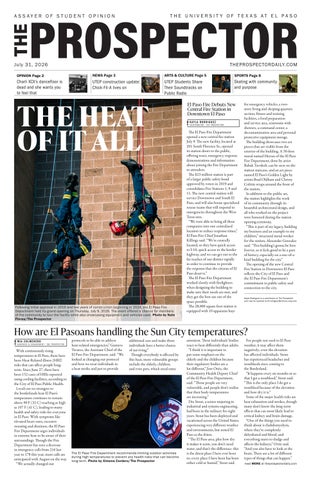
Following initial approval in 2019 and two years of construction beginning in 2024, the El Paso Fire Department held its grand opening on Thursday, July 9, 2026. The event offered a chance for members of the community to tour the facility while also showcasing equipment and vehicles used. Photo by Nate Flores/The Prospector
El Paso Fire Debuts New Central Fire Station in Downtown El Paso B K AY L A R O D R I G U E Z Y CONTRIBUTOR • THE PROSPECTOR
The El Paso Fire Department opened a new central fire station July 9. The new facility, located at 201 South Florence St., opened its station doors to the public, offering tours, emergency response demonstrations and information about joining the Fire Department to attendees. The $23 million station is part of a larger public safety bond approved by voters in 2019 and consolidates Fire Stations 1, 9 and 11. The new central station will service Downtown and South El Paso, and will also house specialized rescue teams that will respond to emergencies throughout the West Texas area. “We were able to bring all these companies into one centralized location to reduce response times,” El Paso Fire Chief Jonathan Killings said. “We’re centrally located, so they have quick access to I-10, quick access to the border highway, and we can get out to the far reaches of our district rapidly in order to continue to provide the response that the citizens of El Paso deserve.” The El Paso Fire Department worked closely with firefighters when designing the building to make sure their needs are met, and they get the best use out of the space possible. The 28,000 square foot station is equipped with 10 apparatus bays
for emergency vehicles, a twostory living and sleeping quarters section, fitness and training facilities, a food preparation and service area, restrooms with showers, a command center, a decontamination area and personal protective equipment storage. The building showcases two art pieces that are visible from the exterior of the building. A 30-foot mural named Heroes of the El Paso Fire Department, done by artist Babak Tavokoli, can be seen on the station staircase, and an art piece named El Paso’s Golden Light by artists Brad Oldham and Christy Coltrin wraps around the front of the station. In addition to the public art, the station highlights the work of its community through its beautiful architectural design, and all who worked on the project were honored during the station opening ceremony. “This is part of my legacy, building my business and an example to my children,” structural metal worker for the station, Alexander Gonzalez said. “This building’s gonna be here forever, so it feels good to be a part of history, especially on a one-of-akind building for the city.” The opening of the new Central Fire Station in Downtown El Paso reflects the City of El Paso and the El Paso Fire Department’s commitment to public safety and connection to the city. Kayla Rodriguez is a contributor at The Prospector and may be reached at Krrodriguez@miners.utep.edu
How are El Pasoans handling the Sun City temperatures? B MIA COLMENERO Y AUDIENCE & ENGAGEMENT • THE PROSPECTOR
With continuously rising temperatures in El Paso, there have been Heat-Related illness (HRI) risks that can affect people longterm. Since June 27, there have been 152 cases of HRIs reported using cooling facilities, according to the City of El Paso Public Health. Locals are no strangers to the borderlands heat El Paso’s temperature continues to remain above 90 F (32 C) reaching as high as 107 F (41 C), leading to many health and safety risks for everyone in El Paso. With symptoms like elevated heart rates, excessive sweating and dizziness, the El Paso Fire Department urges individuals in extreme heat to be aware of their surroundings. Though the Fire Department has seen a decrease in emergency calls from 216 last year to 178 this year, more calls are anticipated with August on the way. “We actually changed our
protocols to be able to address heat-related emergencies,” Gustavo Tavarez, the Assistant Chief of the El Paso Fire Department, said. “We looked at changing our protocol and how we treat individuals in a heat stroke and just to provide
additional care and make those individuals have a better chance of surviving.” Though everybody is affected by this heat, more vulnerable groups include the elderly, children, and even pets, which need extra
The El Paso Fire Department recommends limiting outdoor activities during high temperatures to prevent any health risks that can become long term. Photo by Ximena Cordero/The Prospector
attention. These individuals’ bodies react to heat differently than adults. “I think it is important to put some emphasis on the elderly and the children because their regulatory bodies are a lot different,” Jose Ortiz, the Community Health Deputy Chief of the El Paso Fire Department, said. “Those people are very vulnerable, and people don’t realize that their body temperatures are increasing.” Dre Stout, a senior majoring in industrial and systems engineering, had been in the military for eight years. Stout has been deployed and vacationed across the United States, experiencing very different weather and environments, but noted El Paso as the driest. “The El Paso area, plus how dry it makes it seem, you don’t need water, and that’s the difference: this is the driest place I have ever been to; every place I have been has been either cold or humid,” Stout said.
For people not used to El Paso weather, it may affect them negatively; even the elevation has affected individuals. Stout has experienced headaches and nosebleeds since coming to the Borderland. “It happens every six months or so that I get a nosebleed,” Stout said. “This is the only place I do get a nosebleed because of the elevation and how dry it is.” Some of the major health risks are heat exhaustion and strokes, though many don’t know the long-term effects that can most likely lead to critical kidney and brain damage. “One of the things you need to think about is rhabdomyolysis, where they’re completely dehydrated and blood, and everything starts to sludge and affects the kidneys,” Ortiz said. “And you also have to look at the brain. There are a lot of different types of things that can happen.” read MORE at theprospectordaily.com
PAGE 2 · July 31, 2026 · THE PROSPECTOR
Opinion
Ximena Cordero, editor-in-chief
Charli XCX’s dancefloor is dead The Architecture and she wants you to feel that of Longing B AZIEL RAMOS Y CONTRIBUTOR • THE PROSPECTOR
(From top) Aziel Ramos, Lesly Chavez, Alan Acosta, and Kayla Rodriguez pose for a composite portrait at the University of Texas at El Paso, Wednesday July 22, 2026. The shoot was inspired by the promotional imagery of Charli xcx’s newest album “Music, Fashion, Film.” Photos by Carol Mora/The Prospector
Charli XCX released her eighth studio album on July 24, titled, “Music, Fashion, Film.” This is her second album release of the year, following her seventh studio album, “Wuthering Heights,” which was released earlier in the year to accompany the film “Wuthering Heights.” With the release of “Music, Fashion, Film,” Charli said that it was going to be a big step away from “brat,” leaving behind the club and pop music for this new record, coming as a surprise for many fans. Charli has described this album to be about the things that describe her the best when she’s inspired, but also how she feels when she’s inspired or in the moment of inspiration, making it one of her most introspective records to date. The album cover also features what the title is all about, with John Cale from the band “The Velvet Underground,” Fashion designer Marc Jacobs and legendary filmmaker, Martin Scorsese filling their roles for “Music, Fashion, Film.” Music, Fashion, Film: The tracks The album’s lead single and opener, “Rock Music,” lays the foundation with Charli talking about how her and her friends continue to feel inspired, calling the dancefloor “dead” so now they want to make rock music. The song playfully tells the audience what is to be expectedwith the record, bringing her introspective ideas into place. The whole “rock” vibe of the album is present, but not in the
way that you’d think it’d be. It feels more of a mellow soft-rock with a slight presence of that “Y2K” sound, with songs like “SS26,” “Wink Wink” and “2007” fitting in with that sound. However songs like “Card Declined,” “I’m Afraid,” and “Yeah” bring in more of a grittier and grungier-rock. Charli doesn’t just talk about her creative mindset though as in “Rock Music,” but she also gets introspective on herself as an artist and a person, “SS26” being about how the culture changes her persona or tries to make a different image out of her now that she’s becoming a bigger artist, saying how her “politics could work as a press strategy” and her heritage could give her “quite the USP”. “Card Declined” brings in a more satirical attempt at that, going “shopping” for a “new smile” or “new backstory” just so she can make herself stand out from other artists. When it comes to a different side of Charli’s career or her as a person, songs like “Camera” and “I’m Afraid” talk more about that, with how she’s now attempting to become an actress or how she feels as a wife, wanting to get rid of that generational trauma she’s gone through during her personal life. “Wink Wink” brings out more of a playful and fun side of Charli in this album, referring to how she isn’t a “bad girl anymore, wink wink”, saying that people can change and how people can perceive her no matter what she does anymore or changes. read MORE at theprospectordaily.com
Turns out the girl so in love was pretty sad after all B XIMENA CORDERO Y EDITOR-IN-CHIEF • THE PROSPECTOR
Olivia Rodrigo’s third studio album, “You seem pretty sad for a girl so in love,” released June 12, marks a new chapter in the singer-songwriter’s career. Produced by longtime collaborator Dan Nigro, the record trades much of the pop-punk angst that defined “SOUR” and “GUTS” for a softer rock sound while delivering
Rodrigo’s most emotionally mature songwriting yet. The album chronicles what Rodrigo has described as her first adult relationship, beginning with the excitement and optimism of falling deeply in love before gradually unraveling into heartbreak and self-reflection. The tone shifts halfway through the album, making it feel like two interconnected stories. One that
VOL. 112 July 31 , 2026 EDITORS
ADMINISTRATION
CONTRIBUTORS
Ximena Cordero, Editor-in-Chief
Veronica Gonzalez, Director Crystal Hinga, Assistant Director Amy Ontiveros-Bocanegra, Administrative Assistant
Adrian Gonzalez
Abby Pedroza, Arts & Culture Editor Kristian Hernandez, Sports Editor Iziah Moreno, Photo Editor
Diego Hernandez Aziel Ramos Kayla Rodriguez Lesly Chavez
Tori Adler, Web & Copy Editor
Alex Jauregui
Sebastian Perez-Navarro,
Coral Mora
Multimedia Editor
Iziah Moreno
Mia Colmenero, Audience & Engagement Editor
celebrates love and another that confronts what happens when that love begins to fall apart. A girl SO in love The album opens with “Drop Dead,” the lead single, which immediately captures the rush of becoming completely infatuated with someone. That feeling continues through tracks like “Stupid Song,” “Honeybee,” and “Maggots for Brains,” creating an opening stretch
filled with warmth, excitement and hope. One of the album’s standout lyrics comes from “u + me = <3,” “I know everybody changes but I hope that we don’t.” The line perfectly captures the innocence of believing a relationship can remain the same through time. read MORE at theprospectordaily.com
B DIEGO HERNANDEZ Y CONTRIBUTOR • THE PROSPECTOR
There is a quiet weight that comes with feeling the world too deeply. For me, life has never been a series of moments I just pass through, its been a collection of people and places that have carved themselves permanently into my soul. I used to think nostalgia was just a rearview mirror or a way to look back at what used to be. But my heart aches for the world in a way that tells me longing isn’t just about memory, its an ongoing, living state of missing everything and everyone I have ever known. Perhaps that longing comes from the fact that I have always felt out of place. The city I grew up in never truly felt like home, and the people around me never made me feel like I belonged. I spent years navigating a profound sense of isolation, feeling like an outsider in my own life, disconnected from the very environment that was supposed to ground me. Its a lonely thing to feel out of place everywhere you go, to look around at the familiar and feel entirely alien to it. Because of that, the longing inside me grew vast and consuming. I find myself wishing I could visit every single city in this planet, speak every language that has ever existed, and connect deeply with every single human being in the world. Its a beautiful, impossible hunger to want to understand the heartbeat of humanity, to sit in a cafe in a town I cant pronounce, conversing fluently with a stranger as if we’ve known each other our whole life. It’s that same strange, beautiful trick of my own imagination that makes me feel completely homesick for places I have never even set foot in. I’ll look at a photo of a rainy day in London, a neon lit alley in Seoul, or the crowded sidewalks of New York, and a sudden sharp pain of belonging hits me so hard it makes me cry. I have built entire lives in my mind cities across the world. read MORE at theprospectordaily.com
SP E A K YO U R M IND! …and submit a letter for publication. Please include your full name, street address, telephone number and email address, as well as your student major, classification and/or title if applicable. Write to us at 105 E. Union, 500 W. University Ave. El Paso, TX 79968; email us at prospector@utep.edu, or call us to 747-5161. Personal information (phone number and address) will be used for identification only. Letters are subject to editing to fit available space, clarity and brevity. The Prospector is published by Student Media and Publications, 105 Union East, 500 W. University Ave. El Paso, Texas, 79968. The Prospector appears in print monthly on Tuesdays during the fall and spring semesters. The newspaper is not printed during holidays and when classes are not in session. The Prospector provides news online at www.theprospectordaily.com. The Prospector is provided to students through student fees. First copy is free. Any additional copies, if available, must be purchased for $1 through the Department of Student Media and Publications. The Prospector is not responsible for claims made by advertisers. Additional policy information may be obtained by calling The Prospector at 915-747-5161. Opinions expressed in The Prospector are not necessarily those of the university.
PAGE 3 · July 31 2026 · THE PROSPECTOR
News
Ximena Cordero, editor-in-chief
UTEP construction update: Chick-fil-A lives on installing utilities and laying out the foundation before the building begins to take shape. Unlike UTEP’s apartmentstyle housing, Minor Crossing is intended to provide a more traditional first-year living experience complete with an onsite dining hall, intended to help students transition to college life. The residence hall is scheduled to open in fall 2028, with prospective students able to select rooms beginning in fall 2027. McCorry-Andalis said demand for campus housing continues to grow. “For the past four years, we have had a wait list for housing, and this fall [fall 2026] we will have it again,” McCorry-Andalis said. “The desire to be here and just engross in student engagement and student life is very much what students want to do.” McCorry-Andalis says she expects the new residence hall to attract both students from outside the El Paso area and more local students interested in living on campus for the academic and social benefits as well as the economic benefits. “We have students who get apartments off campus or even are commuting from home, which for many of our students is absolutely fine, but when you start adding it up, the cost of gas, wear and tear in your vehicle, having to plan getting into research labs or internships, it becomes a bit challenging,” McCorry-Andalis said. “So, being a little bit more central is helpful.”
B XIMENA CORDERO Y EDITOR-IN-CHIEF • THE PROSPECTOR
From the sound of heavy machinery outside the Union Building to the demolition of the Liberal Arts Building, construction has become part of daily life at the University of Texas at El Paso (UTEP). Over the next several years, students can expect even more changes as UTEP moves forward with a series of major construction projects, including Minor Crossing, a renovated Student Union, a Student Success Center and an Arroyo Park. While detours and temporary relocations will happen, Vice President for Student Affairs, Catie McCorry-Andalis, Ed.D., said each project was designed with student success in mind and that the longterm goal is to create a campus better equipped to serve a growing student population. “We are very mindful of what our students’ needs are, and all of these projects I think have the students at the forefront of ensuring success while they’re here at UTEP,” McCorry-Andalis said. “I firmly believe that UTEP is a top-notch institution, and we do public higher education the right way, providing access to this institution, but not lowering the bar on excellence.” Miner Crossing One of the biggest projects for the university is Minor Crossing, UTEP’s future five-story residence hall for first-year students located on the north side of Kidd Field. Officials broke ground on May 28, and construction crews are currently preparing the site by
Lego inspired signs are set up around The University of Texas at El Paso (UTEP) campus to direct students and vistors through construction detours. Photo by Iziah Moreno/The Prospector
Construction crew members working at a campus renovation site at the University of Texas at El Paso (UTEP) Thursday, June 25, 2026. Photo by Carol Mora/The Prospector
see CONSTRUCTION on page 4
Going modern: The process behind Paydirt Pete’s new look Photo courtesy of UTEP Marketing and Communications.
B ADRIAN GONZALEZ Y CONTRIBUTOR • THE PROSPECTOR
As the University of Texas at El Paso (UTEP) officially crossed over into the Mountain West Conference on July 1, the university marked the historic athletic transition with the first visual redesign of its iconic mascot, Paydirt Pete, in nearly three decades.
The visual refresh has generated a flood of conversation across the Borderland, but behind the scenes, athletic department officials describe the new design as the result of a deliberate, year-long creative effort aimed at balancing nostalgia with modern digital needs. “We wanted to give Paydirt Pete a fresh look while not straying too
far from the vintage mark that our fans love,” Jim Senter, UTEP vice president and director of athletics, said in the university’s official announcement on UTEP Miners Athletics said. According to Deputy Athletic Director and Chief of Staff Jeff Darby, planning for the project began more than a year before the official launch. The athletic department assembled a focus group that brought together representatives from Athletics, Student Affairs, and the university’s marketing and communications teams. “Before we could really get started, we needed to have an idea of what we wanted the new Pete to look like,” Darby said. “We developed a creative brief that outlined specific characteristics that we thought Pete should have.” The creative roadmap established a strict list of physical requirements rooted in UTEP heritage: Pete needed his signature mining pick in hand, a full beard and mustache, and a classic miner safety hat com-
plete with a light. “We wanted him to look fierce but friendly, because we’re trying to cater to different audiences, including kids,” Darby said. To bring that vision to life, UTEP partnered with Torch Creative, a Dallas-based design firm specializing in collegiate and professional sports branding. “Torch has a process of their own,” Darby said. “They start by sketching everything in pencil. Then we would see various drafts, and they would make changes, before they ultimately came up with the final design that we felt good about.” The primary goal of the design team was to modernize the popular “retro” Pete marks of the 1980s and early 1990s. Because Pete’s last visual update took place in 1999, long before the rise of modern digital media, the design team had to account for how the logo would perform across smartphones, social media channels and stadium video boards. The launch’s timing was also highly strategic. By coordinating the
design’s release with the university’s historic July 1 conference move, the department aimed to capture a milestone moment for UTEP. “First of all, we felt like we were overdue for a refresh of Pete. It has been nearly 30 years,” Darby said. “Coupled with the excitement of joining a new conference on July 1, the timing just seemed right to make the change.” While a logo redesign of this scale naturally brings a wave of opinions, university officials remain pleased with the community’s overall reception. “Paydirt Pete is iconic, and there are going to be a lot of different opinions when you redesign a logo of this stature,” Darby said. “Everybody has an idea of what he should look like, and it’s impossible to make everybody happy ... We’re excited that we have a lot more people liking the mark than posting negative comments. If you don’t like the new Pete, we respect your opinion, but we also hope he grows read MORE at theprospectordaily.com
THE PROSPECTOR · July 31, 2026
Page 4 NEWS
from CONSTRUCTION on page 3
Arroyo Park The nearly demolished Liberal Arts Building marks another major milestone in UTEP’s campus transformation. McCorry-Andalis said the building, constructed in 1961, had become increasingly susceptible to flooding as development throughout El Paso changed the surrounding landscape. “We are on track to completely demolish the Liberal Arts building by the end of the summer, if not sooner,” McCorry-Andalis said. “We haven’t had a lot of rain yet, which is helping this group do what they need to do, but liberal arts really sunk down in there, so if you go look, there’s still a bit more like the first floor basement they’re getting out of, so once that happens, then the restoration will start to occur, and so the completion will happen in two phases.” The first phase will be completed in 2028 at the southern side closest to the Texas Western, then the second phase will be full completion by 2031 closer to the new Student Union building. After demolition, crews will begin restoring the area into a landscaped green space connecting Texas Western Hall with the future Student Union through walking paths, study areas and a pedestrian bridge. “It’ll be great for students, little niches to sit down and study, but you know, we’re a campus for the community, so people walk their dogs all the time, or kids come out of little tricycles through here, like I’m excited about that,” McCorry-Andalis said. “We are not one of those institutions that have a big gate that you have to get permission to come in, like this is not my institution, it’s this community’s institution.” Union Buildings and Student Success Center Planning is also underway for the Student Union renovation and the new Student Success Center, which McCorry-Andalis said are following nearly identical timelines. During construction, departments such as the Counseling Center and the Student Engagement and Leadership Center will temporarily relocate, while Union East will remain open. “Nothing will change on Union East side,” McCorry-Andalis said. “All services will operate, stay the same. One of the challenges that we’ll work through with the architects and the design folks is when construction happens.” To help students navigate construction zones, UTEP has revived its “On the Move”
committee, which coordinates campus traffic, pedestrian routes and communication during largescale construction. Students can find signs designed to look like a Lego Paydirt Pete that will help them navigate detour routes. These signs can already be spotted on Glory Road around the Miner Crossing construction site. The Student Success Center will replace the El Paso Natural Gas Center and bring several student support offices under one roof, including the Counseling Center, the Center for Accommodations and Support Services, the Military Student Success Center and UTEP Engage. The facility will also feature dining options and gathering spaces designed to make services easier to access. One concern students won’t have to worry about, McCorry-Andalis joked, is losing Chick-fil-A. “Obviously, we are very concerned about Chick-fil-A,” McCorryAndalis said. “We all want the Chick-fil-A, so Chick-fil-A will stay where we are. We’ll share pretty soon where they’re gonna go, but trust me, we will not cut [it] off.” Parking and the future of campus As construction continues, parking will remain a challenge, though university officials are studying long-term solutions. A campuswide parking study is examining everything from lot locations and shuttle routes to bike paths and public transportation to better accommodate future enrollment growth. McCorry-Andalis said the projects are part of a broader vision to support record enrollment while giving students more places to study, gather and access campus resources. “I think giving students... the place for them to come and have their own [spaces],” McCorryAndalis said. “To see comedians, to have bands, to do movie nights, like the things that also support a sense of belonging.” Although construction will continue for several years, McCorry-Andalis said students have helped shape many of the projects through feedback and referendums, including the Student Union renovation. “I hope they’re [students] excited,” McCorry-Andalis said. “I know it’s going to have some challenges the next couple of years, but I think if we continue to focus on what’s to come, we can get through this time period. I truly do mean this, I love that I’m at a campus that cares so deeply about student success.” Ximena Cordero is the editor-in-chief for The Prospector and may be reached at xcordero@miners.utep. edu, on LinkedIn @ximenacordero, an on Instagram @ximenacordero.reports
Multiple excavators clear debris at the Liberal Arts demolition site at the University of Texas at El Paso, Thursday, June 25, 2026. Photo by Carol Mora/The Prospector
UTEP Food Pantry expands their fight against food insecurity on campus
Workers at the Mobile Food Pantry organize fresh boxes of produce on Monday, June 28, 2026. All active UTEP students, staff and faculty members qualify for the food pantry as long as they bring a physical or digital ID. The Food Pantry also distributes hygiene products like shampoo and deodorant. Photo by Kristian Hernandez/The Prospector B AZIEL RAMOS Y CONTRIBUTOR • THE PROSPECTOR
The University of Texas at El Paso (UTEP) Food Pantry has been a part of campus since 2014, their goal being to help students that deal with food insecurity, providing food and toiletries to those who need assistance. According to Move for Hunger, nearly 30% of undergraduate students tend to face food insecurity throughout their academic career, which can possibly be even higher for marginalized communities. The Food Pantry has made sure to battle food insecurity amongst students here at UTEP, striving to ensure that there are enough supplies for the students in need throughout the semesters. Even so, they are operating during the Summer as well, with their demand still being high. Jaime Mendez Ed.D., Assistant Dean for Student Support at UTEP, has taken into account how much of a difference in demand it has been this summer compared to the ones previously. “It used to be that summers were one of our low periods,” Mendez said. “We’ve seen that because of the availability of the food pantry operating at extended hours during the summer and then the intro-
duction of our mobile pantry that comes every Monday (…) and so we’ve seen steady traffic for the summer. Not as big as fall and spring, but a little higher and consistent than other years.” The UTEP Mobile Food Pantry is another service that is part of the Food Pantry, offering their services for the El Paso community and students everyMonday at the Helen of Troy Softball Field Parking Lot from 8:30 a.m. to 11:30 a.m. “They give more bulk items, so individuals can have more than a week’s worth of food when they go to the Mobile Pantry,” Mendez said. UTEP junior and Food Pantry employee, Emilio Medrano, was a student who had experienced food insecurity firsthand, finding it important for students to seek out that help when needed. “I know from experience because that was me when I lived on campus. I didn’t know about the food pantry,” Medrano said. “I feel like a lot of students when they come, they don’t realize how many of the things we do have. And when they do, they feel surprised that they were there in the first place. We’re here to help. It’s a big help, especially for any college student.” As these services continue, their job is to progress as they start to ex-
pand from their current location in Memorial Gym to 105 Union East, wanting the accessibility to become bigger, even changing how they will be providing their services. “We’re anticipating that the pantry at the Union is really going to change the landscape of our resources on campus, and I say that because what we’re hoping to make it a mini market style pantry, where individuals will come in, check in, grab one of those hand baskets, and be able to go through the aisles and pick what they want,” Mendez said. Mendez believes that by incorporating a “mini-market” style, it gives the students more autonomy to be able to see what they want before they check out and take it with them.. With expansion, there are plans to bring in more food than before, even with the availability of refrigerated and frozen foods. The UTEP Food Pantry hopes to bring their expansion towards the fall semester, continuing to fight food insecurity, one student at a time Aziel Ramos is a contributor and may be reached at aramos45@miners.utep.edu
Fall 2026 parking sale information B XIMENA CORDERO Y EDITOR-IN-CHIEF • THE PROSPECTOR
The University of Texas at El Paso (UTEP) is changing the way students purchase parking permits for the Fall 2026 semester after receiving feedback about the Fall 2025 sale process. Instead of opening permit sales for all students on the same day, UTEP Parking and Transportation Services will implement a staggered sales schedule based on student classification. Officials say the new system is designed to reduce long wait times, ease website traffic and create a smoother purchasing experience. Permit sales will be available from 9 a.m. to 9 p.m. on each designated sales day, with permits sold on a first-come, first-served basis. Students who miss their assigned sale date will have another opportunity
to purchase a permit when general sales begin Aug. 21. High-demand permits, including those for the Sun Bowl Garage, will remain limited. The majority of those permits will be allocated to graduate students, followed by seniors, juniors, sophomores and freshmen. While premium locations may sell out during a particular sale window, university officials said some type of parking permit will remain available each day. Students will not see a queue number before their sale window opens. According to Parking and Transportation Services, the change is intended to prevent confusing or inflated wait counts. Once their sale window begins, students can log in with their UTEP single sign-on credentials to complete their purchase.
Fall 2026 Parking Permit Sales Schedule • Aug. 12: Graduate, Doctoral, Special Professional, Post-Bachelor, Doctoral Master’s • Aug. 13: Seniors • Aug. 18: Juniors • Aug. 19: Sophomores • Aug. 20: Freshmen • Aug. 21: General sales Before their assigned sale date, students are encouraged to pay any outstanding parking citations, update their vehicle and mailing information and verify their classification in Goldmine after the Aug. 9 grade roll. Ximena Cordero is the editor-in-chief for The Prospector and may be reached at xcordero@miners.utep. edu, on LinkedIn @ximenacordero, an on Instagram @ximenacordero.reports
Photo by Iziah Moreno/ The Prospector
THE PROSPECTOR · July 31, 2026 · PAGE 5
Arts & Culture
Abby Pedroza, editor
UTEP students share their soundtracks on public radio
“Frontera Frequencies” often features student guests on the show where they can discuss some of their favorite songs. Roberto Avant-Mier Ph.D. and his crew aim to create a show that students and listeners are excited to tune in to. Photos by Nate Flores/The Prospector B K AY L A R O D R I G U E Z Y CONTRIBUTOR • THE PROSPECTOR
Every Friday evening on station 88.5 FM, listeners can get a small snapshot of what life on the border is like. Listeners can hear a variety of music, with each episode having a unique theme. These songs are often introduced from the perspective of those living in the borderland. “Frontera Frequencies” is a show broadcasted on KTEP’s public radio hosted by Roberto AvantMier Ph.D., a University of Texas at El Paso (UTEP) professor and department chair and UTEP student Alejandra Seanez. The program is an interesting hybrid between a talk radio show and a music show; where the hosts play songs and examine the history, memories or feelings associated with music. Halfway through each episode,
the hosts invite a student guest to interview and share their musical interests. Throughout the interview, students get to pick three songs to play on the show based on what they are currently listening to. Guests often talk about the memories or feelings they have surrounding their music choices. The discussion between the guest and the hosts provides a different perspective that invites the listener to share a connection with someone based on something familiar, like music. “I think having the student voice is absolutely important. Having other people, inviting other people to talk about their music, to me that’s the magic,” Avant-Mier said. “You can hear people when they get excited, they get passionate about their songs or their music, right? To me, that’s kind of what makes it interesting.”
“Frontera Frequencies” was created with student engagement and interest in radio as a focus and producers strive to create a show that listeners are excited about. “If we could get students to know the show and have lots of different students on the show doing the Miner Music Minute have students wanting to be on the show so they can talk about their music, that would be really cool,” AvantMier said. Besides the Miner Music Minute, Avant-Mier and Seanez discuss the history of the songs chosen and why they were picked for the episode. There is a lot of information provided during the program, and a big challenge for producers is figuring out a balance between talking and playing music. Show Producer Martin Leon often puts himself in the audiences’ shoes when producing or editing
the show. He hopes the audience can feel the excitement he feels when producing an episode. “Radio, especially public radio, is for the public, is for the community. It’s to inform, it’s to entertain, but it’s always educational,” Leon said. “That’s the main focus I have when working on the radio. I feel proud that I’m doing something that is going to be enjoyable and is a good product for the human brain.” According to Leon, the Miner Music Minute segment also gives student guests and listeners the opportunity to learn about another person who they might have been intimidated by. “In shows like this, you get the chance to see the human being behind it, and you see this is just a normal human being as I am, and we can share this special connection between music,” Leon said.
KTEP recently lost a significant amount of funding and relies heavily on listener support to continue operating. Programs like “Frontera Frequencies” reflect the love the team at KTEP has for public radio and listeners can hear that passion transmitted during the broadcast. The program airs Fridays at 7 p.m. on KTEP 88.5 FM and runs for an hour. Supporters of the show can always gain something from listening. Whether that is hearing a friend’s excitement on the radio, discovering new songs or learning about what they might have in common with their peers. Kayla Rodriguez is a contributor and may be reached at krrodriguez4@miners.utep.edu
THE PROSPECTOR · July 31, 2026
Page 6 ARTS & CULTURE
Colorful Chapters brings diverse authors to Borderland readers B KRISTIAN HERNANDEZ Y SPORTS EDITOR • THE PROSPECTOR
Colorful Chapters came from the mind of Alabama native Tephanie Hopper, who has had a passion for reading before the thought of creating Colorful Chapters appeared in her mind. “I’ve always wanted to be a librarian,” Hopper said. “I worked at a library my junior and senior year of high school, but my librarian discouraged me because she said I talked too loud and I talked too much.” Gwendolyn Brooks, an author and poet, became the inspiration for Hopper’s dreams to be a librarian. Brooks became the first African American author to be awarded the Pulitzer Prize for poetry and was the first African American woman to enter the American Academy of Arts and Letters. Hopper joined the U.S. Army after high school and ran multiple book clubs during her service. In 2025, Hopper was on administrative leave from the government when her husband gave her the idea of starting her own bookstore. “I was thinking about starting a brick and mortar [business],” Hopper said. “Starting a brick and mortar is very expensive, plus I still had my main gig going on.” Business owners in any industry must obtain certain permits and
licenses before opening. According to the census bureau, starting a brick-and-mortar business costs an average of $100,000, with minimum startup costs of about $35,400. While the bookstore industry has seen a decline in revenue and locations since the turn of the century, there has been an increase in sales since 2021, according to the census bureau. In 2023, 291 bookstore businesses opened with 34 of them being pop-up stores and 28 being Black owned as reported by the American Booksellers Association. Hopper now joins this demographic profile, where the industry is around 80% white, nonHispanic and non-veteran owned according to the Southwest Ledger. “I started my pop-up about over a year ago,” Hopper said. “But for me, if I did a mobile [bookstore] or pop-up or something like that, there’s no overhead. I just purchase the books.” Colorful Chapters began popping up around the sun city and surrounding areas like Rally Point Coffee, Wake and Bake and other events. The mission for Colorful Chapters is to showcase diverse books from diverse authors that celebrate a variety of experiences and cultures. “The people that have come to my events, I think they’re kind of
all over because I do have different books,” Hopper said. “The main thing that makes my bookstore different from a lot, is our books are mostly black, brown [and] Japanese authors. My primary goal is to share the joy of reading within the El Paso community by providing diverse books from diverse authors.” Hopper has collaborated with Patrick Gabaldon, a well-known artist and lawyer in El Paso, to use his art for bookmarks that represent the spirit of the borderland where Gabaldon was born and raised. Like many veterans and active military members, Hopper made her way to El Paso and fell in love with the city. “I love the weather, even though it’s hot, I still love it. I love the community and the openness of El Paso,” Hopper said. “I’m hoping that El Paso will continue to grow in a positive way.” Hopper’s next goal is to begin a Kickstarter to help raise funds for the children’s book she is writing. Colorful Chapters’ upcoming events can be found here with book club meetings and other social events. Kristian Hernandez is the sports editor for The Prospector and may be reached at kahernandez16@ miners.utep.edu and social media tags @northeastvideography.
“Colorful Chapters Bookstore” founded in 2025 and owned by Tephanie Hopper, is powered by Booksop.org, a certified B Corp whose goal is to help independent bookstores thrive in the age of ecommerce. Photos by Lesly Chavez/The Prospector
Guacamole, goals and green jerseys: Why El Paso has total World Cup fever B DIEGO HERNANDEZ Y CONTRIBUTOR • THE PROSPECTOR
Mexico defeated Ecuador 2-0 in the Round of 32 on June 30, 2026, at Estadio Azteca in Mexico City. Photo by Diego Hernandez/The Prospector
If your sleep schedule hasn’t been completely ruined by the world cup, are you even living right now? The whole tournament is a massive history-making event as Mexico is the first country to host three different World Cups. The Estadio Azteca is the holy ground and seeing it back on the main stage is incredible. “Es una locura total,” local fan Cesar Hernández said. “El Azteca tiene una magia que ningún otro estadio puede replicar, verlo brillar le da piel de gallina a cualquiera.” That feeling of total goosebumps is exactly what is connecting everyone across both countries right now. But this tournament hits a lot deeper than just a standard sports calendar. During times like these, where it feels like the news is constantly heavy and everyone is divided, people find the need for moments like this. For a lot of people living on the border, this World Cup hits so close to home as it feels like a celebration of our roots, proving that no matter what side of the line people are on, our shared passion is a bridge that connects everyone. It is about identity, pride and seeing how beautiful it is when the world can come together instead of pulling apart. Nothing proved that more than
Mexico’s intense 1-0 win against South Korea on June 18. Even though the game was a fierce battle on the pitch, the best part was seeing what happened in the stands at the stadium in Mexico City and on social media. Because of shared history from 2018, when South Korea defeated Germany 2-0 to save Mexico’s tournament run and send them to the knockouts, the love between the two fanbases formed. Seeing the videos of Mexican and South Korean fans partying together, hugging in the streets and joining voices, shows a simple game can turn total strangers from opposite sides of the world into family. So, how exactly is El Paso showing up? Short answer: it’s doing the absolute most. Nobody is watching these games alone. Group chats are blowing up and local restaurants and bars across town have been converted into mini stadiums. Mexican people are rocking retro Mexico jerseys, planning massive backyard watch parties and blasting playlists where the opposing country’s music blends with classic Mexican tracks. “We literally brought a whole couch and a TV onto the street just to watch the matches,” University of Texas at El Paso (UTEP) student Emily Davila said. The hype is still growing because Mexico keeps making history.
The team didn’t just survive the group stage, Mexico went on to completely dominate their Round of 32 match against Ecuador with a 2-0 victory, shutting them down completely thanks to electric firsthalf goals from Julián Quiñones and Raúl Jiménez. The stakes became higher than ever as they faced a European team in a massive Round of 16 match against England on July 5. This wasn’t any regular match; Mexico was fighting to break a decades-old curse. The national team hasn’t won a Round of 16 match since the 1986 tournament against Bulgaria. That is a 40-year drought they tried to shatter, and the entire city of El Paso was ready to manifest that win. UTEP students looking to continue witnessing history, don’t just have to watch from their couch. The @utepinvolved Instagram page announced they are throwing a massive watch party right on campus for the Sunday match against England. It’s the ultimate spot to come out, wear your green jersey, grab some snacks and scream your heart out with your fellow Miners. read MORE at theprospectordaily.com
PAGE 7 · July 31, 2026 · THE PROSPECTOR
Summer Shots Photos by Lesly Chavez/The Prospector
Photos by Iziah Moreno/The Prospector
Photos by Carol Mora/The Prospector
Photos by Nate Flores/The Prospector
Photos by Alex Jauregui/The Prospector
Photos by Kristian Hernandez/The Prospector
Photos by Tori Adler/The Prospector
Nate Flores, editor
THE PROSPECTOR · July 31, 2026 · PAGE 8
Sports
Kristian Hernandez, editor
Skating with community and purpose
The El Paso Roller Derby team conditions as a team and individually about three to four hours a week. Photo by Lesly Chavez/The Prospector B K AY L A R O D R I G U E Z Y CONTRIBUTOR • THE PROSPECTOR
Two teams of five skaters each, one Jammer and four Blockers per team, positioned at the starting line of a flat track. The crowd is excited as the players focus on the game they’ve been training for and their
teammates who are ready to bring their best. The whistle signals the start of the game, and the skaters race down the track, blocking jammers or pushing blockers in a derby stance. Roller derby is a contact sport played by skaters on a flat track.
Roller derby is a fast-paced, full-contact sport played on quad roller skates with one jammer and four blockers on each team. Photo by Lesly Chavez/The Prospector
During the roller derby season, El Pasoans can catch a game played by one of several teams in the El Paso Roller Derby league at Nations Tobin Sports Center in Northeast El Paso. Established in 2010, The El Paso Roller Derby is a nonprofit organization whose mission is to build self-confidence, athleticism and community for their skaters through roller derby. The league, made up of over 120 members, has a playing season from March through December. During the season, skaters train on and off the track to take hits, push through mental and physical blocks, and foster trust with their fellow skaters. Every skater in the league has a unique derby name they use on the track. These names are often chosen by the skater and are deeply personal, serving as reminders of a skater’s strength or commitment to their team. Kamikaze is a second-year skater for the El Paso Roller Derby who joined the league with a friend and stayed for the community and the constant challenge. The intensity of roller derby builds the confidence they need to take on intimidating tasks. “You have a good team behind you, and you take that into the world with you because now if I feel something’s hard at work, I don’t even think twice about it,” Kamikaze said. “If I can
get shoulder checked by Fish or knocked out from Pinchi, a meeting that would normally stress me out: piece of cake.” The sport is also physically demanding sport. Players train at least twice a week and are encouraged to work out outside of practice. Despite the challenges, roller derby helps athletes improve their athleticism and skating skills, while the league’s players and coaches work to make roller derby a positive experience. “It’s weird because I never saw myself like a gym rat, but I do see myself running more often and preparing because I want to do my best,” Kamikaze said. “I don’t try to get super enraged. Nothing in life is that serious. If we lose, at least I had fun. At least I’m playing with the people that I love.” Skaters in the league push each other to bring their best to the game. Reminders to be in proper derby stance, to get lower or to push a certain way can often be heard during practice, but players are not left to improve on their own; experienced skaters are always willing to provide guidance or support to newer players. Skater, Betta Fish, has been part of the organization for about two years and believes that the community at the El Paso Roller Derby makes growth in the sport less intimidating. “Every practice, everyone’s got positive feedback,” Betta Fish
said. “And then, it makes you feel like you’re progressing because even if you feel tired and beat up, everybody’s just giving you high fives, and everybody’s like, ‘you did great.’” Derby skaters have respect for each other in the game and are always learning from other players. That respect and openness for improvement keeps roller derby fun and enjoyable for the skaters. “There’s times where it gets intense but, I can’t help but to be in awe of how good Michi [their teammate] did this one turn, or how good Zero [their teammate] did this other turn,” Betta Fish said. The league gives back to the community with every game as well. The organization chooses one nonprofit to support every game and players feel a sense of accountability to bring their best knowing that they make a direct impact on the city around them. The El Paso Roller Derby is open to anyone who is willing to join. Through encouragement, support and feedback, the league creates an environment where a challenging sport like roller derby becomes a place to build confidence and strength. Kayla Rodriguez is a contributor and may be reached at krrodriguez4@miners.utep.edu.
THE PROSPECTOR · July 31, 2026
SPORTS Page 9
Becoming besties in the 915 B L E S LY C H A V E Z Y CONTRIBUTOR • THE PROSPECTOR
In college, sports tend to nuture a competitive environment. The pressure of expectations and the relentlessness of the schedules can create a suffocating existence in a student-athlete’s life, especially for those who are foreigners and are trying to make a new city feel like home. However, this was not the case for University of Texas at El Paso (UTEP) volleyball players Shea Bruntmyer from Abilene, Texas and Lily-Rose Pichon from Saint-Saturnin, France, who formed an unexpected, yet strong friendship at the beginning of the year. They explored the 915 together and adapted hand-by-hand to how life is like at UTEP. Both athletes came to El Paso in January 2026, and from the moment they met, they clicked, which led them to become roommates in the Spring 2026 semester after Pichon flew in late at night from Paris, France, where she transferred from. “My first impression of Shea was that she was so outgoing. She talks to everyone and has such a positive personality, which made it easy to become friends with her,” senior libero Lily-Rose Pichon said. “She understands what it’s like to be around international students and has always been supportive and easy to talk to, which is why I call her ‘ma vie’ (my life), because she became part of my life as my best friend.” Throughout the year, Bruntmyer and Pichon have cultivated their
friendship outside of UTEP, going out of their way to create more memories together. “One of my favorite things about us is that we are both very adventurous, we love to explore many places, we even went on a spring break trip to California together and had a blast just sight-seeing,” junior setter Shea Bruntmyer said. “During the semester, we explore new coffee shops or just go to the Downtown area and walk around. It gives us time away from volleyball to just enjoy El Paso together.” Friendship is a connection that not only has helped them adapt in a foreign city, but has helped them grow in their sport. As part of the UTEP volleyball team, lead by Head Coach Ben Wallis, the athletes used their friendship to help each other train every week to increase their chances of succeeding during the season. “As an athlete, having someone like Shea, who you can trust and talk to about everything, has made a huge difference,” Pichon said. “I want others to feel like this too, which is why I’m excited to help my team as much as I can to have clear communication and mutual trust, to make this season a successful and memorable one.” The relationship between these two UTEP athletes is not only an example of how friendships in sports can give athletes a space in where they can allow themselves to be in touch with their emotions without being overwhelmed, it
Lily-Rose Pichon and Shea Bruntmyer began their friendship after they became roommates at the beginning of the Spring 2026 semester. Their friendship has continued to grow throughout the months on and off the court. Photo by Lesly Chavez/The Prospector
shows how a personal connection can often complement or transcend intriguing dynamics between players. Reflecting on their journey from strangers to now “besties,” the players are looking forward to this upcoming volleyball season and continuing to nurture their
connection. “I believed God opened a door for me to play at UTEP, and having been here for a couple of months, I can say that I love El Paso,” Bruntmyer said. “I’m looking forward to playing and helping my team whatever way I can to win the Mountain
West conference and make it to the Sweet 16 round, and with Lily by my side, I am sure I will have an amazing season on-and-off the court.” Lesly Chavez is a contributor photographer and may be reached at lmchavez33@miners.utep.edu and social media @pics.by.lesly
Prospector Picks: Zacarias Velasquez B AZIEL RAMOS Y CONTRIBUTOR • THE PROSPECTOR
Zacarias Velasquez has participated in track and field for over seven years, balancing the program with his studies at the University of Texas at El Paso (UTEP). Track wasn’t his first choice though, as basketball was his focus for most of his life. “My main sport was basketball throughout my whole life,” Velasquez said. “Then I realized that it’s not really going to lead me anywhere because for college you need a bigger size, and I’m 5 [feet], 7 [inches] and I don’t really fit that profile. But I realized that I’m way better at jumping, especially in El Paso.” When he arrived at UTEP, he decided to major in physical therapy because of his first injury during his time in high school. “I’ve always enjoyed physical therapy,” Velasquez said. “In high school, that’s when I found my love for long jump, I was coming off a really good season, I was progressing year by year. And then COVID hit... I was training really hard, and then it would lead into my senior season, and I got hurt.” Velasquez injured his hamstring, leading him to take a break during his senior season which took a toll on him. “It really hurt me as a person,
Zacarias Velasquez earned Conference USA Winter Spirit of Service Award which are given to student athletes who demonstrate outstanding community service and maintain good academic standing. Photo by Kristian Hernandez/The Prospector
mentally and physically,” Velasquez said. “Even then, going into college, it was hard for me to adjust. I’ve had hamstring problems ever since that [injury].” His injuries kept him interested in his studies, helping him understand
how the body works and how important it is for other people, not just athletes, pointing out how there is more to just the physical part of it. “There’s a lot of things that people don’t understand about
physical therapy, that we cater to the physiological side of people and what they experience because when someone loses an attribute of movement in their lives, they lose a part of themselves that wants to take care of themselves,”
Velasquez said. As he’s continued managing his studies and the program, it has also led him to learn more about himself, keeping himself in touch with his own body when he is managing his abilities. “I think more than ever this season, I understand a lot of the load intensity and stuff that affects my body,” Velasquez said. “I know the nutritional foundation being an athlete, especially a track athlete.” Velasquez also finds that moving is the most important thing that anyone can do to keep themselves healthy and active. “I think everything correlates with you moving,” Velasquez said. “If you can’t move your body, there’s nothing you can really do in life. Moving in general is the most important thing you can do in life.” Velasquez is working toward earning his Doctor of Physical Therapy degree and hopes to get a job in physical therapy while continuing to train for the Mexican National Team. He continues to train in track and long jumps, hoping to meet the qualifying standard for the national team. Aziel Ramos is a contributor and may be reached at aramos45@miners.utep.edu.
THE PROSPECTOR · July 31, 2026 · PAGE 10
Multimedia
Sebastian Perez-Navarro, editor
Picking Up on the District Attorney Bring on the World Cup
Fans of the Mexican national mens soccer team gathered at a communal event and watched Mexico beat Ecuador in the round of 32, 2-0. Many believe that ‘El Tri’ broke the curse of the 5th game in the World Cup. Photo by Diego Hernandez/The Prospector B SEBASTIAN PEREZ-NAVARRO Y MULTIMEDIA EDITOR • THE PROSPECTOR
B SEBASTIAN PEREZ-NAVARRO Y MULTIMEDIA EDITOR • THE PROSPECTOR
In the local elections of 2024, James Montoya was elected as the 34th District Attorney of Texas. Currently, Montoya is nearing the second half of his term as he joins The Prospector Podcast in a special episode filmed at the county courthouse. He picks up on the policies he’s enforced through the cases his department has handled.
Montoya opens up about his view on recidivism and explains what cases the approach is applied to. The District Attorney also hits on the need for more lawyers in the El Paso area and highlights internship opportunities for college students. With a law school now being feasable at the University of Texas at El Paso (UTEP), Montoya weighs in on what its structure could look like.
When beginning his term, Montoya was faced with the case of the Walmart shooter, recalling it as one of the most impactful situations he’s encountered thus far. Learn more of Montoya’s thoughts by clicking on the image above. This episode is available on The Prospector Dos YouTube channel. Consider subscribing and leaving a like. Sebastian Perez-Navarro is the multimedia editor at The Prospector and may be reached at spereznavarro@miners.utep.edu
There is no place like the ‘casita’
For the summer, The Prospector was excited to start a new series, “The Prospector Chronicles.” In this series, videos take a longer form than usual, going more into depth with the topics at hand. With 2026 being the year that hoisted the return of the FIFA World Cup to North America, for the first episode of this new series, The Prospector is chronicling the World Cup. Multimedia editor Sebastian Perez-Navarro sat down with Ivan Kasanzew and Mariano Trujillo to juxtapose the tournament’s past and present. Kasanzew, formerly an anchor at Univision, having covered multiple World Cups. In the 2020s he released two documentaries of soccer, which have covered prominent figures such as Argentinian legend Diego Maradona. Trujillo previously played for the Mexican national team in 2003.
He also spent time at various clubs in north america such as Pumas in Liga MX and Chivas USA, a prior existent MLS team. Currently, Trujillo is an analyst for Fox Sports and Deportes. Kasanzew and Trujillo address the expansion of the tournament from 32 teams to 48. “Before the tournament started... I wanted the highest quality,” said Trujillo. “Now that the tournament is going on, I loved it.” Since its inception, the World Cup has undergone drastic change from FIFA, seen in the leap from an initial 13 teams, the technology introduced to the ball and the creation of each tournament’s unique mascots. Now, that’s culminated in the first ever World Cup to be hosted across three countries. These changes lead to posing one question, what’s the future of soccer? Form an answer by clicking on the photo above. Sebastian Perez-Navarro is the multimedia editor at The Prospector and may be reached at spereznavarro@miners.utep.edu
Rewinding back to Springtime
B SEBASTIAN PEREZ-NAVARRO Y MULTIMEDIA EDITOR • THE PROSPECTOR
The Union building at the University of Texas at El Paso (UTEP) was the home of Student Media and Publications for several years, but this summer, history was made. Right after the end of the spring semester, Student Media and Publications moved to the other side of campus on Hawthorne Street. As coined by the department’s director, Veronica Gonzalez, The Prospector has entered its “casita era,” and to usher this new chapter in the publications history, The Prospector Podcast started its summer at their new home.
Last year, The Prospector Podcast was brought back in the summer for the very first time and this year it returns, with a twist. The publications editor team decided to make the attempt to film every single episode in a location that was not a traditional studio. To undergo this task, there was no better setting to propel the idea forward than by asking to borrow Minero Magazine’s office for a bit. With summer entering its midst, The Prospector ventured to have fun in accessible ways. They did so, by collectively learning crafts, taught to them by editor-in-chief Ximena Cordero, and challenging each other to a game of UNO.
“I get violent off of UNO,” new editor-in-chief of Minero Magazine Iziah Moreno said. The first episode of The Prospector Podcast Summer Edition showcases arts & culture editor Abby Pedroza and Moreno thrive at crafts under Cordero’s direction. Multimedia editor Sebastian Perez-Navarro and sports editor Kristian Hernandez did not fare so well. Watch the group giggle their way through new experiences, while learning how to have a good summer vacation in a way that echoes do it yourself culture. Subscribe to The Prospector on YouTube by searching up @The Prospector. Also subscibe to the publication’s second channel @The Prospector Dos
The podcast crew takes a group picture with Jair Maruffo, who refereed in the 2018 FIFA World Cup. Photo by Nate Flores /The Prospector
To end season 14 of The Prospector Podcast, current Major League Soccer (MLS) referee Jair Marrufo was invited on. Maruffo refereed at the 2018 World Cup and shared his experiences with The Prospector, such as dealing with nerves before a game, interacting with players at an international level and the pride
he feels representing his hometown of El Paso on the pitch. Maruffo has not only referreed on soccer’s biggest stage, but has also officiated at the Club World Cup and the 2008 Bejing Olympics. Click on the photo above to watch Maruffo’s segment. Subscribe to The Prospector on YouTube by searching up @The Prospector.