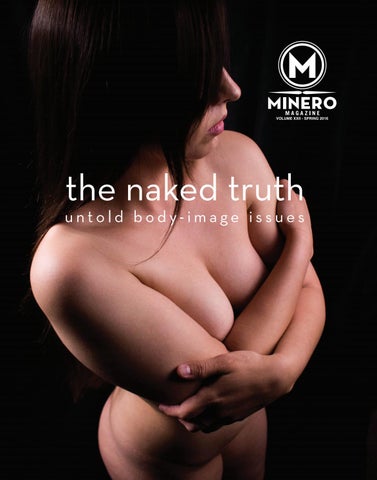
the naked truth untold body-image issues
Minero Magazine Spring 2016 .indd 1
1/6/16 7:22 PM
Minero Magazine Spring 2016 .indd 2
1/6/16 7:22 PM
Editor-in-Chief
Adminisitrative Secretary
Jose Soto
Marcela R. Luna
Art Director
Advertising Director
Jacobo De La Rosa
Veronica González Editorial Advisor/Director
Copy Editor
Fernanda León Photo Editor
Andres Martinez
Kathleen Flores Covers: Photography
Andres Martinez Design
Jacobo De La Rosa Wr i t e r s
Models
Fernanda León Maria Esquinca Jose Soto
Additional Model
Kristen Brice Dereck Neyland Amy Marie Licerio
Photography
Andres Martinez Fernanda León
Special thank you to:
UTEP Department of Art Please contact us at:
Designers
Fernanda León Vanessa Guevara Jacobo De La Rosa Advertising Designers
Jacobo De La Rosa Vanessa Guevara Edgar Hernández
Account Executives
Mariel Mora Valeria Delgado
minero@utep.edu Minero Magazine Department of Student Publications The University of Texas at El Paso 105 Union East 500 West Univesity Avenue El Paso, Texas 79968-0622 Minero Magazine is published by UTEP students through the Department of Student Publications. It is published once every fall and spring semester. Periodicals postage is paid at El Paso, Texas. Minero Magazine is not responsible for any claims made by advertisers. Additional policy information may be obtained by calling Students Publications at 915-747-5161. Views expressed in this publication are not necessarily those of the university.
Accounting Specialist
Isabel Castillo
Minero Magazine Spring 2016 .indd 3
1/6/16 7:22 PM
contents 6 10
Las Diferentes Caras de un Actor By Fernanda León
Measuring Up By Maria Esquinca
pg.
pg.
La Mezcla Ser una mujer birracial en esta sociedad By Jose Soto
Strong is the New Sexy How a female body builder found self-love By Jose Soto
8 6
pg. pg.
from the editor Most of us have the necessity of doing this highly common ritual: looking at ourselves in the mirror. While doing so, we’re simply not looking at our reflection, we are depicting our flaws and our shortcomings, or rather what we perceive as our flaws and shortcomings. Few are absolutely satisfied with their reflection–most of us would alter, redesign or completely discard a feature. It isn’t something we discuss commonly, but the issue is there. When it comes to body-image issues, it isn’t always about fat or skinny, big or small, round or flat–whatever derogatory terms are used to describe body parts. There are other issues that are usually taboo, rarely discussed, not reported on.
Minero Magazine Spring 2016 .indd 4
This issue of Minero Magazine hopes to expose issues that the human population faces, both physically and socially. The issues that come with either beautifying or degrading certain body parts/characteristics are very complex. There are many contributing factors such as the media’s depiction of attractiveness; what is socially acceptable and tolerated. Many campaigns and causes provide positive reaffirmation toward the human body, especially for females. We wanted to provide the same positivity toward issues that aren’t normally addressed. As editor-in-chief, I strived for this issue to provide a different approach to the type of reporting we’ve previously con-
ducted. The last two issues had a social and political thematic nature. This time, we opted for a humanistic one instead, exposing the issues people face when it comes to the perception of physical beauty. Without sacrificing our passion for accurate and relevant journalism, we crafted out stories that would resonate well with the UTEP and El Paso community. Como siempre, tuvimos presente a la gente de nuestra comunidad para representarlos en los reportajes. Es importante que los artículos de esta y cada edición de Minero dejen una huella en nuestro público para que se creé una conexión para que nuestros labores como reporteros tengan un final productivo y efectivo. Esperamos
que ustedes se relacionen con el contenido de los articulos. The stories we have provided you in this issue aim to reveal that you are not facing these situations alone. Whether the stories tell your personal one or not, they are intended to illustrate the fact that we all endure the same human struggle: to come to terms with our body and appearance, to embrace them and love them and to break away from the sociallyimplemented definition of what is beautiful or not. We hope you enjoy this issue of Minero Magazine.
Gracias por todo.
1/6/16 7:22 PM
EAT THE SUSHI. ...
We oFFer healthy, nutritious and exquisite Food alternatives that satisFy a healthy liFestyle.
..... ...
10% oFF with UTEP Student ID
LOCATIONS:
Kern Place 2604 N. Mesa
Minero Magazine Spring 2016 .indd 5
&
West Side 5905 N.Mesa St.
1/6/16 7:22 PM
LASDIFERENTES CARAS DE UN ACTOR POR FERNANDA LEÓN fotografía por FERNANDA LEÓN
diseño por JACOBO DE LA ROSA
“B
socialmente por distintos estereotipos que son más notorios entre la sociedad.
ueno, yo no soy el caso de eso. Es decir, no tengo el estereotipo de galán y soy un hombre ya de 50 años”, Joaquín Cosío, actor y poeta mexicano, dice.
Por otro lado, los estereotipos, las diferentes castas, nacionalidades e incluso la apariencia física del género masculino en los distintos tipos de medios no suele ser un tema frecuente.
Cosío, como muchos otros profesionales y semiprofesionales en el ámbito actoral, han experimentado distintas dificultades al momento de involucrarse en los criterios que son utilizados por los distintos medios en el cine, la televisión y el teatro.
El hecho de observar personajes masculinos con buen físico y de facciones finas en diferentes programas de televisión y en diferentes filmes es percibido como un
Comúnmente, es la mujer quien es representada
6
Minero Magazine Spring 2016 .indd 6
1/6/16 7:22 PM
S
“
Tengo la suerte de trabajar bastante en cine y los papeles que me dan no son propiamente de personajes en ese sentido .
El teatro no necesariamente se vale de eso (estereotipos) y el cine tampoco.
Joaquín Cosío
actor y poeta mexicano
suceso normal. Al igual sucede con los estereotipos que varios actores llegan a experimentar debido a su cultura y lugar de origen. “Yo llegue a México a los 38 años,” dice Cosío. “También, ya llegue grande. Entonces en mi caso no ha sido ese estereotipo el capital con el que yo he podido trabajar”, menciona Cosío. “Sin embargo, efectivamente la televisión, sobretodo, se mueve mucho por estereotipos de belleza. Más que actores muchas veces utilizan modelos”. El ámbito, tanto teatral como cinematográfico, también es conformado por personas externas a los actores. Tal es el caso de técnicos, diseñadores, mentores, entre otros. “Cada persona en la industria tiene una marca diferente en la forma en que ejecutan sus habilidades, algunos tienen una mentalidad abierta y la capacidad para adaptarse al cambio y otros son más estrictos y de mente cerrada”, dice Mark Sadler, ex-alumno de la Universidad de Texas en el Paso quien obtuvo su licenciatura en teatro técnico. Sadler, quien ha trabajado como diseñador y técnico en obras como “Esperanza Rising”, “Othello” y “The Scarlet Letter”, hace mención sobre la importancia que el buen físico conlleva a la hora de escoger a los actores de una obra. “La apariencia hace una gran diferencia a la hora de ser escogido para interpretar algún papel”, dice Sadler. “Si eres esbelto, formado y de buen físico, la mayoría del tiempo los papeles principales son para ellos mientras que los individuos que tienen sobrepeso ó no tienen ese
factor 'wow' se les dan roles más pequeños ó de comedia". De acuerdo a la opinión de Sadler, y como es visto continuamente en los medios, es muy común que los directores y demás profesionales del medio artístico seleccionen como protagonistas de su trabajo a hombres con un físico atractivo ya que es lo que más llama la atención del público. Sin embargo, con el paso de los años y la constante transformación que sufre tanto el teatro como el cine y la televisión para ofrecer ideas y conceptos innovadores, muchos profesionales han ido rechazando poco a poco los estereotipos que son muy constantes en distintos personajes masculinos. Un ejemplo viene de la mano de los diferentes proyectos y personajes que Cosío ha interpretado. Con varias personificaciones tanto en el cine nacional como internacional, Cosío ha interpretado a personajes como El Cochiloco en la película mexicana “El Infierno”, Hassan en “Los Héroes del Norte”, el General Medrano en “Quantum of Solace” (Cuántico de Consuelo), entre otros. Debido a su variada experiencia y constante aprendizaje en el medio, Cosío admite que aún existen varios estereotipos que resaltan en los roles otorgados al actor masculino. Aun así, Cosío también dice que existe una industria del entretenimiento que va alejada del uso de estereotipos. “El teatro no necesariamente se vale de eso (estereotipos) y el
”
cine tampoco”, dice Cosío. “Tengo la suerte de trabajar bastante en cine y los papeles que me dan no son propiamente de personajes en ese sentido”. Varios estereotipos del personaje mexicano en los Estados Unidos son relacionados con los diferentes aspectos de la cultura mexicana y la creencia de los extranjeros con respecto a la anatomía de los hombres mexicanos. Los sombreros, la vestimenta tradicional, el aspecto desaliñado, el acento marcado al hablar el ingles y el físico, son algunas de las características con las que el mexicano es y ha sido representado en el cine estadounidense y en el extranjero en general. Muchos de estos estereotipos han ido disminuyendo, más no desparecido por completo, a travez de los años. “La cultura a empezado a amoldar la manera en que las personas son vistas y ahora esta llegando a diferentes audiencias y, a la vez, rompiendo la barrera de los estereotipos”, dice Sadler. “Aun hay mucho camino por recorrer pero ya ha habido mucho progreso”. Tras haber tenido la oportunidad de trabajar en el mundo de la actuación en los Estados Unidos, Cosío admite notar cambios en el mundo del entretenimiento que van eliminando la manera de interpretar a ciertos personajes así como utilizar el talento como el principal factor para seleccionar el trabajo de algún actor y no su apariencia. Asimismo, no solo son los actores
7
Minero Magazine Spring 2016 .indd 7
1/6/16 7:22 PM
y sus personajes quienes han sido perjudicados por los estereotipo, sino también el mundo o la escenificación que rodea el trabajo del actor. “Ya también la industria se ha liberado un poco de eso”, dice Cosío. “Hay casos, por ejemplo en la película de 'Terminator', donde si hay una representación del Mexico típico. Actualmente, yo creo que nos estamos escapando de eso, aunque los estereotipos se siguen utilizando, pero ya hay películas como 'A Better Life', con el actor Demián Bichir, que habla sobre el migrante en los Estados Unidos”. El giro que se le ha dado al cine, al teatro y en muchas veces a la televisión es en la actualidad un resultado de una industria de entretenimiento más enfocada en la realidad. La percepción exagerada y simplificada que se utiliza para representar a muchas culturas,
lugares, hábitos y personajes en los diferentes medios artísticos se ha ido disminuyendo para, ahora, presentar una realidad y un concepto más sólido a la audiencia. Así, se puede buscar evitar que se creé una percepción común sobre algún personaje ó cultura. A pesar de que sea más obvia la representación de la mujer artista en papeles estereotipados, el hombre que trabaja dentro del medio artístico también dedica su labor a representar personajes que sufren de varios estereotipos. Esta situación es mucho más común dentro de las minorías donde, por ejemplo, los actores latinos representan solamente a aquel personaje de tez morena, con un acento marcado y con un sentido del humor muy grande. Por otro lado, los estereotipos también se presentan dentro de las
“W
Stereotypes are labels that are commonly used by the media to portray beauty goals, certain behaviors or even cultural traditions. These labels are usually geared toward women, but, on the other hand, men are also stereotyped by the different areas of the entertainment industry.
Actores como Joaquín Cosío y técnicos como Mark Sadler, ambos han presenciado los estereotipos tanto enfrente como detrás de cámaras, pero, igual han presenciado como poco a poco estás características se vuelven menos fuertes. “Es loco como todo esto trabaja, pero lo que importa en realidad es que tan bueno eres y que tan bien sabes venderte”, dice Sadler
.
Sadler says that culture has changed and it is now starting to shape the way people are seen and, due to this action, audiences are now looking at more realistic representations of different characters in the media that are, little by little, breaking stereotypes.
Race, nationality and physical appearance are some of the characteristics where stereotypes take over in the different male roles shown in films, television and theater.
INBRIEF
En nuestra sociedad actual y con los ideales que esta conlleva, los estereotipos han ido disminuyendo de manera que el medio artístico ha roto tabúes y se ha dedicado a presentar una sociedad y situaciones más cerca de la realidad.
alumnus of The University of Texas at El Paso, who received his bachelor’s degree in theater arts. “If you’re slender, built and good looking, most of the time the leading roles will be given to them, while individuals who are overweight or don’t have that wow factor, will be given comedic or smaller roles.”
ell, I was never that case. I mean, I don’t have the beau stereotype and I am already a 50 year-old man,” says Joaquin Cosio, Mexican actor and poet.
“The industry has liberated itself a little bit (of stereotypes),” Cosio says. “There are many cases like the movie ‘Terminator,’ where there is a representation of the traditional Mexican. Nowadays, I think that we’re escaping from that. Even if stereotypes are still present, there are movies like ‘A Better Life,’ with Demián Bichir, that talks about the migrants in the U.S.”
It is very common to see minorities represent secondary characters. For example, the Latino actor usually gets to play the funny and chubby man, who most likely will have an accent. On the other hand, stereotypes are also present in major roles, where the principal characters are usually white and have an attractive physical appearance. Apart from all those characteristics, this character is usually a leader.
Professionals such as Cosio and Sadler have experienced or seen the use of stereotypes in the different male roles in the entertainment industry, but, at the same time, they have both seen a betterment in the use of them. “Crazy how that works, but what it comes down to is how good you are and how good you can sell yourself,” Sadler says
.
“Appearance does make a huge difference when it comes to being chosen for a role,” says Mark Sadler,
Minero Magazine Spring 2016 .indd 8
mayorías ya que es muy común que el personaje principal sea de tez blanca, ojos de color claro, buen físico y, además, tenga cualidades de líder y una personalidad amable.
8
1/6/16 7:22 PM
GETMOVING! REACH YOUR FITNESS GOALS THIS SPRING
THERE IS SOMETHING FOR EVERYONE
@
RECREATIONAL SPORTS DEPARTMENT 3450 SUN BOWL DR. EL PASO, TX 79968 • Tri-level Facility • Climbing Pinnacles & Bouldering Walls • 2 Fitness Studios, Mat Room and Boxing Gym • Over 100 Cardio Machines • Over 70 Selectorized Machines
• Separate Free Weight Area • 2 Indoor Basketball Courts • Multi-purpose Activity Court (MAC) • Indoor Running Track (1/8 mile) • Competitive and Recreational Pools • Lounge Areas •Fitness Classes •Challenge Course •Intramural Sports •Outdoor Trips •Outdoor Equipment Rental
915-747-5103 utep.edu/rsd recsports@utep.edu
Minero Magazine Spring 2016 .indd 9
1/6/16 7:22 PM
Measuring Up Story by Maria Esquinca Photography by Andres Martinez Design by Jacobo De la Rosa
In this story, “Tomas” asked to remain anonymous; his real name has been protected by using a pseudonym.
T
omas, a UTEP student, stares at his smartphone and swipes his thumb across a mosaic of pictures of half-naked men on ”Grindr,” a gay hook-up application. He flicks his finger over countless images of smiling men, most of them in search for the perfect hook-up. “Grindr” launched in 2009 and is marketed as the world’s largest gay social network. According to the site, it has more than 1.6 million active daily users exchang-
ing over 70 million chat messages and five million pictures on iPhone, iPad, iPod and Android devices. “Basically, you just click on somebody and then you click on whoever you want to hook-up with and you just message them,” Tomas says. “They’ll reply, and then it goes from there, they host and they’re like 'this is my location,' and you meet them there, and you just fuck.”
10
Minero Magazine Spring 2016 .indd 10
1/6/16 7:22 PM
After seven minutes of skimming, Tomas receives two messages.
because most of the industry is privately owned.
“So usually you start a conversation and you’ll be like ‘hey, you know, I’m horny,’ and then if you’re a bottom (a person that is penetrated during intercourse) they’ll ask for a picture of your ass,” says Tomas. “If you’re a top, (a person that penetrates during intercourse) of course they’ll ask you for a picture of your dick.”
The Internet has helped fuel the expansion of porn. It has expanded its scope and reach and made it cheap and accessible. TopTenReviews estimates that there are 4.2 million pornographic websites, 42.7 percent of all Internet users view porn, and 68 million pornographic search engine requests are made daily.
Tomas got a “Grindr” account four years ago. He calls El Paso a “bottom town.” He says that gay men in El Paso have a fetish for large penises, a preference he attributes to porn.
Research also shows that men view porn more often than women. Internet user data from the General Social Survey found that men are 543 percent more likely to look at porn than females. In an article published in the Journal of Adolescent Research, researchers surveyed college students ages 18 to 26 and found that 87 percent of men, roughly nine in 10, reported using pornography, compared to 31 percent of women.
“People here are living this kinky fantasy of being porn stars,” he says. “They want to make it (sex) happen the same way and they don’t realize that there’s a plan behind porn and in real life you don’t have that.” Tomas says he does not care about penis size; he places more importance on foreplay and technique. However, he resurfaces a classic, and perhaps stereotypical, male conundrum—penis size.
The Porn Industry and Large Penises
The porn industry is a billion dollar industry. TopTenReviews, a research group, estimates that that the U.S. revenue for porn exceeds the combined revenues of the television stations ABC, CBS and NBC combined with an estimated $6.2 billion, while the size of the industry is $57 billion worldwide. However, exact estimates are difficult to estimate
“A lot of young men grow up thinking penis size is really important and that most women care much about it,” said Auroly Luykx, anthropology professor and sex educator. “Porn gives men the idea that this is what successful, skilled sex is. It’s having a huge penis.” According to The Porn Report, a content analysis of best-selling pornographic videos and DVDs in Australia, only 3 percent of the male actors had small penises and 55 percent had penises that were longer and/or thicker than the average penis. Little research has been done to examine whether watching porn can affect self-image. However, a study
by the University of Amsterdam, titled “Does exposure to sexually explicit Internet material increase body dissatisfaction? A longitudinal study,” sought to examine if exposure to sexually explicit Internet material leads to male and female body dissatisfaction with stomach size, penis size and breast size. Researchers surveyed 1,879 Dutch males and females who ranged from ages 12 to 87. The study's findings reveal that male exposure to sexually explicit Internet material resulted in greater dissatisfaction with their body and stomach. However, it had no effect on male satisfaction with their penis size. The researchers concluded that because males have less control over the size of their penis than the size and shape of their stomach, it might suggest that people may feel less in control of changing their bodies than assumed. One of those men is Adriano Kristian Perez, a senior biological sciences major. Perez is a transgender man, who prefers to be addressed as a gender-queer identified bisexual person. “I think that society places a great amount of emphasis on genitalia as a marker of gender identification,” he said. Perez does not believe gender is defined by genitalia. He does not want to have sex-reassignment surgery, something that could cost anywhere from $5,200 to $13,000, depending on the procedure. “I don’t think my genitalia makes me less of anything,” he says. “So the fact that I was born with a vagina, that does not make me any less than a man and it does not make me a woman.
“I don’t think my genitalia makes me less of anything.” Adriano Kristian Perez
senior biological sciences major
11
Minero Magazine Spring 2016 .indd 11
1/6/16 7:22 PM
I am a man with a vagina. I am a gender queer masculine person with a vagina, and I think that’s okay.” However, some men do feel pressured to change their bodies.
Phallosplasty:
The Cost of a Larger Penis
Robert Caporitti, a cosmetic surgeon at the Texas Phalloplasty Institute in Houston, has been practicing phalloplasty since the early 1980s. Phalloplasty is the surgical reconstruction of a penis to increase lengthening, girth and/ or the penile glands. Phalloplasty is something Caporittie says has increased in popularity in part because of the Internet. The most popular services Caporitti offers are the pure graft transfer, penile length-ening and penile widening. “If a person came in and said that they thought you would go two to three inches right away, that would be unrealistic,” he says. “By the time they leave the consultation, they know what to expect and what not to expect. I cannot guarantee anything, but I give them the benefit of my experience.” A pure graft transfer is a technique in which fat is removed from the abdomen through liposuction. Penile widening is the injection of fat into the penis to make it wider. Penile lengthening is a procedure where the surgeon cuts the ligament that connects the penis to the pelvic bone. The procedure requires that two weeks after the surgery, the patient be fitted with an extender device that he has to wear for six hours a day for six months. Caporitti said he has up to five
12 Minero Magazine Spring 2016 .indd 12
new patients every week. A majority of them are middle-aged, ranging from 35 to 40 years old. They come from all over the world, not just Texas. Most of them will do a combination of lengthening and widening, which costs anywhere from $7,500 to $9,500. “I ask them what they think the average male length is and a lot of them will volunteer they think it’s four to five inches, so I tell them ‘no, you’re average.’ If you’re 3.5 inch, you’re the average male,” Caporitti says. “But nobody changes their mind just because of that.” Caporitti’s three-and-half-inch figure closely matches that of Dr. Eduardo A. Gómez de Diego, the founder and general manager of Andromedica, who collected data to determine what was the average male penis size around the world. His data places the average size of a flaccid penis for U.S. males at 3.4 inches and at 5 inches when erect. The largest average penis size is from Spain, at 5.9 inches erect, while the lowest is South Korea, 3.7 inches erect. In comparison, most male porn start have an average penis length of 8 inches. “If penis size were all that important to our survival and our reproduction, we’d have a lot more guys with really large penises,” Lukyx says. “The fact that it’s so variable suggests that the size is really not very important. It’s a connection that our culture makes and hammers into boys' heads from a young age.” After six months, Caporitti said patients can expect penis length to increase by an inch, but he has had a lot of patients who do better than that. He could not answer whether he attributes phalloplasty to porn usage because his patients do not share that information. “The motivation of the men is different, but the main motivation is they simply feel they are undersized compared with their peers,” he says. “Even though they may be average, their selfimage is that they are not.”
12
1/6/16 7:22 PM
En Breve En esta historia, “Tomas” pidió permanecer anónimo; su nombre verdadero ha sido protegido con el uso de un pseudónimo. Tomás, un estudiante de UTEP, observa su teléfono móvil mientras ve una gran cantidad de fotografías de hombres semi desnudos en “Grindr”, una aplicación de citas dirigida a la comunidad homosexual. “Básicamente, solo seleccionas a alguien y luego haces clic en el perfil de la persona con la que quieras ligar y les mandas un mensaje”,Tomas dice. “Ellos te contestaran y luego ahí empieza todo. Ellos serán anfitriones y compartirán su localización para que los puedas encontrar ahí y solamente coges”. De acuerdo a Tomás, una vez que uno empieza una conversación con alguien en esta red de citas, los usuarios preguntaran que si uno es penetrado y se envíe una fotografía de su trasero. Por otro lado, si uno es quien penetra, entonces se pedirá una fotografía de su pene. Tomás, quien ha contado con cuenta de “Grindr” por cuatro años, menciona que la comunidad gay de El Paso tiene un fetiche por los penes grandes, preferencia que le atribuye a la pornografía.
La Industria de la Pornografía y los Penes Grandes La industria de la pornografía es una compañía billonaria. TopTenReviews, un grupo de investigación, estima que los ingresos de la pornografía en Estados Unidos excede los ingresos combinados de estaciones de televisión ABC, CBS y NBC con un estimado de $6.2 billones. “Muchos jóvenes crecen pensando que el tamaño del pene es muy importante y que a las mujeres les importa mucho”, dice Auroly Luykx, profesor de antropología y educador sexual. “La pornografía les da a los hombres la idea de que el sexo exitoso y experto viene de tener un pene grande”. De acuerdo a The Porn Report, un análisis de contenido de los videos y DVDs mejor vendidos en Australia, solo el 3 por ciento de los actores masculinos tenían penes chicos, mientras que el 55 por ciento tenían penes más largos y/ó gruesos que el pene promedio.
Faloplastia
El Costo de un Pene Más Grande Robert Caporitti, un cirujano plástico de el Texas Phalloplasty Institute en Houston, ha estado practicando faloplastias desde principios de los años 80. La faloplastia es la reconstrucción quirúrgica del pene para aumentar la longitud, el grosor y las glandes del pene. Caporitti menciona que la faloplastia ha ganado popularidad gracias al Internet. Los servicios más populares que Caporitti ofrece son la transferencia pura de injerto, el ensanchamiento de pene y el alargamiento de el mismo. La transferencia pura de injerto es una técnica en donde la grasa es removida del abdomen a traves de la liposucción. El ensanchamiento de pene consiste de una inyección de grasa en el pene para hacerlo más ancho. El alargamiento de pene es un proceso donde el cirujano corta los ligamentos que conectan al pene con el hueso pélvico. “La motivación en cada hombre es diferente, pero su mayor motivación es que simplemente sienten que su miembro es pequeño a comparación de otros hombres”, dice Caporitti. “A pesar de que muy posiblemente tengan un tamaño promedio, su imagen personal les dice lo contrario”.
13
Minero Magazine Spring 2016 .indd 13
1/6/16 7:22 PM
Minero Magazine Spring 2016 .indd 14
1/6/16 7:22 PM
2016 Resolutions Spend more time studying Be kinder to the environment Work out at the Student Rec Center Meet new people Increase my GPA Get more involved on campus
LIVING ON CAMPUS WILL HELP YOU COMPLETE OR MEET YOUR RESOLUTIONS • Graduate on time. • Have a higher GPA. • Balance your studies, recreation and social life. • Be more satisfied with your college experience.
• An assortment of living options. You can live alone or with friends. • Central location with the optimum distance to everything a student needs. • Apartment style housing. • All utilities included.
You will be more likely to:
Living on Campus offers :
MORE INFO sa.utep.edu/housing CONTACT housing@utep.edu 915-747-5352
STOP BY FOR A TOUR!
1/6/16 7:22 PM
“Mi pelo era y sigue siendo muy obscuro y bastante grueso”, dice Jade. “Mi madre tenía que hacer una mezcla de aceite de coco y gel para apaciguarlo y hacerme una ‘colita' bien apretada. Me daba dolor de cabeza", dice Amy. Jade dice que la melena de ella es bastante rizada y cuenta que de niña se quería rapar la cabeza. “A los otros estudiantes les encantaba tocar mi pelo porque era diferente”, dice Jade. “Yo le rogaba a mi mamá que me comprara un relajante, pero jamás lo hizo. Ella quería que apreciara las cosas que me hacían y me hacen única”. Recientemente, un grupo de activistas llamado Mexico Negro logro que el censo nacional mexicano incluyera la categoría de afro-mexicanos. De acuerdo a Quartz, una publicación de economía global, 1.2 por ciento de los mexicanos viviendo en Mexico son de descendencia africana. Hoy en día, esas personas pueden identificarse
“I hated when I was called ‘brillohead’,” says Amy Marie Licerio, a recent graduate with a bachelor’s degree in multimedia journalism. “When I was a little girl, other students would ask me if I was mixed (race) and I wouldn’t bother because I would always say ‘yes.’ I have always known that I’m black and Hispanic. My cousins and my aunts looked a lot like me, but it wasn’t until I started school that I noticed how different I was.” Even though El Paso is made up of people of Hispanic or Mexican origin, the city is a mix of persons, a fusion of the Mexican culture with a variety of ethnicities. The Hispanic community at The University of Texas at El Paso is at about 80 percent while only 0.6 percent falls under the multiracial category. “It wasn’t until my family moved to the west side of the city when I
adecuadamente en un reportaje de censo. Quizá esto no sea pertinente aquí en El Paso—aunque estemos en proximidad con Mexico—pero sirve como ejemplo de como la gente biracial necesita una manera de identificarse fuera de las simples opciones representando blanco o negro. “Ser birracial significa que tienes facciones que contribuyen a muchas clases de etnias”, Jade dice. “Esto quizá hace a la gente sentirse incómoda porque no te ves como ellos perciben a un afro-americano. Ya acepté mis facciones y hasta me da gusto ser birracial. He dejado de maquillarme de una manera para verme más clara, ó hacer que mi nariz parezca más chica”, dice Jade. “He dejado de teñirme el cabello de otro color. Es cansado pelear con los aspectos genéticos". Jade menciona que ya se dio cuenta que ella puede definir por si misma lo que viene siendo la belleza. No tiene que aparentar lo que la sociedad quiere.
Minero Magazine Spring 2016 .indd 15
“Es muy fácil decirle a otras niñas que son bellas y únicas, aunque es la verdad y es importante reafirmárselos", Jade dice. "Pero también necesitamos que sepan que todas las cosas buenas toman tiempo. Como un buen vino, la mujer mejora con el tiempo.” Aunque la reafirmación es esencial para el desarrollo de la aceptación para todas las mujeres, dice Jade que también es importante dejar a los jóvenes biraciales tomarse su tiempo para estar cómodos con su apariencia y distintas características. Al mismo tiempo, ella reconoce que aún queda mucha labor social para llegar a una etapa donde la unicidad sea aceptada. “Creo que como una nación, tenemos todavía un camino larguísimo para llegar a aceptar a todos con sus características únicas y distintas”, Jade dice. “Eso va más allá de la gente biracial solamente”
.
Hair is one of the most obvious characteristics of biracial people. Both women experienced problems due to the way their hair looks. “Today I have accepted my looks and I’m proud of being biracial. I have stopped doing my makeup in a way that I looked whiter or making my nose look smaller. I have stopped dying my hair with another color,” Jade says. “It is tiring to fight with your genetic aspects. I have realized that I can define by myself what beauty really is. I don’t have to feign what society wants.”
Being biracial consists of the combination of two or more races. According to a study conducted by Pew Research Center, 60 percent of biracial people in the United States are proud of their linked roots. At the same time, this same study found that 55 percent of these people have been subjected to racial insults, specifically for their appearance.
being biracial. She started to view her reality after an experience with another child. “When I was 6, a kid told me that I couldn’t play with him because he didn’t want to play with a black,” Jade says. “Before that, I have never seen myself in the mirror and thought that I was AfricanAmerican.”
noticed the ‘cultural shock’ and saw myself as someone different than the others,” Amy says. “Most of my classmates were from Anglo or Hispanic origin. I felt different in a bad way. It wasn’t until I got involved with artistic studies that I started to accept the characteristics that make me a biracial person.”
Likewise, Jade Williams, an English and American literature major at UTEP, has also dealt with
10
1/6/16 7:22 PM
D
e niña, Amy Marie Licerio, recién egresada de la carrera de periodismo, iba al baño de su escuela primaria para peinarse constantemente el cabello. Su cabello “de bebe”, como le llama ella, se esponjaba y desacomodaba. Se mojaba las manos para luego acomodarse la melena. Esta acción, dice ella, funcionaba solamente por un tiempo breve. Veinte minutos después, ella tenía que volver a acomodar su cabello de nuevo.
en su mayoría de origen anglo o hispano. Me sentía diferente de una mala manera. No fue hasta que me involucre en estudios artísticos que empece a aceptar mis características como una persona birracial”. Ser birracial es determinado como la combinación de dos o más razas. De cuerdo a un estudio
Minero Magazine Spring 2016 .indd 16
no comprendes inmediatamente que algo sobre ti es diferente”, Jade dice. “Mi mamá es de raza caucásica. Notaba que ella era más blanca que yo pero no era gran cosa”. No fue hasta que una experiencia con otro niño abrió los ojos de Jade a la realidad sobre su tono de piel.
“Odiaba que le llamaran ‘brillohead’”, Amy dice. “Cuando era chica, los otros estudiantes me preguntaba si era mezclada'. Siendo niña chiquita, no me molestaba tanto ya que simplemente les respondía que 'si'. Amy menciona que siempre supo que era hispana y negra. “Mis primos y mis tías se parecían mucho a mi”, Amy dice. “No fue hasta que empecé la escuela que comencé a notar lo diferente que era”. Aunque El Paso esta compuesto por habitantes de origen mexicano/ hispano, la ciudad es un revoltijo de personas, una fusión de la cultura mexicana con una variedad de otras etnias. De acuerdo al Texas Department of State Health Services, la ciudad es anfitriona de aproximadamente 877,248 personas. También es anfitriona de una población diversa. La comunidad hispana abarca aproximadamente el 80 por ciento de la población estudiantil de la Universidad de Texas en El Paso. Solamente el 0.6 por ciento esta bajo la categoría de multirracial. “Yo crecí en el lado noreste de la ciudad”, Amy dice. “Ahí había bastante gente que se parecía a mi. Recuerdo que tenía los labios grandes y luego me pusieron frenos dentales y se veían aún más grandes. No fue hasta que mi familia se mudó al oeste de la cuidad cuando realmente sentí el ‘choque cultural’ y me percibí diferente a los demás. Mis compañeros eran
conducido por el Pew Research Center, 60 por ciento de la gente birracial en los Estados Unidos se sienten orgullosos por sus raíces vinculadas. Al mismo tiempo, el mismo estudio encontró que 55 por ciento habían sido sujetos a insultos raciales, específicamente por su apariencia y facciones. Amy dice que fue esas facciones cuales la llevaron a obtener ciertos papeles en obras escolares. “Me daban los papeles ‘exóticos’”, Amy dice. “Es cuando deje de que me importara mi apariencia comparada a los demás”. Al igual que Amy, Jade Williams, una estudiante de la Universidad de Texas en El Paso enfocada en estudios de literatura en inglés, también con entiende lo que es ser birracial. “Como una niña birracial,
“Cuando tenia 6 años, un niño dijo que no podía jugar con él porque no quería jugar con una negra”, Jade dice. “Antes de eso, nunca me había fijado en el espejo y pensar que era Africa-Americana. Desde ese día, yo empecé a estar consciente de mi genética y de lo diferente que era ser de dos culturas, al menos en ese tiempo”. Jade cuenta que ella, y otras cinco personas más, eran de origen africano en una escuela compuesta de más de 500 estudiantes. Ella dice que los demás se quejaban de su tez y su cabello. El cabello viene siendo una da las características más evidentes de la gente birracial. Ambas mujeres tuvieron problemas de imagen causadas por su cabello.
9
Minero Magazine Spring 2016 .indd 17
1/6/16 7:22 PM
BIRRACIAL Por Jose Soto // Fotografía por Andres Martinez // Diseño por Fernanda León
1/6/16 7:22 PM
get into shape. I picked up a magazine called Oxygen. I was amazed at these women in the magazine– they were beautiful. It was a different kind of beauty–one that you can’t just buy at plastic surgeon’s office. These women had muscle, and it was attractive, sexy and sensual with a spice of tough. I told myself that I wanted that. I wanted to transform not only my inner self, but also my body. Alicia then found a coach who was a National Physique Committee judge. He helped and motivated Alicia to start her progress and enter competition in one or two years. She then returned to the surgeon’s office and got her money back, proving to herself that she would do it without any nip and tuck. She has since been competing in national competitions and training others to do the same, never once paying heed to the opinions of others. Q: What kind of responses have you gotten to your involvement in this sport? A: Many stated that I looked sick, that I looked like a man, that I did not have curves anymore, I should get implants–you name it. However, I do this for me and I love the way the body is built. I am a person
E
l concepto de la belleza es muy complejo. Su definición es objetiva y viene de lo que la sociedad considera bello. Nadie es más sujeto a esta definición que la población femenina. Es muy común ver figuras de mujeres delgadas ó voluptuosas en los medios de comunicación representando la ”figura ideal” de la mujer. Muchas mujeres optan por obtener dicha apariencia en particular mientras que otras desafían el concepto social que se tiene sobre la anatomía femenina. Una de ellas es Alicia Ramos, 34, quien dedica gran parte de su tiempo al fisicoculturismo, deporte donde predomina la figura masculina. A pesar de que los músculos en los hombres son vistos de manera atractiva, las carac-
who goes for what I envision, and never asks anyone what they think. Not because I don’t care what others feel, but because if I am doing the work, I can really care less if someone else approves or disapproves. Actually, I feel that it’s my perspective that is important. I feel that muscle on the female body looks empowering and shows dedication and love for oneself. It takes work and fun work at that. People will always have an opinion, that’s the awesome thing that makes us all different. Q:What is it that attracts you to the sport of body building?
A: To be honest, I love the way the body can change. The body is such an amazing machine, what the mind can fathom the body will shape. It’s extremely empowering and addicting. It’s art in my eyes. I am an artist of my own canvas and how I manipulate my training and my nutrition, I shape my curves and colors of my masterpiece.
terísticas musculares no son vistas de igual manera en las mujeres. Alicia dice que, a pesar de los ideales de la sociedad, ella se siente atractiva en su propia piel. Minero Magazine hablo de este tema con Alicia, quien es egresada de la Universidad de Nuevo Mexico en la carrera de nutrición. Q: Qué the indujo a este deporte? A: Hace cinco años, estaba en una consulta con un médico e hizo una composición corporal para mi. Una composición corporal es un termino que describe los varios porcentajes de grasa, agua, hueso y músculo que el cuerpo humano tiene. Después de mi examen, determinaron que el 41 por ciento de los porcentajes era grasa. Estando en este campo, eso fue una cachetada en mi cara.
Minero Magazine Spring 2016 .indd 18
,,
,, Q: What is your advice for women who struggle with body image? A: I can remember mine started at the age of 10 years old. I went on my first diet to lose weight. Now that I think back, that is insane. Sexy or pretty is an energy I feel. You have to love yourself; confidence in yourself is silent. You do not need to prove or try for anyone. Strong is the new sexy! You and I can achieve anything we focus on, we just need to delete doubt and fear out of the equations. On the other side of fear is success.
Q: Qué es lo que más te atrae del fisicoculturismo? A: Para ser honesta, la capacidad que tiene el cuerpo para cambiar. El cuerpo es una máquina sorprendente, lo que la mente puede imaginar el cuerpo lo hará. Es arte en mis ojos. Soy artista de mi propio lienzo y de como manipulo my entrenamiento y mi nutrición. Q: Que consejo les dirías a las mujeres que sufren con la imagen de su cuerpo? A: Tu y yo podemos obtener todo en lo que nos enfoquemos, solo necesitamos borrar la duda y el miedo de nuestras ecuaciones. En el otro lado del miedo, esta el éxito.
7
1/6/16 7:22 PM
T
says she feels sexy in her own skin and rightfully so. Minero Magazine discussed the issue with Alicia, who has her degree from New Mexico State University in human nutrition with a focus in dietetics, she has been bodybuilding since 2007, and is also a health and wellness educator for the Army Wellness Center. She has a certification through WellCoaches and Certified Personal Training through the American College of Sports Medicine.
A: About five years ago, I was consulting with a physician for his development of expanding his wellness program and he did a body composition for me. Body composition is a term that describes the various percentages of fat, water, bone and muscle in human bodies. After my test, it was determined I was 41 percent body fat at 160 lbs; 5'' feet tall. Being in this field, that was a slap in the face for me. In regards to overall health I was great; my blood work was optimum. However, the body composition showed me an area that needed my attention. This perplexed me. I was eating six healthy meals a day and
It is common to see both a slender or voluptuous figures of females in the media. In turn, many females strive to obtain that particular look. Others, however, take no consideration of what society’s views are about the female anatomy. Alicia Ramos, 34, is one of them. She is in the world of bodybuilding, which is one that is primarily dominated by males. There are, however, some women who take on the competitive sport despite how it might alter the female body. Although muscular features are deemed “sexy” on men, society’s view of these features on women aren’t the same. Alicia
Q: What got you started in this sport?
he concept of beauty is a complex one. The definition is objective, primarily originating from what society considers to be beautiful. No one is more subjected to these implications than the female population. A vast majority of the examples they are given to define what a beautiful and sexy female anatomy looks like comes from the media’s depiction–magazine covers, television and printed advertising, and the actresses that get leading roles. These are all examples of the spoon-fed ideals of what is beautiful and socially acceptable for females.
Minero Magazine Spring 2016 .indd 19
exercising six to seven days a week for at least one hour. Q: What steps did you take to address this result? A: Here I was, a 29-year-old mom of three, a spouse and married to my job. I had to take a good look at myself and do a self-inventory. On the outside, I perceived things were in order. From the inside looking out, I was a mess. I found that I was sick and tired of being sick and tired. I started to reevaluate my nutrition and exercise, although I was physically active and healthy, something was missing. I scheduled an appointment with a cosmetic surgeon. The physician told me there was nothing I could do about my stretched skin and that I would never have a six pack. The best thing for me was a body lift, liposuction and breast augmentation. I put a down payment of $4,000 for a procedure I would do later that year. As time went on, I wondered if I could ever do it on my own. I was not gifted with great genetics; always struggled with my weight. I had two cesareans; and my third child was all natural. I had loads of stretch marks and wanted to
6
1/6/16 7:22 PM
contents Strong is the New Sexy How a female body builder found self-love
pg.
By Jose Soto
10
La Mezcla Ser una mujer birracial en esta sociedad By Jose Soto
Measuring Up By Maria Esquinca
pg.
Las Diferentes Caras de un Actor By Fernanda León
pg.
Minero Magazine Spring 2016 .indd 20
6
8
pg.
6
from the editor Most of us have the necessity of doing this highly common ritual: looking at ourselves in the mirror. While doing so, we’re simply not looking at our reflection, we are depicting our flaws and our shortcomings, or rather what we perceive as our flaws and shortcomings. Few are absolutely satisfied with their reflection–most of us would alter, redesign or completely discard a feature. It isn’t something we discuss commonly, but the issue is there. When it comes to body-image issues, it isn’t always about fat or skinny, big or small, round or flat–whatever derogatory terms are used to describe body parts. There are other issues that are usually taboo, rarely discussed, not reported on.
This issue of Minero Magazine hopes to expose issues that the human population faces, both physically and socially. The issues that come with either beautifying or degrading certain body parts/characteristics are very complex. There are many contributing factors such as the media’s depiction of attractiveness; what is socially acceptable and tolerated. Many campaigns and causes provide positive reaffirmation toward the human body, especially for females. We wanted to provide the same positivity toward issues that aren’t normally addressed. As editor-in-chief, I strived for this issue to provide a different approach to the type of reporting we’ve previously con-
ducted. The last two issues had a social and political thematic nature. This time, we opted for a humanistic one instead, exposing the issues people face when it comes to the perception of physical beauty. Without sacrificing our passion for accurate and relevant journalism, we crafted out stories that would resonate well with the UTEP and El Paso community. Como siempre, tuvimos presente a la gente de nuestra comunidad para representarlos en los reportajes. Es importante que los artículos de esta y cada edición de Minero dejen una huella en nuestro público para que se creé una conexión para que nuestros labores como reporteros tengan un final productivo y efectivo. Esperamos
que ustedes se relacionen con el contenido de los articulos. The stories we have provided you in this issue aim to reveal that you are not facing these situations alone. Whether the stories tell your personal one or not, they are intended to illustrate the fact that we all endure the same human struggle: to come to terms with our body and appearance, to embrace them and love them and to break away from the sociallyimplemented definition of what is beautiful or not. We hope you enjoy this issue of Minero Magazine.
Gracias por todo.
• Pocket Folders • Magazines/Publications • Posters • Instructional Manuals • Digital/Offset Printing
PRINT & MAIL • Direct Mail Campaigns • Mail List • Targeted Demographics • Every Door Direct Mail
7 Leigh Fisher Blvd. El Paso, Texas 79906
915-772-7488
www.airportprinting.com
1/6/16 7:22 PM
Editor-in-Chief
Minero Magazine Spring 2016 .indd 22
Adminisitrative Secretary Advertising Director
Art Director
Marcela R. Luna
Jose Soto Jacobo De La Rosa
Veronica González Editorial Advisor/Director
Copy Editor
Fernanda León Photo Editor
Andres Martinez
Kathleen Flores Covers: Photography
Andres Martinez Design
Jacobo De La Rosa Wr i t e r s
Fernanda León Maria Esquinca Jose Soto
Models
Kristen Brice Dereck Neyland Additional Model
Amy Marie Licerio Photography
Special thank you to:
minero@utep.edu Minero Magazine Department of Student Publications The University of Texas at El Paso 105 Union East 500 West Univesity Avenue El Paso, Texas 79968-0622
Fernanda León Vanessa Guevara Jacobo De La Rosa
UTEP Department of Art
Andres Martinez Fernanda León
Please contact us at: Designers
Advertising Designers
Jacobo De La Rosa Vanessa Guevara Edgar Hernández
Account Executives
Mariel Mora Valeria Delgado
Minero Magazine is published by UTEP students through the Department of Student Publications. It is published once every fall and spring semester. Periodicals postage is paid at El Paso, Texas. Minero Magazine is not responsible for any claims made by advertisers. Additional policy information may be obtained by calling Students Publications at 915-747-5161. Views expressed in this publication are not necessarily those of the university.
Accounting Specialist
Isabel Castillo
Minero Magazine Spring 2016 .indd 23
1/6/16 7:22 PM
Every mountain top is within reach.
Let's start climbing.
Cross fit Level 1 Certified Sports Specific Training Strength Training/Body Sculpting Nutrition Counseling IFTA Certification Olympic Weight Lifting 5450 Hurd, Suite C El Paso, TX 79912 (915) 249-0096
peakfitnesselpaso@gmail.com peakfitnessep.com
untold body-image issues
the naked truth Minero Magazine Spring 2016 .indd 24
1/6/16 7:22 PM