
We are the future, we are the ‘somebodies’
Alexa Morales‘No Más Bebés:’ Forced sterilization in 1970s America
BY ELISHA NUÑEZThe Prospector
‘Mija Market’ represents women owned businesses


 BY AVERY ESCAMILLA-WENDELL The Prospector
Tables, trucks and stands filled with food, art and clothes are going to surround Chuco Relic Sunday, March 26. “Mija, Yes You Can” is hosting its annual Mija Market at Chuco Relic Central, 10 p.m. to 3 p.m. 2750 Gateway Blvd East from where women leaders are being represented.

Iris Lopez the founder and executive director of “Mija, Yes You Can” runs the nonprofit organization with a powerful vision to help women and girls in the El Paso region. They provide resources for women to become ambitious in their future.
The organization is celebrating its three years of existence with a market full of women-owned businesses. For National Women’s Month, the organization plans to showcase women who impact the El Paso community with their businesses.

Last year, history was made when the landmark U.S. Supreme Court decision Roe v. Wade was overturned. Since then, women, historians, health experts and others have examined the roots of healthcare in the country. One such story from a time where reproductive rights were a topic of heavy discussion is the forced sterilization of immigrant mothers in Los Angeles during the early 1970s. An event with several victims, the story of their pain is told in the award-winning documentary “No Más Bebés,” which translates to “No More Babies.”
Directed by Renee Tajima-Peña and produced by Virginia Espino,
the documentary takes a look at the heartbreaking recounts of mothers who were unwillingly and unknowingly sterilized. It also tells the stories of others involved, including a doctor who acted as a whistleblower for the women and a young attorney who filed a case in defense of the women’s reproductive rights.
“It’s a story about women of color.
It’s a story about what happens to working class women when they don’t have access to safe, legal, and dignified reproductive health care,” Espino said. “I learned about this story when I was in graduate school, even though it took place about ten minutes from where I
live. It’s a story that will anger you and frustrate you, and I hope it will move you to (take) action.”
The documentary begins with the introduction of María Hurtado, one of five women that the film examines. She is seen wandering the remains of the original hospital for the Los Angeles County+USC Medical Center and remembers the trauma she experienced. After the introduction, the movie gradually introduces the audience to the other women who underwent forced sterilization, all only in their 20s.
Not only is a main theme of this documentary reproductive justice
for women, but it also focuses on the injustices faced by women of color and immigrant women. The film focuses on the language barriers that aided the doctors in their unfair treatment of the women, all of whom were immigrants. It also focuses on how the documents that needed their signature for the procedure, which were all in English, were forced onto the Spanishspeaking victims during labor. One victim even described how a nurse took her hand and forced her signature.

Despite the atrocities shown in the film, there is a bright side.
see BEBES on page 4
The celebration started off small, but over the years, the organization saw the rising support from women owned businesses. This led the organization to collaborate with Chuco Relic, a women owned business, to sell the Mija shirts which in turn gives profit back to the organization.
“The amount of women who wanted to be a part of the market was just overwhelming and that was when we realized, oh, wow, there’s a lot of women-owned businesses out there,” Lopez said. “This year, we just wanted to really make it more about the vendors and kind of a celebration for them.”
The vendors were chosen by the organization‘s committee of two women.
The vendors who signed up were chosen by their products and if the business was not well-known by


see MIJA MARKET on page 4

THE UNIVERSITY OF TEXAS AT EL PASO MARCH 21, 2023 VOL. 108, NO.13 Assayer of Student Opinion theprospectordaily.com
OPINION Page 2
NEWS Page 3 The Prospector’s Student Athlete
the Month:
SPORTS Page 7 An exhibition to raise awareness ARTS & CULTURE Page 5 FILL OUT CROSSWORDOURON PAGE 2! Great styles for men, women and children!
with UTEP ID Students, Staff & Faculty! Your Hair. Your Way. We Got You. EL PASO Miner Plaza • 2500 N. Mesa, Ste. B2 • (915) 206-2116
La vida de una madre en el desierto
of
$11.99
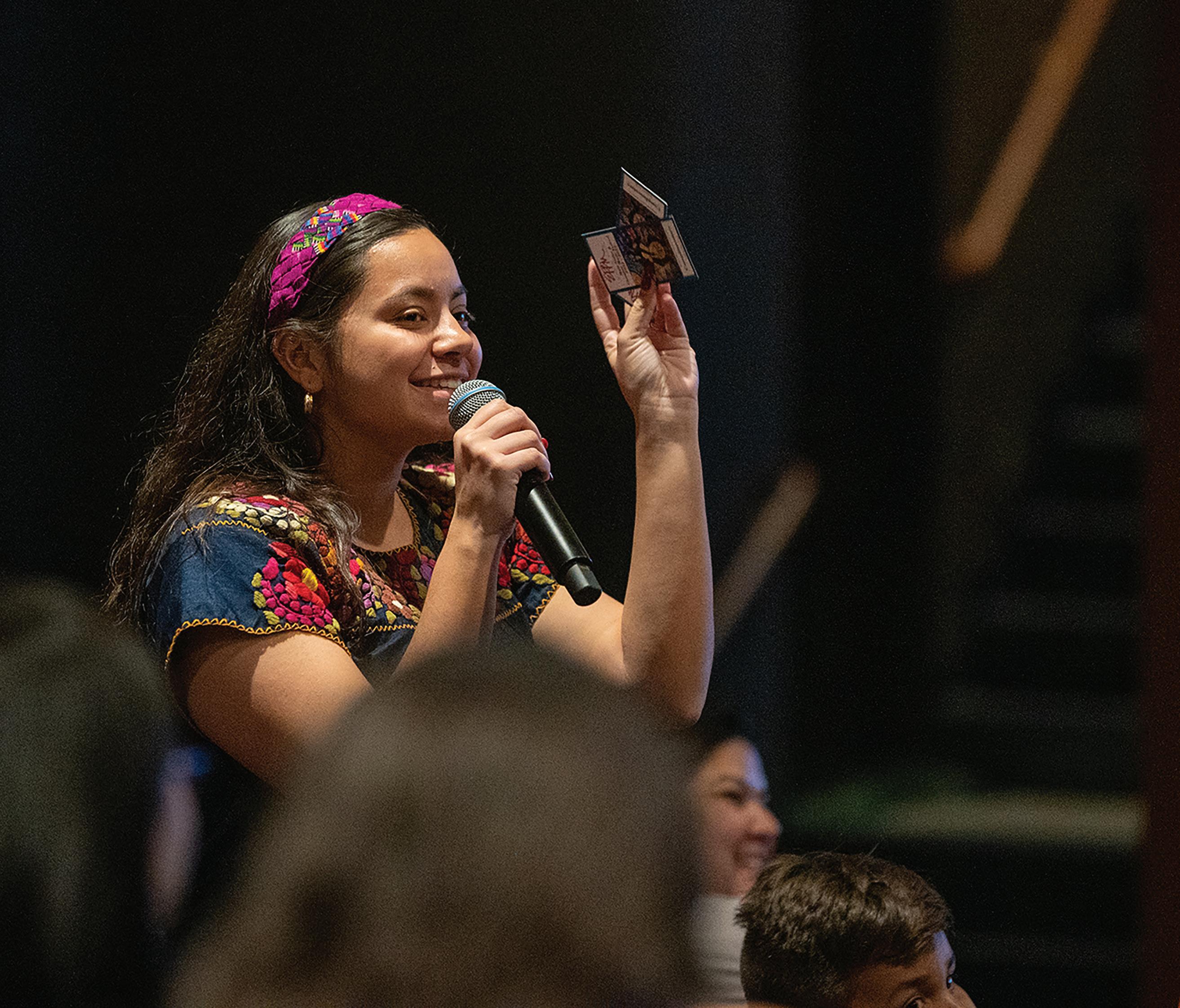
Tickets being handed out to the first people to ask questions during the Q&A. Photo by Joel Molina/The Prospector
We are the future, we are the ‘somebodies’
BY MEAGAN GARCIAThe Prospector
I developed a good understanding of where I stood in the world at a fairly young age. I was taught by society to brush off the way that boys tease and I was taught to like it. I was taught that I could do anything I wanted but was then reminded to expect that men could do it 1000 times better.
I was taught by society that people could demean women all they wanted and that we were still expected to fulfill our role in their system regardless.
I never liked those sentiments, though. The world has never been set in our favor, but history has proven that we constantly exceed expectations and overcome seemingly insurmountable odds.
Women are the backbone of our society. We are mothers, sisters, friends and mentors.
We are also activists, scientists, doctors, homemakers, managers, writers, lawyers, engineers and so much more.
We break academic boundaries and present new knowledge and contributions to fields across the globe. We are creative and curious; we seek answers and solutions to problems that seem unsolvable. When I think of women, I love
who embodies this, I picture my mom. I see the work she does not only for our home and for our family, but as an educator. She spends her days teaching kids the essential things they will need to build a life for themselves and their community.
I think of my aunt who works by getting kids their lunch every day and how she is feeding the future.
I also think of my grandma who worked tirelessly to provide a safe and loving home not only for her kids but my brother and I as well. Women have community and solidarity too. We look out for ourselves because no one else will. There is power in the bonds that we can form with one another.
I have made some of the most meaningful relationships and friendships with the women who came into my life when I needed them most.
I have a friend who has shown me strength in softness. She has taught me that there is braveness in tears and unconditional love.
Another close friend has shown me how to fight for my dreams regardless of how difficult achieving them may be.
I have friends who have held me while I cried and celebrated with
The stars shine for Lana Del Rey
me through my successes.
My best friend especially, has shown me the power that friendships between women can possess. We have been in each other’s lives for over a decade and the amount of love and respect we have for one another has only grown with each passing year.
Women change the world. We are at the forefront of movements regarding climate change, education, civil rights, disability advocacy, gun violence, bodily autonomy and everything in between. Malala Yousafzai, Patrisse Khan-Cullors, Alexandria Ocasio-Cortez and Greta Thunberg are just a few examples of women who have fought for our wellbeing and exist as great role models for the generations following them.
Women are also present in the art that has colored history for centuries. We exist in sculptures and paintings and songs and poems, but we do not only exist to be a muse. We are multifaceted, we contain multitudes. We are the song and the singer, the poem and the poet, the sculpture and the sculptor.
It is like Daisy Jones (Riley Keough) remarks in the new “Daisy Jones & the Six” show, “I’m not the muse, okay? I’m the somebody.”
Meagan Garcia is the arts & culture editor and may be reached at megarcia19@miners.utep.edu.
BY MARCO HINOJOSA The ProspectorThe iconic and lovely Lana Del Rey received the Visionary Award at the Billboards Women in Music event. The award show highlighted Del Rey’s achievements and growth as an artist, showcasing previous eras in her work and how she has paved the way for so many other artists. Del Rey received her award from pop star, Olivia Rodrigo. Rodrigo highlighted the influence Del Rey has had on this generation and pop culture overall.
In my opinion, Del Rey is the best singer and songwriter on the planet. Nothing compares to her lyricism and her poetry. However, the majority of the media and people take her sadness out of context and do not give her the real recognition she deserves.
Del Rey has caused a paradigm shift in pop music and completely redirected the genre of pop and forged it with her influence. Her music inspires emotion and gives this nostalgic, yet timeless cinematic feel. She brings power and beauty into vulnerability, capturing sadness and sensuality into her writing, she truly is like no other. The songwriter has remained true to her artistry throughout her 14 years in the music industry.
While Del Rey is known for
THE PROSPECTOR CROSSWORD

DOWN:
1. What was Miner Tunnel primarily known for?
2. Who was the American lawyer and jurist who served as an associate justice of the Supreme Court of the United States from 19993 until her death in 2020.
6. Who was the first Hispanic female alumna to be appointed an academic dean?
ACROSS:
3. Pakistani female education actavist and the 2014 Nobel Peace Prize laureate. Awarded when she was 17.
4. What was the cost tuition on opening day in 1914?
5.Which building once has a bowling alley in the basement?
7. Who gave UTEP’s 100th commencement address 1998?
8. What is hill called that begins at the base of Education building and connects the main campus with the Memorial Gym and Kidd Field.
9. How many buildings are known to be haunted on campus?
10. Recording artist, actress and designer who was appointed as a UNICEF Ambassador in September 2009.
VOL. 108, No. 13 March 21, 2023
her bold melancholy sound and persona, she gave fans a warm and emotional message while receiving her award.
“I don’t exactly have a long-term vision at all, but if you were curious, I am very very happy,” Del Ray said.
“When I released my first album 14 years ago, the waters were not quite as warm. So, I’m really really happy for everyone who feels like it’s a wonderful time in the culture to be themselves and express themselves. It didn’t feel that way in 2008.”
Now, having been a fan since 2015 and seeing her progress through her music and her own identity is something so amazing to witness. It makes me ecstatic to see people finally giving her the recognition she has been robbed of for so long.
Something about knowing that other fellow artists in the industry tune in, understand and enjoy Del Ray’s music almost invokes a sense of pride.
Del Rey will forever be my “Living Legend” and she will always be known as an icon. Witnessing current artists run with the torch that Del Rey once lit and began to walk with, gives me comfort with songwriting and storytelling for music in the future.
…and submit a letter for publication. Please include your full name, street address, telephone number and e-mail address, as well as your student major, classification and/or titile if applicable. Write to us at 105 E. Union, 500 W. University Ave. El Paso, TX 79968; email us at prospector@utep.edu, or call us to 747-5161.
Personal information (phone numbers and address) will be used for identification only. Letters are subject to editing to fit available space, clarity and brevity.
PAGE 2 · MARCH 21, 2023 THE PROSPECTOR Opinion Itzel Giron, editor-in-chief EDITORS & STAFF Itzel Giron, Editor in Chief Fatima Alvarado, Designer Meagan Elizabeth Garcia, Arts & Culture Editor Maria Luisa Guerrero, Web Editor/Copy Editor Annabella Mireles, Photo Editor Katrina Villarreal, Multimedia Editor Emmanuel Rivas Valenzuela, Sports Editor Marco Hinojosa, Audience & Engagement Editor Erik Acosta, Staff Reporter Avery Escamilla, Staff Reporter Elisha Nuñez, Staff Reporter ADMINISTRATION Veronica Gonzalez, Director Crystal Hinga, Assistant Director Amy Ontiveros, Administrative Assistant Isabel Castillo, Accounting Specialist Jacob Lopez, Account Executive Vacant, Advertising Coordinator PHOTOGRAPHER Jasmin Campoya, Photographer Joel Molina, Photographer CONTRIBUTORS Maya Alvarado SalmaPaola Baca Eugenio Cantu Gianluca Cuevas Angelica Gutierrez Gabriel Guzman Nicholas Maes H.Catching Margniot SPEAK YOUR MIND! The Prospector is published by Student Media and Publications, 105 Union East, 500 W. University Ave. El Paso, Texas, 79968. The Prospector appears in print biweekly on Tuesdays during the fall and spring semesters. The newspaper is not printed during holidays and when classes are not in session. The Prospector provides news online at www.theprospectordaily.com. The Prospector is provided to students through student fees. First copy is free.
be purchased for $1
the Department of Student Media and Publications. The Prospector
responsible for
by advertisers. Additional policy information
be
by
The Prospector at 915-747-5161.
in The Prospector are not necessarily those of the university.
Any additional copies, if available, must
through
is not
claims made
may
obtained
calling
Opinions expressed
Marco Hinojosa is the audience and engagement editor and can be reached at mhinojosa4@miners.utep.edu.
La vida de una madre en el desierto
POR MARIA L. GUERRERO DURAN ProspectorThe





Editor’s Note: This story was written in spanish to convey Alma’s story without the translation of her quotes. A summary in English accompanies the story.
Si alguna vez has estado en el edificio Unión, seguramente te has topado a Alma, la señora de limpieza quien con una sonrisa te da los buenos días. Pero, ¿quién es Alma?
poder ayudar a sus padres a cuidar de sus hermanos menores, mientras ellos salían a trabajar. No fue hasta aproximadamente los 18 años, que Alma decido cruzar sin papeles a los Estados Unidos con la esperanza de comenzar una mejor vida.
“Al principio era difícil porque estaba sola aquí y no me gustaba”, dijo García. “Y ya después, dije, ‘Este es mi lugar y aquí me voy a quedar’’.
García vivió con una familia por
ta’. Y sorpresa, nació mi otra hija. A partir de entonces, como quería un mejor futuro para ellos decidí quedarme. Estoy contenta, feliz”. García y sus tres hijos vivieron una vida modesta en el programa de vivienda por 20 años, hasta que su hijo y dos hijas tuvieron edad de poder trabajar. No fue hasta que Julio Cesar cumplió los 21 años, que García pudo conseguir la residencia. Siete años después, la ciudadanía americana y las cosas empezaron a mejorar.
“Tuve tres hijos, pero hace casi un año mi hijo murió en un accidente. Es muy difícil. Mi hijo fue excelente, padre, hijo y hermano”, dijo García.
A pesar de los obstáculos que la vida le ha puesto a Alma García en su camino, como la muerte de seres queridos y problemas de salud, siempre se le puede encontrar con una sonrisa en el rostro y lista para platicar con quien sea.
a familar face you might see on campus.
Garcia lived with a family for a couple of years, working as a nanny. But once she got pregnant with her first child, Julio Cesar Garcia, she found refuge for her small family in a public housing program.
el Programa de Vivienda Pública, en donde les dieron la bienvenida a sus dos hijas, Elizabeth y Alejandra García.
“Al principio cuando mi primer hijo nació dije, ‘Él tiene derecho a ser ciudadano, a no batallar lo que yo he batallado’’’, dijo García.
“Después dije, ‘Mi hijo no merece estar solo, merece una her-
“Estoy muy feliz, porque salimos de ‘housing’’’, dijo García. “No somos ricos, no tenemos mucho, pero cada quien tiene su casa, mi hija se va a casar, ella va a tener su casa. O sea que si pudimos. Ellos sí pudieron y se logró lo que yo quería para ellos”.
Durante siete años, Alma se expuso a tratamientos de radiación contra el cáncer de mama y a una cirugía para retirar el tumor. A pesar de lo desgastante del tratamiento, García reconoce que la vida se acomodó para que ella pudiera vencer el cáncer.
“Yo no le tengo miedo al cáncer, Dios decide, a mí eso no me asusta”, dice García. “Me lo detectaron a tiempo, Dios sabe la hora y el tiempo”.
Hace un año, desafortunadamente Julio Cesar falleció en un trágico accidente, sumando a los pesares de Alma, tras la muerte de sus padres.
Alma lleva 11 años trabajando en UTEP con el personal de limpieza y cuenta que es el trabajo en el que más contenta ha estado.
“Me encanta, me fascina, nunca soñé estar aquí”, dijo García. “Mi hija me estaba buscando trabajos y me dijo ‘Mira ma, este trabajo es para ti’’’, dijo García. “Estoy muy contenta, por eso sigo aquí. Todos aquí son excelentes personas, desde el de arriba hasta el de abajo, todos nos tratan bien”.
Sin duda Alma demuestra que, a pesar de los momentos difíciles, siempre hay algo o alguien que nos sonríe. Para Alma, su sonrisa viene de sus nietos y de sus dos hijas que la llenan de orgullo y de satisfacción, haciéndole ver que sus esfuerzos han valido la pena. Y como bien Alma dice, “La vida nos da de todo”.
BRIEFLY IN ENGLISH
Alma Consuelo García Hernández, 65, born in Ciudad Juárez, is the second of nine siblings and
For seven years, Alma underwent radiation treatment against breast cancer and surgery to remove the tumor. Despite how exhausting the treatment was, Garcia knows her state of mind helped her win the battle against cancer.
Atop her cancer struggles, her son Julio Cesar died in a tragic accident, adding to Alma’s struggles and grief especially, after the death of her parents.
Despite the hard obstacles life has thrown her way, one can always find her with a smile on her face and ready to greet anyone walking through the Union Building.
Alma has been working with UTEP for 11 years with Union Services Custodian Staff and says this job has helped her become the happiest.

For Alma, her smile comes from her grandchildren and two daughters who make her proud and satisfied, making her realize all her efforts have been worth it.
Just like Alma says, “Life gives us a little bit of everything.”
AIM is an online software
to process accommodations for students with disabilities.
AIM allows students to access or request services online and from the safety and comfort of their home 24/7 with their single sign on UTEP credentials.


NEWS Page 3 THE PROSPECTOR · MARCH 21, 2023 AIM CASS ONLINE PORTAL Connects with you anytime, anywhere with THE CENTER FOR ACCOMMODATIONS AND SUPPORT SERVICES cassportal.utep.edu utep.edu/cass cass@utep.edu (915) 747-5148 AIM is an online software system that many institutions of higher learning utilize as a way to process accommodations for students with disabilities. AIM allows students to access or request services online and from the safety and comfort of their home The system will allow you to log on with your single sign on UTEP credentials, so there will be no new passwords or usernames to memorize. CHECK YOUR STATUS REQUEST ACCOMMODATIONS APPLY TO BE A NOTETAKER FACULTY PORTAL
system
mani-
Maria L. Guerrero Duran is the web editor and copy editor and may be reached at mlguerrerod@miners.utep. edu.
para
Photo by Gabriel Guzaman/The Prospector
Directing the next set of female filmmakers
BY ERIK ACOSTA The ProspectorAt any film festival you can find many eating popcorn or drinking refreshments with friends or family while waiting for the unique short films to start. You will see others finding their seats and everyone being welcomed by hosts and other performers.
A community built on dedicating and supporting women and LGBTQIA+ filmmakers make this upcoming film festival happening March 21 a little more special and unique.
The Latinx-led organization
Femme Frontera was established in 2016 by six female and non-binary filmmakers from the U.S.-Mexico border regions. The organization wanted to highlight those films to celebrate the distinctive voices and stories of women and non-binary genders. While some women may lack opportunities to showcase their work in the film industry, as it is a field typically dominated by men, Femme Frontera supports and empowers these female and non-binary filmmakers to break through those barriers and find their path in the film industry. Director of Community Engagement, Jackie Barragan thinks being in this organization, which supports women, is good way to start as a filmmaker.

“Create a venue of resources and a support group for female filmmakers because like many industries, the film industry is dominated by men,” Barragan said. “So, it’s nice because the whole mission is just to share voices that we rarely hear or see on the media.”
The use of powerful storytelling in many of these short films presented during past festivals have put emphasis on women, border communities, immigrants and many other underrepresented
The attorney in the film, Antonia Hernandez, led the fight against those who put those women through the sterilizations. Although the case was lost, it helped bring the case’s attention to the public during a time when civil rights was in the public eye. The
voices and stories that people rarely hear or see.
During their seventh annual festival last year, some of the films highlighted the struggles of motherhood, grieving the loss of a mother and others like immigration on the border. According to El Paso Matters, Femme Frontera Executive Director Angie Reza Tures, says stories like these are rarely seen or heard.
“Stories from our region, stories from our border communities are so silenced and very rarely allowed to be consumed by the mainstream market,” Reza said. “We are always shut out and so for us, its breaking through those challenges.”
Showcasing touching films that evoke a range of emotions in their viewers, Femme Frontera is not just about highlighting the work of filmmakers, it also offers workshops and various programs for young and adult female and nonbinary filmmakers and sometimes even grants.
These grants include a film grant to increase and support content made by filmmakers from El Paso and Las Cruces and a screenwriting grant to help write scripts and develop screenwriting skills. Femme Frontera encourages female and non-binary
whistleblower in the film, Dr. Bernard Rosenfeld, was brave enough to speak for these women and help in the fight against the medical staff who led the procedures.
The documentary is an empowering film that shows how women’s rights were treated in the 20th
the community. The organization chose to invite different and new vendors this year.
The women-owned businesses will include Star Glampers Sleepovers, Pica Dientes and La Confitería who are just three of the 20 vendors planned to be at the market.
Over the last two years, the event has brought in different cultures through art, fashion, and essentials.
The organization is partnering up with Little Caesars Pizza to provide food towards the vendors.
“The special thing we do is we don’t charge the vendors anything, this is actually a celebration for them.”
Lopez says. “We’re gonna feed the vendors, give them water, and they don’t pay a fee, they just donate whatever item that they sell, they donate one to use and we raffle it off during the market.”
In addition to that, the market will be a way for the organization to fundraise for their “Mija, Yes You Can!” scholarship and other additional events where they help countless women across El Paso.
They are collecting all proceeds from the Mija merchandise that is sold at the market.
“Mija, Yes You Can” has been helping women all over El Paso to expand their businesses and have a bigger audience. Not only are they giving women a space to promote their businesses, but also using the event to give back to the community with feminine hygiene products and scholarships.
“I hope that it brings awareness that El Paso is full of strong women owned businesses,” Lopez said.
filmmakers to apply for these two grants per year.
“After a couple of years, we received $80,000 grants from the Ford Foundation, and it created a few jobs which is why I was able to get on the team,” Barragan said. “We are very focused on providing these grants to women across the border.”
Many of these programs include a film lab where female filmmakers work together to create documentaries on the southwest border, as well as screenwriting seminars, documentary workshops, and numerous other activities available to women and kids.
Femme Frontera has not released the lineup of directors and films showcased for their upcoming festival however, when the festival does come to town bring some friends along, load that popcorn with butter and catch a glimpse at the incredible unique films that the festival has.
Visit Femme Frontera’s website for additional details about their upcoming festival or to learn how to become more involved in this community that uplifts and guides the next generation of future female filmmakers.
Erik Acosta is a staff reporter and may be reached at emacosta6@miners.utep.edu
century. In a time where reproductive rights in America are under observation, the film brings this issue to light and tells of a fight led by Chicana women for their right to have children.
“It’s just not right that they took advantage of women, especially
This market expresses the importance of bringing in anyone interested in buying from the locally womenowned businesses that display their product, grow and become wellknown businesses in El Paso.
Many of these locally owned businesses are very small and are not well known to El Pasoans.
During the event, you can find other fun things to take part in rather than just the market, there will be raffles every 20 minutes and the “Mijas” will be collecting feminine hygiene products to “Her Pantry” which is a nonprofit organization diaper bank.
The organization hopes to inspire women who are afraid to start their own business, to step out and be influenced by other strong leaders.
“I hope it pushes them to do what they want to do in life as well,” Lopez said.
Continue to celebrate National Women’s Month by supporting locally owned women’s businesses now and all year round.
Aside from the market everyone can support these local business and the women behind them.
For more information visit mijayesyoucan.org and @mijayesyoucan on Instagram.
Avery Escamilla-Wendell is the staff reporter and may be reached at amescamilla@miners.utep.edu or on Instagram @ by_avery_escamilla
UTEP legend dead at age 81
BY EMMANUEL RIVAS VALENZUELA The ProspectorWillie Cager, a team member of the 1966 NCAA Championship team, has passed away at the age of 81.
The news broke in the late afternoon Sunday, March 19 after an announcement from Cager’s family. Cager was born in Bronx, New York in 1942. Cager spent most of his life in El Paso including his college years. While at Texas Western, now UTEP, Cager became a piece in the machine that was the 1966 Championship team under the direction of coach Don Haskins.
Cager, along with his teammates Bobby Joe Hill, Orsten Artis, Willie Worsley and Dave Lattin, made history after the Texas Western Miners
with language barriers and sterilized them. It’s just really sad, and then just to see that we’re going through something similar with Roe v. Wade being overturned now,” said Andrea Celis, a multidisciplinary studies major at UTEP.

“I feel like it’s an amazing docu-
started five Black men for the first time in the NCAA title game. Cager had a brief stint in the NBA after being drafted in 1968.
Cager would continue to engrain his influence on the El Paso community by working with the Ysleta Independent School District to create a robust after school basketball program. Cager also founded the Willie Cager Foundation, which aims to “raise money to build his dream of several multi-purpose athletic and academic complexes for El Paso’s youngsters.”
The UTEP legend passed on the 57th anniversary of Texas Western’s NCAA Championship game against the Kentucky Wildcats.
Emmanuel Rivas Valenzuela is the sports editor and may be reached at erivas7@miners.utep.edu: @rivasemmanuel2 on Instagram.
mentary and it’s very powerful for, especially young women to see this. We have the opportunity to make a change for our future and to be able to try to prevent this from happening again.”
Elisha Nuñez is a staff reporter and may be reached through egnunez2@miners.utep.edu
Page 4 NEWS THE PROSPECTOR MARCH 21, 2023
BEBES from cover
The annual Film Frontera festival is happening March. 21 and is inviting female and non-binary filmmakers from the U.S.-Mexico border to submit their pieces. Photo courtesy of Femme Frontera
MIJA from cover
Arts & Culture
Meagan Garcia, editorAn exhibition to raise awareness
The queen of UTEP’s Liberal Arts: A journey in education
BY H. CATCHING MARGINOT The Prospector BY ANGELICA GUTIERREZ The ProspectorThe opening of the Women’s History Month art gallery took place Monday, March 6 at UTEP’s Union Gallery, featuring both local and UTEP artists. The event started at 6 p.m. and hosted by the Women’s and Gender Studies Program who invited musicians to play and sing live while people walked around the gallery admiring unique art pieces.
The Union Gallery runs throughout the school year and is constantly changing its exhibitions. The gallery displays artwork of UTEP students and also the El Paso community from time to time.

Entrance is free and welcomes anyone who would like to see local art.
According to the Student Engagement and Leadership Center’s mission, “the Union Gallery offers a meaningful platform for University students to acquire a sense of belonging on campus.”
The UTEP Music Department was invited to perform songs that would resonate with Black feminists and women in general. One of the songs was called “I Am Not An Angry Black Woman,” performed by Abeni Janae, and it was performed to demonstrate that the Music Department also has Black art that must be shown.
“The purpose of this art gallery was to commemorate or kick off Women’s History Month here at UTEP and at the community. So, we invited the entire community and not only UTEP students to submit their art and show us their renditions of what it means to be a woman,” said Hilda Ontiveros, Ph.D., Interim Director of UTEP’s

Women’s and Gender Studies Program. “We wanted to bridge it with Black History Month because it just ended, so we wanted to bridge it with Black feminism.”
A tree made of cardboard was placed at the entrance of the gallery with the intention of women hanging pieces of paper containing their stories and struggles of being a woman.
The importance of this activity is to give a safe space for women to voice their day-to-day fights and the reason for doing it.
The first submissions displayed at the gallery were ones that reflected the feminicides in Latin America, especially in Ciudad Juárez. It is
important to create awareness about Mexico’s heartbreaking situation regarding women since, according to Amnesty International U.S.A., 10 women are killed every day and more than 20,000 women are missing countrywide. Mexico is failing at protecting their women and opening investigations.
“My favorite piece was the one that painted a rendition of the Ni Una Más movement from Ciudad Juárez because that’s something very important to me,” Ontiveros said on this art submission, “It’s like my research interest and my research focus is the feminicides in Ciudad Juárez and throughout North America.”
The gallery showed not only paintings but sculptures, drawings, digital art and more. Some represented Black women and others the fight for abortion in the country.
“What I really liked about this exhibit was that it demonstrates that UTEP is a place to talk about nowadays problems,” said a UTEP student. “It is important to feel heard without being attacked and the exhibit is just that.”
This exhibition will remain open throughout Women’s History Month. Pay a visit to educate yourself about feminicide, abortion, Black women and more.
Angelica Gutierrez is a contributor and may be reached at agutierrez89@miners.utep.edu
This past month The University of Arizona’s Southwest Institute for Research and Women (SIROW) recently awarded its prestigious regional scholar of the year award to UTEP’s very own Hilda Ontiveros Arrieta, Ph.D., for the 2022-2023 season. The award is given to those who have demonstrated excellence in SIROW’s goal of improving the well-being of females and the communities they live in. Ontiveros’ research puts emphasis on this philosophy, with her work focusing on the measure of value of women’s studies programs and ethnic studies programs for higher education students enrolled in Hispanic-Serving Institutions.
Ontiveros is a professor and Interim Director of the Women’s and Gender Studies program at UTEP. Ontiveros is an El Paso native, with her father working at ASARCO, a copper smelting plant, and her mother working as a homemaker. Ontiveros and her family fell in the bracket of a lower middle-class family and knew it would be a difficult journey to obtain a higher level of education.
However, this obstacle was no match for her determination as she most recently gained her doctorate at UTEP from the College of Education in May 2022, marking her near 20-year journey in the world of higher education.
“So, I have a long trajectory here in the university, and I did go to other universities intermittently,” Ontiveros said. “I studied abroad at the medical school of Universidad Autónoma de Ciudad Juárez. I studied abroad in Spain and in Mexico City. I did a lot of bouncing around, but I always came back home to UTEP.”
Ontiveros speaks on the affordability UTEP granted her as an upcoming student and how after earning her second master’s degree, everything seemed to click in place.
“After I earned my second master’s degree, I started working for Chicano Studies and became a faculty member for Women’s and Gender Studies,” Ontiveros said.
Then through 13 to 14 years of hard work in the university system, Ontiveros obtained her doctorate in educational administration in higher education, landing her the position of Interim Director of Women’s and Gender Studies.
see QUEEN OF L.A. on page 6
THE PROSPECTOR · MARCH 21, 2023 PAGE 5
Artist Alyssa Jaime from the EPISD Young Women’s Academy stands next to her painting “Ni Una Menos,” which is featured at the UTEP Union Gallery to help celebrate the commencement of Women’s History Month. Photo by Annabella Mireles/The Prospector
Artist Michael Barber’s “Key to Life,” an installation mixed medial oil on wood with metal sculpture shows how “abortion rights in this country have taken a turn for the worse.”
Photo by Annabella Mireles/The Prospector
Part of Ontiveros’ determination and mindset of working hard comes from the struggles her family endured early on.
“All of our family worked in that copper smelting industry, a lot of them farm workers,” Ontiveros said. “My aunts and uncles were born in the beet and chili fields. My grandmother had nine children (one of them my mother), and they were farm workers, some of them being born on the dirt of the fields, with a few dying of malnutrition.”
Ontiveros reflects on how much she has worked to be where she is right now and embraces her roots.
“So, I think about that, every time I drive to work down the freeway and I exit Schuster to come to UTEP,” she said. “As I come into work, I never take it for granted that those are my roots growing up in this community. I think that’s what drives me every day to do better and (be) better and learn more so that I can be a better servant and steward of my community.”
At first Ontiveros studied Microbiology, with the hopes of going into the medical field.
However, because of unaffordable prices, a new road was paved leading her to women’s studies.

“I just kind of landed with women’s studies,” Ontiveros said. “I got pushed in that direction as I saw the way the nation was moving, that women’s rights needed to be addressed and that we needed to promote equality. The Chicano studies and women’s studies courses really opened my eyes and broadened my perspective.”

As Ontiveros has gone through her academic and personal journey, she has picked up advice she hopes to instill in young women from all over who may be going through difficulties themselves.
“Keep pushing on,” she said. “Put your head down like a football player and run through it, we have to be twice as hard, three times as hard to the person next to us.”

Ontiveros is another graduate to make the UTEP community proud to call themselves Miners.
H. Catching Marginot is a contributor and may be reached at hcmarginot@miners.utep.edu.


The women of geoscience
 BY AVERY ESCAMILLA-WENDELL The Prospector
The future of science is looking brighter because of the Association for Women Geoscientists (AWG) Sun City Chapter.
The sciences have always been a male-dominated field; however, AWG is breaking this stigma by inspiring women to choose the field of geosciences.
AWG is a national organization with its Sun City Chapter in El Paso which dates back to 1977, a time when women were struggling to be represented in geosciences.


The UTEP chapter was founded by Amanda Labrado and has helped many women in geoscience find a home at UTEP.
Carmel Murillo, a senior majoring in geological sciences, is the president of AWG. Murillo started college as an anthropology major, but then decided to leave school. She eventually came back as an Option Two student, meaning she has a record of taking courses at UTEP

previously. Murillo says she then found her passion for geosciences when she took her first geology course at UTEP.
“I would ask a lot of questions, and I became interested in geology and how it’s an area that integrates all of the sciences,” Murillo said.
“I never thought of myself as a scientist until I learned that I could integrate everything that was just so fascinating: physics, mathematics, chemistry, into one area.”
Murillo joined AWG in 2021 and says it became her safe place as it provided her opportunities in the world of geosciences and for her future in graduate school.

AWG has provided Murillo with scholarship opportunities in the community and the ability to teach young children who aspire to be future geoscientists.


“We want to uplift voices of women in the geosciences,” Murillo said. “We also like to use our organization as a place for us to come together and work together, uplift

each other, welcome everyone who believes in supporting each other, and in any field of science.” AWG provides all members with mentoring for different types of scholarships and internships.
Field camp is a required course students must take for their degree, so the scholarships do help fund that course or any materials a student might need to pay for.
“We like to be the first stop for other students looking for that experience to show them around and just guide them through that process,” Murillo said. The inclusion the organization has made for women in geosciences has allowed them to feel more comfortable in their field.

Professors have reached out to AWG at UTEP to share they notice the effort of inclusion of the women in geoscience.
Murillo says the women of history who fought to be a part of geosciences are the reason for all the opportunities they now have at AWG.
“We like to set the example and just continue that progress and in that development of the representation of women and minorities in the geosciences,” Murillo said.
AWG requires members to attend meetings and events they host.


The organization just had its recent trip to White Sands National Park and will have more trips and events coming up for the rest of the spring semester.
AWG is setting the standards for future women in geoscience by presenting many opportunities for those within the chapter.
For any questions on how to be a part of AWG, contact the organization at utepwomengeos@gmail. com or on Instagram @awgsuncity.
Anyone interested in joining AWG may join through MineTracker and apply for membership through the AWG Sun City Chapter website.
Avery Escamilla-Wendell is the staff reporter and may be reached at amescamilla@miners.utep.edu or on Instagram @by_avery_escamilla

Read more about this story
In honor of Women’s History Month, numerous events throughout UTEP are explaining different scenarios women are going through around the world. One event at UTEP was a book reading led by Natalia Ribas-Mateos, Ph.D. As one of the editors of the book, “The Elgar Companion to Gender and Global Migration Beyond Western Research,” Ribas-Mateos shared plenty of information that showed what women around the world experience throughout their lives. After some words from Josiah Heyman Ph.D., director of the UTEP Center for Inter-American Border Studies and professor of sociology and anthropology, Ribas-Mateos began going through each chapter of the book.
Photo by SalmaPaola Baca/ The ProspectorPage 6 ARTS & CULTURE THE PROSPECTOR · MARCH 21, 2023 QUEEN OF L.A. from page 5
online at theprospectordaily.com
The AWG is a national organization with a chapter in El Paso that is devoted to enhancing the participation of women in geoscience. President of the Association for Women Geoscientists, Carmel Murillo (CENTER) joined AWG in 2021. Photo by Jasmin Campoya/The Prospector
The Prospector’s Student-Athlete of the Month: Alexia Morales
BY ERIK ACOSTA The ProspectorWomen in sports continue to be overlooked
BY EMMANUEL RIVAS VALENZUELA The ProspectorIn June 1972, the U.S. Congress passed the massive gender equality law Title IX, which states, “No person in the United States shall, on the basis of sex, be excluded from participation in, be denied the benefits of, or be subjected to discrimination under any education program or activity receiving Federal financial assistance.”
“Sports” section of the site. Also, an interesting note, the New York Liberty is currently host to former UTEP alumna Kayla Thornton.
Growing up near softball stadiums, attending countless softball games and tournaments, hearing fans screaming, parents cheering and having teammates supporting each other, has been the world that revolves around UTEP junior outfielder Alexia ‘Lexi’ Morales.


Morales grew up in El Paso, Texas, and is the daughter of Joe and Elsa Morales, in a household driven by sports and softball. Morales’ passion and interest in the game was embedded at an early age since her father played softball when he was younger and was part of the USA national softball team.
“My dad played softball his whole life, so it has always been engraved in me a little bit and I think we bonded a lot because of it,” Morales said. “He has been my coach since I got to high school, so I think being able to go play tournaments with him and him being part of every success that I had is really important to me.”
Playing since she was three years old, Morales started her successful softball career at Chapin High School, playing infielder for the Huskies. Her talent and passion helped lead the team to a regional semifinal for state playoffs and a District 1-5A Championship.
Thanks to Morales’ exceptional softball skills throughout high school, she was selected for the Texas Girls Association’s Class 5A All-State team and in 2020 Morales received the El Paso Hall of Fame Female Athlete of the Year award for Chapin High School. Now, a junior majoring in forensic
science, Morales has been playing at UTEP for two years, helping lead the softball team to a massive victory against the UTSA Roadrunners for the first time in a series finale Mar. 12.
Juggling exams, classes and being a student-athlete can be challenging for some, but for Morales having solid time management skills has helped her balance her softball career while being a student.
“It was definitely an adjustment coming from high school into college,” Morales said. “But once you can get your time management up and understand that things need to be done and school is a little bit more important than softball, you will be alright.”
A strong and gifted female athlete in an industry dominated by men, Morales says that all female athletes should have confidence in their skills and seize every opportunity that comes their way.
“Never doubt yourself and your abilities because there is always an opportunity,” Morales said. “Even though we are women, we get overlooked a lot.
As long you work hard, and set your sites on what you want to do, you can be successful.”
Female athletes can find several female role models in the sports world to look up to, like Serena Williams, Alex Morgan and Danica Patrick. Yet, it is Jennie Finch, a softball athlete, who has given Morales confidence.
“She’s been to the Olympics and the highest state that we as softball players can go, so I think seeing her doing that and being successful at that level has encouraged me to keep going,” Morales said. “Obviously that’s the end goal but seeing her do it, made me want to do it.”
Through those years of practicing with her father, sharing special memories with teammates and experiencing the ups and downs of being an athlete, Morales is still unsure whether she wants to continue after college. However, Morales encourages other female athletes who want to play after high school to push and keep moving forward.
“We are at a very high level here, and it is hard but keep moving forward after high school,” Morales said. “Yes, the process is hard, but it is definitely worth it. Once you get there and put in the work, all the hard work you have done, it will pay off eventually.”
This principle extends to collegiate athletics. As a result, the popularity in women’s sports has increased after attendance, sponsorships and media coverage exploded. Despite these promotions, the state of women’s sports still leaves a lot to be desired. The most prevalent example must be pay in professional sports. Earlier this year, the Las Vegas Aces of the Women’s National Basketball Association (WNBA) were outed for allegedly paying several players outside the league’s designated salary cap. This raises, once again, questions about pay equality between women and men in sports.
These dissonant treatments trickle down into collegiate athletics. Of course, payment looks much different, but other forms of mistreatment are obvious, like attendance.
An argument against promoting women’s attendance tends to be the quality of the game with major media outlets peddling this narrative. Founder of OutKick, a self-proclaimed conservative sports news outlet, Clay Travis tweeted a series of statements after ESPN’s SportsCenter promoted New York Liberty’s guard Sabrina Ionescu and forwards Breanna Stewart and Jonquel Jones. Travis claimed that, in promoting women in sports, ESPN is descending into “woke” sports.
In that same thread, Travis would barrage the WNBA by tweeting, “Every state champion high school boys’ team in New York would smoke the WNBA team. I mean absolutely rout and mercy rule them. It would be a bloodbath.”
It is interesting to point out that Travis’ OutKick website does not feature a WNBA tab in the


But it is not like women cannot put out a good product. Just a little over a year ago, the UTEP women’s volleyball team went on a historic 24-8 run eventually finding themselves in the semifinals of the National Invitational Volleyball Championship. At the same time, UTEP football was on a run of their own. The football team would end the season with seven wins. Although attendance numbers for the volleyball team is not readily available, graduate student Alianza Darley recalls being shocked by the large number of fans at the semifinal home game. In comparison, the lowest recorded home game for the football team would be a whopping 10,097 people in the team’s win over Rice Nov. 21, 2021.
An argument can be made that the comparison between football and volleyball is unfair given the size of the team’s respective venues. The Sunbowl has a maximum capacity of 51,500 whereas Memorial Gym can only house 5,200. A fairer comparison would be basketball, as UTEP hosts both a men’s and women’s team.
This season, the UTEP Miners women’s basketball team nailed a Women’s National Invitational Tournament bid after winning 20 games. The team’s highest recorded attendance was capped at 1,403 in a game against Western Kentucky in early February.
Meanwhile, the men’s basketball team, who went 14-18 this season, never played a game with less than 3,498 fans.
Both teams hosted a “915 Night” against New Mexico State and North Texas. This event would be the men’s largest crowd by far, only including regular season games, with 11,315 fans in attendance for the season opener Nov. 12, 2022. The women would only see a crowd of 1,286 nearly two months into the season Jan. 28. The women would average 3,047 less in atten
THE PROSPECTOR · MARCH 21, 2023 PAGE 7
Sports
El Paso Natural Gas Building, Room 10 (915) 747 - 7124 • EH&S@UTEP.EDU KEEP OUR WATER CLEAN! Only rain should go down the storm drain. Do not dump waste, chemicals, paint, custodial waste, and general rubbish items (tires, old car parts, shopping carts, etc.) into storm drains, channels, or ditches.
Emmanuel Rivas Valenzuela, editor
Erik Acosta is a staff reporter and may be reached at emacosta6@miners.utep.edu
see FANS on page 8
Lexi Morales Photo and Stats Courtesy UTEP Athletics Career at UTEP (2021-23) GAMES PLAYED...........................105 GAMES STARTED..........................101 AT BATS...................................280 BATTING AVERAGE..................... .314 RUNS........................................53 HITS........................................88 HOME RUNS..................................3 RUNS BATTED IN...........................35
Junior outfielder Lexi Morales, an El Paso native, believes that female athletes should have confidence in their skills and seize every opportunity that comes their way. Photo by Gianluca Cuevas/The Prospector
dance at 998 fans per game this past season to the men who averaged 4,045 fans. No matter how you cut it, fans do not appear to support the women as they would the men.


This is not attacking UTEP fans or even men’s programs as their passion for student-athletes is clearly immeasurable. Rather it is a critique on social norms surrounding women’s sports.


Author and professor of Women’s, Gender, and Sexuality Studies at Purdue University, Cheryl Cooky makes the argument that the lack of excitement over women’s sports is strictly by design in a study with two other colleagues.



“Men’s sports are going to seem more exciting,” Cooky said. “They have higher production values, higher-quality coverage, and higher-quality commentary. When you watch women’s sports, and there are fewer camera angles, fewer cuts to shot, fewer instant replays it’s going to seem to be a slower game, (and) it’s going to seem to be less exciting.”


Even though we have made massive strides since the establishment of Title IX, several steps are still ahead of us. Many current issues require massive culture changes, but this one may not be overwhelming. Simply finding the time to go to a women’s event, libe one does for a men’s event, does a lot for the program and more importantly the student-athletes across all sports.
Women taking on today’s world of sports
BY KATRINA VILLARREAL The ProspectorStrategic communications graduate assistant, Lilliana Valdespino, was a student athlete at UTEP before working with UTEP athletics.
Valdespino was on both the cross country and track and field teams at UTEP where she graduated with a bachelor’s degree in electrical engineering and is set to graduate with her master’s degree in leadership studies in May 2023.

Valdespino was a walk-on for the cross-country team. She said that her mom received an email about there being open tryouts, so she encouraged her to try out. Valdespino mentioned that she was the only person to show up for tryouts, so the coach gave her a two-week trial to practice and train with the team.
At the end of that season, Valdespino won the Thomas Howard Athletic and Academic Achievement Walk-On award.
“After the first week, he just handed me some papers ‘sign here, you’re on the team,’” Valdespino said. “It was a really fun opportunity, I wasn’t the best, but it was really fun just being a D1 athlete.”


Valdespino has been working in sports for two years getting her start through an internship at the Sun Bowl Association during her last semester as an undergraduate.
Valdespino said that she was not always looking into working in sports, but working at the Sun Bowl
was an exciting experience for her. Being able to do behind the scenes work and updating record books is something she enjoys doing.
“When they told me about this opportunity, I thought it was great,” Valdespino said. “I mean, I graduated from UTEP, I was a student athlete so it was a nice little homecoming type of path to get on. I’m really excited to continue as a full-time employee here after graduation.”


Valdespino currently oversees beach and indoor volleyball, softball and rifle. Working with student athletes and ensuring their voices are heard is one of her favorite parts of working as a Sports Information Director at UTEP. Valdespino said that all sports are different when it comes to what is required for each one. She has been able to learn
more about each sport while working at UTEP. One sport Valdespino says is very interesting to her and one of her favorites, is rifle. She says this sport is where she has learned the most.
“I really like hearing all of their stories, especially all the ones that are international or even just transfers from within the states,” Valdespino said. “It’s just really cool just trying to bond with them because if they ever need anything or if I need something from them, it’s just an easy text away or I can just go up to them and I don’t have to feel like I’m intruding on them. People don’t ever really know that UTEP has a rifle team, which I love trying to explain that to them and how they got started and just how it works.”


Being a woman in sports has


EL PASO


& PART-TIME JOB FAIR


meant so much to Valdespino. She loves that was a student-athlete at UTEP and can vouch for other student athletes and all four of her women’s teams.
In the future, Valdespino says she can see women in sports taking over. She says that most schools already have more women’s sports thanks to Title IX with some schools having all-women teams in departments such as communications and media relations.
“Jalen Hurts, his management team is all females, and you know that just shows women can do anything that men can do,” Valdespino said. “We had to start somewhere and we’re going to continue to just branch out in every aspect of sports, not just competing, but you know ownership and being an agent, communications, even just being a photographer.”
Valdespino encourages women who want to work in sports to just go out and do it.

“Sports can definitely use a women’s touch,” Valdespino says. “We’re seen as a lot more detail oriented and we get a lot more tasks done. I think that having more women in any kind of aspect in sports is really going to be beneficial for whatever the program or organization is that you’re working for. Don’t let anybody tell you that you can’t make it in sports because you most definitely can, and you will.”
Katrina Villarreal is the multimedia editor and may be reached at kvillarreal1@miners.utep.edu


Page 8 SPORTS THE PROSPECTOR · MARCH 21, 2023 INTERNSHIP
Come speak to local employers and learn about part-time and internship opportunities SEE EMPLOYERS ATTENDING AT: UTEP.EDU/CAREERS THURSDAY, MARCH 30, 2023 9 AM – 1 PM TRCC - UNION BLDG. EAST, 3RD FLOOR THE UNIVERSITY OF
AT
TEXAS
Emmanuel Rivas Valenzuela Armendariz is the sports editor and may be reached at erivas7@miners.utep.edu or @rivasemmanuel2 on Instagram.
Lilliana Valdespino is a leadership studies graduate student while also working for Strategic Communications at UTEP Athletics coordinatingwith volleyball, softball and rifle. Photo by Joel Molina/The Prospector
from page 7
FANS