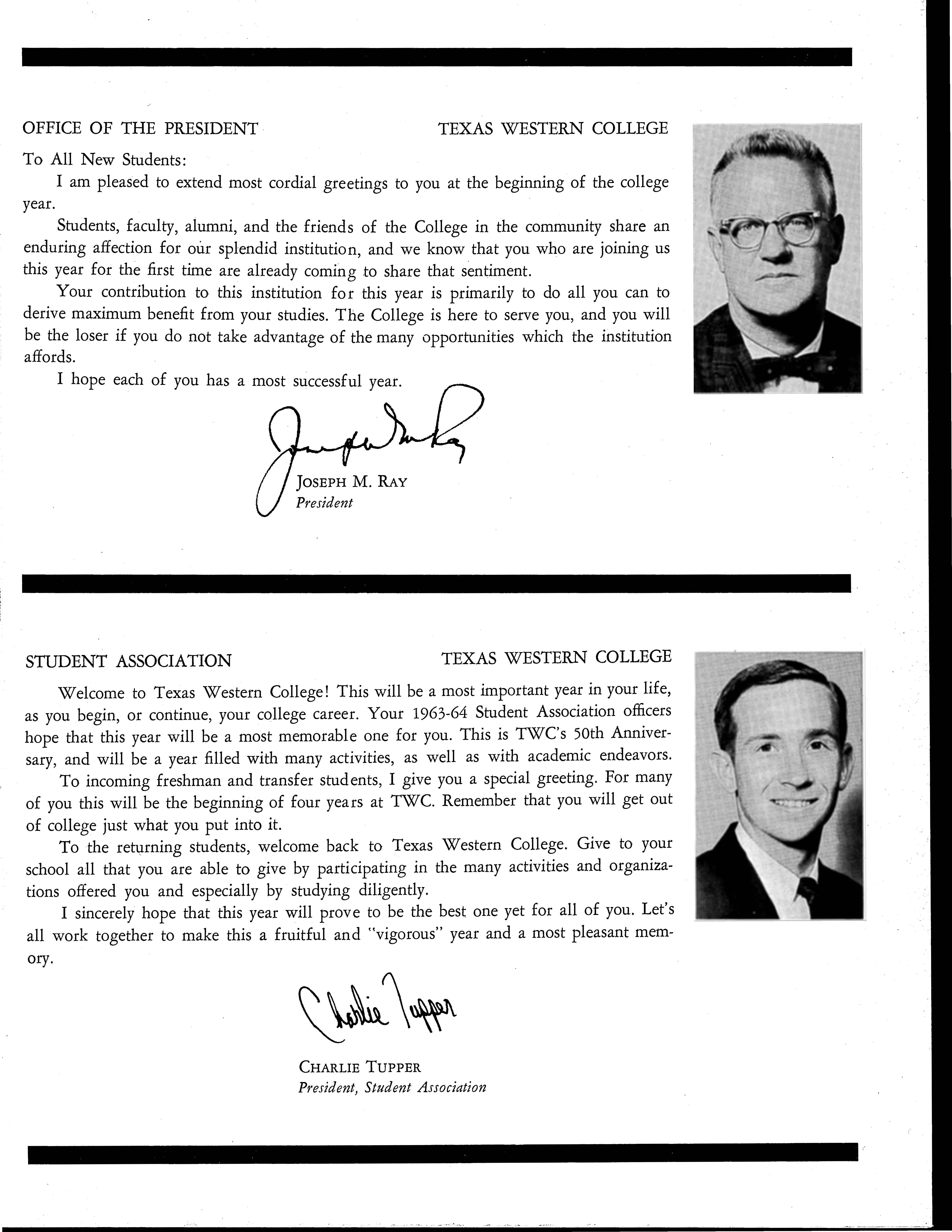
I am pleased to extend most cordial greetings to you at the beginning of the college year
Students, faculty, alumni, and the friends of the College in the community share an enduring affection for our splendid institution, and we know that you who are joining us this year for the first time are already coming to share that sentiment.
Your contribution to this institution for this year is primarily to do all you can to derive maximum benefit from your studies. The College is here to serve you, and you will be the loser if you do not take advantage of the many opportunities which the institution affords.
I hope each of you has a most successful year.
SWDENT ASSOCIATION
TEXAS WESTERN COLLEGE
Welcome to Texas Western College! This will be a most important year in your life, as you begin, or continue , your college career. Your 1963-64 Student Association officers hope that this year will be a most memorable one for you. This is TWC's 50th Anniversary, and will be a year filled with many activities, as well as with academic endeavors.
To incoming freshman and transfer students, I give you a special greeting. For many of you this will be the beginning of four years at TWC. Remember that you will get out of college just what you put into it.
To the ret1.,1rning students, welcome back to Texas Western College. Give to your school all that you are able to give by participating in the many activities and organizations offered you and especially by studying diligently.
I sincerely hope that this year will prove to be the best one yet for all of you. Let's all work together to make this a fruitful and "vigorous" year and a most pleasant memory.
CHARLIE TUPPER President, Student Associati on
EL BURRO
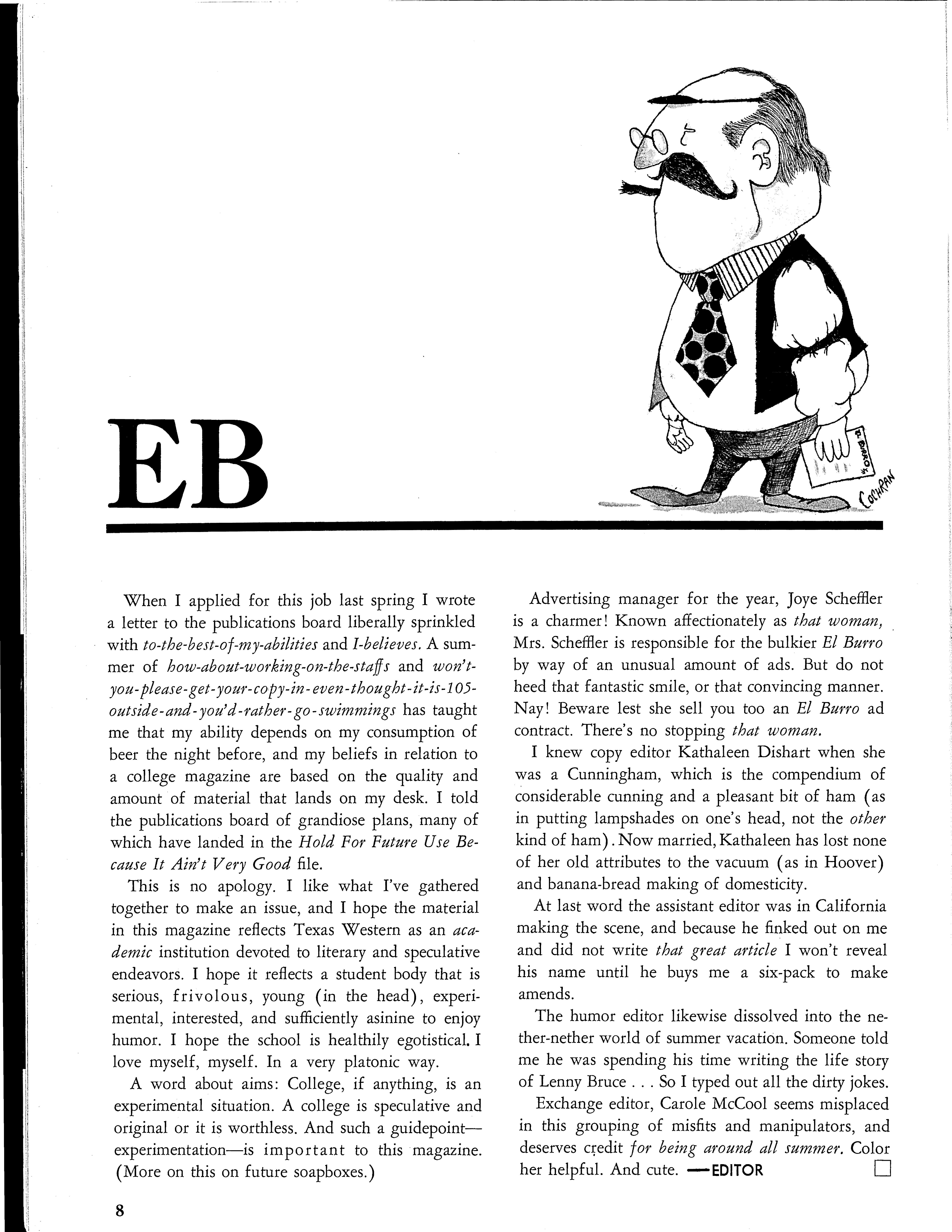
EDUARD KEE, editor
CAROLE
JOYE
JOSEPH RICE, staff writer
JULIE ELKINS, staff writer
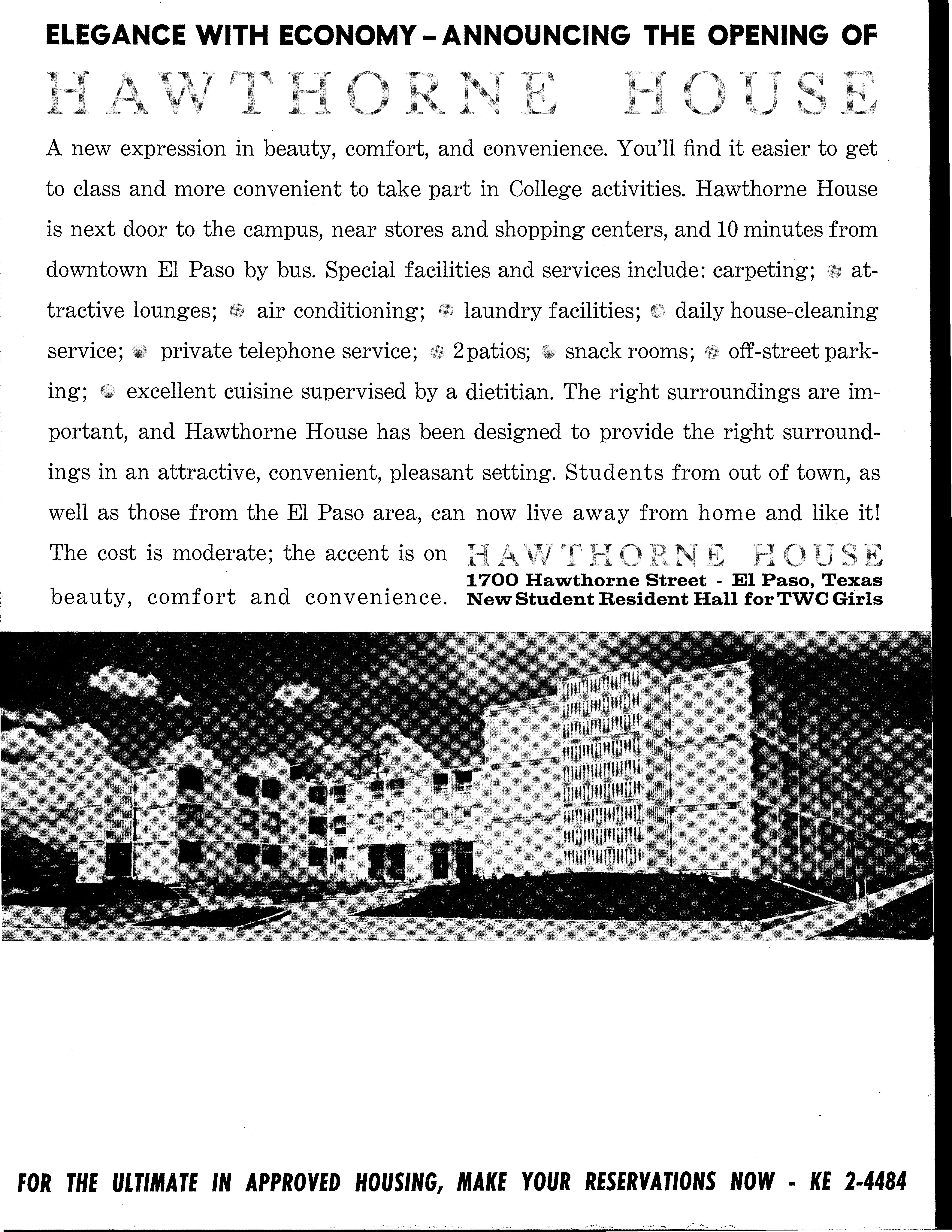
ELEGANCE WITH ECONOMY -
A new expression in beauty, comfort, and convenience. You'll find it easier to get to class and more convenient to take part in College activities. Hawthorne House is next door to the campus, near stores and shopping centers, and 10 minutes from downtown El Paso by bus. Special facilities and services include: carpeting; attractive lounges; air conditioning; • laundry facilities; • daily house-cleaning service; private telephone service; 2patios; • snack rooms; ft off-street parking; excellent cuisine supervised by a dietitian. The right surroundings are important, and Hawthorne House has been designed to provide the right surroundings in an attractive, convenient, pleasant setting. Students from out of town, as well as those from the El Paso area, can now live a way from home and like it! The cost is moderate; the accent is on I-1 A. Vl THOR. N. E ~10 l_T SE,
1700 Hawthorne Street - El Paso, Texas beauty, comfort and convenience. New Student Resident Hall forTWCGirls
A man and his wife were sitting together in the living room one evening. The phone rang and the man answered. He s a i d to the person on the phone, "How on earth should I know? Why don't you call the Coast Guard?"
"Who was that?" asked his wife.
"I haven't the faintest idea. Some fool wanted to know if the coast was clear."
"Don't you realize that I actually don't know who I am? I was left on a doorstep."
"Gee, maybe you're a bottle of milk."
A canny Scot was engaged in an argument with the conductors as to whether the fare was to be five or ten cents. Finally the disgusted conductor picked up the Scot's suitcase and tossed it off the train just as they were crossing a long bridge. It landed with a mighty splash.
"Hoot mon !" cried the Scot. "First you try to rob me, and now you've drowned my boy!"
Mother: Where did you learn such words, dear?
Little boy: From Chaucer.
Mother: Well, don't play with him anymore.
HAWTHORNE HOUSE
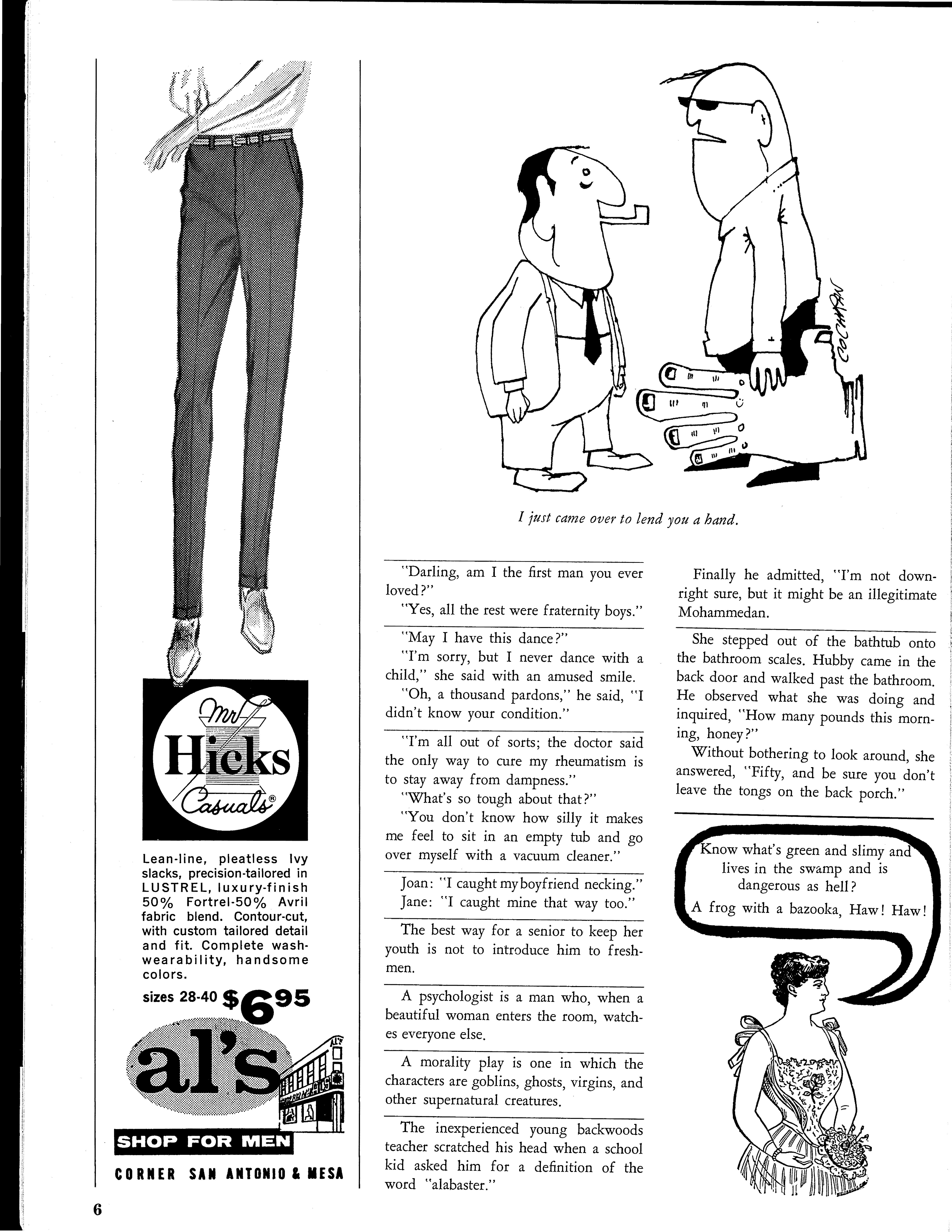
Lean-line, pleatless Ivy slacks, precision-tailored in LUSTREL, luxury-finish 50% Fortrel-50% Avril fabric blend. Contour-cut, with custom tailored detail and fit. Complete washweara bi lity, handsome colors.
I just came over to lend you a hand.
"Darling, am I the first man you ever loved?"
"Yes, all the rest were fraternity boys."
"May I have this dance?"
'Tm sorry, but I never dance with a child," she said with an amused smile.
"Oh, a thousand pardons," he said, "I didn't know your condition."
'Tm all out of sorts; the doctor said the only way to cure my rheumatism 1s to stay away from dampness."
"What's so tough about that?"
"You don't know how silly it makes me feel to sit in an empty tub and go over myself with a vacuum cleaner."
Joan: "I caught my boyfriend necking."
Jane: "I caught mine that way too."
The best way for a senior to keep her youth is not to introduce him to freshmen.
A psychologist is a man who, when a beautiful woman enters the room, watches everyone else.
A morality play is one in which the characters are goblins, ghosts, virgins, and other supernatural creatures.
The inexperienced young backwoods teacher scratched his head when a school kid asked him for a definition of the word "alabaster."
Finally he admitted, 'Tm not downright sure, but it might be an illegitimate Mohammedan.
She stepped out of the bathtub onto the bathroom scales. Hubby came in the back door and walked past the bathroom. He observed what she was doing and inquired, "How many pounds this morning, honey?"
Without bothering to look around, she answered, "Fifty, and be sure you don't leave the tongs on the back porch."
Know what's green and slimy and lives in the swamp and is dangerous as hell ?
A frog with a
CORNER SAN ANTONIO l IIESA
bazooka, Haw! Haw!
"Do insects e v e r get in your corn, Farmer Brown?"
"Yep, but we just fish'em out and drink it anyway.
If all the students who slept in classes were laid end to end they would be more comfortable.
Two business partners were fishing in a small rowboat, and suddenly a storm came up. The boat capsized, and while one of the men began to swim, his partner floundered and sputtered helplessly. He was sinking.
"Say Harold," the swimmer said to the sinking man, "can you float alone?"
"Look 1" said the other, 'Tm drowning and you talk business !"
The d o ct o r had two children, and everyone said they were the prettiest girls in town.
"Say," said the visitor to the town, "Who are those pretty little girls?"
"They're the doctor's children," said a village boy. "He always keeps the best for himself."
Rub your hand over this spot and if it feels hairy see your doctor before the next full moon.
An inmate in an insane asylum was to be examined for dismissal. The first question he was asked was: "What are you going to do when you get out of here?"
The inmate replied: 'Tm going to get me a slingshot and come back here and break every damn window in this place."
After another six months in the padded cell, he was again examined, and the same question was put to him.
"Well, I'm going to get a job," was the reply.
"Fine," said the examiner, "and then what?"
"Then I'm going to buy a new car." "Good."
"And then I'm going to meet a beautiful girl."
"That's wonderful."
"Then I'm going to take her out driving on a lonely road."
"Yes?"
"Then I'm going to grab her garter, make me a slingshot, and come back here and break every d a m n window in the place."
So our jokes are old. Whatta ya gonna do about it?
HOUR SERVICE ON MOST PRESCRIPTION EYE GLASSES
SINGLE VISION
EB
When I applied for this job last spring I wrote a letter to the publications board liberally sprinkled with to-the-best-of-my-abilities and I-believes. A summer of how-about-working-on-the-staffs and won'tyou-please-get-your-co py-in- even-thought-it-is-I 05outside-and-you' d-rather- go-swimmings has taught me that my ability depends on my consumption of beer the night before, and my beliefs in relation to a college magazine are based on the quality and amount of material that lands on my desk. I told the publications board of grandiose plans, many of which have landed in the Hold For Future Use Because It Ain't Very Good file.
This is no apology. I like what I've gathered together to make an issue, and I hope the material in this magazine reflects Texas Western as an academic institution devoted to literary and speculative endeavors. I hope it reflects a student body that is serious, frivolous, young (in the head), experimental, interested, and sufficiently asinine to enjoy humor. I hope the school is healthily egotistical. I love myself, myself. In a very platonic way.
A word about aims: College, if anything, is an experimental situation. A college is speculative and original or it is worthless. And such a guidepointexperimentation-is important to this magaz111e. (More on this on future soapboxes.)
Advertising manager for the year, Joye Scheffler is a charmer! Known affectionately as that woman, Mrs. Scheffler is responsible for the bulkier El Burro by way of an unusual amount of ads. But do not heed that fantastic smile, or that convincing manner. Nay! Beware lest she sell you too an El Burro ad contract. There's no stopping that woman.
I knew copy editor Kathaleen Dishart when she was a Cunningham, which is the compendium of considerable cunning and a pleasant bit of ham ( as in putting lampshades on one's head, not the other kind of ham). Now married, Kathaleen has lost none of her old attributes to the vacuum ( as in Hoover) and banana-bread making of domesticity.
At last word the assistant editor was in California making the scene, and because he finked out on me and did not write that great article I won't reveal his name until he buys me a six-pack to make amends.
The humor editor likewise dissolved into the nether-nether world of summer vacation. Someone told me he was spending his time writing the life story of Lenny Bruce ... So I typed out all the dirty jokes. Exchange editor, Carole McCool seems misplaced in this grouping of misfits and manipulators, and deserves qedit for being around all summer. Color her helpful. And cute. - EDITOR
Sam: "What would you have if you took 2000 bras and cut them down the middle?"
Joe: "I don't know."
Sam: "Four thousand beanies with chin straps."
"I don't like Bill," confided a coed to her roommate. "He knows too many nasty songs."
"Does he sing them to you?" asked her friend.
"No-he whistles them."
An old lady was sitting in her rocking chair knitting, her Persian cat reclining at her feet.
Suddenly, a fairy appeared and asked the old lady if there was anything she wished.
"Yes," she replied, "I would like to be beautiful young maiden again."
The fairy waved her wand, and there she stood, a lovely girl of twenty.
"Now," asked the fairy, "Is there any other wish you would like granted?"
"Oh, yes, I w o u 1 d like a handsome young man."
Turning to the cat, the fairy waved her wand. In place of the cat rose a fine looking youth. He looked sadly at the girl and sighed, "Now aren't you sorry you took me to the vet ?"
"Mommy, Mommy! I'm fourteen years old now, can I wear a brassiere?"
"No George."
"Sam, do you think it will be all right if I ask Janet for a kiss tonight?"
"Look, Joe, you don't order root beer in a speakeasy, do you?"
"I 'aven't 'ad a bite for days," said the tramp to the landlady of an English inn, The George and the Dragon. "Don't think yer could spare me one?"
"Certainly not," replied the woman.
"Thank yer," said the tr a mp, and slouched off. A few minutes later he was back.
"What d'yer want now?" asked the landlady.
"Could I have a few word s with George?" said the tramp.
He: What's that gurgling noise?
She: That's me trying to swallow your line.
Moe: Why are elephants grey?
Joe: Why?
Moe : So you can tell them from pecans.
Moe: What did Tarzan say when he saw the elephants coming?
Joe: Here come the elephants?
Moe: 'Here come the pecans!' He was color blind.
HAW HAW HAW HAW HAW!
Know what's green and slimy and lives in the swamp and is dangerous as hell? A frog with a bazooka, Haw! Haw!
"Ivan, vat are you doing?"
'Tm drunk, Papa."
"What??"
"Yas, I'm drunk pictures on the wall."
"Porter, get me another glass of ice water·
"Sorry sir, but if I take any more ice, that corpse in the baggage car isn't going to keep."
\KURLAND~ SALZMAN
El Paso's Most Complete Music Centers
HEADQUARTERS FOR:
• Records
• Pianos
• Organs
• Sheet Music
• All Band Instruments
• Complete Line of Teaching Material
• Instruments sold, rented & repaired
• Use our Budget Terms
CHELMONT
5030 Montana Ave. 778-6345 SUNRISE 8516 Dyer SK 1-1219 American & Italian Food
GO FIRST CLASS WITH~. NATURAL~ GAS
EL PASO NATURAL GAS COMPANY
• BRASSWARE
• PORCELAIN
• TEAK
• CAST IRON
• CLOTHING
• INCENSE
• LANTERNS
• FIGURINES
• STONE CARVINGS
• WOOD CARVINGS
• SCREENS & SCROLLS
• EXECUTIVE GIFTS
• PARTY FAVORS
• RATTAN FURNITURE
• DECORATOR ITEMS
• PLACE MATS
• CANDLES AND MATCHES
• PERFUMES
UNUSUAL AND DISTINCTIVE GIFTS
GIFT WRAPPING & DELIVERY
DISPATCHES FROM By
THE COSMOS
Jon Carleton
and Joseph Richards
Bear with us for a moment, friends, as we ponder reverently the trials of registration. To the older student it is merely a reliving of old horrors, but to the unsuspecting freshman it is a swirling, supererogatory labyrinth derived from the darkest meditations of the Marquis de Sade. Indeed, after groping through a seemingly ineluctable maze of IBM cards, car-registration tables, closed class lists, fealty statements, fee lines, and religious preference papers, is it any wonder that the old Dickens' line "It was the best of times, it was the worst of times," echoes back from memory to describe the scene?
It is with a full realization of the mental tensions evolving from the fore-described procedure that we dedicate this first column to the end of your gross edification only. In future editions, however, we intend to discuss a potpourri of subjects, including literature, the fine arts, social occurances of import, and places of interest to visit in our area. But now The Gift Idea of the Month
Your friendly TWC Book and Trick Shop is now offering, at a specially marked-up price, handsomely personalized cuspidors, engraved with your name and intended year of graduation. These fine items are made of high-quality tin and are backed by a manufacturer's guarantee. In addition, with each purchase of this amazing product, there will be given, absolutely free, the definitive new 596 page edition of The Use and Maintenance of Your Cuspidor. It should also be noted that each of the TWC cuspidors is the spitting image of one found in the Louvre.
When we recently asked bookstore owner Arthur Wombat how this item has sold so far, he repli'ed, "It's been simply unbelievable." He went on to point out that many practical-minded new students were using their cuspidors as a substitute for the outdated Freshman beany. This statement is most assuredly true, for at that moment a passing freshman using a cuspidor for that very purpose interrupted to say, "It rea1ly keeps my forehead cool."
It was then time for Mr. Wombat's daily demonstration
of the various approaches to the cuspidor. He performed eximiously the ten basic stances for accomplishing a good ringer and then went on to attempt several trick shots. One over-the-shoulder shot went somewhat awry and Mr. Wombat was forced to make an uncommonly vulgar geshire. He then smiled graciously and executed the very difficult, under-leg squat shot which we found to be most gratifying. At this point our interview was cut short by rude outcries of "hook" from unappreciative onlookers and we were forced to take our leave.
Other suggested uses for your personalized cuspidor are for cooking excellent stews and soups and for storing old copies of El Burro.
Last year Texas Western's Debate Team became highly proficient at devising and playing word and literature-association games. Many long trips which would have otherwise been oppressingly tedious were saved by playing such stimulating games as Botticelli, Pass-word, and Ghost. But in the intervals between these games, there was no less enthusiasm displayed for making puns. It often turned out that the worse a pun was, the funnier it was also. You can imagine, then, the delight of the team when we first heard of the game known as "Tom Swifties."
The idea of this little game is to pun a phrase with an adverb describing how the speaker said it. For example: 'Tm sure I can dig up a date for you," said Tom gravely; or, "He's a man of steel," Tom said ironically. The game spread like wild-fire, and magazines as different in format as PLAYBOY, LIFE, and SATURDAY REVIEW all lauded the game's merit and busily created their own "Swifties." The game became so popular that TIME magazine offered a prize for the best "Swifty" submitted. The effect on the Debate Team was that it was very unhealthy for several weeks to enter the conference room without being armed with numerable new "Swifties."
But, as it is, we soon tired of the game and began looking for new worlds to conquer. One game that we are especially proud of is one we call "Old-Books-New Authors." The game is self-explanatory, so we herewith present our Best-sellers for the month:
l. The Naked Communist
2. The Marriages
3. Travels With Charley ( an autobiography)
4. Vanity Fair
5. The Possessed
6. The Trial
7. The Agony and the Ecstacy
8. To Kill a Mockingbird
9. How to Win Friend and Infuence People
SIGNS
We are happy to have been selected to install TWC's new scoreboard
HEAP POWERFUL PLEN Y CHEAP!
By Christine Keeler
By Nelson Rockefeller
By Charles DeGaulle
By Cassius Clay
By Richard Burton
By Jimmy Hoffa
By John Profumo
By Frank Buck
By Billie Sol Estes
COMING NEXT MONTH: RARE, NUDE PHOTOGRAPHS OF GABBY HAYES, HOOT GIBSON, AND PINKY LEE!*
And now we leave you with A Thought to Live By: T'is better to have loved and won, than loved and lost.Lucretia Borgia.
*We regret to note that the photographs of Hoot Gibson have been censored.
BANK GASOLINE
THE MINOR DISCIPLE AND THE INCHWORM
A minor disciple of the Chojun sect of the school of Nodo once decided to make a pilgrimage to the great mountain of Lo. Actually, he never really decided to make such a pilgrimage at all. Rather, he awoke one morning and found, much to his surprise, that the wooden step in front of his door had collapsed during the night. Of course, when a wooden step collapses it can mean only one thing. So, resigning himself to his fate, the minor disciple began immediately to make preparations for a pilgrimage.
lapsed step completely. But, since he was fairly sure the other disciples and the monks had seen it already, he tried to pretend that he enjoyed making pilgrimage preparations more than anything else.
By Howard Sigman White
This preparation business took about all the courage and religious fervor that the minor disciple possessed. It was not that the minor disciple was ignorant of the proper procedure of pilgrimage preparation: on the contrary. If there was anything that he knew how to do it was making such preparations, for he had studied long and hard on that particular subject, even though he had never expected to use what he had learned. No, it was not that he was unprepared. It was simply that not one of the last eightyseven monks to leave the monastery on a pilgrimage had returned. The minor disciple liked it at the monastery. Indeed, he could imagine no finer place. The food was good, the roofs did not leak, and, best of all, one did not have to join in with the regular work parties until one had taken the final vows of the Chojun sect, until one achieved the Supreme Enlightenment. It took many long hours of meditation and contemplation to reach a decision as important as the one to take the final vows. It took a great deal of work to achieve the Supreme Enlightenment, too. The more he thought about it, the more difficult ·such a decision became for the minor disciple. Recently he had decided that perhaps it would be best if he never achieved the Supreme Enlightenment. He had decided to remain a minor disciple for good. Life. was so much simpler that way. And then that wooden step had to collapse during the night! He would have liked to ignore the col-
First he cleared his mind of physical distractions by muttering several verses from the Undum Sutra. Then, seating himself in the double lotus position, he proceeded to enter into the Primary State. Once he was settled in this blissful condition, the minor disciple commenced to meditate as hard as he could. As everyone knows, the first thing to do in pilgrimage preparation is to reach s o m e conclusion concerning the exact place to w hi ch the pilgrimage is to be made. Without first determining this important factor, one's pilgrimage is bound to be : of little value. During the entire journey, one will very likely be wondering where it is that he is going and, indeed, he may not even know when he gets there. The minor disciple realized that such a thing could be rather bothersome.
Now, the minor disciple remained deeply engrossed in his meditationwhich consited solely in keeping his mind in a state of divine emptiness-for about : seven hours and forty-three minutes. You may have heard it said that seven hours and forty-three minutes is a long time to keep one's mind empty-but such was • not the case at all with this particular minor disciple. It was not in the least difficult for him. If you must know, his mind was usually empty all day long. Nevertheless, seven hours and forty-three minutes was a very long time to be sitting in the double lotus position, and the minor disciple's legs had long since become rather numb. In fact, the numbness had spread all the way up to his neck. If you have ever been numb all the way up to your neck, then you know how disconcerting it can be. If you have never been numb all the way up to your neck, then you will have to take my word for it: it is very disconcerting. Suddenly, the minor disciple's mind began to wander,
and the first thing he knew it was no longer empty! Not only was it not empty, but it was imagining that being numb all the way up to the neck must be very much like sitting in a neck-high snow-bank, white and cold and numbing, such as the deep, eternal snows which covered the top of the great Mt. Lo. And the next thing you know, the minor disciple's errant mind was picturing the snowy slopes of Loyama with the minor disciple himself sitting in the double lotus position in a neck-high snow-bank right on the top of the peak!
When the minor disciple realized what his mind was doing, he was taken aback. He made several sincere attempts to clear his wandering mind, but without success. The snow-topped image of Mt. Lo just would not go away. This was, as you may well suppose, most frustrating to the minor disciple. He grew more and more nervous. He tried to remember the proper verses from the Undum Sutra for emptying the mind. He made a great effort to return to the Primary State. He even resorted to muttering that most sacred of syllables, "Om," the mere thought of which is the most powerful mental pergative recorded in the ceremonial texts of the Chojun sect of the school of Nodo. None of these things did the least good. The image of Mt. Lo shone in his mind bright and clear.
"Oh, well," the minor disciple thought. "One place is as good as the next, I suppose. Since I have to make a pilgrimage, I may as well go to loyama." And, after gathering up all his worldly possessions, he started for the west gate of the monastery. About half-way to the gate, however, he realized that he would never make it to Mt. Lo with such a heavy load, so he returned to his room and left most of his worldly possessions stacked bY,, his pallet. This was, he considered, just as well anyway, for he could always return on the pretext of having forgotten something essential if the trip became too difficult. A second time he started for the
west gate of the monastery this time he made it.
The highroad to Mt. lo turned out to be a hundred times more dusty and a thousand times more tiring than the minor disciple had ever imagined a road could be. What little religious fervor the minor disciple had left was waning fast. On top of that, he had gotten a late start and was beginning to feel sleepy. On top of that, with all his preparations, he had forgotten to bring any food along, and he was beginning to feel hungry. It was not many miles from the monastery that the minor disciple saw a cool, green grove of bamboo off to the side of the highroad.
"What a pleasant looking grove of bamboo thought the minor disciple. "That is just the spot to rest for a while from my pilgrimage. Perhaps I will even find some nuts or berries to eat in the grove." By the next morning, the minor disciple had slept. He had discovered in the meantime that nuts and berries do not grow in bamboo groves, and he was hungrier than ever. After his morning meditations, he started thinking on his own and soon decided that this pilgrimage b u s i n e s s was not at all like he had thought it would be. He was sitting on a clump of moss in a very dejected state when he slowly became aware of a small, light-green inchworm that was inching its way up a shoot of water-buffalo grass next to the clump of moss. The inchworm would work all the way up to the top of the shoot of water-buffalo grass, fall all the way down to the bottom, and start all over again. This happened several times as the minor disciple watched, and it began to bother the minor disciple to no end. Finally he could contain his agitation no longer and he spoke aloud to the light-green inchworm in the followmg manner:
"Ah, little brother, you sure 1y are among the lowest of all life forms on the face of the earth. You spend your time in nothing but inching up that shoot of wa-
ter-buffalo grass all day long. You learn nothing from the experience of failing, it is clear, for you only inch back up to fall over again. Can't you see that your existence is without meaning, little lightgreen inchworm? Take my advice and try to find something that has a higher significance in the Great Wheel of life. Only then will you discover the real value of living."
Such a long speech was a rare thing indeed for the minor disciple, and it left him quite worn out. He was just about to fall asleep again when, lo and behold ! he heard a surprisingly deep voice coming from the vicinity of the inchworm.
"Ah, minor disciple, I will thank you not to call me 'little bro the r.' And' though your size is considerably greater than my own, I would not say that you are any higher a life-form than I am. You spend your time in nothing more worthwhile than sitting on yourself all day long. You would do well to take your own advice and look for s o m e meaning in life. And I would venture to say that you have never once inched up a •shoot of water-buffalo grass in your life, so you probably have no idea what significance i n ch i n g has in the Great Wheel of Life. Be on your way, minor disciple, and leave me to find my own values in living."
The minor disciple jumped up from the clump of moss and was well on his way before the inch-worm could start to inch up his shoot of water-buffalo grass again. It is not certain what the minor disciple did after that, however. There are several different reports. Some say he returned to his native village to work in the rice paddies. Others say he went to Yokuska to become a sail-maker. You see, his disappearance from the area was the subject of considerable conjecture among the people of the region. But on one point they all seem to agree. All are certain that the minor disciple never again stooped so low as to speak aloud to an inch-worm.
At last! The realm of the folksinger has been invaded by El Burro in an attempt to introduce, inform, discuss, or argue-as the case may be-the merits of a relatively new phenomenon around TWC and El Paso, folk music.
Folksinging has been a part of the fabric .of American tradition and heritage since the ballad of Valley Forge; it fought in the Civil War, floated in haunting Negro spirituals, steamed placidly down the canals of the East, hammered the golden spike in the first great Transcontinental, went West with Greeley's advice, grubbed gold in California, slashed a path for civilization through the towering timbers of the magnificent Northwest, braved storms at the Cape in the sleek Clipper ships, sweated and swore in the rough mining towns, administered raw justice in the vast cattle empires, immortalized the badman images of Billy the Kid and Jesse James, shed blood overseas in two World Wars, and preserved in melody the history of our land.
However, since opinions among folksingers vary as much or more as they do among enthusiastic amateurs, then naturally new acquaintances to the art, such as these reporters, can't define the ultimate essence of folk music in one short article. If you're inclined towards specificity, write the Library of Congress.
Before the critics get their shootin' irons primed and pointing our way, let us hasten to explain that the purpose of El Burro is merely to review for you the burgeoning growth of a new form of addiction-the Don Quixote devotee, on the local scene, and to provide you with some background information on traditional American songs, singers, instruments, etc.
The password-Montana Street on Monday night. The locale-the Don Quixote Coffee House. The setting-a room of ample size, dimly-lit by crimson candlelight flickering on the beams overhead. Rows of tiny, intimate tables around which cluster the ethnic initiates, the true folk-type music-lovers. Far forward in a slightly recessed corner, two wooden stools before a microphone. Guitars, ukeleles, banjos placed casually around the room. Background of soft-voiced verse and ad-lib strumming. Relax a while and order a cup of expresso.
Don Quixote's opened about two and a half years ago and was originally a jazz place. But then an unusual combination of circumstances occurred: the increasing national popularity of folk music initiated by commercial entertainers such as the Kingston Trio, the Whiskey Hill Singers, Joan Baez, Pete Seegar, Woddy Guthrie, Burl Ives-stimulated local interest.
Howard Wilcox, partner, operator, and entertainer in the coffee house, began scheduling tolk singers. Response grew. Steve Brainard, operator of a similar club in Oklahoma, spent some time in El Paso recently organizing the movement.
Groups around town began appearing with folk music as the outstanding characteristic of their performances. The Tekewoods, Glenn and Jay, Tom O'Neill. Howard White and the TWC Literary Society presented a special program devoted to the "new" style. Of course, it was new only to
El Paso.
Now to reveal a trade secret of the penpushing profession: the best way to write an article on a subject which you know next to nothing about is to get some. people who do know a little about it into a good-natured, wide-ranging argument.
This particular night was cool, rain was pattering gently and persistently outside, and the door stood ajar mingling moonlight with the red candles. But tranquility within had been disrupted, in a friendly fashion, while we sat hunched industriously over the dim table scribbling frantically with skipping ballpoint on convenient napkins.
And here are the fruits of our labors:
The evolution of music is the evolution of man's impulse to express himself. This can be traced from the rhythm chants of the aborigines to the primitive melody instruments of the Orient to lyrics arising out of Medieval ballads and on down through the pageantry of Americana.
While the classics are the music of the composer, jazz is the music of the musicians and folk music is the music of the people. Folk music is actually the oldest form and consequently the foundation of all others. Its lasting popularity is attributable to the fact that it usually tells a story arising out of the daily lives of the people and every person who sings it is free to change absolutely anything to suit his own individual tastes-tempo, stanzas, chords-without destroying the original. You still have a perfectly good, authentic folk song.
Half a century and more ago students of folksongs looking regretfully toward the past and uncertainly toward the future, noted that ballads and folksongs were something that had their day. New times brought new interests, and folksinging, except as an antiquarian hobby, seemed on the way out. The amazing resurgence of this informal traditional music is one of the minor miracles of our time.
Though the folksong is relatively simple and is thought of as primitive and unsophisticated, its intrinsic beauty and universal appeal have given it standing as a genuine art, as well as a chronicle of folklore. It has even stimulated other fields: operas, among which Green Grow the Lilacs (from which Oklahoma! was derived) and Porgy and Bess are probably the most well-known; symphonies such as Dvorak's From the New World and the Pulitzer Prizewinning Suite in Southern Mountains; ethnic dances such as the rounds, reels, and square dances; and an infinite number more.
The tools of folksong production are a fascinating variety. The guitar with its soft and mellow tones no doubt holds undisputed first place for all-around use among folk instruments today; the harmonica takes a kind of precedence because of its pocket size and modest price. The banjo and the fiddle, with lively, sharp, and sometimes raucous voices, seem perfectly fitted to American pioneer exuberance and for a long time have been deservedly popular over the whole country. Worthy of mention also are the zither, auto-harp, dulcimer, mandolin, accordian, lute, harp, and recorder.
Anyone interested in the wonderful world of folksong soon learns that a vast amount of research goes on in the field of folklore. Activities of many folklore societies, including their publications, give ample evidence of much specialized work, as well as lively and entertaining information. John Lomax of Texas and his son Alan, the two men who created the Archive of American Folk Song in the Library of Congress, have compiled a body of words and music that tells more about the American people than all the miles of quadruple-laned freeways and bill-boardplastered countrysides and sky-scraper riddled cities combined.
Perhaps the most truly distinctive thing about folksingers are their festivals. A time of joy, gaiety, and mutual entertainment, the "Big Singin' " whingding has flourished widely, if somewhat sporadically, all across the nation. The latest successor to this old-time type of gathering has been the college-sponsored program of guest groups.
The present controversy and the biggest argument against folk music is that the contemporary musicians are not singing authentic, original, straight-from-the-horse's mouth type ballads. Some believe that this was one reason for the split between Dave Guard and the Kingston Trio. Guard wanted more authenticity. He got it with his Whiskey Hill Singers, who, although singing with almost hillbilly authenticity, nevertheless have discovered that their record sales are well below the latest "commercial" Trio album. The reason is simple. Most of the folk audience doesn't appreciate obtrusively authentic music, as most of the public are not avid followers of ancient balladry. They care little for originality and crave only entertainment. But despite minor rifts among artists, folksinging continues to expand as a major form of music.
So extensive have become the activities of the folksingers and so rich is the field that the parade of folksingers who have risen to a measure of popularity seems endless. The Weavers come instantly to mind, singing "Michael, Row Your Boat Ashore," with the entire throng in Carnegie Hall singing along. Pete Seegar alone at the banjo is enough to keep a person spellbound for hours. More recent but just as popular are Bud and Travis with their fantastic version of "La Malagena Solarosa." The Smothers Brothers with "Marching To Pretoria" and the Kingston Trio singing "Zombie Jamboree" have entertained millions (people) and made millions (profit) with their harmony.
Newer on the scene are the gospel singers who recently brought the house down on "Hoot-Nanny". Josh White and a stream of women singers led by Joan Baez and Lynn Gold are coming on strong. Peter Paul and Mary have quite a message in their recent release "Blowing in the Wind." Mose Allison, Lester Flatt and Earl Scruggs, Leadbelly and his famous 12-string guitar-all are gaining prominence in the music world as the vanguard of a new folksinging image.
For the expert, (if there is such a thing in regard to folk music) perhaps authenticity is the keynote for acceptance. The rest of us just sit back, listen and enjoy. D
so
YEARS AGO
Being a disreputable history of Gripton College, or, if you must, TWC.
By Kathaleen Dishart
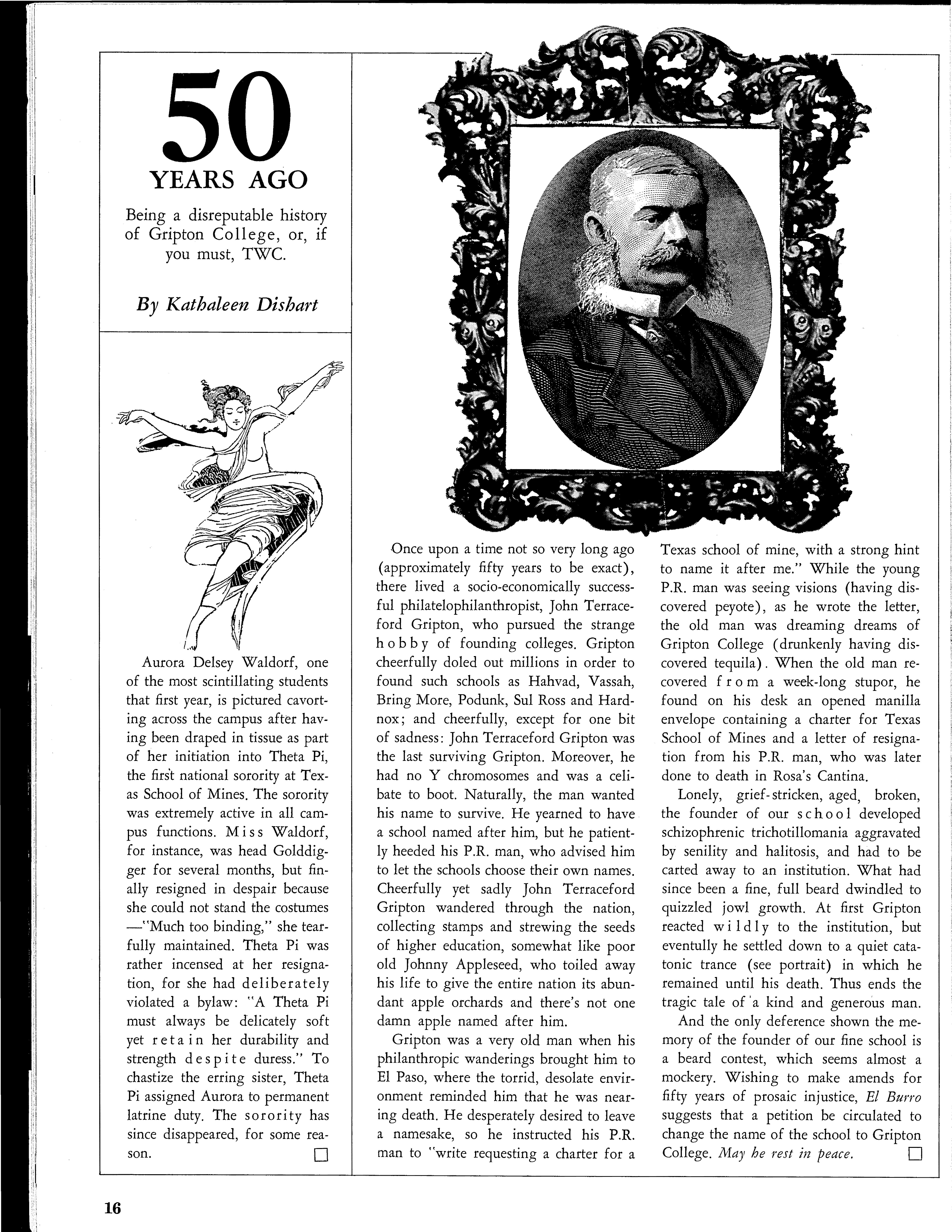
/., Aurora Delsey Waldorf, one of the most scintillating students that first year, is pictured cavorting across the campus after having been draped in tissue as part of her initiation into Theta Pi, the firs't national sorority at Texas School of Mines. The sorority was extremely active in all campus functions. Miss Waldorf, for instance, was head Golddigger for several months, but finally resigned in despair because she could not stand the costumes -"Much too binding," she tearfully maintained. Theta Pi was rather incensed at her resignation, for she had deliberately violated a bylaw: "A Theta Pi must always be delicately soft yet re ta in her durability and strength despite duress." To chastize the erring sister, Theta Pi assigned Aurora to permanent latrine duty. The sorority has since disappeared, for some reason.
Once upon a time not so very long ago ( approximately fifty years to be exact), there lived a socio-economically successful philatelophilanthropist, John Terraceford Gripton, who pursued the strange hobby of founding colleges. Gripton cheerfully doled out millions in order to found such schools as Hahvad, Vassah, Bring More, Podunk, Sul Ross and Hardnox; and cheerfully, except for one bit of sadness: John Terraceford Gripton was the last surviving Gripton. Moreover, he had no Y chromosomes and was a celibate to boot. Naturally, the man wanted his name to survive. He yearned to have a school named after him, but he patiently heeded his P.R. man, who advised him to let the schools choose their own names. Cheerfully yet sadly John Terraceford Gripton wandered through the nation, collecting stamps and strewing the seeds of higher education, somewhat like poor old Johnny Appleseed, who toiled away his life to give the entire nation its abundant apple orchards and there's not one damn apple named after him.
Gripton was a very old man when his philanthropic wanderings brought him to El Paso, where the torrid, desolate environment reminded him that he was nearing death. He desperately desired to leave a namesake, so he instructed his P.R. man to "write requesting a charter for a
Texas school of mine, with a strong hint to name it after me." While the young P.R. man was seeing visions (having discovered peyote), as he wrote the letter, the old man was dreaming dreams of Gripton College ( drunkenly having discovered tequila) When the old man recovered from a week-long stupor, he found on his desk an opened manilla envelope containing a charter for Texas School of Mines and a letter of resignation from his P.R. man, who was later done to death in Rosa's Cantina.
Lonely, grief-stricken, aged, broken, the founder of our s ch o o 1 developed schizophrenic trichotillomania aggravated by senility and halitosis, and had to be carted away to an institution. What had since been a fine, full beard dwindled to quizzled jowl growth. At first Gripton reacted w i 1 d 1y to the institution, but eventully he settled down to a quiet catatonic trance (see portrait) in which he remained until his death. Thus ends the tragic tale of 'a kind and generous man. And the only deference shown the memory of the founder of our fine school is a beard contest, which seems almost a mockery. Wishing to make amends for fifty years of prosaic injustice, El Burro suggests that a petition be circulated to change the name of the school to Gripton College. May he rest in peace. D
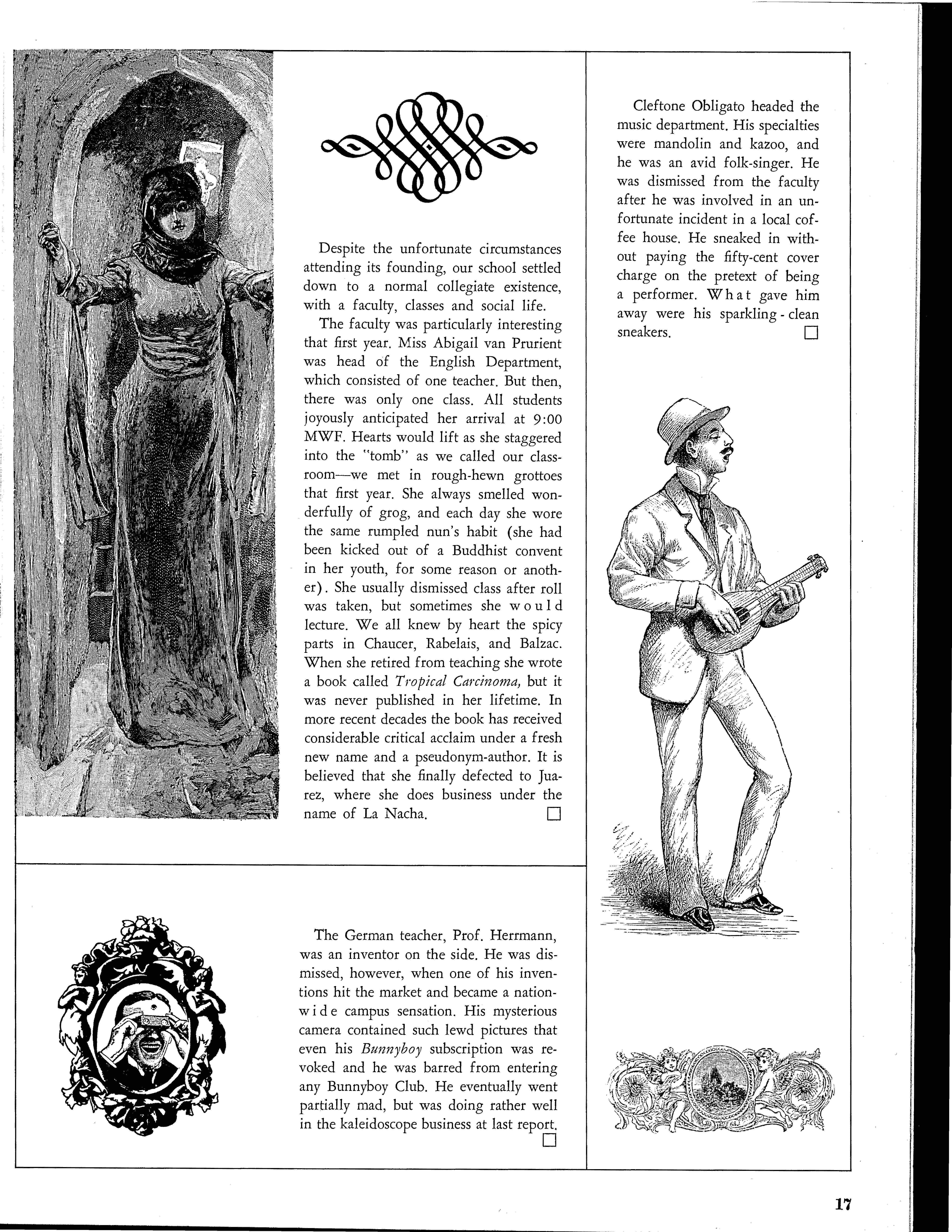
Despite the unfortunate circumstances attending its founding, our school settled down to a normal collegiate existence, with a faculty, classes and social life. The faculty was particularly interesting that first year. Miss Abigail van Prurient was head of the English Department, which consisted of one teacher. But then, there was only one class. All students joyously anticipated her arrival at 9 :00 MWF. Hearts would lift as she staggered into the "tomb" as we called our classroom-we met in rough-hewn grottoes that first year. She always smelled wonderfully of grog, and each day she wore the same rumpled nun's habit (she had been kicked out of a Buddhist convent in her youth, for some reason or another) She usually dismissed class after roll was taken, but sometimes she w o u 1 d lecture. We all knew by heart the spicy parts in Chaucer, Rabelais, and Balzac. When she retired from teaching she wrote a book called Tropical Carcinoma, but it was never published in her lifetime. In more recent decades the book has received considerable critical acclaim under a fresh new name and a pseudonym-author. It is believed that she finally defected to Juarez, where she does business under the name of La Nacha. D
The German teacher, Prof. Herrmann, was an inventor on the side. He was dismissed, however, when one of his inventions hit the market and became a nationw i d e campus sensation. His mysterious camera contained such lewd pictures that even his Bunnyboy subscription was revoked and he was barred from entering any Bunnyboy Club. He eventually went partially mad, but was doing rather well in the kaleidoscope business at last report.
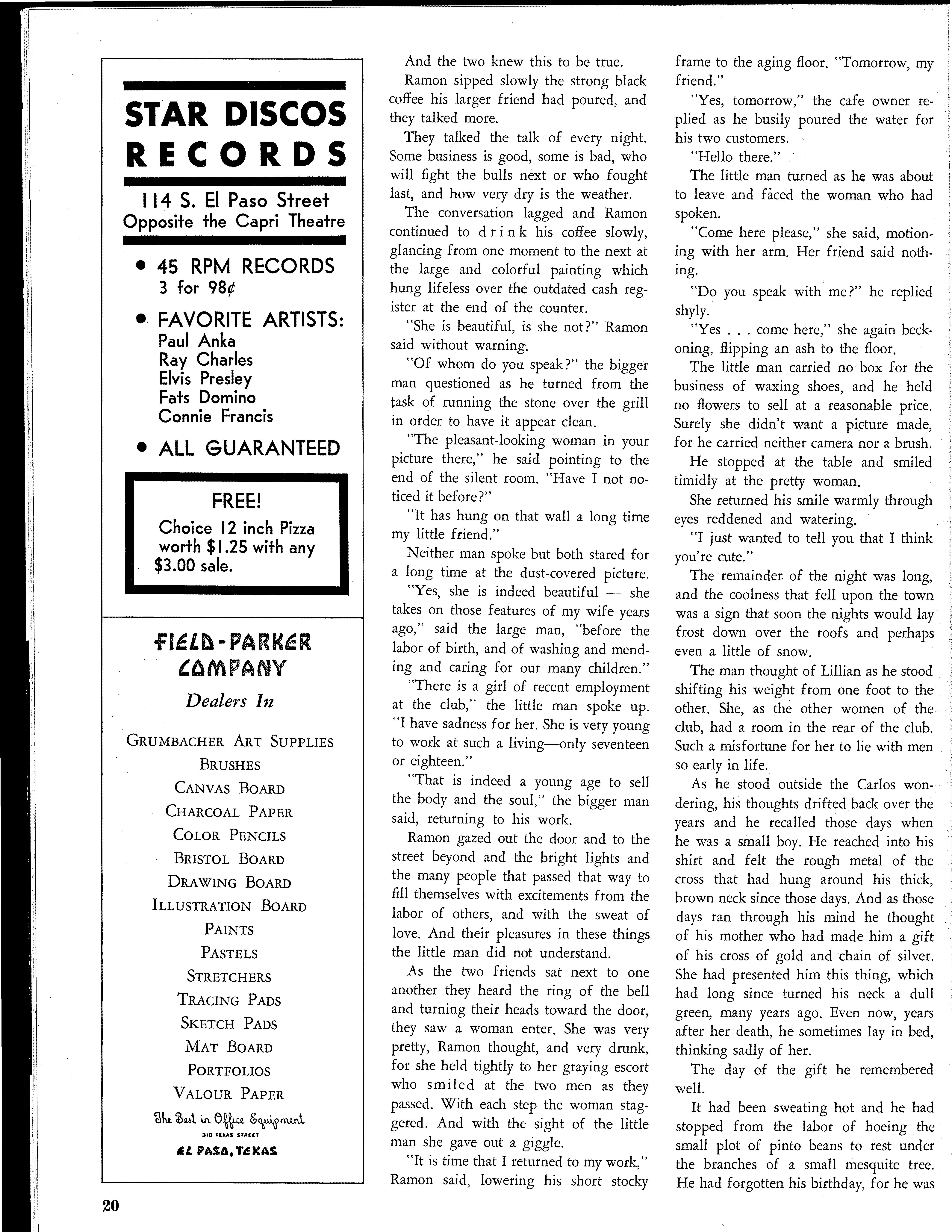
Cleftone Obligato headed the music department. His specialties were mandolin and kazoo, and he was an avid folk-singer. He was dismissed from the faculty after he was involved in an unfortunate incident in a local coffee house. He sneaked in without paying the fifty-cent cover charge on the pretext of being a performer. What gave him away were his sparkling - clean sneakers. D
The measure of a man: is it goodness, or money, or love? And are any of these attributes assurances of worth and success? A story of sadness. By Ronnie Hutchison.
TO BE BUT HALF A MAN
From doorway to doorway the shadows hurried toward the excitement that awaited them inside.
"In here! Good drinks! Lotsa pretty girls! Come on, come on."
And how the dirty narrow streets were filled with the business of these unknown shadows. E a ch silhouette in the night : seeking its own kind of pleasure before • once again each would cross at a late hour the slow, muddy river that separated the two worlds.
Music flowed in never-ending streams along either s i d e of the drunk-paved street. And mixed with the noise of the drum or the sax or the guitar came also the sounds of bliss-the songs and shouts of those drunk with liquor and forgetful of life.
And giving the gaiety motion were flashing neon lights signaling the uncertain to make entrance into this bar or this exhibition of flesh or this house of lust.
And to further persuade pleasure-seekers to visit these honorable establishments, these places of fine profit and half dollar drinks and shapely strippers and five dollar prostitutes, a man was stationed at the outer door.
This man who spoke to those passing was more often than not a fine looking man, for appearance was a good selling point indeed. And to those guilty of wealth these men would speak more often than not a tune of these words. "In here! Good drinks ! Lotsa pretty girls ! Come on, come on."
They came sometimes in scores to drink the half dollar drinks and to watch the
shapely stripper and later to relax for a reasonable price.
If many came to drink, the man at the outer door who called to them was paid well, but if no one saw fit to go in Poverty was common in the life of Ramon, the man with a cracked front tooth.
Ramon called to the people to come into his Carlos Club and inspect with their own eyes the promised delights. He was pleasant in a funny, distorted way, with a thin black mustache and long wavy black hair which was always well oiled and combed. And those passing him would remark about the man, for pleasantness was not known to his kind and he appeared strange. Many of the students of sin from across the river would make foul and ugly remarks to the man, trying to anger him. But the man called R a m o n merely shrugged and ignored their painful barbs, for to do otherwise would surely mean his job.
He had been of good fortune to secure such employment, for he was dwarfed, and it was a sad thing indeed.
"It is time?" the little man asked the bartender above the clamor of song and drink.
"In five minutes, little one, "the man called Guillen answered as he lit the cigar of an elderly, bald-headed man who sat next to the girl Lillian. The old man grasped with one hand a glass of whiskey while the other traced a pattern on the girl's smoothly shaped thigh.
Ramon stared for a minute at the old man's pale, wrinkled hand, then h1rned away from the bar and started for the door.
It had become a pleasurable habit in his work to travel down the long wide street midpoint in his work night, and sit in quiet and drink coffee with his friend who owned the old cafe many blocks from the club.
It was a small cafe, but Ramon had always thought his friend forrunate to own such a fine place---to own the cups, and the tables and the very coffee- they drank. From time to time he had even wished for himself an establishment of such quality, but he was without money and to small of stature to own a business.
As he entered the cafe the bell above the door sounded, the only clue to his presence, for he was too small to be seen below the tall counter.
"And how is my little fr i end this night?" the large cafe owner said as he glanced over the counter to discover whe 0 ther it had been man or wind sounding the bell.
"There is much business tonight and many people have come," the small man answered as he climbed to a stool.
"To you my small friend. To you and your Carlos and your booze and women." He stopped for a moment to sip at his coffee. "My tiny restaurant has seen but six people enter its door this night," he said.
"I am, troubled to hear this truth my friend," the smaller man replied as he clumsily brought a smoke to his lips, "But the body sees need for the evilsthe pleasures-of the club." He paused for an instant to inhale the smoke. "Food seems to lack the pleasure of drink and women."
STAR DISCOS RECORDS
Paul Anka
Ray Charles
Elvis Presley
Fats Domino
Connie Francis
fl~Lrl- PARK~R t.OMPANY
Dealers In
GRUMBACHER ART SUPPLIES
BRUSHES
CANVAS BOARD
CHARCOAL PAPER
COLOR PENCILS
BRISTOL BOARD
DRAWING BOARD
ILLUSTRATION BOARD
PAINTS
PASTELS
STRETCHERS
TRACING PADS
SKETCH PADS
MAT BOARD
PORTFOLIOS
VALOUR PAPER
And the two knew this to be true. Ramon sipped slowly the strong black coffee his larger friend had poured, and they talked more.
They talked the talk of every night. Some business is good, some is bad, who will fight the bulls next or who fought last, and how very dry is the weather.
The conversation lagged and Ramon continued to drink his coffee slowly, glancing from one moment to the next at the large and colorful painting which hung lifeless over the outdated cash register at the end of the counter.
"She is beautiful, is she not?" Ramon said without warning.
"Of whom do you speak?" the bigger man questioned as he turned from the task of running the stone over the grill in order to have it appear clean.
"The pleasant-looking woman in your picture there," he said pointing to the end of the silent room. "Have I not noticed it before?"
"It has hung on that wall a long time my little friend."
Neither man spoke but both stared for a long time at the dust-covered picture.
''Yes, she is indeed beautiful - she takes on those features of my wife years ago," said the large man, "before the labor of birth, and of washing and mending and caring for our many children."
"There is a girl of recent employment at the club," the little man spoke up. "I have sadness for her. She is very young to work at such a living-only seventeen or eighteen."
"That is indeed a young age to sell the body and the soul," the bigger man said, returning to his work.
Ramon gazed out the door and to the street beyond and the bright lights and the many people that passed that way to fill themselves with excitements from the labor of others, and with the sweat of love. And their pleasures in these things the little man did not understand.
As the two friends sat next to one another they heard the ring of the bell and turning their heads toward the door, they saw a woman enter. She was very pretty, Ramon thought, and very drunk, for she held tightly to her graying escort who smiled at the two men as they passed. With each step the woman staggered. And with the sight of the little man she gave out a giggle.
"It is time that I returned to my work," Ramon said, lowering his short stocky
frame to the aging floor. "Tomorrow, my friend."
"Yes, tomorrow," the cafe owner replied as he busily poured the water for his two customers.
"Hello there."
The little man turned as he was about to leave and faced the woman who had spoken.
"Come here please," she said, motioning with her arm. Her friend said nothing.
"Do you speak with me?" he replied shyly.
"Yes ... come here," she again beckoning, flipping an ash to the floor.
The little man carried no box for the business of waxing shoes, and he held no flowers to sell at a reasonable price. Surely she didn't want a picture made, for he carried neither camera nor a brush.
He stopped at the table and smiled timidly at the pretty woman.
She returned his smile warmly through eyes reddened and watering.
"I just wanted to tell you that I think you're cute."
The remainder of the night was long, and the coolness that fell upon the town was a sign that soon the nights would lay frost down over the roofs and perhaps even a little of snow.
The man thought of Lillian as he stood shifting his weight from one foot to the other. She, as the other women of the club, had a room in the rear of the club. Such a misfortune for her to lie with men so early in life.
As he stood outside the Carlos wondering, his thoughts drifted back over the years and he recalled those days when he was a small boy. He reached into his shirt and felt the rough metal of the cross that had hung around his thick, brown neck since those days. And as those days ran through his mind he thought of his mother who had made him a gift of his cross of gold and chain of silver. She had presented him this thing, which had long since turned his neck a dull green, many years ago. Even now, years after her death, he sometimes lay in bed, thinking sadly of her.
The day of the gift he remembered well.
It had been sweating hot and he had stopped from the labor of hoeing the small plot of pinto beans to rest under the branches of a small mesquite tree. He had forgotten his birthday, for he was
,othered with the talk of that morning ,etween him and the store owner.
He had journeyed that morning into he town to the store where farm goods ,ere sold on credit.
And to the owner he had said, "How -ery hot it is." And, being a boy as he vas, he had asked about his father. "And did you know of my father?" he small boy had asked.
"Your father is gone, small boy nd it is good, for he was only half a nan."
And others, even his mother had said his thing: "Your fathe.r is gone." But J be only half a man-that Ramon did tot understand, and this thing bothered tim.
These things were going through his oind as his mother came that day to the ree with a small box in her thin hands.
He had asked: "Mother, it is said faher was but half a man. I do not undertand this thing. And mother, am I to >e but half a man, for other boys are 10w much taller than I?"
His mother had handed him the box vith the cross and turned away quickly .o brush from her eye a bug, for many )ugs found shelter likewise beneath the iree.
But this thing had passed now.
The morning sun on his back felt warm ts he walked the mile to his one room tdobe hut on the edge of town. He enoyed the early-day walk.
The climbing sun lay its warmth on famon's shack and he took notice of the :racking of the dirt bank which served as 1is back wall. The bank itself formed he side of a hill forty or fifty feet above 1is home and it appeared that one hard :ain might in fact bring the steep slopes >f the hill tumbling down on him while 1e slept. He would surely have to build t few supports. "Possibly tomorrow," he bought.
"But now I will eat so I may sleep at :ase," he muttered as he entered the flim:y door of wood frame and cardboard. The little man had made no repairs >r improvements on his house of adobe n the years he had lived there, and the >ressure of age and weather had eaten at t relentlessly.
His dwelling was set in among hunireds of similar huts where dry dusty :oads honeycombed around the hills and 10uses.
Life was as simple as rewards were
few, and the people of these houses knew what poverty was, and sickness and hunger and death, for these thing sought them out and weighed heavily upon them.
As the days melted into weeks and the weeks into months, the weather grew fingers of icy winds to tickle and agonize Ramon's tiny body as he stood singing his song to the soldiers and students and men of business from across the river. And as the weeks closed he journeyed to his adobe home on the hillside, money in his hand, sadness _in his heart.
As quickly as corn will break ground and grow-so had a love for the girl Lillian grown - and it was not a passing thing.
Nights upon n i g ht s the little man would sit in the Carlos and have patience until the wind had settled, and with each night the girl grew more precious, and only when she was working or the man called Guillen would say, "Back to work Ramon," only then would he leave and return k> his work in the street.
And it was odd indeed, for although she sinned and slept with many men, Ramon had respect and love for her.
He himself had no desire to sleep with her-only to care for her.
But these things he knew would never be.
Now, the greatest part of the little man's time was generally spent outside the club, except for those nights when the weather worsened and the customers from the North did not come. And of late he had seen much of the girl and he knew her habits and motions. The little man had a first thought he was only imagining to himself the difference he saw in this girl from the others; but to watch and listen was to know this thing to be true.
For as the other girls came to action at the opening of the door, this girl would wait and judge those with whom she would drink. And those men who knew of her would return seeking only her, for she was indeed of a different breed.
How it tore at the tiny man when she and her man would make exit from the bar and enter into the room in the back. Loneliness for her would fill his body. But never did he speak these thoughts to those about him. Even· his fat friend at the cafe knew little of Lillian.
And it was on such a night, cold even to numb his toes and windy even to blow
his well oiled hair, that the streets were offering little business, and he had again entered the club. And, as usual, when customers would thin to none, the girls would sit at the bar chattering away about things Ramon knew little of, of the elegant red silken dress seen early this very day at the Fashion House and of its low price, and, too, of the handsome new hair stylist at the shop by the bridge, and how gracefully his hands molded hair. The girls and women would speak of many things, but the girl Lillian sat alone.
And as they spoke this night, the man called Ramon spoke only to himself.
"How would I feel if I could touch for a moment the light face of the girl . . . and how truly good would I feel if she would come and speak with me at this booth."
But those blissful thoughts ceased as the door opened and two from across the river entered.
The girls stirred, for these man of few years were fine looking indeed and the little man was envious.
And Nancy, the red-haired girl quickly joined Lillian, for to wait and judge on thin nights was to be with no earnings.
The men were pleased with what they saw: the beauty and firmness of the two bodies, with dresses cut low, exposing much of the breasts. The men were indeed well pleased, for they smiled.
And the one who sat with Lillian motioned to her with a pack of cigarettes, but she shook her head, smiled, and said something that the little man wished had been spoken to him, and the bigger man smoked.
And the sadness that had come over the little man at first went quickly away, for he tought-"How virtuous she is. She does not take gifts from anyone."
And as those thoughts flowed through his mind, the girl and the taller man rose from the booth together and walked for the rooms in the back.
And as they went by, the girl looked down and smiled at the little man with the cracked tooth.
"And we sat and talked for a great while," the little man said to his large friend who owned the cups and coffee and the whole cafe.
And this thing was true. For the girl had come to him later that very night and sat and talked.
And she had asked of the coldness in the street and "Would it snow by morn-
ing ?" because she disliked the snow and the mud that came also and the muddy shoes that followed. And at first the little man had choked with nervousness of possibly saying the wrong words.
She then had said he must take medicine for his c o u g h , and, too, that he should dress more warmly, for it must indeed be cold in the street.
And they had talked together.
And the happiness known only as a boy returned to the little man.
"And you say she goes by what name?" his fat friend asked as he dried glasses washed with soap and water.
"Lillian is her name," he said with a smile
The two had coffee together and talked more of the girl and of the Carlos and how g o o d the business was for these months of winter.
And as t h e y talked the little man thought of the girl and if at this moment she might be lying with another.
"But now I must go," he said suddenly, and he bade a good-night to his friend and walked quickly down the street to the Carlos.
And the streets, on this night, were cold and almost deserted.
As he walked through the deserted • streets of the town he thought that things must not go on as they had been. "Yes, I will on this very night tell the girl of my love and tell her that I ask nothing from her, for I am nothing - I have nothing, and will in fact never have a thing. I will tell her only that I care greatly for her."
These thoughts of confession to the girl excited the little man and he knew that the time had come, foolish time that it was. But excitement was flowing hot in his veins, tiny as they were.
The air had t u r n e d chilly and to breathe deep was to quicken the mind and body. As he walked through and down the street to the club he knew that as surely as the sun rose in the morning and fell in the evening it was of no use to tell or ask or beg or whatever he was to say or do. Although his arms were in good proportion to his legs and his head set equally well upon his frame and his eyes and ears and the rest, save for his cracked tooth, w e r e unmolested, they were as a whole dwarfed, and it was a sad thing indeed.
He lessened his pace as many thoughts swam through his mind.
He passed a church. He stopped, walked on, then stopped again.
The church stood silhouetted against the wide moon-struck sky giving an air of promise to things, and as he stood alone at its base, a wind came softly gliding down the street over the church and was lost in the sea of stars and emptiness above.
"Oh God," he whispered in a choke, looking up at the peaceful structure.
"If only once you answered my prayers, if only once you would help me."
He sat on the cold stone steps and dropped his head to his hands.
And for a time he sat motionless.
After a long while he looked towards the sky, the heavens, and the eternity above, blemished by the lazy room and the light douds breezing gracefully along.
"As a boy of fifteen I prayed for the life of my mother, and the day following she spit blood and died there in her bed. This I thought was your way but I did not judge. And at the age of sixteen I prayed to you for strength and good fortune in raising the field of pinto beans.
But the cow ran with the plow and I fell beaten to the ground-and I have but half a tooth to remember it well."
"And, my Father, do you remember as a man of twenty-two I prayed that I might be given the job of caring for the bulls that fight? But they laughed and sent me away, for I was but half a man they said."
"But you have commanded such things and I hope never to question."
And the man of short stature rose, for the stone steps were cold and his trousers were thin.
"I will tell this girl Lillian this very night of my thoughts for her and I pray she speaks to me with kindness."
And the man without another word left the church steps and walked with unnatural speed down the narrow street to the Carlos and to the girl called Lillian.
And as these things go, she had gone.
"To Chihuahua City," said the man called Guillen, "for there are those of her name who have taken ill. She will return in two days. And what interest have you?"
And the smaller man felt relieved, for
he did not know what he would have said, for these things were difficult and fools were made many times over the lounge calleq the Carlos.
"And what offerings have I to present to this g i r 1, for a small man with a cracked tooth must truly make offerings/ he thought as he returned to the street and his song.
''How nice it would be to present a gift to the girl on her return. Surely I have money enough in my home to purchase some item of pleasure for her?"
"A dress of silken material would indeed be nice, or shoes. Yes, shoes for her tiny feet, or still yet a golden comb for her long black hair. This thing must be dealt with properly and without haste."
The little man thought of many things and saw in many shops shoes and jewelry and leather handbags and many other things. But he could not decide, for he had never bought for a girl and he feared a mistake.
A cool breeze struck his face as he approached his hut that following morning. The day was pleasant and refreshing, and only those clouds to the north
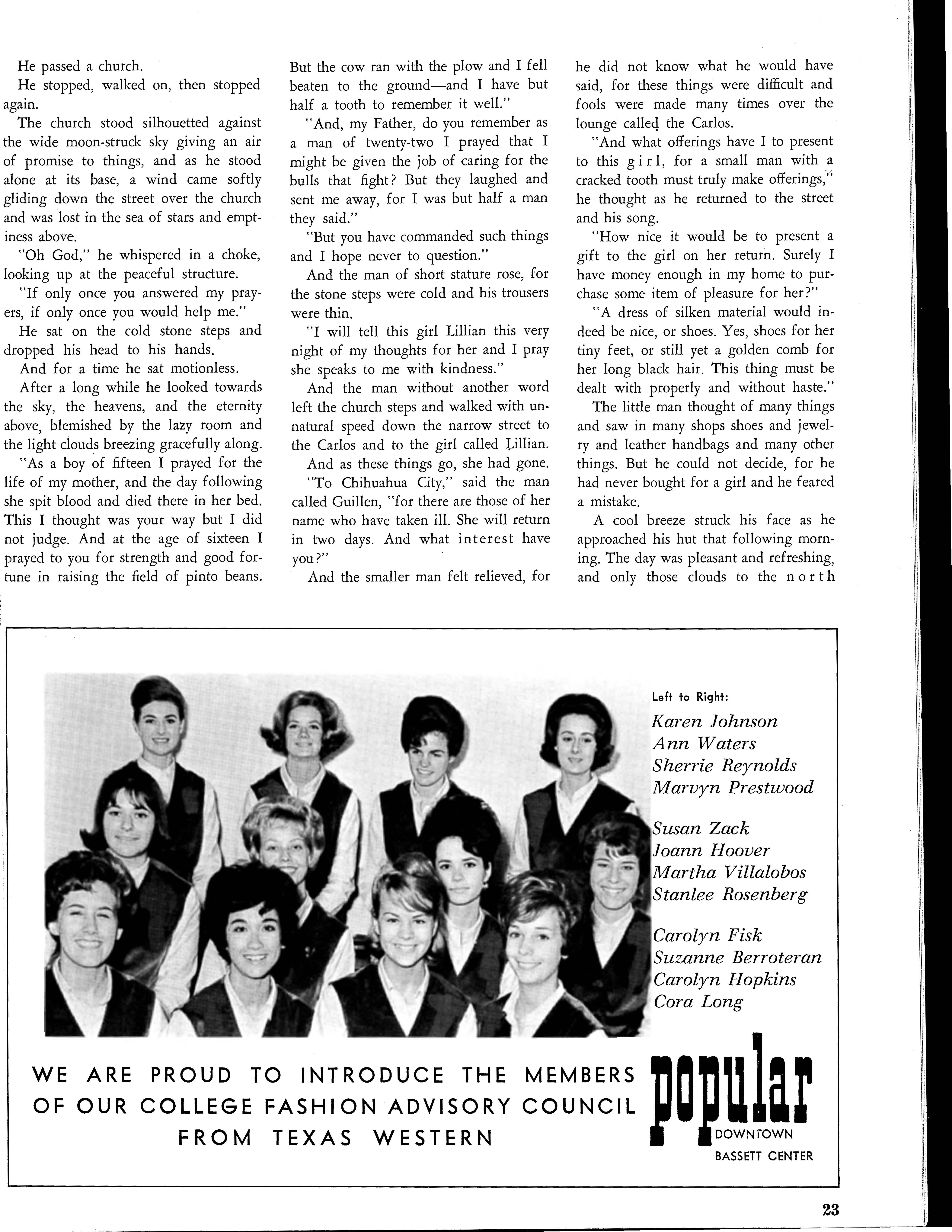
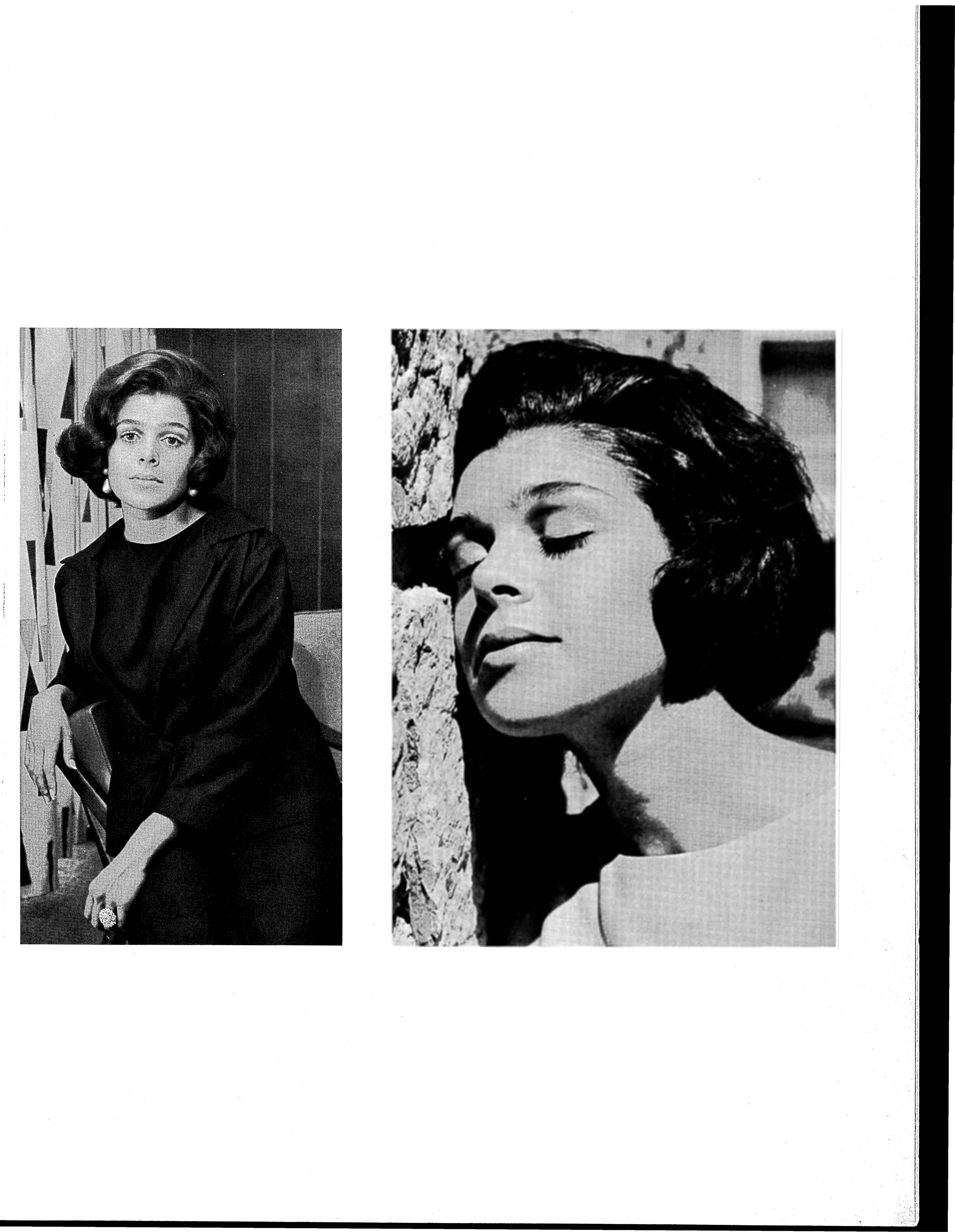
Left to Right:
Karen Johnson
Ann Waters
Sherrie Reynolds
Marvyn Prestwood
Susan Zack
.Joann Hoover
Martha Villalobos
Stanlee Rosenberg
Carolyn Fisk
,Suzanne Berroteran
Carolyn Hopkins
Cora Long
brought threat of offense to the day. And he took notice of that hill which in part served as his back wall and of its need for support, for one hard rain would indeed bring the rock and mud of the hill down upon his dwelling.
"Later in this day I surely must give attention to that hill."
And with that thought he entered the door of wood frame and cardboard to eat quickly and trek again to the town in search of a gift.
What Ramon had hoped to find was unknown e v. e n to himself, for he had found nothing to his liking.
And the little man had wrapped carefully those savings of his in thin paper and stuffed them into the shoe of his left foot, for there were many thieves in the town. Who would think to look for a lump in a shoe ?
He walked the streets from one to another, and f r o m shop to shop asking advice in this matter of gift buying.
One elderly woman had said to her tiny customer, "For a girl as young and beautiful as you say this fine lace-covered Bible could truly do justice to her."
But Ramon knew Lillian not as the Virgin Mary, but as the young prostitute who might take offense at such a gift.
So he continued his search.
On this day many people from the north had come also to shop in the stores and to stare at the little man, and he was uncomfortable.
He entered every shop on the plaza, looking about, wondering ab o u t girls' pleasures, looking about once more and leaving dissatisfied with the lack of mercliandise offered by the shop keepers.
And on to the smaller stores to the far side of town he trudged sore of foot, but happy with his task.
Later, as the day lessened and the air about grew cold, he grew tired and thought, "Now it is growing late and soon the shop doors will close for the day. I must hurry if I am to buy on this day."
But he was uncertain and the doors did in fact shut tight.
And with heavy heart he traveled to his home in the honeycomb of hills and shacks.
The winds whistled songs of chill and
cold as he walked swiftly, longing for the warmth of his home.
Upon arriving the man gave fire to his humble stove of pipe and metal scraps he himself had made, for a coldness had come from the north to cover the town.
It was time to eat, but the little man's mind drifted to other things.
"You stupid little fool - can you do nothing right?" he s p o k e harshly to himself.
"You have not the body for work, nor the mind for gift buying. How stupid and ugly you are!"
He sat with folded arms on the edge of his bed and thought for a while.
"I will ask the girl. Yes, I will go tomorrow on the night of her return and talk with her as before and ask what gift would please her. And I will pray that her taste does not reach further than my s a v i n gs, and also that she does not laugh."
He lay back in his ragged bed and gazed into the hungry flames of the stove.
The day's walking had tired him, and his small eyes closed into sleep.
"How simple an answer to my prob-
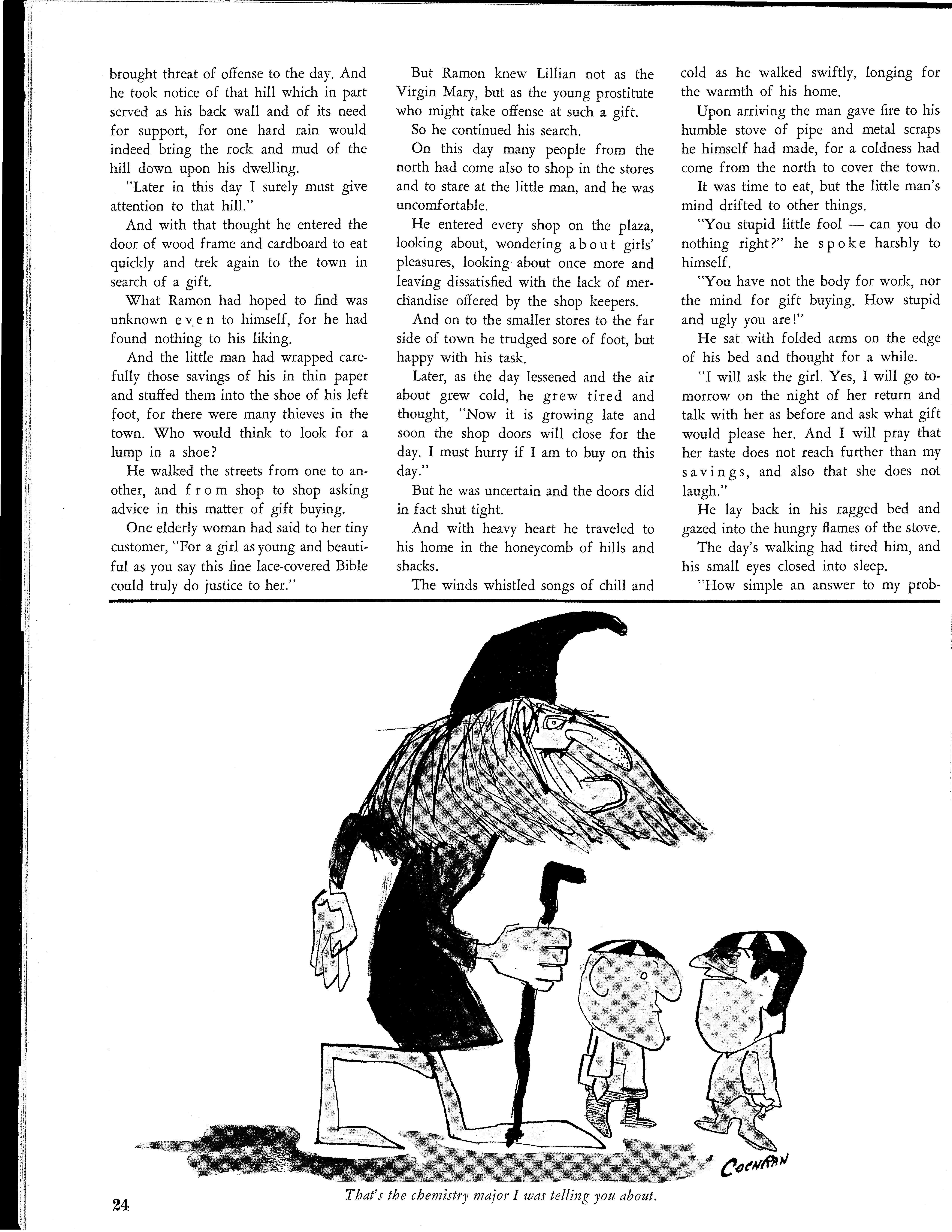
That's the chemistry major I was telling you about.
lem," thought the little man the next day as he climbed the dirt road leading- to town.
And still that lump was to be felt in his shoe, for he did not know when he might make use of it for the business of purchasing a gift.
"I will say, 'a girl so beautiful should have a gift'," and she will say I do not know what will be her answer."
It was six o'clock when he arrived at the club and entered to report his presence.
"She is not to be seen," he thought, glancing from one end of the room to the other.
And as he started to the street the girl came from the room in the back, followed by a tall, thin man.
"How early in the evening it is for her," the smaller man thought, "but the girl is ambitious and m o n e y must be earned.'
The girl, fresh as ever, sat with her tall customer at a table near the music box and they talked together.
"Will you stand doing nothing all this night my worthless little friend?" asked the man Guillen as he gazed over the bar and down at the littler man.
Ramon turned quickly.
"Yes, I'm going now," and he w.alked to the door and the street beyond.
How very cold and icy were the winds that whipped around the corners of the building and over the leaky roof tops and through the narrow street where the man stood quietly thinking.
Few people were to be seen on this night. Only that man who had been with the girl could be seen, for he had left and was vanishing rapidly into the night. Th bars along the street were stripped naked of business on this cold evening.
The blissful sounds of those d r u n k with liquor were absent. The never-ending stream of m u s i c from the dance houses and strip shows and the many bars and lounges that line the street wos not to be heard.
Only the silent flashing of the signs gave indication of life.
And now the skies offered flakes of wet, heavy snow that mixed with a slow drizzle of rain to cover the filth of the street with a shiny blanket.
How silent and how uncomfortably cold it was.
the little man entered the club.
The night passed over slowly and, at the hour of eight, longing for warmth,
"You may call the night's work done, my friend," said the keeper of drinks to the smaller man as he entered.
And Ramon was amazed indeed, for it was rare to have a night off.
"Thank you, my friend," he replied, "This night will truly present us little business:"
But no work for the smaller man meant no pay, and he thought of this thingand of the uncomfortable lump in his shoe-and of the girl Lillian sitting in the corner alone.
"I will s p e a k now with her," he thought, "but in what fashion will I approach the question?'' It was much easier to think of this thing than it will be to do it."
"Let me buy us both a warm drink of chocolate," he said to the girl as she sat motionless in the booth.
He climbed into the seat across from her in a clumsy, nervous manner.
"Yes, my body is in need of something warm this night. How the winds find entrance, even into this room, to chill the bones!"
"Yes yes, it is cold," he replied. And together they drank the w a r m chocolate.
Neither spoke for a long while.
"It would please me if you would accept a gift from me." And it was done.
The little man had spoken his heart, and at o n c e was fearful that the girl would think him stupid.
A slow smile crossed her smooth, light face. "You are thoughtful toward a girl, Ramon, but you have no money for gift buying. Why should you find it in your heart to purchase something for me?"
"The money I have," he replied quickly, "and the reason I have also." He was happy that she had not laughed.
He felt strange, almost dizzy, and off balance, but smiled, trying to cover with his lip that tooth which was cracked.
"You are a fine tnan and a gentleman, Ramon, and I have sensed your notice of me for many months now. Do you in fact care for me?"
Her voice was soft and low to the little man who knew little of women and their ways.
"I would purchase a gift to your liking," he said, rubbing the cup in front of him with both hands in order to steady himself. Suddenly he felt a strange urge to leave that place and travel the wet road
home, but some force held him in place.
The girl threw her long black hair over the back of the booth in one smooth movement and sipped again her drink of chocolate.
"And if you would purchase a gift, would you not purchase anything that would please me?"
"Yes ... yes, surely ... "
She turned her head and looked at the empty booths in the room and at the other girls sitting on stools around the room.
"Then for a gift," the girl continued, "purchase me this night, and for the price of a gift buy my love.''
The ram mixed with the wet heavy snow and stopped, and the road to his home, lacking a cover, was wet and muddy.
Ramon made his way slowly down the water-soaked dirt trail.
"And what had you expected?" his fat friend at the cafe had said whep. Ramon had sadly told him of the experience.
He had walked the cold streets the entire night searching for that answer.
The sun, which was beginning to rise far in the east, was now hidden by miles of low, thick clouds and not a trace of its illuminating warmth filled the frigid morning air. In the d i s t a n c e a cock crowed the birth of the day as .a lone black crow cawed the signal of departure. The dizziness of the night before had passed and in its place had grown a sickness of reality.
And as he stood overlooking the silent valley and his hut below a sight came to his small eyes which should have caused him to curse-the rain of the night before, mixed with the heavy snow had in fact brought the hill which served as his back wall' down upon this tiny home of adobe, and had broken it into pieces.
But a fatally wounded heart cannot be further injured, and he stood only looking.
And as he stood in the snow-mixed mud looking over his home the thick, low clouds b r o k e open, throwing the morning light to the still wet valley.
A tear broke from his small, brown eye and found its way down to the lip that covered his cracked tooth. And he thought back to that mesquite tree and that w a r m day beneath it, and of his mother who had loved him. D
YSIIUIM-4
To: All government counselors and administrators.
Purpose: To report public attitude toward the state's housing and recreation communities, now in existence three years.
In the latter months of the year just past, the government's council on public welfare and happiness conducted a comprehensive series of tests and interviews in all thirteen districts to ascertain public opinion toward our newest program for the population's physical and spiritual fulfillment - this program, of course, having been designed to keep the public active and satisfied until a more constructive use for their abilities can be devised. The results of these tests have been most satisfactory. As our computers predicted, fully 97% of those involved in the program are completely content with their present positions. Of the remaining three per cent, the great majority are new arrivals and therefore have not yet had time enough to fully adjust.
The following two interviews are representative samplings from the over-all survey, and are designed to more thoroughly acquaint you with both the success of our efforts and with the problems still confronting us.
The subject in the first interview is a fine example of the type citizen we are most proud of. He is well group-oriented, non-aggressive, and his wants are simple and easily satisfied. Both the questions asked him and the questions asked in the second interview were concerned with the large plains community in District 11, Fantasia. At first reading, Example One's answers may seem sarcastic, but I have been informed by our chief psychiatric board that this is due to some sttb-consciotts element, and that no disrespect was intended. Indeed, the answers are, by the council's evaluation, those most in keeping with the needs of the state.
Unfortunately, the person answering in the second interview is quite the opposite from the first-being, rather, a good example of those dissidents in our society who wish to undermine the values and goals which are most conducive to our national purpose. To be sttre, such persons are now, happily, becoming a rarity. But that such examples still exist is an indication to our minds that perhaps our policies in such areas have not been as swift and effective as we m i g h t have
wished. Therefore, even as this report is being distributed, the efforts to more solidly unitize the populace toward our directed ends are being accelerated. As for the example in question, he has been admitted to our institution of re-direction for corrective treatment of his malady. If he is unresponsive to the efforts there, he will be placed in strict isolation in a government ward. Such men are too dangerous to the public welfare to be at large.
SUPERVISOR-IN-CHIEF
G. L. Rockwell III
Interview No. 1
(No questions are listed in this interview as the answers are self-explanatory.)
The Speaker: "Fantasia? YeS: I live there.
"Fantasia is the home of those who care not to know. Its dream-like mansions have many doors and hallways, but no mirrors. In its mazes we find escape from the ultimates which lead to truth and from the burdens which we cannot bear. We have plenty of company, for the enrollment is large. The only requirements for entrance are to flash a pretty smile and loll a sugared tongue.
"Are we happy there? Oh, yes indeed ! You see we have a place to let time slip by and that's the important thing, you know.
"What do we do? Oh, we laugh a lot and talk. It's great fun. We say these phrases over and over again. No one knows what they mean, put they sound nice. Once in a while we'll dig out a deep feeling, kill it, and then chortle. We also lie. We're getting very good at it. Of course, it's very bad when we get caught-but then, every one soon forgets.
"The thing that's really great though, is that there aren't any lights. That way we can't see each other. Sometimes we fall down and can't get up because people are walking on us. But that's all right, we'll walk on them some day."
Interview No. 2
Question: Where do you live?
Answer: My home is in the mountains. I live alone there.
Question: Why do you live in the mountains? You know they are dangerous.
Answer: In the mountains I know a
certain peace of spirit I have found in no other place. There, one can w a l k through secluded valleys which are rich with color and alive with all manner of animals. And one can drink from the clear streams and shiver happily beneath a pine tree when the rains fall. There a man is free to be alone with himself and to climb to the highest summits. The air is crisp and fresh and each new day exciting. Yes, the mountains are my dearest friends. To me they are not dangerous.
Q1-testion: Why do you deliberately avoid contact with the people of Fantasia? Why can you not live as they live, well provided for and happy?
Answer: Once, not long ago, in autumn, when everything was dying in the mountains, the pain of loneliness, which is mankind's deepest pain, drew from my narrow pathways down to the level plain where men dwell together in Fantasia. At first the sight and sounds of others like myself was very pleasant, and there I was not alone. It was an easy life and I soon found myself a part of it, just as all the others were a part of it. I grew accustomed to the dark and even learned to play all the games the others knew. But soon the games grew old and the longing for new paths to follow and new valleys to explore brought me once again into the day. As I made my way back toward the craggy peaks, I looked back from time to time and heard the hollow laughter and saw the darkened buildings standing in a cluster. The first time I looked back I knew I would never again return.
In Fantasia there are no concepts of time. It was only when I reached the first foothills of the range and saw the new buds and leaves on the trees that I realized how long I had been gone. How important a commodity is time, and how foolishly we toss it lightly aside. It is not something meant to be filled with meaningful experience; something which can be captured and preserved only in the warmth of happy memories ? That is why I do not choose to live in Fantasia with the others There is nothing to remember.
"Dad, I n e e d an encyclopedia for school."
"Hell! You can walk to school like I did!"
"Who was that lady I saw you out with last night, Ralph?"
"That was no lady, that was my wife."
"Don't be silly, I'M you wife."
"Gee, pardon me for slapping y o u r face. I thought you were trying to steal my sorority pin."
He: "Gosh-it's dark here in the parlor-I can't see my hand in front of my face."
She: 'That's all right. I know where it is."
A man who had b e e n undergoing evere emotional strain decided that per1aps psychoanalysis might uncover the :ause of his ills. In vain he consulted the nost eminent men in the field. But none :ould determine the source of his trouble. ~inally, the man went in desperation to ,n analyst of mean reputation and low -ates.
"The trouble with you is that you are n love with your raincoat," the wizened ild doctor said.
"In love with my raincoat?" the man ·eplied disgustedly. "Here I go to the ~reatest names in psychiatry and they :an't cure me. I go to you and you tell ne I'm in love with my raincoat. Pre>0sterous ! It's true I'm very fond of my ·aincoat "
"On what grounds are you seeking your livorce ?"
"I think my husband's been unfaith:'ul."
"What makes you think that?"
"I don't think he's the father of my :hild."
Once there was a man who grew an ~normous raspberry. It was so large that pe decided to preserve it in a large glass ::age. Then he decided that a raspberry :hat big was probably quite valuable, so be called an insurance company to send a man out to look at it. Sure enough, the oext morning a man in a pickup truck drove up to his house and asked to see the raspberry.
"Certainly," said the owner of the berry, and showed his visitor to the glass cage. As soon as he had unlocked the cage, the other man hit him on the head and knocked him to the ground. Then, grabbing the berry, he carried it to his truck and prepared to make his getaway. The owner of the berry staggered to the door and cried, "Wait! Aren't you from the insurance company ? Haven't you come to tell me how much my berry is worth?"
"Aha!" replied the other. "I come to seize your berry, not appraise it!"
Many very serious diseases are caused by biting insects-so stop biting insects.
"We really ought to have a chaperone," she said as they went into the garden.
"Don't worry about that," he said, "we won't need one."
"Well hell, what's the use of going?"
WANNA HEAR A SAD STORY?
SHE TOLD ME ABOUT HER OLD BOYFRIENDSHE'D BROKEN UP WITH HIM. 11 I 1 LL NEVER GO STEADY AGAIN, 11 SHE SAID.
5 THE.N ONE DAY
c'' ? SHE CAME TO ME 1/ AND SAID, 11 MY OLD BOYFRIEND IS IN TOWNBUT I COULDN 1 T CARE LESS. n
/.:'\ BUT ONE DAY SHE " ? _,,,, CAME TO ME AND .,, SAID, 11 I 1M GOING TO HAVE A BABY AND MY BOYFRIEND HAS LEFT TOWN. BOO-H00. 11
THEN ONE DAY / SHE SAYS, 11 MY OLD BOYFRIEND IS IN TOWN. GOODBYEI YOU CAN KEEP THE BABY." AND SHE LEFT ME.
I BUMPED INTO THIS CUTE CHICK ONCE-I INTRODUCED MYSELF AND SOON WE GOT TO BE GOOD FRIENDS THIS INSPIRED ME-I WROTE SONGS ABOUT HER-I ALWAYS SAID NICE THINGS ABOUT HER-I LOVED HERi
HAW! THE NEXT DAY SHE 1 S WEARING HIS RING. SHE WOULDN t T EVEN SPEAK TO MEI
SO OUT OF THE ~- c,~ :///KINDNESS OF MY HEART I MARRIED HER-SHE HAD
lo. HER BABY AND WE LIVED HAPFILY ),::1 I WASN 1 T GOING c'2,. 1 V TO KEEP THEIR BABY, THOUGH •..•
BELINDA OWENS
Recognizable around campus by her oversized sunglasses, Belinda is most likely to be seen in the vicinity of the Cotton Memorial Building. She's an art major. How did we find her? She happened into the El Burro office seeking a position as a staff artist. We accepted! So, if Belinda's person doesn't grace the pages of this magazine always, at least her drawings will.
Photographs by Photography Unlimited, 510 Montana
Photographed at Desert Hills Motor Hotel
EXCURSION INTO A NORM
I was walking I don't know why along the coast of which I neither know and the sun was bright like a torch before my eyes and was hot and so was the sand and the ocean was blue not deep blue nor clear blue but so blue and I was young not so much in years but in the adventure of my quest for the place the pocket the groove maybe peace and most likely life. I stumbled on thirst-ridden seeking I didn't know what but my home perhaps beyond and the beaches were barren and the blue to the left and the molten sands to the right and nothing else but maybe driftwood from nobody knows where or cares and over hill and mound and through shimmering waves of heat and the hot breeze off the ocean and nothing behind or beyond and all along thoughtless and in agony in search in want in need and in desire of a place to rest and to live and to be happy and to find wisdom and love and more. And then in a maze with sweat-blurred eyes
I saw the village-neither near nor mapped but a vision maybe a dream but a sight. I trudged for I was tired but I always trudge toward maybe a dream for a dream it seemed and a tremendous cloud clung over it and left it in shadows -in semi-darkness - and there was a mountain backdrop aglow of yellow-orange for behind my vision-the envision of the village-the fires lay beyond and ridges of flame burned as every wave of heat turned and the village grew closer but as yet far and the sand cooler and the sweat ceased to draw from my pores and the ocean was smooth not as cut grass nor rippled desert sand but alasof massive glass and I moved into the edges of the cloud above and serenity slowly crept within and entangled my modest mind and then before me not a
prose-poetry by howard baron
mile away my huts all close not far yet far but not too near and I did not spring for all was too subtle but still rather tense and I could see the pathways of the village and they were deserted and what had but a short time ago yet too long appeared as big was small but it was there and peace too. The mountain the fountain of flame was still above but there was the ocean of blue-of placidity I knew-and I was between for I was man-man on land 'twixt red and blueon the sand of everyman's land I knew I'd found what no men could lend what the weak seek and the strong long but it was mine for I think it was mine to find and it was the white of the swan's down yet brown as the ground and had the sheen and the gleam and the glisten of the teardrop. My footsteps were light and a smirky smile of smothering happiness flourished over my face and ecstasy prevailed in my mind and my body felt clean but I knew it was dirty and yet it was clean-clean like the shimmering of the dew on the petite pansy petal. To further my ease and strengthen my knees I felt a new and cool breeze for that too was mine. No wind nor gale could penetrate my tale and I continued my stride forward. I marched to the center of my one block town-turned by body around and around. "Where be thee - answer my shout" I yelled then thought then knew and yes perhaps within the warped wooden wobbly huts and the street was mine until I found that holy crowned crowd of utopian town.
Then a gong sounded-I jumped I was astounded Time for devotion-in a moment a town in motion
No longer alone they came from many
THE MAELSTROM OF EMOTION
ways
'Twas the type of sight as if a town ablaze
Many men poured from the swinging open doors
And walked across the squeaking porch floorboards
And then onto the dirt-the dirty clean street
With barefoot feet into the cool sweet heat
All dressed alike they strolled noiselessly
Free yet somehow fettered and toward the endless sea
Each face black bearded I gazed into their eyes
The eyes so shallow staring toward the ocean rise
None was spoken and women were nil
Motionless they floated in ghostly tranquil
As they brushed past my frail frame
I never moved a muscle-what was their aim
Between two blackback huts a statue stood up tall
Bearded like the men I saw robed the same and all
Each man in his movement toward the sea
Turned to their god then bowed upon a knee
With absence of expression they again arose
Moved toward the ocean in slow rhythmatic pose
In unison and together they moved in a pack
Then scattered one and all not one man left a track
Half went in the water half in the black shade
Stomach-face down those in the shade laid
f.eads faced seaward the horizon their eyes did sweep
100n they were all ashore their act of cleansing done
f oward the huts each stmt first movement yet not run
[hey passed their statue mr. god to give quick prayer
ro ease their malcontent and lose scare fear
They filed into their shabby work huts to finish off a day
To pass the time in ignorance and freeze
• the hours away
The men if one might name them men had disappeared from sight
To push away their only life in a life of illiterate plight
And then I gazed across the way to the
They laid in the shade of a building part made
For not all at once could confess their sins-sins yet not weighed
The structure was the only edifice on that side of the street
A structure constructed for awaiting the wet treat
Those in the water they walked to chin deep
Stood there as if frozen with neither a smile nor weep
Cry moan even wail I wanted them to do
But they were motionless everyone of them too
After many minutes the waterlings returned
Only to be replaced for it was the groundmeditator' s turn
The clothing of the waterlings was not wet
And they laid stomach-face down in the shade they set
And then the meditators reached chin deep
lone statue of a deity
The big brother of mankind the symbol of eternity
I thought of the fire that was hell in those men's hearts
That forbade him from evil and those other mundane parts
And then the wading waters it was heaven on earth to all
'Twas the priest prayer contribution the crutch that made them small
A chill ran upon me and I knew my place then and it was far far away from there not among those masses. It was not there for that wos not mine-it was theirs and not mine for I was beyond and above and below and too large and too small and something greater or perhaps lesser but yet I was not them and they were not me for they belonged to each other and I to myself and neither of us could converse for we were of separate norms. Neither knowledge nor love they really knew for thye had escaped their very being and wore musty masks of muddled misunderstanding and contrived a life around a simple set of silly substitutions to formulate· an evasive waste of an almost bottomless mental capacity. And then I was myself again and bouncl. to be free and sweat beaded on my forehead and my clothes clung to my body and the cool sand was hot like stone coals on my soles as it had always been and I had been deceived-deceived to believe in the world of another. Feigned serenity and placidity were not my deity and I walked away from them for with them I was alone and alone-with myself-I was truly alone but with myself and not others and I was free to search for the inner self the link between mind and body the abstract and concrete that which is and that which isn't that which does
and that which doesn't that which breathes and feels and experiences - misery and frustrations and that which d o e s nothing but be-not as existence but as matter and serves to stand in upon the order that has evolved out of nowhere but is absurd for it all leads into nothing for nothing is the basis of everything and one begins as nothing and ends as nothing and no other would or could ever penetrate myself and I knew I would or could never know but I could seek for if you don't seek you know not what lies b e y o n d and what separated me from others did not separate me from myself for if I could not seek and then know myself I could know nothing and no doubt I would never know myself and thus nothing but I must live for life is a tramp a trudge toward the ultimate beyond the wall-the barrier climbing to eternity holding man into his pattern of existence-and the cloud of darkness and the yellow-orange of hell and the glassblue of heaven were mine to destroy for the mind of my being rejected them and I had to leave my once owned town for I sought more. Hell above and heaven below were not me nor the statue nor the praise nor the daily swim of sanctification nor the ignorance of existence nor any of it and I pushed my body forward and made my way back into solitude into the wilderness-back into the clear sky the hot sun the molten sand to seek the path perhaps toward my home and I never looked back only forward because behind were the blind ahead maybe the alive or maybe myself or maybe nothing.
SING LOUDLY INTO THE BLACK VALLEY; AN ECHO IS A VOTE OF FAITH, A SIGN THE LISTENING ROCKS APPROVE. GO TO THE RIM OF THE BLACK VALLEY, AND WITH YOUR TONGUE, BLOW FORTH ALL YOU HAVE LEARNED TO LOVE.
FEAR NO HARDNESS OF AUDIENCE BUT HOPE NO PENETRATION. FEAR WILL LEAVE YOU PARCHED. THE FETID SWEATS OF APPREHENSION AND AWE, SEEPING FROM YOUR SKIN, WILL LEAVE YOUR SOUL HOARSE, YOUR SONG VAPID. HOPE WILL LEAVE YOU BLOATED, AND J-N YOUR SATURATED SATIETY ALL MUSIC WILL DROWN. THESE THINGS ARE KNOWN BY THOSE WHO FEAR AND HOPE; BUT THEY ARE THE WEAK THEY ARE THE WASTED THEY ARE THOSE INSIPID MANY WHO NEED EXCUSES FOR THE FAILURES THEY ARE. SO PICK A MIDDLE KEY SOMEWHERE BETWEEN FEAR AND HOPE . .. THERE TO ARRANGE WHATEVER HARMONIES YOUR OWN VOICE ENJOYS IN WHATEVER MEASURES YOUR OWN EAR ADMIRES. WITH THE RIGHT FORM AND PITCH, THE NOTES WILL BE EASY.
THEN TAKE THIS SONG, THE RESULT OF YOUR LOVE, TO THE BLACK VALLEY AND TOSS IT OVER THE EDGE DOWN THE STEEP BLACK WALLS INTO THE MISTS BELOW.
(HALF GUESSING, I WOULD SAY THERE IS WATER DOWN THERE. SUCH MISTS DON'T SEEP FROM STONE. IN FACT, SUCH THICK, WHITE VAPOROUS BLINDFOLDS~ LOOK LACTEAL RATHER THAN ONLY WATERWET, SO VEILING ARE THEY. BUT THAT CANNOT BE: NOTHING SO ALIVE AS MILK COULD EVER STAY IN THE BLACK VALLEY. STILL, IT IS THE ONLY PLACE FOR SONGS TO BE HEARD. SING IT OUT, WHATEVER ITS THEME. AND, JUST TO BE SURE YOU ARE NOTICED, SING LOUDLY.
THEN WAIT FOR THE ECHO.
KNOW YOU THAT AN ECHO MAY NEVER COME. AND IF ONE DOES COME, IT MAY BE VERY FAINT, IT MAY MEAN NOTHING. BUT KNOW YOU ALSO THAT IF AN ECHO DOES COME .. HOWEVER FAINT IT MAY BE, HOWEVER MEANINGLESS . ... IT WILL BE WORTH WAITING FOR.
CHILD HIDING, SHADOW CHILD
Child hiding, shadow child,
For me:
Give it up, let it go.
Just drop into the tall grass this small needle, This little splinter of self you send:
"I shall forever be lost to myself and to those who love me for try as they will, I cannot be changed."
It bends, you know, is bending even now, and barbs itself a fish-hook turning to pierce its own shaft.
You let your whole self be lost; why not it?
Child unchanging, dream child, You refuse to lose it?
Ah! Remember, careless moments come in restless children's play.
Choose this cruel little thorn to be one of the misplaced toys.
To dandle it so is to chance its prick;
To store it away in the chest with the other playthings
Is to risk killing the Maybe that one loves you unchanging.
And then, you might never be listenin.~ when I say (hoping even a you unlost) I do.
Child hiding I seek
-HOWARD SIGMAN WHITE
EB INDEX OF ADVERTISERS
• EL p ASO NATURAL GAS
• ORIENT AL IMPORTS
• TWC BOOKSTORE
• TWC SNACK BAR
• FRANKLIN OPTICAL
• OASIS RESTAURANT & DRIVE-INS
• KERN PLACE FLORIST
• LANDIS SHOE REPAIR
• FIDELITY UNION LIFE INSURANCE Co.
• GUYNES PRINTING Co.
• PIGGYBANK SERVICE STATIONS
• AL'S SHOP FOR MEN
• POTTER'S FLOWERS
• R. M. METCALFE Co., INC.
• HONDA-EL PASO
• GUNNING-CASTEEL DRUG STORES
• MAYFAIR MEN'S WEAR
• PHOTOGRAPHY UNLIMITED
• SEARS ROEBUCK & Co.
• PANCAKE Corr AGE
• POPULAR DRY GooDs Co.
• HAWTHORNE HOUSE
• ELECTRIC & NEON INC.
• ST AR Discos RECORDS
• KERN PLACE PHARMACY
• KURLAND-SALZMAN MuSIC Co.
• KVOF RADIO-TV
• FIELD-PARKER Co
• CORONADO STATE BANK
• VIc THUNBERG MOTORS
• DESERT HILLS MOTEL
• ROBERT R. TEEL LAUNDRY & DRY CLEANERS
• PETERSON LUMBER Co.
• TANTILLO'S RESTAURANT
• PETERSON ELECTRIC INC
• CAC PAINTING CONTRACTORS
• T& T SUBCONTRACTORS
• TOM MAYS & CROSS NURSERY
• PITTSBURGH PLATE GLASS Co.
• ARTCRAFT TILE Co.
• THE ATLAS BUILDING PRoDucrs Co.
One
CHECK CASHING SERVICE
For Texas Western Students & Faculty Register for the College Year with us for this free service by presenting your current registration receipt THE FAVORITE DRUG SERVICE FOR TWC STUDENTS & FACULTY FOR THE PAST 20 YEARS
KERN PLACE PHARMACY
Cincinnati Phone KE 2-4637
WELCOME TO COLLEGE!
Are you in the above group who waited too long to buy their books, or will you shop early! Pretty crowded-yes! But that's because we have a very large and very interesting stock! Shop for all your books and supplies at your college - owned bookstore. We have a wide selection of textbooks, paperbacks, technical books, school supplies, engineering supplies, toiletries, novelties, and gift items. Come in and browse around. If we don't have what you need, we'll special order it for you.