work with other policemen, but they drink, party, hunt and even go to church with them. When they walk through the barrios, not withstanding their origins from the same, they walk uneasy. They are seen as the enforcer of the white man's law which have kept the people living in those barrios or ghettos in subjugation for so long. Many times officers unable to cope with or understand the friction, rely on sheer physical force to subdue troublemakers. Whether these officers realize it or not, they tend to become defensive and to protect their egos, they brandish their badges and guns with easy persuasion.
And so we have the situation in which the police force is not functioning as effective as it could if it had the cooperation and confidence of a large majority of the public. The need for a professional police force is vital. It must entail more stringnet qualifications such as college education: not only to deal with and understand the deep social malaise that breeds disrespect for the law, but also to be effective in fi,e:ht-
1971
ing crime. Most criminals aren't punks ro half-wits, but extremely intelligent and crafty men who with their cunning have outwitted law enforcement. A police department who takes pride in busting a college kid with possession of one marijuana joint and other relatively harmless, petty offenses in only ridiculing itself. How ab o u t the businessman, the embezzlers, and shrewd elite of El Paso who might, ( who knows? ) be invloved in more serious offenses. A rep o rt by the National Crime Commission described organ i zed crime as a structure as complex as those of any large corporation, subject to laws more rigidly enforced than those of 1e git i mate governments. Its actions are not impulsive but rather the result of intricate conspiracies.
Ninety per cent of the El Paso police force have no higher education than high school, and for some officers that was many ye a rs ago. We must guarantee that all officers, including the 35 presently enrolled at U. T. E. P. receive a full college education. We must establish pro-
grams such as "Store Fronts" to bring the policemen into the neighborhoods, if not to live there, but to spend their days or evenings learning the at tit u d es and particular problems of the neighborhoods. We must critically set standards for the proper use of force, promote the development of more effective, less destructive weapons, and develop methods in all areas of police operations to isnure maximum effectiveness, and minimum hostility between civilians and officers.
Law enforcement is still largely a local responsibility. Its success denies the need for a national police force which could dangerously become a powerful instrument of repression, and the right hand of a Fascist government. Let's not underestimate the need for vigorous criticism and action ... the law-abiding law enforcer can only be aided and upheld by fair, well-founded criticism and he should know that.
CAROL KELLY
u. t. el paso
markings 2 towards closing the gap/carol kelly 4 trilogy on education/howard trusch . 12 outlaws of the southwest/ steve peters "chicanos"/norma cardenas pictorial . 23 26 in the springof 71/ri.chard smothermon & barney napolske Ill . 16 fiction and satire pitboy interview/1. kohler guide to the student senate/ charles mayfield so kind to his mother/kelly la rue fly me to fabens/carlos morton. acirema/anthony isaac victor cowboy and his lady/carlos morton poetry richard santelli . carol kelly the last lob
editor-in-chief: henry de la garza jr.
managing editor: charles mayfield
associate editors: kelly la rue/terry acosta
administrative assistant to the editor: john navidomski
art editor: sherrill mundy
poetry editor: raymond swiesford
business advisor: albert hutchinson
quality control: martha me cracken/stella perez/vera hernandez
dark room specialists: karin elliott/olga quintana legal counsel and head union negotiator: ethyl v. boone. EL BURRO, the University of Texas at El Paso variety magazine is published by Student Publications, El Paso, Texas 79902. Reproduction in whole or in pa-rt of any article without prior written permission from the Editor is prohibited. Advertising rates furnished upon request. Opinions expressed in this magazine are not necessarily those of the University of Texas at El Paso or its students. Letters to the Editor, unsolicited manuscripts, photographs, art, etc., may be delivered to the EL BURRO office, 202 Union W. We reserve all rights to accept (and, edit) any material submitted for publication in EL BURRO.
Markings
Towa rds Closing the Gap
The El Paso Police Department, unlike its counterparts in major metropolitan areas, has never been seriously threatened by a massive coalition of hostile citizens. Maybe due to the le t hargy of this border town, or th e "solar somnia" of the Sun City, confrontations between the police and citizens have been genera ll y random, isolated events in which t h e police have had the upper hand, eit h er by numbers, or the sheer force of t heir weaponry. Nevertheless, anyone who has ever been busted; any long hair who ever took a Sunday walk, barefoot, and was stopped and frisked for no probable cause; any Southside Chicano who was forced to swallow his La Raza button; in general, those who are person a 11 y aware that a policeman can be less than professional, and even downright sadistic, rally around and slur with contempt the less than euphemistic term "PIG".
Those who attempt to transform this word into initials standing for stirring professional qualities such as P ride, Integrity, and infinitum, only sh ow their ignorance of the deep-
rooted alienation between communities and I aw enforcement age n ts rampant throughout the United States. These are the same people whose call for "law and order'', would lead us toward a Fascist state because the y would deem it short of treason if one attempted a critical analysis of the role and attitudes of the police in our country. Nonetheless, s u pp o rt of our local police, wholly unthinking and uncritical, is p e r h a p s a greater danger to our freedom, than organized crime. Heretofore, programs initiated by our local police department to ease tensions between the police and citizens, have been rarely nothing more than token efforts and have served largely only to better the "image of the policeman; " kind and helpful with a latent boy scout tendency to help old ladies across the street. Even now, most of the programs to increase rapport between citizens and officers are aimed largely at the youth, giving rides to them while the po Ii c e are on their beats and creating sympathy for the role of the officer, and all of the problems he
encounters trying to carry out the law. Of course no one can disagree that these minor programs are helpful, but certainly it is obvious that society ' s needs today exact a greater professional and more tho rough treatment.
Hostility between communities and officers, at least a disproportionate amount in ghetto areas, or barrios as we namer them, is caused by police officers who have short -fused tempers or sadistic impulses, or who simply lack common sense in crises situations. Unfortunately, psychiatric tests at induction have not succeeded in rooting out such defects. For this reason p o 1i c e m an ' s records should be subject to inspection frequently by a police-civilian reviewing board An officer who is known to be strongly prejudiced against minorities, or lacks coolness and good judgment should be assigned to uncritical jobs on the force.
Policeman aren't generally equipped with the attitudes to deal with the problems of the barrios. They usually live in relative isolation from the rest of society. They not only
PITBOY interview: SPIT T. AGNOI
"A candid conversation with that peerless patriot of perversion and pestilence known for his perspicuous persuasion and prominent phallus-par excellence."
by L. Kohler
Mr. Ag-No! has graciously, and it might be added with some gratuity, undertaken an extensively detailed discussion with our anonymous interviewer. The logic behind this surprising action, if unraveled, might prove so enigmatic and bizarre that we have conveniently accepted the phlegmatic explanations of the Vice-Pest. Needless to say, we were quite pleased to hear our own philosophy reiterated through the thin lips of alliteration as he explained his acceptance ...... .
For those of you turning the pages of Pitboy Magazine for the first time, I suggest that you stop dragging the vivid, colored pages, and contemplate the noble and materialistically inspiring breadth of the content. And if it's not great, then I'm not Trick Milhouse Red., of Pit'boy.
Now, you're probably attempting to discern the
meaning behind those cryptic letters after my affable name. The letters are an abbreviation for the euphemism redactor. And let me make it perfectly clear that I take a great deal of pride in that designation. When they discharged me from the Navy, a Quaker refuge, I thought that the world was collapsing about me. I coudn't conceive of any position in the world. It was then that I had a vision. The Q u a k e r on the Quaker Oats boxes appeared to me in my dreams. He told me not to worry. He assured me that I would become a redactor. After those dreams I had confidence and set my sights high. I worked on my ambition till they accused me of having such a frenzied ambition, that they said it was insatiable. And make no mistake about it, it is! But enough of my trials and tribulations, it is time that I clarify our magazine'•s philosophy for the many
traitors who have not come under its heavy mesmerization.
Will you please take out your manuals, "The White Manifest Destiny" and turn to page I, 456. That's right. Now find the pa r a g r a p h which begins right after the line that ends, 11 ••• and so it is the irrevocable responsibility of the white man to carry the burden." That's right. Have you found it? Good! Now, please read with me, silently or orally, I assume it depends on what type of classroom situation that you were f o r c e d into. It begins
•"Chicanery, the· maligning of others and rightousness are all forms of despotic behavior, that men should refrain from using, until they are in power. Then they can do whatever they wanl Patience muri be observed. These despotic goals can only be acquired without impugnity if
they are pictured as desirable in contrast to something else. The Christian principals of love, etc. always act as excellent objects of hate. But you must call your principals Christian and label theothers as non-Christian. I know this all sounds very confusing, but take my word forit.The people must have glory exuberating from their eyes. This comes through education. They must know without understanding. This is therootof Democracyand if I might add with capitalistic pride, to mastery. Right makes might. Patriotism is the last refuge of politicians and a few other cliches, slightly altered, are the prayers of those in • power. I have purposefully light-faced the word cliche to denote that it must be striken from our revered libraries, aIong with the word alliteration. Remember, we are the coming, even if it is two thousand years Iate in coming.
So Pitboy subscribers, that concludes the theme, the guiding force behind our magazine and the same thoughts of Mr. Ag-No! Just think of those ideas. Laconic aren'tthey? Noticethestructure of the ideas? How they build upon each other in such precise and consecutive order? That is the infallibility of the manuaI. Bound in pieces of the American flag, confiscated from anarchists, "The White Manifest Destiny" sells for $4.95. It's not
1971
too late to buy your voluntary copy. Just write me, Trick Milhouse, The BIack House, Fifty-three stars minus three. And with your free copy of "The White Manifest Destiny" you will also receive a patriotism questionaire and a smiling portrait of J. Ebony Hoofer. Now on to the interview.
Anon., Mr. Ag-No! My boss, Trick Milhouse, seems quite satisfied with your answers concerning your acceptance with this interview.But I'm not so sure that your answers were really frank.Do you think you could elaborate slightly?
Ag-No! Well, that's a two partquestion. To the first part you're right.I am not frank, I'm Spit.And, on elaborating on that? I don't think I can do that.You see I let the liberals elaborate.They've got more to elaborate about.Ha! Ha! Ha! Ha! Boy, that was good!!! Anon., I don't think that's very funny.
Ag-No! I didn't think you would. It's not sex orientated.Besides that's one reason I'm here.
Anon., Because you're not sex orientated.Do you really mean that? Do you wish to confess here and now, that you're a unisex?
Ag-No! Not yet.We'll get to my sex life later.One reason I'm here is to find out about you.
Anon., Gosh! We have something in common.
Ag-No! One thing I teach my fellows is to admit nothing. But, going •back to why I'm here ....
Anon., Isn't that the thing I tried to find out in the beginning?
Ag-No! ls it? No, it couldn't be because myfirstanswer didn't contain any subject matter to why I'm here.I think it had to do with elaboration and ...
Anon., And conservatives. Right?
Ag-No! I wouldn't swear to it. I'd like to see a transcript first. We conservatives are elaborate in our thoughtfulness.
Anon., How's that?
Ag-No! In that we search out the truth, whenever it doesn't agree with us, or it is with them? It matters little.I admit to nothing!
Anon., What do you mean that you admit to nothing?
Ag-No! As I said, I mean that I admit to nothing! It's that simple.You're not going to catch me with my pants down like they d:d to poor ol' Barry Goldtree.
Anon., You must mean Senator Goldflower.
Ag-No!That's it, ...I think. You know how all the Jewish pork names sound alike?
Anon., Why do you say Jewish pork names? Why don't you just say Jewish names?
Ag-No! Because the real ones can't eat any, right?
Anon., Right, but ...
Ag-No! But nothing.First time you agree with me and you try to weasel your way out of it. Which brings me back to why I'm here.
Anon., Let's forget that for a second and get back to the pork.
Ag-No! I don't want to forget anything.My parents were immigrants.They came to this • country for some reason. It might have been that they were kicked out of Zorba land or that America was the only place in the world that would take people whocouldn't make it anyplace else in the world. That, I think, shows why Americaissuch a great country.She took the worst, like spuds and made the best - like hash browns. 0f course, that doesn't mean I believe in mixing the races.You know what I mean, don't you? .
Anon., I must say, I'm rather bewildered by the turn of events.
Ag-No! That's true, these are
hard times.
Anon., I didn't mean that
Ag-No! Well then, what did you mean? I hope it's not about that pork again!
Anon., Excuse me, I didn't hear everything you said. What was that about pork?
Ag-No! You've got manners. , How old are you boy?
,Anon., Thirty minus three years.
Ag-No! Thirty-three. Not bad looking. You know, if you trimmed those side burns and got rid of them ruffles on the end of your sleeves, and, while you're at it, divested yourself of that pink shirt. I think I know a lot of us out there who could like you. Maybe even love you.
Anon., But sir, we're not on T.V.
Ag-No! Sorry son, I didn't know that. If you ever decide to go into T.V. take my advice though.
Anon., I'll remember sir.
Ag-No! Now, where were we? Ah, yes on pork. I said · Jewish pork names like I would talk about niggers, no, what is it they call'em now? Black people?
Anon., Whatever you call'em sir.
Ag-No! That's right, isn't it? I am the Vice-Pest. Well you see I call'em Joe Watermelon Brown and Lucille Chitterling Anne. I call all the races by food n a m e s. Then it don't sound so bad. Like Jose Taco Garcia and Lee Chop Suey something, I can't pronounce them Chi n es e names. Then there's Joe Buffalo Kitchen. See, it's my way to be affectionate for all the races.
Anon.~ You are a true patronizer. I guess they could call you the ....
Ag-No! Galloping gourmet of . . .
Anon., Peasant foods.
Ag-No! Right. Very funny, Ha!
Ha! Ha! Very good, very ...
Anon., Sir, I don't wish to intrude on your merriment, but what do you feel about the theory that the Jews are not a race, but a religion.
Ag-No! Are you kidding?!? Why do you think I didn't vote for Barry Goldtree?
Anon., Goldflower. No, why?
Ag-No! Because he changed his religion. ls that supposed to mean that he isn't a Jew anymore? Man look at that nose. You can't miss it.
Anon., But, sir, you have a rather pronounced nose.
Ag-No! Sure I do!! But, if you'll look at it closely, you'll see that there's sharp and mine's round and kind of mushy.
Anon., But what about the Arabs?
Ag-No! What about 'em? Don't you know nothing. They're just Jews. Pretending to be something they're not. They get money from us. They get money from over there, where the pinkoes live. Jesus, I wish you'd get rid' of that pink shirt. It sure is hurting my eyes.
Anon., Next time I will.
Ag-No! Like I was saying, the Arabs and the Jews are all the same people. They're infidels aren't they? Well they get money from us and •they get money from Russia. I tell you, if I was President Pest instead of Vice-Pest, I'd end all that double dealing. If there's one thing I can't stand it's a foreign cheater. Now we all cheat to get where we are, but a foreign cheat does it with a greasy, little, slick moustache. He's the worst of them all. I'd put a stop to all that even if it meant war. And not a pussilanemous pussyfooting war either. Right makes might!!
Anon., Which brings us to another topic. War!
Ag-No! It might bring you there son, but it doesn't and won't bring ME there!!
Anon., Exactly what I was thinking.
Ag-No! I know you were son! That's why I'd be quite pleased to see you fill out that patriotism questionnaire which I handed you backstage. Anon., I know vou would.
Ag-No! I know you know I would. Ha! Ha! Ha! You've got a good sense of humor, boy! Anon., Talking about that, I'd like to get a more complex glimmer of your philosophy about war.
Ag-No! Yes, I do have very complicated philosophical views, don't I? Isn't anyone going to answer affirmatively. Aw, who cares?! I don't need the approbation of those circus people out there.
Anon., But sir, we're not on T.V.
Ag-No! Yes, yes, I just forgot for a moment . I meant that those people, you know the public, are bungling birds. There are no true aristocrats, like us, in power anymore. Everybody thinks they can be equal and criticize who the hell they want. Don't they know that those they're criticizing are more equal than them. The lousy traitors. After all the time I spend trying to get them to know without understanding anything. Really, it's ironical. I could probably term myself into more of an educator, than Vice-Pest. Goes to show you that I'm pre tty bright. I could probably do almost anything I wanted to. Even maybe become an intervlewer.
Anon., Which reminds me that I want to verifv somethina. Is _ it true that your 1.Q. is 135?
Ag-No! Yes, yes, quite right. I'm quite proud of that distinction. Goes to show my superior type breeding. The only thing I can't understand is why my parents never learned English. I worked with them for hours on it. I even got some of those slum teachers to help, but Christ they just couldn't hack it. The teacher that is. All my fat her ever said was America, America, America Jnd looking at me would' yell with fire in his eyes the Spanish word, Bofo while pointing with his finger at his head. I think it means stupid or something like
that. My father and mother sure were proud of me. But that's just sentimental slop, because they're as dead as two cold mackerels. •
Anon., I' take it then that your parents didn't talk much, then.
Ag-No! That's right. They knew when to keep their mouths shut. They weren't like today's kids. Lousy little S.O ....
Anon., Ah. Mr. Ag-No! about that 1.Q.
Ag-No! Well, well, what about it?
Anon., Do you think that it is absolutely necessary to have a 135 1.Q. or better to become Vice-Pest?
Ag-No! No, just 135 will suffice.
Anon., You mean only those with a 135 1.Q. exactly, would be able to qualify?
Ag-No! Right, I believe I'm unique at that figure in that, when I took the test they retired that number.
Anon., Retired it?
Ag-No! Yes, I saw to that. I'm an efficient beaurocrat you know.
Anon., Did you have any trouble with your parents?
Ag-No! Are you trying to imply any of that perverted Freudian stuff. If you are, I'm leaving. That's simply one thing I won't tolerate. Any type of disparagement about motherhood is a communistic plot. Remember that!
Anon., Yes sir, I'll remember that. Your views on the war; how do you . . . aw hell talk about whatever you want.
Ag-No! Right, the war. Well war is war. I guess that sums it up. Anon., I mean the moral implications.
Ag-No! Implications hell! There's only one right way of living. That's to make war. What is it that that great bastion of American moral Gen. Patton said? I think it goes, "Compared to war all other forms of human endeavor shrink to insignificance. 11 Now to me that is a:. great statement. To see all that death, to be personally
involved and yet watch from a distance, to order in and see all your dictums obeyed is such •a gratifying experience. It's too bad that all people can't be the Vice-Pest. Perhaps then they could feel the exhiliration I feel watching the American flag being raised and thinking to myself, and quite proudly, of all the human bodies it took to color that flag red. Oh, yes and blue and white too.
Anon., But Mr. Ag-No! isn't it true that your position holds very little power, except where you preside and occasionally break a deadlock? But even that is a rarity. Because Congrous is now hawkishly conservative.
Ag-No! That's just a facade boy. You know a side of a picture. The fact of the matter is that I am a reserve general of the armed forces which means I'm the head concho. The President-Pest knowing very little about tactical maneuvers decided to choose me as his running mate, because of my vast knowledge on the subject of genocide and its glorification. You see I knew Hitler before the war slightly. Too bad he wasn't on our side. Well that's bodies under the bridge. See, the idea in America is that the military and government are divorced in this country and that we place the power in the hands of a President-Pest who doesn't know anything about war. Well, that isn't so. Be logical for a moment. Now why does the government spend all or most of its paycheck on the military if it's really •divorced from it. Obviously it's not. And here is' where I come in. I'm really a military man. Something that most Americans are unaware of. They think I just have a big mouth. They think that that oversimplified analysis goes to the crux of the problem. Well it does and yet only partially. You see I was the chief engineer of Ham-
burger Hill or was it Hot Dog Mound. I can't seem to remember. It's not important anyhow. You see now why all those white haired generals are always coming over here to the Black House. Coincidental isn't it, how the Chief redactor and the President Pest both live in the Black House. Needless to say they get along well with each other if they don't meet their psychoanalyst. Then he has to divulge the truth. That they're both schizophrenic. But as I was saying the generals come over here and you should see me yield my big stick. Just imagine those generals all cowering over there under my little ole stick. And me who didn't even go to Anapolis or West Point or any of those other places where they make chocolate soldiers. Chocolate soldiers? I must mean something with paper with it.
Anon., Let me ask you something very serious. Don't you have any qualms about the human life that is being squashed on both sides of the war?
Ag-No! What do you mean both sides of the war. There's only one side. You think I give a holy damn about them little gooks. Man they've got funny little eyes. And if that don't qualify them for the zoo, _ I'm sure their little bow legs will. Besides they breed like rabbits. Disgusting!
Anon., But how do you account for the fact that we enlist the aid of the South Vietnamese? Ag-No! Simply as expedient. In war, everybody is expedient. Everything! Of course the leadership never is. And you better understand that, and not just know it. See, if the same situation had occurred in England that· has in Vietnam, we would never gotten involved. It would be tragic to see that pure white skin kill itself. But with the gooks that's another thing. Remember, every-
body and everything is expendable for war, except the leadership. And I emphasize the word leadership. That means those in power, like me. Those Nuremburg trials were a crime. They should never have taken place.
Anon., There is quite a bit of talk about dissent in this country. Some of it's violent and has been compared to the administration in its tactics. There is another faction, peaceful in their demands but radical in the notion of asking for change. What do you think?
Ag-No! It makes me want to get rid of my first name Spit. It's just too damn glib. And that's what the kids like. Now, about these kids that use violence. It's a shame that they're on the other side. They have just that degree of violence that I enjoy. But, our own violence will take care of them. You know what really makes me sick?
Anon., No, what?
Ag-No! It's those punks, those peace lovers. I bet you they like to do nasty things, like, for instance, the boys like the boys, and the girls like the girls, and probably love each other too.
Anon., But, sir, wasn't it reported over the AP that you were found frollicking with General Happy Jack under his bed sheets?
Ag-No! Right, but you must remember, during a war, any port in a storm will do.
Anon., That was the time you visited Vietnam on your fact finding tour, which, I believe, lasted two days.
Ag-No! Three.
Anon., Ah, yes; three. Now, may we discuss Christ with you, and your belief in the Supreme Being?
Ag-No! That's private. But I wish to clarify one thing, I believe! I believe! I believe! And if you want more information on the matter, read, "The White Manifest Destiny". It's
a must reading for all Americans today.
Anon., Sir, what do you believe in?
Ag-No! That's private. Next question.
Anon., About your sex life, you said you would discuss that with us later. Will you discuss it now?
Ag-No! Sure, that's easy enough to talk about. Once a month will do the trick. Any more than that tends to deteriorate the body and you know what that can lead to?
Anon., No, what?
Ag-No! To insanity and blindness of course.
Anon., Are you talking about masturbation?
Ag-No! No, about sex.You know the good old one, two.
Anon., The reason I ask if you were talking about masturbation is that it has been proven that that doesn't lead to blindness or insanity anymore. As a consequence it is one of my favorite pastimes. Of course, I didn't know that about sex.
Ag-No! There are many things we don't know. That's why we must listen to our leaders. They know everything. So, you masturbate do you?
Anon., Yes, uh, I think it's time we conclude this interview. It has been a
Ag-No! Wait a minute! I remember the first question I wanted to ask you. Why is it that you are anonymous?
Anon., Because, to tell you the truth, I hate interviews ..
Ag-No! That's not what I mean. Back at headquarters we don't even have a dossier on you. That's why I volunteered for this interview. I think I can admit that it hasn't been too bad.
Anon., Thank you.
Ag-No! You're welcome.
Anon., Thank you again.
Ag-No! And you're welcome. Now stop this! Why isn't there a dossier on you.
Anon., Where is the CIA or the BIF?
Ag-No! Neither, it's a secret. But, where's your dossier?
Anon., I don't know! Did you check to see if you had one on yourself?
Ag-No! What do you mean to see if I had one. I run the g?dd?mn place!
Anon., You don't have to blaspheme.
Ag-No! Excuse me.
Anon.; Perhaps I'm clean and they didn't want to waste the money on keeping a file on me.
Ag-No! Nonsense, nobody's clean. Besides that's what the government's money is supposed to be used for in the first place, to uphold freedom.
Anon., I guess that's right, Freedom does depend on others, doesn't it?
Ag-No! Excuse me. It all depends on this week's ideology. And as much as I hate to admit it I haven't read up on it for a few days. Maybe tonight. My wife will be playing bridge with our two year old son.
Anon., He must be a genius if he knows how to play bridge.
Ag-No! Not really. Well, yes, yes he is! My wife gives him a complicated problem like a bridge and he figures out how to blow it up.
Anon., Well thanks again Mr. • Ag-No! for the interview.
Ag-No! Any time, any time and for Pete's sake, fill out that d?mned voluntary patriotism questionaire.
Anon., Sure, goodby.
Ag-No! Goodby.
Richard Santelli
Loafing
What if yo 0 u loaf your life away, or butter up one piece at a time?
Coffee
on the Porch
Three cockroaches waiting for dinner on what the worms will soften further and the wind will turn to cloudthree cocks, kingly in creation, await the meat. As it drinks another coffee over Hamlet, they breeze about the worm.
The trinity philosophizes on the worm between solioquys of coffee and decides that it must be a figment
They stir and scatter in the windand damn!
A bug in my cup
Night Music
The musician in evening dress strikes his chord, a call to mate or meet the cockroach beneath the cold sun. Undulant violin tells the dark half of heart rhythm under the house where the cricket lives.
"Star
Scene" -for Joan Miro
Kiddy colors daubed on black stoned inkit's a genuine Miro.
I bought it, but who owns it? Not me, or maybe just my part of this limited edition of the universe.
Not Miro, who peeks out laughing with the money. Did he know the cross-eyed crazy pregnant cat the stars are made of?
Goodbye, Goodbye Sobered up in spitedrunk, in spite. Free wheeling, wanting better, what it meant. The girls, ugly, of a piece, one-night-stand, and so, forth upon the world of surprises, slick rooms and greasy dull, lived in but neverlived out of.
The stream, sometimes, runs all night long, footsteps down the crazy ledges of an old, old hell.
The Lamp
Don't go without me. I knew I couldn't go. I plug into the wall for power, my bulb is burned out, and it isn't dark out there anyway.
Another Age of Man
The soldiers marched downtownthe drums, the guns; the troopers beat the tune of the drums with their boots.
The soldiers hand salute, file on file pass the flag, pass in from another age where their uniforms were bolted on with brass.
The soldiers swing their arms in the sun as their standards wing along singing eddies of the march.
The soldiers match the music of the wind in the cracking of the flags that swallow up the drums, and the brass and iron baggage retreats into the sun.
The soldiers marched downtown in the sparkle of the sun. The line of march is littered and hides where it has gone.
The soldiers march to town, in another age of man, and stayed to watch no man's parade go marching out again.
Markings
Trilogy on Education
I. Public Education
"It is not possible to spend any pro Ion g e d period visiting public school classrooms without being appalled by the mutilation visible everywhere - mutilation of spontaneity, of joy in learning, of sense of self. Because adults take the schools so much for granted, they fail to appreciate what grim, joyless places most American schools are ... what contempt they unconsciously display for children."
Notwithstanding this condemnation of American public schools by Charles Silberman, Fortune editor who visited more than 100 schools during a 3½-year study sponsored by the Carnegie Corporation, parents today seem anxious to begin their children's formal education at earlier ages. Today's parents seem to have accepted, without reservation, the popular opinion that the b es t teacher for one's chi Id is a public school teacher. They apparently do not consider the possibility that the early regimentation that formal schooling represents might stifle their child's independence, or that such regimentation might adversely affect any learning that might occur during these sensitive years.
In any event, when formal public schooling begins, children are immediately thrust into a situation and an atmosphere that is hardly conducive to their growth and flowering as creative human beings. Efforts to encourage individuality are, at most, minimal, or lacking altogether.
One day in an American public school is often enough to point out to the sensitive and careful observer that the n at u r a I expressiveness of children along with their creative imaginative individuality have a slim chance for survival.
Almost immediately the child is introduced to the concept of competition in education, upon which the public schools are based. In the public schools the child sees his classmates not only as friends but, contradictorily, as competitors. The grueling system of tests and grades soon makes for tense children and overlyconcerned and "pushy" parents. The school, eventually, can seem like a prison to the child. He often finds hims e I f forced to attend school against his own better instincts, in order that society might culturally educate and carefully discipline him.
This is the u n h a pp y system to which parents, knowingly or not, hand over their children; in effect, incarcerating and impressing them into a long, long process of educational coersion and mis-direction. In a recent poll conducted by Life magazine, a group of Ame r i c an parents stated exactly what they want from the schools: "Teach the kids to understand our existing values ... discipline them to conform." Also discovered in a recent Gallup poll: "most" U.S. adults think that their community's schools are not strict enough.
Unfortunately, this process of dis-
ciplinary education can become more destructive to young people as their education progresses. Especially during adolescence, that exploratory period of life when the young are seeking to discover their identity, the repressive attitudes of the educational system becomes more intense. This system grinds on, and instead of improving, in the university systems, by granting more freedom, based upon responsibility, it often becomes even more despotic. The young university students, "pressured to study more and more (22 years from 1st grade toaPh.D) en joy it less and less (while) youth's prolonged s e gr e g at ion in school create boredom and rebellion." (Time, Dec. 7, 1970). Those who remain ( 60% of collegians quit before getting degrees) , often strike out at the symbols of the society that has foisted this sort of education upon them. They view most of their" elders as insensitive to new ideas, new attitudes and new life styles. These young adults seem to be refusing to join the society of non-feeling, unimaginative, non-intellectual and unemotional people that they feel surrounds them.
It seems as though our educational system often does double damage to the personality of the growing child that is placed in its trust. The process of education itself, being stark and serious, with little play, pleasure and enjoyment available, is often responsible for changing- the
Invariably,whenevertwosegmentsofsocietyholdtotallydivergentviewsonthenatureandpurposeofeducation,battlelinesare formed; If wewishtoavoidviolence thenwemustavoidpolarization. If theoldercommunitydesirestoperpetuateitselfanditstraditions,it mustdosonotbysimplycontrolling educationwithafirmhand,butby invitingitsyoungtoexpresstheir individualintegrity.Thecommunity candevelophealthfullyonlythrough open,cooperativecommunityeval-
Future Education-~flife educational experience''
uation.
Inevitably, in such a process, some form of compromise must occur. Alternative solutions bringing to consciousness the best i d e a s of b o t h groups should be the proper working method for eradicating discord from society and, eventually, bringing about reconciliation between the two points of view concerning the nature of education.
III. Future Education
It seems obvious that if ever reasonable changes are to be made in American community life, a vast new reeducation and rehabilitation program for the young and for the old must be established.
Since university education today seems to many to be unrelated to contemporary social needs, I suggest that we declare a moratorium on university education for the young. I propose that we do away with the process of youth university education temporarily and substitute a "life educational experience" instead : that we return to an older educational practice of sending out the young to discover, first hand, within the community, the tasks and techniques necessary to function in socitey and affect change. (This is, in no way, a new idea. The Carnegie Commission on Higher Education chaired by Clark Kerr recommended something along the same line.)
By a "Ii£e educational experience" I mean an apprenticeship system, whereby a young person, upon graduation from high school, would be-
come associated as a worker-student in his chosen field. I feel that this would be more natural for the young person and most beneficial for the older community. In this way the natural passions and energies of the young could be immediately directed towards the goals of finding a place in society and changing it from within. The older community should be willing to accept this hitherto untapped reservoir of youthful energy and idealism, and be willing to teach them the skills necessary to become a creative and productive part of society.
The advantages of accepting this new approach in education would be threefold: 1 ) The young would immediately translate their dreams and aspirations into tangible experiences; they would do the things they want to do immediately and get paid of it. 2) Qommunities would immediately benefit from the influx of these young people in terms of utilizating a potentially creative work force. 3) Parents would become free of the financial burden of sending their children through four or more years of college; thus freeing them s e Ives earlier, for more meaningful and creative activities.
Our universities could then become the place where mature people could retire from the active business and social comm u nit y and spend several •years studying, thinking, learning and reflecting. After ye a rs of practical experience, they could perhaps seek out a new career,
or choose an area of i n t ere st for study and investigation, or, perhaps, just enjoy the pleasure of spending several years in the pursuit of wisdom. In any event, this return to the "new university," where older people could live, work, study and create, would contribute to the growth and dignity of the older community and, I believe, thereby help stabilize society.
Such a university experience might help to effect a bond between the young out in the business world and their elders on campus, since the university experience for the older person, reviving as it must the questioning and idealistic probing that is instinctive in youth, should enable the "new" college student to understand and join with the young in a further reconstruction of society.
Bertrand Russell, commenting on mankind's future in a BBC interview, said, "Sometimes in a vision I see a world of happy human beings, all vigorous, all intelligent, none of them oppressing, none of them oppressed. A community of human beings aware that their common interests outweigh those in which they compete. F e e Ii n g themselves one family. Working together towards those really splendid possibilities that the human intellect and the human imagination make possible. Such a world that I am speaking of can exist, if men choose that it should."
HOWARD TRUSCH UNIVERSITY PROGRAM ADVISOR
Charles Mayfield Guide to the Student Senate
Because there seems to be great confusion circulating about the campus over what the Student Senate is and what it does, El Burro proudly presents this "Guide to the Student Senate" to those uninformed and/or co n f us e d about the Senate. This guide is divided into three parts, the first part is a basic explanation or introduction to the Senate; the second part is on the personalities and interest groups of the Senate; and the third answers miscellaneous questions about the Senate.
Introduction to the Senate
Every Thursday night on the U.T.E.P. campus, a strange spectacle occurs on the third floor, in the southeast comer of the Union; the strange spectacle is the weekly meeting of the U.T.E.P. student senate, of course.
The senate is composed of representatives from all the schools on campus; the senators meet to discuss and· act upon matters of student concern, non-student concern, or no concern at all.
Personalities of the Senate
and its Interest Groups
In the Senate, personalities and interest groups hold life or death over any bill or appropriation. The majority of the senate personalities are associated with several interest groups, of some kind or another; these main interest groups are the Conservatives, Moderates, "Shaggy Hairs," and the Chicanos.
The Conservatives are led by the fearless, peerless Pat Mosher, one of the two current Student Association Presidents and the YR's answer to Paul Russell. The Conservatives' power lie only in the veto power which Mosher has on Senate legislation.
Spokesmen for the Moderates include one of the two senior statesman of the Senate, Richard Robbins, former secretary of the Senate and famed chaser of the opposite sex.
Best organized interest groups and with the largest numerical advantage are the Chicanos. Chief spokesman for the Chicanos is Gabe Loyola, out of Senate temporarily due to
a problem with transcript.
But although the Chicanos number a good many, they don't have a two-thirds plus one majority to override Pat Masher's inevitable veto so to obtain working majority they often join forces with our fourth interest group, "The Shaggy Hairs". to get their legislation p a s s e d . T h e "Shaggy Hairs" who are more commonly known as the white radicals include the other senior statesman of the Senate, Ron Vincent, his understudy Ira Davis, and Long Beach's gift to Texas, Mike ,Kral. Miscellaneous questions asked about the Senate
How does one get money from the Student Senate? Answer: With difficulty! The last time that a finan~ial appropriation actually r~sulted m some money given out 1t was listed in El Burro under the column of Unusual and/or Unique Incidents.
When are the meeti~gs of the Senate? Answer: Never when they're scheduled, usually they're scheduled at around 8 p.m. but the meeting doesn't start until 8: 30 p.m.
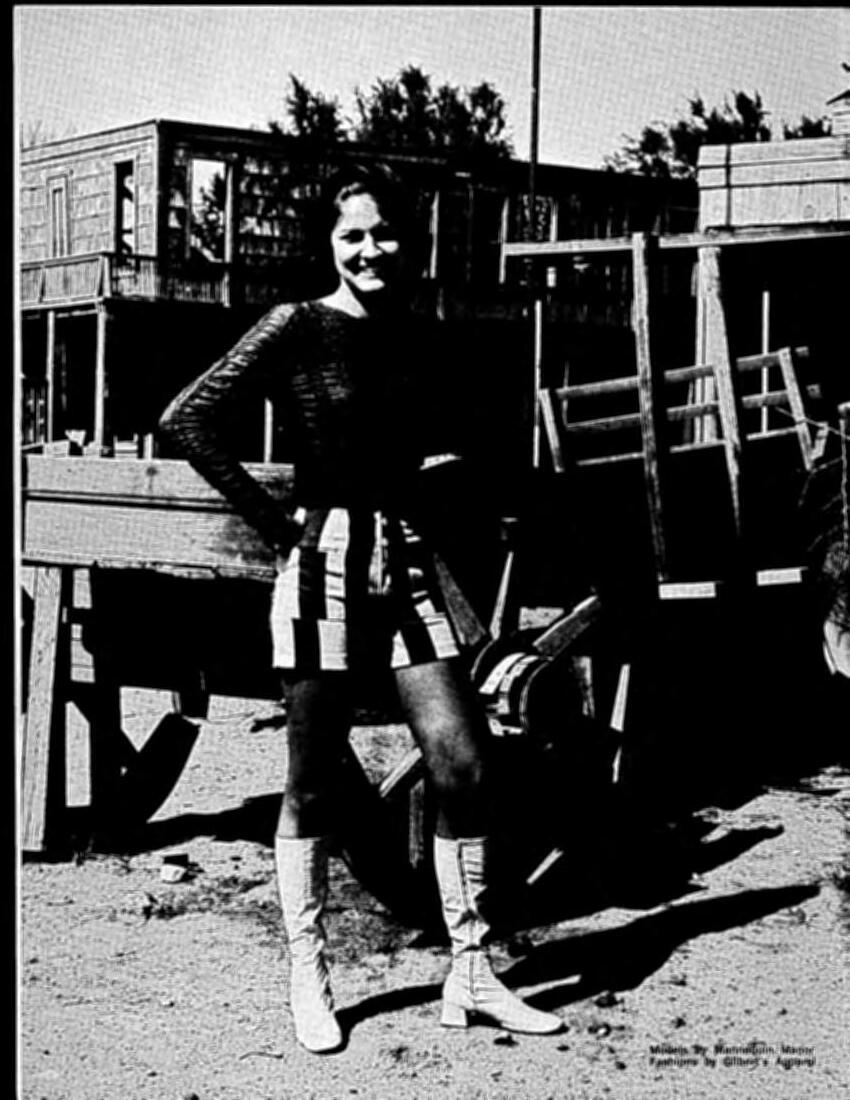
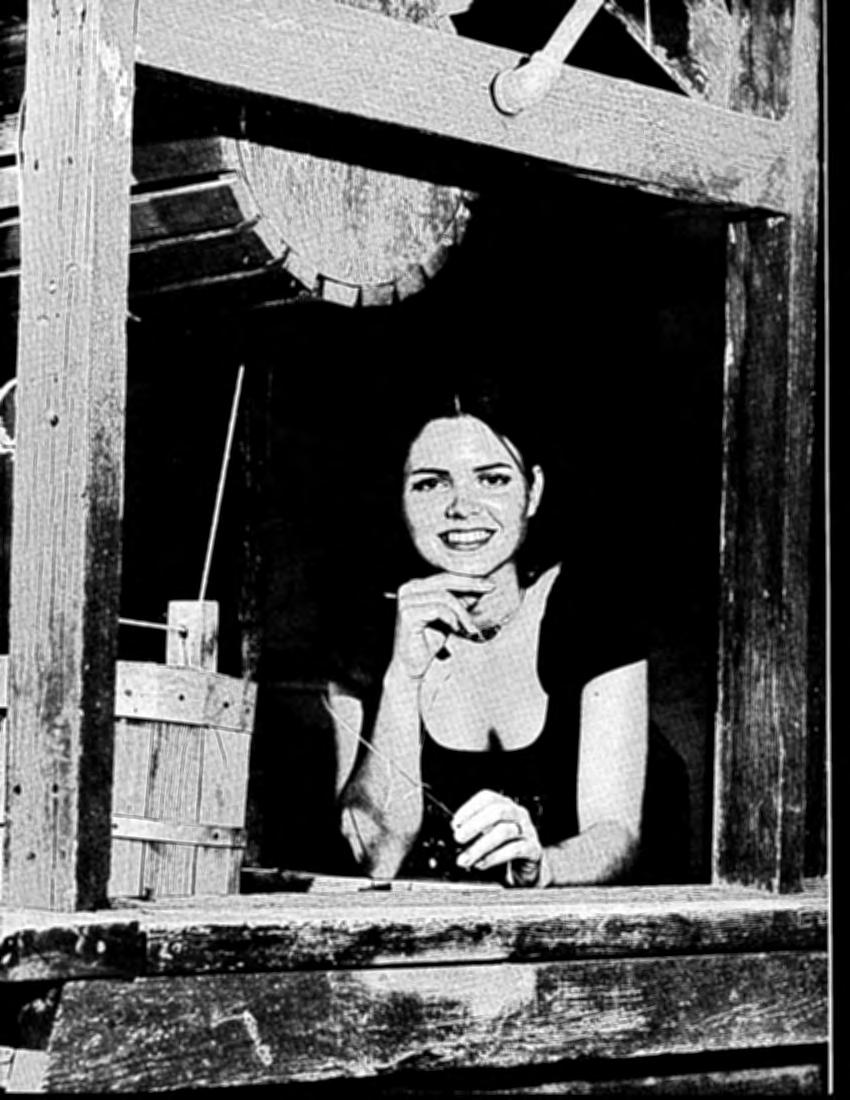
Cindy is a student at Mannequin
Manor Modeling School and hopes someday to model professionally or become involved in fashion merchandising. Her friendly smile and captivating figure assures her success in any endeavor. Cindy describes herself as a «typical hamburger or steak girl". She likes to swim and ride horses. Her summer plans include 4 weeks in Saltillo, Mexico, studying Spanish and the Mexican culture. Ole!
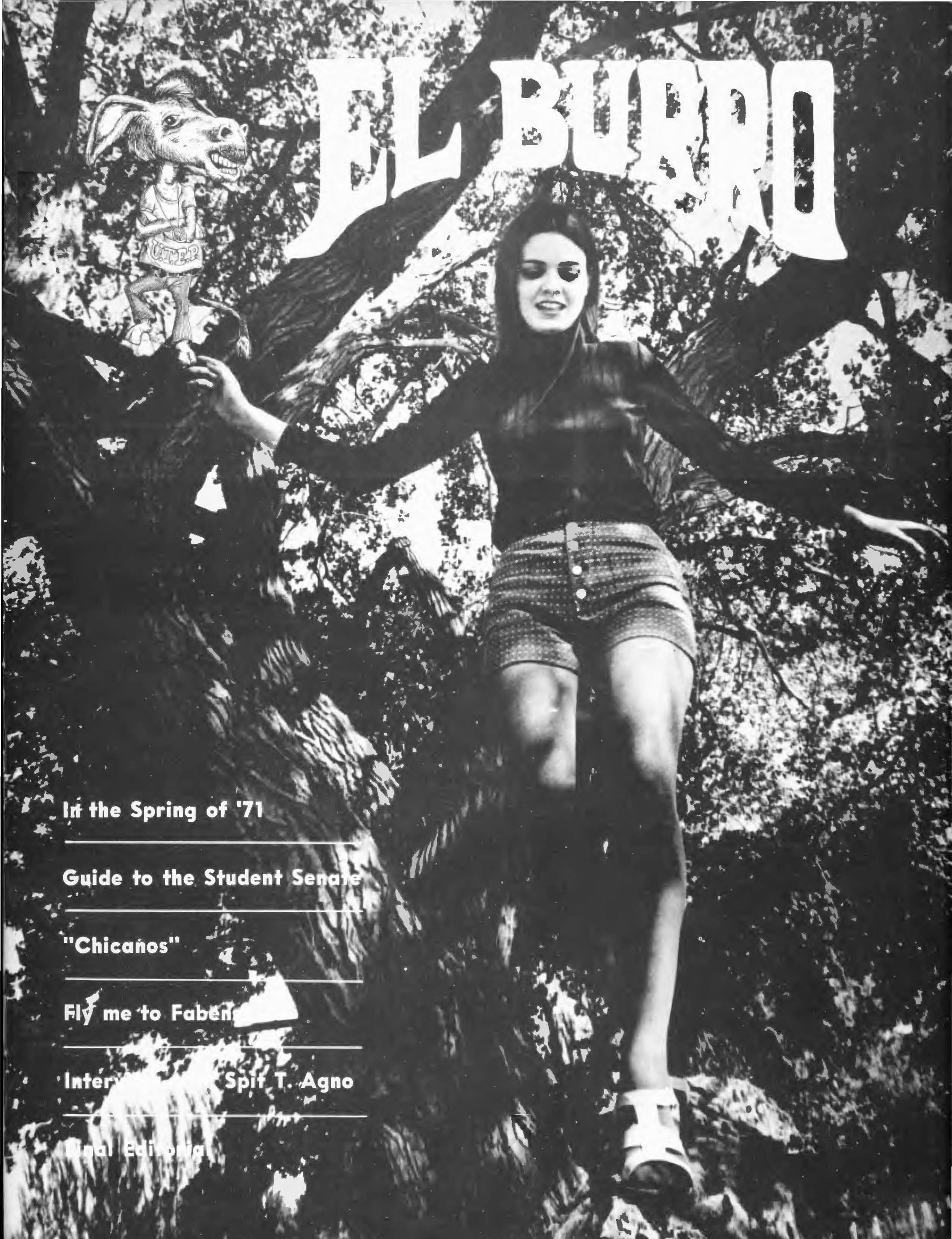
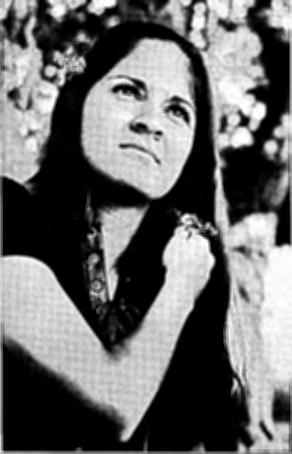
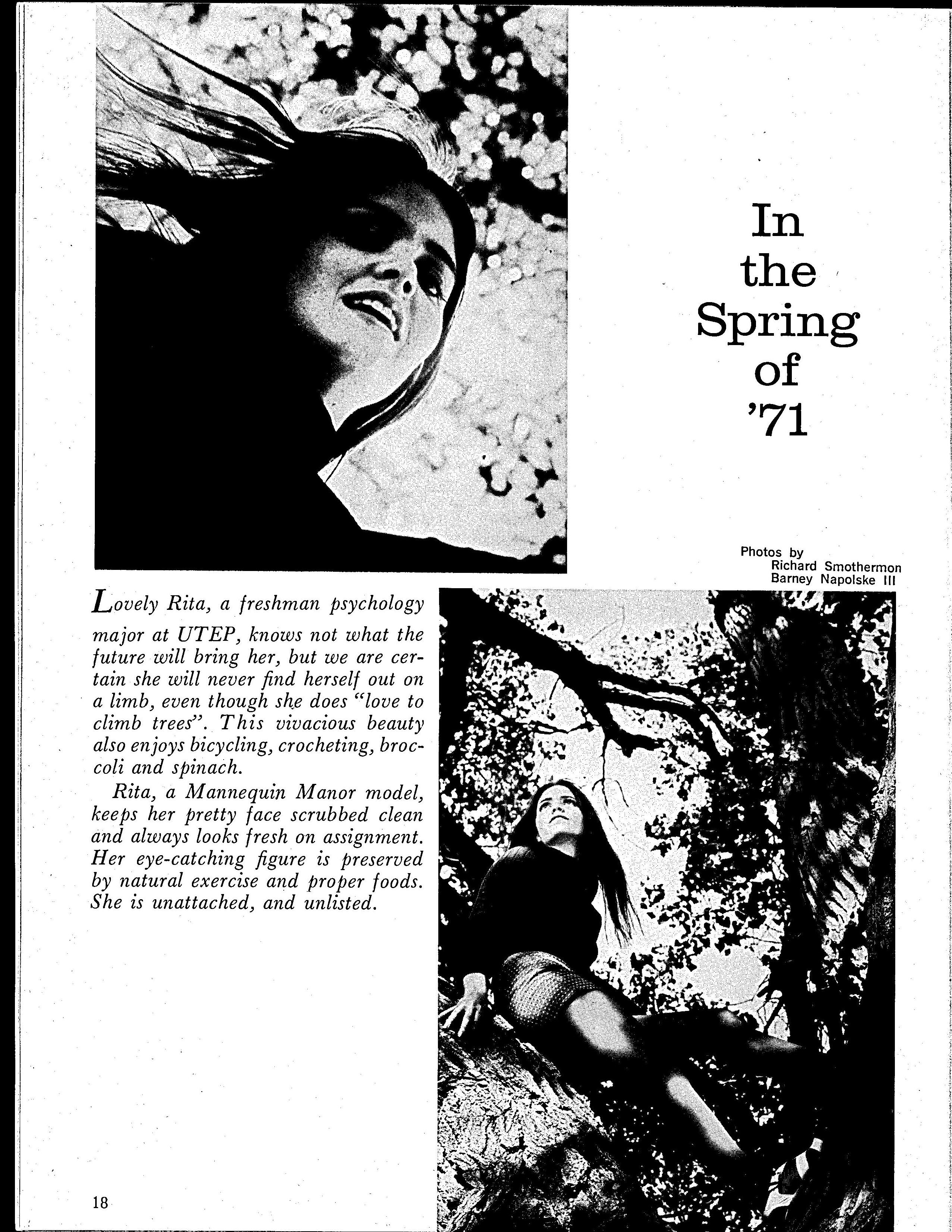
Lovely Rita, a freshman psychology major at UTEP, knows not what the future will bring her, but we are certain she will never find herself out on a limb, even though she does "love to climb trees". Th is vivacious beauty also enjoys bicycling, crocheting, broccoli and spinach.
Rita, a Mannequin Manor model, keeps her pretty face scrubbed clean and always looks fresh on assignment. Her eye-catching figure is preserved by natural exercise and proper foods. She is unattached, and unlisted.
In the I Spring of '71
Photos by Richard Smotherman Barney Napolske Ill r,lf"
Kelly La Rue
The front door slammed, cut~ ting off the shrill voice that had been slicing through the screen door into the hot stillness of the summer day. Mrs. Welleby was the only one listening, but what she hears becomes community property.
"I've told them and told them about that damn dog but it doesn't do any good. They let it run wild over the neighborhood. You know how I need my sleep, but every morning that damn mutt is barking and raising cain till I'm about to go out my mind." The small, slim and very shrill old woman sat down and began fanning herself with a newspaper, "It's all right, they've had their chance; is it fair for me to suffer just because of some selfish people down the street? Well, is it?"
"Now, Mother, I just, uh, don't know, it doesn't seem right ." George was also slim, very slim, a little taller than average, good looking and had a slight, permanent slump. At this moment his mouth was open because he had just been interrupted by a very impatient shout:
"OF COURSE IT'S ALL RIGHT! Now there you again worrying about the other guy when your own flesh and blood is in trouble. All you have to do is coax it into your car and take it to the pound; what could be simpler? I
So Kind to His Mother
told them to do something about that dog but they just got mad that any9ne would have the nerve to say anything against their precious mongrel. I gave them their chance. You must admit that! I warned them but they woudn't listen. I'd do it myself but dogs hate me and besides you have a way with them " However reasonable and logical she might have been, it was all wasted on George because he had quit listening at this point. He knew her dialogue on this sort of thing by heart anyway. He usually went along with her schemes because argument was useless and besides, as he had recently forced himself to acknowledge, he was afraid to defy her. But this time he felt she was asking too much. He could see her side, and he sympathized, but this was stealing, and tall, slim, good looking, slumped George did not like stealing. In fact, he would rather listen to his Mother's shrill raving than steal something. However, that comparison may be meaningless because there are some that think George just might enjoy listening to this gray haired old hag's ranting. George did not think he enjoyed it, but then it was only recently that he had realized that not everyone's mother acts like this. That in fact some mothers like to hug and kiss their children ( George
was shocked and embarrassed the first time he witnessed such a display).
George elapsed his hands together to stop their trembling and looked longingly at the pitcher of Kool-Aid in the kitchen. "Well Mother, I need time to think. What would my wife and the people at Church think if they found out.. . ."
George's mouth hung open again. George's mouth hung open a lot when he talked (?) to his mother.
"WHO'LL FIND OUT? And what's there to think about? I can't understand your reluctance when it's so obvious I'm right. It's not like we're taking a well cared for family pet. In fact we'd be doing it a favor, just ask Mrs. Welleby how they treat him."
That gossip. When she and his mother got together they could convince themselves of anything. He should just get up and leave, just walk out without a backward glance ( George had been having rebellious thoughts lately). Leave her with her junky furniture, her tom and stained wallpaper, and her straggly flowerbed. Ever since he'd been born into this dump he'd known nothing but scheming, manipulation and guilt. Especially guilt, it blanketed his life like Alfred Prufrock's yellow fog. She beat his father down until he was a nonetity in the
home and then acted the part of a martyr when he disappeared instead of returning from work one day. It really made little difference to George except that now he received the full benefit of her attention, and it was something less than benevolent. All through high school he labored under her influence until he went to college with a scholarship and loans. There he got married (secretly) And there he made a decision of dubious worth, to return to his hometown, where he was once again caught up in his mother's yellow fog. It goes without saying that he still hasn't made up for getting married, ( I worked, slaved, and sacrificed for you George and now you . . ." ) . George closed his eyes as thought about his wife. Although his wife's looks were ones of pity, they held the threat of contempt. And George knew that someday they would fulfill that threat. What was George to do? All his life his mother never considered what he might want, or what anyone else wanted for that matter. She never considered anyone's feelings, always assumed the worst of people, always thought they were doubledealing her. Paranoid, that's what she is, neurotic and paranoid. George's father had figured this out ten years ago, but he didn't have her for a mother. George's face
burned hot from these thoughts and his limbs numbed with fear.
"George! Are you listening?!"
"Why yes, you were saying something about the dog."
"Exactly! Now, are you going to do it?"
"Yes, yes, I guess so."
"Good, good, I knew you'd come through. Now here's my plan "
Damn ! Just like all the other times. But this time George wasn't sure he could really go through with it. Maybe his mother didn't have any scruples, but he did. And under the influence of his wife's silent stares he was being forced to look at and understand his relationship with he mother. And with this understanding came contempt. The same contempt his wife promised. Something must be done, but it just had to be impossible to say no. His mother could tum his insides to gelatin any time she felt it necessary. Even the serious consideration of resistance had this effect when George lay awake at night thinking about his problem. He felt a mementary blaze of hatred for the dog. But of course it wasn't the dog's fault, besides something like this was bound to happen sooner or later. So now George had a problem: if he tried to tell his mother "no," she would stuff his backbone down his throat without lifting a
finger. But George found the thought of stealing most distasteful and felt that he just couldn't. Maybe he could find the dog a new home. No, that was the same thing his mother had in mind, only with a nicer ending. Actually the people probably loved the dog; he had only his mother's side of the story and he knew how she could anger people she talked to. There had to be someway out of this mess ... some way besides open defiance that is. George knew what happened when he tried that (his mother stuffed his backbone down his throat without lifting a finger). Maybe he could talk to the people himself? Say, now there was an idea. People usually liked him ( harmle~ fella you know) and it just might work. He might be able to soothe their ruffled feelings from their one or two encounters with Mother and make them see that no good was going to come of this. George felt suddenly weak from the excitement of the idea. He stood up shakily.
"It's an excellent plan Mother and I'll do it as soon as I can; but I gotta run."
"But George, I haven't finished '
"Don't worry Mother, I'll use my common sense and take care of it. Bye."
George's heart pounded from the
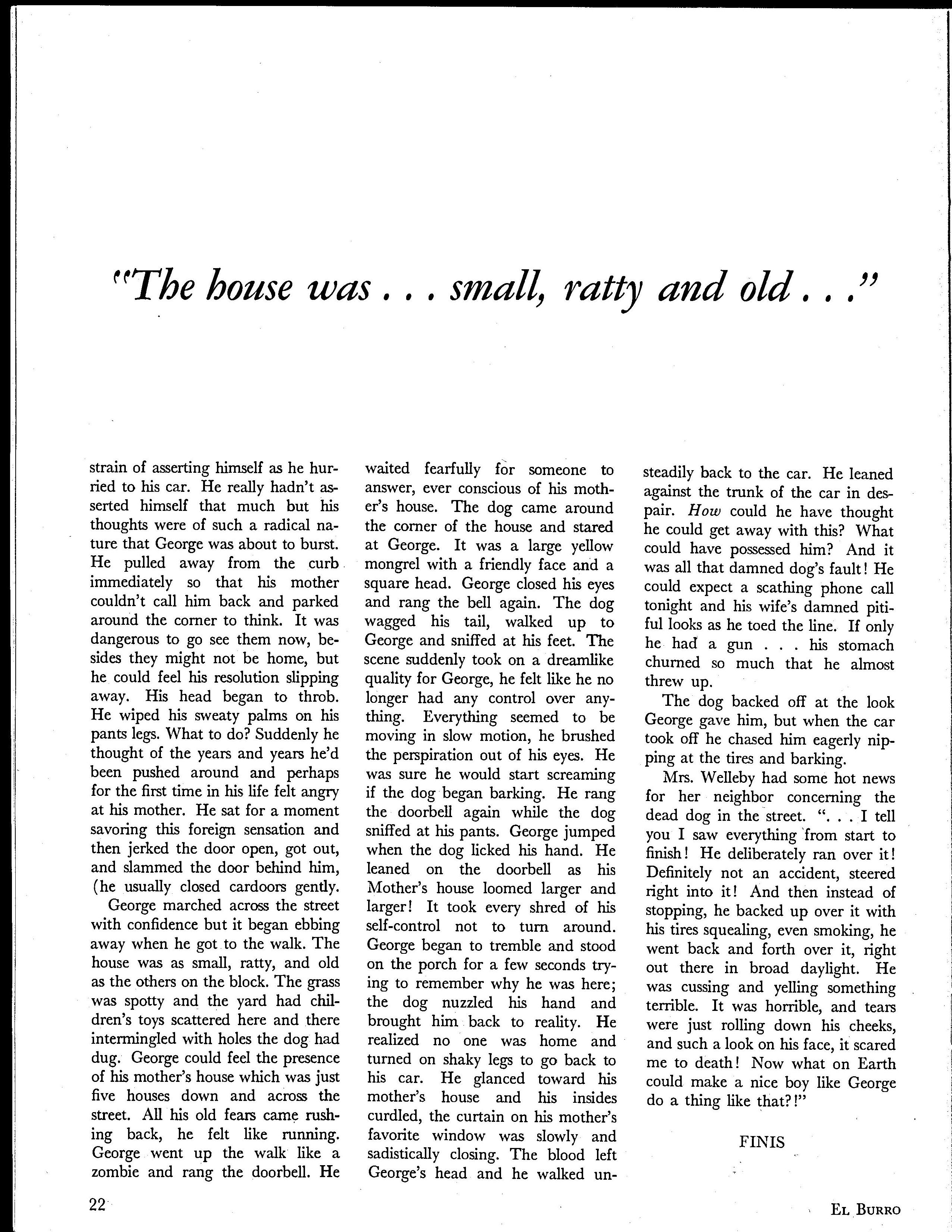
rrThe house was , , , smal4 ratty and old, , , ''
strain of asserting himself as he hurried to his car. He really hadn't asserted himself that much but his thoughts were of such a radical nature that George was about to burst. He pulled away from the curb immediately so that his mother couldn't call him back and parked around the corner to think. It was dangerous to go see them now, besides they might not be home, but he could feel his resolution slipping away. His head began to throb. He wiped his sweaty palms on his pants legs. What to do? Suddenly he thought of the years and years he'd been pushed around and perhaps for the first time in his life felt angry at his mother. He sat for a moment savoring this foreign sensation and then jerked the door open, got out, and slammed the door behind him, (he usually closed cardoors gently. George marched across the street with confidence but it began ebbing away when he got to the walk. The house was as small, ratty, and old as the others on the block. The grass was spotty and the yard had children's toys scattered here and there intermingled with holes the dog had dug. George could feel the presence of his mother's house which was just five houses down and across the street. All his old fears cam~ rushing back, he felt like running. George went up the walk like a zombie and rang the doorbell. He
waited fearfully for someone to answer, ever conscious of his mother's house. The dog came around the corner of the house and stared at George. It was a large yellow mongrel with a friendly face and a square head. George closed his eyes and rang the bell again. The dog wagged his tail, walked up to George and sniffed at his feet. The scene suddenly took on a dreamlike quality for George, he felt like he no longer had any control over anything. Everything seemed to be moving in slow motion, he brushed the perspiration out of his eyes. He was sure he would start screaming if the dog began barking. He rang the doorbell again while the dog sniffed at his pants. George jumped when the dog licked his hand. He leaned on the doorbell as his Mother's house loomed larger and larger! It took every shred of his self-control not to turn around. George began to tremble and stood on the porch for a few seconds trying to remember why he was here; the dog nuzzled his hand and brought him back to reality. He realized no one was home and turned on shaky legs to go back to his car. He glanced toward his mother's house and his insides curdled, the curtain on his mother's favorite window was slowly and sadistically closing. The blood left George's head and he walked un-
steadily back to the car. He leaned against the trunk of the car in despair. How could he have thought he could get away with this? What could have possessed him? And it was all that damned dog's fault! He could expect a scathing phone call tonight and his wife's damned pitiful looks as he toed the line. If only he had a gun his stomach churned so much that he almost threw up.
The dog backed off at the look George gave him, but when the car took off he chased him eagerly nipping at the tires and barking.
Mrs. Welleby had some hot news for her neighbor concerning the dead dog in the street. ". . . I tell you I saw everything 'from start to finish! He deliberately ran over it! Definitely not an accident, steered right into it! And then instead of stopping, he backed up over it with his tires squealing, even smoking, he went back and forth over it, right out there in broad daylight. He was cussing and yelling something terrible. It was horrible, and tears were just rolling down his cheeks, and such a look on his face, it scared me to death! Now what on Earth could make a nice boy like George do a thing like that?!"
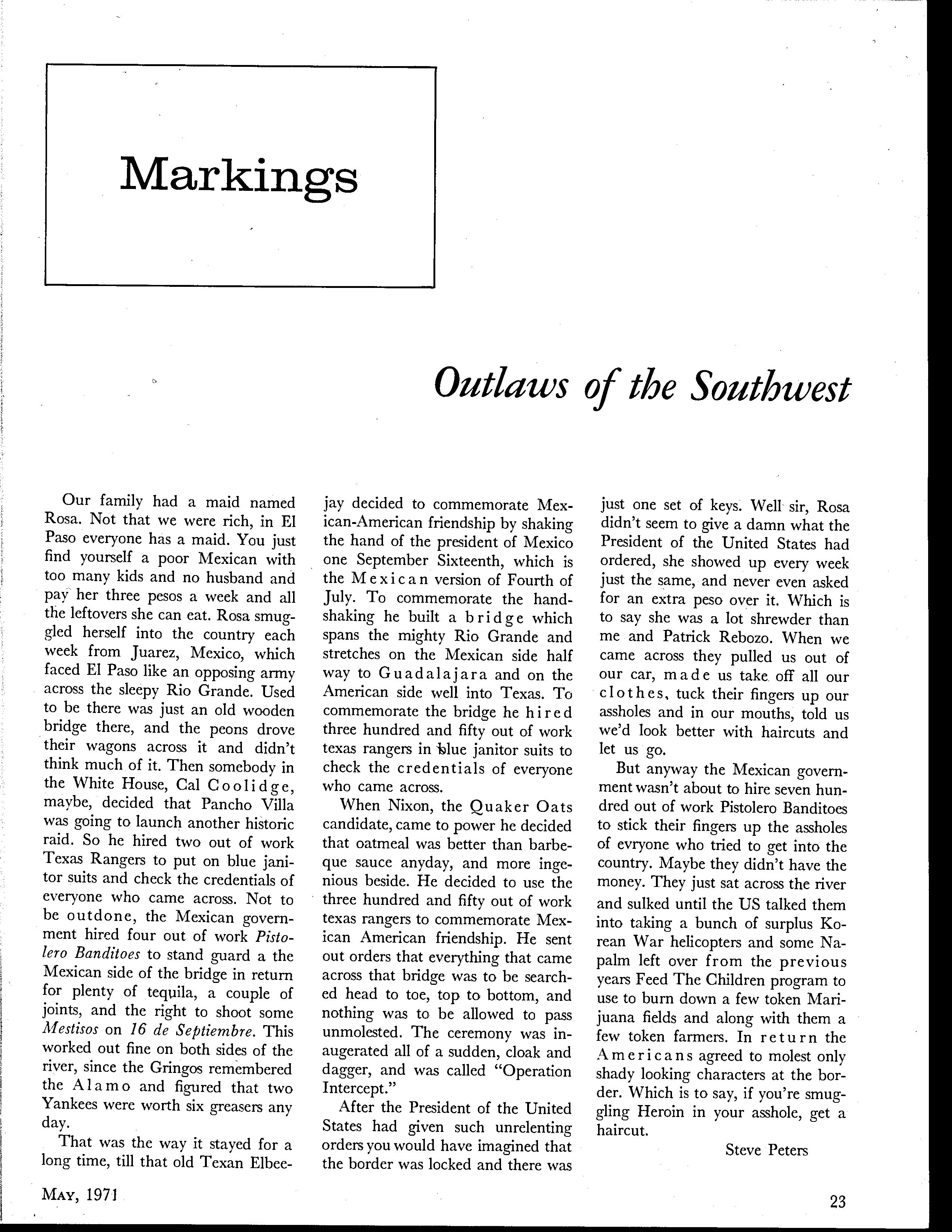
Markings
Our family had a maid named Rosa. Not that we were rich, in El Paso everyone has a maid. You just find yourself a poor Mexican with too many kids and no husband and pay her three pesos a week and all the leftovers she can eat. Rosa smuggled herself into the country each week from Juarez, Mexico, which faced El Paso like an opposing army across the sleepy Rio Grande. Used to be there was just an old wooden bridge there, and the peons drove their wagons across it and didn't think much of it. Then somebody in the White House, Cal Coolidge, maybe, decided that Pancho Villa was going to launch another historic raid. So he hired two out of work Texas Rangers to put on blue janitor suits and check the credentials of everyone who came across. Not to be outdone, the Mexican government hired four out of work Pistolero Banditoes to stand guard a the Mexican side of the bridge in return for plenty of tequila, a couple of joints, and the right to shoot some Mestisos on 16 de Septiembre. This worked out fine on both sides of the river, since the Gringos remembered the A 1am o and figured that two Yankees were worth six greasers any day.
That was the way it stayed for a long time, till that old Texan Elbee-
1971
Outlaws of the Southwest
jay decided to commemorate Mexican-American friendship by shaking the hand of the president of Mexico one September Sixteenth, which is the Mexican version of Fourth of July. To commemorate the handshaking he built a bridge which spans the mighty Rio Grande and stretches on the Mexican side half way to Guadalajara and on the American side well into Texas. To commemorate the bridge he hi red three hundred and fifty out of work texas rangers in l\llue janitor suits to check the credentials of everyone who came across.
When Nixon, the Quaker Oats candidate, came to power he decided that oatmeal was better than barbeque sauce anyday, and more ingenious beside. He decided to use the three hundred and fifty out of work texas rangers to commemorate Mexican American friendship. He sent out orders that everything that came across that bridge was to be searched head to toe, top to bottom, and nothing was to be allowed to pass unmolested. The ceremony was inaugerated all of a sudden, cloak and dagger, and was called "Operation Intercept."
After the President of the United States had given such unrelenting orders you would have imagined that the border was locked and there was
just one set of keys. Well sir, Rosa didn't seem to give a damn what the President of the United States had ordered, she showed up every week just the same, and never even asked for an extra peso over it. Which is to say she was a lot shrewder than me and Patrick Rebozo. When we came across they pulled us out of our car, m ad e us take off all our clothes, tuck their fingers up our assholes and in our mouths, told us we'd look better with haircuts and let us go.
But anyway the Mexican government wasn't about to hire seven hundred out of work Pistolero Banditoes to stick their fingers up the assholes of evryone who tried to get into the country. Maybe they didn't have the money. They just sat across the river and sulked until the US talked them into taking a bunch of surplus Korean War helicopters and some Napalm left over from the previous years Feed The Children program to use to burn down a few token Marijuana fields and along with them a few token farmers. In re tu r n the A m e r i c an s agreed to molest only shady looking characters at the border. Which is to say, if you're smuggling Heroin m your asshole, get a haircut.
Steve Peters
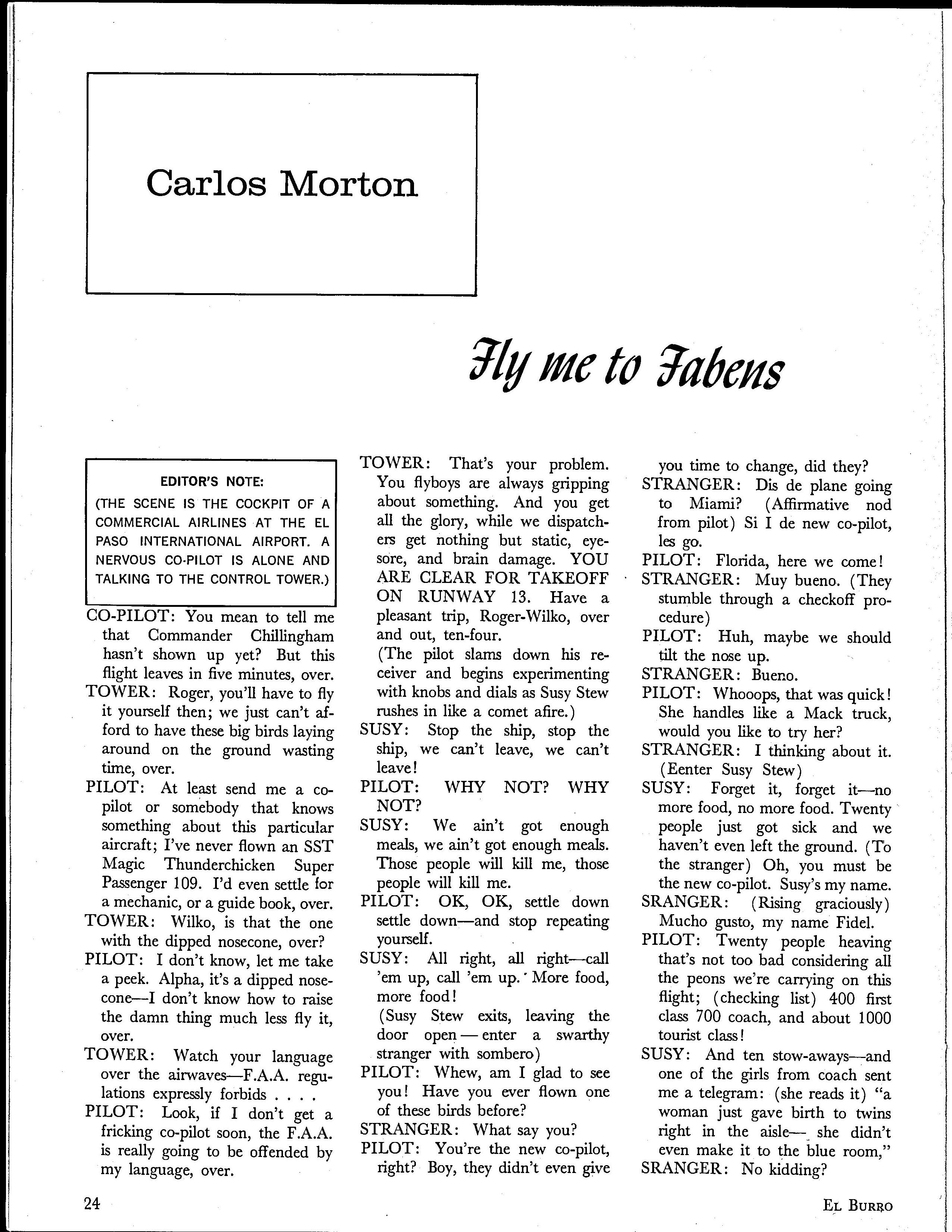
Carlos Morton
EDITOR'S NOTE:
(THE SCENE IS THE COCKPIT OF A COMMERCIAL AIRLINES AT THE EL PASO INTERNATIONAL AIRPORT. A NERVOUS CO-PILOT IS ALONE AND TALKING TO THE CONTROL TOWER.)
CO-PILOT: You mean to tell me that Commander Chillingham hasn't shown up yet? But this flight leaves in five minutes, over.
TOWER: Roger, you'll have to fly it yourself then; we just can't afford to have these big birds laying around on the ground wasting time, over.
PILOT: At least send me a copilot or somebody that knows something about this particular aircraft; I've never flown an SST Magic Thunderchicken Super Passenger 109. I'd even settle for a mechanic, or a guide book, over.
TOWER: Wilko, is that the one with the dipped nosecone, over?
PILOT: I don't know, let me take a peek. Alpha, it's a dipped nosecone-I don't know how to raise the damn thing much less fly it, over.
TOWER: Watch your language over the airwaves-F.A.A. regulations expressly forbids
PILOT: Look, if I don't get a £ricking co-pilot soon, the F.A.A. is really going to be offended by my language, over.
1111 me to 1abe11s
TOWER: That's your problem. You flyboys are always gripping about something. And you get all the glory, while we dispatchers get nothing but static, eyesore, and brain damage. YOU ARE CLEAR FOR TAKEOFF ON RUNWAY 13. Have a pleasant trip, Roger-Wilko, over and out, ten-four.
(The pilot slams down his receiver and begins experimenting with knobs and dials as Susy Stew rushes in like a comet afire.)
SUSY: Stop the ship, stop the ship, we can't leave, we can't leave!
PILOT: WHY NOT? WHY NOT?
SUSY: We ain't got enough meals, we ain't got enough meals. Those people will kill me, those people will kill me.
PILOT: OK, OK, settle down settle down-and stop repeating yourself.
SUSY: All right, all right-call 'em up, call 'em up.· More food, more food!
( Susy Stew exits, leaving the door open - enter a swarthy stranger with sombero)
PILOT: Whew, am I glad to see you! Have you ever flown one of these birds before?
STRANGER: What say you?
PILOT: You're the new co-pilot, right? Boy, they didn't even give
you time to change, did they?
STRANGER: Dis de plane going to Miami? (Affirmative nod from pilot) Si I de new co-pilot, les go.
PILOT: Florida, here we come!
STRANGER: Muy bueno. (They stumble through a checkoff procedure)
PILOT: Huh, maybe we should tilt the nose up.
STRANGER: Bueno.
PILOT: Whooops, that was quick! She handles like a Mack truck, would you like to try her?
STRANGER: I thinking about it.
( Eenter Susy Stew)
SUSY: Forget it, forget it-no more food, no more food. Twenty people just got sick and we haven't even left the ground. (To the stranger) Oh, you must be the new co-pilot. Susy's my name.
SRANGER: (Rising graciously) Mucha gusto, my name Fidel.
PILOT: Twenty people heaving that's not too bad considering all the peons we're carrying on this flight; ( checking list) 400 first class 700 coach, and about 1000 tourist class !
SUSY: And ten stow-aways-and one of the girls from coach sent me a telegram: (she reads it) "a woman just gave birth to twins right in the aisle-" she didn't even make it to the blue room,"
SRANGER: No kidding?
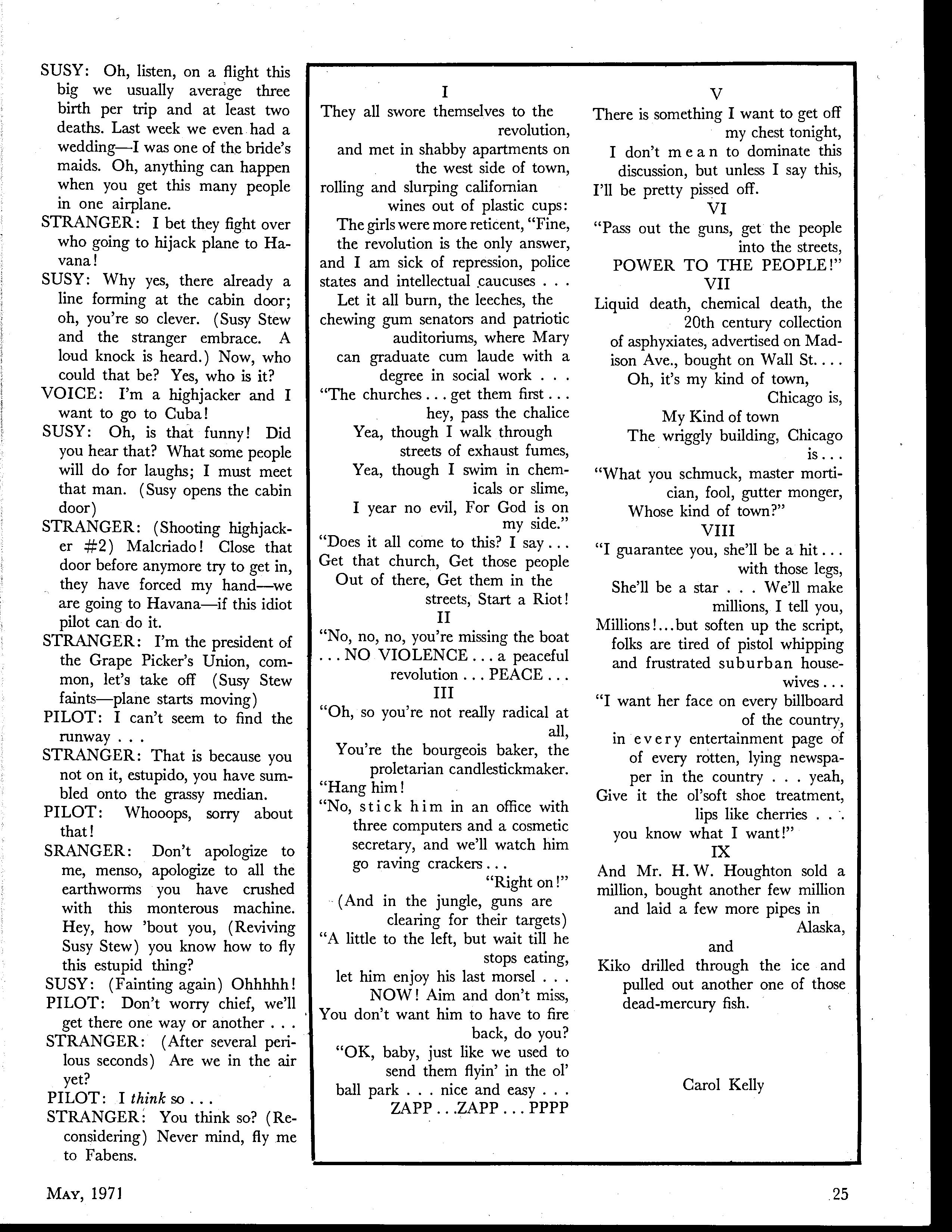
SUSY: Oh, listen, on a flight this big we usually average three birth per trip and at least two deaths. Last week we even. had a wedding-I was one of the bride's maids. Oh, anything can happen when you get this many people in one airplane.
STRANGER: I bet they fight over who going to hijack plane to Havana!
SUSY: Why yes, there already a line forming at the cabin door; oh, you're so clever. ( Susy Stew and the stranger embrace. A loud knock is heard.) Now, who could that be? Yes, who is it?
VOICE: I'm a high jacker and I want to go to Cuba!
SUSY: Oh, is that funny! Did you hear that? What some people will do for laughs; I must meet that man. ( Susy opens the cabin door)
STRANGER: (Shooting highjacker #2) Malcriado ! Close that door before anymore try to get in, they have forced my hand-we are going to Havana-if this idiot pilot can do it.
STRANGER: I'm the president of the Grape Picker's Union, common, let's take off ( Susy Stew faints-plane starts moving)
PILOT: I can't seem to find the runway ...
STRANGER: That is because you not on it, estupido, you have sumbled onto the grassy median.
PILOT: Whooops, sorry about that!
SRANGER: Don't apologize to me, menso, apologize to all the earthworms you have crushed with this monterous machine. Hey, how 'bout you, (Reviving Susy Stew) you know how to fly this estupid thing?
SUSY: (Fainting again) Ohhhhh!
PILOT: Don't worry chief, we'll get there one way or another ...
STRANGER: (After several perilous seconds) Are we in the air yet?
PILOT: I think so
STRANGER: You think so? (Reconsidering) Never mind, fly me to Fabens.
IThey all swore themselves to the revolution, and met in shabby apartments on the west side of town, rolling and slurping califomian wines out of plastic cups: The girls were more reticent, "Fine, the revolution is the only answer, and I am sick of repression, police states and intellectual _caucuses . . . Let it all burn, the leeches, the chewing gum senators and patriotic auditoriums, where Mary can graduate cum laude with a degree in social work
"The churches . . . get them first . . . hey, pass the chalice Yea, though I walk through streets of exhaust fumes, Yea, though I swim in chemicals or slime, I year no evil, For God is on my side."
"Does it all come to this? I say ... Get that church, Get those people Out of there, Get them in the streets, Start a Riot!
II
"No, no, no, you're missing the boat ... NO VIOLENCE ... a peaceful revolution PEACE
III
"Oh, so you're not really radical at all,
You're the bourgeois baker, the proletarian candlestickmaker. "Hang him!
"No, stick him in an office with three computers and a cosmetic secretary, and we'll watch him go raving crackers
"Right on!"
· ( And in the jungle, guns are clearing for their targets)
"A little to the left, but wait till he stops eating, let him enjoy his last morsel NOW! Aim and don't miss, You don't want him to have to fire back, do you? "OK, baby, just like we used to send them flyin' in the ol' ball park nice and easy ZAPP ZAPP PPPP
V
There is something I want to get off my chest tonight, I don't m e a n to dominate this discussion, but unless I say this, I'll be pretty pissed off.
VI
"Pass out the guns, get the people into the streets, POWER TO THE PEOPLE!"
VII
Liquid death, chemical death, the 20th century collection of asphyxiates, advertised on Madison Ave., bought on Wall St
Oh, it's my kind of town, Chicago is, My Kind of town
The wriggly building, Chicago is
"What you schmuck, master mortician, fool, gutter monger, Whose kind of town?"
VIII
"I guarantee you, she'll be a hit ... with those legs, She'll be a star We'll make millions, I tell you, Millions! but soften up the script, folks are tired of pistol whipping and frustrated suburban housewives
"I want her face on every billboard of the country, in e v e r y entertainment page of of every rotten, lying newspaper in the country yeah, Give it the ol'soft shoe treatment, lips like cherries you know what I want!"
IX
And Mr. H. W. Houghton sold a million, bought another few million and laid a few more pipes in Alaska, and
Kiko drilled through the ice and pulled out another one of those dead-mercury fish. Carol Kelly
Markings
"Why do you separate yourselves by calling yourselves Chicanos?" people scream. "Aren't we all Americans?" they ask. "Why do you want a Movement?"
The Chicano answers that we are not "separating" ourselves - We have been separated from the mainstream of American society since 1848. It is precisely because we are all legally Americans that the Chicano demands the rights of equal education, decent housing, equal job , opportunities and equality in the administration of justice that have been only words and empty promises to the Chicano. It is a sad testimony of American society that Movements must come into existence only to secure that w h i ch is guaranteed to all men.
Among the most glaring injustices is a school system that is geared primarily to white middle-class pupils that has severely handicapped the Chicano. Because of the melting pot theory of the school system, the Chicanito, upon entering first grade, is forced to conform to a model of the "American Ideal." The child is
eechicanos''
thus educable only to the extent that he can fit into the mold. If he persistently refuses to be called "Jimmy" and to refrain from speaking Spanish while on the school grounds, he is labelled a troublemaker, a "discipline problem." Schools, especially in Texas, have shamefully neg 1e ct e d their Chicano students. The fact that SO% of the. Chicanos in Texas never finish high school and that the average number of school years completed is 4.7 is a brutal indictment of the educational quality the Chicano is subjected to. Herded into modified classes on the basis of anglo-oriented tests, the Chicano is rarely stimulated by his high school counsellors to continue on to college. He is presented with literature about the Army and Navy rather than potential Universities.
Schools that are even up to 100% Chicano do not take into account the special needs of their students and continue with the same antiquated methods of instruction and counselling that have proven so disastrous for the Chicano. The basic premise of the school
system should be to develop to the upmost degree the capabilities of its students. The direct opposite effect is achieved in Chicano schools. Educational facilities and opportunities are rarely on an equal level with predominantly Anglo schools. Enriched accelerated and college preparatory courses are offered at Anglo schools, while Chicano schools heavily stress the vocational and manual trades.
Having received little incentive from the school to continue past high school and inadequate preparation for college, there are few choices left to the Chicano. By this time he often begins to believe the bigotries of society and the myth of his inferiority and think the University to be beyond his capabilities. The Chicano then "chooses" the military. Coming from a society in which his worth is questioned and where he is assumed incompetent until he proves himself competent, the Chicano ·often tries to prove himself on the field of battle. This need is often cruelly exploited by the military and Chicanos comprise a shockingly disproportionate
number of the Viet Nam casualties. When the Vietnamese war dead totaled 45,000 approximately 8 to 10,000 were Chicanos. We are 4% of this country's population, yet we fight 20% of its war.
We do not need to prove our right to be Americans. Our labor, our toil, our knowledge, has developed the Southwest for 300 years. Nor are we recent immigrants, as is often charged, seeking to escape the poverty of Mexico. Government .. surveys indicate over 85% of the Chicano population is born in this country. Yet, if one must prove his right to this country, the Chicano has shed blood from Okinawa to France to Viet Nam to safeguard a nation in which his people are the poorest ethnic group, have the lowest educational level and whose vast majority, (almost SO%) are working at unskilled, low-paying jobs, and who even the United States government admits are: "subjected to unduly harsh treatment when arrested."
The Chicano Movement is burgeon throughout the Southwest as a reaction against
the injustice suffered by a people since the Mexican War. When the first anglos arrived, the Mexican taught him the the ways of the desert. He taught him to irrigate, to cultivate the land, and how to raise cattle. The I a r i at, the Western saddle all sprang from the Chicano. He gave the anglo a new architecture suited to the land. Robbed of our land by a foreign people, treated as a conquered race, the Treaty of Guadalupe Hidalgo ignored, our culture deprecated, stigmatized into a feeling of inferiority, the Chic an o shouts "Ya basta!" No longer will our youth seethe as we hear our ways, our language, our people malignated and held up in ridicule. The automatic relegation to a secondclass position that comes with a Spanish surname will no longer be tolerated. This is the Movement. The Movement says that CHICANO is a word overflowing with pride-pride in our culture, and in oneself. The Movement stresses that it is not necessary to divest oneself of one's soul in order to conform to the prescribed standards of society. The In-
dio, the meztizo, we are the RAZA COSMICA. In our veins runs the blood of every racial group in the world. This is the "orgullo" that must be instilled in our children, this is the heritage they must grasp not the wretched and negative self-image of the chili-picker and taco-vendor. No longer the greaser, the spic, the wetback, the "culturally deprived," the "under-achiever", but the Chicano, is glad he has brown skin, and is aware of the beauty of a vibrant, living culture. "Chicano" is a word that comes from the Raza-it is imposed as was "MexicanAmerican." The Movement is not a trend of recent times. As long as there have been Chicanos willing to help others who have not "made it", to look back into his origins in the barrio, to give of himself that other Raza might advance, there has been a Movement, and it will continue to expand and to thrive as long as we feel the bond that ties one Chicano to another.
brace and fell to the ground-I looked into his face-He was a baby! A kid, a stupid kid! He wasn't dead - He began crying and asking for his mama. I told him to shut up! -I wanted to help him, but I couldn't he was the enemy. He kept crying -shut up! I yelled! Be quiet!-I stabbed him again and again and again. He wouldn't let go of me! Mama! he would say, Mama! Finally, he let go of me. I knelt there beside his body-He looked as if he were sleeping-but I could see the flow of blood from his mouth -I was not a human. I was an animal! -A damn animal! And,this ,,~.. was wrong! Killing . was wrong!-What the hell did this kid do to me? It didn't make any sense-This kid didn't want to be out hereOur leaders have made us animals! Filthy animals! Filthy rats! We are filthy rats! I cannot kill no morel
C: Do you think I like
·this war? Do you think I like seeing these young men die and writing letters home to their parents and telling them that their son died gallantly fighting for their country? Nol I say, I do not; but one must do his duty: You ran from your responsibility-When you be-
came a soldier, you lost your rights to think of what is right and what is wrong .. Your existence was only to obey orders - not to think - what if everybody had your ideas, what would happen?
P: There would be no war.
C: Only slave camps perhaps.
P: No, I don't think so.
C: You don't think so I Are we to lay down our arms and not kill because you don't think so?
P: Yes! If that's what it takes to bring peace I
C: That is treason you speak of!
P: Is it treason to want to live and let live? To live in harmony with all men?
C: It is impossible!
P: Sir, is it really?You're wrong, Captain .. It's not impossibleMen must do this -
C: You had to create this problem for yourself, didn't you ?-If I give you your life and write on the records that you were dazed and lost your sense of direction, will you go back to the front lines and fight?
P: No Sir, I cannot.
C: Man I Do you know what this means?
P: Yes, my Captain.
C: As a human being, I feel for you-but as a soldier, I see before me a deserter and a traitor. You leave me no
no other choice than to carry. out my duty.Guard! (The guard enters) Carry out the execution immediately! (The prisoner looks at the Captain)
P: (Sincerely) Sorry I made you do it-Goodby.
(The prisoner is led out the door. The Captain looks at the desk and picks up a package of cigarettes. He removes one and throws the package back on the desk. He lights the cigarette slowly and takes two puffs nervously. The volley of gunfire is near. He removes the cigarette from the holder, drops it on the floor, and crushes it with the heel of his boot. The Captain looks at his watch, picks up some papers from his desk, and calls the clerk.)
C: Clerk!
Clerk: Yes. Sir.
C: Take this down-
To the parents of Antonio Marcello: I regret to inform you that your son was killed in action on this Sunday. I knew him personally. He was a fine soldier. Be proud of him. With my deepest sympathy. Captain An,sano
Clerk: Is that all, Sir?
C: Yes.
(The clerk leaves the room. The Captain re. mains seated at his desk-thinking)
Carlos Morton
Cowboy and his Lady
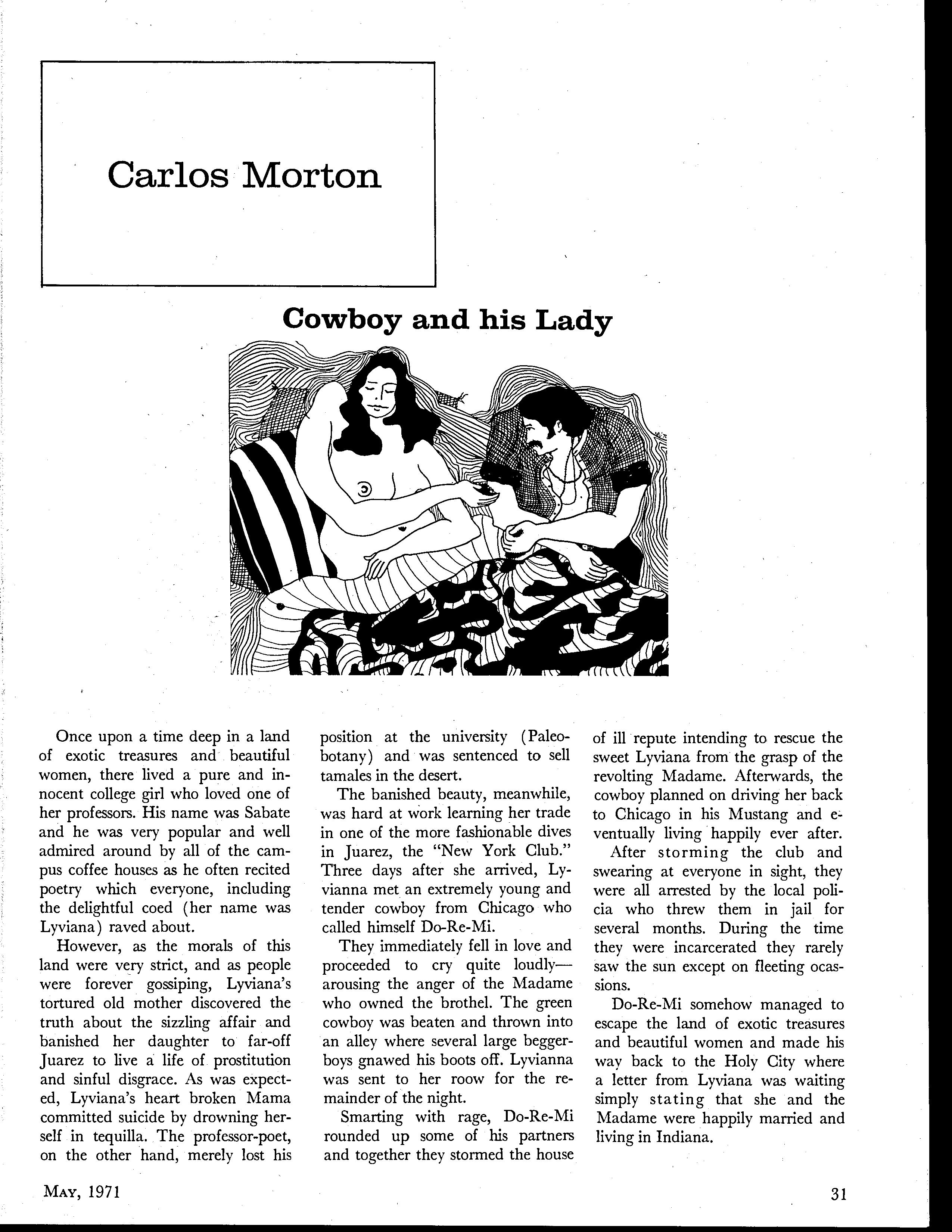
Once upon a time deep in a land of exotic treasures and beautiful women, there lived a pure and innocent college girl who loved one of her professors. His name was Sabate and he was very popular and well admired around by all of the campus coffee houses as he often recited poetry which everyone, including the delightful coed ( her name was Lyviana) raved about.
However, as the morals of this land were very strict, and as people were forever gossiping, Lyviana's tortured old mother discovered the truth about the sizzling affair and banished her daughter to far-off Juarez to live a: life of prostitution and sinful disgrace. As was expected, Lyviana's heart broken Mama committed suicide by drowning herself in tequilla. The professor-poet, on the other hand, merely lost his MAY, 1971
position at the university ( Paleobotany) and was sentenced to sell tamales in the desert.
The banished beauty, meanwhile, was hard at work learning her trade in one of the more fashionable dives in Juarez, the "New York Club." Three days after she arrived, Lyvianna met an extremely young and tender cowboy from Chicago who called himself Do-Re-Mi.
They immediately fell in love and proceeded to cry quite loudlyarousing the anger of the Madame who owned the brothel. The green cowboy was beaten and thrown into an alley where several large beggerboys gnawed his boots off. Lyvianna was sent to her roow for the remainder of the night.
Smarting with rage, Do-Re-Mi rounded up some of his partners and together they stormed the house
of ill •repute intending to rescue the sweet Lyviana from the grasp of the revolting Madame. Afterwards, the cowboy planned on driving her back to Chicago in his Mustang and e~ ventually living happily ever after.
After storming the club and swearing at everyone in sight, they were all arrested by the loca:l policia who threw them in jail for several months. During the time they were incarcerated they rarely saw the sun except on fleeting ocass10ns.
Do-Re-Mi somehow managed to escape the land of exotic treasures and beautiful women and made his way back to the Holy City where a letter from Lyviana was waiting simply stating that she and the Madame were happily married and living in Indiana.