3 Dean Kumar Yelamarthi Connecting the College of Engineering and Computer Science to Chattanooga’s Future
5 CECS Faculty Recognized for Exemplary Work in Scholarship and Service
6 UTC awarded $500K from State of Tennessee to Build the Future of Traffic Safety and Smart Streets
8 Dr. Erkan Kaplanoglu Earns Patent for New Tech Blending Rehab and Robotics
10 Brewing Science: How Coffee Fueled a UTC Chemical Engineering Student’s “grounds”-Breaking Research
12 Dr. Murat Barisik Featured in Nanotechnology Journal
13 Fly! Pitch Competition Awards $5K to CECS Student Entrepreneur
13 CECS Undergraduates Take Their Research to the Capitol
14 Leaving UTC with a Legacy of Leadership and Purpose
16 Revolutionary Research: Doctoral Candidate Develops Self-encrypting AI
A Triple Threat in Mechanical Engineering: Riggs Siblings Building Their
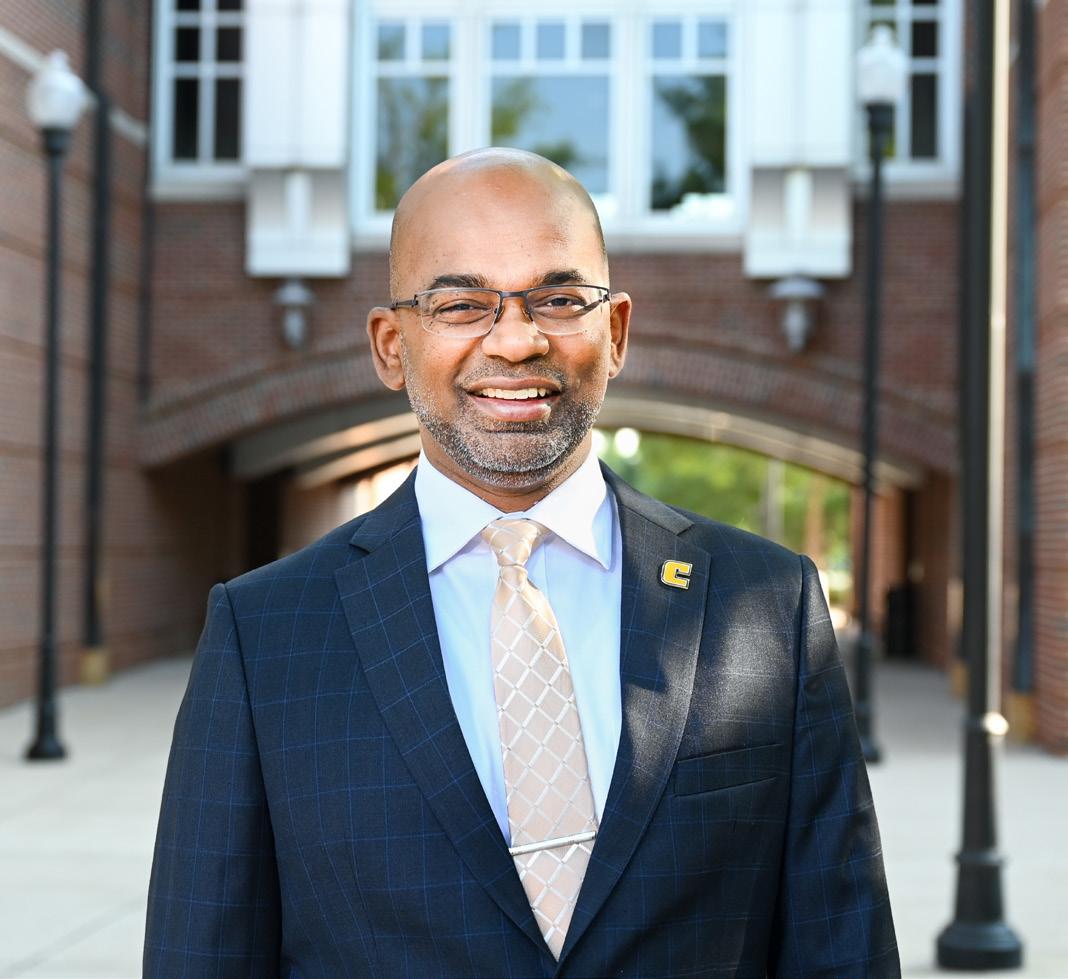
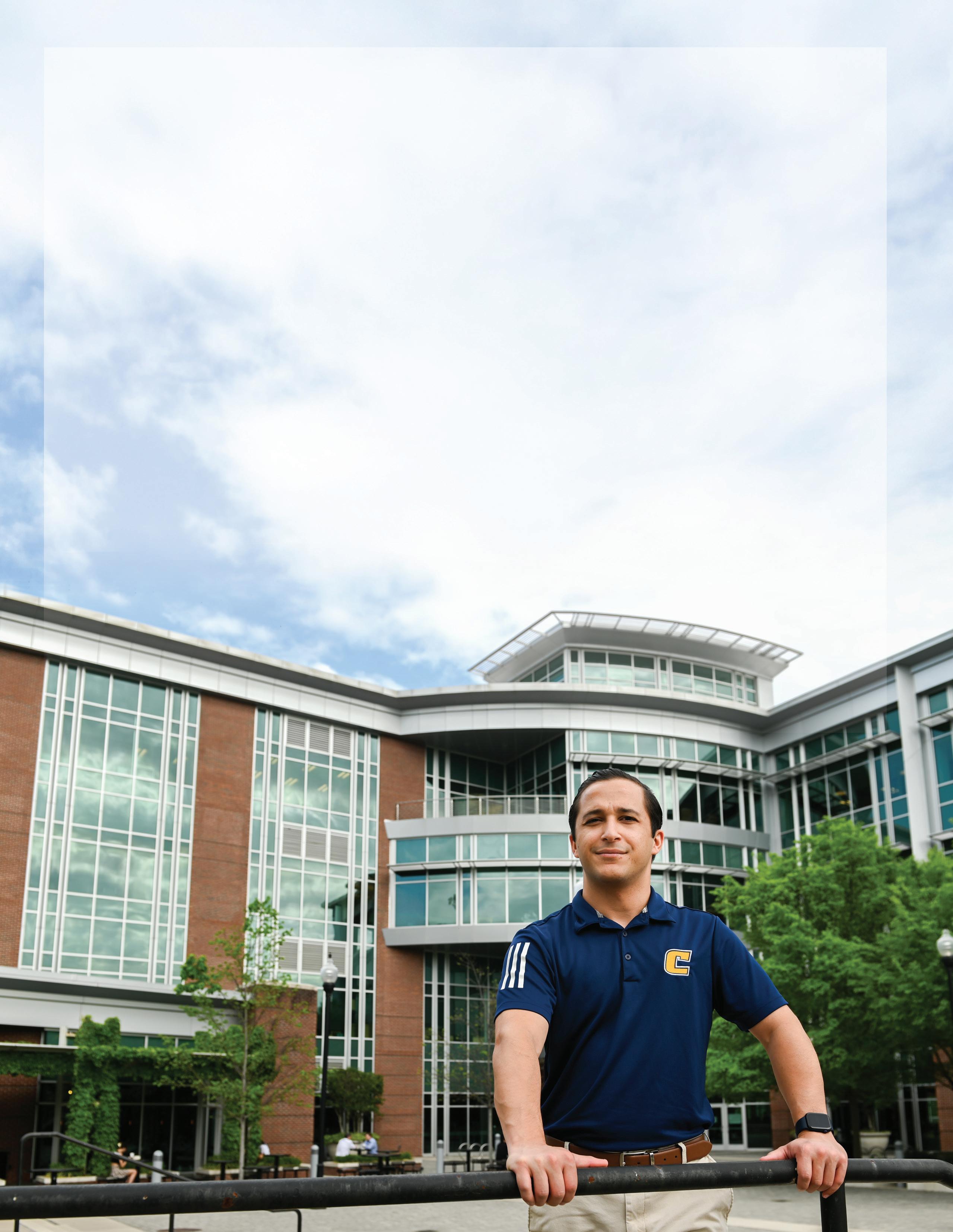
When Dr. Kumar Yelamarthi walked through the doors as dean of the University of Tennessee at Chattanooga College of Engineering and Computer Science, he wasn’t stepping into a role, he was stepping into something bigger: a chance to make an impact.
“When people say this title of dean, it reminds me of the old Spider-Man quote, ‘With position comes responsibility. With title comes responsibility,’” Yelamarthi said. “The dean’s position comes with a lot of responsibility and requires making many decisions. The way I look at it is, any decision you make … put the students front and center and say, ‘What is right by them?’ And the answer comes out very simple.”
It’s a leadership principle he puts into practice every day, and those who have worked with him have seen it firsthand.
“Kumar is student-focused, action-oriented, and he brings a mindset that understands what it means to be a good partner,” said UTC Chancellor Lori Bruce, who spent four years working with Yelamarthi at Tennessee Tech. “He’s one of the most genuine and sincere people I’ve ever met.
“He’s high energy. He’s positive. He has a can-do attitude. He has a very, very positive spirit. And he’s that way 24/7. He’s going to be a fantastic leader for the College of Engineering and Computer Science.”
Yelamarthi’s leadership potential was evident during the search process, said Provost and Senior Vice Chancellor for Academic Affairs Jerold Hale.
“He emerged from a rigorous national search and was embraced by every group he met with on campus and in the community,” Hale said. “Sometimes you cast a wide net only to find that the best person for the job is just a couple of hours up the road. We’re fortunate to have found that in Dr. Yelamarthi.”
Now, as dean, Yelamarthi sees an opportunity to build on the college’s strengths by leaning into partnerships, focusing on outcomes and keeping students at the center of it all.
Engineering for What’s Next:
Dean Kumar Yelamarthi Connecting the College of Engineering and Computer Science to Chattanooga’s Future
By UTC Communications and Marketing
“Industry engagement. Community focus. Urban scale. Natural beauty,” he explained. “v is an energy that pulls you to Chattanooga and a connectedness—on campus and off—that makes you feel like this is a place where you can grow something meaningful.
“We want to move fast but we want to advance everyone along with us, and if we keep the students at the center of everything the right decisions will follow.”
Yelamarthi’s connection to Tennessee higher education began in 2021 when he moved to Tennessee Tech after a 13-year stint at Central Michigan University, rising from assistant professor to director of the School of Engineering and Technology.
As associate dean of academic affairs in Tennessee Tech’s College of Engineering, he helped support more than 3,100 students and 85 faculty members across seven departments and 18 programs. He led initiatives that increased firstyear student enrollment by 35%, boosted retention and academic performance, expanded access to underserved communities and helped secure millions in external funding.
But even then, Chattanooga had caught his attention.
“I was trying to understand the geography of Tennessee, the key players, the strategic partners, the competitors, and UTC kept coming up again and again as a fierce competitor—a force to be reckoned with,” he noted.
The more he learned, the more he saw a university gaining momentum and a city growing right alongside it.
“Chattanooga is the land of opportunity in Tennessee,” he said. “People are migrating here. The community is strong, extremely connected and believes in collaborative success. That’s what drew me here—the interdependence, the mutual growth mindset.
“Everyone I talked to was passionate about student success and passionate about the success of the college. I wanted to be in the middle of that.”
Yelamarthi is quick to point out that UTC’s location provides distinct advantages, especially for engineering and computer science students.
“How many universities can say we have a quantum lab next door? That we’re located a mile or two from BlueCross BlueShield headquarters? That we’re deeply connected with an automotive company that manufactures right in the city?” he asked.
“If you walk the halls in the College of Engineering and Computer Science, you’ll see names like TVA, Volkswagen, Maytag, BlueCross BlueShield, Chattanooga Manufacturing Association. They’re outside our classrooms and labs. And when you look inside, you’ll see that these companies are actively involved—with training, with labs, with workforce development.”
During his first few weeks on campus, Yelamarthi has already begun deepening ties with regional stakeholders, including early outreach to the Chattanooga Area Chamber of Commerce.
It’s the kind of engagement that aligns closely with the University’s mission, Hale said.
“The economic vitality of the Tennessee Valley is going to depend on engineering and computer science,” Hale said, “and having those community connections is going to be absolutely essential. Dr. Yelamarthi is the kind of leader who can strengthen those connections across the board and he’s hit the ground running in that regard.
“Our mission is to develop talent, solve problems and be a good community partner, and we are developing talent for our community partners. We are solving problems related to cybersecurity, computer science and engineering issues that the region and country will face in the future. I am convinced that he is the person who can help us develop the talent pool that our community partners will need to move forward.”
Yelamarthi said he has already started crafting proposals with faculty for new projects at TVA and EPB, and he’s prioritizing operational efficiency so he can spend more time externally representing the college.
“Somebody has to connect the community to the college,” he explained. “Somebody has to tell the stories of our faculty and students and staff and bring people in to see the greatness we have.
“Faculty need to focus on what they do best— teaching and research. Department heads need to focus on programs and operations. As dean, I see myself taking on that external-facing responsibility.”
He’s building those connections with a clear goal: To make the college not only more visible but indispensable.
“I want our college to be recognized for developing such talented and connected engineers that employers are eager to hire our graduates—so much so that the demand far exceeds the number of students we can provide,” he said.
Yelamarthi, who earned a Ph.D. and master’s degree in electrical engineering from Wright State University in Ohio, as well as a bachelor’s degree in instrumentation and control engineering from the University of Madras in India, doesn’t just see the College of Engineering and Computer Science as a place to learn.
He views it as an essential part of Chattanooga’s growth and a pipeline for regional talent.
“In my mind, we’re not just educating traditional students. We are serving the workforce of the state of Tennessee,” he noted. “Workforce development is age-agnostic. It’s position-agnostic. And we have the expertise here to meet that need.”
He said it places UTC in a unique situation of helping students build careers while shaping what’s next.
“We’re not simply interested in preparing students to be ‘job-ready’ on day one. We need to think beyond,” he explained. “What I mean by that is we need to think about students blazing the trail on day one. We need to think about how to train students to become leaders, go-getters, achievers and role models on day one.”
To do that, he continued, students need more than just technical knowledge; they need a foundation of adaptable, transferable abilities to lead in a world that’s moving faster than ever.
“We are preparing engineers, engineering technology and computer science professionals for jobs that do not exist yet,” Yelamarthi said. “Technical skills are absolutely necessary, but so are lifelong skills.
“So I ask, ‘How do you instill an interest in lifelong learning? How do you instill critical thinking?’
“There is an energy that pulls you to Chattanooga and a connectedness—on campus and off—that makes you feel like this is a place where you can grow something meaningful.”
Those are the things we need to work on.”
It’s why Yelamarthi believes in the “Six Cs,” a framework essential to shaping well-rounded engineers and computer scientists for long-term impact. His “Six Cs” are comprised of:
Curiosity: inspiring students to constantly ask “why” and “why not”
Critical thinking: encouraging students to think constructively, question assumptions and see beyond the obvious
Connection: building bridges between engineering, business, economics, environment and society
Creating value: designing solutions that add meaningful value to society.
Communication: empowering students to share ideas clearly across audiences—from peers to policymakers
Character: fostering integrity, empathy and a service mindset
Those six traits, he said, “form the DNA of a 21stcentury engineering graduate.” He is working to make sure they’re embedded in every aspect of the UTC experience.
“Once we recruit new students, I want to ensure that they enjoy their experience at UTC and that they
say, ‘This is where I belong,’” he explained. “When we call them back for homecoming, they should say, ‘That’s my home.’”
Yelamarthi spoke about reducing barriers to ensure every student feels seen and supported.
“Whether it’s tuition, scholarships, course scheduling, academic advising,” he said, “whatever it is, we need to simplify and improve it.”
The goal is to foster retention and a sense of belonging, which extends to faculty and staff as well.
“Everybody should be excited to be here,” he said. “I want people to try new things. I want them to fail and learn from it. That’s how innovation happens.”
To Yelamarthi, that’s not just permission to experiment. It’s part of how real progress happens— and it’s part of his leadership philosophy.
“As Thomas Edison once said when somebody asked him about inventing the light bulb, ‘I have not failed. I have just found 10,000 ways that won’t work,’” Yelamarthi said. “Greatness comes out of failure. Progress comes out of failure.
“Failing and making mistakes is how we learn. That is how you pivot to something new and achieve greatness.” ■
CECS Faculty Recognized for Exemplary Work in Scholarship and Service
The University of Tennessee at Chattanooga celebrated the achievements of its faculty honoring excellence in scholarship and teaching, with awards presented by the Faculty Awards Committee of the Faculty Senate. The annual celebration spotlighted the significant impact UTC faculty have on student learning, research and the broader community.
“At UTC, we are fortunate to have faculty whose commitment to excellence is evident in every classroom, lab and community partnership,” said Provost and Senior Vice Chancellor for Academic Affairs Jerold L. Hale. “These awards are a reflection of the extraordinary dedication our faculty bring to their teaching, research and service—and I’m proud to recognize the people who make UTC such a dynamic academic environment.
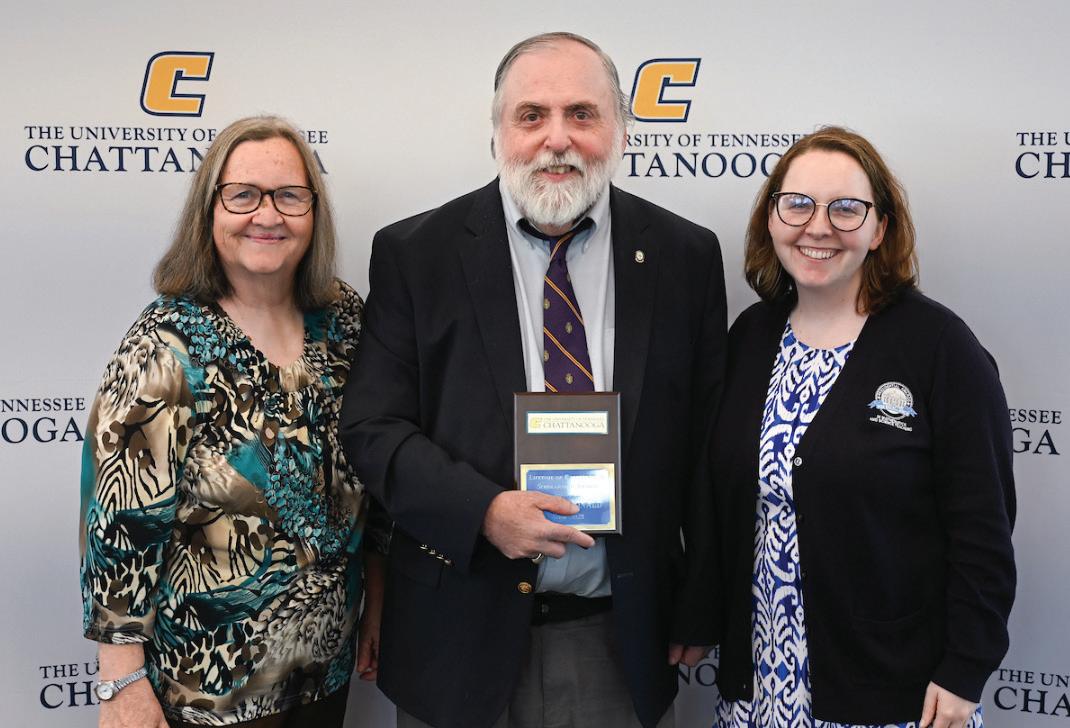
Lifetime Award
Gary McDonald, UC Foundation Associate, Mechanical Engineering
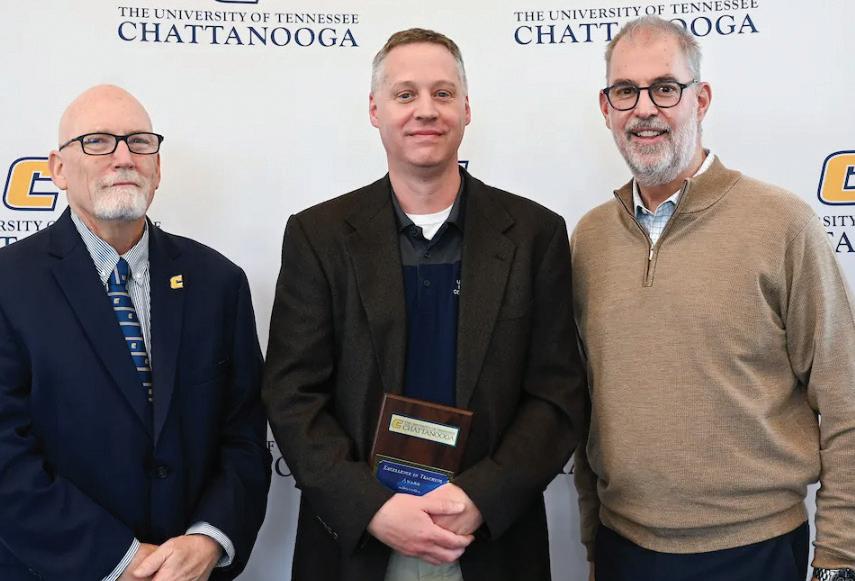
Tenured Award
Chuck Margraves, UC Foundation Associate, Mechanical Engineering
UTC Awarded $500K from State of Tennessee to Build the Future of Traffic Safety & Smart Streets
By UTC Communications and Marketing
The University of Tennessee at Chattanooga Research Institute’s (UTCRI) Center for Urban Informatics and Progress (CUIP) has been awarded $500,000 through the Tennessee Department of Economic and Community Development’s (TNECD) Transportation Network Growth Opportunity (TNGO). This funding will support the development and deployment of two systems that will continue to transform Chattanooga’s approaches to safety and smart mobility.
One project, in collaboration with DENSO, will use artificial intelligence to predict potential traffic collisions and detect accidents the moment they occur. The second project, developed with LG CNS, will bring the nation’s first smart crosswalk
system to Chattanooga, using real-time sensors and AI to extend signal times and improve visibility for pedestrians, including children, seniors, and people with disabilities.
“CUIP is excited to spearhead two major TNGOfunded projects in Chattanooga in collaboration with DENSO and LG CNS—two of our most dynamic and innovative industry partners,” said Dr. Mina Sartipi, executive director of UTCRI. “Thanks to their support and the continued investment of the Tennessee Department of Economic and Community Development, it is clear that Tennessee—and Chattanooga in particular—is where the future of urban mobility and safety will be created.
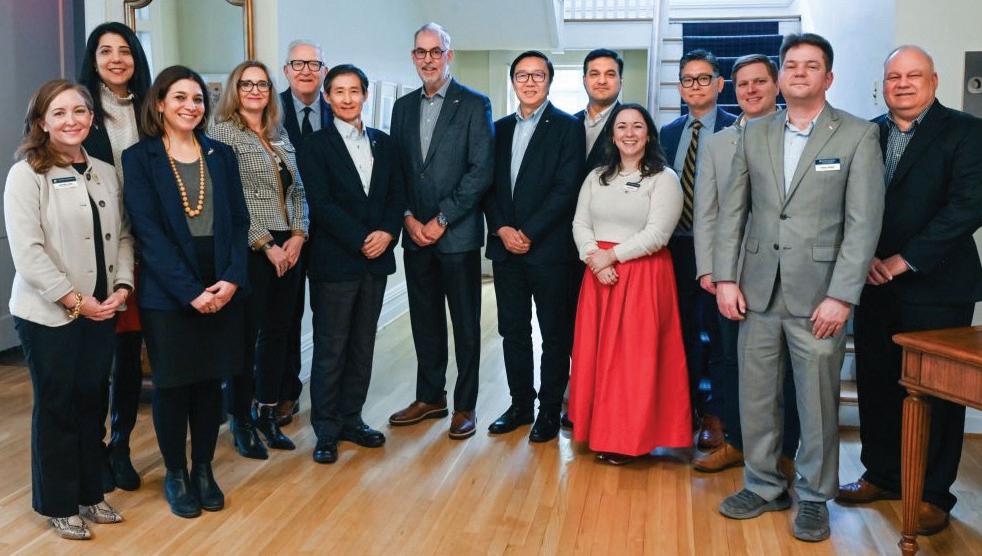
Several members of DENSO’s leadership team, including CEO of DENSO North America Tomoyuki Arakawa (sixth from left), recently met with personnel from the UTC Research Institute and UTC executives during a visit to campus.
We can’t wait to see where these projects take us.”
“This investment by the State of Tennessee affirms the University of Tennessee at Chattanooga’s role as a leader in innovation and real-world research,” said UTC Interim Chancellor Robert Dooley. “Through the visionary work of the UTC Research Institute and outstanding partners like DENSO and LG CNS, we are shaping the future of traffic safety and smart mobility. These initiatives not only enhance the quality of life in Chattanooga but also demonstrate how UTC can drive progress that benefits our community, economy, and the entire state.”
“The UT System is one of our biggest assets in recruiting new business to Tennessee, and as we think about the companies and jobs we want to attract to the state, it’s critical that we work in lockstep with our educational institutions to ensure we are aligned with what industries need,” said TNECD Commissioner Stuart C. McWhorter. “I thank Gov. Lee for his leadership and strategic efforts to build out Tennessee’s innovation ecosystem and UT System President Boyd for his partnership in announcing this latest round of TNGO grants.”
“Growing university and industry collaboration is a top priority across the UT System, and why we worked to advocate strongly for the creation of TNGO. We are grateful to the State and TNECD for recognizing the power of these partnerships,” said UT System President Randy Boyd. “Our recipients, UT Chattanooga and UT Knoxville, are partnering with global Tennessee brands to discover and create new technologies – underscoring our commitment to help make Tennessee the top state for research and development, engineering and innovation.”
TNGO, created by the Tennessee General Assembly and administered by TNECD, is designed to boost mobility-related R&D across the state by connecting higher education institutions with industry. To date, TNGO has awarded funding to nine collaborative projects, including the two that CUIP is leading.
This latest funding announcement from TNECD builds upon a series of significant investments that UTCRI has secured in recent years.
In 2023, CUIP received a $1.1 million grant from the Federal Highway Administration to enhance the
detection of vulnerable road users like pedestrians and cyclists along Chattanooga’s Smart City Corridor. This project integrates thermal imaging and sensor fusion to improve real-time traffic management. Last year, CUIP and the City of Chattanooga were awarded a $2 million SMART grant from the U.S. Department of Transportation. This grant supports the deployment of Cellular Vehicle-to-Everything (C-V2X) and Intelligent Transportation Systems (ITS) technologies at highrisk mid-block crossings near downtown to enhance pedestrian safety and inform citywide infrastructure improvements. ■
“This investment by the State of Tennessee affirms the University of Tennessee at Chattanooga’s role as a leader in innovation and real-world research.”
Dr. Erkan Kaplanoglu Earns Patent for New Tech Blending Rehab and Robotics
By Charlie Reed
Dr. Erkan Kaplanoglu moves like someone with three calendars and no off switch—teaching, mentoring, inventing, and leading the Department of Engineering Management and Technology at the University of Tennessee at Chattanooga.
His relentless pace paid off this spring when he secured his first U.S. design patent for a pneumatically powered balance board designed to support patients with chronic lower back pain or those recovering from injury or surgery. It’s one of many endeavors he’s juggling alongside prototypes, proposals, partnerships and students.
On any given day, Kaplanoglu might be debugging hardware in his lab, mentoring a capstone team, working at a recruitment event or collaborating with industry partners and campus colleagues. Often, it’s all of the above. And somehow, he still makes time for Mocs basketball, the bağlama (a Turkish guitar that he plays in his office) and almost anyone who asks for his help.
Inventing for the real world
Kaplanoglu’s patent, issued April 15, 2025, is one of only a handful that UTC has secured in recent years— part of a broader shift toward research that not only gets published but also drives practical innovation.
“Erkan develops innovations that solve problems and help people,” said Gregory Sechrist, a technology manager with the UT Research Foundation, which supports faculty across the UT System with technology transfer.
Over the past five years, Kaplanoglu has submitted five invention disclosures through UTRF, a pace that speaks both to his personal drive and to UTC’s expanding support for applied research.
“He’s a serial inventor,” Sechrist said, “and I’m glad to see him get his first patent issued at UTC. I look forward to continuing to work with him on what’s next.”
Issued about two years after filing, the patent reflects Kaplanoglu’s precision and the momentum that comes with UTRF’s support. The foundation works closely with faculty to bring their research to market, offering guidance on intellectual property protection, commercialization strategy and industry access.
With the balance board now available for licensing, UTRF remains a key partner in Kaplanoglu’s next round of inventions.
“This is a great example of how we empower researchers not just to protect their ideas, but to take them further,” said Jennifer Skjellum, UTC’s commercialization counselor. “Erkan is always thinking
ahead about what’s possible and how to make it happen. His work brings together students, faculty, clinicians and industry, and we’ve built a pipeline to support that.”
Finding balance in motion
Early support from UTC’s MOCS Innovate! and Fly! Pitch competitions—key programs in UTC’s growing commercialization pipeline—helped Kaplanoglu push his design forward. Additional backing came from the Biomedical Research Innovation Center (BRIC), a partnership between UTC, Erlanger and the University of Tennessee Health Science Center College of Medicine – Chattanooga. Dr. Jeremy Bruce, an orthopedic surgeon and BRIC collaborator, offered early clinical feedback—one of many connections Kaplanoglu has forged across disciplines and institutions.
“We built the first version, then fine-tuned it with feedback from physical therapists and orthopedic surgeons,” Kaplanoglu said. “They helped us dial in the movement, data tracking and safety settings to make it truly usable.”
He credits those clinical collaborators and UTC’s commercialization support team with moving the board from concept to clinic.
Dr. Max Jordon, a physical therapy professor and longtime campus collaborator, is leading a UTC study to validate the board for clinical use. Though he didn’t design it, Jordon has been testing it in his lab and comparing its performance with standard rehab devices.
“This collaboration opened a door for me and my students,” Jordon said. “We’ve used balance boards before, but this one’s precision and translational focus move our work forward.”
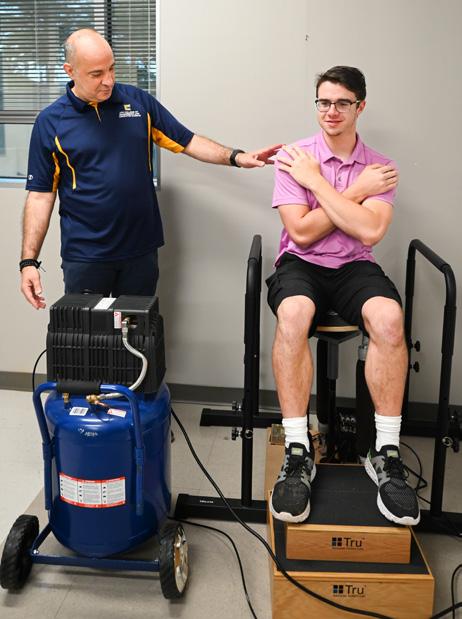
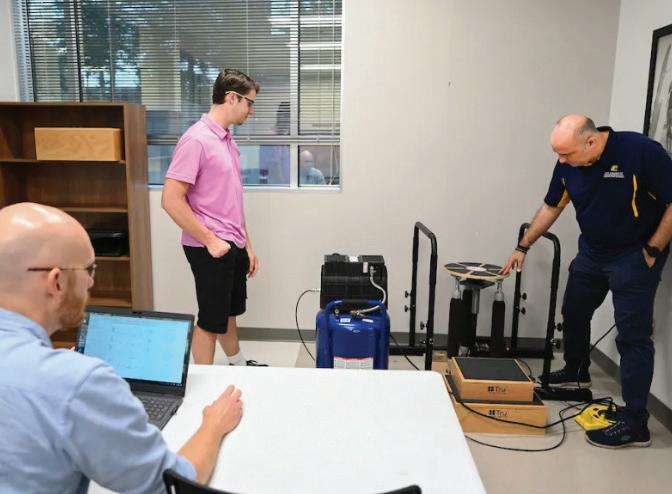
The board’s pneumatic “muscles” create small, controlled movements—just enough to challenge balance. Built from off-the-shelf parts and powered by a standard compressor, it not only supports recovery but also uncovers balance issues that traditional tools miss.
Engineering for humans
Kaplanoglu arrived at UTC in August 2019 and quickly transformed an underused space into what’s now the Biomechatronics and Assistive Technology Lab, or BioAstLab. It focuses on eliminating barriers, whether physical, logistical or technological. Ongoing projects include a tremor-reducing wearable device, an exoskeleton for post-stroke rehabilitation and a smart
diabetic foot insole. He’s also developing new industrial applications for automation and precision control.
Since launching the lab, Kaplanoglu has brought in $450,000 in research funding while building a team that spans engineering, design and physical therapy—and includes both undergraduate and graduate students. Every student is paid. Every voice counts.
“He gives you real responsibility,” said Chase Guttu, a recent recipient of a Bachelor of Applied Science: Mechatronics degree who transferred into that program specifically to work in Kaplanoglu’s lab. “And he listens. He wants you to be proud of what you build.”
Kaplanoglu didn’t set out to work in health care. But years ago, his father passed away from complications after a delayed surgical procedure. That loss stayed with him and eventually shaped his focus.
“It changed how I thought about engineering,” he said in a previous interview. “I started thinking more about how tech could be used to help people live better, not just faster.”
Dr. Ahad Nasab, interim dean of the College of Engineering and Computer Science, brought the mechatronics program to UTC in 2018 and recruited Kaplanoglu in 2019 to build it out. A longtime colleague and early champion of his work, Nasab has seen Kaplanoglu turn strong technical instincts into a body of research that bridges theory and application.
“I remember taking him to Cleveland State (Community College) right at the start of COVID,” Nasab said. “They’d just bought a half-million-dollar mechatronics trainer from Germany and it wasn’t working. The company couldn’t send anyone to fix it. While we were still talking, Erkan walked over, rewired a few things and got it running. The whole team was blown away.
“That kind of hands-on fluency is rare. He doesn’t just design complex systems. He knows how to make them work.” ■
TECH SPOTLIGHT: INSIDE THE INVENTION
ACTIVE PNEUMATIC BALANCE PLATFORM
Design Patent: U.S. D1,009,261
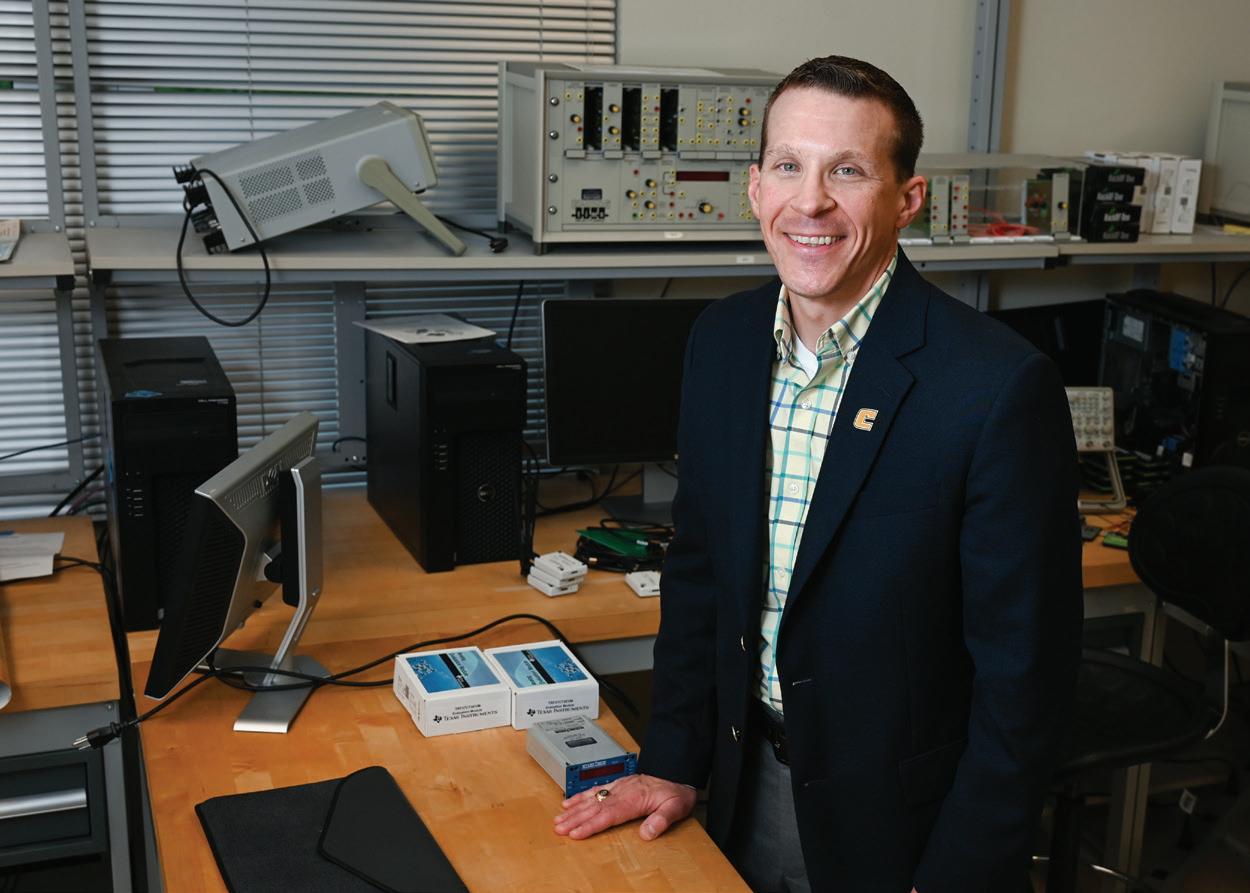
Inventor: Dr. Erkan Kaplanoglu, UTC professor and department Head, Engineering Management and Technology
Research Home: Biomechatronics and Assistive Technology Lab (BioAstLab), UTC College of Engineering and Computer Science, UTC
Commercialization Partner: UT Research Foundation (UTRF)
Refined with input from therapists and clinicians, Kaplanoglu’s active pneumatic balance platform uses soft robotics and real-time sensing to help patients rebuild balance and uncover postural issues traditional rehab tools may overlook. Compact and clinic-ready, it brings advanced motion training into everyday care.
By recreating the subtle, unpredictable shifts people face in daily life—like a bumpy car ride or walking across uneven ground—the device lets clinicians observe and measure patient responses in real time.
Designed for physical therapy and athleticrehab settings, the platform closes gaps in assessment and retraining. It reflects the mission of UTC’s Biomechatronics and Assistive Technology Lab (BioAstLab) to build accessible, human-centered technologies that integrate seamlessly into clinical practice.
“We listened to what therapists needed and developed something flexible, accurate and ready for the clinic,” Kaplanoglu said.
How it works
The platform leverages three pneumatic actuators arranged in a Stewart-platform configuration to control motion in pitch, roll and yaw. Inspired by Stewart-platform architecture— used in everything from flight simulators and firecontrol systems to surgical robotics—this design translates high-end mechanical precision into a compact, clinical-grade system.
Kaplanoglu’s patented balance board is now available for licensing through UTRF.
The device is undergoing preliminary validation supported by a working prototype.
Dr. Max Jordon (sitting), Austin McDade and Dr. Erkan Kaplanoglu
Brewing Science: How Coffee Fueled a UTC Chemical Engineering Student’s “grounds”-Breaking Research
By Chuck Wasserstrom
Katelyn Hamilton describes making coffee as a “really big science experiment. You have to weigh everything. You have to measure the temperature of everything. You have ratios. Everything has to be on point to make a good cup of coffee.”
Hamilton, a chemical engineering major at the University of Tennessee at Chattanooga, has transformed a high school coffee shop job into the cornerstone of her academic and career goals.
Hamilton began working at a coffee shop during her junior year of high school. What started as a parttime job quickly became a passion as she dove into the intricacies of coffee preparation—studying the history and technicalities of coffee-making as part of earning her barista certification.
Initially dreaming of working for NASA as a mission specialist, she experienced “an epiphany” during a conversation with her college roommate.
“I was talking about space but I felt a little stressed; there are so many requirements that you need to even get to the point of working at NASA as an astronaut,” she recalled. “Then—right after that—we started talking about coffee and all the stresses just went away.
“We started talking about the science behind it and I thought, ‘Wait a minute, there is chemical engineering in coffee roasting.’ I decided to change my career path.”
Hamilton brought her enthusiasm for coffee and a growing curiosity about its environmental impacts to Chattanooga—pairing her UTC schooling with a barista position at nearby Goodman Coffee Roasters.
She had the opportunity to merge the two interests during after noticing a bulletin board in the Engineering and Computer Science
KATELYN HAMILTON
Building that featured Assistant Professor of Chemical Engineering Venkateswara Rao Kode’s research on bionanocomposites for 3D printing.
Curiosity piqued, she contacted Kode and proposed using spent coffee grounds to create a 3D printing filament.
Kode, who had never participated in coffee research, was intrigued.
“She reached out to me and said, ‘Dr. Kode, I work in a coffee shop and we have a lot of spent coffee grounds that we don’t know what to do with. How can we effectively utilize this waste and help improve the ongoing research at UTC?’” he recalled.
“I said, ‘Bring it in. We can convert those spent coffee grounds into something useful.’”
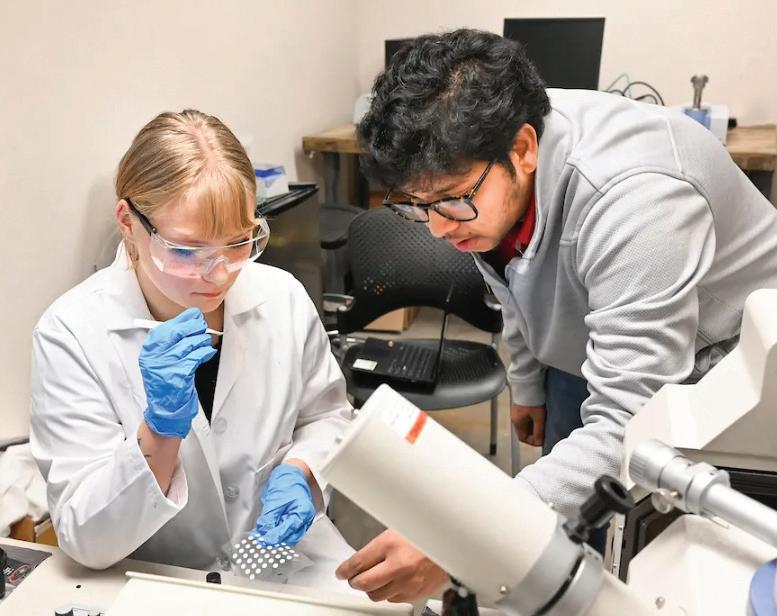
Hamilton and Kode started working together in the lab researching the spent coffee grounds, as she learned how to conduct pyrolysis and use a scanning electron microscope.
Pyrolysis is a process where organic material—in this case, the spent coffee grounds—is heated in the absence of oxygen. This heating breaks down the material into smaller compounds, leaving behind a carbon-rich product known as biochar. Hamilton used the scanning electron microscope to analyze the biochar’s topography.
“It was mind-boggling … drying the coffee, baking it six hours total, and then we undergo pyrolysis using a tube furnace,” Hamilton explained. “You can see all the different coffee components—like the oils getting cooked away—but at the very end it’s just this black carbon. It’s like, ‘Wow, that’s literally carbon that we’re looking at.’
That was just really, really cool.”
Kode, who joined the UTC faculty at the start of the 2024-25 academic year, said Hamilton’s enthusiasm for the research project—which is funded by the Faculty Development Grant and the UTC Chemical Engineering Faculty Startup Grant—has been inspiring.
“It’s absolutely amazing to have undergraduate students like Katelyn working in the lab and learning state-of-the-art research, especially with the ongoing environmental concerns around the world to bring down the carbon emissions and help improve the overall circular economy and sustainability,” Kode said. “Her project aligns with our efforts to promote chemical engineering with an environmental science focus.”
“We have lots of exciting things coming up, so this is just a footstep to the door of possibilities.”
While Hamilton’s passion for coffee engineering is evident, she also shared challenges she has faced in her journey—as she was diagnosed with ADHD at an early age.
“With ADHD, the biggest downside is academics,” she explained. “I’ve struggled with academics because of my ADHD for as long as I can remember—and I know I’m not the only one who struggles with it.
“There are some things that you can’t do because it gets really hard sometimes. I didn’t think I was going to work in STEM because of how difficult it was.”
Hamilton talked about her days as an elementary school math student “when everyone was doing multiplication and division” while she was “still stuck adding and subtracting. It really feels like you’re a step behind everybody.”
“I want to really shine a light on it because if you have ADHD or something else, it shouldn’t limit what you can do,” she said. “But I’ve had to work harder and stay determined.
“I feel like (the fall) semester gave me kind of the ‘a-ha’ moment of where I think I can succeed … getting handson experience and being able to integrate my interests and passions. Pyrolyzing and capturing the carbon was my first, ‘Oh my gosh. I actually did something.’”
“We started talking about the science behind it and I thought, ‘Wait a minute, there is chemical engineering in coffee roasting.’ I decided to change my career path,” Katelyn Hamilton explained.
The coffee research, she continued, has fueled her ambition to pursue a Ph.D. in chemical engineering.
“Working with coffee is something I’d love to do for the rest of my life,” she said. “That’s where I’m at now.”
She cited a couple of environmentally friendly examples of decaffeinating coffee—the Swiss Water Process and supercritical carbon dioxide extraction.
“Maybe there’s a different way we can decaf coffee and make it more environmentally friendly because when it comes to coffee roasting, a lot of greenhouse gases are emitted,” she said. “Maybe there’s something we can do to make coffee safer and better for the environment.”
“Making coffee is one really big science experiment,” she said with a laugh. “I would definitely say that—with my newfound interest and passions—it has changed the way I see it.
“It’s great because where I work, there are regulars who work in engineering fields and computer science and I get to talk with them and update them on what I’ve been doing. They show a lot of interest in it. It’s really fun to create a little community around coffee science.” ■
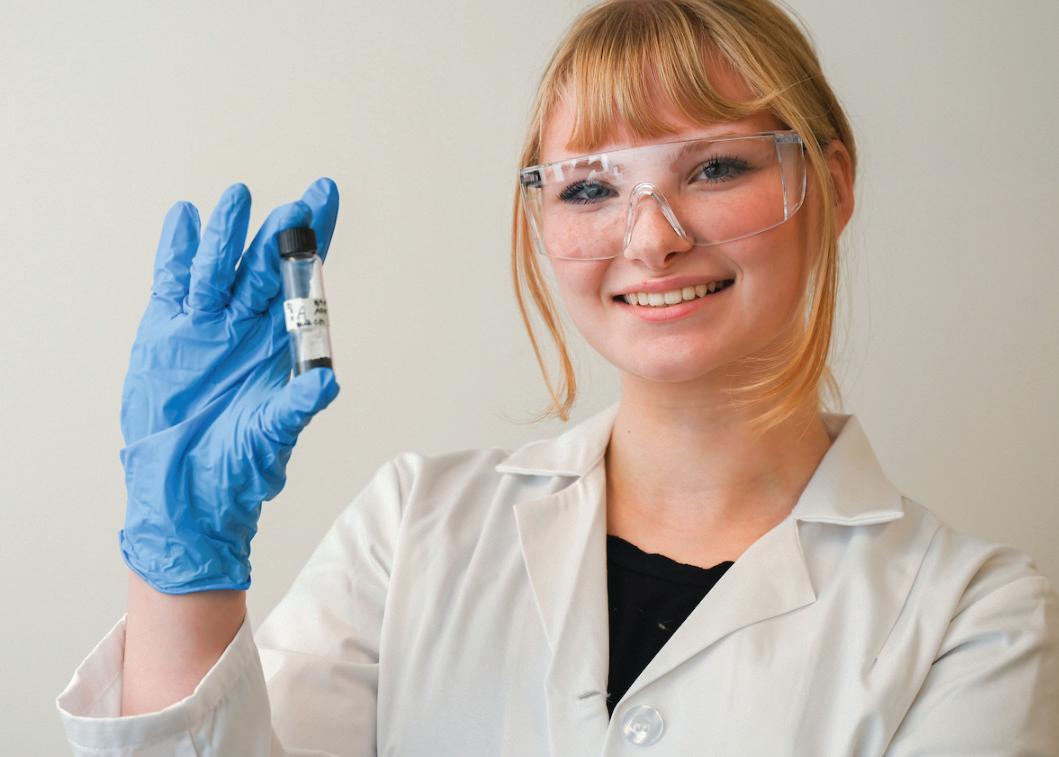
Chemical engineering major Katelyn Hamilton, left, and Dr. Venkateswara Rao Kode perform research in the College of Engineering and Computer Science.
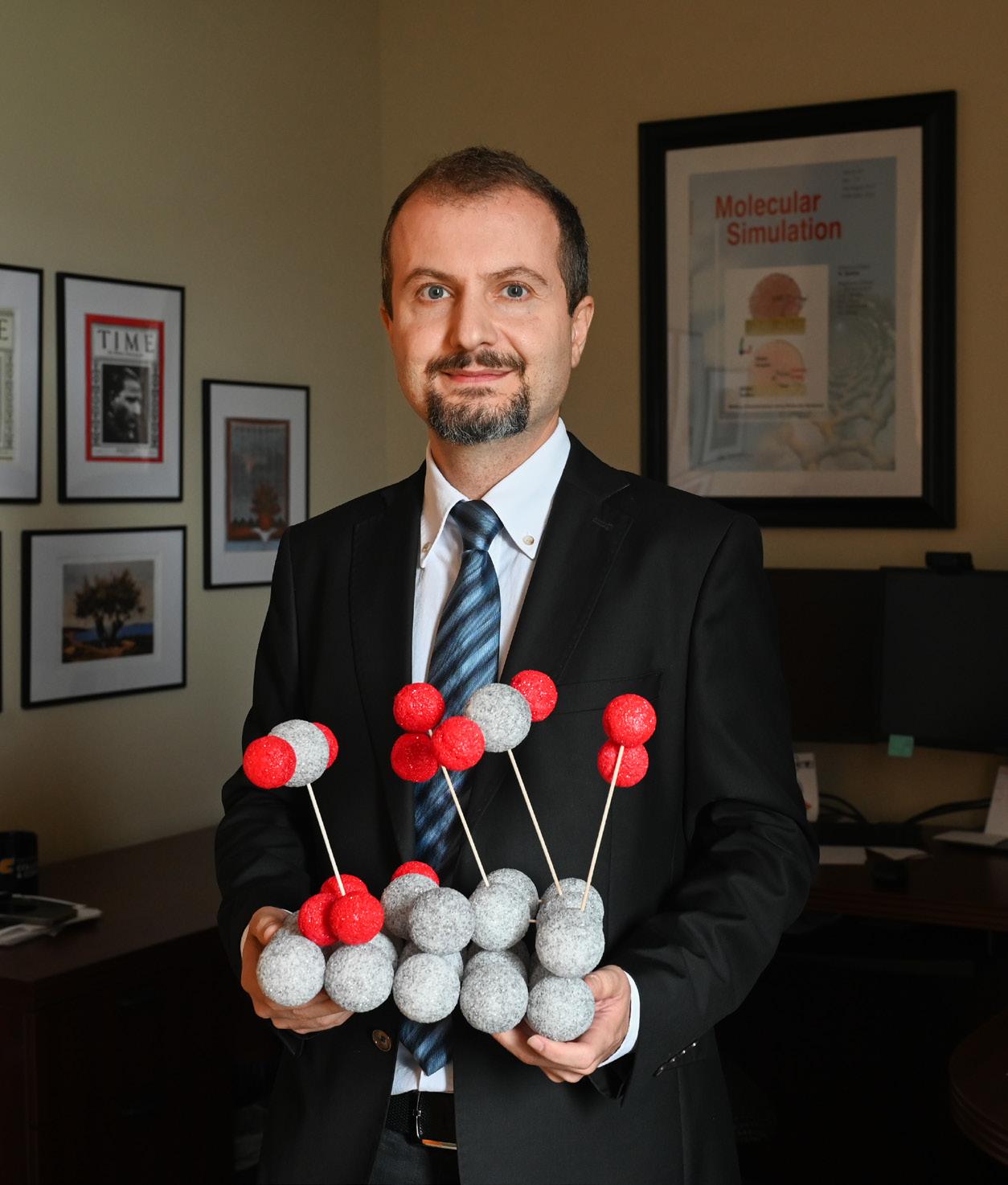
Research Article by Dr. Murat Barisik Featured in Nanotechnology Journal
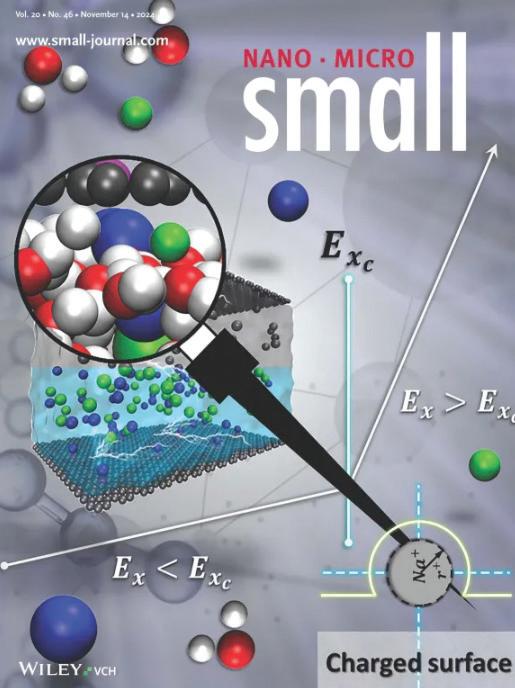
A research study involving University of Tennessee at Chattanooga Assistant Professor of Mechanical Engineering Murat Barisik was the cover story for a recent issue of Small—a prestigious nanoscience and nanotechnology journal.
Barisik collaborated with researchers from the University of Ulsan in South Korea and the Indian Institute of Technology Kharagpur to explore fluid dynamics at the nanoscale. Their study, “Applied Electric Field Effects on Diffusivity and Electrical Double-Layer Thickness,” offers new insights into nanoscale fluid behavior with potential implications for next-generation energy storage technologies.
Barisik, Md Masuduzzaman (University of Ulsan), Dr. BoHung Kim (University of Ulsan) and Dr. Chirodeep Bakli (IIT Kharagpur) explored fluid motion under an applied electric field in nanoconfined spaces. Using molecular simulations, the researchers uncovered a critical shift in fluid behavior offering new insights into optimizing nanofluidic systems where precise ion transport and electrolyte behavior are crucial.
“Our research provides a deeper understanding of how electrolytes respond to electric fields, which is essential for improving the efficiency of nextgeneration batteries and supercapacitors,” Barisik explained. “By harnessing these principles, we can lead to faster charging, longer lifespans and higher energy densities.”
By UTC Communications and Marketing
Published by Wiley, Small is recognized as a leading forum for interdisciplinary research at the nano- and microscale, spanning chemistry, physics, engineering and life sciences. The journal is known for highlighting groundbreaking advancements in nanotechnology, organic electronics and advanced materials such as graphene.
Barisik learned that a project he leads as principal investigator, “Nanotechnology in Engineering,” was selected by the UTC Research Institute as an awardee for the FY2025–2028 Center for Excellence in Applied Computational Science and Engineering Convergent Research Initiative—a program supporting multidisciplinary research to advance applied computational science and engineering at UTC.
This project focuses on advancing UTC’s research in nanotechnology with applications in energy, bioscience and defense. A multidisciplinary team from five departments will collaborate with the Department of Energy, National Science Foundation, Oak Ridge National Laboratory and local industry partners to use computational modeling, material design and machine learning in developing advanced nanomaterials. Key research areas include energy storage, biodegradable materials and thermal protection for hypersonic systems. ■
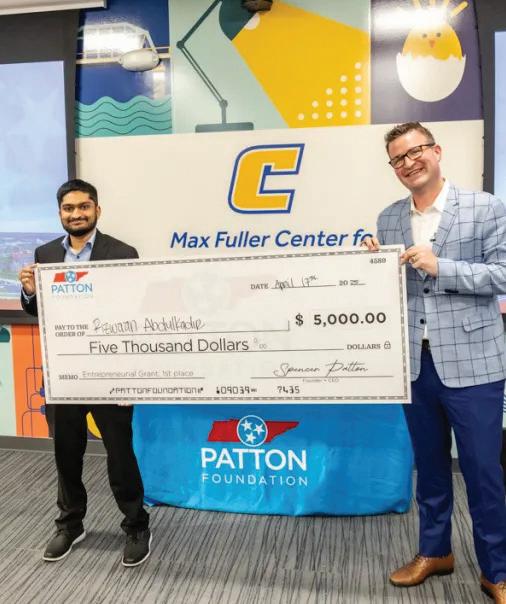
Fly! Pitch Competition Awards $5K to CECS Student Entrepreneur
By Peyton Schultz
A CECS student won top prize in this year’s Fly! Pitch competition. Abdulkadir’s business “Parleii” took home the top prize of $5,000.
The business originated as a class project during his senior year at UTC as a computer engineering student. “Parleii” offers pre-assembled circuit boards and a custom software platform to help students and instructors practice safer and more streamlined lab work.
Abdulkadir, who is now pursuing a master’s degree in electrical engineering, said the Fly! Pitch experience helped him gain confidence in his presenting abilities.
“It wasn’t until Mike (Bradshaw) invited us to his last competition last semester when we actually started thinking, ‘OK, let’s try to make a business plan,’” he said. “The last competition is what actually motivated me to realize that I do have some skills.” ■
CECS Undergraduates Take Their Research to the Capitol
By UTC Communications and Marketing
Four College of Engineering and Computer Science undergraduate students traveled to Nashville to present their work at Posters at the Capitol, a statewide undergraduate research showcase held at the Tennessee State Capitol.
Posters at the Capitol featured students from public universities across Tennessee, providing a platform to share research with state legislators and officials.
UTC participants represented a wide range of disciplines—from environmental science to mechatronics engineering—and presented on topics such as machine learning, stroke rehabilitation and biomedical implants.
Student presenters and their posters:
Brenden Lippard (mechatronics): “Exoskeleton Glove for Stroke Rehabilitation”
Logan McCollough (mechanical engineering): “Defect Reduction in 3D-Printed Parts for Higher Tensile Strength”
Diya Patel (mechanical engineering): “Fabrication of Bioactive Ceramic Coatings on Magnesium-Based Implants”
Rizwaan Abdulkadir (left) poses with Spencer Patton after receiving the top prize for his business “Parleii.” Photo by Flint Chaney.
STUDENT SPOTLIGHT: CHAMYRA TEASLEY
Leaving UTC with a Legacy of Leadership and Purpose
By Peyton Schultz
Student body president, Chancellor’s Ambassador, orientation leader, freshman senate advisor and homecoming queen—Chamyra Teasley definitely knows what it’s like to step into the spotlight.
When the engineering management major from Clarksville, Tennessee, first arrived at the University of Tennessee at Chattanooga, she said it was the perfect distance from home. It was the community that made her stay.
“After my first year at UTC, I had created a community of like-minded individuals and all-around good people,” Teasley said. “I knew that staying here would really help in my growth at such a time where we’re really moldable and our brains are trying to take in so much knowledge.”
Teasley joined UTC as a mechanical engineering major but changed her major to engineering management after realizing she had an affinity for leadership.
“The intense math was not my strong suit,” she said. “I understood that my passion came from leadership and teamwork and the ability to work in a group at all times. With engineering management, I can go into the project management field, where my entire job would be to work with a team and to be a leader.”
Adding a political science minor helped Teasley combine her passion for social action and justice
with her technical skills. Her decision to enter a field where women, particularly women of color, are underrepresented was intentional.
“I knew that engineering was a male-saturated field,” she said. “Especially for me being a woman of color, I knew that there weren’t going to be many people in my major who looked like me, let alone be a woman.
“I liked the idea of that challenge. I also enjoy learning about the way the world works. That’s essentially why I chose that major; I knew it would challenge me.”
“Overall, I haven’t felt singled out,” she said. “Of course, physically I looked different from everyone else in the class, but it didn’t make me anxious or nervous. If anything, it made me realize that I have something to prove and that it made me want to do better. It made me want to do more.”
Throughout her time at UTC, Teasley gravitated toward opportunities where she could make a difference, a lot of which came from her experience in the Student Government Association (SGA).
In her junior year, she was elected student body president, an experience that brought with it great responsibility and learning opportunities.
She delivered several public speeches, including a commencement address, met regularly with Chattanooga Mayor Tim Kelly and represented the student body at the State Capitol.
“Public speaking is not my greatest strength,” Teasley said. “That was something that I had to get comfortable with because—as SGA president—you are the student that people look at when it comes to answers.”
She recalled speaking to state legislators about a bill that would affect higher education.
“Our sole purpose was to make sure our students get represented because we see the impact that it has,” she said. “It helped me find my voice. You had to speak up. If you sat back and watched it, how could you be OK with that?”
While her role as student body president was a highlight of her SGA experience, she said being a freshman senate advisor had the most profound impact.
As an advisor, Teasley said she helped to build confidence and leadership skills in first-year students and assisted them in writing their resumes and practicing interviews.
“Freshman senate helps our students cultivate community for themselves,” she said. “You remember your freshman year—well, me, I felt like a chicken with its head cut off, running around just so stressed. It felt a bit lonely.
“Being able to be part of their freshman year and have a positive impact has really been special to me.”
Serving as a Chancellor’s Ambassador, Teasley represented the University at events across campus—from groundbreaking ceremonies to home football games.
“It’s a really good networking experience,” she said. “You have the opportunity to meet really cool people as well.”
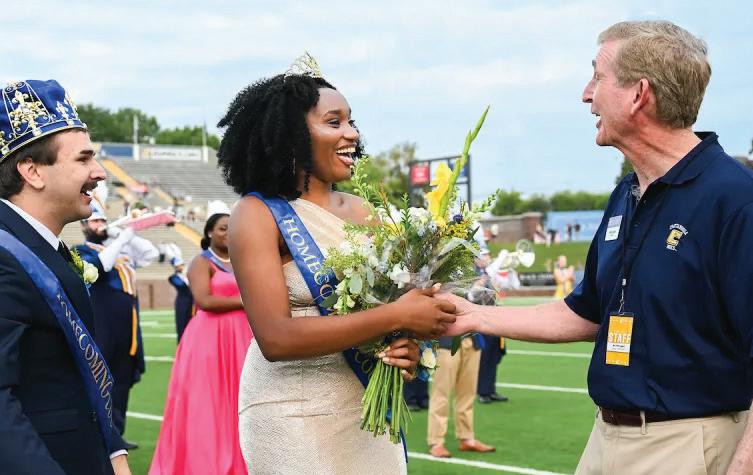
Teasley described being crowned homecoming queen as an honor and a designation she didn’t take lightly.
“I’m forever grateful for my position as homecoming queen and I’m grateful the students voted me for that,” she said. “I’m really blessed.”
Teasley’s ambitions stretch beyond UTC. After completing an internship with the Tennessee Valley
Authority (TVA), she said the experience pushed her out of her comfort zone and helped her grow in ways she didn’t expect.
“I started in May (2024) as an engineering specialist intern and that was the most fun,” she said. “TVA was my first corporate internship, so it took some getting used to.
“I was at a nuclear plant, so you knew the ins and outs of Excel and Microsoft Suite, but at the same time, you want to learn about the reactors and the safety protocol.”
What started as a summer internship evolved into a year-long opportunity, where her role grew from an engineering specialist intern to someone regularly working alongside a project control specialist. In that position, she found clarity in her career goals.
“I worked with our project control specialists— they help the project managers keep everything on task,” she said. “It’s a lot of responsibility. One project manager can be responsible for hundreds of millions of dollars and I was learning how to support that process.
“I realized I liked being a part of something from beginning to end—from funding requests all the way through to implementation. It made me even more excited about going into project management.”
Now, she’s exploring job offers in Chattanooga, Knoxville and Nashville while planning her next steps: earning an MBA, attending law school and eventually stepping into local government.
“My dream job is to be a state representative, so I’m going to be working toward that,” she said.
As graduation approaches, Teasley said she feels a mix of excitement and nostalgia.
“Everything is kind of bittersweet. It went by super fast,” she said. “I’m proud of what I’ve done while I was here. UTC will always have a special place in my heart because it’s where I did the most growing.” ■
“I’m forever grateful for my position as homecoming queen and I’m grateful the students voted me for that,” she said. “I’m really blessed.”
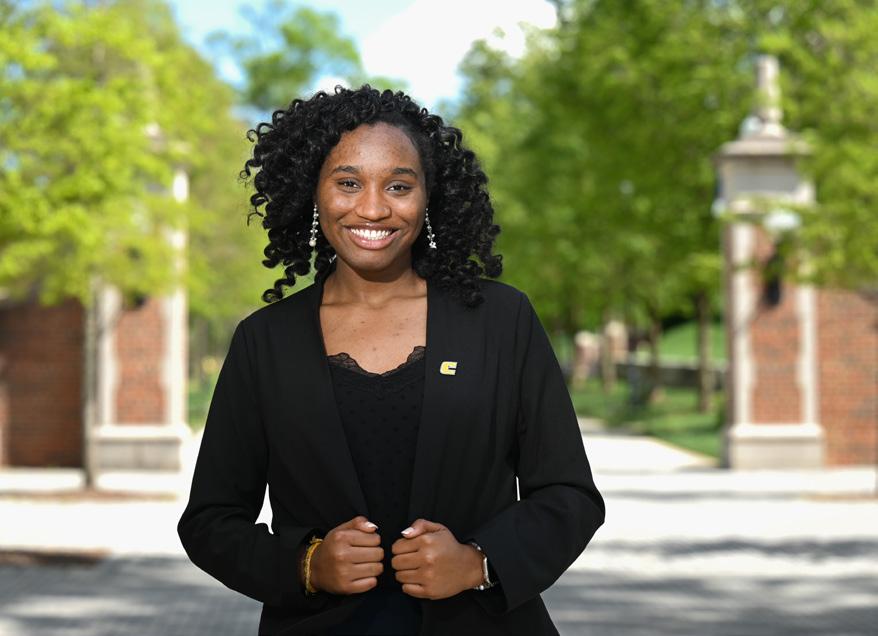
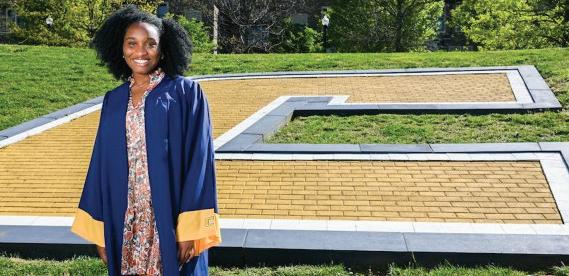
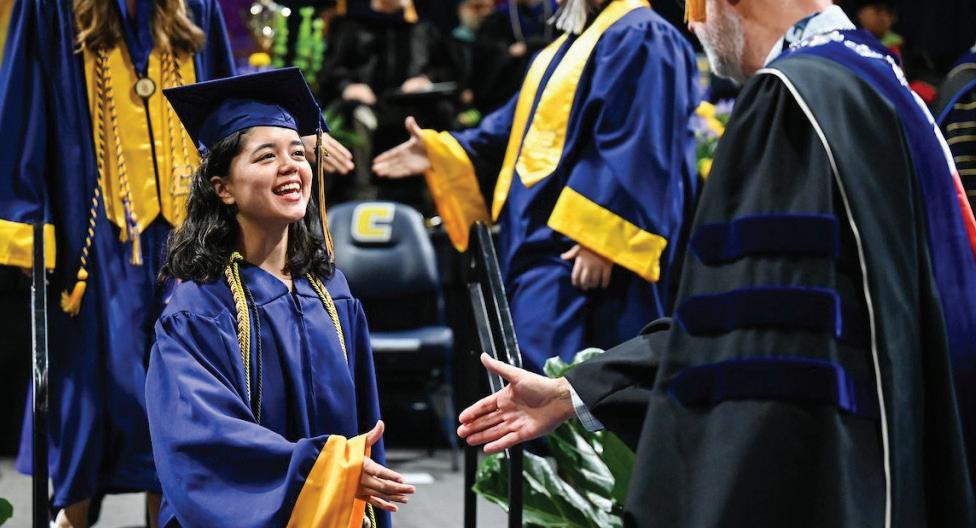
Chamyra Teasley was crowned the 2024 homecoming queen.
REVOLUTIONARY RESEARCH: Doctoral Candidate Develops Self-encrypting AI
By Chuck Wasserstrom
In a world where data security is an ever-growing concern, Joshua Tyler—a computational engineering doctoral candidate and electrical engineering research associate at the University of Tennessee at Chattanooga—has broken new ground.
Tyler, who is on track to receive his third UTC degree in May, has developed the world’s first usable Artificial Intelligence network that can learn how to encrypt itself. This AI network, he said, can provide nearly unbreakable cryptography—significantly improving the security of communications.
Tyler and his faculty mentor, Dr. Don Reising, a Guerry and UC Foundation associate professor of electrical engineering, have uploaded a draft of their publication to arXiv—an open-access repository for scholarly papers. They have already submitted their invention disclosure to the University of Tennessee Research Foundation for a provisional patent.
Tyler’s AI network, he explained, learns to encrypt data “by transforming an encryption key onto the original unencrypted data. The goal is to ensure that the encrypted message is unique to the key while the original message is still recoverable on the other end.”
“This ensures that when deployed, each encryption is unique and significantly extends the network’s lifespan,” said Tyler, who received a bachelor’s degree in electrical engineering in 2020 and a master’s degree in 2022.
The research builds on a concept initially proposed by Google, known as Adversarial Neural Cryptography. While Google demonstrated the potential for AIdriven cryptography, its approach faced significant limitations—particularly in ensuring the encryption key’s influence on the encrypted message and additional communication overhead.
“I copied over Google’s setup and trained their network on my side,” he said. “The network was encrypting the information, but we found out that there wasn’t a lot of uniqueness on the encrypted side when we were switching keys, so that makes the overall life of the network shorter. You’d only get to encrypt one message per network.”
Reising, who has worked with Tyler for more than six years, said he “basically challenged Josh to go and find a way to get this thing to generate a unique code or a unique encoded message.”
Joshua Tyler, has developed the world’s first usable Artificial Intelligence (AI) network that can learn how to encrypt itself.
“And that’s what he did,” Reising said. “He went off and worked on developing his own technique.”
Reising recalled a pivotal moment during the process.
“I asked him, ‘What architecture are you using? Are you using CNN? Are you using an LSTM? What are you using?’
“And he’s like, ‘No, I’m not using any of those. I made my own.’
“I said, ‘What do you mean you made your own?’
“He said, ‘I made my own and it’s a deep learning network.’ That was crazy and it was pretty awesome.”
By rethinking the structure of AI networks, Tyler developed a “novel neural network architecture” that addresses these challenges.
The result is a network that offers nearly unbreakable encryption and unparalleled adaptability in safeguarding sensitive data.
“I changed the network architecture so that the influence of the key was still maintained through the entire structure of the network,” he said.
A crucial feature of Tyler’s system is its rapid adaptability, which allows it to retrain itself in seconds to produce entirely new cryptographic algorithms. This new architecture ensures that each encryption remains unique, effectively overcoming the limitations of previous methods.
“Every time you retrain the network, you get a different cryptographic algorithm,” Tyler said. “So then, even if you use the same key across two differently trained networks, you’ll get a new encryption scheme.”
“These things train really fast so that we can have a new cryptographic algorithm in about 16 seconds.”
Tyler said it took several months of trying to get it to work with the traditional architectures, “just trying different training scenarios and different metrics that the network would use to update itself.”
“When it finally worked,” he said, “it was surprising because you go through two or three months of it not working—and then you try something completely new that you invented and it suddenly works. That’s where the real fun starts because then you get to make sure that it really works.”
Tyler admitted he felt a “slight bit of disbelief” when he realized his discovery was—indeed—a discovery. “When you get it to work that first time, you’re like, ‘Was that a lucky guess?’ I think it was a little bit lucky—but it was also hard work to map it out mentally, write the code to run the algorithms, and then see how well it holds up against what’s already out there.”
The implications of Tyler’s discovery extend across industries—including defense, health care and finance.
“In the military, they want to do a lot of unmanned vehicles, and a really big consideration is communications,” he said. New aircraft are being designed to be unmanned because it costs a lot of money to put a human pilot in the cockpit.
“You have to have life support systems, you have to have G-force and you have to pay to train that pilot—and that takes millions of dollars,” he continued. “If you have an unmanned vehicle, you can go faster and you don’t risk the pilot’s life every time they go out on a mission
or do training—but that requires coordination between the operating base and the unmanned vehicle. It has to communicate a lot of information, but we don’t want that information to be gleaned by any adversary.”
He described a real-world incident in which an unmanned vehicle operated by a drone pilot lacked encrypted communications. An adversary intercepted the data, resulting in the loss of the aircraft.
“They reverse-engineered it,” he said, “so we lost that capability because we weren’t encrypting our communications to the drone.”
In other areas, such as health care, the technology could secure sensitive information transmitted between devices.
“In a hospital, you have the vitals being read in the patient’s room—and that’s being fed to the nurse’s station to where they can monitor that,” Tyler said. “There may be someone that wants to intercept that information for some reason. So, we would prevent them from being able to intercept a patient’s vitals.”
With a draft already published on arXiv, Tyler and Reising are preparing to submit the work for peerreviewed publication.
“Part of it is we submit the paper and hopefully get that published,” Reising said, “and look to see what the application space is. Who’s interested in it? Is it something that people would license?”
As Tyler’s mentor, Reising has taken great pride in watching his protégé’s career growth. Mentors, he said, are meant to guide.
“My job is not to impede, not to hinder and not to stymie. It’s to move obstacles and enable,” he said. “When something like this happens, it tells me two things: I’m getting to work with somebody really special who really can do some really great things—and I’m doing something right in terms of the mentorship.
“I’m enabling the student to achieve those things and put them in a place so that they can follow their passion, solve problems and push the paradigm of what we know and understand—which is really cool, really exciting and rewarding as a professor.” ■
Dr. Don Reising
A Triple Threat in Mechanical Engineering: Riggs
Siblings
Building Their Futures Together
By Chuck Wasserstrom
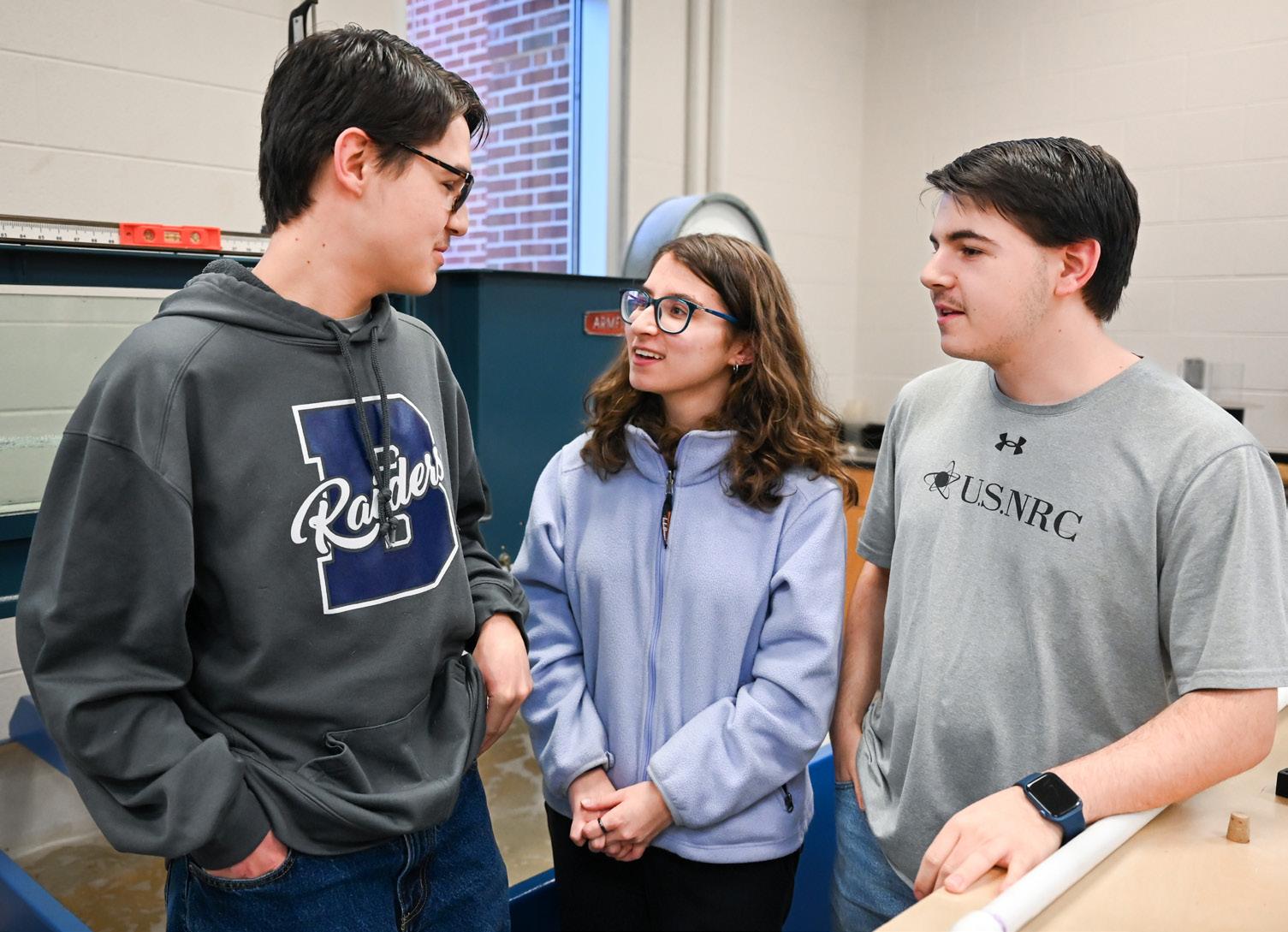
For many college freshmen, finding a study group can be a challenge. But for triplets Isabella, Luke and Matthew Riggs, their study partners have been the same since birth.
The University of Tennessee at Chattanooga mechanical engineering majors are inseparable— attending every class together, taking the same coursework and earning identical 4.0 GPAs.
Their presence in the classroom hasn’t gone unnoticed by their professors—who marvel at their academic excellence, discipline and the rare dynamic of having three high-achieving siblings excelling in the same rigorous field.
“These three, I mean, they take classes together, they sit side by side, front row together,” said Dr. James C. Newman, professor and head of UTC’s Department of Mechanical Engineering. “Everywhere you go, you see them together. They are close-knit.”
Newman, who has the three in his Introduction to Engineering Computations course, has had many talented students walk through his doors over the years—but said he has never seen anything quite like the Riggs siblings.
“I don’t think I’ve ever had students like this before, to be completely honest. And there’s three of them,” said Newman—who came to UTC in 2011 after spending 14 years in Mississippi State University’s aerospace engineering program. “They’re engaged, they’re eager, they’re hardworking.
“To be completely honest with you, they inspire me and motivate me as a faculty member.”
Isabella, Luke and Matthew grew up in a household that nurtured curiosity. Their father, Eric, is a mechanical engineer. Their mother, Rebecca, is a chemist.
The triplets, who also have an older brother, quickly
found that they thrive in a structured, problem-solving environment.
“We all work together to ensure that everyone understands everything,” Isabella said. “Our parents placed a whiteboard up for us. All three of us can complete our homework and study for quizzes and tests by doing plenty of practice problems on the whiteboard.”
After one year at East Hamilton High School in Ooltewah, Tennessee, they enrolled at Collegiate High—a dual-enrollment program at Chattanooga State Community College. They spent eight total semesters in that program—including two summers— and earned their high school diplomas and associate degrees in May 2024.
Isabella said they pursued mechanical engineering at Collegiate High because it “allowed us to get most of the gen eds out of the way as well as calculus, linear algebra, statics and dynamics courses.”
The triplets became the first mechanical engineering cohort to go through the Collegiate High program.
“It was thrilling to say that you could do it,” Luke said. “Nobody else had done it in the 20-year history of the school being open. Being able to say you’re the first to do something is always a good feeling.”
They arrived at UTC last fall as 18-year-olds with 98 credit hours already completed—although they consider themselves freshmen on paths to receive bachelor’s degrees in 2027—and that head start propelled them straight into junior-level engineering courses.
Not only did they handle the transition, but they excelled.
Dr. Cecelia Wigal, UC Foundation professor and associate dean of Academic Affairs in UTC’s College
of Engineering and Computer Science, has the Riggs triplets for Introduction to Engineering Design.
“They’re very good, strong students,” Wigal said. “Not just strong in terms of performance, but they have a desire to learn. They want to do things, they want to take in the information and they want to do well.”
When she first saw their names listed together on her class roster, Wigal wasn’t sure if they were siblings or simply shared a common last name. It wasn’t until introductions that she learned they were triplets.
“I’m learning just because they’re triplets doesn’t mean they’re exactly the same,” said Wigal, a member of the UTC faculty since 1999. “They come with their personalities and they’re their own people in how they relate. They’re individuals, but they’re all go-getters.”
As triplets, their closeness extends far beyond the classroom.
They live at home, commute together, and even work together as tutors and test proctors in ChattState’s Math Center—where they help students in subjects ranging from algebra to differential equations.
Studying together is second nature to them, something that’s been part of their daily routine for as long as they can remember.
They each have distinct academic strengths—Luke in thermodynamics, Isabella in computations and Matthew in engineering structures—allowing them to help each other in different subjects.
“When we study, we play to each other’s strengths,” Isabella explained. “If one of us is struggling with a concept, the others step in and explain it in a way that makes sense.”
“Like Isabella said, if I’m struggling with fluids or computations, I can go to her or Luke and vice versa,” Matthew said. “We help each other out and we study together a lot—especially when it comes to quizzes and exams.”
Isabella said it’s incredibly valuable to have that built-in support system, likening their teamwork to a poker game.
“We know each other’s strengths and weaknesses and we play them to our advantage,” she said. “It makes us stronger as students.”
Despite their shared path, each triplet has a unique vision for the future.
Isabella, the oldest and the leader of the three— according to her brothers—has a keen interest in biomedical engineering. She recently connected with Assistant Professor Hamdy Ibrahim about research opportunities.
“My interest is in computational medicine or improving current medical equipment and drug delivery systems to improve patient outcomes,” she said. “That is very interesting to me and that’s what I would like to do.”
Luke, born second, is drawn to thermodynamics and fluid dynamics. He said he’s fascinated by the mechanics of HVAC systems, heat pumps and steam power plants.
“I took Thermo-1 last semester and absolutely loved it,” he said. “It’s complex, but it’s so interesting to see how everything fits together. I want to do research in that field and see where it takes me.”
Lego bricks, he said, played a role in identifying “how everything fits together.”
“I played with Legos when I was a kid and loved to build stuff,” he explained. “As I got closer to the University, I looked into different fields and engineering lined up with my interest—and as I got more involved in my classes, it became more evident that the thermal sciences were more appealing just because of how interesting yet complex they could be.”
Matthew, the youngest and the most laid back, envisions staying in academia longer than his siblings.
He plans to pursue a Ph.D. in computational engineering and hopes to take part in UTC’s JUMP Program—which allows students to transition from their bachelor’s degree directly into a master’s program.
“I want to keep going,” Matthew said. “I’ve always been interested in how things work and designing objects or devices that would help people. Mechanical engineering best suits that.
“I like building stuff and designing stuff and engineering allows you to do that—whether it’s aerospace, mechanical, chemical. But I’m more interested in gears and structures and I knew mechanical was the best one for that.”
While they may have different specialties, they acknowledge that their fields naturally intersect.
“I think at some point our roads are going to branch out,” Matthew said. “We’ll each go our own way, but they might cross over.”
Isabella nodded in agreement.
“They might cross over, for example, with the artificial heart that uses fluid flow and thermodynamics,” she pointed out. “That could be one area that biomedical and computational would come together.”
Their mother, Rebecca, couldn’t be prouder of their successes.
“They have worked very hard to accomplish what they have,” she said. “It is phenomenal to say, ‘My children graduated high school with an Associate of Science in Mechanical Engineering—and they were the first to do so.
“They work hard, but more importantly, they’re good people. It’s very satisfying to see how well they’ve done.”
She also takes great pride in watching her triplets build their futures together.
“When you have children, you never know what they’re going to be like. You don’t know how they’re going to turn out. You don’t even know if they’re going to get along,” Rebecca said. “It’s very comforting to know that the three of them enjoy each other.
“Yes, they’re thrust upon each other because they’re the same age, but they have the same interests and they enjoy each other’s company.” ■
Supporting Military-Connected Students at UTC
By Charlie Reed
At the University of Tennessee at Chattanooga, Mara Doze helped military-connected students make sense of a system that often overwhelms, learning to navigate it for herself along the way.
As a student ambassador in UTC’s Office of Veteran and Military Affairs, she offered support that went beyond paperwork. She answered questions about U.S. Department of Veterans Affairs benefits, explained financial aid processes, connected people to campus resources and, just as often, listened.
“Even if they didn’t know where to start, I could at least help them ask the right questions,” Doze said. “That was the part I liked; making people feel like they weren’t alone in it.”
Doze’s work embodied the kind of one-on-one support that helped UTC earn national recognition earlier this year as one of the top 10 public universities in the 2025–26 Military Friendly Schools rankings.
Doze graduated with a bachelor’s degree in computer science and is now pursuing a career in finance. She’s also considering taking additional coursework using the remainder of her VA education benefits.
Doze receives Chapter 35 education benefits through the VA’s Survivors’ and Dependents’ Educational Assistance program—which supports
children and spouses of veterans who are permanently and totally disabled due to a serviceconnected condition. Her father, a combat veteran, retired from the U.S. Marine Corps after 20 years of service as a gunnery sergeant.
A native of Winchester, Tennessee, Doze spent most of her life in the region, with earlier years near Camp Lejeune in Jacksonville, North Carolina. Her upbringing didn’t follow the usual rhythms of military life—no constant moves, no childhood spent on base. Still, the structure, discipline and quiet influence of her father’s service were always part of the picture.
For most of her life, Doze didn’t see herself in uniform. But after a year of working alongside veterans, active-duty students and reservists at UTC, she’s reconsidering.
“It’s something I’ve thought about lately,” she said. “Just being around it changes the way you think about what it means.”
Wherever she goes next—into finance, graduate school or possibly military service—she carries with her a firsthand understanding of what real support can look like: steady, practical, human. ■
Degrees & Certificate Programs
Undergraduate Programs
Bachelor of Science
Engineering Programs
• Chemical Engineering (B.S.Ch.E.)
– Environmental Civil Engineering (B.S.C.E.)
– Environmental
• Computer Engineering (B.S. Cp.E)
• Electrical Engineering (B.S.E.E.)
• Mechanical Engineering (B.S.M.E.)
Computer Science Program (B.S.)
• Cyber Security
• Data Science
• Sofware Systems
Engineering Technology Management Program (B.S.)
• Construction Management
• Engineering Management
Undergraduate Programs
Bachelor of Applied Science
• Mechatronics Engineering Technology (B.A.S.)
• Information Technology in Cybersecurity (B.A.S.)
Undergraduate Minors
• Computer Science
• Construction Management
• Electrical Engineering
• Engineering Management
• Mechatronics Engineering Technology
• Production and Operation Systems
Graduate Programs Master of Science
Engineering Program (M.S.)
• Chemical
• Civil
• Electrical
• Mechanical
Computer Science Program (M.S.)
• Computer Science
• Cyber Security
• Data Science
Engineering Management Program (M.S.)
• Construction Management
• Engineering Management
• Power
Graduate
Program Doctor of Philosophy
Computational Science Program (Ph.D.)
• Computational and Applied Mathematics
• Computational Engineering
• Computer Science
Awards & Grants
Department of Civil and Chemical Engineering
Dr. Jejal Bathi - University wide tenure track service award, UTC, Department Civil and Chemical Engineering Community Award, UTC College of Engineering and Computer Science, 2025, Organizing committee member and technical committee co-chair for the American Society of Civil Engineers EWRI’s International Prospects on Water Resources and Environment (IPWE) 2025
Dr. Rahule Bhosale - Ruth S. Holmberg grant for 20252026
Dr. Venkateswara Kode - Outstanding Professional Service Award, UTC College of Engineering and Computer Science, 2025 - Outstanding Professional Service Award, UTC Civil & Chemical Engineering, 2025 Internal Grants: Ruth S. Holmberg Grant for Faculty Excellence, UTC, 2025, Faculty Development Grant, UTC, 2024, Faculty Start-Up Grant, UTC CECS, 2024
Dr. Zakia Tasnim - Lecturer/Adjunct Teaching Excellence Award, UTC College of Engineering and Computer Science, 2025
Dr. Sungwoo Yang - $100k fund from Housing Innovation Alliance for Housing Innovation Challenge project.
Department of Computer Science Engineering
Department of Engineering Managment and Technology
Department of Electrical Engineering
Department of Mechanical Engineering
Bachelors
Undergraduate
2024-25 CECS Advisory Board Members
Joe Brown Miller Industries
Jeff Cornett ORNL
Scott Craig JTEKT
Aaron Cross Denso
Vicki Farnsworth University of Tennessee at Chattanooga