ANNUAL REPORT
SPRING 2026
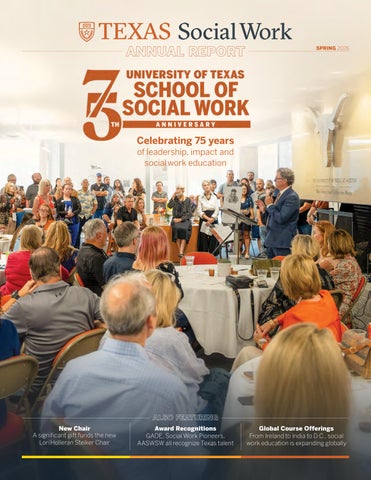
Celebrating 75 years of leadership, impact and social work education
ALSO FEATURING New Chair A significant gift funds the new Lori Holleran Steiker Chair
Award Recognitions GADE, Social Work Pioneers, AASWSW all recognize Texas talent
Global Course Offerings From Ireland to India to D.C., social work education is expanding globally
"Our 75th year is not a resting point. Instead, it is a launchpad."
75 Years of Texas Social Work For 75 years, the School of Social Work at The University of Texas at Austin has developed leaders, produced meaningful research, and transformed lives — and we’re just getting started. As you’ll read in this annual report, we are in a time of enormous opportunity and look to the future with extraordinary faculty and staff, students and alumni, and supporters and partners. Together, they exemplify a commitment to excellence in all that they do. In practice and policy, as well as in social work research and education, we teach students to lead. Our graduates are in arenas of high stakes, such as C-suites as well as soup kitchens, boardrooms as well as schools and hospitals, and beyond. We recognize that thoughtful, reflective, and values-driven leadership enriches any setting and missional objectives. We recruit and appoint faculty and staff — and we admit, educate, and launch graduates — who prize innovation and ingenuity. They lead by example, they understand and know how to build relationships, and they support people and navigate systems for lasting benefits. At 75 years young, we consistently punch above our weight class, ranking consistently among the most productive research units on the Forty Acres, and our campus footprint is much larger than one would expect. Our 10 research institutes and centers set the standard for advancing knowledge and practice on addiction,
aging, disability, housing, child and family wellbeing, behavioral health, medical humanities, social policy, and military veterans — among other domains. Our investment in health and wellbeing, particularly with arts and humanities as a guiding focus, breaks new ground relating to the benefits of creative expression, preventing burnout, and developing interdisciplinary research. We are welcoming more applicants than ever before, with more than a 30 percent increase in applications over the last two years. We continue to add new faculty and staff positions, expand our partnerships and establish new footholds for social workers to not just have a seat at the table, but to lead. As we grow, our graduation rates consistently rank among the best on campus, reflecting our dedication to preparing students to transform lives without delay, and our post-graduate support is responding to the workforce needs of Texas and beyond. Our 75th year is not a resting point. Instead, it is a launchpad. For decades, this school has written chapters defined by vision, compassion, courage, and transformation, and the next chapters are being written now. We have great opportunity before us — the opportunity to confront the challenges before us, to develop solutions, and to transform lives. Hook ‘em Horns!
Allan Cole Dean
ANNUAL REPORT
TABLE OF CONTENTS
SPRING 2026
04
06
08
Celebrating 75 Years of Leadership and Innovation
By The Numbers
Five Faculty Named to Fellowships
From research to people, we continue to grow and lead
Leadership and vision continue to guide Texas Social Work
Endowed positions promote high‑impact scholarship
09
10
11
Danielle Parrish Honored by Academy
Catherine Cubbin Wins GADE 2025 Faculty Award
Newest NASW Pioneers
The AASWSW adds another Longhorn to its members
Newest accolade honors leadership in doctoral education
John McNeil and David Springer join latest class
12
14
15
Spanning Continents and Growing Leaders Texas Social Work turns global experiences into local leadership
Heart Galleries of Texas Garners Additional Support
New Postgraduate Scholarships from WoodNext Foundation
Texas legislature renews investment
Inaugural cohort includes 27 graduates
16
19
20
New Humanities Program with Dell Med
Hogg Foundation Announces 10 New Research Grants
Research Highlights
Focus on medical humanities treats the person not the diagnosis
New funding supports tenure‑track faculty
Send comments, news items, suggestions and address changes to: Marketing & Communications Department Texas Social Work Email: ssw-communications@austin.utexas.edu | Phone: (512) 471-1458
10 Institutes and Centers garner support for vital research and programs
All submissions are subject to editing and are used at the editor’s discretion. Opinions expressed in this publication do not necessarily reflect official school and/or university policy, Articles might be reprinted in full or in part with written permission of the editor. Your comments are welcomed.
CELEBRATING 75 YEARS OF LEADERSHIP AND INNOVATION In September, a standing-room-only crowd of UT Social Work community and partners gathered as The University of Texas at Austin School of Social Work marked its 75th anniversary with a full-day symposium celebrating the many ways social workers lead on the Forty Acres and beyond. State of the School Dean Allan Cole opened with a State of the School address to an audience that included UT President Jim Davis, deans from across campus, faculty, staff, students, alumni and community leaders. His remarks highlighted partnerships that set UT Social Work apart: direct integration with Dell Medical School, collaboration with the Hogg Foundation for Mental Health, and strategic alliances with the School of Nursing and College of Pharmacy.
"Our vision remains anchored in rigorous science and social science — in evidence-based practice and critical inquiry," Dean Cole said. "And yet it's also tethered to the humanities and the arts."
04 | ANNUAL REPORT
Celebrating Innovation Through Partnerships The Hogg Foundation announced new funding for behavioral health research through the arts and humanities. Ten grants of up to $22,000 will support mental health research and tenure-track faculty at social work schools across Texas. Dell Medical School's Dr. Greg Wallingford, in a keynote presentation about social work in healthcare, talked about the moments in patient care when clinical knowledge meets human presence. Dr. Kelley Glover, a postdoctoral fellow at the Hogg Foundation, led participants through interactive lectures on utilizing drumming and somatic healing exercises — an experience in how the body holds what words can't always express. KUT's "Two Guys on Your Head" brought the intimacy of public radio into the room, recording a live conversation with Dean Cole and Dr. Octavio Martinez about where mental health, psychology and social work meet.
Spotlight on Student-Led Solutions Four student teams presented community-based projects to the Moritz Center for Societal Impact, each receiving $5,000 to pursue work they'd designed with community partners: teaching mental health narratives in prison, building bilingual literacy programs that weave in wellness, using creative expression to explore cultural healing.
Honoring Generosity That Fuels Our Mission The day also brought commitments. A $100,000 pledge allowed 13 students to pursue specialized training in elder care through the GRACE Program (Gerontology Resources and the Aging Community in Education) — work that honors the dignity of aging Texans while preparing the people who will care for them. A member of the School's Advisory Council and their spouse formalized plans to support the School through their estate, in addition to other gifts pledged during the event.
Art as Advocacy The day concluded with the opening of the art exhibit, “Into Light — Drug Addiction: Real People, Real Stories.” Families stood with students, faculty and community members to view portraits and read the personal stories of those lost to addiction. UT Social Work continues to lead efforts to end cycles of substance misuse through research, education and community partnerships. Seventy-five years of leadership, and the vision remains clear: rigorous inquiry paired with deep humanity. That's how social workers lead — and how UT Social Work will continue shaping the field for generations to come.
For more information on our 75th year as a school, check out our Year in Review
SPRING 2026 | 05
BY THE OUR RESEARCH
$37.5 M
70 IN ANNUAL RESEARCH GRANTS
EXTERNAL FUNDING GRANTS AWARDED
130+
300+
STUDY PUBLICATIONS
INVITED TALKS AND PRESENTATIONS
11 10 TECHNICAL REPORTS AND OP-EDS
BOOKS OR BOOK CHAPTERS
All numbers measured during fiscal year 2025.
06 | ANNUAL REPORT
NUMBERS OUR PEOPLE
No.
1 32.73%
TEXAS SOCIAL WORK RANKS TOP AMONG THE SCHOOLS AT UT AUSTIN WITH THE MOST EXTERNAL RESEARCH FUNDING PER CAPITA.
INCREASE IN MSSW APPLICATIONS IN THE LAST TWO YEARS
27
3
GRADUATES IN THE INAUGURAL LCSW POST-GRADUATE SCHOLARSHIP COHORT
ENDOWED CHAIRS TO PROMOTE HIGH-IMPACT SCHOLARSHIP
FULL STORY ON PAGE 15
Dr. Danielle Parrish, pictured here, became the eighth active faculty member of Texas Social Work named as an AASWSW Fellow in January 2026.
8
ACTIVE FELLOWS INDUCTED TO THE AMERICAN ACADEMY OF SOCIAL WORK AND SOCIAL WELFARE
22
TOTAL FACULTY AND ALUMNI INDUCTED AS SOCIAL WORK PIONEERS FULL STORY ON PAGE 11
SPRING 2026 | 07
Five Faculty Named to Endowments In this academic year, five Texas Social Work faculty were named to endowed positions. They are listed below in alphabetical order.
Allan Cole, Robert Lee Sutherland Endowed Chair in Mental Health and Social Policy Allan Cole, dean of Texas Social Work, serves as the Robert Lee Sutherland Endowed Chair in Mental Health and Social Policy at The University of Texas at Austin. Dean Cole, in addition to his leadership as the dean of Texas Social Work, also serves as the deputy for medical humanities and technology and professor of psychiatry and behavioral sciences at Dell Medical School. Cole also holds the Bert Kruger Smith Centennial Professorship in Social Work. As a scholar, Dean Cole is a nationally recognized authority on chronic illness, health humanities, bereavement, and the study of spirituality and religion in social work.
Fiona Conway, Fellow, Ruby Lee Piester Centennial Professorship in Services to Children and Families Dr. Fiona Conway serves as the newest fellow for Texas Social Work’s Ruby Lee Piester Centennial Professorship in Services to Children and Families. Conway is an associate professor at Texas Social Work and associate director of research at the Addiction Research Institute. She also serves as director of adjunct affairs for Texas Social Work. Her research primarily focuses on substance use behaviors emphasizing recovery support services, digital health solutions, and substance use among adolescents and young adults.
Rebecca Gomez, Fellow, David Johnson Professorship in Social Work Dr. Rebecca Gomez serves as the inaugural fellow for the newly established David Johnson Professorship in Social Work, effective this August. Gomez, who currently serves as an associate professor and the associate dean for academic affairs at Texas Social Work, is a leading researcher in the field of complex trauma and is nationally recognized for her work on child and family well‑being.
Danielle Parrish, Steve Hicks Professor in Addictions and Substance Abuse Services Dr. Danielle Parrish serves as Texas Social Work’s Steve Hicks Professor in Addictions and Substance Abuse Services. Dr. Parrish is a professor at Texas Social Work and associate director of the Health Behavior Research and Training Institute. Her research focuses on bridging the research‑practice gap by developing and testing feasible and efficient behavioral health interventions and improving the implementation of empirically supported interventions.
Mary Velasquez, Lori Holleran Steiker Endowed Faculty Chair in Substance Use and Recovery Dr, Mary M. Velasquez, serves as the inaugural holder of the Lori Holleran Steiker Chair. Dr. Velasquez also serves as the Centennial Professor in Leadership for Community, Professional and Corporate Excellence and as the director of the Health Behavior Research and Training Institute, a nationally renowned center specializing in the development and dissemination of health behavior interventions. Velasquez conducts research on integrated primary care, screening and brief intervention, fetal alcohol spectrum disorders, alcohol and drug misuse, prenatal health, HIV prevention, and smoking cessation. 08 | ANNUAL REPORT
Want to meet the rest of our faculty? See our directory!
DANIELLE PARRISH NAMED TO THE AMERICAN ACADEMY OF SOCIAL WORK AND SOCIAL WELFARE Dr. Danielle Parrish was among the newest inductees named to the American Academy of Social Work and Social Welfare (AASWSW), marking the eighth total active faculty member at UT Social Work who is a member of the academy. The organization, a national leader in social work education, recognizes distinguished accomplishments by scholars, practice, and/or policy leaders dedicated to achieving excellence in high-impact work to advance social good.
Administration. She also currently serves as the editor‑in-chief emerita of the Journal of Social Work Education after serving five years as editor-in-chief, and as a research scientist with SEARCH Homeless Services in Houston, Texas.
A graduate of Texas Social Work (Ph.D. ’10), Parrish serves as the Steve Hicks Professor in Addictions and Substance Abuse Services. She is also the associate director of the Health Behavior Research and Training Institute, an institute housed within UT Social Work.
“Being named a fellow within the Academy is an exceptionally high honor in my career, and to me, it especially shows the importance of the meaningful research and practice that we lead at UT Social Work,” Parrish said. “I thank the AASWSW for this recognition, and I thank my colleagues — especially my fellow Academy members here on the Forty Acres — for building the research that changes lives and provides evidence-based solutions to benefit society at large.”
Her research focuses on bridging the research-practice gap by developing and testing feasible and efficient behavioral health interventions and improving the implementation of empirically supported interventions. Her current work focuses on the prevention of alcohol and marijuana‑exposed pregnancy for young women involved with juvenile probation. “Professor Parrish exemplifies excellence in scholarship, teaching, and leadership. Her work in substance misuse helps transform lives and has lasting impact. I am grateful that the Academy has recognized her significant contributions and standing in social work education, and we celebrate her accomplishments,” said Dean Cole. Parrish has worked as principal investigator or co‑investigator on projects funded by the National Institutes of Health, Centers for Disease Control and Prevention, and the Health Resources and Services
SPRING 2026 | 09
DR. CATHERINE CUBBIN WINS GADE’S 2025 FACULTY AWARD The Group for the Advancement of Doctoral Education in Social Work (GADE) announced Dr. Catherine Cubbin as the recipient of the 2025 Faculty Award for Educational Leadership in Social Work Doctoral Education.
“There has never been a more important time to build up reliable, scholarly and rigorous research in doctoral education, and it is a joy to mentor the next generation of leading scholars.” Dr. Catherine Cubbin
10 | ANNUAL REPORT
Cubbin, who serves UT Social Work as the Clara Pope Willoughby Centennial Professor in Community Safety, specializes in mentoring doctoral students in quantitative methods, specifically to better inform health and social policy. She recently stepped down as the longest-serving associate dean for research in the history of UT Social Work, during which time funding levels tripled. During her term, she also secured the school’s first‑ever T32 award funded by NIH and mentored dozens of impactful doctoral graduates. “We produce world-class researchers and educators at UT Social Work, and our success is inseparable from the high-quality leadership and mentoring found within our doctoral program,” said Dean Cole. “Professor Cubbin is among the most effective mentors and leaders in doctoral education, and I am pleased that she is being recognized for her important contributions to our school, the academy, and the larger social work landscape.” The award is the newest accolade in Dr. Cubbin’s accomplished career. In 2021, she was inducted into the American Academy of Social Work and Social Welfare. She also won the Outstanding Graduate Teaching Award from the Graduate School at UT Austin in 2022 and was named in the top 30 of “Best Scientists — Social Sciences and Humanities” at UT Austin in 2023 by Research.com.
Former Faculty Among Newest NASW Pioneers Former UT Social Work faculty members John McNeil and David Springer are among the newest class of Social Work Pioneers, as designated by the National Association of Social Workers Foundation. The NASW Pioneers program, founded in 1994, recognizes the “select few chosen to join the ranks of social workers who have explored new territories and built outposts for human services around the country.” McNeil and Springer now comprise a total of 22 NASW Social Work Pioneers with ties to The University of Texas at Austin. This group includes two Pioneers who are on UT Social Work’s current faculty: Cynthia Franklin, the Stiernberg/Spencer Family Professor in Mental Health, and Diana DiNitto, Distinguished Teaching Professor and the Cullen Trust Centennial Professor in Alcohol Studies and Education. Springer, who will return to Texas Social Work in August 2026 as the Centennial Professor in Leadership for Community, Professional, and Corporate Excellence, will mark three Pioneers on active faculty at UT Social Work. “When you think of excellence, leadership and mentorship in social work, you think of John McNeil and David Springer, two exceptional humans who have made enormous contributions to our practice and to our school,” said Allan Cole, dean of UT Social Work. “Each has made transformative contributions to our profession, and I appreciate the NASW Foundation for recognizing their extraordinary accomplishments.”
McNeil, who passed away in 2023, served UT Social Work as the Louis and Ann Wolens Centennial Chair Emeritus in Gerontology. During his 45-plus years as a social worker, McNeil served in the United States Air Force as a social worker for 25 years, achieving the rank of colonel, and in academia as a leader in research for the next 20 years. His contributions led to the development and administration of social work and mental health services across 80 U.S. Air Force installations in the United States and abroad. Springer, who currently serves as dean of the College of Social Work at Florida State University, was recognized for his work as a licensed clinical social worker and nationally recognized scholar. Springer has dedicated his nearly four-decade career to advancing well-being and strengthening communities at the intersection of clinical practice, public policy, and community development. He has led transformative initiatives in juvenile justice reform, crime reduction, mental health policy, and community resilience — anchoring social work values in interdisciplinary systems of care and governance. McNeil and Springer will be honored at the NASW national conference in Washington, D.C. in summer 2026.
Dr. John McNeil
Dr. David Springer
“When you think of excellence, leadership and mentorship in social work, you think of John McNeil and David Springer, two exceptional humans who have made enormous contributions to our practice and to our school.” llan Cole A Dean of UT Social Work
SPRING 2026 | 11
BUILDING PARTNERSHIPS THAT SPAN CONTINENTS AND GROW LEADERS Texas Social Work turns global experiences into local leadership, using international perspectives to strengthen practice wherever students ultimately serve. Through a variety of initiatives, the School is building up leaders with social work perspectives to impact lives around the globe.
12 | ANNUAL REPORT
Key to that is the Office of Global Engagement, offering students, faculty and staff opportunities for global research, academic exchange programs and practicum education. The mission is clear: foster strategic partnerships on campus and internationally, cultivate a thriving community of international students and scholars and create opportunities for Longhorns to connect with peers and institutions worldwide. “Social workers address society's greatest challenges at home and abroad,” said Noël Busch-Armendariz, Ph.D., associate dean for global engagement. “When a member of our social work community engages globally, we believe they leave to learn and return to lead.” With more than 40 years of international experience, Busch‑Armendariz leads the Office of Global Engagement with a collaborative, restorative and reciprocal approach. This philosophy guides the team's work of coordinating semester‑long internships for graduate social work students in Santiago, Chile; Oaxaca, Mexico; Wellington, New Zealand and Cape Town, South Africa. In addition, the School has partnered with the United Nations’ Office of the High Commissioner for Refugees for 30 years — one of the longest-standing institutional partnerships — sending Longhorn interns to headquarters to work with staff coordinating refugee efforts in Ukraine, Syria, Democratic Republic of Congo, Myanmar, Sudan and Haiti.
Signature Courses Prepare Students Through Study and Hands-On Experiences The Office of Global Engagement’s newest international course, "From Texas to the Troubles," launches in summer 2026. The program will immerse students in Austin, Dublin and Belfast to study constructive dialogue and leadership in divided societies while working with community leaders and practitioners shaped by the Troubles — the 30-year conflict that claimed more than 3,500 lives before the Good Friday Agreement in 1998. Another Maymester course takes students to London to study community issues and social change from an international lens. Through immersion into London’s city life, students deepen their understanding of communities, experience a diverse and multicultural landscape, and explore the historical roots of social welfare and social work. Students also work on in-depth projects examining a contemporary issue in conjunction with local social service agencies.
May term to build practical connections between organizational theory, relevant data and real-world application in social work practice. Participants explore strategies for policy promotion and building constituencies to strategically advance issues impacting the public good. The class is open to both graduate and undergraduate students, allowing for a mix of perspectives and experiences. Whether in Belfast to Budapest, Washington or Wellington, these experiences don't just expand horizons — they equip the next generation of social work leaders to tackle complex challenges with the insight that comes from seeing problems through multiple lenses.
Leveraging Leadership in Washington, D.C., for Worldwide Impact Global impact also means building up social workers domestically beyond the Forty Acres as well. A new course called "Social Work Leadership for the Public Good” takes students to Washington, D.C., for the
SPRING 2026 | 13
HEART GALLERIES OF TEXAS GARNERS
ADDITIONAL SUPPORT In 2025, the Texas Legislature renewed its investment in the Heart Galleries of Texas, committing an additional $12 million to a program that connects children in foster care with permanent, loving families — and supports those families long after adoption day. The renewal brings the state's total investment to $24 million over four years.
Heart Galleries of Texas is a collaboration between the Moritz Center for Societal Impact, the Texas Institute for Child & Family Wellbeing — both within The University of Texas at Austin School of Social Work — and the Texas Center for Child and Family Studies, a nonprofit supporting organization of the Texas Alliance of Child and Family Services. The program began in 2014 with a simple but powerful idea: professional portraits of children and teens waiting for adoption, displayed in galleries across the state to connect them with potential families. But Heart Galleries has grown far beyond the photo. Today, the program surrounds children, youth and families with resources and support throughout their journey to permanency — and for years afterward. In fiscal year 2025, Heart Galleries awarded $5.9 million to more than 50 organizations statewide to deliver post‑adoption services, including emergency assistance, mental health care, respite care and family connection activities. The program also provides training for caregivers and child welfare professionals — building a community that nurtures stability, healing and belonging for a lifetime. With funding renewed through the 89th Texas Legislature and support from the Texas Governor's Commission for Women, the Office of the Speaker and the Office of the First Lady, Heart Galleries now operates in all 11 child welfare regions across Texas. Each region has a local Heart Gallery and access to support services for children, teens and families. The numbers tell a story of statewide impact: more than 1,000 children featured in online galleries and exhibits this year, nearly 1,900 exhibits and over 800 outreach events reaching close to 100,000 Texans. And behind every number is a child — and a family — finding their way home. UT Social Work provides research expertise and programmatic leadership to this collaboration, ensuring social workers play a central role in strengthening Texas families.
14 | ANNUAL REPORT
Inaugural Wood Scholarships Prepares 27 New Licensed Clinicians for Texas Twenty-seven UT Social Work graduates will become LCSWs thanks to the Susan and Anthony Wood Postgraduate Scholarships for LCSW Workforce Development, made possible by a significant gift from the WoodNext Foundation. The program addresses critical gaps identified in the 2024 Texas Social Work Workforce Study: 97% of counties are designated Mental Health Professional Shortage Areas, with demand for mental health professionals exceeding supply by 27% statewide — projected to reach 36% by 2036. The two-year program provides complete support for the licensure pathway: 100 hours of board-approved clinical supervision, monitoring toward the required 3,000 supervised work hours, exam preparation materials, exam fees and a $3,300 stipend.
The WoodNext Foundation — the philanthropy of Roku CEO and founder Anthony Wood and his wife, Susan — funds initiatives nationwide that address mental health, economic opportunity and barriers to a fulfilling life. This program addresses a significant need in Texas and paves the way for additional programs that will create a pipeline of jobs for social work students and create pathways to mental health care across Texas.
"One of our goals has long been to make debt and financial burden less of an issue for students every year, and these scholarships represent a critical step forward in that mission," said Dean Allan Cole. "Our graduates are remarkable — they're passionate, innovative and committed to making the world better. This investment ensures that financial barriers won't prevent them from reaching their full potential as licensed clinicians when Texas communities need them most."
SPRING 2026 | 15
TREATING THE PERSON NOT JUST THE DIAGNOSIS The two schools farthest apart on the UT campus are the Dell Medical School, at the southeast corner, and the School of Social Work, for the next few years at the northwest. But in terms that matter most, they’ve just become closer than ever.
Allan Cole, dean of the School of Social Work, is helping Dell Med build a certificate program, its first, in medical humanities and ethics, which will help medical students both in honing their skills and in what he terms their “professional formation.” In 2024, Dell Med’s dean, Claudia Lucchinetti, asked Cole to become her deputy for medical humanities and technology, creating an interdisciplinary approach to medical education informed by the arts and humanities. His work also includes a focus on ethical uses of technology, as AI and other new capabilities (of which he is a proponent) call for even greater awareness of their potential for being misappropriated or misused. Studies have shown that patient outcomes are better when physicians are informed by the arts and humanities. Several years ago, a program at Yale Medical School had students and physicians look for differences in paintings and articulate those. Their diagnostic ability improved by at least 30%. “They learned how to observe differences more closely,” Cole says, “because sometimes a diagnosis is made with only faint differences among options: is it this or is it that?
16 | ANNUAL REPORT
If we train students perceptually with fine arts — in this case paintings — an outcome is that they become better diagnosticians.” Almost anything within the realm of the humanities is fair game in the program. “They remind us what is most deeply human in us as we’re engaging in really important scientific work that all of us need and/or will need at some point in our lives.” One innovation that differentiates Dell Med is that it has designated the third year of medical school as the “growth” year, when there’s space to explore outside medicine, be it a dual degree in business, public health or biomedical engineering. The certificate program is for students who don’t want that intense a course of study but are deeply interested in an area that will enhance their preparation. The certificate program will be launched by next fall.
One of Cole’s partners in this work is Jim Korndorffer, Dell Med’s vice dean for education. “While many medical schools including Dell Med have electives or enrichment courses to augment the traditional medical school course,” he says, “few if any create a series of courses in an area of study that has sufficient rigor and content to warrant formal recognition on a transcript.” Being able to leverage the broader University’s strengths in ways that stand‑alone medical schools can’t not only sets UT and Dell Med apart from other schools, “but the recognition of the certificate on the transcript sets our graduates apart from other graduates,” he says. In a sort of warmup or proof-of-concept for the program, Cole and Dell Med’s assistant dean for well-being, Greg Wallingford, have been leading a writing group of more than a dozen Dell Med faculty and clinicians. “There are qualitative gains that we see when doctors write about and talk about their experiences with patients,” Cole says. Many experiences in medicine are hard. “We don’t win every case, if you will. Having outlets that are creative in nature for doctors to tell their stories, to have other people hear them, and to understand these stories more deeply and in a more nuanced way — that makes a material difference in their overall well-being and effectiveness.” The crux of the matter, Cole says, is found in the difference between illness and disease: “Disease is what happens to us in our bodies physically or mechanistically — chemically or structurally — that leads to us not being well. Illness is akin to disease but different: illness is our subjective experience of having a disease. If I know you care about me as my doctor and that you really are in this work for the right reasons, deeply humanistic ones, I’m better set up for success medically than would otherwise be the case.” Cole knows only too well the experience of the medical patient, having been diagnosed with young-onset Parkinson’s Disease nine years ago, at age 48. “My experience of Parkinson’s is mine, just like others’ experiences of illnesses are theirs. Physicians who treat illness as intentionally and aggressively as they treat disease — the objective experience as well as the technical case — and who do that in a way that demonstrates a real investment in the personhood of the patient have better outcomes.”
"Dell Med's guiding concept has been patient-centered care, and medical humanities is a natural input of that." Allan Cole Dean of UT Social Work
Cole says, “At Dell Med, we treat people before we treat diseases. If we can talk about that with the medical students from the moment we get them in the door to the time they graduate, and even beyond, I believe we will come even closer to our ideal of patient-centered care that is tied to enduring human values and needs and which is distinctive among other ways of doing medical education.” Dell Med’s guiding concept has been patient-centered care, and Cole says medical humanities is a natural input of that. A clear example of something the field of social work can offer specifically is how to better have difficult conversations. “How do you break bad news to patients? Trying to humanize medicine starts with trying to humanize medical education more, because that’s the way you change cultures of healing over time.” The program will include a foundational seminar, a writing group experience, various electives and an integrative capstone. story continues next page
SPRING 2026 | 17
Treating the Person Not Just the Diagnosis (continued)
Other courses being planned include “Humanities: Heart and the Art of Medicine”; “Medicine: Close Reading, Expressive Writing”; “Medicinema” (bringing film to bear); “Healers’ Art: The Heart of Medicine”; “Medical Anthropology”; and “Short Fiction and Medicine.” Cole will teach “Persons, Pain and Resilience.” Cole has also spearheaded a related research project with colleagues in Social Work and Dell Med to study the effects of playing music on Parkinson’s. Cole took up the electric bass nearly three years ago, and playing in a band is now a source of joy and a major part of his life. “I’m an n of 1,” he says in research-speak, referring to sample size, “but I will tell you, something happens in my brain when I play music that’s good. It’s good for me. It makes me feel better emotionally but also physically, and so I want to figure out what’s going on! I don’t think I’m the only one out here like this, so we’re doing a little study.” Dell Med’s guiding concept has been patient-centered care, and Cole says medical humanities is a natural input of that. “How do we prepare ourselves to be patient‑centered? Well, one way is by developing dispositions, ethical commitments, and postures and practices for care. With experience, these help in the development of phronesis, or practical wisdom, that distinguishes the best physicians
we have. The deep‑seated stuff of humanity, the relational pieces, such as authenticity, compassion, empathy, and care — all those things make for the best doctors and the best medical treatment because they make for the best experiences as human beings.”
Once up and running, integrating the humanities and professional formation will distinguish Dell Med. “There are other schools doing this work because it adds value to medical education as well as to health care. But we will do it our way, with distinct accents and colors.
Cole thinks of this work broadly as “professional formation” — how doctors carry themselves across their whole careers. “How do we take bright students who come in the door who are very motivated to heal people and to be part of the public good and help them direct those passions, sharpen those skills and develop the capacities not just for knowledge but for action, ways of thinking and doing. Many professions have some version of formation in them. What is at stake in medicine in terms of developing dispositions and ethical frameworks and ways of being in that work that matters?”
Korndorffer concurs. “The traditional medical education model prioritizes the acquisition of professional knowledge and clinical skills, while the importance of humanistic values and the cultivation of medical ethics is frequently overlooked,” he says. “This program represents a concrete answer to what many see as a challenge in medical education — demonstrating that humanities integration can be structural and comprehensive rather than superficial.” It positions UT and Dell Med as a leader in the movement toward a more holistic model of physician formation that balances technical mastery with human wisdom, he says.
Formation ultimately is about values that, when internalized and prioritized as norms, inform habits of practice and ways of being a physician. These qualities engender clarity about the physician’s role as well as public trust. He identifies four parts to formation: 1) professional identity 2) ethical and humanistic commitments 3) interpersonal and communication competencies and 4) well-being and self‑regulation practices.
Cole adds, “These are contributions that my school, Social Work, can make to interprofessional education that make a difference. That’s good for social work. It’s good for medicine. It’s good for patients. I spoke to a small group of students a few weeks ago about this work, and two of them got teary-eyed. They said, ‘This is what we need more of in medical school.’”
This story was written by Avrel Seale for UT News and was republished with permission.
18 | ANNUAL REPORT
HOGG FOUNDATION ANNOUNCES NEW GRANT RFP FOR ARTS & HUMANITIES The primary purpose of this initiative is to produce and publish research findings of scholarly works investigating the interface of mental health, well‑being, and the arts and humanities.
The Hogg Foundation for Mental Health, a part of Texas Social Work, developed a new grant initiative that will fund projects that integrate arts, humanities, mental health, and well-being. This initiative, titled “Arts and Humanities Research Grants for Early Career Faculty,” will fund up to ten research grants in the State of Texas that will elevate research in mental health, well-being, and the arts and humanities (peer-review articles; gray literature) by tenure-track, assistant professors; and support the promotion of assistant faculty toward full tenure. Through this grant program, the primary purpose of this initiative is to produce and publish research findings of scholarly works investigating the interface of mental health, well-being, and the arts and humanities. A secondary goal is to support tenure-track, assistant faculty in promotion to full tenure in departments or schools of social work at institutions of higher education in Texas. With the belief and evidence that the arts and humanities contribute to improved health, greater social cohesion and connection, and community well-being, these grants are designed to enhance individual practice to improve one’s mental health through the arts, music, literature, and history. By creating and strengthening a healthy arts and humanities ecosystems, social work educators and social workers have the potential to contribute to healthy communities where all people can thrive and positively influence mental health.
SPRING 2026 | 19
RESEARCH HIGHLIGHTS Moritz Center for Societal Impact moritzcenter.utexas.edu Elisa Borah, Ph.D., MSW Director
Addiction Research Institute ari.socialwork.utexas.edu Kasey Claborn, Ph.D. Director
Health Behavior Research & Training Institute sites.utexas.edu/hbrt Mary M. Velasquez, Ph.D. Director
20 | ANNUAL REPORT
National Survey Analyzes Artificial Intelligence Use by Social Workers The Moritz Center conducted the Survey on the Use of AI in Social Work in partnership with the National Association of Social Work. More than 1,000 social workers nationwide responded, with early analysis and publications slated for late spring 2026.
TxCOPE Partnership Named 2025 Google Cloud Social Impact Partner of the Year The Addiction Research Institute (ARI) and its digital partner Eviden received the 2025 Google Cloud Social Impact Partner of the Year Award for Crisis Response and Resilience, recognizing its innovative approach to addressing the opioid crisis.
HBRT, NASW Publish Guide to Help Prevent and Treat Substance-Exposed Pregnancy The HBRT team published “Screening, Brief Intervention, and Referral to Treatment (SBIRT) for Risky Alcohol and Other Substance Use: Best Practices for the Prevention and Treatment of Substance-Exposed Pregnancy in Girls and Women of Reproductive Age,” in collaboration with the National Association of Social Workers (NASW).
Institute for Collaborative Health Research & Practice Lailea Noel, Ph.D. Director
Institute on Domestic Violence and Sexual Assault sites.utexas.edu/idvsa Noël Busch-Armendariz, Ph.D., LMSW, MPA Director
Institute for Military and Veteran Family Wellness imvfw.utexas.edu
Institute Director Recognized for Career Achievements in Cancer Care Research Lailea Noel, director of ICHRP, received the 2025 Association of Oncology Social Work’s Quality of Life in Cancer Care Research Career Award, recognizing her significant contributions and dedication to quality-of-life care for cancer survivors.
$4.5M in Funding, 3,000+ Trained Through Expert Witness Program For nearly two decades, IDVSA has advanced safety and justice across Texas through sustained investment in multidisciplinary expert witness training and consultation. State and federal funders have invested more than $4.5 million in the Expert Witness Training Program, training more than 3,000 criminal justice professionals and expert witnesses.
IMVFW Receives Continued Funding for Suicide Prevention For a third straight year, IMVFW has received funding to deliver suicide prevention training through its Veteran Spouse Network. Veteran Spouse Network is proud to be among 27 organizations nationwide selected to receive $16.5 million in grants.
Elisa Borah, Ph.D., MSW Director
SPRING 2026 | 21
Research Highlights (continued)
Institute for Organizational Excellence sites.utexas.edu/ioe Noel Landuyt, Ph.D. Director
Texas Center for Disability Studies sites.utexas.edu/ioe Sandy Magaña, Ph.D., MSW Executive Director
Texas Institute for Child and Family Wellbeing txicfw.socialwork.utexas.edu Monica Faulkner, Ph.D., LMSW Director
Texas Institute for Excellence in Mental Health sites.utexas.edu/mental-health-institute Molly Lopez, Ph.D. Co-Director Stacey Stevens Manser, Ph.D. Co-Director
22 | ANNUAL REPORT
IOE Develops Employee Engagement Surveys for ASL IOE surveyed over 1 million customers of Texas state services last year and over 200,000 employees, developing new partnerships with several state agencies, new employee engagement insights, and better workforce data.
Texas Center for Disability Studies is Closing a Critical Gap in Children's Health Research Texas Center for Disability Studies researchers tested PODER Familiar, a culturally tailored health education program for Latina caregivers of children with intellectual and developmental disabilities. Caregivers reported stronger confidence in managing their own health, healthier home environments and lower parenting stress, and children in the program showed fewer sleep problems than those in the control group.
TXICFW Conducts Evaluation of Foster Angels of Central Texas Scholars To inform potential program expansion of the Foster Angels of Central Texas (FACT) Scholars program — which provides financial assistance, relational support, mentorship, and career guidance to young people who have experienced foster care — the Texas Institute for Child & Family Wellbeing conducted an evaluation that examined program effectiveness, clarified core components, and developed sustainable methods for tracking program outcomes.
Inaugural Summit Strengthens Mental Health and Justice System Collaboration Across Texas The Texas Institute for Excellence in Mental Health, in collaboration with the Texas Health and Human Services Commission, organized the first-ever statewide conference for the Texas Behavioral Health and Justice Technical Assistance Center. The conference focused on enhancing collaboration between mental health and justice systems.
New Significant Gifts & Resources Lori Holleran Steiker Endowed Faculty Chair in Substance Use and Recovery A transformative $3.5 million gift from Revolution Recovery (formerly known as Austin Recovery) established the Lori Holleran Steiker Endowed Faculty Chair in Substance Use and Recovery. This endowed chair will provide permanent support for excellence in research, teaching and programming focused on substance use, recovery and well-being. The new chair is named in memory of Lori Holleran Steiker, Ph.D., a distinguished faculty member, beloved colleague, and nationally recognized leader in the recovery field. Her pioneering work, deep compassion and tireless advocacy profoundly shaped adolescent recovery efforts on campus and across the nation.
Dr. Lori Holleran Steiker
Marilyn White’s Gift Funds Doctoral Research Marilyn White, a 1959 graduate of The University of Texas who studied mathematics, supports the doctoral program at Texas Social Work through current use funding, particularly doctoral students who are studying addiction recovery and overdose prevention strategies. Her gift helps students attend conferences, conduct and present research, build professional networks, and pursue the collaborative connections that define academic careers. Additionally, her gift gives doctoral students the time and space to focus on their dissertations and research.
Qusay Hussein Humanitarian Award Named for Three‑Time Alum
Marilyn White, pictured center in blue shirt
The Qusay Hussein Humanitarian Award, a new annual scholarship at Texas Social Work, was founded in memory of three-time graduate Qusay Hussein (BSW ’21, MSSW ’22, Ph.D. ’25). The award is given to a student who demonstrates strength of character, resilience and compassion for others. At the age of 17, Hussein survived a 2006 suicide bombing attack at his home in Mosul, Iraq, which left him blind and critically injured. After enduring dozens of reconstructive surgeries, he resettled in the U.S. in 2012 to seek advanced medical care and pursue an education. Hussein was the first student at UT to graduate with a minor in disability studies, which he helped create. He served on UT’s Student Advisory Committee for students with disabilities and also as an advisor for Refugee Services of Texas. He was named a 2025 Outstanding Young Texas Ex, and developed close relationships within the UT community. Following a battle with kidney cancer, he died in Summer 2025 shortly after walking the graduation stage for his doctorate program. His focus on education, advocacy and refugees’ well-being helped him heal from the bombing's effects as well as extend his extraordinary compassion and knowledge to those he encountered.
Dr. Qusay Hussein
SPRING 2026 | 23
NONPROFIT ORG. U.S. POSTAGE PAID Austin, Texas Permit No. 391 306 Inner Campus Drive, Ste. 2.200 Stop D3500 Austin, TX 78705 socialwork.utexas.edu CHANGE SERVICE REQUESTED
ANNUAL REPORT
The annual report is published for alumni and friends of the School of Social Work at The University of Texas at Austin.
Have questions, comments or story ideas? We would love to hear from you. Please email: ssw-communications@austin.utexas.edu
Dean Allan Cole
Director of Public Relations Jane Kovacs
Director of Marketing & Communications JD Moore
Photography William X. Whitworth
@UTAustinSocialWork
Art Design Think Horse Studios
linkedin.com/school/utaustinsocialwork
socialwork.utexas.edu