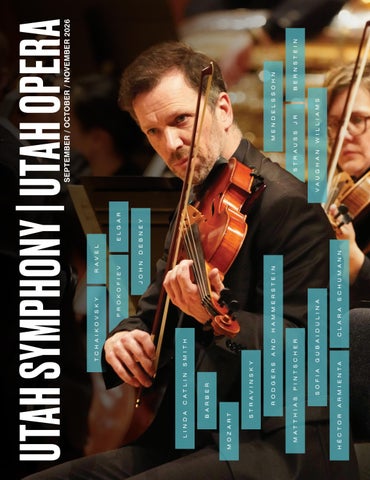
C A T L I N
H É C T O R
S O F I A
H A M M E R S T E I N
C L A R A
S C H U M A N N
G U B A I D U L I N A
P I N T S C H E R
A R M I E N T A
M A T T H I A S
R O D G E R S
A N D
S M I T H
S T R A V I N S K Y
M O Z A R T
B A R B E R
L I N D A
J O H N
E L G A R
D E B N E Y
R A V E L
P R O K O F I E V
T C H A I K O V S K Y
V A U G H A N
J R
W I L L I A M S
S T R A U S S
B E R N S T E I N
M E N D E L S S O H N
SEPTEMBER / OCTOBER / NOVEMBER 2026
Cover Preprint
Preprint Jerry Seiner Cadillac Inside Front Cover
L E T ' S TA K E THE CADILLAC
MEET
THE
JERRY SEINER CADILLAC JerrySeinerCadillac.com
EV
LOCATION 1530 S. 500 W. Salt Lake City, UT 84115
F A M I LY
SALES 801.512.0864 Mon-Fri 8am-8pm Sat 8am-8pm Sunday Closed
©2022 General Motors. All Rights Reserved. Cadillac®
SERVICE 801.512.0650 Mon-Fri 7am-6pm Sat 8am-5pm Sunday Closed
Ruth
A Girl from New York An American Opera in Three Acts
Benjamin
In my heart I know it’s true, I can feel it thru and thru; There’s a place for me where I must be, I’m comin’ home to you.
WATCH VIDEO
williamcall.net/ruth
October 31, 2026 beginning at 11:00am Libby Gardner Concert Hall University of Utah The Utah District round of the competition is open to the public free of admission charge. Visit UtahMONCAuditions.org after October 23 to view a schedule of singers and updated competition times. The Utah District round of the Metropolitan Opera Eric and Dominque Laffont Competition is supported in part by the Salt Lake City Arts Council, the residents of Salt Lake County through the Zoo, Arts & Parks (ZAP) Program, and the University of Utah School of Music.
WELCOME
6
CONTENTS
19 CIRQUE DE LA SYMPHONIE
THE BOARD OF TRUSTEES
10
UTAH SYMPHONY
24
12
UTAH SYMPHONY | UTAH OPERA STAFF
14
Mills Publishing, Inc. Publisher
ELGAR’S CELLO CONCERTO & PROKOFIEV’S SYMPHONY NO. 5
Cynthia Bell Snow Office Administrator
31 CELEBRACIÓN SINFÓNICA
AN INTERVIEW WITH OUR NEW ASSISTANT CONDUCTOR KYLE DICKSON
22
35
45
THE SECRETS BEHIND THE STATE TOUR
42
ZORRO: BRINGING A LATINO LEGEND TO THE OPERA STAGE
55
MEET THE NEW FACES OF UTAH OPERA
59
61
56
MORE THAN A VOLUNTEER, REMEMBERING ARLEN HALE
66
INDIVIDUAL DONORS
68
58 85
Jackie Medina Art Director/ Production Manager Patrick Witmer Publication Designer/ Web Development
USUO SPONSORS
16
Dan Miller President
A NIGHT IN ANCIENT GREECE: RAVEL’S DAPHNIS AND CHLOE
Ken Magleby Patrick Witmer Graphic Designers Paula Bell Dan Miller Advertising Representatives
HÉCTOR ARMIENTA’S ZORRO
Julia Lyon & Camila Baltazar Editors UTAH SYMPHONY | UTAH OPERA program is published by Mills Publishing, Inc., 772 East 3300 South, Suite 200, Salt Lake City, Utah 84106.
RICK STEVES: A SYMPHONIC JOURNEY
TCHAIKOVSKY’S SYMPHONY NO. 5
Phone: 801.467.8833 Email: advertising@millspub.com Website: millspub.com Mills Publishing, Inc. produces playbills for many performing arts groups. Advertisers do not necessarily agree or disagree with content or views expressed on stage. Please contact us for playbill advertising opportunities.
♻Please Recycle © Copyright 2026
DISNEY’S HOCUS POCUS IN CONCERT
HALLOWEEN HIJINKS
LEGACY GIVING
91
MEMORIALS & TRIBUTES
69
92
MOZART WITH CONRAD TAO
INSTITUTIONAL DONORS
93
77
TANNER & CRESCENDO SOCIETIES
95
ACKNOWLEDGMENTS
98
82
STRAVINSKY’S FIREBIRD SUITE
Please scan the QR code if you’d like to view a digital version of the publication.
RODGERS AND HAMMERSTEIN CELEBRATION
5
WELCOME ON BEHALF OF THE BOARD MEMBERS, MUSICIANS, AND STAFF OF UTAH SYMPHONY | UTAH OPERA,
it is our pleasure to welcome you to today’s performance. This is your symphony, your opera, and your home for connection with others through great live music. This past summer, USUO carried our great live music to a variety of locations that celebrate Utah’s natural beauty—throughout the state during our Music Elevated State Tour and at USUO’s beloved summer home in Park City, our Deer Valley® Music Festival. As the season changes and a new school year begins, we’re pleased to return to our beloved indoor venues and to schools across Utah. Did you know that, in addition to the more than 100 subscription concerts and operas performed at USUO home venues, last year our artists presented nearly 300 performances, classes, and events designed specifically for students, schools, and community members throughout our state? That kind of reach— into professional venues and classrooms alike—is what makes this organization belong to all of Utah, not just to those of us in the seats tonight. It’s made possible by a deep pool of exceptional instrumental and vocal musicians (meet some of our newest musicians on pages 22–23 and 56–57) and by a dedicated team of staff professionals who carry out impressive behind-the-scenes logistics. Those logistics range from the everyday (though never ordinary) work of planning and implementing rehearsals, performances, ticketing, fundraising, and billpaying to the extraordinary challenges like presenting a full orchestra in multiple outdoor pop-up venues over the course of two weeks (read more about the operations heroes who made that happen on pages 42–43). Our 2026–27 Season brings orchestral and operatic works led by worldclass conductors and featuring extraordinary soloists, all with the outstanding musicians of USUO’s orchestra and choruses. These first few months bring an incredible variety of symphonic, film, theatrical, and popular music to our stages, with particular highlights in honor of Hispanic Heritage Month, including Celebración Sinfónica with Ballet Las Americas de Utah and Héctor Armienta’s 2022 opera Zorro, inspired by the pulp-fiction character of early 1800s Spanish California and sung in English and Spanish by an all-Latino principal cast (see pages 54–55 for more about this work). Thank you for being here today. This is your Utah Symphony | Utah Opera, and we’re proud to steward this community resource for you. We hope to see you again soon for memorable musical moments—the kind that leave you enriched, and reminded of what we build together through the shared experience of great live music! Sincerely, Steven Brosvik
President & CEO The O.C. Tanner Chair
Annette W. Jarvis Chair, Board of Trustees
6
USUO.ORG | 801-533-NOTE (6683)
For all things Your Home. Your Way.
SHOP ONLINE
Furniture • Appliances • Mattresses • Electronics • Flooring
ABOUT UTAH SYMPHONY | UTAH OPERA
Our mission is to connect the community through great live music. As the flagship arts organization of the Intermountain West, Utah Symphony | Utah Opera connects communities through great live music and educational work. USUO performs for more than 400,000 people each year, presenting more than 175 symphonic and chamber music performances at Maurice Abravanel Hall, the Deer Valley® Music Festival, and venues throughout the Intermountain region; 20 opera performances at the historic Janet Quinney Lawson Capitol Theatre; and music education programs serving every school district in Utah. One of just 17 year-round orchestras in the U.S., the Utah Symphony has a storied recording legacy, has embarked on seven international tours in addition to numerous domestic tours, and performed at Carnegie Hall in 2016. Utah Opera—one of just six opera companies in the U.S. with full production capabilities, including costume and scenic shops—provides patrons with distinguished productions that showcase emerging and established artists, celebrate traditional works, and champion new works and the American operatic tradition. USUO is the only merged symphony orchestra and opera company of its scale in the U.S.
THE BOARD OF TRUSTEES ELECTED BOARD Annette W. Jarvis* Chair Judy Moreton* Vice Chair Joanne F. Shiebler* Vice Chair Thomas Wright* Vice Chair Jason Englund* Secretary Steven Brosvik* President & CEO The O.C. Tanner Chair Stewart E. Barlow Larry Brownstein Paul E. Burdiss
George Cardon-Bystry Aaron M. Chamberlain John D’Arcy* David L. Dee Barry L. Eden* Senator Luz Escamilla Jonathan Freedman Brandon Fugal Marie Gochnour Gardner Dennis H. Hranitzky Scott M. Huntsman Stephen Tanner Irish* Thomas N. Jacobson Abigail E. Lowder Derek B. Miller Dr. Dinesh C. Patel Frank R. Pignanelli* Gary B. Porter Jennifer Price-Wallin Shari H. Quinney R. Ryan Richards Miguel R. Rovira
Stan Sorensen Aaron Starks Shane D. Stowell Thomas Thatcher W. James Tozer Jr. David Utrilla Sharlene Wells Kim R. Wilson Henry C. Wurts* Daniel E. Young
Thomas M. Love* David T. Mortensen Scott S. Parker David A. Petersen
Patricia A. Richards* Harris Simmons
Spencer F. Eccles Kristen Fletcher Julie Aiken Hansen Richard G. Horne Ronald W. Jibson Anthony W. Middleton Jr.
Edward Moreton Marilyn H. Neilson Stanley B. Parrish Marcia Price Jeffrey W. Shields, Esq. E. Jeffery Smith
MUSICIAN REPRESENTATIVES Andrew Keller* Lissa Stolz* EX-OFFICIO REPRESENTATIVES Christina Myers Onstage Ogden Curtis Woodbury Associate Board
LIFETIME BOARD Kem C. Gardner Brian Greeff* Jon Huntsman Jr. G. Frank Joklik
HONORARY AND TRUSTEES EMERITI Carolyn Abravanel Jesselie B. Anderson Howard S. Clark Gary L. Crocker Geralyn Dreyfous Lisa Eccles
* Executive Committee Member
10
USUO.ORG | 801-533-NOTE (6683)
TICKETING & PATRON SERVICES How to buy tickets for Utah Symphony | Utah Opera events: •
Purchase online at usuo.org or through an authorized ArtTix seller.
•
Call USUO Patron Services at 801-533-NOTE (6683).
•
Visit our ticket office at Abravanel Hall during regular box office business hours.
Discounts may be available for subscribers, groups of 10+, military service members, educators, students, and individuals under 30. Contact Patron Services for assistance. Utah Symphony | Utah Opera Patron Services 123 West South Temple, Salt Lake City, Utah 84101 Phone: 801-533-NOTE (6683) | Email: info@usuo.org
BOX OFFICE HOURS •
Monday–Friday: 12 PM – 6 PM
•
Saturday: 2 PM–showtime* (with a scheduled performance)
• •
SUBSCRIBER BENEFITS Unlock special discounts by becoming a subscriber today! Contact Patron Services or visit usuo.org to learn more about the following perks:
Sunday: 90 minutes before showtime*
•
Flexible and fee-free ticket exchanges
(with a scheduled performance at scheduled performance location)
•
On-account credit
Holidays: visit usuo.org for special event hours
•
First access to ticket pre-sales
* The box office remains open 30 minutes after each performance begins.
•
Waived service fees
•
Savings up to 25%
ACCESSIBILITY We offer: •
ADA-compliant websites
•
Assistive listening devices
•
ASL/Closed Caption (CC) performances**
•
Braille programs**
•
Wheelchair, bariatric, and transfer seating
•
Sensory devices (fidgets, lap pads, ear plugs, etc.)
•
ADA parking/drop-off zone
•
Online Social Story™ **Available by advance request.
For additional accommodations, please contact Melissa Robison at mrobison@usuo.org or 801-869-9067.
GROUP TICKETS Bring a group of 10+ to any USUO performance and earn exclusive benefits, including: •
Priority seating
•
Savings up to 20% (except for signature performances)
•
Dedicated group sales support
For more information on group sales, please contact our Group Sales Associate Genevieve Gannon at ggannon@usuo.org or 801-533-NOTE (6683).
PROTECT YOUR WALLET — Utah Symphony | Utah Opera and ArtTix are the only official ticket outlets.
UTAH SYMPHONY Markus Poschner Music Director Designate The Maurice Abravanel Chair, endowed by the George S. and Dolores Doré Eccles Foundation Delyana Lazarova Principal Guest Conductor The Patricia A. Richards & William K. Nichols Chair Thierry Fischer Music Director Emeritus Kyle Dickson Assistant Conductor Sponsored by The Larry H. & Gail Miller Family Foundation Austin McWilliams Chorus Director & Opera Assistant Conductor The Sandefur Schmidt Chair VIOLIN* Madeline Adkins Concertmaster The Jon M. & Karen Huntsman Chair, in honor of Wendell J. & Belva B. Ashton Kathryn Eberle Associate Concertmaster The Richard K. & Shirley S. Hemingway Chair Laura Ha 2nd Associate Concertmaster Hugh Palmer Assistant Concertmaster Claude Halter Principal Second Lucy Lu Associate Principal 2nd Violin Evgenia Zharzhavskaya Assistant Principal Second Karen Wyatt Second Assistant Principal Second Erin David Joseph Evans Karen Ferry Wen Flatt Ellen Hayashi Lun Jiang Rebekah Johnson Tina Johnson~ Alison Kim Amanda Kofoed~ Jennifer Kozbial Posadas~ David Langr Hannah Linz Yuki MacQueen Alexander Martin Rebecca Moench
12
David Porter Lynn Maxine Rosen Elina Rubio Barbara Ann Scowcroft Ju Hyung Shin Bonnie Terry Julie Wunderle VIOLA* Brant Bayless Principal The John C. Kish Chair Yuan Qi Associate Principal Emily Brown~ Julie Edwards Joel Gibbs Carl Johansen Scott Lewis John Posadas Leslie Richards~ Whittney Sjogren CELLO* Matthew Johnson Acting Principal The J. Ryan Selberg Memorial Chair
OBOE Zachary Hammond Principal The Gerald B. & Barbara F. Stringfellow Chair
Jeff Luke Associate Principal
James Hall Associate Principal
TROMBONE Sam Elliot Acting Principal The Nathan & Shannon Savage Chair, in memory of Neal Savage
Lissa Stolz ENGLISH HORN Lissa Stolz CLARINET Tad Calcara Principal The Norman C. & Barbara Lindquist Tanner Chair, in memory of Jean Lindquist Pell Erin Svoboda-Scott Associate Principal The Shane & Stacey Stowell Chair Lee Livengood BASS CLARINET Lee Livengood
Andrew Larson Acting Associate Principal
E-FLAT CLARINET Erin Svoboda-Scott
John Eckstein Walter Haman# Ian Jones~ Anne Lee Louis-Philippe Robillard Kevin Shumway Hannah Thomas-Hollands~ Pegsoon Whang
BASSOON Lori Wike Principal The Edward & Barbara Moreton Chair
BASS* David Yavornitzky Principal
Jennifer Rhodes
Corbin Johnston~ Andrew Keller Edward Merritt James Stroup~ Jens Tenbroek Thomas Zera HARP Louise Vickerman Principal FLUTE Mercedes Smith Principal The Val A. Browning Chair Lisa Byrnes Associate Principal Caitlyn Valovick Moore PICCOLO Caitlyn Valovick Moore
USUO.ORG | 801-533-NOTE (6683)
Leon Chodos Associate Principal
CONTRABASSOON Leon Chodos HORN Jessica Danz Principal The Marcia JS Richards Chair
Seretta Hart~ Paul Torrisi
Theodore Swanson~ Acting Associate Principal/ Second Trombone BASS TROMBONE Graeme Mutchler TUBA Alexander Purdy Principal TIMPANI Mike Tetreault Principal Eric Hopkins Associate Principal The Theodore & Elizabeth Schmidt Family Foundation Chair PERCUSSION Keith Carrick Principal Eric Hopkins Michael Pape KEYBOARD Jason Hardink Principal LIBRARIANS Clovis Lark Principal Anna Thompson~ Acting Associate Principal Librarian
Edmund Rollett** Associate Principal
ORCHESTRA PERSONNEL Ebner Sobalvarro Director of Orchestra Personnel
Lauren Robinson~ Acting Associate Principal
Eric Reichelt Orchestra Personnel Manager
Jonathan Chiou Julia Pilant~ Stephen Proser TRUMPET Travis Peterson** Principal Alex Mayon~ Acting Principal
* String Seating Rotates ** On Leave # Sabbatical ~ Substitute Member
COMMAND THE STAGE. BMW X5
SOME VEHICLES ARRIVE. OTHERS TAKE THE LEAD. The BMW X5 is crafted for those who move with intention—balancing confident design, dynamic capability, and intelligent innovation. With available xDrive all-wheel drive and a driver-focused interior, it adapts seamlessly to every road and every moment. Because when presence meets performance, it doesn’t go unnoticed. Experience the performance worthy X5 at BMW of Murray or BMW of Pleasant Grove.
BMW of Murray 4735 S. State Street Murray, Utah 801-262-2479 bmwofmurray.com
BMW of Pleasant Grove 2111 West Grove Parkway Pleasant Grove, Utah 801-443-2000 bmwofpg.com
© 2026 BMW of North America, LLC. The BMW trademarks are registered trademarks.
UTAH SYMPHONY | UTAH OPERA STAFF ADMINISTRATION Steven Brosvik President & CEO The O.C. Tanner Chair David Green Senior Vice President & COO Micah Luce Director of Human Resources & Organizational Culture Julie McBeth Executive Assistant to the CEO Natty Taylor Human Resources Manager Farrah Valdez Executive Assistant to the Senior VP & COO SYMPHONY ARTISTIC Kyle Dickson Assistant Conductor Sponsored by The Larry H. & Gail Miller Family Foundation Ebner Sobalvarro Director of Orchestra Personnel Eric Reichelt Orchestra Personnel Manager Morgan Moulton Artistic Planning Manager Guillermo Sanchez Artistic Planning Coordinator & Assistant to the Music Director OPERA ARTISTIC Christopher McBeth Opera Artistic Director Austin McWilliams Chorus Director & Opera Assistant Conductor The Sandefur Schmidt Chair Deborah Robertson Principal Coach Michelle Peterson Director of Production Ashley Tingey Production Coordinator Hyein Hong, Soprano Isabelle Kosempa, Mezzo-soprano The Charles Boynton Chair Colin Miller, Tenor The Judy Brady† & Drew W. Browning Chair J. Andrew Garratt Jr., Baritone Marine Eckert, Piano Resident Artists SYMPHONY OPERATIONS Jen Shark Director of Orchestra Operations Melissa Robison Front of House Director Chip Dance Director of Production Chris Danz Stage Manager Fiona McGowan Operations Manager Garrett Vargo Assistant Stage Manager
14
USUO.ORG | 801-533-NOTE (6683)
OPERA TECHNICAL Jason Barroncini Technical Director Kelly Nickle Properties Master Dusty Terrell Scenic Charge Artist JR Orr Head Carpenter/Shop Foreman COSTUMES Carol Wood Costume Director Marcos Ambriz Cutter/Draper & Costume Manager Abby Gehring First Hand Mallory Goodman Costume Rentals & Collection Manager Spencer Smith Costume Rentals & Collection Assistant Manager Milivoj Poletan Master Tailor Kathryn Wieland Assistant Tailor Julie Porter Crafts Artisan/Milliner Elizabeth Webb Kennington Temporary Crafts Artisan Lee Sego Wardrobe Supervisor/Stitcher Amy Fernelius Stitcher DEVELOPMENT David Hodges Director of Development Operations and Institutional Giving Garrett Murphy Director of Development Calli Forsyth Assistant Director of Institutional Sponsorships & Engagement Katie Swainston Assistant Director of Philanthropy & Development Operations Lisa Poppleton Grants Manager Ellesse Hargreaves VIP & Sponsorship Benefits Manager Anna Summers Annual Fund Manager Chloe Toyn Development Coordinator MARKETING & COMMUNICATIONS Meredith Kimball Laing Vice President of Marketing & Communications Amelia England Director of Marketing Nina Starling Website Manager Camila Baltazar Communications Manager
Emmalee Chastain Marketing Manager Emma Price Email Marketing Strategist Billy Clouse Graphic Designer Abigail Morris Marketing & Communications Coordinator PATRON SERVICES Caitlin Marshall Director of Patron Services Toby Simmons Patron Services Manager Bev Storrs Sales & Patron Loyalty Manager Michael Gibson Patron Services Assistant Manager Genevieve Gannon Group Sales Associate True Moore Annabelle Daniels-Rosenberg Patron Services Specialists Ananda Spike Val Tholen Kjelbi Elassali Thia Harris Alex Porter Cynthia Jensen Patron Services Associates ACCOUNTING & INFORMATION TECHNOLOGY Jeffrey Andreasen CFO Mike Lund Director of Information Technologies Melanie Giles Controller Dallin Mills Database Manager Paige LeFay Accounts Payable Specialist EDUCATION & COMMUNITY ENGAGEMENT Ben Kipp Vice President of Education & Community Engagement Kevin Nakatani Opera Education Manager James Wesson Symphony Education Manager Beth Foley Education Coordinator
We would also like to recognize our interns and temporary and contracted staff for their work and dedication to the success of Utah Symphony | Utah Opera.
Park City Gallery Stroll
Look for our flags and join us from 6pm – 9pm on the last Friday of every month. The Park City Gallery Association invites you to our monthly Gallery Art Stroll along Historic Main Street and beyond. Held on the last Friday of each month, participating galleries extend a warm welcome, offering captivating exhibitions, refreshments, occasional live music, and the opportunity to connect with fellow art enthusiasts.
— PARK CITY GALLERY ASSOCIATION — parkcitygalleryassociation.com
Create PC • Bret Webster Images • David Beavis Fine Art Gallery MAR • LIK Fine Art • Mangelsen - Images of Nature Gallery • Meyer Gallery Montgomery-Lee Fine Art • Mountain Trails Gallery • Relévant Gallery • Summit Gallery Susan Swartz Studios • Trove Gallery • William Kranstover Fine Art
LEARN MORE
USUO SPONSORS
UTAH SYMPHONY | UTAH OPERA SEASON SPONSOR
MASTERWORKS SERIES SPONSOR
FAMILY SERIES SPONSOR
POPS SERIES SPONSOR
CONCERT SERIES AT THE NOORDA SPONSOR
UTAH OPERA ARTISTIC DIRECTOR SPONSOR
CHORUS DIRECTOR & OPERA ASSISTANT CONDUCTOR SPONSOR
EMMA ECCLES JONES FOUNDATION
SANDEFUR SCHMIDT
PRINCIPAL GUEST CONDUCTOR SPONSOR
ASSISTANT CONDUCTOR SPONSOR
PATRICIA A. RICHARDS & WILLIAM K. NICHOLS
UTAH OPERA RESIDENT ARTISTS SPONSOR
16
USUO.ORG | 801-533-NOTE (6683)
OFFICIAL VOICE CARE PROVIDER OF USUO
2026-27 Utah Symphony | Utah Opera Season Sponsor
Enriching excellence in the arts in Utah for more than half a century
EXPERIENCE A CLASSIC FAIRYTALE Season Sponsor Utah Symphony | Utah Opera is supported in part by Salt Lake County Arts & Culture as a resident of Maurice Abravanel Hall and the Janet Quinney Lawson Capitol Theatre.
POPS
CIRQUE DE LA SYMPHONIE THURSDAY, SEPTEMBER 10, 2026 / 7:30 PM / BROWNING CENTER AT WSU, AUSTAD AUDITORIUM FRIDAY, SEPTEMBER 11, 2026 / 7:30 PM / MAURICE ABRAVANEL HALL SATURDAY, SEPTEMBER 12, 2026 / 7:30 PM / MAURICE ABRAVANEL HALL
KYLE DICKSON, conductor* CIRQUE DE LA SYMPHONIE, guest artists UTAH SYMPHONY
SELECTIONS TO BE ANNOUNCED FROM THE STAGE.
CONCERT SPONSOR
*Utah Symphony debut
USUO.ORG | 801-533-NOTE (6683)
19
ABOUT THE ARTISTS — CIRQUE DA LA SYMPHONIE
Kyle Dickson Conductor
AMERICAN CONDUCTOR KYLE DICKSON WAS RECENTLY APPOINTED ASSISTANT CONDUCTOR of
the Utah Symphony. He served as Assistant Conductor of the Memphis Symphony and Conductor of the Memphis Youth Symphony from 2023 to 2026 and was previously a Salonen Fellow with the San Francisco Symphony and Assistant Conductor of the Chicago Sinfonietta. Dickson is the recipient of the GPMF Advocate for the Arts Award and CAG’s Weinert Award and Weissberg Prize.
Recent conducting engagements include the National Symphony, Minnesota Orchestra, Detroit Symphony, Indianapolis Symphony, and the Louisiana Philharmonic. As cover conductor, Dickson has worked with ensembles including the New York Philharmonic, Baltimore Symphony, St. Louis Symphony, Lyric Opera of Chicago, Orchestre de Paris, and the NDR Elbphilharmonie.
ASSISTANT CONDUCTOR SPONSOR
Committed to music education, Dickson has worked with the Inner City Youth Orchestra of Los Angeles, UW-Madison Summer Music Institute, Carnegie Hall’s NYO/NYO2, Chicago Youth Symphony, and the Colburn Academy Virtuosi.
Cirque de la Symphonie Guest Artists
Cirque de la Symphonie is a unique and exciting production designed to bring the magic of cirque to the music hall. An elegant fusion of cirque and orchestra, the program showcases many of the best cirque artists in the world, thrilling audiences with aerial flyers, acrobats, contortionists, dancers, jugglers, balancers, strongmen, and more. These accomplished veterans include world record holders, gold medal winners, Olympians, and some of the most original talent ever seen. Founder Alexander Streltsov created the concept of cirque paired with symphony in 1998 in a special PBS production with the Cincinnati Pops. A circus veteran from Moscow, Streltsov is the only aerialist to perform with the Bolshoi Ballet. After winning the gold medal at the prestigious Festival du Mondial in Paris, he starred in a Broadway production. His music and programming sensibilities, combined with his performance background, provide a program with stunning three-dimensional visual and musical elements. Classical masterpieces are perfectly choreographed to the elegant movements of cirque artists, elevating cirque artistry to a fine arts level. Cirque de la Symphonie performs with dozens of orchestras across North America and beyond each season.
20
USUO.ORG | 801-533-NOTE (6683)
Unmatched Academic Results Come tour a campus and see for yourself!
Challenger School offers uniquely fun and academic classes for preschool to eighth-grade students. Our students learn to think for themselves and to value independence. Farmington (PS–G8) (801) 451-6565 1089 Shepard Creek Parkway
Salt Lake (PS–G8) (801) 487-4402 1325 South Main Street
Holladay (PS–K) (801) 278-4797 4555 South 2300 East
Sandy (PS–G8) (801) 572-6686 10670 South 700 East
Lehi (PS–G8) (801) 407-8777 3920 North Traverse Mountain Boulevard
West Jordan (PS–G1) (801) 565-1058 2247 West 8660 South
Scan to schedule a tour An independent private school offering preschool through eighth grade © 2026, Challenger Schools Challenger School admits students of any race, color, and national or ethnic origin.
AN INTERVIEW WITH OUR NEW ASSISTANT CONDUCTOR KYLE DICKSON By Julia Lyon
THIS FALL, WE WELCOME KYLE DICKSON as the new assistant
conductor of the Utah Symphony. We asked him about his musical influences and what he’s looking forward to in the season ahead. You’ve conducted orchestras across the United States and around the world. What appealed to you about becoming assistant conductor of the Utah Symphony? Utah Symphony | Utah Opera has a tremendous reputation for music making at the highest level. For any conductor, the opportunity to work with this orchestra, alongside dynamic guest artists and across such vibrant repertoire, is incredibly exciting. Utah, itself, is a region rich with history, culture, and a strong sense of identity. There’s something very exciting about making music in a place with that kind of cultural energy and contributing to what the orchestra means to this audience. I’m looking forward to becoming part of that community! Tell us about your journey to the podium. Was it a specific concert, musician, or moment that inspired you? There were really two pivotal moments. The first came very early: watching Thomas Wilkins conduct the Detroit Symphony Orchestra on elementary school field trips and, from a young age, seeing myself reflected on that stage. The second moment was as a teenager, at Sphinx Institute of Music, where I studied piano, violin, and music theory through a tuition-free program. Regularly hearing ensembles like the Sphinx and Harlem String Quartets inspired my love for the violin and ultimately led me to become a violinist, teacher, and chamber musician. A medical diagnosis threatened my ability to continue
22
USUO.ORG | 801-533-NOTE (6683)
playing around the same time a mentor and prominent conductor, Victor Yampolsky, saw me coaching a youth orchestra and encouraged me to pursue conducting. I went on to study conducting with him at Northwestern University while serving as Assistant Conductor of the Chicago Sinfonietta as Freeman Fellow under my mentor Mei-Ann Chen, who I’d played for as a violinist in the same orchestra. I later became a Salonen Conducting Fellow with the San Francisco Symphony. What initially felt like an unexpected turn ultimately became a way to bring together everything I loved about performing, teaching, and sharing music with others. You’re an accomplished violinist as well as a conductor. How does your experience as a musician influence your conducting style? I really found my musical voice through the string quartet repertoire, first as a student and later as a professional violinist. Chamber music taught me how much can be communicated through gesture and listening. Leading a string section as a principal taught me many of those same skills on a different scale. I was fortunate to learn that language from teachers who were incredibly perceptive orchestral musicians long before I ever pursued conducting. I’ve spent a lot of time on the other side of the baton, so to a certain extent I understand what players are being asked to do. I try to make sure that what I do on the podium helps them do it. You’ve been committed to music education and inclusivity throughout your career. How do you hope to impact young people in Utah? We all remember the concerts that first made us fall in love
AN INTERVIEW WITH OUR NEW ASSISTANT CONDUCTOR KYLE DICKSON with music and the teachers who inspired us and continued to reignite that passion throughout our lives. As a teacher, I’ve always hoped to be that for the next generation.
history, and how great performances come together. The stronger and more curious you are as a musician, the more naturally the path to conducting will follow.
I want young people across Utah to know that the concert hall is a place for them and that classical music can be a source of expression and representation for them, too. It’s an honor and a privilege to be part of a young person’s first experience with a piece of music, and I take it seriously. I hope to be a bridge to the concert hall in the same way others were for me.
Go to as many rehearsals as you can! And play as much chamber music with other people as possible. Conducting is ultimately about listening, communicating, and making music collaboratively—and you don’t need an orchestra in front of you to start developing those skills.
What advice would you give a young person aspiring to become a conductor one day? The best conductors are incredible musicians first and foremost, so focus on constantly sharpening your musicianship. Master your own instrument, but also learn as much as you can about other instruments, scores, music
Audiences will get to see you at work during a variety of pops and family concerts this season. What are you looking forward to in your inaugural season with the Utah Symphony? Connecting with families in Salt Lake City! There’s lots of fun programs lined up and I can’t wait to get to interact with audiences through a very interesting variety of concerts. I’m particularly looking forward to getting to know concertgoers during the pre-concert chats!
THE CHILDREN’S HOUR
9TH & 9TH SALT LAKE CITY
USUO.ORG | 801-533-NOTE (6683)
23
MASTERWORKS ELGAR’S
CELLO CONCERTO & PROKOFIEV’S SYMPHONY NO. 5 THURSDAY, SEPTEMBER 17, 2026 / 8:00 PM / DAINES CONCERT HALL AT THE CHASE FINE ARTS CENTER FRIDAY, SEPTEMBER 18, 2026 / 7:30 PM / MAURICE ABRAVANEL HALL SATURDAY, SEPTEMBER 19, 2026 / 7:30 PM / MAURICE ABRAVANEL HALL DELYANA LAZAROVA, conductor ZLATOMIR FUNG, cello UTAH SYMPHONY
BARBER ELGAR
Medea’s Dance of Vengeance (14’) Cello Concerto in E minor, Op. 85 (26’) I.
Adagio - Moderato
II.
Lento - Allegro molto
III.
Adagio
IV.
Allegro - Moderato - Allegro, ma non troppo
INTERMISSION PROKOFIEV
Symphony No. 5 in B-flat Major, Op. 100 (46’) I.
Andante
II.
Allegro marcato
III.
Adagio
IV.
Allegro giocoso
CONCERT SPONSOR
24
USUO.ORG | 801-533-NOTE (6683)
ABOUT THE ARTISTS — ELGAR’S CELLO CONCERTO & PROKOFIEV’S SYMPHONY NO. 5 Delyana Lazarova Conductor
DELYANA LAZAROVA IS THE PRINCIPAL GUEST CONDUCTOR OF THE UTAH SYMPHONY. As a
conductor, she sees herself as a musician among musicians, collaborative, open, and attuned to each orchestra’s unique sound. Lazarova’s international musical education influences her wide-ranging repertoire. Born in Bulgaria, she has a natural affinity to Eastern European and Russian repertoire (Dvořák, Stravinsky, Tchaikovsky, Bartók), but feels equally at home in the Viennese Classical period. Lazarova is passionate about music of the 20th and 21st centuries.
CONDUCTOR SPONSOR
PATRICIA A. RICHARDS & WILLIAM K. NICHOLS
She has a master’s degree in conducting, but is also an accomplished violinist with a master’s degree and performance diploma from the Jacobs School of Music in Indiana where she received a scholarship for artistic excellence. In addition to conducting multiple Utah Symphony concerts this season, Lazarova will appear with the BBC Scottish Symphony Orchestra as Principal Guest Conductor. She will be on tour with the Kammerorchester Basel, conducting concerts in South America, and in Europe with the Junge Deutsche Philharmonie, among others.
Zlatomir Fung Cello
CELLIST ZLATOMIR FUNG BURST ONTO THE SCENE AS THE FIRST AMERICAN IN FOUR DECADES
(and youngest musician ever) to win first prize at the International Tchaikovsky Competition, cello division. Fung has received many distinguished prizes and awards, including the 2017 Young Concert Artists International Auditions and a Borletti-Buitoni Trust Fellowship in 2022. Highlights of the 2026–27 season include his Hollywood Bowl debut with the Los Angeles Philharmonic, a return to the London Philharmonic Orchestra, and the world premiere of a new work by Lawrence Osborn with the Royal Philharmonic Orchestra. He undertakes a residency at the University of Maryland and tours Japan with the Kyushu and Osaka symphony orchestras. Recital appearances include his recital debut at San Francisco Symphony’s Davies Hall. Fung will premiere his own new works for solo cello in recital and for cello and string orchestra with the New York Classical Players. GUEST ARTIST SPONSOR
USUO.ORG | 801-533-NOTE (6683)
25
ABOUT THE MUSIC — ELGAR’S CELLO CONCERTO & PROKOFIEV’S SYMPHONY NO. 5 BY NOEL MORRIS
Key Notes All three works on this program emerged from the world wars. In each case, the composer sets a tonal pathway through an age of modernism. American composer Samuel Barber and his partner Gian Carlo Menotti each won two Pulitzer Prizes in music. Edward Elgar’s masterful Cello Concerto, composed in 1919, went largely ignored until the 20-year-old cello superstar Jacqueline du Pré discovered the piece in 1965. SAMUEL BARBER
born March 9, 1910, in West Chester, Pennsylvania died January 23, 1981, in New York City
Medea’s Dance of Vengeance composed in 1946/1955 premiered in New York City, in 1956 Utah Symphony premiere
The Backstory
In the months after the Japanese attack on Pearl Harbor, American composer Samuel Barber received his draft notice and reported to basic training. Soon, the U.S. Army realized he had more to offer as a composer than as an infantryman and transferred him to the Army Air Corps. Now based at West Point, Barber and his partner, composer Gian Carlo Menotti, settled into a house in Mount Kisco. Dubbed “Capricorn,” their home became a composers’ retreat.
The Music
26
Barber wrote music for Cave of the Heart, a ballet starring the modern dance pioneer Martha Graham in 1946. According to Martha Graham Dance Company, “this dance is a psychological study of the destructive powers of love, the dark passions that guard the human heart, coiled like a serpent ready to strike when attacked.” Barber wrote: “The present version, rescored for large orchestra in 1955, is in one continuous movement and is based on material from the ballet which is directly related to the central character, Medea. Tracing her emotions from her tender feelings towards her children, through her mounting suspicions and anguish at her husband’s betrayal and her decision to avenge herself, the piece increases in intensity to close in the frenzied Dance of Vengeance of Medea, the Sorceress descended from the Sun God.” Barber included an excerpt from Euripides in his program note: Medea “Look, my soft eyes have suddenly filled with tears: O children, how ready to cry I am, how full of foreboding! Jason wrongs me, though I have never injured him. He has taken a wife to his house, supplanting me… Now I am in the full force of the storm of hate. I will make dead bodies of three of my enemies – father, the girl and my husband! Come, Medea, whose father was noble, Whose grandfather God of the sun, Go forward to the dreadful act.” EDWARD ELGAR
born June 2, 1857, in Broadheath, England died February 23, 1934, in Worcester
People typically distill Medea into a single event: she killed her kids. But the play by Euripides and the novel Circe, by American author Madeline Miller, fleshes Medea out into a more sympathetic character—to a point.
Cello Concerto in E minor
Cupid’s arrow dooms Medea to love a coldly ambitious and faithless man. She betrays her father and murders her brother to help her beloved Jason in his quest to become king. They marry and have two boys. Medea continues to use her magic against anyone standing in Jason’s way until he dumps her for a princess. When Medea’s sorrow turns to vengeance, she does the unthinkable.
The Backstory
USUO.ORG | 801-533-NOTE (6683)
composed in 1919 premiered in London, in 1919 last performed by the Utah Symphony in September 2008 with conductor Arlid Remmereit and cellist Natalie Clein
In July 1904, Edward Elgar, the son of a piano tuner, knelt before King Edward VII. The king raised his sword and tapped the composer’s shoulders, elevating him to knighthood. In
ABOUT THE MUSIC — ELGAR’S CELLO CONCERTO & PROKOFIEV’S SYMPHONY NO. 5 truth, even with his newfound status, Elgar could never relax around aristocrats. But it was a racy age. And the partyloving, playboy king was too busy hopping around Europe to concern himself with a composer’s low birth. In those days, the British Empire stretched around the globe. Technological advances brought electric lighting, indoor plumbing, and refrigerators. In fiction, we know the Edwardians from Sherlock Holmes, Downton Abbey, and Mary Poppins. And Elgar wrote their proverbial soundtrack, scoring hits like Pomp and Circumstance and Enigma Variations. The Edwardian era was brief. The king died in 1910, and war followed in 1914. In just four years, the Great War spilled the blood of a generation, leaving a million Englishmen dead and another two million with disabilities. The Spanish flu wiped out tens of millions worldwide. Forging a new world order, America emerged as a political and economic power as Britain receded.
The Music
After the war, the music scene changed, too. At 62, Elgar became a has-been. In 1919, he wrote his Cello Concerto, a piece that is, to many ears, a lament for a lost civilization. In it, the Nobilmente of the first movement spins a doleful melody that gives way to virtuosic spiccato (literally bouncing the bow) in the Scherzo. The third movement oozes nostalgia, while the finale has a more robust atmosphere, culminating in the opening lament—but just for a time. In the end, the composer’s Victorian ethos prevails; he sends the cello and orchestra out with a bang, as if to dust himself off and mutter, “Keep calm and carry on.” By this time, the composer’s beloved wife, Alice, was in decline. Nevertheless, as she’d done so many years before, Alice Elgar sat in the audience as her husband conducted his latest work. Six months after the premiere of the Cello Concerto, she passed away. Elgar outlived her by 14 years, but composed almost nothing after her passing.
USUO.ORG | 801-533-NOTE (6683)
27
ABOUT THE MUSIC — ELGAR’S CELLO CONCERTO & PROKOFIEV’S SYMPHONY NO. 5 What to Listen for
Sergei Prokofiev loved machines and scored their motoric rhythms right into the finale of his Fifth Symphony. SERGEI PROKOFIEV
born April 27, 1891, in Sontsovka, Ukraine died March 5, 1953, outside Moscow
Symphony No. 5 in B-flat Major
composed in 1944 premiered in Moscow, in 1945 last performed by the Utah Symphony in September 2023 with conductor Eduardo Strausser
The Backstory
Music lovers spend lots of time searching for meaning in music. Sergei Prokofiev described his Fifth Symphony as an ode to “the free and happy man, to his mighty powers, his pure and noble spirit.” But some find those words disingenuous. It’s possible Prokofiev made the comment to satisfy his Soviet overlords, while giving the piece private meaning—or none at all. And yet the Fifth Symphony bears the weight of history. According to the National World War II Museum, the Soviet Union counted some 24,000,000 civilian deaths during World War II. Disease, freezing temperatures, forced labor, Hitler, Stalin, and policies of starvation and extermination created horrific conditions. With that in mind, there are all sorts of things one might hear in the Fifth Symphony. Written in 1944, it is a study in contrasts, juxtaposing danger and beauty, violence and poetry, machine-like militarism and soulful yearning. The Soviets pursued a system dictating each citizen’s service to the motherland. Prokofiev’s job was to write worker-affirming music in the service of propaganda. Apparatchiks took care to keep their best “artistic laborers” away from German bombs. In that spirit, they ordered the composer to evacuate Moscow in 1941. Determined to bring along his mistress, Mira Mendelson, Prokofiev split with his wife, Lina, who opted to stay behind in Moscow with their two sons.
28
USUO.ORG | 801-533-NOTE (6683)
As callous as Prokofiev could be, he spent his exile directing financial support to a wide circle of family and friends at a time when many Russians starved. He and his fellow evacuees practiced their art while scrabbling for news of those left behind. Nevertheless, his companions noted they’d never seen him happier. “He was [uncharacteristically] simple and kind with everyone,” wrote Olga Lamm. With Lina out of the picture (physically, if not legally), Mira became Prokofiev’s wife and had a stabilizing influence on him.
The Music
Work on the Fifth Symphony coincided with D-Day. The opening melody, played by the flute and bassoon, becomes a recurring theme—a trickle here, menacing there, and explosive at the end. The clarinet takes a central role in bringing out new material throughout the symphony, while gritty trumpets, playing at the bottom of their range, add to the composer’s broad color palette. Prokofiev sketched the piece in a month at an artist’s retreat near Ivanovo, where Dimitri Shostakovich occupied a nearby studio (converted from a hen house). As Prokofiev kept all his musical inspirations in notebooks, some of the symphony’s material dates back to the 1930s, including discarded music from Romeo and Juliet and The Queen of Spades. Prokofiev conducted the premiere of the Fifth Symphony, just as news reached Moscow that the Red Army had crossed the Vistula River, pushing Hitler’s forces back into Germany. “The hall was probably lit as usual, but when Prokofiev stood up it seemed as though the light poured down on him from on high. He stood there, like a monument on a pedestal,” wrote piano legend Sviastoslav Richter. Then, as the composer raised his baton, the sound of artillery salvos pierced the silence—20 volleys of 224 guns saluting Russian forces. Prokofiev waited, Richter recounts, “and began only after the cannons had stopped. There was something very significant in this, something symbolic. It was as if all of us—including Prokofiev—had reached some kind of shared turning point.”
HVAC AND TEMPERATURE INFORMATION Have you ever felt a sudden chill or a burst of heat while enjoying a performance? You’re not imagining things! Here’s an overview of why this occurs and the enhancements we’re implementing to improve your comfort. Why Does This Happen?
The entire theatre - stage, orchestra level, and balcony - is served by a single air handler and it is a delicate balance to keep temperatures just right for the audience and the performers on stage. This means some areas may be a little warmer and other areas may be a little colder.
How Do We Compensate?
We monitor temperatures in real-time using the IMonnit App, allowing us to respond to temperature fluctuations quickly. Backstage, we can deploy portable heaters for localized temperature adjustments. We work hard to find ideal temperatures in all areas of the auditorium
and stage, but because of the historical design of the systems we are not always able to reach perfect temperatures in every area.
When Will This Be Fixed?
Our long-term goal is to design and install an HVAC system with independent tempera-ture control for different zones. This multi-year project begins in 2026 with a feasibility study to determine the best options for optimizing temperatures and associated costs, while preserving the historical nature of Capitol Theatre. From there, we will seek funding and develop a construction timeline. Because of the scope of this project, it is expected to take several years.
Thank you for your continued patience as we work to make the Capitol Theatre a more comfortable experience for everyone.
KEEP A SHOVEL AND BUCKET OF WATER NEARBY TO EXTINGUISH YOUR CAMPFIRE SMOKEYBEAR.COM
SPECIAL EVENT
CELEBRACIÓN SINFÓNICA MONDAY, SEPTEMBER 21, 2026 / 7:00 PM / MAURICE ABRAVANEL HALL ENRICO LOPEZ-YAÑEZ, conductor MÓNICA ÁBREGO, soprano BALLET LAS AMERICAS DE UTAH, guest artists UTAH SYMPHONY
SELECTIONS TO BE ANNOUNCED FROM THE STAGE.
CONCERT SPONSOR
RECEPTION SPONSOR
CONSULADO DE CARRERA DE MÉXICO EN SALT LAKE CITY
USUO.ORG | 801-533-NOTE (6683)
31
ABOUT THE ARTISTS — CELEBRACIÓN SINFÓNICA Enrico Lopez-Yañez Conductor
ENRICO LOPEZ-YAÑEZ IS REDEFINING WHAT IT MEANS TO BE A CONDUCTOR IN THE 21ST CENTURY.
Celebrated for his charismatic stage presence, genre-defining collaborations, and passion for making orchestral music accessible to all, Lopez-Yañez is one of the most innovative and in-demand conductors in North America. He currently serves as Creative Director and Principal Conductor of Pops and Specials at the Dallas Symphony, Principal Pops Conductor for the Detroit and Pacific symphonies, as well as Principal Guest Conductor of Pops at the Indianapolis Symphony Orchestra. He previously spent eight seasons conducting the Nashville Symphony, where he also served as their Principal Pops Conductor. As a trailblazer in the symphonic world, Lopez-Yañez has premiered dozens of groundbreaking symphonic collaborations with artists including Dolly Parton, Kelsea Ballerini, Portugal. The Man, The Mavericks, Tituss Burgess, Trisha Yearwood, The Lone Bellow, and The War and Treaty. His wide-ranging collaborations span genres and generations, featuring artists such as Nas, Common, Itzhak Perlman, José Carreras, Kenny Loggins, Stewart Copeland, Patti LaBelle, Gladys Knight, Samara Joy, Ben Rector, Ben Folds, The Beach Boys, and more.
Mónica Ábrego Soprano
MÓNICA ÁBREGO IS CONSIDERED ONE OF MEXICO’S MOST OUTSTANDING AND VERSATILE
sopranos. She has performed on stages around the world with a diverse repertoire that includes opera, art song, mariachi, and Latin American music. Her orchestral performance collaborations include the Pacific Symphony, Milwaukee Symphony, Detroit Symphony, Baltimore Symphony, Phoenix Symphony, Seattle Symphony, Elgin Symphony, Buffalo Philharmonic Orchestra, Utah Symphony, Tucson Symphony, Nashville Symphony, Santa Rosa Symphony, Newport Symphony, Florida Orchestra, Colorado Symphony, Idaho Falls Symphony, Idaho State-Civic Symphony, San Diego Symphony, Key West Symphony, La Jolla Symphony & Chorus, Aguascalientes Symphony, Orchestra of Baja California, the Opera Philharmonic Society in Bulgaria, as well as the Chihuahua Philharmonic Orchestra. Some of the operatic roles she has performed include Norina in Don Pasquale, Lauretta in Gianni Schicchi, Gilda in Rigoletto, Magda in La rondine, Violetta in La traviata, Manon in Manon, Musetta in La bohème, Olympia in The Tales of Hoffmann, and Nanetta in Falstaff.
32
USUO.ORG | 801-533-NOTE (6683)
ABOUT THE ARTISTS — CELEBRACIÓN SINFÓNICA
Ballet Las Americas de Utah Guest Artists
BALLET LAS AMERICAS DE UTAH IS A LATIN AMERICAN FOLK AND MODERN DANCING GROUP
sponsored by Utah Arts Alliance in Salt Lake City. The group presents from pre-Hispanic to modern Latin music and dancing. It promotes unity, love, and respect through music and dance to build a stronger community. The group has been part of the annual Living Traditions Festival, Mondays in the Park, SLC Dance Community by Corriente Alterna, the Annual Guelaguetza, Latin American Festival in Provo, Mexico’s Independence Day with Mexico’s Consulate in SLC, Days of ’47 Parade, Day of the Dead Celebrations, and in multicultural programs in public schools, churches, and other organizations in northern Utah. Irma B. Hofer General Director The guest choreographers this year are Elvis Sanchez from Colombia (Colombia Tierra Querida) and Efrain Villalobos, a local choreographer and Director of Ballet Folklorico de Efrain Villalobos BFEV.
USUO.ORG | 801-533-NOTE (6683)
33
MASTERWORKS
A NIGHT IN ANCIENT GREECE: RAVEL’S DAPHNIS AND CHLOE FRIDAY, SEPTEMBER 25, 2026 / 7:30 PM / MAURICE ABRAVANEL HALL SATURDAY, SEPTEMBER 26, 2026 / 7:30 PM / MAURICE ABRAVANEL HALL MATTHIAS PINTSCHER, conductor INON BARNATAN, piano UTAH SYMPHONY CHORUS AUSTIN MCWILLIAMS, chorus director UTAH SYMPHONY
STRAUSS JR. MATTHIAS PINTSCHER
Overture to Die Fledermaus (9’) NUR for Solo Piano and Ensemble (27’)
I.
Lightly, Floating
II.
Sospeso, sospirando
III.
Erratico, con durezza
INTERMISSION
RAVEL
Daphnis and Chloe (57’) Part I:
I.
Introduction et Danse religieuse
II.
Danse générale
III.
Danse grotesque de Dorcon
IV.
Danse légère et gracieuse de Daphnis
V.
Danse de Lycéion
VI.
Danse lente et mystérieuse des Nymphes
Part II:
I.
Introduction
II.
Danse guerrière
III.
Danse suppliante de Chloé
I.
Lever du jour
II.
Pantomime (Les amours de Pan et Syrinx)
III.
Danse générale (Bacchanale)
Part III:
USUO.ORG | 801-533-NOTE (6683)
35
ABOUT THE ARTISTS — A NIGHT IN ANCIENT GREECE Matthias Pinstcher Conductor
MATTHIAS PINTSCHER HAS BEEN THE MUSIC DIRECTOR OF THE KANSAS CITY SYMPHONY
since the 2024–25 season. Following the launch of his tenure with the orchestra’s inaugural European tour, they returned in August 2026 for performances in Amsterdam, Hamburg, and Berlin. Alongside his distinguished conducting career, Pintscher is internationally acclaimed as one of today’s leading composers. His catalogue encompasses opera, concerti written for many of the world’s foremost soloists, as well as orchestral, chamber, and solo works. Through his appearances as conductor and performances of his compositions, Pintscher is a leading artistic voice of the 21st century. His 2026–27 guest engagements in Europe include the Sinfonieorchester des Bayerischen Rundfunks, RSO Berlin, Orchestre Philharmonique de Radio France, Stockholm Philharmonic, Frankfurt Radio Symphony Orchestra, Boulez Ensemble, and Musikkollegium Winterthur; and in North America with the Cincinnati, Dallas, San Diego, and Utah symphonies, as well as the Los Angeles Chamber Orchestra.
Inon Barnatan Piano
“ONE OF THE MOST ADMIRED PIANISTS OF HIS GENERATION” (The New York Times), Inon
Barnatan has established a uniquely varied career, celebrated as a soloist, curator, and collaborator. As a soloist, Barnatan performs regularly with leading orchestras and conductors worldwide. He was the inaugural Artist-in-Association of the New York Philharmonic and has appeared with the Los Angeles Philharmonic at the Hollywood Bowl, the BBC Proms with the BBC Symphony, the Cleveland Orchestra, the Chicago and Boston symphonies, and most major U.S. ensembles, as well as the Leipzig Gewandhaus, Zurich Tonhalle, Tokyo Metropolitan Symphony; and the London, Hong Kong, and Royal Stockholm philharmonics. In the 2026-27 season, he performs with the National Philharmonic; Pittsburgh, Vancouver, and San Diego symphonies; gives duo recitals with cellist Alisa Weilerstein at Seattle Symphony, San Francisco Symphony, and the HarrimanJewell Series; and continues the Complete Etudes of Philip Glass project at the Gaillard Center in Charleston and Performing Arts Houston. GUEST ARTIST SPONSOR
THE LINDA & DON PRICE GUEST ARTIST FUND
36
USUO.ORG | 801-533-NOTE (6683)
ABOUT THE ARTISTS — A NIGHT IN ANCIENT GREECE THE UTAH SYMPHONY CHORUS IS COMPOSED OF VOLUNTEER SINGERS from the Salt Lake City area who come from all
walks of life. The chorus typically performs three concerts each season with the Utah Symphony in Abravanel Hall, which may include choral masterworks, pops concerts, and the annual Messiah Sing-In. Singers have performed under the baton of Utah Symphony Music Director Designate Markus Poschner as well as former Music Directors Maurice Abravanel, Varujan Kojian, Joseph Silverstein, Keith Lockhart, and Thierry Fischer. The Utah Symphony Chorus rehearses Tuesday evenings for several weeks before each concert and most evenings the week of a performance. Visit usuo.org/choruses to learn more about joining the chorus.
Utah Symphony Chorus Soprano Joanna Armstrong Cydnee Barnum Farmer Rebekah Barton Stockton Abigail Bendixsen Julia Bigelow Christina Brandt Caitie Bryner Anadine Burrell Isabella Carlton Jana Conrad Julie Fleming Andrea Hale Kaily Jacobs Macy Kelson Isabelle Knowles Kate Olsen Natalie Sandberg Sarah Singer Margaret Steele Cherry Stewart Margaret Straw Kathryn Thompson Hannah VonHatten Breanne White Jennifer Williamson
Alto Sara Bayler Caite Beck Emma Chambers Nelya Coomans Chelsea Cummins Katherine Filipescu Sylvia Fisk Kate Fitzgerald Paula Fowler Kyra Furman Jennifer Hancock Annette Jarvis Joan Jensen Bowles Raenell Jones Inhye Kang Mallory Keele Samantha Lange Julie McBeth Jessica Morgan Deborah Naylor Johnson Belinda Purdum Ruth Rogers Anastasia Romanovskaya Kat Rubush Kim Smith Jennifer Taylor Maizie Toland Sammie Tollestrup Katrina VanTassell Dawn Veree Valerie Wadsworth
Tenor Peter Asplund Matt Balcells Drake Bennion Geordie Burdick Holden Deitsch Garv Gianchetta Samuel Hancock Connor Hansen Hayden Höglund Nathaniel Kemp Matthew Koster Isaac Lee Ken McKell Zachary Payne Alan Robertson Todd Seymour Hugh Strike Jared Swift Scott Tarbet Carl Wadsworth Edgar Zúñiga
Bass Aaron Asay Bruce Boyes Zane Covington Paul Dixon Nolan Fontaine Ethan Hepworth Michael Hurst David O. Johnson Ben Lobrot Tom McFarland Trevor McFarland Steven McGregor Michael Moyes Vincent Nguyen Chris Patch Gabriel Poulson Bryan Romney Carlos Salazar Nathan Scott Kaden Smith Jay Sweet Phil Wilson
USUO.ORG | 801-533-NOTE (6683)
37
ABOUT THE ARTISTS — A NIGHT IN ANCIENT GREECE Austin McWilliams Chorus Director
AUSTIN MCWILLIAMS IS A CONDUCTOR AND COUNTERTENOR WHO SPECIALIZES IN
contemporary vocal music. He strives to present compelling, intriguing art that is directly relevant to the communities in which it is performed. This season marks his third as Chorus Director & Opera Assistant Conductor at Utah Symphony | Utah Opera. Previously, McWilliams was Associate Conductor and Chorus Master at Opera Grand Rapids, Head of Music at West Michigan Opera Project, and Co-Artistic Director at Ad Astra Music Festival. In Grand Rapids, he was the choir director at Fountain Street Church, a non-denominational, noncreedal institution that serves as a venue for heterodox speakers and ideologies. A dedicated conductor and educator, McWilliams has served as Director of Choral Activities at Aquinas College and as adjunct faculty at Western Michigan University. He is also a faculty member at Missouri Scholars Academy, a governor’s school for gifted high school juniors in his native state.
CHORUS DIRECTOR SPONSOR
SANDEFUR SCHMIDT
ADVERTISING OPPORTUNITY! Reserve your space in
utah symphony | utah opera 2026-27 season programs Advertising in the Utah Symphony | Utah Opera programs offers unique advantages:
▶ High-Value Audience: Your brand reaches an
▶ Targeted Local Impact: You connect directly with a
engaged, affluent, and culturally-minded audience, community leaders, professionals, and patrons of the arts.
loyal base of Utah residents who value supporting local businesses and organizations.
▶ Extended Exposure: Programs are often kept as
▶ Positive Brand Association: Enhances your brand’s
keepsakes, providing prolonged visibility for your message beyond the performance night. Your ad will run in every concert program season-long, helping reinforce this target market’s memory and influence.
reputation and demonstrates support for the arts, which resonates with both customers and employees.
▶ Exclusive Environment: Your message stands out in a curated, distraction-free setting—free from the noise of digital advertising.
Advertising in the Utah Symphony | Utah Opera programs is not just about visibility—it’s about meaningful connection and community impact.
ElEvatE: TrusT, LoyaLTy, ProducTs, service and Brand exceLLenT ad PosiTions are avaiLaBLe in each issue, Packages, and PrePrinT secTions.
Your Audience Awaits... Your Audience Awaits...
38
Mills Publishing, Inc. • 801-467-8833 • info@millspub.com • millspub.com
USUO.ORG | 801-533-NOTE (6683)
ABOUT THE MUSIC — A NIGHT IN ANCIENT GREECE BY NOEL MORRIS
Key Notes Maurice Ravel was good friends with Igor Stravinsky, the other composer writing ballet music for Sergei Diaghilev, and they sat together at the premiere of Daphnis and Chloe. Johann Strauss Sr. led a popular dance band in his day and tried to stop his sons from becoming musicians. Defying his dad, the more talented Johann Strauss Jr. came to be known as “The Waltz King.” Matthias Pintscher is equally active as a composer and conductor. Just this year, his opera Das kalte Herz premiered at the Berlin State Opera.
JOHANN STRAUSS JR.
born October 25, 1925, in Vienna died June 3, 1899, in Vienna
Overture to Die Fledermaus
composed 1873-1874 premiered in Vienna, in 1874 last performed by the Utah Symphony in August 2025 with conductor Jessica Rivero Altarriba
Strauss in America
In July 1872, Johann Strauss Jr. climbed a towering podium and peered over the heads of tens of thousands of Bostonians, more people than he’d ever seen in his life. Sweat trickled from his brow as the outside air temperature neared 100. Strauss raised his violin with an exaggerated motion to signal the 100 conductors who blinked back at him. After a volley of cannons, Strauss Jr. and his conducting retinue began a serviceable performance of his most famous piece, On the Beautiful Blue Danube. Their orchestra numbered over 17,000 musicians, while the audience reached an estimated 70,000. Strauss Jr. hated to travel. But an enterprising Bostonian lured him there for a staggering $100,000 (approx. $2.6
million today). There, he was a headliner, alongside Giuseppe Verdi, at Boston’s World Peace Jubilee. To cap off his Bean Town residency, Strauss Jr. composed his Jubilee Waltz.
The Backstory
Strauss Jr. was a bona fide rock star. He had the money and the name recognition. In fact, you might say he was the original king of pop. Around Europe, polite society frowned upon dances involving hopping, stamping, and dancing with bodies touching—not so in Vienna. After the fall of Napoleon, the Viennese prospered and made dancing their “national” pastime. Contrary to the Hollywood-style balustrades and crystal chandeliers, waltzing was not just the domain of the rich. Many coffee houses and beer gardens made space for dancing and competed to book Strauss Jr.’s band. At the same time, the composer aspired to elevate his waltzes (and polkas and marches) artistically. Initially, Strauss Jr. didn’t believe in his own ability to write music beyond the dance floor. Scratching his head at such successful theater composers as Offenbach and Suppé, he rebuffed attempts to persuade him to write an opera. Finally, his wife, Jetty, conspired with a theater director to give him a nudge. Together, they slipped some of his scores into the hands of an arranger, who rescored them for voice. They then ambushed the composer with an ad hoc performance. With that, the composer’s creative wheels hit the pavement, and he premiered his first operetta in 1871.
The Music
Strauss Jr.’s third operetta, Die Fledermaus (The Revenge of the Bat), premiered in 1874, two years after his mega concerts in Boston. Once again, he struck gold. Adhering to the old saying “write what you know,” Die Fledermaus takes you to the heart of the Viennese waltz— champagne bubbles and a glittering New Year’s masquerade ball. Within that backdrop, subterfuge, romantic trysts, pranksters, mistaken identity, and drunken shenanigans ensue. Strauss Jr.’s overture to the show serves as a preview of the irresistible music to come, including the jail music, a grand waltz, and Roselinde’s theme.
USUO.ORG | 801-533-NOTE (6683)
39
ABOUT THE MUSIC — A NIGHT IN ANCIENT GREECE MATTHIAS PINTSCHER
NUR for Solo Piano and Ensemble
descriptive markings, asking wind and brass players to “overblow” at some places and blow straight air at others. Other techniques include flutter tonguing (rolled R’s) and mutes. String players snap their strings, play harmonics, and bow over the bridge and the fingerboard—all to create an eerie, otherworldly effect that, above all, requires active listening on the part of the players and the audience.
The Backstory
Barenboim premiered NUR (2019) with the Barenboim-Said Akademie under Pintscher in Berlin. American-Israeli pianist Inon Barnatan has since taken up the piece on this side of the Atlantic.
born January 29, 1971, in Karl, Germany
composed 2018-2019 premiered in Berlin, in 2019 Utah Symphony premiere
“As a child, I learned Hebrew, but I hated it, because I felt forced to do it,” remarked Matthias Pintscher. He remembers grimacing at the “joyless” people at his parents’ synagogue in Germany. But as an adult, he rediscovered his heritage within the urban environs of New York City. Today, Pintscher describes himself more as a spiritual person than a religious one. But he fell in love with the Hebrew language and its ancient texts. So much so, he’s made them the cornerstone of his compositions. Pintscher wrote his piano concerto NUR for Daniel Barenboim and the Barenboim-Said Akademie, an outgrowth of the West-Eastern Divan Orchestra made up of young Palestinian, Israeli, and Arab musicians. According to staff, the Akademie is the “physical embodiment of this house of hope.” “Edward Said and I see our project as an ongoing dialogue in which the universal, metaphysical language of music links with the continuous dialogue that we have with young people, and that young people have with each other,” said Barenboim.
The Music
“Nur” means “fire” or “light” in both Hebrew and Arabic. To honor this interfaith and intercultural collaboration, Pintscher notes, “The solo instrument and the ensemble are partners; there is no performing in the usual sense, but an encounter on an equal footing, true music-making in dialogue.” In keeping with his title, Pintscher leans into the coloristic possibilities of the ensemble to evoke the properties of fire, including the accelerant, the explosive energy, the spread and the decay of fire, as well as the ash and stillness after the burn. Serving as a road map, Pintscher’s score adds highly
40
USUO.ORG | 801-533-NOTE (6683)
What to Listen for
Maurice Ravel is one of the all-time greatest orchestrators. Notice the ever-evolving flow of orchestral colors in Daphnis and Chloe. MAURICE RAVEL
born March 7, 1875, in Ciboure, France died December 28, 1937, in Paris
Daphnis and Chloe
composed 1910-1911 premiered in Paris, in 1912 last performed by the Utah Symphony in April 2015 with conductor Thierry Fischer
The Backstory
Record producer George Martin (famous for his work with The Beatles) called Daphnis and Chloe a masterpiece. Igor Stravinsky gushed, “Not only is it Ravel’s best work, but also one of the most beautiful products of all French music.” But only after a bumpy start. Daphnis came out of La Belle Époque, a golden age in Paris, when the city was giddy with celebrities, including Proust, Monet, Renoir, Pasteur, Degas, Fauré, Debussy, Rodin, Picasso, and many others. It was a time when Russian impresario Sergei Diaghilev convened the finest choreographers, artists, and dancers. Soon, paintings by his set and costume designer Léon Bakst appeared in Paris galleries; actresses sought out Bakst’s dress designs. Riding that wave, Diaghilev hired the 34-year-old Frenchman Maurice Ravel to write music
ABOUT THE MUSIC — A NIGHT IN ANCIENT GREECE for a ballet called Daphnis and Chloe, with a scenario by choreographer Mikhail Fokine.
The Imbroglio
As it happened, the creative team for Daphnis quarreled over the ballet’s details, including the use of a chorus (it was expensive). Meanwhile, the composer, the son of a Swiss civil engineer, applied his father’s love of fine machines to music. Fastidious at every turn, Ravel fashioned each theme and musical gesture to fit together like a Swiss watch. And it took him three years to finish, much to Diaghilev’s frustration.
The Tale
Fokine based the story on the Roman play by Longus, in which teenage lovers overcome overtures by various romantic rivals. All seems well until pirates kidnap Chloe. After much handwringing, the god Pan swoops in with his fantastical horde and sends her back into the arms of Daphnis. In Pan’s honor, the two reenact Pan’s famous pursuit of the nymph Syrinx, who flees into the river and turns into reeds. With the reeds, Pan fashions his pan pipes. The ballet ends with a celebratory bacchanal.
Furthermore, Ravel’s concept differed from that of the choreographer and set designer. Fokine and Bakst wanted to depict the two-dimensional figures on Greek vases, while Ravel spun a riot of color and flowing imagery.
The Music
Ultimately, his Swiss watch was beyond Fokine’s dancers. The final bacchanal, for example, employs a 5/4 meter, which absolutely befuddled the dancers until they came up with a rhythmic chant: “ser-gei dia-ghi-lev ser-gei dia-ghilev” (1-2 1-2-3). “My intention was to compose a vast musical fresco, less scrupulous as to archaism than faithful to the Greece of my dreams, which inclined readily enough to what French artists of the late 18th century have imagined and depicted,” the composer said. (Picture intense pigments, cherubs perched upon billowing clouds, and muscular, mostly-naked people draped in fabrics with deep folds.) In the end, the creative team’s quibbling doomed the premiere production of Daphnis, forcing it to close after only two performances. Nevertheless, Ravel’s score soon entered the repertoire as an orchestral suite.
USUO.ORG | 801-533-NOTE (6683)
41
CONTENTS
THE SECRETS BEHIND THE STATE TOUR
however, was a story of teamwork, preparation, and a crew determined to make sure the music never stopped.
How it starts
“The venue planning actually begins months in advance,” says Director of Production Chip Dance. Before a single truck rolls into town, the team has already visited each site, met with local officials, and mapped out where the 70-foot stage truck will go.
By Camila Baltazar
A BLOWN TIRE. A TWO-HOUR DELAY. THOUSANDS OF POUNDS
of equipment still waiting to be assembled. For most people, that sounds like the beginning of a disaster. For the Utah Symphony team traveling on this summer’s Music Elevated State Tour—a seven-stop journey through Wellsville, Springville, Salt Lake City, Midway, Fillmore, Cedar City, and Bryce Canyon—it was simply another challenge to solve before the audience arrived. The blowout happened on the road to Fillmore. By the time audience members found their seats that evening, the stage was standing, the orchestra was ready, and the performance began as planned. Behind the scenes,
42
USUO.ORG | 801-533-NOTE (6683)
Once everything is in place, the transformation begins. One truck unfolds into the stage itself, while another climate-controlled semi is unloaded with everything the orchestra needs: chairs, music stands, percussion instruments, lighting, audio equipment, the harp, and even the low strings. In total, 17 crew members work together to build a concert venue from the ground up. To someone watching from the outside, it might look like assembling an oversized Lego set. Sarah Madany, who was Utah Symphony Stage Manager until this fall, says it’s a little more complicated than that. “While the Lego analogy does work to some degree,” she says, “I would describe the setup process more like a sliding tile puzzle.” Every piece has to land in exactly the right place while
THE SECRETS BEHIND THE STATE TOUR leaving room to move the next one. At the end of the night, she says, “it becomes a game of Tetris” as the crew fits every oddly shaped case back into the truck. Dance has another way of describing it. “The assembly of the stage itself is a sight to behold,” he says. “I would compare that to something straight out of a Transformers movie.”
An engineering marvel
The truck literally transforms into a stage. Side walls become the roof, hidden panels unfold into the floor, and hydraulics raise everything into place. “As far as outdoor stages are concerned,” Chip says, “this stage is an engineering marvel.” Outdoor performances mean preparing for wind, heat, cold, and whatever else Mother Nature decides to bring. The crew travels with wind clips to secure sheet music, chains to keep music stands from tipping over, and heaters for chilly evenings. “No matter how much we prepare,” Dance says, “there will always be moments where things pop up that couldn’t have been predicted.”
roles to make up for lost time. Thanks to built-in schedule flexibility, creative teamwork, and a faster pace, the stage was ready before most audience members ever knew there had been a delay. For Madany, reflecting on her second state tour, one of the most memorable parts isn’t the logistics—it’s the people. “My biggest takeaway from the first tour was a greater appreciation for the concerts we put together through seeing the joy that it brought to the communities we visited,” she says. “I really enjoyed seeing the enthusiasm from the patrons.” No matter how much work it might be or how tired they might get, the team says it’s always worth it to see the audience enjoying themselves. When audiences gather for a Music Elevated State Tour concert, they see a stage, an orchestra, and an evening of music. What they don’t see is the team that spent the entire day making sure the only thing anyone remembers is the performance.
The tire blowout was one of those moments. Some crew members stopped to help while others continued preparing at the venue. The truck’s stabilizing outriggers helped speed up the tire change, and once everyone arrived, crew members jumped into unfamiliar
USUO.ORG | 801-533-NOTE (6683)
43
UTAH OPERA SPONSORS — ZORRO OPERA ARTISTIC DIRECTOR SPONSOR
EMMA ECCLES JONES FOUNDATION
VIP INTERMISSION RECEPTION SPONSOR
VIP INTERMISSION BEVERAGE SPONSOR
VIP INTERMISSION WINE SPONSOR
FLORAL SEASON SPONSOR
CAST PARTY SPONSOR
44
USUO.ORG | 801-533-NOTE (6683)
DEERUTAH VALLEY OPERA RESORT Héctor Armienta’s
ZORRO
OCTOBER 10 (7:30PM), OCTOBER 12 (7:00PM), OCTOBER 14 (7:00PM), OCTOBER 16 (7:30PM), OCTOBER 18 (2:00PM) JANET QUINNEY LAWSON CAPITOL THEATRE
Music and Libretto by Héctor Armienta Premiere – January 26, 2022, Fort Worth Opera, Texas Utah Opera Premiere Performed in English and Spanish with English and Spanish Supertitles (Captions)
CAST
(in order of vocal appearance) Diego de la Vega . . . . . . . . . . . . . . . . . . . . . . . . . . . . . . . . . . . . . . . César Delgado Carlota de Obragón . . . . . . . . . . . . . . . . . . . . . . . . . . . . . . . . . . Stephanie Sánchez Ana Maria Soza . . . . . . . . . . . . . . . . . . . . . . . . . . . . . . . Zulimar López-Hernández Octavio Rivera y Moncada . . . . . . . . . . . . . . . . . . . . . . . . . . . . . . Octavio Moreno Sergeant José Maria Gomez . . . . . . . . . . . . . . . . . . . . . . . . . . Armando Contreras Luisa . . . . . . . . . . . . . . . . . . . . . . . . . . . . . . . . . . . . . . . . . . . . . Arianna Rodriguez Toypurina . . . . . . . . . . . . . . . . . . . . . . . . . . . . . . . . . . . . . . . . . . . . Sishel Claverie** Flamenco Dancer/Choreographer . . . . . . . . . . . . . . . . . . . . . . Katie Sheen-Abbott
ARTISTIC TEAM
Conductor . . . . . . . . . . . . . . . . . . . . . . . . . . . . . . . . . . . . . . . . . . . . . . . Alex Amsel Stage Director . . . . . . . . . . . . . . . . . . . . . . . . . . . . . . . . . . . . David Radamés Toro Chorus Director & Assistant Conductor . . . . . . . . . . . . . . . . . . Austin McWilliams Scenic Designer . . . . . . . . . . . . . . . . . . . . . . . . . . . . . . . . . . Liliana Duque Piñeiro Costume Designer . . . . . . . . . . . . . . . . . . . . . . . . . . . . . . . . . . . . . . . . Ulises Alcala Lighting Designer . . . . . . . . . . . . . . . . . . . . . . . . . . . . . . Tláloc López-Watermann Wig & Makeup Designer . . . . . . . . . . . . . . . . . . . . . . . . . . . . . . . . . . Kate Casalino Principal Coach . . . . . . . . . . . . . . . . . . . . . . . . . . . . . . . . . . . . Deborah Robertson Guest Coach . . . . . . . . . . . . . . . . . . . . . . . . . . . . . . . . . . . . . . . Benjamin Beckman Chorus Rehearsal Pianist . . . . . . . . . . . . . . . . . . . . . . . . . . . . . . . . Marine Eckert* Assistant Director . . . . . . . . . . . . . . . . . . . . . . . . . . . . . . . . . José Israel Garcia Jr. Fight Choreographer . . . . . . . . . . . . . . . . . . . . . . . . . . . . . . . . . . . . . . . Chris DuVal Stage Manager . . . . . . . . . . . . . . . . . . . . . . . . . . . . . . . . . . . . . . . . . . . . Gina Hays Assistant Stage Managers . . . . . . . . . . . . . Mickey Acton & Benjamin Kulwanoski Supertitle Musician . . . . . . . . . . . . . . . . . . . . . . . . . . . . . . . . . . . . Mitchell Atencio Supertitles provided by Arizona Opera Company. Set and costumes rented from Opera San José. Scenery, props, and costumes for this production originally created by Opera San José. Production originally designed for and created by Opera San José. Supplemental chorus costumes courtesy of Arizona Opera. Zorro is presented through special arrangement with Just a Theory Press and UIA Talent Agency. The videotaping or other video or audio recording of this production is strictly prohibited. The performance run time is approximately 2 hours 30 minutes with one intermission. *Current Resident Artist **Former Resident Artist
USUO.ORG | 801-533-NOTE (6683)
45
ABOUT THE ARTISTS — ZORRO Héctor Armienta Héctor Armienta is a nationally recognized composer-librettist whose work explores the Mexican and Mexican-American cultural experience. Born and raised in Los Angeles, he is one of the few Chicano opera composers to have had his work performed nationally and internationally. His awards and commissions include those from Meet the Composer, the NEA (six grants in artistic excellence), the MAP Fund, Fort Worth Opera, the Pacific Symphony, Opera Southwest, and the Oakland East Bay Symphony, among others. He was named a 2022 CCSRE Arts Mellon Fellow at Stanford University and received a 2021 MAP Fund award. Notable projects include the operas Bless Me, Ultima (based on Rudolfo Anaya’s novel), Zorro, the animated opera film Mi Camino, and the family Christmas opera Farolitos of Christmas. Upcoming is La Muerte, the third installment of his trilogy Aguas Ancestrales. Armienta is founder and director of Ópera Cultura, dedicated to exploring music theater through a cross-cultural lens, and serves on the board of OPERA America. He holds a B.M. in composition from CalArts and an M.M. in composition from the San Francisco Conservatory of Music. “I’m neither Mexican nor American, but Mexican-American,” Armienta says. “Like my work, I exist between these two cultural worlds.” Drawing on his classical training, he reinvents traditional forms by weaving in mariachi, música azteca, and corridos from the fields of central California. His opera Zorro, set in 1800s Los Angeles, reaches further still—into his Spanish heritage, incorporating flamenco. Through it all, his mission remains constant: to give voice to his community.
UIA Talent Agency
Established in 2011, UIA Talent Agency is an entertainment enterprise with an industry-leading reputation of excellence in representing a multifaceted and diverse roster of artists, spanning classical singers for opera and concert, actors for stage and screen, directors, conductors, composers, librettists, and playwrights. In 2014, UIA expanded into the theatre, film, and television sectors, culminating in its rebranding as UIA Talent Agency in 2019. This pivotal transformation also saw the launch of a literary division, representing composers and librettists for opera as well as writers and producers across stage, screen, and television. UIA’s literary division, led by CEO Aaron Sanko, works with some of the most exciting authors writing for the stage today. Their collective bodies of work encompass plays, musicals, operas, symphonies, poetry, and an array of multidisciplinary art forms.
Just a Theory Press
46
USUO.ORG | 801-533-NOTE (6683)
Just a Theory Press is a music publishing company specializing in new music for performers and books for the wider public. In addition to its extensive catalog of new music, it also provides preparation services to some of the top ensembles and composers in the country. Learn more at www.justatheorypress.com.
ABOUT THE ARTISTS — ZORRO
Ulises Alcala (Oregon) Costume Designer Utah Opera debut
Alex Amsel (Argentina) Conductor Utah Opera debut
The Light in the Piazza, Opera Theatre of Saint Louis Dolores, West Edge Opera Florencia en el Amazonas, Opera San José
La traviata, Houston Grand Opera Cendrillon, University of North Texas Greatest Opera Choruses, Phoenix Symphony
Recently:
Recently:
Upcoming:
Concerts at the George Enescu International Festival and Cincinnati Symphony Orchestra
Kate Casalino (New York) Hair & Makeup Designer Most Recently at Utah Opera, La traviata
Sishel Claverie (New York) Toypurina Most Recently at Utah Opera, The Magic Flute
Fidelio, Utah Opera Come from Away, Pioneer Theater Company
Carmen, St. Pete Opera Constance: A Confession, Experiments in Opera
Recently:
Upcoming:
Little Shop of Horrors, Pioneer Theater Company
Recently:
Upcoming:
Rusalka, Heartbeat Opera
USUO.ORG | 801-533-NOTE (6683)
47
ABOUT THE ARTISTS — ZORRO
Armando Contreras (Colorado) Sergeant José Maria Gomez Utah Opera debut
César Delgado (Mexico) Diego de la Vega/Zorro Utah Opera debut
Zorro, Pacific Opera Project Zorro, Arizona Opera The Knock, Central City Opera
La vida breve, Ópera de Bellas Artes Lucia di Lammermoor, Nashville Opera La bohème, San Diego Opera
Recently:
Upcoming:
The Old Man and the Sea, LA Opera Così fan tutte, Opera Colorado
Upcoming:
Cruzar la Cara de la Luna, Opera in the Park Portland La traviata, Guadalajara Opera
Liliana Duque Piñeiro (California) Scenic Designer Utah Opera debut
Chris DuVal (Utah) Fight Choreographer Most Recently at Utah Opera, The Elixir of Love
Romeo and Juliet, Opera Theater of Saint Louis Daughter of the Regiment, Boston Lyric Opera
he Heart of Robin Hood, Lake Tahoe Shakespeare Festival T Macbeth, Lake Tahoe Shakespeare Festival
Recently:
Upcoming:
The Barber of Seville, Charlottesville Opera
48
Recently:
USUO.ORG | 801-533-NOTE (6683)
Recently:
Upcoming:
The Heart of Robin Hood, Idaho Shakespeare Festival
ABOUT THE ARTISTS — ZORRO
Zulimar López-Hernández (Puerto Rico) Ana Maria Soza Most Recently at Utah Opera, The Magic Flute Recently:
Upcoming:
Partenope, Pittsburgh Opera
Chorus Director Sponsor: Sandefur Schmidt
The Snowy Day, Minnesota Opera Carmen, Opera de Puerto Rico Cruzar la Cara de la Luna, Minnesota Opera Don Giovanni, Sacramento Philharmonic & Opera Messiah, Reno Chamber Orchestra Così fan tutte, The Princeton Festival
Tláloc López-Watermann (New Mexico) Lighting Designer Most Recently at Utah Opera, La tragédie de Carmen Recently: The Falling and the Rising, Brevard Music Center Andrea Chénier, Opera Delaware
Austin McWilliams (Missouri) Chorus Director & Assistant Conductor Most Recently at Utah Opera, La traviata
Octavio Moreno (Arizona) Octavio Rivera y Moncada Utah Opera debut
Faculty, Missouri Scholars Academy Cantata misericordium, The Cathedral of the Madeleine
Pagliacci, Minnesota Opera Cruzar la Cara de la Luna, Lyric Opera of Kansas City
Recently:
Upcoming:
Messiah Sing-In, Utah Symphony
Recently:
Upcoming:
Louisa Miller, Passion Project: Opera!
USUO.ORG | 801-533-NOTE (6683)
49
ABOUT THE ARTISTS — ZORRO
Arianna Rodriguez (Texas) Luisa Utah Opera debut
Stephanie Sánchez (Illinois) Carlota de Obragón Utah Opera debut
My Name is Florence, Minnesota Opera
The Flying Dutchman, Des Moines Metro Opera The Cunning Little Vixen, Des Moines Metro Opera El último sueño de Frida y Diego, Lyric Opera of Chicago
Recently:
Recently:
Upcoming:
La fanciulla del West, The Metropolitan Opera Ariadne auf Naxos, Opera Omaha El último sueño de Frida y Diego, San Francisco Opera
Katie Sheen-Abbott (Utah) Flamenco Dancer/Choreographer Utah Opera debut
David Radamés Toro (Arizona) Stage Director Most Recently at Utah Opera, Thaïs
Carboy Winery Women’s Democratic Club of Utah International Banquet, Weber State University Utah Arts Festival Veteran’s Day Performance, University of Utah
Zorro, Opera San José Zorro, Arizona Opera Tosca, The Florentine Opera Le nozze di Figaro, Central City Opera
Recently:
Upcoming:
European Cultural Festival International Education Week, University of Utah
50
USUO.ORG | 801-533-NOTE (6683)
Recently:
ABOUT THE ARTISTS — ZORRO UTAH OPERA CHORUS Soprano Rebekah Barton Stockton Lauren Bohannan Genevieve Gannon McKenzie Mulberry Kate Olsen Katie Sullivan
Alto Jennifer Hancock Melissa James Jamie Johnson Rebecca Keel Angela Keeton Dawn Veree
A NOTE FROM THE DIRECTOR By David Radamés Toro
Zorro has been a part of American popular culture since 1919 when John McCulley first wrote a historical fiction serialized novel about a California landowner who donned a black mask and cape to defend the people from Spanish tyranny. Since then, this story has been adapted into a famous black and white TV show, comic books, multiple movies, and now, an opera. No matter the medium, Zorro is recognized for its sense of adventure, romance, but most importantly, justice. Along with entertaining audiences, this opera addresses an American history that few outside of California learn about, that of the Spanish empire’s presence in North America centuries before the colonies east of the Mississippi would become a republic. It addresses the complexity of an
Tenor Benjamin Bird Timothy Hanna Layton Loucks Lucas Henry Proctor Esteban Senzig William Tepner
Bass Julio César Alejos Ibarra Buddy Eyre Nelson LeDuc Gonzalo A. Peña Ben Peterson Carson Smith
American identity through dramatizing colonial California and its caste system. The Spanish and criollos (people of Spanish descent who were born in the Americas) set themselves atop a hierarchy and placed indigenous populations (in this story, the Tongva people) and the mestizos (the biracial people of Spanish and Indigenous backgrounds) beneath them. In the opera, Diego de la Vega, the son of a Spanish landowner, returns from Spain, but only becomes aware of the system’s injustice when his childhood nanny, Toypurina (a Tongva woman inspired by the historical figure) and his childhood friend, Ana Maria, show him firsthand the plight that imperial rule has caused. The beauty of Mr. Armienta’s interpretation is that Zorro is not a white savior who arrives to save the poor. He is an extension of revolutionary thought who can only defeat the tyrant, Moncada, with the help and strength of the people who seek freedom. The opera’s historical setting reminds audiences that Latino culture is an American culture. That we have always been here and that we belong. Even the way in which the text flows seamlessly between English and Spanish reflects how intertwined Latinidad is in America’s heritage. As the American opera canon continues to expand, I am honored to be a part of a production that celebrates Spanishlanguage opera’s place in telling the multifaceted and diverse stories that make up the history and culture of the United States.
USUO.ORG | 801-533-NOTE (6683)
51
SYNOPSIS — ZORRO 1811: The embers of revolution in Spain have begun to spread to New Spain. Diego de la Vega, a trained swordsman, must now return to his childhood home in Alta California. It is there that he will be forced to choose between the power that he was born into as a young man of Spanish nobility or the righteous power of the poor and enslaved. At last, he will discover his true destiny and the name of Zorro will be forever etched in stone and in legend (or memory)… ACT I Spain The action begins within the Mountain Fortress of the Order of Zazueta. A scholarly student named Diego trains to become a master swordsman and a skilled marksman. One fateful day, his enlightened master puts him to a final test by master students. He defeats them all and Zazueta carves a letter “Z” into his upper arm and sends him back to the place of his birth in Alta California. There it is said he will find his destiny and give the order a new life. Reina de Los Ángeles (outskirts of the pueblo) The poor are working in the fields. They lament their tragic lives, but still cling onto hope for a better day. The Plaza Diego arrives from his long voyage and enters the plaza. He encounters Carlota, whom he was once romantically involved with while in Sevilla, Spain. Ana Maria, Diego’s childhood friend, appears (much to Carlota’s dismay). Diego promises to catch up with her later in the day. Carlota takes Diego to meet the new alcalde (mayor), General Moncada. Moncada’s Office General Moncada is torturing a young man. Sergeant Gomez enters and announces to Moncada that he has guests. The prisoner is removed and Gomez leaves after he escorts Diego and Carlota inside. Through their conversation, Carlota quickly learns that Diego and Moncada were once friends at a military cadet school in Spain. Afterwards. Carlota invites Diego to the masquerade ball the following evening. He promises to attend, and they both leave. Gomez enters the office with a letter from the viceroy, giving Moncada full permission to enforce the brutal el sistema de castas. The Plaza Gomez enters as two of his soldiers bring him Don Francisco, a local drunk whom they’ve arrested. Gomez and the soldiers complain about their uneventful life, but hope for a better future.
52
USUO.ORG | 801-533-NOTE (6683)
A Street in the Pueblo Ana Maria and Luisa, a servant, have finished giving food to the poor. Luisa is saddened by the people’s desperation, but Ana Maria holds hope that revolution will come to Alta California. Luisa leaves. Unbeknownst to Ana Maria, Diego enters. She finally sees hims, and they reminisce about their childhood together. Diego gives her a gift (a handkerchief) he brought from Spain and invites her to the masquerade ball, but she firmly reminds him that mestizas are not welcomed at such lavish social events. Diego tells her that the hacendados (land owners), like his deceased father, will never change and that there might be a better life for them somewhere else, but Ana Maria tells him that she could never leave those that need her the most—the poor. He becomes upset with her and leaves, but tells her that he hopes she will still join him at the ball. Ana Maria accidentally leaves behind Diego’s handkerchief, and Carlota, who was hiding in the shadows, enters and takes it with her. Courtyard of the De la Vega Estate (the same day) The scene opens with Toypurina, who has been taking care of the estate since Diego’s father passed away. She is knitting. Luisa complains about her dreary life. She dreams of one day meeting the right man. Diego enters, and Luisa leaves. Diego asks how his father died. Toypurina tells him that they said it was a heart attack, but she believes evil forces were to blame. She shares with him that in his last years he understood the plight of the poor and left Diego a sword to wield in the name of justice. Montage Scene As the annual masquerade ball approaches, Diego, Moncada, Carlota, and Ana Maria contemplate what the future might hold. Masquerade Ball in the Plaza (evening—the next day) The hacendados and their wives are dancing and enjoying the evening’s festivities. Carlota enters and looks around the plaza hoping to see Diego, but she cannot find him. Luisa soon spots Sergeant Gomez and finds that there is instant chemistry between the two of them. Diego, dressed in costume, arrives at the ball and walks over to Ana Maria. They interact, but she is completely unaware of this masked gentleman before her. The guests, including Ana Maria and Diego, perform a fiery flamenco dance titled El Zorro. When it concludes, Moncada arrives. Diego momentarily disappears. Moncada announces his plans to bring “order” back to Alta California. One of the soldiers brings in a tortured prisoner. Ana Maria
SYNOPSIS — ZORRO yells, “asesino” and Diego (now dressed in full costume as Zorro with sword in hand) enters. A fight ensues. Before Zorro leaves, he makes the mark of “Z” on the plaza wall.
that do not have holes in their soles—a life where they both rub elbows with high society. They promise to love one another forever and build a life together.
ACT II
Outside the Chapel Carlota pounds on the chapel door. Ana Maria opens it, and Carlota tells her Moncada is coming to arrest her. Carlota begs her to leave with her, but Ana Maria is waiting for Diego.
Reina de Los Ángeles (outskirts of the pueblo and in the plaza) As Moncada’s terror reigns, Zorro continues to come to the aid of the poor. With each new victory, he leaves the mark of “Z” behind. The scene opens as Diego/Zorro joins forces with Ana Maria to defeat soldiers that were chasing her. The two have a flirtatious exchange and Zorro professes his undying devotion to her. She admits her mutual attraction, but tells him that her heart belongs to another. He leaves the scene and changes back into his regular clothes. Ana Maria sees Diego and asks him where he was at the masquerade ball the other night when her life was in peril. He tries to kiss her, but the conversation shifts to Padre Hidalgo, the father of Mexican independence. As they discuss the revolution, they profess their love for one another. Diego promises to take her away from the madness around them later that night. He tells her to wait for him at the old chapel. Moncada’s Office Moncada reprimands Gomez for failing to capture Zorro. Carlota tells him that he won’t be found and that the poor adore him and despise the general for his abject cruelty. A soldier enters and hands Moncada a note. He reads it and leaves it on his desk. When Carlota asks what it says, Moncada reveals they have found Ana Maria’s hiding place. Summoned by Moncada, Diego enters. Suspecting that Diego is Zorro, Moncada challenges Diego to a fencing duel and accuses him of being Zorro. With all his might, Moncada attacks. Diego, aware that he cannot reveal his true identity, allows Moncada to injure him. Bewildered and confused, Moncada leaves in disgust. Carlota tends to the wound, and Diego shares that he is in love with Ana Maria. Trying her best to hide her true feelings, she wishes him happiness. Diego leaves. Devastated, she weeps for the long lost love that never was to be. She picks up the letter Moncada had left on his desk and decides to warn Ana Maria. She’s unaware that Moncada was secretly watching her from afar. Gomez’s Bedroom Luisa and Gomez confess their passion for one another. She imagines a life of leisure with new clothes and shoes
Carlota confesses she still loves Diego. She pulls out the handkerchief Ana Maria dropped earlier and gives it to her. Ana Maria promises to always be true to Diego and agrees to leave with her. They both go inside the chapel. When Ana Maria goes into the chapel to fetch her belongings, Moncada arrives. As he advances towards her, Carlota warns him that she will destroy him if he harms Ana Maria. The general touches her cheek, and she slaps him hard—scarring his face with her ring. He says that he will forgive this minor indiscretion if she agrees to marry him and be his prized possession; however, she refuses, and he takes out his dagger and stabs her while kissing her violently. Ana Maria reappears and runs to Carlota’s aid. She grabs the dagger to attack him, but Moncada overpowers her. She drops her weapon, and Moncada makes it clear that he will blame her for Carlota’s death. Moncada takes her away. With her own blood, Carlota writes Moncada’s name on the handkerchief. Diego and Toypurina arrive to find Carlota dying with the handkerchief in her hands. She gives him the cloth, and he reads what she wrote on it. Carlota requests that he look at her one last time, so that she might see her reflection in his eyes. Then, she dies. He vows vengeance, but Toypurina calms his anger and tells him that his destiny is to bring hope to the people. The Plaza (at dawn) Tortured, bruised, and battered, Ana Maria stands in front of a firing squad. With Sergeant Gomez looking on, Moncada falsely accuses her of the murder of Carlota de Obragón, but Ana Maria remains defiant. The general asks Gomez to do the honors. When he refuses, Moncada orders that they both be put to death. A small group of peasants arrive in the plaza. Zorro appears holding the bloody handkerchief with the name of Carlota’s assassin. Zorro shouts, “This will all end today!” A great battle ensues. Moncada is wounded, but he attacks once more before he is fatally pierced with the sword. Ana Maria is saved. Zorro lives to fight another day and defend the oppressed.
USUO.ORG | 801-533-NOTE (6683)
53
A NOTE FROM THE COMPOSER AND LIBRETTIST By Héctor Armienta
I AM THRILLED ABOUT THE UTAH OPERA PREMIERE OF ZORRO,
which marks its eighth production in the United States following productions with Fort Worth Opera, Opera Southwest, Opera Santa Barbara, Opera San José, Arizona Opera, Pacific Opera Project, and Opera in Williamsburg. As a composer, I consider myself a neo-romantic and a great admirer of Puccini. At the same time, I infuse all my work with musical styles drawn from the rich tapestry of my heritage on both sides of the U.S.-México border. I have always been inspired by the rhythms, melodies, and harmonies that reflect this cultural richness. For Zorro, I also turned to the musical idioms of Spain, weaving into the score allusions to corridos, boleros, and flamenco. The bulería in Act I was co-written with the acclaimed flamenco guitarist and composer Adam del Monte, whose artistry brought an authentic voice to the work. While Zorro draws inspiration from the famous pulp fiction character, it is grounded in the history of Spanish California and México during the early 1800s. This was a time of significant political unrest in both Spain and New Spain. Throughout the opera, you will hear historical references to real events, offering audiences a window into a turbulent and transformative era. My intention was to go beyond the swashbuckling adventure for which Zorro is known. This opera is, at its heart, a story about the resilience of the human spirit, the courage of the oppressed to rise and seek a better life, and the power we all possess to unite against tyranny. It is both a personal and universal story—one that celebrates identity, heritage, and the enduring fight for justice. In bringing Zorro to life, I am deeply grateful to the many
54
USUO.ORG | 801-533-NOTE (6683)
collaborators who have helped shape this production, from musicians and singers to designers and directors. Each has contributed their artistry to a work that blends romance, history, and cultural tradition into one dramatic arc. As they sing in the opera: ¡Viva el Zorro! And thank you, Utah Opera!
ZORRO: BRINGING A LATINO LEGEND TO THE OPERA STAGE
of work that not only tells universal stories that different communities can relate to, but draws from the Mexican and Mexican American cultural experience. In doing so, my hope has always been that it would create opportunities for those in my community. Having an all-Latino principal cast has great significance for me. While I believe all artists should be able to sing repertoire that may not be from their specific culture, there are roles that carry particular meaning and weight when performed by artists who have a deep connection to that culture.
By Julia Lyon
This opera is rich in culture and history. Tell us why being culturally authentic is important to you.
COMPOSER AND LIBRETTIST HÉCTOR ARMIENTA SHARED MORE
about the origin of his opera and what’s important to him when the curtain rises. Why did you create Zorro? Was there an initial spark that caused you to compose it? About 13 years ago, I decided to compose at least three more large-scale operas. Within that time span, I composed Bless Me, Ultima, which is based on Rudolfo Anaya’s novel of the same title. I then started on Zorro, which took about four years to complete. I chose Zorro, because I’d be able to tell a hero’s journey from a new perspective and draw on the rich musical tapestry of Mexican, Mexican American, and Spanish cultures. What do you see as the significance of having an all-Latino principal cast? One of my lifetime goals has been to create a repertoire
When composing Zorro, I wanted to ground the story in real California history—that period when California was still Mexican and Spanish, before statehood. That era is rich with detail most audiences have simply never encountered on an opera stage, and it gave Zorro’s journey a world to push against that felt lived-in and specific, rather than a generic backdrop for a man in a mask. It also let me tell a more compelling story—one about a people and a place with a long, layered history, not just a masked man trying to save the day. Why does such an old story belong in the world of opera today? The characters may be from the past, but the themes never age—a hero’s journey, the pull between good and evil, love, sacrifice. Every generation needs those. What makes this Zorro matter to me is that his real strength was never about the sword—it’s about what that awakens in the rest of us. In short, true power comes from all of us as a community. That is the Zorro story that resonates most with me.
Image?
USUO.ORG | 801-533-NOTE (6683)
55
MEET THE NEW FACES OF UTAH OPERA By Julia Lyon
Hyein Hong
Soprano Schools: Bachelor of Music from Sookmyung Women’s University, Master of Music from University of Cincinnati College-Conservatory of Music, Doctor of Musical Arts from University of Texas at Austin Hometown: Seoul, South Korea Why did you become an opera singer? I first fell in love with opera during my undergraduate years when I was cast as Papagena in The Magic Flute. Although it wasn’t a large role, it was incredibly memorable. I had to transform into an old woman on stage before revealing Papagena’s true character, and she was one of the most lively, playful, and audience-grabbing characters in the entire opera. Playing that role showed me that opera is so much more than singing beautiful music. It is about becoming someone else, telling a story, and creating a connection with the audience. I was completely captivated by that experience, and it made me realize that opera was what I wanted to dedicate my life to. Since then, I have continued to study opera and pursue every opportunity to perform. The stage is where I feel most alive, and there is nothing more rewarding to me than bringing a character to life and sharing that experience with an audience. That feeling is what continues to motivate me to grow as an opera singer. Why did you want to become a Utah Opera Resident Artist? I had heard so many wonderful things about Utah Opera from my teachers and colleagues, especially about the supportive environment and the quality of the Resident Artist program. That made me excited to apply. The happiest moments in my career are when I’m on stage performing, and I had heard that Utah Opera provides Resident Artists with many opportunities to perform. I feel incredibly fortunate to be part of a program that values performance and artistic development.
Isabelle Kosempa
56
Why did you become an opera singer? I have always loved to play pretend, and I have always loved classical music. My beloved grandma, who was my piano teacher for over 10 years, knew this long before I did. She urged me to try out singing, and as it turns out, she was on to something. In my undergraduate studies, I tried to convince myself I belonged in just about every other field, from environmental science to English, but nothing ever felt quite right. There was no feeling like stepping onto a stage, pouring my heart out, and becoming part of someone else’s story for a few hours. Opera lets me combine everything I have always loved: imagination, storytelling, and music. It challenges me, humbles me, and constantly reminds me why I fell in love with performing in the first place. It is truly a privilege to have the opportunity to move people through this art form. If I can make someone laugh, cry, or leave the theater feeling something they did not expect, then I know I have done exactly what I was meant to do. Why did you want to become a Utah Opera Resident Artist? We are so lucky to have so many incredible resident artist programs in this country, but Utah Opera immediately stood out to me because of its people. Every conversation I have had with colleagues and alumni has pointed to the same thing: a community that is genuinely kind, passionate, and invested in one another’s success. That is exactly the kind of environment where I know I will do my best work. As a young artist, I want to be challenged, supported, and encouraged to grow, and I believe Utah Opera offers all three. I know the training and performance opportunities will prepare me for the next steps in this competitive industry, but just as importantly, I want to learn from people who value collaboration. That sense of community is what makes Utah Opera the place where I want to continue growing as both an artist and a person.
Colin Miller
Tenor, Sponsored by Drew Browning Schools: Bachelor of Music from New England Conservatory of Music, Master of Music from Shepherd School of Music at Rice University
Mezzo-soprano, Sponsored by Charles Boynton Schools: Bachelor of Music from University of North Carolina at Chapel Hill, Master of Music from Shepherd School of Music at Rice University
Hometown: Albuquerque, New Mexico
Hometown: Durham, North Carolina
Why did you become an opera singer?
USUO.ORG | 801-533-NOTE (6683)
MEET THE NEW FACES OF UTAH OPERA
I have always had a fondness for classical music ever since I started taking legitimate voice lessons. But what I love even more is getting to share these timeless stories with—and include—so many different generations of people (younger and older) in them. Why did you want to become a Utah Opera Resident Artist? I think exposing the next generation of young singers, performers, and musicians, even if they don’t know what they want to be yet, is invaluable. Utah Opera’s education programs take opera into places where it might never have been if they didn’t exist. Additionally, getting to hone my own craft and performing skills in such a high caliber program with the most amazing faculty is something that will shape my own future in ways I will be noticing for years to come.
J. Andrew Garratt Jr.
Baritone Schools: Bachelor of Music from Western Washington University, Master of Voice and Opera from Northwestern University Hometown: Sun Valley, Idaho Why did you become an opera singer? Singing was not my original plan. As a high schooler, I was set on flying airplanes and joining the Air Force like my late father. A few months before I signed with the Air Force Academy, I discovered I had a heart condition that required a pacemaker. That took flying and the Air Force off the table. That summer, as I recovered from the heart surgery, my best friend asked me to join him at the Sun Valley Music Festival Opera Institute. It was here where I realized opera gave me the same feeling as flying. I haven’t looked back since. Why did you want to become a Utah Opera Resident Artist? What I love about Utah Opera is their unwavering commitment to community. While opera is uniquely special for the singing, it is the collection of people who have fostered it for the past several centuries that make it a monolith in human culture. To put on an opera requires a village, and Utah Opera is keenly aware of this. From the singer, to the stage crew, to the audience member; Utah Opera makes it clear that each member of this process is important. This is what has made me most excited to be a Utah Opera Resident Artist!
Marine Eckert
Piano Schools: Bachelor of Music from Haute École de Musique de Lausanne, Master of Music and Artist Diploma from University of Cincinnati CollegeConservatory of Music Hometown: Geneva, Switzerland What made you want to become an opera pianist? Playing the piano has always been one of my greatest passions. From the first note I played on my grandfather’s piano to this day, making music has always brought me the same exhilarating sense of joy and the freedom to express my emotions. I fell in love with opera as a child when I discovered the 1984 film adaptation of Carmen, directed by Francesco Rosi, on VHS. From that moment on, my favorite birthday tradition was receiving tickets to an opera performance each year. Later, during my undergraduate studies, I was fortunate to be surrounded by talented, dear friends who were opera singers. I learned and grew so much as a pianist and artist by collaborating together, and it solidified my aspiration to pursue a career as an opera pianist. Why did you want to become a Utah Opera Resident Artist? As a young vocal coach and aspiring opera pianist, having the opportunity to gain such a rich professional experience at an inspiring and supportive institution like Utah Opera is incredibly meaningful to me. As a Resident Artist this season, I will not only have the chance to work on mainstage productions but also to tour throughout the community through our education and community engagement programs. Those performances will allow me to give back to the community what was once given to me: a passion for music and opera. I was also drawn to the program because of its commitment to developing young artists. Working alongside experienced coaches, conductors, singers, and artistic staff will allow me to continue refining my skills while growing as a collaborative pianist, vocal coach, and musician. The diversity of experiences offered by the residency makes it a truly unique program, and I am confident it will serve as a springboard for my career in opera.
USUO.ORG | 801-533-NOTE (6683)
57
CONTENTS
MORE THAN A VOLUNTEER, REMEMBERING ARLEN HALE By Camila Baltazar
Those who worked alongside him quickly learned they could always count on him. For years, Melissa Robison, Utah Symphony | Utah Opera front of house director, encouraged Arlen to take on a leadership role. To everyone around him, it seemed like an obvious choice. He was dependable, experienced, and deeply respected by volunteers and staff alike. Every time, he politely declined. But the truth was, Arlen never needed a title to lead. He welcomed new volunteers, answered questions, offered encouragement, and quietly taught others how things were done. He led by showing up, by serving faithfully, and by setting a standard that inspired everyone around him. “Sometimes leadership isn’t standing at the front of the room,” Robison reflected.“Sometimes it’s being the person everyone hopes will be there when they arrive.” The performing arts are built by countless hands working behind the scenes. While audiences applaud the musicians and artists on stage, there are also volunteers whose generosity makes every performance possible.
SOME PEOPLE LEAVE A LEGACY BY STANDING IN THE SPOTLIGHT.
Arlen understood that better than anyone.
Others leave one by making sure the spotlight shines on everyone else.
His kindness reached far beyond the tasks he volunteered for. Robison remembers him as someone who was always willing to help—whether taking the last boxes to recycling so she could get home to her family, finding a new way to hang a banner, or simply being a dependable shoulder during the busiest seasons.
For more than 40 years, Arlen Hale gave his time, his kindness, and his unwavering dedication to Utah Symphony | Utah Opera, quietly becoming one of the organization’s most treasured volunteers. Beginning in the 1980s as a member of the Utah Opera Chorus, Arlen became a familiar face behind countless performances. Year after year, decade after decade, he volunteered hundreds of hours, not because anyone expected him to, but because he believed in the power of music and the community that brings it to life. He was often the first to arrive and was always dressed for the occasion. That might mean his signature vest and bow tie or a costume to match the spirit of the performance. Whether greeting patrons, helping backstage, or volunteering to stay overnight as stage security after a double-header performance, Arlen never looked for recognition. He simply looked for ways to help.
58
USUO.ORG | 801-533-NOTE (6683)
“He always said to me, ‘I don’t know how you do everything you do,’” she recalled. “The truth is, I only do it because of the community I have of people like him. He was my village.” If you attended a Utah Symphony or Utah Opera performance over the last 40 years, there’s a good chance your experience was made better because of Arlen, even if you never knew his name. That is his legacy. Arlen Hale JULY 21, 1951–JULY 9, 2026 mcdougalfuneralhomes.com/obituaries/arlen-hale
SPECIAL EVENT
RICK STEVES: A SYMPHONIC JOURNEY SATURDAY, OCTOBER 17, 2026 / 7:30 PM / MAURICE ABRAVANEL HALL KYLE DICKSON, conductor RICK STEVES, guest artist UTAH SYMPHONY
SELECTIONS TO BE ANNOUNCED FROM THE STAGE.
CONCERT SPONSOR
CONDUCTOR SPONSOR
USUO.ORG | 801-533-NOTE (6683)
59
ABOUT THE ARTISTS — RICK STEVES: A SYMPHONIC JOURNEY Kyle Dickson
Conductor Please see page 20 for Kyle Dickson’s artist profile.
Rick Steves Guest Artist
RICK STEVES IS A POPULAR PUBLIC TELEVISION HOST, A BEST-SELLING GUIDEBOOK
author, and an outspoken activist who encourages Americans to broaden their perspectives through travel. But above all else, Rick considers himself a teacher. He taught his first travel class at his college campus in the mid-1970s—and now, more than 40 years later, he still measures his success not by dollars earned, but by trips impacted. Rick is the founder and owner of Rick Steves’ Europe, a travel business with a small-group tour program that brings more than 30,000 people to Europe annually. Each year, the company contributes to a portfolio of climatesmart nonprofits, essentially paying a self-imposed carbon tax. He also supports and works closely with many advocacy groups and has been instrumental in the legalization of marijuana in states across the country. Rick spends about four months a year in Europe, researching guidebooks, fine-tuning his tour program, filming his TV show, and making new discoveries for travelers.
60
USUO.ORG | 801-533-NOTE (6683)
MASTERWORKS
TCHAIKOVSKY’S
SYMPHONY NO. 5 THURSDAY, OCTOBER 22, 2026 / 7:30 PM / BYU CONCERT HALL - SCHOOL OF MUSIC BUILDING FRIDAY, OCTOBER 23, 2026 / 7:30 PM / MAURICE ABRAVANEL HALL SATURDAY, OCTOBER 24, 2026 / 5:30 PM / MAURICE ABRAVANEL HALL DOMINGO HINDOYAN, conductor MARIA IOUDENITCH, violin* UTAH SYMPHONY
SOFIA GUBAIDULINA BERNSTEIN
Fairytale Poem (12’) Serenade (after Plato’s Symposium) (30’) I.
Phaedrus; Pausanias: Lento - Allegro marcato
II.
Aristophanes: Allegretto
III.
Eryximachus: Presto
IV.
Agathon: Adagio
V.
Socrates; Alcibiades: Molto tenuto - Allegro molto vivace
INTERMISSION
TCHAIKOVSKY
Symphony No. 5 in E minor, Op. 64 (47’) I.
Andante - Allegro con anima
II.
Andante cantabile
III.
Valse: Allegro moderato
IV.
Finale: Andante maestoso - Allegro vivace
*Utah Symphony debut
USUO.ORG | 801-533-NOTE (6683)
61
ABOUT THE ARTISTS — SYMPHONY NO. 5
Domingo Hindoyan Conductor
DOMINGO HINDOYAN IS THE MUSIC DIRECTOR OF THE LOS ANGELES OPERA, Chief
Conductor of the Royal Liverpool Philharmonic Orchestra, and former Principal Guest Conductor of the Polish National Radio Symphony Orchestra. During his first season in Liverpool, Hindoyan opened his tenure with a critically acclaimed conducting debut at the BBC Proms, after which he embarked upon various recording projects. He also collaborated with Liverpool’s well established “In Harmony” educational program and continued to demonstrate his commitment to new music with various world premieres and commissions. Hindoyan has released six albums with the Royal Liverpool Philharmonic, including Verismo, Bruckner’s Fourth Symphony, Music from the Americas | Venezuela!, and Tchaikovsky’s Symphony No. 6 & Souvenir de Florence. In the 2026–27 season, Hindoyan begins his tenure as Music Director of Los Angeles Opera, where he conducts Carmen and Nabucco. In his sixth season as Chief Conductor of the Royal Liverpool Philharmonic Orchestra, concert highlights include Mahler’s Symphony No. 2.
Maria Ioudenitch Violin
VIOLINIST MARIA IOUDENITCH ATTRACTED THE ATTENTION OF MUSIC LOVERS WORLDWIDE
when she won first prizes at three international violin competitions in 2021—the Ysaÿe, Tibor Varga, and Joseph Joachim competitions—as well as numerous special prizes at these competitions, including Joachim’s Chamber Music Prize, the prize for the best interpretation of a commissioned work, and the Henle Urtext Prize. In 2023, she won the Opus Klassik Award in the category “Chamber Music Recording of the Year” for her debut album, Songbird, on Warner Classics. The young violinist’s innovative programming is reflected in her album Songbird. In her current concerts, she performs violin concertos by Brahms, Barber, Dvořák, and Glazunov, as well as Prokofiev’s First Concerto. Highlights of the 2025-26 season included debuts with the ORF Vienna Radio Symphony Orchestra under Marin Alsop, the Royal Danish Opera Orchestra under Marie Jacquot, and the Stavanger Symphony Orchestra under Jan Willem de Vriend.
GUEST ARTIST SPONSOR
THE EVELYN ROSENBLATT YOUNG ARTIST AWARD
62
USUO.ORG | 801-533-NOTE (6683)
ABOUT THE MUSIC — SYMPHONY NO. 5 BY NOEL MORRIS
Key Notes Sofia Gubaidulina was but a tot when the Soviets persecuted modernist composers. Living in a less restrictive age, she defiantly emerged as a composer of sacred modernist music in the Soviet Union. As one of the most renowned conductors of his age, Leonard Bernstein cycled through piles and piles of orchestral scores, giving him an eclectic musical voice, while his love of literature often served as a basis for his works. Pyotr Ilyich Tchaikovsky was part of the first graduating class of Russia’s first conservatory in 1865. He was among the original faculty members at the Moscow Conservatory, which now bears his name.
SOFIA GUBAIDULINA
born October 24, 1931, in Chistopol, Russia died March 13, 2025, in Appen
Fairytale Poem
composed in 1971 premiered on Russian radio, in 1971 Utah Symphony premiere
The Backstory
Sofia Gubaidulina was born in a Tatar region of the Soviet Union and eventually studied at the Moscow Conservatory. She cofounded an ensemble to explore a fusion between popular music; folk instruments of the Caucasus, Russia, and Central Asia; and the avant-garde. Defying Soviet dictates, she was Russian Orthodox and viewed composition as an expression of faith. She wrote her Fairytale Poem in 1971 for a radio broadcast of a children’s story, The Little Piece of Chalk, by Czech author Miloš Macourek.
A Note from the Composer
The fairy tale appealed to me so much and seemed so symbolic of the fate of an artist that I developed a very personal relationship with this work…The main character of this fairy tale is a small piece of chalk that is used to write on blackboards—the chalk dreams of drawing marvelous castles, beautiful gardens with pavilions, and the sea.
But day in, day out, she is forced to draw boring words, numbers, and geometric shapes on the blackboard. In contrast to the children, who are growing every day, she is getting smaller and smaller. Gradually, the chalk becomes desperate and loses all hope of ever being allowed to draw the sun or the sea. It soon becomes so small that it can no longer be used in the classroom and is thrown away. The chalk then finds itself in total darkness and thinks it has died. However, the supposed eclipse of death turns out to be a boy’s trouser pocket. The child’s hand brings the chalk to light and begins to draw castles, gardens with pavilions, and the sea with the sun on the tarmac. The chalk is so happy that it doesn’t even realize how it is dissolving as it draws this beautiful world. –Sofia Gubaidulina
What to Listen for
Leonard Bernstein scored his Serenade for string orchestra, but included five percussionists to add color and punch to this violinistic essay. LEONARD BERNSTEIN
born August 25, 1918, in Lawrence, Massachusetts died October 14, 1990, in New York City
Serenade (after Plato’s Symposium) composed in 1954 premiered in Venice, in 1954 last performed by the Utah Symphony in April 2014 with conductor Thierry Fischer and violinist Kathryn Eberle
The Backstory
Apart from being an icon of American music who excelled as a pianist, conductor, composer, and educator, Leonard Bernstein was an avid reader. At a time when he was jetting around the world and writing scores for Broadway, opera, and film, he picked up Plato’s Symposium for some summer reading. “The text explores love through a series of speeches in praise of Eros, delivered by some of the great thinkers of Athens at a symposium, which in ancient Greece meant, quite simply, a drinking party,” said the composer.
A Note from the Composer
There is no literal program for this Serenade. The music, like Plato’s dialogue, is a series of related statements in praise of love. The relatedness of the movements does not depend
USUO.ORG | 801-533-NOTE (6683)
63
ABOUT THE MUSIC — SYMPHONY NO. 5 PYOTR ILYICH TCHAIKOVSKY
on common thematic material, but rather on a system whereby each movement evolves out of elements in the preceding one, a form I initiated in my second symphony, The Age of Anxiety. I.
Phaedrus; Pausanias (Lento—Allegro): Phaedrus opens the symposium with a lyrical oration in praise of Eros, the god of love. (Fugato, begun by the solo violin.) Pausanias continues by describing the duality of the lover as compared with the beloved. This is expressed in a classical sonata-allegro, based on the material of the opening fugato.
II. Aristophanes (Allegretto): Aristophanes does not play the role of clown in this dialogue, but instead that of the bedtime-storyteller, invoking the fairy-tale mythology of love. The atmosphere is one of quiet charm. III. Erixymachus (Presto): The physician speaks of bodily harmony as a scientific model for the workings of lovepatterns. This is an extremely short fugato scherzo, born of a blend of mystery and humor.
Symphony No. 5 in E minor
composed in 1888 premiered in St. Petersburg, in 1888 last performed by the Utah Symphony in October 2022 with conductor David Danzmayr
The Backstory
In the summer of 1888, Pyotr Ilyich Tchaikovsky expressed two ambitions: to plant a flower garden and to determine if his 48-year-old self could still write music. It had been eleven years since he’d completed his Fourth Symphony, and he blamed it on his endless conducting engagements. Longing for solitude and a bucolic space to plant that garden, he escaped the bustle of Moscow for a village called Frolovskoye.
IV. Agathon (Adagio): Perhaps the most moving (and famous) speech of the dialogue, Agathon’s panegyric embraces all aspects of love’s powers, charms, and functions. This movement is simply a three-part song.
“In the last year, I composed absolutely nothing, only wandered around Europe and Russia!” he wrote. “It seems to me that only at home, in Frolovskoye, will I again have the desire for work. I dream of a new symphony, a string sextet, a number of small piano pieces!”
V.
The Music
Socrates; Alcibiades (Molto tenuto—Allegro molto vivace): Socrates describes his visit to the seer Diotima, quoting her speech on the demonology of love. Love as a demon is Socrates’ image for the profundity of love; and his seniority adds to the feeling of didactic soberness in an otherwise pleasant and convivial after-dinner discussion. This is a slow introduction of greater weight than any of the preceding movements, and serves as a highly developed reprise of the middle section of the Agathon movement, thus suggesting a hidden sonata-form. The famous interruption by Alcibiades and his band of drunken revelers ushers in the Allegro, which is an extended rondo ranging in spirit from agitation through jig-like dance music to joyful celebration. If there is a hint of jazz in the celebration, I hope it will not be taken as anachronistic Greek party music, but rather the natural expression of a contemporary American composer imbued with the spirit of that timeless dinner party. –Leonard Bernstein
64
born May 7, 1840, in Votkinsk, Russia died November 6, 1893, in St. Petersburg
USUO.ORG | 801-533-NOTE (6683)
Three weeks later, with the gears beginning to turn, he wrote: “I’m now gradually beginning, with difficulty, to squeeze a symphony out of my addled brain.” Alongside the earliest sketches he jotted down some thematic ideas: Programme: 1st movement of symph. Intr. Total submission before fate, or, what is the same thing, the inscrutable designs of Providence. Allegro. 1) Murmurs, doubts, laments, reproaches against... XXX II) Shall I cast myself into the embrace of faith??? A wonderful programme, if only it can be fulfilled. There were always two opposing forces at work within Tchaikovsky: he had a powerful drive to express himself through music and a near-paralyzing tendency to doubt himself. In fact, the summer of 1888 was a productive one, but not without its labor pains.
ABOUT THE MUSIC — SYMPHONY NO. 5 “I can honestly say that the urge to create has deserted me,” he complained. “What does this mean? Am I really written out? I’ve no ideas or inspiration whatsoever! But I hope little by little to gather materials for the symphony.”
so repellent about such excess, insincerity and artificiality.” This is not to say he declined to perform it.
And that he did. After four months of toil, he finished the Fifth Symphony, wrote his overture to Hamlet, and then went about preparing his new works for performance.
In January, Tchaikovsky embarked upon a European tour, conducting in Berlin, Cologne, Frankfurt, Dresden, Leipzig, Geneva, Hamburg, Paris, and London. After the Hamburg performance, he reported coming to peace with his Fifth Symphony.
After the premiere, he reported to his brother: “The symphony has received unanimous approval from all of my friends: some even say it’s my best work.” But then, three months later, he declared the opposite: “I am convinced that this symphony is not a success. There is something
“The musicians took to the music more and more each time the symphony was played. At rehearsals there was general enthusiasm, flourishes, etc. The concert also went excellently. As a result, I no longer have a bad opinion of the symphony, and like it once more.”
USUO.ORG | 801-533-NOTE (6683)
65
FILM IN CONCERT
DISNEY’S
HOCUS POCUS IN CONCERT WEDNESDAY, OCTOBER 28, 2026 / 7:30 PM / BROWNING CENTER AT WSU, AUSTAD AUDITORIUM THURSDAY, OCTOBER 29, 2026 / 7:00 PM / MAURICE ABRAVANEL HALL FRIDAY, OCTOBER 30, 2026 / 7:00 PM / MAURICE ABRAVANEL HALL VLADIMIR KULENOVIC, conductor UTAH SYMPHONY
Starring Bette Midler Sarah Jessica Parker Kathy Najimy Directed by Kenny Ortega Produced by David Kirschner Steven Haft
Screenplay by Mick Garris Neil Cuthbert
Additional Music by James Horner Brock Walsh
Story by David Kirschner Mick Garris
“I Put a Spell on You” Music and Lyrics by Jay Hawkins Arranged by Marc Shaiman
Executive Producer Ralph Winter
Musical Arrangements by Marc Shaiman
Score by John Debney
Choreography Peggy Holmes Kenny Ortega
Prints by TECHNICOLOR®
Walt Disney Pictures
Original Motion Picture Soundtrack available at Disneymusicemporium.com This film is rated “PG.” Today’s performance lasts approximately 1 hour and 59 minutes, including a 20 minute intermission. The performance is a presentation of the feature film Hocus Pocus with a live performance of the film’s score. Out of respect for the musicians and your fellow audience members, please remain seated until the conclusion of the end credits. Presentation licensed by Disney Concerts © All rights reserved.
66
USUO.ORG | 801-533-NOTE (6683)
ABOUT THE ARTISTS — HOCUS POCUS IN CONCERT
Vladimir Kulenovic Conductor
WINNER OF THE SIR GEORG SOLTI FOUNDATION’S HIGHEST CONDUCTING AWARD and
named “Chicagoan of the Year in Classical Music” by The Chicago Tribune, Vladimir Kulenovic has emerged as one of the finest conductors of his generation. He has conducted the symphony orchestras of Chicago, San Francisco, Houston, Utah, Alabama, Grand Rapids, as well as the Florida and Louisville Orchestras. International engagements include performances with the Vancouver Symphony, National Arts Centre Orchestra (Ottawa), Leipziger Symphonieorchester, Beethoven-Orchester Bonn, Orquesta Classica de Santa Cecilia/Madrid, Taipei Symphony, and the Slovenia RTV Symphony. Kulenovic served two terms as Music Director of the Lake Forest Symphony, and prior to that was Resident Conductor of the Belgrade Philharmonic and Principal Conductor of the Kyoto International Summer Festival. Kulenovic’s discography includes the Beethoven and Bruch Violin Concertos with violinist Stefan Milenkovich and the Slovenia RTV Symphony. He holds graduate degrees from Juilliard and the Peabody Institute of Johns Hopkins University.
USUO.ORG | 801-533-NOTE (6683)
67
FAMILY
HALLOWEEN HIJINKS SATURDAY OCTOBER 31, 2026 / 11:00 AM / MAURICE ABRAVANEL HALL KYLE DICKSON, conductor UTAH SYMPHONY
SELECTIONS TO BE ANNOUNCED FROM THE STAGE.
Kyle Dickson Conductor
Please see page 20 for Kyle Dickson’s artist profile. CONCERT SPONSOR
68
USUO.ORG | 801-533-NOTE (6683)
CONDUCTOR SPONSOR
MASTERWORKS
MOZART WITH CONRAD TAO FRIDAY, NOVEMBER 6, 2026 / 10:00 AM / MAURICE ABRAVANEL HALL - FINISHING TOUCHES FRIDAY, NOVEMBER 6, 2026 / 7:30 PM / MAURICE ABRAVANEL HALL SATURDAY, NOVEMBER 7, 2026 / 7:30 PM / MAURICE ABRAVANEL HALL CONRAD TAO, conductor and piano UTAH SYMPHONY
LINDA CATLIN SMITH MOZART
Nuages (15’) Piano Concerto No. 20 in D minor, K. 466 (28’) I.
Allegro
II.
Romanza
III.
Rondo: Allegro assai
INTERMISSION
MOZART
Symphony No. 40 in G minor, K. 550 (22’) I.
Molto allegro
II.
Andante
III.
Menuetto: Allegretto - Trio
IV.
Finale: Allegro assai
CONCERT SPONSOR
USUO.ORG | 801-533-NOTE (6683)
69
ABOUT THE ARTISTS — MOZART WITH CONRAD TAO Conrad Tao
Conductor & Piano CONRAD TAO IS A PIANIST AND COMPOSER CELEBRATED FOR HIS BOUNDARY-DEFYING
artistry as well as his powerful performances of traditional repertoire. He has been described by New York Magazine as “the kind of musician who is shaping the future of classical music,” and praised by The New York Times for his “probing intellect and open-hearted vision.” Last season, Tao returned to the Chicago Symphony Orchestra as both soloist and recitalist, performing Bartók with Karina Canellakis, and later presented a recital program featuring Gershwin song arrangements. Other recent orchestral highlights include returns to the Los Angeles Philharmonic at the Hollywood Bowl with Marin Alsop, and to the New York Philharmonic at the Bravo! Vail Festival performing with Santtu-Mathias Rouvali. He is a recipient of the Avery Fisher Career Grant, the Gilmore Young Artist Award, and a New York Dance and Performance “Bessie” Award for his collaboration with Caleb Teicher on More Forever.
CONDUCTOR & GUEST ARTIST SPONSOR
70
USUO.ORG | 801-533-NOTE (6683)
ABOUT THE MUSIC — MOZART WITH CONRAD TAO BY NOEL MORRIS
Key Notes Starting at the age of 6, Wolfgang Amadeus Mozart gave hundreds of private concerts as a violinist and keyboard player. When he moved to Vienna in 1891, he chose to focus on the piano, originally called the pianoforte. Mozart and his wife, Constanze, were part of Vienna’s beau monde, hosting glamorous parties into the wee hours of the night. The pianoforte was invented around 1700 and gradually spread across Europe. Throughout his youth, Mozart routinely played organ and harpsichord until he fell in love with the expressive capabilities of the piano as a young adult.
superimposed, generating an overall hue or atmosphere. The title Nuages (clouds) refers to the orchestral images that were in my mind during the creation of the piece: the veiled haze of strings, tangled thicket of woodwinds, or soft fog of percussion. I was interested in a quiet lushness, as in the weaving of light and shade in an overgrown garden; occasionally the work completely thins out, like a clearing in the surroundings, a pause in thought. Above all, I felt I was working with clouds of harmony, through which an occasional melody sometimes appears. Commissioned by BBC Radio 3 and first performed by the BBC Scottish Symphony Orchestra conducted by Ilan Volkov at the Royal Festival Hall on September 1, 2019 as part of BBC Proms 2019. —Linda Caitlin Smith WOLFGANG AMADEUS MOZART born January 27, 1756, in Salzburg died December 5, 1791, in Vienna
What to Listen for
Musicians often borrow from the visual world to describe music, using words like bright, dark, muddy, or clear. In this case, Linda Catlin Smith used the image of drifting clouds as a metaphor for her shifting harmonies and orchestral colors in Nuages. LINDA CATLIN SMITH
born January 1, 1957, in New York City
Nuages
composed in 2019 premiered in London, in 2019 Utah Symphony premiere
The Backstory
Linda Caitlin Smith is a New York City native who lives in Toronto. She wrote Nuages for the BBC Proms concerts at Royal Albert Hall: “It’s an ever-changing atmosphere that we’re in.” She goes on to say, “I didn’t call it Clouds because it’s about real clouds. I called it [that] as a metaphor for things that shift and change and transform, which I think people can observe in the piece.”
A Note from the Composer
Recently, I have been interested in a multilayered approach to composing. I love the subtleties and gradations of the undertones in painting, for instance, where different colors are
Piano Concerto No. 20 in D minor composed in 1785 premiered in Vienna, in 1785 last performed by the Utah Symphony in November 2019 with conductor Thierry Fischer and pianist Till Fellner
The Backstory
On March 31, 1795, the celebrated pianist Ludwig van Beethoven walked onstage to play a benefit for Mozart’s widow. Beethoven’s choice of repertoire was a favorite of his: Mozart’s Piano Concerto No. 20 in D minor. Over the coming years, the Romantic era would take hold and displace the likes of Mozart; his music would be mostly forgotten—but not this concerto. There was something in its agitated, minor-key affect that agreed with the Romantics. The key of D minor was one that Mozart used for some of his most harrowing music, including the Requiem and Don Giovanni’s journey to hell. This is not to say that Mozart was in crisis when he wrote the concerto. In fact, he was at the top of his game in a splashy, urban playground. By age 29, Mozart had been a keyboard soloist for more than two decades. All along, his father’s greatest ambition was to see him working in the service of a ranking nobleman—possibly a royal. Yet the elder Mozart had unwittingly groomed his son for life as a freelancer. Carting his family from city to city, Leopold Mozart pushed young Wolfgang to jockey for projects from members of the
USUO.ORG | 801-533-NOTE (6683)
71
ABOUT THE MUSIC — MOZART WITH CONRAD TAO nobility. In this way, Leopold grew the family coffers well beyond his own earnings. (Both Leopold and Wolfgang were low-ranking servants of the Archbishop of Salzburg.) Wolfgang grew accustomed to fine clothing and elite company. In 1781, the younger Mozart broke with his dad, broke with Salzburg, and moved to Vienna, where the piano concerto became a primary source of income. Mozart’s life in Vienna was beyond hectic. Often, he taught ladies of the nobility by day and gave concerts at night, all the while pushing out piles of music. Living around the seat of the Holy Roman Empire, the Church strictly controlled his world. As such, theaters closed during Lent, creating an opportunity for a different form of entertainment.
The Music
For the Lenten season of 1784, Mozart sold subscriptions and gave more than a dozen public concerts, with the piano concerto serving as the major draw. In the fall, he began a push to write more concertos, culminating in concerts for the Lenten season of 1785, where he premiered his Piano Concerto No. 20—with the ink still wet. In a letter to Mozart’s sister, Leopold Mozart wrote: “[I attended the premiere of] an excellent new piano concerto by Wolfgang, on which the copyist was still at work when we got there, and your brother didn’t even have time to play through the rondo because he had to oversee the copying operation.” Mozart improvised his cadenzas (solos), leaving large gaps in the piece as it exists today. In the coming years, Beethoven, Brahms, Hummel, and Busoni all offered worthy options, while Conrad Tao, an award-winning composer, often plays his own.
Symphony No. 40 in G minor
composed in 1788 premiere unknown last performed by the Utah Symphony in July 2026 with conductor Markus Poschner
The Backstory
When Mozart’s father died on May 28, 1787, one of our links to the past fell silent. The letters between father and son— tortured as they were—provided precious insight into the movements, cares, and work of one of music’s greatest minds. Mozart outlived his father by 4.5 years. During that time, he produced one masterpiece after another, including his last three symphonies (Nos. 39-41), the Clarinet Concerto, “Ave verum corpus,” Don Giovanni, Così fan tutte, The Magic Flute, and his unfinished Requiem. However, there are gaps in the story without the letters between father and son. 1788 was a trying year. Austria went to war with the
72
USUO.ORG | 801-533-NOTE (6683)
Turks, which led to heavy taxes and soaring food prices. The Vienna premiere of Don Giovanni underwhelmed the audience. Mozart’s infant daughter died in June. His wife, Constanze, suffered complications from multiple pregnancies, and they had money problems. “I am at the moment so destitute that I must beg you…to assist me with whatever you can spare,” Mozart wrote to a friend. More than 20 such letters paint such a bleak picture that some scholars concluded that the composer was in decline. But the facts tell a different story. In December of 1787, the emperor appointed him Imperial Chamber Composer. In the coming years, Mozart sent Constanze to Baden for extended spa treatments. Their son attended boarding school, and the family kept domestic servants. In September of 1791—weeks before his death— Mozart premiered two operas: One honored the emperor’s coronation in Prague, and the other became an overnight sensation in Vienna (The Magic Flute). In truth, Mozart’s career was not in decline; he was a freelance musician who weathered ups and downs, spent lots of money, and died suddenly at 35. Little is known about the symphonies Nos. 39-41. Written in just over two months, they’re dated June 26, July 25, and August 10th, 1788. Their early performance history is vague. Because Symphony No. 40 exists in two versions, one with clarinets and one without, he likely added clarinets for a specific performance, possibly Tonkünstler-Societät concerts conducted by Salieri in April of 1791.
The Music: Minor Key Mozart
Fans of the BBC series Sherlock might remember the scene in which the sleuthing legend Sherlock Holmes (Benedict Cumberbatch) comments on coincidences: “The universe is rarely so lazy.” Indeed, the abundantly prolific Mozart must have had a thing about writing music in a minor key. Canonically speaking, he composed 18 piano sonatas, 23 string quartets, 27 piano concertos, and 41 symphonies. In each case, he wrote only two such works in minor keys. He wrote some 35 violin sonatas, and only one of those is in a minor key. Most listeners find the Symphony No. 40 to be a turbulent, even violent piece, but some would disagree. The revered musicologist Sir Donald Tovey argued the symphony was comical in character, in the spirit of opera buffa, while the famously keen music critic Robert Schumann praised the symphony’s “Grecian lightness and grace.” Whatever its affect, Mozart’s Symphony No. 40 continued to have currency through the Romantic period, while many of his other works (temporarily) fell by the wayside.
You good?
Reach out to a friend about their mental health. Find more ways to help at SeizeTheAwkward.org
MASTERWORKS
STRAVINSKY’S
FIREBIRD SUITE THURSDAY, NOVEMBER 12, 2026 / 7:30 PM / UVU NOORDA CENTER FOR THE PERFORMING ARTS FRIDAY, NOVEMBER 13, 2026 / 7:30 PM / MAURICE ABRAVANEL HALL SATURDAY, NOVEMBER 14, 2026 / 7:30 PM / MAURICE ABRAVANEL HALL DELYANA LAZAROVA, conductor ALEXANDRA DARIESCU, piano UTAH SYMPHONY
MENDELSSOHN CLARA SCHUMANN
Overture to A Midsummer Night’s Dream (11’) Piano Concerto in A minor, Op. 7 (24’) I.
Allegro maestoso
II.
Romanze
III.
Finale
INTERMISSION VAUGHAN WILLIAMS STRAVINSKY
Serenade to Music (11’) The Firebird Suite (1945) (29’) I.
Introduction and Dance of the Firebird
Pantomime 1 Pas de deux Pantomime 2 Pantomime 3 II.
Dance of the Princesses
III.
Infernal Dance of King Kastchei
IV.
Berceuse
V.
Finale
CONCERT SPONSOR
CONDUCTOR SPONSOR
PATRICIA A. RICHARDS & WILLIAM K. NICHOLS
USUO.ORG | 801-533-NOTE (6683)
77
ABOUT THE ARTISTS — FIREBIRD SUITE Delyana Lazarova Conductor
Please see Delyana Lazarova’s artist profile on page 25.
Alexandra Dariescu Piano
ALEXANDRA DARIESCU, THE VISIONARY PIANIST BEHIND THE NUTCRACKER AND I,
brings fearless curiosity, innovation and artistic integrity to her programs and performances. From cherished classics by Tchaikovsky, Grieg, Rachmaninov, Ravel, and Chopin, to the rediscovered works of Clara Schumann, Nadia Boulanger, George Enescu, and Doreen Carwithen, she stands out as a distinct and original voice on the international piano stage. A sought-after soloist worldwide, Dariescu has forged strong ties with orchestras such as the BBC Symphony, Academy of St Martin in the Fields, Detroit Symphony, and Melbourne Symphony. Eminent collaborations include the London Symphony Orchestra, Orchestre National de France; the London, Royal Stockholm, Oslo, and Copenhagen philharmonic orchestras; and the Sydney, Houston, Detroit, Seattle, and Vancouver symphonies. Among the renowned conductors Dariescu has worked with are Ádám Fischer, Cristian Măcelaru, Alain Altinoglu, Sakari Oramo, John Storgårds, Fabien Gabel, Vasily Petrenko, Ryan Bancroft, James Gaffigan, and JoAnn Falletta. GUEST ARTIST SPONSOR
78
USUO.ORG | 801-533-NOTE (6683)
ABOUT THE MUSIC — FIREBIRD SUITE BY NOEL MORRIS
Key Notes In 1938, Ralph Vaughan Williams’ idyllic, Shakespeareinspired Serenade to Music carried a whiff of nostalgia and sadness. On the eve of World War II, Winston Churchill lamented, “The whole state of the world is moving steadily to a crisis that cannot long be delayed.” Clara Schumann is considered one of the greatest pianists in history. The Firebird, written by 27-year-old Igor Stravinsky, was a breakout hit.
What to Listen for
Felix Mendelssohn’s nod to Shakespeare works much like a tone poem. Listen for noblemen strutting around, fairies fluttering, midnight mischief, and a braying donkey. FELIX MENDELSSOHN
born February 3, 1809, in Hamburg died November 4, 1847, in Leipzig
Overture to A Midsummer Night’s Dream
composed in 1826 premiered in (now) Szczecin, Poland, in 1827 last performed by the Utah Symphony in December 2018 with conductor Conner Gray Covington
The Backstory
The Mendelssohn home was a gathering place for philosophers, musicians, authors, actors, scientists, and the two Mendelssohn prodigies. Felix and Fanny dazzled folks with their adult-like musicianship. It was the perfect environment for history’s most gifted child composer, Felix, who wrote 12 string symphonies and the masterpiece Octet by age 16. In the Mendelssohn household, acting out whole plays was an evening’s entertainment, which led Felix to write his second masterpiece, Overture to A Midsummer Night’s Dream in 1826.
The Music
Notice how four held chords (written with fermatas) usher
us into the darkness of a fairytale kingdom. Switching to E minor, Mendelssohn split the violins into four parts to capture the scurrying fairies. Soon, Duke Theseus arrives in major-key splendor. Here, the composer scored for the (near) extinct low-brass ophicleide, a part usually played by the tuba. The bumbling actor-turned-donkey, Bottom the Weaver, makes an appearance with “hee haws” amid a rousing gallop. In the end, sweeping strings signal Puck’s conciliatory lines: “Give me your hands, if we be friends, And Robin shall restore amends.” CLARA SCHUMANN
born September 13, 1819, in Leipzig died May 20, 1896, in Frankfurt
Piano Concerto in A minor
composed in 1835 premiered in Leipzig, in 1835 last performed by the Utah Symphony in March 2011 with conductor Christian Arming and pianist Nareh Arghamanyan
The Backstory
For years, people remarked, “Believe it or not, Robert Schumann’s wife wrote a piano concerto.” Many expressed surprise that a woman could write music. Today, we scoff at an age that upheld such prejudice. Even Clara Schumann couldn’t help comparing herself to another woman who wrote music (as opposed to comparing herself to other male composers). “Everything that I read about her,” she wrote in her diary, “is an ever clearer proof that she is above me….I once thought that I possessed creative talent, but I have given up this idea; a woman must not desire to compose—not one has been able to do it, and why should I expect to? It would be arrogance, though indeed, my father led me into it in earlier days.” Happily, Clara got over her self-doubt and went on to write some terrific music. Yet, circling back to associations between composer and biology, the real story here is age. Clara began writing her piano concerto at 14. Not even Mozart did that. Her father, Friedrich Wieck, was a renowned, if severe, piano teacher, who raised his daughter to be a worldclass soloist (also a social taboo for women). Clara made her Gewandhaus debut at 9. When she was 12, Goethe
USUO.ORG | 801-533-NOTE (6683)
79
ABOUT THE MUSIC — FIREBIRD SUITE remarked, “The girl has more strength than six boys combined” (aided by unusually large hands). At home, Clara Wieck developed an easy friendship with one of her father’s students, Robert Schumann, who gave her some tips on orchestrating her concerto. He was 24; she was 15. By the time she finished the piece, their feelings had grown into something more.
The Music
Clara wrote the finale first. The opening movement came next, with a rising motif that forms the glue of the entire work. Notice the seamless transitions between movements. With striking originality, Clara places the entire orchestra at rest for the slow movement with a lone piano playing achingly tender music, like a girl falling in love. Finally, the solo cello enters, intertwining the two voices. Going forward, Robert and Clara would exchange many musical love letters. A timpani roll kicks off the finale, described by pianist Alexandra Dariescu as a “total tour de force, especially for the soloist, full of challenging passages, extraordinary jumps, virtuosity at its best, fantasy, cheekiness, and constant dialogue with other instruments, but most importantly, a beautiful sense of self-confidence.” On November 9, 1835, 16-year-old Clara Wieck joined conductor Felix Mendelssohn with the Gewandhaus Orchestra. The prodigious teen played three concertos that night: a Mendelssohn piece, a Bach double concerto (with Mendelssohn at the other piano), and the premiere of her Piano Concerto. Clara Schumann continued to write music until Robert died in 1856. From that point on, she served as Robert’s champion and Brahms’ muse. She raised her eight children and supported them as a touring pianist.
RALPH VAUGHAN WILLIAMS
born October 12, 1872, in Down Ampney, England died August 26, 1958, in London
Serenade to Music
composed in 1938 premiered in London, in 1938 last performed by the Utah Symphony in July 2006 with conductor Craig Jessop
The Backstory
For eight weeks in the summertime, a queue forms outside Royal Albert Hall. Sipping wine and playing cards, the “Prommers” wait for hours—all to claim a favorite seat for the night’s Proms concert. Started in 1895 with conductor Henry Wood, the Proms invites people to hear the world’s reigning classical artists for as little as £8.00. Through a world war and the Great Depression, Henry Wood led those concerts until his conducting Jubilee approached in 1938. For the occasion, he asked the esteemed English composer Ralph Vaughan Williams to write something for 16 singers. “VW” lifted lines from Shakespeare’s The Merchant of Venice and got to work. Originally, each of the 16 singers got just a line or two, and the composer tailored the parts for each individual singer. Later, he rescored the piece for orchestra alone, but the language continues to guide the music. In Act V, Scene 1, Jessica and Lorenzo meet in a starlit garden where musicians serenade them: I am never merry when I hear sweet music. The reason is, your spirits are attentive: The man that hath no music in himself, Nor is not mov’d with concord of sweet sounds, Is fit for treasons, stratagems and spoils; The motions of his spirit are dull as night, And his affections dark as Erebus: Let no such man be trusted... Music! hark! It is your music of the house. Methinks it sounds much sweeter than by day.
80
USUO.ORG | 801-533-NOTE (6683)
ABOUT THE MUSIC — FIREBIRD SUITE IGOR STRAVINSKY
born June 17, 1882, in Oranienbaum (now Lomonosov), Russia died April 6, 1971, in New York City
The Firebird Suite (1945)
composed in 1909 premiered in Paris, in 1909 last performed by the Utah Symphony in July 2026 with conductor Markus Poschner
The Backstory
Before The Firebird premiered, its composer was a noname, a 28-year-old stranger in the cultural capital of the world. In a few days, the skinny, bespectacled Russian would be the toast of Paris. Ironically, Igor Stravinsky, the composer who would one day make the Hollywood Walk of Fame, hadn’t even been the first choice for the job. In 1909, ballet impresario Sergei Diaghilev envisioned a new ballet called The Firebird, using a scenario drawn from various Russian fairy tales. He hired the Russian composer Nikolai Tcherepnin, but the deal fell apart. He then turned to Lyadov, Glazunov and Sokolov—all of whom declined the project. Six months before rehearsals, the impresario offered the job to Stravinsky, who later wrote, “I remember the day Diaghilev telephoned me to say, ‘Go ahead,’ and my telling him I already had.” Although this would be his first large-scale work, Stravinsky was no stranger to the theater. The son of the famous bass, Fyodor Stravinsky, the opera house had been his playground. To his dismay, his parents insisted he study law. And yet it was his father’s stature that afforded him access to one of the most influential Russian composers of his time: Nicolai Rimsky-Korsakov. Stravinsky asked the older composer for advice about his compositions, and when his father died in 1902, became a “Rimsky” disciple.
By the time Stravinsky landed The Firebird commission in 1909, Rimsky-Korsakov had been dead for a year. Already, the younger composer was taking strides into modernism, but set those inclinations aside to write this Russian fairy tale.
The Music
“Russian legends have as heroes characters that are simple, naive, sometimes even frankly stupid, devoid of all malice,” wrote Stravinsky. “And it is they who are always victorious over characters that are clever, artful, complex, cruel and powerful.” He goes on to say that the hero Ivan defeats the sorcerer Kashchei “because he yielded to pity, a wholly Christian notion, which dominates the imagination and the ideas of the Russian people.” Following his teacher’s lead, Stravinsky tapped into Russian nationalism. One of the most prominent tunes in the ballet, “Round Dance of the Princesses,” is taken from RimskyKorsakov’s compilation 100 Russian Folk Songs. It follows that Stravinsky used folk songs to contrast his human characters with the chromatic music of his supernatural characters. Stravinsky’s opulent orchestration leans heavily upon the influence of Rimsky-Korsakov, the author of the widely read book on the subject. In the wake of his success, Stravinsky produced concert suites of The Firebird in 1911 and 1919. He led a charmed existence in Europe until the late 1930s, when the Nazis reared their ugly heads. He settled in the United States, where he proceeded to revise his earlier works in order to reassert his copyrights. As a more seasoned composer looking back, he reconsidered The Firebird’s orchestral excesses (which included two contrabassoons, two Wagner tubas, and three harps) and rescored much of the piece for a leaner ensemble in 1945. He also added more music from the original ballet.
USUO.ORG | 801-533-NOTE (6683)
81
POPS
RODGERS AND HAMMERSTEIN CELEBRATION FRIDAY NOVEMBER 20, 2026 / 7:30 PM / MAURICE ABRAVANEL HALL SATURDAY NOVEMBER 21, 2026 / 7:30 PM / MAURICE ABRAVANEL HALL KYLE DICKSON, conductor DOUG LABRECQUE, director SARAH URIARTE BERRY, vocalist LISA VROMAN, vocalist JOHN RIESEN, vocalist UTAH SYMPHONY
SELECTIONS TO BE ANNOUNCED FROM THE STAGE.
CONCERT SPONSOR
CONDUCTOR SPONSOR
MITCH RICE AND FAMILY IN MEMORY OF JOYCE RICE
GUEST ARTISTS SPONSOR
82
USUO.ORG | 801-533-NOTE (6683)
ORCHESTRA SPONSOR
ABOUT THE ARTISTS — RODGERS AND HAMMERSTEIN CELEBRATION Kyle Dickson Conductor
Please see page 20 for Kyle Dickson’s artist profile.
Sarah Uriarte Berry Vocalist
SARAH URIARTE BERRY STARRED AS BELLE IN DISNEY’S BEAUTY AND THE BEAST on
Broadway, as Cinderella in Rodgers and Hammerstein’s Cinderella for New York City Opera alongside Eartha Kitt, and was the first Belle ever to grace the stages at Disneyland. She made her Broadway debut as Eponine in Les Misérables after graduating from UCLA. Berry won critical acclaim as Franca in the Tony Award-winning The Light in the Piazza at Lincoln Center Theater (Drama Desk and Outer Critics Circle Award nominations-Best Supporting). Other Broadway credits include: Nicola in Taboo (opposite Boy George), Next to Normal, and End of the Rainbow. Other New York, tours, and regional credits: Bernstein’s Mass conducted by Marin Alsop (Carnegie Hall), The Boys From Syracuse and Tenderloin (City Center Encores!), Julie in Carousel (Royal National Theater), Sondheim on Sondheim (Hollywood Bowl), and A Little Night Music (Kennedy Center). @iamsarahuriarteberry
Lisa Vroman Vocalist
LISA VROMAN HAS ESTABLISHED HERSELF AS ONE OF AMERICA’S MOST VERSATILE VOICES.
Vroman starred for several years on Broadway as Christine Daaé in The Phantom of the Opera. She made her Broadway debut in Aspects of Love and was the first to play both Fantine and Cosette in Les Misérables. Vroman starred as Rosabella in The Most Happy Fella, making her New York City Opera debut, and has appeared in A Little Night Music; Kiss Me, Kate; The Music Man; Die Fledermaus; Regina; and premieres of Bastianello and Lucrezia. For PBS, she appeared in Cameron Mackintosh’s Hey, Mr. Producer! and sang Johanna in the San Francisco Symphony’s Emmy Award-winning Sweeney Todd in Concert. A frequent guest soloist, she has performed with orchestras including San Francisco, Philadelphia, Chicago, Seattle, Hong Kong, Cleveland, Nashville, Pacific, Utah, Dallas, the Boston Pops, New York Pops, and Philly Pops.
USUO.ORG | 801-533-NOTE (6683)
83
ABOUT THE ARTISTS — RODGERS AND HAMMERSTEIN CELEBRATION John Riesen Vocalist
HAILED AS “EVERY INCH THE HERO IN STATURE AND VOICE” (Classical Voice North
America), award-winning American tenor John Riesen is consistently impressing audiences with his “impassioned...and vibrant” voice (Opera Today). Riesen’s growing career boasts a variety of roles in which he excels and includes significant work in opera, musical theatre, studio recording, and concert. He has released two albums: What You’d Call a Dream (2019) and Christmas at Home (2020) and several singles, including “Autumn Leaves” (2021), “What a Wonderful World” (2021), and “Maria” (from West Side Story, 2021), that have reached well over one million streams on Spotify and Apple Music. Riesen is also the head of Spotify promotion and PR for Emitha LLC, building an ecosystem for classical singers to be heard around the world.
84
USUO.ORG | 801-533-NOTE (6683)
INDIVIDUAL DONORS Utah Symphony | Utah Opera is grateful to our generous donors who, through annual cash gifts and multi-year commitments, help us bring great live music to our community.
Millennium ($250,000+) Anonymous Kem & Carolyn Gardner
Michal & Maureen Mekjian Jacquelyn Wentz Norman C. & Barbara L. Tanner Second Charitable Trust
Encore ($100,000 – $249,999) Anonymous Estate of Dr. J.R. Baringer Dennis Hranitzky Scott & Jennifer Huntsman Anthony & Renee Marlon
John & Marcia Price Family Shiebler Family Foundation Foundation Beano Solomon Marcia JS Richards Wheatley Family Charitable Patricia A. Richards & William K. Fund Nichols
Bravo ($50,000 – $99,999) Doyle Arnold† & Anne Glarner Billings Family Fund of Park City Community Foundation Judy Brady† & Drew W. Browning Dr. Kent DiFiore & Dr. Martha Humphrey
Kristen Fletcher & Dan McPhun George Speciale Gordon Irving Norman C. & Barbara L. Tanner Frederick & Lucy Moreton Charitable Trust Mark & Dianne Prothro Zibby & Jim Tozer Harris H. & Amanda P. Simmons Foundation
Overture ($25,000 – $49,999) Anonymous Frances Akita & Christine Akita Sulser Scott & Kathie Amann Beesley Family Foundation Jim & Susan Blair Bloomfield Family Foundation Mr. Charles Boynton Judy & Larry Brownstein Michael & Vickie Callen John & Flora D’Arcy
Marian Davis & David Parker Barry & Traci Eden Christian & Marie Gardner David & Angela Glenn Brian & Detgen Greeff Ronald & Kaye Gunnell Intuitive Funding Jennifer Price-Wallin Mr.† & Mrs. Alvin Richer Nathan & Shannon Savage
Peggy & Ben Schapiro Theodore & Elizabeth Schmidt Foundation Sam & Diane Stewart Family Foundation Shane & Stacey Stowell Taft & Anne Symonds The Hal R. & Naoma J. Tate Foundation John & Jean Yablonski
Gifts as of July 21, 2026 * in-kind donation ** in-kind & cash donations † deceased USUO.ORG | 801-533-NOTE (6683)
85
INDIVIDUAL DONORS
Maestro ($10,000 – $24,999) Anonymous Clisto & Suzanne Beaty Diane & Hal Brierley Steven & Cassandra Brosvik Paul Burdiss Mary Carpenter Howard & Betty Clark Larry Clemmensen Mr. & Mrs. Kenneth R. Cutler Kathleen Digre & Michael Varner Estate of Jeff Drenker Pat & Sherry Duncan Sarah Ehrlich Pam & Jonathan Eichner Matthew B. Ellis Foundation Carolyn & Craig Enenstein Midge & Tom Farkas The Thomas H. & Carolyn L. Fey Family Foundation James Finch
Robert & Elisha Finney John H.† & Joan B. Firmage Brandon & Kristen Fugal David & Karen Gall Diana George Emma Hamilton & Brian Casper Douglas & Connie Hayes Susan & Tom Hodgson Mary P.† & Jerald H. Jacobs Family Stephen C.† & Lynda M. Jacobsen Thomas Jacobson Annette & Joseph Jarvis G. Frank & Pamela Joklik Rick & Paulette Katzenbach Irene Lee Matthew Prince & Tatiana Lingos-Webb Prince Charles & Pat McEvoy The Millerberg Family Giving Fund Harold W. & Lois Milner
Dr. Dinesh & Kalpana Patel Leslie Peterson & Kevin Higgins Frank R. Pignanelli & D’Arcy Dixon Pignanelli Walter J. & Peggy Plumb Albert J. Roberts IV Richard & Carmen Rogers James & Anna Romano Sandefur Schmidt Jonathan & Marisa Schwartz Gerald† & Sharon Seiner Dewelynn & J. Ryan† Selberg Pamela Slomski Sheryl & James Snarr Mr.† & Mrs. G. B. Stringfellow Thomas & Marilyn Sutton James R. & Susan Swartz Brad E. & Linda P. Walton Caroline & Thomas Wright Kathie Zumbro
Barbara & Melvin Echols Ray & Howard Grossman David Luker
Vincent & Elizabeth Novack Jaelee Watanabe Terri Poli & Craig Weakley
Allegro ($6,000 – $9,999) Anonymous [5] Kyle & Melissa Barnett Kenneth Colen
Gifts as of July 21, 2026 * in-kind donation ** in-kind & cash donations † deceased
86
USUO.ORG | 801-533-NOTE (6683)
INDIVIDUAL DONORS
Abravanel & Peterson Society ($3,000 – $5,999) Anonymous [3] Marcia Aaron Clayton & Julia Anderson Dr. Ann Berghout & Dennis Austin Dr. Peter & Rosemary Beck Philip Bienert C. Kim & Jane Blair Patricia Bragg Mr. & Mrs. William D. Callister Dr. Thomas D. & Joanne A. Coppin Michael Brent Davies John Doppelheuer & Kirsten Hanson Matt & Nancy Dorny Linda Francis Sarah Ratchye & Edward Frank Barbara Greenlee Dr. & Mrs. John Greenlee William T. Gillespie Jonathan Hart John Edward Henderson Sunny & Wes Howell Dixie S. & Robert P.† Huefner Jay Jackson Rhett & Willow Jeppson
Kimberly Johnson & Bennett Greenfield Maxine & Bruce Johnson Jones & Associates James R. Jones Family Lucinda Kindred & Pete Pringle Jeffrey LaMora Dr. Donald & Alice Lappe Christie & Franklin Michael Liess Dennis & Pat Lombardi Hillary Marquardson Kathryn & Jed Marti Dale & Carol Matuska Christopher & Julie McBeth David & Nickie McDowell George & Nancy Melling Pieter & Janice Mensink L. Craig & Denise Metcalf Terrell & Leah Nagata Patrick & Charlotte O’Connell Patricia Legant & Thomas Parks Elodie Payne Jeff Pickett Lisa Poppleton & Jim Stringfellow
Esther Rashkin Glenn Ricart & Patricia Guenther Gina Rieke Kenneth Roach & Cindy Powell Albert J. Roberts IV Kazuhiro Saito Margaret P. Sargent August L. Schultz Ruth Stone Paul Taylor Dr. Albert & Yvette Ungricht Susan & David† Wagstaff Sally Wakefield & Anthony Arnason John & Susan Walker Susan Warshaw Sharlene Wells Thomas C. Wikstrom Dan & Amy Wilcox Kim Wilson David† & Jerre Winder Michael Wolfe Jennifer Wollin
Associate Board A dynamic group of young professionals, the Associate Board partners with Utah Symphony | Utah Opera to shape the future of live music. They bring fresh ideas, cultivate philanthropy, and strengthen connections between USUO and the community. Contact Katie Swainston at kswainston@usuo.org for more information about becoming involved. Curtis Woodbury, chair Matthew Bell Kylee Dickamore Hillary Marquardson Moses Namkung Anna Parks Jeff Pickett Stephen Tracy
Gifts as of July 21, 2026 * in-kind donation ** in-kind & cash donations † deceased USUO.ORG | 801-533-NOTE (6683)
87
INDIVIDUAL DONORS Friend ($1,000 – $2,999) Anonymous [4] Craig & Joanna Adamson George & Frances† Alderson Christine A. Allred Henry T. Ames A. Scott & Jesselie Anderson Drs. Crystal & Dustin Armstrong Joe Arnold Fred & Linda Babcock Dr. & Mrs. Grant Bagley Austin & Kristi Bankhead James Barthelmess Lowell Bennion Vicki & Bill Bennion Susan Boyer Diane Banks Bromberg & Dr. Mark Bromberg Céline Carol Browning & Nathan Sutherland Linda Jo Carron Po & Beatrice Chang Phillip I. & Gail Coleman David & Carol Coulter Jason & Kristin Covili Coleen Cronin Darrell & Sharon Child Mark B Dean Thomas & Candace Dee Paul Dorgan Eric & Shellie Eide David & Susan Erhart Craig Fineshriber & Dr. Nancy Futrell Drs. Norman L. & Carol† M. Foster Dr. Robert Fudge & Sylvia Newman Dennis & Sherrie Gardner Dr. Martin I. & Sheila G. Gelman
Ralph & Rose† Gochnour John & Linda Green Olga Gromadzka Keith Guernsey & Rebecca Burrage Kenneth & Kate Handley Robert & Marcia Harris Virginia Harris Jeff & Peggy Hatch Lex Hemphill & Nancy Melich Susan K. Hickenlooper Connie C. Holbrook Ron & Marsha Houston Stephen Tanner Irish Jay & Julie Jacobson Eldon Jenkins & Amy Calara Audrey Jiricko Bryce & Karen† Johnson Nicholas Johnson Rebekah & Joseph Johnson Kimberli Jones Michael & Peg Kramer Claudia Laycock Patricia L Leikhim Scott & Valerie Lindley Chris & Susan Lockwood Ms. Susan Loffler Jerilyn S. McIntyre & David Smith Warren K.† & Virginia G. McOmber Mr. & Mrs. Reed W. Merrell David B. & Colleen A. Merrill Stephen & Sandy Morgan Barry & Kathy Mower Phillip & Alice Newberry Norman & Carol Foster Hal Noyce Rick Oliver
Gifts as of July 21, 2026 * in-kind donation ** in-kind & cash donations † deceased
88
USUO.ORG | 801-533-NOTE (6683)
Maura & Serge Olszanskyj James & Janette Orton Cynthia L. Papadopoulos Cynthia & George Petrow Keith & Linda Poelman Dr. Susan J. Quaal Thomas Quam The Charles & Annaley Redd Foundation G. Dale & Susan Richey Rachel Sabin Peggy & Richard Sacher John F. Foley, M.D. & Dorene Sambado, M.D. Tomoko Schlag Steffen Schmitz-Valckenberg Mr. Jeffrey W. Shields & Ms. Mary Ross Barbara Slaymaker Shauna Sloan Jan H. Smith Marcie & Avy Stein Marshall Steinbaum Val & Julie Stokes Clint & Jody Stone Annie & Cory Strupp Briant Summerhays Jay Teevan Douglas L & Susan J Terry Brent & Lissa Thompson Sharon Walkington Dr. James C. Warenski Judith Warner Bruce & Leigh Washburn Frank & Janell Weinstock
explore the possibilities At Residence Inn by Marriott® Salt Lake City, Downtown, we provide spaces and experiences that allow you to travel like you live. Enjoy a variety of amenities including outdoor spaces with fire pits and grills; and our seasonal Outdoor Pool. Start each day off right with our hot breakfast and Wi-Fi. Plus, head outdoors and get moving with access to outdoor parks and trails all within minutes. See why The Residence Inn SLC Downtown is your perfect home away from home today by visiting www.marriott.com/slcri.
Residence Inn Salt Lake City Downtown Marriott.com/SLCRI
City Weekly has been your go-to source for local news, arts, entertainment and culture since 1984
cityweekly.net/subscribe
absolutely free!
ALWAYS FREE, WORTH SUPPORTING!
D MACHINERY ARNOL Arnold Machinery USUO 1/4 ad
ARNOLD MACHINERY COMPANY IS PROUD TO SUPPORT UTAH SYMPHONY AND HELP SET ANOTHER SEASON OF GREAT MUSIC IN MOTION. CONSTRUCTION EQUIPMENT | MATERIAL HANDLING EQUIPMENT MINING EQUIPMENT | GENERAL IMPLEMENT DISTRIBUTORS SALT LAKE CITY, UT • OGDEN, UT • SPRINGVILLE, UT • BOISE, ID • IDAHO FALLS, ID • TWIN FALLS, ID • PORTLAND, OR • BILLINGS, MT DENVER, CO • GRAND JUNCTION, CO • COLORADO SPRINGS, CO • JOHNSTOWN, CO • COMMERCE CITY, CO • WACO, TX • LAS VEGAS, NV • RENO, NV ELKO, NV • FLAGSTAFF, AZ • PHOENIX, AZ • TUCSON, AZ • JAMESTOWN, ND • ALBUQUERQUE, NM • GILLETTE, WY • CASPER, WY • ETNA, WY
ARNOLDMACHINERY.COM
Utah Symphony Quarter Page Sept 2025.indd 1
8/19/2026 3:03:13 PM
LEGACY GIVING
Utah Symphony | Utah Opera is grateful to those donors who have made commitments to our Endowment Fund.
Anonymous C. Comstock Clayton Foundation The Elizabeth Brown Dee Fund for Music in the Schools Lawrence T. & Janet T. Dee Foundation Thomas D. Dee III & Dr. Candace Dee Hearst Foundation Carolyn T. Irish Revocable Trust The Right Reverend Carolyn Tanner Irish† & Mr. Frederick Quinn Edward Moreton The Linda & Don Price Guest Artist Fund Perkins-Prothro Foundation Kenneth† & Jerrie Randall The Evelyn Rosenblatt Young Artist Award Bill† & Joanne Shiebler Steven P. Sondrop Family Trust James R. & Susan Swartz Clark L. Tanner Foundation Norman C. & Barbara L. Tanner Charitable Trust Norman C. & Barbara L. Tanner Second Charitable Trust O.C. Tanner Company Jack & Mary Lois Wheatley Family Trust Edward & Marelynn† Zipser
The Endowment Fund is a vital resource that helps the long-term well-being and stability of USUO, and through its annual earnings, supports our Annual Fund. For further information, please contact Garrett Murphy, Director of Development, at 801-869-9200.
† deceased USUO.ORG | 801-533-NOTE (6683)
91
MEMORIALS & TRIBUTES Many donors have made gifts to Utah Symphony | Utah Opera in memory or to honor friends and loved ones. Thank you for your generous tributes.
IN MEMORY OF Doyle Arnold Barry & Traci Eden
Ashby Snow Decker David & Colleen Merrill
Joel Millard Katherine Matthews
Jack Ashton David Luker
Dr. Gary F. Larsen The G.F. Larsen Fund
Glade & Mardean Peterson Leslie Peterson & Kevin Higgins
Judy Billings Billings Family Fund of Park City Community Foundation
Charles William Huebner James & Elizabeth Cobb
Gladys Gladstone Rosenberg David Luker
Maxine, Frank & Joel McIntyre Jerilyn McIntyre & W. David Smith
Willard & Evelyn Smith Jerilyn McIntyre & W. David Smith
Brent McMasters Naoma Tate
Carol Zimmerman Patrick Zimmerman
Camila Baltazar Arthur J. Levy
Steve Hogan Barry L. Eden
Paige Lowe & Stephen Irish Michelle Robin Stewart
Warren K. (Sandy) McOmber Virginia McOmber
Joanne Shiebler Linda Hsueh Dr. Rhonda Sanderson & Dr. Richard Schuman
Judy Watts Brady Drew W. Browning Gerald Rich (Skip) Daynes James Barthemess
IN HONOR OF
† deceased
92
USUO.ORG | 801-533-NOTE (6683)
INSTITUTIONAL DONORS We thank our generous institutional donors for their annual support of Utah Symphony | Utah Opera. $100,000 or more AHE/CI Trust The Church of Jesus Christ of Latter-day Saints Foundation Lawrence T. & Janet T. Dee Foundation Marriner S. Eccles Foundation
George S. & Dolores Doré Larry H. & Gail Miller Family Eccles Foundation Foundation The Florence J. Gillmor O.C. Tanner Company Foundation Sorenson Legacy Foundation Emma Eccles Jones Foundation Stowell Leadership Group, LLC* Frederick Q. Lawson Foundation Zions Bank LOVE Communications**
$50,000 – $99,999 Anonymous 47G Utah Aerospace & Defense** The Grand America Hotel & Little America Hotel*
The John C. Kish Foundation Janet Q. Lawson Foundation Moreton & Company
Charles Maxfield & Gloria F. Parrish Foundation Salt Lake Chamber of Commerce* World Trade Center Utah**
Deer Valley Resort* Joan and Tim Fenton Family Foundation Goldman Sachs & Co. LLC Richard K. & Shirley S. Hemingway Foundation Intermountain Community Care Foundation
Minky Couture* Moreton Family Foundation OPERA America S.J. & Jessie E. Quinney Foundation Simmons Family Foundation Summit Sotheby’s International Realty Nora Eccles Treadwell Foundation
Goldman Sachs Philanthropy Joseph & Kathleen Sorenson Legacy Foundation The Kahlert Foundation Mountain Living Park City Chamber of Commerce & Visitors Bureau
Pura The Joseph & Evelyn Rosenblatt Charitable Fund University of Utah Health Utah Valley Chamber of Commerce WCF Insurance Woodbury Corporation
$25,000 – $49,999 Anonymous Arnold Machinery Bar & Bar* Big-D Construction BMW of Murray/BMW of Pleasant Grove Carol Franc Buck Foundation Cultural Vision 30 Year Endowment $10,000 – $24,999 Altabank HJ & BR Barlow Foundation B.W. Bastian Foundation Bertin Family Foundation Bryce Canyon City R. Harold Burton Foundation The Capital Group
Gifts as of July 21, 2026 * in-kind donation ** in-kind & cash donations † deceased USUO.ORG | 801-533-NOTE (6683)
93
INSTITUTIONAL DONORS $1,000 – $9,999 Anonymous Amano Artisan Chocolate American Online Giving Fdn Bank of America The Buckner Company Caffé Molise* CHG Healthcare Services Spencer F. & Cleone P. Eccles Family Foundation Every Blooming Thing* The Fanwood Foundation Western Office Grandeur Peak Global Advisors Greenberg Traurig Hideout Adventures Holland & Hart J. Wong’s Thai & Chinese Bistro*
Lone Peak Valuation KeyBank KKC Foundation Microsoft Corporation* Millcreek Coffee Roasters* Mountain America Credit Union Mountain Temp Services, LLC Nammo Precision Hermetic Technology Promontory Foundation R&R BBQ* Ray, Quinney & Nebeker Foundation Red Rock Brewing Company* Ruth’s Chris Steak House* SALTT** Semnani Family Foundation Serving Table 22*
Spencer Fane Snow Christensen & Martineau Foundation Squatters Pub Brewery* St. Regis / Deer Crest Club** Stay Park City Summerhays Music Center The Swartz Foundation Swire Coca-Cola, USA* The Fang Family Foundation Thread Wallets Urban Hill Utah Autism Foundation Vergara Miller Law Vox Marketing Group* Wasatch County TAP Wells Fargo
Utah Symphony | Utah Opera would like to especially thank our major sources of public funding that help us to fulfill our mission and serve our community.
Salt Lake County Zoo, Arts & Parks Utah State Board of Education Utah Department of Cultural & Community Engagement
94
USUO.ORG | 801-533-NOTE (6683)
Utah Division of Arts & Museums Utah Office of Tourism Utah State Legislature Summit County RAP Tax
Summit County Restaurant Tax National Endowment for the Arts Salt Lake City Arts Council Orem City CARE Tax
TANNER & CRESCENDO SOCIETIES Utah Symphony | Utah Opera offers sincere thanks to our patrons who have included USUO in their financial & estate planning.
TANNER SOCIETY OF UTAH SYMPHONY Beethoven Circle (gifts valued at more than $100,000) Anonymous [3] Eva-Maria Adolphi† Doyle Arnold† & Anne Glarner Edward R. Ashwood & Candice A. Johnson Dr. J.R. Baringer† Dr. Melissa J. Bentley Marcy & Mark Casp
Shelly Coburn Raymond & Diana Compton John & Flora D’Arcy Jeff Drenker† Anne C. Ewers Annette W. & Joseph Q. Jarvis Flemming & Lana Jensen James Read Lether
Daniel & Noemi P. Mattis Anthony & Carol W. Middleton Jr., M.D. Robert & Diane Miner Pieter and Janice Mensink Glenn Prestwich Kenneth A.† & Jeraldine S. Randall Marcia JS Richards
Barbara Hartman† Richard G. & Shauna† Horne Virginia A. Hughes Gordon Irving† Herbert C.† & Wilma Livsey Dianne May Jerry & Marcia McClain
Dr. Louis & Deborah Moench Jim & Andrea Naccarato Stephen H. & Mary Nichols Craig S. Ogan Mr. & Mrs.† Scott Parker Mr. & Mrs.† Michael A. Pazzi
Mahler Circle Anonymous [3] Dr. Robert H.† & Marianne Harding Burgoyne Richard Clegg Mr. & Mrs. Kenneth E. Coombs Dorothy B. Cromer† Robert & Carolee Harmon
CRESCENDO SOCIETY OF UTAH OPERA Anonymous Judy Brady† & Drew W. Browning Dr. Robert H.† & Marianne Harding Burgoyne Richard Clegg Shelly Coburn Travis & Jamie Donio Anne C. Ewers Joseph & Pat Gartman
Gordon Irving† Annette W. & Joseph Q. Jarvis Edward R. Ashwood & Candice A. Johnson Herbert C.† & Wilma Livsey Richard W. & Frances P. Muir Marilyn H. Neilson Carol & Ted Newlin
Patricia A. Richards & William K. Nichols Mr.† & Mrs. Alvin Richer Laura Scholl Jeffrey W. Shields G.B.† & B.F. Stringfellow Dr. Ralph† & Judith Vander Heide Edward J. & Marelynn† Zipser
For more information, call 801-869-9001. † Deceased USUO.ORG | 801-533-NOTE (6683)
95
IMAGINE SITTING IN 1/3 OF A SEAT— THAT’S WHAT YOUR TICKET COVERS
The remaining 2/3 comes from generous supporters like you. With ticket sales covering roughly 30% of the cost of our performances, your contribution helps complete the experience. Here’s how you can help:
One-Time Gift
DonorAdvised Fund
Monthly Giving
Qualified Charitable Distribution
USUO.ORG | 801-533-NOTE (6683) 96 FIND OUT MORE | usuo.org/ways-to-give | 801-869-9200
Stock Gift
PARTNER WITH A PLAYER “When I was young, I dreamed about becoming a professional horn player. I attended Eastman School of Music, but realized there was little chance of a female brass player being hired by a major orchestra. Today, I can be part of the Utah Symphony horn section through financial support, adding my name to the principal horn chair. My childhood dream is now realized in a different way.” -Marci Richards Foster a unique connection with the individual behind the music while supporting the Symphony’s commitment to excellence.
LEARN MORE by contacting Garrett Murphy, Director of Development gmurphy@usuo.org
LEAVE A LEGACY
MAKE A PLANNED GIFT Make a lasting impact while meeting your financial goals today. Including Utah Symphony | Utah Opera in your will is simple, often taxadvantageous, and helps ensure the power of music touches lives for generations to come. To learn more, please reach out to your financial advisor or contact us at: 801-869-9200 usuo.org/planned-giving
USUO.ORG | 801-533-NOTE (6683)
97
ACKNOWLEDGMENTS
UTAH SYMPHONY | UTAH OPERA 123 W. South Temple Salt Lake City, UT 84101 801-533-5626 EDITORS Julia Lyon & Camila Baltazar LIBERTY PRESS libertypress.com 1180 North Mountain Springs Parkway Springville, Utah 801-853-5353 AUDITING AND ACCOUNTING SERVICES PROVIDED BY Tanner, llc LEGAL REPRESENTATION PROVIDED BY Greenberg Traurig, llp Parsons Behle & Latimer, llp ADVERTISING MEDIA & WEBSITE SERVICES PROVIDED BY Love Communications, Salt Lake City The organization is committed to equal opportunity in employment practices and actions, i.e. recruitment, employment, compensation, training, development, transfer, reassignment, corrective action and promotion, without regard to one or more of the following protected class: race, color, religion, sex, national origin, age, disability, family status, veteran status, sexual orientation, gender identity and political affiliation or belief. Maurice Abravanel Hall and and The Janet Quinney Lawson Capitol Theatre are owned and operated by the Salt Lake County Center for the Arts. By participating in or attending any activity in connection with Utah Symphony | Utah Opera, whether on or off the performance premises, you consent to the use of any print or digital photographs, pictures, film, or videotape taken of you for publicity, promotion, television, websites, or any other use, and expressly waive any right of privacy, compensation, copyright, or ownership right connected to same.
98
USUO.ORG | 801-533-NOTE (6683)
PACIFIC OFFICE AUTOMATION - TOTAL OFFICE SOLUTIONS -
Visit pacificoffice.com to find your Total Office Solution
ħ V I S I T Z I O N S B A N K . C O M / W E A LT H T O L E A R N M O R E A N D S C H E D U L E A N A P P O I N T M E N T.
Not Insured by FDIC or Any Other Government Agency
Not Bank Guaranteed
Not Bank Deposits or Obligations
May Lose Value