Wilson’s Phalarope, a Migratory Bird, Depends on the Declining Great Salt Lake William Christenson1, Kendall Becker1,2, Spencer J. Good1,2, T.J. Clark-Wolf 2, Scott Hotaling1,2 1
Utah State University (USU) Climate Adaptation Intern Program 2 USU Department of Wildland Resources
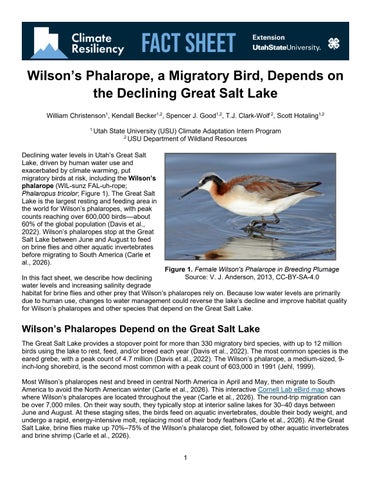
Declining water levels in Utah’s Great Salt Lake, driven by human water use and exacerbated by climate warming, put migratory birds at risk, including the Wilson’s phalarope (WIL-sunz FAL-uh-rope; Phalaropus tricolor; Figure 1). The Great Salt Lake is the largest resting and feeding area in the world for Wilson’s phalaropes, with peak counts reaching over 600,000 birds––about 60% of the global population (Davis et al., 2022). Wilson’s phalaropes stop at the Great Salt Lake between June and August to feed on brine flies and other aquatic invertebrates before migrating to South America (Carle et al., 2026).
Figure 1. Female Wilson's Phalarope in Breeding Plumage Source: V. J. Anderson, 2013, CC-BY-SA-4.0 In this fact sheet, we describe how declining water levels and increasing salinity degrade habitat for brine flies and other prey that Wilson’s phalaropes rely on. Because low water levels are primarily due to human use, changes to water management could reverse the lake’s decline and improve habitat quality for Wilson’s phalaropes and other species that depend on the Great Salt Lake.
Wilson’s Phalaropes Depend on the Great Salt Lake The Great Salt Lake provides a stopover point for more than 330 migratory bird species, with up to 12 million birds using the lake to rest, feed, and/or breed each year (Davis et al., 2022). The most common species is the eared grebe, with a peak count of 4.7 million (Davis et al., 2022). The Wilson’s phalarope, a medium-sized, 9inch-long shorebird, is the second most common with a peak count of 603,000 in 1991 (Jehl, 1999). Most Wilson’s phalaropes nest and breed in central North America in April and May, then migrate to South America to avoid the North American winter (Carle et al., 2026). This interactive Cornell Lab eBird map shows where Wilson’s phalaropes are located throughout the year (Carle et al., 2026). The round-trip migration can be over 7,000 miles. On their way south, they typically stop at interior saline lakes for 30–40 days between June and August. At these staging sites, the birds feed on aquatic invertebrates, double their body weight, and undergo a rapid, energy-intensive molt, replacing most of their body feathers (Carle et al., 2026). At the Great Salt Lake, brine flies make up 70%–75% of the Wilson’s phalarope diet, followed by other aquatic invertebrates and brine shrimp (Carle et al., 2026). 1
Between 1982 and 2022, peak counts of Wilson’s phalaropes were periodically recorded at multiple saline lakes in western North America, leading to 13 years of regional population estimates for migrating individuals (Jehl, 1999; Carle et al., 2023). The population peaked in 1990 at 642,500, then dropped rapidly in 1994 to 160,100, its lowest value, with the Great Salt Lake hosting up to 98% of the birds each year (Figure 2). The population drop in the early 1990s occurred when the Great Salt Lake was at a healthy water level, indicating that factors such as drought or other habitat changes––not just water level––can affect movement patterns and/or population size (Carle et al., 2026).
Figure 2. Low Wilson’s Phalarope Populations Have Occurred When the Great Salt Lake Water Level Decreases, Even If the Decrease Results in a Healthy Lake Level Note. Population estimates include both Wilson’s phalaropes and unidentified phalaropes. Data sources: Carle et al., 2022; Carle et al., 2023; Jehl, 1999; Great Salt Lake Strike Team, 2026 Surveys conducted from 2019 to 2022 indicate that the contemporary Wilson’s phalarope population migrating through western North America is comparable to the lower levels of the mid-1990s, is primarily supported by the Great Salt Lake, and may be in decline (Figure 2; Carle et al., 2023). Other saline lakes, including Mono Lake in California and Lake Abert in Oregon, help provide habitat for Wilson’s phalaropes but are much smaller and lack the food resources to support the entire population (Carle et al., 2023). The recent lower population levels observed in western North America coincide with the shrinking of the Great Salt Lake, which has resulted in lower water levels and higher salinity, factors that negatively affect Wilson’s phalarope food sources. 2
Low Water Levels Low water levels negatively affect brine flies, the most important food source for Wilson’s phalaropes at the Great Salt Lake (Frank & Conover, 2021). Brine fly larvae attach to and pupate on submerged microbialites, a type of sedimentary rock created by microbial communities (Figure 3; Lindsay et al., 2020). Areas with more submerged microbialites have larger brine fly populations and higher densities of phalaropes (Frank & Conover, 2019). However, as water levels decline, fewer microbialites are submerged, reducing brine fly habitat (Figure 3; Frank & Conover, 2023). Low brine fly populations at the Great Salt Lake could cause Wilson’s phalaropes to shorten their staging periods, which can reduce survival during migration and drive population decline––an outcome observed when other shorebirds have lost critical staging areas (Carle et al., 2023).
Figure 3. (left) Brine Fly Pupae Attached to a Submerged Microbialite and (right) Barely Submerged Microbialites in Bridger Bay, Great Salt Lake, on July 1, 2021 Sources: (left image) Utah Division of Wildlife Resources, n.d., used with permission; (right image) Utah Geological Survey, 2021, used with permission
High Salinity Lower water levels mean less water for the same amount of dissolved salt, raising salinity and posing another challenge for Wilson’s phalarope prey. Parts of the lake with limited freshwater inflows, such as Gunnison Bay, have already exceeded 21% salinity, which reduces brine fly biomass by half and kills newly hatched brine shrimp (Conover & Bell, 2020). Since brine fly and brine shrimp populations have collapsed in Gunnison Bay, bird use has shifted to other areas (Conover & Bell, 2020). Wilson’s phalaropes also feed on other invertebrates such as midge larvae that live in the less saline parts of the lake, like Farmington Bay (Frank & Conover, 2021). These aquatic insects, however, are less tolerant of high salinity than brine flies and will likely become scarce if salinity continues to increase.
Human Water Use Is Driving the Great Salt Lake’s Decline The size of the Great Salt Lake varies over time but has generally been shrinking since 1986 (Figure 2). In November 2022, the lake reached 4,188.5 feet––its lowest elevation since records began in 1847 (Rowland & Freeman, 2024). As of September 2026, the lake’s elevation is slightly higher at 4,190 feet but still far below the target “healthy” level of 4,198 feet (Figure 2; U.S. Geological Survey, n.d.; Great Salt Lake Strike Team, 2026). The shrinking of the Great Salt Lake is driven by human water use and climate warming (Bigalke et al., 2025). For the lake to maintain its size, the water evaporated from its surface must be replenished by precipitation and incoming streamflow. However, 62% of the water in the Great Salt Lake’s tributaries is diverted and consumed by people using it for agricultural, municipal, and industrial purposes (Richter et al., 2025). In addition, climate warming reduces how much water reaches the lake by decreasing the amount of precipitation that falls as 3
snow, increasing human demand for water, and increasing water lost to evaporation (Berghuijs et al., 2014; Hotaling & Becker, 2024). This results in not enough water reaching the lake to maintain the depth and salinity needed for quality migrating bird habitat (Frank & Conover, 2019). Currently, the Great Salt Lake’s water level is seriously affecting air quality, mineral extraction, and recreation, as well as food sources for Wilson’s Phalaropes (Great Salt Lake Strike Team, 2026). Although some progress has been made toward reversing the lake’s downward trend, more water is needed (Great Salt Lake Strike Team, 2026; Truman et al., 2026). Recent legislation establishing water banking has resulted in nearly 400,000 acre-feet of water being sent to the lake between 2021 and 2025, but the lake will need an additional annual inflow of 800,000 acre-feet to reach healthy levels by 2055 (Great Salt Lake Strike Team, 2026).
Monitoring Wilson’s Phalaropes at the Great Salt Lake To understand how lake water levels impact the Wilson’s phalarope and other migratory birds in the coming decades, continued monitoring of these species is key. Many groups are contributing to this effort: •
The Great Salt Lake Ecosystem Program, run by Utah’s Division of Wildlife Resources, conducts annual multi-site surveys across the lake.
•
The International Phalarope Working Group is a network of scientists and conservationists that has conducted concurrent phalarope surveys at major saline lakes in western North America since 2019.
•
Manomet Conservation Sciences is a nonprofit group contributing to shorebird monitoring across North and South America.
•
The Audubon Society manages critical shoreline habitat at the lake, synthesizes long-term waterbird survey data, and co-organizes the Intermountain West Shorebird Surveys.
Acknowledgments This publication was produced as part of the Climate Adaptation Intern Program (CAIP) at Utah State University. CAIP was supported by the USGS Southwest Climate Adaptation Science Center (#G24AC00611) as well as the Utah Climate Workforce Fund, USU Extension, and the USU Extension Water Initiative. We improved this fact sheet based on feedback from CAIP participants. The authors did not use generative AI in creating this content; it is solely their work. For correspondence, contact Scott Hotaling: scott.hotaling@usu.edu.
References Anderson, V. J. (2013, May 25). File:Wilson's Phalarope, Oregon 03 (cropped).jpg [Photograph]. Wikimedia Commons. https://commons.wikimedia.org/wiki/File:Wilson%27s_Phalarope,_Oregon_03.jpg Barnes, B. D., & Wurtsbaugh, W. A. (2015). The effects of salinity on plankton and benthic communities in the Great Salt Lake, Utah, USA: A microcosm experiment. Canadian Journal of Fisheries and Aquatic Sciences, 72(6), 807–817. https://doi.org/10.1139/cjfas-2014-0396 Berghuijs, W. R., Woods, R. A., & Hrachowitz, M. (2014). A precipitation shift from snow towards rain leads to a decrease in streamflow. Nature Climate Change, 4(7), 583–586. https://doi.org/10.1038/nclimate2246 Bigalke, S., Loikith, P., & Siler, N. (2025). Explaining the 2022 record low Great Salt Lake volume. Geophysical Research Letters, 52(2), e2024GL112154. https://doi.org/10.1029/2024GL112154 Carle, R.D., Burns, G., Clapp, M., Caruso, K., House, D., Larson, R., Lewis, A., McKellar, A.E., Neill, J., Prather, M., Reuland, J., & M. Rubega. (2022). Coordinated phalarope surveys at western North American staging sites 2019–2021. Unpublished report of the International Phalarope Working Group. https://www.oikonos.org/wp-content/uploads/2021-phalarope-report_final.pdf Carle, R. D., Burns, G., Caruso, K., House, D., Larson, R., Lewis, A., McKellar, A. E., Neill, J., Prather, M., Reuland, J., Rubega, M., & Tarr, K. (2023). Coordinated phalarope surveys at western North American 4
staging sites 2019–2022 [Unpublished report]. International Phalarope Working Group. 10.13140/RG.2.2.35060.01920 Carle, R. D., Castellino, M., Tarr, K., McKellar, A. E., Miller, S. M., Larson, R. J., Gregoret, P. G., Van Schmidt, N. D., Lesterhuis, A. J., Clay, R. P., Abbott, B. W., Colwell, M. A., Jehl Jr., J. R., & Pyle, P. (2026). Wilson's phalarope (Phalaropus tricolor), version 2.0. In N.D. Sly (Ed). Birds of the World, Cornell Lab of Ornithology. https://doi.org/10.2173/bow.wilpha.02 Conover, M. R., & Bell, M. E. (2020). Importance of Great Salt Lake to pelagic birds: Eared grebes, phalaropes, gulls, ducks, and white pelicans. Great Salt Lake Biology Book, 239–262. https://doi.org/10.1007/978-3-030-40352-2_2 Davis, J., Gwynn, J. W., & Rupke, A. (2022). Commonly asked questions about Utah’s Great Salt Lake and Ancient Lake Bonneville (2nd ed.). Utah Geological Survey. https://ugspub.nr.utah.gov/publications/public_information/pi-104.pdf Frank, M. G., & Conover, M. R. (2019). Threatened habitat at Great Salt Lake: Importance of shallow-water and brackish habitats to Wilson’s and red-necked phalaropes. The Condor: Ornithological Applications, 121(2), duz005. https://doi.org/10.1093/condor/duz005 Frank, M. G., & Conover, M. R. (2021). Diets of staging phalaropes at Great Salt Lake, Utah. Wildlife Society Bulletin, 45(1), 27–35. https://doi.org/10.1002/wsb.1157 Frank, M. G., & Conover, M. R. (2023). Spatial and temporal distribution of phalaropes (Phalaropus spp.) and adult brine flies (Ephydra spp.) are linked on Great Salt Lake, Utah. Western North American Naturalist, 83(3), 403–412. https://doi.org/10.3398/064.083.0309 Great Salt Lake Strike Team. (2026). Great Salt Lake data and insights summary. https://d36oiwf74r1rap.cloudfront.net/wp-content/uploads/2026/01/GSL-Jan2026.pdf Hotaling, S., & Becker, K. (2024). Recent climate change in Utah, 1870–2023 [Fact sheet]. Utah State University Extension. https://digitalcommons.usu.edu/extension_curall/2453/ Jehl Jr., J. R. (1999). Population studies of Wilson's Phalaropes at fall staging areas, 1980–1997: A challenge for monitoring. Waterbirds: The International Journal of Waterbird Biology, 22(1), 37–46. https://doi.org/10.2307/1521991 Lindsay, M. R., Dunham, E. C., & Boyd, E. S. (2020). Microbialites of Great Salt Lake. In B. K. Baxter & J. K. Butler (Eds.), Great Salt Lake Biology: A Terminal Lake in a Time of Change (pp. 87–118). Springer International Publishing. https://doi.org/10.1007/978-3-030-40352-2_4 Richter, B. D., Fowler, K. F., Lamsal, G., Lant, C. L., Ripple, W. J., & Rushforth, R. R. (2025). Reducing irrigation of livestock feed is essential to saving Great Salt Lake. Environmental Challenges, 18, 101065. https://doi.org/10.1016/j.envc.2024.101065 Rowland, R. & Freeman, M. (2024). Record low water surface elevations at Great Salt Lake, Utah, 2021–2022. 1–14. Utah Geological Association. Truman, A., Becker, K., Null, S., & Hotaling, S. (2026). How water banking can help refill the Great Salt Lake [Fact sheet]. Utah State University Extension. U.S. Geological Survey. (n.d.). Great Salt Lake hydro mapper. Utah Water Science Center. Retrieved May 22, 2026, from https://webapps.usgs.gov/gsl/data.html Utah Division of Wildlife Resources. (n.d.). Brine flies. Great Salt Lake Ecosystem Program. https://wildlife.utah.gov/gslep/wildlife/brineflies Utah Geological Survey. (2021). Drought negatively impacting Great Salt Lake microbialites and ecosystem. https://geology.utah.gov/drought-negatively-impacting-great-salt-lake-microbialites-and-ecosystem/ In its programs and activities, including in admissions and employment, Utah State University does not discriminate or tolerate discrimination, including harassment, based on race, color, religion, sex, national origin, age, genetic information, sexual orientation, gender identity or expression, disability, status as a protected veteran, or any other status protected by University policy, Title IX, or any other federal, state, or local law. Utah State University is an equal opportunity employer and does not discriminate or tolerate discrimination including harassment in employment including in hiring, promotion, transfer, or termination based on race, color, religion, sex, national origin, age, genetic information, sexual orientation, gender identity or expression, disability, status as a protected veteran, or any other status protected by University policy or any other federal, state, or local law. Utah State University does not discriminate in its housing offerings and will treat all persons fairly and equally without regard to race, color, religion, sex, familial status, disability, national origin, source of income, sexual orientation, or gender identity. Additionally, the University endeavors to provide reasonable accommodations when necessary and to ensure equal access to qualified persons with disabilities. The following office has been designated to handle inquiries regarding the application of Title IX and its implementing regulations and/or USU’s non-discrimination policies: The Office of Equity in Distance Education, Room 400, Logan, Utah, titleix@usu.edu, 435-7971266. For further information regarding non-discrimination, please visit equity.usu.edu, or contact: U.S. Department of Education, Office of Assistant Secretary for Civil Rights, 800-421-3481, ocr@ed.gov or U.S. Department of Education, Denver Regional Office, 303-844-5695 ocr.denver@ed.gov. Issued in furtherance of Cooperative Extension work, acts of May 8 and June 30, 1914, in cooperation with the U.S. Department of Agriculture, Justen Smith, Vice President for Extension, Utah State University.
October 2026, Utah State University Extension
5