Top 5 Tree Planting Mistakes Miles Becker, USU Extension Urban Forestry Specialist Daniel Allen, Board Certified Master Arborist
Background Trunk for trunk, larger, older trees provide more benefits to people than smaller trees. Mistakes made at planting time can substantially shorten a tree’s life. The consequences of planting mistakes may show up within a year or two or remain hidden until a tree dies inexplicably years later. In many cases, these planting mistakes are easy to avoid, saving the tree owner substantial money and time. Homeowners can use this list of five common planting problems to check the quality of work by hired professionals, as instructions for gardeners or landscapers, or as a quick reminder for more experienced tree planters. By making a few simple changes to tree planting, we will all benefit from longer-lived, larger trees gracing our cities and towns.
Key Takeaways 1. Select tree species that match your soil, climate, and available space for maximum tree longevity and benefits. 2. Ensure the trunk flare is above soil level to promote strong root development and prevent decay. 3. Dig a wide planting hole with rough sides and use only local soil for backfill to encourage strong root growth. 4. Inspect trees at the nursery for root structure and cut back circling roots before planting. 5. Place a woodchip mulch layer around newly planted trees to protect the trunk from damage and improve soil quality.
One caveat: Trees are tough. They want to grow and survive, sometimes succeeding under the most challenging conditions. These are the exceptions. Following the tips in this guide will help make large healthy trees the norm.
Mistake 1: Wrong Tree, Wrong Place The Problem
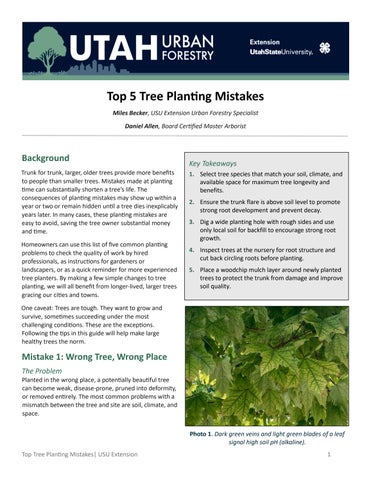
Planted in the wrong place, a potentially beautiful tree can become weak, disease-prone, pruned into deformity, or removed entirely. The most common problems with a mismatch between the tree and site are soil, climate, and space. Photo 1. Dark green veins and light green blades of a leaf signal high soil pH (alkaline). Top Tree Planting Mistakes| USU Extension
1
What to Look For
Soil problems show up in the tree as several symptoms. A very common micronutrient deficiency in many Utah trees is iron, due to alkaline soils. Iron chlorosis is identified by the green in leaves fading out to leave dark veins visible (Photo 1). Flood irrigation with secondary water from salty lakes may also increase soil salinity, which can burn tree tissue. River-sourced and well irrigation may have lower salinity, depending on surrounding land use and runoff pollution levels. Water quality should be checked on a property-by-property basis for potential issues. Climate affects tree growth and survival in several ways. Some species will be damaged or even killed by freezing temperatures below their cold hardiness level. Buds and branches can die over winter and late frosts may kill newly emerged leaves in the spring. Species less tolerant of heat will lose leaves or needles during prolonged summer heat (Photo 2). Limited space to grow makes trees ugly (Figure 1). Large trees Photo 2. Brown margins on leaves resulted from high planted too close to a building or overhead power lines temperatures and insufficient water. usually get severely pruned to maintain clearance. As a result, the crowns become unbalanced, their form is stunted, and they never reach their full potential at maturity. Trees very close to sidewalks, streets, and driveways are often removed or have their roots severely pruned. Large trees that lose many roots are more likely to eventually fall over or die within a couple of years.
How to Correct
Soil: When planting new trees, test your soil and select a species that is tolerant of any special conditions. Help established trees by improving soil quality with specific amendments that correct the soil problem identified from the soil test. You can flush salts from the soil by saturating it with clean culinary water several times during the growing season. Climate: Start by finding your hardiness zone in the USDA map or USU weather station network. You may need to adjust the hardiness zone for your property because of microclimate factors, like wind and sun exposure. Pick a species suited to your local climate by asking a professional at a nursery or referring to online tree lists from local organizations, such as Red Butte Garden and Arboretum, USU Extension Tree Browser, or Conservation Garden Park.
Figure 1. Obstacles to a tree growing into its full size and natural form (purple outline) include utility lines and structures.
Limited space: This is the easiest site problem to prevent for trees. Measure the crown width the tree is expected to reach at maturity for its species. The critical root system typically matches the branch radius. You can plant most medium and large trees 25 feet apart, measured from the center of their trunks. We highly recommend planting all trees at least 10 feet from a building and 5 feet from property boundaries, sidewalks, and other hardscapes.
Top Tree Planting Mistakes| USU Extension
2
Mistake 2: Planted Too Deep The Problem
Trees planted too deep in their hole are more likely to develop weak roots and trunk decay. Sunken trees can grow very slowly or possibly die before establishing (Lim et al. 2025).
What to Look For
Despite its importance for tree survival, correct planting depth can be very difficult to identify and, consequently, skipped during planting. The trunk flare where the base of the trunk meets the top of the roots should not be below the soil level or finished grade around the planting hole. The trick is finding the true trunk flare. Trees in plastic containers or ball-and-burlap at the nursery often have their true trunk flare buried in potting soil (Photo 3). In response, the young tree grows small roots that are weakly attached to the trunk and not fully developed. If someone else planted your tree for you, it was planted too deep if you can’t see the trunk flare without digging and there are no strong roots just below the soil surface.
How to Correct
For trees recently planted too deep, your best option is to dig them up and replant them correctly. Replanting may take time and effort, but it can add years to the tree’s life. For established trees that cannot be easily replanted, root collar excavation is a good option.
Photo 3. Container-grown trees often have their root collar buried. Remove the surplus soil and plant the trunk flare 1–2.5 inches above grade.
The easiest way to avoid deep planting is to do it correctly before the tree is in the ground. For containerized trees, take the tree out of its container and gently remove all the soil at the base of the trunk until you find the true trunk flare. Measure the root ball depth from the base of the trunk flare to the bottom of the roots. The depth of your planting hole should be the root ball depth minus 1 to 2.5 inches. The tree will slowly settle over time, and the extra 1 to 2.5 inches gives the tree the height to adjust. After your hole depth is correct, walk around the bottom of the hole to slightly compress the area under the tree. When placing the tree in the planting hole, position it correctly by propping it up from below or have an assistant hold it in place. Add layers of soil to the bottom of the hole and water each layer to help settle them.
Mistake 3: Poor Soil Quality and Site Preparation The Problem
Most urban soils are not ideal for growing trees. Common issues include compacted soils with low organic matter and limited microorganisms. These conditions slow or inhibit root growth and potentially cause the rest of the tree to grow very slowly, fail to establish, or die prematurely (Day et al., 2010).
What to Look For
Water often puddles or runs off compacted soil because there are not enough air spaces between soil particles to hold water. Such high-density soils will be heavier and harder to dig than better aerated soils. Dig a small pit or large hole in the planting area about 20 inches deep to get a good look at the soil layers. Compacted soils usually contain less organic
Top Tree Planting Mistakes| USU Extension
3
matter and appear uniformly gray or pale brown (Photo 4A). Healthier soils with more organic matter and nutrients are darker in color and looser (Photo 4B). The sharper the contrast between the soil in the planting hole and the soil surrounding the hole, the more troublesome it is for your tree. Tree roots in nutrient-rich, low-density soil will grow normally until they hit the edge of the planting hole and encounter poorer-quality soils. At that point, they may circle around or grow back toward the trunk and develop a weak root system that shortens the tree’s life (Photo 5A). Obvious indicators of a sharp contrast include smooth sides in the planting hole, especially in clay, that act like a container, and adding amendments to the soil when backfilling the hole.
How to Correct
A
B
Photos 4A and 4B. Compacted soil under a street (A) is more challenging for tree roots than soil with higher organic content under a permeable surface (B).
Soften the contrast between the soil in the planting hole and the soil around it by roughing up the sides of the hole. Avoid leaving it glazed and smooth. Give the roots more time to adjust to the native soils by making the hole three times as wide as the root ball of the tree. Healthy tree root systems grow more outward than downward. Use only the site soil to backfill the hole. Adding a slow-release mulch, such as coarse wood chips, to the surface of the planting area will improve the soil without shocking the roots (Percival et al., 2023). Ideally, extend the mulch ring 1 to 2 feet beyond the planting hole to start improving the soil before the roots get there. For very compacted or low organic soils, first place a 1-inch layer of highquality organic compost over the planting area before covering it with mulch.
Mistake 4: Poor Root Structure
A
B
The Problem
Roots supply a tree its water and nutrients. They also stabilize it during wind events or when the tree is leaning. Young trees with significant root defects that go uncorrected at planting often struggle to survive.
What to Look For
Circling roots in the shape of the container purchased from a nursery are normal. They should be a dense mix of solid primary roots and fine roots with absorbing hairs (Photo 5B). You can correct these when planting.
Photos 5A and 5B. A circling root (A), possibly from when the tree was planted, may girdle the tree or at least reduce the efficiency of its root system. Fine roots curved around the edge of a container (B) is typical and can be corrected before planting.
It is much harder to correct circling roots that previously formed when the tree was in a smaller pot. Container-grown trees are moved from smaller to larger pots at the nursery as they increase in size. When done correctly, nursery workers cut circling roots before placing the tree in a larger pot to encourage outward root growth, like spokes on a wheel (Photo 6). If they skip this step, the tree can develop a cylindrical root system that limits
Top Tree Planting Mistakes| USU Extension
4
its access to water and nutrients when permanently planted in the ground (Cregg & Johnson, 2025). Look for roots in the shape of a smaller pot in the center of the roots shaped like the larger pot (Photo 7). There is no good solution for this root defect. You wouldn’t buy a car without test driving it, so why buy a tree without looking at its roots? Inspect the roots of containerized trees at the nursery by taking the tree out of its pot. Tip the entire tree on its side, then wiggle and slide the pot off the root ball. Directly lifting the tree by the trunk can damage some of the roots. Shake off as much soil as you need to see the root structure. For ball-and-burlap trees, ask the nursery for a written agreement that you can return your purchase if the root system is defective due to improper nursery production. Inspect the roots when the wire cage and burlap are removed at the planting site. Promptly return the tree if it has root structure issues that cannot be corrected. Bare root trees offer the advantage of letting you easily see the roots at the nursery. Check for good structure and a reasonable density of fine absorbing roots.
Photo 6. A healthy root structure has primary roots growing straight out toward the edge of the container (not pictured). Photo by Jim Barborinas
How to Correct
You can correct circling roots formed in a container by cutting them at planting time. After taking the root ball out of the container, gently loosen the outer roots and soil by hand. Prune back curving roots to their origin where they were pointed straight out to the edge of the container. Use hand pruners to cut back curved roots individually or use a saw to shave the outer surface of the entire root ball. An option for smaller trees with mostly finer roots is to slice down the length of the root ball on four sides.
Mistake 5: Too Little or No Mulch The Problem
Photo 7. Circling roots, formed before the tree was Lawn mowers or weed trimmers often injure the trunks of moved to a larger container (dashed red line), were trees surrounded by turf (Photo 8A). Even if the trees survive, not pruned to keep them straight. After planting, the the damage can have lasting impacts on their health and circling roots will severely limit the lifespan and performance (Photo 8B). Rocks and other hard surfaces health of the tree as it grows. around the trunk reflect sunlight, radiate heat, and may Photo by Ed Gilman prevent water from reaching the roots. Turf, rocks, and hardscapes contribute almost nothing to the soil quality for the tree. Using a plant-based mulch around the new tree will combat these common establishment challenges.
What to Look For
This problem is easy to spot: no mulch ring around a tree! Even if there is mulch, not all types are equally beneficial. Finely shredded bark mulch may function like a sponge and draw moisture out of the soil, potentially to the tree’s detriment. Landscaping fabric, sometimes used under mulch as a weed guard, will prevent most beneficial nutrients released by the mulch from entering the soil. Lower-quality soils with less nutrients and organic matter generally
Top Tree Planting Mistakes| USU Extension
5
encourage more weedy species. Over time, a mulched planting area without fabric becomes harder for weed species to colonize and easier for you to control.
A
B
How to Correct
At the time of planting, place a 3- to 4-inch-deep layer of mulch in a 2- to 5-foot radius around the young tree (Photo 9). The wider the mulch ring, the better. Keep the chips a few inches away from the trunk of the tree. Use natural, untreated materials such as coarse wood chips. Heavier materials, including coarse wood chips, are more likely to stay in place in windy conditions or when run over by a lawn mower. If a rock ground cover is necessary, lay down a wood chip mulch layer under the rocks first. Instead of landscape fabric to initially slow weed growth, use layers of newspaper in the sheet composting technique.
Photos 8A and 8B. Mechanical damage to the tree’s trunk (A) led to interior decay the tree could not contain (B). Buffering trees from mowers and machines with a mulch ring helps prevent these types of wounds.
Other Considerations While this list of five issues covers the most common problems to avoid during tree planting, it is not all-inclusive. Urban tree survival in the first 5 years after planting depends on several other factors, such as sufficient water or the excess application of chemical fertilizers.
Acknowledgments All photos and images copyright of the authors unless otherwise noted. The authors did not use generative AI in creating this content, and it is solely the authors’ work.
References Cregg, B., & Johnson, R. (2025). Physiology and root development of container-grown urban trees in response to root-shaving, root-washing, and root-slicing at planting. Urban Forestry & Urban Greening, 112, 128925. Day, S., Wiseman, P. E., Dickinson, S. B., & Harris, J. R. (2010). Tree root Photo 9. Wood chip mulch around a ecology in the urban environment and implications for a sustainable newly planted tree will provide it rhizosphere. Arboriculture & Urban Forestry, 36, 193–205. many benefits without conflicting Lim, J., Allen, K. S., Powning, C. B., & Harper, R. W. (2025). Impact of planting with adjacent rock ground cover. depth on urban tree health and survival. Forests, 16, 1788. Percival, G. C., Graham, S., & Franklin, E. (2023). The influence of soil decompaction and amendments on soil quality. Arboriculture & Urban Forestry, 49, 179–189. In its programs and activities, including in admissions and employment, Utah State University does not discriminate or tolerate discrimination, including harassment, based on race, color, religion, sex, national origin, age, genetic information, sexual orientation, gender identity or expression, disability, status as a protected veteran, or any other status protected by University policy, Title IX, or any other federal, state, or local law. Utah State University is an equal opportunity employer and does not discriminate or tolerate discrimination including harassment in employment including in hiring, promotion, transfer, or termination based on race, color, religion, sex, national origin, age, genetic information, sexual orientation, gender identity or expression, disability, status as a protected veteran, or any other status protected by University policy or any other federal, state, or local law. Utah State University does not discriminate in its housing offerings and will treat all persons fairly and equally without regard to race, color, religion, sex, familial status, disability, national origin, source of income, sexual orientation, or gender identity. Additionally, the University endeavors to provide reasonable accommodations when necessary and to ensure equal access to qualified persons with disabilities. The following office has been designated to handle inquiries regarding the application of Title IX and its implementing regulations and/or USU’s non-discrimination policies: The Office of Equity in Distance Education, Room 400, Logan, Utah, titleix@usu.edu, 435-797-1266. For further information regarding non-discrimination, please visit equity.usu.edu, or contact: U.S. Department of Education, Office of Assistant Secretary for Civil Rights, 800-421-3481, ocr@ed.gov or U.S. Department of Education, Denver Regional Office, 303-844-5695 ocr.denver@ed.gov. Issued in furtherance of Cooperative Extension work, acts of May 8 and June 30, 1914, in cooperation with the U.S. Department of Agriculture, Justen Smith, Vice President for Extension, Utah State University.
October 2026 Utah State University Extension Peer-reviewed fact sheet
Top Tree Planting Mistakes| USU Extension
6