How Water Banking Can Help Refill the Great Salt Lake Avery Truman1, Kendall Becker1,2, Matthew Behrens1,2, Sarah Null3, Matt Yost4, Scott Hotaling1,2 1
Utah State University (USU) Climate Adaptation Intern Program 2 USU Wildland Resources Department 3 USU Water, Earth, & Environmental Sciences Department 4 USU Department of Plants, Soils, and Climate
Concern about low water levels in the Great Salt Lake has contributed to the development of water markets in Utah. Water markets enable the voluntary transfer of water or water rights from right holders to other people or entities in exchange for compensation. In general, these transfers are more likely to occur if a water rights holder can make more money by selling their water (or water rights) to another user rather than using it themselves. Willingness to engage in water transfers also depends on the ease of transactions, confidence in the water market, and confidence in the ability to exit the market. One type of voluntary, market-based water transaction is water banking, where a water rights holder––without forfeiting their water rights––can transfer their water to a water bank, which reduces transaction costs and streamlines state approvals.
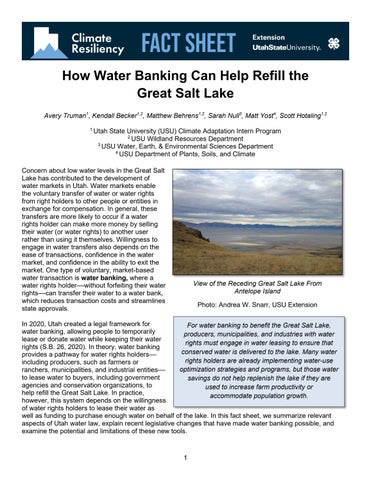
View of the Receding Great Salt Lake From Antelope Island Photo: Andrea W. Snarr, USU Extension
In 2020, Utah created a legal framework for For water banking to benefit the Great Salt Lake, water banking, allowing people to temporarily producers, municipalities, and industries with water lease or donate water while keeping their water rights must engage in water leasing to ensure that rights (S.B. 26, 2020). In theory, water banking conserved water is delivered to the lake. Many water provides a pathway for water rights holders–– rights holders are already implementing water-use including producers, such as farmers or optimization strategies and programs, but those water ranchers, municipalities, and industrial entities–– to lease water to buyers, including government savings do not help replenish the lake if they are agencies and conservation organizations, to used to increase farm productivity or help refill the Great Salt Lake. In practice, accommodate population growth. however, this system depends on the willingness of water rights holders to lease their water as well as funding to purchase enough water on behalf of the lake. In this fact sheet, we summarize relevant aspects of Utah water law, explain recent legislative changes that have made water banking possible, and examine the potential and limitations of these new tools.
1
Key Definitions Beneficial use
The purpose that water diverted under a water right is used for and the amount of the beneficial use.
Water right
A legal right to use a specific amount of water diverted at a specific location for a beneficial use.
Water market
The voluntary transfer of water or water rights in exchange for compensation.
Water banking
A framework for a water rights holder to temporarily lease or donate water to another entity––without forfeiting their water rights––by transferring their water to a water bank.
Source: Adapted from Water Rights, n.d.
Recent Changes to the Great Salt Lake In 2022, the Great Salt Lake receded to its lowest water level since 1847, when records began (Figure 1; Rowland & Freeman, 2024). Factors contributing to this decline include water depletions from major tributaries, like the Bear, Jordan, and Weber Rivers, as well as climate warming. Consumptive water use by people for agricultural, municipal, and industrial purposes depletes 62% of the water that could otherwise flow into the lake (Richter et al., 2025). In addition, warmer air temperatures cause more precipitation to fall as rain instead of snow, increase the rate of evaporation from the lake and its tributaries, and intensify water demand, leading to greater water use (Hotaling & Becker, 2024).
Figure 1. From June 1985 to July 2022, the Great Salt Lake’s Water Level Decreased From a Near Record High (4,210 feet) to a Near Record Low (4,190 feet) Note. Lake levels between 4,198 feet and 4,205 feet are considered healthy. Source: NASA, 2022 2
Low water levels in the Great Salt Lake harm the lake’s ecosystem and surrounding area (Figure 2; Great Salt Lake Strike Team, 2026a). Wind sweeping across the exposed lakebed mobilizes toxic heavy metals, including arsenic and mercury (Utah Department of Environmental Quality, 2026). This dust is detrimental to humans and wildlife (Blakowski et al., 2026). In addition, millions of animals from migratory birds to large mammals depend on the shrinking wetlands for food and habitat (Christenson et al., 2026). To mitigate these negative impacts and raise the lake to a healthy level by 2055, an extra 800,000 acre-feet of water needs to flow into the lake each year (Figure 2; Great Salt Lake Strike Team, 2026a). This amount is about one-third of the water that is consumed annually by agricultural, municipal, and industrial water rights holders in the Great Salt Lake Basin (Great Salt Lake Strike Team, 2026a).
Figure 2. Elevation of the Great Salt Lake at Saltair Boat Harbor, 1903–2025 Note. The Great Salt Lake has been depleted to an unhealthy level for more than a decade. Source: Great Salt Lake Strike Team, 2026b
History of Utah’s Water Law Since 1897, water rights, which allow a specified amount of water to be diverted from a specific location for a beneficial use, have been allocated in Utah by the state government––initially by the Office of the State Engineer and today by the Utah Division of Water Rights (Division of Water Rights, 2008). In Utah and other western states, water rights can be granted to businesses, landowners, or other institutions and have historically been regulated by the Prior Appropriation Doctrine, which is based on three main tenets: 1. “Beneficial use” historically included agricultural, municipal, and industrial purposes but excluded filling the Great Salt Lake because the lake was not associated with economic value (Francis et al., 2024). Fresh water that flowed into the lake was considered wasted once it mixed with the salt water and could no longer meet freshwater needs. 2. “First in time, first in right” means those who first established a legal right to use water for a beneficial use had priority during shortages (Utah Division of Water Rights, 2008). 3. “Use it or lose it” rewarded active use and penalized non-use. Water rights holders who did not put their full allocation toward a beneficial use for 7 years could risk losing their unused water rights (Utah Division of Water Rights, 2023). This put water rights holders under pressure to use all the water available to them, regardless of scarcity. In recent years, however, the definition of “beneficial use” has broadened as the lake’s economic importance and the financial risks associated with its decline have become clearer. 3
Great Salt Lake Economic Benefits • •
•
Today, Great Salt Lake industries generate about $1.9 billion annually and support more than 7,700 jobs (Utah Division of Water Resources, n.d.-a). The lake's largest industry is mineral extraction. Each year, roughly 2 million tons of salts and metals are extracted from evaporation ponds, supplying most of the United States’ magnesium and contributing $300 million to Utah’s economy (Utah Division of Water Resources, n.d.-a). The lake also supports a brine shrimp industry valued at up to $60 million, making Utah the world’s largest exporter of brine shrimp eggs, which are used for feed in aquaculture (Great Salt Lake Ecosystem Program, 2023; Brown, 2023).
Harms From a Shrinking Great Salt Lake Since the high water levels of the 1980s, scientists have documented the lake’s decline, and the consequences of continued shrinkage now include toxic dust, detrimental changes to the ecosystem, economic losses, and reduced snowpack due to less lake-effect snowfall (Figure 2; Great Salt Lake Strike Team, 2026a; Lambert et al., 2025). Together, these impacts have motivated support for laws that make it easier to allocate water to the lake while protecting water rights.
Facilitating Water Banking Through Legislative Changes Recently, Utah lawmakers have updated water law to make it easier to transfer water to the Great Salt Lake. In 2017, a stakeholder group that included conservationists, producers, and public water suppliers began developing water market strategies that later informed Utah’s first water banking bill (Utah Division of Water Resources, n.d.-b). The Water Banking Act (S.B. 26) was passed in 2020 and created a system for protected, voluntary, and temporary transfers of water through water banks. The Act allows water to be deposited, leased, or donated without forfeiting water rights. However, even after the framework for water banking was established, water flowing to the Great Salt Lake was still not recognized as a beneficial use, leading to ambiguity about whether people could retain their water rights if they allowed their water to flow into the lake. That changed in 2022 when Instream Water Flow Amendments (H.B. 33) passed, expanding beneficial use to include benefits to Utah’s navigable lakes and rivers, including the Great Salt Lake. Together, the Water Banking Act and Instream Water Flow Amendments made it much easier to temporarily lease or donate water for the lake’s benefit (Great Salt Lake Strike Team, 2026a).
Who Is Using Water Banking to Benefit the Great Salt Lake? The Great Salt Lake Watershed Enhancement Trust and the Great Salt Lake Commissioner’s Office are the two main entities working to secure water for the Great Salt Lake. The Trust was created in 2022 and launched with $40 million of state funding (Great Salt Lake Watershed Enhancement, 2022). The Commissioner’s Office is also connected to several major funding streams, including a state-managed $50 million Water Delivery Program, funded by the U.S. Bureau of Reclamation, that can support voluntary water transactions, ecosystem and habitat projects, and improvements to water delivery systems (Great Salt Lake Commissioner’s Office, 2025). In 2025, a public–private partnership called the 2034 Great Salt Lake Charter was announced, which included pledges to raise $100 million from Great Salt Lake Rising and $100 million from Ducks Unlimited (Office of Governor Spencer J. Cox, 2025). Like the Water Delivery Program, these private commitments could fund water leases, ecosystem restoration, and/or water delivery improvement projects. In 2026, the Utah Legislature allocated another $40 million for water rights acquisition by the Great Salt Lake Commissioner’s Office. The legislature also authorized up to $1 million in funds for long-term water leasing and up to $170,600 for splitseason leasing, where water rights holders lease their water rights for part of the growing season (H.B. 5, 2026). As of August 2026, a pending request for $1 billion of federal funding includes $300 million for water leasing (Moilanen, 2026). 4
Implementing Water Banking in Utah Utah’s water banking system was inspired, in part, by the goal of refilling the Great Salt Lake, but it can be used by any community in Utah that wants to lease their water. To help launch the Water Banking Act, the Utah Legislature approved four pilot projects outside the Great Salt Lake Basin shortly after 2020 (Utah Division of Water Resources, n.d.-b). These projects showed the importance of having designated leaders, clear goals, and effective outreach (Utah Division of Water Resources, 2024). Those lessons are now being applied in the Great Salt Lake Basin, but progress remains small relative to the lake’s needs. As of December 2025, about 400,000 acre-feet of leased or donated water had been delivered to the Great Salt Lake since the Water Banking Act was passed in 2020 (Figure 3; Great Salt Lake Strike Team, 2026a). By comparison, the lake would need roughly 800,000 additional acre-feet each year beyond current inflows to approach healthy levels by 2055 (Great Salt Lake Strike Team, 2026a; Tarboton et al., 2026).
Figure 3. Water Dedicated and Delivered to the Great Salt Lake Through Water Banking or Negotiated Agreements, 2021–2025 Source: Great Salt Lake Strike Team, 2026b
Refilling the Great Salt Lake: Where Can Water Come From? Each year, about 2.4 million acre-feet of water are diverted and consumed before reaching the Great Salt Lake (Figure 4; Great Salt Lake Strike Team, 2026a). The Great Salt Lake Strike Team attributes about 65% (1.55 million acre-feet) of these depletions to agricultural irrigation and 27% (0.64 million acre-feet) to municipal and industrial uses, which include residential landscape irrigation as a major component (Cottam et al., 2025). Richter and others (2025) report slightly different estimates—a total of 2 million acrefeet of water diverted and consumed each year, with 71% (1.38 million acre-feet) depleted by agriculture and 19% (0.37 million acre-feet) depleted by municipal and industrial users.
Estimates of annual municipal and industrial depletions range from 370,000 to 640,000 acre-feet, so even if those depletions were reduced to zero, the amount of water made available would still fall short of the 800,000 acre-feet goal.
Overall, however, the two water budgets tell a similar story: the agricultural, municipal, and industrial sectors account for about 90% of upstream, human-driven water depletion, with mineral extraction, evaporation from reservoirs, and incidental loss accounting for the remaining 10%. And, given that the lake needs one-third of 5
the diverted water that is consumed in a typical year to attain a healthy water level in the long term, water conservation and contributions from all sectors––but especially agriculture––will be important (Francis et al., 2024). Estimates of annual municipal and industrial depletions from Richter and others (2025) and the Great Salt Lake Strike Team (2026a) range from 370,000 to 640,000 acre-feet, so even if those depletions were reduced to zero, the amount of water made available would still fall short of the 800,000 acre-feet goal (Great Salt Lake Strike Team, 2026a; Richter et al., 2025). Thus, engaging producers in economically viable water banking transactions will play a key role in providing water for the lake.
Figure 4. Simplified Schematic Showing the Annual Water Budget of the Great Salt Lake Basin Note. Water depletion estimates vary by source. Richter and others (2025), whose estimates are shown here, attribute 71% of depletions to agriculture and 19% to municipal and industrial uses; current estimates from the Great Salt Lake Strike Team are 65% and 27%, respectively (Great Salt Lake Strike Team, 2026a). The figure was simplified by removing the exceptionally small roles of West Desert water consumed by municipal and industrial uses, water consumed by “other crops,” and water lost to riparian evapotranspiration. Source: Modified using data from Richter et al., 2025
Complex Decisions for Producers With Water Rights Water banking is a valuable strategy that has the potential to raise Great Salt Lake water levels, but only if water rights holders are willing to participate. A recent survey found that many water managers who provide water to producers are familiar with water banking but remain hesitant to participate because they do not trust the system, do not have water to spare, or expect resistance from shareholders (Schumacher et al., 2026). Broadly, water leasing decisions are shaped by financial and operational constraints. And these decisions are difficult because the economic and practical value of water changes constantly, depending on crop and commodity prices, drought conditions, irrigation needs, and many other factors. In some cases, a producer may have surplus water that can be leased with limited disruption. In other cases, leasing water could mean reduced production, financial loss, or greater uncertainty for the operation. Two features of the Water Banking Act are designed to make participation easier: 1. Water deposited into a bank is protected from the “use it or lose it” rule. 2. Split-season leasing allows producers to lease water for part of the growing season, so they can keep land in partial production and contribute water to the lake. 6
The Challenge of Refilling a Saline Lake If the Great Salt Lake is successfully restored to the minimum healthy water level of 4,198 feet, it would be the first major saline lake in the world to recover from depletion (Figure 2). But reversing the decline of a saline lake is difficult and expensive. For example, the Los Angeles Department of Water and Power plans to spend $3.6 billion on Owens Lake to reduce dust and address the consequences of long-term water diversions (Null, 2022). Mono Lake, which has been shrinking since water diversions began in 1941, has also experienced falling water levels, higher salinity, dust problems, and harm to bird habitat. It has, however, begun a slow recovery after a lawsuit led to limits on water diversions (Mono Lake Committee, n.d.). The Great Salt Lake faces a similar challenge but with higher stakes and added complexity. Both Owens Lake and Mono Lake are less than 10% of the size of the Great Salt Lake, and neither is adjacent to a massive population center (O’Donoghue, 2022). Moreover, concentrations of phragmites, an invasive reed, and partitioning of the Great Salt Lake to reduce salinity in the southern arm mean that water must be delivered to specific locations (i.e., areas of the southern arm that are not dominated by phragmites) to have ecological value. Understanding when, where, and how water reaches the lake and its wetlands is key because the benefits of delivered water depend on timing, location, and the pathways available to move that water through the system (Great Salt Lake Strike Team, 2026a). For this reason, organizations working on water leases do not treat every acre-foot as equally valuable. They must consider not only how much water can be secured but also how effectively that water can be transferred and shepherded to the parts of the lake where it can provide the greatest benefit (Turney et al., 2025). This complexity makes it difficult to determine how much funding would be needed to restore the lake. So far, $130 million has been committed in state and federal funding, $200 million has been pledged by private organizations, and $1 billion of additional federal funding has been requested. These investments are meaningful, but the volume of water they can secure for the lake is not yet clear. To begin with, water leases are only possible if water rights holders are willing to lease their water. And secondly, determining an adequate water leasing budget is more complicated than multiplying a fixed price by the number of acre-feet needed. Lease costs change over time and depend on where the water is located, when it is available, and whether the water can be delivered to the lake. Currently available information helps describe the scale of the challenge but does not yet provide a reliable estimate of what it could cost to refill the lake.
Water Conservation and Banking Resources Because water is limited throughout the Great Salt Lake Basin, using it more efficiently can help make more water available for leasing. For producers, this may include: • Investing in water-optimizing irrigation systems, • Altering irrigation practices, • Substituting crop types, • Growing drought-resistant crops, or • Adopting new approaches, such as agrivoltaics, where solar panels can reduce evaporation on cultivated land (Soteros et al., 2026). For municipal and industrial users, efficient water use could involve converting to water-wise landscaping or installing water recycling systems. Efficiency also matters after water is captured: shading reservoirs or canals with solar panels or other coverings can reduce evaporation during storage and delivery (McKuin et al., 2021). However, for these efforts to actually benefit the Great Salt Lake, producers, municipalities, and industries must engage in water leasing to ensure that conserved water is delivered to the lake. Many water rights holders are already implementing water-use optimization strategies and programs, but those water savings do not help replenish the lake if they are used to increase farm productivity or accommodate population growth. 7
Several resources provide information about how to use water banking to lease or donate conserved water to benefit the Great Salt Lake: • • •
The Great Salt Lake Enhancement Trust provides information to water rights holders about how to lease water to be delivered to the Great Salt Lake. The Utah Division of Water Resources provides information about applying to become a water bank. The Great Salt Lake Commissioner’s Office coordinates management efforts to increase flow to the Great Salt Lake.
Acknowledgments This publication was produced as part of the Climate Adaptation Intern Program (CAIP) at Utah State University. CAIP was supported by the “Secure Water Future” project, funded by an Agriculture and Food Research Initiative Competitive Grant (#2021-69012-35916) from the U.S. Department of Agriculture (USDA) National Institute of Food and Agriculture, as well as the USGS Southwest Climate Adaptation Science Center (#G24AC00611). CAIP is also supported by the Utah Climate Workforce Fund, USU Extension, and the USU Extension Water Initiative. We improved this fact sheet based on feedback from CAIP participants. The authors did not use generative AI in creating this content: it is solely the authors’ work. For correspondence, contact Scott Hotaling: scott.hotaling@usu.edu.
References Blakowski, M., Fernandez, D., Perala-Dewey, J., Hageman, K., & Brahney, J. (2026). Metal mobility and bioaccessibility in Great Salt Lake dust and exposure risks for humans and food crops. Atmospheric Environment, 373, 121845. https://doi.org/10.1016/j.atmosenv.2026.121845 Brown, H. (2025). The shrimp at the center of world hunger. Utah State University, College of Humanities and Social Sciences. https://artsci.usu.edu/social-sciences/political-science/international-studies/aggiesgo/news/greatsaltlake-brineshrimp Christenson, W., Becker, K., Good, S. J., Clark-Wolf, T. J., & Hotaling, S. (2026). Wilson’s phalarope, a migratory bird, depends on the declining Great Salt Lake [Fact sheet]. Utah State University Extension. Cottam, M., Becker, K., Stemmler, K., Poudyal, S., Crump, W., Kogan, L., & Hotaling, S. (2025). Reducing residential landscape water use in Utah: Technologies and strategies [Fact sheet]. Utah State University Extension. https://digitalcommons.usu.edu/extension_curall/2538/ Francis, C., Becker, K., Yost, M., & Hotaling, S. (2024). Irrigation companies and the Great Salt Lake: Managing water in Utah amidst climate change [Fact sheet]. Utah State University Extension. https://digitalcommons.usu.edu/extension_curall/2458/ Great Salt Lake Commissioner’s Office. (2025). $50 million Great Salt Lake grant program application deadline extended. https://greatsaltlake.utah.gov/updates/50-million-great-salt-lake-grant-program-applicationdeadline-extended Great Salt Lake Ecosystem Program. (2023). Brine shrimp harvests. Utah Division of Wildlife Resources. https://wildlife.utah.gov/gslep/harvests.html Great Salt Lake Strike Team. (2026a). Great Salt Lake data and insights summary: A synthesized resource document for the 2026 General Legislative Session. Kem C. Gardner Policy Institute. https://d36oiwf74r1rap.cloudfront.net/wp-content/uploads/2026/01/GSL-Jan2026.pdf Great Salt Lake Strike Team. (2026b). Kem C. Gardner Policy Institute. https://gardner.utah.edu/great-salt-lakestrike-team/ Great Salt Lake Watershed Enhancement, H.B. 410, General Session (Utah 2022). https://le.utah.gov/~2022/bills/static/HB0410.html Hotaling, S., & Becker, K. (2024). Recent climate change in Utah, 1870–2023 [Fact sheet]. Utah State University Extension. https://digitalcommons.usu.edu/extension_curall/2453/ Instream Water Flow Amendments, H.B. 33, General Session. (Utah 2022). https://le.utah.gov/~2022/bills/static/HB0033.html Lambert, L., Becker, K., Pokharel, B., & Hotaling, S. (2025). Cloud seeding: Enhancing winter snowpack to bolster Utah's water supply [Fact sheet]. Utah State University Extension. https://digitalcommons.usu.edu/extension_curall/2551/
8
McKuin, B., Zumkehr, A., Ta, J., Bales, R., Viers, J. H., Pathak, T., & Campbell, J. E. (2021). Energy and water cobenefits from covering canals with solar panels. Nature Sustainability, 4, 609–617. https://doi.org/10.1038/s41893-021-00693-8 Moilanen, S. (2026). Here is what’s in Donald Trump’s $1B plan to save the Great Salt Lake. The Salt Lake Tribune. https://www.sltrib.com/news/2026/05/23/shrinking-great-salt-lake-needs/ Mono Lake Committee. (n.d.). State of the lake. https://www.monolake.org/learn/stateofthelake/ NASA Earth Observatory. (2022). The great shrinking lake. NASA Science. https://science.nasa.gov/earth/earthobservatory/the-great-shrinking-lake-150187/ Natural Resources, Agriculture, and Environmental Quality Base Budget, H.B. 5, Utah Legislature, General Session. (Utah 2026). https://le.utah.gov/Session/2026/bills/enrolled/HB0005.pdf Null, S. E. (2022). Water banking can help Great Salt Lake [Report]. Utah State University. https://digitalcommons.usu.edu/wats_facpub/1159 O’Donoghue, A. J. (2022). Five things to know about Owens Lake. Great Salt Lake Collaborative. https://www.deseret.com/utah/2022/10/10/23381374/are-there-other-lakes-like-great-salt-lake-owens-lakecalifornia/ Office of Governor Spencer J. Cox. (2025). Gov. Cox and Utah leaders sign Great Salt Lake 2034 Charter with $200 million in private sector commitments. Utah.gov. https://governor.utah.gov/press/gov-cox-and-utah-leaderssign-great-salt-lake-2034-charter-with-200-million-in-private-sector-commitments/ Richter, B. D., Fowler, K. F., Lamsal, G., Lant, C. L., Ripple, W. J., & Rushforth, R. R. (2025). Reducing irrigation of livestock feed is essential to saving the Great Salt Lake. Environmental Challenges, 18, 101065. https://doi.org/10.1016/j.envc.2024.101065 Rowland, R. & Freeman, M. (2024). Record low water surface elevations at Great Salt Lake, Utah, 2021–2022, 1– 14. Utah Geological Survey and Utah Water Science Center. Schumacher, B. L., Yost, M. A., Ulrich-Schad, J. D., Barker, B., & Null, S. E. (2026). Agricultural water manager perspectives on water markets in Utah. JAWRA Journal of the American Water Resources Association, 62(1). https://doi.org/10.1111/1752-1688.70085 Soteros, D., Becker, K., Good, S. J., Mufuti, N., Yost, M., & Hotaling, S. (2026). Agrivoltaics: Combining food and solar power on agricultural lands [Fact sheet]. Utah State University Extension. Tarboton, D., Albers, E., and Great Salt Lake Strike Team. (2026). Great Salt Lake surface elevation Monte Carlo simulation results 2025 [Data set]. HydroShare. http://www.hydroshare.org/resource/885979f4acdd412ab3cf09799eab7ead Turney, E., Lukens, E., Null, S., & Neilson, B. (2025). Evaluating surface water movement and measurement near Great Salt Lake. HydroShare. https://doi.org/10.4211/hs.4dff7b44bc574fb29beaa6ee56adbddd Utah Department of Environmental Quality. (2026). Utah dust research. https://deq.utah.gov/air-quality/utah-dustresearch Utah Division of Water Resources. (2024). Cache Valley pilot water bank: Summary assessment. https://water.utah.gov/wp-content/uploads/2024/12/WMSR-Appendix-2-Cache-Valley.pdf Utah Division of Water Resources. (n.d.-a). Great Salt Lake. https://water.utah.gov/great-salt-lake/ Utah Division of Water Resources. (n.d.-b). Utah water banking pilot projects. https://water.utah.gov/watermarketing/water-banking-act-projects/ Utah Division of Water Rights. (2008). The division of water rights. https://waterrights.utah.gov/techinfo/history/state_engineer_history.pdf Utah Division of Water Rights. (2023). Frequently asked questions. https://waterrights.utah.gov/wrinfo/faq.asp Water Banking Amendments, S.B. 26, General Session. (Utah 2020). https://le.utah.gov/~2020/bills/static/SB0026.html Water Rights. (n.d.). Glossary of water words. https://waterrights.utah.gov/water-rights/glossary In its programs and activities, including in admissions and employment, Utah State University does not discriminate or tolerate discrimination, including harassment, based on race, color, religion, sex, national origin, age, genetic information, sexual orientation, gender identity or expression, disability, status as a protected veteran, or any other status protected by University policy, Title IX, or any other federal, state, or local law. Utah State University is an equal opportunity employer and does not discriminate or tolerate discrimination including harassment in employment including in hiring, promotion, transfer, or termination based on race, color, religion, sex, national origin, age, genetic information, sexual orientation, gender identity or expression, disability, status as a protected veteran, or any other status protected by University policy or any other federal, state, or local law. Utah State University does not discriminate in its housing offerings and will treat all persons fairly and equally without regard to race, color, religion, sex, familial status, disability, national origin, source of income, sexual orientation, or gender identity. Additionally, the University endeavors to provide reasonable accommodations when necessary and to ensure equal access to qualified persons with disabilities. The following office has been designated to handle inquiries regarding the application of Title IX and its implementing regulations and/or USU’s non-discrimination policies: The Office of Equity in Distance Education, Room 400, Logan, Utah, titleix@usu.edu, 435-7971266. For further information regarding non-discrimination, please visit equity.usu.edu, or contact: U.S. Department of Education, Office of Assistant Secretary for Civil Rights, 800-421-3481, ocr@ed.gov or U.S. Department of Education, Denver Regional Office, 303-844-5695 ocr.denver@ed.gov. Issued in furtherance of Cooperative Extension work, acts of May 8 and June 30, 1914, in cooperation with the U.S. Department of Agriculture, Justen Smith, Vice President for Extension, Utah State University.
October 2026, Utah State University Extension
9