
Eutrophication
Hope Northagen, Sarah Erwin, and Ethan Gilliam
Highlights
⢠Eutrophication refers to the ecological state of a water body after excessive nutrient pollution.
⢠Because groundwater, streams, lakes, and reservoirs are interconnected, excess nutrient pollution can impact waterbodies far from the initial pollutant site.
⢠Eutrophication is both an aesthetic and ecological concern.
⢠Minimizing nutrient pollution, disposing of waste properly, and implementing wetlands are the best ways to keep waterbodies free of nutrient loading.
What Is Eutrophication?


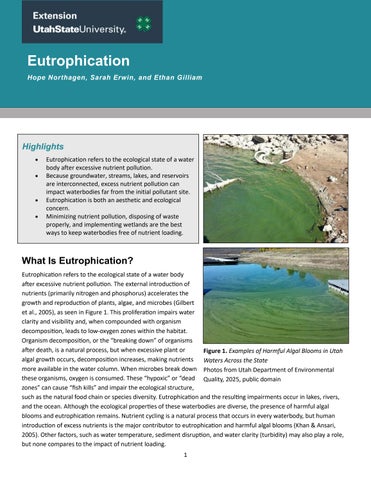
Eutrophication refers to the ecological state of a water body after excessive nutrient pollution. The external introduction of nutrients (primarily nitrogen and phosphorus) accelerates the growth and reproduction of plants, algae, and microbes (Gilbert et al., 2005), as seen in Figure 1. This proliferation impairs water clarity and visibility and, when compounded with organism decomposition, leads to low-oxygen zones within the habitat. Organism decomposition, or the ābreaking downā of organisms after death, is a natural process, but when excessive plant or algal growth occurs, decomposition increases, making nutrients more available in the water column. When microbes break down these organisms, oxygen is consumed. These āhypoxicā or ādead zonesā can cause āļ¬sh killsā and impair the ecological structure, such as the natural food chain or species diversity. Eutrophication and the resulting impairments occur in lakes, rivers, and the ocean. Although the ecological properties of these waterbodies are diverse, the presence of harmful algal blooms and eutrophication remains. Nutrient cycling is a natural process that occurs in every waterbody, but human introduction of excess nutrients is the major contributor to eutrophication and harmful algal blooms (Khan & Ansari, 2005). Other factors, such as water temperature, sediment disruption, and water clarity (turbidity) may also play a role, but none compares to the impact of nutrient loading.
Waters Across the State
Photos from Utah Department of Environmental Quality, 2025, public domain
Figure 1. Examples of Harmful Algal Blooms in Utah
Where Does Eutrophication Come From?
Excess nutrients such as nitrogen and phosphorus are most often carried into water bodies through human wastewater, animal eļ¬uent, and excessive fertilizer use on agricultural or other properties (Schindler, 2012). These pollutants enter waterbodies through groundwater or as ārunoļ¬ā when rainwater or ļ¬ooding washes them into waterways, as well as dust and atmospheric deposition. Figure 2 visually describes the various avenues and processes of how nutrients enter waterways and remain in the aquatic ecosystem.

Sources: Diagram by Hope Northagen, with data from Water Resources Mission Area, 2019, and Schindler, 2012
Because groundwater, streams, lakes, and reservoirs are interconnected, excess nutrient pollution can impact waterbodies far from the initial pollutant site. Accumulation of these ānonpoint sourcesā of pollution is particularly diļ¬cult to manage because it results from the aggregation of many natural and human activities across a watershed (Schindler, 2012). Increased public understanding of the sources and the implications of excess nutrients in waterways may prompt management practices that minimize or divert the nutrients that fuel this cycle
When assessing a waterbody, samples are tested for total nitrogen (TN) and total phosphorus (TP). Waters are placed in one of three nutrient enrichment categories based on results: low enrichment, moderate enrichment, and high enrichment (Table 1). The Utah Department of Environmental Quality (2019) deļ¬nes the ideal threshold for headwater stream enrichment as less than 0.4 mg/L of TN and less than 0.035 mg/L of TP. TN and TP criteria are not currently deļ¬ned for Utah lakes and reservoirs (Environmental Protection Agency, 2025).
Sources: Hope Northagen, with data from Utah Department of Environmental Quality, 2019
Table 1. Table Describing Ideal Total Nitrogen and Phosphorus Criteria for Headwater Streams
Figure 2. Diagram Detailing Nutrient Cycles
What Are Eutrophicationās Impacts?
Eutrophication is both an aesthetic and ecological concern. Overly weedy or algae-ļ¬lled lakes are undesirable for recreationists and property owners. Additionally, some algal blooms contain toxins that impair human, pet, and wildlife health. These are considered āharmful algae bloomsā (HABs), which in some cases, can cause serious health problems and even death when animals ingest contaminated water. When algae and plants die, they are decomposed by bacteria which consume and deplete the dissolved oxygen essential for aquatic life. Hypoxic or ādead zonesā cannot support healthy levels of the aquatic lifeforms that provide the base of a food chain for birds and other animals (Gilbert, 2005)
How Is Eutrophication Treated?
Ultimately, minimizing nutrient pollution is the best way to keep waterbodies free of nutrient loading and eutrophication. Due to the aggregate nature of nitrogen and phosphorus accumulation, prevention must often be coupled with additional biological and chemical mitigation techniques (Schindler, 2012). Other means of mitigating eutrophication include biological removal (using other organisms to ātrapā or remove nutrients from the water column) and chemical removal (using chemicals, typically aluminum or iron, to bind phosphorus and remove it from the nutrient cycle). These management techniques are still being researched and developed.
Preventing and mitigating eutrophication and keeping waterbodies free of nutrient loading includes:
⢠Minimizing nutrient pollution.
⢠Using biological removal techniques, such as mussels and oysters.
⢠Using chemical nutrient removal, such as liquid alum
⢠Combining efforts and techniques
One form of biological removal employs bivalves such as mussels and oysters (Kellogg et al., 2014). These ļ¬lter feeders remove phytoplankton/algae from the water column, thereby reducing the amount of decomposing organic matter in the waterbody. This eļ¬ectively ātrapsā excess nutrients within the bivalve. Microorganisms such as bacteria can also make use of the nitrogen and phosphorus, thus removing these pollutants from the water column (Environmental Protection Agency, 2017). With biological removal, great care must be taken in selecting organisms to ensure ecosystem balance is maintained. Only species endemic to a habitat should be considered.
Chemical nutrient removal is more commonly used to combat eutrophication. More research is underway to assess whether phosphorus removal alone is suļ¬cient, or whether both phosphorus and nitrogen removal are needed to fully reverse eutrophication. An example of chemical nutrient removal is adding liquid alum (aluminum sulfate) to a waterbody. When alum is applied to freshwater, the aluminum permanently binds with excess phosphorus and sinks to the lake bottom. The process ties up both elements, rendering the phosphorus unusable by algae, plants, and microbes (Wisconsin Department of Natural Resources, 2022). Iron can also be used to bind phosphorus, but it is less eļ¬ective than aluminum and can be cost-prohibitive (Smolders et al., 2006).
What Can You Do?
Eutrophication may seem like a daunting issue, impacting a resource that is vital to all life on earth. However, everyday choices can accumulate to aid in restoring and protecting our lakes, rivers, and oceans. Limiting and monitoring the use of fertilizers, especially on properties near waterbodies, is one way to prevent harmful algal blooms and eutrophication. Properly disposing of animal and human waste through trash services or composting is another way to keep nutrients out of waterways. Finally, implementing wetlands or prairie ābuļ¬er stripsā on agricultural ļ¬elds or near areas of high nutrient runoļ¬ can be an eļ¬cient way to trap nutrients before they enter the water. Research shows wetlands and ļ¬lter strips greatly reduce TN and TP in agricultural runoļ¬ (Land et al., 2016), thus making it an accessible tool for agricultural producers. These plants use excess nutrients from organic waste and fertilizers before they end up in waterways. The
major drawback of ļ¬lter strips and wetlands is that once these systems become saturated with nutrients, they become less eļ¬ective, underscoring the need for a holistic approach to excess nutrient control. Other practices used for a holistic approach include soil testing, using ācover crops,ā and leaving a buļ¬er zone when fertilizing. Cover crops help control erosion and improve overall soil health by maintaining soil moisture and nutrients, thus keeping excess nutrients out of waterways (Quintarelli et al., 2022).
References
Environmental Protection Agency (2017). Biological nutrient removal processes and costs. https://19january2017snapshot.epa.gov/nutrient-policy-data/biological-nutrient-removal-processes-andcosts_.html
Environmental Protection Agency. (2025). N/P criteria progress map. https://www.epa.gov/nutrientpollution/stateprogress-toward-adopting-numeric-nutrient-water-quality-criteria-nitrogen#tb1
Fageria, N. K., Baligar, V. C., & Bailey, B. A. (2005). Role of cover crops in improving soil and row crop productivity. Communications in Soil Science and Plant Analysis, 36(19ā20), 2733ā2757. https://doi.org/10.1080/00103620500303939
Gilbert, P. M., Seitzinger, S., Heil, C. A., Burkholder, J. M., Parrow, M. W., Codispoti, L. A., & Kelly, V. (2005). The role of eutrophication in the global proliferation of harmful algal blooms. Oceanography, 18(2), 198ā209.
Kellogg, M. L., Smyth, A. R., Luckenbach, M. W., Carmichael, R. H., Brown, B. L., Cornwell, J. C., Piehler, M. F., Owens, M. S., Dalrymple, D. J., & Higgins, C. B. (2014). Use of oysters to mitigate eutrophication in coastal waters. Estuarine, Coastal, and Shelf Science, 151, 156ā168. https://doi.org/10.1016/j.ecss.2014.09.025
Khan, F. A., & Ansari, A. A., (2005). Eutrophication: An ecological vision. The Botanical Review, 71(4), 449ā482. https://doi.org/10.1663/0006-8101(2005)071[0449:EAEV]2.0.CO;2
Kennedy, R. H., Barko, J. W., James, W. F., Taylor, W. D., & Godshalk, G. L. (1987). Aluminum sulfate treatment of a eutrophic reservoir: Rationale, application methods, and preliminary results. Lake and Reservoir Management, 3(1), 85ā90. https://doi.org/10.1080/07438148709354763
Land, M. Graneil, W., Grimvall, A., Hoffmann, C. C., Mitsch, W. J., Tonderski, K. S., & Verhoeven, J. T. A. (2016). How effective are created or restored freshwater wetlands for nitrogen and phosphorus removal? A systematic review. Environmental Science, 5(9). https://doi.org/10.1186/s13750-016-0060-0
Quintarelli, V., Radicetti, E., Allevato, E., Stazi, S. R., Haider, G., Abideen, Z., Bibi, S., Jamal, A., & Mancinelli, R. (2022). cover crops for sustainable cropping systems: A review. Agriculture, 12(12), 2076. https://doi.org/10.3390/agriculture12122076
Schindler, D W. (2012). The dilemma of controlling cultural eutrophication of lakes. In Proceedings of the Royal Society: Biological Sciences, 279(1746). https://doi.org/10.1098/rspb.2012.1032
Smolders, A. J. P., Lamers, L. P. M., Lucassen, E. C. H. E. T., Van Der Velde, G., Roelofs, G. M. (2006). Internal eutrophication: How it works and what to do about it a review. Chemistry and Ecology, 22(2), 93ā111. https://doi.org/10.1080/02757540600579730
Tahraoui, H., Toumi, S., Boudoukhani, M., Touzout, N., Sid, A. N. E. H., Amrane, A., Belhadj, A.-E., Hadjadj, M., Laichi, Y., Aboumustapha, M., Kebir, M., Bouguettoucha, A., Chebli, D., Assadi, A. A., & Zhang, J. (2024). Evaluating the effectiveness of coagulationāflocculation treatment using aluminum sulfate on a polluted surface water source: A year-long study. Water, 16(3), 400. https://doi.org/10.3390/w16030400
Utah Department of Environmental Quality. (2025). Photo examples of harmful algal blooms (HABs) [Photograph]. Utah.gov. https://deq.utah.gov/water-quality/photo-examples-of-harmful-algal-blooms-habs
Utah Department of Environmental Quality. (2019). Proposed nutrient criteria: Utah headwater streams. https://deq.utah.gov/water-quality/headwater-criteria-nutrients-in-utahs-waters
Water Resources Mission Area (2019). Nutrients and eutrophication. United States Geological Survey. https://www.usgs.gov/mission-areas/water-resources/science/nutrients-and-eutrophication
Wisconsin Department of Natural Resources. (2022). Non-pesticidal products: Alum chemical fact sheet. https://dnr.wisconsin.gov/topic/lakes/plants/factsheets
In its programs and activities, including in admissions and employment, Utah State University does not discriminate or tolerate discrimination, including harassment, based on race, color, religion, sex, national origin, age, genetic information, sexual orientation, gender identity or expression, disability, status as a protected veteran, or any other status protected by University policy, Title IX, or any other federal, state, or local law. Utah State University is an equal opportunity employer and does not discriminate or tolerate discrimination including harassment in employment including in hiring, promotion, transfer, or termination based on race, color, religion, sex, national origin, age, genetic information, sexual orientation, gender identity or expression, disability, status as a protected veteran, or any other status protected by University policy or any other federal, state, or local law. Utah State University does not discriminate in its housing offerings and will treat all persons fairly and equally without regard to race, color, religion, sex, familial status, disability, national origin, source of income, sexual orientation, or gender identity. Additionally, the University endeavors to provide reasonable accommodations when necessary and to ensure equal access to qualified persons with disabilities. The following office has been designated to handle inquiries regarding the application of Title IX and its implementing regulations and/or USUās non-discrimination policies: The Office of Equity in Distance Education, Room 400, Logan, Utah, titleix@usu.edu, 435-797-1266. For further information regarding non-discrimination, please visit equity.usu.edu, or contact: U.S. Department of Education, Office of Assistant Secretary for Civil Rights, 800-421-3481, ocr@ed.gov or U.S. Department of Education, Denver Regional Office, 303-844-5695 ocr.denver@ed.gov. Issued in furtherance of Cooperative Extension work, acts of May 8 and June 30, 1914, in cooperation with the U.S. Department of Agriculture, Kenneth L. White, Vice President for Extension and Agriculture, Utah State University. July 2024 Utah State University Extension
The authors used no generative AI in creating this content; it is purely the authorsā work This content should not be used for the purposes of training AI technologies without express permission from the authors.

October 2025
Utah State University Extension
Peer-reviewed fact sheet