Appraising the Monetary Value of Trees Miles Becker, USU Extension Urban Forestry Specialist Mark Malmstrom, Board Certified Master Arborist
Background Trees have economic value like other property items. Permanently rooted in the ground, trees are considered real property just as a house on a fixed foundation is real property. Damage or loss of a tree incurs a loss in value to its owner, who may be legally entitled to monetary compensation. Dollar values for a single tree can range from a couple hundred dollars to over $100,000.
Key Takeaways 1. Trees have economic value for owners. Their loss or damage may entitle owners to compensation. 2. A tree appraisal by a qualified professional determines the cost to repair or replace the tree.
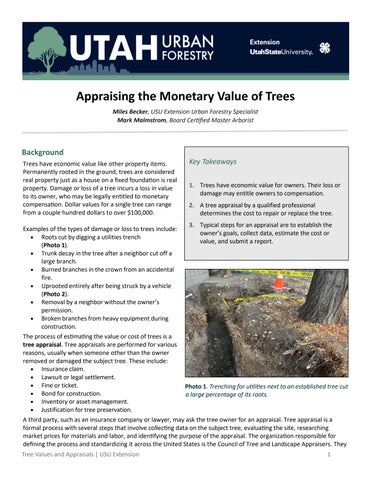
3. Typical steps for an appraisal are to establish the Examples of the types of damage or loss to trees include: owner’s goals, collect data, estimate the cost or • Roots cut by digging a utilities trench value, and submit a report. (Photo 1). • Trunk decay in the tree after a neighbor cut off a large branch. • Burned branches in the crown from an accidental fire. • Uprooted entirely after being struck by a vehicle (Photo 2). • Removal by a neighbor without the owner’s permission. • Broken branches from heavy equipment during construction. The process of estimating the value or cost of trees is a tree appraisal. Tree appraisals are performed for various reasons, usually when someone other than the owner removed or damaged the subject tree. These include: • Insurance claim. • Lawsuit or legal settlement. • Fine or ticket. Photo 1. Trenching for utilities next to an established tree cut • Bond for construction. a large percentage of its roots. • Inventory or asset management. • Justification for tree preservation. A third party, such as an insurance company or lawyer, may ask the tree owner for an appraisal. Tree appraisal is a formal process with several steps that involve collecting data on the subject tree, evaluating the site, researching market prices for materials and labor, and identifying the purpose of the appraisal. The organization responsible for defining the process and standardizing it across the United States is the Council of Tree and Landscape Appraisers. They Tree Values and Appraisals | USU Extension
1
publish The Guide for Plant Appraisal that describes when to use an appraisal, what information to consider, and how to report the results. While parts of this guide are open to interpretation and discussion, the most recent edition is the industry standard that tree appraisers should refer to when completing an appraisal. Professionals trained specifically in tree appraisals complete the assignment and produce a report containing the appraisal result as a dollar-value estimate. Because the appraisal requires knowledge of tree growth, condition, function, and identification, the trained professional is typically an arborist. The International Society for Arboriculture (ISA) certifies arborists who have demonstrated their commitment to learning and professionalism in the tree industry. Certification requires passing an exam and completing continued education in classes and workshops. Note that not all qualified tree professionals are ISA-certified arborists. The American Society for Consulting Arborists (ASCA) administers formal training in tree appraisals in their Tree and Plant Appraisal Qualification (TPAQ) class. Completion of the TPAQ class is not required for an arborist to successfully appraise trees. Tree owners are advised to hire an experienced professional instead of attempting to appraise their trees themselves.
Photo 2. Winter road conditions led to an accidental crash with a roadside tree.
Basic Steps to a Tree Appraisal: 1. Establish the goals.
4. Calculate an estimate of value.
2. Choose an approach, method, and technique.
5. Report the result.
3. Collect data.
Establishing the Goals Appraisals begin with a conversation between the tree owner or client and the appraiser. The client’s description of the circumstances involving the tree and the characteristics of the tree itself will inform the appraiser’s strategy for estimating its cost or value. The appraiser should present the information from the client-consultant conversation to the client in the project scope of a written contract proposal. The scope of services for the project often includes: • Assignment: one or two sentences describing the appraisal’s purpose. • Site information: address, location on the site (illustrated with a map), property ownership, and boundary lines. • Data collection: site visit or document review, number of trees, timing of site visit, and measurements. • Deliverables: format, recipient, and participation in public presentations or court-related activities.
Choosing an Approach The monetary value of a tree is based on either its market value, anticipated income from tree products, or the cost to repair or reproduce the tree in the same location. The market value of a tree is its relative contribution to the total value of the entire property. Property values vary immensely, and identifying the contribution from a tree requires extensive market research comparing the sales of similar properties. Much simpler is estimating the loss in income for a business when the trees it sells are removed or damaged. Timber harvesters, plant nurseries, Christmas tree farms, and orchards can claim the lost inventory based on the expected revenues the tree products would have generated. The most common appraisal approach for ornamental trees in the urban landscape is estimating the cost to repair, replace, or reproduce the removed or damaged tree. A damaged tree that can recover may only require the cost of a professional to repair the damage, such as correctly pruning broken branches or improving soil structure from compaction by heavy machinery. Tree Values and Appraisals | USU Extension
2
Trees serving a specific function for the owner, such as a privacy screen or attractive flowers, could be replaced with a similar type of tree that achieves the same function. In many cases, the subject tree is theoretically reproduced in the same location with a tree of the same species, size, and condition. Realistically, an exact reproduction of most established trees is neither physically possible nor logistically practical. Large trees are not commonly available from most nurseries, and a tree growing for a long time in one place will be uniquely shaped in response to its immediate environment. A solution appraisers use is to recreate an ideal version of the tree on paper by calculating how many times a smaller tree sold at a nursery would fit into the full size of the subject tree (see illustration). The extrapolated calculation for the ideal full-size tree is then depreciated for the subject tree’s actual condition and limitations at the time it was removed. The result is an estimate of cost to reproduce the tree using the trunk formula technique.
The stem of the nursery tree is replicated to match the size of the subject tree for an extrapolated estimate.
Collecting Data Calculating the reproduction cost using the trunk formula technique depends on the key factors of: 1. Tree species, size, and condition. 2. Price of the same species at a nursery. 3. Depreciation of the tree due to limitations of the site and Photo 3. A weakly attached codominant stem failed on this conifer, significantly modifying the crown and region. resulting in additional expenses. Correct species identification is critical for an accurate estimate because nursery prices differ by species. Tree size is usually measured by the trunk diameter at 4.5 feet above grade, also called the diameter at breast height (DBH). Tree size can be measured in height for conifer species, but this usually produces a less accurate appraisal result. Tree condition is a combination of its health, structure, and form. Each tree should be considered in excellent condition at a rating of 100% until observations indicate otherwise. Its condition rating will decrease in percentage points for observations such as low vigor, heavy pest infestations, trunk cavities, weakly attached stems, and severe pruning in the past (Photo 3). An appraiser will collect the tree measurements directly from a tree that is still present. In some cases, the tree may have been removed, and direct observations are no longer possible. For missing trees, the appraiser can estimate species, size, and condition from samples of nearby trees, historic images available online, photos from the owner, or other sources that require additional investigation. The tree or property owner can help with the data collection in several ways. Photos or tree inventories taken when the owner first purchased the property or from before the event will help establish the trees’ original condition. If safe, leaving the site in the condition at the time it was disturbed may add to the quality of the observations. Tree Values and Appraisals | USU Extension
3
Nursery prices of the subject tree greatly influence the final appraisal estimate. Nursery prices vary widely between businesses, regions, and from year to year. Such variation may give different prices to separate appraisers collecting data for the same tree, or even to the same appraiser working on other assignments in future years. Consistency in the use of nursery prices by appraisers helps improve the accuracy of their cost estimates, which is beneficial for the client. To aid in consistency, groups of industry professionals form regional plant appraisal committees (RPAC) in their respective geographic regions to collectively determine the most appropriate nursery prices for specific sizes of trees. Pricing and size lists by RPACs are available to appraisers as an alternative to conducting their own independent nursery research. Ultimately, it is up to the appraiser to source data they can justify and defend in their appraisal reporting. Two other factors besides tree condition are considered for deprecation of the ideal tree in the calculation from the trunk formula technique. These are (1) functional limitations, or the obstacles to growing imposed on the tree by specifics of the planting site and (2) external limitations, or broader issues known to exist for the region in general. Functional limitations are typically observable by the appraiser, such as proximity to a house or sidewalk, overhead utility lines, exposure to high winds, poorly draining soils, disease in neighboring trees, or undesirable species characteristics, such as invasiveness or excessive sap dripping over hardscapes. Observable site characteristics prevent the tree from reaching its full size or health potential or impose higher maintenance or risk that the owner must overcome with extra effort and expense (Diagram 1).
Diagram 1. Obstacles to a tree growing into its full size and natural form (purple outline) include utility lines and structures. Structural obstacles often incur additional expenses for the owner or reduce the tree’s lifetime performance.
External limitations typically cannot be directly observed and are beyond the tree owner’s control. Examples include fatal pests or diseases for the species that are present in the area, a species with a shorter expected lifespan due to intolerance for regional climate conditions, and easements granting a third party the right to remove the tree in the future. Similar to functional limitations, the external limitations may prevent the tree from achieving its full potential without additional costs for the tree owner. They are analogous to known problems or defects in a specific vehicle make and model that lower its resale value compared to a similar vehicle that is expected to have fewer problems and future expenses for the potential buyer.
Many external limitations are specific to the subject tree’s species. The appraiser must be familiar with the performance of the species in the region where it is growing to apply external limitations accurately. To help appraisers who may not be familiar with every regional species or to balance personal biases toward some species, the RPAC produces a list of species ratings available to the public. The species ratings, on a percentage scale, fit into the depreciation calculation to estimate the appraisal result as a dollar amount.
Calculating the Estimate The basic formula for calculating the appraisal result of the subject tree using the trunk formula technique is simple once all the data are collected.
Tree Values and Appraisals | USU Extension
4
The basic formula is:
𝑈𝑈𝑈𝑈𝑈𝑈𝑈𝑈 𝐶𝐶𝐶𝐶𝐶𝐶𝐶𝐶 =
𝑝𝑝𝑝𝑝 𝑑𝑑𝑑𝑑2 × 0.7854
𝑝𝑝𝑝𝑝 𝑈𝑈𝑈𝑈𝑈𝑈𝑈𝑈 𝐶𝐶𝐶𝐶𝐶𝐶𝐶𝐶 = 𝑑𝑑𝑑𝑑2 × 0.7854
𝐶𝐶𝐶𝐶𝐶𝐶𝐶𝐶
𝐶𝐶𝐶𝐶𝐶𝐶𝐶𝐶
𝐷𝐷𝐷𝐷𝐷𝐷𝐷𝐷𝐷𝐷𝐷𝐷𝐷𝐷𝐷𝐷𝐷𝐷𝐷𝐷𝐷𝐷𝐷𝐷 = 𝑐𝑐𝑐𝑐 × 𝑓𝑓𝑓𝑓 × 𝑒𝑒𝑒𝑒
𝑅𝑅𝑅𝑅𝑅𝑅𝑅𝑅𝑅𝑅𝑅𝑅𝑅𝑅𝑅𝑅𝑅𝑅𝑅𝑅𝑅𝑅𝑅𝑅 𝐶𝐶𝐶𝐶𝐶𝐶𝐶𝐶 $ = 𝐵𝐵𝐵𝐵𝐵𝐵𝐵𝐵𝐵𝐵 𝐶𝐶𝐶𝐶𝐶𝐶𝐶𝐶 × 𝐷𝐷𝐷𝐷𝐷𝐷𝐷𝐷𝐷𝐷𝐷𝐷𝐷𝐷𝐷𝐷𝐷𝐷𝐷𝐷𝐷𝐷𝐷𝐷
Where dn = caliper inches of the nursery tree pn = price of the nursery tree dt
= trunk diameter of the subject tree in inches
ct
= subject tree condition percentage (i.e., an average of its health, structure, and form ratings)
fl
= functional limitation percentage
el
= external limitation percentage
The constant of 0.7854 is for converting trunk diameter to the surface area of the circle of the trunk being measured.
Reporting the Results The final step of the appraisal is typically the appraiser’s report to the client. The section of most interest to the client is the appraisal result for their tree’s estimated cost or value. Other sections of the report explaining why and how the appraisal was completed are as important for the integrity of the result. Potential third-party review of the report by another arborist, lawyer, agency, or company may scrutinize the report details to determine its credibility and adherence to industry standards. Again, the appraiser must be able to defend their choice of strategy, data collection, and calculation for the cost estimate. While the report style and format are up to the author, a template for the organization of sections is suggested by ASCA in their publication on writing effective reports. Table 1 shows a recommended report structure. Table 1. Suggested Appraisal Report Structure Section Cover Page Summary Introduction Methods Limitations of the Assignment Observations Discussion Appraisal Method Appraisal Calculation and Assignment
Content List appraiser’s name, business, and contact information; client’s name, project location, project name; and date of the report. Write a few sentences or single paragraph relating the most relevant information from each of the report sections. Outline the case, including the people involved, the event that damaged or destroyed the tree, date of the event, tree species, tree location, and purpose of the assignment. Describe the tools and measurements used on the tree, or if the tree was absent, the documents and other sources used to estimate the measurements. List any missing data and obstacles to collecting data, such as denial of property access or unsafe conditions at the site. List appraiser’s own observations of the site and tree relevant to the assignment. It includes measurements and avoids interpretation or speculation. Describe and interpret the evidence and build a basis for the appraiser’s findings and conclusions. Explain approach, method, and technique used, with an explanation of appropriateness and, sometimes, definitions of the appraisal terminology if a glossary is not included in the appendices. List unit cost, basic cost, depreciation, and final estimate of cost or value for the subject tree.
Tree Values and Appraisals | USU Extension
5
Appendices Although optional, including additional images and information helps communicate the observations described in the text. Recommended items to include in an appendix are: • • • •
Data Table – a table format is convenient for viewing data for multiple trees. Photographs – every report should always include photos of the site and tree. Site Map – the location of the subject tree on the property, boundary lines, structures, and other site features. Supporting Documents – land surveys, contractor bids, and calculation worksheets.
The report structure could be modified by the appraiser to match the type of assignment, client’s needs, scale of the project, and any other qualifying circumstances. For a complete list of items to consider for a report and appraisal, please refer to the current edition of The Guide for Plant Appraisal and educational materials from ASCA.
Acknowledgments All photos and images copyright of the authors The authors did not use generative AI in creating this content, and it is solely the authors’ work.
References Council of Tree and Landscape Appraisers. (2019). Guide for plant appraisal (10th ed.). International Society of Arboriculture. Keefer, C.A. (Ed.). (2004).A consultant’s guide to writing effective reports. American Society of Consulting Arborists. In its programs and activities, including in admissions and employment, Utah State University does not discriminate or tolerate discrimination, including harassment, based on race, color, religion, sex, national origin, age, genetic information, sexual orientation, gender identity or expression, disability, status as a protected veteran, or any other status protected by University policy, Title IX, or any other federal, state, or local law. Utah State University is an equal opportunity employer and does not discriminate or tolerate discrimination including harassment in employment including in hiring, promotion, transfer, or termination based on race, color, religion, sex, national origin, age, genetic information, sexual orientation, gender identity or expression, disability, status as a protected veteran, or any other status protected by University policy or any other federal, state, or local law. Utah State University does not discriminate in its housing offerings and will treat all persons fairly and equally without regard to race, color, religion, sex, familial status, disability, national origin, source of income, sexual orientation, or gender identity. Additionally, the University endeavors to provide reasonable accommodations when necessary and to ensure equal access to qualified persons with disabilities. The following office has been designated to handle inquiries regarding the application of Title IX and its implementing regulations and/or USU’s non-discrimination policies: The Office of Equity in Distance Education, Room 400, Logan, Utah, titleix@usu.edu, 435-797-1266. For further information regarding non-discrimination, please visit equity.usu.edu, or contact: U.S. Department of Education, Office of Assistant Secretary for Civil Rights, 800-421-3481, ocr@ed.gov or U.S. Department of Education, Denver Regional Office, 303-844-5695 ocr.denver@ed.gov. Issued in furtherance of Cooperative Extension work, acts of May 8 and June 30, 1914, in cooperation with the U.S. Department of Agriculture, Justen Smith, Vice President for Extension, Utah State University.
October 2026 Utah State University Extension Peer-reviewed fact sheet
Tree Values and Appraisals | USU Extension
6
1